Abstract
Study of ideology is one of the most important domains of consideration for a successful counter-terrorism strategy. It is necessary to know and understand the ideology of a terrorist outfit coupled with the ongoing evolution at the same, its chief ideologues and its target audiences in order to provide an alternative ideology or in other words to win the ‘hearts and the minds’ of the people. This article traces the mounting similitude in the discourse and the actions of Lashkar-e-Taiba and the ideology of Al-Qaeda. The article begins with a brief depiction of the debate on the ‘end of ideology’ before proceeding on to an examination of Al-Qaeda’s ideology. In the next section, LeT’s discourse and actions from 1990 to 2010 are scrutinised followed by an analysis that attempts to draw out parallels between the ideologies of the two terrorist organisations. In the last section, the conclusion raises several pertinent points for the consideration of counter-terrorist specialists and policy makers.
Introduction
An ideology plays a significant role in terrorist organisations. Counter-terrorism theory thus places a huge significance on understanding the ideologies of terrorist organisations that it hopes to extinguish. In fact, many believe that the Global War on Terrorism (GWOT) is essentially a war of ideas. Ideologies offer quasi-explanations of social facts, interpreted to bring about covertly or overtly the desired future state logically or morally (Roucek 1944, 479).
They determine the objectives and the strategy or the means to be adopted in order to achieve their declared objectives. In terrorism, ideologies can be used as a cause for struggle or to justify the imposition of force and to reduce resentment. They become instrumental in identifying the enemy and in determining the acceptable levels of mass casualty by reducing the psychological cost of participation in inhumane acts. They do this by dehumanising political antagonists and portraying them as deserving of the severest and most violent sanctions.
The organisation’s ideology provides its members with a certain worldview and thus creates a sense of collective identity helping the group to survive by maintaining the morale of the existing members and recruiting new ‘volunteers’. Counter-terrorism efforts must, consequently, include strategies to rebuff terrorists by military means and by countering their ideology as well.
In recent years, Al-Qaeda has morphed into a deadly adversary, with various branches over the globe. Some groups have sworn allegiance to it, others have cooperated with it and many simply provide or take financial support and training from it (Hassan 2006, 532). This article discusses Al-Qaeda’s ideology and the extent to which it has influenced the actions and discourse of Lashkar-e-Taiba (LeT). Many rate LeT to be as dangerous as Al-Qaeda itself. Senior Research Fellow at the Heritage Foundation, Lisa Curtis (2010, 1) in her testimony before the United States House of Representatives Committee on Foreign Affairs contends ‘… that the U.S. must develop policies that approach LeT with the same urgency as that which the U.S. deals with the threat from Al-Qaeda.’ Studying Al-Qaeda’s ideology will help gain an understanding of the organisation, the degree of influence it exercises in the world, will aid in fighting it and eventually terminating it. Also it is important for India to take cognisance of the developments taking place within a terrorist organisation (LeT) that is possibly the biggest non-state threat that the country faces presently.
The End of Ideology Labyrinth
The term ‘ideology’ is one of the central terms of discourse in social sciences. Destutt de Tracy in 1796 coined the term ‘ideology’ which he used to refer to his science of ideas (Hart 2002). Lowenstein defines ideology as, ‘a consistent integrated pattern of thoughts and beliefs explaining man’s attitudes towards life and his existence in society, and advocating a conduct and action pattern responsive to and commensurate with such thoughts and beliefs’.
This definition establishes a nexus between ideas and actions and more importantly the term ‘action’ within the definition allows ideology to perform several functions: the function of motivating by providing an individual with a cause, of legitimising actions, of repressing by consciously manipulating symbols to achieve the desired effect and lastly of integrating individuals by providing them with a sense of identity and belonging (Gerring 1997, 958).
Any treatise on the subject of ideology is incomplete without a discussion or at least a review of the debate on the ‘end of ideology’, which began in the early 1990s. Karl Mannheim was the first to formulate a comprehensive theory of decline/end of ideology (Lipset 1985, 83). The disposition of ‘our’ age, according to Mannheim, is to replace all spiritual aspects with a scientific attitude. This trend can be seen in the increasing absorption of intellectuals by private and public bureaucracies. With continual degradation in the condition of the unattached and free critic, a new kind of thought control would surface. This would be a closed system based on scientific knowledge involving the suppression of all ideological thought.
In the opinion of Raymond Aron, those frustrated segments of the intelligentsia sympathised with the political myths or ideologies. The bureaucrats and technicians were actively taking power away from the intellectuals; and society was simultaneously offering opportunities of employment to these persons, thus reintegrating them. Once the economic sources of frustration for the intellectuals would be overcome, ideology would lose its appeal. Mannhiem and Aron, both tend to ignore the fact that intellectuals have a considerable stake in the society and at times are actually paid to mislead the general masses. Also the growth of an enlightened intellectual does not mean the end of intellectual support for ideologies; and the end of ideology for the intellectuals does not imply the end of ideology for the masses.
For Daniel Bell and Martin Seymour Lipset, stable democracies in the West were moving towards a ‘post-politics phase of general consensus’, where cessation of the basic differences between the right and the democratic left would take place. The socialists would become more moderate and the conservatives would assent to a welfare state. Consequently, ideological thinking would have no role to play (Hodges 1967). On this point, pro-ideology scholars argue that agreement between the conservatives, liberals and socialists on the implementation of the welfare state does not entail the end of ideology but is instead the meeting of many ideological views at a single point (Freeden 2003, 35–38).
Francis Fukuyama was another proponent of the ‘end of ideology’. Fukuyama believed that Western liberalism was the ultimate culmination of man’s ideological evolution. The collapse of the totalitarian regimes and the disintegration of the communist bloc had left liberal democracy as the sole ideology with the potential of gaining universal validity, thus ending all ideological debate. Fukuyama’s prediction of ultimate victory of liberalism is still to become a reality. Various states such as Iran, Russia, Zimbabwe and China have completely rejected liberalism. A particularly remarkable example is China, which although subscribes to a limited market economy, but till date remains a one-party socialist state. Furthermore this repudiation of Western liberalism has in no way hampered its economic development. Chinese form of socialism has not only turned out to be sustainable but has also become an alternative to liberal democracy (Lalich 2009; Peerenboom 2007).
Schulze (1969, 83) believes that the preponderance of a single ideology in a social system allows great political power to be housed chiefly with its adherents and is commonly used to purge all ideological opposition. The existence of a broad range of political ideologies is a must since it provides for ideological balance and is the best guarantee of social tolerance. The presence of several ideologies does not necessarily cause disintegration of a society and a single predominating ideology may not necessarily integrate the social system. The ‘end of ideology’ is conducted within the framework of ideology and hence itself becomes evidence of the irrepressible nature and the continued relevance of ideology in modern life (cooleassay.org 2010). Talshir (2005, 110) contends that ‘Ideologies do not end—they transform’. This transformation becomes a guiding light for some in the society but affects all sections and religions of the society.
Al-Qaeda’s Ideology
In Al-Qaeda’s case, there seems to be no specific philosophy that the organisation’s ideology emphasises. The group’s ideology brings together different identities, different projects and different aspirations. A misleading image created in the Western academia is of a coherent Al-Qaeda ideology (Hellmich 2008). The notion of the necessity of an ideology being coherent, of every part fitting perfectly together is an illusion of the intellectual (Hall 1996, 431). The group’s ideology has constructed as Gramsci writes ‘a unity out of difference’ (Hall 1987).
The first landmark that has contributed to Al-Qaeda’s ideology is the process of modernisation. The Muslim society along with the rest of the world has undergone and is still continuing to experience the processes of modernisation and mass education. These processes along with numerous other factors have influenced the development of modern political societies, new identities, opportunities and unavoidably new forms of inequalities. The result of these social and political changes has been the fragmentation of religious authority and the objectification of Muslim consciousness. Although many Muslims passionately claim that Koranic exegesis and the development of the Islamic jurisprudence over time provides absolute and definitive guidance, numerous modern-educated individuals having access to basic religious texts have confronted this tradition and question the need to automatically defer to the religious class for their interpretation.
Second, believers have become conscious of questions such as what constitutes the true meaning of Islam and of how it affects or should affect the conduct of life. As individual Muslims themselves begin to interpret classical sources of Islam, a broad spectrum of interpretation emerges; making it difficult to define what Islam is and what it is not. This has allowed individuals such as Bin Laden to create destructive ideologies that claim to speak on behalf of Islam; invoke Muslim tradition when and where required; and event contend to defend it (Hellmich 2005, 42–43; 2008, 119–120).
The next event that contributed to the organisation’s ideology was the1979–1989 Soviet war in Afghanistan. The Soviet war was instrumental in bringing together diverse radical Islamist groups and individuals hailing from various regions of the world, which included Osama Bin Laden on one platform. These individuals were introduced to an international arena. Here networks and connections were created on an international scale, which otherwise might have been impossible to make. Furthermore, they were provided with training and sophisticated weaponry (Moussalli 2009, 31–32). The Soviet war is significant for yet another reason. The ‘victory’ of the Mujahideen over the ‘godless’ Russian communist inspired many others to direct jihad against their own ‘unislamic’ rulers (Haynes 2005, 178).
Apart from these two events, several other ideologies and schools of thought have had an influence on Al-Qaeda’s ideology. The influence of Wahhabism in the version of Islam, Bin Laden preaches and of Islamism in the political thoughts of several spokesmen of Al-Qaeda is undeniable (Esmaeili 2008; Sozek 2005). Wahhabism considers itself to be a Salafist movement, the basic tenet of, which is to practice Islam as understood and practiced by the al-salaf or the first three generations of Islamic populace (McCallister 2005; Mourad 2006, 236). The Wahhabis and the Salafist both believe that Islamic communities after the al-salaf were polytheist, superstitious and guilty of disgraceful innovations to Islam.
Another school of thought that is generally in agreement with the tenets of Wahhabism and Salafism is Islamism. It arose as a form of resistance to European colonialism in the nineteenth century; as a Muslim response to Western political and cultural hegemony. Islamism refers to those movements that treat Islam as their political ideology and is often referred to as ‘Political Islam’ (Stanely 2005). It is in agreement with Wahhabism and Salafism on the need to return Islam as practiced by the first generation of Muslim. They believe that pagan and Western influences weakened the Muslim societies and this facilitated the rise of European colonialism.
This weakness would be overcome solely by returning to ‘true Islam’. It is after this point that Islamism begins to take a different path. For the Islamists submission to al-sharia or God’s laws was only possible through the establishment of an Islamic state, a theme reflected in the writing of Sayyid Qutb, commonly regarded as the father of uncompromising militant Islam. Qutb has influenced both, Abdullah Yusuf Azzam believed by many to be Bin Laden’s mentor and Ayman al-Zawahiri, who has now become Al-Qaeda’s chief ideologue and head (Hussain 2010; Moussalli 2009, 15–20). For Qutb, only God’s laws were true but man by establishing his own governments and laws had usurped God’s sovereignty. Moreover, such states and structures had been established within the Muslim world as well. He stressed the establishment of an Islamic state as the first step in the process of implementing the al-sharia, since an Islamic state was a sign of the community’s submission to God. Any constitution and state was illegitimate without such a submission and entered the state of jahiliyya or the state of crude ignorance.
Based on this, he criticised the secularism of both the Eastern communists and the Western capitalists. This jahiliyya, Qutb believed, could only be combated with jihad and Islam would provide the moral and spiritual leadership the world was in need of. He further states that a vanguard must be founded to mobilise the Muslims and undertake the task of reviving Islam. For Qutb, the collapse of jahil state structures would result in progress and people would live in harmony under God’s laws.
Abdullah Azzam had a far more ambitious project than Qutb and took the concept of jihad even further. Azzam’s goal was to establish an Islamic Caliphate. In his opinion one must not wait for the establishment of caliphate to pursue jihad; instead jihad was the only path that would help achieve the establishment of the caliphate. In his work, Join the Caravan, Azzam writes that jihad becomes fard ‘ayn or individually obligatory when disbelievers entered the land of the Muslims. In case of failure on part of the Muslims closest to the enemy or if these Muslims were negligent and chose to not perform jihad, jihad became fard ‘ayn even for those Muslims living far away and they could not abandon this. He thus sought to draw the entire Muslim community into conflict for Islam (Kagan 2005; McGregor 2003, 99–103; Moussalli 2009, 23). By instilling global jihad within its ideology, Al-Qaeda transformed the thinking of its members that was parochial in nature, extending to simply the boundaries of their own nations and limited by their essentially religious aim (Gunaratna 2003; Sozek 2005, 48).
The discourse of the Qutb and Azzam targets audiences at the grass-roots level in Saudi Arabia. This focus on the grass roots is reflected in the sentiments expressed and the issues the group used to arouse resentment. For instance, during the slowdown of the economy in the 1980s, Bin Laden in his communiqués frequently addressed the grievances of the people, especially those of the middle class in Saudi Arabia who had come to look upon oil benefits as right of citizenship. Al-Qaeda’s ideology displays an additional regional element, one that is often ignored by the scholars and is a condemned sentiment by Islamists—nationalism. Nationalism and the subsequent resentment of foreign domination was an active element fuelling the chief Islamist movements in the late twentieth and early twenty-first centuries.
It is conspicuously noticeable in Al-Qaeda’s goals and is evident in the first major manifesto the organisation released in 1996, the ‘Declaration of Jihad against the Americans occupying the land of the Two Holy Places’. The 1996 declaration also spoke about the oppression and the injustice suffered by Palestinians and the Iraqis caused by the alliance between the Jews and the Christians and on the occupation of Saudi Arabia. Nonetheless it would be a mistake to assume that Bin Laden’s opposition to the presence of American troops in Saudi Arabia was merely a reflection of his nationalist resentment (McAuley 2005, 274; Munson 2003, 47–48).
Ayman al-Zawahiri, joined the outlawed Egyptian Islamic Jihad (EIJ) as a teenager and eventually became the group’s leader. He later joined the Mujahideen in Afghanistan where he came in contact with Osama Bin Laden. In 1998, EIJ and Al-Qaeda were formally merged (World Statesmen 2002). This was Al-Qaeda’s first step in becoming a truly global organisation. According to Montasser el-Zayat, an Egyptian lawyer that spent time in prison with al-Zawahiri, it was Zawahiri who was Bin Laden’s brain—the planner, thinker and the organiser (Haynes 2005). His legacy for Al-Qaeda has been the portrayal of Islam under attack, creating an identity of a ‘victim of conspiracy’ that all Muslims could share (Aly 2007). In his work Knights Under a Prophet’s Banner, he wrote ‘… the internal enemy [Muslim regimes and governments] was not less dangerous than the external [the United States of America] was and that the internal enemy was a tool used by the external enemy and a screen behind which it hid to launch its war on Islam’. Thus regimes that were bound to the West had to be fought and defeated as well (Kagan 2005, 4).
Al-Qaeda’s ideology attempts to address audiences all over the world by describing a clash of civilisations between the West and the Islamic world (McAuley 2005, 271). This view is embodied in the ‘Declaration of the World Islamic Front for Jihad against the Jews and the Crusaders’ released in 1998 and signed by Osama Bin Laden, Ayman al-Zawahiri and the leaders of Islamist groups in Pakistan and Bangladesh. The declaration states that the purpose of all the wars in the Middle East, which involved America, were religious and economic and called on every true Muslim to kill Americans and their allies wherever they could (Lewis 1998, 15).
The invasion of Afghanistan and Iraq, post-9/11 lent further support to the claim of ‘the West opposed to Islam’. In both cases, the invasion was followed by unsuccessful attempts of the international community tore-build a sustainable state. This became cause célèbre for numerous militant organisations including Al-Qaeda (Haynes 2005, 178).
Lashkar-e-Taiba’s Discourse and Actions
Lashkar-e-Taiba (LeT) aka Lashkar-e-Toiba aka Lashkar-e-Tayyiba literally means ‘army of the pure’ (Bajoria 2010). It is one of the largest and best-trained groups fighting in Kashmir (Global Security 2011). The precise year in which LeT was established is not known, but several scholars believe that LeT was founded in the early 1990s by Hafeez Muhammed Saeed and was initially the military wing of Markaz-ud-Dawa-wal-Irshad (MDI) or the Preaching and Instruction Centre (Intelligence and Terrorism Information Center at the Israeli Intelligence Heritage and Commemoration Center 2008).
The group is Islamist in nature and belongs to the Ahl-e-Hadith faith (Sikand 2001, 222; Tankel 2010, 1). Its preliminary operations were conducted in the Kunar and Paktia provinces in Afghanistan in the 1990s, where several training camps had been set up to assist the jihad against the Soviet occupation but the outfit itself had refrained from fighting alongside the Taliban (Curtis 2010, 5). The group was a signatory to the 1998 ‘Declaration of the World Islamic Front for Jihad against the Jews and the Crusaders’ (Berman 2010). Experts believe that JuD functions as a cover for LeT’s activities in Pakistan (Farooq 2008). The objectives the group seeks are to establish a fundamentalist theocratic order in Pakistan and trigger a religious revolution in the Indian state (Rabasa et al. 2006, 83).
The earliest presence of LeT in India was recorded in 1993, when 12 Pakistani and Afghan mercenaries together with the Islami Inquilabi Mahaz, a terrorist group then active in the Poonch district of Jammu and Kashmir (henceforth J&K) infiltrated the Line of Control. In subsequent years it has spread its tentacles to the metropolitan cities in India and even in the West. The group gained the attention of the masses and the authorities in India in 1996 during the infamous massacre of 16 Hindus in Kashmir’s Doda district (South Asia terrorism Portal 2001a; World Almanac of Islam 2011).
Following the 2001 attack on the Indian Parliament, the group was condemned as a terrorist organisation by the UK. and the US and banned by Pakistan under heavy Indian and US pressure. Immediately before the ban Hafiz Saeed resigned from LeT and assumed control of Jama’at-ud-Dawa (JuD) (Tankel 2009, 6). South Asia Terrorism Portal has maintained a data bank of all incidents involving LeT in India. 1 Post-2001 three changes can be observed. The number of incidents in India drastically rises (see Figure 1).

Second, the group gradually expands its theater of operation from J&K to Delhi, Gujarat, Bangalore, Mumbai and Pune. It also began to actively support and train members of terrorist outfit Student Islamic Movement of India (SIMI) and the Indian Mujahideen (IM), who are suspect in several terrorist plots such as the 2012 Pune bombing and the 2013 Bodh Gaya bombings in India (Chauhan 2012; George 2013; Hindustan Times 2008; Tripathi 2013). Lastly, LeT began to actively engage in hostilities against the West in Iraq and Afghanistan and by targeting foreign nationals in its attacks in India; thus diverging from its stated objectives. The group is alleged to have played a major role in recruiting individuals to fight in Iraq and Afghanistan. Following the 2003 invasion of Iraq, the group used its Urdu website to call for warriors to fight in Iraq. A notice on the site read, ‘The Americans are dishonoring our mothers and sisters. Therefore, jihad against America has now become mandatory.’
The organisation’s website spoke of an ‘army’ of 8000 strong men from various corners of the globe bound for Iraq. While the number may have been exaggerated, the statement is not completely false (Benjamin and Weimann 2004, 2). The allied forces in Iraq captured Danish Ahmad, a key Lashkar commander in 2004. Western intelligence experts initially dismissed Ahmad’s presence in Iraq as a one-off initiative, but were shortly forced to rethink. Islam-ud-Din another Lashkar operative captured by Indian forces in 1999 held Ahmad responsible for training hundreds of cadres in the use of arms and explosives at the Maskar Abu Bashir camp in Afghanistan for combat in Iraq (Swami and Shehzad 2004).
In 2006, LeT emerged as an active player in Afghanistan. The group began its campaign by recruiting fighters from mosques and madrassas in Peshawar for its campaign in Afghanistan. This assessment is supported first, by reports of LeT recruiting in the Jalozai refugee camp in Peshawar, and second, by the statements of US officials along with officers of the NATO-led International Security Assistance Forces that confirmed the presence of LeT in the Kunar Province of Afghanistan (Tankel 2009, 20). Apart from Iraq and Afghanistan, it is rumored that LeT was active in Chechnya, Kosovo, Southern Philippines and Bosnia (Sikand 2001, 223).
The 2008 Mumbai attack and the 2010 Pune German Bakery Blast in which the group has been implicated marks its evolving anti-Westernism. In November 2008, over a course of three days, 10 gunmen targeted two luxury hotels, the central railway station, a local café, a hospital and a Jewish centre killing almost 182 people including a of minimum of 12 foreign nationals in Mumbai (Mumbai attacks: Key sites 2009). In 2010, the group targeted the German Bakery located in Pune, India. Of the 60 people injured in the blast 12 were foreign nationals. The death toll that numbered at eight, which included three of foreign nationality on the 14 February rose to 17 in the next few days, as injured victims succumbed to their injuries (Thaindian News 2010; The Times of India, 2010).
Though there has been no conclusive evidence to prove the underlying motives behind the 2008 attack and the 2010 blasts, many subscribe to the view that both the Mumbai attack and the Pune blasts were carried out for strategic reasons. The first attack in 2008 had been aimed at provoking so strong a reaction from the Indian government that it would result in a complete breakdown of relations between India and Pakistan (Friedman 2008). Following similar motivations, the second attack in 2010 was perpetrated to interrupt if not absolutely disrupt the ongoing Indian–Pakistani peace process talks (Aljazeera 2010; Indian Express 2011). While the rationales behind the blasts appear to be in congruence with LeT objectives, the places targeted by the group sets these two LeT acts apart from their earlier operations.
The 2008 Mumbai and 2010 Pune attacks denote an evolution from the past when the group purposely abstained from targeting places frequented by foreign nationals. The possibility must be considered that these places were targeted in order to gain the attention of the international community towards their cause. In addition to this, LeT has been held responsible for providing training to would be jihadists from around the world including Westerners (Tankel 2009, 12). It is believed that the group is spearheading attempts by various terrorist outfits to indoctrinate and train ‘clean skin’ militants. Furthermore the group provides access to other terrorist groups such as Al-Qaeda that are in search of ‘clean skins’ to facilitate their attempts to perpetrate attacks in the West. Notable trainees of LeT include:
David Headley held responsible for conducting surveillance in the Mumbai attacks and also supposedly sent to murder the chief editor and cartoonist of the Danish Newspaper Morgenavisen Jyllands-Posten that had published drawings of Prophet Muhammad that many Muslims found highly offensive. David Hicks, the Australian arrested for participating in terror training camps in Afghanistan. Dhiren Barot, the brain behind the failed gas cylinder bombing plot in London. Omar Khayam, who had been at the forefront of the fertiliser bomb plot in the UK. Riyazuddin Nasir, who was arrested in the middle of his planning that involved several blasts specifically targeting Americans and Israeli Jews on the crowded beaches of Goa during the Christmas–New year period in 2007. Willie Brigette, a French convert arrested on the suspicion of planning attacks in Australia (Chalk 2010).
Equally important is the discourse of the group. 2 The replacement of Muslim rulers first by the Sikhs and later by Hindu Dogras is seen as the root of the ‘Kashmiri problem’. The writings of the group in early 1990s focused on liberating the ‘oppressed and innocent’ Kashmiris ‘undergoing Indian aggression’. In its subsequent publications and statement, the group’s discourse shows signs of further radicalisation. In the pamphlet the ‘New Masters of Kashmir’ the group forwards the notion of jihad beyond Kashmir and towards the whole of India. In 1999, Saeed in front of an audience of an estimated three thousand declared that jihad was not limited to freeing Kashmir from Indian control; rather, it was aimed at ‘liberating’ India itself. After 2001, LeT released various writings such as ‘Hum Jihad kyon kar rahen hain’(Why Are We Waging Jihad?); ‘Yeh zagiri kaun torega’ (Who Will Break This Chain?); ‘Ryazul mujahidebb’ (Training for Mujahideen); ‘Difai-e-jihad’ (Defense of Jihad); ‘Sadai-e-jihad’ (Voice of Jihad) and ‘Chalo jihad kochalen’ (Go and Wage Jihad). Each of them stressed the idea of a trans-regional jihad stretching from Afghanistan to India followed by the establishment of a Muslim Caliphate in the region; a concept strongly supported by Al-Qaeda and which had not been part of the previously professed objectives of the group. In its online magazine ‘The voice of Islam’, the conflict in Kashmir is portrayed as one stage within a wider global jihad against disbelief. It states that Islam is meant for all of mankind and therefore the boundaries of the Islamic state must be extended over the world (Rabasa et al. 2006, 87; Roggio 2010; Sikand 2001, 225).
Besides anti-Hindu sentiments, the group has over time begun expressing anti-Christian and anti-Semitic sentiments as well. One its English bulletins claimed that the world of non-believers was united against Islam and this collaboration would result in the destruction of the anti-Muslim elements, which included the Jews, the Crusaders and the Hindu Brahmans. In 2006 a Fatwa calling upon all Muslims to kill Pope Benedict XVI was released by LeT, for a speech he delivered in September 2006 that was considered by Al-Qaeda and other Jihadist organisations as anti-Islam (Raman 2006).
The three-day annual ijtimah or convention that Lashkar-e-Taiba holds has in the last few years also acquired a notably anti-Western tone. For instance, during the 2000 convention Hafiz Saeed’s speech was speckled with rhetoric such as ‘Today the situation of Muslims is pretty depressing as they are faced with an array of problems. Their subjugation to the West is their gravest problem and to rid themselves of this problem they will have to wage jihad’ and ‘The West is afraid of the might of Jihad and is hatching up plans against Mujahideen’ (Rabbani n.d.).
In a rally sponsored by JuD in 2010, Saeed urged the leaders and rulers of the ‘world of Islam’ to meet their responsibilities by adopting the path of jihad and by not bowing to the West. He later declared, ‘A big change is taking place in the world. The era of Europe and America is over. The results of the eighth Crusade are about to come out.’ In the rally, Afghanistan and Iraq were used as examples to highlight atrocities committed by America and Israel on Muslims across the world and calls were made to all the religious and political parties in Pakistan to unite and fight against American imperialism under the leadership of Hafiz Saeed (MEMRI Urdu-Pashtu Media Blog 2010).
LeT’s expression of anti-Western sentiments was clearly on display after Bin Laden’s death. Scores of JuD activists took to the streets to offer special funerary prayers in absentia and to declare Bin Laden a martyr. Campaigns were organised where provocative speeches arousing Jihadi sentiments and threatening India and the West were given. A 10-point declaration was released at an event in Karachi on 20 June that declared the United States as an enemy of Pakistan (Roul 2011).
A Symbiotic Affiliation
Al-Qaeda spokesmen together have created an attractive picture that has influenced scores of thousands of Muslims worldwide. The organisation’s influence is not only noticeable among individuals but also in the actions and the discourse of Lashkar-e-Taiba, an independent terrorist organisation. Change in the group’s discourse goes hand-in-hand with a change in its operations. This is not surprising, since ideas tend to shape practices and practices in turn create new ideas (S. Gutkowski, personal communication, 25 August 2011).
Initially the group’s discourse and activities were both focused on the Kashmir. On the verge of the millennium, the struggle to liberate Kashmir was extended to the whole of India and in 2000 the group perpetrated its first attack on mainland India. The goal here was and still is to establish an Islamic caliphate, a concept Abdullah Azzam supported, in Kashmir and India (Anti-Defamation League 2011). Post 2001, the group’s discourse begins to increasingly focus on issues that have little to do with Kashmir; simultaneously the group appears to make efforts to widen its scope of war to include the West.
It begins to devote vast amounts of time, energy and finance to operations meant to harm the interests of United States and other governments that support the GWOT. These are moreover the same countries that have been repeatedly disparaged by spokesmen of Al-Qaeda (Rabasa et al. 2006, 87). LeT’s participation in conflicts in Iraq and Afghanistan, the targeting of Western nationals in the Mumbai 2008 and Pune 2010 attacks, the Fatwa on the pope are actions that appear to embrace Al-Qaeda’s agenda and digress from their own professed goals.
Al-Qaeda’s notion of ‘West—an enemy of Islam’ is a theme recurring often in LeT’s discourse. This anti-Western rhetoric in the discourse represents progressive steps taken by LeT in the direction of Al-Qaeda’s global jihad. This is not to say that LeT carries out or would carry out strikes on Al-Qaeda’s commands. Lashkar’s threat to the West does not lie in the prospect of the group mounting a direct attack against a Western country, although this possibility cannot be completely ruled out. The threat from the group emanates from its willingness and capability to provide support to other groups aspiring to launch attacks in the West in the form of a training provider, a gateway to other organisations and as a facilitator for perpetrating attacks (Tankel 2009, 25; Tankel 2010, 4).
LeT’s growing interaction with Al-Qaeda and the international jihadist movement currently existing under Al-Qaeda’s umbrella may have been responsible for the evolving changes in the group’s worldview. The group furnished Al-Qaeda’s senior commanders with a safe haven after 2001. In 2002, Al-Qaeda lieutenant Abu Zubaydah along with 30 other suspected Al-Qaeda operatives were arrested in raids at safe houses run by Lashkar-e-Taiba (Imtiaz 2011). The group has also provided Al-Qaeda and the Taliban with training in the tribal areas of Pakistan, where the two had taken refuge after the 2001 invasion of Afghanistan.
A number of LeT militants killed or captured at militant training centres run by either the Taliban or the Al-Qaeda in Afghanistan have been identified as members of LeT. Conversely, Al-Qaeda has constantly been accused by Indian authorities of supplying LeT with money to purchase ammunition, arms and other related material. They insist that the growth in LeT’s scope of operations has been made possible solely because of the direct external assistance and coordination provided by Al-Qaeda.
Conclusion
Political thought is primarily expressed through the medium of ideologies; they highlight ideas, explicit assumptions and unspoken biases, which in turn drive political conduct. It provides different interpretations of the same facts and decision-making frameworks, making ideology central to the domain of politics (Freeden 2003, 126–127). Any political reflection of public significance is ideological; policies, institutions and men of power are criticised or approved of in those terms. Ideology therefore can never lose its significance in any society. The ‘end of ideology’ in the famous words of C. Wright Mills (1960, 129–133) is ‘itself an ideology’—an ideology of political complacency.
Like all other societies, the world of Islam and within it the volatile sphere of Islamic terrorism are not devoid of ideologies and ideologues. Al-Qaeda’s ideology has made an undeniable impression on the actions and discourse of Lashkar-e-Taiba. Even more significantly, these developing similarities in the outlook of Lashkar-e-Taiba and of Al-Qaeda are indicative of a growing sense of Islamist solidarity, whose primary mission is to propagate a global as opposed to a local holy war. It is symptomatic of the spread of Jihadist mindset through the underbelly of the Muslim world.
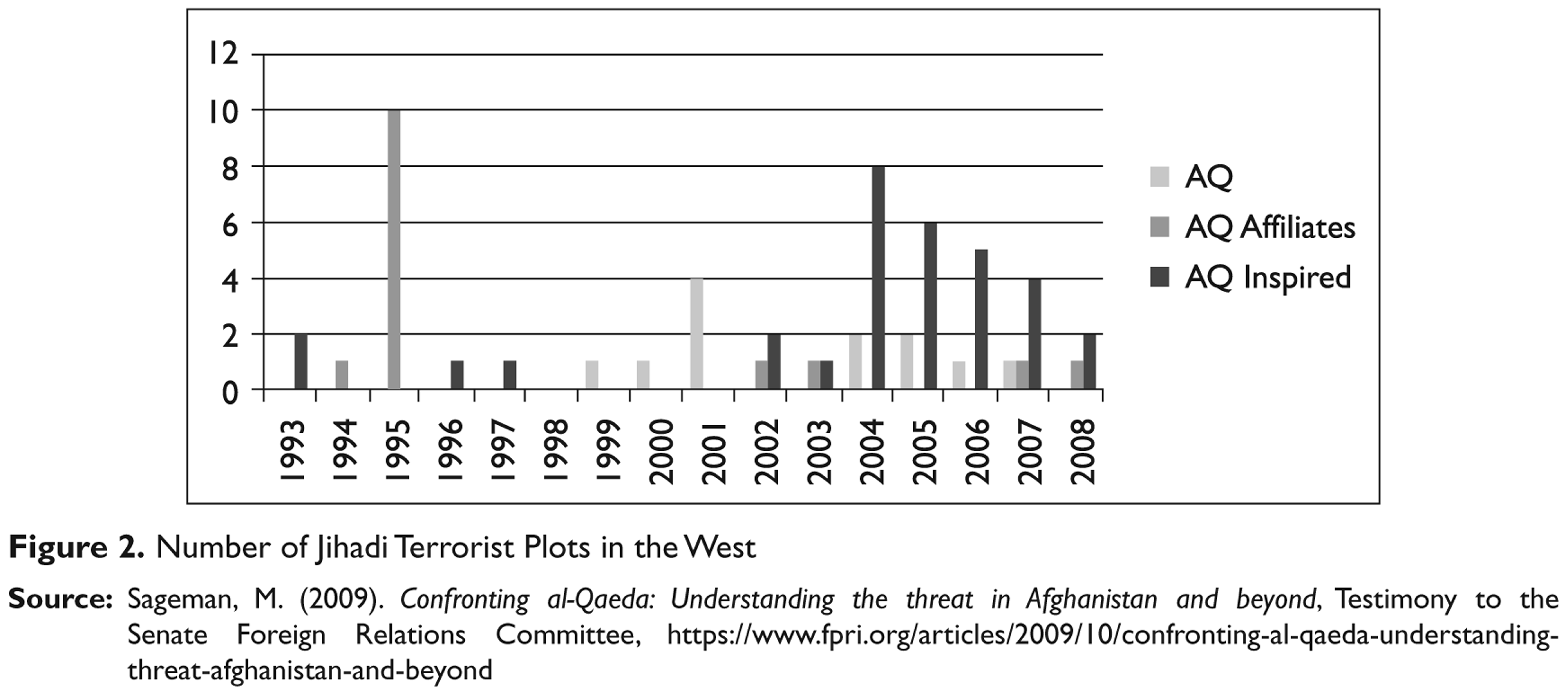
According to Bruce Reidel, a former CIA analyst and senior advisor to President Obama on Pakistan-Afghanistan policy, Al-Qaeda’s ideology is gaining grounds with other terrorist groups (Hindustan Times 2010). Statistics on terrorist attacks lend credence to Reidel’s claim. In the past 15 years, Al-Qaeda has been responsible for merely 12 attacks in the West. On the other hand, organisations affiliated to Al-Qaeda have been held responsible for 15 attacks; while 32 operations were carried out by organisation that were inspired by Al-Qaeda (see Figure 2).
Research post 9/11 suggests that groups linked to or inspired by Al-Qaeda have approximately attempted four plots per year in Western Europe (see Figure 3). Empirical data shows that this threat does not show any signs of slowing down any time soon and the sole reason for the failure of these plots has been the robust counter-terrorism environment that the European security agencies have been maintaining in recent times.

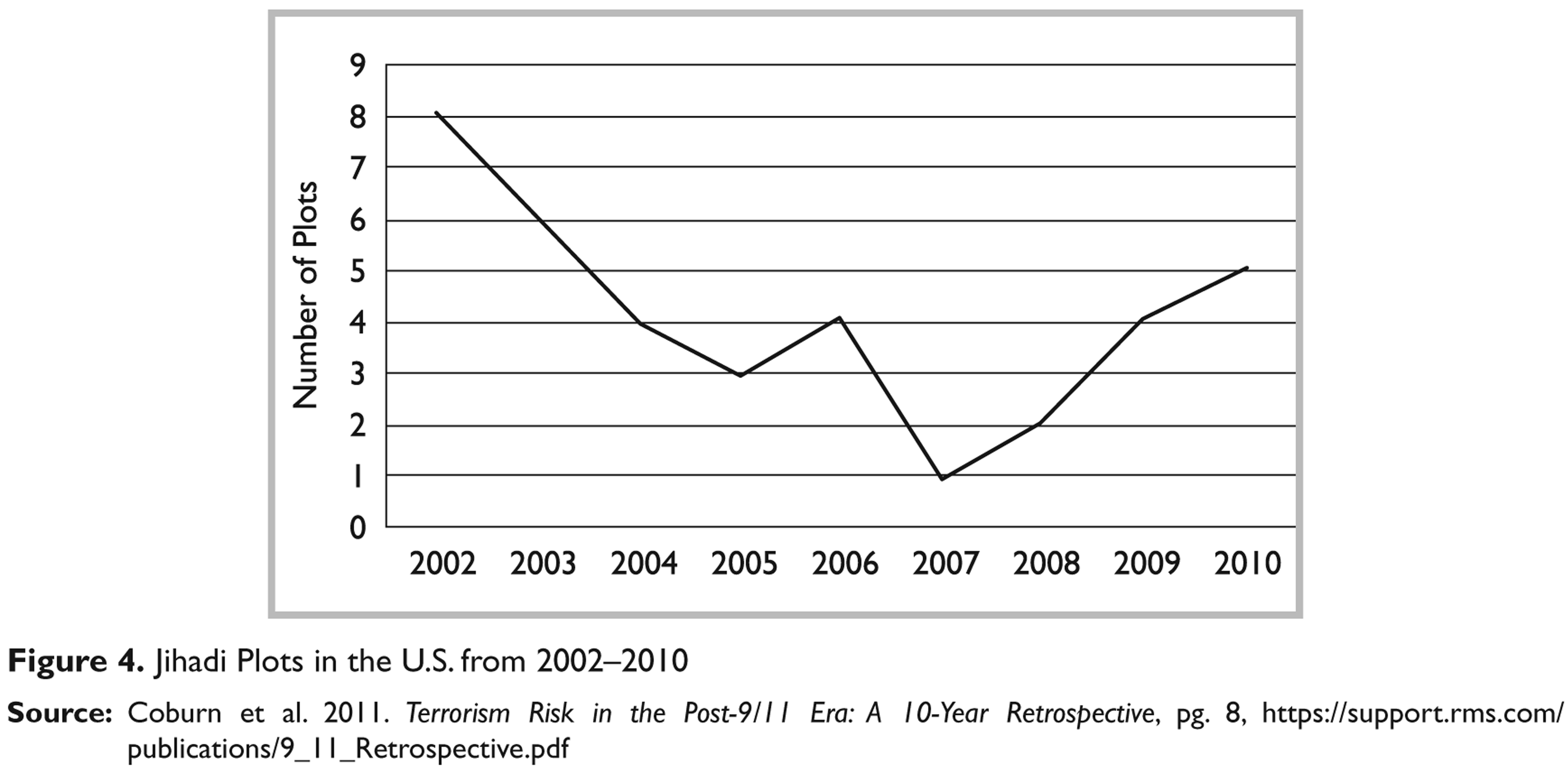
Another nation that has seen a similar increase in terrorist plots has been the US. Nearly 40 attacks inspired by or connected to Al-Qaeda have taken place in the US since 2002 (see Figure 4). Most of these attacks have been perpetrated not by the core Al-Qaeda leadership but by individuals unaffiliated to the terrorist outfit but inspired by it nonetheless (Coburn et al. 2011).
The ‘Al-Qaeda Nebula’ is both broad and complex in its dimensions. Some groups such as EIJ, the Algerian Salafist Group for Preaching and Combat (GSPC) now called Al-Qaeda in the Islamic Maghreb (AQIM) and Al-Shabab in Somalia have already pledged their allegiance to the group (BBC News 2010; Blitz 2011). In other cases groups may be genuinely motivated and inspired by Al-Qaeda; and many others have decided to cooperate and work with Al-Qaeda for reasons pragmatic in nature.
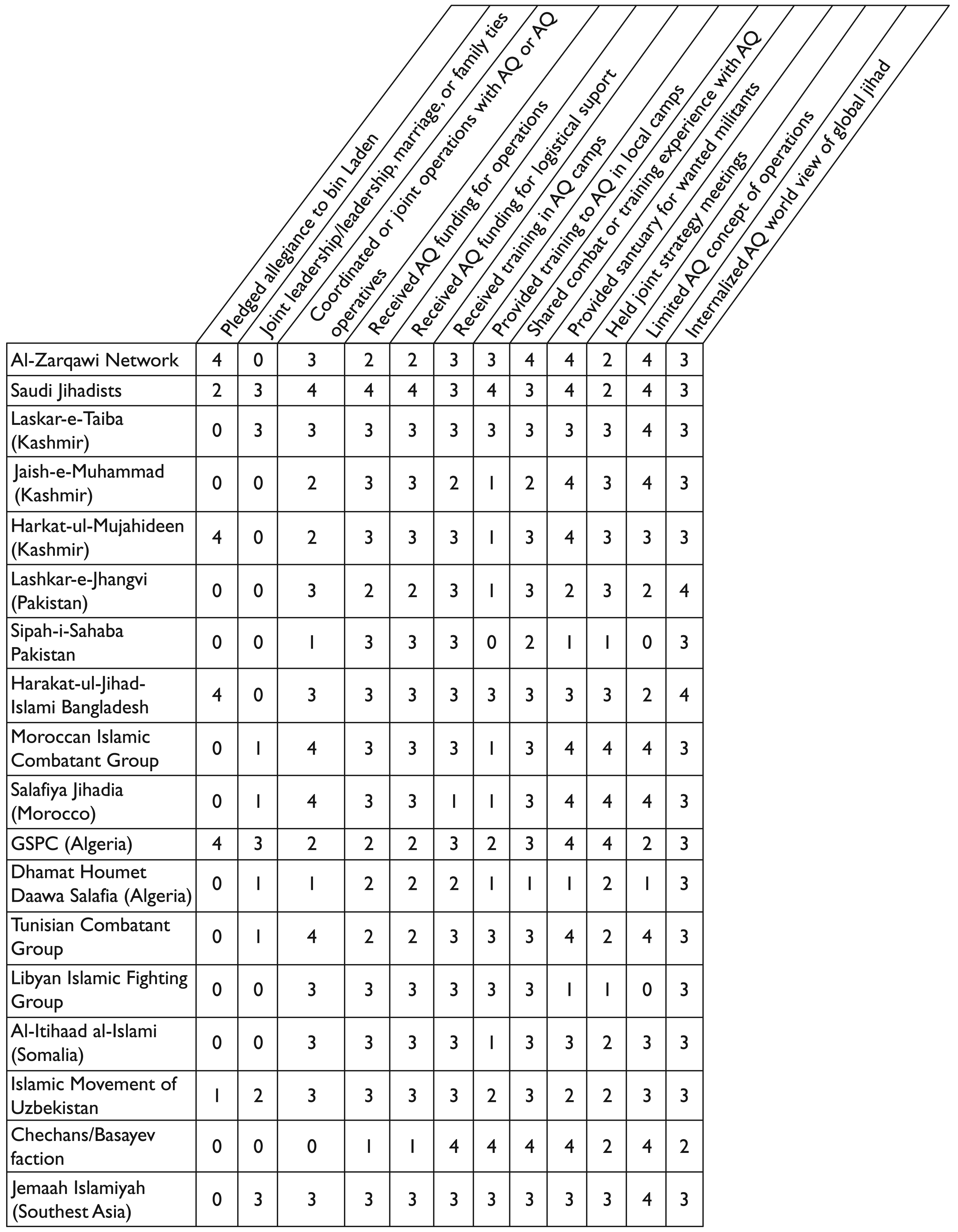
A 2006 report released by RAND, gave comprehensive and exhaustive details on the nature of links that several major terrorist organisations had with Al-Qaeda. The degree of association is based on 12 key criterions; and each of these criterions has been an assigned a value in the form of a number. The values are as follows: (0) not established; (1) possible; (2) probable; (3) confirmed; and (4) confirmed and continuing (see Table 1).
It is possible that like the LeT, these groups that have come in contact with Al-Qaeda may have been imbibed with or influenced by its ideology as well. Considering the magnitude of the threat, it is essential to study the actions of other organisations besides LeT that have come in contact with Al-Qaeda. By studying individual organisations, one could come to understand the strength and intensity of their relationship with Al-Qaeda and also determine the extent of Al-Qaeda’s influence on them. Lastly, counter-terrorism experts when formulating policies could and must differentiate between organisations that are in an allegiance with Al-Qaeda, are their affiliates or are merely inspired by it. This would allow them to adopt a nuanced approach in their policies and to eventually take advantage of the fragile nature of these relationships. Further, studies are required in order to understand the possible threat of expansion of Al-Qaeda’s ideology and to develop measures for the prevention of the establishment of a network of like-minded Islamic radical groups that will be global in nature, with no hesitation to carry out mass violence and the capacity to strike anywhere.
Associations between Major Jihadist Clusters and Al-Qaeda