



Abstract
International migration is a highly contested topic and has become a critical part of the global security agenda due to the growing fear of terrorism notably after 9/11. There is a lack of relevant baselines and a gap in scholarly work that shows the direct connection between migration and security. This paper aims to identify the circumstances under which migration can be considered as a security issue. For this, we conducted an extensive literature review and interviews with policy-makers and staffs from migration regime as well as migrant professionals in Singapore, Malaysia, Thailand, Indonesia and the Philippines between May 2018 and March 2019. The concepts of migration and security act as the theoretical standpoint of this paper. The findings show that the formation of an illusory correlation between migration and security has resulted in an extreme act of biasness towards migrant minority groups.
Introduction
History shows that migration was a major catalyst for some of the most profound global socio-political transformations in the twentieth century in addition to the two world wars, the improvements in technology and the transformation in the global economy (Krause, 1998; Rumpf, 1963). It has been a security issue since the 1980s. Today, international migration is one of the most discussed, yet most contested areas of the security agenda. The securitisation of migration has become a salient topic amongst academics, policy makers and international players, especially after the 9/11 resulting in a broader understanding of what is a security challenge. Some scholars argue that migration causes threat to both national sovereignty and human security (Thompson, 2013). However, evidences are scarce to support this argument. A few scholars and media outlet tried to make connections between terrorism and migration. The 9/11 tragedy was seen as a stimulant for the securitisation of migration by means of borders. However, securitisation of migration is a development that was well underway before the US-Mexico border securitisation (Ackleson, 2003; Buzan et al., 1998; Waever, 1995). Thus, academics argue that the securitisation of migration occurred long before people tried linking it to terrorism (Huysmans, 2000).
Migration: A Security Issue?
Migration could be considered as a security issue in two contexts: (a) geopolitical dislocation associated with the end of the Cold War and (b) by the wider socio-political shifts associated with globalisation (Huysmans, 2006). Academics and researchers (Choucri, 2002; Koser, 2011) claim that migration and security are interlinked. There is, however, no definitive answer whether migration causes security threat or security causes migration (Ullah & Huque, 2019; Ullah & Kumpoh, 2018). As migration becomes a soft issue (Choucri, 2002) in the security agenda of many countries (Collyer, 2006), current migration-security debates reflect on different approaches to understanding migration (Huysmans & Vicki, 2009). Some scholars argue that the debates about migration flows were at its peak during the collapse of the Soviet Union in the 1990s, which saw the end to the Cold War where countries lost enemies while simultaneously migration appeared to be their main security challenge (Ronald, 2008).
The public debate on the migration-security nexus tends to focus on the aspects related to national security and the protection of well-being of citizens. Many argue that national security is at stake due to irregular migration. According to Khalid Koser (2011), the perception that migration poses a threat to national security intensified due to the rise in the number of ‘irregular’ migrants. However, how these migrants become a threat to the national security has not been substantiated by a well-grounded research.
Fauser (2006) argues that Myron Weiner—a legendary security analyst—for the first time in the academic sphere questioned how migration could affect states’ security. It depends on how different countries define security. Scholars began questioning if migration and 9/11 are interrelated, and today this has become the main issue in the security agenda (Adamson, 2006). Are the 19 airplane hijackers during the 9/11 tragedy who attacked important landmarks and buildings in the United States representative of the 300 million migrants? (Llorca-Vivero, 2008)
Today, migration has become a highly emotional as well as a sensitive topic. This is often misrepresented to incite fears of human tsunamis across borders. The socioeconomic, climatic, demographic and political conditions, coupled with shrinking resources, drive people to migrate, leaving behind their roots (Zoubir, 2017). We tend to ignore the myriad of forces that make people to migrate. Therefore, the rhetoric of migration-security nexus gives an impression of the tensions and resentments that can easily be mobilised whenever the topic of migration is raised. The risks, especially for ‘recipient’ countries, are widely acknowledged while the migrants who run risks receive little attention. These judgemental ideas monopolise much of the literature, reflecting biasness against the migrant community.
Understanding the migration security interplay is particularly significant in an era of globalisation. Most debates on ‘security’ broaden the orthodox and narrow concept of security as safeguarding the state from threats emanating from outside borders (Soenmez, 1998), to other wider and relevant threats linked to globalisation ranging from economic, environmental, human rights to migration (Giddens, 1981; Krause, 1998). The production of the migration-security nexus discourse is the result of the rhetorical political game of different Western democracies orchestrated by the popular media, international organisations, governments and epistemic community of experts (Llorca-Vivero, 2008). Our argument is to not reject the phenomenon of migration from the domain of security discourse entirely but to determine these: To what extent is migration perceived as a security threat in today’s reality? What kind of insecurities do migration raise, for whom and for what purpose? What is the impact of framing migration in terms of security, and what alternative reference might be used? How a political analysis of migration can be developed from the migration-security nexus? We argue that though migrants’ cause is lost in the current security discourses, however, migrants’ security should not be unheeded. Therefore, most debates on the migration-security nexus are biased whereby the connections are mainly based on illusory correlation (Hickman & Suttorp, 2008). This means there is a lack of coherent framework to prove that there is a valid correlation between migration and security; how migration systems change in response to security concerns, as well as, how security may alter perceptions and realities of migration.
This paper asks whether migration can justifiably be considered a security issue and under what circumstances this may be the case? We argue that we should not be one-sided in the argument of migration-security nexus. Though migration and security are not entirely separable, not all migration results in security instability. Perhaps the more important question is how or when do we deem migration as a threat or a security issue? What kind of migration becomes a threat and why and to whom? We ask the question ‘whose security’ is relevant in such a debate—the security of states or humans or both? If both are important, then who should we prioritise? The paper continues by presenting challenges to national security and human security in countries of destination, origin and transit.
Methodology
Apart from the extensive existing literature review, we conducted interviews with policy-makers and migrant professionals from selected countries. The countries chosen for the research are Singapore, Malaysia, Thailand, Indonesia and the Philippines, whereby their policy-makers and some IOM staff were interviewed both over the phone and in person. Our respondents were chosen based on logistical convenience and acquaintances. We have adopted convenience and snowball sampling technique in order to select our respondents (between May 2018 and March 2019). The rationale behind including the five countries in our research is that the project was meant to undertake in the SEA countries, and these countries are known as sending, receiving and transits. We undertook some desk research about migration policies that enabled us to identify informants. Interviews were conducted following an interview guide. Questions addressed the thoughts about the relationship between migration and security; what policy changes they plan on making; what potential threats migrants may pose or the other way around to respond to the global concerns? Migrants were asked about their security concerns. Detailed notes of interviews and the transcripts were used for analysis. Conventional content manual analysis (inductive) was used which involved generating a provisional list of codes/themes that were based on the research questions and objectives. Ethical issues were considered throughout the process.
Underlying Theoretical Explanations
According to Choucri (2002, p. 97), ‘the connection between migration and security is particularly challenging and problematic because migration, security and the interplay are inherently subjective concepts’. This implies that the connection is dependent on who defines security and how it is defined. Choucri further highlights three conditions under which a situation can change: what you see depends on how you look at it; who counts defines who is counted; and what is counted depends on who counts, how and why. This means there is an interesting flip side to the meaning of security: one’s security may be another’s insecurity; strategies designed to create security may actually enhance insecurity; and security may be objective, but it depends on the eye of the beholder (i.e. subjective). We, therefore, argue that security is a social construct determined by people’s capitals (e.g. cultural and social).
Securitisation refers to the quality of existential threat that an issue might acquire, even beyond the actual threat (Umansky, 2016). It is a social construction that pushes into an area of security by resorting to a rhetoric of discursive emergence, threat and danger aimed at justifying the adoption of extraordinary measures (Waever et al., 1993). According to Ole Waever (1993), securitisation is a discursive process by means of which an actor claims that a referent object is existentially threatened; demands the right to take extraordinary countermeasures to address the threat; and convinces an audience that rule-breaking behaviour to counter the threat is justified, thus justifying the use of restricted policies with the aim of protecting the object that has been threatened (Baele & Sterck, 2015; Buzan, Waever & Jaap, 1998).
Migration and security could be studied in two contexts: first, how far the migration and resulting demographic change bear upon national security questions (Choucri, 2002; Heisbourg, 1991; Loescher, 1992), such as whether there is a likelihood for migrants to become violent political actors (Loescher, 1992) to the social cohesion and the possibility for them to participate in the workforce (Rudolph, 2006). Second, how security concerns can impact a state’s migration policies (Loescher, 1992; Rudolph, 2006; Vernez, 1996; Weiner, 1993, 1995). Rather than conceptualising security in terms of the dangers that migration is perceived to pose, it should be perceived as constituting social and political techniques of governance that shape migration (Andrijasevic, 2004, 2009).
The process of securitisation of immigration intensified after the 9/11 that profoundly affected the American National Security and immigration (Rudolph, 2017). Between 2005 and 2006, the Cayucos crisis 1 emphasised that migration flows were perceived as a risk to European security. Instruments, actions and policies have been developed on the basis that the protection and control of borders is key to national security. The heightened flow of migrants onto the Spanish borders, Lampedusa, Malta and the Eastern Greek islands, underlined the concerns about the European border protection. Since 2001, border control policies have been revisited and become key instrument to repel migrants for the sake of state security (Bigo & Guilds, 2005).
Migration Threats to State Security
We argue that any kind of migration (irregular or regular) could turn to security threat to the state and thereby the individual. The perception of migration as a threat to national security has certainly heightened in recent years, in part as the security agenda has become more prevalent across many aspects of policy, and in response to the rapid rise in the number of international migrants (IOM, 2010). We further argue that the flawed governance can lead migration to national security, financial and job market security. Such concerns are not entirely unfounded; however, they must be placed within the broader context of the range of impacts—both positive and negative—that international migration flows have on states’ core national security interests (Adamson, 2006). Hence, migration regimes are placing emphasis on global compact for migration, which ration is the first, inter-governmentally negotiated agreement, prepared under the auspices of the UN, to cover all dimensions of international migration in a holistic manner (IOM, 2010).
Myron Weiner (1993) addressed the question of how international migration creates threats to states and citizens. Through transnational perspective, he shows how the sending and receiving states are linked by security challenges. Migrants are challenged by the security of both their origin country as well as the country of reception. Weiner (1995) argues that there is one possible threat that might emerge from the rise of uncontrolled mass migration, bringing about the violation of national territory. He labels this as a classical security issue. Angenendt (2008) warns about the potential diplomatic havoc due to migration. Weiner’s (1995) argument comes fundamentally from a nationalist ideology. What Weiner’s argument relates to that of Angenendt? We think there is a lack of coherency in the two arguments because the second half of Angenendt’s argument is vague.
Who are responsible for the situation that forces migrants out of their country? This reminds us Betts (2003, 2009; 2018) burden sharing notion (see also Betts et al., 2017). We seek to address issues such as when is migration a function of demand and supply, when refugees are the creation of western powers (Cockburn, 2015; Jamil, 2015; Jebreal, 2015; Jinglie, 2015), why are migrants the only ones to bear the brunt of the blame? We argue that some scholars and policy-makers relate security with migration because they are using the migrants as a scapegoat where all blame lies on migrant and no other factor? The migration-(in)security nexus has been, from the very beginning when migration came under academic investigation, a highly controversial one. Whereas some researchers state that there is no connection between the two components, others claim the existence of a consequential relationship between migration and security (Basarabă & Nistor, 2015).
Thomas Faist (2004) contends that security is superficially involved in border crossings. Ratna Omidvar (2002), however, found the association between migration and security as a discrimination against [im]migrants. Anna Kicinger (2004) endorses strict measures for migrants’ entry based on the assumption that migrants are threats to social security, demographic stability, cultural identity and welfare system. However, her arguments are unsubstantiated. Some scholars (such as Tonry, 2014; Finlayson & Martin, 2006) have positioned themselves in-between (i.e. a neutral position). Some sceptics like Rodney (1972) argue that Europe’s security was tightened due to the African migrant. They argue that the Europeans are responsible for the exploitation of Africa resulting in their state of underdevelopment during the European colonialism. Africa has since carried colonial legacy. One of the main arguments Rodney made is that Africa developed Europe at the same rate as Europe underdeveloped Africa (Rodney, 1972).
Furthermore, migrants are the distinct group in any destination country. This distinctiveness magnifies any minor offenses committed and often overshadows crimes committed by the majority group. We strongly agree with Fan (2007) and Hickman and Suttorp (2008) that due to illusory correlation, policy-makers are quick, or tend to hurl the blame onto the shoulders of the migrants i.e. the minority.
An illusory correlation is a cognitive bias, which occurs when an observer assumes two unrelated events are related or assumes a stronger association between two events than is actually the case (Fan, 2007). Formation of illusory correlations is easy for anyone who observes, as it does not require any deep analysis. According to Klaus (2000), illusory correlations are, in fact, distorted perceptions of correlation of two components. Placing undocumented [im]migration with terrorism generates illusory correlations, ‘because the vast majority of undocumented [im]migrants remain today what they have long been-people in search of a better life, no terrorists intent on destroying own life’ (Fan, 2007, p. 33).
The illusory correlation generates a flawed decisional control, which is about ‘fighting terrorism, and not a complex balancing of humanity, human need, privilege, property, and conscience’ (Fan, 2007, p. 33). The compelling responsibility of the governments is to keep their people safe; however, it should not mean to forgo a fair consideration of the complex issues of [im]migration policy. The heuristics and biases in social psychology have generated insights into how people think and make decision. People simplify complex questions by substituting them with easier ones through a ‘process called judgment by heuristic whereby the substituted issue is different from the real one or the reality, therefore, heuristics inevitably produce predictable decisional errors called systematic biases’ (Fan, 2007, p. 34).
There is a simple illustration for the formation of an illusory correlation, i.e. mistaken association, and its consequences. The migrant community is the minority group. If 3 per cent of each group (majority and minority) are involved in crimes in a community of 10,000 people [minority: 500 and majority: 9,500], meaning that 15 minority individuals and 285 majority individuals are involved in crimes. The calculations show that more majority individuals than minority are committing crimes (285>15). In general, majority group is not likely to interact with members of minority regularly. When media outlets disclose the involvement of minorities in crimes, the impressions about them from majority group turns horrendous. Majority groups and policy-makers, therefore, tend to conclude that crimes are more likely to be committed by [un]documented immigrants than by the much larger majority.
So how is the illusory correlation formed in this case? For example, a member of a majority group witnessed that a minority member committed a crime. A few months later, the majority member heard about another crime committed by another minority group member. A year later, media coverage of the trial relating to another [im]migrant has been convicted of a crime. We are saying that the illusory correlation does not offer a holistic perspective on issues related to migration or security and that the process of illumination/blaming/decision-making is simplistic. So this equation would prove that even though illusory correlation makes people think migration = security threats, but our illustration indicates that it is not true because numbers would show that majority still commit much of the crime than minority yet minority are used as scapegoats. The association made, and the conclusion drawn here, was based on only three people who committed crimes. This happens because of the distinctiveness i.e. correlations are perceived between events and characteristics that are distinct (Chapman, 1967). In this case, immigrants and the acts are both distinct. However, if a member of the majority group committed this: the act would be distinct, but the individual is not. Thus, minority group members become the victims of hate or hate crimes.
Whose Security Comes First?
Migrants who have left or fled their homes are frequently viewed in terms of sheer numbers and a potential source of insecurity. Yet, the securitisation of borders, criminalisation of migration (Ullah & Kumpoh, 2018) and using detention as a deterrent measure do not prevent people from starting a journey (migrating) but rather they create greater hardship and suffering to an already vulnerable group. Relevant migration researchers and security policy-makers who we have talked to on these issues unanimously agreed that it is high time for a paradigm shift. A global phenomenon is migration. Making an illusory correlation hurts almost one billion migrant population. Regardless of their reasons for migrating, people become vulnerable at many stages of the migration trajectory as they travel from their home countries, often through numerous other countries and dangerous borders.
Intolerance towards migrants has become a serious security issue within the ambit of migration. The rise of racism, xenophobia and intolerance generate serious threat to the creation of multicultural societies. Thus, this leads to the criminalisation of [im]migration. In the recent years, the growing number of far-right political leaders openly espousing racist or xenophobic political platforms into migration policies in order to criminalise and exclude migrants. This of course heightens security issues.
Most policy-makers (in study countries) interviewed hold similar views that the blame is easily and quickly hurled on the migrants’ shoulder without considering deeply the migrants’ situation. ‘We often receive complaints about our migrant population being involved in “security” issues from foreign countries. We take these complaints very seriously. We as well investigate into the facts. Honestly, in the last five years, we received a few hundred complaints with such merits but we concluded after investigations that those cases were baseless…’ (Respondent A, February 2019). The migrant population are one of the most vulnerable groups as they leave their family, friends, neighbours and their roots behind (for a destination where religion, language, culture and food may be new and different). These people undergo psychological burden. The vulnerability arises from a range of factors intersecting simultaneously; influencing and exacerbating each other and can change over time with the shifting circumstances. Vulnerability is generated by myriad of factors, which cause migration in the first place. This vulnerability may occur at any point such as in transit or at destination, ‘regardless of whether the original movement was freely chosen, or forced due to a migrant’s identity or circumstances’ (Ullah, 2010, p. 89). This is the reality for overwhelming majority of the migrants (Skeldon, 2006; Ullah, 2014).
Dissatisfaction at home and disillusionment with globalisation are the driving forces behind the recent rejectionist movement (Carens, 2013) in countries that have pushed towards closed-border system (Giddens, 1981). Under restricted closed border system, many suffer assaults, robbery and abduction by criminal gangs (Ullah & Hossain, 2011). Extortion and ill treatment by police and immigration officials are rising. Sometimes, migrants get killed before they get to that point. From Central America to Mexico, as many as 20,000 migrants are kidnapped every year (Shetty, 2019). The incumbent countries justify mostly with baseless evidences and magnify migrants’ involvement in offences. Most respondents (from migration regime) we interviewed agreed ‘… partly, migrants are responsible for the problem in the way that they sometimes fail to explain their position because of language and cultural differences. We have reports that police asked some of the suspects whether they were involved in a particular crime, out of nervousness, they answered ‘yes’ without understanding the question. At the end, they were released but media already publicised their confession…’ (Respondent B, February 2019).
Securing the border cannot simply be seen as the securitisation of migration. Potential migrants are not free to move. The states decide who is to be admitted and who is to be excluded. The ‘securitisation’ of migration led to repeated restrictive actions, ranging from intensifying border controls to sweeping operations concluding in massive deportations and xenophobic reactions against the ‘other’ (Lazaridis & Wickens, 1999). The rhetoric for the adoption of intense securitisation policies and measures to control cross-border movements intensified with the economic crisis and the resulting social, economic and other conditions of insecurity for citizens who provided a fertile ground for far-right groups in different parts of the world.
Some countries are reluctant to modernise the data collection and preservation system. Therefore, appropriating reliable data on migrant disappearances, deaths or persecution becomes difficult. In 2014, there were about 8,000 cases of death and missing of Indonesian migrants in Asia and the Middleeast (AP, 2015). Two years later, there were 2,600 more cases of dead or missing were reported (Gelineau & Karmin, 2018). More than 2,000 migrants from the Philippines died in 2017 (Gelineau & Karmini, 2018a) and countless of other cases are never reported. About 281 Indonesians faced death penalty in 2015 and while 219 others are undergoing legal proceedings (The Jakarta Post, 2015). From January to December 2013, around 883 overseas Filipinos were repatriated to the Philippines while a total of 3,154 were in prison and 130 in death row overseas. ‘… I returned to Thailand after about 4 years in prison in … I was in a bar with some other friends. A bottle (might be beer or wine bottle) exploded which created panic. The security called the police. A few (including me) were arrested and most of them were released in a day but my friend and I were not. This is perhaps we have Muslim names…after about four years we obtained exoneration’ (Respondent C, September 2018).
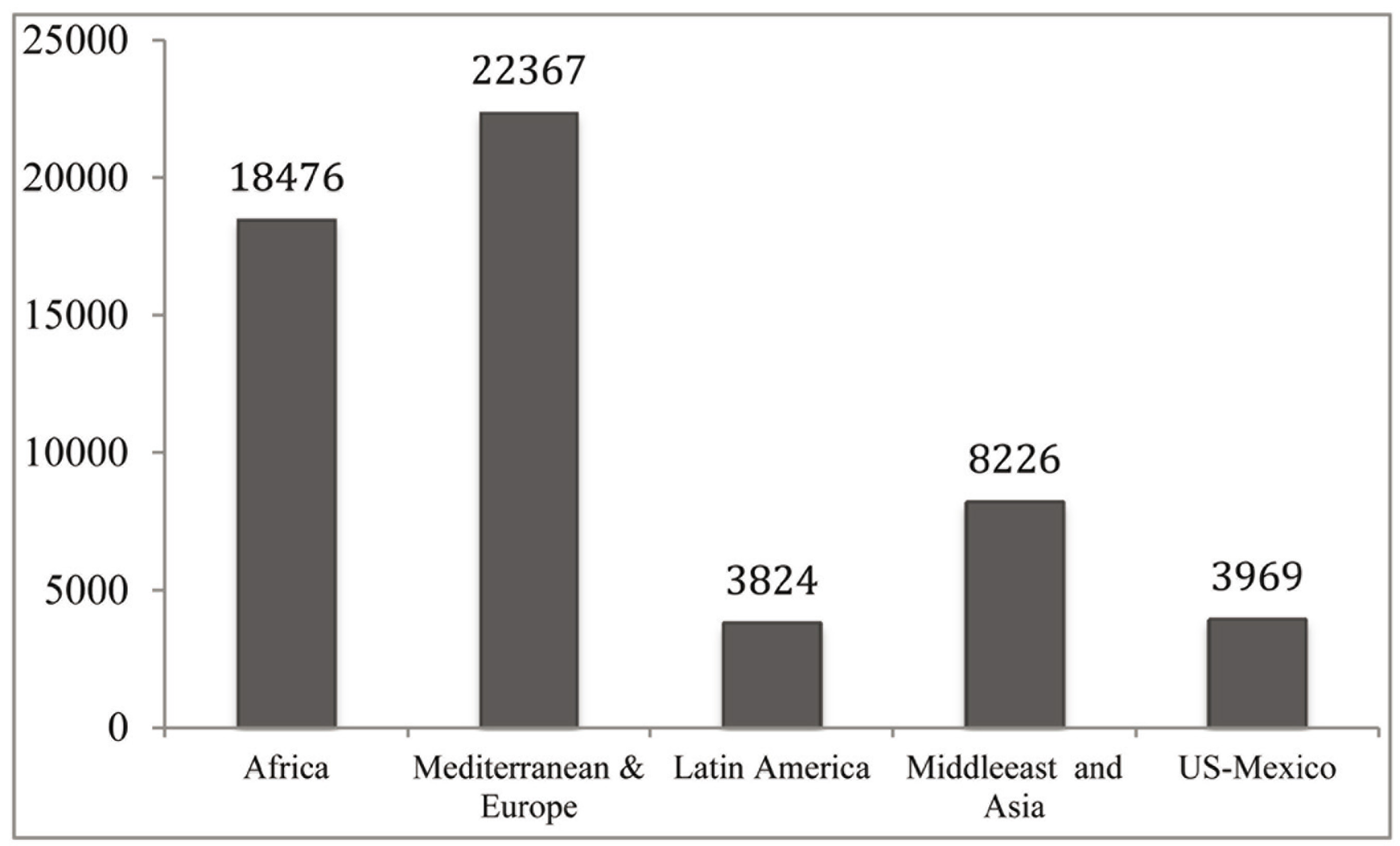
Owing to the fact that the most dangerous and riskiest works are assigned to the migrants to do, they are hence more vulnerable to occupational injuries and fatalities than others (Figure 1). Work health and safety legislation and practice differ widely between countries and the dangers of accidents, and deaths tend to fall on workers in developing countries, where large numbers are employed in the high-risk industries of agriculture, fishing and mining (International Labor Organization (ILO), 2013). A huge percentage of migrants succumb to the injuries, fatalities and deaths that happen globally (Figure 2). According to the ILO (2013), annually about 2.02 million people die from work-related diseases; 321,000 people die from occupational accidents; 160 million non-fatal work-related diseases and 317 million non-fatal occupational accidents. A few respondents (from a refugee regime) accepted the fact that they have not been fully successful in negotiating with resettlement countries for the protection of those vulnerable. The lack of success has led these people to become defenceless.
Vulnerabilities in Origin, En route and Destinations

Researchers and advocates tend to pay little attention studying xenophobia, racism and nativism. Due to the belief that self-nation-state is superior to others; and the existing grievances about various issues; and the competition for scarce resources have resulted in migrants facing severe hatred and xenophobic treatment (Ullah et al., 2019). Hatred has appeared as a new terror against migrants and immigrants. March 2019 events in New Zealand and Netherlands are genuine examples. There are, however, similarities and dissimilarities between these two recent events. The killing of innocent people in New Zealand by a white supremacist (though an Australian migrant) due to social conditioning and thinking that Muslim migrants spread seeds and erodes Christianity and white off from the countries (reaction due to fear and hatred to a another minority group) while the Netherlands incident is a Turkish man (possibly a migrant with a possible criminal offence of rape) who had marital or family issues and was killing anyone (mainly migrants) without any statements or manifesto of hatred against the people he is killing.
Both are terror attacks against people, but motives are somewhat different. However, a question to be considered is that if we follow the illusory correlation, would the white Australian actions instil fear on other people (majority group around the world?) that would result in people or borders or governments fearing white migrants? Or is the illusory correlation discourse also biased to certain ethnic or colour groups of migrants only? Was it underplayed? The social stigma against people of colour—in this case non-whites—runs deeper than a white supremacist migrant. Even Trump did not highlight the issue of white supremacist or the Australian politician who got egged. That egged politician even blamed migrants despite the attacks on migrants who have lived harmoniously with the community, which we have seen in the outpouring of love, and sadness shared by the people of NZ themselves.
Each region where migration takes place has its own special situation, involving people fleeing conflict or natural disaster or just people on the move looking for better opportunities. There is a stigma attached to migrants. Stigma and discrimination depend on the security situation of the particular country, which they come from. The reality is that in many parts of the world that migrants are being stigmatised and scapegoated in particular situation such as economic downturn and any terrorist act. The fact the PM of NZ refused to mention the killer’s name is an act of removing the fear that these white supremacist wants to bring about amongst the Muslim community around the world? Is this her way of removing power/fear the killer and white movement wants to inflict against Muslim migrants? What happened in NZ was the opposite of the migration-security nexus. Majority group did not follow the words of the egged MP but supported NZ PM to help the victims (migrants) using NZ funds and resources.
There are claims from the dominant group that [im]migrants are reluctant to assimilate (Croucher, 2013). When members of the host country feel threatened, it is highly likely that they would conclude that it is because of their reluctance to assimilate. Let’s turn our attention to the notion of security developed by Copenhagen School of Thoughts. Copenhagen Research Group widened the concept of security (Buzan, 1991) and came up with an interesting conceptual effort in security studies, i.e. non-traditional security (NTS), which includes environmental; economic and societal security along with human security. The NTS threats are in other words called non-military threats (Acharya, 1997; Gautam, 2006), which means that increasing gaps between rich and poor could appear as the greatest threat to human security. These gaps create instability at global stage, and refugees and migrants are the outcomes of these instability. Hence, reducing the gap between the rich and poor would be the primary solution for the non-traditional security threat. The global economy today has created 2,043 billionaires reflecting a great development in the global economy. However, the boom in billionaires does not reflect a thriving economy but a symptom of a failing financial system (O’Connor, 2018). O’Connor (2018) drew a striking example where the United States has spent nearly $6 trillion on wars contributing directly to the deaths of around 500,000 people since the 9/11 and creating millions of refugees and displaced. This money, if used appropriately, could have helped reduce the gaps and minimise the NTS threat in the long run.
By the end of 2017, more than 68.5 million people (25.4 million refugees; 40 million displaced; 3.1 million asylum seekers) were forcibly displaced (UNHCR, 2017, p. 02) and about 10 million people are denied a nationality (UNHCR, 2017, p. 51). About 85 per cent of the total 68.5 million are in developing countries. Understandably, some countries are concerned about the refugee inflows and raised questions on security issues. However, they tend to ignore the fact that the refugees are mostly a product of the unfriendly global policies. Therefore, some researchers perceive that refugees actually come from the warmonger’s thirst for oil resources.
At least 30,510 people died between 2014 and 2018 (IOM, 2019). More than 19,000 migrants died and disappeared in the Mediterranean Sea, in the Rio Grande, the Bay of Bengal, and many other en-route to their destinations overseas (IOM, 2019). Due to the lack of official information on deaths during migration, transit and post-migration, these figures do not represent the actual estimate (Figure 2). Examples of death during migration in African region are horrifying and representing the second-largest regional total of the 30,000 deaths recorded since 2014, with 6,629 fatalities since 2014 (IOM, 2018, 2019). In 2016 alone, a total of 7,189 migrants and refugees died on the migratory route (Loesche, 2016). The Mediterranean has proven most deadly for migrants. About 4,812 people died in 2016. About 36,000 dead bodies of migrants returned to Bangladesh alone from abroad in the last 12 years (Mirza, 2019).
Conclusions
This paper demonstrates that the security oriented discourses on migration should be consolidated and taken into consideration both national and societal threats. The construction of the migration question as a security threat not only bodes ill for migrants’ protection but also for the stability of the host states. In many countries, the security loaded migration dynamics has instigated and exacerbated tensions and hostilities between migrants and hosts making the potential of integration a daunting task (Francesca & Scribner, 2013).
The migration-security nexus is a complex dynamics. Therefore, simplistic conclusions might be unfair for both migrants and those receive them. Hurling blames, however, on the shoulders of the migrants is too simplistic and one-sided only focusing on host/domestic communities (majority group) blinded by illusory correlation tactics. When, in fact, migrants who have been labelled evil or threats are people who are searching for a better life and safety from their own sets of threats at home. These people have sacrificed much—their roots and even their life and their families during the whole migration journey. Still the threats do not end once they reach the destination. It carries on due to the overgeneralisation or social stigma attached onto them by the minority groups (who might have committed offences). Therefore, re-invention of the way to see security and migration rather than devaluing a migrant’s worth and security is necessary. The NZ case reminded us that only the local majority is not a threat today and also immigrants. The boundary between ‘we’ and ‘they’ contributes to the security matter because this makes majority group see the migrants as ‘rivals’ in the labour market and social services (Bigo, 2001; Guiraudon & Joppke, 2001; Waever, 1995). They hence become a matter of security from a domestic point of view. The Global Compact for Migration is a non-binding agreement signed by 164 countries. Many researchers question its end result because this agreement may not yield any positive results for migrants (Jacobs, 2019). It is dangerous to conclude that migration is a threat based on the simple illusory correlation. We have to look at it from more realistic perspectives and holistic approach.
Footnotes
Declaration of Conflicting Interests
The author declared no potential conflicts of interest with respect to the research, authorship and/or publication of this article.
Funding
The author received no financial support for the research, authorship and/or publication of this article.