



Abstract
It is noticeable that India–Vietnam relations have remained stable and had signs of development despite the new challenges in the global and regional environment due to COVID-19 pandemic. The authors of this article are of the view that one of the factors that help maintain the stability and development of bilateral relations in the current context is public diplomacy. Since the beginning of the twenty-first century, India has invested a huge amount of resources in public diplomacy to leverage India’s soft power. A dedicated public diplomacy division within the Ministry of External Affairs was set up in May 2006, many new schemes were designed to engage domestic and foreign public opinion and a series of high-profile dialogues with foreign think tanks were organised. By utilising both traditional and new approaches of public diplomacy, India is actively seeking new audiences within and outside India. India’s foreign policymaking process has become more open and democratic with the contribution of communities outside the New Delhi political and diplomatic elite. New media has also been utilised to reach its various target audiences. Vietnam considers public diplomacy an important pillar of the comprehensive diplomacy of the country. Public diplomacy helps Vietnam succeed in implementing comprehensive and effective foreign policies. It contributes important part in building cooperative, peaceful and friendly relations between Vietnam and international partners. The importance that both India and Vietnam attach to public diplomacy has many implications for strengthening Vietnam–India relations in the current context. This article focuses on India and Vietnam’s public diplomacy as an instrument of strengthening bilateral relations, and thereby proposes suggestions for both sides to enhance cooperation in the future.
Introduction
Shortly after the Cold War, many scholars believed that public diplomacy had become an important part of diplomacy in general; it may even be considered as a top priority in the implementation of foreign policy of a country. This article examines how public diplomacy is used as a means of strengthening India–Vietnam relations through both primary and secondary sources, including Annual Reports of the Ministry of External Affairs (MEA) of India, Ministry of Foreign Affairs of Vietnam, Annual Reports of the Indian Council for Cultural Relations, websites of Indian and Vietnamese Missions abroad, books, journal articles by scholars and diplomats, policymakers in India and Vietnam, etc. This article begins with a brief introduction about the concept of public diplomacy, followed by an analysis of India and Vietnam’s public diplomacy and how it is used as an instrument in strengthening India–Vietnam relations. On that basis, this article provides several suggestions to promote India–Vietnam relations in the future.
Concept of Public Diplomacy
In the mid-1960s, the term ‘public diplomacy’ was first used by a former US diplomat Edmund Gullion; it was considered as a propaganda means for distance overseas governmental information activities. Gullion defined public diplomacy as ‘dimensions of international relations beyond traditional diplomacy, the cultivation by governments of public opinion in other countries’ (Prabhu & Mohapatra, 2014). Some scholars pointed out that public diplomacy related to public affairs is preferred in international relations and cross states communications. There is a strong connection between public relations and public diplomacy due to similar objectives and tools, when public diplomacy is ‘the way in which both government and private individuals as well as groups influence directly or indirectly on those public attitudes and opinions, which bear directly on another government’s foreign policy decisions’ (Signitzer & Coombs, 1992, p. 138). Audiences play a major factor in divergence between public diplomacy and media diplomacy when policymakers use the media to address foreign publics and government officials (Rawnsley, 1995). Moreover, public diplomacy was influenced by three interrelated revolutions, that is, mass communication, politics and the international relations after the 11 September 2001 terrorist attacks in New York City and Washington DC by Islamic fundamentalists.
Besides public affairs and communication, public diplomacy associates with cultural diplomacy due to common concepts. Cultural diplomacy can be seen as one of the five elements of public diplomacy after listening, advocacy, international exchange and international broadcasting (Cull, 2008, pp. 32–34). Further, the US Department of State also emphasises that cultural diplomacy is one of the main pillars of public diplomacy because cultural activities best represent a nation’s ideas of itself (Advisory Committee on Cultural Diplomacy, 2005, p. 4). Over the past few decades, many nations have concentrated on public diplomacy as a part of soft power towards the international environment. A surge of activities have been undertaken by a national government to inform and influence foreign public opinion and attitudes in order to advance its foreign policy goals (Cowan & Cull, 2008; Cull, 2008; Nye, 2008). It can be seen that a country’s efforts enhance not just a positive image and a reputation to an international audience but also its significant role in a global stage.
Thus, public diplomacy has seemed an ambiguous concept, which coincides between public relations: communication and cultural diplomacy. But it has primarily focused on the people from foreign countries with a view to secure the foreign policy objectives of the state practicing public diplomacy.
India’s Public Diplomacy
Building on Cull’s (2008) concept of public diplomacy, in which activities can be classified into five ‘elements’, that is, listening, advocacy, cultural diplomacy, exchange diplomacy and international broadcasting, Laskar (2019) added one more category, that is, domestic outreach, and interpreted the six categories of public diplomacy (see Table 1). These six categories are not watertight compartments, and many of the public diplomacy activities can be placed in more than one category. The classification is only for the convenience of analysis.
Classification of India’s Public Diplomacy Instruments.

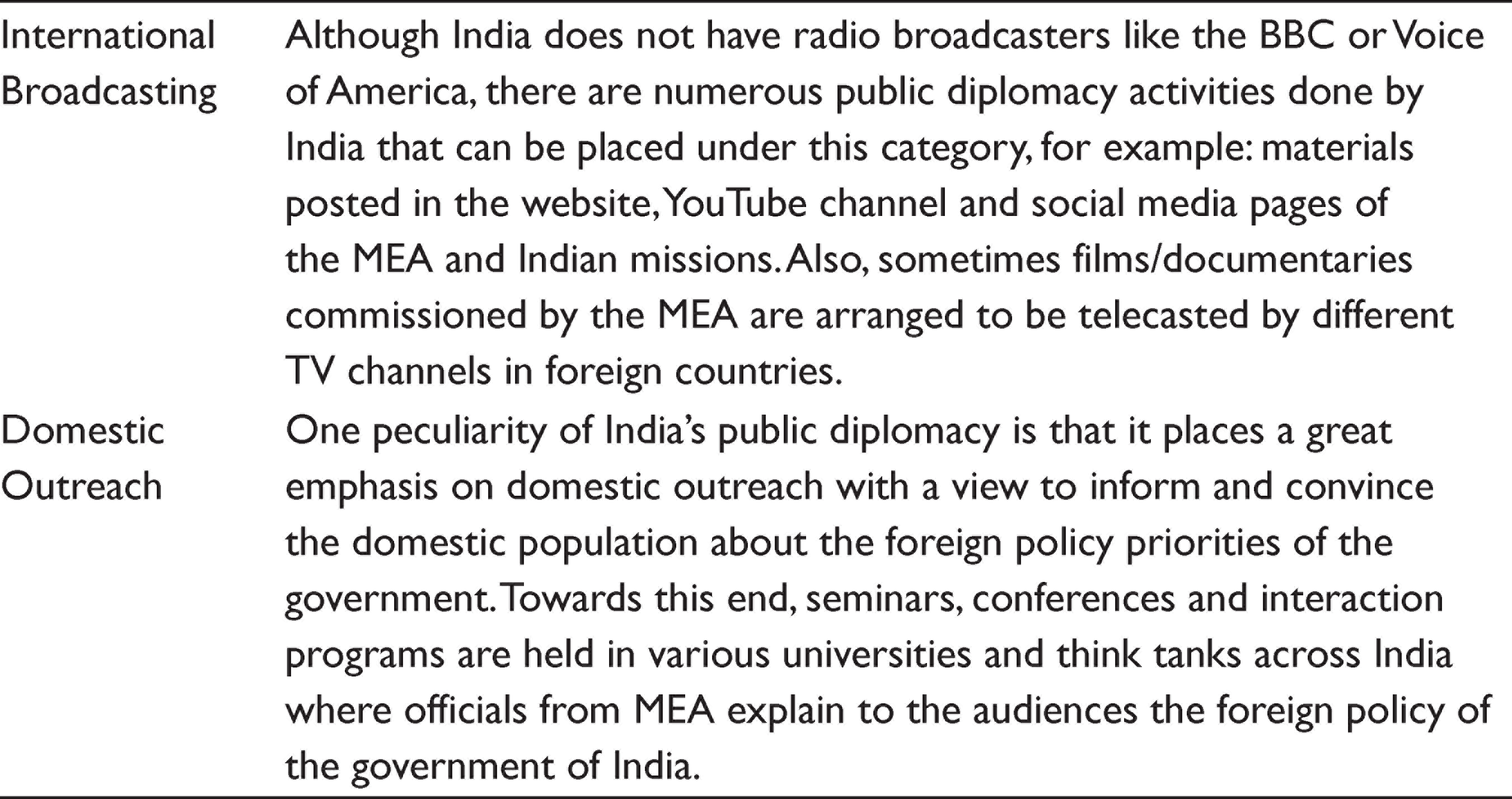
Indian Government’s emphasis on public diplomacy predates Prime Minister Modi’s period. Since the beginning of the twenty-first century, India has invested a huge amount of resources in public diplomacy to leverage India’s soft power. India has used both traditional approaches and new approaches of public diplomacy to secure this objective. Indian investment in public diplomacy is partly a response to concerns about the perceived growth of Chinese soft power and partly a function of changed beliefs in the foreign policymaking elite about the uses of new social media. There are three significant initiatives: a dedicated public diplomacy division within the MEA in May 2006, a raft of new schemes designed to engage domestic and foreign public opinion, and a series of high-profile dialogues with foreign think tanks.
The emphasis on using India’s soft power resources was accelerated after Narendra Modi came to power in 2014 (Heng, 2016). Prime Minister Modi is known for his ‘passionate use of India’s soft power assets through both an effective media management strategy and an intelligent use of social media’ (Laskar, 2019). India’s new public diplomacy is built upon its traditional public diplomacy; but to a certain extent, it also departs from India’s past practice in three key ways (Hall, 2012, pp. 1089–1110; Laskar, 2019). First, India’s new public diplomacy is actively seeking new audiences within India, in the West (Indian diaspora communities abroad) and in the developing world. Second, Indian officials are attempting to render India’s foreign policymaking process more open and democratic by engaging in dialogue with communities outside the New Delhi political and diplomatic elite. Third, the effort seeks to utilise new media rather than traditional methods to reach its various target audiences.
Indian Cultural Diplomacy
Cultural diplomacy is considered one of the major elements of India’s public diplomacy. It is considered ‘a powerful tool for furthering (India’s) interests in commercial, political and strategic fields’ (Laskar, 2019, p.252). In India, the Indian Council for Cultural Relations (ICCR) is the leading institution for cultural diplomacy. The primary objective of the Council is to establish, revive and strengthen cultural relations and mutual understanding between India and other countries in order to promote awareness and appreciation of India’s soft power and cultural diplomacy. The ICCR organised its foundation day for the first time on the 69th year of its existence on 9 April 2019 at ICCR Headquarters. Its founder President is Maulana Abul Kalam Azad. Its new website has been launched on 24 December 2019.
For promoting India’s culture abroad, the ICCR maintains 37 full-fledged ‘Cultural Centres’ (ICC, later renamed as Swami Vivekananda Cultural Centres) in foreign countries, supporting the ICCs with local support on the ‘Public–Private Partnership’ Model in Spain and South Korea, deploying teachers of Indian culture on Yoga, Veda and Sanskrit to various ICCs and deploying India-based teachers in the disciplines of Bharatanatyan, Kathak, Odissi, Kuchipudi, Hindi language, etc. The ICCR undertakes activities, including Yoga promotion (facilitating the celebration of International Day of Yoga in 172 countries in 2019), Sanskrit and Hindi promotion (organising Hindi workshops, printing Hindi magazines), holding of Indian cultural festival abroad, sending cultural delegations abroad, establishing and maintaining ‘Indian Studies’ Chair in foreign universities, art/cultural exhibitions abroad, sending of statues/busts of great personalities of India, etc. In 2019–2020, commemorating the 150th birth anniversary of Mahatma Gandhi in the international arena was a major focus of India’s MEA and ICCR. An event was organised at the United Nations on 24 September 2019 to mark the beginning of this series of events. An anthology on ‘What Gandhi means to Me’ with contributions from major personalities from across the world was published. An ICCR’s programme led to the installation of Mahatma Gandhi’s busts in 40 countries (Indian Ministry of External Affairs, Annual Report, 2019–2020). One bust of Mahatma Gandhi has been installed at the Embassy of India in Hanoi in 2019. In all, ICCR’s cultural diplomatic activities span a wide range of areas (Ministry of External Affairs of India, Annual Report, 2019–2020).
Vietnam’s Public Diplomacy
Vietnam has not yet had a strategy of public diplomacy, though manifestations of elements of public diplomacy as propounded by Cull (2008) and Laskar (2019) in implementing foreign policy have been there in Vietnam since its independence. In Vietnam, public diplomacy can be seen as a part of the overall comprehensive diplomacy of Vietnam. The initiative of using public diplomacy came from President Ho Chi Minh in the early days of new Democratic Republic of Vietnam in 1945. He wanted to gain a valuable support of the progressive people around the world and international organisations for the Vietnamese revolution. Under Ho Chi Minh’s idea, public diplomacy was the important factor of national diplomacy (Niên, 2008). Public diplomacy contributes important part in building cooperative, peaceful and friendly relations between Vietnam and international partners. In the post-Cold War era, in the context of globalisation and international integration, Vietnam has been determined to use ‘soft power’ as an effective means in the process of international integration. In this process, some key expressions of public diplomacy have been found, including organising cultural diplomacy activities, people-to-people interaction, utilising cultural tools and disseminating information in foreign affairs. Although none of the government document mentions the term ‘public diplomacy’, many scholars in Vietnam agree that the essence of public diplomacy is cultural diplomacy. Toan (2008) explains that cultural diplomacy is a form of diplomacy through cultural tools. While Huân (2007, pp. 13–19) thinks that cultural diplomacy is a part of the foreign policy of the Communist Party and Vietnam. According to Phương (2014), the basis of Vietnam’s soft power should be seen as ‘cultural soft power’ (Phương, 2014). In Phương’s definition, ‘cultural soft power’ is attraction, manipulation, ability to influence and attractiveness of a country by a variety of things (cultural, spiritual, ideological values, cultural exchange, external channels, education, film, media, etc.).
Public diplomacy can be seen as a practical and successful story of Vietnamese diplomacy during the struggle for national independence against the French and American colonialism over 30 years (1945–1975). President Ho Chi Minh, the first person who set a milestone for Vietnam’s diplomacy in the modern time, had applied successfully ‘diplomacy of the heart’ (heart-to-heart diplomacy), which helped win the hearts of many people around the world (The Army Academy, 2020), thereby garnering precious support for the Vietnamese revolutionary cause. Entering the twenty-first century, Vietnam has increasingly recognised the important role of public diplomacy in foreign policy implementation, national security, development and enhancement. Achievements of ‘Doi moi’ (Innovation, since 1986) have helped upgrade Vietnam to the ranking of ‘middle power’ with greater resources and capacities for a more effective deployment of public diplomacy. At the 30th Diplomatic Conference (2018) in Hanoi, Nguyen Phu Trong, the General Secretary of the Communist Party of Vietnam, emphasised Vietnam’s achievements in cultural diplomacy activities, which helped in promoting the country’s international integration (The World & Vietnam Report, 2020a, 2020b).
Vietnamese Cultural Diplomacy
From Vietnam’s perception, public diplomacy is a method of national diplomacy that is represented mainly through cultural diplomacy. In Vietnam, public diplomacy is sometimes used interchangeably with cultural diplomacy. Cultural diplomacy is considered one of the three solid pillars of the comprehensive diplomacy of Vietnam, besides political and economic diplomacy. The adoption of the Strategy of Cultural Diplomacy through 2020 by the government of Vietnam shows that the perception of high-level leaders of the country has changed. Cultural diplomacy is given more importance and considered a proper approach among instruments of public diplomacy in Vietnam due to its special values (history, tradition, humanistic ideas, and the conceptual system towards human life and worldview). Although there is no consensus on the definition of cultural diplomacy, Vietnamese researchers and policymakers agree on its role in promoting the country’s relations with the outside world and elevating national interests. According to Vu Khoan, Deputy Prime Minister of Vietnam (2002–2006), the depth of diplomacy is the culture (The Voice of Vietnam, 2016). Being a small country located nearby large and aggressive powers, Vietnam’s diplomacy since ancient times has played an important role in turning danger into safety, weaknesses into strength and war into peace. Vietnamese cultural diplomacy has a long history, starting from the Dai Viet period in the form of paying tribute and selecting representatives to maintain relationships with major neighbours.
Modern cultural diplomacy of Vietnam is a legacy of ancient culture, which highlights the diplomatic idea of gaining ‘more friends and fewer enemies’. In 2009, Vietnam celebrated ‘The Year of Diplomacy’ that brought cultural diplomacy into focus. The 11th Congress of the Communist Party of Vietnam emphasised the crucial role of culture in foreign policy implementation with the motto of ‘independence, self-reliance, peace, cooperation and development, multilateral and diversified relations, proactive and positive international integration, being a friend and a reliable partner and responsible member of the international community, for national interests and for a strong and prosperous socialist Vietnam’ (Ministry of Foreign Affairs of Vietnam, 2011). It was after this congress that Vietnam’s Prime Minister ratified ‘The Strategy of Cultural Diplomacy through 2020’. It is considered the guideline for activities of cultural diplomacy of Vietnam, which consists of five categories: (a) establishment of relationship with countries or regions; (b) strengthening and deepening understanding about partner countries; (c) an enhanced image of the land and the people of Vietnam in the international stage; (d) having as many heritages recognised by The United Nations Educational, Scientific and Cultural Organization (UNESCO) as possible; (e) enrichment of the national cultural identity by obtaining the quintessence of mankind culture (Ministry of Foreign Affairs of Vietnam, 2011).
Public Diplomacy in Strengthening India–Vietnam Relations
Both India and Vietnam have a long history of utilising public diplomacy and other instruments of soft power to secure its foreign policy objectives. Both the countries have made new developments in public diplomacy in the first decade of the twenty-first century, as a part of the rising trend in public diplomacy efforts in the old and new media throughout Asia. China established a new public diplomacy division in the Information Department of the Ministry of Foreign Affairs and opened its first Confucius Institutes abroad (2004). Then, other countries followed in improving their image; Japan (2004), Malaysia (2006) and India (2006) established public diplomacy divisions within their foreign ministries. These efforts are not confined to the more developed Asian states; they are also in less developed Asian states such as Myanmar.
Public diplomacy has been an effective means of strengthening India–Vietnam relations. India and Vietnam have used both traditional and new approaches of public diplomacy in furthering foreign policy goals. In case of India, the two autonomous organisations—Indian Council of Cultural Relations (ICCR) and Indian Council of World Affairs (ICWA)—both of which are more than half a century old, are involved in public diplomacy activities. The ICCR (founded in 1950) works together with the MEA in the area of external cultural diplomacy, including promotion of cultural exchange with other countries and people. The ICWA (founded in 1943) is a think tank, whose tasks include the promotion of India’s relations with other countries through study, research, discussion, publication and exchange of ideas and information with organisations outside India.
Since 2000, India has looked beyond these well-established traditional instruments of public diplomacy and employed a number of new initiatives. India has made efforts to reach out to overseas Indians (including Indian diaspora in Vietnam), attempted to build connections with foreign business interests, started foreign aid and development programme, used major events to showcase and ‘nation-brand’ India and used new social media to reach out to younger, tech-savvy audiences. These instruments differ from the traditional approach in their extensive use of new media. In 2004, India established a separate Ministry of Overseas Indian Affairs (MOIA, originally called the Ministry of Non-Resident Indian’s Affairs). The MOIA directs a number of other key initiatives. It administers the Overseas Citizenship of India scheme, launched in 2006, which in effect extends to people of Indian origin abroad a permanent visa for entry into India. This scheme has been highly successful in fulfilling its primary objective of reconnecting people of Indian origins to India. In 2008, the MOIA also set up a ‘Tracing Your Roots’ service to aid those in the diaspora who may be interested in their genealogies and in locating their relatives within India. The MOIA runs various schemes for young diaspora Indians such as the ‘Know India Program’, which offers a three-week orientation to people aged 18–26 and a scholarship programme for diaspora students to attend Indian universities. The MOIA also established various overseas Indian centres in countries with significant migrant worker population (like UAE).
In Vietnam, there are several agencies/departments at the Ministry of Foreign Affairs, Ministry of Information and Communication, Ministry of Culture, Sports and Tourism, which take care of the work of public diplomacy activities. The Vietnam Academy of Social Sciences (VASS) (founded in 1953) is the oldest and largest government think tank in Vietnam which is involved in promotion of Vietnam’s relations with other countries through research projects, joint conferences/seminars, publication, dialogue, exchange of ideas and information with international organisations. The VASS has also signed a memorandum of understanding (MOU) with the ICWA in 2016 during the Prime Minister Modi’s visit to Hanoi, and since then, several VASS–ICWA dialogues have been organised. Within the VASS, the Institute for Indian and Southwest Asian Studies (VIISAS) is instrumental in promoting international cooperation particularly related to India. The VIISAS since its establishment in 2011 has contributed a great deal to the promotion of Vietnam–India relations. It has been very dynamic in informing Vietnamese audiences about India’s foreign policy, India’s new development, to promote the new image of a strong and dynamic India, to counter against the old entrenched view about Indian society as divided by caste. The VIISAS has established an MOU with various Indian research institutions in different cities of India, including Kolkata, Madras (Chennai), Tirupati, New Delhi and Shillong.
India and Vietnam have utilised all the six ‘elements’ in public diplomacy to promote bilateral relations. Among those six ‘elements’, cultural diplomacy is the most prominent aspect.
Indian Cultural Diplomacy Activities in Vietnam
The Swami Vivekananda Cultural Centre (SVCC) Hanoi was set up in Hanoi in 2016 and has conducted numerous Indian cultural diplomacy activities so far. The SVCC Hanoi has brought Indian culture to a large number of Vietnamese people through organising series of events such as opening of dance classes, music and yoga classes and Sanskrit language classes for Vietnamese people; organising of exhibitions, film screenings, lectures on Indian culture and eminent persons of India; book discussion; etc. In addition, the SVCC works closely with the Institute of Indian and Southwest Asian Studies, Hanoi Union for India–Vietnam Friendship Organisation, Department of Indian Studies, Centre of Indian Studies in Hanoi to organise Indian cultural events. In addition to events in big cities, the SVCC collaborates with institutions and universities in provinces to organise cultural events. In October 2020, the SVCC collaborates with the VIISAS and Vinh University in Nghệ An province to organise the Indian Cultural Days in Vietnam with activities such as seminar on eminent persons of India and Vietnam, exhibition of photos of Mahatma Gandhi, Rabindranath Tagore and Swami Vivekananda, film screening, celebration of Diwali festival, etc. The SVCC also maintains relationship with the people of Vietnam from different classes, including students, lecturers, academicians, policymakers and individuals working in the field of culture and foreign affairs to disseminate India’s rich culture.
The promotion of Yoga in Vietnam can be highlighted as an instrument to further India–Vietnam relations. In the time of the COVID-19 pandemic, it is easier to grasp the meaning of yoga and its eternal values. Prime Minister Modi sent out the message ‘Yoga for peace and harmony’ worldwide and to Vietnam. Yoga and COVID-19 has brought India and Vietnam closer together. Today, more and more Vietnamese people choose Yoga as a method of practicing physical and mental health, cultivating a healthy lifestyle, changing their attitude to a more positive one. Every year, on 21 June the Yoga ‘spirit’ increases in Vietnam. Many Vietnamese said that before coming to yoga, they were hot-tempered, easily irritable and mentally insecure, but after coming to yoga, they know how to balance their body and mind.
Mr Đào Trung Nghĩa, who is a 30-year-old citizen of Hanoi and has been practicing yoga for six years, shares that Yoga has completely changed his life:
Before, I used to be an effeminate person, impatient and follow irregular lifestyle. But since practicing yoga daily, I have set myself a certain framework of life, my mind become lighter, feels more peaceful and serene. The most special thing for me is that, the more I practice yoga, the deeper I feel that hidden in my body are mysteries that need to be discovered. (Tuổi Trẻ, 17/6/2018)
Ms Nguyễn Thị Ngọc Nga, a 45-year-old citizen of Hanoi, said that the beauty of yoga is its capacity to wake up all the senses, all the parts of the body, especially those parts that people rarely notice, such as the heel or wrist (Tuổi Trẻ, 2018).
Ms Mai, a mother of 10-year-old Tùng Lâm, said as follows: ‘In the class, my son often lose concentration, practicing yoga helps Lâm to focus on daily activities as well as to be more healthy’ (Tuổi Trẻ, 2018).
In short, Indian Yoga has become more and more popular in Vietnam and has a positive impact on the life of the Vietnamese people. It shows the closeness in the concept of life and culture of the Vietnamese and Indian people. Many Vietnamese, young and old alike, are increasingly concerned with health and choose Yoga to improve their health. Indian culture, through Yoga, has also spread to every corner of Vietnamese life, has promoted the cohesion between Vietnam and India, and increased the sympathy and admiration of the Vietnamese people towards the profound and abundance culture of India.
Vietnamese Cultural Diplomacy Activities in India
According to Phạm Sanh Châu (2008), former Director-General of the Department of Cultural Diplomacy UNESCO, Ministry of Foreign Affairs and currently the Ambassador of Vietnam to India, cultural diplomacy helps multiply a country’s soft power. Since becoming the Vietnam Ambassador in India, Phạm Sanh Châu has initiated various activities to enhance Vietnam’s image in India and promote India–Vietnam bilateral relations. Recent cultural diplomacy activities in strengthening India–Vietnam relations done by the Vietnamese side include connectivity promotion (starting direct flights between Vietnam and India in October 2019, Vietnamese cuisine promotion (opening Vietnamese restaurant in India in May 2019, establishing Club of Cuisine Ambassadors in New Delhi), sending Vietnamese art troupes to India, inviting Indian dance troupes to Vietnam, organising and taking part in numerous online seminars, establishing of Ho Chi Minh statue in New Delhi, screening of Vietnamese films in India, establishment of the Centre for Vietnamese Studies in New Delhi, setting up Vietnam–Ho Chi Minh Book Corner in the Central Secretariat Library in New Delhi and publications of joint book on India and Vietnam. For example, the bilingual book of a thousand pages on ‘Ho Chi Minh with India’, published by the Centre for Indian Studies Hanoi, Ho Chi Minh National Academy of Politics, is truly a valuable source of information for both India and Vietnam on one of the leaders who laid the foundation of India–Vietnam relations.
The Centre for Vietnamese Studies in New Delhi was officially established in March 2018 during the visit to India by the late President Trần Đại Quang. Since its inception, it has conducted various activities to promote understanding about Vietnam in India to inform the Indian government and public about Vietnam’s policy as well as its land and the people. Under the aegis of the Centre for Vietnam Studies, various international conferences were held, including the conferences on ‘India–Vietnam Relations in the Changing Geo-politics of the Indo–Pacific’ (January 2018); ‘India–Vietnam: Strengthening Economic Ties’ (July 2018). After the outbreak of the COVID-19 pandemic, the Centre for Indian Studies continues to hold video conferences such as ‘Public Diplomacy and India–Vietnam Engagements’ (June 2020), ‘Indian Cultural Imprints in Korea and Vietnam’ (June, 2020), etc. In addition, the Centre for Vietnam Studies also organised Vietnamese classes for Indian students and keeps close contact with Vietnamese students in India, Vietnamese diplomatic mission in Delhi as well as various research institutions and universities in Vietnam.
Thus, India and Vietnam have done much in promoting public diplomacy activities. The Embassy of India in Hanoi and the Embassy of Vietnam in New Delhi have also been very active and supportive. Diplomats such as Ambassadors Praney Verma and Phạm Sanh Châu have been very active in using public diplomacy as instrument in strengthening India–Vietnam relations. The release of the Indian Embassy Newsletter every month to inform the Vietnamese audience about the latest development in India and Vietnam–India relations is highly appreciated. This broadcasting was lacking in earlier period. Vietnam Embassy in Delhi should also issue this kind of Newsletter.
Implications for India and Vietnam
It can be seen that India and Vietnam use various instruments of public diplomacy to influence the people of foreign countries with a view to secure the foreign policy objectives of the state. Among the six mentioned instruments, cultural diplomacy gets most attention and resources of India and Vietnam’s public diplomacy. When resources are being limited, this implies that other instruments face shortage of resources. This also implies that both India and Vietnam do not yet have an overarching strategy of public diplomacy, which lays down the general direction as well as optimal mix of these six instruments which work in tandem towards a common goal. Without such an overarching strategy, there is a danger that different instruments work with different objectives and sometimes at cross-purpose, thus cancelling each other’s achievements. Limited resources have prevented the two sides in implementing desired public diplomacy activities.
The COVID-19 pandemic has forced countries, including India and Vietnam, to find new directions in utilising instruments of public diplomacy for policy purposes. In time of crisis of the COVID-19 pandemic, public diplomacy has become all the more important than other forms of diplomacy. Many Asian countries developed new public diplomacy in response to the pandemic. In particular, the use of ‘mask diplomacy’ by Japan and China to clear up deep disagreements is considered a bright spot in the countries’ public diplomacy (Báo Quốc tế, 2020). Thus, in time of the COVID-19 pandemic, India and Vietnam should also think of new ways of implementation of public diplomacy so that it can play greater role in connecting community and strengthening bilateral relations.
Following are several suggestions for both sides to promote India–Vietnam relations by using public diplomacy instruments: First, India and Vietnam should design official overarching strategies whereby the optimum mix of instruments of public diplomacy can be prescribed and ensured that instruments of public diplomacy do not work at cross purpose. Public diplomacy should be institutionalised by giving it a place in the official documents of the two governments. Many countries in Asia have put public diplomacy into their foreign policy documents (Japan’s Diplomatic Bluebook [2004]; the Diplomatic White Paper [2007] and the Public Diplomacy Act [2016] from South Korea and the National Strategy of China [2012]). This should be taken into account by foreign policymakers of India and Vietnam. Second, both sides should increase the sharing of experience in public diplomacy activities, especially among the individuals directly involved in doing these activities. Third, both sides should design annual action plan in collaborating and coordinating in holding public diplomacy activities. Finally, both sides should make joint efforts in improving state media presence in each other’s country. It is encouraging that the Voice of Vietnam has opened its Representative Bureau in New Delhi during the Vietnamese Vice President Đặng Thị Ngọc Thịnh’s official visit to India in February 2020. Channels of Indian state media should also be set up in Vietnam. More state-funded international news channels should be created in major cities of both countries. More cultural centres should be established while at the same time strengthening the functioning of existing cultural centres. In addition, research on public diplomacy should also be done in a systematic way. The implementation of public diplomatic activities should not be limited within a group of government officers but should be in coordination with various non-state actors so that it can have spillover effects on many more people from different sections of the society. For an effective implementation of public diplomacy activities, proper investment in terms of finance and human resources is also important to meet the new demand of the modern age.
Conclusion
Both India and Vietnam have made significant efforts to utilise public diplomacy instruments in recent two decades of the twenty-first century. India has reformed its public diplomacy, re-invested in traditional modes of building soft power— such as the cultural exchanges organised by ICCR—and utilised new methods— including the use of new social media. Vietnam has also reformed its public diplomacy based on the ‘Cultural Diplomacy Strategy through 2020’. The dividends of public diplomacy activities are difficult to measure in quantitative terms, but it will bring about long-term qualitative results. Both the countries have been able to improve its image in world stage as well as in each other country. To a certain extent, both the countries have shifted international public opinion of the countries’ foreign policy. However, both India and Vietnam have to do much more to enhance positive public opinion about its policies, thereby best serving its national interests. Well-crafted public diplomacy may prove a good investment in bringing about political and economic ends.
By utilising various public diplomacy instruments, India and Vietnam have been able to constantly strengthen bilateral relations. Mutual understanding has been improved considerably in recent years. The lack of authentic information about the two sides has gradually been mitigated. Views of India’s ‘national brand’ in Vietnam have improved considerably, particularly since the two countries signed the Comprehensive Strategic Partnership. A positive trend has been created, and we hope for future transformation of India–Vietnam relations. The recent ‘Joint Vision for Peace, Prosperity and People’ was issued by Prime Ministers Narendra Modi and Nguyen Xuan Phuc after the virtual summit on 21 December 2020, in which ‘People’ has become an important pillar once again to testify the importance of utilising public diplomacy in strengthening bilateral relations.
Footnotes
Declaration of Conflicting Interests
The authors declared no potential conflicts of interest with respect to the research, authorship and/or publication of this article.
Funding
The authors received no financial support for the research, authorship and/or publication of this article.