



Abstract
Leisure practices have implications for belonging. In Metro Manila, a rapidly urbanizing metropolis, leisure is becoming increasingly associated with the most ubiquitous hyper-conditioned environments: privately owned shopping malls. By decontextualizing the built environment from its natural and cultural settings, these malls present a challenge to establishing a sense of belonging within a metropolis. Yet, despite its ubiquity, the mall has not fully displaced outdoor spaces, especially public green spaces, as sites of leisure. What do leisure practices in these two seemingly contrasting environments reveal about belonging in a metropolis? Some answers to these questions are to be found in a socio-material reading of leisure spaces, which reveal how belonging is not only created by actors and social institutions but also by spaces, objects, technologies, infrastructure and the microclimate. On the basis of a qualitative study, our findings demonstrate why public green spaces are more conducive than hyper-conditioned environments for fostering a sense of belonging together and to the metropolis.
Introduction
In the 1950s, the architect Victor Gruen envisioned the shopping mall in the United States as the nucleus of car-based communities, providing for a safe, climate-controlled ‘market square’ with integrated shopping, dining and entertainment. In his later years, however, Gruen distanced himself from his own creation, which he had initially envisioned as being more akin to community centres, rather than the highly commercial places they had evolved into. While ‘leisure’ may still be associated with the quintessential ‘walk in the park’ in some parts of the world, in Metro Manila, it has come to be increasingly practised in malls. Indeed, in many rapidly urbanizing cities with similar climatic (i.e., tropical, hot and/or humid) and socio-economic (e.g., growing middle-class with increasing disposable income) profiles as Metro Manila, global integration means following the path of American post-war mall culture. In Latin America, malls emerged in the 1970s and by 2016, their boom continued unabated, with 326 new malls built in a span of 5 years (Dávila, 2016). The trend has recently reached sub-Saharan Africa, where comparatively small Western-style malls are springing up in countries such as Botswana, Kenya, Nigeria and Ghana. Cities in the Middle East, China and Southeast Asia are similarly witnessing an unprecedented boom in giant mall construction, boasting some of the largest malls in the world, from Metro Manila and Bangkok to Dubai and Tehran.
Leisure is usually conceptualized as the opposite of work, with Turner (1969) referring to it as a liminoid phenomenon in a modern society. As opposed to a liminal phenomenon in a pre-modern society that serves a particular function, a liminoid experience, by virtue of being optional, provides the opportunity for limitless possibilities. In malls, people are confronted with seemingly endless opportunities for food consumption and shopping, in which the acquisition of consumer accrues societal value. Maximizing profit by using interchangeable designs and layouts, designers and developers turn malls into a ‘geography of nowhere’ (Kunstler, 1993), where a nondescript every place could be any place, and where any product could be enjoyed at any time. Malls are also one of the leading exemplars of the ‘hyper-conditioned’ environment in which spaces are decontextualized from their natural, local environment through the use of conditioning techniques (e.g., ventilation, air-conditioning, lighting, sound and odourization) (Siret & Requena, 2019). As such, malls offer urban residents a material setting that is in sharp contrast with the outside world: far removed from heavy traffic, air pollution and overall visual and acoustic noise. Thus, in terms of resource use (e.g., energy intensive lighting and cooling), lifestyles (e.g., disposables and packaging, fast-food consumption, artificially cooled air, reduced physical activity), and because they only cater to a specific class of residents (middle class or elite), malls are problematic in creating a sense of belonging, which is defined as the sharing of values, networks and practices, finding one’s place and forging togetherness (Pfaff-Czarnecka & Toffin, 2011).
The implications of hyper-conditioned environments on leisure and belonging are unmistakable in Metro Manila, a metropolis of 12.9 million people (Philippine Statistics Authority, 2018), where countless vertical neighbourhoods of condominiums foreordain living, working and leisure as a symbiotic relationship (Saloma & Akpedonu, 2016). Its urban layout reflects a landscape that is ‘isolated, introverted, and tightly controlled to secure differentiation, distinctiveness, and difference’ (Connell, 1999, p. 435). Metro Manila’s public life has been described as lacking in the art of living with others. Instead, ‘[T]hose who have money, power… go about their daily business, completely unmindful of the effects they create on the life circumstances of others’ (David 2002, pp. 145–146).
These observations imply a lack of connectedness among people, without which, a sense of attachment to the metropolis and commitment to its overall well-being are difficult to form. Yet, despite its ubiquity, the mall has not fully supplanted public green spaces as sites of leisure in Metro Manila. In his reflections on the bazaar and the shopping mall, Dovey (1999) hinted that seductions and manipulations of the mall are not totalizing, but neither are they easily resisted. Why so? How does leisure in the hyper-conditioned environments of shopping centres contrast with the forms of leisure practiced in public green spaces? What do the leisure practices in these two contrasting environments reveal about belonging in the metropolis?
In offering answers to these questions, this article presents the socio-material dimensions of leisure as a frame to analyse belonging in a rapidly urbanizing metropolis. Through a focus on socio-materiality, or the interactions between people and the material world, it examines how leisure is practiced in hyper-conditioned environments and in public green spaces. The examination of the similarities and contrasts between these two settings not only acknowledges the ubiquitous presence of malls and the relative rarity of public green spaces in Metro Manila but also the seemingly unavoidable reference to malls. In the final section, the article assesses what leisure spaces mean for belonging, before concluding with insights on how the contemporary metropolis could better plan for leisure.
Conceptualizing Leisure and Belonging as Socio-materiality
Inter-related leisure activities are socio-material or produced through the interactions between people and the material world (Law & Urry, 2003). Socio-materiality recognizes that the social affects the material and vice versa; ‘materiality’ is created through social processes, and ‘the social’ is also made up of material things (Leonardi, 2012). This entanglement is visible in malls through techniques of conditioning such as ventilation, air-conditioning, lighting and sound systems. In experiencing the mall’s augmented reality, the lifeworld of the mall-goer is marked by distorted communication and a preclusion of authentic experience (Habermas, 1989). Its hyper-conditioned environment also reinforces social stratification in the metropolis; in Metro Manila, the colder the mall, the more elite the consumer (Sahakian, 2018).
Leisure activities in Metro Manila’s hyper-conditioned environments and public green spaces can be seen as ‘social practices’ made up of material arrangements. These include spaces, objects, infrastructures and technologies; people and the competences required in the consumption of leisure spaces; and social meanings attached to certain leisure practices (Shove & Pantzar, 2005). In the socio-material approach to leisure practices, material arrangements and features of objects, spaces, infrastructures and technologies constitute materiality. Materiality has functions independent of humans and, hence, has material agency (Leonardi, 2012). People, in turn, have human agency which refers to the capacity of people for wilful action (Giddens, 1993) and to set and realize their goals (Leonardi, 2012). The expansion or constriction of human agency is determined, not only by individuals and their various endowments and competences but also by material settings. These are made up of infrastructures and micro-climates, which provide frames for human activity and mediate social practices of power (Berger & Luckmann, 1966; Dovey, 1999).
The agency of the material world is usually taken for granted. Objects can constrain or enable human behaviour but do so quietly or invisibly in a manner described by Miller (2005) as the ‘humility of things’. By encouraging or discouraging certain forms of social interaction, ideology and facilitating sociability, spaces of leisure greatly affect one’s sense of belonging (Glover, 2017; Glover & Parry, 2008). Belonging is experienced in at least three ways: through perceptions and performances of commonality; a sense of mutuality and collective allegiance; material and immaterial attachments and a sense of entitlement (Pfaff-Czarnecka, 2013; Pfaff-Czarnecka & Toffin, 2011). Commonality, expressed as identity, includes recognition of ‘us and them’ distinctions and common-knowledge practices and explains how individuals and groups know who does and does not belong. Mutuality refers to the social relations of belonging such as participation, engagement and sociability with people and artefacts. Attachments emphasize emotional investments and affective bonds with people, ideas, goods, places and spaces, among other things. Commonality can be advanced through ideas of sameness when sharing lifestyles. ‘Belonging’, as Pfaff-Czarnecka (2013) emphasizes, has two dimensions: an individual person’s belonging to a collectivity and belonging together in a group or organization. This distinction is important to understand the present study’s wider preoccupation with belonging to the metropolis, even as it focuses on belonging together with other users of leisure spaces.
Those who feel a sense of belonging among each other tend to share values, networks, practices and types of capital. Bourdieu (1986, p. 16) outlines three types of capitals in this respect, namely, economic capital that refers to anything ‘convertible to money’, social capital that is a person’s social network in a certain group and cultural capital that refers to aspects of culture that one is endowed with or develops. Among the three, it is cultural capital that largely determines how human agency masters material agency. In the embodied state, cultural capital refers to intangible aspects of culture engrained in the person through imitation of others, understanding the rationale of how things are done, and getting used to practices through time. In the objectified state, cultural capital means the tangible aspects of culture. Finally, in the institutionalized state, cultural capital refers to qualifications such as recognitions or awards that serve as a proof of a person’s level of understanding of a certain aspect of culture (Bourdieu, 1986).
Due to differing amounts of capital, material agency is not only quiet and barely noticeable but also influences social practices to a lesser extent than human agency. Materiality has affordances and constraints that are largely dependent on an individual’s capacity to mobilize different types of capital. As a result, each person may perceive a different affordance or constraint in the same material (Leonardi, 2012). This ‘spatial practice’ is defined by Lefebvre (1974) as people’s everyday usage of space (i.e., perceived space), ‘representations of space’ as the technocratic blueprints of spaces (i.e., conceived space) and ‘representational space’ as the space whose signs and symbols have to be interpreted by users (i.e., lived space). The affordances and constraints offered by this triad of spaces in organizing and performing commonality, mutuality and attachments vary for different people. For instance, Simmel (1903), writing on the consequences that the metropolis has for individuals points to the large degree of personal freedom that individuals will variably perceive. For some, it is freedom from the boundaries of belonging to smaller groups and communities. For others, it is non-belonging: the boundless pursuit of pleasure afforded by the metropolis and its money economy results in boredom and lack of concern.
Thus, belonging as commonality, mutuality and attachment can be limited in a leisure space that demands individuals to manage how they present themselves in public such as investments in appearance and demeanour (Goffman, 1951), or entrenches existing social inequalities by supporting the consumption preferences of some groups over others (Bourdieu, 1986). Neither belonging will thrive in leisure spaces that promote indifference and apathy (Simmel, 1903).
Uncovering Leisure Practices
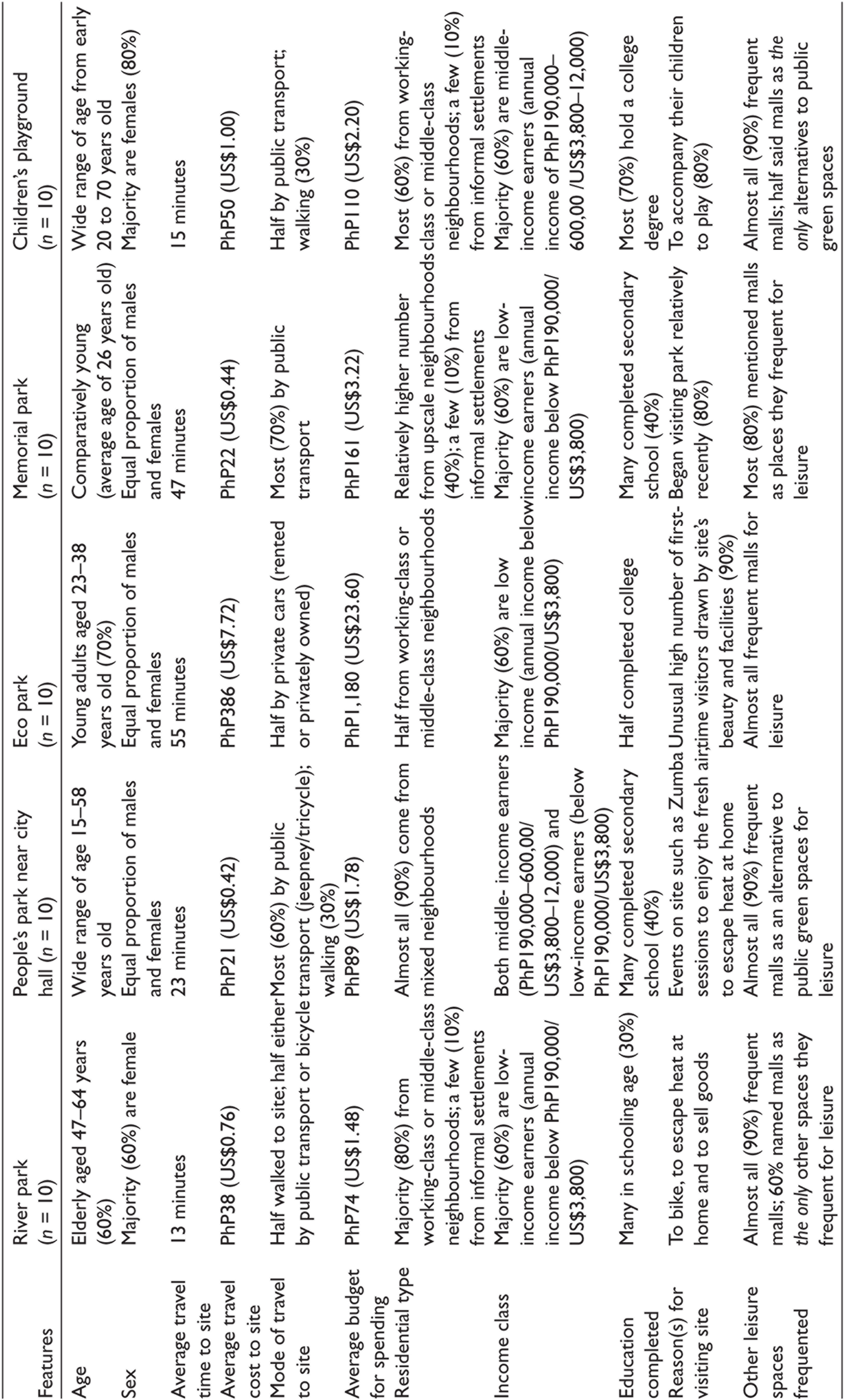
In this qualitative study, we draw from observations of five public green spaces and 50 short interviews with the users of these spaces, with the aim of uncovering the impact of spaces and material arrangements on leisure practices. In addition, observations in five malls were conducted towards the goal of understanding the socio-material arrangements in both these spaces, after at least 80 per cent of those interviewed in public green spaces mentioned that they frequent malls for leisure as an alternative to public green spaces (see Table 1, ‘Other leisure spaces frequented’). Field research was conducted from April to June 2017, which coincided with the Philippines’ summer months. This is a period associated with outdoor activities for children and families and for visiting air-conditioned malls to escape the heat. We understand ‘green spaces’ as any parcel of land or water with some level of vegetation that is essentially devoted to an open space use for the purpose of outdoor recreation (see ASSURE, Inc., 2019). We use ‘public’ to refer to ownership by a national or local government body, or by a non-government body in trust for the public, or by a private individual or organization but made available for public use or access. This reference follows Lefebvre’s (1974, p. 147) definition of public as ‘opening’ as well as Habermas’ (1989) definition of events and occasions as ‘public’ when they are open to all, in contrast to closed or exclusive affairs.
Characteristics of Research Participants by Public Green Spaces
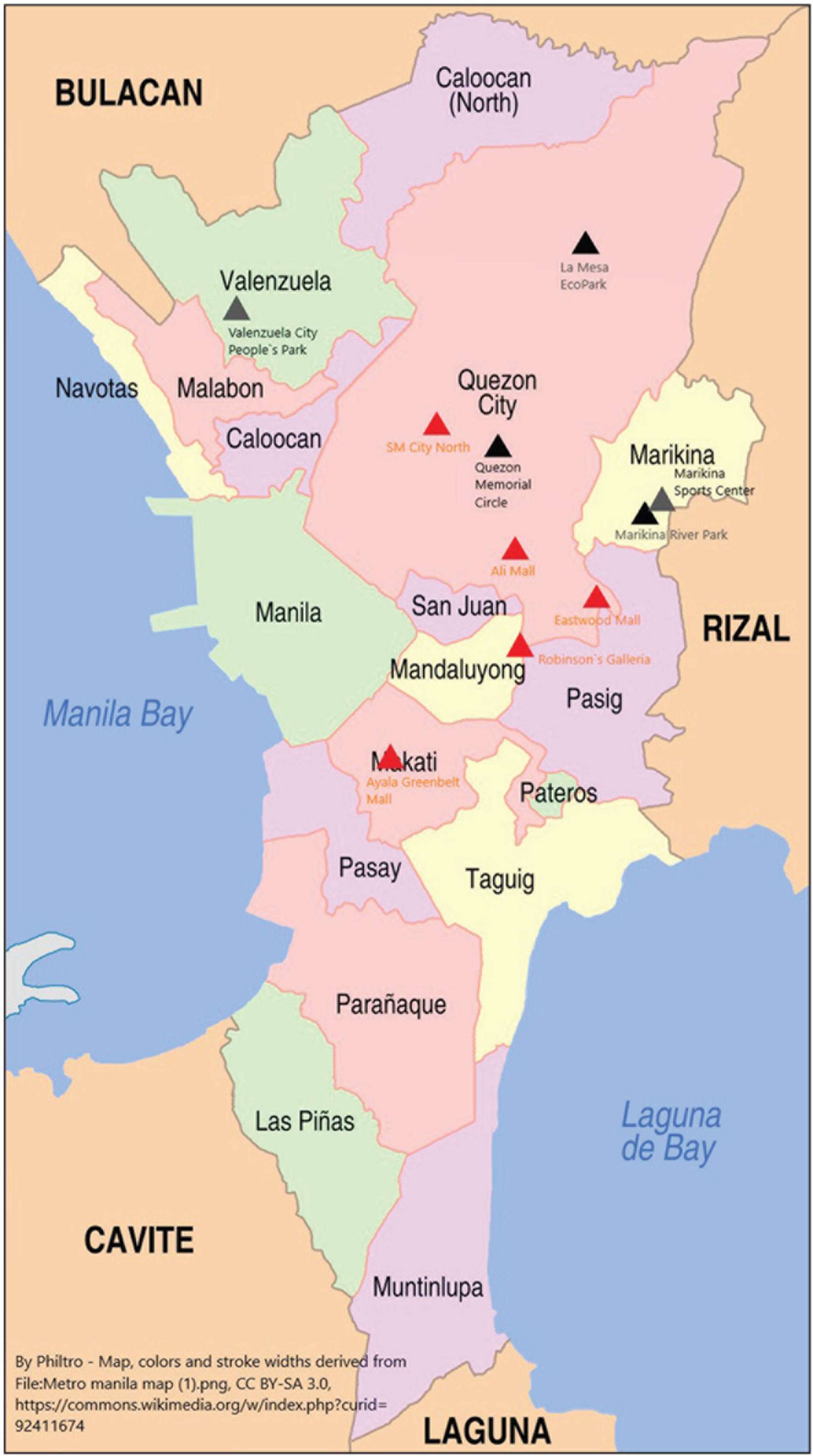
The selection criteria for public green spaces aimed to capture the diversity of such spaces: the parks are government-owned although they may be managed by a national agency, a local government unit and/or in partnership with a private foundation. They vary in size (from less than a hectare to 33 hectares), location and accessibility (from a location in the city centre and along public transportation routes to a location requiring private vehicle access), cost of entry (from free entrance to a minimal fee) and biodiversity offering (from a watershed area to a playground with minimal vegetation). The public green spaces included in this study are a river park along one of Metro Manila’s main rivers (Marikina River Park), a park adjacent to the city hall of one of Metro Manila’s cities (Valenzuela City Peoples’ Park), an eco park built on a portion of Metro Manila’s watershed area (La Mesa EcoPark), a park honouring a Philippine president (Quezon Memorial Circle) and the outdoor playground of a public sports centre (Marikina Sports Center). Similarly, the selection of the malls also aimed at capturing diversity. Two (SM City North and Robinson’s Galleria) are owned by the two biggest mall chain operators in the country, while two (Ayala Greenbelt Mall and Megaworld’s Eastwood Mall) are owned by relatively smaller mall operators. The fifth, Ali Mall, is a stand-alone mall. Figure 1 shows the location of these public green spaces and malls.
The selection of research participants likewise aimed at capturing the diversity of park users, differentiated by age, gender, socioeconomic class and type of space usage. In qualitative studies, this form of sampling works with initial ideas; in this case, from observations and literature on who are the users of public green spaces. It is aimed at explaining how and in what ways diverse groups of people experience such spaces (see Strauss & Corbin, 1998). This research question does not seek to substantiate any statistical analysis nor a representative sample of Metro Manila’s public green spaces and population; instead, it aims to account for the diversity as well as the typicality or exemplarity of actors and activities.
Table 1 demonstrates how public green spaces differentiated by their material affordances such as location and facilities are used differently by different individuals and groups.
A Tale of Socio-materiality: Leisure Practices in Indoor and Outdoor Environments
In this section, we discuss leisure spaces and leisure itself as a medium and product of mutually constitutive relationships between people and the material world. In the contrasting environments of the park and the mall, the material arrangements that are socially constructed allow for some forms of leisure activities and deter or prevent others.
Metro Manila’s Hyper-conditioned Environments as Leisure Spaces
Malls are thriving spaces in the Philippines. They offer comfort, security and increased opportunities for leisure (e.g., watching movies, bowling, ice-skating, arcade gaming, mall-organized events), alongside many conveniences. Malls are located along major thoroughfares or the light rail transit system and have parking facilities virtually guaranteeing a parking slot. They are central locations for accessing public services, enabling one to file taxes, renew driving licenses and passports and pay utility bills. Remittances, which play a major role in the economic livelihood of many Filipinos, can easily be sent or received inside malls. Hospitals and clinics likewise maintain branches in malls. All malls contain numerous ATMs and house branches of major banks. Even the highly influential Roman Catholic Church offers Holy Masses in malls on Sundays. Childcare services are available for the young, while parents engage in shopping, eating or entertainment.
Philippine malls are entirely climate-controlled, with temperatures and humidity levels set throughout the day. ‘To go malling’, is a verb in Filipino, which is as much about shopping as it is about experiencing the artificially cooled air of malls. Given the high cost of unsubsidized electricity in the Philippines, air-conditioning in homes is used sparingly; malls thus become spaces where air-conditioning is experienced at no direct cost (Sahakian, 2014). Moreover, malls not only shield customers from soaring heat during the summer but also from torrential rains during the typhoon season. Malls are usually heavily reliant on artificial lighting as well. Artificial lighting is used to create a sense of timelessness, independent of day or night, and promotes a culture of consumerism by skilfully creating the desired effect, be it ‘cosy’ with warm light or ‘uncomfortable’ with cold light settings for higher turnover of goods (as is the case in fast food outlets). The permanent playing of music or announcements is also intended to create an environment conducive to consumption. Some retail outlets even use the sense of smell by releasing artificial aromas into the air, suggesting freshly baked bread or freshly ground coffee beans to entice consumption.
Leisure practices in malls could only conform to the highly sanitized and hyper-controlled environment. Control already begins at the entrance, where all mall visitors and their bags are searched for banned objects (e.g., weapons or drugs). While these search checks are usually quite superficial, they nonetheless represent a distinction between indoor and outdoor spaces and reinforce a sense of security. People in malls are permanently watched over by security guards or CCTV (closed-circuit television) cameras, representing a safe and secure environment, in contrast to the outside world where muggings and pickpocketing, while not exactly rampant, do frequently occur. Begging, soliciting and lounging on floors and staircases are almost completely absent inside the mall. Likewise running, shouting and other conspicuous behaviours are prohibited.
Inside the malls, leisure is entwined with purchasing. Quite apart from the myriad psychological ‘tricks’ that retailers use inside their stores to make customers stay longer and spend more, everything present or absent in a mall has been carefully planned by highly skilled experts and professionals towards stimulating an environment of consumption and spending. The large-scale absence of free seating facilities (e.g., benches) is not an oversight, but intentional to encourage tired shoppers to sit down in a restaurant or food court and to subsequently spend money there.
Public Green Spaces as Leisure Spaces
Public green spaces differ from the hyper-conditioned malls as they reflect more ‘local’ and ‘natural’ qualities than the latter. They are usually green spaces with different tree species, from bigger trees offering shade in larger parks to more ornamental plants and medium-sized trees in smaller parks. If existing, lawns are partly covered with carabao grass, a species that is easy to maintain, or by a faux grass matting. Decorative elements include flower gardens, ponds usually with koi carp, gazebos, bandstands and artworks. Dancing fountains, with water and light displays set to music, and which are in operation in the evenings, are popular elements. Outdoor fitness equipment and running and biking paths are also available in most parks and used by people of all ages. The playgrounds, set with rubber matting, have slides, swings and bars installations.
The limited illumination and security in parks, as compared to malls, mean that some norm-breaking behaviour such as public displays of affection, sleeping, smoking and vandalism are practiced in public green spaces with little to no fear of being reprimanded. This limitation also enables the presence of the homeless and street children. The activities in public green spaces are usually limited to the availability of natural light. Although some public green spaces never close, it is a convention to leave just when the sun starts to set—perhaps for safety and security issues. Moreover, unlike visits to malls, users of public green spaces have to consciously consider the weather in deciding to come to these spaces. Most outdoor spaces have poor drainage system resulting in large puddles and flooding of certain areas when it rains. Roofed-over areas are limited and usually only include the restaurant and commercial areas and, if available, amphitheatres, stages and pavilions.
Our study’s inventory of the leisure activities in public green spaces suggests an overlap with those in the malls. Nonetheless, low social-density leisure practices, or practices done alone without social contact with others (Rojek, 2005) seemed to be done only in public green spaces and encouraged by certain material arrangements. These include sitting around and related activities (e.g., reflecting, resting, sleeping, reading, eating) and are facilitated by the provision of park benches, picnic tables, pavilions, senior citizens’ gardens, chess and checkers tables and open spaces. The same material arrangements enable high-density leisure practices such as hanging out and other related activities (e.g., picnicking, singing, group rehearsals, discussion of political and religious topics). Another leisure practice that is supported by the material arrangements in public green spaces is eating ‘street food’, and buying items such as picnic mats, balloons and sun visors sold by street vendors.
Using public green spaces requires competences and skills related to class and social capital. Indeed, aside from the weather, an equally important consideration in deciding to visit outdoor spaces is mobility cost (see Table 1, ‘Mode of travel to site’). Park users usually come from areas in the immediate vicinity of the park which means lower or no expenditure on transportation. Corollary to this, parks that are near the city hall and along public transportation routes welcomed more visitors from the lower-income groups. In comparison, higher-income park users were more likely to visit the eco park in a more peripheral location; more than half of the research participants came to this site with private cars.
Public green spaces offer the view of sunsets, trees, expansive spaces, quiet surroundings, pleasant smell and clean breeze offered by parks. Almost all research participants had no problems with being in a non-air-conditioned environment, primarily because of the fresh and cool air and the absence of stress. In public green spaces, leisure is mainly characterized by the absence of social pressure to spend, dress up or leave for the next user. They allow people to appreciate nature; engage in meditation and being alone; appreciate art; be in good terms with others especially family and friends; participate in public life; and enjoy interacting with plants and animals. Similarly, fountains, art installations, trees and the sunsets make for compelling subjects of photography, and highlights appreciation and enjoyment of nature and the norm of sharing; in this instance, through the posting of experiences on social media.
Leisure Practices and the Forging of Belonging
The notion that materiality has affordances and constraints suggests that the perception of materiality (e.g., lights for security, infrastructure for weather protection, equipment for various activities) will either enable or hinder individuals to carry out goals that are important to them. It implies that new forms of togetherness are structured by an individual’s possession of economic, social, cultural and symbolic capital, in relation to what socio-material arrangements are available. When individuals are able to mobilize cultural capital along with other forms of capital, they can make boundaries of the social, set by leisure spaces, permissible. This, in turn, will allow new forms of belonging amid three significant divisions: those across gender, generation and class, as seen in Metro Manila’s public green spaces.
First, public green spaces in the study are generally accessible to both men and women and bear no signs of a significant gender segregation (see Table 1, ‘Sex’). Both men and women feel equally safe and comfortable, being in groups or alone, in the parks. Moreover, risks in certain areas of the park (e.g., remote areas, areas with dense tree covering) and during specific times of the day (e.g., early morning, late evening) were mentioned by both men and women research participants. The inceptive dissolution of marked gender differences in the use of public green spaces confirms the necessity of addressing unequal gender relations in the public spaces where women actively take part in public life (Lachenmann, 1999). Furthermore, the passage of the ‘Safe Spaces Act’ (Republic Act 11313) in 2018 which aimed to address sexual harassment to include public spaces and beyond those committed in the context of unequal power relations recognizes the work that still lies ahead for the safety of women and girls in public spaces. This is because the passage of the law is quite different from its implementation.
Second, the wide age range of research participants shows how material affordances help in overcoming generational differences in the use of public green spaces (see Table 1, ‘Age’). Senior citizens’ gardens and children’s playgrounds are as important as the walking, jogging and running paths to meet the diverse needs of the youth and families, with the latter prominently visiting public green spaces for bonding, celebrations and reunions.
Finally, mitigating perceptions of class differences are significant in the forging of belonging. In 2015, the ‘upper income’ class comprised less than 1 per cent of the Philippine population, while the ‘poor’ and ‘low-income but not poor’ classes constituted 22 per cent and 37 per cent of the population, respectively. The lower-, middle- and upper-middle classes accounted for the rest (40%) (Albert et al., 2018). Our study suggests that outdoor leisure spaces may be neither for the very rich nor for the very poor but for the large majority between these two extremes (see Table 1, ‘Income class’ and ‘Residential type’). With pecuniary pursuits not being the main reason for maintaining public green spaces, visitors reported having a sense of equality and freedom from social pressure: that it entailed less expense than going to a mall and that one could sit down without having to spend for anything. According to one research participant: ‘When you are in the park, even if you are rich, it seems that everyone is the same’.
However, non-belonging highlights that while the aspect of commonality (as part of belonging) stresses commonness, it does not necessarily imply sameness or homogeneity. There are at least three difficulties in the (re)creation of common cultural denominators in Metro Manila.
First, most Metro Manila residents usually do not share the cultural repertoires of freedom, safety or insecurity of middle- and upper-income mall-goers. Belonging and non-belonging in public green spaces in this instance are framed by one’s circumstances. While all research participants felt that public green spaces are inclusive and welcoming to both rich and poor, as ‘this (place) does not measure your status in life’, there are those who believe that ‘no rich people come here. They don’t like public places’. This may be due to financially feasible alternatives available to them, as well as a wide-spread unease or even fear to move about in public spaces frequented by the masa (masses). There is a view that the rich have other alternatives and that ‘when the rich see travel promos, they just go to Hong Kong or Macau’.
The main draw of malls for research participants lies in the air-conditioning. Most middle-class users of public green spaces usually frequent malls during their leisure time. The tropical heat is often mentioned as a reason for the visit (‘when it’s hot we go to mall to cool down’, ‘instead of spending money on the air-con running at home, we go to the mall’). However, frequenting malls does not seem to be particularly widespread among the lower-income groups. Although a majority do go to malls, very few do so frequently and primarily for job-hunting and eating. The uneasiness towards ‘richer’ middle-class environments may be gleaned from comments regarding the inability to spend money in malls and in the quest for waiving the already low fee for the use of public toilets in the parks. A research participant said: ‘If I have my children with me, I don’t go to the mall. It’s shameful to enter if you are not dressed properly and the children point at things to buy’. While no official dress code is in place or announced, individuals visually identified as poor such as the homeless, beggars and street children are almost never seen inside malls. This suggests that such groups do not feel a sense of belonging towards the type of consumer culture put forward by malls, as opposed to public spaces.
Moreover, when asked what they prefer about public green spaces in comparison to malls, about half of research participants mentioned a feeling of freedom in a public space. Visitors who came to the park to enjoy its facilities, activities and natural offerings feel that public green spaces are safe places to be. This is mostly attributed to the presence of security guards. Remarkably, those who feel that public green spaces are not safe also attribute this to the presence of security guards, but from an opposing point of view vendors, street children and the homeless feel harassed by the guards, ‘because the security guards here catch us every night if we sleep here’. Thus, access to space can be advantageous to some but not all, and different social groups have varying access to the same spaces.
The second difficulty in the (re)creation of common cultural denominators rests on the fact that establishing a sense of belonging requires rendering boundaries of the social permissible and creating space for new negotiations and expanded meanings of commonality, mutuality and attachments (Pfaff-Czarnecka, 2013). However, by being privately owned, the valid norms in commercial spaces are independently forged by mall owners and operators. Since they fulfil many public functions, malls today can be aptly described as private spaces masquerading as public. Here, consumers are encouraged to engage in what Veblen ([1899]1953) termed ‘conspicuous consumption’, or a form of leisure and spending that is designed to communicate pecuniary strength and social position. In this highly sanitized and hyper-controlled environment, forms of democratic discourse and dissent such as demonstrations, banners and flyers, among others, are conspicuously absent and would indeed be immediately suppressed by the omnipresent private security guards. In an urban environment where the public square has been replaced by the private mall, where will political dissent find a place to express itself? Worse, the lack of visible social mix with its deliberate exclusion of all forms of social inequality (e.g., beggars, homeless, street children) fosters a potentially dangerous isolationism among middle-class Filipinos as they move from one bubble (gated subdivision) via another bubble (private vehicle) to yet other bubbles (air-conditioned workplace or mall).
Third, the social boundaries and norms imposed by malls are unchallenged and are instead being reproduced in public green spaces. Responses to the question on how to bring more people to public green spaces comprise a wide range of proposals: from adding more facilities and activities (e.g., public toilets, trash bins, exercise equipment, better lighting, more CCTV cameras, bazaars, playgrounds, rides, zoos, volleyball courts, skating parks, swimming pools) to improving their overall appearance. Many of these suggestions would make public green spaces resemble a mall rather than a park, and approximate what Ritzer (1999) describes as a disenchanted world’s constant need for enchantment. As public green spaces start to entertain private elements by developing smaller, inner parks that charge a certain fee, or by renting out more commercial spaces, they begin to resemble consumerist private spaces where one’s presence is justified by the amount of money spent. It is also in this light that ‘green retrofitting’ (Dunham-Jones & Williamson, 2009), which has been applied by some Metro Manila malls, is to be assessed. While the ‘earlier’ mall types of the 1980s and 1990s are decried as boring enclosed boxes, newer malls are generally praised for bringing in nature and providing public squares and parks within their grounds. Yet, as much as the environment of a mall may now include rooftop gardens and more communal spaces, it is, in the final analysis, as artificial and hyper-controlled and curated as any other mall in the country. After all, the mall is not a public space at all but wholly private and commercial.
There are, nevertheless, grounds from which to (re)create common cultural denominators towards a sense of belonging together and to the metropolis. Amid the green retrofitting of malls, the vast majority of research participants continue to value the uniqueness of public green spaces. Leisure has a sensuous dimension that requires being-in-the-world and the various conditions and circumstances that go with it (Rojek, 2005). The natural (i.e., breeze, morning and afternoon sun, sunset, shady trees) and the material (i.e., benches, space) offerings of public green spaces, which cannot be found in malls, support leisure activities ranging from meditation to hanging out in groups. Belonging that develops out of attachments to the outdoors, healthy lifestyles, personal development goals and ecological values also reinforces the emotional character of leisure activities. Thus, park visitors said they would feel sad if the public green space that they are using was suddenly taken away from them. One park user regretfully observed: ‘It’s sad that it [park] used to be very big but it is now very small and many trees were cut’. Most would regret the loss of beauty and the loss of trees and dread the worsening pollution (‘In the city, it’s not very happy. There’s pollution’.). Related to this is the sense of nostalgia: in four out of five research sites, more than half of the visitors used to frequent public green spaces in their youth. All research participants were also in favour of more people accessing public green spaces in social solidarity: for others ‘to see and enjoy the beauty of the place’ and as an affordable location for ‘those who can’t afford to go to the mall’.
All research participants put their trust in the government to preserve public green spaces. They expressed confidence that the public green spaces they are using will not disappear. Some based their optimism on the fact that the land on which the space is located is government property that cannot easily be sold, while some foresee massive protests to counter any commercial enterprises. No one among the research participants would even consider what could possibly replace the park in the future. Indeed, treating public green spaces as a shared resource in which the community has interest, inevitably forges a sense of belonging. The revitalization of the citizen-state contract wherein park users put their trust in the government for the continued existence of public green spaces hews closely to what Arendt (1958) depicts as the proper mark of the public realm: its claim to permanence. In a metropolis where public green spaces are constantly being threatened by capitalist interests and government need for buildings, trust in the citizen-state contract is a sense of belonging unexpectedly enabled by the precarity of these spaces.
Conclusion
Leisure spaces are among the most important social spaces of belonging. ‘Belonging’ has been conceptualized in terms of ‘inclusion’ or ‘exclusion’ and ‘fitting’ or ‘not-fitting-in’. This enquiry into belonging through leisure in rapidly urbanizing cities highlights the role of socio-materiality. In leisure spaces, the sense of belonging is produced by the relational and dynamic nature of the human and material agency. In other words, the (re)configuration of the materiality of a leisure space, enacted according to the skills and competencies of its users, determines, to a large extent, the chances of belonging to that space.
The present study confirms that material agency frames human activities associated with belonging. The sharing of common characteristics, values and practices along diacritical markers, such as class through lifestyles, will not thrive in a space which is exclusionary and isolates one group from the wider society. Malls decontextualize the built environment from its natural and cultural settings. The human agency of individuals visiting the mall for leisure and the material agency of the mall have been captured by commercial and private interests to produce specific realities. Thus, public green spaces, which are marked by fewer pecuniary pursuits, limited behavioural and access control, minimal environmental conditioning and a significant tolerance for different people using space for purposes other than leisure (such as street vendors and homeless people), provide more opportunities to exercise human agency. They also forge better connections among people, nature and the metropolis.
Yet, as more malls seek to incorporate aspects of outdoor spaces, more public green spaces are simultaneously adopting elements of malls: more green-retrofitting for the former and more technocratic measures for the latter. For better or worse, the adoption of the other’s phenotypes emphasizes the dynamic nature of leisure and belonging: their constitutive socio-materiality carries the possibilities for creating new spaces for living together. In this sense, the extremely multifunctional Philippine malls today may indeed be closer to Victor Gruen’s original vision of the mall as a community centre than any of their counterparts in the world. Still, their extensive use of panoptic strategies and conditioning techniques and, especially their near-complete monopoly of leisure, are serious hindrances to generating a sense of belonging in the city. In metropolises such as Metro Manila, hyper-conditioned environments should only be one among several leisure options. Corollary to this, public outdoor spaces must be preserved as the means through which diverse groups of people fit into the metropolis.
Footnotes
Declaration of Conflicting Interests
The authors declared no potential conflicts of interest with respect to the research, authorship and/or publication of this article.
Funding
The authors acknowledge with much gratitude the funding support from ETH Zurich and the Swiss State Secretariat for Education, Research and Innovation. Czarina Saloma, in particular, is grateful to the Alexander von Humboldt Foundation for a research fellowship at Bielefeld University.