



Abstract
The relationship between local economic development and urbanization is a vital policy concern across the world, especially in the developing countries. The local economy exhibits enormous potential in the process of transformation of a rural area into an urban one. Based on the theoretical discourse of planetary and subaltern urbanization, this article explores the role of the local economy, even in the form of banal activities, in the process of urbanization of the Indian Sundarbans, a highly vulnerable part of the Ganga–Brahmaputra delta. For this study, we have relied on two facets of local economy—that of the local market centres, and the household economy of small towns. In the local market analysis, we have analysed market details such as the growth story of entrepreneurs, the function of shops in providing services and in developing their own profit level for sustenance and further growth. Household economy has been analysed from the perspective of changes in the occupational structure, nature of employment and household income in order to understand the surplus generation and reinvestment of the same as the local capital. This article is based on an intensive field survey that used the stratified random sampling method. A total number of 240 households and 100 shops have been surveyed from four towns. Both quantitative and qualitative methods of data collection have been followed. The article argues that the local economy plays a key role in the urbanization process of the Indian Sundarbans, as the regional economy is gradually shifting from the farm to non-farm activities.
Introduction
Economy is generally defined as the interconnected system of production, exchange, distribution, trade, and consumption of material and non-material resources (Krugman & Robin, 2017). In addition to this traditional definition, the economy of an area includes a variety of aspects such as consumer behaviour, competition, infrastructure, human capital, occupational structure, income determinants, and so on (Spiegler, 2008). Scottish philosopher Smith (1776) has described economy as a condition of wealth, and he was the first to state that the main reason behind the development of a nation’s wealth is rooted in its economy. Economy varies from place to place and has a unique feature that makes each economy different from the other. However, there is a worldview of the aggregate economy that connects international businesses across the borders. 1 Based on these two approaches, economy is divided into two parts, namely, the global economy and the local economy.
The significance of the local economy was first highlighted by the neoclassical economist Marshall (1890) in his book Principles of Economics. His work emphasized the day-to-day business of individuals and bridged the gap between individual actions and society as a whole. The domain of the local economy encompasses several disciplines such as Economics, Planning, and Marketing. The local economy can be defined as a regional state of economic transactions within a specific geographical area (Salder, 2021). However, at present, globalization, competitiveness, and entrepreneurship are having a huge impact on economic development, irrespective of their scale—local or global. In this regard, Robertson (1995) and Swyngedouw (2004) have introduced and popularized the term ‘glocalization’ 2 to emphasize both globalization and localization. Depending on the level of connections we can still locate where the local remains local without being connected to the global. This is the dominant case as observed in the Indian Sundarbans and has attracted our interest in understanding the local economy and its linkage with the fast growth of urban phenomena in this region.
The local economy investigates the production, consumption, and distribution of goods and services based on regional diversities instead of aggregate performance. In 2007, the Cities Alliance 3 had introduced the local economic development (LED) indicators to assess the competitiveness of economic considerations. Especially in developing countries, LED acts as an approach for the economic improvement of the local area (Cities Alliance, 2007). This LED is primarily focused on improving the local conditions through effective economic activities, infrastructural development, and planning. However, the overall goal of LED is to ensure a sustainable economic future and bring about social well-being to a depressed local area (World Bank, 2006). UN-Habitat (2013) has described LED as a participatory and inclusive process that could lead to economic solutions. They have described the local economy as a bottom-up approach that generally links urban, suburban, and lagging rural areas to improve the condition of the urban areas and reduce outward migration. The government, civil society, and the private sector are the three main drivers of local economic transactions. Geddes and Erskine (1994) have identified five key elements of the local economy in an area. These are small-scale firm enterprise, local labour market, community enterprise, inward investment, and income support. However, there are no universally accepted assessment indicators for the local economy in urban areas. From the above perspectives, it can be argued that LED can transform a rural area into an urban one and it can be claimed that it has the potential to accelerate the process of urbanization.
Whether living in urban or non-urban areas, we all are under the impact of the process of urbanization today. Since the middle of the twentieth century, a universal form of urbanization has begun and the civilization of the twenty-first century will be determined by the quality of life in urban areas (Harvey, 2014). The notion of worldwide urbanization was first conceptualized by the French philosopher Lefebvre (1970/2003) in his book The Urban Revolution. Lefebvre had conceived the idea that society has been completely urbanized, from the city to urban society, where the urban fabric has persisted not only in the built environment but all over the country where it has spread. In particular, over the last three decades, we have been experiencing a new form of urbanization called regional urbanization that is spreading the world over, leading to the end of the metropolis era (Soja, 2011, 556). In a similar vein, Brenner and Schmid (2014) have theorized the concept of planetary urbanization to explain the formation, transformation and evolution of the urban phenomena in the current twenty-first century. They have characterized urbanization as a socio-spatial process across the planet that blurs the notion of the rural-urban divide. The process of planetary urbanization is triggered by a range of factors such as globalization, capital accumulation, LED, and so on. From a different perspective, Denis et al. (2012) have introduced the concept of subaltern urbanization to create an alternative paradigm that focuses on small and medium towns outside the metropolitan shadow. Subaltern urbanization refers to an unseen and often unspoken process of urbanization that conceptualizes the autonomous growth of settlements generated by the markets and historical forces, at times without the intervention of the larger economy (Mukhopadhyay et al., 2017).
Based on the theoretical framework of both planetary and subaltern urbanization, the present article examines the condition of the local economy of selected towns to comprehend the process of urbanization in a highly vulnerable area. In urban economics, the local economy is considered as one of the major components for analysing the economy of cities. The firm and its production, the local market, the labour market, and the households are the four main components of the local economy. The micro-economic analysis of the local economy addressed in this article focuses primarily on the local market and household economy. The article also tries to explore the role of local economy in the process of urbanization. To make our understanding more precise, the analysis of local economy has been done on the basis of its two components: (a) the local market and (b) the household economy.
Linkage Between Local Economy and Urbanization
Jacobs (1969) in her book The Economy of Cities has described how cities begin to prosper and how a new work starts with an emphasis on local economic stimulation. She has stated that a city cannot survive without an economic stimulus. Harris (1990) has examined the per capita GNP and level of urbanization in 120 countries and discussed why this connection exists between economic development and urbanization. He has considered the labour markets responsible for linking economic development with urbanization. Initially, economic development increases the factors of production that lead to changes in the structure of the economy and the workforce. These radical changes in different sectors create regional disparities and widen the territorial differences between the urban and the rural areas. The urban population density increases mainly due to economic development that attracts more companies and creates employment opportunities in the urban areas (Dao, 2002). Urbanization, especially in the developing countries, is the manifestation of rural economic development driven by agricultural surplus. Urbanization also has a profound effect on the economic prosperity of an area. From an economic perspective, Becker (2008) has described the urban area as a location of economic activity where scale economies are internal and localized agglomeration is external to the firm or organization that produces goods and services. Contrary to the economic view, Chen et al. (2014) have examined the relationship between urbanization and economic development over the past three decades worldwide and stated that a neutral relationship exists between them. However, at the regional level, the local economy plays an important role in the early stages of urbanization.
Krugman (1991, 1998) has also introduced the New Economic Geography model to trace economic agglomerations. He has stated that positive and negative externalities combined with economic agglomeration usually transform the farm hinterlands into urban areas. However, this agglomeration varies from place to place, aligned with the level of connectivity and integration (Fujita et al., 1999). In simple terms, the trajectory of urbanization around the world changes with the changing pattern of socio-economic conditions (Kim & Short, 2008). In the context of China’s urbanization, Bradbury and Kirkby (1996) observed that broad urbanization and competitive market orientation are the imprints of a radical transformation of the country’s economy. Gugler (2004) has comparatively examined the phenomena of urbanization in India, China, and Indonesia. He has posed the argument that the rate of urbanization was more or less the same in all the three countries in the 1960s, but over the decades the pace of economic growth has caused dramatic changes resulting in the present scenario.
Economic development and the process of urbanization supplement each other. In developing countries like India, the local economy has made a huge contribution to overall urban expansion based on suburban development. Dasgupta (2000) had examined the comparative trend of urbanization in Punjab, West Bengal, and Kerala. In that study, he demonstrated that localized endogenous development through agriculture had led to the balanced urbanization pattern in Punjab in comparison to the urbanization led by the exogenous forces in West Bengal. In 1991, after economic liberalization took place in India, the local economy gained importance along with the global economy, accelerating the pace of urbanization, especially in the peripheral areas of the metropolitan cities (Guin, 2016; Karmakar, 2015). According to the 2011 census report, more than half of the new towns appeared in the suburbs, far from the influence of the metropolitan cities (Pradhan, 2017). These newly emerging towns provide local services and act as market towns because of their connectivity and economic prosperity (Mukhopadhyay et al., 2016). However, the economy of these census towns is independent and primarily based on the localized growth of agricultural, non-agricultural, and rural household industrial activities (Roy & Samanta, 2018). From the above analysis of existing studies and their arguments, it can be argued that local economic growth is leading to urbanization in the Sundarbans and this article analyses that linkage through the research carried out on the local markets and also on the changes in household economies.
Objectives and Methodology
The main objective of this article is to investigate the role of the local economy in the urban expansion of vulnerable areas such as the Indian Sundarbans. The study specifically examines the role of the local markets and the household economy in the growth and development of the selected urban centres. This article also tries to discern the function of the local markets as urban service centres. To address these research objectives, a mixed methodological approach has been incorporated to conduct the present study. Both quantitative and qualitative data have been collected to analyse the condition of the local economy. Initially, a comprehensive review of literature was done based on key factors such as the local economy, the Indian Sundarbans, local market, household economy, and urbanization; these further helped to identify the research objectives. Following the pilot survey, the study area was selected and the questionnaires framed. To meet the research objectives, the entire field survey was divided into two sections, namely, the household and the market. A total of 60 households and 25 shops from each urban unit were surveyed using the stratified random sampling method. Finally, 240 households and 100 shops from the central market areas were surveyed from the urban areas of the Indian Sundarbans. This survey has been conducted through structured and semi-structured questionnaires.
Study Area
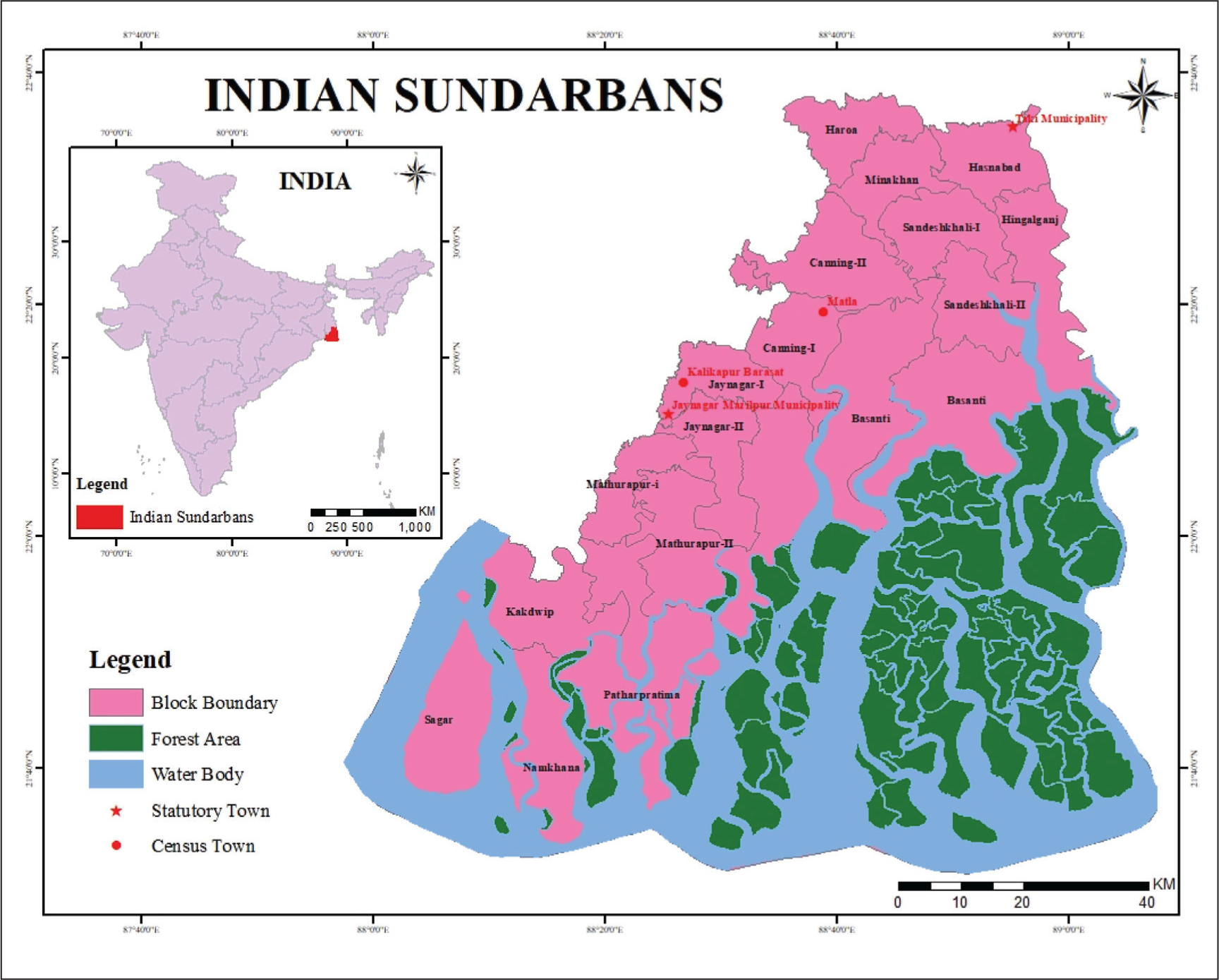
The Sundarbans is located on the northern apex of the Bay of Bengal (Bandyopadhyay, 2019). About 40% extends over West Bengal, while the remaining 60% lies in the Khulna division of Bangladesh (Chowdhury et al., 2021). The mangroves, divisional reserve forests, tiger reserves, and sanctuaries are mainly located at the southern end of the Sundarbans. Besides the river, forest, and wildlife the Sundarbans have also been known for human habitation since the eighteenth century and is now a rapidly growing populated region (Jalais, 2007). It covers a total area of 9630 sq km, out of which 5366 sq km (55.72%) is built up (Sahana et al., 2019). A total of 19 blocks fall within the boundary of the Sundarbans. Four towns, namely, Jaynagar Mazilpur, Taki, Kalikapur Barasat, and Matla have been selected for the study (Figure 1). Of these, two are statutory towns and the remaining two are census towns.
Location of the Indian Sundarbans Showing the Selected Census and Statutory Towns.
Rationale Behind the Selection of Study Area
According to the 2011 census, the Indian Sundarbans has two municipal towns and 27 census towns. For the selection of census towns, the method of Index Value has been used to conduct a comparative analysis. The formula for calculating index value is: 1−(Maximum−Absolute)/(Maximum−Minimum). A total of seven parameters have been chosen to compute the urbanity of each of the census towns. The population size, growth rate of population, area, density, percentage of non-farm activities, distance from the nearest state highway, and literacy rate have all been taken into consideration for comparative analysis. Each index value has finally been added for a particular town to make a composite score accordingly (Table 1). Index value 1 or near 1 signifies higher weightage and 0 or near 0 is vice versa. However, after examining the location of these census towns, it is found that almost all of them are located in two clusters. The first one is spread over Canning-I, Canning-II, and Basanti blocks, whereas the second cluster extends over Jaynagar-I, Jaynagar-II, and Mathurapur-I blocks. From each cluster, one census town has been selected for the purpose of the study.
List of Census Towns as per Composite Score.
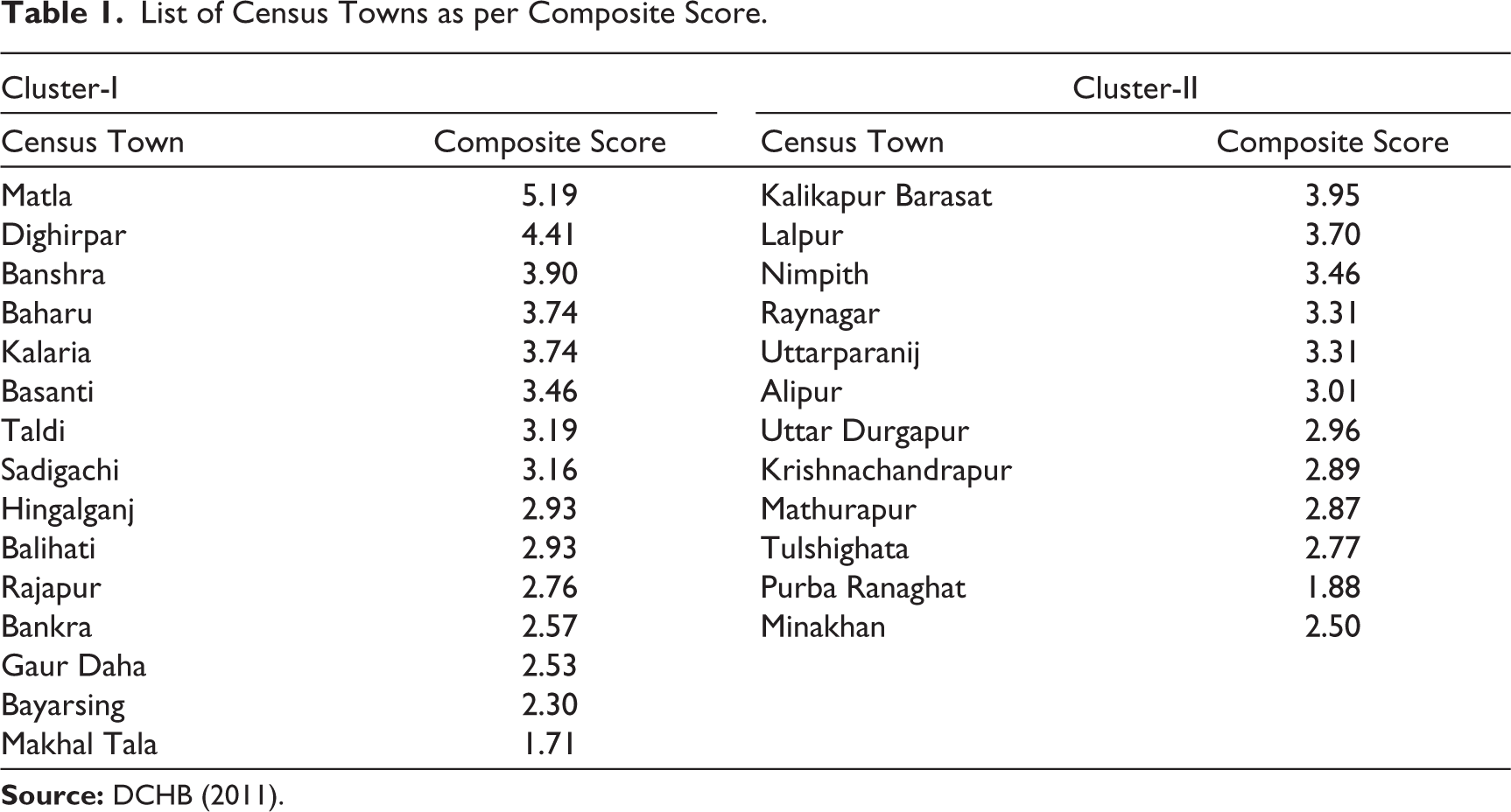
From the first cluster, the Matla census town in the Canning-I block represents the highest urbanity not only in cluster-I but also among all the 27 census towns. The composite score of Matla is 5.19. From the second cluster, Kalikapur Barasat ranks first in terms of urbanity, and its composite score is 3.95. Henceforth, these two census towns, Matla and Kalikapur Barasat, have been selected for the purpose of the study. In addition to census towns, there are two statutory towns in the Sundarbans, Jaynagar Mazilpur, and Taki. Jaynagar Mazilpur is located between the Jaynagar-II and Mandirbazar blocks of the South 24 Parganas, whereas Taki is located in the Hasnabad block of the North 24 Parganas. These towns are relatively smaller in size, having 14 wards in Jaynagar Mazilpur and 16 wards in Taki. Both Jaynagar Mazilpur and Taki have been selected for the study.
Market as Proxy of Local Economy
A market refers to a mechanism or institution where demand and supply meet each other and transactions are made (Callon, 1998). Based on geographical distribution, markets can be global, national, regional or local. A local market is a market that prioritises the use of local land, labour and capital based on proximity (Lambin, 2014). The economic system of the local markets and all its aspects such as production, distribution and consumption are governed by market forces (Klein & Leffler, 1981). On the one hand, market forces are guided by the law of demand and supply. On the other hand, prices of goods and services also affect market forces. Typically, these market forces initiate the urban development of an area (Sudianto, 2008). In order to understand how urbanization takes place, it is necessary to analyse the function of the local markets as centres of collection and distribution of goods, which plays a significant role in the LED of an area. Markets are considered the centres of economic transaction of an area because most exchanges take place there. 4 Generally, a local market is a place where sellers and buyers come together to transact sales and fulfil their daily needs for commodities (Ménard, 1995). In this article, the local market is considered as a proxy of economic transactions and flow of goods. The study mainly focuses on the four local urban markets of the Sundarbans, namely, Jaynagar Mazilpur, Taki, Kalikapur Barasat, and Matla.
There are a variety of shops in the local markets but most of them are linked to daily necessary goods and services and are banal in nature (Mukhopadhyay et al., 2017). The shops are of four categories: general shops, restaurants, hotels, and vendors. However, within the categorization of general shops, there are also various types such as those supplying groceries, medicine shops, garment shops, and so on. Out of the total, there are 44% shops, 25% vendors, 16% hotels and 15% restaurants. Out of these four urban areas, the highest percentage of shops and vendors is found in Kalikapur Barasat and the highest concentration of restaurants lies in Jaynagar Mazilpur, while most of the hotels are located in Taki. Taki being a tourist place caters to a relatively higher number of hotels. The majority of restaurants and shops are located in the central part of the towns whereas vendors and hotels are found in the peripheral areas. These shops in the towns act as local service centres and serve not only its population but also many people beyond the boundary of the town. Besides, these shops generate employment for local people to enhance the growth of the non-farm sector and the agglomeration starts with more local demand for services from the towns and the surrounding rural areas. The agglomeration of the commercial sector is based on local demand and feeds into the growth of regional urbanization.
The data on shop ownership has helped us to understand the nature of local entrepreneurship—who all are investing and how these investments are adding up to the local economic growth. About 71% of the total surveyed shops are in the premises of the owners’ land and the remaining 29% are in rented places. Out of these four towns, Kalikapur Barasat has the highest percentage (88%) of people who have their own shops. Taki has the highest rental shops (40%) due to the presence of numerous hotels. The shop ownership profiles of Matla and Jaynagar Mazilpur are more or less the same. The cost of land in the Taki municipality is relatively higher than the other towns. As a result of this Taki municipality has the lowest shop ownership as most entrepreneurs have established their businesses in rented places. The source of initial investment also provides an idea about the nature of LED. Around 49% of the entrepreneurs have invested in the shops from their own surplus funds without borrowing money from outside sources such as banks or moneylenders. About 27% of the shopkeepers have raised the initial cost from relatives or friends, and the remaining 24% are solely dependent on loans from moneylenders. Thus, these figures indicate how local surplus is being circulated and invested in the localized development of the non-farm sector, leading to urban growth.
The profit of a business firm gives an idea of the level of surplus generation from that particular firm. If the level of profit is high in one business, there is a chance of replication of a similar activity in the region. The average profit level varies from shop to shop. Depending on the level of margins, we have found roughly three categories, namely, less than ₹5,000, ₹5,000–₹10,000, and more than ₹10,000. Around 14% of the surveyed shops earn less than ₹5,000, 46% earn between ₹5,000 and ₹10,000 and the remaining 40% earn more than ₹10,000. The surplus ensures the financial security of shops and allows people to continue and expand their businesses. It has been noted that the general profit margin has increased considerably over the last 10–15 years and therefore, agglomeration economy is working with more and more business houses in the region, having a multiplier effect on economic growth as well as on urbanization.
In an economy or business, an entrepreneur is the driver who runs the business and customers are the participants. In most cases, both entrepreneurs and consumers meet in a market and exchange their goods and money. As a result of this economic transaction, economic development is gradually taking place in the Sundarbans. The location of an entrepreneur’s residence describes whether the entrepreneur is a resident of the town or has come from another place. Most of the entrepreneurs, about 78%, are local and are residents of the respective towns. The remaining 22% are outsiders and they commute to reach their shops. Non-resident entrepreneurs rely primarily on public transport, especially on trains to reach their stores.
A large number of shopkeepers have stated that the majority of the customers live in their respective towns and are regular to some extent. However, some buyers come from outside to collect goods and services. Especially in Matla, some customers come from different locations to collect products. Apart from the residents of Matla town, villagers from nearby blocks such as Basanti, Gosaba, and Kultali too, visit the town for meeting their necessities. For example, grocery shops of surrounding blocks of Canning-I collect their commodities from Matla town. Besides the grocery items, it being the best fish market in the Indian Sundarbans, fish buyers from different regions are regular customers of this place. In Jaynagar Mazilpur, a large number of customers come from Kultali to access the market. As Taki is a tourist destination, tourists from different places visit this town. On the other hand, the Kalikapur Barasat market fails to attract customers from outside as it is located on the periphery of Jaynagar Mazilpur, a comparatively bigger town. In the relatively inaccessible areas of the Sundarbans, these markets are places of opportunity for stronger rural–urban interactions leading to further spread of urbanization. In the Indian Sundarbans, most of the market centres have emerged between 1990 and 2010. However, some old markets have also existed in these areas since the nineteenth century. Among the four selected centres considered in this study, Matla, Jaynagar and Taki have had established markets for a long period of time in the past, while the market in Kalikapur Barasat is a newly emerging one. However, since the last two or three decades, all these markets have been expanding rapidly and experiencing a multiplier effect.
According to the statements made by the research participants, Matla is growing due to the development of the transport sector, location of government offices, and commuting of people from surrounding blocks. Taki and Jaynagar markets are also full-fledged markets as these belong to the statutory towns and have a larger influence area. Earlier, people of the Indian Sundarbans used markets in established towns. However, with the passage of time, there has been ample advancement of the transport system in the area. As a result, new market centres are gradually being established in many remote places. These new centres act as the local growth centres from where non-farm activities are spreading in the region. They also act as service centres to cater to the demand of the local people, thus leading to a higher growth rate of urbanization. These new market centres serve people roughly within a range of 5–10 km.
Role of Local Markets in Urbanization
Markets have always been an important element in the development of cities around the world. In the Sundarbans, the local markets drive the economy and many people depend on them because these are the places where one can earn a living as well as exchange and acquire goods and services. All the commodities are gathered in such markets, which act as the centres of economic transactions with the aim of satisfying human needs. As transactions take place, a surplus is generated, which in turn attracts entrepreneurs and customers from both inside and outside of the area. Market forces, therefore, play a crucial role in triggering the process of urbanization. After the independence of India, these small markets have also gained importance because of the development of the transport infrastructure. Especially with the expansion of the district and village roads since the 1990s, they have become more and more influential and have started to function as nodal points. In addition to Jaynagar and Taki, a bunch of new markets such as Kalikapur Barasat, Uttarparanij, Raynagar, Baharu, Banshara, Kalaria, Taldi, Gaur Daha, and Makhal Tala have emerged between the 1990s and 2000s and are still continuing to emerge.
Household Economy as a Component of Local Economy
A household represents either a family or an individual and is used as a basic unit to analyse different aspects of society. The notion of household economics was first put forward by Gary Becker and Jacob Mincer in the 1960s (Grossbard, 2006). However, the concept has evolved a lot so far. Generally, the household economy of a particular family or individual describes the money-earning occupation/s of that household. Unlike the demand and supply law in a local market-based economy, household economy is governed by the decision of the household head (Kooreman & Wunderink, 1996). In a household economy, goods and services are produced by family members for themselves, and the surplus is sold in the market for profit. Therefore, household economy is not only a centre of consumption but also a source of production, which opens up opportunities for regional economic development (Bardhan & Udry, 1999). In the Indian Sundarbans, many such regional developments have taken place based on the household economy, which is briefly discussed in the following sections.
The household is one of the most important socio-economic institutions that reflect on the market economy (Gillespie, 2014). Household economy and the local market are connected in such a way that a household acts as a driving force for a market. Details of a household usually include its type and ownership. Those surveyed in this study have been divided into two categories based on field survey data and these include the pucca and the kutcha houses. The latter are made of several non-permanent materials such as unburnt bricks, mud, bamboo, tin, etc. Pucca houses are made of durable materials, namely burnt bricks, cement, tiles, etc. Among the total surveyed households in the Indian Sundarbans 83.75% (201) were pucca and the remaining 16.25% (39) were kutcha. The Jaynagar Mazilpur municipality has the highest percentage of pucca houses while the concentration of pucca houses is lowest in Kalikapur Barasat. However, most of the houses in the selected towns were pucca.
Household ownership refers to the exclusive legal right to live in a house. There are two formats of household ownership, namely, owned and rented. Most of the surveyed houses in the Indian Sundarbans, about 92.08% (221) are owned by the residents themselves. The remaining 7.92% (19) pay rent to their landlords. Out of these four urban areas, the Taki municipality has the highest number of rented houses, even though the number is relatively low. The average monthly rent for a family in these towns ranges from around ₹6,000 to ₹9,000. As each sector of the economy plays an important role, the household pattern also works together with other sectors to provide a strong economy in the area. Generally, the households select the type of preferred goods and services, create the demand for that particular product, and drive the economy.
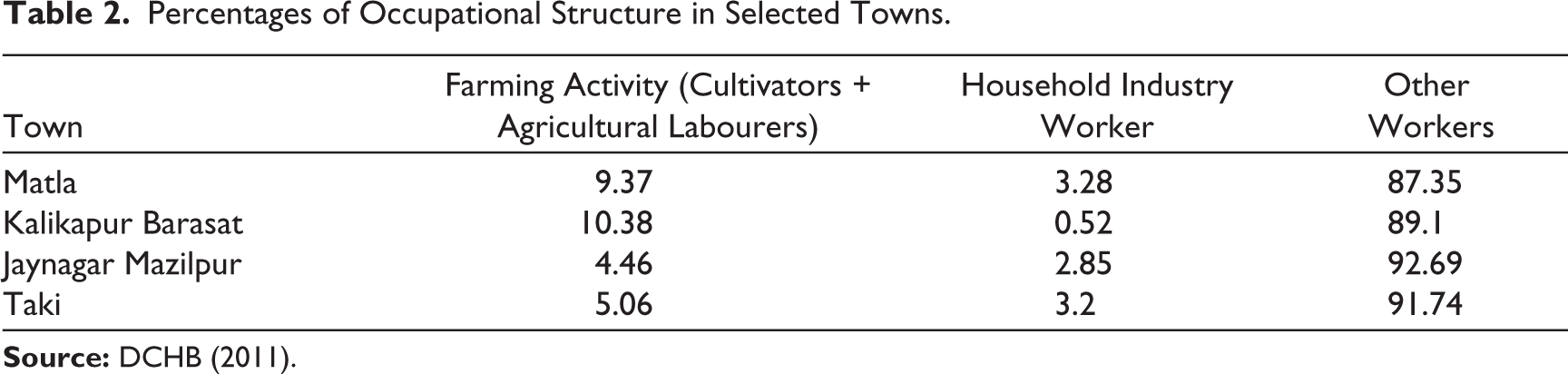
As per the census 2011 report, the occupational structure of India is divided into four categories: agricultural labourers, cultivators, household industry workers, and others. Both agricultural labour and cultivation are considered a farming activity. Other workers include government employees, factory workers, and persons engaged in business, banking, social works, and artistic activities. According to the 2011 census data, the occupational patterns of the surveyed census towns and statutory towns are more or less the same (Table 2). Based on the field survey data, we have observed six categories of occupation: cultivation, daily labour, factory work, businesses, service sectors salaried jobs, and others. Among the major occupations of the households, 24.17% are engaged in businesses, 20% in daily labour, 20% in tertiary salaried jobs, 11.66% in factory works, 8.75% in agriculture, and the remaining 15.46% are employed in other economic activities such as tailoring, driving, book binding, plumbing, etc. Among these four towns, Jaynagar Mazilpur has the highest percentage of non-farming activities, followed by Taki, Matla, and Kalikapur Barasat (Figure 2). From the field investigation, it has been observed that the occupational patterns have shifted from primary to secondary or tertiary activities. This occupational change attracts rural people to the nearest settlements that are gradually getting urbanized with better services and opportunities. This, in turn, creates a multiplier effect on the local economy leading to further urbanization.
Percentages of Occupational Structure in Selected Towns.
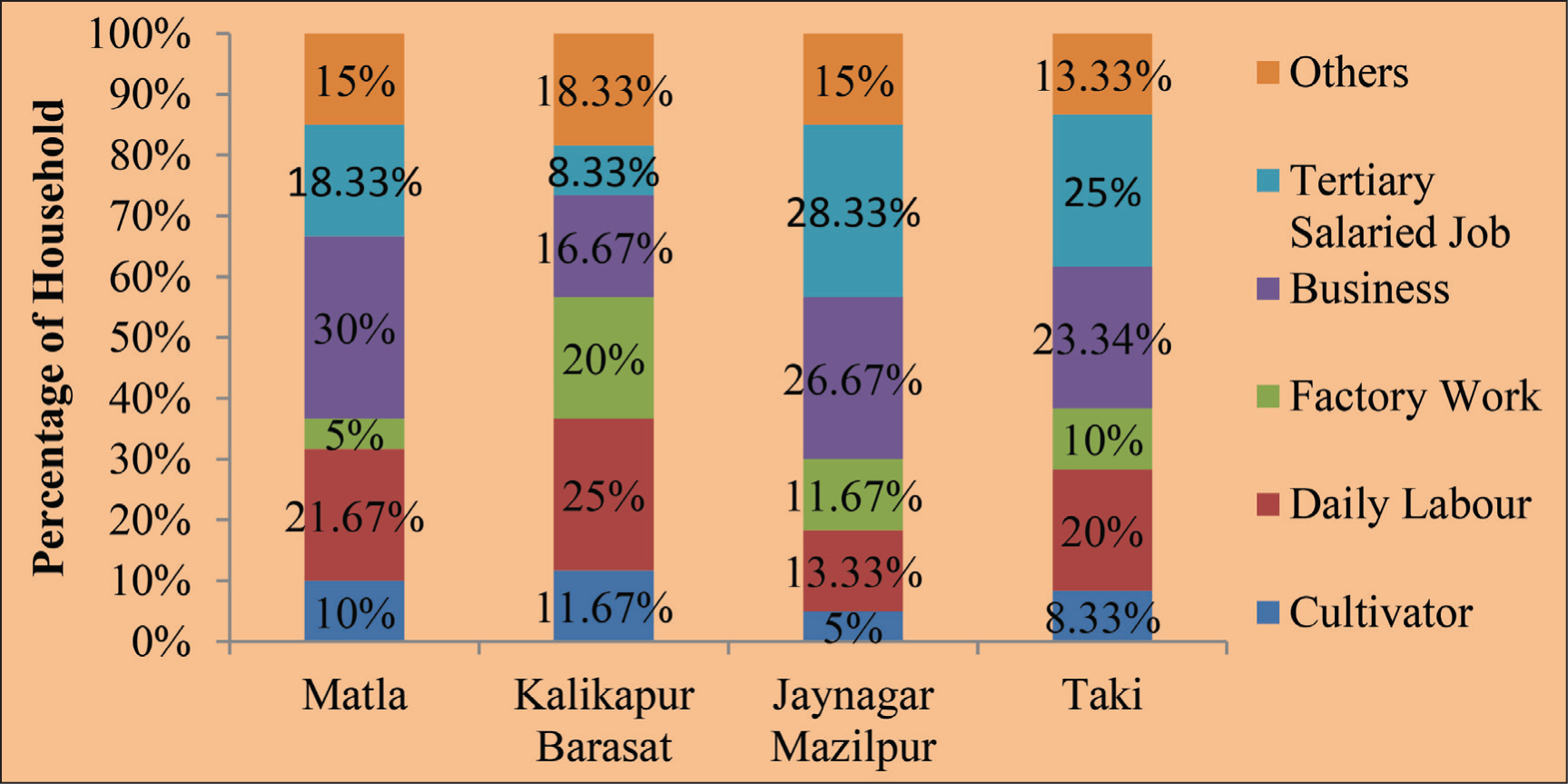
The type and nature of work is also an important component of household economics. The working detail includes all the working as well as the non-working persons in a household. A total of 1,078 people have been enumerated from the 240 surveyed households in the Sundarbans. Out of these, 36.27% (391) are workers and the remaining 63.73% (687) are non-workers. The majority of the population are non-workers consisting of children, the elderly, students, and domestic workers. Out of the total working population, 33.12% (357) are the main workers, who work securely for more than 6 months of the year. In contrast to the main workers, 3.15% (34) are marginal workers who do not get work for more than 6 months of the year (Figure 3). The share of main and marginal workers in these four towns is more or less equal. Besides creating demand, households provide human capital in the form of labour to their economy. Households exchange labour for cash, and then spend the cash to buy the commodities and services as per the family’s requirements.

In addition to the main and marginal classification of workers, the nature of economic activities describes whether a particular occupation is formal or not. Formal economic activities are generally those that are regulated by some government rules, having better pay scales and social security benefits; whereas, the informal sector includes all economic activities that are not under the jurisdiction of government rules except the Minimum Wages Act, 1948. Most of the economic activities within the precinct of the selected four urban centres are informal in nature. On an average, 80% of the surveyed households are engaged in informal economy while the remaining 20% are associated with the formal one. Despite having several drawbacks, the main advantage of the informal economy is that it provides tremendous employment opportunities, especially to the urban poor, and develops their socio-economic status.
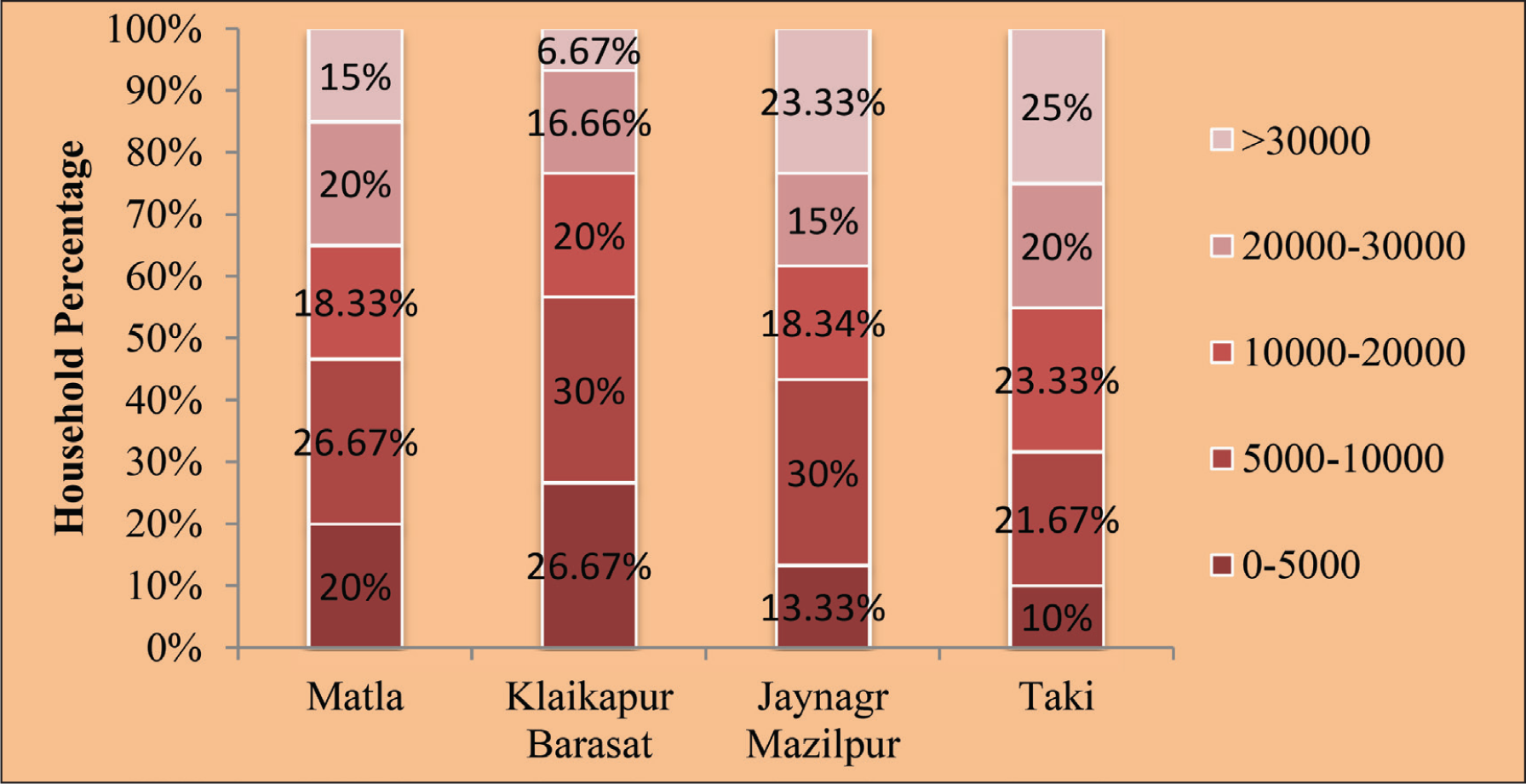
Along with the per capita income and family income, household income is also a significant measure to analyse economic health of an area or region. The household income is used as an indicator to compare standards of living between different regions. Based on the field survey data, household income varies under five categories: less than ₹5,000, ₹5,000 to ₹10,000, ₹10,000 to ₹20,000, ₹20,000 to ₹30,000, and more than ₹30,000. On an average, 27% of households earn between ₹5,000 and ₹10,000, followed by 20% who earn ₹10,000–₹20,000, 18% earn ₹20,000–₹30,000, another 18% earn more than ₹30,000, and the remaining 17% earn less than ₹5,000. Most of the households in these four towns earn between ₹10,000 and ₹20,000 per month (Figure 4). The average income of the surveyed households is ₹17,823 per month. In the Sundarbans, the average number of members in the surveyed household is around four. Hence, the average per capita income is around ₹4,456 per month. A data visualization platform called India in Pixels (IIP) has calculated the per capita income of West Bengal based on the last Economic and Statistical Report of 2014–2015. According to IIP, the per capita income of West Bengal is ₹1.15 lakhs annually (2019–2020), which means ₹9,583 per month. Thus, the average per capita income of West Bengal is much higher than the per capita income of the surveyed households. The economic health of the surveyed households in these areas is not as good as it is in other urban areas of West Bengal. However, according to some respondents, the present condition is much better than before.
Role of Household Economy in Urbanization
Besides local markets, a household’s economy also serves as a key element in the development of towns in the Indian Sundarbans. The diversification of household livelihood sources following shifting occupations from the farm to non-farm sector and changing consumption pattern as well as higher demand for commodities and services have an impact on the regional economy. From the empirical research, it is clear that almost 50% of the urban households are engaged in business or tertiary salaried employment. Many respondents have stated that the share of farming activity is declining day-by-day at the cost of which non-farm activities are increasing. Because of the increase in non-farm activities, the income of families has increased as well. This growth and expansion of urban household economies have also reduced outward migration from urban areas of the Sundarbans to other places and improved the standard of living and human capital. These changes in the economic structure, even though of a small scale, have positive impacts on the regional development and have ultimately accelerated the process of regional urbanization.
Conclusion
This article analyses the functioning of the local economy and its relationship with urbanization in the Indian Sundarbans. This study claims that the local economy plays a key role in the process of urbanization. In this region, both the local market-based economy and the household economy boost one another in a cyclic manner to improve the local economic condition, in turn accelerating the pace of urbanization. The local markets act as local service centres for the exchange of goods and services. These markets are places which connect surrounding villages and enhance the rural–urban linkage. Moreover, they also connect the entire region with the metropolitan city of Kolkata. Thus, they are the key drivers of both the regional and the local economy. Through the exchange of goods and services, surplus is generated locally, which improves the socio-economic status of the people as well as attracts customers from outside the towns. The diversification of the household economy creates demands for higher goods and services and helps to free labourers from the farm sector and enables them to find employment in the non-farm sector. By using that cheap local labour and with higher demands for goods and services, the non-farm sector and markets grow, which ultimately helps the local economy to flourish. Apart from the development of the regional economy, the development of the local economy also helps to reduce the out-migration of people from the towns by increasing chances and options for local employment. The entire region develops with the help of these small towns and the growth of their local economy. This regional spread and diffusion of urbanization has reduced the disparities between urban, suburban, and rural areas in this entire region, and is gradually transforming non-urban areas into urban ones. Following the process of planetary urbanization and subaltern urbanization, the Indian Sundarbans is also experiencing similar socio-spatial transformation and localized growth leading to urbanization of the biggest delta region of the world.
Footnotes
Acknowledgements
The authors are immensely grateful to those who participated in the research by sharing their knowledge, information and assistance. We are also thankful to the University Grants Commission for providing financial support in the form of a Junior Research Fellowship for conducting this research.
Declaration of Conflicting Interests
The authors declared no potential conflicts of interest with respect to the research, authorship and/or publication of this article.
Funding
The University Grants Commission provided financial support in the form of a Junior Research Fellowship for conducting this research.