




Abstract
Farmer collective (FC) history in developing countries is a mixed one. Different models of FC are adopted, but many farmers have not been part of collectives, and the established collectives have been facing various challenges such as marginalization of weak, external interference and poor competitiveness. This review focuses on the understanding the role of various factors influencing the FC performance and success. The article critically examines the evidence provided regarding the socio-economic-environmental characteristics of the local area, collective characteristics, performance characteristics and externalities in determining FC success. The main focus is on relevance of a local system in determining FC success. The article concludes that while FC success is mixed, incorporation of local system characteristics during the FC establishment and functioning could ensure FC success. However, it is important that external agents need to co-align their interests with the local context such that FC becomes successful both for local system intrinsic goals and national development goals.
Introduction
In developing countries, the rural economy and development is strongly attached with agriculture and employs major portion of workforce (Government of India, 2018). Agriculture is an important focus of any rural policy; however, it still suffers due to various issues including low productivity, poor access to financial and non-financial resources, high climate dependence, excessive dependence of population on agriculture for employment and weak policies (Jha, 2018; Murthy, 2013; Siddiqui, 2015). The reduction in landholding size, higher debt and low productivity has affected the economics of the agriculture and has increased poverty and inequality in rural landscape. While, opportunities in agricultural sector has increased with the national growth, the overall agriculture is in crisis (Jha, 2018) and is pushing farmers out of agriculture and onto urban streets (Murthy, 2013). The attempts made to address the agricultural crisis are diverse including economic support, favourable agricultural policies and business empowerment (Hnatkovska & Lahiri, 2013; Jha, 2018). It is difficult for individual farmers especially less-endowed farmers, if not impossible, to maximize the benefit from external support such as government and non-government agencies (Jha, 2018).
Around the globe, the urban need for supermarkets puts additional pressure on the existing agricultural supply chain as these markets are establishing stringent product quality measures resulting in an increase in transaction cost (Reardon, Timmer, Barrett, & Berdegué, 2003; Reardon, Timmer, & Berdegué, 2005). Consequently, less-endowed farmers have poor ability to compete in modern agricultural markets that are driven by supermarkets or traditional imperfect agricultural markets driven by traders (Mahendra Dev, 2012); this is an issue acknowledged across developing countries (Andersson, Chege, Rao, & Qaim, 2015; Louw, Vermeulen, Kirsten, & Madevu, 2007; Shiferaw, Hellin, & Muricho, 2011). Further, it is not always physically and/or financially possible for any external agency including government agencies to reach out to millions of individual farmers (Chambers, 1994; Dev, 2006; Stone, 2011). As a consequence, farmer collectives (FC) are seen as a potential and feasible vehicle to address the farmer agricultural issues, as well as to steer the economic development of the region. However, not all farmers are covered under this collective. Further, studies indicate that an FC may not always provide benefit to farmers or regions (Singh & Singh, 2012).
Globally, studies were done to understand the issue of variable success of FC (Akwabi-Ameyaw, 1997; Bray, 1991; Murray, 2008; Tregear & Cooper, 2016; Uphoff, 1988; Uphoff & Wijayaratna, 2000). The studies adopted different factors (or variables) including the factors related to local context to better understand and explain the FC outcomes. Literature on local context highlighted two main aspects: (a) presence of multiple factors (Dhakal, 2013) and (b) context dependency of factors (Anandajayasekeram, Davis, & Workneh, 2007; Murray, 2008). This has pushed research towards attempting to deeply understand the local context in regard to its role in FC. Given that FCs are influenced by different local factors, it is important to critically review and understand the comprehensive spectrum of factors that affect FC.
This article provides a fresh insight to different stakeholders (researchers, policy- makers and development practitioners) to understand and effectively evaluate the local conditions to enable better and sustainable FC. The rest of the article is organized as follows: in Section 2, we briefly outline the concept of FC. Section 3 discusses the various factors that contribute towards the success of FCs. In Section 4, we characterize and identify relationships between the various factors that could enable in better understanding of the dynamics of FCs in a given environment and lead to improved viability of FCs. Finally, conclusions are drawn in Section 5.
Farmer Collectives
A collective can be characterized as a group of producers coming together to perform some or all operations related to production of a product. In a broader sense, this idea has been applied in variety of sectors ranging from industry (Jones, 1980) to agriculture (Murray, 2008) where producer is the main individual involved in production of product. A producer can be anyone including an industry worker, farmer, craftsman or forest gatherer. The operation/s for which producers could come together can also be diverse ranging from the basic information-sharing like farm field schools (Anandajayasekeram et al., 2007) to end-to-end linkages such as cooperatives and producer companies (Murray, 2008). An FC is one such type of collective which is formed by the group of farmers. The FCs are categorized into three levels based on the purpose of organization.
The first level of collective is engaged in pooling of production resources such as land, water and labour. The second level of collective is involved in enabling better exchanges such as attaining knowledge and buying and/or selling goods in a bulk. The third level of collective is engaged in performing activities of both types, that is, pooling of resources and enabling exchanges (Bratton, 1986). However, a fourth level may exist for some collectives who are engaged in product value addition such as AMUL cooperative (Amul, 2011), along with other activities. In the modern context, these collectives can either be formal or informal in nature. The formal forms commonly found are farmer groups, self-help groups, cooperatives, and farmer producer companies (FPCs) (Murray, 2008).
Any FC is a dynamic organization (Attwood & Baviskar, 1987) which evolves over a period of time. Figure 1 describes the generic development path that could be considered for any FC. The path starts with the first stage or formation stage in which individual farmers decide to come together to form a collective. This initial form of collective is normally informal in nature (Penrose-Buckley, 2007). At this stage, attempts are directed towards getting exposed to the concept and functioning of a collective for developing social capital. The second stage or survival stage is a critical stage in which the formed FC needs to handle various internal (such as domination of elites, high transaction cost and low social capital) and external (such as traders, legal provisions and markets) pressures and forces, while FC may not be yielding stable benefits. The final stage or growth/sustenance stage is the mature stage. In this stage, FC has clarity in its functioning and has stably established itself amidst the prevalent internal and external forces.

The FC’s progress through its three phases has been reported to be influenced by different factors. These factors and their interactions, as per literature, are as shown in Figure 1. Various factors discussed in literature can be broadly categorized into collective characteristics, local context, externality, level of collective, relationship with higher collective and performance of collective. These factors perform both intra- and interactions. They are dynamic in nature, and feedback interactions happen between the FC and its factors. The changing demands of market, locals and beneficiaries drive the dynamicity of the relationship.
Collective characteristics are a major parameter which directly influences FC formation stage and indirectly influences remaining FC stages through performance. The collective characteristics’ influence on FC performance is both direct and indirect through the parameter, ‘relationship with the higher collectives’. Collective characteristics are the parameter intrinsic to FC as they reflect the properties of FC. The various themes associated with it are collective objective, type of collective, member type, leadership, regulation, monitoring and evaluation (RME), product type, functional flexibility, level of member commitment, size of collective and type of activity.
Type of members in a collective is known to produce different collective characteristics. The homogeneity in the group could enable greater cohesiveness and monitoring as compared to a heterogeneous group (Mishra & Shah, 1992), but it may lead to the exclusion of marginalized farmers (Shiferaw et al., 2011). In a study of potato FC in Middle Guinea, it was found that women members were more active in FC participation and, hence, were more important in collective performance (Tolno, Kobayashi, Ichizen, Esham, & Balde, 2015). Size (Singh & Singh, 2012) and age are also considered important characteristics. As a group, individual farmers could achieve economies of scale and reduce cost; however, beyond a particular group size the cost of group participation may outweigh the benefits. Any collective will take time to achieve its maximum performance, accordingly, around 30 years is observed as the optimal time for any collective to achieve its maximum potential after which performance could start to decline (Wouterse & Francesconi, 2016).
Rules of engagement enable the members to trust and cooperate with each other. It was reported that sugar and dairy cooperatives in western India were major successful cases of FCs in the twentieth century owing to the clearly defined rules of engagement based on the members’ needs. Sugarcane is the main income source for the farmers while milk is the secondary income source for farmers. Accordingly, the level of involvement of members in decision-making is changed with cooperative type. The cooperative members were allowed greater involvement in decision-making in the case of sugar cooperatives as compared to dairy cooperatives (Attwood & Baviskar, 1987). A study on FCs for chilli marketing in Indonesia showcased that FCs with different organization systems could yield similar performances. The freedom of an FC to design rules such as compulsory meetings and method of seed distribution enabled member-friendly rules resulting in similar performances across different FCs (Raya, 2014).
Product and services provided by FCs are important for its performance. In a Ugandan case study, it was shown that FC farmers earned higher than non-FC farmers for maize and banana, but earned less in the case of sweet potatoes and had similar earning for beans and cassava (Mwaura, 2014). The products of FCs could either be existing farm products (Raya, 2014) or new farm products (Akwabi-Ameyaw, 1997). Further, the product could have different characteristics like shelf life that could alter the FC performance (Shiferaw et al., 2011). The FC through its services including collective purchasing, transportation or marketing could allow farmers to have better access to markets for sale of their products as well as access to easier and cheaper supply of inputs and knowledge (Raya, 2014; Uphoff & Wijayaratna, 2000). The FC’s ability to reduce the market transaction could enable members to realize better prices for their products (Shiferaw, Obare, Muricho, & Silim, 2009). The FC plays a critical role in enabling farmers to access markets in a more competitive manner by aggregating the individual-farmer bargaining power into a more formidable collective bargaining power.
Externality is another key parameter which affects FC indirectly by influencing both the local context and collective characteristics. They have the ability to jeopardize the functioning and sustenance of an FC (Chirwa et al., 2005). In the case of Zimbabwe, push for cooperative farming in the 1980s led to failure due to poor government planning (Akwabi-Ameyaw, 1997). In the case of Indian cooperative sector, government control has been largely considered to hinder cooperatives’ success (Murray, 2008). In a Mozambique study, it was observed that external organization FC objective was to provide equal opportunity without gender bias, but the vision affected the female representation in FC (Gotschi, Njuki, & Delve, 2009).
The externality consists of both market and external agents. Further, the externality looks into the themes such as quality of external support, level of involvement from external support and objective of external support. Market represents the interface at which the farmers either directly or through an FC interact with the environment to trade goods and services. An external agent represents any institution (government, civil society or private) or an individual that interacts with locals or FC to support and sustain the FC (Louw et al., 2007; Shiferaw et al., 2011). The effectiveness of these agents will depend on the quality of support they provide to the FC, which in turn could depend on certain factors such as training and experience in handling FC (Uphoff & Wijayaratna, 2000). Further, objectives and targets of the external agent coupled with the level of involvement provided by these agents in the FC establishment and functioning is important for collective sustenance.
The parameter ‘level of collective’ affects the performance of FC indirectly through collective characteristics. The level of collective reflects the level at which the FC collective is formed. It is considered as a local FC if the beneficiary covered belongs to a village or small number of villages commonly present under single local administration. The FC is considered as a regional one if beneficiaries belong to more than few villages, but not large enough to represent the nation. These collectives are present under a single regional administration. The FC is considered as a national one if the beneficiaries are present under multiple regional administrations. The FC is considered as an international one if the beneficiaries belong to different countries. As the FC level increases, its functioning needs to become more formalized and structured for sustenance. At a higher level, FC may lose agility and flexibility of adapting the changing needs and demands of beneficiaries. It has been commonly argued that many large companies and organizations fail owing to their inability to adapt towards changing environment (Forbes, 2016).
The relationship of FC with a higher level collective could be an important indirect parameter that could influence the performance of the collective. This relationship would depend both on the collective characteristics of FC and on the higher level collectives. The higher collective could facilitate FC to access market for procuring intangible and tangible inputs and selling FC outputs. The facilitation could either be direct (Kamdem, 2012) or indirect by playing the advocacy and lobbying role to influence market and national policies (Tolno et al., 2015; Ton, de Grip, Lançon, Onumah, & Proctor, 2014).
Local Factors Influencing Farmer Collectives’ Success
The local factor has been a critical factor for FC success and affects all phases of FC. It is in the prevalent local socio-economic-environment settings in which farmers have to establish FC. Studies have tried explaining various patterns by exploring the local context in which an FC exists and highlighting the importance of the local context. The social themes such as social capital, literacy, gender role, ethnicity/community, practices, hierarchy, aspirations and behaviour need to be considered. The economic themes such as off-farm earning and standard of living and environment themes such as climate and geospatial and natural resources need to be considered.
Social capital had been studied in literature using various parameters, and its role has ranged from positive impact to no impact on FC. Marketing performance of the FC in Tanzania was shown to be independent of social capital parameters such as trust, altruism and social networks (Barham & Chitemi, 2009). Similarly, results were found in Vietnam for the FC involved in improving product quality to access high-value markets (Naziri, Aubert, Codron, Loc, & Moustier, 2014). However, in the case of Hungary, social capital in the form of emotional trust was found to play a role in maintaining the FC (Gyula & Imre, 2009). In the case of Indonesia, FCs with greater dependence on group-based activities were found to have their performance influenced by the prevalent social capital in the society (Raya, 2014).
Education has been regarded as an important component in promoting collective action (Glaeser, Ponzetto, & Shleifer, 2007). However, studies involved in determining the relevance of education in FC have showcased that education effects range from detrimental to beneficial for FC. Some studies across globe focusing on economic and marketing performance of FC had reported no significant role of education (Bernard & Spielman, 2009; Gyula & Imre, 2009; Raya, 2014). While, some other studies have reported positive impact of education on marketing performance (Barham & Chitemi, 2009). In case of economic performance of women measured on the basis of income, an Indian case study suggested that education helps in reducing the lag time in women’s adaptation to the FC which enables them to start earning quickly compared to their counterparts (Desai & Joshi, 2014). Similarly, an Indonesian study had reported an increase in efficiency of knowledge dissemination in FC members with increase in their education level (Karim, Handayawati, & Ruminarti, 2012). However, one Vietnamese study has reported a negative effect of education. The educated members were more reluctant in meeting the product safety objective of FCs (Naziri et al., 2014).
In terms of enabling social welfare for females, the position and non-FC responsibilities of women in the society could determine the female representation and participation in FC (Fischer & Qaim, 2012a; Gotschi et al., 2009; Tolno et al., 2015). The studies related to age had provided mixed results. An Indonesian study on FC for marketing showed that age played an important role in farmer participation for FC with interpersonal communication-based information dissemination than in FC which relied on group meeting for information dissemination (Raya, 2014). In an Indian study, age of women members in women FC did not seem to affect their earnings from FC (Desai & Joshi, 2014). The literature has also focused on history of people and the household size (Desai & Joshi, 2014; Karim et al., 2012). Studies have attempted to look into the role of historical parameters such as frequency of conflict events (Ragasa & Golan, 2014) or past technical knowledge/experience of members (Karim et al., 2012) in determining FC performance.
Various economic aspects of the members have been studied for their role in FC functioning or performance (Barham & Chitemi, 2009). Source of secondary income have been reported as an important factor in determining member decisions on FC functioning (Raya, 2014). Small farmers in Vietnam were more likely to be successful in maintaining better food safety of vegetables and maintain access to high-value market if their majority income comes from vegetables (Naziri et al., 2014). In an Indian case study, it was reported that women living in non-permanent houses achieved higher rate of income gain as compared to other women through FCs (Desai & Joshi, 2014).
Various environmental factors such as geospatial location and natural resources were reported for their role in FC functioning and performance (Becchetti, Conzo, & Gianfreda, 2012). In the context of geospatial location, the studies related to market access have studied the role of distance between FC and market and road quality in FC efficiency and performance (Barham & Chitemi, 2009; Kamdem, 2012; Ragasa & Golan, 2014). Commonly, land as a natural resource is considered in literature to study its role in FC. Land is commonly associated with its size rather than fertility during these studies (Barham & Chitemi, 2009; Becchetti et al., 2012; Camanzi, Malorgio, & Azcárate, 2011; Hariadi & Widhiningsih, 2015). One of the important reasons for considering land resource for studies is its usage as an economic well-being parameter. Water related parameters such as rainfall variability and reliable water source have also been used in the studies to estimate their roles in FC (Barham & Chitemi, 2009; Ragasa & Golan, 2014). Some studies have shown a significant impact of certain environmental parameters on FC (Barham & Chitemi, 2009; Becchetti et al., 2012), while other studies performed at different areas did not show any significant effect (Barham & Chitemi, 2009; Ragasa & Golan, 2014), which reiterates the importance of local context in FC.
The social, economic and environmental parameters pertaining to local context do not exist in isolation. These parameters interact with each other to provide more themes such as access disparity, conflict, geospatial population distribution, economic disparity, resource disparity and occupational practices. The coexistence of the different trends or values under these different themes creates multiple local context scenarios. On the basis of the local context scenario prevalent in the area, the farmer responses towards forming an FC and its type are decided. This scenario understanding is critical for recommending any FC formation in the area. Uphoff and Wijayaratna (2000) in their Sri Lankan study found that trust building between the facilitator and locals, as well as between locals, is the critical exercise for success of any farmer organization.
The local context is dynamic in nature, and the conditions present during the FC formation may not necessarily remain the same. The FC presence itself could play an important role in changing the local dynamics of the area. Consequently, the local context not only influences the first stage of the FC, but also indirectly affects the next two stages of FC through its performance. In a Malawi study, it was reported that elite farmers in FC at initial stages may be beneficial for its functioning and sustenance as elites have required exposure, self-esteem, funds and other farmers’ trust to provide leadership and enable FC functioning. However, over extended periods, elites could exclude the non-elite members from FC benefits (Mapila, Makwenda, & Chitete, 2010). The local context’s influence on the FC performance could be created either by affecting the external environment in which FC has to function or by influencing the functioning of the farmers in the FC.
Such behaviour reflects the complexity and dynamicity of the system in which FC operates. Therefore, the understanding and designing of FC in its local context is necessary. Further, such understanding of local context will be critical for a diverse country like India where replication model for a single FC form across the nation has provided variable success (Murray, 2008). However, the literature to focus and establish a standardized framework for understanding the local context’s role in FC performance is found missing.
Performance Parameter of Farmer Collectives
Various other parameters mentioned above influence the performance parameter either directly or indirectly. Thus, performance of the FC is the main parameter that dictates the functioning of the established FC. An FC needs to evaluate for its ability to deliver desirable outcomes. The parameters used for evaluating FC are dependent on the definition given to the performance. The performance defined for any FC is found to be variable as shown in
In Figure 2 dotted lines show the various possible combinations for any study to adopt. Bold lines indicate the categorization of different performance approaches.
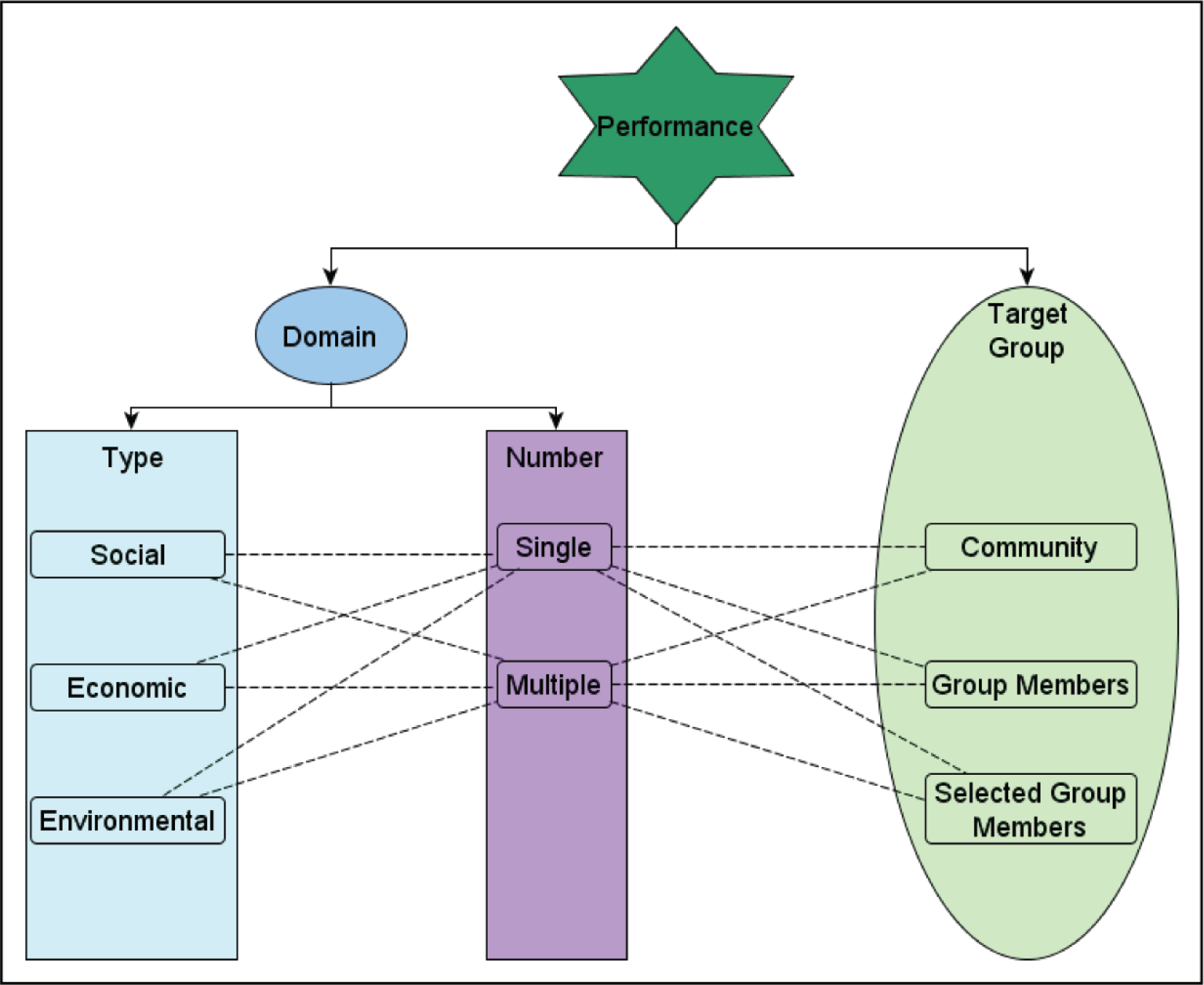
At a broad level, the purpose behind performance evaluation could be categorized into three domains, namely, social, economic and environmental. The social aspect of FC studies focuses on understanding the impact of the FC on relationships prevalent between the humans. Some of the aspects commonly covered in evaluating the FC performance are marginalization, social capital (Sangole, Kaaria, & Jemimah, 2014), health and nutrition (Fischer & Qaim, 2012a) and education (Friis-Hansen & Duveskog, 2012).
The economic aspect of the FC studies focuses on the production and consumption of goods and services. The FCs have been evaluated for their economic performance using various indicators including earnings (Wouterse & Francesconi, 2016), yield, technology adoption (Fischer & Qaim, 2012b; Mwaura, 2014), market access (Barham & Chitemi, 2009) and innovation (Pratoom & Savatsomboon, 2012). The environment aspect focuses on the status of the various natural resources present in the area. Some of the environmental aspects considered in the FC performance studies are pesticide residue (Naziri et al., 2014), deforestation (Caviglia-Harris, 2003) and fertilizer type (Mwaura, 2014) and use (Fischer & Qaim, 2012b).
The focus of the literature could be single domain or multi-domain. In a single domain performance-measuring study, the focus is on evaluating the FC only for a single domain of either social, economic or environment, although the number of parameters used to evaluate performance can be more than one. In a multi-country study across the African continent, the focus was on evaluating the economic performance of the FC using profit as a parameter (Wouterse & Francesconi, 2016). Another study on a Kenyan FC focused on the performance of farmer collective on the basis of the social domain in terms of health and nutrition and women empowerment (Fischer & Qaim, 2012a).
In a multi-domain performance-measuring study, the focus is on evaluating the farmer collective for more than one domain. A study on the Kenyan farmer cooperatives measured the performance in multi-domain context comprising environment and economic parameters. The study tried to evaluate the performance of the farmers in terms of their ability to adopt modern agricultural technology, generate revenues and utilize eco-friendly products (Fischer & Qaim, 2012b). Similarly, in a case study of a Ugandan FC, the performance was measured in terms of the crop productivity and utilization of eco-friendly cultivation products (Mwaura, 2014).
On the basis of the target group, the purpose behind evaluation could be categorized into community, all members of the group and specific member/s of the group. The FC is setup in an active and dynamic system, primarily in rural settings, in need of development. In such a context, FCs could be seen as a vehicle of development not only for the members but also for the other people living in the area who are not members of the group. Accordingly, certain studies with the intent to determine the externalities of the FC could choose to evaluate FC performance in terms of its overall effect on the local community. An Indonesian study found that in many cases, the knowledge given to farmers who are members of a farmer group was also diffused to non-member farmers by member farmers (Rustam, 2010). Further, an experimental study in Uganda showed that group members could share their endowments with other people belonging to the same village (Baldassarri & Grossman, 2013).
Commonly, the FC performance may be narrowed to only the members or just certain members of the FC as they are expected to be target beneficiaries. A study on FC performance across Ethiopia, Malawi and Senegal focused on FC profits (Wouterse & Francesconi, 2016). Another study in Middle Guinea compared the net farm profits from potato cultivation for FC members and others (Tolno et al., 2015). A Kenyan study focused on measuring the performance of women in FC as compared with non-FC women regarding control on banana revenues and share in household income (Fischer & Qaim, 2012a).
The FC performance may vary with change in performance parameters. There could be trade-off between social and economic performance of the FC (Bernard & Spielman, 2009). The performance of banana FC in central Kenya was good economically, but environmental concern due to higher use of fertilizers and pesticides was its unfortunate downside (Fischer & Qaim, 2012b). In a Ugandan case study, it was reported that farmers in FC had better performance as compared to non-FC farmers in terms of higher yield and eco-friendly cultivation. However, FC farmers were less inclined to adopt better agricultural technology as compared to non-FC farmers (Mwaura, 2014). Consequently, the different performance parameters provide a dissimilar outcome of FC and could change based on FC stages. This creates a challenge to understand the FC system and conduct comparative analyses of FCs studied in the literature. Further, it provides a difficulty in providing a standardized framework for the FC development.
The FC is a key in empowering and enhancing the development trajectory of the rural areas and the farmers; however, a holistic understanding of the complex dynamic system is needed to make FCs effective. Literature had proposed that FCs despite being inadequate are important to enable development of farmers (Penrose-Buckley, 2007). There is no single model or plan to enable development of a successful FC; only few can perform and sustain (Attwood & Baviskar, 1987). However, review of the different experiences across the globe provides certain key insights that could be put into mindful practice for better performance and success of FCs. These insights could be put into a broader context using a conceptual framework that could enable in preparing a generic analytical tool to better understand the FC need and intervention approach in a given region. This could better guide the researchers in empirical studies, development lists in designing interventions and policymakers in policy decisions. The learning that emerge from understanding the FC functioning in the local context indicate certain good and actionable practices for FC success, and they are described as follows:
Adaptability of collective characteristics with local context: evidence suggests that FC performs and sustains better when local context is favourable and supportive of its FC functioning (Attwood & Baviskar, 1987; Mishra & Shah, 1992; Raya, 2014). It has been suggested that the FC success depends on its ‘design thinking’ which needs to incorporate local context in its formation and functioning (Shah, 2016). The collective action is mutually beneficial for both the progressive FC members and the risk-averse local system if the FC could leverage economic and non- economic benefits without endangering the local system’s functionality beyond a threshold (Raya, 2014; Tolno et al., 2015; Uphoff & Wijayaratna, 2000). This suggests that the FC should carefully adapt its collective characteristics to the local context for obtaining comparative advantage over others by tackling local issues. In order to implement this action, the FC should:
Identify the local context in which FC needs to exist. The FC products are commonly dependent on the local system. In such a scenario, local support could enable it to establish its roots. In order to gain local support, it needs to understand the strengths, weaknesses, needs, behaviour and aspirations of the local context in socio-economic-environmental aspects. Such an understanding could enable FC define its strategies for establishment and operations. In the identified local context, it is important that the FC clearly defines the benefits of membership to its members. Any FC is able to draw the benefits over the individual owing to the collective action ability to generate more rewards or lesser cost or both from the same activity (Shiferaw et al., 2011). It is important that the FC ensures that it remains competitive in the local context as well as in the global context for it to maintain benefit over the individuals. Further, the provision of benefits alone is not sufficient; it should be clearly communicated and found satisfactory by members. The FC is an organization whose success would depend on its ability to manage, control and direct its members in achieving its goals and objectives. Rules and norms are the mechanisms to enable members to get associated with each other and with the organization. The clarity of these rules and norms are necessary for building trust and allegiance among members (Shiferaw et al., 2011). Further, these norms and rules should be in synchronization with the local context of members for their success and compliance (Attwood & Baviskar, 1987; Shah, 2016). Co-alignment of external agents’ interest and local context: Any intervention in a local system will meet with resistance if the interests are not aligned. Evidence suggests that when external agents execute a standard implementation strategy for addressing a problem, it could lead to a complete failure of the FC. While, in the same region, the same problem can be solved by adapting strategies based on local needs (Uphoff & Wijayaratna, 2000). It suggests that the external agents are an important catalyst in the system that could create and sustain FC, but only if their strategies are aligned with the local interest. In order for such an alignment to exist, the following actions need to be considered:
An FC in an area is established by creating members from the locals. It is very important that engagement of external agent is clearly defined with the locals and members. Evidence suggests that FC members respond differently to locals and outsiders (Baldassarri & Grossman, 2013). This suggests that the external agent needs to factor in this differential behaviour of the members in establishing partnership with the FC and locals. The understanding of locals is an important knowledge that could be leveraged by the external agent to better design and communicate the implementation strategy for the FC creation and sustenance. The FCs during initial stages need a handholding in terms of financial and/or technical support. This handholding is either provided or enabled by the external agents. Evidence suggests that this hand-holding of FC must be targeted and should have threshold in terms of time and resources (Chirwa et al., 2005). Otherwise, it could undermine the FC position and responsibility. The FCs are unique groups that have broad range of functioning and operational nature. They are self-iterative in nature and evolve into a more organized and systematic system with success and sustenance. In such a dynamic system, it is important to have the adaptive legal and policies system that identify and respond based on the FC. They need to be flexible enough to prevent suffocation of new FCs, but strict enough to help in maintaining the integrity and sustenance of FCs (Shiferaw, Obare, & Muricho, 2008).
Finally, literature lacks synthesis of the experiences required in establishing and identifying the local contexts in which different types and forms of FC will be successful. This is linked to the understanding of the idea, ‘viability voids’, as proposed by Hitchins, Elliott and Gibson (2005). According to the idea, the role of region is critical in assessing and prioritizing the economic viability of any collective. Further research will be required to address this need.
Conclusions
The extensive literature reviewed in this article shows that FC is a globally accepted strategy for the socio-economic-environmental development of the marginalized sections of the society. Countries have adopted different models of FC. Some models are more formal such as cooperatives and producer organizations while other models are more informal such as farmer groups and self-help groups. These different models indicate that the FC framework needs to incorporate factors of local context to make it adaptable to the local system.
Nevertheless, the FC models have not completely covered the marginalized sections of farmers, globally. Many established FCs have been reported to have struggled to perform and sustain even after strong political will and support by governments. This is caused by several factors, namely, local factors, group characteristics, externalities, level of FC, relationship with higher collective and performance framework for the collective. Successful performance and sustenance of FC will depend on its ability to adapt and co-align with these factors.
Among these factors, local factor is the one factor which has been described in literature but in limited and fragmented manner. Although, these limited studies have shown its critical importance in determining the FC performance and its sustenance. Local factors comprise the socio-economic-environmental factors which dynamically interact with all the stages of an FC. The local factors are relevant because an FC needs to operate within the local system where it is established and recruits its members. Accordingly, it is seen as an intervention through which the local system tries to improve its performance and growth. The performance parameters are dependent on context and perspective. This necessitates a deeper and nuanced understanding of the FC functioning in its local system. However, FC and external agents face the challenge of planning and adapting to the local factors due to the lack of a comprehensive and standardized analytical tool. Thus, it is imperative that the future research should address these lacunae.
In the context of a developing nation, past experiences with FC have been a bag of mixed results. In a limited-resources scenario, every resource investment comes with a huge opportunity cost. All the new FCs must focus on adapting their functioning based on the local context. Similarly, external agents must focus on co-aligning their interests with the local context to enable the FC to be more customized to the local settings.
In summary, an FC could play a critical role in transforming the development trajectory of the farmers. However, the grim reality is that FC struggle to become successful, and even a successful FC runs the risk of facing the various challenges which may prevent it to remain effective and competitive in the local system in the long run. The reason is that the factors affecting the FC are dynamic, and it needs to continuously innovate to counter those changes.
Declaration of Conflicting Interests
The authors declared no potential conflicts of interest with respect to the research, authorship and/or publication of this article.
Funding
The authors received no financial support for the research, authorship and/or publication of this article.