



Abstract
Research into the framing of sporting events has been extensively studied to uncover newspaper bias in the coverage of global sporting events. Through discourse, the media attempt to capture, build, and maintain audiences for the duration of sporting events through the use of multiple narratives and/or storylines. Little research has looked at the ways in which the same event is reported across different nations, and media representations of the Rugby World Cup have rarely featured in discussions of the framing of sport events. The present study highlights the different ways in which rugby union is portrayed across the three leading Southern Hemisphere nations in the sport. It also shows the prominence of nationalistic discourse across those nations and importance of self-categorizations in newspaper narratives.
Introduction
Since the beginning of the 21st Century, the relationship between the media and sport evolved from simple game previews and/or recaps in the newspapers to contemporary video-on-demand and online streaming formats (Billings and Hardin, 2014). Sport and the media are now so interwoven that both are dependent on one another for survival in order to meet their capitalistic goals. This was a concept Jhally (1984: 41) termed the “sports/media complex.” While the Olympic Games and the FIFA World Cup are the most popular global sports mega-events, other events also capture international attention, such as the Super Bowl, the Cricket World Cup, and the Rugby World Cup (RWC) amongst many others. Consumption of pinnacle events is ‘virtually mandatory’ (Real and Mechikoff, 1992: 325) as people ‘recognize them as an invitation – even a command – to stop their daily routines and join in the holiday experience’ (Dayan and Katz, 1992: 2).
To benefit from the added attention these events provide for the media, editors and producers select aspects of a variety of storylines to highlight to their consumers in order to frame the event in such a way that consumers continue to be engaged for the duration of the entire event. One very common way to encourage people to watch is via the construction of nationalized narratives, where the ‘home’ nation is disproportionately praised and becomes the inordinate focus of the telecast.
The current study investigated the framing of the 2015 RWC in Australia, New Zealand, and South Africa newspapers. The 2015 RWC was held in England (and Cardiff) over a six-week period in September and October, with games played in 12 stadiums located throughout England with eight matches also taking place at the Millennium Stadium in Cardiff, Wales. News coverage in the aforementioned three nations was analyzed to provide insights into how nationalism and patriotism were perpetuated in the coverage of the RWC. Each of the studied nations has a strong rugby history and rugby’s consumption (both spectatorship and participation) is quite high (see Harris, 2010). All newspaper articles from each of the seven matches played formed the dataset for the study. This provides a deeper understanding of how the same event was framed and not only answers Whannel’s (2000) call for more cross-cultural research into sporting events, but also provides further insight into how three nations’ newspapers covered the RWC.
Theoretical relevance
Goffman’s (1974) framing theory and Turner’s (1975) self-categorization theory provide theoretical insight for this study. Both approaches occupy blends of social psychology and empirical research methodology, making the pairing ideal for exploring the RWC from similar standpoints. As such, each theory is outlined below.
Framing
The use of Goffman’s (1974) framing theory helps explain the powerful influence the media have in presenting a story to readers and viewers in ways that facilitate the how readers and viewers interpret or decode the story. Simply put, framing is the process editors and journalists use to carefully select, organize, and encode their messages into a story (Kian and Hardin, 2009). Entman (1993) noted that when editors and journalists synthesize information to construct a story, certain aspects or issues are emphasized or given greater salience and this is often at the expense or even exclusion of other aspects of the same story or theme. Thus, when editors and journalists favor, emphasize, downplay, or exclude certain aspects or issues of a story they define and shape it for their readers. In the context of mega sporting events (MSEs), Billings et al. (2008: 2) noted that the US National Broadcasting Company (NBC) broadcasts of the Olympic Games are carefully framed because NBC makes “overt choices” on what sports, events, and athletes it features (selection), how often it features them (emphasis), and what it chooses not to feature (exclusion), mirroring the conceptions Gitlin (1980) advances regarding primary frames. Although it is important to acknowledge that reception theorists such as Fiske (1987) and Morley (2004) outlined how most narratives are polysemic, with multiple meanings and possible interpretations (Chalip, 1992), Scheufele and Tewksbury (2007) conclude that the way in which a story is framed by the media greatly influences how it is understood or decoded by consumers.
Newspaper articles and images about national teams’ performance at MSEs are carefully framed to galvanize interest and unite the imagined national community of readers (Vincent et al., 2010). Indeed, Rowe et al. (1998: 133) described the interplay between mediated accounts of MSEs as the ‘sport–nationalism–media troika’, because, as Polley (1998: 35) noted, ‘a national team can, in media and popular discourse, take on the guise of the nation itself’. Thus, the influence newspapers have in framing national identity through the performance of their national team in a MSE, like the RWC, is substantial. As Whannel (2008) observed, the media play a major role in constructing, (re)producing, and reinforcing narratives and images, which then communicate shared meanings, understandings, and values about sport and national identity. As such, framing has been used extensively to examine issues in MSEs, but to date few studies have examined a MSE from a cross-national perspective, while none have looked at the RWC.
Self-categorization theory (SCT)
In performing cross-nation media comparisons, one highly relevant theoretical underpinning is self-categorization theory (Turner et al., 1987), often unpacked as the social identity of the group (Tajfel and Turner, 1986). This theory focuses on the formation of perceived in-groups and out-groups depending on elements such as demographics, psychographics, sociology, or some combination of elements. Similarities form in-groups; dissimilarities form out-groups, and the groups most relevant at a given point in time depend on issue relevancy (Stott et al., 2001). While often applied within the realm of media effects, self-categorization is pertinent to the issues advanced within newspaper coverage of the RWC because of the standpoint the writers embody. Each occupies a central identification with advancing an “us” and a “them” based on their own citizenship and the anticipated reader responses to the ways these categorizations unfold.
Self-categorization theory helps us make sense of ‘us’ versus ‘them’ dichotomies, which are formed largely based on whether one perceives oneself to be a member of a group (or not). MSEs offer inherent opportunities for the formulation of such groups, as situations and variables forge alliances or rivals that are fluid, depending on the teams in opposition (Stott et al., 2001). Moreover, MSEs are even more natural venues for such divisions to cognitively occur, as ‘identification with a sport team is likely to become a salient basis of self-definition if the team is involved in a number of games within a short period, the team is involved in a playoff or finals series, or the team is playing against a fierce rival’ (Dimmock and Grove, 2005: 44).
Voci (2006) found that self-categorization unfolded differently for soccer fans who were attending a game as opposed to those witnessing it via media, highlighting how such third-party mechanisms can cause people to view games (and media coverage) quite differently depending on the team to which their allegiance lies (Bruner et al., 2014). Thus, self-categorization has been found to be highly relevant in the context of sport, particularly after notable events (Delia, 2015). Exploring such divisions in the context of nation-based teams becomes quite relevant (see Mehus and Kolstad, 2011) because ‘sport and nationalism collectively form arguably two of the most emotive issues in the modern world’ (Bairner, 2001: xi). These two types of in-groups supersede most others when a match is contested, causing negative thoughts and actions to be exhibited even toward others in shared in-groups such as family and friends (Delia, 2015). Benedict Anderson (1983: 6) notes that nation-states often are built on ‘imagined political communit[ies]’ of commonality, presumably areas in which in-group and out-group membership is more sharply defined. Bruner et al. (2014: 52) summarize the contributions of the theory within sport consumption, noting that:
Among other contributions, SCT helps to explain why fans of opposing teams often perceive the same game quite differently. Due to shared group membership (and the positivity extoled toward those categories with which an individual possesses membership), fans of a team will be more likely to interpret the behaviors of that team favorably relative to fans of an opposing team.
Sport, the nation and national identities
Boyle and Haynes (2000) suggest that with its visibility and focus on symbols, winning and competition, sport serves as a key marker in indicating certain national characteristics and being used as representative of national identity. The nation has been the focus of the work of social scientists for a number of years (see for example, Anderson, 1983; Guibernau, 2007). Two different types of nationalism appear prominently in the maintenance of the nation state. Ethnic nationalism, based on the natural origins of the nation, is tied to areas such as race and language, and ‘emphasizes common descent and sameness’ (Özkirimli, 2005: 23). Civic nationalism has been linked to the largely artificial creation of nations in the nineteenth and 20th Century. However, it focused on the shared sense of national identity and community underpinned by public institutions and symbols of a civil society.
Guibernau (2007: 60) defined a nation as a ‘community, sharing a common culture, attached to a clearly demarcated territory, having a common past and a common project for the future, and claiming the right to rule itself”. This recognizes the distinctive territorial and geopolitical aspects of a nation state as well as emphasizing the role of a shared common history in forming a particular national identity. In highlighting a shared sense of belonging, and the distinguishing characteristics and national cultural traits (Anderson, 1983; Guibernau, 2007), it is easy to see why sport has long been considered an important site for the promotion and celebration of national identity. International sporting events offer a means for the collective ‘us’ of a national discourse to be visible as evidenced through media analyses of some of the biggest sporting events in the world (Billings, 2008; Maguire, 2005; Scott and Kunkel, 2016).
Any national identity encompasses both continuity and change. This change is facilitated through the re-appropriation of enduring symbols and traditions and the narrative of a nation may be reaffirmed through the selective celebrations of its past successes. One of the most widely cited authors in the work on national identities is Benedict Anderson. Anderson’s (1983) work focused on the ways in which newspapers create an imagined community of fellow readers sharing particular representations of news and events. Anderson’s (1983) descriptor of nations as ‘imagined communities’ has been applied to sports in a range of different locales to help identify the ways in which national teams can help foster a sense of togetherness and identity. Of course, the fact that these communities are ‘imagined’ emphasizes the fact that even in the smallest of nations we can never know all of our fellow countrymen and women. However, it is also important to acknowledge that just because something is imagined this does not mean that it is imaginary (Bairner, 2009).
Rugby union and imagined communities
Numerous scholars have looked at the relationship between sport and national identity as (re)presented in media discourse (e.g. Billings, 2008; Maguire, 2005). Association football has often been the focus of such discussion where national male teams are seen as representatives of the country as a whole and their successes (and failures) are read as indicative of the health and status of a nation (e.g. Scott et al., 2012; Vincent et al., 2010). The majority of the published research focuses on male sporting teams as these are often used to represent ‘the nation’. These teams are often framed in militaristic terms with men as defenders of a particular territory. Yet despite some notable exceptions (e.g. Alabarces et al., 2001; Blain et al., 1993; O’Donnell, 1994) there has not been a great deal of research that has looked at media reporting of the same sporting event across different nations. O’Donnell (1994) described a ‘mapping of the mythical’ to detail the ways in which different stereotypes of national character were visible in media discourse across fifteen European nations. This work capably highlighted the ways in which sport was used as an entry point ‘into a much denser and more complex discursive network’ (O’Donnell, 1994: 354) and reflecting this, Alabarces et al. (2001) compared Argentinean and English media accounts of the Argentina versus England match during the 1998 FIFA World Cup. Alabarces et al. (2001) noted how the narratives drew on contrasting national myths about their respective styles of play, as well as the behavior and deportment of the players, who, in the rarefied atmosphere of this MSE became personifications of their respective national identity and culture.
Some research has looked at media portrayals of a national rugby team within specific nations including New Zealand (see Falcous and West, 2009; Jackson et al. 2001; Jackson and Hokowhitu, 2002), England (see, Tuck, 2003b), Ireland (see Maguire and Tuck, 2005; Tuck and Maguire, 1999), and South Africa (see Grundlingh, 1996, 2017; Steenveld and Strelitz, 1998), but little work has explored the ways in which the media in different nations report upon the same major rugby event. Desmarais and Bruce (2009, 2010) analyzed live broadcasts of rugby matches between New Zealand and France to examine how national stereotypes were used in the portrayal of the two teams. This work capably shows that despite the tendencies towards global, homogenized presentation, there are still strong local differences in expectations concerning the different types of audience (Desmarais and Bruce, 2009). The three leading rugby nations, in terms of overall success in the RWC since its inception in 1987, would seem to offer an interesting site to explore similarities and differences in newspaper coverage of a major international sporting event. Before moving to look at the methods employed in this study, we will first briefly outline the position of rugby in the three nations and consider some of the work that has been published about the sport in these places.
New Zealand, which has won the RWC a record three times (1987, 2011, and 2015), is a nation whose very identity is often implicitly tied to the performances of the men’s national XV, known as the All Blacks, and rugby serves an important function as a means of symbolically uniting the nation (Scherer and Jackson, 2010). Hobsbawm (1991: 142) noted that ‘the imagined community of millions seems more real as a team of eleven named people’ to explain the hegemonic positioning of association football across the globe, but in New Zealand it is undoubtedly rugby union that provides the site upon which discourses of the nation are most keenly discussed. Rugby’s international reach and appeal may not be anywhere close to that of football, and whilst claims to its stated globalization are somewhat exaggerated (Harris, 2010), it is a sport that is continuing to develop a wider international profile. The 2015 RWC attracted record audiences and Rugby 7s debuted in the 2016 Rio Olympic Games. If England is the birthplace and ancestral ‘home’ of rugby, then New Zealand may be considered to be the game’s spiritual home. Reflecting its status as the national sport, many scholars in New Zealand have written on aspects of the game focusing in large part on identity politics and the branding of the All Blacks (e.g. Falcous and West, 2009; Scherer and Jackson, 2010). The All Blacks are perhaps the most iconic brand in all of rugby and the sport is arguably the main means by which New Zealand is recognized by the rest of the world (Scherer and Jackson, 2010).
Far less attention has been paid to the role of rugby union in relation to Australian national identity. Whilst it was the first country to win the RWC twice (1991 and 1999), the sport occupies a less central position within national media than it does in New Zealand with both rugby league and Australian Rules Football (Aussie Rules) occupying much of the media space here. Horton (2009) looked at the development of rugby union in Australia, and argues that the sport remains a particularly ‘glocal’ game. Given the close geographical proximity of the two nations, Australia may also consider themselves to be New Zealand’s biggest rivals as the two national rugby union teams have battled for international supremacy during the professional era (Smith, 2004). The annual Bledisloe Cup contest between the two nations continues to be an important prize although New Zealand has held the upper hand in recent years. Some matches within this have also taken place outside of Australia and New Zealand with games in Hong Kong and Japan being staged as part of the continued quest to promote the sport outside of the foundation nations (Harris, 2010).
Another important nation in the sport, and the third of the three Southern Hemisphere powers that have dominated international rugby, is South Africa, which has won the RWC twice (1995 and 2007). Due to their exclusion from much of international sport during the apartheid regime in the country, South Africa did not compete in the first two RWC competitions (see Black and Nauright, 1998; Nauright, 1997). Awarding the 1995 tournament to the country as it continued to be plagued by political violence was a controversial choice. Despite the end of the apartheid regime there was much concern about staging the RWC there. In a story chronicled in a 2009 Hollywood film (Invictus), South Africa won the trophy and the iconic image of the country’s first black President, Nelson Mandela, presenting the trophy to Francois Pienaar fleetingly moved the sport of rugby into the mainstream media across the world (see Carlin, 2008; Grundlingh, 2017). Black and Nauright (1998: viii) described this as ‘the most significant trans-racial moment of celebration’. South Africa won the RWC for the second time in 2007 and reassumed their position as one of the leading teams in international rugby. Between them the three Southern Hemisphere nations have won the RWC seven times with England’s victory in 2003 representing the only RWC won by a Northern Hemisphere nation to date. The next section of this paper will now outline the hypotheses and research question that guided the examination of the 2015 RWC in Australia, New Zealand, and South Africa.
Hypotheses and research question
Dyerson (2005: 940) noted that ‘the globalization of modern sport is sometimes misread as a sign of the decline of nationalism and other forms of modern tribalism’ but as various scholars have capably shown the coverage of sport in a range of international media clearly shows that images of the nation continue to assume a prominent position (e.g. Billings, 2008; Vincent et al., 2010). Despite some ambiguity as to what is real and/or imagined ‘the nation has material substance’ (Bairner, 2009: 225). Through investigating the differential frames that could emerge through cross-national comparisons of Australia, New Zealand, and South Africa during the 2015 RWC, insights can be gleaned not only about the nature of rugby within its quadrennial pinnacle event, but also about the role national identity and inculcated feelings play within media narratives. While other studies of mediated rugby have been conducted (e.g. Falcous and West, 2009; Tuck, 2003a), the comparisons and contrasts within such a three-nation composite makes this study a demonstrable and noteworthy step forward. As such, five hypotheses and one research question were posed to investigate the amount of coverage devoted to and themes embedded within media coverage of the 2015 RWC:
H1: The three nations will significantly differ in the amount of coverage devoted to the 2015 RWC.
H2a: The Australian media will cover the Wallabies more than all other teams combined that are participating in the 2015 RWC.
H2b: The New Zealand media will cover the All Blacks more than all other teams combined that are participating in the 2015 RWC.
H2c: The South African media will cover the Springboks more than all other teams combined that are participating in the 2015 RWC.
H3: The top five most-implemented themes will significantly differ between the three analyzed nations.
RQ1: What thematic differences in the reporting of the 2015 RWC will emerge among the three nations?
Method
All of the coverage of the 2015 RWC was downloaded from the Australia, New Zealand, and South Africa newspapers within representative databases, comprising the sample for investigation. The RWC took place between 18 September and 31 October. A content analysis of each of the three nations’ coverage of their 2015 RWC campaign was conducted and this method was deemed the most appropriate and consistent with prior similar studies in which ‘it should be possible to draw inferences about how a printed medium like a newspaper covers and portrays relevant participants’ (Vincent et al., 2003: 7).
Instrumentation
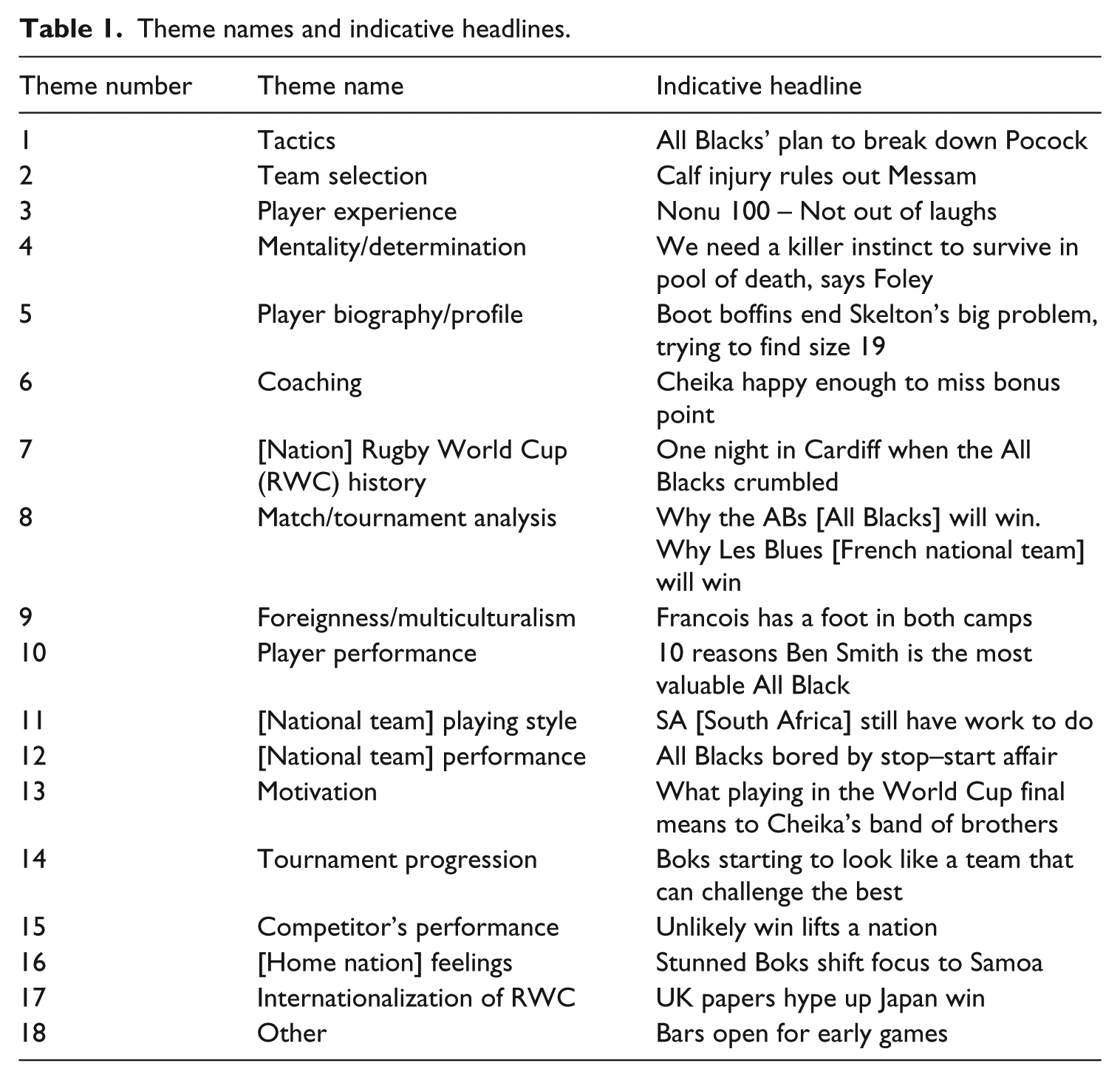
The 2015 RWC was analyzed using a taxonomy reflecting rugby union matches. As no known study has been conducted specifically on the framing of the RWC the first game of the three nations was downloaded and independently coded using a grounded theory approach (Glaser and Strauss, 1967). Each of the coders identified and recorded salient themes from each of the three nations, satisfying the needs of textual analysis, which must incorporate ‘objectivity, system, and generality’ (Holsti, 1969: 3) to maximize reliability and validity. This preliminary analysis netted 89 themes. To establish operational definitions, a round table discussion was conducted by the research team, with the result of this discussion being the merging of many themes based on belongingness (n = 18). The 18 themes with an indicative newspaper headline that are included in the analysis of this study are shown in Table 1.
Theme names and indicative headlines.
Administration
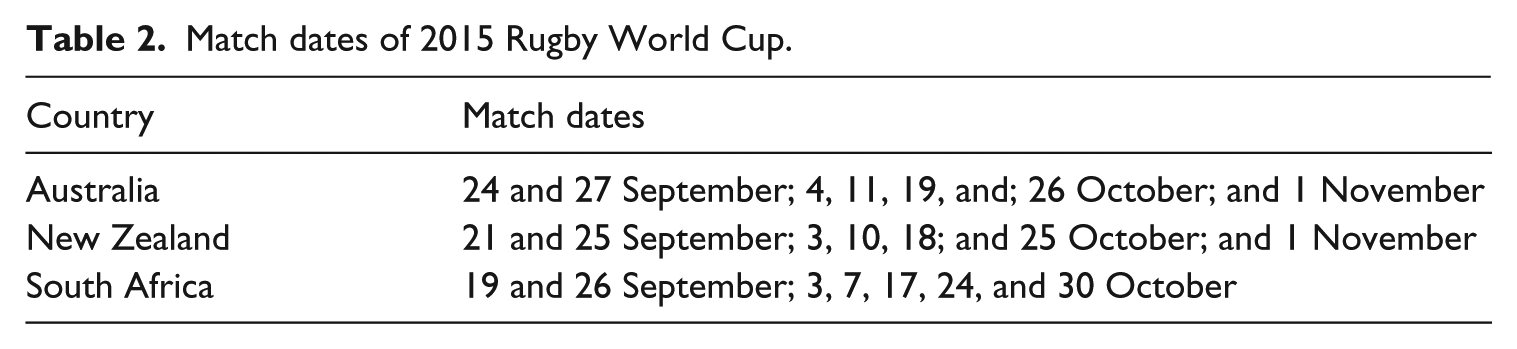
Each nation’s coverage of the RWC was downloaded using Factiva, an online information and research repository of media coverage. As this study sought to uncover how each nation’s newspapers covered the 2015 RWC, this study focused on the seven games of each nation. As such, this study examined the day prior to a match, the day of the match and the day after the match to uncover how the nation’s media previewed, described, and summarized each match. Thus, there are cases where the official 2015 RWC dates do not match with the local dates in Australia and New Zealand due to the time difference between the UK and these two nations. Table 2 shows each of the three nations’ match days (in local time). Every relevant article was downloaded and coded using coding sheets containing: (a) date; (b) newspaper name; (c) article title; (d) newspaper type (broadsheet or tabloid); (e) page number; (f) nation; (g) article theme(s); and (h) the studied nation’s opponent. The coding sheets were grouped both by nation and by game.
Match dates of 2015 Rugby World Cup.
Once the analysis of all three nations was complete, a trained researcher randomly selected 15% of each nation’s coverage for a second analysis to ensure reliability of the contextual coding. This study employed Cohen’s (1960) kappa (k) for determining inter-coder reliability. Inter-coder reliability scores were for: (a) date (k = 1.00); (b) newspaper name (k = 1.00); (c) article title (k = 1.00); (d) newspaper type (broadsheet or tabloid) (k = 1.00); (e) page number (k = 1.00); (f) nation (k = 1.00); (g) article themes (ranged between k = 0.906 and k = 0.974); and (h) the studied nation’s opponent (k = 1.00). These scores indicate a good level of reliability (Wimmer and Dominick, 2006) providing support for usefulness of the taxonomy employed for this study. To determine associations for discrimination in commentator discourse and differences between home country and international athlete commentary in broadcasts Chi-square analysis was conducted using SPSS version 21.
Results
Content analysis of this MSE suggests that newspapers employed the practice of framing when reporting on the RWC. In total, there were 775 articles that comprised the dataset for this study. Of these, 430 (55.48%) were from New Zealand, 240 (30.97%) from Australia, and 105 (13.55%) from South Africa. Figure 1 highlights these differences.
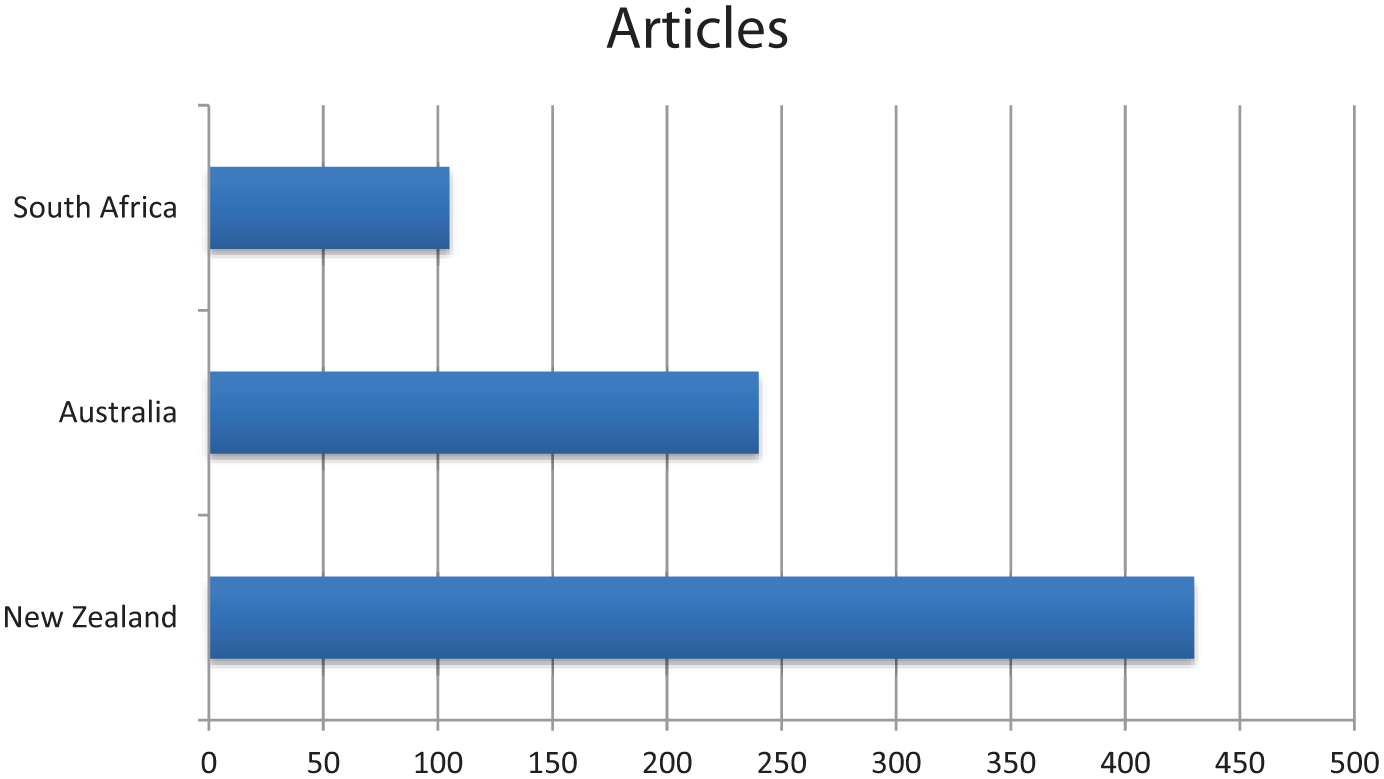
Number of Rugby World Cup articles by nation.
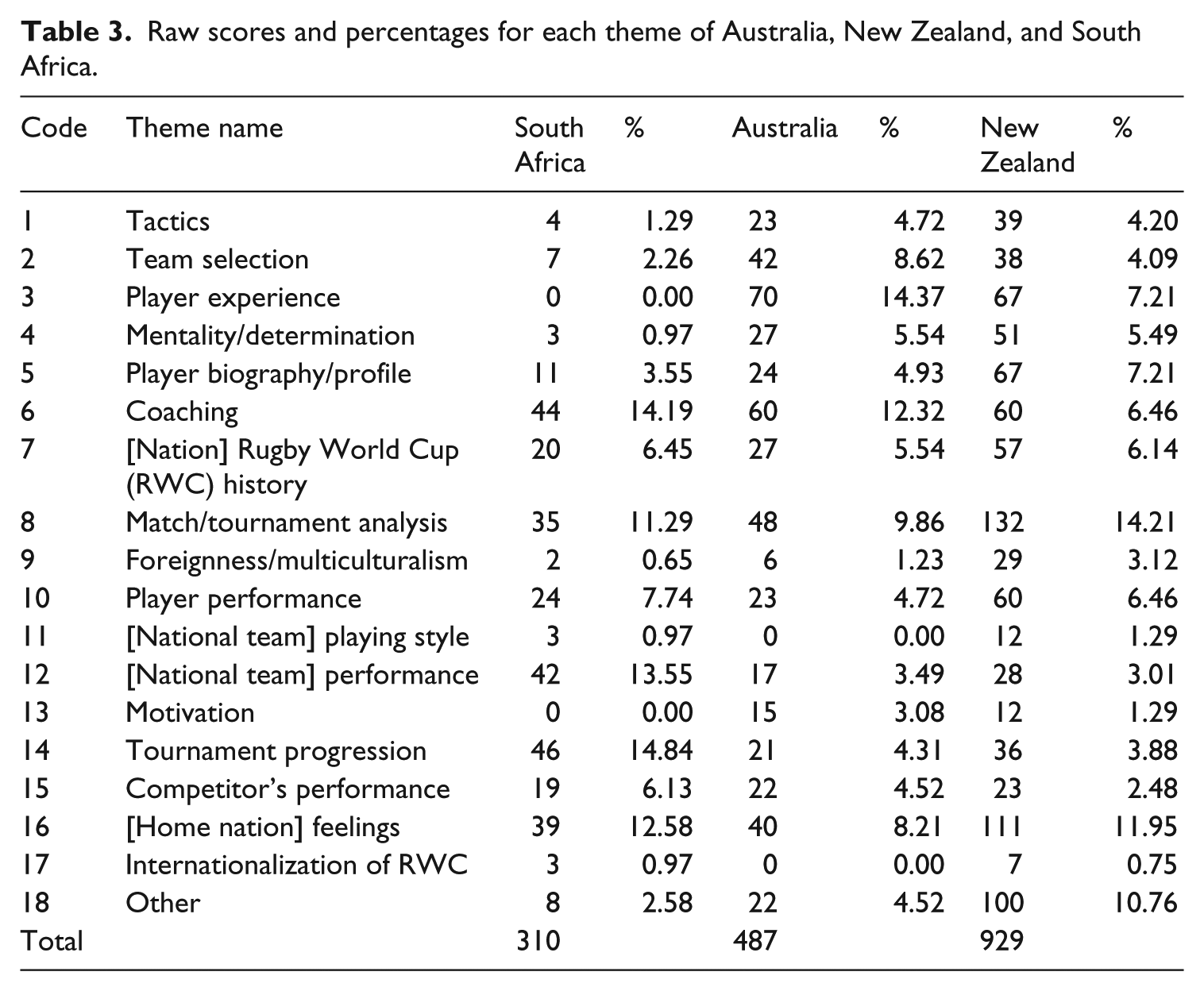
Moreover, as each article was coded with all of the themes that were used, there were a total of 1,726 uses of the 18 themes, which formed an average of 2.23 uses of the themes per article. The New Zealand press used 929 (53.82%) themes, Australia 487 (28.22%) and South Africa 310 (17.96%). Table 3 indicates the raw scores and percentage of themes by nation.
Raw scores and percentages for each theme of Australia, New Zealand, and South Africa.
As each of the nations competed in the same number of games (n = 7), the data analysis represents the national content of each nation’s newspaper coverage of the home nation’s progression in the 2015 RWC. Thus, using Chi-square tests Hypothesis 1 was supported as there was a large disparity in terms of the overall coverage of the 2015 RWC in each of the nations with New Zealand’s press accounting for more than 50% of the total.
Hypotheses 2a, 2b, and 2c predicted that each of the home nations’ newspapers would focus on the home nation more than 50% of the time; all were supported as the majority of each of the nations’ reporting of the RWC focused on the home nation. In terms of home nation reporting, Australia’s media had home nation coverage in 189 of the 240 (79%) total articles. For New Zealand, 293 of 430 (68%) articles were about the local team and for South Africa, 91 of 105 (87%) had that home-team focus. Despite South Africa’s media publishing the least number of articles in its reporting of the 2015 RWC, the focus on the home nation was proportionally highest. Meanwhile, New Zealand’s newspapers yielded the greatest number of articles but was, in terms of percentage of articles focusing on the home nation, the least nationalistic.
In terms of the overall variety of articles types, Hypothesis 3 was supported partly through a lack of significant correlation between nations. A Spearman rho correlation found lack of consistently used themes when comparing South Africa and Australia (rho = 0.18; p > 0.05), South Africa and New Zealand (rho = 0.14; p > 0.05), and Australia and New Zealand (rho = 0.26; p > 0.05). Additionally, Hypothesis 3 was also partially supported via thematic comparisons; each of the three nations’ reporting of the RWC contained articles on most of the themes and three of the top five most-used themes were different. In terms of the themes, home nation feelings and match/tournament progression were both in the top five reported themes in each of the three nations. The theme [home nation] feelings were used 12.58% of the time for South Africa, 8.21% for Australia, and 11.95% for Australia. Match/tournament analysis was used 11.29% for South Africa, 9.86% for Australia, and 14.21% for New Zealand.
The New Zealand newspapers reported on RWC-related news that did not fit within the 17 themes. Thus, results for New Zealand contain 100 uses coded into the ‘other’ theme. Coding into this theme included: Family legacy, RWC births (e.g., “Baby Isla arrives at halftime”), bar related news including opening hours (e.g., “Bars open for early games”), viewing times for matches and behavior of patrons (e.g., “Rugby watchers in bars praised”), gambling odds and associated stories including large or successful wagers (e.g., “Punter misses out on $1M but gets trip to RWC Final”), and local New Zealand rugby competitions including those that have produced current All Blacks. Given the number of articles published in New Zealand is significantly more than the other nations, it is expected to have reporting on a wider range of related subjects.
Research Question 1 sought to uncover the differences in the reporting of the 2015 RWC. Again using Table 1 as a guide, significant associations were ascertained; it was necessary to analyze the data, which used the percentage of overall themes used from the entire dataset for its baseline score. To reiterate, there were a total of 775 articles in the dataset, which included 1,726 uses of the 18 themes in the three nations. Of these, 430 were from the New Zealand press and 929 themes were used, which was 53.82% of all of the themes used. Of the 240 articles in Australia, 487 themes were used (28.22%), and, of the 105 articles, 310 themes were used (17.96%) in South Africa, thus, these percentages were used to calculate for significant associations. Because of the sheer differences in the number of articles in each of the three nations, using equal ratios is problematic, as these results do not reflect the percentages of articles in each nation. Further, there would be many more themes exhibiting significant associations due to this discrepancy. In other words, the adjustment in expected scores is practical, because if many of the articles appeared in one or two nations’ coverage of the RWC, they would, presumably, also receive the majority of articles in each of the categories (Billings and Tambosi, 2004; Scott et al., 2012, 2014).
In the analysis, there were nine significant associations. These were: Tactics, χ2 (df = 2, n = 66) = 6.572, p < 0.037, team selection, χ2 (df = 2, n = 87) = 18.825, p < 0.001, player biography, χ2 (df = 2, n = 102) = 6.388, p < 0.040, coaching, χ2 (df = 2, n = 164) = 20.301, p < 0.001, foreignness, χ2 (df = 2, n = 37) = 9.283, p < 0.010, national team performance, χ2 (df = 2, n = 87) = 54.410, p < 0.001, tournament progression, χ2 (df = 2, n = 103) = 49.937, p < 0.001, competitor’s performance, χ2 (df = 2, n = 64) = 9.563, p < 0.008, and other, χ2 (df = 2, n = 130) = 28.861, p < 0.001.
In terms of raw percentages, the New Zealand press used each of the themes at least seven times, whereas both the Australian and South African press used 16 of the 18 total themes. When the expected baseline scores were adjusted for proportionality there were nine significant associations with a variety of results in which country was overrepresented in the number of articles printed: For tactics, both Australia and New Zealand received more than the expected number of articles. For both coaching and competitor’s performance, both Australia and South Africa were overrepresented in terms of articles printed. For team selection, Australia received more than the expected number of articles. For player biography, foreignness/multiculturalism and other, New Zealand was overrepresented and for national team performance and tournament progression, South Africa was overrepresented.
Discussion
The aim of this study was to examine how newspapers in three participating Southern Hemisphere nations framed the “home” team during the 2015 RWC. While an initial glance would reveal unsurprising results – each nation’s media focused predominantly on the “home” team during the reporting of these nation’s matches – a great deal of nuance is uncovered regarding both the type and quantity of coverage dedicated to each “home team”. Thus, it is not surprising that media will seek to foster and maintain readership in the tournament via home focus, yet the differential proportions and topics covered are where noteworthy insights can be ascertained.
It was not surprising that the newspapers from all three nations framed the coverage to emphasize home nation content. Naturally, the consumers of the newspapers will mainly be those from the home nation or region, so the inclusion of stories that appeal to those readers is of importance for reporters and editors. Use of the home nation skewed discourse is common in the framing of sporting events and supports the findings from other scholars on media frames on MSEs and non-MSEs (e.g., Billings and Tambosi, 2004; Scott et al., 2012; Scott and Kunkel, 2016; Vincent et al., 2010).
Much of the reporting of the RWC was home team-focused in the three nations and more than 50% of the sample contained home content which suggests that the media sought to portray the home team more often in the press. In their study on ice hockey fans, Fisher and Wakefield (1998: 34–35) found that ‘being psychologically linked to a winning team enables fans to be connected to the sport they love and to be associated with a winner’. Each of the three teams analyzed in this study had mixed commentary on performances, with South Africa’s shock loss to Japan being particularly visible here. Both the New Zealand and Australian press noted that the All Blacks and Wallabies were not winning in the dominating fashion expected. All media continued to showcase the qualities of each of the national teams to their home readers and promote feelings of connectedness with the home team. Further, by framing the coverage of the RWC to show the success of the national teams, the press may have been successful in attracting higher interest from casual observers of the RWC or rugby in general, thereby, having the potential to increase overall readership in RWC articles and newspapers.
This study used self-categorization theory as its theoretical framework, which suggests there are inherent opportunities for individuals to outwardly display their in-group status through the consumption of their national team. Hypotheses 2a, 2b, and 2c were all supported as the “home” nation coverage of the RWC focused more than 50% of the time on the home nation – thus, more than all other nations combined. However, it was surprising that South Africa’s media would report on its team (proportionally) the most, particularly after South Africa’s defeat to Japan. This was characterized as the biggest upset in RWC history (Rugby World Cup, 2016). Perhaps it was the South African media’s attempt to foster positive storylines after the loss to Japan, as the Springboks were touted as one of the teams that had a chance to win the RWC. Another explanation of the South African press reporting the most home nation content could be that rugby has been used for nation building (Nauright, 1997) and this sport holds a special position within the national psyche. Thus, the more noteworthy result was the surprise loss which also attracted considerable media attention across other rugby-playing nations of the world including the two other nations that form the focus of this study.
In both New Zealand and Australia, past studies have shown that both nations’ media outlets will cover mega-events from the home nation’s perspective (Desmarais and Bruce, 2009; Scott and Kunkel, 2016). Further, both New Zealand and Australia were touted by the world press as having a good chance to win the RWC and the two teams entered the final match undefeated. Thus, it was not surprising that both nations’ media focused on the home nation more than others.
Hypothesis 3 sought to uncover whether there would be similarities in the thematic use of the top five themes in each of the nations. Spearman rho correlations were conducted between each of the nations and there was a lack of consistency when comparing the nations. All three studied nations have a strong rugby culture and this was evident in the reporting surrounding the RWC. As New Zealand’s rugby team, the All Blacks symbolically serve to unite the nation (Scherer and Jackson, 2010), and it is not surprising that the most articles were published in this nation. Further, the least used theme reported in the New Zealand press was the internationalization of the RWC, which also advances the suggestion that the New Zealand press was insular in its reporting of the RWC.
In terms of internationalization, it could be argued that the Australian press was the most insular, as the theme of foreignness/multiculturalism and internationalization of the RWC was only used 1.23% of the time. Despite the two other major football codes occupying more media interest in Australia (Rugby League and Australian Rules Football), much of the RWC took place when both sports were in their off-seasons. Thus, there could have been increased interest in the RWC because the two winter sports were in the off-season and the elite competitions in the popular summer sports (tennis and cricket) would not have commenced at that time. As a result, much of the sport media’s interest would have been on the RWC as there would have been little other national content during that time.
In the South African press, the home nation was portrayed, proportionally, more than the other two nations, which may be explained by the fact that the RWC is an opportunity for the home nation consumers to back their team and forge alliances with the Springboks (Stott et al., 2001). After the apartheid era in South Africa, sport – in particular rugby – had a nation-building and uniting effect (Nauright, 1997). Nauright (1997) also suggests that rugby has been important in the construction of modern South Africa through the promotion of sporting heroes and in the creation of a national sporting identity. In the study presented here, results show that the South African press was the most focused on the home nation, which may be because of rugby’s position as a national unifier.
Civic nationalism was promoted in the media coverage of each of the three nations studied. This construct was created in the 19th Century and promotes the shared sense of national identity and community (Guibernau, 2007). The majority of the news articles focused inward, with the promotion of the home nation taking up much of the press in each of the three nations. In all nations, both foreignness/multiculturalism and internationalization of the RWC were in the bottom third of the most used themes. A third theme that reflected the civic nationalism of the New Zealand press was the relatively small amount of coverage devoted to their competitor’s performance.
Limitations and future directions
The strength of the current study is that it furthers the understanding into how three nations’ newspapers portrayed the home nations during the 2015 RWC. There are, however, several limitations that deserve discussion. A central limitation of this study is that it analyzed the home nation’s games during this tournament (the day before, the day of, and the day after the games). Thus, this study provides a snapshot into how the home nation’s press portrayed the home nation, but it would be useful to analyze the entirety of the RWC in all three nations. This would provide a more diverse sample and uncover how self-categorization was embedded into the coverage of the nation’s media during the entire event. This study also only analyzed three nations’ coverage of the RWC and these three nations were the most successful as they all, fairly predictably, finished in the top three. Thus, it would be interesting to study the media coverage of a team that was less successful at the RWC. For example, England, as the home team, was touted as one of the teams that had a chance to progress to the final stages of the tournament, but to the dismay of many English rugby enthusiasts, it did not progress beyond the group stage. Thus, the coverage of the England team may provide an interesting contrast in terms of home nation content in the coverage because of its lack of success.
In addition, this study analyzed the newspapers’reporting of the RWC. It would be beneficial to collect data across multiple media modalities, such as television and the Internet. This would help to understand how other forms of media portrayed the nations during the RWC, such as panel discussion shows on television or user-generated content on websites, blogs, and social media. Understanding how other media outlets, media personnel, and the general public portrayed the home team may provide some additional interesting results into how self-categorization is embedded into the framing of the RWC.
Conclusion
Understanding how three prominent rugby playing nations’ national media portray MSEs is important to interpreting how an event is presented to the audience, because the media has the ability to influence the consumption and comprehension of these events. Mediated sport is a mirror that helps to understand how people understand culture and this research provides a snapshot into how three nations’ media portrayed the 2015 RWC to their readers. Further, this research also provides insights into how civic nationalism was embedded into the coverage of this event, the importance of self-categorization in three nations’ newspaper coverage, and the prominence of nationalistic discourse in the framing of MSEs. Cross-cultural comparisons of the framing of the RWC provide an additional lens from which to analyze a MSE. Much of the research to date has focused on one nation’s framing or coverage of MSEs and expanding the analysis to include multiple nations’ media is important for researchers who want to understand how an event is covered, rather than just how one nation covered an event. The three leading Southern Hemisphere nations continue to dominate international rugby union and have now won seven of the eight RWCs contested to date.
Footnotes
Declaration of Conflicting Interests
The author(s) declared no potential conflicts of interest with respect to the research, authorship, and/or publication of this article.
Funding
The author(s) received no financial support for the research, authorship, and/or publication of this article.