



Abstract
Despite several decades of Sport for All policies, social class differences in organized sports participation of youth persist. However, few population-based studies have examined how social class may influence adolescent participation. We use survey data from upper secondary school students (aged 16–19) from the Norwegian capital of Oslo (N = 10,531) and investigate the factors through which social class operates. To measure parental social class, we use the well-established Erikson, Goldthorpe and Portocarero class scheme, supplemented by indicators of economic and cultural resources. We also include data on immigrant status, neighbourhood and school affiliation. There were large differences in organized sport participation between youth from the higher and lower social classes. Indicators of parental economic resources mediated many of these differences and had an additional independent statistical effect. Indicators of cultural resources, immigrant status, and neighbourhood and school affiliation only had modest effects. We conclude that social class plays a major role in organized sport participation, and economic resources are particularly important. Methodologically, we suggest that well-established social class schemes should be used in such research, supplemented with more detailed indicators of economic resources.
Keywords
Even though Sport for All policies have been implemented in many European countries throughout the past 30–40 years, participation in organized sports among children and youth is still related to social background (Van Tuyckom and Scheerder, 2010; Vandermeerschen et al., 2016). Because participating in organized sport plays an important role in many adolescent lives, this is a topic of societal concern. In an age when digital leisure activities dominate their lives, physical activities offered by sport clubs may counteract the negative health effects of sedentary activities. Sports clubs are places where young people acquire skills that are advantageous in educational or other institutional settings (Lareau, 2003). They are arenas where youths develop friendships, networks and social capital (Seippel, 2006), and they offer young people a sense of belonging to the wider local community (see Theeboom et al., 2010). For families, attending a sports club can have integrative community effects (Stefansen et al., 2016), and even strengthen parent–youth relationships (Strandbu et al., 2018). Thus, class-based differences in sport participation among young people are not only an issue ‘here and now’, but may also contribute to the social reproduction of inequality in society (Bourdieu, 1978).
Researchers have highlighted access to resources in the family, in particular economic and cultural resources, as the main explanations of social class differences in sports participation among youth (e.g. Stuij, 2015). Nevertheless, population-based studies that systematically examine the mechanisms of social class are scarce, and provide limited understanding of why social class matters for participation. Additionally, few quantitative studies of club-organized youth sports have had a clear class-based theoretical basis, and few have used conventional class schemes. In some studies, the concept of social class has been used, but most studies have applied concepts such as socio-economic status, parental education, household income and/or employment status of the parents. Stalsberg and Pedersen (2010) note that the application of a variety of measures of social inequality makes the comparison between studies problematic. This is unfortunate, not least because the research field remains rather ‘atheoretical’.
In this article, we use data from a large population-based survey of young people living in Oslo, Norway, to examine whether there are social class differences in participation rates in club-organized sports, and what causes these differences. To meet some of the shortcomings from earlier studies of social inequality in sports, we will apply the well-established Erikson, Goldthorpe and Portocarero (EGP) class scheme (Ganzeboom and Treiman, 2011), where class is defined by parents’ labour market situation. Inspired by the culturalist class approach of Bourdieu (1984, 1986) and followers (Lareau, 2003; Savage et al., 2005), we examine the extent to which cultural and economic resources make class origin significant for adolescents’ sport participation. 1
Social inequality in club sports participation
A large body of literature has documented positive relationships between club sports participation and education level, income, socioeconomic status and/or social class position among adults (e.g. Bourdieu, 1984; Rohrer and Haller, 2015; Scheerder et al., 2002; Wilson, 2002). Even though social inequality in adolescent sport has been less explored, there have been an increasing number of studies in recent decades. With some exceptions (e.g. Scheerder et al., 2005), studies of youth sports participation have found patterns of social inequality that resemble those of adults, for example in Belgium (Vandermeerschen et al., 2016), Canada (Berger et al., 2008; White and McTeer, 2012), Sweden (Larsson, 2008), the USA (Aspen Institute, 2015; Sabo and Veliz, 2008) and Brazil (Fernandes et al., 2012).
Several studies using broader class-related measures show the same pattern. For example, La Torre et al. (2006) found that participation in extra-curricular physical activity among Italian students in early adolescence was related to parents’ educational level as well as occupational and employment status. Parental employment status has also been found to be a predictor of sports participation and exercise among young adolescents in Denmark (Toftegaard-Stockel et al., 2011). In another Danish study, Nielsen et al. (2012) found that participation in organized sport among children aged six to 10 was positively associated with parental socio-economic position (indicated by professional qualification), suggesting that the social differentiation of organized sports starts at an early age. Although these studies provide useful insights, they also exemplify how operationalization of social origin tends to vary and remains loosely related to class and stratification-based theories.
Social class: ‘minimalist’ and ‘culturalist’ approaches
In sociological research, most approaches to the concept of social class in contemporary society can be traced back to Marx and Weber. However, according to Bottero (2005) two branches dominate the field – minimalist (Erikson and Goldthorpe, 1992; Goldthorpe, 2000) and culturalist approaches (Bourdieu, 1984, Savage et al., 2013). Common to these approaches is the assumption that a complex economy and the emergence of a large middle class make differentiation between classes and subclasses necessary, but they diverge regarding the definition of social classes, especially in their view of the relationship between cultural aspects and class itself. Consequently, they attribute different mechanisms that seem to produce social class differences in young people’s participation in club-organized sports.
From the minimalist position, social classes are defined and measured by individuals’ employment relations (whether they be employers, employees or self-employed), and among employees, their type of labour contract (which reflects the required job skills, the degree of autonomy in their daily work, and career prospects such as promotion and job security) (Goldthorpe, 2000). There are various reasons why a labour market-based class position may explain social differences in adolescent sport participation. First, as class position reflects parental work situation, one important factor could be their flexibility and autonomy at work, which may affect parental availability to engage in their children’s leisure activities. Another factor is parental skills, which may influence their capacity for organizing children’s sport activities. A third possibility is that job prospects affect parental perceptions of their economic security, which may affect their investment in their children’s leisure activities.
In the minimalist approach, social class is often operationalized using the EGP scheme, where the main opposition is between the service class (professionals) and the working class (Erikson and Goldthorpe, 1992: 35–47). Service class occupations are characterized by specialization and autonomy, whereas working class occupations are easier to monitor and demand less specialization. The scheme also includes categories for self-employed people, farmers and routine non-manual occupations.
Although the EGP scheme is widely applied in the sociology of inequality, it is seldom used in studies of sports participation. Katz-Gerro and Shavit’s (1998) analyses show small class differences in sport participation, except for slight over-representation among routine non-manual employees, while Wells et al. (2017) showed that class origin affected girls’ risk of physical inactivity.
In the minimalist class approach, cultural factors are not seen as important aspects of class, and class is also seen as different from social status, education and income (Chan and Goldthorpe, 2007). This differs from the culturalist class approach, where cultural factors are essential constituents of class as a concept. In this approach, the inequality structure is usually seen as a multidimensional social space (Bourdieu, 1984) in which individuals’ total volume and composition of power assets, namely economic and cultural capital, define their class positions.
According to Bourdieu (1986), economic capital is the dominant type of capital, and refers to individuals’ income, fortune or the value of their material possessions. In the literature, varying access to such resources is often seen as an important explanation of social class differences in organized sport activities. Because participation can be expensive, finances may hamper participation among the classes with the lowest incomes (Duncan et al., 2002). Holt et al. (2011) show that lack of economic assets is a major barrier for some families. They emphasize the importance of material resources, such as transport, in ensuring that adolescents can attend sports clubs.
On the other hand, cultural capital refers to individuals’ mastery of a society’s legitimate culture. It can be part of individuals’ habitus, representing their cultural knowledge, ways of communicating, tastes and lifestyle preferences. It can also be acquired in an objectified form (such as books and paintings) or in an institutionalized form (educational qualifications). Several studies highlight cultural capital as an important factor in social differentiation in youth sports participation, and in a Swedish study (Larsson, 2008), even more important than economic capital. Vandermeerschen et al. (2016: 480) argue that differences in habitus could ‘…shape the preferences of young people, and make them more likely to rule out club sport for themselves, or to not feel “at their place”. In other words, as determined by their habitus, young people might make different choices’. Furthermore, Nielsen et al. (2012) argue that educational resources can be a ‘…knowledge resource, making it more likely that information on, for example, the importance of children’s physical activity and other public health messages are read, understood and dealt with’.
A common idea in the culturalist approach is that sporting activities can be valued more by some classes than by others. Lareau (2003) found that organized leisure time activities were much more common for the middle class than for the working class or the poor. She argued that participation in such activities enhanced the development of a ‘sense of entitlement’, which again gave benefits in other organizational settings (e.g. education). Consequently, an investment in adolescents’ organized sport participation can also be an investment in cultural capital.
Wilson (2002), inspired by the culturalist approach, examined the relative effects of cultural and economic capital among adults and found that both factors independently increased participation in sport. Those rich in economic capital were supposedly more involved in sport since they better can afford the costs in terms of money and leisure time. Cultural capital also increased the likelihood of sports involvement, net of economic capital, but it had a negative effect on involvement in ‘prole sports’, which ‘implies that sports consumption is to a large degree motivated by preferences, tastes, skills, and knowledge that vary by class’ (Wilson, 2002: 13).
There are also other possible factors that can account for, or influence, the relationship between social class origin and sport participation among youth. One is immigrant origin, as adolescents of such origin typically have parents in lower-class positions, and are under-represented in organized sport activities, especially girls (Strandbu et al., 2019). As apparent class differences may have more to do with immigrant rather than class origin, it is essential to control for immigrant origin, which recent research seldom does (see, e.g., Vandermeerschen et al., 2016). Another neglected possibility in the research field is that social class differences in sports participation may be a result of school and neighbourhood segregation processes. Most urban areas are socially segregated, which is also the case in Oslo (Ljunggren and Andersen, 2015), and if sport clubs are more widespread and better organized in some urban areas than in others, place of residence may contribute to social differences in participation patterns. Equally, adolescents attend different schools, owing to place of residence and academic achievement, both of which vary by social class. Because club-organized sport activities may be encouraged more in some schools than others, school affiliation may partially mediate the relationship between social class and sport participation.
Research questions
We first ask: to what extent are there social class differences in organized sport participation among youth? To examine this we start with the minimalist class approach, which focuses on parental labour market position. Then, we examine whether the key elements of the culturalist class approach can explain such differences by asking: to what extent do cultural and economic resources in the parental home represent mechanisms that establish this relationship? Finally, we ask: what is the importance of immigrant origin, place of residence and school affiliation for the relationship between class and sport participation?
Research context
The study was conducted in the capital of Norway, Oslo, which has 670,000 inhabitants. Generally the welfare level is high in Norway, but there are considerable socio-economic differences between parts of the city (Toft and Ljunggren, 2016). Norway was one of the first countries to implement Sport for All policies (Van Tuyckom and Scheerder, 2010), a policy that still remains a major goal of the government’s ‘Norwegian sports model’ (Kulturdepartementet, 2012) and in the vision ‘Joy of Sport – for all’ of the national confederation of sports, which organizes all sports federations in Norway (Norges idrettsforbund, 2018). In Oslo, there are 652 sports clubs, or one club per 1000 inhabitants. Many clubs have mainly children and youth members, and most organize team sports such as football or handball. The clubs are part of the civil sector. There is usually a participation fee, which varies widely, but can be quite high. In most clubs, parents play crucial roles as volunteers and in many cases, as coaches (Seippel, 2008). In general, parental involvement is high in Norway (Stefansen et al., 2016; Strandbu et al., 2018: 2).
Data and methods
We used data from the large-scale Young in Oslo survey, 2 conducted in 2015 to map the general living conditions of teenagers in Oslo. All upper secondary schools in Oslo were invited to participate. Eventually, 30 of 33 schools participated; all the city’s 22 public schools and eight of its 11 private schools. The students could participate during a school lesson, and most completed the questionnaire in less than 45 minutes. Parents and students were informed about the study in advance, and notified that participation was voluntary. All ethical aspects of the study were approved by Norwegian Centre for Research Data (NSD).
The response rate was 72%, and the sample covered 62% of the population of 16–18-year-old adolescents in Oslo. From the total sample (N = 10,928), we excluded 320 respondents older than 19 years and 77 without geographical information, which left 10,531 observations. The average age was 17.0 years (SD = 0.9), and 54% of the respondents were girls. Because the dataset only included students, the sample might be socially biased due to higher dropout rates from school in the lower social classes. Thus, social class differences in club sport participation might be somewhat larger in the population than what is documented in this study.
Dependent variable
Participation in organized sport activities was measured by asking ‘How often do you exercise or take part in the following activities?’. Different exercising activities were listed, including ‘exercise on your own’, ‘exercise in a gym’ and ‘exercise or compete in a sports club’. We used the latter alternative to identify those who were active participants in a sports club. The variable had six response options from ‘never’ to ‘more than five times a week’. We defined active participants as those who exercised at least ‘1–2 times a week’.
Measuring social class background
The respondents were asked to name their mother’s and father’s occupation, and to describe their work. All answers were coded according to the International Standard of Classification of Occupations, ISCO-88. In addition, we identified supervisors, owners of firms and self-employed people. We first operationalized both the fathers’ and mothers’ EGP class position, based on the 11-category scheme of Ganzeboom and Treiman (2011). Because of the small numbers in some categories, we collapsed the scheme (original categories in Roman numerals) into six classes 3 : 1. Higher professionals (I); 2. Lower professionals (II); 3. Routine non-manual employees (IIIab); 4. Self-employed (IVabc); 5. Manual supervisors (V) & Skilled workers (VI); and 6. Unskilled workers (VIIa)/Farm labourers (VIIb). In addition, we included a category for respondents who stated that their parents were not working. We based our classification on a conventional approach (e.g. Breen, 2004): fathers’ class position was primarily used to define the family’s position, but used mothers’ position when information on the father was missing.
Other independent variables
We used three measures of economic family resources. First, family affluence was measured using four items from the Family Affluence Scale (FAS II) (Currie et al., 2008): 1. Does your family have a car? 2. Do you have your own bedroom? 3. How many times have you travelled somewhere on holiday with your family over the past year? and 4. How many computers does your family have? An average FAS score across items was constructed (range 0–3). Second, we asked about type of residence and we distinguished between ‘House’/‘Terrace House’ versus ‘Flat’/‘Other’. Third, perceived family economy was measured by asking ‘Has your family’s economic situation been good or bad during the past two years?’ with a five-point response scale from ‘Bad all the time’ (0) to ‘Good all the time’ (4).
Building on quantitative studies on measuring cultural capital (e.g. Leopold and Shavit, 2013; Wells, 2008), we used information on parental education and the number of books at home as two separate indicators of the cultural resources of the household. Education was represented by mothers’ and fathers’ education level, and measured by the number of parents who have higher education (0–2). The number of books is a six-value variable ranging from 0 (no books) to 5 (more than 1000 books). Both measures were satisfactorily validated against school grades (Bakken et al., 2016).
Immigrant background was measured by asking where parents were born. Those who answered that both parents were born abroad were classified as having immigrant backgrounds. We also collected information about which of the 30 schools each respondent attended and which of the city’s 92 subdistricts they resided in.
Analyses
Table 1 shows the features of the analytical sample, the distributions and means of variables, as well as class differences for all variables. In the main analyses, we estimated a set of regression models. In Models 1–4 we used ordinary least squares (OLS) regression to create linear probability models with robust standard errors. In the last two models, we included both neighbourhood and school in cross-classified multilevel models (Goldstein, 2003), as these levels are not hierarchical.
Descriptive statistics. Average score on key variables by social class origin. Adolescents 16–19 years. Young in Oslo 2015.

When a dependent variable only has two values, it is common to use non-linear models. However, we used linear probability models, because estimates are easier to interpret (as differences in probabilities) and they are comparable across models and groups (Mood, 2010). In many cases, the main objection to such models – heteroscedasticity – is of minor importance, as linear models tend to provide similar results to non-linear models (Hellevik, 2009). As long as the probabilities are in the percentage range of 20 to 80, the log odds tend to be a linear function of probability (Hippel, 2015).
To avoid bias from missing data arising from item non-response in the multivariate analyses, a multiple imputation technique was used with chained equations to manage missing data for all variables (White et al., 2011), as 33% of the sample had missing information on at least one variable. We ran 30 imputations before performing the analyses on the pooled estimates. These analyses were compared with ‘complete case’ analyses where we used list-wise deletion of respondents with missing values on at least one of the included variables (n = 6962), and a single imputation approach (n = 9032) where we imputed mean values for observations with missing values on continuous variables and included dummies for those with missing values on categorical variables. All approaches provided very similar results.
Results
Descriptive statistics are presented in Table 1. A majority of adolescents, 62%, had parents in the two upper social class categories. Those with parents in non-manual routine jobs made up 12.4%, and less than 3% had self-employed parents. Skilled workers and unskilled workers each represented 9.2%, and 4.5% had non-employed parents. As expected, the amount of cultural and economic resources varied considerably between the social classes. Moreover, the percentage of youth with two immigrant parents varied from 79% among children of unemployed parents to slightly above 10% among the professional classes. Neither age nor gender varied greatly between the social classes.
Table 1 shows that 26% of all youth participated in club-organized sport at least once a week. The social class differences in participation rates were quite clear: 18% of children of unskilled workers participated, compared with 30% of children of higher professionals (odds ratio (OR) = 1.95, p < .001). The difference in participation rates between higher and lower professional classes was very small and not significant (p > .05). The percentages of children of skilled, self-employed and routine-manual workers who participated in sports clubs were between those of the professional classes and the unskilled workers and the non-employed.
In Table 2, we examined the relationship of social class origin to sports club participation, controlling for immigrant status, economic and cultural resources, as well as the school and neighbourhood context. The purpose was to test whether each component could explain initial class differences in participation. In these analyses, ‘unskilled workers’ was used as a reference group for all other class origins. In all models, age and gender were controlled for, which showed that boys were more active than girls, and the youngest children were more active than the oldest.
Participation in club sports regressed on social class, gender, age, economic and cultural resources, immigrant status and neighbourhood and school affiliation.
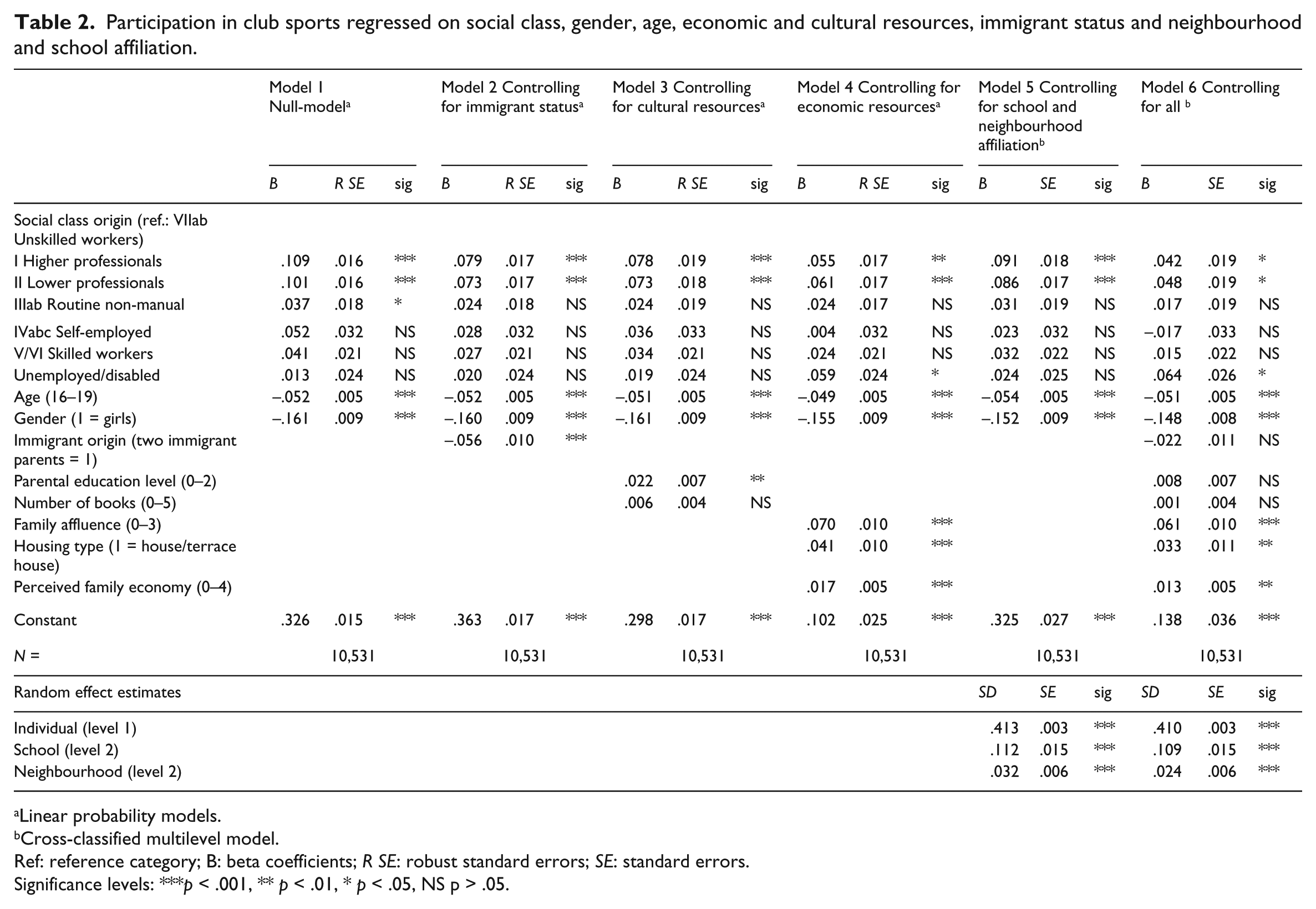
Linear probability models.
Cross-classified multilevel model.
Ref: reference category; B: beta coefficients; R SE: robust standard errors; SE: standard errors.
Significance levels: ***p < .001, ** p < .01, * p < .05, NS p > .05.
In the first regression model, we included only class position in order to examine the ‘gross’ association with sport participation. It mainly reflected the pattern described above, showing significant differences in participation rates between unskilled workers and the two professional classes. The differences between unskilled workers and other classes were more moderate, between 3.7 and 5.2 percentage points, and only children of non-employed parents did not differ from children of unskilled workers.
In Model 2, when immigrant status was included, the social class differences in sport participation were slightly smaller than the initial class differences. Compared to Model 1, the estimated difference between unskilled workers and the professional classes was reduced about 28%, indicating that immigrant status was only partially related to the initial class differences. The difference in participation rates between those with and without immigrant parents was around five percentage points, when social class position was controlled for.
Since cultural resources are factors that can explain the relationship between class and sport participation, we included parental education level and the number of books at home in Model 3. These variables contributed about the same extent as immigrant status in explaining social class differences in sports participation. After controlling for social class, both coefficients were weak. The number of books at home did not explain any variance in sports participation, while parental education played some role in addition to social class.
In Model 4, economic resources were introduced as they might explain the class differences. These factors were clearly more important than the others, as they explained around half of the initial class differences between the reference category and professional classes. The relationship between family affluence and sport participation was quite strong, as the difference in participation rate between those with the most and the least resources was estimated to be 21 percentage points. In addition, sport participation was higher among adolescents who resided in houses and among those who perceived their families’ financial situation to be good.
In Model 5, we used cross-classified multilevel modelling to measure the importance of school and neighbourhood context simultaneously. Since these contexts are not nested – i.e. students at schools come from many different neighbourhoods, and those from different neighbourhoods often go to different schools – they should be included as two separate higher level variables. The results showed that these contextual factors contributed little to explanations of social class differences in club participation. The two coefficients for service class positions were 15–17% smaller when these factors were considered, compared with the initial differences in Model 1. Thus, social class differences in participation rates were rather similar within such contexts as across them.
In the final model, we entered all variables using the cross-classified multilevel framework. This model explained slightly more than half of the social class differences in sport club participation. The economic resources variables remained significant. On the other hand, when all variables were controlled for, the coefficients for immigrant status and parental education were non-significant and very close to zero. Because neither school nor neighbourhood effects were particularly large, the explanatory power here must be attributed to families’ economic resources. Nevertheless, close to half of the class differences were left unexplained by the variables in the analysis.
Discussion
The study showed that 26% of all youth in Oslo aged 16–18 were participating in club-organized sport, a figure that was slightly below the national level (29%) (Bakken, 2017: 46). In such a context, social class differences must be considered quite large, as those raised by parents in service class positions had a 10–11 percentage point higher probability of participating in sports clubs than children of unskilled workers. The participation rates of children of skilled workers, self-employed people or manual routine workers were somewhere between the poles of the class distribution. An important finding concerns the relative importance of cultural and economic resources as mechanisms that generate social class differences in sport club participation. The analyses showed that economic resources were the most important factors. Family affluence strongly influenced participation rates, as well as type of housing and youths’ perceptions of their families’ financial situation. Cultural resources explained only a modest proportion of class differences, and controlling for immigrant origin only slightly reduced the associations between social class and sports participation. The same was true for place of residence and school affiliation. Although we can explain large proportions of the class differences in our models, some of these class differences were left unexplained. This proves that applying a conventional and well-established class scheme in analyses of sport participation is an important approach to examining this kind of social difference among youth.
Understanding class differences
Previous studies have also found that economic resources in the family are the main contributor to social class differences in club sports participation (Duncan et al., 2002; Holt et al., 2011). Club sports are costly, and the more limited a family’s budget, the higher the relative cost of adolescent club sport participation – and the less it may be prioritized. Particularly among unskilled workers and non-employed people, who have the lowest economic resources, cost may be a barrier. In this study, we found an independent explanatory effect of economic resources in the family, even among those in similar class positions. This implies that the EGP scheme does not capture all social differences, and there is heterogeneity of economic resources within the class categories that affects participation.
Immigrant background and parental education explained only a small proportion of class differences, and the number of books at home had virtually no impact. The latter indicates that academic culture is not particularly relevant for young people’s participation in sports club activities. Thus, our findings contradict previous findings that cultural capital affects sport participation net of economic capital (Wilson, 2002), and especially those by Larsson (2008) who argues that cultural capital is even more important for youth sport participation than economic capital.
Still, because the variables included in our analyses explained only slightly more than half of the initial class differences, we cannot reject the view that cultural resources may be important in class differences in sports participation. A first issue is that the indicators used in this article may be incomplete, and more precise measures of family cultural and economic resources may explain even more class differences. Furthermore, cultural capital is understood and measured in different ways, and the indicators used in this study do not necessarily capture all relevant cultural resources. For instance, families from different social classes could have different ‘cultures for sports’ or ‘tastes for sport’ (Bourdieu, 1978), and middle class parents may encourage children’s participation in organized leisure time activities more than parents in other classes (Lareau, 2003: 82). Also, middle class parents may have more confidence and ease in organizational settings (Lareau, 2003: 231), a type of cultural skill that again could affect their children’s experiences and their participation rates. Nevertheless, as we had limited access to indicators of these aspects of the family culture, we can only hypothesize that such cultural differences play a role.
On the other hand, the unexplained class effect (in Model 6) could be a result of class differences more directly related to parental working situation. The EGP class scheme distinguishes between occupations with different degrees of skills, flexible working hours, long distance commuting and/or exhausting conditions. Such factors may influence parental ability and time for supporting, organizing and raising funds for their children’s club sport activities. Such a substantial class effect would contradict the view that a minimalist class understanding is of little relevance in explanations of cultural and social activities (e.g. Savage et al., 2013: 222).
The analyses showed that class effects were somewhat reduced when neighbourhood and school context were controlled for. This indicates that the youths’ social context may also matter. Although these effects were not particularly large, they indicate that organization of sport clubs, degree of parental engagement in neighbourhoods, and school sports cultures may explain some class differences in participation.
To the best of our knowledge, this study is the first to use established measures from the minimalist tradition and concepts from the culturalist tradition in class research to investigate the link between parental social class and participation in organized youth sports. Hopefully, the study will inspire other researchers to use similar approaches so that further research results will accumulate in this area. In this regard, we wish to highlight that the use of established class models may facilitate comparison of studies. Moreover, when we apply theory-based class schemes and concepts in multivariate analyses, we have a better understanding of the inequality-generating factors and mechanisms than with arbitrary measures of social inequality. The results suggest that in analyses of organized club sport participation, the EGP classification should at least be accompanied with indicators of economic resources. We also wish to highlight the importance of including related variables such as immigrant background and social context in analyses, which were typically neglected in earlier studies.
Conclusion
Our analyses show substantial differences in organized sport participation between adolescents from different social classes. Despite Sport for All policies, democratization of participation in organized sport has not yet been realized, not even in relatively egalitarian countries such as in Scandinavia. Our analyses suggest that cultural resources, immigrant origin and the social context in which the adolescents live in and what school they attend, only partially explained this relationship. The analyses suggest that economic resources are more central in young people’s sport club participation, and that such assets are the most important factor in social class differences. This is not a particularly new conclusion, but the strength of the study is that we find this even when cultural and economic resources, as well as other factors such as immigrant origin and social context, are treated in the same study. Thus, policies by local authorities and sport clubs in low-income areas that provide economic assistance to low-income families with children who wish to participate in sports, should be encouraged. The results also suggest that the sport clubs should be more aware of the costs for parents, such as membership fees, as high costs can exclude adolescents of low-income families from sport.
However, as discussed above, our measures of cultural and economic resources can only be crude indicators of resources that do not cover all family assets relevant to class differences in participation. Thus, future research should include even more detailed information on parental education, cultural resources and income. Because many of the class differences in participation rates remain even after controlling for all factors in the full model, future research should examine whether differences in parental involvement in sports (e.g. how important they think it is, and their level of participation) and differences in their work situations, affect their support of their adolescent children’s sport club participation. Future research should also examine how class, cultural resources and economic resources influence adolescents’ participation in different types of sports and clubs, as these factors have been found to be important among adults (Wilson, 2002).
Further research should have better control of the temporal aspect of social inequality in sports participation. For example, in this study we do not know whether the class differences seen in late adolescence are mainly the result of lower classes taking up sports (as children) to a lesser degree than youths from professional classes, or if the former group is dropping out more frequently than the latter during adolescence, when sports activities become more expensive and serious. This question has important policy relevance, and future research should be encouraged.
Footnotes
Declaration of conflicting interests
The author(s) declared no potential conflicts of interest with respect to the research, authorship, and/or publication of this article.
Funding
The author(s) disclosed receipt of the following financial support for the research, authorship, and/or publication of this article: This research is a part of the project ‘Participation in Sports among Norwegian Youth’, project number 316032, funded by the Norwegian Ministry of Culture, Norwegian Social Research (NOVA) and the Norwegian School of Sport Sciences.
