




Abstract
This article aims to address the question of credibility as a key issue for sports stakeholders. Due to the number of doping scandals, professional cycling offers an interesting example to understand how agents try building credibility after facing mistrust. The present study provides an example of how a professional team (Sky) faced controversy during the 2015 Tour de France. The dispute about Sky riders’ performance reflects the rejection of their occupational self-definition. Relying mainly on Goffman’s sociology to analyse public interactions, we have observed how Sky tried to convince their audience that their performance was credible. However, the team’s quest for credibility remains uncertain for two reasons. First, the legacy of doping scandals in cycling – in addition to the low trust in the organizations in charge of anti-doping regulations – weakens its credibility. Second, the mistrust in cycling drives journalists and experts to stage their independence in order to avoid being considered an ally or accomplice. As a consequence, collaborative networks were rendered fragile, and Sky could not rely on a large ‘team presentation’ to face criticism. This research shows that the lack of credibility is a central issue for the sport since it threatens its whole economy.
Introduction
At least until the 2000s, doping was probably widespread in cycling. Doping was perceived as a legitimate part of riders’ work (Brissonneau et al., 2008; Fincoeur et al., 2018; Smith, 2017). Some riders were thus open to speaking up and revealing their doping practices (Dimeo, 2007). However, from the 1960s, sports authorities instated new rules that forbade performance-enhancing drugs in sports, and doping became a deviance (Becker, 1963). Over time, the anti-doping measures aimed at cleaning up the sport of cycling became more intense (Møller, 2009). As a consequence, doping was increasingly pushed ‘behind the scenes’ (Brewer, 2002; Connolly, 2015). Most of the riders adopted a moral code, which included a ‘law of silence’ regarding doping (Møller, 2009). However, this code was only partly respected since some riders shared insiders’ secrets (Kimmage, 1990). Additionally, a solidarity between riders was observed. For example, during the 1998 Tour de France, cycling teams went on strike to show their support for the Festina team that had been accused of doping.
Cycling was the scene of several doping scandals toward the end of the 1990s and during the 2000s. In 1998, the Festina affair was a crucial moment since it revealed the extent of doping in cycling to a large audience (Waddington, 2000) and led to the creation of the World Anti-Doping Agency (WADA) in 1999 (Hanstad et al., 2008). The scandals in cycling have been described as prompting stakeholders ‘to work together for change and to restore the sports’ credibility’ (Morrow and Idle, 2008: 332). But the next scandals, especially the one involving Lance Armstrong, prevented the restoration of cycling’s credibility. In 2012, after years of investigation, Armstrong was stripped of his seven Tour de France titles for doping. This scandal has battered the reputation of international cycling along with the other doping cases, as well as a recent wave of riders’ confessions, which has emphasized the normalization and omnipresence of doping within cycling (Smith, 2017).
This history has discredited cycling in the public opinion to the point that cycling is perceived as one of the sports in which doping is the most prevalent (López, 2015). As a consequence, any remarkable performance is quickly perceived as suspicious. Cycling is tarnished, with the public stigmatizing professional riders and forcing them to constantly work to repair a spoiled identity (Sefiha, 2017). Whether the riders are really doping or not does not matter. In any case, suspicions require them to manage their communication and retain credibility (Møller, 2009). They need to reframe the situation to show that their performance is credible. That is precisely the challenge that Christopher Froome, a multiple Grand Tour winner, and his Team Sky had to face during the 2015 Tour de France.
Team Sky facing mistrust on the 2015 Tour de France
Team Sky, one of the most successful teams in the history of cycling, was launched in 2010 in the context of the Armstrong scandal. Sky’s general manager, Dave Brailsford, promised a real change in the culture of cycling thanks to a rationalization of the team’s organization and their scientific-based training. He applied the theory of ‘marginal gains’, which is concerned with small incremental improvements in any process (e.g. scientific training, riders’ own mattresses trucked from town to town, etc.), which, when added together, lead to a significant improvement. Brailsford claimed that this strategy allows clean riders to win grand tours.
However, despite Team Sky’s efforts at transparency, they are overshadowed by the dark story of doping in cycling; Froome’s victory in the 2013 Tour de France was partly obscured by Lance Armstrong’s cumbersome legacy (Groves and Griggs, 2016). When Froome won the 2014 Tour de Romandie, he was questioned about his use of Ventolin spray (salbutamol) during the race because the therapeutic use exemption he received from the International Cycling Union (UCI) was considered suspicious (Lassalette, 2014; Thomas-Commin, 2014). In the context of a sport facing recurrent doping scandals and a team beginning to win increasingly important races, Sky was scrutinized by the media and cycling experts during the 2015 Tour de France. Sky’s strategy of ‘marginal gains’ had generated great interest, but critics within the French media forced Sky to produce elements proving that this strategy, and therefore the team’s results, are credible (see e.g. Carrey, 2016).
It is in this context that a controversy arose during the 2015 Tour de France, after Froome had a stellar performance in the stage-ending climb of the 10th stage. His performance was immediately questioned in live TV comments. While the comments at the finish of a race are usually descriptive, celebrating the athletes’ performances and lacking a critical approach (Rowe, 2007), this occurrence of a public expression of mistrust is a ‘breach’ (Goffman, 1967). This violation of a common rule between riders and media was consistent with the attitudes of some critics that were already surrounding Team Sky (Carrey, 2015). Such disruptions were usually repaired through ritual activities that smooth the flow of activities in a certain context, but this was not the case for this controversy – at least for the French media analysed in this paper. Most sports journalists echoed the live comments, suggesting that the performance was not authentic and framing it as a deception.
The production of credibility as a challenge for Sky and a threat for the whole cycling economy
In the context of the controversy during the 2015 Tour de France, this paper aims to better understand the interactions between Sky, who tried to prove that Froome’s performance was authentic and credible, and the media, determined to question Froome’s performance. The media serves as a conduit between Sky and the general public, which makes analysing these interactions fundamental to understanding the process of production of credibility. Facing virulent criticism, Sky had to defend itself and provide proof of its credibility. The challenge the team encountered is comparable to other situations in which the trust relationship is at stake, as with an asylum seeker (Rogers et al., 2015), an accused defendant before a judge, or an elderly person facing a doctor who is judging his or her capabilities (Brossard, 2017), in which questioning credibility is an important step to identify possible deceptions. Other sociologists, such as Fisher (1969), analysed the question of credibility as a problem that exists when an agent group rejects the occupational self-definition which some groups claim. Fisher’s wish to employ the notion of credibility in its behavioural sense fits well with Team Sky’s contested self-definition. Becker (1966: 241) observed relations of power and authority at stake because ‘credibility and the right to be heard are differentially distributed through the ranks of the system’. He underlines that in apolitical situations, credibility is often unquestioned by sociologists, which may explain why sociologists rarely question the reason why people are not perceived as credible and adopt a common-sense view (Becker, 1966: 244), echoing the stigmatization of riders in the case of cycling (López, 2015).
Placing the issue of credibility at the core of the analysis feeds the sociology of sport’s theoretical debate, especially on the symbolic value of sports performance. To this end, this study relies on Goffman’s sociology to analyse the interactions between Team Sky and the journalists. Credibility has rarely been considered by sociologists as a significant aspect of agents’ actions in ordinary situations. Manning’s (2000) is one of the rare examples of research that conceptualizes credibility. He suggests that Goffman’s approach is a ‘sociology of the production of credibility’ (Manning, 2000: 283). This is precisely what Team Sky encountered during the 2015 Tour de France, in the production of numerous narratives and mise-en-scènes to encode Froome’s performance. Although actors can perform ‘acts of faith without “doing” anything’ (Goffman, 1983: 1), Sky inherited a lack of credibility concerning its performances due to recurrent doping scandals in cycling. Thus, the team tried save face by staging its beliefs as a dramatic, idealized, consistent realization (Goffman, 1959: 10–33). Through the consistency of these staging devices and various courses of action in a series of interactions, Sky tried to convince its audience that its representations were not false (Goffman, 1959: 37). The social order is visible as an expressive order (Goffman, 1983) in the way it faced mistrust while trying to produce credibility.
However, during the controversy, two opposed keyings completely transformed the meaning of Froome’s performance. A key is ‘a central concept in frame analysis’ (Goffman, 1974: 43–44) or even a ‘fabrication’ since it could be perceived to induce ‘a false belief in what is going on’ (Goffman, 1974: 83). Keying is a process of encoding a situation with a specific meaning. During the 2015 Tour de France, many in the audience (journalists, experts and the public) doubted the credibility of the riders’ performance since mistrust was extremely strong in cycling. Those actors, and particularly some of the media, ‘keyed’ Froome’s performance to frame it as the outcome of doping. To resist this keying, Sky engaged in credibility-producing endeavours (Manning, 2000). Credibility, defined as ‘the quality of being believable’ (Manning, 2000: 283), was a central element needed for Sky to defend the value of Froome’s performances.
Methodology
This study is based on the qualitative analysis of a French media corps. Two main reasons justify this choice. First, the Tour de France represents one of the country’s foremost sporting events. Consequently, it receives extensive coverage in all the French media and especially the daily press. Second, we decided to analyse solely French media because our goal is to understand how credibility and discredit are shaped in interactions, so we needed to observe it in a specific context in accordance with the interactionist perspective adopted in this study. Of course, it means that our analyses are not representative of the whole of media treatment. We can assume that French media were more critical toward Sky than the UK press, for example. Furthermore, we must also consider a possible bias in French reporting due to the fact that there has not been a French cyclist winner of the Tour De France since 1985 – a fact that can, as suggested by the British journalist Matt Slater (2015), elicit some added sanctimony.
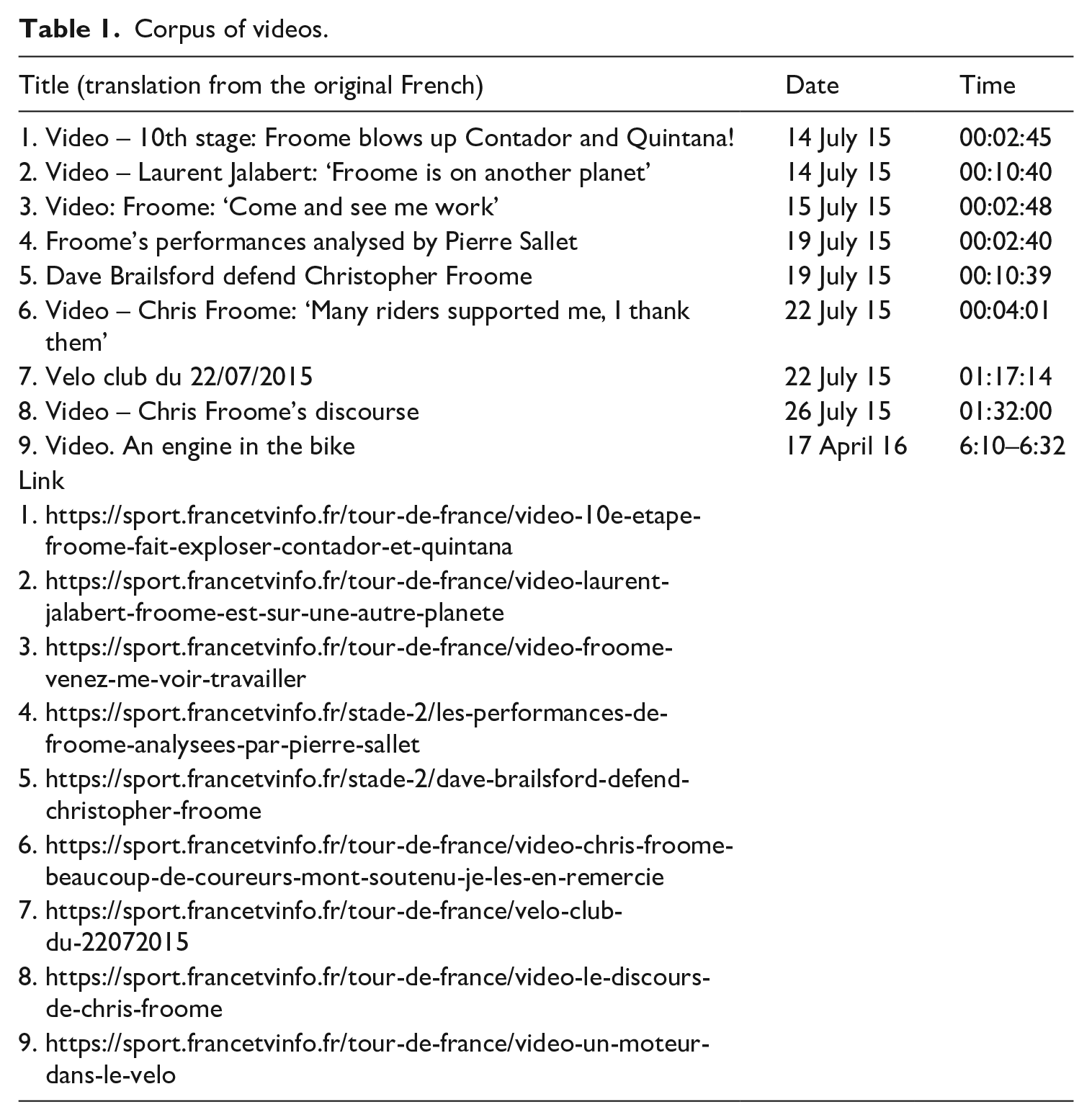
The material analysed is composed, first, of nine videos produced by France Télévision (France TV, the French public audiovisual group that held the exclusive broadcast rights for the 2015 Tour de France) to present race-day highlights. These videos were taken from France TV archives. We chose to analyse these videos because they have been reconfigured to focus on the controversy around Froome’s performance. We also reviewed the archives of France TV to complete the corpus of eight videos (see Table 1). The analysed period extends from 14 July 2015 (the day of the stage where the controversy began) to the end of the Tour (26 July 2015). We selected the videos that dealt directly with the controversy; that is, all the videos that addressed doubts and suspicions about Froome’s performance.
Corpus of videos.
Second, we also analysed 320 press articles published by 4 French daily newspapers: Le Figaro, Le Monde, Libération and L’Équipe. The newspapers were chosen because they represent diverse positions in the French press. Le Monde claims to be politically neutral and is an intellectual daily paper of reference. Le Figaro is a right-oriented newspaper and is the main rival of Libération, which is on the left. L’Équipe is the only exclusively sports-focused daily paper in France. The period of analysis of the press articles extends from 27 June 2015 to 2 August 2015 (one week before the start and one week after the end of the Tour de France). All articles mentioning the name ‘Froome’ were selected.
One of the researchers – not involved in cycling – proceeded to perform open coding. The coding concerned (a) acts of communication and staging devices, in particular the production of the personal front (face, expression, outfits, activity); (b) the setting (decor, layouts, objects); and (c) the way the situation is framed and ‘keyed’ (Goffman, 1959, 1974). The first two levels of analysis correspond to Fiske’s (1987) categories of ‘reality’ and ‘representation’, and the third one echoes Fiske’s analysis of ‘ideology’. Personal front, setting and framing/keying are layers of encoded meanings that produce a coherent meaning when merged. The other co-authors read the press articles and watched the videos several times to agree on the emerging themes. Codes related to credibility, trust, judgements, the course of action and the progress of the interactions emerged. A set of analysis categories was built, and one of the researchers proceeded to selectively code the data by assigning quotations to themes (Boeije, 2010). All researchers are fluent in French, which allowed them to precisely analyse the data and to translate it into English. The research team discussed the coding and the data regularly to question its bias and to confirm the relationship between codes and emerging themes and their importance to the research questions.
Sky’s social performance to face mistrust
The actors of the controversy – journalists, experts, teams, riders – did not share the same interpretation of the meaning of Froome’s performance at the 2015 Tour de France. In response to the question ‘What’s going on here?’ (Goffman, 1974), as one of the bases of a social frame, the actors diverged. Journalists of Le Monde, L’Équipe and Libération and experts like Cédric Vasseur or Pierre Sallet considered Froome’s performance suspicious or even a deception. Consequently, impression management became crucial for Froome and his team to convince the audiences (e.g. the general public, sponsors and others) that Froome’s performance was authentic.
Journalists and ‘experts’ challenged Froome’s credibility
During the 14 July stage of the 2015 Tour de France, Froome made a commendable performance that was questioned during the live broadcast by France TV analysts. At the time, Froome was wearing the yellow jersey that distinguishes the leader of the general ranking. He was also a leading professional cyclist owing to his victory in the 2013 Tour de France, the primary reference event in cycling. France TV commentators, notably Cédric Vasseur (a former professional cyclist), questioned the authenticity of this performance during the post-race commentary: And here we have the impression that Christopher Froome, his bike pedals effortlessly spinning, that he moves forward, um, it’s wonderful. It’s a beautiful sight to see, but we’re talking about a slope of over 12%. Of course, this raises serious questions.
1
The words of sports analysts, who are recognized for their expertise, carry legitimacy and play an important role in shaping judgements. Consequently, the suspicions they expressed about Froome fuelled a controversy over the authenticity of his performance.
Five days later, the channel broadcasted a report dedicated to Froome’s performance during its popular Sunday sports programme Stade 2. Journalist Céline Géraud, speaking hesitantly, described the sequence as a ‘scientific spotlight with unstoppable markers’ to give it some credibility. In the same sequence, Pierre Sallet (see Figure 1), who is presented as a doctor of physiology and a scientific expert working for the Amaury Sport Organisation (ASO), tried to mobilize science as a ‘fundamental ground for the legitimacy of professional techniques’ (Abbott, 1988: 189), but also as a good ground to delegitimize the yellow jersey’s performance. He based his argument on a method of estimating riders’ power output: Chris Froome’s climbing time . . . is 40 minutes, 43 seconds. Based on this time, we can calculate the rider’s power output . . . which gives us an average power over the entire climb of 425 watts. Based on these 425 watts, the idea is to calculate the maximal aerobic power, the MAP, which would be 500 watts for Froome.. . . Therefore, knowing that we took an ideal weight for Froome as 71 kg . . ., it gives you an MAP in watts per kilos of 7.04 watts/kg.
2
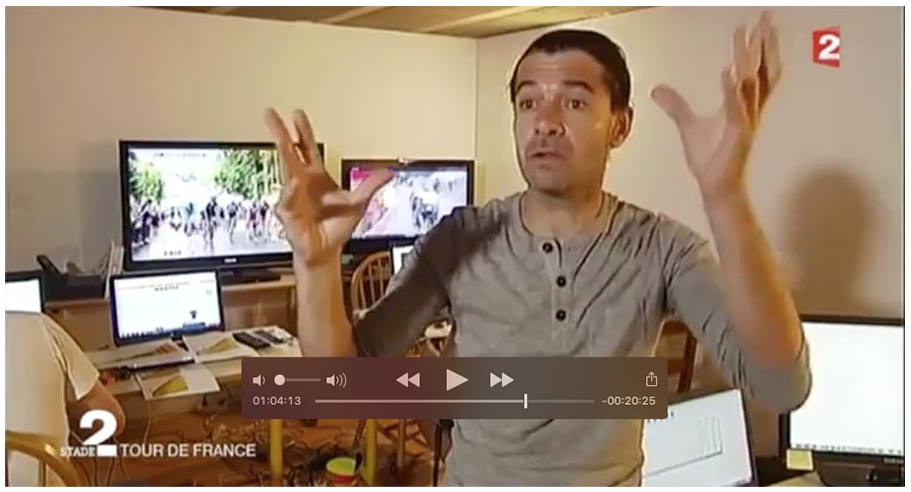
Pierre Sallet during his demonstration.
According to his calculations, he argued that Froome’s performance was beyond the humanly feasible threshold and therefore was a result of doping. To remind viewers of the argument’s scientific framework, he asked the rider to justify his performance in the same register; that is, to share his physiological data (which would allow analysts to identify anomalies that could be signs of doping). Through his demand, Sallet, who identifies himself as a researcher and an anti-doping expert, puts himself in a position of authority over Froome. This strategy allows him to impose his discourse as evidence in order to persuade the critics of Froome’s dishonesty (Krieg-Planque, 2015).
Through his performance, Sallet tried to display the meaning of the situation by ‘keying’ it in another frame (Goffman, 1974: 43–44). In response to the question ‘What’s going on here?’, Sallet tried to convince audiences that Froome’s ‘extraordinary’ performance was actually a deception. Sallet’s keying was supported by the France TV broadcast that staged pictures of Lance Armstrong and Jan Ullrich (the 1997 Tour de France winner, suspended for doping in 2011) during the broadcast (see Figure 2). Associating Froome with the images of well-known dopers supports Sallet’s demonstration based on data that aims to show that developing power greater than 7 watts/kg is not realistic.
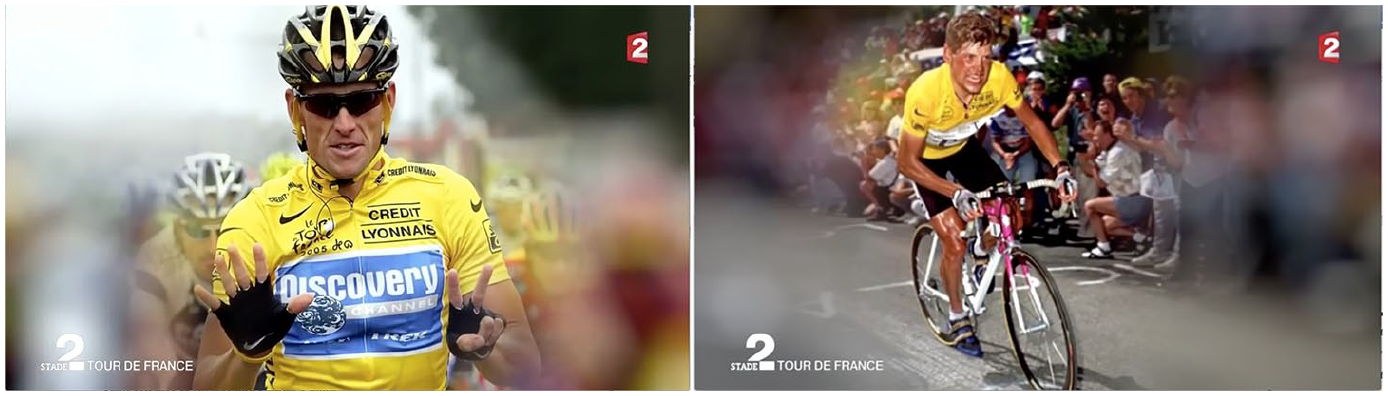
Armstrong and Ullrich as references of doping, above 7 watts/kg.
Sky’s defence of discrediting critics’ keying
To face journalists’ and experts’ criticisms, Sky had to convince audiences that the analysts’ ‘keying’ was a mistake and that the actual frame was that of ‘clean cycling’. Dave Brailsford was also invited to appear on France TV. He declared that he perceived the interview as a kind of breach (Goffman, 1967) since he felt ‘ambushed by the broadcaster of France 2’. He did not know that the interaction would involve what he called ‘pseudo-scientists’ (referring to Pierre Sallet) and provide ‘incorrect data’ on Froome (Cary, 2015). In order to preserve face and the success of the interactions on the show, he reacted by mobilizing different types of arguments to reframe the performance. First, he criticized the scientific reliability of the demonstration by arguing that the figures that Sallet had produced did not reflect the truth about Froome’s power: ‘First, you have to be careful because, as the person said, mathematical model, eh, anyway. They don’t have the data, they don’t have the facts, they don’t have Chris’s weight . . .. It’s an estimate.’ 3
Brailsford tried to deconstruct the truthfulness of Sallet’s frame and the authority of his discourse by explaining that his estimate was not scientific because he lacked the rider’s precise physiological data. Second, he called on independent experts, which allowed him to question Sallet’s credibility and thus to question the relevance of his demonstration.
At that point, the France TV journalist challenged Brailsford once again. She reinforced the keying of the situation as a deception by comparing Froome’s situation to Armstrong’s: ‘Armstrong’s case hurt cycling badly and today we say to ourselves “He was able to fool us for years, why not Froome?” ’ This scene proves that time matters: Froome’s credibility was challenged by the burden of history that drove the journalist to make a comparison with Armstrong. In his response, Brailsford displayed comprehension and empathy for the suspicious journalist. He also suggested an ethic of responsibility based on transparency: ‘I totally agree, and we are trying to deal with the shadow of the past now. However, we have responsibilities and it is up to us to show that we are transparent in order to try to show the evidence.’
His argument aimed to show his sincerity. To this end, he acknowledged the poor legacy of cycling to convince them that cycling had entered a new era, in which Froome’s performance is credible. Brailsford also called for the fair treatment of all teams, inviting them to provide physiological data on their riders: And why don’t we take independent experts, all the data, not just Sky riders but everyone? We give their power data, all the data, the facts, and we can analyse it and make a power passport. I am very much for this idea, and I am asking the UCI here, in fact, because where are they? They aren’t present right now, and we need them.
He shifted the blame and displaced the responsibility (Boardley and Kavussanu, 2011) by indicating that if the UCI had done its job by setting up a power passport – a tool that would monitor the development of the riders’ performances over the long term and thus detect anomalies that could be signs of doping – the controversy would not have occurred. By explaining that Froome ‘is special, for sure, but he does not cheat’, Brailsford also tried to reframe the ‘truth’. His argument is supported by his assertive tone and his body language, such as raising his index finger to question Sallet’s analysis (Figure 3). Speaking publicly on France TV was a way for Brailsford to present Sky as a model of transparency and commitment in the fight against doping despite the UCI’s foot-dragging.
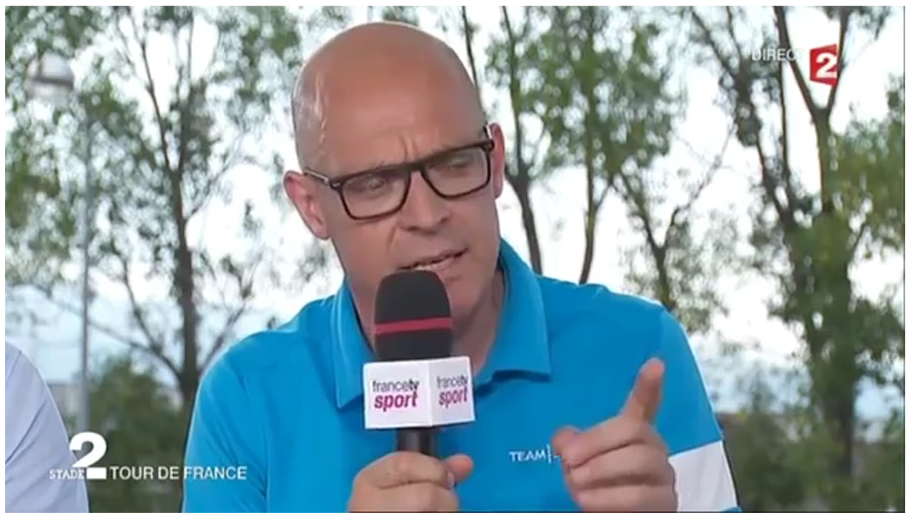
Dave Brailsford responds to Pierre Sallet.
Froome’s emotional work supporting Sky’s quest for credibility
The day after the beginning of the controversy, Froome spoke out during the official interview at the end of the stage. France TV analyst Gérard Holtz asked him about his reaction to the suspicions of doping. Froome defended himself by explaining that his performance was the result of hard work and a rigorous lifestyle: Those people should come watch us train and see how do we work and to see how I live my life, 9 months a year, and I’m working from 6 o’clock in the morning sometimes until 10 o’clock at night to be in the condition that I’m in. That’s what I say to those people. They should come and see me work and then tell me I’m not clean.
4
By emphasizing the work put in to training, by playing on the emotions as a victim of slander and by inviting critics to observe his daily life, Froome staged a ‘dramatic realization’ (Goffman, 1959: 19). He tried to demonstrate his sincerity and to be convincing about his professional skills to indicate the authenticity of his work and to rule out the hypothesis that his sports performance might be the result of doping.
On 22 July, Froome again spoke out in the same type of interview, with similar staging. This time, in a rare occurrence, his wife joined him during the interview (see Figure 4). Holtz asked for her opinion about the ‘bad atmosphere’ around Froome. She evoked her husband’s abandonment during the previous Tour and the forthcoming birth of their first child. By doing so, while also reminding the audience that Froome was a man ‘who has nothing to hide’, she sought public compassion. She and her husband achieved an emotional ‘team performance’ (Goffman, 1959) leaning on the values of family and friends as the determiner of moral commitment (Boardley and Grix, 2014). This interview also contributed to the ‘dramatic realization’ that allowed Froome to attest his truthfulness, because he would not lie in front of his pregnant wife. Moreover, it showed a congruence between his private self and public self that seemed to be a condition of sincerity (Tseëlon, 1992).
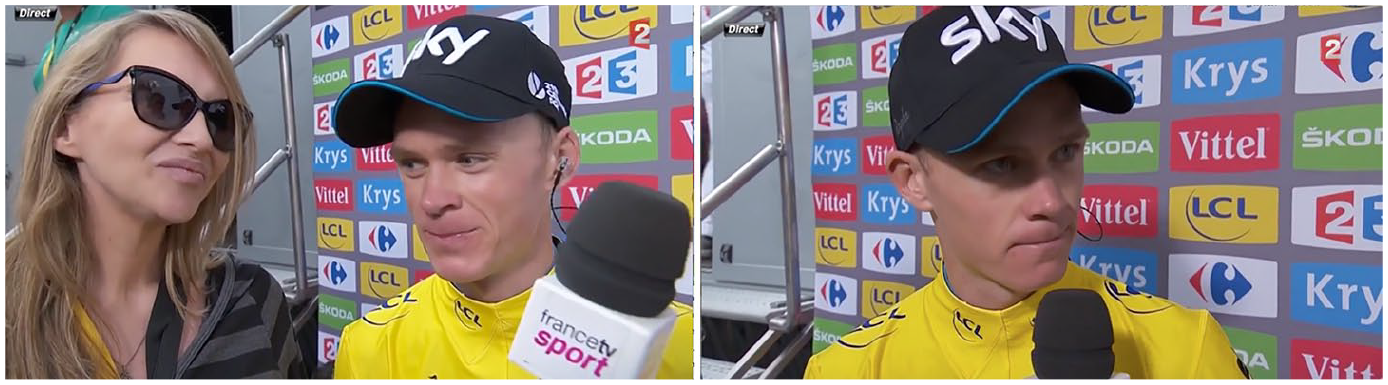
Christopher and Michelle Froome interview at the end of the stage on 22 July.
Looking sober and serious (see Figure 4), nodding to underline the sincerity of his words, Froome in turn began speaking: ‘There are a lot of riders who gave their support in the last days, and for that I would like to say a big thank you to them, um. We are the riders of 2015; we are clean riders!’ 5 To show that his performance was not a deception, Froome tried to reframe the situation: he created a break from cycling’s past and tried to convince audiences that cycling had changed. Froome linked his identity to ‘the positive brand of clean cycling’ (Sefiha, 2017). His claim that he belonged to a new generation of clean riders produced an ‘idealization’ (Goffman, 1959: 23) of the situation. By using ‘we’ and evoking the support that he had received from other riders since the beginning of the controversy, Froome staged a ‘team presentation’. Through body language with strong nods, he affirmed that a new generation of riders agreed on a novel social arrangement of work on clean cycling (Becker, 2008; Hughes, 1976), therefore implying that he was trustable and illustrating Goffman’s conception of the self as a performer.
In fact, other teams and riders were, with a few exceptions, publicly silent. They did not express doubts in the media. They were very cautious about Froome’s performances and asserted their trust in a kind of ‘complexity-reducing mechanism’ (Giddens, 1991) because they did not have information and did not want to rely on rumours. Riders knew that publicly sharing their doubts could be an additional threat to the fragile public image of cycling. Therefore, silencing their critics would be the minimal form of cooperation to avoid new damage to cycling’s reputation.
Froome concluded by presenting himself as clueless and said that he could do no more to be convincing: What haven’t I done? I’ve tried to be as much as a spokesman as I can for clean cycling. I’ve spoken to the CIRC (Cycling Independent Reform Commission), I’ve made suggestions to the governing body to implement things like night-time testing. I’ve pointed out when I’ve felt there hasn’t been enough testing, in places like Tenerife (a popular place for cycling training camps). What else is a clean rider supposed to do? (Roos, 2015)
The whole staging device – the decor, the personal front, his language, his pregnant wife on stage, and his tone – aimed to present his indignation as sincere, to touch the feelings of the public and to arouse empathy. His social performance seemed to be not ‘surface’ acting but rather ‘deep acting’ (Hochschild, 1979: 558). He staged his true belief, his emotional feeling, that his media treatment was unfair and that he was sincere. He took the ‘challenge of being natural’ (Alexander, 2004: 70) seriously so that he could be convincing.
At the end of the sequence, Holtz, who is well known for his passion for cycling and the esteem he expressed for Armstrong, engaged in a ‘corrective exchange’ (Goffman, 1959): And we’re also going to broadcast an interview with Tony Gallopin, who says we have to put a stop to all this. And I think that’s the right solution . . . and another thing, in French law and in the French spirit, we call this the presumption of innocence. Absolutely. At no point has it been said that you are a cheater, at no time on France Télévision, we need to make that clear.
Holtz’s deferential interaction aimed to reframe the channel’s and his own relationship with Froome, and to absolve the channel from any negative role in the controversy, especially since it is the main broadcaster of the race.
The logic of evidence: Sky’s press conference as the moment of truth
Following the interview with Froome, France TV broadcast on the same day (22 July) a press conference that had taken place the day before, during one of the race rest days. The following individuals were present: Froome; to his right Tim Kerrison, the team’s head trainer; and to his left Brailsford and Geraint Thomas, Froome’s teammates (see Figure 5). The video presented two speeches that showed that Sky and its leader were organizing their defence by combining several arguments. 6 First, Froome tried to be convincing by again touching the public’s emotion, emphasizing the injustice of the situation with nods: ‘Why is the same level of doubt not being cast upon similar performances from other Grand Tour contenders? Why is it only us?’ He displayed a serious face, and the raised eyebrows that punctuated the last sentence highlighted his indignation and annoyance at what he presented as an injustice. Through his acting, Froome requested the public ‘to believe that the character they see actually possesses the attributes he appears to possess’ (Goffman, 1959: 10). He tried to position himself as a victim of journalists and experts and used the audience as witnesses whose sensitivities must be activated. The context of the press conference was particularly conducive to this undertaking: it was organized by Team Sky itself to perform a moment of sincerity in the interest of transparency and dialogue.
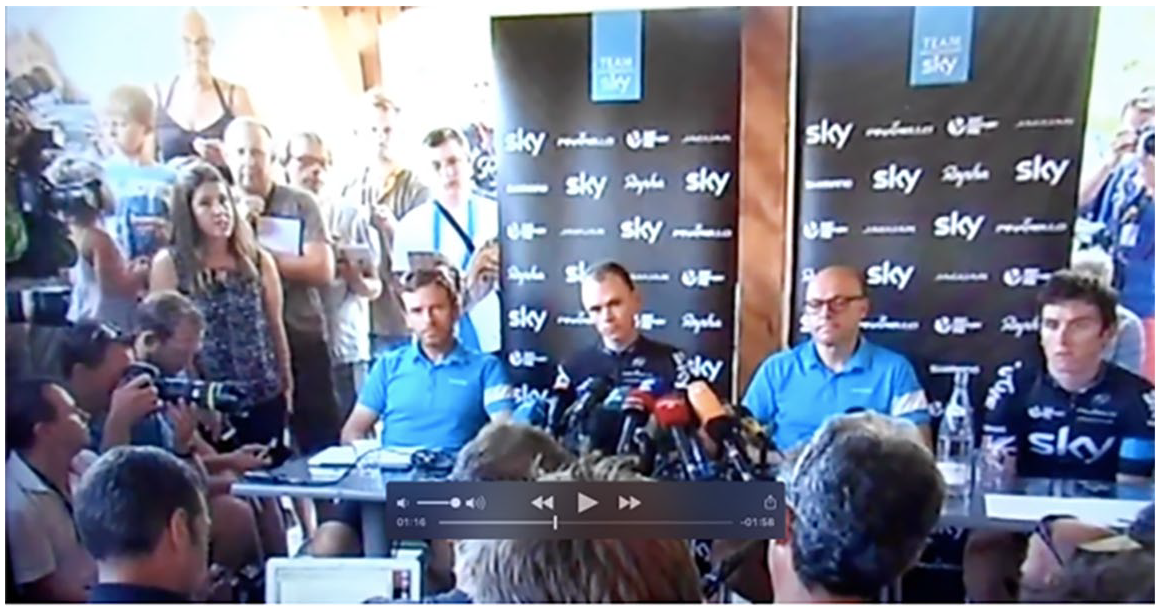
The press conference given by Sky.
Second, the choice of Kerrison as interlocutor was particularly strategic on Sky’s part because it staged a ‘scientific truth’. Kerrison is a well-known doctor in exercise physiology, making him a credible expert. As Olympic swimming champion Ian Thorpe’s former coach, he brought greater legitimacy through a neutral position not associated with professional cycling and its past culture. Therefore, when Kerrison provided Froome’s power data, he could hope to be convincing regarding the credibility of Sky’s measurements: What we know about Chris’s power with the oval chainring is that the parameters show 6% extra power because of the oval chainring (it is usually round). That’s why we need to take this into account when we interpret Chris’s power data. With his weight around 67.5 kg, it gives a correct weight/power ratio of 5.78 w/kg.
Kerrison tried to show that Froome’s data fell within acceptable standards because they were below 6.5 w/kg, which is considered the ‘normal’ limit for humans. This press conference was a team performance of a scientific demonstration that enabled Sky to respond to Sallet’s demonstration and show that his keying was inaccurate. Sky showed that it alone had all Froome’s data and that, consequently, no one else could accurately calculate the power that he generated. The team also tried to give assurances that they told the truth about Froome’s performances and that Sallet’s demonstration was wrong, in order to deprive him of a position of authority (Blais, 2006). Finally, Holtz concluded the sequence by explaining that Froome would show all the mechanics of his bike after the next day’s stage. The journalist contributed to Sky’s staging of transparency, improving the corrective exchange engaged in the previous video. Sky’s mise-en-scène was carefully set up. Concerned with maintaining the line of a clean performance, it ‘select(ed) as team-mates those who (could) be trusted to perform properly’ (Goffman, 1959: 56) and combined emotion and science in a well-orchestrated dramatization.
Why Sky’s quest for credibility remains uncertain
Despite Sky’s efforts to convince audiences that the good frame was that of a ‘clean’ performance, the ‘belief in the part one is playing’ (Goffman, 1959: 10) remained uncertain. In addition to the doubt expressed by experts and journalists, Froome faced public outrage a few days after his controversial performance when he was sprayed with urine during the race by a spectator shouting ‘Doper’ (Ezvan, 2015). This was also the case for his teammate Richie Porte, who said that he had been punched during the race (Festor, 2015), and for fellow rider Luke Rowe, who was spat on during the same stage. Froome displaced the responsibility for those incidents onto the media: ‘I don’t accuse the public; it’s really a minority. For me, the responsibility goes to some of the media treatment that is very irresponsible’ (Bouchez, 2015). In a team performance, Porte confirmed: ‘It’s coming to a point where all journalists who write anything should feel responsible for our safety’ (Kimmage, 2015).
Those incidents, and the recurrence of the controversy, revealed that Sky’s social performance obviously had not been efficient enough to restore confidence in the authenticity of Froome’s ‘biological/body’ performance. It also showed that the suspicions of critics and members of the public were mutual; that Froome and his teammates blamed the media and the experts; and that the past ‘network of co-operative relationships’ (Waddington, 2000: 153), at least before Festina, had been broken. This lack of a social arrangement of work could be observed at two levels. First, the organizations in charge of cycling and anti-doping were not powerful enough to play the role of trust devices that might have guaranteed the authenticity of Froome’s performance. Second, changes occurred in the media that weakened the role of journalists as supporters of the celebration of cycling heroes.
No sports organization able to operate as trust device
After the numerous doping scandals in cycling, the collaboration at the base of the social drama was disrupted. The declining belief that cycling respected the anti-doping doxa – a set of shared fundamental beliefs in what a sport is (Bourdieu, 1984) – weakened the collaborative network that had previously supported the valuation of riders’ performances. Froome had to face an overall greater degree of scepticism among the journalists. Indeed, before the big doping scandals in cycling, such as Festina’s scandal in 1998, a substantial part of the public shared a belief in the value of cycling rankings. Until the beginning of the 21st century, doping was not an issue for most ‘insiders’ but rather was a specific ‘culture of tolerance’ (Waddington, 2000). Critical voices regarding doping were rare and overall not heard. Until the 2000s, most of the sporting actors, including UCI staff, journalists and ‘experts’, performed a ‘team presentation’ (Goffman, 1959) that staged the same framework in which an ‘extraordinary’ performance was associated with storytelling about courage, masculinity and talent. As for other kinds of deceptions, keeping doping issues backstage was necessary to oil the wheels of interaction (Scott, 2012). Most of these actors shared a similar sport doxa that favoured ‘collusion or “understanding” without altering the basic frame of reference’ (Goffman, 1959: 48).
However, the historical conditions of performativity had changed, and it was therefore difficult for Froome to perform without reliable support from the sport institutions. Indeed, the burden of the history of doping ‘had an erosive effect on public trust in sport institutions’ (Dimeo and Henning, 2018: 185). Those institutions had encountered difficulty operating as trust devices that could guide people’s judgement. Sky could not rely on a sports organization that could play the role of an independent and trustful ‘third party’. The disputes and doubts could not be settled properly by the WADA or the Cycling Anti-Doping Foundation (CADF) who also inherited the burden of doping as to question their efficiency to identify dopers.
Indeed, athletes’ testing had been discredited in the past. For example, Lance Armstrong was tested more than 250 times without a positive result while he was actually doping (United States Anti-Doping Agency, 2012: 130). Thus, the gap between the promises of this ‘technology-based detection regime’ (Meier and Reinold, 2018) and the recurrence of doping scandals weakened the role of anti-doping organizations as ‘trust devices’ (Karpik, 1996), especially the WADA (Read et al., 2019). Despite the UCI’s efforts to strengthen its anti-doping system through the creation of the CADF in 2008, the issue of credibility unceasingly resurfaced in the words of federation members. Furthermore, they are able to identify and prevent some of the deceptions, through inquiry or testing, but it is impossible for them to guarantee that an athlete is clean and to restore confidence in riders’ performances. Finally, the importance of credibility for these social actors was also reflected in the establishment of the Movement for Credible Cycling (MPCC), an organization established in 2007 by several cycling teams and dedicated to restoring the credibility of cycling.
However, despite all these efforts, cycling is still the sport that is most associated with doping in people’s minds (López, 2015), and Froome cannot rely on the main sports organizations to legitimate his performance. Indeed, to operate as trust devices, these organizations must themselves appear credible and present the proof of their trustworthiness for an actor to risk trusting them. The UCI, CADF and even WADA (Read et al., 2019) are not predominantly perceived as trustworthy institutions that are able to prevent doping. Furthermore, they seem to face difficulties of working together and with the teams. For example, Brailsford complained about the UCI’s lack of determination, and the MPCC criticized the UCI and WADA for not enforcing their rules. Obviously, collaboration is fragile, and each atypical event is an opportunity to doubt the value of cycling performances.
A weak collaborative network for the production of expertise on cycling
The value of Froome’s performance depends on the interpretive power of external actors, particularly journalists and experts. In the 1990s many sports journalists were aware that being critical of doping was similar to ‘spitting in the soup’ (Johnson, 2016), and critical and investigative journalists were rare. The actual situation has changed as riders and external actors, particularly journalists, do not necessarily share a uniform interpretation of the meaning of the situation anymore. Since the numerous doping cases, and especially the scenario with Armstrong, also known as the ‘greatest deception in sport history’ (Wieting, 2016), the situation is more complex. Actors are required to show that they are not complicit in cycling deceptions anymore. So, any team or rider publicly defending the credibility of Froome’s performance could be framed as guilty of collusion. This explains why Sky was isolated to face mistrust and convince audiences that their performance was clean. Teams and riders did not work together in a ‘team performance’ (Goffman, 1959) to support Sky, as was the case in 1998 during Festina’s case.
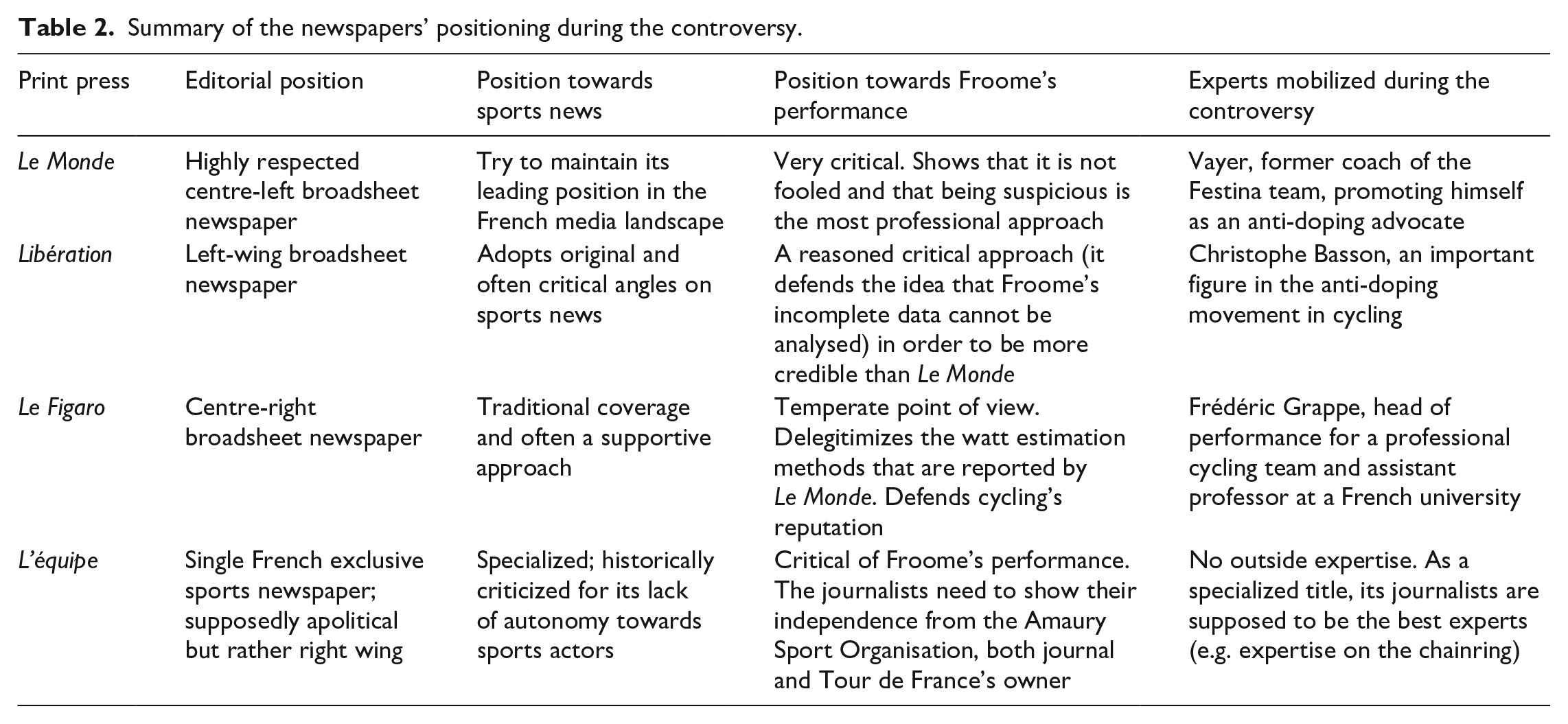
Regarding journalists, they cannot take the risk of appearing naive or complacent. To certify their professionalism, they must express their doubts, although their judgements affect Froome’s honour and reputation (Goffman, 1983: 12). Journalists’ judgements are subject to evaluation by other actors involved in the controversy and by the general public. They perform their own value in a context of mistrust, in which being critical and suspicious of cycling is a resource to maintain their professional credibility or even to solidify their authority and reputation in journalism and toward the public. In order to preserve their professionalism, journalists cannot look foolish and lose face by being duped, as had happened in the past. This encourages them to be sceptical about riders’ performances. However, the level of criticism that a journalist can adopt depends on the positioning of his or her newspaper in the media: generalist vs specialized, intellectual vs popular (Marchetti, 2005). To be credible, media need to be consistent in their approach to doping, which contributes to their reputation in sports journalism (see Table 2).
Summary of the newspapers’ positioning during the controversy.
Moreover, journalists have to maintain good relations with the cyclists, which is conditional for obtaining access to high-quality information. This narrows their room for manoeuvring and explains that some journalists clearly key the frame into other meanings, while others have both to express doubts about Froome’s performance and to maintain the value of the spectacle they are covering or broadcasting. It also explains that journalists often rely on commentators, analysts and experts to act as critics, allowing them to displace onto them part of the responsibility for critical judgement. Like France TV with Vasseur and Jalabert, TV channels often invite former riders to take over these positions. It provides a clear division of roles between journalists, who can remain more neutral, and commentators/analysts/experts, who can more easily be critical. Indeed, they do not necessarily have to maintain good relationships with athletes and teams, and their great notoriety as well-known former riders gives them the legitimacy to be critical without being criticized themselves.
Finally, the cultivation of expertise outside the traditional media field was an external pressure on their work that could have encouraged journalists to discredit Sky’s storytelling of clean performance and the new generation of riders. Since the 2000s, the transformation of the media landscape, with the development of social media, allowed spectators, fans and bloggers to spread critical comments on sport performance (Schultz et al., 2010) and some even specifically devoted to criticism of Sky. 7 Some experts, notably Sallet and Vayer, who are regularly approached by traditional media, also rely on social media to publicize their opinions and build their own reputation. In addition, new digital media such as ‘Play the Game’, ‘Inside the Games’ or ‘The Sports Integrity Initiative’ provide space for diverse contributors to debate integrity and doping issues in sports. These changes are challenging the traditional media, and journalists have to bring added value to their articles to stand out from all these publications (McEnnis, 2017).
Therefore, in this context of mistrust, Froome and Sky could not rely on ‘a set of individuals whose intimate co-operation is required if a given projected definition of the situation is to be maintained’ (Goffman, 1959: 64), which would support a strong ‘team presentation’. Since the suspicions were expressed publicly, it was a risk for the collaborative networks of other cycling teams, journalists and experts to support a social arrangement able to produce a coherent collective drama (Becker, 2008; Hughes, 1976) that might have produced a less controversial performance. In the context of mistrust in cycling, Sky’s production of credibility did not achieve the goal of ‘bring(ing) together some combination of actors across all these ecologies at once’ (Abbott, 2005: 247). The context of cycling has changed and so have the conditions for a felicitous social performance. Paradoxically, the social performance of professional cycling teams was much more efficient in the context of the widespread culture of doping and deception. Before the Festina scandal, journalists and experts collaborated, personally or as a professional group, to maintain the situation defined as a sports performance. Riders’ and staff’s ‘law of silence’ (Møller, 2009) was partly shared by journalists, riders and staff who kept professional secrets about doping backstage (Waddington, 2000). They shared a doxa that bonded them and favoured the collaborative drama.
Discussion and conclusion
This study highlights the importance of the theatrical dimension of sport performance. Beyond the wish to save face in each observed moment, it is in the series of interactions, in their connections and their consistency, that cyclists’ credibility, and therefore their professional value, plays out. But Froome’s obligation to manage mistrust and to claim that his performance was not a deception is, however, very different from that of asylum seekers (Rogers et al., 2015) or elderly people (Brossard, 2017). Indeed, Froome’s credibility depends on a more complex institutional arrangement for the valuation of his sincerity, as is the case for confessions in sports (Thing and Ronglan, 2015). This explains why the analysis of interactions needs to be connected to the history of cycling and other actors such as the media. Understanding Sky’s credibility needs the situation of interactions in the social frame and order (Goffman, 1974, 1983) and not just the giving of attention to interaction ritual (Goffman, 1967).
Furthermore, the suspicions about cycling performances studied in this paper are a lens for the social value of sports performances. The value of sports performance is routinely deemed to reflect athletes’ talent in connection to their ‘biological’ qualities and the ‘professionalism’ of their team. Usually, the audiences are confident in athletes’ integrity, and there is no need for them to specifically engage in social performance to ensure that the media as well as ‘experts’ and the public judge them to be credible. This means that in ordinary conditions the perception of sports performance overlooks both its social dimension and the many actors who contribute to its symbolic value.
However, in cycling, the history of deception tarnishes the reputation of the riders and depreciates the value of their performances. In such a context of mistrust, athletes are not perceived as credible and the symbolic value of a performance is impaired. ‘Symbolic capital is always credit’ (Bourdieu, 1977: 181), and gaining it is uncertain in the French context since Sky was not able to convince the media that they had lowered the value of Froome’s performance. Indeed, to function as symbolic capital, any property, including performance, needs to be recognized, accepted as legitimate by a group, a community, or more broadly within a culture (Bourdieu and Wacquant, 2013). But during the controversy analysed in this study, Sky was not able to gain the recognition of the French journalists and experts, participating in different and independent arenas, that are part of ‘complex interactional structures’ functioning as ‘ecologies’ rather than unified structures (Abbott, 2005: 247). Furthermore, being credible is an issue for all of the actors involved in the controversy, but the production of each actor’s professional credibility is made in the context of their respective ecology, which leads, as shown, to an opposed interpretation of Froome’s performance. Abbott’s apprehension of ‘the whole social world in the form of linked ecologies’ that function as ‘complex interactional structures’ rather than unified structures (2005: 247) seems relevant in the case studied here. This perspective evokes the ‘ “loose coupling” between interactional practices and social structure’ identified by Goffman (1983: 12), between the interaction order and the broader order.
Thus, being credible is not only crucial for Froome to save face and defend his honour during an interaction, it is also essential for cycling organizations. Credibility is at the heart of David Lappartient’s concerns as the UCI president: ‘Trust the institutions . . .. The UCI is fighting, the UCI is on the cutting edge with this system, and you can believe in the credibility of the results.’ 8 Credibility is central since the whole organization of cycling can be threatened by suspicions of doping. The burden of the history of deception in cycling and controversies involving the best riders constitute potential new threats. Analysing how actors are trying to produce credibility and identifying the social conditions of success provides a renewed gaze on the symbolic value of sport. The interest in the analysis of credibility is much broader than cycling. It invites us to question the social conditions in which credit is granted for sports organizations. It is not surprising that Thomas Bach, the International Olympic Committee president since 2013, places credibility as the main priority of the agenda reform for the ‘Olympic Agenda 2020’ (International Olympic Committee, 2014: 4). Without a strong belief in the value and the authenticity of sports performance, the value of rankings depreciates and the whole economy of sport is threatened. The Olympic movement’s power and recognition depend on the credibility of its competition, so safeguarding it is crucial for its own legitimacy.
Footnotes
Declaration of Conflicting Interests
The author(s) declared no potential conflicts of interest with respect to the research, authorship, and/or publication of this article.
Funding
The author(s) received no financial support for the research, authorship and/or publication of this article.
