



Abstract
The World Anti-Doping Agency (WADA) and the International Olympic Committee (IOC) have been held accountable for the “Russian crisis,” a major state-sponsored doping scandal, which began in 2014. The scandal has brought intense scrutiny on the IOC’s and WADA’s efficiency in curbing doping. This paper argues that their impaired credibility should not only be explained through their objective failure in preventing doping in Russia but can be mainly understood through an analysis of their staged promises of clean sport. This study relies on the analysis of a corpus of official policy documents from the IOC and WADA over the last two decades, several media sources, and field-notes from our “participant-as-observer” role during several anti-doping meetings. In the first part of this article, we argue that to convince the audiences of their commitment to the fight against doping, WADA and the IOC collaborate to create a “team presentation” in which “impression management” is used to stage promises of a strong anti-doping doxa. The second part of the article elaborates that performances are vulnerable and complicated. Because of its scale, the Russian crisis disrupted the IOC’s and WADA’s dramaturgy, revealing their individual agendas and their rivalries over the control of the doxa, with the IOC seeking to protect its power and WADA trying to remain a “trust device.” Finally, the article shows that the IOC and WADA trapped themselves within their own staged discourse because of their divisions and their outbidding promises of clean sport, which turned ineffective and even “toxic.” We conclude that such a scenario was detrimental to the overall anti-doping efforts and the subsequent credibility of these organizations.
Keywords
The so-called “Russian crisis” revealed a highly sophisticated doping system constituted and implemented by the Russian Anti-Doping Agency and the Russian Olympic Committee with the support of the Russian State. The scale of the crisis was uncovered when evidence of doping was found in 43 Russian athletes in the 2014 Sochi Olympic Games (OG). The state-approved illicit drug use has stormed the anti-doping world and was proven to have been in operation since 2010 (Denham, 2019). This raised claims of alleged inefficiency on the part of the World Anti-Doping Agency (WADA) and the International Olympic Committee (IOC) toward effectively curbing doping (Hanstad et al., 2008).
As shown in the first part of this article, WADA and the IOC abundantly staged a strong anti-doping doxa. These organizations used their powerful positions to control drug use and impose an anti-doping orthodoxy, regularly performing and vocalizing strong promises on “clean sport.” However, the second part of this article demonstrates, as shown by Goffman (1974), that performances are inherently vulnerable. Although the doxa (Bourdieu, 1984) was used to exhibit WADA’s and IOC’s commitment to anti-doping, it became a burden when the Russian crisis disrupted its dramaturgy. Indeed, a counter-performance “can undermine confidence and shatter legitimacy” (Alexander, 2011: 4). The Russian crisis revealed publicly the “backstage” of IOC and WADA’s relations, in particular the rivalries over the control of the doxa and the legitimate vision of anti-doping. Promises made by these organizations subsequently turned ineffective and even “toxic,” which undermined the credibility of overall anti-doping mechanisms.
This study intends to show that the public mistrust in anti-doping, widely reported in the media, cannot merely be explained by the IOC and WADA’s failure to prevent doping in Russia, just as high levels of crime do not mechanically lead to mistrust in the police or justice system. Instead, we argue that this crisis reveals the symbolic ineffectiveness of anti-doping.
Literature review
The expectation of a doping-free sport performance, as a specific standard of conduct, was fashioned under the influence of geopolitical, social, economic, and ethical concerns (Dimeo, 2007; Gleaves and Hunt, 2016; Hoberman, 2002; Hunt, 2007; Waddington and Smith, 2009). Doping began to be perceived as a major threat when the “sports stars” and major sports events became increasingly affected by doping practices. The Festina affair during the 1998 Tour de France, which revealed the widespread and organized doping culture within elite cycling, was a turning point. Its huge scale led to the creation of WADA in 1999, under the pressure of some governments (Hanstad et al., 2008), which resulted in lesser autonomy for sports organizations (Houlihan, 2002). The adoption of the World Anti-Doping Code (WADC) in 2004 was a key step in shaping the anti-doping doxa and the subsequent transformation of the anti-doping movement. WADC has since played a significant role in harmonizing the anti-doping regulations regarding testing policy, sanctions, compliance rules for laboratories, and national anti-doping agencies. This has resulted in increased expectations on anti-doping through the substantial visibility of WADA and IOC’s rhetoric on clean sport and its many variations (Dimeo, 2016). In particular, the rhetoric emphasizes on “the credibility of elite sport,” which was presented as a main goal (Hoberman, 2013: 139). This official sport orthodoxy stigmatizes doping and elaborates various devices to fight it.
Scholarly literature shows that anti-doping policies are controversial, and it identifies a combination of internal and external factors that explain the complex situation. First, internal factors such as beliefs, moralities, contradictions, and misbehaviors of the actors in the sporting field define anti-doping as a fostering system in which athletes must constantly accept constraints, such as restrictions to their privacy in order to prove that they behave “ethically” (Henne, 2014; Hunt et al., 2012). Further, the basis on which these anti-doping policies were put in place were judged dubious (Dimeo and Møller, 2018) and the stakeholders’ moral commitment to doping was found ambivalent (Henne, 2014; Møller and Dimeo, 2014). According to Hunt (2007), none of the IOC’s presidents had showed a clear commitment to anti-doping before Jacques Rogge in 2001. Anti-doping policies have also been criticized because they are based on a moral regulation mainly focusing on individual responsibility, which means mentalities shaped outside sporting culture, and because they minimize sport organizations’ responsibilities (Houlihan, 2002). WADA has also been blamed for its lack of independence from the IOC (Beamish and Ritchie, 2006), and its actions continue to reflect the IOC’s inconsistencies, ambiguities, reactive policymaking, and lack of internal and external legitimacy (Read et al., 2018). WADA’s deterrence-based policies, made of testing and sanctions, were judged ineffective and as evidence of the “anti-doping crisis” (Dimeo and Møller, 2018). The current anti-doping regime has likewise been analyzed as a surveillance regime—especially WADA’s “whereabouts,” which requires elite athletes to provide their location and includes them in a registered testing pool. This practice is considered unfair and harms privacy (Waddington, 2010) in the name of an ideal of purity (Henne, 2015). Therefore, anti-doping is seen as a series of failures in curbing drug use in sport, illustrated by WADA’s ineffectiveness and incapacity to provide new and/or solid grounds for anti-doping policymaking (Waddington and Møller, 2019). However, these studies contrast with several other exploring athletes’ voices. Numerous athletes believe that anti-doping is protecting clean sport and perceive anti-doping measures as necessary (Woolway et al., 2020), although they are “simultaneously met with support, trust, distrust, and frustration” (Overbye, 2016: 17).
Second, scientific literature has argued that sport is a “commercial industry” like any other (Hunt et al., 2012: 59) and that anti-doping is driven by actors outside the sporting field, including economic actors to whom clean sport is a commercial brand (Sefiha, 2017; Sefiha and Reichman, 2016), especially “the multinational corporate sponsors and American television” (Hoberman, 2001: 245) and the political actors that use sports in geopolitical games such as the Cold War (Hunt, 2011).
So far, scholars have mainly assessed the ineffectiveness of anti-doping through its objective dimensions. The effectiveness of anti-doping, defined as the achievement of the objectives set up by itself and its stakeholders, has been studied through theoretical models of organizational performance and objectivized structural and contextual factors (Houlihan and Hanstad, 2019). Anti-doping is mainly assessed by alleged objective metrologies, such as the number of adverse analytical findings and anti-doping rule violations. However, these criteria are also used by anti-doping organizations to show that they are working well. Metrologies are part of the symbolic dimensions of anti-doping.
Wagner and Pedersen (2014: 169) already paid attention to symbolism, but they primarily focus on IOC’s organizational identity by using a discursive approach. Other authors also focused on discourses, but it is rather a kind of “thick description”(Geertz, 1973) than a sociological approach (Dimeo, 2016; Hoberman, 2013). Further, IOC and WADA discourses on “clean sport” have mainly been analyzed separately, rarely in their mutual interactions or interactions with other actors, and the recent and intense period of the Russian crisis has not been extensively investigated yet. Hence, in light of this gap in literature, we continued our data collection until 2020, whereas Wagner and Pedersen (2014), for example, focused exclusively on the IOC’s official communications before 2003, and Hunt’s data analysis (2011) run until 2007.
Finally, the IOC and WADA received considerable attention regarding their construction and expression of power, but mainly on criticizing the interference of political and economic stakes in anti-doping (Dimeo, 2016; Hoberman, 2013; Hunt, 2011). However, researchers did not analyze how power plays out in anti-doping “social performances” (Alexander, 2011), nor did they pay attention to the interactions and the symbolic dimensions at stake in the sporting field.
Doxa and dramaturgy of anti-doping: theoretical framework
This study argues for the relevance of analyzing the conducts and beliefs within the sporting field, with its specific anti-doping doxa, through Bourdieu’s theoretical lens. Our assertion is that the tough anti-doping doxa has created schizophrenic tension between its idealization of sport performance and the many doping scandals.
Sport doxa is important since it is related to the power and the symbolic order of the field. It comprises the core values and undisputed beliefs that bond together the “Olympic family.” Bourdieu’s field theory relies on the relations between capital, habitus, and the field that embraces a certain doxa (Bourdieu, 1986). Doxa is composed of language (narratives, categories, binary oppositions, common sense) that structures the habitus (Everett, 2002) and reflects “the autonomization of a domain of activity [that] generates the doxa” (Hilgers and Mangez, 2014: 7). One key element of the doxa is the value given to sport performances. In the sporting field, actors share the common belief that sports rankings (e.g. medals, prestigious titles) are valuable and constitute the main capital of the field. As for other fields, actors struggle over sport capital, primarily the most prestigious rankings and competitions, as the most recognized properties of the sporting field and a source of prestige and power (Bourdieu, 1989: 20). The IOC is in a powerful position in the field of sport because it controls the OG and the redistribution of its incomes. It thus plays a key role in shaping the sport doxa (Olympic Oath and values, celebration of the OG and athletes’ performances). This common belief about the value of sport performances binds the main IOC stakeholders.
Another key element of the sport doxa is anti-doping. The relationship between sport stakeholders and this part of the doxa is ambivalent. Being a part of the sporting field requires showing a strong commitment to anti-doping—as a condition of membership—which is often expressed in the idealization of clean sport and the stigmatization of dopers. Paradoxically, doping is also a key resource to gain sport capital, although illicitly. It explains why doping has not always contradicted sports’ values. The economic and symbolic value of sport fosters a win-at-all-cost mentality and a risk of deviance (Coakley, 2006), which explains why even doping has been a part of the culture of some sports (Coakley, 2015; Fincoeur et al., 2019; Waddington and Smith, 2009).
We chose to articulate Bourdieu’s and Goffman’s theories to understand this ambivalent relation to the doxa. Discourses on clean sport are analyzed as a resource to bring the doxa to the front stage (Goffman, 1959).They are part of a dramaturgy in which the WADA and IOC aim to prove that everything is done so that clean athletes can win medals without “being stolen” by dopers. The doxa can also be seen as a theatrical performance, which allows the combination of the structural aspect of Bourdieu’s field with Goffman’s interactionist perspective. Goffman (1974) defines “frames” as metaphors for a setting that a group of participants agrees on and keying as the fact that participants understand and share the framing. For example, the IOC and WADA try to key the frame of sport so that the participants and the public believe that anti-doping guarantees a level playing field. Goffman also identifies fabrications of the frame, in which participants are not aware of what is at stake. Goffman also refers to the “relational dimension of meaning” (1974: xiii), which means that participants’ keying may be opposite and contradictory.
The WADA and IOC tried to convince the public and the various stakeholders that they are fully committed to the anti-doping doxa by overbidding on promises in their official communication. The athletes’ and the spectators’ belief in the level playing field is required to preserve the social and economic foundations of Olympic sports. Consequently, the techno-science devices, usually perceived as tools of objectivation, can be read as being part of IOC and WADA’s dramaturgy. To develop a deeper understanding of this dramaturgy, we subsequently analyzed IOC’s and WADA’s official communication over a period of two decades, with a focus on the Russian crisis. This helped us recognize the divergences in the doxa as struggles in the legitimate vision of anti-doping, and power within the sporting field. Since the exercise of power also lies in “impression management” (Goffman, 1959), which “can also be a kind of exercise of power”(Persson, 2019: 60), Goffman’s dramaturgy is consistent with Bourdieu’s focus on structure and power at the condition of not “overlooking the macro-sociopolitical construction of the ‘frame’ (in Goffman’s sense)” (Bourdieu and Wacquant, 1992: 144).
The IOC and WADA’s credibility was at stake during the Russian crisis, and Goffman’s dramaturgy as a “sociology of the production of credibility,” defined as “the quality of being believable” (Manning, 2000: 283), is relevant here. We argue that convincing the audience that their anti-doping performance is genuine contributes to the maintenance of credibility and protects their power within the field of sport. In this perspective, anti-doping is not simply a technical tool that aims to catch as many cheaters as possible. It is rather a “trust device” (Karpik, 1996), which is supposed to maintain the belief of the stakeholders in the value of competition. Consequently, these symbolic dimensions of anti-doping and staging performances and counter-performances deserve more attention because, as we argue, dramaturgical analysis, which has proven its relevance in enhancing scientific credibility (Hilgartner, 2000), is central to understanding anti-doping. Therefore, we do not focus, as several studies did, on anti-doping sciences successes and failures. Rather, our interest lies in understanding how the doxa is shaped, staged, and disputed.
Methods
We had the opportunity to observe anti-doping stakeholders’ communications in two WADA symposiums and three iNADO (Institute of NAtional Anti-Doping Organisations) workshops (2017–2019) from a “participant-as-observer” position (Junker, 1960). Based on these observations, the protection of clean sport came out as a “ritual idiom” (Goffman, 1967) that was repeatedly used. It was clearly part of the anti-doping stakeholders’ active dramaturgy. In this light, some journalists’ views on the backstage of dramaturgy appeared restrictive while seeing WADA’s and IOC’s role as passive and/or complicit vis-a-vis the Russian crisis. 1
So, we first wanted to understand IOC and WADA’s use of front stage for their common “team presentation.” We have, thus, chosen to analyze their official tools of communication, which form the front, as an “expressive equipment” (Goffman, 1959: 13), used for their dramaturgical performance. We focused on the IOC and WADA as performers staging an “idealization” of their actions and official viewpoints on anti-doping—that is, a “reaffirmation of the moral values of the community” (Goffman, 1959: 23). We were not interested in outcomes from the IOC and WADA, nor in beliefs about the effectiveness of their actions and discourses. Instead, we focused on how both organizations, especially their executives, control and display their actions.
We performed a content analysis of official policy documents from the IOC and WADA. This includes: (1) all the 91 issues of the Olympic Review, the IOC’s official magazine, published from 1999 to 2019; (2) four official statements from the IOC World Conference on Doping (1999, 2003, 2007, and 2013); and (3) all the issues (35) of Play-True, WADA’s official newsletter, published from 2002 to 2015 (WADA ended its publication in 2015). NVivo software was used to code these documents. The first stage of the coding consisted of building a significant corpus to analyze. To this end, we conducted a keyword search to identify when the IOC addressed the issues of “doping” and “anti-doping” in the Olympic Review. All articles in Play-True were analyzed, as Play-True quite exclusively focuses on (anti-)doping. We then conducted an open-coding of this corpus that helped us to identify the key topics related to “doping” and “anti-doping” (e.g. use of sciences and technologies, drug-free, laboratory, testing, clean athletes). Each text of the corpus was coded according to these keywords, which allowed us to observe, in terms of the contents addressed by the IOC and WADA, (1) the differences between the Olympic Review and Play-True and (2) their evolution over time.
In both cases, open coding helped in the initial identification of the contents and the key topics related to doping. Then, we focused on the sentences and topics associated with doping and clean sport/athletes. The software NVivo was used to focus on the changes in the discourses over time. For example, during the first coding, we did not differentiate “war on doping,” “drug-free sport,” and “zero-tolerance policy,” as these notions are closely related in the literature. We did, however, do so in the second step, using the automatic words and sentence identification function crossed with the year of publication, to identify changes over time. According to our identification of the key topics within the official communications, and identified in the literature, we analyzed more systematically the use of sciences and technologies, drug-free, clean athletes, and so on, over time to identify how the official anti-doping doxa has been staged since the creation of WADA.
While conducting our analyses, we noticed that the Russian crisis was a key event in the communication displayed by WADA and the IOC. Because of the scale of the crisis, the IOC and WADA needed to displace the fault on “someone else” and felt less bound to “team presentation.” This period is interesting to analyze for a better understanding of the contradictions and struggles over the definition of the doxa. We, therefore, conducted a closer analysis of the IOC and WADA’s official communication during this period. Furthermore, other media sources available via open access from 2015 to 2019 were also analyzed. In particular, we focused on the year 2016 when the Russian crisis occurred. An initial corpus of 1143 articles was collected, including some short comments and long reports (e.g. the McLaren Report) from newspapers, websites (e.g. Insidethegames.biz), social media (Twitter), and collaborative networks (e.g. Facebook groups on doping). When collecting the papers, over a period of four years, the question of credibility and discredit progressively emerged as a central issue in the discourses. We then operated a classification regarding their position on the Russian crisis (critics or support on actors’ credibility). However, it did not influence the coding on Nvivo nor the content analysis of the papers, which led us to select 122 articles published in 2015 and 2016 from the initial corpus for further analysis. The selection was based on their representativeness of the diversity of expression and the perceptions of each key actor’s position during the Russian crisis.
Finally, we also collected data through participant observation during several WADA symposiums and iNADO workshops (2017–2019). This allowed us to access to diverse visions of the doxa, sometimes expressed backstage or even off-stage, independently of any team performance. Informants we interacted with were IOC and WADA members, stakeholders from iNADO, anti-doping laboratories, journalists, and politicians during these events. In total, 58 field notes were collected from these informal interactions. The data provided a better understanding of the meaning of front-stage dramaturgy and the struggles on anti-doping, and will be used to discuss IOC and WADA’s official communication.
Results
The front stage: performing the doxa
As other performers, the IOC and WADA proceed to the “reaffirmation of the moral values of the community” in “team presentations,” achieved through their official communication tools (Goffman, 1959: 23, 47). Analyzing discourses at the front stage allowed us to capture the permanence and inflexions of the doxa.
Relying on sciences to win the war against doping
Content analysis of the Olympic Review shows that, in addition to many references to the fight against doping, doping controls, testing, and laboratories’ activities were key components of the implementation of WADA from 1999 to 2001. These topics are part of the IOC’s president communication strategy, more focused on a short period of time and on very specific topics, compared to that of WADA. The IOC staged the technologies and the science behind testing in their promise of an efficient fight against doping. This went together with the promises of “Clean Games” observed for the 2000 Sydney Olympics, which were expected by many policymakers to be the “cleanest” games in Olympic history alongside the 2002 Salt Lake City Olympics (Hunt, 2007: 170–186). The IOC was reluctant to become directly involved in testing in the 1960s, and some of the actors were skeptical about testing, especially in competitions (Hunt, 2007). However, testing and science were promised as tools to win the war against doping, as was done by Xavier Sturbois, a member of the IOC’s Medical Commission (Sturbois, 1999: 22-26):
The Olympic Solidarity and the IOC Medical Commission decided to join forces and together take up the challenge of developing a “modern sport” in which science would replace narrow-minded empiricism. . . The war against doping is underway, and it must be won: the peace and serenity of the OM depend upon it.
Therefore, despite numerous controversies between sport actors and scientists within WADA (Hunt, 2007: 189), science and technology were extensively used to showcase the advances in anti-doping. Before the creation of WADA, the IOC and its Medical Commission played a central role in defining the anti-doping doxa (Hunt et al., 2012; Meier and Reinold, 2018; Wagner and Pedersen, 2014).
Focusing on stakeholders’ attitudes: Rogge’s zero-tolerance policy
At any period, the images of blood, testing figures, syringes, pills, labs, sciences, and technologies have repeatedly and commonly been used to stage the seriousness and authenticity of IOC’s and WADA’s commitment to anti-doping. However, since the establishment of WADA, science has been used to stage a renewed doxa of a zero-tolerance attitude rather than “a declaration of war on drugs” (Wagner and Pedersen, 2014: 167) as it was used by the IOC previously. This was an important point of inflection as since then the doxa had been less focused on the results and more so on the actors’ attitudes. The previous orthodox position claiming that the war could be won was rare in Play-True. It could still be found in 2003 from IOC member and Athletes’ Commission Chairman Sergey Bubka, who suggested that winning the war was the priority:
The IAAF is one of the leading sport federations taking a strict stand on the war against doping. It undoubtedly is troubling when positive results happen with athletes, but I believe that with new ways to fight doping being introduced and with the coordinated efforts by WADA, we will do our best to recover and take steps to clean up sport. We aren’t going to give up. (Play-True, 2003: 9)
Another doxa inflection can be observed in the decrease in the references to the idealization of a victory against doping. For example, when asked whether the war against doping could be won, WADA Athlete Committee member Marcus Vinícius Freire seemed embarrassed, stating that “I think there is a big, big war between clean athletes and those that dope. WADA has been an important element, making things better” (The Value of Team Work, Play-True, 2007, 3: 34). With some exceptions of people believing in the past orthodoxy, the ambition to clean up sport was gradually discarded and moved to other topics and less categorical, albeit challenging, discourses, such as the protection of clean sport and clean athletes. Play-True (2005: 9) stated, “For this war to be won, we must remember to balance our perspective and make room for the clean athlete.” A similar view was expressed by Richard Ings (CEO of the Australian Sports Anti-Doping Authority), who stated, “If we hope to win the war on doping in sport, then this has to change” (Play-True, 2007: 10).
The IOC president seemed to play a key role in the evolution of the narratives. After the Samaranch era, the IOC presidents were keen to leave a legacy in the fight against doping, or at least show that they were concerned. Under Rogge’s presidency, the IOC focused on a zero-tolerance policy for doping, which went hand-in-hand with the defense of “clean sport” (Figure 1).
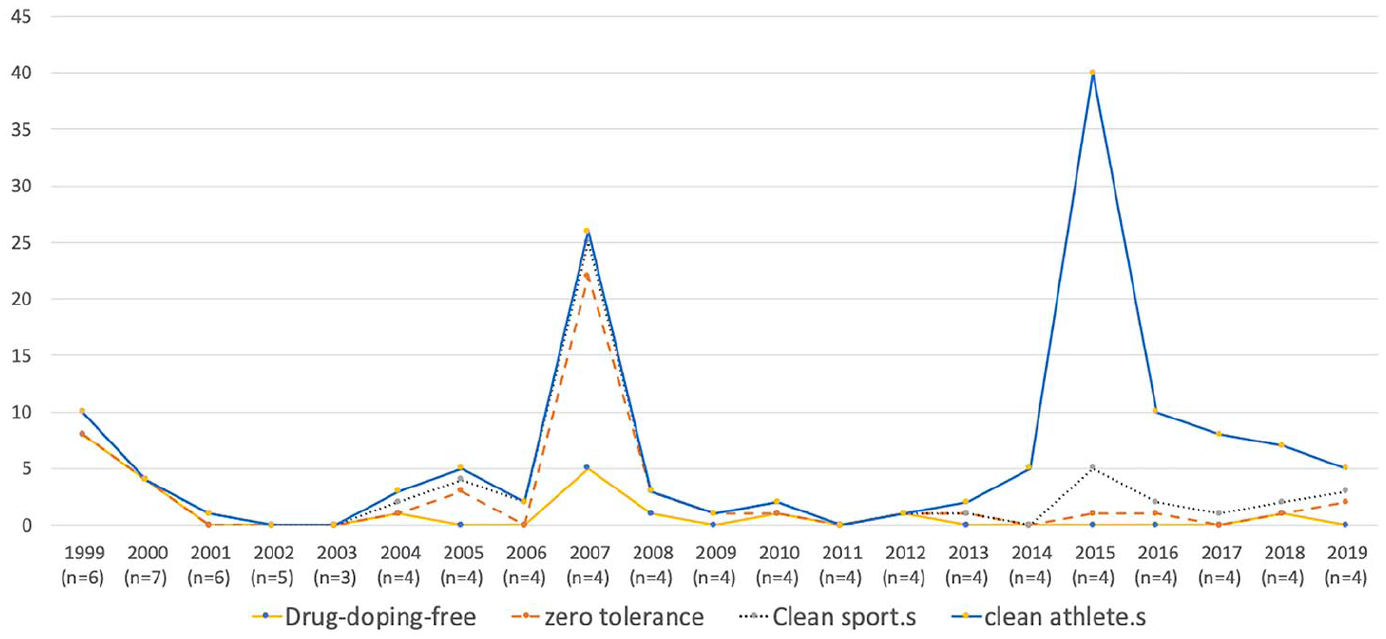
Changes in the Olympic review contents on doping (1999–2019).
During the 2004 Olympics, Rogge explained that the IOC “will have zero tolerance for doping in sport [and] zero tolerance for cheats,” and reported that progress against doping was expected to be deterrent, saying that “We think people want to know what or who is credible at the Olympic Games. . . . We are making major progress against doping because it is becoming more and more difficult to cheat” Rogge quoted in (Palmer, 2004). The zero-tolerance concept spread and was used by other key stakeholders. It could be identified in Play-True in 2005 (Issue 2: 15-16) for the first time. In a column on “The Past, Present, and Future of IAAF Anti-Doping,” International Association of Athletics Federations (IAAF) Communications Director Nick Davies promised the cleanest competition ever and quoted Juan Manuel Alonso, the IAAF Anti-Doping Commission Chairman, as follows:
The IAAF will be increasing testing before and during the competition and our goal is to make these World Championships the cleanest ever. . .We are also determined, with the support of WADA, to focus our efforts on education and information because we need our athletes to support our zero-tolerance policy for doping in athletics.
The zero-tolerance policy on drugs was central in the IOC’s communications on doping in 2007. Evidence can be found in Rogge’s discourse during the World Conference on Doping in Sport in Madrid on November 15, 2007. His speech was supported by the 65th Olympic Review issue and intended to publicly reiterate the IOC’s commitment to anti-doping. The image on the cover page of this issue works as a setting, achieving an expressive coherence: science is used as a frame and a key support, and a new era of zero-tolerance to doping is announced on the horizon (Figure 2).
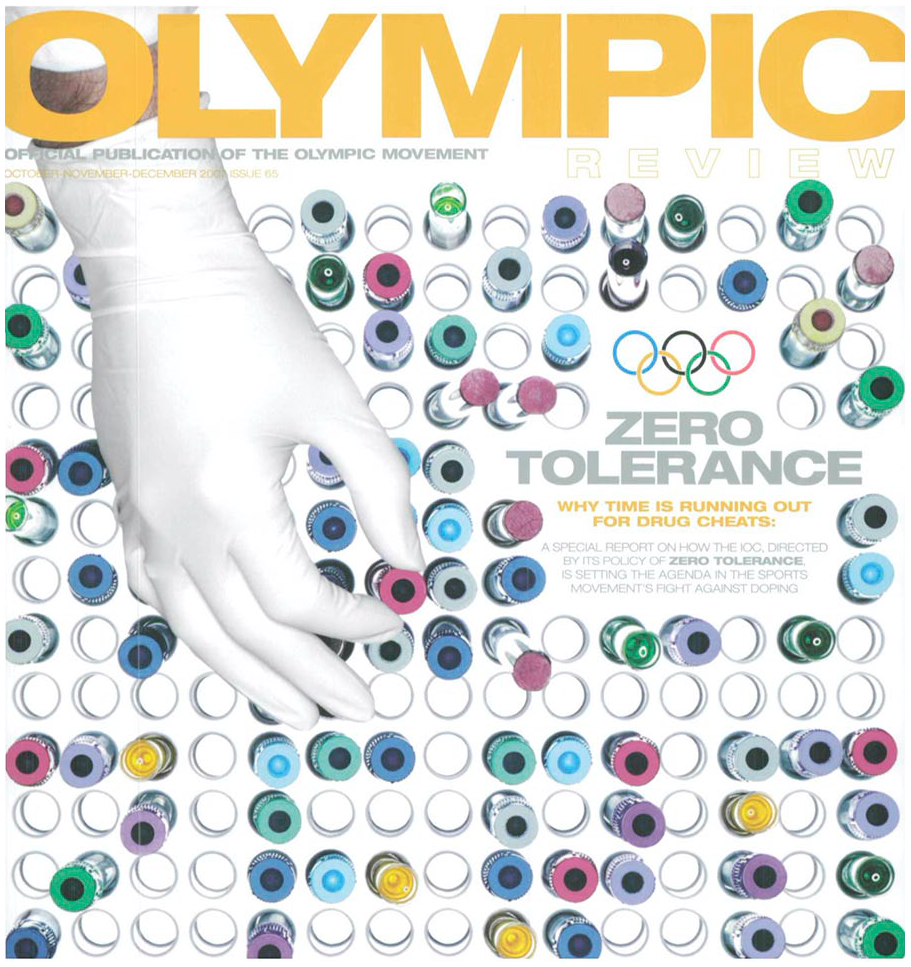
The Olympic Review, Issue 65, December 2007, front cover (reproduction authorized by the IOC).
Although WADA decreased its staging of the “zero-tolerance policy” (Figure 3), the IOC performed a narrative of a good “working team” made up of WADA (“in accordance with WADA,” “links with WADA,” “IOC’s representative at the WADA”) and other sport stakeholders (“thanks to the far-sighted cooperation between the IOC, WADA, and IFs, the number of pre-competition dope tests was increased”: Olympic Review, 2007: 38). In addition, Rogge pointed out an emotional link with WADA, stating that “since WADA was formed, the IOC has supported it ‘wholeheartedly’” (Olympic Review, 2007: 41). He acknowledged that cooperation and science were staged as the key resources to fight doping, and he presented the IOC “as guardian of many of the ethical values of international sport.” Despite losing its control on anti-doping since it “handed over some of its responsibilities to the World Anti-Doping Agency” (Olympic Review, 2007, 41), the IOC still fully staged a shared anti-doping doxa with WADA.
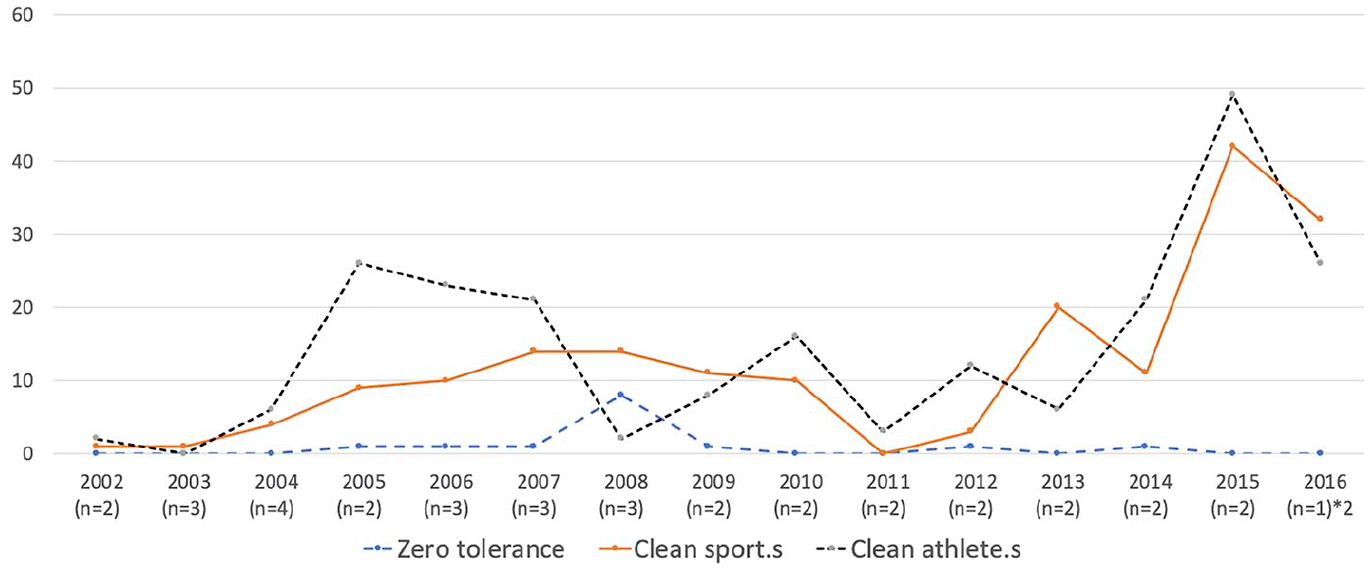
Changes in reference to zero tolerance and clean sport/athletes in Play True 2020–2016.
Staging sport organizations’ social responsibilities: the protection of the “clean athlete.”
Between 2008 and 2013, doping was not at the forefront of Olympic Review’s content. While WADA and the fight against doping were regularly quoted, there were less references to laboratories and doping control. Since Thomas Bach’s arrival at the IOC presidency (2013) and his new agenda for 2020, the narration on the protection of clean athletes has increased (Figure 1). Bach displayed the IOC’s responsibility to protect clean athletes, which is also a way to protect IOC’s credibility and the sports capital along with the power IOC has over it, stating that:
What saddens me most as a former athlete is that [recent developments in sport] erodes the trust in the clean athlete. We must do everything we can to protect [them]. For their sake and for the credibility of sports competition, they have to be protected from doping and corrupting influences. (Bach, 2015).
Staging the protection of clean athletes and clean sport became the backbone of the anti-doping doxa (Figures 1 and 3). This can be clearly observed in Play-True and in other anti-doping organizations’ communications (such as the iNADOs) echoing WADA’s discourses, in the themes of the 2018 WADA Annual Symposium (titled “Shaping the Future of Clean Sport”), in the WADA and iNADO conferences, and in the content of the Olympic Review. The content analysis of the papers published by the two magazines during the Russian crisis showed that the protection of clean sport and clean athletes was a main concern for WADA and IOC. Clean sport is mentioned 164 times, and clean athletes 65 times in Play-True. Other mentions are very scarce, such as the laboratories (seven times), and the war against doping (only mentioned 14 times in the whole sample). In our sample of 122 articles, health is only cited 29 times, with half of the articles simply referring to the name of an organization, compared to clean sport/athletes, which is cited 247 times, and to previous health-justified anti-doping before 2003 (Wagner and Pedersen, 2014).
Changes also appeared in official declarations of the IOC president during different conferences on doping. For example, in 2007, Rogge supported the IOC zero-tolerance policy (quoted three times), with particular attention to health concerns (quoted four times). In 2013, Bach referred to Rogge’s zero-tolerance commitment, but his whole discourse was dedicated to the protection of clean athletes (quoted six times). Of course, one can sometimes observe the reactivation of previous doxa on anti-doping. Before succeeding to the WADA presidency in 2019, Witold Banka claimed that “[d]opers are cheats and cheats must be eliminated” (Banka, Deutsche Welle, 2019). But Banka’s words sounded as a doxa that was out of step with some of WADA’s discourses at that time. During an informal discussion (WADA board member, field note, 2019), a WADA board member expressed disappointment with this promise, judging Banka’s comment unfortunate and risky for WADA: “I was very sorry with Banka’s comment, such a claim is unrealistic and may harm anti-doping.”
Although science—new technologies, forensic approaches, progress of sport, anti-doping sciences—remained an important topic in discourses, the attention given to the protection of clean sport and clean athletes reflects a change in the doxa since 2014. The IOC’s main claims shifted from an obligation of result (“winning the war”) to an obligation of means (“zero tolerance”) and then to a commitment to protect “clean athletes” (Figure 1). This led to significant differences between the IOC and WADA’s communications, even if their commitment to protecting “clean athletes” converge. The breakout of the Russian crisis, not only involving athletes and staff but also IOC members not committed to protecting “clean athletes,” instead meant a failed bid to keep the promise of a doping-free sport. Presumably, these promises were used as excellent short-term performances, but, in the long term, they transmuted into counter-performances that threatened the credibility of the IOC and WADA. Consequently, the front-stage presentation, which was a “working consensus” supported by a “team presentation” (Goffman, 1959), cracked during the crisis, as shown in the next part of the results.
The backstage: the Russian crisis and struggles in the control of anti-doping doxa
During the Russian crisis, the “working consensus” (Goffman, 1959: 4) on the doxa was out of date and the “team presentation” was suspended. Thus, it offered an access to the backstage and revealed that the staged commitment to the doxa hid major differences. “Keyings represent a basic way in which activity is vulnerable” (Goffman, 1974: 83), and when members of the audience, including academics and journalists, keyed the crisis as a deception, both the IOC and WADA had to prove they were not part of it. IOC and WADA blamed each other, which made public the struggles on the symbolic power on doping in which the legitimate vision of anti-doping is at stake, as observed in other fields (Bourdieu, 1991). The blame placed on WADA can be seen as forms of keying that increased the threat to its legitimacy (Read et al., 2018).
WADA’s dramaturgy to defend its position
In July 2016, WADA proposed a total ban of Russian athletes before the Rio Olympics. The ban was embarrassing for the IOC because it highlighted WADA’s increasing role in the doxa and narrowed its autonomy in the legitimate definition of the “clean athlete.” The Russian crisis and how WADA managed it was contrary to the IOC’s expectations. The IOC, as a result, perceived WADA as a threat to its power and consequently questioned its existence, as Robert Katz, a journalist, echoed (Katz, 2016). It further explains IOC’s angry response to WADA’s proposal, as described by journalist Declan Hill, as a temptation to “kill WADA”:
The IOC will continue their long, slow murder of the WADA. They will, presumably, announce some plan that will help institutionally kill WADA, dumping its body into a new organizational change, and then try to pass over the whole problem of state-sponsored doping. (Hill, 2016).
The IOC tried to strengthen its control over WADA. It did not support WADA’s affirmation of independence, as a WADA member noted after the OG in 2016: “Basically we [WADA] find ourselves in a situation where the Olympic Movement would rather control WADA.”
The Declaration of the 5th Olympic Summit, held in October 2016, approved, in principle, proposals regarding a full review of the “WADA anti-doping system” (IOC, 2016) in an example of its desire to increase its control over WADA.
However, despite its powerful position, the IOC was not able to drive WADA’s decisions during the Russian crisis. To fulfil its role as a “trust device” (Karpik, 1996), WADA had to show its independence toward IOC in order not to lose its symbolic power over the control of the anti-doping doxa. Being a complex hybrid organization (Wagner, 2009), financed by several governments and the IOC, constitutes an advantage in case of a crisis, as a WADA member told us in 2016: “Despite the imperfections of the current WADA model, when there is an attack from one side, the other side can try to counter it.” Nevertheless, WADA had to defend its threatened position. It tried to stage both its independence and the fact that it served the entire sports community. Evidence can be observed in Play-True, in which references to the anti-doping community were more frequent in 2015 compared to any previous year, and in WADA president Sir Craig Reedie’s speeches. In 2016, Reedie reaffirmed, in the name of stakeholders, WADA’s role in the control of the anti-doping doxa: “WADA should be strengthened as the leader of clean sport” (Butler, 2016).
But “team presentation” staging sport as a unified community failed during the Russian crisis. The audience had limited access to the backstage and the crisis publicly revealed divergence. The RT television channel (supported by the Russian state) published recorded phone calls supposedly featuring the International Paralympic Committee President, Sir Philip Craven—one of the rare IOC members supporting WADA’s call for a blanket ban—talking to a prankster who was posing as Edwin Moses, a hurdler Olympic gold medalist. When the prankster asked for Craven’s thoughts, he stated that:
“What I think about it is, if Bach tries to pull a fast one, I am gonna slam him,” comes the reply in the recording. . . . And I hope Craig Reedie [WADA President] does the same. . . . But what worries me is that some senior members of the IOC seem to be afraid of Bach. . . . If Bach does not change his tone he is going to be in a very difficult situation because public opinion all over the world is against him. (Pavitt, 2016)
After the numerous revelations on the crisis made visible the divergence between WADA and the IOC, WADA had to reaffirm its status as leader of the anti-doping community. This can be found in WADA’s communications support (its November 2019 media release was titled “Clean Sport Community Expresses Support for 2021 WADC on First Data of WADA’s Fifth World Conference on Doping in Sport”) and in Director General Olivier Niggli’s communications, whose presentation at the opening of the 2018 WADA Annual Symposium was conducted in the name of the “anti-doping community.” His opening speech (“Friends from the anti-doping community, we are all here to defend clean sport and protect the athlete”) was a good example of how the core of the doxa—the protection of the clean sport and of the clean athlete—was used to present WADA as the leader of a unified anti-doping community (Figure 4).
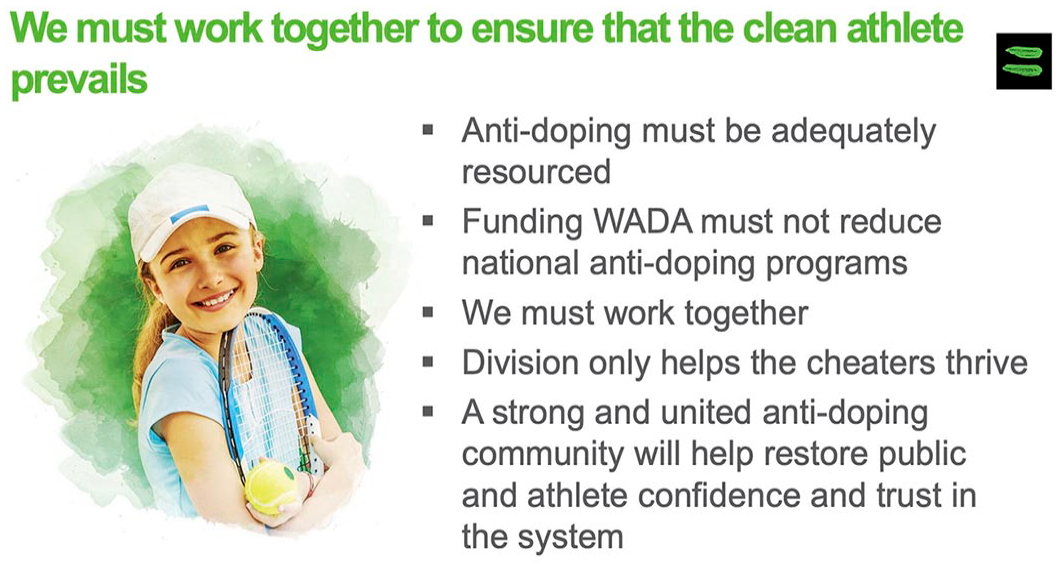
Conclusion slide from Niggli’s presentation at the WADA 2018 symposium (reproduction authorized by WADA).
It sounded like a public agreement on the doxa during a “team presentation” (Goffman, 1959) that was applauded by the stakeholders. Nevertheless, as observed by Fligstein and McAdam (2011: 4–5), fields are “rarely organized around a truly consensual taken for granted reality,” and the stakeholders could have applauded the “clean sport” doxa for various reasons.
Control of the anti-doping doxa
Since IOC did not follow WADA’s proposal to ban all Russian athletes from the Rio Olympics, several stakeholders questioned and criticized the IOC’s position on doping. This situation strengthened WADA’s symbolic power regarding the implementation of the anti-doping doxa. The IOC was criticized for its alleged permissiveness toward the corruption scandals within the Russian Olympic Committee and the IAAF, in which an important IOC members, Lamine Diack was involved. For example, the iNADO questioned the IOC’s commitment to the doxa when it claimed that if the next WADA report provided “considerably more conclusive evidence” of the “corruption” in Russian anti-doping, it would be “even clearer that the IOC has much more to do to protect clean athletes as an absolute priority” (Pavitt, 2016).
However, several stakeholders, who had expressed criticism vis-a-vis the IOC’s standpoints on doping, also complained about WADA’s policy on anti-doping, as reported by an officer we interviewed in an international federation:
WADA is trying to protect itself. WADA has a lot of compliance rules and anti-doping organizations spend more time checking that we are complying with the rules that really fight against doping. . . more time on bureaucracy is less time tracking the dopers. (iNADO meeting, field note, 2018)
Effectively, the WADC functions as a resource for WADA to protect its role and establish its power regarding the anti-doping rules. The current version of the WADC, with its increased number of regulations (e.g. the five mandatory standards and the numerous recommendations on good practices), may also be perceived as an attempt to reiterate and reinforce WADA’s compliance with the anti-doping orthodoxy. However, this complex dramaturgical situation resulted in weakened cooperation between the IOC and WADA, whose promises and doxa increasingly became a burden.
Discussion
The symbolic dimensions of the objective effectiveness
Most of the literature has analyzed the “under-performance” of anti-doping as the result of its limited effectiveness, which is often assessed through “objective” criteria such as structural and contextual factors (Houlihan and Hanstad, 2019), its (in)capacity to reduce the prevalence of doping in sport (Waddington and Smith, 2009: 200–216), or the failures of testing policy and the excessive surveillance regime (Dimeo and Møller, 2018: 60–78). However, these explanations, which often focus on actors’ economic interests and/or pervasive ideologies, may narrow the scope of analysis. Moreover, whether anti-doping is effective is a controversial debate, which does not reach a consensus among scholars (Dimeo and Møller, 2018; Haas, 2020). In fact, such a debate runs the risk of being polarized between the contempt for anti-doping actors, who would be accused of being unable to be self-reflexive, and the under-criticism vis-a-vis sports and/or anti-doping organizations. Furthermore, it is not only because doping prevalence is supposedly high (or testing is ineffective) that the IOC and WADA can be judged to be ineffective. The anti-doping performance is also symbolic.
Doxa, power, and the protection of sport capital
Our results confirm that the belief in clean sport is idealized. However, we observed significant changes over the last two decades in the nature of this belief. The vision of clean sport is no longer absolutist. “Protecting the clean athlete” became the new dominant doxa in the 2010s. This softens the goal of “winning the war on doping.” It also indicates a partial shift from simply “sanctioning the (bad) athletes” to increasingly “protect the good ones.” Analyzing “clean sport” as a “myth” (Dimeo, 2016) or an idealized “purity” (Henne, 2015) does not help to better understand the role of social structures and interactions. Instead, we argue that combining the analysis of the structural dimension of fields within which institutional actors like the IOC and WADA operate and the interactions between various stakeholders allows us to better grasp the complexity of anti-doping. The “clean sport” doxa is both shared and shaped by numerous organizations, including sports stakeholders and governments interacting with each other, which cannot simply be reduced to a “moral crusade against doping” (Henne, 2015).
Considering this complexity also overcomes the temptation to present the IOC and WADA as complicit (e.g. Beamish and Ritchie, 2006). Although they both stage an analogous belief in the anti-doping doxa, our observations show that their relation is more complex than just their seemingly similar ideological positions. Established under pressure from governments, WADA was a breach to IOC’s autonomy (Hanstad et al., 2008). WADA then took the lead while establishing the norms—illustrated by the subsequent WADC—with significant independence from the IOC (Hanstad et al., 2008). Although the IOC still has a strong hold on the anti-doping doxa, given its role in WADA’s governance and funding, WADA is required to work as a “trust device” (Karpik, 1996) and, consequently, to show a relative independence from IOC and various governments. WADA’s attitude toward the athletes’ ban during the Rio Olympic Games is illustrative of its claimed independence. Further, to understand WADA and IOC’s interactions, one needs to be aware that the power relations within anti-doping can also be seen as an expressive order (Goffman, 1983) that requires replacement in the structure of the sporting field. IOC and WADA’s interests and discourses are embedded into, and rely on, the historical and structural dimensions of the sporting field. In addition, ideologies and morality may play a role in anti-doping, but the main stake for IOC is to protect and control sport capital, since it is the most valuable product in this field and the IOC draws its power from it. Sport leaders—regardless of how they behave—know that the fake rankings are a huge threat to sport’s symbolic and economic value. This is obvious in Lamine Diack’s analysis of the doping risks for the sports industry, wherein he states that “doping is a scourge and, as I have always pointed out, when people no longer believe in what they see, sport is dead” (Cagnacci, 2015). Sport capital and anti-doping doxa are strongly intertwined, because anti-doping is supposedly intended to ensure a level playing field for all athletes, and, consequently, to protect sport capital as symbolic capital (Bourdieu, 1989). Therefore, the IOC and WADA often collaborate to stage the anti-doping doxa, but they also struggle over its control because of their contradictory positions and goals. WADA did not threaten IOC’s power within the field of sport directly, but showing its independence was perceived as a threat to IOC’s control on the doxa.
Credibility at stake
The IOC and WADA are often represented as powerful commercial organizations (Hunt et al., 2012). It is even claimed that “WADA has become a huge multinational enterprise” (Beamish and Ritchie, 2006: 7). Statements regarding their status, credibility, and trustworthiness appear somewhat questionable; however, the analysis of the same has not been conducted yet. To date, Hunt (2007: 170–171) has highlighted that trust and credibility were important concerns for WADA, and other researchers have questioned the IOC’s and WADA’s legitimacy (Read et al., 2018; Wagner and Pedersen, 2014). Using Goffman’s perspective (1959: 87) becomes relevant in this context because he pointed out that expressive coherence is required to be convincing and trustful. Hence, to convince that they are trustful, WADA and the IOC should consistently produce an expressive coherence, especially considering the fragility of trust in anti-doping. Ideally, this is what the anti-doping doxa was supposed to achieve.
However, the Russian crisis revealed IOC’s and WADA’s lack of expressive coherence. They were supposed to be at the forefront to restore sport’s credibility because of the decline of public trust in anti-doping (Wagner and Pedersen, 2014). The unrealistic expectations on anti-doping were also found to be counter-productive (Houlihan and Hanstad, 2019). Promises on clean sport, so important in WADA’s and the IOC’s strategy to show their commitment to the anti-doping doxa, created high expectations from their performance of the same. Similarly, not keeping their promises exposed these organizations to “the penalty of never being trusted again in case of failure” (Hume, 2009: 784–785). The promises were seen as breached, since the viewers did not “project themselves into the characters they see onstage” (Alexander, 2004: 531), and the value of athletes’ performances, including those of the clean ones, were questioned. The overbidding of promises produced a gap between the claims on clean sport and the unorthodox positions on doping as revealed by the crisis. Consequently, promises became a burden, and distrust weakened the overall credibility of anti-doping. The IOC and WADA’s dramaturgy was perceived as a fabrication (Goffman, 1974), which aimed to hide the true extent of doping and the inconsistency of anti-doping policies. Therefore, despite some of the changes in sporting culture and anti-doping, and some objective improvements in intelligence, testing, or harmonization, the unachieved promises may explain the weakened credibility IOC and WADA are currently facing, especially since the Russian crisis. The IOC’s and WADA’s promises on clean sport harmed their symbolic performance. Unsurprisingly, the IOC tried to react, as shown by the announcement made by its president, Thomas Bach, who staged credibility as the highest priority of the “Olympic agenda 2020” (IOC, 2014: 4). This confirms that credibility, which is “the quality of being believable” (Manning, 2000: 283), is a central component of trust within organizations.
Goffman’s sociology, as a sociology of the condition of credibility (Manning, 2000), combined with Bourdieu’s field theory, helps to understand the “toxicity” of anti-doping doxa’s promises. These unwanted outcomes, such as in the case of the Russian crisis, detrimental to public trust in sport organizations, are due to the doxa-specific condition of production and its specific content. It, therefore, cannot be argued that economic interests or immoral standpoints alone drive anti-doping, although “the credibility of organizers of elite competitions” is a central concern (Hoberman, 2013: 142). Neither can it be argued that anti-doping contradicts the “set of values which conflict with those found in the rest of society” (Hunt et al., 2012: 59), as a field with its “relative autonomy,” social meanings are also partially autonomous “from political and economic powers” (Alexander J. in Larsen, 2014: 9).
Limitations
Our utilization of Bourdieu and Goffman’s theories in this study has two main limitations. First, the difference between the front and the backstage may sound dichotomic; however, it is more a continuum than a strict opposition. In addition, what comes from the backstage or the off-stage can also be controlled as part of a mise-en-scène, including what we had access to in our fieldwork. Second, the anchorage of anti-doping dramaturgy in the sporting field might be too narrow. We focused on WADA and IOC’s interactions, and the anti-doping dramaturgy is not just to convince athletes and sport stakeholders; the mise-en-scène is also addressed to a much broader audience constituted of, but not limited to, sponsors, consumers, governments, and journalists on which the value given to sport depends (Ohl et al., 2020).
Additionally, concentrating on power relations is restrictive. WADA protects its “jurisdiction” (Abbott, 2005) and does not intend to take over the IOC. However, since the field theory works well in understanding the production of doxa and the struggles over it, it would be simplistic and imprudent to view it as purely driven by its dependence on the economic and political fields. Consequently, it should be noted that the dramaturgy also builds upon interactions with actors that are entrenched in “linked ecologies” that function as “complex interactional structures” rather than unified structures (Abbott, 2005: 247).
Footnotes
Funding
The author(s) disclosed receipt of the following financial support for the research, authorship, and/or publication of this article: The research grant (FNS_100017_166236), from the Swiss National Foundation, was beneficial for this reserach since it has enabled us to develop research on doxa and sporting capital.
