



Abstract
The aim of this work is to synthesize bis 4-[(6-bromonaphthalene-2)-oxy] substituted metal phthalocyanines at the peripheral positions and to investigate their biological properties. All synthesized compounds exhibited complete α-amylase inhibition activity 100% at a concentration of 100 mg/L. DNA interaction studies revealed that the compounds caused total degradation of DNA, as evidenced by gel electrophoresis analysis. Antimicrobial activity tests show that the complexes effectively inhibit the metabolic growth of the tested microorganisms. The minimum inhibitory concentration (MIC) values against Escherichia coli were determined as 32 mg/L for 4FFPcMn, 16 mg/L for 4FFPcCo, and 8 mg/L for 4FFPcCu. Additionally, 100% of E. coli cell viability was completely inhibited by all synthesized metallophthalocyanines, demonstrating their potent antimicrobial and photodynamic potential.
Keywords
Introduction
Phthalocyanines are macrocyclic compounds with eighteen delocalized π-electron systems, a porphyrin ring joined by isoindole groups, and two inner pyrrolic hydrogen atoms. 1 Phthalocyanines are also promising substances in a variety of biomedical applications because of their structural stability and modifiable structure. 2 These days, phthalocyanines are used in many different fields, such as biomedical imaging, gas sensing, photodynamic treatment, dyes and pigments, optical data storage, and catalysis. 3 In recent years, phthalocyanines have attracted attention for their numerous pharmacological and biological properties, such as antibacterial, antioxidant, DNA-interactive, enzyme inhibitory, anticancer, and photodynamic therapeutic activities.4–9 The properties and biological activities of the molecule are influenced by the metal ions located in the center of the phthalocyanine ring and by peripheral or non-peripheral substituents. 10 In particular, phthalocyanines with metal centers such as copper, cobalt, or zinc have shown significant antioxidant activity due to their ability to scavenge free radicals and reduce oxidative stress in biological systems. Antioxidant activity plays an important role in the prevention and progression of numerous diseases, including cancer, neurodegenerative disorders, and cardiovascular diseases. 11 Metal-centered phthalocyanines can effectively interact with reactive oxygen species (ROS) to neutralize them and prevent oxidative cellular damage. 12
Phthalocyanines exhibit potent antimicrobial activity against a wide variety of fungi and bacteria, including both Gram-positive and Gram-negative species. Their antimicrobial effects generally increase in the presence of light, particularly when used in the context of photodynamic therapy (PDT). When exposed to light, phthalocyanines act as photosensitizers that generate ROS. These ROS can damage the cellular structures of microorganisms, leading to their death. Due to their antimicrobial properties, phthalocyanines are being investigated for use in wound healing, disinfectant formulations, and the treatment of infections, particularly in combination with light to enhance their efficacy. 13 Biofilms are clusters of microorganisms covered by a protective extracellular matrix, which makes them highly resistant to traditional antimicrobial treatments. One of the most significant challenges in infection treatment and control is antimicrobial resistance. Phthalocyanines show promise as inhibitors of biofilm formation and agents capable of disrupting established biofilms. 14
In this study, the synthesis of metallophthalocyanines containing bis 4-[(6-bromonaphthalen-2)-oxy] substituents in peripheral positions was carried out. The biological properties of these compounds, which contain cobalt, copper, and manganese in the phthalocyanine core and heavy atom substituents in peripheral positions, were systematically investigated and compared.
Synthesis
4-[(6-bromonaphthalene-2)oxy]phthalonitrile (
General procedure for the preparation of metallophthalocyanine derivatives (4FFPcCo, 4FFPcCu, 4FFPcMn)
For the cyclotetramerization reaction, 4-[(6-bromonaphthalene-2)-oxy] phthalonitrile
Synthesis of cobalt (II) phthalocyanine (4FFPcCo)
Yield: 0.152 g (49%).
Synthesis of copper (II) phthalocyanine (4FFPcCu)
Yield: 0.134 g (43%).
Synthesis of manganese (III)phthalocyanine (4FFPcMn)
Yield: 0.107 g (34%).
Material and method
The experimental methods used in biological activity research are detailed in supplementary material.
Results and discussion
The synthetic pathway for the preparation of the new metallophthalocyanines (4FFPcCo, 4FFPcCu, and 4FFPcMn) is illustrated in Scheme 1.
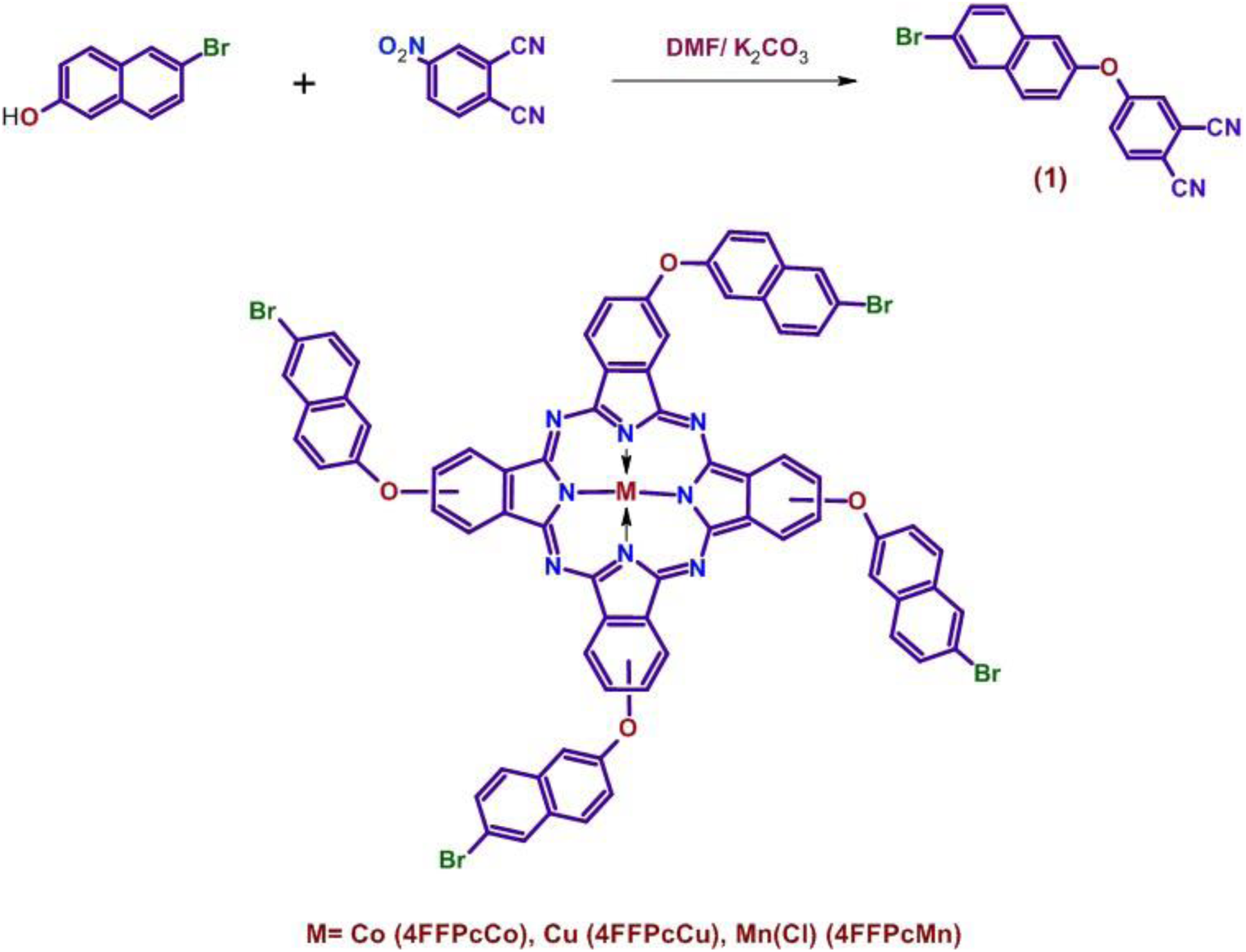
Structure of 4-[(6-bromonaphthalene-2)-oxy] substituted phthalocyanines.
The cyclotetramerization reactions were performed in a nitrogen atmosphere at 165°C using dry hexanol as solvent, in the presence of the corresponding anhydrous metal salts and DBU as a strong organic base catalyst. After 8 h of reaction, the products were purified by column chromatography. The isolated yields were determined to be 49% for 4FFPcCo, 43% for 4FFPcCu, and 34% for 4FFPcMn. The spectroscopic and analytical characterization data of the synthesized complexes were fully consistent with the proposed molecular structures. All three metallophthalocyanines exhibited good solubility in common organic solvents such as CHCl₃, CH₂Cl₂, THF, DMF, and DMSO, which is advantageous for both spectroscopic and biological investigations. In this study, the aggregation behavior of phthalocyanine compounds was investigated using THF as solvent. None of the synthesized metallo phthalocyanines (4FFPcCo, 4FFPcCu, 4FFPcMn) aggregation occurred in THF. The aggregation behavior of phthalocyanine complexes was evaluated in THF. None of the compounds (4FFPcCo, 4FFPcCu, and 4FFPcMn) showed any evidence of aggregation in this solvent. To further investigate concentration-dependent aggregation, UV-Vis spectra were recorded in the concentration range of 2 × 10⁻6 M to 12 × 10⁻6 M. While the Q-band absorption intensity increased linearly with increasing concentration, no additional blue-shifted bands associated with aggregated species were observed (Figs. SM2, SM5, and SM8).
These results indicate that the complexes remained in their monomeric form in THF under the conditions studied. The FT-IR spectra of the synthesized metallophthalocyanines show characteristic aliphatic CH stretching vibrations around 3060 cm−1, aliphatic CH stretching vibrations in the 2955–2912 cm−1 range, and corresponding to ether group (C-O-C) stretching vibrations at approximately 1246 cm−1. The corresponding FT-IR spectrumu are presented in Figs. SM1, SM4, and SM7. Mass spectrometric analyses also supported the proposed structures. Characteristic molecular ion peaks were observed at m/z: 1455.072 [M], 1460.032 [M], and 1448.787 [M-Cl]2−, confirming the proposed structures. The corresponding mass spectra are presented in Figs. SM3, SM6, and SM9.
Antidiabetic Activity
Diabetes is a complex metabolic disorder characterized by persistently high blood sugar levels, typically caused by insufficient insulin synthesis in the body. A range of serious consequences, including cardiovascular disease, kidney disease, neuropathy, and retinal damage, can arise due to persistently high blood sugar. Blocking α-amylase activity is one of the most important methods for controlling blood sugar and reducing the risk of complications. When treating postprandial hyperglycemia, α-amylase is a very important target. It catalyzes the hydrolysis of carbohydrates into absorbable monosaccharides by breaking down glycosidic bonds. Therefore, controlling postprandial hyperglycemia is a very important strategy in diabetes management. One of the most effective approaches involves the inhibition of α-amylase, a key digestive enzyme responsible for the hydrolysis of complex carbohydrates into absorbable monosaccharides. In this study, the properties of the compounds 4FFPcMn, 4FFPcCo, and 4FFPcCu to inhibit the activity of α-amylase were investigated. Results are presented in Figure 1. The compounds of 4FFPcMn, 4FFPcCo, and 4FFPcCu significantly inhibit α-amylase as the metabolic enzyme. Inhibition percentages were obtained to be 100%, 100%, and 73.6% for 4FFPcMn, 4FFPcCo, and 4FFPcCu at 50 mg/L concentrations. Comparable findings have been reported in the literature. Günsel et al. 16 synthesized non-peripherally tetra-thiazole-substituted gallium(III) phthalocyanine chloride and its graphene oxide composites, demonstrating highly effective α-amylase inhibition. Similarly, Solğun et al. 17 reported that newly synthesized 2, 10, 16, 24-Tetrakis-3-(phenoxy) propanoic acid phthalocyaninato zinc (II) exhibited strong α-amylase inhibitory activity. Although enzyme inhibitors are effective in delaying carbohydrate digestion and glucose absorption, their clinical application is often limited by gastrointestinal side effects such as bloating and diarrhea. Consequently, the development of novel, potent, and safer α-amylase inhibitors remains an important research priority for the management of type II diabetes. 18 In this context, the metallophthalocyanine derivatives investigated in this study represent promising candidates for further pharmacological evaluation.
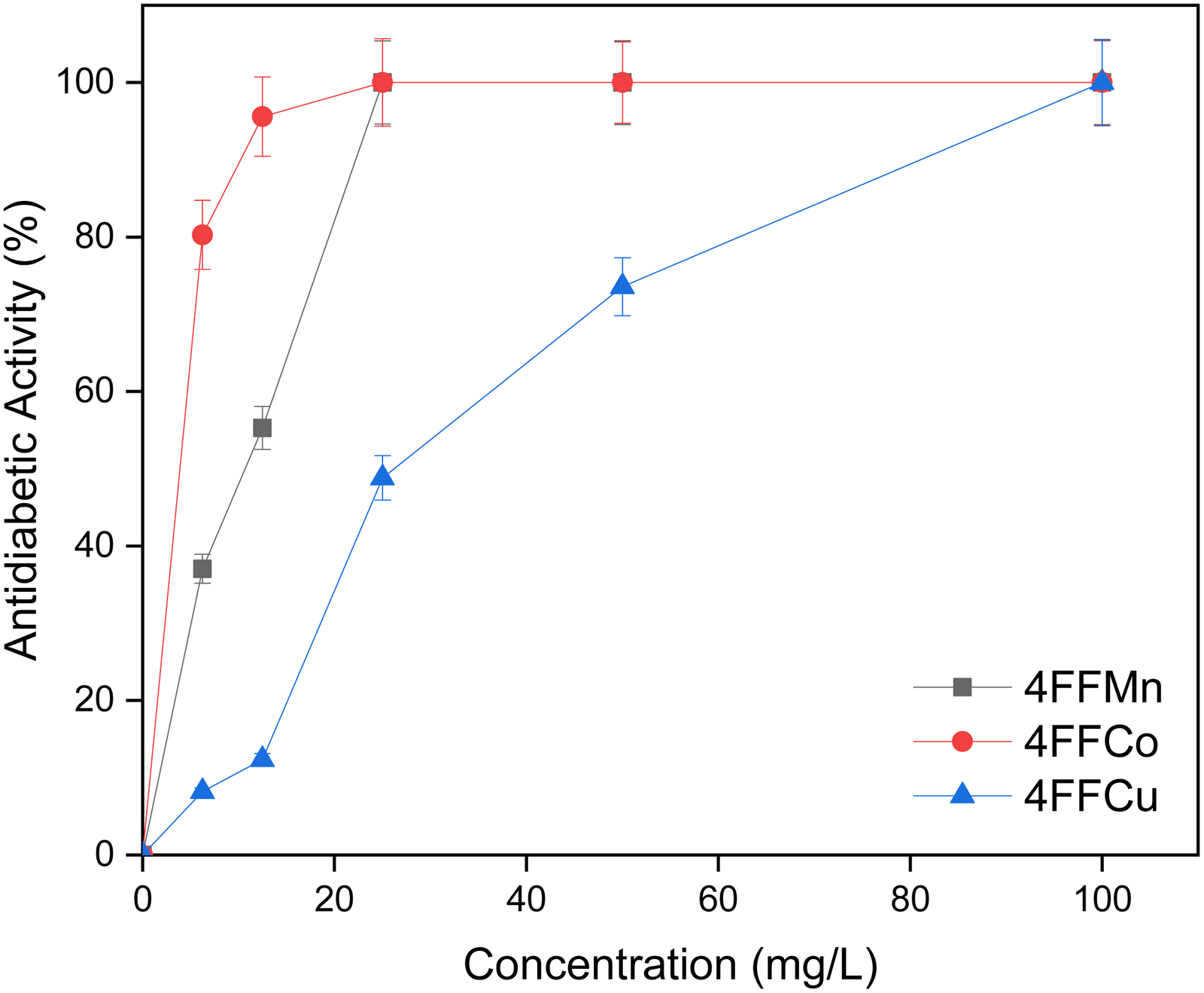
Antidiabetic Activity.
DNA cleavage activity
Due to the undesirable side effects of chemotherapeutic drugs used for the treatment of malignant tumors, researchers have directed toward developing drugs with fewer side effects and optimum therapeutic potential. 19 The nuclease activity of a compound by intercalating with DNA is revealed by gel electrophoresis. DNA nuclease potentials of the 4FFPcMn, 4FFPcCo, and 4FFPcCu were investigated using this technique. The gel images are presented in Figure 2. The ability of compounds to change supercoiled DNA into a circular, linear, or nicked form was used to gauge the effectiveness of cleavage. The control (lane 1) represented the native form of circular DNA, consisting solely of DNA. However, at concentrations of 50, 100, and 200 mg/L, 4FFPcMn, 4FFPcCo, and 4FFPcCu did not exhibit any discernible cleaved band (Lanes 2–10), suggesting that it totally degraded the DNA instead of cleaving it. By interacting with DNA and causing breakage in its sugar-phosphate backbone, these compounds can have the ability to harm DNA molecules. DNA cleavage is the outcome of strand breaks and changes during this process. 20 Amitha and Vasudevan 21 reported that the Betti base substituted Cu phthalocyanines (CuBBPc) showed •OH radical-mediated oxidative cleavage. Ağırtaş et al. 22 reported that the 4-(3,4,5-Trimethoxybenzyloxy) Phenoxy) Substituted Zinc Phthalocyanine compound has good DNA cleavage activity at a concentration of 150 mg/L. The DNA cleavage results of 4FFPcMn, 4FFPcCo, and 4FFPcCu compounds reveal the potential of these compounds.

DNA cleavage activity of PCs. Lane 1, pBR 322 DNA; Lane 2, pBR 322 DNA + 50 mg.L−1 of
Antimicrobial activity
Both human populations and aquaculture species have a high death rate from bacterial infection. Synthesis of drug precursor compounds that will overcome this problem is an important area of research. The results of the antimicrobial study indicate that 4FFPcMn, 4FFPcCo, and 4FFPcCu compounds can effectively inhibit the metabolic growth of the bacteria and fungi that were tested. The MIC values of compounds against microorganisms are shown in Table 1. C. parapsilosis and C. tropicalis were found the most resistant microorganism whereas E. coli was the most sensitive one. The MIC values of compounds against C. tropicalis were 64 mg/L. The lowest MIC values of 4FFPcMn, 4FFPcCo, and 4FFPcCu against E. coli were obtained as 32 mg/L, 16 mg/L, and 8 mg/L, respectively. The most effective compound was found 4FFPcCu. The least effective compound appears to be 4FFPcMn. In the literature, it is reported that 4-(34,5-Trimethoxybenzyloxy) Phenoxy) Substituted Zinc Phthalocyanine compound exhibits antimicrobial activity against B. cereus and E. coli at 64 mg/mL. 22 In another study, Si(IV) phthalocyanine exhibited significant antimicrobial activities against S. aureus and E. coli as 8 mg/L and 64 mg/L, respectively. 23 The effective antimicrobial values obtained and the compatibility with the literature reveal that these compounds are candidates for detailed investigation as drug precursors.
MIC values of test compounds.

Biofilm inhibition without and with photodynamic therapy
Persistent infections are frequently caused by bacterial biofilms. 24 A biofilm is a microbial community that is encased in a matrix and involves cell-to-cell attachment between microorganisms and a synthetic surface. The inherent resistance of biofilm-related illnesses to human immunity, traditional antimicrobial treatments, and biocides is a characteristic they all share. Antibiotic concentrations 10–1000 times greater than the corresponding planktonic form's minimal inhibitory concentration can be tolerated by biofilms. There is a pressing unmet medical need for alternative medications and/or treatments because there are fewer novel antimicrobials entering the drug development pipeline these days. 25 One novel approach to inactivate bacterial biofilms is photodynamic therapy (PDT). In this study biofilm inhibition potentials of 4FFPcMn, 4FFPcCo, and 4FFPcCu were investigated with/without PDT. Staphylococcus aureus and Pseudomonas aeruginosa were used as biofilm-forming strains. Biofilm inhibition activities of compounds without PDT on S. aureus and P. aeruginosa are presented in Figures 3 and 5, respectively. As seen in the figures, biofilm inhibition abilities of 4FFPcMn, 4FFPcCo, and 4FFPcCu against S. aureus and P. aeruginosa were obtained as 63.3, 67.4, and 79.4% and 69.1, 78.6, and 85.2% at 15 mg/L, respectively. Moreover, biofilm inhibition activities of compounds with PDT on S. aureus and P. aeruginosa are presented in Figures 4 and 6, respectively. Biofilm inhibition abilities of 4FFPcMn, 4FFPcCo, and 4FFPcCu against S. aureus and P. aeruginosa were obtained as 77.2, 86.0, and 93.8% and 84.3, 89.6, and, 98.6% at 15 mg/L, respectively. PDT clearly enhanced the test compounds’ ability to inhibit biofilms. PDT is a two-pronged strategy that uses oxygen to create in situ reactive oxygen species (ROS), which have a cytotoxic effect, and light, a chemical (also called a photosensitizer) that is activated when exposed to light waves within its absorption spectrum. A few similar studies were reported in the literature. The biofilm inhibitory properties of dichlorophenylthio substituted phthalonitrile and its novel non-peripherally tetra substituted Mn, Cu, and Zn phthalocyanines against S. aureus and P. aeruginosa were investigated by Çuhadar et al.. 26 They reported that PC compounds exhibited highly effective biofilm inhibition activity. Öztürk et al. 15 studied biofilm inhibiting activities of phthalocyanine derivatives on C. parapsilosis and C. albicans strains. Their results demonstrated that PDT combined with phthalocyanines decreased the amounts of mature biofilms and hindered the development of biofilms by Candida strains. Our results provide an experimental foundation for possible therapeutic applications by demonstrating the potential of 4FFPcMn, 4FFPcCo, and 4FFPcCu as biofilm inhibitors.

Biofilm inhibition of S. aureus without PDT.

Biofilm inhibition of S. aureus with PDT.

Biofilm inhibition of P. aeruginosa without PDT.

Biofilm inhibition of P. aeruginosa with PDT.
Microbial cell viability
It is known that approximately 14% of the world's population carries E. coli resistant to various antibiotics in their intestinal microbiota. The spread of antibiotic-resistant bacteria is a major problem and they are spread through various routes including industrial and hospital waste, and animal and human feces. The effectiveness of our compounds against E. coli cells is therefore a subject of research. The findings of this study are shown in Figure 7. As shown, the respect 4FFPcMn, 4FFPcCo, and 4FFPcCu inhibited E. coli viability as 67.2%, 79.5%, and 93.5% at 10 mg/L, although a 100% inhibition effect was obtained at 15 mg/L concentrations. It was determined that our compounds significantly inhibited E. coli growth and they can be used as inhibitor agents on resistant bacteria viability. Aftab et al. 27 synthesized di-substituted phthalonitrile derivative, namely 4,5-bis((4-(dimethylamino)phenyl)ethynyl)phthalonitrile, and its octa-substituted metal phthalocyanines {M = Co (2), Zn (3)}. These substances dramatically reduced the vitality of E. coli cells. Çuhadar et al. 26 studied newly synthesized dichlorophenylthio substituted phthalonitrile and its innovative non-peripherally tetra-substituted Zn, Cu, and Mn phthalocyanines and compounds exhibited great E. coli growth inhibition. These compounds exhibited important microbial cell inhibition ranging from 96.4% to 100% at 250 mg/L. Our findings were supported by the literature and also 4FFPcMn, 4FFPcCo, and 4FFPcCu can be utilized in medicine industries for several approaches.
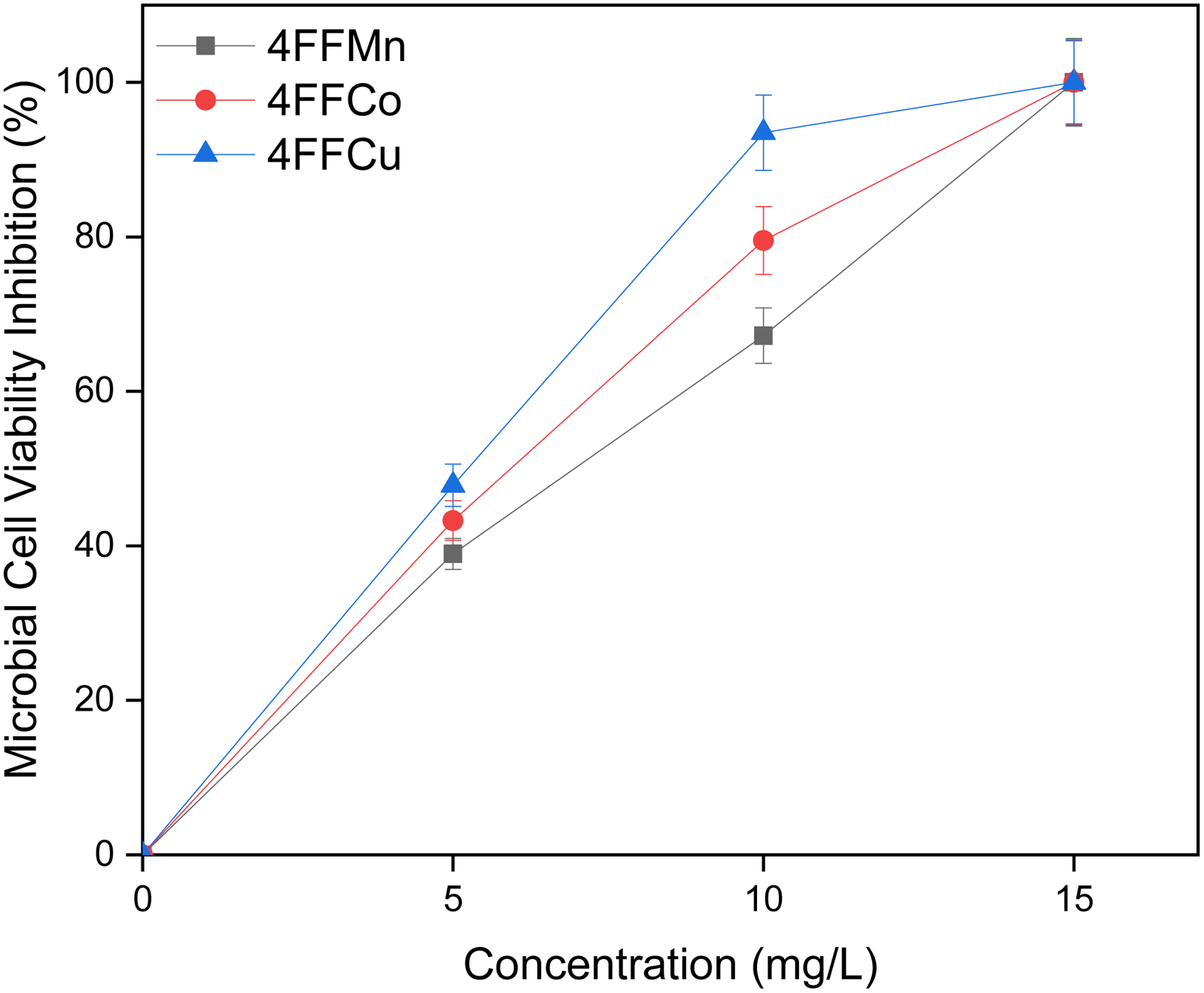
Microbial cell viability inhibition.
Conclusion
This study examined the diverse biological activities of 4FFPcMn, 4FFPcCo, and 4FFPcCu. Following thorough testing, we concluded that they exhibited potent antidiabetic and DNA nuclease properties. The antimicrobial properties of compounds are highly good. Our compounds’ excellent photosensitizing capabilities were demonstrated by the discovery of highly satisfactory biofilm inhibition effects following PDT application. Furthermore, our synthetic compounds have shown a full inhibitory capacity against the viability of pathogenic microorganisms.
Supplemental Material
sj-docx-1-mgc-10.1177_10241221261447751 - Supplemental material for Novel peripherally 4-[(6-Bromonaphthalene-2)-Oxy] substituted CoII, CuII, MnIII(Cl) phthalocyanines: Synthesis, characterization and biological activities
Supplemental material, sj-docx-1-mgc-10.1177_10241221261447751 for Novel peripherally 4-[(6-Bromonaphthalene-2)-Oxy] substituted CoII, CuII, MnIII(Cl) phthalocyanines: Synthesis, characterization and biological activities by Fatma Aytan Kılıçarslan, Ali Erdoğmuş, M Serkan Yalçın and Sadin Özdemir in Main Group Chemistry
Footnotes
Acknowledgments
This research has been supported by Yıldız Technical University Scientific Research Projects Coordination Department. Project Number: GAP-2024- 6646.

CRediT authorship contribution statement
Fatma A. Kılıçarslan: Writing – review & editing, Writing – original draft, Visualization, Validation, Methodology, Investigation, Formal analysis, Conceptualization. M. Serkan Yalçın: Writing – original draft, Methodology, Investigation, Formal analysis. Ali Erdoğmuş: Writing – review & editing, Supervision, Methodology, Investigation, Conceptualization., Sadin Özdemir: Writing – review & editing, Supervision, Methodology, Investigation, Conceptualization.
Funding
The authors received no financial support for the research, authorship, and/or publication of this article.
Declaration of conflicting interests
The authors declared no potential conflicts of interest with respect to the research, authorship, and/or publication of this article.
Data availability
All data generated and analyzed during the current study were produced specifically for this research and are available from the corresponding author upon reasonable request.
Supplemental material
Supplemental material for this article is available online.
References
Supplementary Material
Please find the following supplemental material available below.
For Open Access articles published under a Creative Commons License, all supplemental material carries the same license as the article it is associated with.
For non-Open Access articles published, all supplemental material carries a non-exclusive license, and permission requests for re-use of supplemental material or any part of supplemental material shall be sent directly to the copyright owner as specified in the copyright notice associated with the article.
