




Abstract
The balance between flexibility and security on the labour market has since 2007 become a priority on the European Union’s agenda. The efforts of Member States are assessed by means of performance indicators. This article focuses on the dynamic employment security indicator, in an attempt to highlight what the EU’s Employment Committee means by the notion of ‘making people’s pathways more secure’. With both empirical and theoretical perspectives in mind, we seek to reveal the postulates behind the decisions of those who designed this indicator. Drawing on an epistemological analysis founded on Amartya Sen’s capability approach, and in particular on his key idea of the ‘informational basis of judgement’, this article identifies the normative thread of this indicator, which gives flexibility precedence over real freedom for workers, and employability precedence over capability. Our case studies of Sweden and the United Kingdom demonstrate the key effects of institutional systems, shed light on practices whereby labour market policies can be manipulated to optimize the performance of the dynamic employment security indicator, and cast doubt on the relevance of institutionalized benchmarking using this indicator.
Depuis 2007, la question de l’équilibre entre flexibilité et sécurité sur le marché du travail est devenue une des priorités de l’agenda de l’Union Européenne. Les efforts des Etats-Membres sont évalués au moyen d’indicateurs de performance. L’article se focalise sur l’indicateur dynamique de sécurité d’emploi afin de mettre en lumière le contenu concret que le Comité de l’emploi de la Commission européenne donne à la notion de sécurisation des parcours professionnels. S’inscrivant dans une double ambition empirique et théorique l’article vise à révéler les postulats sous jacents aux choix des concepteurs de cet indicateur. A partir d’une analyse épistémologique fondée sur l’approche par les capacités d’Amartya Sen, et notamment sur l’idée centrale de « base informationnelle de jugement » il identifie la trame normative de cet indicateur qui privilégie flexibilité plutôt que liberté réelle des travailleurs et employabilité plutôt que capacité. L’analyse des cas suédois et britannique montre l’importance des effets de système des institutions, éclaire des pratiques d’instrumentalisation des politiques du marché du travail visant à optimiser la performance de l’indicateur dynamique de sécurité d’emploi et met en doute la pertinence du benchmarking institutionnalisé au travers de cet indicateurs.
Der Ausgleich zwischen Flexibilität und Sicherheit auf dem Arbeitsmarkt gehört seit 2007 zu den Prioritäten der Europäischen Union. Die Anstrengungen der Mitgliedstaaten in diesem Bereich werden anhand von Leistungsindikatoren bewertet. Dieser Beitrag befasst sich mit dem dynamischen Indikator für Arbeitsplatzsicherheit und versucht zu ermitteln, was der EU-Beschäftigungsausschuss unter dem Begriff der “Sicherung von Erwerbsverläufen” versteht. Er analysiert empirisch und theoretisch, auf welche Postulate sich die Entscheidungen derjenigen stützen, die diesen Indikator erarbeitet haben. Ausgehend von einer epistemologischen Analyse, die sich auf den Ansatz der Verwirklichungschancen von Amartya Sen und insbesondere auf sein Konzept der “Informationsbasis für die Beurteilung” stützt, wird zunächst die normative Grundlage dieses Indikators herausgestellt, der Flexibilität Vorrang vor realer Freiheit für Arbeitnehmer und Beschäftigungsfähigkeit Vorrang vor Verwirklichungschancen gibt. Anhand von Fallstudien aus Schweden und dem Vereinigten Königreich werden die wichtigsten Auswirkungen institutioneller Systeme dargestellt und es wird gezeigt, wie arbeitsmarktpolitische Maßnahmen manipuliert werden können, um bei dem dynamischen Indikator für Arbeitsplatzsicherheit eine bessere Leistung zu erzielen. Insofern sind Zweifel angebracht, ob institutionalisierte Benchmarking-Verfahren, die sich auf diesen Indikator stützen, relevant sind.
Keywords
The EU Member States have been expected since 2007 to institute reforms promoting flexicurity. This agenda is pursued through the open method of coordination (OMC), whereby each individual country is responsible for determining how to implement the flexicurity model. The OMC replaces the classic Community method, based on top-down directives, and is altogether different. Here, the EU does not lay down any laws or binding texts, but issues guidelines accompanied by timetables for attaining general targets. Member States convert the guidelines into national policies and then draw up action plans indicating how they envisage implementing these principles. The Commission scrutinizes these documents, drafts a joint report with the Council of Ministers assessing countries’ actions according to a set of indicators elaborated by the Indicators Group of the Employment Committee (EMCO) and issues a number of recommendations. The directives can then be revised for the next time round in the light of this exercise.
The European Union is no novice in this regard. Ever since the launch of the European Employment Strategy in 1997, ‘benchmarking’ performance indicators have been used as the standard tool for monitoring the attainment of targets set at supranational level, thereby raising fears that labour market policies might be manipulated in order to optimize quantitative indicators (Salais, 2006). There is also agreement on the need to view these indicators as something other than a neutral, unquestionable tool (Stiglitz et al., 2009; Méda, 2008). One common theme in these various debates is the recognition that normative or policy issues are enmeshed with statistical issues. Indicators therefore occupy a favoured position which should be called into question.
We aim to demonstrate in our article that the construction of indicators follows both scientific and ideological pathways. Basing ourselves on concepts developed by Amartya Sen – capability and the informational basis of judgement – we shall discuss the limitations of the perspective whereby security is viewed in terms of adaptation to labour market requirements rather than in terms of real freedom for workers. This contribution is presented in four sections. First we shall revisit the circumstances in which Europe endowed itself with flexicurity indicators, before looking in detail at one of these indicators: the dynamic employment security indicator. The performance of European countries will then be studied through the lens of this specific indicator, by focusing on two major concurrent options: the liberal mindset of the United Kingdom and the universalist mindset adopted in Sweden. The next section, testifying to the eminently political function of indicators in governing flexicurity, will endeavour to reveal the standards lying behind their construction. In our conclusion we shall argue in favour of renewing the indicators used to measure employment security.
Flexicurity: from principles to indicators
Flexicurity, the watchword of the European Employment Strategy, has become the cornerstone of the strategies unveiled by the European Union countries. Its four components were formally set out in June 2007 in a Commission communication entitled ‘Towards common principles of flexicurity: more and better jobs through flexibility and security’: flexible and reliable contractual arrangements, comprehensive lifelong learning, effective active labour market policies and modern social security systems (European Commission, 2007).
Europe sets up flexicurity scoreboards
This agenda is pursued via the OMC, finalized at the Lisbon summit of March 2000. The OMC is a reaction to the Community method, deemed overly restrictive (Zeitlin and Pochet, 2005). It is inherently flexible, leaving Member States free to decide whether or not to take action in areas of responsibility that, in principle, remain national. That does not however mean that total freedom prevails. The OMC involves a monitoring process whereby the EU Council of Ministers sets policy targets at the outset; then the Member States convert these guidelines into national policies. Besides, a list of specific indicators is agreed by EMCO, with a view to evaluating these policies and identifying best practice. Thus it is mandatory under the OMC to report back on outcomes.
This new kind of political efficiency takes its lead from New Public Management (NPM) to develop target-oriented regulation. The technique attempts to transpose managerial logic and governance from the private sector to the public domain, by introducing management methods and tools used by major private firms. Just like a company director, the European Union establishes a scoreboard of quantitative indicators to be attained. Hence, these indicators define the criteria that will apply to the benchmarking of Member States’ performance.
The introduction of such private sector logic cannot be taken for granted, however, and can lead to ‘an instrumental drift’ (Salais, 2006, 2010). The risk is that, rather than seeking cognisance of all the relevant facts before conducting appropriate policies, public sector action will be organized around the process of reaching the target figure. Since Member States know what they must achieve to obtain a good mark, the fear is that the programmes they implement will be tailored as far as possible to the performance indicators set. Hence these indicators appear to reveal the EU expectations with regard to flexicurity. Indeed, these expectations are more manifest in respect of the indicators than in connection with the major principles contained in the European strategy.
Europe adopts a dynamic employment security indicator
The EMCO Indicators Group set to work in 2006. In order to assess the degree of security of working trajectories, it devised dynamic indicators to encapsulate the transition process. The availability of longitudinal data furnished by the recent European Survey on Income and Living Conditions (SILC) made it possible to adopt two dynamic indicators (employment security and skills progress). The remainder of this article focuses on the dynamic employment security indicator in order to highlight exactly what EMCO understands by making people’s pathways more secure.
This indicator relies on annual labour market transitions and on the evolving use of different contract types. Transitions between one year and the next are thus assessed as upwards, downwards or neutral according to how a person’s circumstances evolve. The employment security indicator, deriving from the work of Muffels and Luijikx (2008), identifies and counts the number of persons having at least the same level of job security as in the previous year (i.e. an identical or higher level) using the matrix presented in Table 1 (upwards and neutral transitions). In sum, for people who are out of work, security improves once they visibly move closer to the labour market, whereas for persons in work, security increases with the security afforded by the type of job contract.
Change in employment security from year t to t+1: matrix of annual transitions
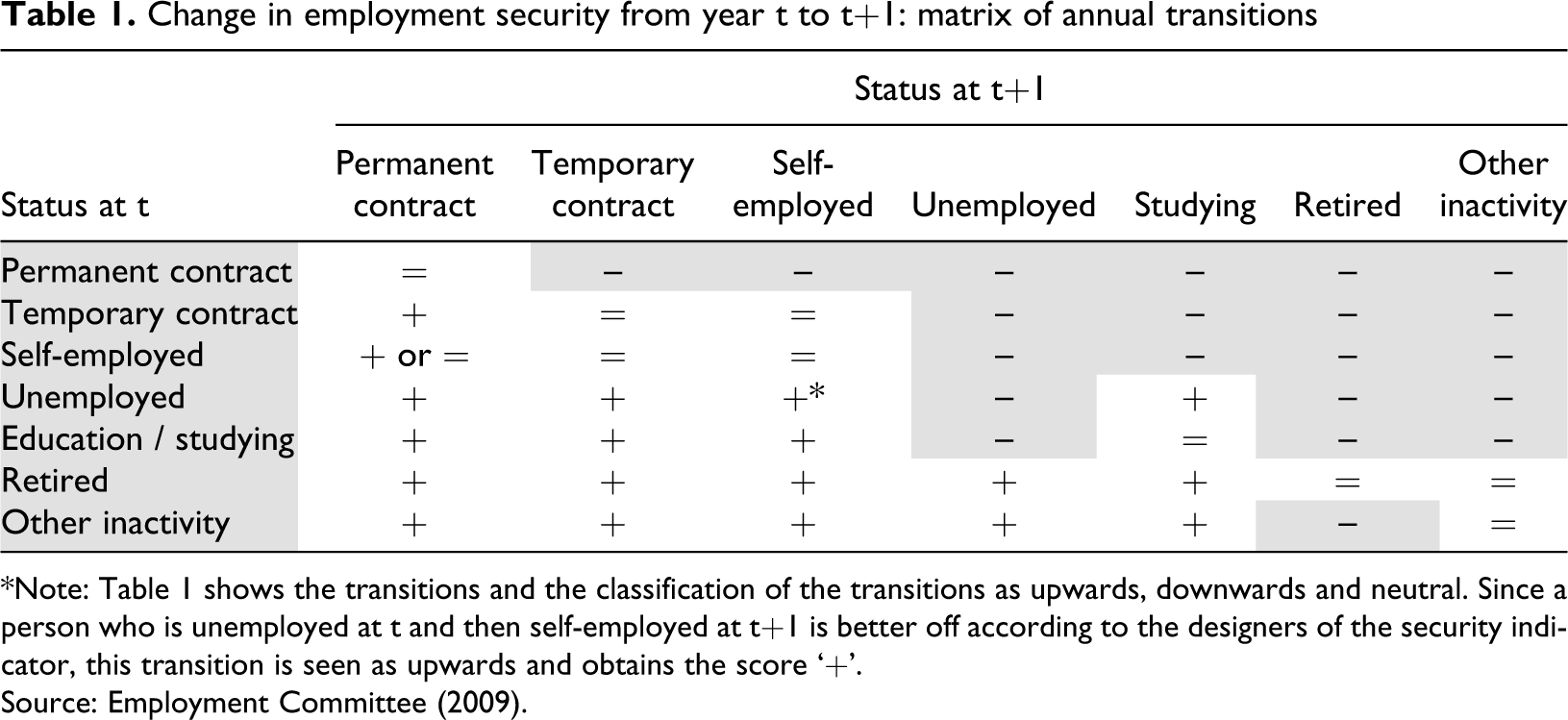
*Note: Table 1 shows the transitions and the classification of the transitions as upwards, downwards and neutral. Since a person who is unemployed at t and then self-employed at t+1 is better off according to the designers of the security indicator, this transition is seen as upwards and obtains the score ‘+’.
Source: Employment Committee (2009).
By encouraging Member States to improve their rankings in the league table resulting from the statistical data, the indicators prescribe priorities. Hence one might expect what is measured by the performance indicators to be achieved as a priority, rather than what is not measured. These indicators therefore serve to reveal the implications around flexicurity, which we shall now examine. To this end we shall compare two countries with opposing views of the labour market and social security: the United Kingdom, with its liberal stance on the one hand, and Sweden, with its universalist social-democrat approach on the other.
Is the UK Europe’s ‘good guy’ and Sweden its ‘bad guy’?
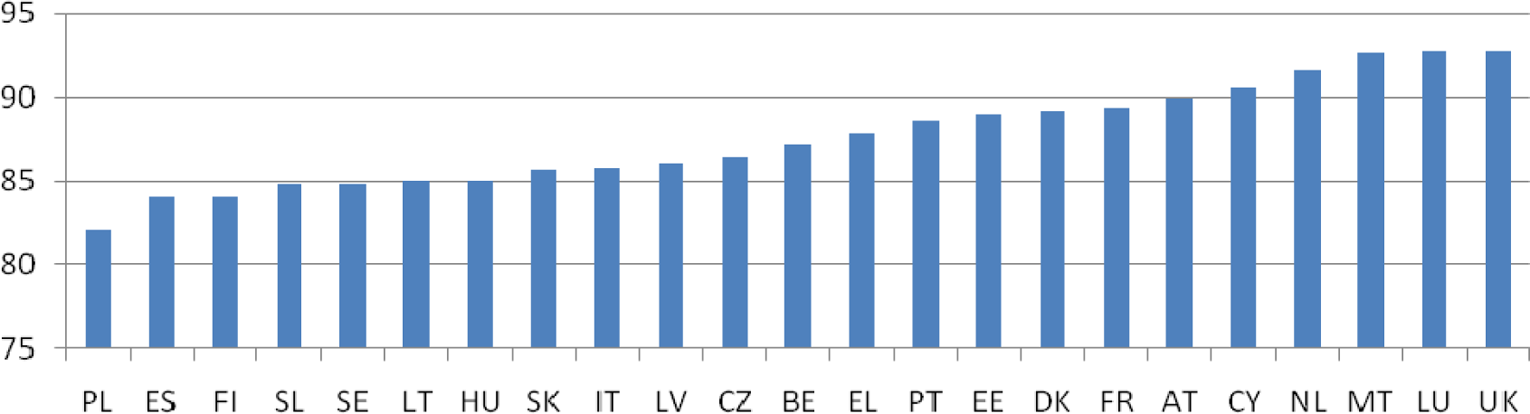
Between 2005 and 2006, the United Kingdom scored top marks on the employment security progress indicator (92.8 percent), whereas Sweden was among the countries bringing up the rear (84.8 percent) (Figure 1). So is the UK the Eldorado of job security? And is the Swedish model, often described as the successful outcome of lengthy trade union struggles since the 20th century, a non-starter?
Employment security progress from 2005 to 2006
Source: Eurostat-SILC Survey – processed by Céreq – Percentage of the population aged 16–64 having at least the same level of employment security in 2006.
UK performance: a model worth following, or statistical eyewash?
The major neoliberal turn taken by the United Kingdom in the 1980s led to the emergence of a specific course of action as concerns job security, enabling the UK to perform well in terms of the dynamic employment security indicator between 2005 and 2006. The scheme received an especially warm welcome in Europe in view of the disappointment aroused by other national measures. Looking at this indicator in more detail (see Table 2), it becomes noticeable that the UK’s good performance (as illustrated by the lighter boxes in the table) is attributable to three factors: numerous transitions into permanent employment (60.4 percent); a low rate of annual transitions into unemployment (2.42 percent) and in particular very few unemployment-to-unemployment transitions (0.82 percent); but also a significant number of transitions from inactivity to inactivity (11.68 percent). The concurrence of these three elements helps to explain the United Kingdom’s successful performance around progress on employment security.
Employment security performance in the United Kingdom. Matrix of annual transitions from 2005 to 2006

Source: Eurostat-SILC Survey – processed by Céreq – Percentage of the population aged 16–64 in 2006.
This performance is attributable to structural reforms carried out in the United Kingdom over almost 30 years. These reforms deregulated the labour market, reduced employers’ social security contributions and introduced return-to-work incentives, forcing workers to adapt to labour market requirements. It would however be wrong to reduce the UK’s positive performance to this aspect alone. Another relevant factor is the very high number of departures from the labour market, and above all from long-term unemployment, through recourse to disability pension schemes: these contributed officially to lowering unemployment-to-unemployment transitions and increasing inactivity-to-inactivity transitions, thereby artificially bolstering the UK’s performance. It is therefore necessary to investigate these two different, but complementary, dimensions: the scale of deregulation and the number of departures from the labour market into inactivity.
Development of a liberal mindset…
The option that inspired the reforms undertaken in the United Kingdom leads to the adoption of a liberal mindset that basically generates incentives to work centred on the individual. So the main labour market reforms consisted of cuts in the duration and amounts of unemployment benefit available, while devising measures to activate the unemployed (‘welfare to work’) and subsequently introducing a series of schemes (the ‘New Deal’) intended to accelerate their return to work and, beyond a certain period of joblessness, to make them resume work or training (Clasen and Clegg, 2006: 539–541). But, as is pointed out by Huyghues Despointes et al. (2001: 24), ‘In the United Kingdom, the activation approach is not primarily based on the principle of workfare (…) it arises out of a broader dynamic of constant pressure on wages and working conditions’. Thus the rise in employment rates results from additional wage and employment flexibility amidst weakened trade union power and a decentralization of wage bargaining following the elimination of wage councils (Cressey, 1999). In addition, the costs associated with redundancies and notice periods have been reduced, while severance pay is now confined to employees with at least two years of service. In this context, where labour legislation provides little protection, the proportion of open-ended contracts is especially high and temporary work is not widespread, since permanent contracts do not confer any guarantee of stability on employees. Yet that does not rule out other forms of atypical employment or an intensification of work (Green, 2006), which makes it worth mentioning the risk of a trade-off between the quantity and quality of employment (Davoine and Erhel, 2007). This is illustrated by the high rate of part-time work in the United Kingdom: more than one worker in every four works fewer than 30 hours per week.
… Combined with a manipulated decrease in unemployment
On the other hand, the social measures taken to diminish the unemployment figures likewise help to make the United Kingdom look like a haven of employment security. For instance, while the female inactivity rate was continuing to decline, as in other European countries, male inactivity was rising steadily between the late 1980s and 2006. There were more than 2.5 million disability benefit recipients in 2006. Disability claims were therefore a means to avoid inflating the unemployment statistics and, in the case of the job security indicator, to underestimate the extent of transitions into unemployment and hence to overestimate UK performance (Argouarc’h and Fournier, 2007). Even though the shift of jobseekers towards the status of disability benefit recipients is not visible in Table 2, it is nonetheless the growth in disability and long-term illness that explains the UK’s lower figures in terms of transition into unemployment and hence, to a significant degree, its good performance on employment security. This finding shows how labour market policies can be manipulated in order to optimize the indicators (Salais, 2006).
Sweden’s counter-performance reveals flaws in the dynamic employment security indicator
As far as labour market regulation is concerned, Sweden’s social-democratic stance on employment activation policy is radically at odds with the neoliberal UK version. Here, active labour market policy acts in tandem with trade union rights, guaranteed by the highest rate of union membership in Europe (75 percent), labour rights ensuring a higher degree of protection for workers 1 , and a widespread social security system thanks to mandatory tax and social security contribution rates that are among Europe’s highest. The EU benchmarking does not detect these elements: Sweden is ranked 19th with regard to progress on employment security, even though concern for employment security appears more evident in Sweden than in most other EU countries. This bad ranking can be explained partly by the fact that the indicator calculates progress from t to t+1: thus a country beginning from a lower level at time t and making substantial progress can outperform a country with a high level at the outset. 2 But this is not a fully adequate explanation: the skewed nature of the employment security indicator must also be taken into account to explain Sweden’s less successful performance, as we shall now demonstrate.
Labour market institutions: a blind spot
A comparison with the United Kingdom reveals remarkable differences in the transitions into permanent employment: approximately 12 points (48.46 percent as against 60.4 percent, see Table 3). The share of permanent contracts of course has a good deal to do with the labour market institutions. As we have already seen, the sluggish development of temporary work in the UK resulted from the less protective nature of national legislation for workers on open-ended contracts. Sweden, by contrast, is a country where employment protection is more stringent and redundancy legislation more restrictive. Despite rendering the legislation on temporary work considerably more flexible, Sweden still affords a significant amount of employment protection: this explains why less recourse is made to permanent contracts and there is a counter-performance from the employment security perspective. It is worth pointing out that the Swedish social partners are heavily involved in labour market regulation and are represented on parliamentary and governmental committees responsible for introducing labour legislation. Moreover, there are numerous sectoral and company-level collective agreements regulating issues such as working conditions, working time and job protection (Anxo and Niklasson, 2006). The trade unions’ strength and the recognition of their contribution to the collective bargaining process result in the establishment of regulations that are much more protective than in the liberal UK context. This dimension, in itself a beneficial contributor to job security, is not taken into account by the security indicator, which deals solely with the volume of transitions into employment irrespective of their quality. Yet, Sweden is better placed with respect to job quality, whether it be measured by the Laeken criteria or by supplementary criteria (Davoine and Erhel, 2007).
Employment security performance in Sweden. Matrix of annual transitions from 2005 to 2006
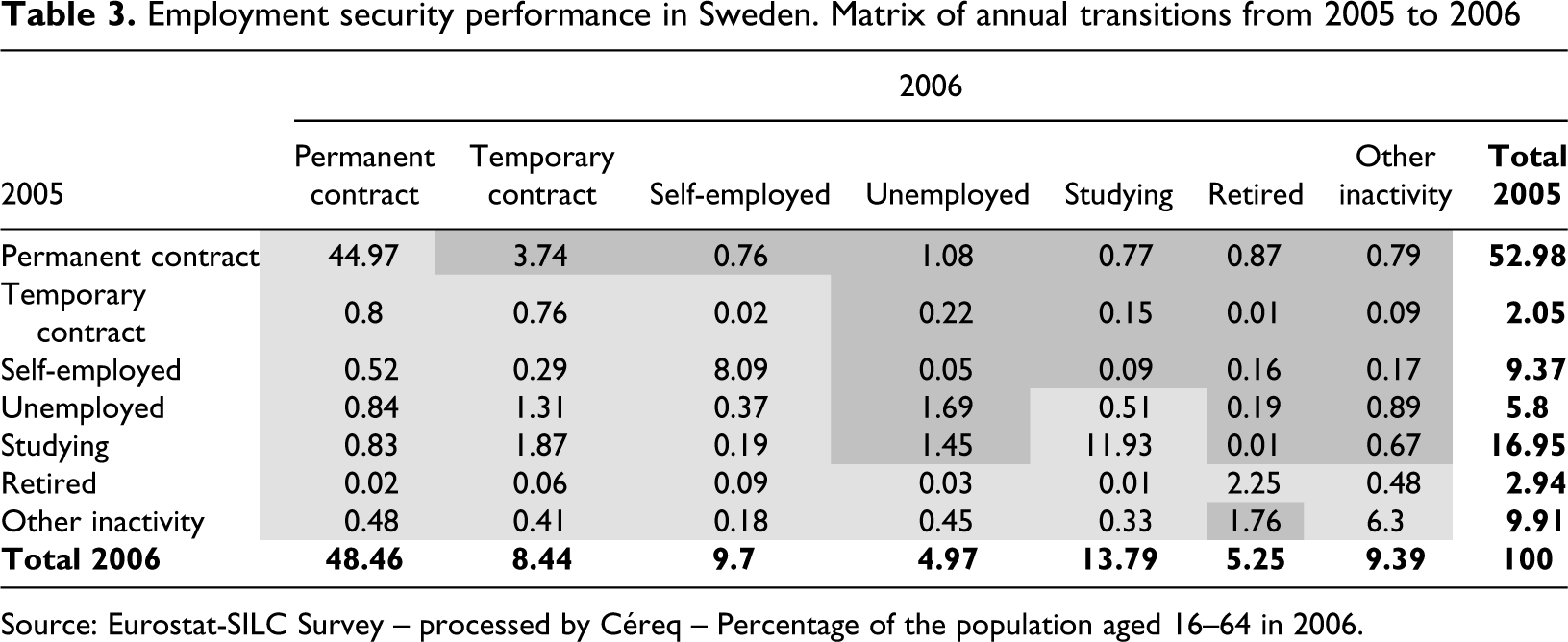
Source: Eurostat-SILC Survey – processed by Céreq – Percentage of the population aged 16–64 in 2006.
A biased view on making people’s pathways more secure
Making people’s pathways more secure in Sweden rests on three pillars: a generous long-term compensation scheme, full-time activation measures costing more than anywhere else in Europe (for training in particular) and an employment service that has fostered intensive individual supervision. The emphasis on resuming work in both unemployment insurance and social welfare has been stepped up considerably over the past few years (Wadensjo, 2007). By comparison with the United Kingdom, Sweden is notable for resorting more readily to active labour market measures (according to the OECD figures for 2005, 1.06 percent of GDP was devoted to active measures in Sweden compared with only 0.05 percent in the UK 3 ). In addition, Table 3 clearly demonstrates a less marked tendency to resort to inactivity in order to diminish the unemployment figures (6.3 percent as against 11.68 percent in the UK). The employment security indicator does not allow these two dimensions to be shown: on the one hand, the quality and intensity of Sweden’s active measures are not taken into account; on the other, the emphasis on work rather than inactivity ultimately penalizes Sweden.
What employment security progress should an indicator measure?
The work of Amartya Sen enables us to grasp the normative thread of quantitative indicators, thanks in particular to the key idea of ‘informational basis of judgement’ (IBJ). This ‘identifies the information on which the judgment is directly dependent and – no less important – asserts that the truth or falsehood of any other type of information cannot directly influence the correctness of the judgment. The informational basis of judgments of justice thus determines the factual territory over which considerations of justice would directly apply’ (Sen, 1990: 111).
Indicators cannot be regarded as an objective description of the world; they provide a partial image of it by selecting one specific informational basis to the detriment of others. In this way, they also require reconfiguration of the reality observed in the sense of their underlying values and standards. Indeed, even when indicators are based on objective and irrefutable information, they espouse value judgements, often passed over in silence or taken for granted, about the relevance of information worth retaining at the expense of other facts deemed inappropriate. Sen designates this inescapable partiality of the indicators with the notion of ‘positional objectivity’, which stresses the fact that, depending on our position, we tend to prioritize a point of view on the reality that we observe, to the detriment of other viewpoints (Sen, 1993). Hence there is no such thing as absolute objectivity, neither in scientific knowledge nor in ethical reasoning. A player’s notion of what is a fitting description of reality depends on his/her position or situation. Besides, selection of the informational basis not only has descriptive effects (in that it emphasizes one specific way of describing reality); it likewise has the effect of transforming this reality. With the indicators, as a matter of fact, emphasis is also placed on the relationship between description and prescription. Describing situations means making choices and attracting the attention of public decision-makers and public opinion to the issues regarded as most important. Devising indicators is not merely aimed at describing what exists or analysing practices; it is first and foremost a policy move connected with a prescriptive dimension.
The experts in the EMCO Indicators Group cannot of course evade this need to select a specific informational basis and the condition of positional objectivity, which lies behind every epistemological approach. It is therefore necessary to ask ourselves about the normative and informational foundations of the dynamic employment security indicator in the light of Sen’s epistemological principles. Our intention, then, is to shed light on the normative postulates underlying this indicator, while putting them to the test of an alternative concept of flexicurity brought about by the capability approach.
Employment security as adaptability to labour market requirements
According to Robert Salais, ‘the upheaval introduced by the capability approach relates to the choice of the yardstick against which collective action (policies, legislation, procedures) should be devised, implemented and assessed. For Sen, the only ethically legitimate reference point for collective action is the person, and specifically his situation as regards the amount of real freedom he possesses to choose and conduct the life he wishes to lead’ (Salais, 2005: 10).
This perspective sets out an ambitious way forward for public policy-making, which is not merely about enhancing people’s adaptability to labour market requirements but first and foremost about promoting their real freedom to choose the life they have every good reason to lead. Collective action is therefore expected to develop opportunities for people while acknowledging their free choice with regard to ways of living or being.
By contrast, the employment security indicator matrix (see Table 1) shows that the experts have hijacked the definition of what is a transition of value. The chosen perspective draws largely on inputs from the network of transitional markets. The champions of this perspective have focused on a typology of transitions that a person can accomplish within the labour market, in order to identify desirable transitions. Yet labour market experts alone cannot guarantee the construction of objectivity markers about the value of labour market transitions. We should fear a certain degree of ethnocentrism (where the observer is mistaken about the universality of his or her viewpoint) or paternalism (where the decision-maker believes himself or herself authorized to impose his or her vision on others).
Statistical error would not be too bothersome, were it not accompanied by political errors. Describing transitions as upwards means prescribing desirable transitions. For instance, the transition into work is always interpreted positively, without considering the quality of the job in question. Similarly, deprecation of (early) retirement and of all forms of inactivity is a strong normative postulate of this indicator, which leads to positive interpretation of the move from disability status to unemployed status. This normative postulate is in line with the desire to raise employment rates, which lies at the heart of the European strategy: it sees work as the ideal situation for everyone, without taking account of work and employment quality or the person’s specific circumstances (i.e. his or her physical, psychological or other ability to work, to balance work and family life, etc.). This indicator therefore views employment security from the angle of adapting to labour market requirements without considering quality of life or work or the casualization of labour.
Moreover, the indicator puts forward a narrow-minded vision of transitions, given that the annual transition matrices are liable to skip over certain interim episodes. In this way, the process may be blind to certain transitions lying at the very core of job insecurity situations: a period of unemployment between two fixed-term or permanent contracts, the move from a long to a short fixed-term contract, etc. The quality of transition within jobs and work is likewise masked.
Although the topic of employment quality was incorporated into the European Employment Strategy (EES) in the second half of 2001 (through the 10 Laeken indicators, see European Commission, 2001), it gradually disappeared in the wake of the 2001–2002 recession. There followed, as from 2003, a gradual revision of the EES, putting the ‘quantity’ of employment ahead of its ‘quality’ and ‘refocusing priority on growth and employment’. Flexicurity, at first only one of the 10 employment quality topics, became a key aspect of EMCO’s thinking. By introducing a more dynamic dimension into the analysis, it helped to place employment quality on the back burner and enforce acceptance of the idea that a poor-quality job is worth more than no job at all. 4 In actual fact, from a synchronic perspective, employment quality at a given point in time appears to be a central issue, whereas from a dynamic angle a bad job may be justified because it can represent a springboard towards lasting integration into the workforce.
Moving over to a capability approach-inspired vision of flexicurity would entail a number of developments. First the employment quality issue would need to be integrated into a synchronic and dynamic perspective, referring back to ‘an analysis of the scope of working and living possibilities offered by inclusion in employment’ (Salais and Villeneuve, 2004: 287). Moreover, by contrast with the normative foundations of flexicurity as measured by the employment security indicator, the capability approach emphasizes the two essential dimensions of real freedom: empowerment (opportunity development), which enables people to acquire the resources of freedom, and respect for process freedom, which enables them to remain in charge of their own choices. Should one of these two dimensions be lacking, the goal of developing capabilities is missed.
Assessed in this light, flexicurity, as defined by the security indicator, appears doubly deficient. On the opportunity side, it aims above all else to develop employability in the sense of increased adaptability to labour market requirements. Thus access to security in other aspects of life appears subordinate to the holding-down of a job, raising the fear that people whose employability is reduced in the long term enjoy limited security. Besides, the way in which transitions are valued and ranked indicates a firm belief in the notion of activation: any progress towards work or towards a situation regarded as being closer to work represents progress in security terms. Such a conclusion seems much less clear-cut if we refer to the capability approach: does a very insecure, poorly paid job really enable the development of the capabilities of an unemployed person? It might certainly do so in some cases, but not in all. From a capability standpoint, this question requires a more nuanced answer for which the security indicator allows no scope.
On the process side, to regard the resumption of employment as a sine qua non precondition for enjoying a certain degree of security is to restrict the free choice of the persons concerned. By establishing a hierarchy of the various possible labour market situations (being unemployed is better than being inactive, etc.), the flexicurity strategy forces national and regional political authorities and beneficiaries alike to comply with this hierarchy and make it a fixed part of their daily practices and customs. Otherwise, the Member States will find themselves with bad marks and the beneficiaries will be threatened with penalties or suspension of their rights.
By looking at labour market organization from a flexibility viewpoint, the flexicurity strategy makes access to security subordinate to the acceptance of labour market flexibility, which in itself significantly restricts freedom of choice. Free choice is acknowledged only inasmuch as the person goes along with the normative concept underpinning the indicator and is willing to adapt to labour market requirements.
Given all of these elements, the security indicator appears too uniform to contend with the diversity of situations. This diversity makes it necessary to situate and contextualize issues of justice, also when defining the indicators to be used for evaluating public policies. Therefore, indicators should not give priority to one specific definition of what is a valuable transition on the labour market, over all others. From the perspective of the capability approach, all collective decisions and all performance indicators that do not leave scope for diversity and for the prospect of real individual freedom are open to criticism because they tend to impose the vision of those who design the indicators.
Conclusion: towards different indicators of flexicurity
In the OMC, a governance environment inspired by the NPM, indicator-driven measurement is not simply a technical issue; it likewise lays down strong injunctions concerning the targets to be attained. Hence, when defining indicators about what should be measured, we should ask ourselves what vision of flexicurity we wish to promote.
The employment security progress indicator displays a number of weaknesses. First, it is based on an informational basis that gives precedence to labour market flexibility, expecting workers to adapt to labour market requirements, while masking the issue of real freedom for the people concerned. In close correlation with that, the indicator’s second weakness is that it considers making people’s pathways more secure, devised as individuals’ unilateral adaptability to labour market requirements, as a duty lying under their own responsibility.
Under the capability approach, by contrast, the main question is not whether workers are more flexible or adaptable. Rather, it is whether the conditions are properly met (or are guaranteed) for workers to possess real freedom to work and to be entitled to genuine professional development. Such real freedom represents a precondition for taking an active part in the external transition from one job to another or in the internal transition within a company by changing post, department or occupation. Empirical research has shown that making people’s pathways more secure progress, on the one hand, when the public authorities support employees and companies by offering them an institutional framework within which to assume their risks and responsibilities (Keune and Pochet, 2009); on the other hand, progress comes about when companies set up ‘capability-friendly organizations’ oriented both towards the development of the company and the professional development of its employees.
The hope of expanding individual freedom is without doubt the main vector of transformation of democratic societies. Our hypothesis is that the reference to real freedom and capabilities, provided it is supported by adequate means of action, is not merely a device; it implies a deep-seated change in the content of flexicurity policies and at the same time in the approach to and implementation of the benchmarking of such policies. Aiming at the development of real freedom and capabilities when contemplating flexicurity would lead to the construction of a battery of indicators capable of showing whether people can genuinely benefit from the active support of benevolent institutions, from responsive public services and from deliberately organized policies and institutions: what Sen calls ‘conversion factors’. Evaluating security via the lens of capabilities would mean shifting the emphasis to access to different possible options and the existence of a range of choices. These ideas, which are still struggling to take shape in European circles, call for a reinvention of public guidance in favour of the development of real freedom of action for all European citizens.
Translation from the French by Janet Altman
Footnotes
Notes
This work undertaken in the framework of the CAPRIGHT project was supported by the European Union’s Sixth Framework Programme [contract number: CIT4-CT-2006-028549].