




Abstract
Measured by its achievements, industrial unionism represented the high point in the history of 20th century trade unions. This article analyses the defining characteristics and organizing model of industrial unions and argues that changes both in the labour market, in particular the decline of industry, and in union organizing and sectoral bargaining have led to the ‘fall’ of the industrial union. The article ends with some suggestions with regard to the spirit and agenda of the post-industrial union.
Introduction
Arguably, the rising of shipyard workers in Gdansk and the foundation of the Solidarity union, now more than three decades ago, was the most powerful manifestation of industrial workers’ power in post-war Europe, as measured by its effects. It set in train a chain of events that led to the end of Communism and the reuniting of central and eastern, and western Europe. It is hard to believe that, today, any group or union of industrial workers could produce a similar shockwave. More likely, 21st century capitalism will be shaken up by banks rather than by trade unions. Włodzimierz Borodżiej, in his history of 20th century Poland, draws the comparison with British miners, who in 1974 brought about the downfall of the British conservative government of Edward Heath, before he concludes: ‘What beyond their different political systems British miners and Polish shipyard workers had in common was an at the time unimaginable, yet fundamental error: they thought of themselves as a timeless and indispensable part of the economy and society. Neither of them nor their intellectual friend could imagine that in 1980 “modern times” were about to end. The rising of the workers helped to upset the existing order to such an extent that only a few years later there was no longer a place for them.’ (Borodziej, 2010) Today, the shipyard workers in Gdansk struggle to keep their plant alive with European subsidies and finding a new niche in building windmills; the British miners’ union, once a formidable force with more than 600 000 members around 1960 and still with more than 200 000 men in 1980, was a few years later brought to its knees by Mrs Thatcher and had fewer than 5 000 members by the end of the 1990s (Ebbinghaus and Visser, 2000).
This article is about the success and demise of the industrial union. The relative and absolute decline of industrial workers within the union movements of Europe, in terms of membership and hegemonic power in shaping industrial relations, is one side of that story. Their share in the union movements of Europe reached its peak in the 1960s and has declined ever since, following the pattern of decreasing industrial employment and the rise of the service economy. The other side of the story is the gradual erosion and loss of meaning of what, probably, was the most successful organizational form of trade unionism in 20th century democratic capitalism: the industrial union or, better perhaps, the ‘political industrial union’, as it is called by Wolfgang Streeck (2005).
The rise and fall of the industrial workforce and of the industrial union are not the same, but the two are closely related and have reinforced each other. Without industry and industrial workers, or groups closely aligned with industry, at its heart, the industrial union tends to lose its weight as a trailblazer and inclusive power for the entire labour movement, setting the trend for better wages and conditions for all workers and not just for union members or skilled workers. Their influence, directly and through the peak federations that were built on their power, reached much beyond industry.
The particular confluence of sector and occupation, or bundle of occupations, that held together the one sector=one union idea of the ‘industrial union’, be it in metal engineering, chemicals, textile and clothing, construction or transport, was 30 or 40 years ago common in many European countries, but is today the exception. Industrial decline; the blurring of occupational profiles in many sectors and erosion of sectoral borders; union decline, union mergers and the rise of the multi-sector union; the loosening of sector agreements; and finally, the severing of the links that once held industrial unions and political parties together are all part of this transformation of modern day trade unionism in Europe. 1
In what follows I will detail these developments for a number of European countries. I will start with defining (political) industrial unionism. Next I will document the decline of industrial workers, and manual workers, in the unions. Section three presents some statistics on union type, allowing us to gauge the changes and variation, across countries, in the presence of industrial unionism. Section four adds qualitative information on these changes, and argues that the classical industrial union is no more. The final section ponders whether there is still some future for the industrial union.
Political-industrial unionism
The oldest and most commonly used distinction in the literature on trade union structure is the one between craft and industrial unions, sometimes equated with the distinction between ‘closed’ and ‘open’ unionism (Turner, 1962). Craft unions originated in the mid-19th century as organizations of skilled workers or independent craftsmen whose employment was often regulated by a ‘contract of work’ with the possibility of outsourcing part of the job to other workers or to trainees. In many aspects these workers combined something of independent businessmen and the ‘economically dependent self-employed’ worker of today. Their unions negotiated collectively over the (piece) rates of pay for their product or job, and they engaged in mutual insurance against various occupational and industrial hazards (Webb and Webb, 1920). Control over training and access to the job, and thus over the organization of work, was key to the bargaining power of these unions. Technological change and the replacement of skilled by semi- or unskilled labour was the major existential threat to these unions.
Industrial unions owe their origin to the diffusion of the factory system in the late 19th, early 20th century and the transformation of ‘work contracts’ into ‘employment contracts’. In the latter management retains the final say over how and when the job is executed, and the ‘dependent’ worker is remunerated for his or her effort or time spent on the job. As a rule, industrial unions have little control over training or access to the job, or over the organization of work; their bargaining strength derives from their capacity to unite different groups of workers within the same company, sector or location, and forestall the employers’ power to replace striking workers. Industrial unions could never prosper without some help from the state and labour laws in upholding the right to strike.
Unlike the homogenous – skilled – membership of the craft union, industrial unions were from the start characterized by heterogeneity. They tried to organize all workers – skilled and unskilled, in some cases including supervisors and white-collar staff – in a particular industry or branch. In order to compensate for such diversity, and establish themselves as a single voice and bargaining agent confronting the employer, industrial unions could only survive if they succeeded in exerting central control over strike and bargaining decisions. Solidarity had to be balanced by discipline – with no single group or subsector, be they local port workers threatened by extinction, or all-powerful train drivers in a transport union, or car workers in a metal engineering union, believing that in the long run they could do much better than the industry’s average. Industrial unions relied on their ability to strike strategically, for defensive or offensive purposes when and where it mattered, and on their power, or authority, to enforce agreements with their interlocutors.
Often, holding together such a union required the support of powerful employers’ associations in the same sector, in a process of mutually conditioned centralization, and legal or extra-legal recognition rules that favoured existing unions over newcomers and breakaway unions. Investment in joint rules, forums and funds, for example for the sake of industry statistics, export promotion, vocational training or industrial peace, were powerful devices for the survival of both employers’ associations and industrial unions facing heterogeneous memberships in large and small firms, different skill levels and different regions, tied to different, domestic or foreign markets. Such neo-corporatist devices and the strength of a rich, enforceable and regularly renewed multi-employers’ agreement covering the entire sector, were vital for the organizational viability of the industrial union, just as the control over access to the job was crucial for the occupational or craft union.
Streeck has argued that industrial unions have been willing to compromise with a bureaucratic factory regime, as long as they could circumscribe the extent of managerial prerogative by general rules in law or collective agreement, sometimes and especially after the 1960s supplemented by some modicum of ‘industrial democracy’ or worker influence over labour management within the firm. He explains: ‘Political-industrial unionism, with its preferences for the standardization of employment contracts and of the relationship between skill, effort and pay, turned out to be highly compatible with the bureaucratic-hierarchical management of “Fordist” work organizations. At the heart of what might be called the Fordist compromise between large mass production firms and broad-based industrial trade unions was the acceptance of negotiated flexibility by workers in exchange for standardization of employment and working conditions within and across firms as well as over time, insulating workers and their families from market fluctuations and giving them as much economic security as a free labour market can sustain’ (Streeck, 2005).
Streeck adds the prefix ‘political’ to ‘industrial’ union and emphasizes that, unlike the craft unions, industrial unions never relied on market power and collective bargaining only, but typically valued, and were often born as part of, the alliance with political parties on the left, including the Christian, mainly Catholic left. (Instead, craft unions, originally representing labour’s elite, stayed out of party politics or favoured liberal and nationalist causes; see Ebbinghaus and Visser, 2000.) This made them more ready to espouse egalitarian ideologies and to support erga omnes extension of collective agreements and universalistic social policies benefiting all workers and their families. As explained by Mancur Olson, large, open and inclusive unions of this type are threatened by free-rider behaviour (Olson, 1965). According to Streeck, this explains why industrial unions in many countries based their organizational security in large part on legal rights and political support, ‘such as state facilitation of collective bargaining or corporatist participation in the administration of vocational training or public social security funds’ (Streeck, 2005: 269). In the Scandinavian countries and to a lesser extent also in Switzerland and Belgium these guarantees were obtained through central agreements with employers, usually in return for the recognition of management’s prerogative to manage. In some countries, union security was further buttressed by union-administrated unemployment funds, and union-related workplace representation (Ebbinghaus and Visser, 1999).
The decade of the 1970s constituted probably the high point of political-industrial unionism. Never before or after was Organized Labour in both its political and industrial manifestation more included in the political and economic governance of the European (and Anglo-American) nation states (Goldthorpe, 1984). At the level of companies and following the eruption of worker discontent of the late 1960s against the poor working conditions in Taylorist-Fordist mass production firms, unions successfully pressed for more worker and union rights in the workplace (Crouch and Pizzorno, 1978). At the level of national politics this was the age of ‘democratic corporatism’ (Crouch, 1979; Korpi, 1983; Wilenski, 2002): a labour-inclusive political regime featuring parliamentary democracy, strong social-democratic parties, centralized trade unions and employers’ associations, tripartite economic policy-making in a negotiated economy, and an extensive and still expanding social welfare state. After 1968 and in Greece, Portugal and Spain following the downfall of the dictatorships that had held back free trade unions, these features of a labour-inclusive regime spread to the whole of western Europe.
Unions and the decline of industrial and manual work
Employment in industry, taking together manufacturing, mining, utilities (gas, water and electricity) and construction, reached its maximum share around 1970. A decade later absolute numbers also began to fall. Figure 1 shows divergence across the six major economies of Europe – with a much earlier turn to the service economy in the UK, followed by France, and higher industrialization rates, and slower decline, in Germany, Poland, Italy and Spain (partly due to the oversized construction industry), but the trend points in the same direction. Currently, at most one in three employees, in Britain and France rather one in five, has a job in industry (see Figure 1).

The declining share of employment in industry in the six largest European economies
Unionization rates in industry, especially in mining, utilities and key manufacturing industries like metal, chemicals, printing and paper, and textiles, have always been much higher than in the rest of the economy, with the possible exception of some sectors and occupations in the public sector, such as teachers, municipal workers, or tax collectors. Consequently, around 1970 and even 10 years later, union members in industry represented a clear majority in the union movements of Europe. 2 However, during and even more so after the 1970s experiences begin to diverge and some countries, like Germany, Belgium or Spain, have retained a much larger industrial base, and a larger share of union members in industry, than others, like the Netherlands or the UK, where the share of union members in industry is now down to less than 15 percent (see Figure 2). The average is about 30 percent; about half of what it was in 1960. As a bloc industrial workers represent today a smaller force in the unions than public sector workers (if retired workers are excluded). Differences between countries are large and they have become larger, but the trend is everywhere in the same direction, moving towards a less dominant place of workers and employees in industry and towards a much less prominent place of the unions representing them. Even in the most industrial country, Germany, union members in industry are now in a minority, albeit a strong one.
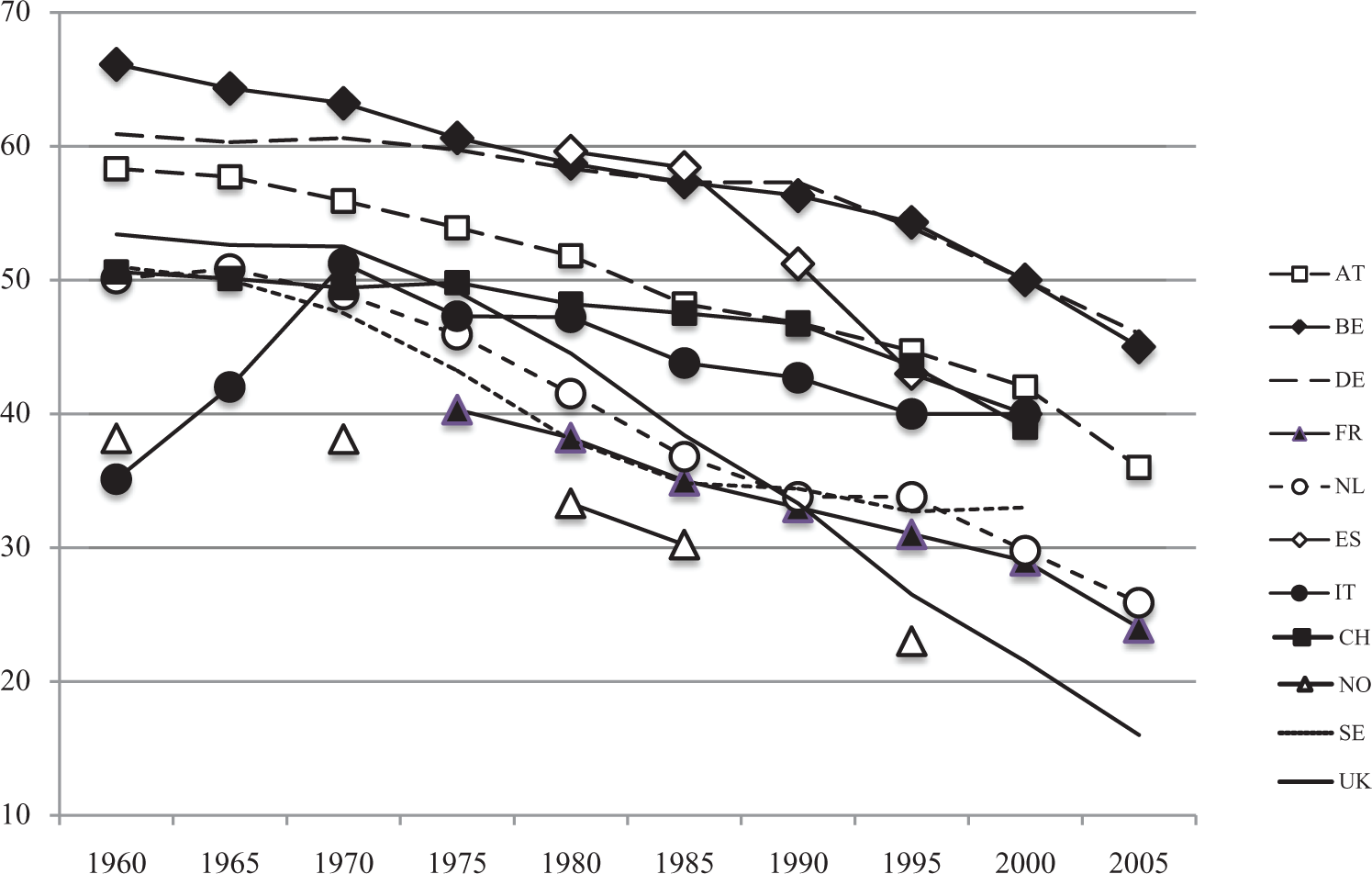
Share of union members in industry, % of all (employed) union members
I do not have comparable statistics for union movements in central and eastern Europe (CEE), but the decline of the share of industrial members in the union organizations in these countries is probably even more dramatic, due to the dismantling of the old state-run industrial conglomerates and the difficulties of the unions in establishing themselves in the new light-industry sectors depending on foreign investment. In CEE countries and in many western European countries, including Norway, the UK, France, the Netherlands and Greece, the majority of union members are currently employed in the public sector, including education and health care.
With the decline of industry, the share of manual workers in today’s union movements has shrunk as well. If one disregards the public sector, the largest (socialist) labour or union federations of Europe, from the Nordic LOs to the German DGB, the TUC in Britain, the CGIL or CISL in Italy, the CGT or CFDT in France, the CCOO or UGT in Spain, the FGTB/ABVV in Belgium, the FNV in the Netherlands, the ÖGB in Austria and the SGB in Switzerland are still very strongly characterized by the historical imprint of organizations of and for manual workers, combining industry, transport, manual public and private services, and agriculture. In the mid-1980s the share of manual union members in the private sector in these federations still averaged a stunning 80 percent, as most of them had failed to recruit white-collar staff in the private sector (Visser, 1990: 116). This share is probably closer to 60 percent today, but that is still lagging far behind changes in the labour market.
The truth is that unionization rates of white-collar employees in the private sector have remained very low and that in countries and sectors where white-collar employees and professionals do unionize they tend to organize in separate unions and federations – as is the case in Scandinavia, or in the banking industry in many European countries. The expansion of the public sector and the unionization of teachers, nurses, and many other service providers in the welfare state have led to even the mainstream and left-leaning trade union federations becoming, for the most part, white-collar organizations. (The rising share of women in trade unions, making up half or more of all trade union members in the Nordic countries, is part of the same story.) 3
It has always been hard to infer from such cold statistics on changes in membership composition – whether it is the rising share of the public sector, the decline of manufacturing industry, the feminization of union membership, or ageing – the implications for union politics and for the policies they support. Clearly, the shift towards the public sector and the ageing of union membership is reflected in strike statistics and in the themes that have dominated the protests and pacts in which unions have since the 1980s become involved: pension reform, social security reform, active labour market policies, public employment (Avdagic et al., 2011). Feminization of the unions, apart from merely being a reflection of changes in labour market and family behaviour, can perhaps also be interpreted as both cause and effect of the new, work-family agenda pursued by unions in collective bargaining. Surely, with the disappearance of the manual, heavy industry imprint of unions and union membership, the image of unions as a gathering of (older) males, although not altogether untrue, also tends to grow paler.
Undoubtedly, industrial decline and the rise of services has altered trade unions’ recruitment, as it has eliminated, or fragmented, the landscape of large factories and urban centres where people worked and lived in relatively similar conditions and have common collective experiences. It has also changed the way in which young people are inserted in the world of work and the world of unions, just as it has changed education and the relation between education and work. The rapid decline of the share of young people in trade unions throughout Europe and disproportionate rapid fall in unionization rates of workers below the age of 35, compared to older age groups, as documented in the ICTWSS database (Visser, 2011) and the European Social Survey, probably have causes that go much beyond the changes in the nature of employment and employment contracts, discussed elsewhere in this issue. But it seems to me that the ‘withering away’ of industry as a collective and collectivizing experience linking generations must be part of that explanation. In this connection I should also mention that it has become much more exceptional that union leaders rise through the ranks of industrial and (skilled) manual work to high office. More likely, they are now professionals with several years of higher education, and although lagging behind the changing gender composition of the membership, many of them are now female.
How much of the ‘withering away’ of the strike in the private sector since the 1980s, observed throughout the industrialized world, is tied to the fact that industry and industrial workers are in retreat, I do not know. One can think of alternative explanations (globalization, changes in the organization of firms, chains of production and work, the ‘servicing’ of industry itself). Whatever the explanation, it does not change the conclusion that the power, and centrality, of unionized industrial workers has been much diminished. The new figments of union power are to be found in logistics and transport (although with a much diminished role for the most ‘industrialized’ among them, the port workers), and in the public sector generally. Probably, the most effective strikes of the future will involve the Internet, but it is hard to see how such a weapon could be monopolized by the unions and turned into a means of collective power.
Presence and variations of industrial unions
How does the decreasing share of industrial workers affect the industrial union? In order to answer that question I start with presenting some statistics on membership shares by type of union. Based on Ebbinghaus and Visser (2000), I distinguish five types of union organization: two variants of the sectoral union: (i) the encompassing sectoral union for blue-collar workers of all skill grades, in some cases also open to non-manual workers, including technicians, supervisors and clerical staff, and (ii) the narrow sectoral union which only organizes non-manual workers or white-collar staff; next, two variants of the occupational union: (iii) the classical blue-collar craft union and (iv) the occupational white-collar union or staff association organizing particular occupations or professions, irrespective of the sectors in which they work; and finally (v) the general union, the membership of which tends to cut across occupational and sectoral boundaries.
Only type (i) can be called ‘industrial unions’ as previously defined. There are in fact two types, which I will call, for reasons of brevity, the German or Swedish variant (see Visser, 1990: 138). The post-war reconstruction of the German trade union movement followed a model which was at once rigorously sectoral and unitary, not only in the sense of merging socialist and Christian-inspired currents, but also organizing all status groups and occupations in one union affiliated to one federation. The Swedish variant of ‘industrial unionism’ was likewise sectoral but with different unions for manual and non-manual occupations, and a separate union for university-educated and higher-graded staff. Thus the main union federation, the LO, organized only or mainly blue-collar workers (usually including sales workers and public sector workers), whereas non-manual employees and academic staff combine in peak associations of their own. The Swedish variant is also found in Norway, Finland and Denmark, though in the latter case the main organizing principle within these different federations is not industrial or sectoral, but occupational, reflecting the dominant division between craft unions for skilled workers and general unions organizing the rest. The Dutch trade unions, divided by religion, have tried to emulate the German principle of organizing all occupations and grades in unions demarcated by sector but the failure of the Catholic workers’ unions to convince white-collar staff to join the same organizations was one of the sparks that produced a separate federation for supervisors and white-collar staff. Something similar happened in Switzerland, where a powerful white-collar federation with a stronghold in financial and commercial services now rivals the main confederation SGB. The mainstream unions in Italy and Spain are mostly demarcated by sector, closer to the German than the Swedish model. Despite several attempts, this was never fully achieved by the French and Portuguese unions, which remain fragmented and unbalanced federations of separate groups and strongholds. The CFDT’s attempt to create union federations based on production chains did not produce lasting organizational results. The Austrian and Belgian unions are variants within the Swedish variant of sectoral unionism – with separate unions for manual workers and a catch-all (general) union for non-manual workers in the private sector, albeit within the same federation.
The relative decline of the Scandinavian LOs, in terms of membership share, is conditioned by their rather exclusive focus on manual workers and has probably contributed to the eclipse of their role as negotiators of central agreements. In only 30 years, from 1980 to 2010, the LO’s share of total union membership has fallen from 61 to 44 percent in Sweden, from 68 to 53 percent in Norway, and from 71 to 60 percent in Denmark; in Finland the membership share of the SAK decreased from 63 to 46 percent. The membership share of confederations representing sectoral unions for blue- and white-collar unions was far more stable – at around 80 percent for the DGB in Germany, and over 60 percent for the FNV in the Netherlands (not to mention the absolute monopoly of the Austrian federation).
The implications of these different types for union representation are obvious. Where you have one union negotiating in, say, metal engineering in Germany, you have two in Austria, two in Spain (but for different reasons: politics rather than union type), three in Sweden as in the Netherlands or Italy (again for different reasons), four in Belgium, and more in France, although in the French case some unions, in particular the CGT, have often decided not to sign agreements and leave the negotiations to the two, three or four unions that do. Multi-union bargaining is a common feature in Europe, with all the risks of division and conflict. For obvious reasons, the implications of occupational splits are different and probably less upsetting or volatile than the ones inspired by politics or ideological creed.
Figure 3 shows the distribution of union membership by union type in 1980 and 1995/98, based on data in Ebbinghaus and Visser (2000). The first impression is that not much has changed. Notwithstanding the rapidly declining share of industrial workers in the union movement during that period, the share of members in industrial unions has been stable or even expanded, which means that remaining occupational unions in industry have merged with existing sectoral unions, and that outside industry, for instance among hotel and restaurant workers, in banking, or in health care, sectoral (‘industrial’) unions have been created or expanded. Blue-collar craft unions are now nearly extinct.
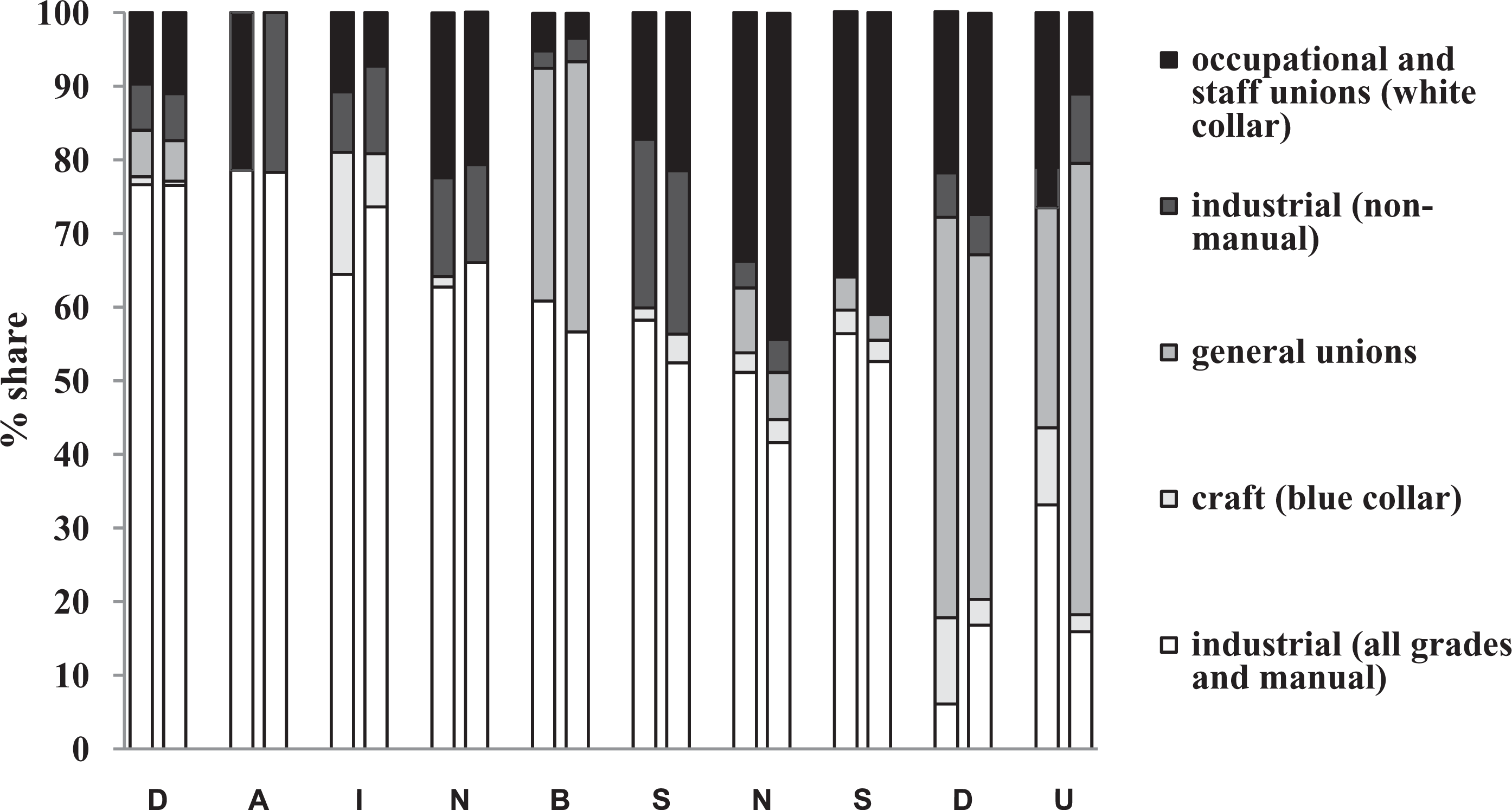
Distribution of membership by union type, 1980 and 1995/1998
The big picture emerging from Figure 3 is not the change over time, but the variation across countries, with on the one hand countries in which sectoral and industrial unions are dominant (Germany, Austria, the Netherlands, Italy, Sweden) and on the other hand countries in which craft unions and then general unions became the dominant type of union organization (the UK or Denmark, or, not shown in this chart, Ireland). We see that Switzerland and Norway are borderline cases, mostly due to the prominent role of unions for professionals in services. Greece and Portugal, and most CEE countries, would today probably show a similar ambiguous picture. Although the old Communist-era unions were set up according to the encompassing ‘industrial union’ principle, post-1989 unions in CEE have experimented with all kinds of demarcation, from a variant of almost pure local (enterprise) unionism in Poland to occupational and professional unions in Hungary.
The decline of industrial unionism
Some important changes are not picked up by the statistics shown in Figure 3. First, as one can guess from the information provided in Figure 1, ‘industrial unions’ do represent fewer and fewer industrial workers; the expanding or stable share of the industrial union type, as evidenced in Figure 2, is due to the success of sectoral organizations outside industry – in transport, trade and commerce, hotels and restaurants, banking and finance, public administration and health care. Occupational unions in these sectors still exist, and have in some countries (especially in Norway, Finland and Switzerland) prospered in recent times, but most have either merged into general unions (the British model) or into sectoral unions (the German model). In Germany there are very few groups outside the mainstream (apart from the civil servants’ federation, representing state officials with a special statute; and apart from a small Christian federation), but those that are – train drivers, air pilots, air traffic controllers, physicians and other highly skilled groups in the health service – command an extraordinary power in the labour market due to their skills and scarcity. It is interesting to note that within industry there are hardly any groups left with such power – with the exception, probably, of IT specialists, but they often work as independent contractors and unionization is rare.
The second change, not quite revealed by Figure 3, is that in 1980 most industrial or sectoral unions covered just one (broadly defined) sector: metal engineering (sometimes including mining and steel); textiles and clothing (usually including shoes and leather); building materials (though often merged with the main building union); paper and printing; transport (sometimes separate for sea, air and road transport, usually with public transport and post office employees organized in public sector unions), and so forth. In the 1990s and 2000s union mergers, even where they try to follow a pattern of integrating adjacent domains, have created multi-sectoral unions. This process has accelerated due to industrial and union decline, and has gone furthest in countries with a small industrial base, such as Switzerland and the Netherlands, where there are now multi-sectoral unions cross-cutting the boundaries of industry and services. In organizational complexity, these unions hardly differ from the general unions found in countries with dominant craft or occupational unions.
Unions are labour-intensive organizations. With stagnating or falling membership, membership contributions that cannot rise (much) and labour costs increasing with the general trend, mergers can help contain or lower costs through economies of scale, even if such mergers are usually costly in the short term (Streeck and Visser, 1998). Many, perhaps most, union mergers have not lived up to expectations: better services to members, more funds for campaigning and recruitment, higher quality staff and more effective political lobbying (see Waddington, 2006). Yet, the need to cut costs and to ensure effective representation in Europe and in national capitals is pushing towards further integration of existing unions, be they industrial, general or occupational. This pressure is obviously felt most strongly by unions which see their membership domain and actual membership shrink; but even on aggregate, with long-term stagnating membership, as is now the case in Europe (and elsewhere), this conclusion seems inescapable. Small unions can only survive if they represent a very specific niche in the labour market – the examples given earlier – but the history of vanishing craft unions is a reminder that such niches may not outlive technological or political change (as proven by Reagan in the case of air traffic controllers). Or they survive as a member in a federation in which large unions provide the resources needed for effective (political) representation and industrial militancy. On their own, they could never pay for that.
Third, and I note this only in passing as this would require an analysis on its own, the political alliances that once tied the industrial unions, more than other types, to socialist (and in some case Christian or Communist) parties have unravelled.
Fourthly, the cornerstone of the industrial union – the sector agreement – has undergone, or is undergoing, major changes away from the classical principles, and raison d’être, of the industrial union. The sector agreement, especially in its clauses on wages, used to standardize the relationship between skill, effort and pay as the basis for making workers as much as possible independent from the variability in company profits and labour market conditions, equalizing conditions throughout the industry, and redistributing and equalizing bargaining power between stronger and weaker groups (companies, regions, occupations) in the sector (Streeck, 2005). The decentralization that has happened in recent years, basically by moving from standard to minimum or default rates in sector agreements and opening up more space for wage bargaining at the level of companies, has put an end to this. A few years ago Berthold Huber, currently the leader of the strongest industrial union ever, the IG Metall, expressed this as follows: ‘even if the core idea of the sector agreement remains unchanged, many certainties of the wage policies of the past 50 years no longer apply automatically’. Notably, the ‘transmission principle’ which allowed the weakest (sub)sectors and companies to follow the strongest is no longer valid (cited in Dufour and Hege, 2010). The reasons for this, at least in Germany, are that fewer companies are willing to sign or respect the agreement, and that many have abandoned the employers’ association or opted for a type of membership that does not bind them to agreements with the unions. Huber admits, self-critically, that the union has lost power and is less able to impose its will in all corners of the industry. The result is that, in Germany probably more than elsewhere (Keune, 2011), the union has accepted opening clauses and concession bargaining. Such derogations – introducing temporarily lower standards in firms or regions in difficulties – have been made possible by law in France and Spain, by means of social pacts in Ireland and Italy, and through sectoral agreements in Austria, Belgium, Germany and Sweden. In the Netherlands the government is preparing legislation.
Thus, if we define the core of the sector agreement as setting standardized rates, translating levels of skill, training, experience and seniority in wages, then the sector agreement is much diminished compared to the past. If the core is defined as including all workers in the industry, this is problematic as well, since a growing number of temporary staff are not covered, or are covered by rival agreements (applying to and signed by temporary work agencies, for instance), and at least in some industries there are now more independent contractors. If the core is defined as negotiating collective rules and funds for training, mobility, active labour market policy and conflict settlement, together with minimum wages and maximum working hours, albeit with the possibility of both upward and downward derogation, then the sector agreement is still alive and may even have a future. But this is quite far removed from what was once one of the defining characteristics and strong points of the industrial union.
Is there life for the industrial union after industry?
From the preceding pages one might infer that my answer to this question is no. The industrial or political industrial union of the age of industry is no longer and I doubt that this particular form of unionism, including its wage policies, can be or should be reconstructed. I do not believe in a future of craft or occupational unionism either – it is, or rather was, a form of exclusive unionism suited to stable occupations that lasted a lifetime, combined with a collective bargaining practice which covered only the few. The post-industrial union should try to combine the best features of both – the inclusiveness and egalitarian spirit of the industrial union, and the work ethics and attention for training of the craft union. I suspect that the main demarcation lines within such unions should not be between occupations, status groups or even between employees and independent contractors, or those with and without a stable employment or a particular type of contract, but, alas, between sectors, or some such demarcation that can be the basis for multi-employer bargaining. Because I do believe that the future of trade unions depends on their capacity for self-regulation with employers for a more inclusive labour market with decent jobs. It would be an important achievement if these unions were to make the employment and training of young people, and the health and mobility of mid-career workers in preparation for a longer and healthier working life as important a priority as fighting for better wages and social protection.
Footnotes
This research received no specific grant from any funding agency in the public, commercial, or not-for-profit sectors.