



Abstract
Quality of work is a core element of the European social model. In this article we analyse the role and instruments of EU actors in this policy area in order to discover the extent to which it has been institutionalized since the mid-1990s. We first demonstrate that quality of work has to be understood as a multi-dimensional concept, before analysing the respective roles of and interactions between the Council, the Commission, the European Parliament and the social partners. Both the definition of the subject as a policy problem and the construction of a comprehensive indicator-based monitoring tool represent necessary, albeit not sufficient, steps to promote the quality dimension of work. The article is based on document and secondary literature analysis as well as expert interviews.
Introduction
Basic stipulations on improving working conditions and living standards figured in the early European treaties and have subsequently been included more explicitly and in more detail as fundamental human rights in the Lisbon Treaty (see below, Section 3). Quality of work represents a core element of the European social model, but the protection and promotion of quality of work does not figure high on the EU’s employment policy agenda. Despite various critiques of the weakness of the European Employment Strategy (EES)’s quality dimension it has not been strengthened in the Europe 2020 strategy. 1 In this article we consider the extent to which this policy area has been institutionalized by tracing the role and instruments of EU actors with regard to promoting quality of work.
Social security and wages remain the exclusive competence of the Member States (subsidiarity) and the EU has weak power to regulate labour market policies. It is thus unlikely that a comprehensive regulatory framework will be provided at the EU level. Nevertheless, ‘soft’ instruments may have a considerable impact on Member States’ policies by providing ‘resources’ for domestic policy-makers (Graziano et al., 2011). We argue that – as the EES has made evident – EU policies may have a strong impact by defining the subject matter itself as a policy problem, providing a unitary set of comprehensive indicators and introducing a monitoring system which makes it possible to assess the development of working conditions in the Member States.
In a first step, we clarify the concept of quality of work as a policy field (Section 2). We then analyse the respective roles of and interactions between different European actors (Council, Commission, Parliament and social partners) with regard to the quality dimension of employment policies. In order to elucidate their scope and contribution to the institutionalization of this policy area, we focus on their roles with regard to the problem definition, regulation and putting in place of an indicator-based monitoring tool in the field of quality of work (Section 3). In our conclusions we identify systematic problems which prevent a more coherent and consistent European quality of work strategy (Section 4). Methodologically, we draw on document and secondary literature analysis but also on interviews with a number of stakeholders’ representatives. 2
A political approach to the quality of work dimension
Quality of work and employment – a basic feature of the European social model
The protection of people’s living standards and social status are politically, institutionally and culturally anchored in (western) European societies, unlike in the United States. Offe’s understanding of ‘the European social model’ as a habitation is instructive in this regard: paid employment forms the basis of (western) European welfare state arrangements; with basic allowance programmes in the basement, regulation of decent working and employment conditions on the ground floor, social security systems on the first floor and active labour market policies in the attic (Offe, 2003). In this reading, a reasonable degree of quality of work is a precondition for the functioning of our welfare systems. However, the model’s architecture results from the settlement of political conflicts between organized social interests. The ‘varieties of capitalism’ approach points to institutional arrangements as part of a functional design of ‘coordinated’ or ‘uncoordinated’ market economies (Hall and Soskice, 2001), where the specific shape of production regimes results from specific combinations of institutionalized systems of education, wage-setting systems, research and development and financial systems. However, product market regulation or employment policy may produce different institutional features of production and employment regimes (Bosch et al., 2007). Bosch et al. point to the interconnectedness of labour market regulation with other policy regimes where differences in productivity result from these arrangements. Perspectives underpinned by social theory consider welfare states as mechanisms not only of redistribution but also for providing people with different degrees of social recognition. Here, social structures and social mobility are based on a culturally anchored understanding of equality and justice (Nullmeier, 2000). In the ‘old’ welfare states those cultural and moral norms are institutionalized as socio-economic status and rights where citizens attain social status by membership, education and continued professional performance over their life course. Accordingly, an implicit societal consensus exists concerning the degree of social and employment security that the state should provide in order to enable each person to realize their individual life plans. Consequently, the regulation of good working conditions and the provision of decent social security benefits and services form the legitimate basis of a democratic welfare state, providing people with risk protection and positive social rights. Although at present some authors observe a convergence between the European social model and the (economic) liberal (US) model, we take the view that political tradition, institutional structures and culturally anchored norms and values continue to form the legitimate core of a particular European social model 3 in terms of social and labour market relations.
Defining quality of work and employment
The terms ‘quality of employment’, ‘job quality’ and ‘quality of work’ denominate the qualitative dimensions of paid work. However, the criteria subsumed under this concept differ. In the 1970s the concept referred mainly to intrinsic aspects, including physical and psychological stress and monotony of work. It has subsequently been enlarged by such aspects as skills development, employment security and flexibility and, more recently, by possibilities for reconciling paid work with family obligations and work pressure due to increasing work intensity (Gallie, 2007). In most studies, ‘job’ or ‘workplace quality’ refer to intrinsic job characteristics, while ‘employment quality’ denominates macro-social phenomena; the term ‘quality of work’, which includes both intrinsic and extrinsic quality dimensions, thus seems to be most suitable for our approach. 4 Three general insights from current academic research are particularly important for our analysis.
First, the multi-dimensionality of the concept requires a more differentiated approach going beyond subjective indicators of ‘job satisfaction’. Following Dahl et al. (2009: 27) who suggest distinguishing intrinsic indicators – referring to the job or workplace in a narrow sense – from extrinsic indicators referring to the institutional features of employment regimes, we suggest six quality of work dimensions (see Table 1): work intensity, workplace autonomy and voice, skills use and development, job rewards, pay and income security and job security.
Dimensions of quality of work
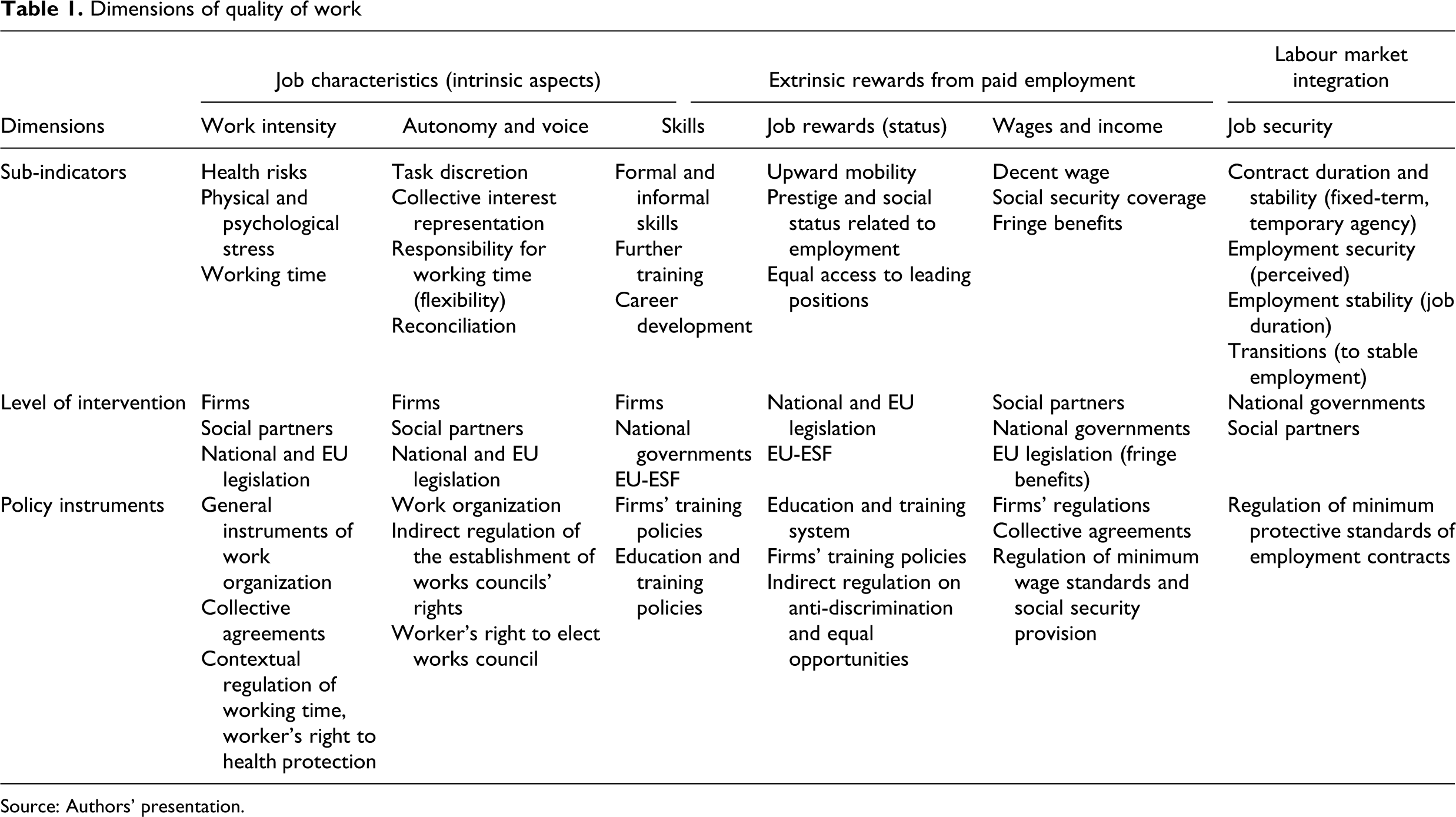
Secondly, considering the job quality dimensions and possibilities for public policy intervention against a more theoretical (sociological, economic or political) background (Davoine et al., 2008a; Gallie, 2007) shows that not all dimensions are equally accessible to the same actors’ interventions or policy instruments: while intrinsic job characteristics are subject to activities within the firm (work organization), which are influenced by working time regulation, health protection or education systems, extrinsic dimensions are rather subject to direct regulation by social and labour law. Although social policy-makers do not directly intervene in work organization within firms, they nevertheless contribute to providing and adjusting the basic institutional context for the organization and development of paid employment.
Thirdly, quality of work is connected with mechanisms of labour market segmentation (Gallie, 2007). Consequently the job quality debate has a normative stance toward the regulation of employment, based on the idea of promoting ‘decent’ employment. Policies promoting job quality – or their absence – are not neutral and will not result from synergetic and consensual political agreement between employers and employees. Although common objectives exist, the promotion of quality of work addresses the principal trade-off, namely between employers’ profit imperative and employees’ interest in well-being (Gallie, 2007).
Promotion of quality as a policy issue
Regulation is certainly the most pertinent instrument for promoting and maintaining quality standards. For the dimensions of work intensity, autonomy or skills and other intrinsic job characteristics, national as well as EU activities provide the institutional context through minimum standards in fields such as working time, health protection and anti-discrimination, but also employment and social protection. It is within this regulatory context that firms, supported or monitored by works councils, develop their workforce. Uniform standards for all areas over all Member States are not realistic but key features of quality of work are part of EU treaties (see below) and Europe-wide uniform legal minimum standards have partly been introduced by EU regulation (Peña-Casas, 2009a: 49 ff).
EU regulatory competences are limited in two respects. Crucial dimensions of quality of work, such as wages, social security or employment protection regulation are not EU competences, and the European governance system lacks an effective and democratic procedure – including legislative parliamentary competences – which would allow the transposition of collective interest into the core of social policy-making. The EU method in social and employment policy-making relies on intergovernmental agreement and the initiative to promote quality issues lies within the Commission’s competences. Therefore, the promotion of quality of work issues may need procedural ‘bypasses’ (Obinger et al., 2005). Undoubtedly, EU-level social policy activities – especially since the inauguration of the open method of coordination (OMC) – contribute to the identification and definition of problems, the formulation of policies and the design of monitoring systems which make it possible to retrace Member States’ activities in the relevant policy domains. Therefore, the definition of ‘headline targets’, guidelines and indicators, as well as the development of mechanisms of assessment (National Reform Programmes) and comparison (joint employment reports) between Member States to that end (benchmarking), can potentially be powerful instruments for promoting the quality dimension of work. The EES is the most prominent example of this, contributing, without any regulatory activity, to the reinforcement of, for example, activation strategies in national labour market policies which however may also have negative effects on quality of work (Betzelt and Bothfeld, 2011).
As regards the role of the social partners, at the European level their federations engage in social dialogue, participate in tripartite bodies and consultation procedures and thus contribute to legislation, including the labour law directives. As the involvement of social partners can thus add more legitimacy to European social policy-making we might expect that new initiatives on quality of work will be based on consultation with EU social partners or even be initiated by them.
In the next section, we retrace the activities of European actors (European Commission, Council of Ministers, European Parliament and social partners) since the implementation of the EES as regards developing instruments to promote the quality dimension of work.
Promoting quality of work through the back door?
From the start, the promotion of quality of work has figured prominently in the EU treaties, mainly through Article 117 (EEC), which stipulates that Member States shall improve working conditions and living standards. However, the competences for legislation in this domain remained at the Member State level until 1986, when majority voting was introduced for issues concerning the ‘work environment’. The Social Protocol to the 1992 Treaty on the European Union spelled out that ‘the Community and the Member States shall have as their objectives the promotion of employment, improved living and working conditions, proper social protection, dialogue between management and labour, the development of human resources with a view to lasting high employment and the combating of exclusion’. Further progress was made with the Employment Title in the Treaty of Amsterdam in 1997, which gave the EU a role in coordinating the Member States’ employment policies. The qualitative dimension of employment policies was put in focus at the 2001 Stockholm summit with the adoption of the Laeken indicators. The implementation of the European Employment Strategy can be considered to be a shift from a ‘work’ to an ‘employment’ focus – reducing employment objectives to numerical headline targets alone (Salais, 2009: 217). More recently, the Lisbon Treaty has given binding legal force to the Charter of Fundamental Rights, whose Articles 27–34 stipulate a broad range of issues of relevance to quality of work. Moreover, the new ‘social clause’ (Article 9 TFEU) might help to strengthen social issues. It remains to be seen, however, whether recent developments turn out to be effective in promoting quality of work.
European Commission
As the European Commission has the right of initiative when it comes to proposing new legal acts and prepares and coordinates – together with the Employment Committee (EMCO) – any action in the domain of quality of work it is the most important actor in this policy field. It also supports a number of specialized institutions that provide information and data on quality of work that go beyond the data available from Eurostat. 5 The commitment of individual actors, such as bureaucrats within the Commission or EMCO (see below), is a crucial driving factor in progress on quality of work. This was the case, for example, with regard to adding the Social Protocol to the Maastricht Treaty, which can to a large extent be attributed to Jacques Delors’ individual efforts or the impact of Allan Larson, director-general in the Commission dealing with employment with regard to the Employment Title in the Amsterdam Treaty (Johansson, 1999). The present Commission’s disregarding of quality of work issues must also be seen in the context of the new centre-right European Commission that was appointed by the Council and approved by the Parliament in 2004 and emphasizes economic over social issues. Moreover, the 2004 and 2007 accession rounds made finding compromises even more difficult, not only due to the increased number of Member States but – in particular – their wide variance with regard to social standards and outcomes.
Complementing the Lisbon strategy by a quality of work dimension
A more comprehensive EU quality of work strategy, taking account of the multi-dimensionality of the concept, emerged only at the beginning of the 2000s when the Lisbon European Council (March 2000) formulated the strategic goal for the EU of becoming ‘the most competitive and dynamic knowledge-based economy in the world, capable of sustainable economic growth with more and better jobs and greater social cohesion’. In March 2001, the Stockholm European Council introduced quality in work as a horizontal objective in the employment guidelines. As a follow-up, in June 2001 the Commission issued a Communication that aimed to take forward the Social Policy Agenda and thereby advance the European social model by promoting quality in employment beyond minimum standards and pay (European Commission, 2001). More explicitly, the Communication sought to define quality of work and to that end proposed 10 key dimensions. 6 It should be noted that wages were not a separate dimension but subsumed under ‘intrinsic job quality’. The indicators put forward in the Communication were further developed in the Employment Committee of the Council (EMCO) and then approved by the Laeken European Council during the 2001 Belgian Council presidency. The Communication also listed the main instruments for addressing the different dimensions of quality of work, such as the EES, legislation, action programmes and the European Social Fund.
The Laeken dimensions and indicators were used once in the 2003 Communication on ‘Improving quality in work: a review of recent progress’ (European Commission, 2003). 7 They reappeared in the 2008 European Commission’s Employment in Europe report, which contained a chapter on measuring quality of employment in Europe (European Commission, 2008). This chapter was largely based on an externally commissioned research paper by Davoine et al. (2008b) which took a rather critical stance towards the Laeken indicators. Reasons for not monitoring quality of work in a regular and coherent manner lie both within the indicators themselves and in political processes. The Laeken indicators, instead of capturing quality of work in the strict sense, contained quantitative phenomena (for example, employment rates) and mobility indicators (for example, transitions between employment and unemployment) which captured characteristics of employment systems rather than quality of work. Due to the prerogative of consensus between the members in the EMCO (see next section), wages were not taken into account as a separate dimension and were captured merely in the form of pay level transitions. The Commission’s original proposal had in fact been more ambitious, proposing the share of low wage-earners, working poor and distribution of income as possible indicators (European Commission, 2001) (for a critical discussion see Smith et al., 2008).
The Flexicurity project: detour or third way?
The flexicurity strategy emerged on the European scene with the European Commission’s 2006 Green Paper on Modernising Labour Law and the Communication on Flexicurity (European Commission, 2007). Although there were a number of critical voices among the social partners (ETUC, 2007; Business Europe, 2007; Dieckhoff and Gallie, 2007) and academics (see Keune, 2008; Burroni and Keune, 2011), flexicurity became the main approach to employment and its various aspects, including quality. The discussions and work around this concept – responses to the Green Paper and the Communication, participation in the mission for flexicurity and joint projects (Voss and Dornelas, 2011), to name but a few – seem to have taken up the resources of European actors, in particular those of the social partners (for a detailed account of the development of the flexicurity concept and the role of the different stakeholders, see Bekker, 2011). Also, some discussions on quality of work were now taking place under the ‘flexicurity header’.
In its substance, the flexicurity concept overlaps with the quality of work strategy but it covers only a small part of the employment relationship, focusing on four policy components: contractual aspects, lifelong learning and career development, active labour market policies and social security systems (European Commission, 2007; EMCO, 2009). Unlike the quality of work concept it assumes synergies between workers’ and employers’ interests (Bekker, 2011: 132). Attempts have lately been made to put in place a set of composite indicators that should allow the monitoring and analysing of flexicurity policies within the framework of the EES (Manca et al., 2010). In its ‘Agenda for new skills and jobs’, which is part of the Europe 2020 strategy, the Commission suggests re-examining the approach to job quality in light of flexicurity and ‘making transitions pay’, as well as the development of new working patterns (European Commission, 2010a: 15). Furthermore, in its proposal for the 2011 exchange of views with social partners concerning EMCO activities on the European quality of work concept (see next section), the Commission underlines the overlaps with the flexicurity concept (EMCO, 2011).
Overall, the Commission’s strategy on quality of work over the past decade appears weak and fragmented. The present regulatory activities are essentially limited to the revision of existing directives (working time, health and safety) and to addressing labour market segmentation (for example, discussions on an open-ended ‘single contract’) (European Commission, 2010a).
The European Council, the Council of Ministers and the committees: promoters or goalkeepers?
While the European Council defines the general political direction and priorities of the EU, the ministers of employment and social affairs prepare policy projects in specific domains, relying on its committees, among which the Employment Committee (EMCO) is the most active with regard to developing a more coherent quality-of-work concept.
The relative resistance of the Council of Ministers to promoting quality of work
The support of the Council for a particular policy project depends to a large extent on national governments’ commitment to it. The institutionalization of the quality dimension of the EES can be traced back to the successive commitment of four EU presidencies (Portugal, France, Sweden and Belgium) (Peña-Casas, 2009a), which culminated in the adoption of the Laeken indicators in 2001, strongly promoted by the Belgian Presidency. Similarly, the Trio Presidency of Germany, Portugal and Slovenia (first half of 2007–second half of 2008) put quality of work high on their agenda in an attempt to strengthen the EU’s social dimension and balance flexibility and security (Bekker, 2011: 179–184).
A brief analysis of the benchmarking exercise of the open method of coordination (OMC) illustrates the limited focus on quality of work in the EES, despite the Council’s adoption of the Laeken indicators in 2001 (on the role of job quality in the EES, see also Erhel et al., 2012). The joint employment reports (European Council, various years) which condense the results of the National Reform Programmes (NRPs), hardly report progress in this area. Indeed, only in 2002 and 2003/2004 was quality of work addressed in more detail by using the Laeken indicators to benchmark countries. 8 The essence of these two reports, however, is that countries only sporadically attach importance to job quality issues in their national reform programmes.
It is noteworthy that since the 2003/2004 joint employment report, quality of work has been discussed jointly with labour productivity, with the emphasis on the latter. Furthermore, the focus is continually shifting to flexicurity, and job creation is increasingly emphasized at the expense of quality issues. This can partly be explained by the current centre-right Commission and the mid-term evaluation of the EES, which reduced and aligned the employment guidelines with the economic ones. In the face of the economic crisis and the NRPs’ focus on measures against unemployment, the 2009/2010 joint employment report does not include a single reference to quality of work. Although job quality is one of the components of Guideline 7 of the revised EES under the Europe 2020 strategy, quality of work does not figure in the latest draft joint employment report (2011). If more qualitative issues come to be addressed at all, the new anti-poverty guideline may involve a shift of emphasis from quality of work to poverty prevention.
A monitoring system for quality of work – the role of the EMCO
The Employment Committee – which consists of two members from every Member State and two Commission officials – was created by a Council Decision in 2000. The EMCO implements the EES, preparing the main analytical documents and formulating opinions and contributions at the request of the Council, the Commission or at its own initiative.
The development of a new employment strategy monitoring tool – the Joint Assessment Framework (JAF) – triggered the revision of the quality of work framework and the Laeken indicators (Council of the European Union, 2011a). The JAF is prepared jointly by the EMCO, the Social Protection Committee and the Commission and takes account of Guidelines 7 to 10 of the EES and the respective EU headline and national targets. Based on the quantitative and qualitative indicators presented in the JAF, EMCO prepares the ‘Employment performance monitor’, which contributes to formulating the recommendations to the Member States. As a first step in the revision of the Laeken indicators, in spring 2009 the EMCO ad hoc group started a thematic review collecting, discussing and writing up the experiences of Member States in promoting quality of work (see, for example, EMCO, 2010). This was complemented by the EMCO Indicators Group’s review of indicators and approaches put forward by academics and other actors to challenge or complement the Laeken approach. 9 This work culminated in a discussion note used for consultation with Member States and social partners, the latest version of which proposes the retention of four dimensions: socio-economic security (with the sub-dimensions adequate earnings and job and career security), education and training (with skills development and employability as sub-dimensions), working conditions (going beyond health and safety by also taking account of work intensity, worker autonomy and collective interest representation) and work-life and gender balance. 10 Essentially, this latest proposal takes up the dimensions of job quality put forward in Table 1 and – importantly – includes adequate earnings as a sub-dimension. Particularly in the dimension ‘work-life and gender balance’ a number of indicators figure once again that capture institutional differences and quantitative labour market outcomes rather than quality of work outcomes.
Coalitions of Member States within EMCO that try to emphasize certain issues and keep other issues off the agenda played an important role as early as the 2001 discussions about the Laeken indicators. This is particularly evident with regard to the dimension of wages, which faced opposition from a number of countries, particularly the United Kingdom. 11 In the recent EMCO discussions on quality of work, wages are no longer questioned as an essential component of it. One explanation is that committee members had seen that indicators – and more particularly the Laeken indicators – did not lead to monitoring and sanction processes. Since as part of the EMCO deliberations, the social partners are consulted officially and, more informally, also the European Parliament, EMCO’s proposals would seem to enjoy high legitimacy. Moreover, due to its bureaucratic membership EMCO works largely independently of political conjunctures and thus creates stability, so that the Council cannot easily bypass its proposals. 12
The Parliament: a potential advocate of workers’ concerns
The Lisbon Treaty gave the European Parliament the right to review the Commission’s work programme and to ask the Commission to initiate legislation (Article 225 TFEU). But it is still not clear how effective these new competences are, since the Parliament still lacks substantial competences and resources. However, the Parliament does make use of formal legislative procedures, resolutions, parliamentary questions and consultations to support social issues, including the quality dimension of paid work.
Agenda setting activities: reports on social policies and parliamentary questions
One way currently used to highlight political issues is to commission independent research reports. Besides recent reports on, for example, health at work, skills development and minimum income schemes the most important report for our purposes was the 2009 report on job quality indicators, which has become a major working tool for European experts and policy actors in this domain (Muñoz de Bustillo et al., 2009). 13 To highlight the need to focus on the quality dimension of work and employment the European Parliament may make resolutions based on these expert reports; one such was the resolution on precarious female workers, in which the European Parliament calls upon the Commission to take action in this regard (European Parliament, 2010a). Another instrument is parliamentary questions to the Commission (Article 230 TFEU), illustrated by the request for an overview of the Commission’s labour law activities 14 or an Austrian MEP’s request that the Commission consider developing a job satisfaction indicator, similar to the Austrian Working Conditions Index. 15
Consultations with EU institutions and Member States’ representatives
Furthermore, the European Parliament, and more particularly the members of its Committee on Employment and Social Affairs, are part of a network of experts and policy-makers. Weekly consultations take place between the Committee members and representatives of the Commission and EMCO. This allows MEPs to be informed about and follow, for example, the developments of EMCO with regard to quality of work indicators (see above). Moreover, preparatory consultations take place with government officials of the incoming Presidency Council. In general, however, these relatively short-term consultations have little impact on the overall projects of the Presidency concerned, since (social policy) initiatives are decided well in advance.
The Parliament’s impact on employment guidelines
Because employment is a policy field in which the EU has mainly coordinating functions (Article 5, 145 ff TFEU), in many crucial areas Parliament participation in legislative processes is limited to consultation. While the ‘ordinary legislative procedure’ (co-decision) applies to such general working conditions as health and safety, social protection and employment, including the EES, are the object of ‘special legislative procedures’ (Article 153 TFEU), in which the Parliament reviews Commission and Council proposals, issues resolutions and formulates opinions. The time framework is often too tight to allow a comprehensive and thorough review of Commission or Council proposals, however. Moreover, the Council does not need to adhere to the Parliament’s amendments within the consultation procedure on employment policy.
In its response to the Commission’s proposal for integrated guidelines for the 2010–11 EES, the European Parliament’s Committee of Employment and Social Affairs underlines in 50 amendments the need – among other things – to emphasize good working conditions, avoid labour market segmentation and in-work poverty and better to coordinate activities. It also calls for closer involvement of all political stakeholders, especially the social partners, in the elaboration of indicators and monitoring systems, and requests that the headline targets be refined by introducing sub-indicators and that they be integrated into the guidelines, reports and recommendations to the Member States (European Parliament, 2010b: 21). In the added explanatory statement to the report (the ‘Öry Report’), the Committee calls on the Commission to set ‘an appropriate legislative framework’ for the domain of atypical employment contracts (European Parliament, 2010b: 41). In fact, the report spells out the European Parliament’s comprehensive position in this domain (European Parliament, 2010b). The Parliament was successful in part, changing the recitals to the 2010–11 guidelines which specify the objectives formulated in the guidelines: the emphasis on quality of work and ‘decent work’ and the reference to in-work poverty could be introduced (Council of the European Union, 2010).
With the Lisbon Treaty, the European Parliament has indeed attained a comprehensive set of competences and tools to influence social and employment policies, at least when it comes to agenda setting. However, it still lacks effective competences to impose its amendments and opinions and to make substantial contributions to the regulation of crucial dimensions of quality of work.
The social partners
The EU social partners' activities in the quality of work field have mainly been carried out through social dialogue. According to the Maastricht Treaty they must be consulted on directives which relate to social and employment issues. Moreover, they themselves have negotiated a number of joint framework agreements which were later either transposed into directives, binding on the Member States, or implemented by the social partners as so-called autonomous framework agreements. Indeed, Table 1 shows that workers' representatives, the ETUC, and the employers' representatives, Business Europe, CEEP and UEAPME, have contributed to legislation pertaining to most quality of work dimensions. Besides the 2003 Working Time Directive, which is currently being recast, and the framework agreement on work-related stress, in the field of autonomy and voice, the recast Works Council Directive of 2009 is also noteworthy. With regard to job security but also linked to rewards from paid employment the framework agreements on part-time (1997) and fixed-term contracts (1999) are worth mentioning. Besides these legislative activities which bind a lot of the resources of the EU social partners the social partners also have the possibility to highlight certain issues of relevance to quality of work via resolutions (see, for example, the ETUC resolution on investment in lifelong learning for quality jobs in 2010).
With regard to the conceptualization of quality of work, including the current EMCO revisions of the system of indicators, the social partners have so far been less active, even though – in contrast to the European Parliament – they are formally consulted. One explanation is that the elaborations in, for example, the indicators’ group are fairly technical and specific. Moreover, Business Europe is quite critical of the Commission’s job quality strategy, as reflected in its response to the Communication on new skills and jobs, where it emphasizes that it ‘strongly disagrees with the Commission’s [mixed] assessment of job quality [and particularly its emphasis of labour market segmentation] and working conditions in Europe … [but also that it does] … not see the need to undertake a review with a view to streamlining the policy concept of quality of work’ (Business Europe, 2011). The ETUC, which should be particularly interested in the issue of quality of work, is short-staffed: the confederal and (deputy) general secretaries are responsible for a range of dossiers, among which quality of work is only a sub-area. Moreover, the first period of the EMCO revisions of the quality of work concept and the pertaining indicators fell into the pre-2011 Congress period, when several of the outgoing secretaries had already left but the new ones had not yet taken up their posts, further limiting ETUC capacities.
Not surprisingly, ETUC statements frequently mention the importance of quality jobs (also termed quality employment, decent work or more and better jobs), but the definition and agenda remain very broad. This is illustrated by the response to the Europe 2020 strategy 16 and the quest for more and better jobs as top European priority in the Athens manifesto. Besides the fact that flexicurity activities are likely to have bound up social partner resources, they have also been used to emphasize job quality, at least by the ETUC. In its response to the Commission’s 2007 communication on flexicurity, the ETUC laid stress on ‘job quality, including the principle that stable and secure open-end contracts should remain the general form of employment, at the centre of flexicurity’ (ETUC, 2007; for details, Bekker, 2011). The response contained one of the few explicit references by the social partners to the Laeken indicators. They were deemed ‘a good basis to develop an agenda of job quality [although they] need … to be enlarged so that they also include the principle of promoting stable, secure and open-ended work contracts as the general rule’. An important ETUC focal point with regard to quality of work has recently been concerns about precarious employment, as is evident in several activities and studies (see, for example, ETUC, 2008).
The European Economic and Social Committee (EESC), an EU consultative body that combines the interests of workers, employers and civil society, largely supports the promotion of quality of work. To give only a few recent examples, its opinion on the draft employment guidelines emphasized the importance of strengthening the qualitative dimension of employment, referring explicitly to the Laeken indicators and adding relevant details on quality of work, such as health promotion and wages (EESC, 2010). Furthermore, an own-initiative opinion (EESC, 3 May 2011) 17 on innovative workplaces as a source of productivity and quality jobs emphasized ‘that a European index should be introduced describing the quality of working life and its effects on innovativeness and productivity’. There is, however, no reference to the Laeken indicators or their revision. Finally, the EESC’s opinion on the Agenda for new skills and jobs (EESC, 2011) 18 includes a subsection on improving quality of work, which asks the Commission to take on board the mixed outcomes of the latest European Working Conditions Survey (EWCS), carried out by Eurofound, when reopening the discussion on quality of jobs. It also urges that job quality be put at the heart of flexicurity.
Conclusions: shortcomings and successes in institutionalizing a ‘quality strategy’ in the EU
Crucial developments with regard to a more comprehensive framework on quality of work took place in the early 2000s, particularly with the introduction of quality of work into the employment guidelines as a horizontal objective and the approval of the Laeken indicators by the Council. European actors, however, have not been successful in keeping the quality dimension on the agenda, as the European political agenda at both national and EU level – since the mid-2000s – has been dominated by centre-right political parties and the primacy of economic issues. This tendency has been further strengthened by the economic and financial crisis which emphasizes more basic social aspects, such as combating (youth) unemployment (Chung et al., in this issue) rather than quality of work. Also, the Europe 2020 strategy, as follow-up to Lisbon, has to date not strengthened the quality of work objective – in fact, the introduction of the new poverty headline target risks reducing ambitions concerning quality of work to the fight against in-work poverty. Nevertheless, we do find ‘traces’ which prove an attempt to institutionalize quality of work on the EU level.
The gradual development of the quality of work dimension
The multi-dimensionality of the concept and the lack of unity on suitable dimensions and indicators as of 2001 did not contribute to motivating the European actors, already rather inactive on this issue, in implementing a concrete and more substantial quality of work strategy. The strong focus on quantitative targets in the EES and the prominence of the flexicurity strategy also overshadowed the quality dimension. Nevertheless, the latter has gained some ground in the activities of all European actors. Due to the academic debate and the activities of EMCO a comprehensive and more suitable system of indicators was recently developed which at present is the object of political consultation. Despite some remaining shortcomings the indicators now cover the dimensions usually identified as relevant by social scientists, including intrinsic and extrinsic aspects – and among them wages and job and career security, as well as collective interest representation – and should thus allow for more adequate monitoring and diagnosis of possible weaknesses in domestic employment systems. To become an effective tool they must be used in a more regular and transparent way than has been the case with the Laeken indicators. The plan to use the quality of work indicators in the Joint Assessment Framework (JAF) as part of the EES might represent a first step to this end but it is too early to judge.
Although quality of work figures in the employment guidelines (at the insistence of the European Parliament and the EESC) and is to be included in the JAF, it has not been translated into a headline target. It is therefore unlikely that it will figure in the reporting of Member States, the joint employment reports and the recommendations. Moreover, activities with regard to implementing a comprehensive and indicator-based quality of work strategy remain largely disconnected from legislative initiatives in the field of quality of work (labour law directives). This is – in addition to it probably not being a priority – also due to different departments or persons usually being responsible.
Above all, the EU lacks powerful actors and effective and democratic procedures to develop and pursue activities in the social area. The present Commission pays little attention to social issues, with DG Economic and Financial Affairs taking primacy over DG Employment, Social Affairs and Inclusion. The Council’s commitment depends on single or trio presidencies promoting specific issues, as was the case for quality of work in 2000 and 2001. In light of high unemployment, the primacy of austerity and the predominant EU focus on reconfiguring economic governance, it is unlikely that any subsequent presidencies will put quality of work (high) on the agenda. The competences of the European Parliament as potential promoter of quality of work, despite recent improvements, remain limited as it has no substantial legislative and veto rights in this field. Social partners have been and are active in negotiating or revising legislation with regard to specific areas of quality of work. Due to limited (human) resources, the European trade unions have so far not been very active in the fairly technical discussions on an indicator-based EU strategy on quality of work.
The issue of quality of work, as much as it may constitute a core element of the EU social model, reflects the limitations of the EU political system, especially the European Parliament’s power and competences as a substantial democratic actor in terms of social issues. In our view, the present crisis of the Economic and Monetary Union illustrates the need for more and not less supranational regulation. The new social clause of Article 9 TFEU will only become the legal basis for actions in this area and contribute to maintaining and strengthening the Union’s political legitimacy, if the far-reaching political decisions in the domain of social and economic policies are linked to substantial democratic decision-making.
Footnotes
Funding
This research received no specific grant from any funding agency in the public, commercial, or not-for-profit sectors.