



Abstract
This article explores different stakeholders’ perceptions of the future of trade unions in Croatia. Findings reveal that respondents (managers, HR experts, trade union officials, government representatives and employees) are not optimistic about the future of trade unions in Croatia, agreeing that they will face many obstacles in the near future, such as a lack of consensus between the five trade union federations, a lack of agreement among the unions within a federation, and further union disintegration. However, survey respondents believe that there are many strategies capable of revitalizing the union movement in Croatia, including networking, ‘organizing unionism’ and union modernization.
Introduction
Over the last 30 years, a dramatic shift away from labour relations towards employee relations 1 has been witnessed throughout the world, a consequence of two major trends. First, employees are no longer upbeat about the collective protection and representation offered by trade unions and their mediating role. Believing in themselves and their competences, they are confident that they can achieve better negotiation results as individuals. As Regini (2010) points out, a growing number of employees with high market power are tempted to defect from collective action, instead negotiating individually or in small groups. Secondly, there has been a significant decline in union membership (absolute loss), union density (relative loss) and subsequently union impact throughout the world as a consequence of contemporary unions having many ‘enemies’. Union decline is the result of various macro and micro factors, such as an unfavourable political environment dominated by neoliberal business philosophy, managerial opposition, employees’ individual career loyalty, and union leaders fighting for power.
At the same time, however, because of the current global financial crisis and the semi-bankruptcy of many developed countries around the world, trade unions have an opportunity and even, many would argue, an obligation to regain their power and influence, needing to revitalize and reposition themselves and become the ‘old-new’ upholders of employees’ rights.
In this vein, this article explores various stakeholders’ perceptions of the status of trade unions in Croatia, an indicator of their future as yet unexplored in the country. Indeed, such perceptions have only rarely been the subject of scientific research in the EU (e.g. Turner and D’Art, 2012 2 ) and in developed countries in general. 3 Croatian unions have been hit by declining membership and power over the past 25 years (Bagić, 2010; Rebac, 2010), even though the ex-Communist country has a long tradition of unionization. In addition, not only is Croatia in the grip of a severe recession, but – as the newest EU country – it is also rapidly adopting neoliberal ways of doing business, implying a further decline in union density. Consequently, such perceptions of the present union status and prospects can be used by unions better to understand current situations and to develop appropriate revitalization strategies.
The article is structured as follows. Following the introduction, the theoretical framework explains reasons for union decline and presents strategies for union revitalization, as well as describing the trade union scene in Croatia. It goes on to present the methodology of the empirical survey conducted and the research findings, while the final section discusses the theoretical and empirical findings, and provides a number of concluding remarks.
Theoretical framework
Setting the stage for the empirical exploration, the theoretical framework explains in brief two areas helping to describe the status of unions in Croatia and their future – reasons for union decline and strategies for union revitalization. It also takes a brief look at the trade union scene in Croatia.
Reasons for union decline
The many reasons for union decline can be grouped into four categories depending whether they happen at society, organization, individual or union level, as depicted in Figure 1.
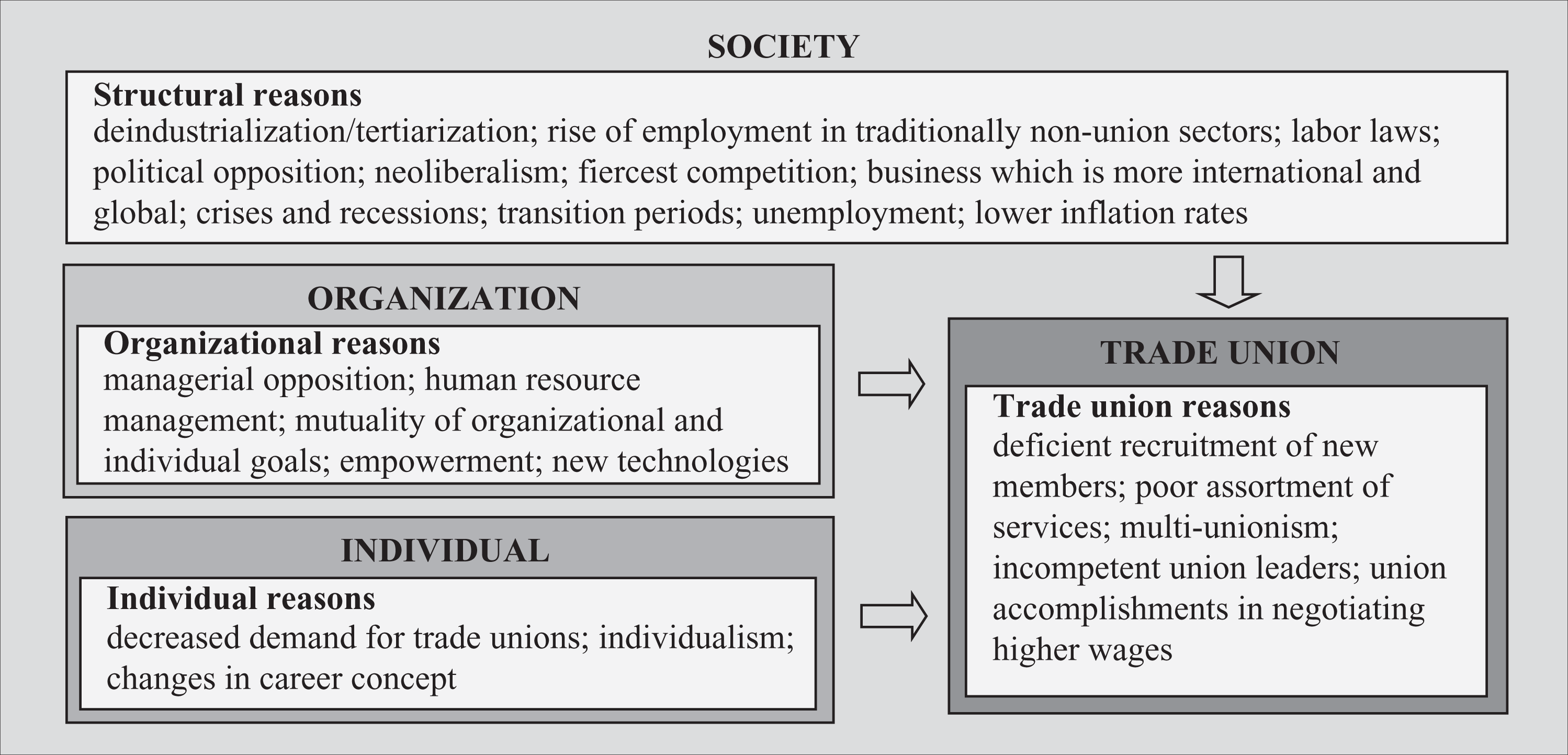
Four categories of reasons for union decline.
At
At an
Reasons for union decline at an
At
Strategies for union revitalization
To survive, it is argued that unions need to align their philosophy and activities to contemporary business conditions and societal values. Strategies for union revitalization can be categorized in three groups, as seen in Table 1.
Strategies for union revitalization.
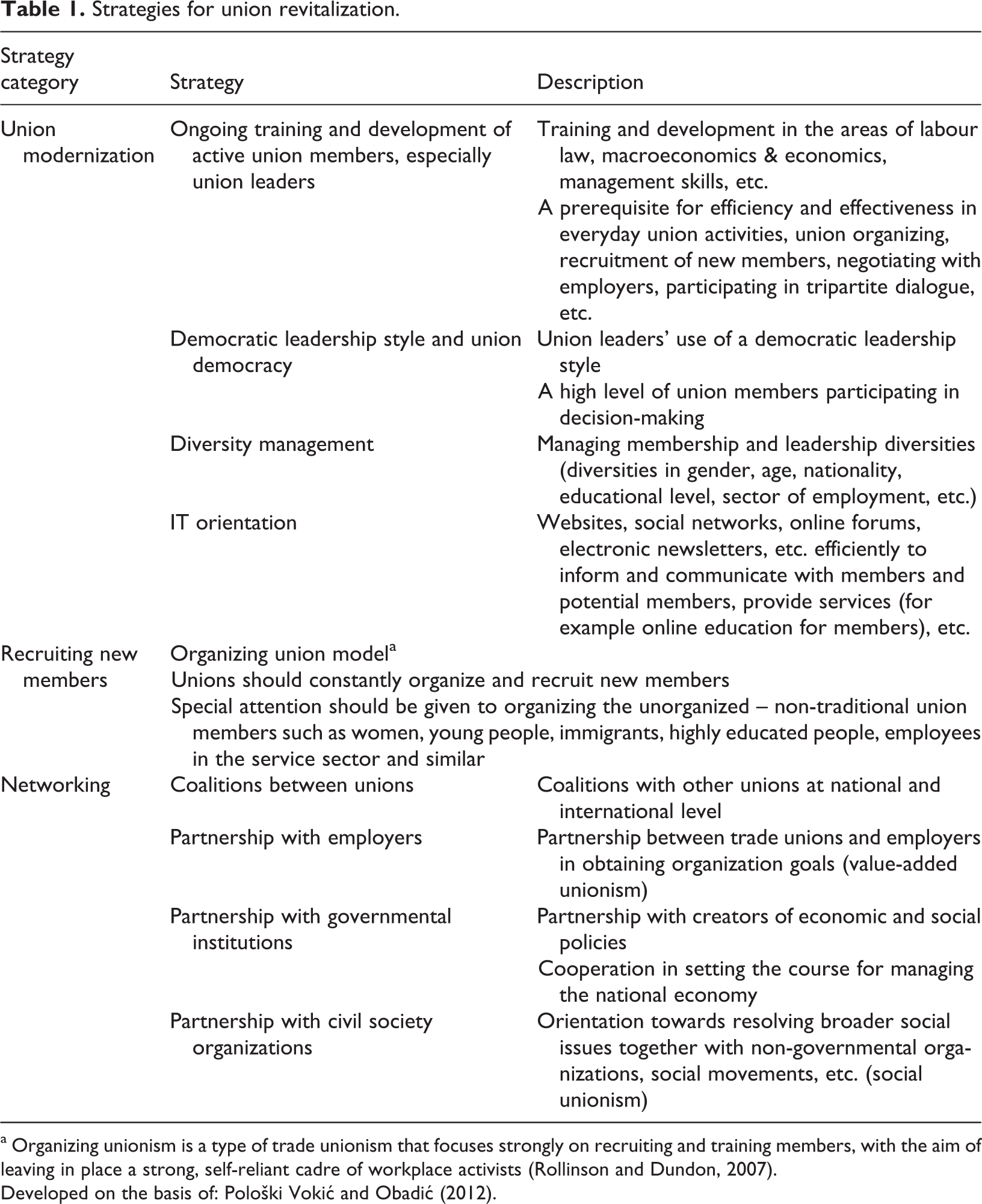
a Organizing unionism is a type of trade unionism that focuses strongly on recruiting and training members, with the aim of leaving in place a strong, self-reliant cadre of workplace activists (Rollinson and Dundon, 2007).
Developed on the basis of: Pološki Vokić and Obadić (2012).
As shown by Table 1, there are many strategies available for revitalizing unions. Learning is ‘part and parcel of building strong unions capable of combating powerful employers’ (Sharpe, 2004: 65). Unions can be revived by union democracy, a system of active union members’ participation in decision-making, policy implementation, and selection of officials, at all levels of the union organization (Barling et al., 1992). Strategies also recommend offering a portfolio of models geared to distinct interest groups (Fiorito, 2004), to improve services and attract members through web offers (Diamond and Freeman, 2002), and to recruit new members as this ‘has become an almost life-or-death issue’ for unions (Clark, 2009: 6). Furthermore, others argue that unions should make efforts to reduce inter-union competition and understand the importance of overcoming these divisions by mergers or other forms of union cooperation (Bach and Kolins Givan, 2004). A partnership agreement, such as one in which management and trade unions agree to work together for mutual gain (win-win) and to create a climate of cooperative relations (Millmore et al., 2007), is considered to be especially fruitful. Governments should also be interested in building partnerships with trade unions, as policy decisions could be a subject to the veto power of politically organized interest groups (Conceição-Heldt, 2008). Finally, civil society is increasingly seen as an arena of trade union engagement (Hyman, 2001).
The trade union scene in Croatia
Croatian experience of independent trade unions is relatively recent, beginning in the 1990s at the onset of the transition from the planned to the free market economy. Under Communism all workers were supposed to join trade unions operated as an arm of the state rather than as independent worker representatives.
In 2010 union membership in Croatia was 34.7 per cent and collective agreement coverage 61 per cent, a figure significantly above the averages for the EU as a whole and for new EU states (Obadić, 2012). Power relations among tripartite dialogue actors are relatively balanced, as the state has a high level of legitimacy and internal stability, employers are considered crucial for achieving economic growth and higher living standards, and unions have demonstrated their mobilization power. However, for many years this balance of power has been unproductive, unable to resolve the outstanding issues in social and economic policy areas (Bagić, 2013).
There are some 500 trade unions in Croatia, organized in 26 higher-level union associations (Office for cooperation with NGOs, 2014), of which five union federations are involved in national tripartite dialogue (in line with their significance/membership: 4 Independent Croatian Unions (NHS), Union of Autonomous Trade Unions of Croatia (SSSH), Croatian Trade Union Association (HURS), Register of Croatian Trade Unions (MHS) and the Workers’ Trade Union Association of Croatia (URSH)). In addition to the union landscape being fragmented (Rebac, 2010), the union federations have a relatively low level of centralization. This gives associated unions a high level of decision-making autonomy (Hernaus, 2012), making it difficult to coordinate union activities at national level.
Methodology
The status of trade unions in Croatia and their future were assessed using a structured questionnaire with closed-ended questions. Compiled on the basis of the theoretical framework presented above, it covered respondents’ perceptions of (1) the influence of trade unions in Croatia in general, in Croatian organizations, and/or in a respondent’s organization; (2) reasons for union decline; (3) challenges facing the trade union movement in the near future; and (4) potential strategies for union revitalization. In addition, demographical data (gender, age, educational level) were collected.
The rationale for selecting organizations to participate in the survey was based on three criteria. The first was that all four union-HRM relationship modalities were present in the sample: total HRM dominance, union-HRM synergy, union-HRM dualism, and union dominance 5 ). As HRM has proved to be one of the successful union substitution strategies (Guest, 1987; Pološki Vokić, 2013; Ramaswamy and Schiphorst, 2000), only the inclusion of all modalities guarantees coverage of all types of organizations with regard to trade union positioning. Secondly, as HRM remains an underrepresented business function in Croatia (Pološki Vokić and Vidović, 2007), 6 a greater number of organizations with union dominance should be present in the sample. Thirdly, the fact that only a small minority of Croatian organizations have a total HRM dominance (Pološki Vokić, 2012) 7 is taken into account. The eight organizations 8 satisfying the above-mentioned criteria (three with union dominance, two with union-HRM dualism, two with union-HRM synergy, and one with total HRM dominance 9 ) were asked to participate in the study. All contacted organizations accepted the invitation, distributed the questionnaires among their employees and collected their answers.
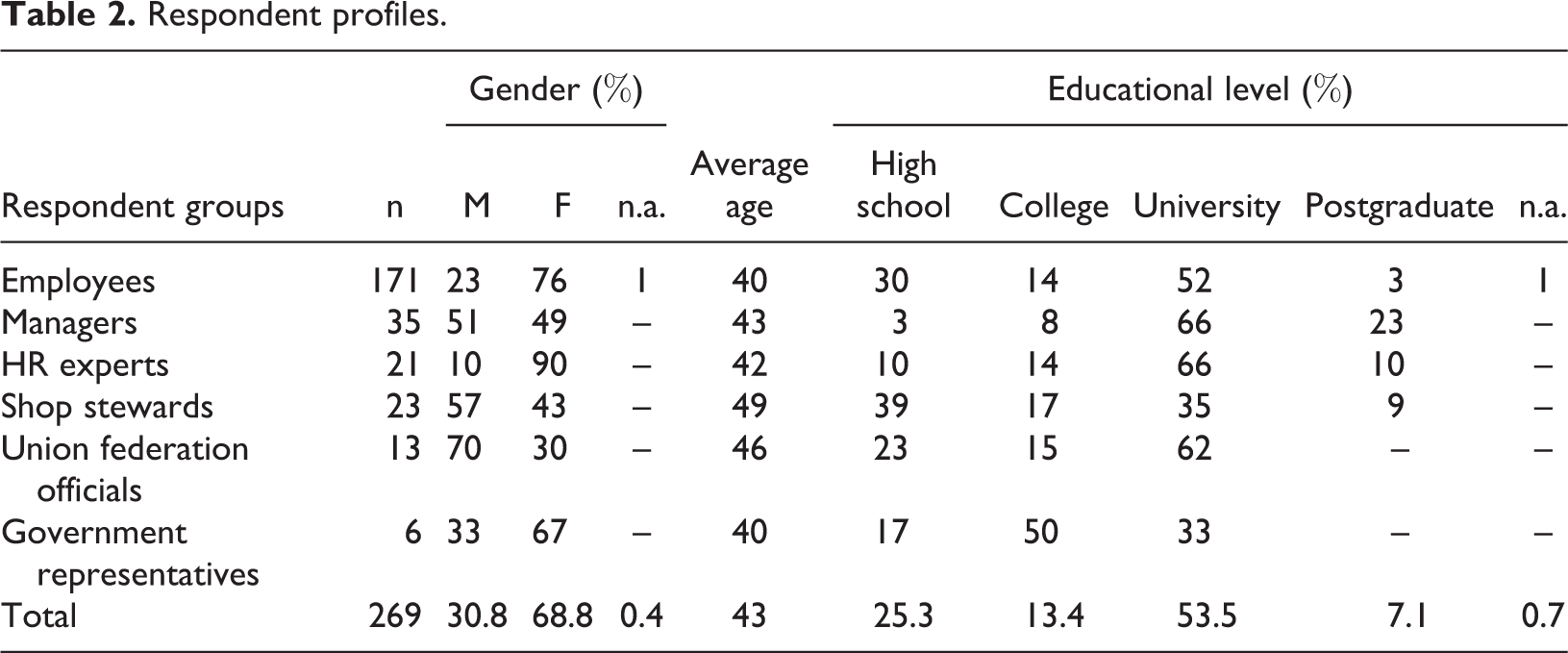
To assess the status of trade unions in Croatia and their future, a 360-degree scheme 10 covering both a tripartite perspective (employers, trade unions, government) and an internal audience perspective (employees) was used. In doing so, the perceptions of the following stakeholders were explored: (1) employees, (2) managers, (3) HR experts, (4) trade union officials (both shop stewards and officials working in trade union federations 11 ), and (5) government representatives (employees of The Ministry of Labour and Pension System responsible for managing tripartite dialogue). Respondent profiles are presented in Table 2. The data collected were analysed descriptively (relative frequencies, mean values) using the Statistical Package for the Social Sciences (SPSS).
Respondent profiles.
Research findings
The research findings on the status of trade unions in Croatia and their future encompass (1) trade union influence in Croatia in general, in Croatian organizations, and in respondents’ organizations, (2) reasons for union decline, (3) challenges for the trade union movement in the near future, and (4) potential strategies for union revival/revitalization.
Trade union influence in Croatia
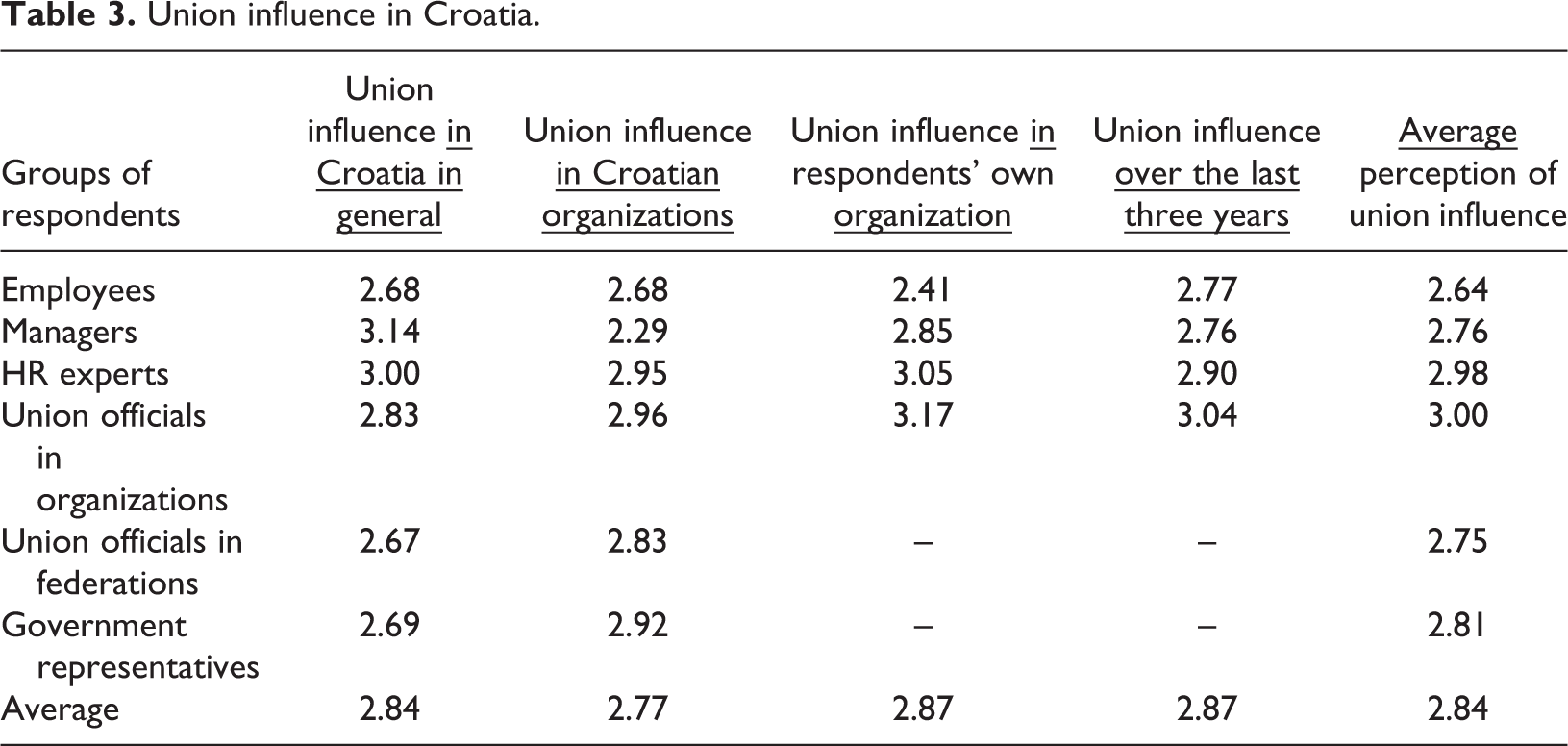
Table 3 illustrates that respondents do not believe trade unions to be an influential stakeholder in Croatia. On a scale ranging from 1 (no influence at all) to 5 (extremely influential) they perceived unions as being less than moderately influential in Croatia in general (mean 2.84), in Croatian organizations (mean 2.77), in their organizations (mean 2.87), and over the last three years (mean 2.87). The most negative group of respondents were employees (average 2.64), while union officials in organizations and HR experts were the most positive groups, though still assessing trade union influence as moderate (mean 3.00 and 2.98).
Union influence in Croatia.
When asked about the future of trade unions in Croatia in the next three years, respondents were slightly negative. Among respondents, 48.7 per cent saw union influence remaining unchanged, 38.2 per cent saw unions losing influence, while only 13.1 per cent saw unions succeeding in gaining influence. The latter is a consequence of union officials in organizations being very positive about the future of unions (56.6 per cent believed that unions were going to become more influential in the near future). By contrast, none of the HR experts or government representatives saw unions becoming more influential in the next three years. In addition, it is interesting to note that two-thirds of government representatives (66.7 per cent) and almost half of employees (42.3 per cent) thought that unions in Croatia were going to lose influence in the next three years.
Slightly more positive results emerged when respondents were asked about their perceptions of trade union influence within their organizations in the next three years. Here, 62.4 per cent of them believed that trade union influence would stay the same, and 14 per cent that trade unions would become more influential, again as a consequence of union officials in organizations being very positive about the future of unions (43.5 per cent believed that trade unions in their organizations were going to become more influential in the next three years). However, one-quarter of respondents thought that trade unions in their organizations were going to lose influence in the next three years, again with HR experts being the most negative group, with none of them believing that unions were going to become more influential.
Finally, managers and HR experts were asked whether they thought trade unions were needed in their organizations. One-third of respondents believed in partnerships between the organization and trade union(s), a very positive aspect for the future of the trade union movement. However, almost half of managers (48.6 per cent) and one-third of HR experts (33.4 per cent) believed that trade unions were not needed at all or only minimally needed in their organizations (possibly for defending workers in grievance procedures and for organizing social events).
Reasons for union decline
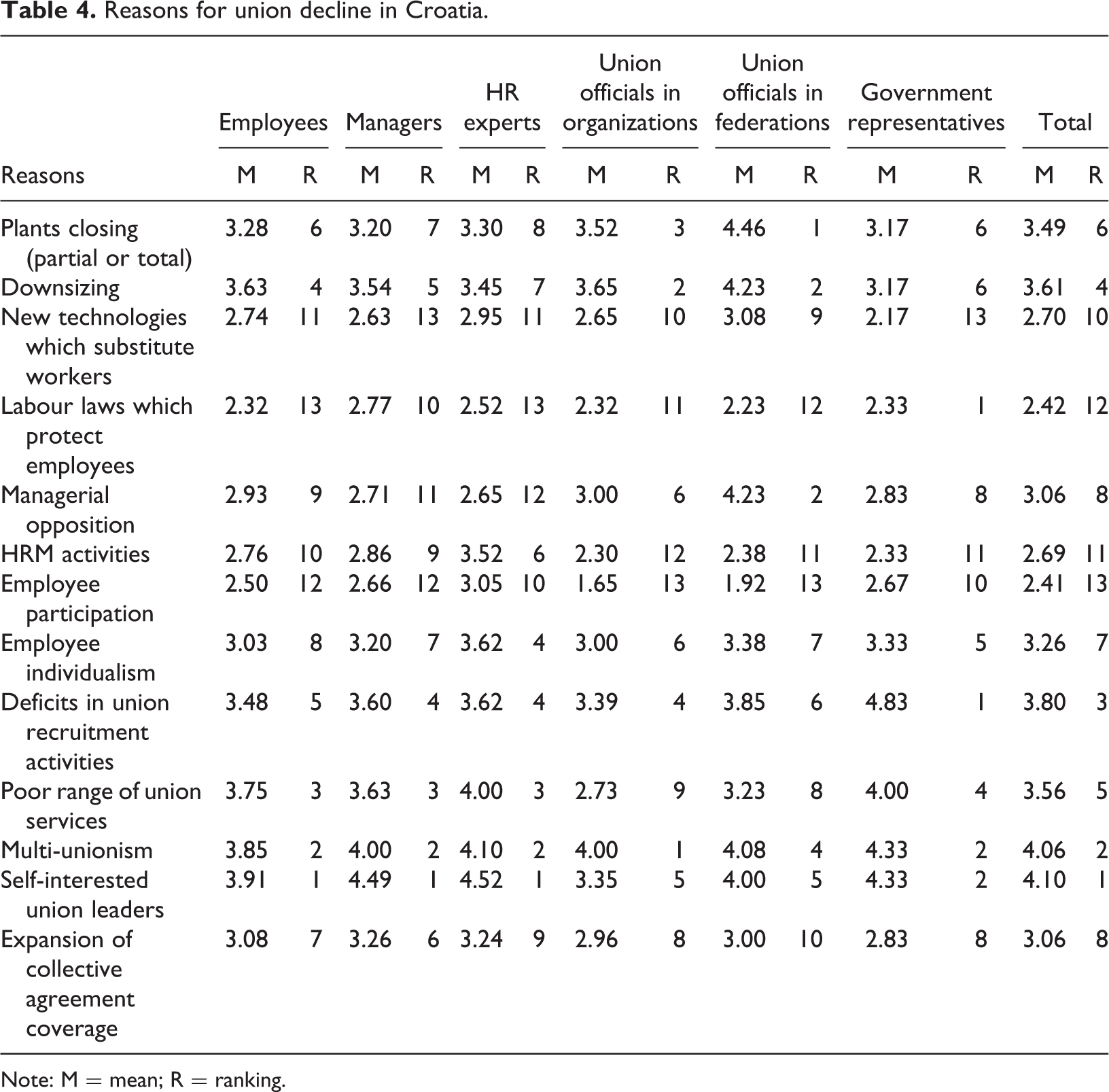
Respondents evaluated 13 reasons for union decline in Croatia (decline in union membership, union density and union influence) on a scale ranging from 1 (not a reason for union decline) to 5 (an extremely significant reason for union decline). Mean values of respondents’ perceptions and rankings of reasons for union decline according to the mean value are listed in Table 4.
Reasons for union decline in Croatia.
Note: M = mean; R = ranking.
As seen in Table 4, the majority of potential reasons for union decline were evaluated by respondents as of significance for union decline in Croatia (mean higher than 3.00). Among them two reasons stand out (mean higher than 4.00): ‘self-interested union leaders’ and ‘multi-unionism’. When looked at more closely, we find that ‘self-interested union leaders’ is the top reason for employees, managers and HR experts, the second-ranked reason for government representatives, and the top reason for union decline overall (mean 4.10). Though union officials have a slightly different perception, they nevertheless evaluated on average this reason as being moderate/influential (3.35 for union officials in organizations; 4.00 for union officials in union federations). ‘Multi-unionism’ is the first-ranked reason of union decline for one group of respondents (union officials in organizations), the second-ranked reason for four groups (employees, managers, HR experts and government representatives) and overall the second-ranked reason. By contrast, the table shows that ‘new technologies which substitute workers’, ‘labour laws which protect employees’, ‘HRM activities’ and ‘employee participation’ are not perceived as being serious threats to unionism in Croatia, all being evaluated on average lower than 3.00 and at the bottom of the ranking both for the respondents in total and for every group of respondents.
Challenges facing the trade union movement
Respondents were asked to evaluate five potential challenges facing the trade union movement in Croatia on a scale ranging from 1 (not a challenge) to 5 (an extremely significant challenge). Their average answers are presented in Table 5.
Challenges facing the union movement.

a The Act on criteria for participation in tripartite bodies and representation for collective bargaining from July 2012 imposed higher requirements for participating in tripartite bodies at national level, thereby encouraging further union consolidation, and potentially reducing the number of trade unions and union federations in Croatia (Hernaus, 2012).
Note: M = mean; R = ranking.
Table 5 reveals that all groups of respondents, except union officials in union federations, believe that the ‘lack of coordination between trade union federations’ is the top challenge facing unions in Croatia (for union officials in union federations the top challenge is of an external nature – the ‘new representation act’). For employees, managers, HR experts and government representatives the second-ranked challenge was the ‘lack of agreement between trade unions in federations’. For union officials (both in organizations and in union federations) the second-ranked challenge was the ‘further disintegration of trade unions’. It is interesting to note that all but one of the challenges are on average evaluated higher than 3.00, meaning that they are viewed as a threat. The lowest-ranking challenge in total and for four groups of respondents is the ‘further development of HRM practices’, and it is the only challenge evaluated on average by three groups of respondents as a minimal threat (mean lower than 3.00).
Potential strategies for union revitalization
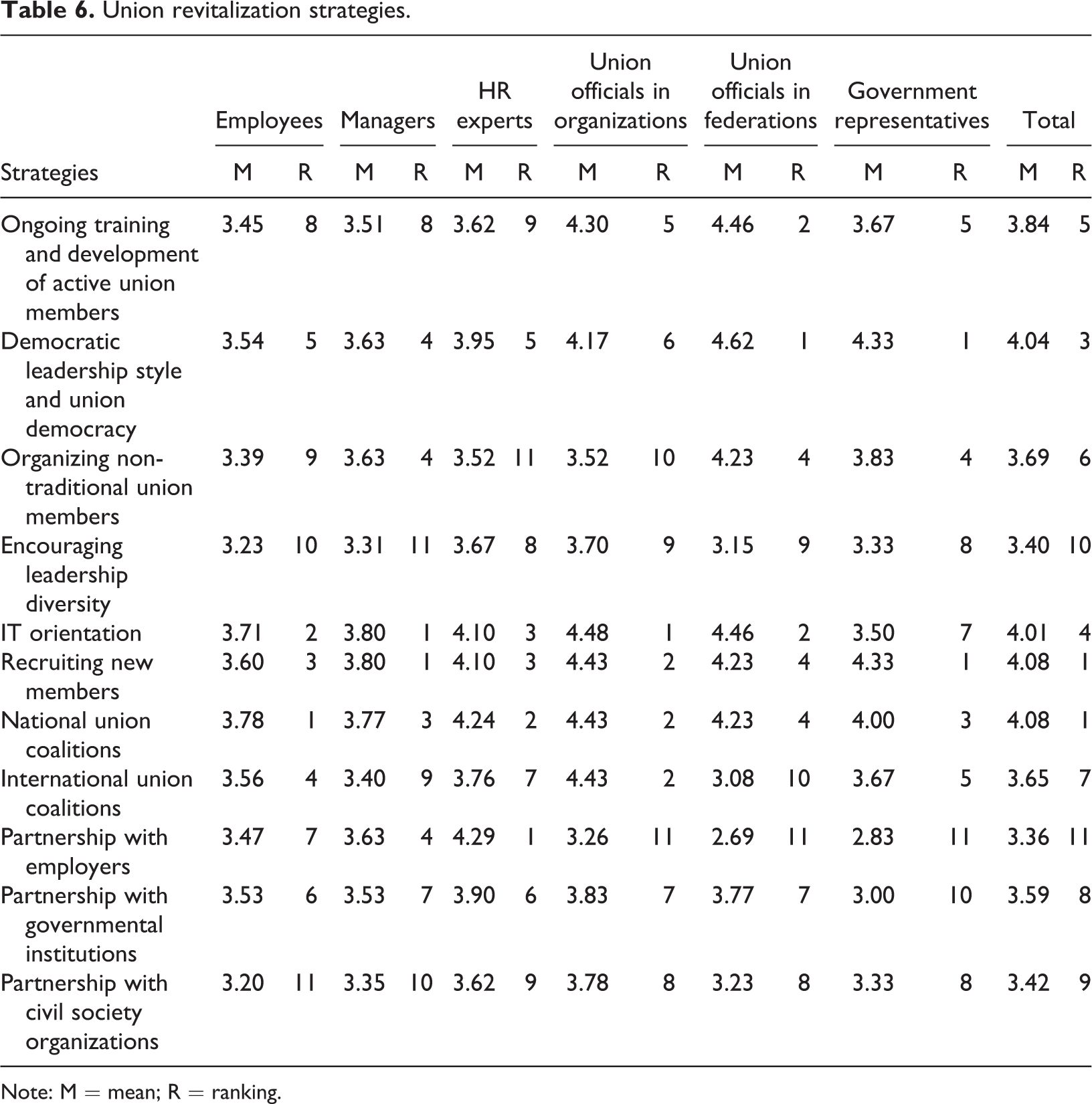
The potential of 11 union revitalization strategies was assessed on a scale ranging from 1 (unable to revitalize unions) to 5 (extremely suitable for revitalizing unions). Average opinions are depicted in Table 6.
Union revitalization strategies.
Note: M = mean; R = ranking.
Table 6 shows that all suggested strategies are on average evaluated as being useful tools for revitalizing unions (a mean higher than 3.00), and that four strategies are on average evaluated as being really suitable for revitalization (a mean higher than 4.00): ‘coalitions between unions at national level’ (mean 4.08), ‘recruitment of new members’ (mean 4.08), ‘democratic leadership style and union democracy’ (mean 4.04), and ‘information technology for communicating with members/potential members’ (mean 4.01). In addition, only two groups of respondents (union officials in union federations and government representatives) evaluated one strategy – ‘partnership with employers’ – on average as minimally suitable (mean lower than 3.00).
Discussion and conclusion
The findings show that respondents are not optimistic about the future of trade unions in Croatia, with the majority believing that the trade union position at national level and in organizations is weak and set to remain so. The only slightly positive finding for the unions is that one-third of managers and HR experts believe in partnerships between organizations and trade unions. However, half of managers and one-third of HR experts believe that trade unions are not needed at all in their organizations or are needed only to handle grievances, organize social events, etc. Interestingly, this is not in line with the Turner and D’Art (2012) finding about the substantial majority of respondents from the European Social Survey (ESS) perceiving a need for strong trade unions to protect their pay and working conditions regardless of their individual characteristics, structural factors or institutional regime. There is limited variance in their dependent variable, as even such groups as employers, the self-employed and managers have majorities agreeing with the need for unions.
Respondents see many reasons for such a modest position of trade unions in Croatia, especially ‘self-interested union leaders’, ‘multi-unionism’ and ‘deficits in union recruitment activities’. As top challenges for the union movement in the near future they point to the ‘lack of coordination between trade union federations’, the ‘lack of agreement between trade unions in federations’ and a ‘further disintegration of trade unions’. However, respondents see many strategies with the potential to revitalize the trade union movement in Croatia, focusing on ‘coalitions between unions at national level’, ‘recruitment of new members’, ‘democratic leadership style and union democracy’, and ‘information technology for communicating with members and potential members’.
The recommendation for trade unions arising from the survey is clear. Croatian trade unions should invest more energy in networking. For example, they should work hard to reach consensus between the five Croatian trade union federations on every issue, as trade unions can only be a value-adding participant in national-level tripartite social dialogue when united. They should embrace the organizing union model, investing time in organizing unions in organizations, recruiting new members, and mobilizing members for industrial action – the more members, the louder their voice. They should modernize, encouraging their leaders to develop a democratic leadership style, promoting union democracy, and using information technology to inform and communicate with their members and potential members.
Respondents do not consider a ‘new union philosophy’ – a philosophy of unions being a vital part of a sustainable future on account of the value they add to organizations and society through partnerships – as a strategy for union revitalization. It has been argued that through partnerships with different stakeholders – with employers (see Badigannavar and Kelly, 2004; Marginson, 2010), with civil society organizations (see Johnston, 2002; Robinson, 2002) and with governmental institutions (see Conceição-Heldt, 2008) – unions can help build a better society. As the most vertically (access to governments, politicians and employers) and horizontally (the broad base of workers) integrated ‘institutions’ in contemporary society, they have the potential leverage to secure balance within society. We would argue that to accomplish this they need to become ‘new unions’ embracing a new philosophy. New unionism implies unions which care about both workers and society, understand employers’ and governments’ needs and wants, and are aware of the fact that the rules of the game are set by global competition and globalization. Moreover, one of the first partnerships they need to build is with HRM departments. A combination of innovative HRM practices and worker representation can yield substantial productivity gains (Addison, 2005), as unions and HRM can create synergies when complementing each other. Indeed, previous research has confirmed that the best possible ‘service’ for their clients is when trade unions and HRM work together as partners to meet employee needs (e.g. Guest, 1987; Pološki Vokić, 2012).
These are hard times for trade unions, both in Croatia and around the globe. Not only are membership and union density shrinking, but unions are also losing their power and influence at both national and organization level, as evidenced both by the description of the union landscape in Croatia and respondents’ perceptions. As yet they have not seized the opportunity for revitalization which came with the global recession. Although the recession is jeopardizing employee rights, trade unions, as traditional upholders of employee rights, have not stood their ground in Croatia. They have not been particularly successful in safeguarding their members’ jobs, negotiating collective agreements, organizing impressive industrial actions or mobilizing new members (Grdešić, 2006; Chavleski and Risteski, 2012; Obadić, 2012; Bagić, 2013). And as social dialogue is weak, they are marginalized in the decision-making process (Chavleski and Risteski, 2012). This is the case with trade unions in all ex-Yugoslavian countries (see for example Chavleski and Risteski (2012) for Serbia and Macedonia, Grdešić (2006) and Stanojević and Broder (2012) for Slovenia, and Slavnić et al. (2013) for Bosnia and Herzegovina), probably because of the overall disappointing results of the transition to free-market economies. The question is whether this is a temporary problem or an ongoing trend. According to survey respondents, this is to be seen as an ongoing trend which for them is negative. A further reason for it being a trend is the continuing economic crisis in Croatia which resulted in the initiation of an ‘excessive deficit procedure’ (EDP) at the end of 2013, a move significantly impairing unions’ negotiating power. However, research findings suggest that there are three potential pillars for Croatian trade union revitalization: networking, organizing and modernization, all of which are strategies suitable for other European trade unions and especially ones in the central and eastern European region.
Footnotes
Funding
This work was supported by the Development fund of the University of Zagreb [grant number 602-04/12-07/3].