



Abstract
This article examines the European Trade Union Federations’ (ETUFs) role within the European polity in representing the interests of their affiliates vis-à-vis decision-makers at European level. In order to influence processes at European level, however, ETUFs need to aggregate and coordinate the often heterogeneous interests of their affiliates. This dual focus of the ETUFs’ activities is captured in the article by using the concept of the ‘logic of membership’ and ‘logic of influence’ to investigate how changes in their internal and external environment have affected the ETUFs’ capacity to act within the institutional structures and decision-making processes that constitute the European polity. A key finding of the article is that the European Commission’s renewed focus on strengthening the social dimension in principle opens up new opportunities for ETUFs to increase their influence at European level. The analysis, however, also shows that this is only possible if the ETUFs manage to mobilise the support of their affiliates for joint European strategies. This in turn requires national trade unions to overcome their tendency to retreat to the national level to cope with transnational challenges.
Introduction
Just before the COVID-19 virus struck, a new narrative had started to emerge at European level after years of pursuing a policy of austerity and internal devaluation as what was claimed to be the only possible way out of the 2008/2009 crisis. This narrative emphasises the need to strengthen the social dimension and views stronger wage growth and wage convergence as a prerequisite for more sustainable economic growth and social cohesion in the EU (European Commission, 2017a). This new narrative is in large part a recognition of the detrimental social effects of the management of the previous crisis which contributed to the increasingly Eurosceptic public attitude in many EU Member States and particularly in the traditionally very pro-European countries in southern Europe that were most exposed to the European crisis management. The new emphasis placed on the social dimension is therefore also an expression of the European policy-makers’ recognition of the need ‘to make a positive difference in the everyday life of all Europeans’ (European Commission, 2018). Prominent examples that illustrate the European institutions’ new commitment to advance social objectives are the proclamation of the European Pillar of Social Rights (EPSR) at the Social Summit in Gothenburg in November 2017 and more recently, in January 2020, the European Commission’s initiative to establish fair minimum wages in Europe (European Commission, 2020; Müller and Schulten, 2020). It remains to be seen whether this new narrative will guide the management of the COVID-19 crisis, but at the time of writing in May 2020 the measures taken at European level seem to indicate a learning curve. In contrast to the previous crisis management which included the freezing of minimum wages as a central element, this time the Commission decided to go ahead with its European minimum wage initiative.
The focus of this article is on how the political and institutional framework affects the role of European Trade Union Federations (ETUFs) 1 in representing the interests of their affiliates within the institutional structures and decision-making processes that constitute the European polity – and what this means for the ETUFs’ capacity to promote transnational trade union activity. In principle, the commitment of the EU to strengthen the social dimension should reinforce the ETUFs’ capacity to influence political decisions at European level. In particular, because the new narrative is not limited to the substance of policies. It also includes a commitment of the European Commission to strengthen the involvement of the two sides of industry in European decision-making processes. However, the past has shown that there often is a considerable gap between political declarations and actual action. This in turn raises the question whether this new narrative is mere window-dressing to restore trust in the European integration project in the light of an increasingly Eurosceptic public attitude in many EU Member States or whether it really provides a window of opportunity for the ETUFs to assert their role at European level.
Even though the key focus of this article is on the ETUFs’ role within the European polity, this represents only part of their tasks. According to the ETUC, its principal aim is to speak ‘with a single voice on behalf of European workers to have a stronger say in EU decision-making’ (ETUC, 2019). This short sentence nicely sums up the dual focus of the ETUFs’ activities. On the one hand, their activities are directed towards the European polity in an attempt to effectively represent the interests of their affiliates vis-à-vis European decision-makers. On the other, the ETUFs’ activities are geared towards their national affiliates in order to gain legitimacy by aggregating, coordinating and articulating the often heterogeneous interests of their members (Platzer and Müller, 2011: 55). The dual focus of the ETUFs’ activities, however, means that any analysis of the external representation of interests also requires taking account of internal processes of interest aggregation. To put it bluntly: in order to be taken seriously by other actors at European level, ETUFs need to secure the support of their affiliates and to commit their members to the outcomes of the political exchanges at European level.
This dual focus of union activity is captured by the analytical model for the analysis of interest organisations which comprises the ‘logic of membership’ and ‘logic of influence’ (Dølvik, 1997; Traxler and Schmitter, 1995) which will form the analytical framework of this article. The next section will, therefore, specify in more detail the factors that influence the ETUFs’ logic of membership and the logic of influence. On this basis, the following two sections will provide an account of how changes in the internal and external environments of ETUFs affected these two constitutive logics of action and as a consequence the ETUFs’ capacity to act. The most recent initiative of the European Commission to introduce a legal instrument on a European minimum wage will be used as a practical example to illustrate how the interplay of the two logics of action determines the ETUFs’ capacity to influence policy developments at European level. In the final section some more general conclusions will be drawn as regards the potential future role of ETUFs as a means of international trade union activity.
The ETUFs’ two logics of action
The relationship between the logic of membership and the logic of influence is by no means straightforward. Traxler and Schmitter (1995: 192), for instance, describe the two as competing logics confronting interest associations with the two contradictory tasks of securing internal legitimacy and ensuring external effectiveness at the same time. Striking a balance between the two is a difficult task because as Hyman (2005: 24) puts it: ‘neglect the logic of influence and one’s demands are ineffectual; neglect the logic of membership and one loses representative legitimacy’. In a similar vein Dølvik and Visser (2001: 32) point to the risk of placing too much emphasis on the logic of influence because as a consequence of their close engagement with the European polity ETUFs ‘might become co-opted by the EU institutions’ and distance themselves from those whose interests they claim to represent. If, however, ETUFs manage to strike a balance between the two logics of action they become mutually reinforcing because as Reutter (1998: 19) argues: ‘organizational power vis-à-vis the institutional environment can only be mobilized through the membership, and exercising influence contributes to stabilizing membership relations and the existence of the organization’.
The logic of influence is heavily preconfigured by the multi-level European governance structure which either constrains or facilitates the ETUFs’ capacity to secure both formal and informal access to European institutions and political arenas. The ETUFs’ access heavily depends on certain opportunity structures which can be the result of three factors. The first of these are institutional innovations such as the new system of European economic governance which emerged since 2008 in response to the economic crisis. Because this new institutional setting involved a shift of political decision-making from the national to the European level enabling European policy-makers to intervene directly in policies at national level (Schulten and Müller, 2015), it, in principle, created an opportunity structure for ETUFs to strengthen their political role in representing their affiliates’ interests in the newly created structures. This was even more so in light of the traditional privileged consultative role of the ETUC as a recognised ‘social partner’. The second factor is the emergence of new European-level arenas such as the European social dialogue at (cross-) sectoral level and European Works Councils (EWCs) at the company level. The third factor is the sheer density of EU legislation in certain policy areas. This includes, for instance, areas in which the EU traditionally has specific competences such as the EU agricultural and fisheries policy; but also areas such as industrial and social policy in which the Commission at different points in time played a particularly active legislative role.
The existence of opportunity structures is a necessary but not sufficient condition for ETUFs to influence decisions at European level. Even if they manage to secure access to European institutions and political arenas their capacity to engage in a process of political exchange also crucially depends on whether they have a political mandate and support from their affiliates. This brings us to the ETUFs’ logic of membership and the factors that shape their capacity to aggregate, coordinate and articulate their affiliates’ interests. In this respect, the following three factors are of particular relevance: first, the number and the geographical range of the membership organisations. The more organisations an ETUF represents and the wider their geographical range the more difficult it is to reach a compromise that meets the wishes and interests of all affiliates. The second factor is the degree of heterogeneity of the national affiliates’ identities and linked to this their usual repertoire of action. Hyman (2001) distinguishes three ideal types of trade union identity: business unionism, integrative unionism and radical-oppositional unionism. Each of the three union identities is associated with a specific ideological orientation and a preferred way to pursue trade union interests. More integrative unions, for instance, are more likely to engage in a process of political exchange whereas more radical-oppositional unions tend to prefer a more confrontational way of pursuing the interests of their members. The larger the heterogeneity among the affiliates in this respect, the more difficult it is for the ETUFs to come to an internal agreement on a jointly shared approach and to manage the different expectations placed on them by their affiliates. The third factor that shapes the logic of membership is the willingness of the national affiliates to support the ETUFs. This support can take different forms. As second-order organisations, the power resources on which the ETUFs can rely in exercising influence in the European polity are essentially ‘borrowed resources’ (Gumbrell-McCormick and Hyman, 2013: 89). This means that their capacity to aggregate and coordinate their affiliates’ interests and activities depends in various respects on their affiliates’ willingness to endow them with the necessary competences and resources. This includes most fundamentally the provision of financial and personnel resources. This, however, also includes their willingness to use their own (in most cases shrinking) national power resources in a coordinated manner in the European context and to provide the ETUFs with a political mandate to perform these coordination tasks. Finally, the ETUFs’ capacity to act also depends on their affiliates’ willingness to adhere to joint decisions and to implement the results of the ETUFs’ interaction with the external environment. Since ETUFs have no means to sanction deviant behaviour of their affiliates they rely on the voluntary cooperation of their membership organisations. In the following, the ETUFs’ capacity to act in the European polity will be analysed in the light of the above factors that shape their two logics of action.
Logic of membership: the art of managing diversity
Membership structure and resources
As regards the membership structure and resources, the most significant challenge for the ETUFs’ capacity to aggregate and coordinate their affiliates’ interests has since the mid-1990s been the need to integrate trade unions from Central and Eastern Europe (CEE) after the end of the political division in Europe. Between 1995 and 2012, the ETUC, for instance, had to integrate 25 trade unions from 11 CEE countries (Degryse and Tilly, 2013: 74–75). The ETUFs’ considerable increase in membership and geographical scope affected their logic of membership in two respects: institutionally, because the greater diversity of national trade union identities and practices made the already difficult task of interest aggregation even more complicated; and politically, because of the often limited capacity of CEE trade unions to implement transnationally agreed policies at national level. The need to integrate the new affiliates furthermore exacerbated the ETUFs’ structural resource problems. Due to the limited resources of most of the trade unions from CEE countries, the ETUFs were faced with rising demands in terms of providing training and advice to the new affiliates. Despite repeated moderate increases in the ETUFs’ subscription fees, they increasingly had to rely on ‘external’ financial support from the EU in their operations, especially as far as member-related activities are concerned such as training, advice and research based on EU-sponsored projects.
The 2008/2009 economic crisis put additional strain on the ETUFs’ financial resources. Reflecting the difficult situation of the national affiliates, the total membership of most ETUFs stayed the same or even decreased during the crisis. The only two organisations with a significant increase in membership were the ETUCE (from 5.5 million members in 2008 to 11 million in 2019) and the ETF (2.5 million members in 2008 and 5 million in 2019). Because the national affiliates’ financial contributions to the ETUFs are linked to their membership numbers a decline in the affiliates’ membership automatically has a negative effect on the ETUFs’ financial situation. The crisis and the new system of economic governance also put considerable strain on the ETUFs’ personnel resources, which – as Table 1 illustrates – have not changed significantly during the past 10 years even though the ETUFs’ number of tasks increased significantly as a consequence of the crisis both with respect to representing the affiliates’ interests within the European polity and with respect to providing support to the affiliates in dealing with the negative consequences of the crisis management. The crisis, furthermore, made the ETUFs’ internal management of diversity more difficult because of its different effects across Europe. Whereas countries in western and northern Europe have been able to mitigate the impact of the crisis, it has had dramatic employment and social effects in southern European and some CEE countries. This divergence in the experience of the crisis, with its differing impacts on labour markets, industrial relations and social welfare, led to different expectations among the affiliates as regards the strategic direction and the appropriate action to be taken by the ETUFs.
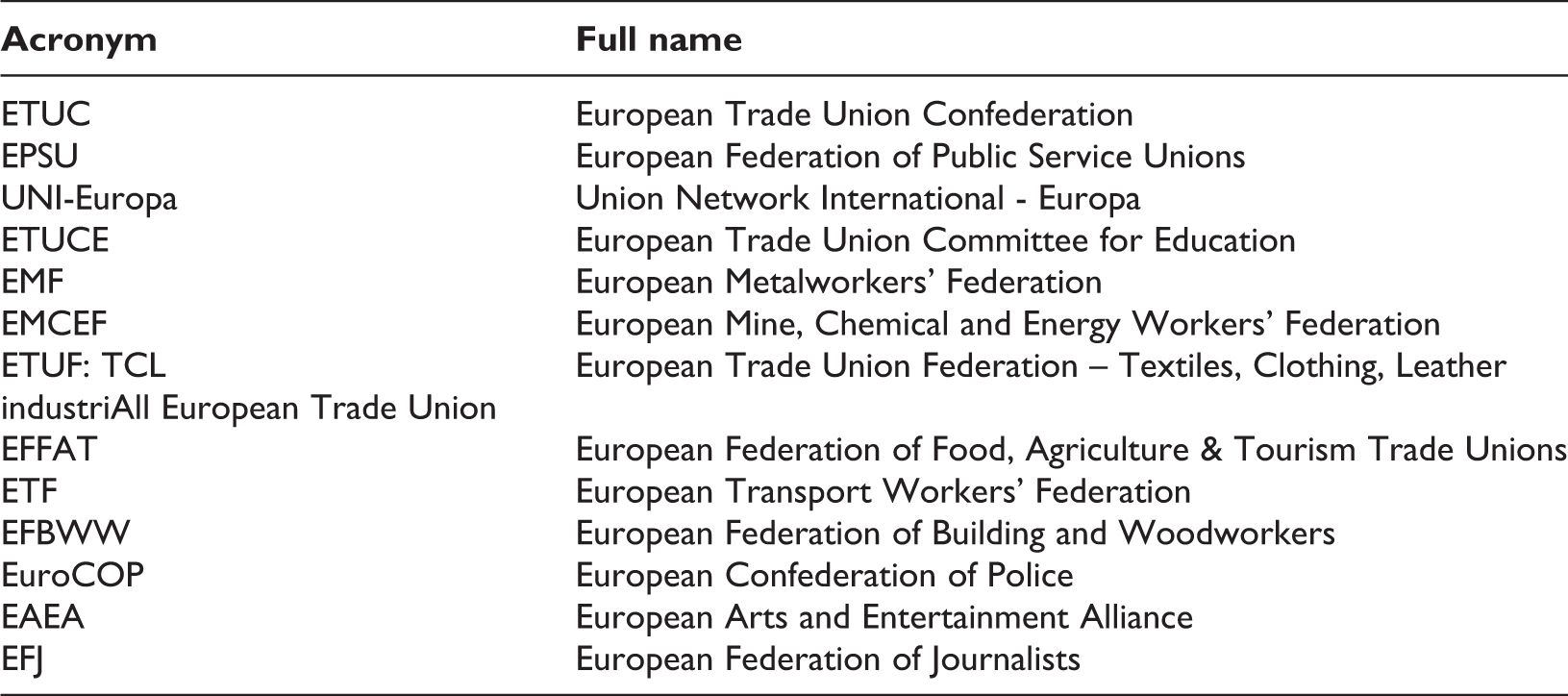
Organisational data on European trade union federations (2008 and 2018).
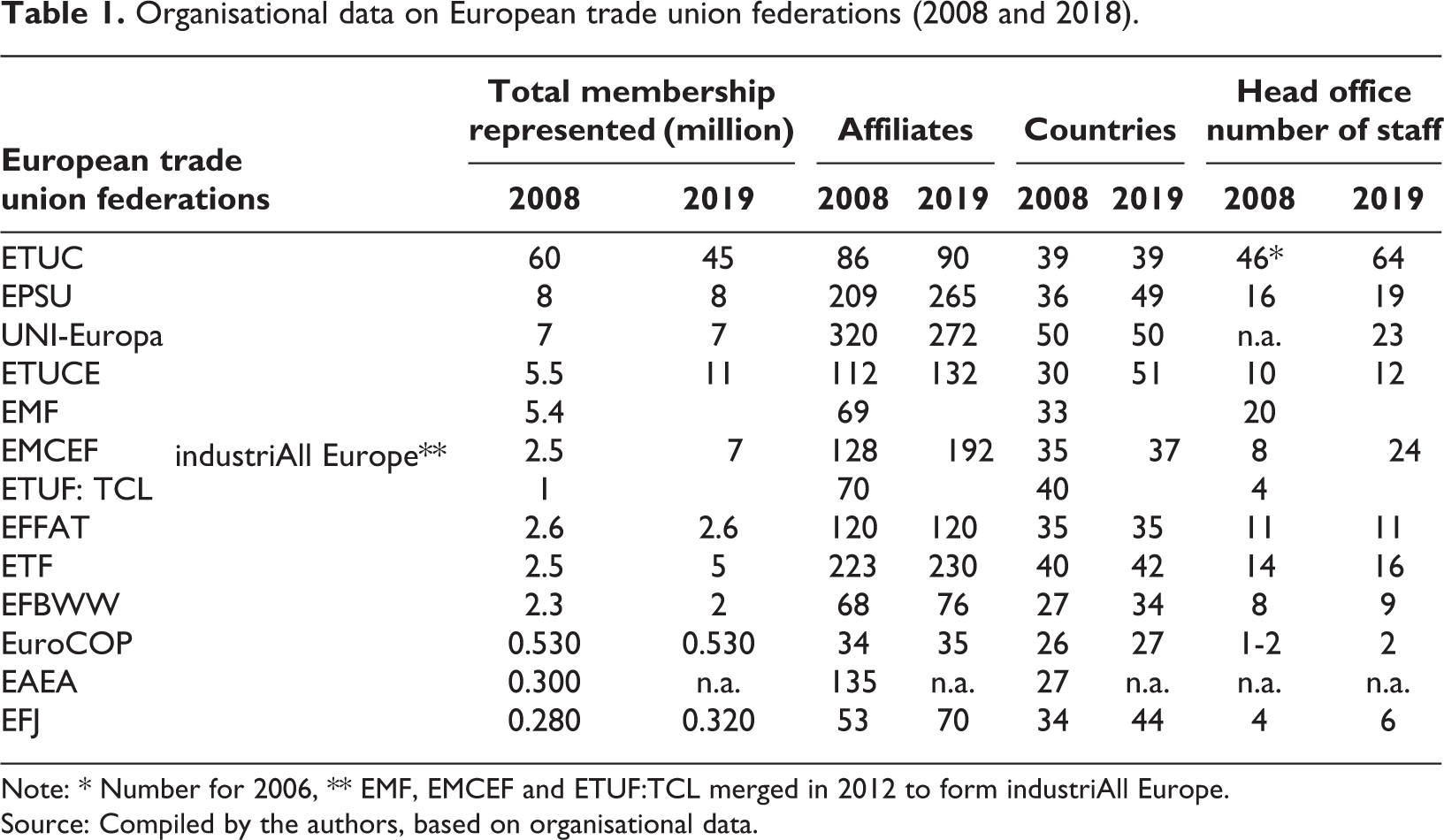
Note: * Number for 2006, ** EMF, EMCEF and ETUF:TCL merged in 2012 to form industriAll Europe.
Source: Compiled by the authors, based on organisational data.
In order to deal with the internal management of diversity all ETUFs have sub-sectoral or issue-specific coordination bodies to coordinate their affiliates’ activities. However, there are considerable variations between the different ETUFs in the scope and intensity of transnational communication and coordination. These differences can be attributed to a number of factors. They can be due to differences in the personnel resources and their capacity to ensure institutional continuity because it takes time to establish functioning transnational operational structures based on mutual trust. Differences can also be attributable to the specific demands posed by an ETUF’s ‘logic of influence’ – that is, the need for transnationally coordinated strategies in relation to the EU’s regulatory activities, which vary from sector to sector.
Different membership expectations and support
It is not only the sheer quantitative increase in the number of affiliates and countries represented by the ETUFs that affected their capacity to aggregate and articulate interests. Even more important is whether the affiliates want to be coordinated and the importance they attach to the European level – and the role of the ETUFs more specifically – in pursuing their interests within the multi-level European polity. Comparative studies illustrate that depending on their situation in the national context the views of national trade unions differ considerably (Bengtsson and Vulkan, 2018; Larsson, 2015). In a nutshell, there are two extreme positions. At one end of the continuum are the Nordic unions which are firmly embedded in the national system of corporatist cooperation based on a strong position vis-à-vis the state and employers. Because of their excellent access to national actors and the decision-making process their engagement with the European level tends to be more defensive, guided by the objective of preventing European interventions in their national model of industrial relations (Larsson, 2015: 102). Because they furthermore have enough resources to run their own offices in Brussels they are less dependent on the ETUFs to represent their interests at European level. At the other end of the continuum are the trade unions from the CEE countries for which essentially the opposite applies. Union density and collective bargaining coverage is low and there is no well-established corporatist system of political exchange which unions could use to influence policies. The tripartite structures that exist have been described as ‘PR corporatism’ in which union participation in tripartite structures is used to legitimise government policies (Bernaciak, 2013). Against this background, the European level plays a much more important role for unions in CEE countries than for their Nordic counterparts – and the ETUFs are viewed by CEE unions as an important actor to influence EU policies with the aim of strengthening their position at national level.
According to Adamczyk (2018), who as a representative of the Polish trade union NSZZ Solidarność is a longstanding member of ETUC committees, these differences represent two different worlds of western and eastern European unions within the European trade union family which manifest themselves in diametrically opposed expectations of what should be achieved at European level. Whereas for western European unions the European level serves primarily to safeguard existing standards and to ‘counteract attempts to infringe the status quo in relation to national social gains’ (Adamczyk, 2018: 189), for trade unions from CEE countries the European level becomes more and more important ‘as a platform for seeking new ways of effective representation of employee interests’ (Adamczyk, 2018: 182). In other words, for western European unions the European level – including the ETUFs – tends to serve more defensive objectives while for unions from CEE countries it primarily serves more offensive objectives. Thus, as regards the logic of membership, the big challenge for the ETUFs consists in managing this diversity of objectives and in finding compromises that help to strengthen the weaker affiliates without weakening the stronger ones.
However, the challenge consists not only in bridging these ‘objective’ differences of interests which are based in the affiliates’ different position in the national context. Adamczyk’s insider account of the two worlds of unions within the ETUC also illustrates an increasing alienation between the two worlds which manifests itself in a perceived lack of understanding of each other’s situation. The unions from the CEE countries are increasingly frustrated with the defensive approach of the western European unions and with what they perceive as attempts of the western European unions to simply transfer the logic and structures of their industrial relations systems to the CEE countries without acknowledging the fundamentally different framework conditions. All this results in a feeling of being ‘treated paternalistically and instrumentally’ (Adamczyk, 2018: 188). At the same time, Adamczyk (2018: 188) notes a ‘noticeable “fatigue” among western European trade unions’ with the lack of progress in establishing effective bargaining and employee representation structures in the CEE countries. According to Adamczyk (2018: 188), ‘the two “union worlds” are still very far apart. Only a common European goal could bring them closer together or perhaps a common threat’.
The preconditions to define a common European goal are more favourable for ETUFs operating in sectors in which the European Commission has the competence to propose European initiatives such as in the fields of agriculture and industrial policy – which can serve as a common target for joint and coordinated activities. This aspect will be dealt with in more detail below. However, the crisis of 10 years ago can be seen as the ultimate test whether a ‘common threat’ facilitates the aggregation of interests as a basis for joint transnational union action under the umbrella of the ETUFs. The results of this test are, however, not very encouraging. Despite a short-lived increase in ‘European’ mobilisation through European Action Days and demonstrations called for by the ETUC between 2009 and 2012 (Hofmann, 2015: 219), the national unions primarily responded with a renationalisation of their policies and activities (Müller and Platzer, 2017). In countries with a tradition of corporatism or social partnership such as the Nordic countries, Germany and Austria the dominant approach was to engage in a ‘crisis corporatism’ as a temporary alliance with the state and employers in order to fend off the worst effects of the crisis (Urban, 2015: 278). In the southern European countries that were hardest hit by the crisis, as well as a number of CEE countries, such ‘crisis corporatism’ was no option because the impact of the crisis has been so great that established mechanisms for institutional exchange have been weakened, broken down completely or did not exist in the first place. In some countries, in particular in southern Europe, with a more conflictual tradition of industrial relations, attempts to engage in corporatist arrangements were supplemented by political strikes and demonstrations in order ‘to limit (or stop) […] anti-labour policies and austerity plans, and enhance their capacity to participate in longer-term negotiations’ (Campos Lima and Martín Artiles, 2011: 399). However, regardless of the country-specific mix of conflictual and cooperative forms of action chosen by national trade unions, the crucial point with respect to the ETUFs’ logic of membership is that the key focus of their policies and activities was almost exclusively on the national level. As a consequence, their willingness to engage in activities at European level and to support the role of the ETUFs both internally in coordinating the crisis responses and externally in influencing policies at European level was only limited.
Logic of influence: ETUFs and the European polity
The ETUFs’ capacity to influence decisions and policies at European level is determined by two key factors: opportunity structures which give them access to institutions and policy arenas and their power position within these processes of political exchange. The latter heavily depends on how successful they are in aggregating the interests of their affiliates and in mobilising support – both internally from their affiliates as well as externally from the broader public. This aspect has been covered above in the section on the ETUFs’ logic of membership. The following analysis of their logic of influence will focus on recent developments in three important dimensions of opportunity structures: institutional innovations in the EU governance architecture, developments in the (cross-)sectoral social dialogue as one of the key policy arenas of ETUFs, and legislative developments in key policy areas such as industrial and social policy.
Institutional innovations
The most far-reaching institutional innovation with a potential impact on the ETUFs’ logic of influence was the establishment of the new system of economic governance and in particular the introduction of the so-called ‘European Semester’, the annual cycle of European economic and fiscal policy coordination leading to the formulation of so-called ‘country-specific recommendations’ (CSRs) for the Member States. In principle, the shift of decision-making powers from the national to the European level in the context of the new European governance architecture should have created more favourable framework conditions for the ETUFs’ capacity to influence European policies. In particular, the staged European Semester process should have offered the trade unions various access points to influence the formulation of the CSRs – both at European and national level. These stages include: first, the formulation of the Annual Growth Survey, which sets out the broad economic guidelines, and the various concomitant documents 2 , which altogether constitute the so-called ‘Autumn package’ that kicks off the Semester process. Second, based on the analyses in the ‘Autumn package’ the Commission formulates Country Reports which for each country identify critical areas for reform. Third, based on the need for reforms set out in the Country Reports the national governments formulate a National Reform Plan which defines specific national policies intended to comply with EU policy recommendations and the EU fiscal rules. Fourth, these National Reform Plans feed into the formulation of CSRs which is the final step of the Semester process.
From the outset, however, the ETUFs’ closer involvement was hampered by the fundamental democratic deficit of the new economic governance architecture. Many of the new instruments have been set up on the basis of intergovernmental treaties such as the ESM Treaty or the Fiscal Compact. This, however, means that all the relevant decisions ‘bypass the usual legislative procedure’ (von Ondarza, 2013: 28) and are thus not subject to the usual co-decision and consultative procedures involving the European Parliament and the two sides of industry. In order to rectify this shortcoming, the heads of the European institutions started an initiative to improve the ‘democratic accountability’ of the European Economic and Monetary Union – which they outlined in the so-called Five Presidents’ Report (Juncker et al., 2015). This plan also involves integrating intergovernmental solutions into the EU legal framework – thereby improving the possibilities of the two sides of industry to influence decision-making processes. In a similar vein, an initiative to revive the European social dialogue was launched in March 2015, aimed in particular at closer involvement of the two sides of industry in the new system of economic governance more generally and the European Semester more specifically (European Commission, 2016).
As a consequence, the European Commission stepped up its efforts to improve the formal involvement of the two sides of industry in the various stages of the Semester process. For the trade unions this means that at European level, the ETUC managed to establish a formal dialogue with the European Commission’s DG Employment, Social Affairs and Inclusion which involves regular consultations in advance of the drafting of the Annual Growth Survey and the Country Reports (Bongelli, 2018: 269). At national level, this means intensified efforts by the European Commission to involve more strongly national trade unions in the formulation of the National Reform Plans. In order to coordinate the trade union input into the Semester process, the ETUC established a so-called ‘Trade union semester liaison officers’ Committee’ bringing together those representatives of its affiliates who are responsible for the Semester process within their union. The aim of this structure is to ensure a regular exchange of information, to determine the common position and priorities of the ETUC to be addressed in the Semester process and to ensure the involvement of national union officers in the regular dialogue with the European Commission (Bongelli, 2018: 269).
Formal involvement, however, does not automatically mean influence. The real test of the ETUFs’ capacity to influence developments at European level is whether their stronger formal involvement in the European Semester actually led to substantial changes in the measures proposed in the CSRs. Even though, overall, there may have been a ‘socializing of the European Semester’ in terms of increasing emphasis on social objectives (Zeitlin and Vanhercke, 2018), in the trade unions’ core area of wages and collective bargaining the result is fairly sobering. Despite the change in the Commission’s narrative and despite a clear commitment in the European Pillar of Social Rights (EPSR) to decent minimum wages and to encourage collective bargaining, the main aim of the CSRs 3 in the field of wages and collective bargaining is still ensuring and improving cost competitiveness. To be fair, countries like Germany and the Netherlands recently received CSRs asking them to create the conditions for higher wage growth. By the same token Austria, Czechia, Estonia and Germany were asked to take measures to reduce the gender pay gap. As regards central union demands such as more dynamic minimum wage increases and the strengthening, restoration or development of multi-employer collective bargaining, however, the CSRs are entirely silent (Müller et al., 2019: 58). This in turn illustrates that increased formal involvement in decision-making processes should not be equated with actual influence.
Emergence of new policy arenas
From a logic of influence, the Social Dialogue is a very important political arena because it provides the institutional structure for a process of ‘negotiated self-regulation’ by ETUFs and European employers’ organisations. By undertaking autonomous negotiations at European level, they can directly intervene in social and labour law proposals and conclude agreements which by means of a Council decision become EU legislation. Between 1996 and 2012 seven framework agreements were concluded by the ETUC at cross-sectoral level and another 15 agreements by the sectoral ETUFs in the context of the Sectoral Social Dialogue Committees (Degryse, 2015). Since then the process of negotiated self-regulation through Social Dialogue has largely come to a standstill. In contrast to the late 1990s and 2000s when the European Commission’s legislative proposals actively supported Social Dialogue by triggering processes of ‘bargaining in the shadow of the law’, the Commission’s more recent behaviour undermines the regulatory capacity of Social Dialogue. Since 2012, the European Commission has twice refused to transpose via a directive a framework agreement concluded at sectoral level. This happened in April 2012 to the agreement on the protection of occupational health and safety signed in the hairdressing sector and in March 2018 to the framework agreement on information and consultation rights of workers and civil servants in central government administration signed in December 2015. The Commission’s refusal to transpose the agreement in central government administration was confirmed by the EU General Court in its ruling on 24 October 2019. According to Jan Willem Goudriaan, General Secretary of EPSU which co-signed the agreement, this ruling endangers the future of the Social Dialogue: ‘What is at stake is the real weight social partners have in the development of EU minimum social standards. The right of autonomy of social partners is put into question. The ruling leaves huge uncertainty over future EU social partner agreements.’ (EPSU, 2019) With its refusal to transpose social dialogue agreements, the European Commission not only undermines the role of ETUFs and European employers’ associations as co-legislators but also contravenes its own commitment to revive the Social Dialogue.
Density of EU legislation
An example of how the density of EU legislation potentially shapes the ETUFs’ logic of influence are the fields of industrial policy and social policy. As regards the former, it was in particular the European Commission’s decision in 2002 to reinvigorate sector-specific industrial policies in order to strengthen the competitiveness of European industry (European Commission, 2002). In this context several sector-specific initiatives 4 were launched which provided favourable preconditions for the institutional involvement of the respective ETUF in sectoral dialogue forums and tripartite committees, which were created to advise these sectoral initiatives. In doing so, these institutionalised sector-specific forums extended the ETUFs’ capacity for exercising influence through dialogue with political decision-makers and the employer side, and to introduce certain subjects into the policy agenda (Platzer and Müller, 2011). Similar effects may be expected from the ‘renewed EU industrial policy initiative’ presented by the European Commission in September 2017 which also includes various sector-specific initiatives, for instance in the steel, space and defence industries (European Commission, 2017b).
Another example is the field of social policy in which after years of stagnation in the context of the primarily neoliberal crisis management, the proclamation of the EPSR (European Commission, 2017c) in November 2017 marks a new opportunity structure for the ETUFs to influence policies at European level. It is the explicit objective of the EPSR to strengthen the social dimension by setting out 20 key principles and rights in three broader policy areas: (1) equal opportunities and access to the labour market; (2) fair working conditions; and (3) social protection and inclusion. Even though the EPSR has been criticised for not being legally binding and for merely summarising the already existing social acquis (Rasnača, 2017) there are also new elements that go beyond the status quo. As regards content, it, for instance, explicitly acknowledges the right of workers to adequate minimum wages.
As regards procedures, a new feature of the EPSR is its close link to implementation and monitoring mechanisms – such as the European Semester with its country-specific recommendations and the European Social Scoreboard (European Commission, 2017d) which will track the performance across the EU countries and which will feed into the European Semester. Since the 20 key principles primarily address the EU Member States and the European institutions, and are intended to serve as a ‘compass’ guiding their future activities in the various policy areas, the EPSR can serve as an important reference point for the trade unions first of all to push certain social policy issues back on the European agenda and secondly to influence the formulation and implementation of policies, for instance in the context of the European Semester. That is the theory. In practice, the impact of the EPSR on the European Semester has so far been limited. The analysis by Hacker (2019) of the extent to which the EPSR and the accompanying Social Scoreboard has been used in the 2018 European Semester reveals two fundamental problems: first, the attempts by the Commission to embed the EPSR in the Semester process have been met with reservations by the Member States and, second, budgetary and competition-related considerations still take priority over social ones (Hacker, 2019: 53).
The two logics in action: the European minimum wage policy
The current debate about a European minimum wage policy illustrates the interdependent relationship between the logic of membership and the logic of influence. The following discussion will focus on the debate within the ETUC at cross-sectoral level, but the dividing lines between the national affiliates and the resulting challenges to come to a compromise at European level have been very much the same within the sectoral European trade union federations. Within the ETUC, the debate about a European minimum wage policy has a long history. Already in 1990, the ETUC adopted a resolution demanding EU legislation to ensure that every worker has the right to a guaranteed minimum wage (ETUC, 1990). Since then, this demand has proven to be one of the most controversial issue among the ETUC affiliates. 5 Like a magnifying glass, the debate within the ETUC about a European minimum wage highlights the different – and very specific – expectations which national affiliates bring to the European level and the corresponding challenge for the ETUC’s logic of membership in developing a shared position. Replicating the different views of Europe more generally, the debate about a European minimum wage policy is dominated by two opposite positions. Whereas a substantial number of trade unions, in particular from CEE countries, are pushing for some kind of EU-level regulation on minimum wages, affiliates mainly from the Nordic countries reject any European approach to the issue of minimum wages (Furåker and Lovén Seldén, 2013; Schulten et al., 2015).
The affiliates from CEE countries are strongly in favour of a European minimum wage policy because it would help to improve their situation at the national level in several ways: first, in many CEE countries, existing minimum wages are too low to effectively protect low-wage workers; a European minimum wage set at 60 per cent of the national median wage, as suggested by the ETUC, would therefore amount to a substantial increase in all CEE countries and help to achieve the overall objective of upward wage convergence across Europe. Second, in most CEE countries, trade unions are confronted by a highly fragmented and decentralised system of collective bargaining marked by extremely low collective bargaining coverage and union density; a European minimum wage would therefore strengthen their bargaining position – especially if it could be linked with initiatives to support multi-employer bargaining. Third, the political climate in many CEE countries is hostile to trade unions; a European minimum wage policy which defines a minimum level would therefore considerably improve their position in tripartite discussions about minimum wage developments.
By contrast, the resistance of the Nordic affiliates is essentially based on the widespread concern that a European legal instrument on minimum wages would interfere fundamentally with their voluntaristic tradition of industrial relations; it thus threatens to undermine the autonomy of collective bargaining, hamper the normative effect of collective agreements, exert negative pressure on wage levels, and weaken the incentives for organisation among both workers and employers (Lovén Seldén, 2020; Schulten et al., 2015: 349).
The ETUC’s dilemma in a nutshell is this: whereas the affiliates from the CEE countries seek an intervention from the European level, this is exactly what the Nordic trade unions want to avoid. These diametrically opposed interests and expectations of its members clearly leave the ETUC between a rock and a hard place as regards the logic of influence. In the past, the ETUC managed to broker a compromise by including in its resolutions various non-regression and guarantee clauses in order to protect systems with higher standards (ETUC, 2017). This allowed the Nordic unions to agree to resolutions, which in turn enabled the ETUC to speak with one voice vis-à-vis European policy-makers.
The recent Commission initiative to introduce a legal instrument on minimum wages was in various respects a watershed moment. In terms of a logic of influence, the initiative changed the rules of the game by bringing the Council of Ministers into play with a much more active role. Until now, national governments have only needed to consider the possibility of a European-level regulation on minimum wages at an abstract level at most; the formal regulatory initiative means that they will now need to engage more concretely with its potential implications for their respective national systems. Discussions within the Council and its advisory Employment Committee (EMCO) will clearly need to be more concrete. For the trade unions, in turn, this means that within the multi-level EU polity it will be all the more important to ensure consistency in their positions when engaging with the European Commission and the European Parliament at European level on the one hand, and simultaneously with their governments at national level on the other. This coherence is crucial, because even if the unions can successfully convince the European Commission to include many of their demands in its legislative proposal, and can gain the support of the European Parliament, they cannot be sure that these will survive in the legislative proposal emerging from possible trilogue discussions – the process of interinstitutional negotiations on EU legislation between the Commission, the Parliament and the Council.
In terms of a logic of membership, the announcement puts to the test the historic compromise reached between the ETUC affiliates because it dramatically increased the stakes for the affiliates. The debate is no longer about defining a position in favour of a European minimum wage policy more generally; now it must be about how to shape a concrete legislative initiative which carries potentially far-ranging implications at the national level. This makes the task of the ETUC but also of the sectoral European federations of developing a robust common position even more difficult because it sheds a harsh light on the fundamentally different positions of its affiliates. Moreover, the initiative to establish a legal instrument puts new, more technical issues into the centre of the debate: should this legal instrument be a Directive or a Recommendation? Should it define a specific level or should it merely define common procedures for setting minimum wages at the national level? Affiliates from the CEE countries would prefer a Directive that defines an obligatory minimum wage standard, because they fear that a non-binding recommendation would too easily be disregarded by their governments and would therefore have no effect in their countries at all. For affiliates from countries with a long tradition of autonomous bargaining and negotiated minimum wages, however, an obligatory European minimum wage standard would amount to an unacceptable interference in their collective bargaining systems.
The ETUC will best be able to exert influence on the policy debate if it can demonstrate a clear position. Hence, the ETUC’s capacity to act vis-à-vis European policy-makers depends on its capacity to find answers to these questions which all affiliates can at least live with, if not support whole-heartedly. At the same time, however, the prospects of the ETUC proving able to successfully influence European policy-makers in turn determines its affiliates’ willingness to agree to a compromise solution in the first place. To put it bluntly: those affiliates which in principle oppose a European minimum wage will only agree to an ETUC compromise if they can be certain that any safeguards laid out in the ETUC position will indeed be included in the final legislative proposal. This demonstrates the interdependent relationship between the two logics of action.
At the time of writing in May 2020, both the internal ETUC discussions about a common position as well as the discussions with policy-makers are still ongoing and the result of both processes is still entirely open.
Conclusion
The analysis of the ETUFs’ two constitutive logics of action demonstrates that the simultaneous extension and deepening of EU integration created more difficult conditions in both dimensions. In particular, the accession of new Member States and the creation of the European Monetary Union simultaneously increased the demands on the ETUFs’ management of diversity and management of interdependence. In terms of the logic of influence, the analysis illustrates that neither the political declaration to place more emphasis on the ‘social dimension’ nor the improved formal involvement of ETUFs in the decision-making process within the European multi-level polity translated into a substantial change of policies. This applies to all three political and institutional framework conditions that have been identified as influencing the ETUFs’ logic of influence: the new system of economic governance – and in particular the European Semester – as the principal institutional innovation; the Social Dialogue as one of the ETUFs’ main policy arenas; and the EPSR as the most important innovation in the field of social policy.
This is not to disregard the importance of ‘labour diplomacy’ by lobbying European policy-makers for alternative policies. One condition for the success of engaging in processes of political exchange within the European polity, however, is the simultaneous development of the ETUFs’ capacity to mobilise their affiliates and the wider public for alternative policies and a counternarrative that supports the trade union strategies. In order to increase the political pressure on European and national policy-makers trade unions also need to be open to forging political alliances with other civil society organisations. Even though, as Erne (2015) has shown, the competitive logic of the new economic governance system, by acting through coercive comparisons that put Member States in competition with one another, negatively affected the ETUFs’ mobilising capacity, there are still some encouraging examples to build on. These include European campaigns, successfully tested in the conflicts over the ‘Bolkestein Directive’ and the legislative proposals ‘Port Package I and II’, where unions were able to thwart further liberalisation that would have damaged employee protection. It also includes using the new means of the European Citizens’ Initiative, as seen in EPSU’s successful campaign ‘right2water’ and the ETF’s (failed) ‘fair transport’ initiative against social dumping in the transport sector (Erne and Blaser, 2018).
It is too early to assess the implications of the current COVID-19 crisis on the ETUFs’ capacity to promote transnational trade union activity, but in the light of the unprecedented scale of the economic and political challenges which will most likely even transcend the ones of the 2008/2009 crisis, far-reaching implications can be expected for both logics of action. Against this background, two central messages emerge from the analysis: first, in terms of a logic of membership national trade unions need to overcome their tendency to retreat to the national level to cope with perceived transnational challenges – even if this seems to be advantageous in the short run. In the long run, they need to grant a higher priority to ‘Europe’ and all that this implies in terms of specific activities, in terms of strategies, and in terms of the allocation of staff and material resources. In the end, the ETUFs’ logic of influence essentially depends on the willingness of their national affiliates actively to support a joint European strategy. Second, in terms of a logic of influence the key to the ETUFs’ capacity to push through alternative policies is to recognise that ‘labour diplomacy’ and mobilisation are not alternatives but complementary tools of a broader toolbox which the ETUFs and their affiliates can draw upon depending on the issue at stake.
Footnotes
Funding
This research received no specific grant from any funding agency in the public, commercial or not-for-profit sectors.