




Abstract
This article questions the disruptive nature of the current process of digitalisation from a retrospective point of view. Four aspects of this process are considered: digitised information as a strategic economic resource; the nature and pace of industrial revolutions; the contested nature of the link between technology and employment; and the shift from flexible work practices towards virtual work. The article reviews some salient research findings from the past three decades and confronts them with recent publications concerning the future of work in the digital economy. It argues that the current wave of digitalisation combines, on the one hand, continuing trends in the analysis of the information society or knowledge-based society, and, on the other hand, significant breakthroughs the scope and impacts of which must be carefully assessed, avoiding any return to technological determinism.
‘Disruptive’ is a much-used buzzword in a lot of discourses and publications concerning the new digital technologies, the increasing digitalisation of the economy and its estimated impacts on work and employment. These changes are often considered to be radically new. The basic assumption of this article is that current changes are rooted in a set of technological, economic and social trends that emerged during the two last decades of the 20th century, within which some recent and significant breakthroughs are, however, gaining increasing importance.
This article analyses the mix of disruption and continuity that characterises the current ‘digital turn’, looking for what is really new. It starts with the concept of information society and questions the emergence of ‘Big Data’ in the current developments of the knowledge-based economy. In a second step, it positions the current wave of digitalisation in the perspective of long waves of economic evolution and changes in techno-economic paradigms. Based on this, the third section addresses the renewal of studies of the relationships between technology and employment, within this long-term perspective. This analysis highlights that the employment issue might be mainly an issue of work organisation and work content. The fourth section considers the evolution from flexible work practices towards virtual or digital work. The article is written as a critical overview of past and current research, relying on long research experience in the area of innovation, work and society. The key argument is not only to sort the old from the new, but to understand what distinguishes the new from the old.
Digitised information as a strategic economic resource
One of the key features of the digital economy concerns the central place of digitised information. Digitally codified information is becoming a strategic resource, while the network is becoming the overarching organising principle of the economy and society as a whole – the information society or network society.
The early literature on the digital economy dates back to a time when the technical possibilities of information coding mainly consisted in computer programming and analogue data transmission. Working separately and with different theoretical backgrounds, Alain Touraine (1969) and Daniel Bell (1973) published two seminal books on the ‘post-industrial society’. They were among the first authors to theorise that the post-industrial world would be dominated by intangible production and consumption, based on information processing and dissemination. Information is defined as ‘the storage, transmission and processing of data as a basis for all economic and social exchanges’ (Bell, 1973) – a definition that nobody would reject today.
Ever since, researchers and international institutions have shown sustained interest in the analysis of the information economy, and its wider impacts on society. At the European level, at the beginning of the 1980s, the first results of the FAST research programme (Forecasting and Assessment in Science and Technology) raised a series of social issues linked to the development of the information society, in three areas: the economic survival of European industries; the impacts of the information society on individuals and social groups; and the variety of transition paths towards the information society (European Commission, 1983). The 1990s saw the appearance of two key policy initiatives: in the USA, Al Gore’s report ‘The national information infrastructure: an agenda for action’ (1993), and in the European Union, the Bangemann report ‘Europe and the global information society’ (1994), which was a decisive driver of the liberalisation and deregulation of telecommunication markets in the European Union. As a kind of counterpart to the neoliberal views of the Bangemann report, a European expert group on the social dimension of the information society (ESDIS), appointed by DG Employment and directed by Luc Soete, issued another report three years later, entitled ‘Building the European information society for us all’. In its introduction, the report defined the information society as ‘the society currently being put into place, where low-cost information and data storage and transmission technologies are in general use. This generalisation of information and data use is being accompanied by organisational, commercial, social and legal innovations that will profoundly change life both in the world of work and in society generally’. Concerning the social dimension, the report starts with the following statement: ‘In the future there could be different models of information society, just as today we have different models of industrialised society. They are likely to differ in the degree to which they avoid social exclusion and create new opportunities for the disadvantaged. In referring to a European information society, we wish to emphasize (…) the importance of the social dimension which characterises the European model. It will also need to be imbued with a strong ethos of solidarity — not an easy goal to achieve, since the traditional structures of the welfare State will have to undergo substantial changes’ (European Commission, 1997: 15). This report also announces a shift from the ‘information society’ to the ‘knowledge-based society’, which will become effective in the terminology used by European institutions after the Lisbon Summit in 2000.
On the academic side, The Rise of the Network Society, by Manuel Castells (1996), is one of the most influential publications of this period. According to Castells, the concept of network appears as a powerful interpretation framework for the increasing complexity of interactions and power relations in the information society. Information and communication technologies are shaping the various forms of network-based organisations, although in a non-deterministic way, opening up opportunities for company strategies and public policies. Knowledge workers or ‘symbolic analysts’ (Reich, 1991) become a leading figure among the workforce. In his preface to the new 2010 edition of the book, Castells (2010) revisits some key trends identified 15 years earlier. Information can now genuinely be seen as an increasingly abundant resource which generates value and profit for players in both the digital and the traditional economy, thanks to phenomena such as user-generated content, geolocation data, open data and the capabilities provided by data mining and analytical software. Moreover, digital technologies have permeated all facets of the economy and society, particularly since the rise in the use of interactive and mobile communication tools which took place during the first decade of the 21st century. The take-up of developments such as social networks, interactive services and mobile Internet has exceeded all expectations, as has the creative potential they have unleashed (Castells, 2010: xvii–xliv). Other authors are however more balanced, or even sceptical, as regards the central role of networks in economic structures, the weight of intangibles in global trade and the predominant role of knowledge workers (Fleissner, 2009; Garnham, 2000; Gadrey, 2000; George and Granjon, 2008; Mansell, 2009).
What is thus really new about the current wave of digitalisation? The answer mainly rests on two words: ‘Big Data’. According to several authors (Brynjolfsson and McAfee, 2015; Cardon, 2015; Escande and Cassini, 2015), we are now confronted with both a quantitative leap and an exponential growth in the collection, storage, and processing of digitised information.
The huge growth in data collection comes from a wide variety of sources: geolocation of computers, smartphones and connected objects; mobile apps; cookies in Internet browsers and search engines; user-generated contents (encoding, rating, sharing); digitalisation of the cultural and institutional heritage of texts, music and images; and obviously the continuous increase in global production and commercialisation of intangible goods and services. The growing volume of digital information benefits from the development of cloud technologies, which started to gain momentum in the mid-2000s: cloud storage (large-scale storage of data in virtual locations) and cloud computing (parallel use of remote hardware infrastructures interconnected by high-speed Internet) make the access and use of digitised information ever more independent of geographical constraints. Developments in data collection and storage are boosting the performance of data mining and modelling software. Algorithms are becoming increasingly powerful, allowing the extraction of economic value from vast volumes of digitised data in activities such as consumer profiling, behaviour modelling, movement tracking, interaction mapping, diagnosing machine breakdowns or human illness. In certain circumstances, the predictive power of computer algorithms combined with Big Data goes beyond our current human understanding (Cardon, 2015). Powerful calculation algorithms and massive data exploitation are also allowing the development of a new generation of robots. The evolution of translation software provides a typical example of the transformations induced by Big Data. Traditionally, such software tools intended to model the linguistic rules and reasoning used by translators. Algorithms are now changing that. Instead of modelling human knowledge, they search for existing translations of similar words or sentences in a giant corpus of digitised texts in a wide variety of languages (coming among others from international institutions), processing gigabytes of online data in a few micro-seconds. This example highlights a future trend in artificial intelligence: not so much modelling human reasoning, but inventing ‘machine learning’ (Autor, 2015; Brynjolfsson and McAfee, 2015).
To sum up, although the role of digitised information as a strategic economic resource appears as a continuation of trends stretching back several decades, the most recent developments in massive data collection, storage and processing, as well as in the performance of algorithms, represent a quantitative and qualitative leap in this trend (Valenduc and Vendramin, 2016).
Meaning and pace of industrial revolutions
At this point, the question ‘Is this time really different?’ is not yet answered. It needs a longer historical perspective. In many writings, the current wave of digitalisation is considered as a third or fourth industrial revolution, or a second machine age. Difficulties in numbering reveal blurred theoretical references, which can be enlightened by the conceptual framework developed by ‘neo-Schumpeterian’ or evolutionary economists 1 (Freeman and Soete, 1990; Rosenberg, 1994; Perez, 2004).
In his book, Business Cycles, published in 1939, Joseph Schumpeter borrowed from Kondratiev the principle of long cycles (or long waves) of economic development, studying the roles of innovation and entrepreneurship in the transition from one cycle to the next – the so-called industrial revolutions. He formulated the hypothesis that transition phases were characterised by ‘innovation clusters’, grouping radical and incremental innovations and giving rise to new technological systems. Transition phases also require new business models and adapted institutional frameworks, including both destructive and creative changes. Many authors unfortunately reduce Schumpeter’s theory to the sole concept of ‘creative destruction’, neglecting his analysis of innovation clusters and his contribution to the understanding of the dynamics of long waves.
Following Schumpeter’s intuition and also referring to Thomas Kuhn’s structuralist approach to scientific revolutions, more consistent theories of technological revolutions and techno-economic paradigms were developed by scholars in evolutionary economics. According to them, the long-term evolution of the economy involves a succession of different techno-economic paradigms, each lasting 45 to 50 years, separated by ‘revolutions’ or ‘great surges’ (Perez, 2010). A techno-economic paradigm is a coherent set of new technological systems, structural changes in the organisation of the global economy, and a new institutional and social context. While the preceding paradigm is progressively exhausting, the irruption of the upcoming paradigm is characterised by the clustering of innovations in new technological systems, restructuring processes in industries (declining and emerging industries) and entailing changes in the distribution of employment, and a need for institutional changes in the regulation of the economy and the labour market.
Figure 1, borrowed from Carlota Perez, illustrates the successive development steps of a techno-economic paradigm. In her recent works, Perez uses this scheme to propose an interesting interpretation of the current ‘technological surge’ (Perez, 2010, 2015). The installation period started in the early 1980s with a ‘big bang’ of convergent innovations in computers and telecommunication networks (micro-processors, micro-computers, digital data transmission, cellular telephony); it raised a lot of controversial questions about industrial policies, employment policies and the information society in the late 1980s and the 1990s, as mentioned in the first section of this article. The phase of frenzy is identified by Perez as an ‘Internet-mania’ at the turn of the century, raising issues like the digital divide, the dotcom bubble, the fashion for the ‘e-’ prefix, etc. After frenzy comes a turning point: financial bubbles and financial crisis (2008), i.e. typical features of the critical break between the installation period and the deployment period of a techno-economic paradigm (Perez, 2013). The crashes occurring at this turning point result in an ‘institutional recomposition’, generating tensions and conflicts among players and stakeholders in the economy and society. Within this scheme, we are now in the ‘golden age’ of this paradigm. The major transformations do not result from a particular set of convergent technologies. They come from all industries and services innovating in convergent directions, and creating a wide variety of paths for wealth creation and wealth distribution. The term ‘digitalisation’ is not the irruption of a new revolution, but the pervasive synergy of digital innovations in the whole economy and society (Perez, 2015).
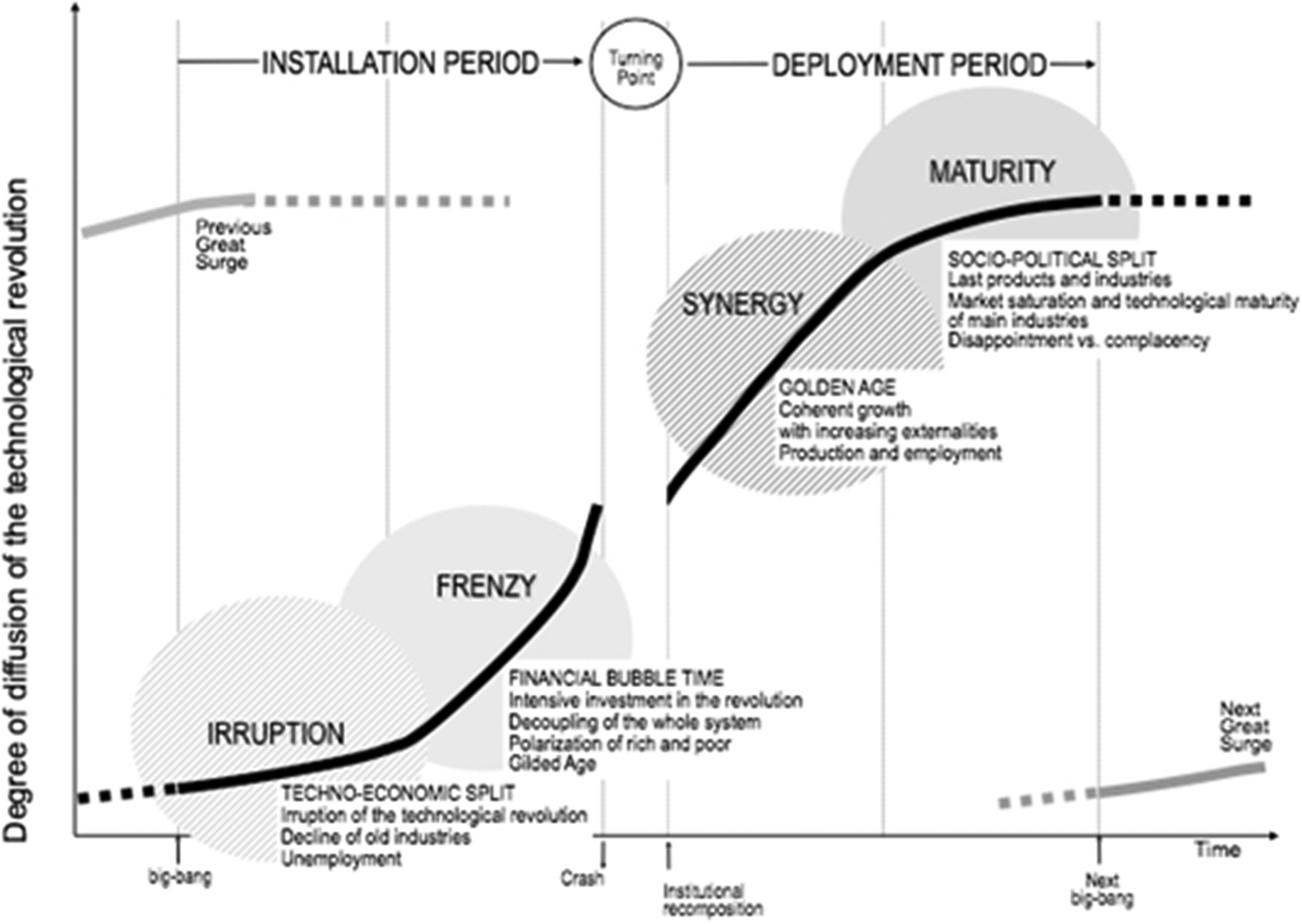
Recurring phases of each great surge.
Looking backwards to the joint evolution of the economy and technology, the current wave of digitalisation belongs to the fifth ‘great surge’, leading to the installation and maturity of the fifth techno-economic paradigm. The fourth techno-economic paradigm was the age of mass production and consumption (the Fordist model), based on energy technologies (oil and petro-chemistry), the automation of manufacturing, electro-domestic products, and transport and communication networks (about 1930–1980). The third techno-economic paradigm was the age of electrical, mechanical and metallurgical engineering (1875–1930); the second one, the age of steam engines and railway expansion (1830–1875), and the first one, the age of mechanised textile industry, water power and waterways (1770–1830) (Perez, 2010).
According to this theoretical framework, the current period is thus not the beginning of a new industrial revolution, but the full development of the techno-economic paradigm of the information society, after a first phase of irruption and a second phase of Internet frenzy followed by the turning point of the 2008 crisis. However, their model suggests that the ‘big bangs’ of the next paradigm begin to germinate during the maturity of the current one – and therefore we will see them emerging from the laboratories in the coming years.
The controversial relationship between technology and employment
The conceptual framework of techno-economic paradigms can shed light on the relationship between technology and employment. Some authors suggest that this question appears particularly acute either at the beginning of the installation period of a new paradigm, or at the beginning of its deployment period (Freeman and Soete, 1993; Rochet, 2015). Indeed, influential research findings were published during the 1980s and the early 1990s, and more recently over the last couple of years.
The early 1980s – a time when rising unemployment following the oil crises of 1973 and 1974 coincided with the appearance of personal computers and the integration of micro-processors into automated industrial facilities – marked a first period of intense research into the effects of computerisation on jobs (Pastré, 1983), moving away from the classical macro-economic assumption that technological innovation increases both productivity (that reduces employment) and growth (that increases employment), and that the final effect on employment depends on the relative balance between productivity and growth (Parienty and Combemale, 1997). At that time, most scholars also referred to Alfred Sauvy’s spillover theory (Sauvy, 1980), which explains that successive industrial revolutions were characterised by a massive shift of jobs from the primary sector (agriculture) to the secondary sector (manufacturing) and further to the tertiary sector (services) – including open questions about the next spillover towards a hypothetic quaternary sector (Réal, 1990).
In 1981, a group of young French economists and labour sociologists, linked to the regulation school (Missika et al., 1981), broke away from this traditional approach. They instead took an innovative meso-economic (i.e. midway between macro-economic and micro-economic) approach to the relationship between technology and jobs, focusing on industrial ‘filières’ (value chains), economic branches and regional systems of innovation. The authors identified eight overarching categories of new computer technologies and investigated whether and to what extent each sector would be affected, which skills would be at risk or in demand and what the foreseeable impact would be on jobs in France. They came to the conclusion that the direct impact on employment would be negative overall, and that positive outcomes would only result from indirect effects such as the emergence of new economic activities linked to these new technologies. With the benefit of hindsight, it is possible to say that Missika et al. (1981) were for the most part right – albeit overly pessimistic – with regard to industrial sectors, but largely mistaken in respect of market and non-market services. The main criticism which can be levelled at the evaluation model developed by the authors stems from their belief in a causal link between the potential of technologies and their effect on skills and jobs, although mediated by work organisation patterns.
Nevertheless, the relevance of a meso-economic approach to technological change has been endorsed in many later studies. In this respect, a research review by the OECD (Brainard and Fullgrabe, 1986) suggests that most significant impacts relate to changes in employment structure rather than job numbers. Computerisation creates jobs in certain sectors and professions while eliminating them from others, but these effects are not distributed uniformly between regions or countries. Its repercussions are likely to be positive for most service-based sectors, where ICT fosters more innovation than rationalisation, but the opposite for industrial sectors, including a transfer of jobs from manufacturing to services. The same OECD research review highlights that many studies overestimate the rate at which new technologies are adopted and their level of productive efficiency, while at the same time underestimating the organisational and social constraints which hinder or mitigate their impacts.
This is well illustrated by the paradox formulated in 1987 by the American economist Robert Solow: ‘You can see the computer age everywhere but in the productivity statistics’. The Solow paradox has aroused controversy within the academic community (Greenan and L’Horty, 2002). Computerisation – as well as today’s adoption of the Internet and the new generation of digital technologies – has an uneven take-up rate, with companies differing considerably depending on their size, geographical location, industrial sector, etc. The true impact of ICT on productivity is revealed only in the long term. The Solow paradox reflects the gap between on the one hand the exponential growth in technological performance and the slower rate at which innovations are adopted and on the other appropriated by companies and other organisations. Productivity gains are a corollary of the organisational changes facilitated by technological innovations rather than the technologies themselves, and will be achieved only by companies which adopt new forms of work organisation at the same time as the new technologies (Askénazy and Gianella, 2000).
These findings were confirmed by a more detailed OECD study carried out 10 years later (Soete et al., 1996). Several publications in evolutionary economics on the employment effects of long waves confirm the predominance of structural changes in employment, linked to the transition towards a new techno-economic paradigm (Freeman and Soete, 1993, 1994). They are still relevant to current research.
Issues relating to the effects of computerisation on employment gradually fell by the wayside during the 1990s in favour of research into the organisational changes accompanying the spread of ICT, with a particular focus on flexibility, changing skills requirements and the intensification of work, and a shift away from quantitative towards qualitative approaches (Vendramin and Valenduc, 2002).
In 2007–2009, a large-scale research project, financed by the European Commission, reviewed the current state of knowledge on the social impacts of ICT (Nett et al., 2010). The report distances itself from previous deterministic approaches in the field of work and employment, instead referring to ICT as a ‘trend amplifier’. It recommends paying particular attention to the development of the Internet of Things and other forms of pervasive computing. Prominence is given to the assertion that ICT investments will yield positive impacts on productivity only if they are accompanied by effective organisational changes, particularly with regard to employee participation, the decentralisation of responsibilities and autonomy at work. The trends identified in the report as being amplified by ICT include in particular the development of virtual work and new forms of employment based on networking and the proliferation of collaborative platforms. Probably because it delivered no spectacular positive or negative predictions, this interesting and nuanced study did not get any significant audience beyond a restricted academic community.
This can certainly not be said about the paper published in 2013 by two Oxford researchers (Frey and Osborne, 2013), forecasting that jobs threatened by digitalisation would represent about 40 per cent of existing jobs. Although based on statistics and job taxonomies from the USA, this paper received a wide audience in the media and in the policy debate in Europe. A number of consultancy firms have replicated these results by applying the same methodology to European classifications and statistics, and the same pessimistic forecasts (30–45 per cent of jobs at risk within the next 15–20 years) have been reproduced for the European Union as a whole and a number of its Member States (Baert and Ledent, 2015; Bowles, 2014; Deloitte, 2014; Deloitte, 2015, Roland-Berger, 2014).
The Oxford paper presumes a direct cause-to-effect relationship between, on the one hand, emerging technological innovations (in particular machine learning and mobile robotics), and, on the other hand, the anticipated productivity gains from using robots as a substitute for human labour. The authors calculate the likelihood of this substitution occurring for particular tasks within a job, and furthermore the probability that the job could be replaced by a machine. The cause-to-effect relationship established at the micro-level (tasks and jobs) is rather similar to the forecasting method of Missika et al. (1981) at the meso-level, but these lessons from the past have been neglected by Frey and Osborne.
Moreover, other task-based foresight studies, using different models, do not lead to such pessimistic results. An alternative version of the Oxford method, recently published by the OECD (Arntz et al., 2016), takes into account a wider variety of tasks within occupational groups, leading to less pessimistic forecasts. Jobs at high risk of substitution by computers and robots only represent an average of 9 per cent in 21 selected OECD countries (including 16 EU countries). The highest figures are to be found in Austria, Germany and Spain (over 11 per cent), the lowest in Estonia, Finland, Belgium and Sweden (under 8 per cent). A detailed comparison between the Oxford and OECD studies goes beyond the scope of this short article, but the discrepancies between both studies are obviously very wide.
Additional critical observations can be formulated regarding this controversy. Most studies trying to forecast the quantitative impact of technology on employment present three main weaknesses (Autor, 2015; Le Ru, 2016; Valenduc and Vendramin, 2016). First, they overestimate the deterministic link between the performance of technology and the substitution of jobs by machines, due to a confusion between tasks, occupations and jobs. Many occupations are a mix of different tasks, and computerisation changes the balance between those tasks, reducing some of them while expanding others; moreover, occupations change over time, even when the employment relationship remains. Secondly, they underestimate the importance of work organisation patterns and human resource management practices. Occupations are not only a set of tasks, but also a position within an organisation, a learning trajectory, a career, a belonging to a working collective, a recognition by managers and by peers; such sociological concerns are often underestimated by economists or engineers. Thirdly, they neglect the societal process of diffusion, adoption and appropriation of innovations, and a long period may exist between the initial uptake of an innovation and its generalisation in the whole economy. The OECD study takes such critical observations into consideration, an aspect lacking in the Oxford paper.
From flexible work practices to virtual work
Nowadays the word ‘disruptive’ is not only used in reference to digital technologies, but also about changes in flexible work forms (Drahokoupil and Fabo, 2016). Yet, these changes are a mix of evolution and disruption. A study carried out for the European Parliament at the end of the 1990s (Gillespie et al., 1999) on ‘technology-induced atypical work forms’ already highlighted the role of ICT as an enabling factor of flexible work patterns. Particular emphasis was put on spatial flexibility and distance working, with a strong focus on telework or ‘e-work’ (Valenduc and Vendramin, 2001). There was strong support from the European Commission for the development of e-work, within the successive e-Europe action plans; telework was also the subject of one of the first framework agreements negotiated between employers’ and workers’ organisations at EU level, in 2002. Among other dimensions of ‘ICT-enabled’ flexible work practices, particular attention was also paid to new forms of subordination links: secondment, detachment, freelancing, subcontracting to self-employed, work status in-between employment and self-employment, on-call work, etc. The meaning of work and the relationship to work were also changing (Méda and Vendramin, 2016).
Digitalisation is amplifying and relabelling these trends, under the umbrella concept of virtual work. According to the COST network ‘Dynamics of virtual work’ 2 , virtual work covers all work forms carried out using digital tools, anywhere and anytime, and new forms of employment relationships are often associated with these new forms of work. Digital technologies have also enabled the creation of entirely new types of digital or virtual labour, both paid and unpaid, shifting the borderline of work and creating new types of unpaid labour connected with the consumption and co-creation of goods and services (Cardon and Casilli, 2016; Huws, 2013). Three patterns of virtual work are considered in this article: digital nomadism, on-call work and crowdworking.
Digital nomadism is characterised by the extensive professional use of computers, smartphones, cloud services, the Internet and email, and by a wide diversity of work locations: home, client premises, external sites, public transport, hotels, co-working spaces, or any other (Eurofound, 2015). It may also become virtual, through remote presence in multiple virtual locations: geographically dispersed virtual teams, computer-based video-conferencing, virtual meetings bringing together avatars of real people, remote monitoring or maintenance, etc. According to Eurofound (2015), digital nomadism mainly affects executives and professionals, and to a lesser extent intermediate professionals (technicians, assistants, supervisors and paramedical occupations). To what extent could digital nomadism be considered as an extension of telework? Most national collective agreements implemented after the European framework agreement on telework in 2002 are factually restricted to telework at home, considering that other forms of distance working, such as remote offices, hired offices, itinerant work or work at client premises, were respectively covered by specific collective agreements. Most national or sectoral collective agreements considered the different forms of distance working separately, while nomadic work organisation patterns combine all of them together. Several authors consider that current legislation or agreements on telework do not cover the full range of working situations of digital nomads (Mettling, 2015; Popma, 2013).
On-call work relies on a continuous employment relationship with an employer, without having a continuous job and without pre-defined working hours and remuneration. According to Eurofound (2015), it covers two main categories of employment contracts: either a ‘zero-hours’ contract, following the well-known UK pattern, or a minimum threshold contract. On-call work is different from intermittent work, for instance in the case of artists or seasonal workers. In intermittent work, the nature of the economic activity is factually not continuous (for instance in artistic jobs), while in on-call work working hours are adjusted to the needs of the employer. What is new nowadays is the combined utilisation of online platforms, geolocation and mobile apps on smartphones to match employers’ requests and workers’ availability (time availability and optimal physical location), and to fine-tune the on-call process. This new pattern of work organisation is named ‘work on demand via apps’ (De Stefano, 2016) or ‘online platforms for on-call work’ (Eurofound, 2015). The development of such online platforms for on-call work is mainly observable in economic activities characterised by a continuous but variable demand: home care, child care, elder care, extra-curricular activities for children, organisation of events of any kind, office support, retail trade, express delivery, truck driving, etc. In many cases, a specific skill or training may be required (care, technical, cultural, sales or office skills, specific professional licences), while in other cases no specific skill is needed. However, according to a recent ILO report, the development of online platforms and apps is progressively shifting the nature of on-call work from specialised work to low-skilled ‘gigs’ (De Stefano, 2016).
Crowdworking refers to work managed by online platforms which allow organisations or individuals to gain access to an undefined and unknown group of other organisations or individuals prepared to solve specific problems or supply specific services or products in exchange for payment (Green et al., 2013). Work is ‘externalised to the crowd’. Three main types of crowdworking platforms are currently operating at the global level (Drahokoupil and Fabo, 2016; Valenduc and Vendramin, 2016). The first type consists of marketplaces for fragmented virtual micro-tasks that can be executed from anywhere with a computer and an Internet connection. Micro-tasks result from a typical process of ‘virtual Taylorism’, separating design from execution and fragmenting the work process in elementary units that can be outsourced to anybody in the global crowd, without any control of skills. Prices are set up by auction. Work is only paid if well done. Workers are rated by the platform, and their rating is displayed when they apply for a task. A typical example is the Amazon Mechanical Turk. The second type involves crowdworking for freelance tasks. Such platforms are only open to freelance professionals, who must be certified by the platform and provide professional credentials. Freelancers announce their daily or hourly rates, and labour demanders select them according to profiles and prices. PeoplePerHour is a typical example. A third type consists of crowdworking for material tasks and services, executable at the local level. Tasks have nothing virtual, mainly consisting of gigs: errands, baby-sitting, watching pets, gardening, home repair, and a wide variety of tasks that generally do not require specific skills. TaskRabbit is an example, and Uber also belongs to this model. All forms of crowdworking platforms disclaim any employer responsibility, leaving responsibility for tax status, social security, insurance, etc. up to the workers. Crowdworkers’ profiles are very diverse: they are more likely to be young, but all ages are concerned; they include slightly more men than women; students are not dramatically over-represented; they live mainly in urban areas; they execute either virtual or material tasks; and most of them derive less than half of their income from crowdworking (Huws and Joyce, 2016).
Several dimensions of the employment relationship are challenged by the trends mentioned in this section. Both digital nomadism and crowdworking are questioning the definition of a workplace – historically a basic concept of labour contracts. Digital nomadism relies on multiple workplaces and moving between workplaces, although being always digitally ‘present’ on the company network; the concept of workplace does not matter for crowdworking platforms. As with the concept of workplace, the concept of working time is also under threat. In on-call work, working time (and consequently income levels) is left to the full discretion of the employer. In crowdworking, time becomes a unit of fragmentation of tasks and this fragmentation process leads to piece rates. In all those work forms, there is an increasing blurring of boundaries between working time and private time (De Stefano, 2016; Degryse, 2016). Moreover, wage formation is at the core of all emerging new forms of work. In on-call work, the variable volume of working hours leads to variable and often unpredictable wage levels, entailing uncertainty about the future, and income precariousness when activity becomes too low. In crowdworking, rates of pay are low or rock-bottom, payments are not guaranteed and workers are systematically put in competition with other workers, even at a worldwide scale in the case of online tasks; piece rates become a general rule, and social protection is disconnected from work (De Stefano, 2016). Consequently, subordination links become increasingly blurred. Emerging forms of work develop a ‘self-employment logic’ among employees, who are put in competition in project teams, internal tendering within companies, individual benchmarking of performance. At the same time, the expansion of freelance work generates new groups of economically dependent self-employed workers, who develop a ‘wage-earning logic’, trying to develop more stable contractual relationships with their core clients (Drahokoupil and Fabo, 2016; Mettling, 2015; Prassl and Risak, 2016). Representation of collective interests is also under threat, and structures of worker representation and social dialogue are mostly absent in the world of on-call work and crowdworking. There are however interesting attempts to reconstruct structures of collective representation. On the one hand, some Western trade unions are setting up new internal structures to affiliate ‘economically dependent self-employed workers’ and to provide them with collective services; on the other hand, crowdworkers are creating platforms to share their experience, rate their employers, and build up online solidarity (Degryse, 2016).
Conclusions
A historical perspective on the issues currently raised by digitalisation helps in understanding the new, based on the old. Regarding the longstanding strategic role of codified information in economy and society, the quantitative and qualitative leaps in the collection and exploitation of Big Data can be considered as the key technological novelty in the coming years. Work organisation will be impacted by the increasing use of algorithmic rationality by managers, engineers and other designers. However, as in the past, any scenario concerning the transformation of work will be shaped by management strategies, power relations and social processes, rather than by the sole performance of technology.
As regards the very nature of the current period, the concept of a techno-economic paradigm provides an interesting perspective on digitalisation, viewing it not as the irruption of a brand new revolution, but as the full and pervasive expansion of a techno-economic paradigm that first appeared 30 years ago with the information society, underwent a phase of ‘e-frenzy’ at the turn of the century, and was followed by a turning point of bubbles and financial crisis. Consequently, the current challenge consists of reshaping institutional frameworks in the regulation of economic activities, policy-making and the labour market, within this expanding paradigm.
As regards the controversial relations between digitalisation and employment, the recent wave of pessimistic forecasts relies on an excessively deterministic approach to the link between technological performance and human/machine substitution. Such approaches have already failed in the past. The relationship between technology and jobs is mediated by work organisation, reconstruction of occupational profiles, skills and learning, human resource management, social dialogue, economic and social processes of diffusion and adoption of innovations. Again, technology is only one of the factors shaping the future of employment.
As regards the shift from ICT-enabled flexibility towards virtual work, particular attention has to be paid to the increasing deconstruction of the employment relationship, which affects a series of new forms of work: digital nomadism, crowdworking, on-call work through online platforms. Although rooted in the diversification of flexible work practices during the late 1990s, this process goes far beyond the traditional analysis of flexibility and the negotiated settings in this area. The future of the employment relationship – and also the meaning of work – might be at the core of the ‘institutional recompositions’ featured in the deployment phase of the current techno-economic paradigm.
Footnotes
Funding
This research received no specific grant from any funding agency in the public, commercial, or not-for-profit sectors.