




Abstract
Taking into consideration the debate on the role of social movements and of trade unions in organising social protests, in the light of contentious and conventional politics, this article examines participation in demonstrations in Europe and the political attitudes of the participants. The article uses data from the European Social Survey to examine the differences and similarities between European countries in respect of mobilisation levels over the past decade, arguing that distrust and dissatisfaction with political institutions might be a necessary condition but not a sufficient one to justify resorting to contentious politics. The article reveals the contrasts between the levels of mobilisation in southern European countries (Portugal and Spain) and Central and Eastern European (CEE) countries (Hungary and Poland) and examines the patterns and (re)configuration of the profile of the protestors in the 2002–2014 period.
Introduction
Over the past decade, social mobilisations in the form of protest demonstrations have taken centre stage in the repertoire of trade union action and of social movements in several European countries. This article examines citizens’ participation in protest demonstrations in Europe in the period 2002–2014, drawing on data from the European Social Survey (ESS). First, it analyses the trends of mobilisation and patterns of political discontent in 16 EU countries, and, secondly, it reviews the differences between southern European (Portugal and Spain) and eastern European countries (Hungary and Poland) with a focus on mobilisation trends and a (re)configuration of the profile of participants. While previous research on citizens’ participation in demonstrations based on ESS data was mostly centred on a synchronic analysis evaluating the role of the socio-economic versus the meta-political motivations of participants and institutional differences between countries (Campos Lima and Martín Artiles, 2013, 2014), this article focuses on both patterns and dynamics of change, evaluating a (re)configuration of the profile of participants in relation to their ideological and political views, political participation and relationship with the trade unions.
In the first section, the article elaborates on the hypothesis and design of the study. It begins by situating the research within the debate on participation in social protest activities in relation to conventional and contentious politics (Kriesi, 2016), and to social movements and trade union repertoires of action, taking into consideration institutional conditions that might contribute to the differentiation between countries (Andretta et al., 2016; Campos Lima and Martín Artiles, 2013, 2014; Della Porta, 2015).
In the second section, the article outlines some developments in the political arena and collective action in southern European (Portugal and Spain) and eastern European countries (Hungary and Poland). This section takes a closer look at contextual parameters that will help provide an understanding of the micro-analysis presented in the third section that focuses on those specific countries.
In the third section, we present the empirical analysis based on ESS data, which comprises three distinct parts: a first part explaining data and methodology; a second part identifying trends in participation in protests in 16 EU countries (2006–2014) and positioning countries based on a cluster analysis (2014) of the participants’ profile in relation to trust in the political institutions and parties and satisfaction with the government and the economy; and a third and final part that examines the pattern and a (re)configuration of the profile of participants in the four countries between 2002 and 2014 with regard to satisfaction with the functioning of democracy, left-right ideological positioning, participation in national elections, closeness to and voting for political parties, and affiliation in trade unions.
Protest demonstrations in times of crisis: conventional and/or contentious politics
In the wake of the 2008 international financial crisis, there was an increase in the number of social protests taking place in Europe and worldwide (Ortiz et al., 2013). Social mobilisations in the form of protest demonstrations where citizens took to the streets occupied centre stage in the repertoire of action of social movements and in the repertoire of trade union action (Andretta et al., 2016; Campos Lima and Martín Artiles, 2013, 2014; Della Porta, 2015; Hamann et al., 2016; Hyman, 2015). Unlike general strikes, in which, by definition, only employees participate, protest demonstrations brought together other groups of participants – including the unemployed, precarious workers and young workers – those less likely to be organised in trade unions. However, in some countries, there was a higher incidence of social protest as a result of both general strikes and demonstrations, as is the case in southern Europe.
Following the 2008 international crisis, the differences between EU countries with regard to their citizens’ political behaviour and their engagement in social protest were certainly influenced by contextual parameters, namely the variable intensity of the crisis and the intensity of austerity and neoliberal policies and their impact on the erosion of existing institutions (Lehndorff et al., 2017), as well as by the more or less authoritarian manner in which these policies were implemented (Rödl and Callsen, 2016; Schulten and Müller, 2013). Political grievances combined in different ways with economic grievances were expressed not only using conventional channels such as the industrial relations institutions and the electoral arena, but also by resorting to contentious politics in organising mass demonstrations and general strikes.
The debate and research on conventional and contentious politics have considered how discontent with conventional politics promoted social movements as a form of contentious politics (Della Porta, 2015), assuming that distrust in political institutions and dissatisfaction with their performance, as well as general dissatisfaction with the functioning of democracy, would contribute, at least to some extent, to increasing citizens’ willingness to engage in social protest (Campos Lima and Martín Artiles, 2013, 2014). A different angle of exploring the relationship between conventional and contentious politics was to investigate how social movements could influence electoral dynamics and power shifts, not only through their influence on the formation of public opinion, but also by expressing grievances also addressed by political parties or by supporting the formation of new political parties. Rather than focus on a segmentation of conventional and contentious politics, an alternative understanding has been developed that suggests that: electoral choices and protest, mobilisation by political parties and social movements are part and parcel of one and the same process of political interest intermediation that continuously links the different forms of interest articulation, in the various channels and arenas of the political system. (Kriesi, 2016: 67)
However, there is a risk of misinterpreting such assumptions, and of portraying social protests (whether organised by social movements or by the trade unions) as ‘outsider’ behaviour marginal to institutions or, ultimately, as undemocratic behaviour, thus underestimating the positive role of social protest in the dynamics of change. There is also a risk of underestimating the significance and relevance of social mobilisations in countries where citizens enjoy active participation in conventional channels and institutions and/or trust the political institutions and are satisfied with democracy. There is perhaps a risk of understanding actors’ choices in exclusive terms, either taking to the streets or investing in collective bargaining, or participating in elections, whereas the full picture might be more complex if we were to consider multiple choices. What if the protest participants resort to taking the streets, engaging in trade union activities and participating in elections? What if the protest participants articulate both conventional and contentious politics? And if so, how widespread is this development, and how do countries differ?
To address the conflict between conventional and contentious politics, we propose to conceptualise the organisation of and participation in protest demonstrations as one form, among others, of expressing ‘voice’, with a specific emphasis on engaging citizens actively and collectively in the exercise of their democratic rights, and with the aim of influencing the public sphere. In its various forms, citizens’/workers’ participation in protest demonstrations is understood as an affirmation of democracy, where the notion of democracy extends beyond that of liberal democracy organised around industrial citizenship and the Habermasian public sphere (Cella, 2008). According to Greskovits (2015: 271), […] organised labour makes its voice heard through various forms of collective bargaining. Alternatively, or combined with deliberation, workers express their grievances by means of protest action, strikes, demonstrations or petitions. Individual workers/citizens may also use their right to vote against unwanted (and for preferred) policies (and express their grievances by means of protest action/strikes).
Over the past decade, particularly following the introduction of austerity policies, significant shifts in the political landscape and the erosion of traditional or ‘mainstream’ political parties have been observed in many European countries (Hutter et al., 2018). The ‘strange survival of neoliberalism’ (Crouch, 2011) and its intensification in Europe in combination with austerity, coupled with the democratic deficit in decision-making, have undoubtedly contributed to these developments (Pochet and Degryse, 2013). Electoral shifts have expressed an increasing discontent and disaffection, not only in relation to the European institutions that have set the pattern of austerity (Freire et al., 2017), but also in relation to national governments committed to austerity. Electoral losses for incumbents engaging in welfare retrenchment were exacerbated by general strikes (Hamann et al., 2016). Demonstrations organised by trade unions or by social movements may also have had a similar effect of blame attribution, not least because they strengthened the impact of the general strikes. Although they may have contributed to the electoral losses of the parties in power, how they influenced the political shifts towards the left or the right is a more complex issue to examine.
However, as the turn to the right or extreme right, and right-wing populism in some European countries was seldom accompanied by mass mobilisations and social protest, it has been suggested that the choice of a channel to voice discontent is a matter of ideological positioning. The explanation could be that the challengers on the right prefer (orderly) conventional political action over (disorderly) protest politics, and that the protests from the right are likely to be found, above all, in the electoral arena (Kriesi, 2016: 71).
Against this background, this article seeks to investigate citizens’ participation in demonstrations in EU countries in the period following the international crisis, based on ESS data, while analysing the trends in the level of mobilisation in the various countries and the profile of participants in protests, taking into consideration their level of trust in the political institutions and satisfaction with the functioning of economy. This analysis will attempt to outline contrasting patterns across countries, not only with regard to the trends in mobilisation but also with regard to the profile of participants (cluster analysis), and will refer to the 16 European countries that were surveyed in all ESS rounds from 2006/2007 to 2014/2015.
In identifying clusters as a point of departure, we will look closely at the positioning of southern European countries and eastern European countries, assuming that the political attitudes of participants in demonstrations in those countries will contrast with western Continental and Nordic European countries in terms of trust in institutions and satisfaction with economy. This assumption is based on the low institutional participation of citizens seen in electoral voting and trade union membership that is characteristic of southern and eastern European countries, contrasting them with the Continental and Nordic countries, the old democracies of the coordinated model of capitalism (Hall and Soskice, 2001).
An expected high level of distrust in political institutions and discontent with the economy among participants in demonstrations in southern and eastern European countries brings us to hypothesise that, while distrust and discontent are a necessary condition for citizens to resort to social protests, they are not a sufficient condition, and we expect to see higher and increasing participation in demonstrations in southern Europe in comparison with that in eastern Europe. To investigate and elaborate further on this question, the next stage in our empirical analysis will focus on the comparison between southern European countries (Portugal and Spain) and eastern European countries (Hungary and Poland) by looking at the level of mobilisations in those countries and at the profile of their protestors. We expect to find polarisation between these two groups of countries, not only regarding the level of participation in demonstrations, but also regarding the profile of the protestors and the trends in the reconfiguration of that profile. In the following section, we will explain in more detail the contextual conditions and processes that justify this hypothesis: the weak tradition in eastern Europe of contentious politics and of repertoires of action, including demonstrations in the public sphere, disconnection between trade unions and politics, and the growing influence of the political right. The late transition to liberal democracy in the context of the hegemony of neoliberalism contrasts the experience of these countries with that in southern Europe, where left-wing and far-left political parties and radical-left trade unions have consistently played an important role.
Discontent and political polarisation in southern and eastern Europe: context and processes
Social mobilisations and discontent
Trade unionism in southern Europe has been prone to social mobilisation (Vandaele, 2016), and this has been seen as a way to exert influence and compensate for the unions’ lack of power in social institutions (Andretta and Della Porta, 2015). However, the massive participation in street protests and the concomitant escalation of general strikes, not only in Greece but also in Spain and Portugal, were unprecedented in the democratic history of the three countries. In the Iberian Peninsula, even the trade union confederations that preferred ‘dancing’ to ‘boxing’ engaged in general strikes (Campos Lima and Martín Artiles, 2014). Therefore, after 2011, contentious trade union politics intensified in southern European countries in response to Troika impositions of welfare retrenchment and cuts in the public sector and dismantling of institutions of employment protection and public sector collective bargaining (Koukiadaki et al., 2016; Marginson, 2014).
In Spain, there was a breakdown in the relationship between the trade unions and those social movements that were openly critical of and hostile to the trade unions, such as the Spanish Indignados (The Indignant Ones) movement. In yet other cases, mobilisations have been carried out by public sector trade unions with some collaboration with social movements, such as the ‘White Tide’ in the health sector and the ‘Green Tide’ in the education sector (Molina and Barranco, 2016). In Portugal, the protests have, on some occasions, involved coordination between the social movements and the trade unions and, at times, joint demonstrations and social movements providing public support for general strikes (Campos Lima and Martín Artiles, 2014). Participation in social movements by young precarious workers was a development that was also associated with the difficulties that trade unions experienced in representing such workers and in understanding the nature of their discontent (Pulignano et al., 2015; Vandaele, 2016). New forms of representation of precarious workers emerged in connection with social movements, such as the movement Precários Inflexiveis (Precarious Inflexible Workers) in Portugal (Campos Lima and Martín Artiles, 2013). In sum, trade unions and social movements in Portugal and Spain, both separately and in conjunction with each other, included in their repertoires of action demonstrations in the public sphere, creating an opportunity for citizens to express their discontent and voice their claims.
In contrast, in Central and Eastern Europe, trade unions had neither the power nor the tradition of exerting pressure through social mobilisation as a means of compensating for their weak and declining institutional power (Bernaciak, 2014, 2017; Greskovits, 2015; Neumann and Tóth, 2017; Varga, 2015). Greskovits (2015: 272) described the trends in the decade after the accession as one of hollowing and backsliding: hollowing refers to workers’ evaporating involvement in the institutions and processes of industrial democracy measured by declining union density or union members’ declining participation in contentious and non-contentious forms of collective action […]. Backsliding refers to a reversal in the direction of development of institutions of collective bargaining and protective labour market regulations.
The wave of new social movements that emerged in 2011 found expression in large social mobilisations that took place in 2013 in Bulgaria, Hungary and Romania, considered to be the most significant mobilisations in post-communist history. Movements in these countries were motivated by different issues but were all equally critical of political corruption and clientelism (Mărgarit, 2015). In Central and Eastern European countries, young precarious workers were also engaged in social movements (Mărgarit, 2015).
Political shifts and discontent
When the international crisis broke in 2008, political parties of the social democratic family were in power in Portugal, Spain, Hungary and Poland. The economic crisis in Hungary preceded the international crisis. The IMF bailout and austerity measures that had already been implemented in 2006 by the liberal socialists plunged the country deeper into recession. In Portugal and Spain, socialist governments introduced the first austerity measures in late 2010. In 2011, Portugal signed Memoranda of Understanding with the Troika – the coalition consisting of the European Commission, the European Central Bank and the International Monetary Fund – while in Spain, the same year saw a bailout of the country’s banks. The first wave of national elections after this initial austerity offensive (2010/2011) brought centre-right and right-wing parties to power in the four countries and substantially reduced the influence of the socialists/social democrats.
In 2015, the second wave of national elections following the full implementation of harsh austerity measures redefined the political landscape in the four countries. Conservative and far-right parties became hegemonic in the two eastern European countries, while the left-wing and far-left parties regained popularity in southern Europe. The fact that the turn to the left or the rise in popularity of the left in national and local elections in southern Europe – Greece, Portugal and Spain – followed the processes of (mostly left-oriented) mass mobilisation and protests suggests that these may have had some influence on the outcome of the 2015/2016 wave of elections. In contrast, it seems that, in eastern European countries, for example in Poland and especially in Hungary, social protests were too ineffective, and the left-wing political challengers were too weak to shift the power to the left (Bernaciak, 2017; Neumann and Tóth, 2017; Varga, 2015). This also implies that the disconnection between social protests and politics, between contentious and conventional politics, has been a major problem in eastern Europe, while in southern Europe, the political electoral arena and the social protest arena have been more closely interlinked.
In southern Europe (with variations between countries), opposition to austerity was accompanied by opposition to ‘old politics’ and support for political renewal, including forms of direct democracy (Hutter et al., 2018). As a result of the elections held in 2015/2016 in both Greece and Spain, the centre-right parties suffered in various ways, severely challenged as they were by the implementation of harsh austerity packages, as did the social democratic parties in the face of the initial stage of austerity measures: in Greece, the January 2015 elections saw the unequivocal victory of the fledgling left-wing party Syriza (founded in 2004), deeply committed to the social movements; while in Spain, the right-wing Popular Party lost its majority in parliament, and Podemos – a new left-wing political formation (founded in 2014) that emerged in connection with social movements – saw a rise in its popularity by securing around 5 million votes. In Portugal, the centre-right parties lost their majority in parliament in the October 2015 election. The shift to a clear left-wing majority in parliament was the catalyst for the unprecedented alliance of radical-left parties (the total number of votes for the Portuguese Communist Party and Left Block came to almost 20 per cent) supporting the government of the Socialist Party, in power since November 2015. Local elections held in Portugal in October 2017 confirmed this trend, consolidating the position of the left, and reinforcing the legitimacy of the government of the Socialist Party and the left-wing strategic alliance.
Micro-level analysis: participation in protest demonstrations, patterns, dynamics and political challenges
Data and methodology, and specific hypotheses
In this section, we examine the individual participation of European citizens in protest demonstrations based on data from the European Social Survey (ESS) – survey rounds from 2002 to 2014 – considering the dependent variable ‘taken part in lawful public demonstration last 12 months’. The ESS does not indicate whether demonstrations were organised by social movements or trade unions, nor does it indicate their claims, and so our analysis considers participation in a lawful demonstration in a broad sense. Unfortunately, the ESS does not include questions about citizens’ participation in general strikes; consequently, our micro-analysis focuses only on social protest in the form of participation in demonstrations.
General trends of participation in protest and national differentiation
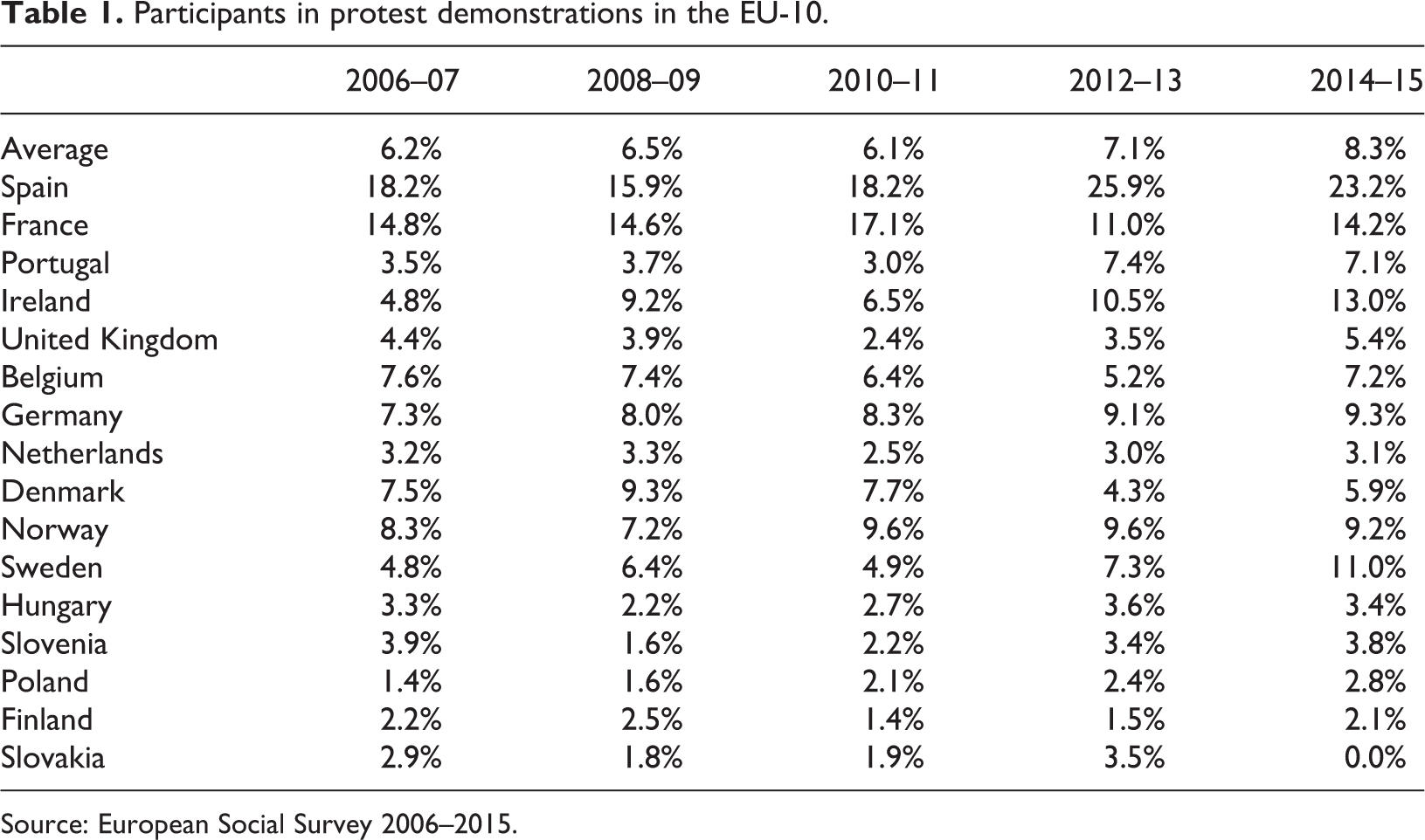
The successive rounds of the ESS provide us with substantial cross-cutting information on participation in protests in Europe, allowing us to identify and compare the differences between countries (Table 1). On average, participation in protests in Europe increased slightly from 2006/2007 to 2008/2009, coinciding with the financial crisis and recession, then declined slightly in 2010/2011 alongside counter-cyclical European policies, only to increase again in 2012/2013, reaching its highest level in 2014/2015, this time coinciding with austerity policies driven by a new style of European interventionism. On the eve of the crisis, ‘protest societies’ (Kriesi, 2016) in Europe were mostly located in southern Europe (France and Spain) where higher levels of mobilisation could be seen, followed by some of the coordinated market economies in Continental Europe (Belgium and Germany) and Nordic Europe (Denmark, Norway and Sweden). In contrast, the United Kingdom and Ireland, liberal market economies, and Central and Eastern European countries showed the lowest levels of participation in demonstrations. Spain and France showed the highest level of participation in protest mobilisations for all the periods, escalating in the case of Spain in the periods 2012–2013 and 2014–2015 in response to extreme austerity policies. In Ireland, where the level of participation in protests was below the European average, participation in protests increased in response to the crisis and austerity measures. In Portugal, although participation in protests increased twofold in the same period, it still remained below the European average. The most striking aspect about the eastern European countries in the sample is that they had the lowest rates of participation in demonstrations and yet showed a remarkable stability, albeit with a slight increase in rates in the periods 2012–2013 and 2014–2015.
Participants in protest demonstrations in the EU-10.
Source: European Social Survey 2006–2015.
Political attitudes and differentiation between countries in the protest wave of 2014/2015
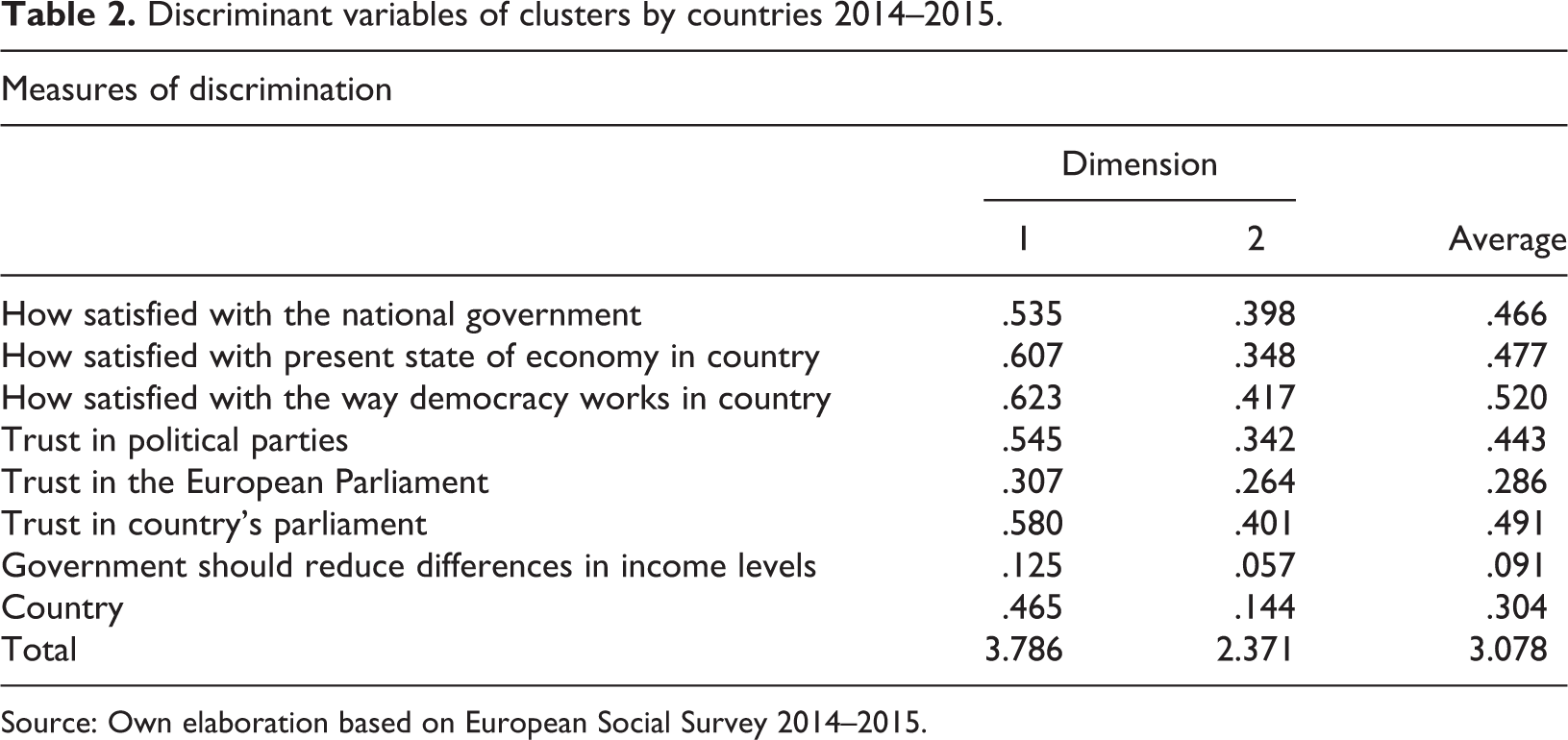
Discriminant variables of clusters by countries 2014–2015.
Source: Own elaboration based on European Social Survey 2014–2015.
The explained variance is high (77 per cent). The means of the most discriminating variables in relation to participation in protests in 2014 were dissatisfaction with the way democracy worked in the country (.520); distrust in the country’s parliament (.491), dissatisfaction with the national government (.466), dissatisfaction with the state of the economy in the country (.477), distrust in political parties (.443) and, showing a greater distance, trust in the European Parliament (.286) and the belief that the government should reduce income differences (.091).
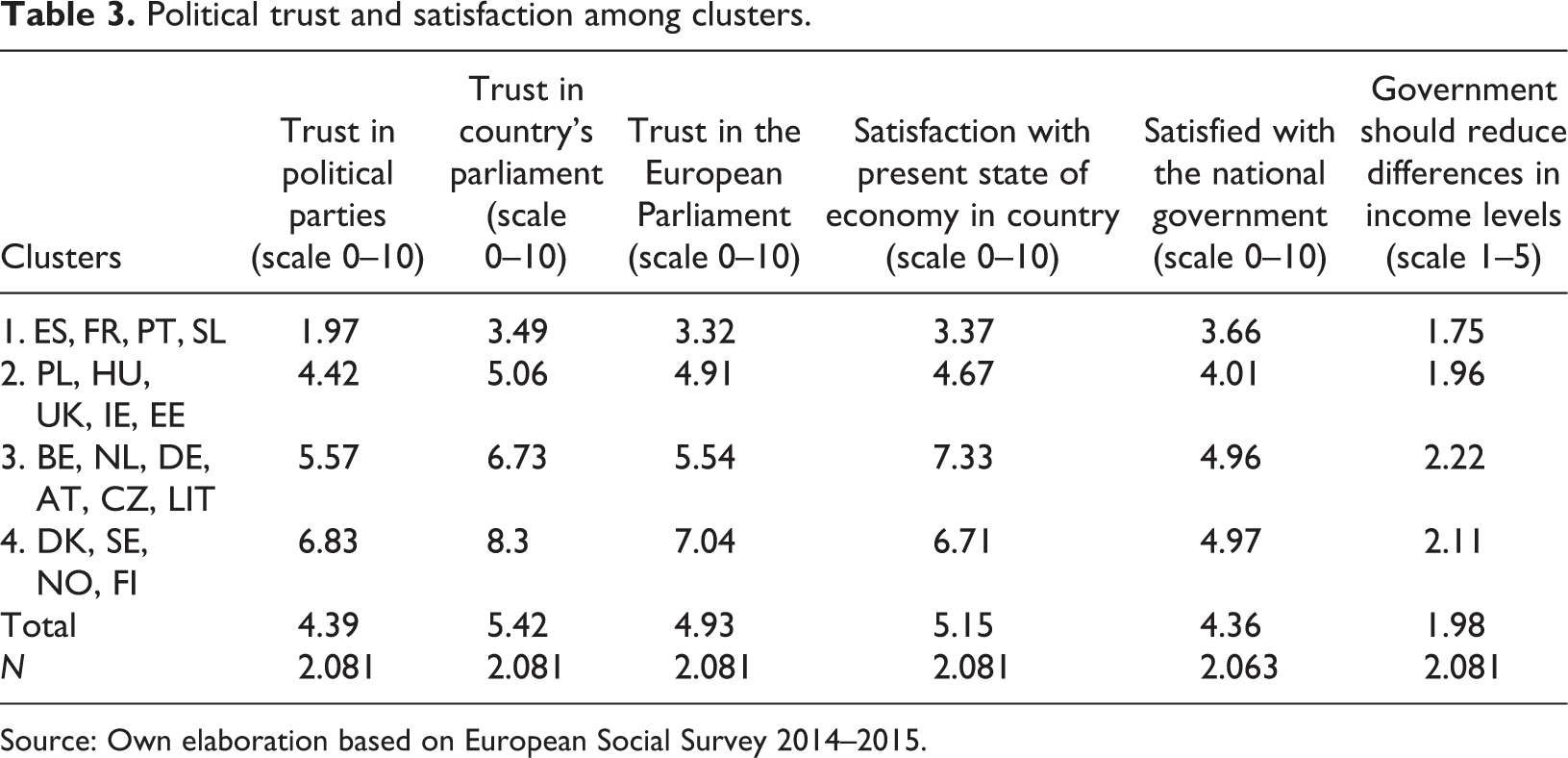
Political trust and satisfaction among clusters.
Source: Own elaboration based on European Social Survey 2014–2015.
The contrast between Cluster 4 and Cluster 1 shows an extreme polarisation of political attitudes of participants in demonstrations, mostly involving the protestors from the southern European and Nordic countries, which is also consistent with the higher levels of mobilisation in the southern European countries. However, with regard to satisfaction with the national government, there is no extreme polarisation in evidence, with participants’ attitudes varying between extreme dissatisfaction and dissatisfaction.
Exploring the evolution of protestors’ profiles in the countries of southern and eastern Europe (2002–2014)
As can be seen in the cluster analysis, Portugal and Spain are included in the cluster of EU countries with the lowest scores regarding trust in political parties, trust in the country’s parliament, satisfaction with the economy and satisfaction with the functioning of democracy. Hungary and Poland are included in a cluster with low scores in all these dimensions, albeit to a less extreme degree, particularly in regard to trust in political parties. In this section, these four countries are examined in detail in order to identify patterns and trends pertaining to the profile of participants in the protest demonstrations.
Participation in demonstrations and satisfaction with the functioning of democracy
The analysis of the trends in the four countries regarding protestors’ satisfaction with the functioning of democracy shows quite distinct trajectories (Figure 1). In 2002, protestors in Spain were moderately satisfied, while in Portugal they were moderately dissatisfied, and in Hungary and Poland clearly dissatisfied. In 2014, protestors in Spain and Portugal were far more dissatisfied than protestors in Hungary and Poland. It is particularly interesting to note that the trajectories in Spain and Hungary follow opposite trends, showing almost an inverse image. In Spain, levels of satisfaction increase sharply from 2002 to 2004, after which point they begin to decline, showing an abrupt drop in 2010/2011, followed by consistently high levels of dissatisfaction. Meanwhile, in Hungary, dissatisfaction increases sharply from 2002 to 2006, stabilising at extremely high levels between 2006 and 2008, after which point protestors are increasingly dissatisfied with the functioning of democracy. Variations in Portugal and Poland are not as turbulent and abrupt as they are in the other two countries, and they follow opposite trajectories: increasing dissatisfaction in Portugal and decreasing dissatisfaction in Poland. The trends in Portugal and Spain suggest the impact of the Great Recession and its attendant austerity policies, while the trends in Hungary reflect the impact of the 2006 financial and economic crisis in that country. In the four countries, dissatisfaction with the workings of democracy correlates with the ongoing dissatisfaction with the economy (r 0.423). The years of ‘crisis’ experienced by each country with regard to satisfaction with the functioning of democracy appear to reflect the years of economic crisis and the diversity of social and political protest movements in times of crisis (Lehndorff et al., 2017).
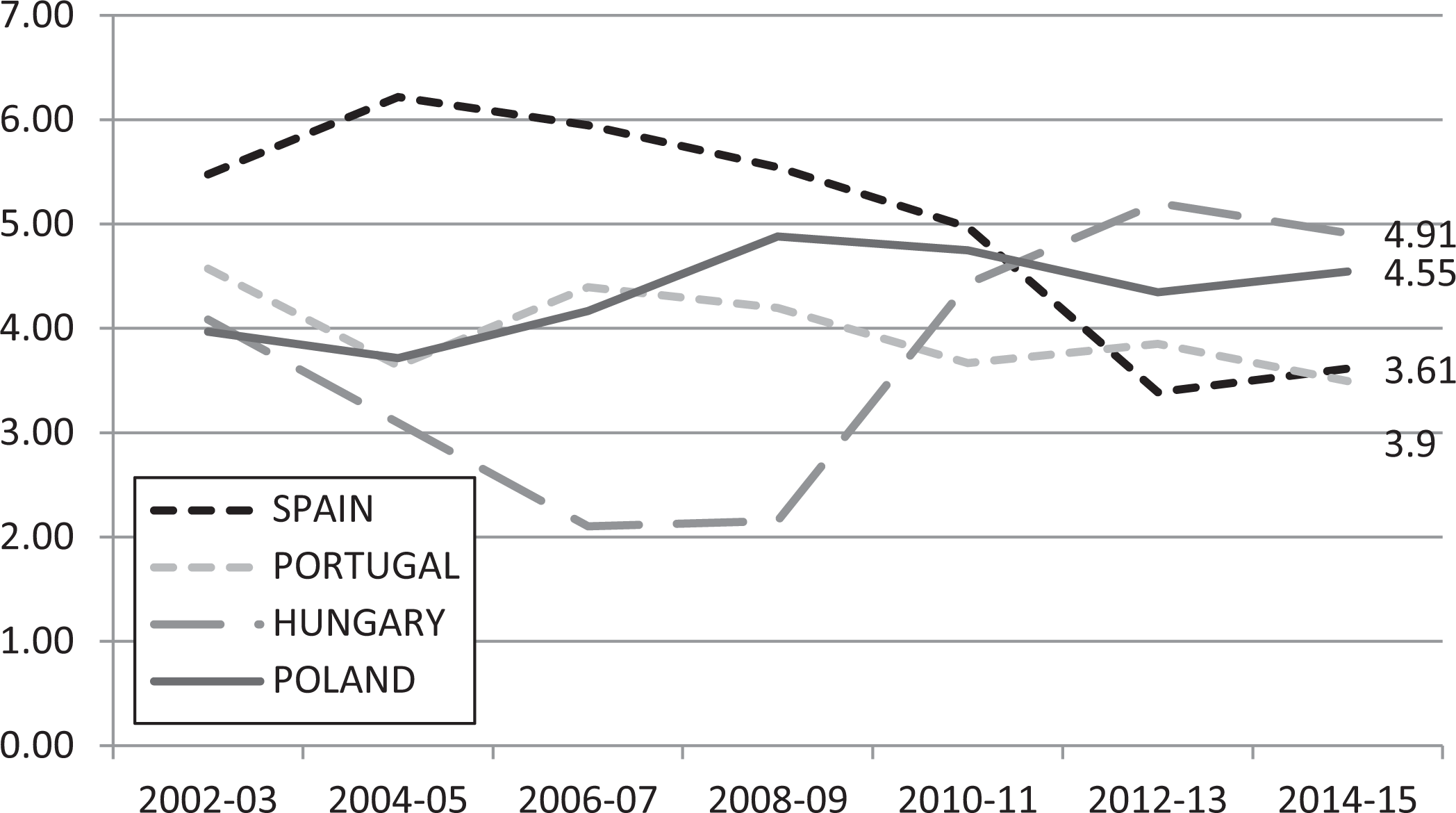
Protestors’ declining satisfaction with democracy (scale: 0 = low level of dissatisfaction and 10 = high level of satisfaction with democracy).
Participation in demonstrations and political ideology
Between 2002 and 2014, the political positioning of protestors has a tendency to polarise, as shown in Table 4: Poland and Hungary moved slightly to the right, while, conversely, Spain and Portugal shifted slightly to the left. Nevertheless, the average scores with regard to self-positioning support neither a move to the extreme left in Portugal and Spain, nor a move to the extreme right in Hungary and Poland. What is interesting, however, is that these shifts and the countries’ respective positioning seem to have foreshadowed, to a certain extent, the trends in the subsequent 2015 national elections. It could at least be said that the political ideology of participants in protests in Poland and Hungary did not favour a turn to the left in the national elections, while the opposite was the case in Portugal and Spain.
Left-right placement of participants in demonstrations between 2002 and 2014.
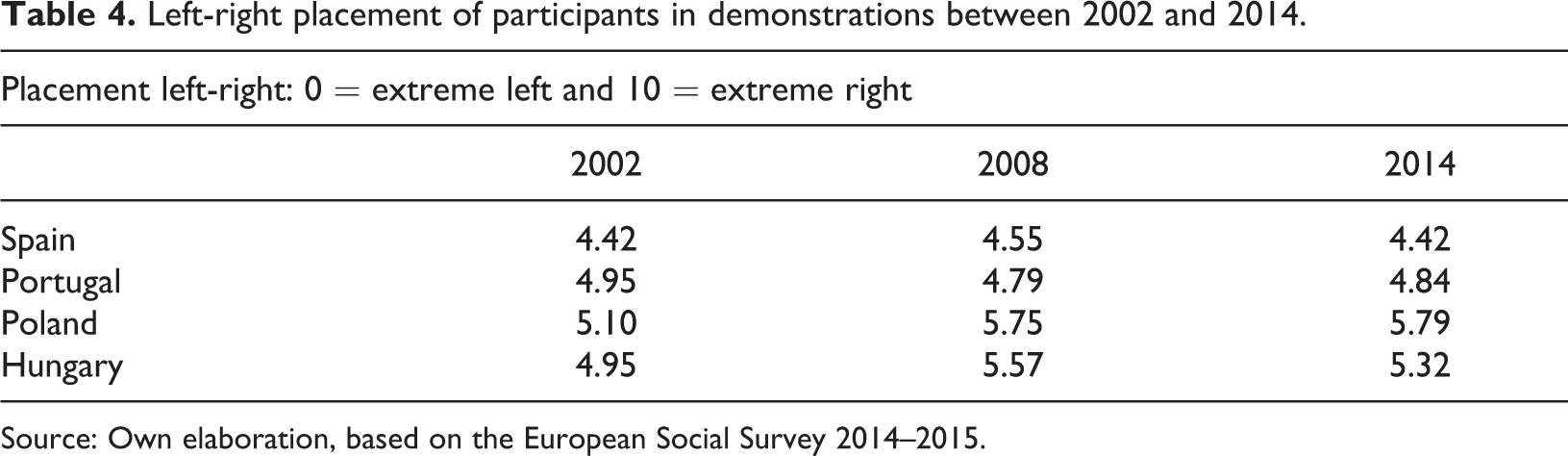
Source: Own elaboration, based on the European Social Survey 2014–2015.
Other evidence confirms the ideological polarisation of the protests, and refers to protestors’ support to political parties in 2014. In Spain, for example, the data show a strong association (Cramer’s V of .402) between left-wing positions and protest demonstrations. In 2014, the highest number of demonstrators claimed to support Podemos (31 per cent), followed by the PSOE (19 per cent) and the United Left (8 per cent). A further 14 per cent supported nationalist parties (CiU, ERC and CUP), and the rest supported several small nationalist parties, also centre- or left-oriented. In Portugal, the trend was similar. The parties supported by people who had participated in protest demonstrations were PCP-PEV (27 per cent), the Socialist Party (25 per cent), the Social Democratic Party (21 per cent) and Bloco de Esquerdas (19 per cent); the rest supported other parties. However, the association between political positioning and protests was moderate (Cramer’s V of .0237).
By contrast, in Hungary, the highest number of protesters supported Fidesz (53 per cent), followed by the far-right Jobbik and the LMP (15 per cent). In Poland, the highest number of protesters supported Law and Justice (44 per cent), followed by Civic Platform (12 per cent) and Congress of the New Right (8 per cent). These two countries were positioned on the right, well above the general European average (4.25). In eastern European countries, there was a strong association between right-wing political positions and protest demonstrations (Cramer’s V of .365).
Participation in demonstrations and connection with political parties
Connectedness with political parties shown by the response to the question ‘feel closer to a particular party than all other parties’ appears to be extremely low among participants in demonstrations, suggesting that there is a relationship between disconnectedness with party politics and participation in protests (Table 5). The exception is Spain, where participants in protests have a greater connection with party politics. This also suggests that the meta-political dimension of the protests is more prominent in Spain than in other countries. Like in Spain, though to a lesser extent, the increase in protests in Portugal was concomitant with the increase in the percentage of citizens who feel close to political parties. However, in Hungary and Poland, where there was no intensification of protests, closeness increased as well, albeit only slightly.
Citizens who feel close to political parties, as % of participants in demonstrations.
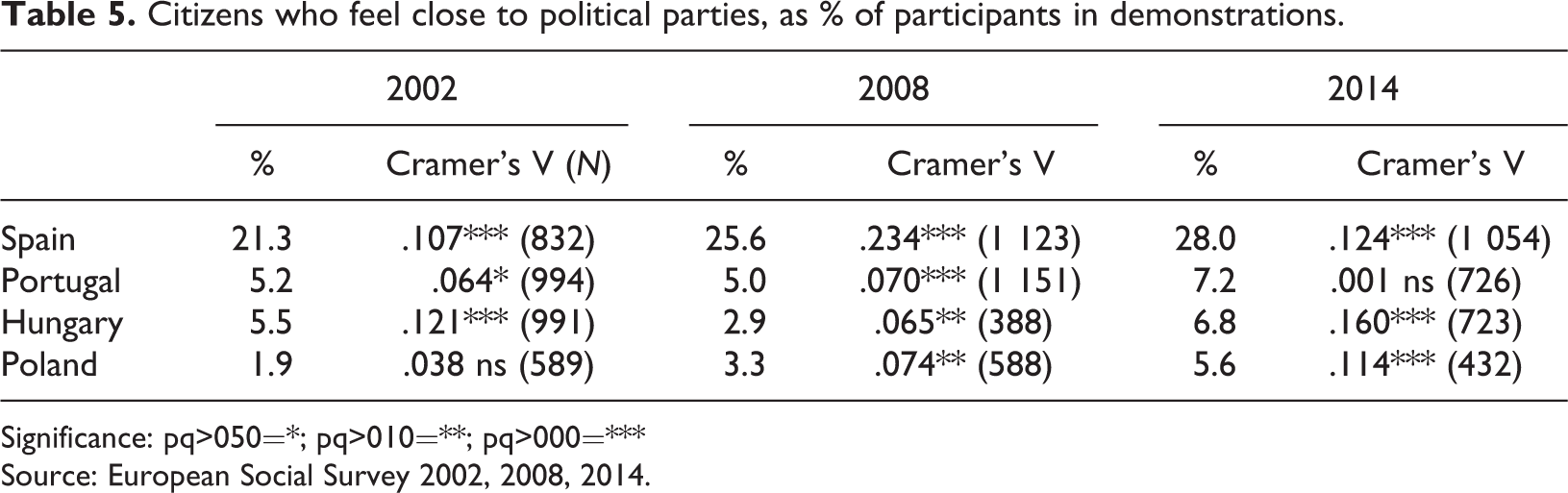
Significance: pq>050=*; pq>010=**; pq>000=***
Source: European Social Survey 2002, 2008, 2014.
Participation in demonstrations and voting in national elections
In general, in the four countries, the percentage of people who participated in protests and voted in the last national election is very low, which suggests that there is a relationship between disaffection with electoral politics and participation in protest demonstrations (Table 6). In general, the association (Cramer’s V) between participation in mobilisations and voting in national elections is weak, if not insignificant, in Poland. However, if we take a closer look at Spain, the country with the highest scores for citizens’ participation in demonstrations, we can see that it also has higher and increasing percentages of protestors who participate in national elections. This suggests that, more so than in the other countries, citizens in Spain have been voicing their discontent both in the electoral political arena and on the streets. Also in Portugal, the percentage of participants in protests who voted in the last national election has been increasing.
Voters in national election, as % of participants in demonstrations.
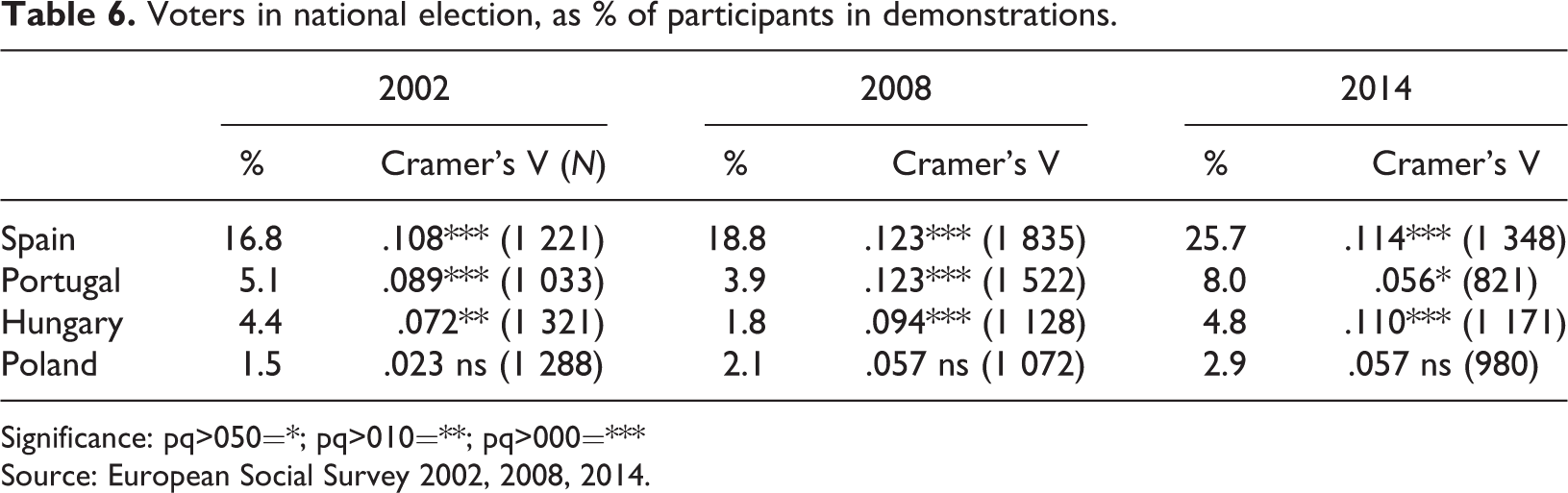
Significance: pq>050=*; pq>010=**; pq>000=***
Source: European Social Survey 2002, 2008, 2014.
Participation in demonstrations and affiliation in trade unions
The percentage of citizens affiliated in trade unions who have participated in demonstrations is relatively low in Spain and Hungary. In contrast, in Portugal, this percentage increased from 16 per cent in 2002 to 28 per cent in 2014. Likewise, in Poland, trade union members showed a high level of participation in protests. However, overall, in Portugal, participation in protests increased, while in Poland, it remained stable and low (see Table 7).
Participants who are members of a trade union, as % of participants.
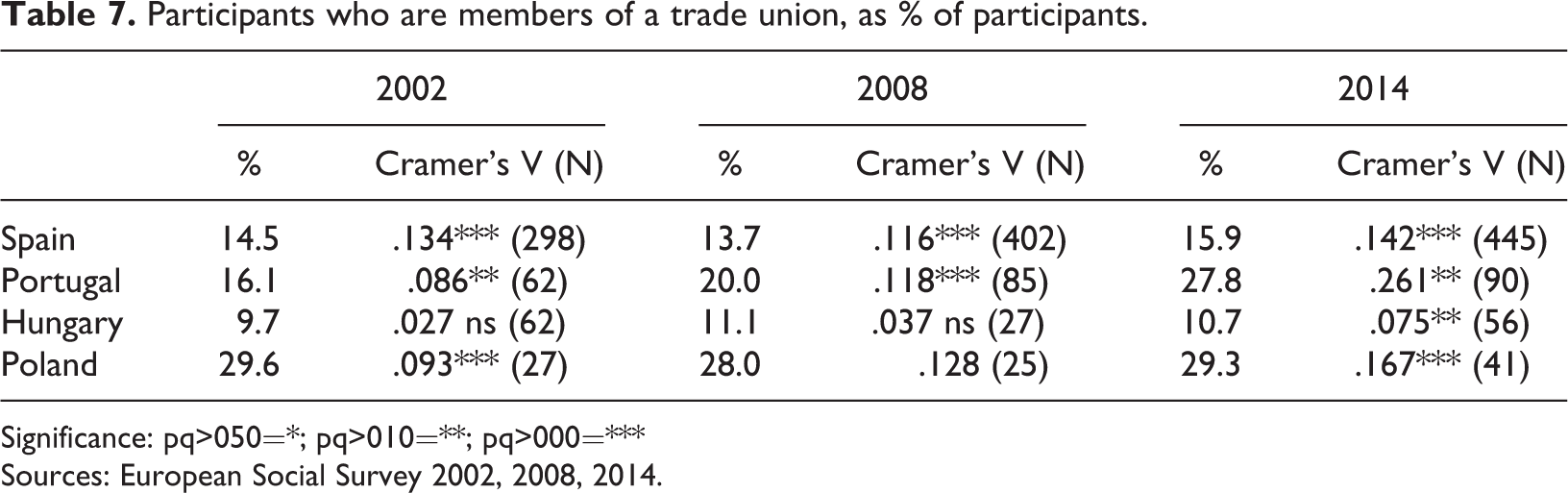
Significance: pq>050=*; pq>010=**; pq>000=***
Sources: European Social Survey 2002, 2008, 2014.
The differences observed may be related to the initiative and capacity of the trade unions to channel and organise discontent in these countries, as well as to the specific forms of social protest in connection with the respective roles played by the trade unions and social movements. The results suggest that social protests were more close to trade unions in Portugal and Poland and less close in Hungary and Spain. In Spain, the tension or even division between the trade unions and social movements seems to be reflected in these results, while in Portugal, the convergence between social movements and trade unions on a great many occasions may have had an impact (Campos Lima and Martín Artiles, 2013, 2014).
These results can also be explained, in part, by the low rate of trade union membership among wage-earners in each country. However, if we compare this with trade union density (Visser, 2016), the picture is rather puzzling: in both Portugal and Poland, the percentage of trade union members who participated in protests is much higher than the trade union density in these two countries (18 per cent and 13 per cent respectively); while in Spain and Hungary, it is almost on a par with trade union density (17 per cent and 11 per cent respectively). These data corroborate the notion that the trade unions in Portugal and Poland were more successful at mobilising workers to participate in demonstrations than those in Spain or Portugal.
Social protests and political challenges: conclusions
Mobilisation levels measured by the ESS question on participation in lawful demonstrations cannot provide an accurate picture of the size of the demonstrations organised either by trade unions or social movements in these European countries or of their incidence throughout Europe. We do not know, for instance, whether those citizens who had responded that they had participated in a lawful demonstration in the last ‘12 months’ had participated several times in small demonstrations or only once in a mobilisation of unprecedented proportions in the country. This suggests that we should be cautious when interpreting the results. When we look at the low rates of Central and Eastern European countries for participation in demonstrations from ESS Round 3 (2006) to Round 7 (2014), that does not mean that, for some of these countries, no important or highly significant mobilisations took place in the country. In southern Europe, Portugal scored below the European average in 2010 and 2014, which does not account for the historical mass demonstrations held during that period against austerity, in 2011, 2012 and 2013. What ESS data do offer is the possibility of depicting, as far as possible, individual willingness to participate in protests over time and space, as well as the possibility of identifying how their characteristics and political attitudes contrast and change over time and space.
ESS data also do not provide any indication of who organised the demonstrations, be it the trade unions or social movements, what the claims/grievances motivating the demonstrations were, or how left- or right-oriented they were. The political attitudes of the protestors give no direct indication of the orientation/goal of the protest, nor of the left-right political orientation. Protestors from the working class may participate in pro-labour demonstrations, seeing as they often participate in general strikes, and still vote right. ESS data do, however, provide an indication of potential challenges: for instance, in countries where participants are left-oriented, there is probably greater capacity to organise left-wing protests or influence any political shifts towards the left. In countries where there is a higher proportion of trade union members among participants in protests, this may correspond to a greater capacity on the part of the trade unions to mobilise their members. Moreover, countries in which there is a high proportion of protest participants who vote in elections, are close to political parties and are members of a trade union appear to have the potential to combine contentious and conventional politics.
The main conclusion to be drawn from a review of the differentiation of political attitudes of protestors (cluster analysis) between EU countries is that the grouping of countries adheres very closely to the distinction between the varieties of capitalism: Mediterranean (Cluster 1) and liberal market economies (LME) (Cluster 2) and coordinated market economies (CME) subdivided into dualist (Cluster 3) and inclusive (Cluster 4) employment regimes (Gallie, 2013). As to be expected, the polar extremes in terms of trust and satisfaction are represented by the variety of capitalism of the countries of the Mediterranean with higher levels of distrust and dissatisfaction and by the Nordic inclusive employment regimes with higher levels of trust and satisfaction. The Central and Eastern European countries muddy this ‘clear’ picture, demonstrating their heterogeneity with regard to trust in political institutions and satisfaction with the functioning of the economy. They generally belong to those clusters where distrust and dissatisfaction prevail: from Slovenia alongside the Mediterranean countries to Estonia, Hungary and Poland alongside the LMEs. In contrast, the Czech Republic is the only CEE country to belong to the CME/dualist regime group.
In the light of the levels of mobilisation in the different countries and their trends, the relationship between distrust, dissatisfaction and the increased possibility of resorting to social mobilisation seems clear only in the case of southern European countries. It is interesting to note that the strongest opposition/contrast in terms of levels of mobilisation exists not between the Nordic countries or Continental countries of CME where trust and satisfaction prevail and the southern European countries that score the highest levels of dissatisfaction and distrust. For the most striking contrast is between the high and/or increasing levels of mobilisation among Mediterranean countries and the low levels of mobilisation in CEE countries, most of them positioned in clusters where distrust and dissatisfaction are also prevalent.
These findings suggest that general dissatisfaction and distrust may bring about an increase in social mobilisations, albeit under certain conditions. These conditions include those historical conditions that incorporated the exercise of freedom of expression in the public sphere and promoted the legality and legitimacy of engaging in collective action and participating in demonstrations as a fundamental right, conditions that, in CEE countries, never reached the level of western Europe and, in some cases, have been eroded over the past few years by repressive action, such as the limitation of the right to strike.
The diachronic analysis with a focus on two southern European countries (Portugal and Spain) and two CEE countries (Hungary and Poland) examined the evolution of the characteristics of participants in protests over a longer period (2002–2014). It showed that, in these countries, a general dissatisfaction with the way democracy was working was correlated with dissatisfaction with the economy. It also showed that the turning points towards increasingly high levels of dissatisfaction with the way democracy was working were clearly related to the most critical years of economic downturn, quite dramatically so in the case of Hungary and Spain, and less markedly in the case of Poland and Portugal.
In line with the review of literature concerning certain political developments and collective action in the four countries featured in the second section of this article, we were also particularly eager to gain an understanding of the role played by political left-right ideology. Our expectations were that lower levels of mobilisation in Poland and Hungary (compared with those in Portugal and Spain) could be also the result of the influence of the political right in preferring the use of conventional channels over taking to the streets. We may assume that the ideological change in the positioning of participants in protests in the four countries for the period under review is related to different waves of protest and reconfiguration of waves of protest. In the case of the two southern European countries, that reconfiguration accentuated the shift to the left and, in the case of the two CEE countries, the shift to the right. The national elections held in the four countries in 2015 showed the same trends. How the political context influenced these shifts and how the demonstrations themselves contributed to them remain open questions. What the ESS tells us is that, in the two southern European countries, higher levels of mobilisation saw the engagement of mostly left-oriented people, and those who voted in national elections chose to vote left and far left; in CEE countries, low levels of mobilisation saw the engagement of mostly centre- or right-oriented individuals, and those who voted in national elections showed a tendency to vote right. It seems that the weakness and erosion of left-wing parties in Central and Eastern Europe prevented them from representing a positive challenge and mobilising and channelling discontent.
The patterns and evolution of the proportion of protestors who vote in national elections and of citizens close to political parties – as indicators of political and civic participation and of participation in conventional channels – showed a number of contrasts and some similarities between southern European and CEE countries. Rates of participation in national elections and closeness to political parties were extremely low among protestors in Poland and Hungary, and increased slightly in Portugal, suggesting that their influence was extremely limited and indicating a breakdown in the relationship between contentious and conventional politics at that level. Paradoxically, Spain – the country showing the highest level of mobilisations – also has a higher and growing proportion of protestors who are close to political parties and who vote in elections. Paradoxically or not, in this country, social movements initially divorced from party politics generated a strong quest for alternative and radical politics that laid the ground for new political formations, in first place Podemos, a left-oriented political party whose strategy is organised around conventional and contentious politics. In response to the election of the mayor of Barcelona and that of the mayor of Madrid in 2015, a journalist from The Guardian reported that ‘Spain’s indignados made the move from city squares to the halls of power […]’ (Kassan, 2015). Ultimately, the patterns and evolution of the proportion of protestors who are members of a trade union pitted Portugal and Poland on the one hand against Spain and Hungary on the other, with the first two countries showing a much higher level of participation of trade union members. The contrast between Hungary and Poland may be related to the fact that, in Hungary, demonstrations were disconnected from the unions, as mentioned above, while in Poland they were linked to the trade unions and the organisation of general strikes. Explaining the differences between Portugal and Spain is not easy. The way in which general strikes in both countries (four in Spain and five in Portugal between 2010 and 2013) were supported by demonstrations may be an issue worth exploring. That has been the case in Portugal since 2011. On the other hand, as mentioned above, it appears that, in Spain, social movements and trade unions were more divided than in Portugal.
The lessons to be drawn highlight the importance of understanding social mobilisations as a critical tool in the exercise of democratic rights and for empowering citizens and workers who are becoming increasingly disconnected from conventional politics, and to revitalise conventional politics based on a more social and more democratic agenda. Alliances and cooperation between trade unions and social movements that respect each other’s autonomy can only enhance the legitimacy both of the unions and of social movements and raise awareness among public opinion. Alliances and cooperation with left-wing part progressive parties or political formations respecting autonomy and independence seem to be crucial even if they appear to be far out of reach. The challenge lies in combining the legacy of the past with innovative strategies (Hyman, 2015).
Ultimately, a critical issue emerges from this study that may serve as a catalyst for exploring the processes of alliances and initiatives for cooperation: the focus on combating income inequality and reinforcing the role of the governments in promoting income redistribution. After all, it seems that what distinguishes countries in this respect is not a neoliberal position expressed by citizens who argue in opposition, but rather the extent to which they agree, with protestors from southern European and CEE countries being those who agree the most strongly.
Footnotes
Funding
This research received no specific grant from any funding agency in the public, commercial, or not-for profit sector