



Abstract

Although Belgium has one of the highest minimum wages in Europe, it is far from offering a decent standard of living. The Belgian trade union confederation FGTB 1 has thus launched a campaign aimed at obtaining a substantial increase of the minimum wage from the current €9.65 per hour to €14 per hour or €2300 per month.
Minimum wage and in-work poverty in Belgium
In Belgium, the official at-risk-of-poverty or social exclusion rate for employed persons was 6.4 per cent in 2017, one of the lowest rates in the European Union (EU). 2 It seems to be the case that particular features of Belgian collective bargaining, such as automatic indexation and the centralised system of wage negotiations at interprofessional and federal levels, have contributed substantially to curb inequality and curb the numbers of the working poor. Various surveys have shown, however, that an increasing number of Belgian workers are not able to go away on holiday for one week a year, eat out in a restaurant or go to the cinema, are having to cut back on health-care expenditure, are unable to pay a deposit on a flat or are falling into arrears with payments (Eurofound, 2018; Solidaris, 2016).
Within the Centrale Générale in Liège, an FGTB affiliate representing more than 40 sectors (including chemicals, construction, cleaning, security and hairdressing), debates on in-work poverty started in 2016. It has been recognised that, since the end of the 1990s, there have been almost no improvements in the real value of the Belgian minimum wage. 3 Moreover, in a longer-term perspective the Belgian minimum wage has experienced a significant decline, from 57 per cent of the median wage in the early 1980s, which after all was already below the at-risk-of-poverty threshold of 60 per cent, to only 47 per cent in 2017 (Schulten and Luebker, 2019). Thus, the Belgian minimum wage no longer protects people from being at risk of poverty.
Inspired by the US ‘Fight for 15’ movement
A major inspiration for the current FGTB campaign came from the ‘Fight for 15’ movement in the United States, which was tentatively launched in 2012 during an unprecedented strike by a small number of fast food workers in New York. They were calling for the establishment of an hourly minimum wage of US$15 and the right to join a union (Rolf, 2016). In the meantime, the movement has spread across the whole country and has been able to achieve substantial increases in the minimum wage in various cities and even some federal states.
There were at least three elements of the ‘Fight for 15’ campaign that inspired the FGTB to launch its own campaign:
‘Fight for 15’ was able to change the dominant public discourse on wages and inequality in a relatively short period and victories could be attained on the basis of demands that many people at first considered unrealistic. In this case, this was the more than doubling of the national minimum wage, which still stands at US$7.25 per hour.
The movement succeeded in organising primarily non-unionised workers around very clear objectives. This spoke to the FGTB’s own desire to mobilise and raise awareness among workers in sectors where trade unions are not very well organised and to develop union activism as part of a common struggle.
The Service Employees International Union (SEIU), which initiated the campaign and provided the means for it to spread across the United States, never pushed itself to the fore, but tried to activate low-paid workers to fight for their own rights.
Taking inspiration from the ‘Fight for 15’ movement, as well as from the ‘Minimum 15’ campaign launched by activists in Quebec, Canada, the FGTB developed its own demand for a decent minimum wage in Belgium. The union’s premise is that a worker ‘who gets up early’ – a phrase used to counter right-wing propaganda that stigmatises the unemployed – must be able to afford a certain basic degree of comfort (which is still far from luxury). The union carried out a research project on in-work poverty in Belgium whose first results were published in 2017 (Flohimont, 2017a, 2017b). On the basis of this research, the Centrale Générale in Liège was the first FGTB affiliate to adopt a demand for a gross hourly minimum wage of €14 per hour in February 2017. Later in 2017 it gained support from all other FGTB affiliates in Liège, which also put forward the corresponding demand of a minimum wage of €2300 per month. A campaign was launched with a dedicated website, www.minimum14.be, as well as various activities in the streets and shops of Liège to raise awareness of in-work poverty in Belgium. Finally, the initiative was taken up by other local FGTB branches and became a nationwide campaign after the Walloon and federal FGTB congresses adopted resolutions in May and June 2018, respectively.
Why €14?
In the United States, the target rate of US$15 per hour was debated and decided on by groups of workers’ activists based on their estimation of minimum needs, without any particular justification. The FGTB took a different approach. First of all, the union looked at several studies on living wages, in particular those from Quebec (Hurteau and Nguyen, 2017) and the United Kingdom (Padley et al., 2016). Unfortunately, there were fewer studies from Continental Europe, where the academic mainstream has focused much more on labour costs than on decent wage levels. In Belgium, some universities looked at the subject around a decade ago (Storms et al., 2015). As their research was destined for public social service centres (Centres publics d’action sociale), however, they limited themselves to determining the absolute minimum income that these centres had to grant households who requested it (Cornelis et al., 2012). In order to define a living wage in Belgium that allows for more than just a subsistence level, the results of this research could be considered only a basic starting point.
At the same time, studies on the share of household budgets dedicated to housing, energy and so on are too piecemeal and do not allow for the estimation of total household expenditure. Moreover, they provided different average budgets that were dependent on household characteristics. The estimation of a baseline budget and a corresponding wage for all workers was therefore impossible, except by carrying out a survey and establishing representative working groups.
Finally, the FGTB decided to use the Household Budget Survey, which is the only survey in Belgium that allows for the cross-referencing of incomes and household expenses by income quartiles (Figure 1). Like all surveys, however, the Household Budget Survey is also subject to biases and therefore must be analysed with care. There are at least two major failings:
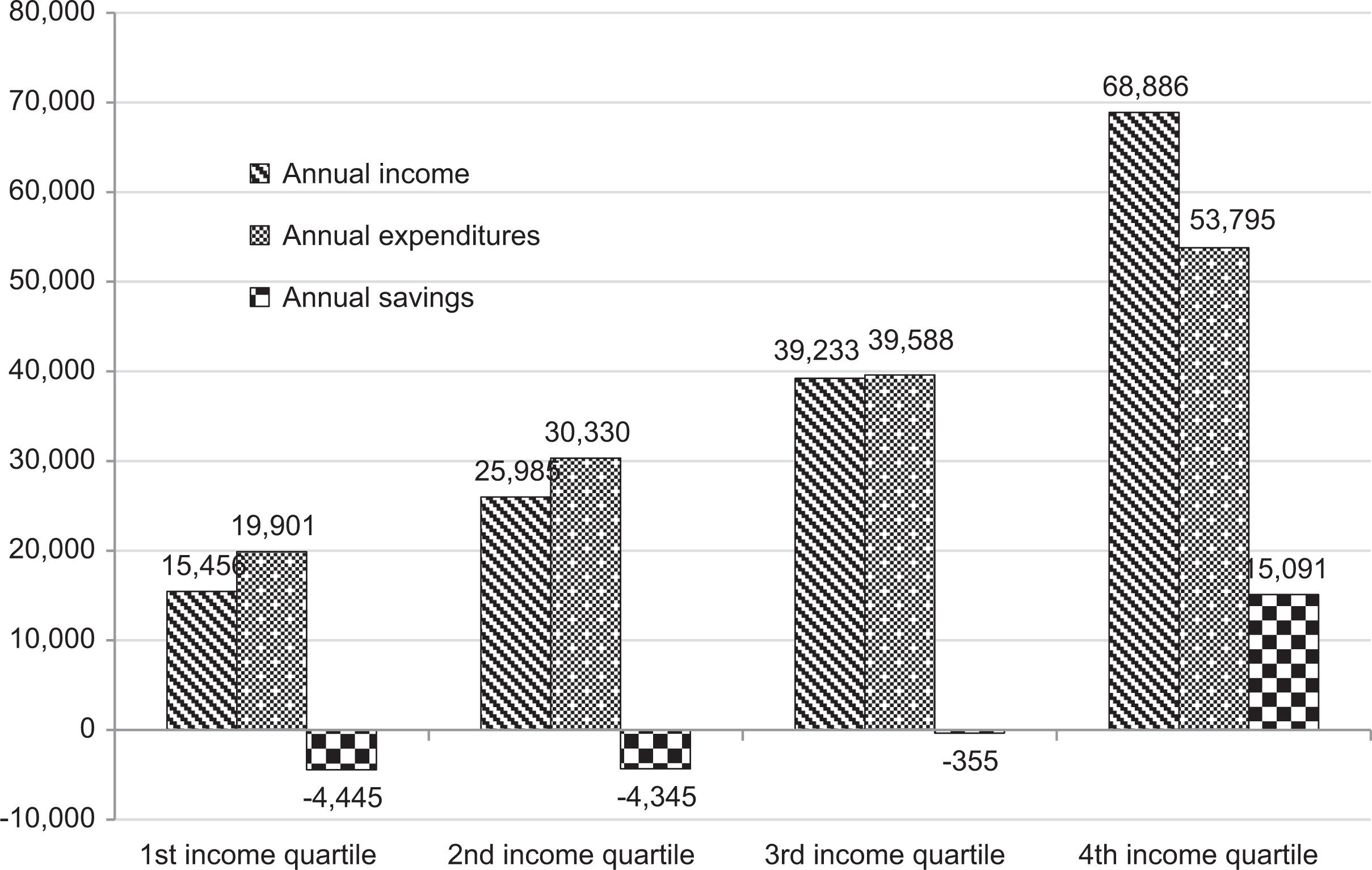
Average annual income, expenditure and savings per household, Belgium, 2014 (euros).
The survey combines individual specificities to work out averages and so masks significant disparities concerning the number of people in the household, their rate of participation in the labour market, their homeowner/renter status, income level and so on. The importance of all these explanatory factors cannot be denied, but without the possibility to cross-reference them we arbitrarily chose to consider only average expenditure on the basis of income quartiles.
In order to be comparable in time and space, this survey follows standard hypotheses that reduce, sometimes significantly, the extent to which it represents reality. For example, the part of the survey that concerns incomes was reduced and simplified over time in order to improve the response rate. Consequently, it is no longer theoretically possible to determine with precision the amount of household savings or dissavings.
Despite these precautions we have observed that:
– The average consumption of the least wealthy half of the population is much lower than that of the wealthiest half. Furthermore, the consumption of the least wealthy half is strongly impacted by meagre real wage increases, as well as the explosion of rent and energy prices, on which spending cannot be reduced.
– The average incomes of the lowest two income quartiles are insufficient to cover the necessary consumption (Figure 1). This alarming finding concurs with another survey, which revealed that 4 employees out of 10 have difficulties in making ends meet or are in debt (Solidaris, 2016) as well as with a recent poll. 4 These observations led to the conclusion that the poorest part of the Belgian population is living at the limit of or even beyond its means, not because it does not know how to manage its budget but because its income is simply too low to cover irreducible expenses.
– The households of the fourth income quartile are able to make substantial savings. Therefore, there is considerable scope for implementing redistribution policies.
Enabling the less wealthy to consume is not just an act of solidarity, it is also economically efficient as it automatically feeds the cycle of consumption and production rather than leaving the richest to hoard or speculate, keeping wealth concentrated in their own hands. In order to enable all households to consume decently – meaning, without having to draw on their assets – an income equal to the average expenditure level of the second income quartile should be a minimum goal.
To calculate a corresponding ‘living wage’, the FGTB used the hypothetical example of a household composed of two working adults, one full-time and one part-time, and on the same hourly wage. This hypothesis, admittedly arbitrary, is nevertheless representative for the Belgian labour market, especially in terms of part-time work and underemployment.
On the basis of our calculations, we determined that a gross salary of €14.87 per hour was the minimum necessary to reach a target consumption level of around €30,000 per year. Allowing for a margin of error, we concluded that an hourly minimum rate of €14 should be the goal for a new minimum wage. Such a rate would correspond to around three-quarters of the Belgian median wage.
The strategy for achieving a minimum wage of €14
In May 2018, the Belgian French-speaking Socialist Party (Parti Socialiste, PS) presented a draft bill to the Belgian Parliament to raise the gross hourly minimum wage to €14 (Parti Socialiste, 2018). The ruling right-wing coalition at that time did not want to put it on the agenda, however. The bill is therefore currently (spring 2019) blocked until the elections in May 2019. Along with the Socialists, the Workers’ Party of Belgium (Parti du Travail de Belgique, PTB) openly supports the proposal and will make it a key issue in its election campaign, while the Greens are in favour of starting a discussion about purchasing power, but also demand the establishment of a basic income.
At the beginning of 2019, the FTGB put the demand for a minimum wage of €14 on the agenda at the interprofessional and federal-level collective bargaining round, which negotiates wage developments in the private sector for the coming two years. The other major Belgian trade union confederation, the Confederation of Christian Trade Unions (Confédération des syndicats chrétiens, CSC) has not endorsed this position and instead has preferred to negotiate a global pay rise of 1.1 per cent. At the end of March 2019, the proposed agreement was rejected by the FGTB, mainly because of the minimal increase in the minimum wage. With only 1.1 per cent, workers earning the minimum wage would have had only €3 more per month in their pocket. Without agreement, the caretaker government will have to decide, but without a majority in Parliament this seems unlikely before the May 2019 elections. Anyway, since early 2019 the FGTB has been implementing awareness-raising activities on the 14th of each month, up until the elections of May 2019. Several FGTB affiliates have also launched a national petition ‘Fight for €14’, under which they are collecting signatures for an increase in the Belgian minimum wage to €14 per hour (http://www.14euros.be).
Achieving a minimum wage of €14 per hour is equivalent to an increase of about 45 per cent of the current interprofessional minimum wage. Among the blue-collar workers’ joint committees and sub-committees, which negotiate sectoral agreements, only 10 per cent of the committees have already set all wage grades above €14. Some 52 per cent of the committees have negotiated wages above €12. 5 Therefore, in many sectors, where the trade unions are strong, the aim of €14 seems to be achievable through sectoral negotiations or additional negotiations at company level. There are also sectors in which unions are much weaker, however, so that €14 cannot be achieved via sectoral negotiations, but needs political support. This is why our campaign activities will attempt to inform voters about the importance of a substantial rise in the minimum wage for everyone.
Conclusions
In-work poverty is greatly underestimated, even in Belgium. By various methods we have attempted to determine a reference budget and wage, but the state of research on the subject in Continental Europe is still underdeveloped. The next step will be to carry out a survey, which will help us to understand what workers want and therefore validate our demand for a minimum wage of €14.
A final important point is that beyond being just a demand for higher wages, this campaign aims to restore hope and confidence to groups of people who feel distanced from trade unions, including precarious workers and young people. This is an important issue that concerns the very future of our organisations.
Translation of an earlier version of this article by Bethany Staunton
Footnotes
Funding
This research received no specific grant from any funding agency in the public, commercial, or not-for-profit sectors.