



Abstract
European trade unions have much to gain from cooperating with each other. Such cooperation does exist, but it is still fairly limited and many obstacles need to be overcome if cooperation is to be improved. According to our survey data, higher-level union officials regard differences concerning financial resources and national labour market regulations to be particularly substantial barriers to cooperation. The enormously varying union density across Europe, and its general decrease, also creates barriers. Therefore, employee attitudes to unions are examined using data from the International Social Survey Programme. As expected, union members tend to be more positive about trade unions than non-members. The most interesting finding, however, is that employees in some countries with low union density exhibit fairly positive views or at least views that are not less positive than what we find among employees in many countries with higher density rates. This suggests that there is potential for recruiting members.
Introduction
This article focuses on transnational trade union cooperation in Europe and on some related factors. In recent decades, EU enlargement and the increasing role of the single market have strongly affected labour market and working life conditions. Europe’s economic integration and the increasingly stronger multinational companies have put pressure upon trade unions to develop transnational cooperation (Bernaciak et al., 2014: 59–78; Gumbrell-McCormick and Hyman, 2013; Keune and Schmidt, 2009; Marginson, 2009; Marginson and Traxler, 2005; Traxler et al., 2008). Unions are essentially nationally based, whereas many companies have only a weak attachment to any specific nation-state and can establish their activities in almost any country where there are opportunities for high and safe profits. This has shifted the balance of power between the social partners in the labour market. It is not surprising that European trade unions find it necessary to work together across borders. Cooperation takes place in many different ways and on different levels: from the European Trade Union Confederation (ETUC) and sectoral organisations, such as IndustriALL Europe, the European Federation of Building and Wood Workers (EFBWW) and the European Public Service Union (EPSU), to various regional and bilateral forms of partnership. Nevertheless, how union cooperation will (and can) evolve remains an open question and a crucial challenge for the future: nothing is set in stone.
Trade unions face several difficulties engaging successfully in transnational cooperation (Larsson, 2012). The overriding aim of the current article is to discuss both problems and possibilities in this respect. Unions are supposed to act for their members, or workers more generally, in relation to employers and it is not self-evident that involvement in European affairs is approved by their grass-roots. The latter may have different opinions about what unions do and how they should act.
If unions are particularly beholden to their members, it may be difficult for them to cooperate with other organisations at European level, because such cooperation may require major adjustments in their approach and lines of action. Above all, this is a matter of how much energy and resources they put into European and domestic issues, respectively. At the same time, we also need to consider the opposite. Achieving success in a European arena can strengthen their support at home. It can be a way of showing that the organisation is important and makes a difference. But even if trade unions do represent member or worker interests in a manner that acquires legitimacy, we cannot assume that such interests are identical across Europe. The heterogeneity of European employment and working conditions, linked to differences in economic development and standards of living, makes it unlikely that all worker demands will coincide.
We need to examine unions’ legitimacy in the eyes of their members. In fact, we can extend this to employees in general. There is immense variation in trade union membership between European countries, but union density rates have been falling almost everywhere for several decades. It is thus reasonable to ask whether this indicates negative employee attitudes to unions. Low density rates can result from many different factors; here we shall confine ourselves to asking whether it has something to do with employees’ negative views of unions. To throw more light on this topic I examine some survey data on employee attitudes to unions.
In Section 2 a few theoretical notions are introduced. Thereafter (Section 3), I briefly summarise some findings from research on transnational trade union cooperation in which I have been involved. It covers the patterns of such cooperation, as well as what union representatives see as obstacles and opportunities. Data on opinions about cross-border union cooperation are also included. Section 4 addresses the low and declining union density in many countries. This development has profound consequences for trade unions. With low membership rates, union financial and human resources are likely to be strained. But there is also an issue of legitimacy. To what extent can an organisation with few members among the employees who could potentially be recruited represent them collectively? To supplement this discussion, I turn to some international data derived from the International Social Survey Programme (ISSP) in 2015 on employees’ attitudes to unions, asking whether the existing attitudinal patterns are in line with union density rates in different countries. Finally, there is a concluding discussion of the themes raised.
Some theoretical notions
The ETUC is what Ahrne and Brunsson (2008) call a meta-organisation: that is, an organisation with other organisations as members (Lovén Seldén, 2014: 30–31). These members are national confederations, with other unions as members. Accordingly, there can be a multi-level hierarchy of meta-organisations. At the bottom of the structure, however, there must be individual employees who have joined a trade union for various reasons, such as securing some protection for their job, working conditions and income.
Ahrne and Brunsson (2008: 123–124) emphasise that meta-organisations frequently try to reach consensus when making decisions. This is essential for building up legitimacy. We should add that this reasoning can hold for all levels in a hierarchical structure. Individual employees may have different views from those of their union regarding its goals and actions. This union may in turn deviate from the views at the next organisational level and so it can continue throughout the organisational structure. At the same time, it is worth repeating that an organisation can enhance or keep its legitimacy among its members by joining a meta-organisation and being successful in its work within this framework.
One example of how the ETUC has handled disagreement is the issue of statutory minimum wages (Furåker, 2017; Furåker and Lovén Seldén, 2013; Furåker and Larsson, 2020: 75–107). While many unions in Europe are strongly in favour of such regulation, most Nordic unions are very negative towards it. The ETUC (2013) supports the idea of statutory minimum wages, but has solved the disagreement through a compromise, saying that wage setting should ‘remain a national matter and be dealt with according to national practices and industrial relations systems’ and that ‘negotiations between social partners at the relevant level are the best tool to secure good wages and working conditions’. Still, where trade unions find it necessary to implement statutory minimum wages, this should be done and these minimum levels need to be raised significantly.
In this context, it is worth recalling the distinction between a ‘logic-of-membership’ approach and a ‘logic-of-influence’ one (Dølvik, 1997; Dølvik and Visser, 2001: 24–25; Hyman, 2005: 24; Schmitter and Streeck, 1999). The first concept refers to a policy in which the organisation puts its members’ interests and views in focus. In contrast, according to the logic-of-influence approach, organisations should adapt their policies to the context and the conditions of decision-making they are part of in order to have a significant impact in relation to other actors.
These two logics are not mutually exclusive; there is rather more or less emphasis on one or the other in organisations. The whole issue is very much a matter of the organisation’s legitimacy. It should be clear, however, that both logics might be a way of increasing legitimacy. The logic of membership can do so by emphasising members’ views and interests, while the logic of influence can achieve members’ support by demonstrating that the organisation has a notable impact on significant issues. Concerning trade union activities at EU level, there are signs that we should not underestimate the possible gap between the organisations’ official EU-positive policies and their members’ ‘scepticism’ (Hyman, 2005). Too great a distance between trade union leadership and the grass-roots can be devastating in the long run.
Transnational trade union cooperation and attitudes to it
This section presents some results from the research in which I was involved during the 2010s. In 2010–2011, our research team conducted a survey with top-level representatives in larger unions in 14 countries: Austria, Belgium, Denmark, Finland, France, Germany, Iceland, Ireland, Norway, Poland, Spain, Sweden, Switzerland and the United Kingdom. The dataset was used for several analyses (Furåker and Bengtsson, 2013a, 2013b; Furåker and Larsson, 2020; Furåker and Lovén Seldén, 2013; Larsson, 2012, 2014, 2015; Larsson et al., 2012). We received completed questionnaires from 250 trade unions, with varying response rates in different countries. The overall response rate was 49 per cent, but it was much higher in the Nordic countries (particularly in Sweden) and much lower elsewhere, above all in France and Poland. Approximately half of the organisations reported that they had regular cross-border exchange of information on collective agreements (Furåker and Bengtsson, 2013a). If we add those answering that they had sporadic such exchanges, this proportion increases to about nine out of ten. Three-quarters of the respondents stated that they had regular or sporadic collaboration on training programmes for union representatives, but only about one-quarter described it as ‘regular’. A closer analysis of the factors influencing regular exchange on collective agreements showed that size of organisation was crucial: larger unions were more likely to engage in such exchanges. This type of collaboration was also more common in manufacturing than in other industries. Swedish unions were also ahead compared with unions in other countries. In addition, the data indicated important differences in attitudes to cooperation on statutory minimum wages (Furåker and Lovén Seldén, 2013). Whereas most respondent organisations agreed on the need for collaboration to fight wage dumping, it was found that the Nordic trade unions were much more negative towards legislation on the topic (Furåker and Bengtsson, 2013a; Furåker and Larsson, 2020: 75–107).
Another analysis of the same dataset focused on respondents’ assessments of obstacles and possibilities for cross-border trade union cooperation (Furåker and Larsson, 2020: 29–74; Larsson, 2012). A striking result was that the number-one obstacle was considered to be differences in financial resources, followed by differences in national labour market regulations. Other important factors appeared to be low interest among union leaders and members and employers’ ‘divide-and-rule’ strategies. Successful trade union cooperation was assumed to be facilitated by similarities within Europe concerning labour market regulations and professional interests among unions. Union leaders’ personal networks and relations were similarly regarded as significant. A principal conclusion was ‘that the “softer” factors like cultural, ideological and religious differences and similarities, as well as language’ came out as ‘much less important for transnational union cooperation than the “hard” institutional and contextual factors’ (Larsson, 2012: 167).
When asked whether cross-national union cooperation would improve conditions for European workers in the long run, more than 90 per cent of respondents agreed strongly or to some degree (Larsson, 2014: 385–386). On being asked whether unions should engage less on European issues, 90 per cent disagreed. In another of our analyses, we compared the answers in Sweden on these two items (responses from 39 trade unions and a response rate of 100 per cent) with survey data from a random sample of Swedish employees in 2006 (Furåker and Bengtsson, 2013b). Most of these employees were unionised, like the majority of workers in the country. The wordings of statements partly differed between the two surveys, but we judged them to be sufficiently similar for some simple comparisons.
I will present some of the patterns that emerged in this latter study. As noted above, most trade union officials in our general sample agreed that, in the long term, cross-national union cooperation would improve conditions for employees in Europe and this also held among Swedish union officials, although employees – including union members – did not agree to the same extent (Furåker and Bengtsson, 2013b: 123–124). Notably, unionised, but even more non-unionised, employees very often stated that they did not know, indicating difficulties in commenting on unions’ cross-border activities. Furthermore, level of education was positively associated with support for union cooperation in the EU.
On the second pair of survey items, the question was whether trade unions should engage less on European or EU-level issues. Almost all the union representatives disagreed with this, while about half of the respondents in the employee survey said that such an opinion corresponded very well or rather well with their own opinion (Furåker and Bengtsson, 2013b: 124–125). In this case, the questionnaire design may have played a greater role, because the wordings of the statements differed more. Again, the proportion of employees answering that they did not know was substantial, although it was clearly lower than on the first item. Education had similar effects to those mentioned above.
Because there were some years between the two surveys, we should approach this Swedish comparison with caution. We should note that general opinion in Sweden has become more EU-positive in recent years (SVT Nyheter, 2018). Still, the data suggest a more positive attitude among trade union officials than among their members with regard to transnational union cooperation and engagement on EU-level issues. Top-level trade union officials are likely to be better informed about what is going on in the EU and its impact on Swedish labour markets and working conditions. This might be part of the explanation of the differences in attitudes. On the other hand, Swedish union officials are well aware of their members’ sceptical attitudes: they actually try to find a balance between different interests.
Besides this, we scrutinised some other indicators in the union survey in Sweden, although there were no corresponding data for employees (Furåker and Bengtsson, 2013b: 127–128). Two statements were intended to give some indication of whether union officials endorsed a logic-of-influence approach: ‘to increase their power and influence, the ETUC member organisations must be prepared to transfer authority to the ETUC’ and ‘it is necessary for the ETUC to adapt its aims and methods to the actual decision-making processes in the EU’. Respondents were asked to what extent they agreed. A third statement had a logic-of-membership focus, but here we should keep in mind that the ETUC does not have individuals but organisations as members: ‘the ETUC should increase its efforts to mobilise and pursue the interests of its member organisations’. This item is apparently a matter of whether trade unions find it important that the ETUC does not embark on a road separate from the interests of its members. On the other hand, it represents a top-down perspective, as it is assumed that initiatives to mobilisation would come from the ETUC.
Concerning the first of these three statements, the Swedish respondents generally turned out to be sceptical: 79 per cent did not agree at all or only to a low degree and the negative attitude was most explicit among LO unions representing manual workers. No organisation answered that they agreed to a high degree. Respondents were more positive on the second item: 85 per cent agreed to a high or to some degree and this was particularly common among Saco unions (academics). On the third ‘mobilisation’ statement, 77 per cent agreed to a high or to some degree, including all the LO unions. Similarly, a majority among the TCO (lower- and middle-level white collars) and Saco organisations assented.
Most of the Swedish trade unions were thus very or fairly reluctant to delegate authority to the ETUC, but they could accept that this meta-organisation must adapt its policies to EU decision-making processes. Simultaneously, they also wanted the ETUC to increase its efforts to mobilise and pursue member organisations’ interests.
In 2015–2016, our research team conducted a second survey (with Bengt Larsson as principal investigator) of more than 600 trade unions in 36 European countries. It was directed at officials of unions at the level below the confederate level. The results should be treated with caution, as the overall response rate was limited to 37 per cent, but again with substantial cross-national variation, ranging from 62 per cent in the Nordic countries down to 18 per cent in the Anglophone cluster (Vulkan and Larsson, 2019: 5). The patterns revealed were very much in line with those in the previous survey, despite some differences in the design of the questionnaires. For example, this second survey included a question on whether there had been cooperation with foreign unions both in the unions’ own sector and in other sectors. As to same-sector cooperation, the most common form concerned information on collective agreements (75 per cent). In second place came work on joint statements, petitions and open letters (63 per cent), third was training of union officials (53 per cent) and fourth demonstrations (47 per cent). With much lower percentages, the same four dimensions scored highest also with regard to cooperation with foreign unions in other sectors. Exchange of information on collective agreements again came first (24 per cent), slightly ahead of demonstrations (23 per cent), with work on joint statements, petitions and open letters third (18 per cent) and training of union officials fourth (17 per cent). As in the previous survey, size of organisation turned out to be significant: generally, the larger organisations were more frequently involved in cross-border cooperation. There were also important industrial differences in participation in transnational cooperation, with high scores for the metal industry and for construction and transport. In contrast, the type of industrial relations regime in which the unions were included appeared to have little impact.
Our studies show some significant transnational trade union cooperation, but much remains to be done to make it more fully fledged. There are many obstacles to be overcome, for example, in terms of differences in resources and in national labour market regulations. These differences are related to existing inequalities in economic development and standards of living. Employees’ inclination to join unions also varies considerably and we can see that even in a high union density country such as Sweden employees’ opinions can deviate from those of union leaders.
Trade union density and collective agreement coverage
Trade union density is one indicator of trade union support among employees. Over recent decades, developments in this respect have been fairly dismal for the trade union movement; we see a decline in most economically advanced nations. A lot has been written about this state of affairs (Crouch, 2017; Ebbinghaus and Visser, 1999; Frege and Kelly, 2004; Kelly, 2015; OECD, 2017: Chapter 4; Van Rie et al., 2011; Visser, 2006). Apart from the general downturn, there are huge cross-national differences in Europe regarding union density. According to the latest available information (2017 or 2016) in the ICTWSS database (Institutional Characteristics of Trade Unions, Wage Setting, State Intervention and Social Pacts), the span ranges from more than 90 per cent, in Iceland, to 4.5 per cent in Estonia (Visser, 2019). Three other Nordic countries, Denmark, Sweden and Finland, also score relatively high but with figures somewhat below 70 per cent. The four highest density countries have a Ghent model of unemployment insurance: that is, the insurance is administered by the trade unions or organisations attached to them. This is an important factor in promoting union membership among employees. Belgium, with a quasi-Ghent model, has a union density of more than 50 per cent, together with Malta and Norway, which have different unemployment insurance systems. Besides Estonia, we find rates below 10 per cent for Lithuania, France and Hungary. Most other European countries are between 10 per cent and 30 per cent.
Comparing the latest available information with data from 2005 (or the nearest year for which data are available), it turns out that trade union density has declined in all European countries except one: Italy stands out with an increase of 1 percentage point. There are also relatively small losses in countries such as France, Belgium, Spain, Switzerland and Lithuania. France and Lithuania in particular have had low levels for a long time, making further substantial declines less likely. Losses of more than 10 percentage points emerge for Cyprus, Slovenia, Croatia, Romania, Slovakia and Ireland.
Collective agreement coverage rates are also important. The relevant indicators are generally higher – often much higher – than union density rates. In particular, we might look at the high level of collective agreement coverage in France (97.7 per cent according to the most recent information, which may be surprising in light of the low French union membership rate of 7.9 per cent – Visser, 2019). This is an exceptional case, but the general pattern seems to be that trade unions have greater influence than their membership figures indicate in that they are able to sign agreements for larger collectives.
On collective agreement coverage, a comparison across time is shakier, because the years for which data are available vary a great deal. Most European countries show negative scores for recent decades, above all Romania, Slovenia, Cyprus and Croatia. In contrast, we discover an increase in the coverage rate in, for example, Switzerland, France and Denmark.
We may ask whether it is important for transnational trade union cooperation whether union density is high or low. Obviously, cooperation can take place under all circumstances (Crouch, 2017). It may not be decisive whether unions are good at recruiting and retaining members. In a long-term perspective, however, union relevance is likely to diminish if membership continues to decline. To shed some further light on this topic, it might be helpful to scrutinise some attitudinal data.
Employee attitudes to unions
In this section, I examine some International Social Survey Programme (ISSP) data on employees’ attitudes to trade unions. The dataset includes 21 European countries participating in the 2015 survey wave. Only employees are included in the analysis, although there are efforts to encourage self-employed people to join unions (ETUC, 2018). One reason is, of course, that there are an increasing number of ‘bogus’ self-employed: that is, they are subject to similar conditions to those of ‘genuine’ employees, but formally work on their own account. Because bogus self-employed cannot be distinguished in the dataset, we must stick to those defined as employees. Moreover, I limit the analysis to people aged 18–65 years of age.
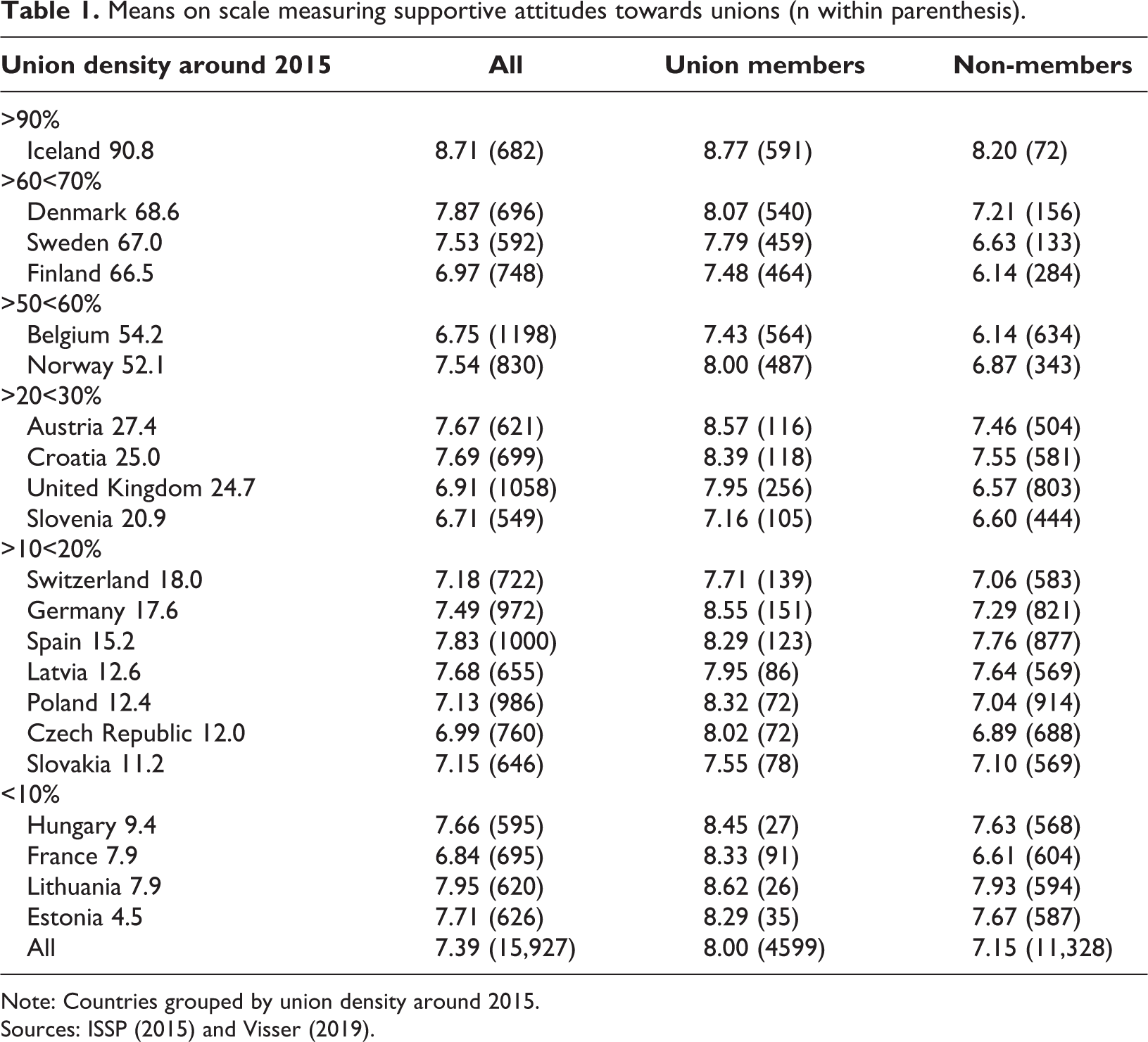
Two items in the survey will be considered. Both are based on statements with simple wordings: (a) ‘workers need strong trade unions to protect their interests’; and (b) ‘strong trade unions are bad for <country’s> economy’. For each of these statements, respondents were asked whether they agreed strongly, agreed, neither agreed nor disagreed, disagreed or disagreed strongly. Answers thus form five-point scales and can be analysed by means of linear regression. High values on the first statement imply a positive attitude to trade unions, as do low values on the second. The two variables correlate relatively well with each other (.52). A factor analysis extracted only one factor and a reliability test gave a Cronbach’s Alpha of .684, slightly below the recommended level of .70. It looks reasonable to merge the variables into one scale (with the answers on the second item reversed) rather than to treat them separately. To begin with, we can look at the mean scores for the 21 countries, grouped according to union density rates around 2015 and with separate columns for union members and non-members (Table 1).
Means on scale measuring supportive attitudes towards unions (n within parenthesis).
Note: Countries grouped by union density around 2015.
Sources: ISSP (2015) and Visser (2019).
Given that the centre point of the scale is 6 (corresponding to ‘neither agree nor disagree’ on both items), it seems that, in general, attitudes to trade unions are fairly positive, as the mean for all countries is 7.39. By far the highest figure is found for Iceland with 8.71. All other countries score below 8, but we also see means above 7.70 for Lithuania, Denmark, Spain and Estonia. The striking thing is that there is great variation between these countries with regard to union density rates. Iceland and Denmark have high rates, Spain has a low rate, and Lithuania and Estonia have very low rates.
Means below 7 (implying relatively union-negative attitudes) appear for Slovenia, Belgium, France, the United Kingdom, Finland and the Czech Republic. In these cases, too, the countries are quite unlike each other in terms of union density rates.
When these data are split between union members and non-members, we can ascertain, first, that members score higher on the index in all countries. The means for the two categories are 8.00 and 7.15, respectively. The largest gap between members and non-members applies to France (1.72), but the United Kingdom and Belgium also have big differences (1.38 and 1.29, respectively). Latvia has the lowest difference (.31), followed by Slovenia (.46), Spain (.53) and Iceland (.57).
As to union members, 13 countries record figures of 8.00 or above. Iceland is again at the top, with 8.77. The most interesting result is perhaps that eight out of eleven nations with a union density below 20 per cent and all of those with density rates below 10 per cent report figures above 8.00. For employees who are not trade union members, Iceland is the only country with such a high level. Mean values among non-members are likewise relatively high for Lithuania, Spain, Estonia, Latvia and Hungary, which all have low or very low union density rates. At the bottom, we find Finland and Belgium, which rank fairly high as to union density.
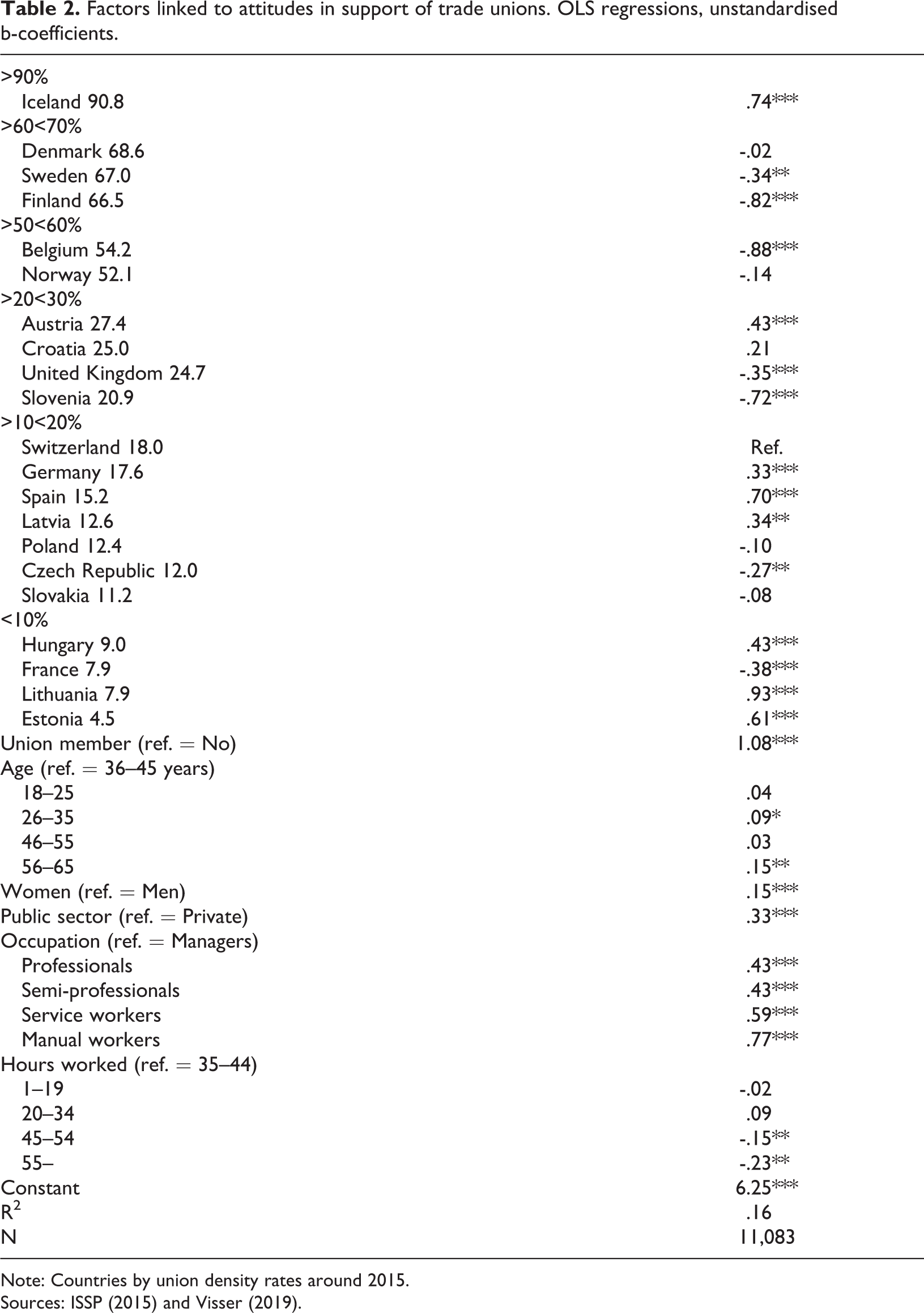
It is possible that the country patterns are due to national differences in employee composition. To check this, I controlled for a number of background variables in an OLS regression (Table 2). Union membership is of course a crucial control variable. I also include age, sex, sector of employment, occupational category and working hours. As reference category, I selected Switzerland, which is not very far from the overall average in the comparisons of means.
Factors linked to attitudes in support of trade unions. OLS regressions, unstandardised b-coefficients.
Note: Countries by union density rates around 2015.
Sources: ISSP (2015) and Visser (2019).
With regard to union membership, the outcome is just as expected: union members score significantly higher on the dependent variable than non-members. Age – with 36–45 years of age as reference category – presents a more complicated response pattern. The oldest workers are obviously more inclined to endorse strong unions, but this seems to hold for those aged 26–35 as well. Female respondents emerge as more positive towards trade unions than males, and public sector employees as more positive than private sector ones. Concerning occupational category, we see that all other categories are more union-friendly than managers and the coefficients tend to increase successively down the occupational hierarchy. Finally, longer working hours appear to be associated with less positive attitudes to trade unions.
The patterns regarding the country variable are to a large extent similar to those disclosed in the means comparison. Those with the highest means – Iceland, Lithuania, Denmark, Spain and Estonia – all have higher positive coefficients than the reference Switzerland. Moreover, four other countries – Austria, Hungary, Latvia and Germany – show significantly higher positive figures than Switzerland. As we have seen before, union density varies a great deal between the eight countries scoring highest on the support-for-unions scale: from Iceland at the top to Hungary, Lithuania and Estonia at the bottom.
The lowest means in Table 1 (implying relatively negative attitudes towards unions) appear for Slovenia, Belgium, France, the United Kingdom, Finland and the Czech Republic. In Table 2, the lowest figures appear for Belgium, Finland and Slovenia, but also the other three countries just mentioned are lower than the reference category. Sweden, too, belongs to this cluster of countries with respondents having comparatively negative opinions on unions. Again, we see a wide variety of union density rates. Belgium, Finland and Sweden have quite high density, whereas the other countries have much lower ones and are spread across the different categories with lower rates.
The main conclusion from this analysis is that attitudes to unions, as measured here, cannot be extrapolated from data on trade union density. Iceland is an exception in this respect: it has a very high density rate, as well as very union-positive employees. In contrast, we find some completely different patterns. Employees in several countries, where only a small proportion are union members, show positive attitudes to unions. The logical question is then: why do they not organise?
Discussion
Cross-border trade union cooperation is undoubtedly important for European trade unions. Such cooperation also exists, as has been demonstrated in surveys with union representatives (Furåker and Bengtsson, 2013a; Furåker and Larsson, 2020; Larsson, 2012, 2014, 2015; Larsson et al., 2012; Vulkan and Larsson, 2019). It is still not very developed and many obstacles need to be overcome in order for further steps to be taken. Trade union representatives regard differences in terms of their organisations’ financial resources and national labour market regulations to be particularly severe impediments (Larsson, 2012). Our interviews provided several examples of how, due to lack of personnel and money, unions had abstained from sending representatives to international meetings. Financial resources depend on the size of the organisation, that is, on whether employees become members and pay their fees. Because there is huge variation across Europe in union density rates, it seems very unlikely that this gap in union density will vanish in the foreseeable future. The same conclusion can be drawn as to national labour market regulations. This is further complicated by the fact that these regulations are not just up to the unions to decide; there are also several other powerful actors who want to have a say.
For European trade union cooperation to develop successfully the organisations must have a fairly high degree of consensus on various issues. The basis is certainly the general rationale for trade unionism: its key task is to work to achieve the best for employees in relation to employers concerning employment and working conditions. It is far from easy, however, to identify what is the best for employees, even in a single workplace. In a cross-national perspective, the problem is even greater, not least because the economic situation and institutional settings differ considerably across countries.
We should not neglect another dimension, namely whether trade unions act for the employees they are supposed to represent. Two alarm signals ring clearly. The first draws our attention to the huge differences in trade union membership between European countries, the second to the decline in union density that has been under way almost without exception for several decades now. The impact on financial resources of having few paying members can be critical and threaten a union’s activities. But this is not the only relevant aspect: membership issues concern not merely finances but also legitimacy. Furthermore, transnational cooperation requires that national unions, which from the beginning can be confederations of unions, join cross-national associations. We must then pay attention to the problems of meta-organisations (Ahrne and Brunsson, 2008). For example, the need to achieve consensus can lead to diluted proposals, which no one is entirely satisfied with. The issues of legitimacy are important at each hierarchical level of meta-organisations. Legitimacy depends on a constant effort to balance the logic of membership and the logic of influence, membership influence and decision-making ability. We should be aware that several relationships need to be taken into account in dealing with these issues, at a minimum the following: first, between the meta-organisation ETUC and its affiliated organisations; second, between the national unions and their members; and third, between the ETUC and employees/union members.
At the bottom of meta-organisation hierarchies there are individual members and their participation is expressed in union density rates. These rates are low in many European countries and the overall tendency is downwards, year after year. We must ask why this happens. Why are so many employees uninterested in joining a union? Do they hope to benefit from unions’ activities without contributing themselves; that is, do they find it convenient to be free-riders? Does it not make sense for them to come together and try to achieve something collectively? Is the explanation that employees do not perceive unions to matter or matter enough? Is it that the union fees are not considered worthwhile – in relation to what the unions can or want to do?
Because union density is low in many European countries, the results presented here on employee attitudes to unions may be surprising, given that the attitudes have been measured in a reasonable way in the ISSP surveys. As a rule, employees judge workers to be in need of strong unions to protect their interests and, for the most part, they do not regard such organisations to be negative for the country’s economy. These conclusions hold for both union members and non-members, although the former turn out to be more firmly supportive in their attitudes.
Perhaps the most interesting outcome is that employees in some countries with low union density show quite positive views or at least not less positive than what we find among employees in many other countries with higher density rates. In other words, despite expressing union-friendly attitudes, many employees remain non-members. Part of the explanation might be that employees are in principle fairly positive towards strong unions, but nonetheless sceptical towards existing unions. This is applicable to many countries, but especially Central and Eastern European ones, where the legacy of the past casts a long shadow. There are no doubt several further aspects to take into account when dealing with Central and Eastern Europe, not least the fact that collective bargaining is highly decentralised and many workplaces are without unions and collective agreements. Further analysis is required to explain the gap between attitudes and behaviours in different parts of Europe. A positive interpretation, however, is that there seems to be a potential for higher union membership.
Footnotes
Acknowledgements
Our studies had several collaborators. In addition to myself, Bengt Larsson, Mattias Bengtsson and Kristina Lovén Seldén participated in both projects (see Funding section) and Anton Törnberg and Patrik Vulkan were involved in the second one. I want to thank them all for their excellent involvement.
Funding
This article is partly based on two research projects for which I am grateful. I led the first, which was called Can Trade Unions within Europe Cooperate? and was funded by the Swedish Council for Working Life and Social Research [FAS 2008-0246], during the period 2009–2011. The second project, Conditions for and obstacles to trade union cooperation in Europe. A comparative study of countries and sectors, was a continuation of the first one and was headed by Bengt Larsson. It received funding from Riksbankens Jubileumsfond [RJ P13-0776:1), during 2014–2016.