



Abstract
As complex challenges like climate change and inequality become increasingly salient, eco-social policies are emerging as suitable public policy instruments to pursue integrated environmental and social objectives. However, despite their rising relevance, a descriptive – and hence empirically applicable – definition is still lacking in the reference literature, currently dominated by normative studies. Therefore, building on a critical assessment of the state of the art, this article proposes a framework for conceptualising eco-social policies, calling for an output-based definition with policy integration as its core element. The article also proposes a typology to differentiate various eco-social policies along two dimensions: the direction of policy integration and the link to economic growth. This typology allows us to elaborate on the possible roles that the welfare state can play vis-à-vis environmental challenges and policies, for instance in the context of decarbonisation: reactive or preventive; protection- or investment-oriented.
Introduction
In the face of increasingly interrelated social and environmental concerns, so-called eco-social policies – or socio-ecological policies – constitute suitable tools to simultaneously pursue environmental and social goals. This article attempts to contribute to the growing literature on the interconnections between welfare states and environmental policies, proposing a framework to redefine and classify the concept of eco-social policies building upon a critical review of some key research strands. The main idea is to shift the current debate on eco-social policies from its predominantly normative orientation to add more empirically grounded approaches.
The article starts from the premises of the sustainable development literature, showing – through the eco-social-growth trilemma – how challenging the reconciliation of environmental, social and economic policy goals can be. Economic growth plays a particularly crucial and controversial role here since social policies have traditionally complemented growth while, conversely, environmental policies originated as part of a quest to limit growth. The eco-social-growth trilemma highlights the difficulties in governing potential contradictions between policy goals. Various solutions, or ‘approaches’, are possible in this view, each promoting different ways to frame and consequently govern the relationships between economic, social and environmental goals. These range from ‘growth-first’ to post-growth, with sustainable development as a prominent example of a ‘balanced’ approach.
Against this background, the article concentrates specifically on the ‘missing link’ in sustainable development, i.e. on the interconnection between the social and the environmental spheres and on how this can be addressed through eco-social policies. The latter include, just to name a few, support for domestic energy efficiency, decarbonisation of social housing, green investments through pension funds, and reskilling workers for green jobs. A growing number of studies in social sciences are now focusing on these policies, but so far most of them have been quite hasty when it comes to specifying their underlying conceptual bases, while others have tended to rely on prescriptive definitions. This article instead proposes a descriptive and hence empirically applicable definition of eco-social policies as public policies explicitly pursuing both environmental and social goals in an integrated way.
To allow for distinctions between various possible eco-social policies, a two-dimensional typology is also proposed. A first dimension refers to the direction of eco-social policy integration, distinguishing between reactive eco-social policies constructed by adding a social dimension to environmental policies and preventive ones aimed instead at greening the welfare state. The second dimension has to do with the link to economic growth, allowing a distinction to be made between eco-social protection and investment policies, with the latter actively contributing to growth.
All in all, the conceptual-analytical framework presented in this article aspires to provide a better understanding of the ongoing process of change that welfare states are expected to undergo as a consequence of growing environmental degradation. In this scenario, eco-social policies may potentially blur the lines between consolidated policy silos and entrenched political interests. A descriptive definition is thus necessary for researchers and socio-political players to empirically identify what an eco-social policy is. Moreover, the proposed typology can help to concretely differentiate among various measures.
The article is structured as follows. Section 2 sets the scene by reviewing the literature on sustainable development and illustrating the eco-social-growth trilemma, as well as the different approaches to govern the three spheres of sustainability. Section 3 concentrates on the concept of eco-social policies, summarising the state of the art and then, building on identified gaps, proposing a (re)definition of this concept. Section 4 presents a typology to classify eco-social policies, applying it by way of example to the challenges of decarbonisation. Section 5 concludes.
Sustainable development and the eco-social-growth trilemma
The literature on sustainable development is the starting point of this article. Sustainable development is problematised here through the so-called eco-social-growth trilemma, which shows how the connection between economic, social and environmental spheres is not necessarily as synergetic as proponents of sustainable development would have us believe.
The three spheres of sustainable development
Originating in the realm of economic studies, the concept of sustainable development was seen initially as a way to address the limited capacity of scarce planetary resources to sustain human existence over time (Meadows et al., 1972). Developing in its wake, the concept of social and economic sustainability also gained increasing importance over time (Klarin, 2018). In an early definition provided by the Brundtland World Commission on Environment and Development, sustainable development was defined as ‘development that meets the needs of the present without compromising the ability of future generations to meet their own needs’ (United Nations, 1987: par. 27). As prototypical as this definition was, it remains one of the most cited and influential to this day (Klarin, 2018), although several alternative conceptions have emerged over the years, making sustainable development an arguably contested concept.
At its core, sustainable development deals with the compatibility between economic, social and environmental goals (Uršič et al., 2014). The ‘system approach to sustainable development’ and the ‘triple bottom line framework’ (Purvis et al., 2019; Schweikert et al., 2018) both point to the existence of three different spheres: an economic, a social and an environmental one. These are organisational forms relying on their own principles for performance and quality and giving rise to sphere-specific policy goals, while also inevitably and dynamically clashing in a way that makes it meaningless to treat them in isolation. O’Connor (2007) adds a fourth sphere, politics, i.e. the realm of systemic regulation in which inputs from the social, environmental and economic spheres are channelled and transformed into policy outputs.
In the social sphere, the ultimate imperative to be satisfied is to (re)distribute resources and opportunities properly, preventing individually unpredictable, yet collectively predictable, risks. Coming in the form of social insurance, social assistance, public services and labour market policies, social policies typically cover risks such as sickness and unemployment or those related to old age. These policies – together with related institutions and normative frameworks – are central elements in the welfare state. This indicates a state that is supposed to provide decommodification, i.e. guaranteeing individuals a socially acceptable standard of living regardless of their participation in the labour market, and de-stratification, i.e. distributing and redistributing resources and opportunities equally in the population (Esping-Andersen, 1990).
The environmental sphere strives to preserve the natural environment. Its ultimate goal is to prevent the deterioration generated through the depletion of natural resources, the disruption of habitats, and pollution (Johnson et al., 1997). The environmental sphere therefore aims to safeguard so-called ‘planetary boundaries’ (Rockström et al., 2009), critical thresholds for maintaining the dynamic biophysical systems in which human activities can operate safely (Raworth, 2017). Climate change, triggered by human-induced changes in atmospheric CO2 concentrations, is perhaps the most politically salient planetary boundary nowadays and has already reached the critical threshold (IPCC, 2021). Although less established than its welfare counterpart in both theoretical and empirical terms, the environmental – also called ‘ecological’, ‘green’ or ‘eco’ – state (Duit et al., 2015; Jahn, 2014; Koch and Fritz, 2014a; Meadowcroft, 2005) supplies both market-based and regulative policies for environmental protection. Building a clear parallel with the welfare state, we could thus say that the eco state seeks to achieve the decommodification of nature, whereby ‘environmental resources [are understood] as commodities requiring de-commodification to avoid self-destructive processes of the capitalist system’ (Zimmermann and Graziano, 2020: 3) which could end up hurting people through ecological disasters, such as increasingly frequent heatwaves, desertification and loss of biodiversity.
Finally, the economic sphere promotes economic growth, i.e. the increase of production, consumption and exchange of goods and services in the market. In the original sustainable development definition, the Brundtland report did not necessarily assume a tension between economic growth and the social and environmental spheres. Nevertheless, in effect, several studies have highlighted the contradictory role of growth in relation to the other two spheres (Gough, 2016; Meadowcroft, 2005). On the one hand, social policies have been traditionally designed as distributional adjustments to free markets and economic growth, while not questioning the prevailing capitalist model. They have instead acted historically as a complement to growth, mitigating market impacts while also relying on growth to generate jobs and the financial resources needed to sustain public social expenditure. On the other hand, at least according to their original rationale, environmental policies aim to challenge unlimited and unregulated patterns of growth, questioning their material throughput, i.e. the total amount of energy and matter involved in various economic stages, ultimately incompatible with planetary boundaries.
The key point here is that sustainable development is not neutral when it comes to the question about how economic growth relates to social and environmental sustainability (Ekins, 1993). It instead emerged with the specific intent to reconcile the contradictions between three spheres, presenting this as a feasible and desirable goal. However, sustainable development is not the only possible approach when looking at the interrelationships between the three spheres.
The eco-social-growth trilemma and approaches to address it
To illustrate the interrelationships between the economic, environmental and social spheres, this article refers to the eco-social-growth trilemma (Mandelli et al., 2021; Schoyen et al., 2022; Sabato and Mandelli, 2018). This provides a useful heuristic for analysing potentially incompatible policy goals. At the three vertexes of a hypothetical triangle, we find the economic, social and environmental spheres, each with its own inner goals. The trilemma addresses their eventual reconciliation. More specifically, it refers to the situation of socio-political actors confronted with a decision about which of the goals arising from the economic, social and environmental spheres are to be respected. The trilemma is hence an analytical construct used to understand the governance and politics of the interconnections between the three spheres of sustainability.
As already pointed out, various alternative approaches can frame and govern the eco-social-growth trilemma (Mandelli et al., 2021; Sabato and Mandelli, 2018). They are based on different assumptions: i) cognitively, on whether and how (i.e. negatively or positively) environmental, social and economic goals are related; and ii) functionally, on whether these three goals should be governed in ‘silos’, hierarchically ordered, or integrated. The approaches related to the trilemma are particularly important for this article, as they constitute the normative bases for constructing eco-social policies. Before presenting the most notable approaches, it is worthwhile first discussing how policy goals can be related in general.
At the cognitive level, logically speaking between two policy objectives called A and B, there could be three possible links: neutrality, synergy and trade-off. The first refers to the situation where A and B are seen as unrelated to one another. Synergy describes a connection between A and B for which, by default, progress in achieving one goal promotes progress in reaching the other (Pradhan et al., 2017), making the goals mutually complementary (Granaglia, 2012). Finally, a trade-off between A and B is defined as the situation where the extent to which A could be achieved is necessarily inversely related to the potential for achieving B (Granaglia, 2012).
At the functional level, if goals A and B are viewed as unrelated, it is reasonable to assume that a ‘silo logic’ to policy-making will prevail, i.e. the two goals are pursued independently of one another. Hierarchical ordering occurs when A and B are connected by a trade-off that is perceived as completely unsolvable. In this scenario, reconciling the two goals is seen as not possible in any way, leading to one of the two goals assuming normative pre-eminence. This could entail either that certain priority rules are established, or that A completely substitutes B (Granaglia, 2012). Third, and finally, there is policy integration. This can be expected to take place in two circumstances. The first entails a trade-off between A and B that is seen as – at least partially – solvable, hence not necessarily and completely inevitable. In this case, synergies do not arise automatically, but can be achieved through policy integration, turning trade-offs into synergies. The second possibility is for policy integration to be pursued, more simply, when A and B are positively related by default. In such a scenario, integration simply aims to boost existing synergies.
Only approaches based on policy integration assume that solving the eco-social-growth trilemma is feasible and desirable. Such balanced approaches aim to reconcile social, environmental and economic objectives. The current notion of sustainable development promoted by the United Nations could be considered a prominent example of a balanced approach (Koehler, 2016). Sustainable development defines a galaxy of other sub-approaches focusing on different aspects of the trilemma. For instance, with respect to the economic-environmental nexus, green growth fosters the idea of ‘ecological modernisation’, seeking to sustain growth through innovation and technological progress (Dryzek, 2013) and to achieve ‘decoupling’, i.e. to ‘divorce economic growth from its ecological impact’ (Fletcher and Rammelt, 2017: 450). Originally defined by the trade union movement and now cited in the Preamble of the Paris Agreement (United Nations, 2015), just transition builds upon green growth, yet pays particular attention to its negative social trade-offs, attempting to turn them into socially just outcomes (International Labour Organisation, 2015; Stevis et al., 2020).
Policy integration – and ultimately finding a solution to the eco-social-growth trilemma – might not always be possible, or even desirable. Two opposite families of approaches stand as alternatives to the balanced ones, promoting either policy silos or hierarchical orderings. On the one hand, there are the purely ‘growth-first’ approaches, based on a silo logic pursuing neoliberal growth, free markets and unconstrained technological innovations, regardless of their externalities. The excessively optimistic reliance on the market mechanisms of pure neoliberalism (Ridley, 2010) has been stamped as ‘irrational optimism’ by several critics (Gough, 2011), precisely because the uncontested prioritisation of economic growth would result in a severe disregard of its socio-ecological consequences. At the opposite end of the spectrum, post-growth approaches fundamentally question not only the supremacy, but also the overall desirability of economic growth, as it is seen to lead to both rising inequality and severe natural disruptions (Asara et al., 2015; Büchs and Koch, 2019). Among these approaches, perhaps the best known is degrowth, understood as ‘an equitable downscaling of production and consumption that increases human well-being and enhances ecological conditions at the local and global level, in the short and long term’ (Schneider et al., 2010: 512). Post-growth approaches do not really aspire to solve the eco-social-growth trilemma. The underlying idea is rather to establish hierarchical orderings, hence de-prioritising growth to the benefit of social and ecological objectives. However, unlike their ‘growth-first’ counterpart, post-growth approaches often go hand in hand with the promotion of sustainable welfare, hence seeking to integrate social and environmental objectives.
(Re)defining eco-social policies
While historically the economic-social and economic-environmental linkages have received considerable attention in both a political and an academic sense, until recently the socio-environmental nexus arguably merely represented ‘the missing link in sustainable development’ (Laurent, 2015). Scholars have now started to fill this gap, investigating the interactions between the welfare and the eco states. The two have significant similarities, but also differences that might make it difficult to reconcile their objectives (Meadowcroft, 2005). Indeed, the few existing studies find that eco states only partially overlap with traditional welfare regimes (Koch and Fritz, 2014a; Zimmermann and Graziano, 2020). Against this backdrop, eco-social – or socio-ecological – policies represent suitable public policy instruments to address the missing link. This section starts by reviewing the state of the art. Building on a critical assessment of the literature, it goes on to propose a descriptive definition of eco-social policies.
Eco-social policies in the literature: a predominantly normative field
Traditionally, the governance of environmental and social policies has followed a silo logic, despite their similarities. Both are responses to long-term societal problems; both have to do with managing and distributing scarce resources; both operate within certain political and economic constraints; and both are delivered by political institutions through dedicated structures, known as the welfare and the eco states (Gough et al., 2008). Despite this, the welfare and environmental policy literatures only recently started to cross-fertilise, addressing their mutual implications.
Climate justice, energy justice and environmental justice are frameworks that attempt to introduce a social dimension into environmental policy studies. Specifically, ‘(1) climate justice concerns sharing the benefits and burdens of climate change from a human rights perspective; (2) energy justice refers to the application of human rights across the energy life cycle (from cradle to grave); and (3) environmental justice aims to treat all citizens equally and to involve them in the development, implementation and enforcement of environmental laws, regulations and policies’ (Heffron and McCauley, 2018: 74). Moreover, within this same literature, just transition is proposed as a suitable framework to bring together the three justices, calling attention to the social implications of sustainability transitions (Wang and Lo, 2021).
In the welfare state field, several scholars have focused on how the welfare state is being – or rather ought to be – transformed to incorporate environmental risks and concerns. It is precisely within the welfare literature that the concept of eco-social policy first came up. In his seminal book, Gough (2017) advocated a three-stage gradual process to reconcile welfare with planetary boundaries, progressing from equitable green growth, via ‘recomposing consumption’, to a final ‘post-growth’ stage, i.e. a global steady-state economy. Gough’s work, which in turn built on studies advancing green critiques of the welfare state (Fitzpatrick and Cahill, 2002), inspired a whole new range of research within the social policy field united under the umbrella term of sustainable welfare (Hirvilammi and Koch, 2020). The latter ‘[. . .] is oriented towards satisfying human needs within ecological limits, from an intergenerational and global perspective’ (Koch et al., 2016: 704). Sustainable welfare calls for the equal distribution of welfare between rich and poor countries, between the poorer and richer subsets of the population, and between current and future generations. It aims to prescribe eco-social policies for a new model of well-being beyond economic growth (Laurent and Jouzel, 2018) and compatible with planetary boundaries. It does so in different ways, for example by endorsing a ‘relational paradigm’ (Helne and Salonen, 2016; Hirvilammi and Helne, 2014) or centre-staging human needs (Gough, 2015). Looked at through the lens of the eco-social-growth trilemma, we could then say that most scholars in the sustainable welfare literature endorse a post-growth approach, assigning pre-eminence to the socio-ecological nexus, while de-prioritising economic growth.
Surveying existing studies, we find several examples of policies labelled as eco-social. Bohnenberger (2020), for instance, has focused on universal basic income, services and vouchers and on whether these can bring about environmental benefits. In the same vein, other studies have proposed a participation income as an eco-social post-productivist measure (McGann and Murphy, 2021), or have compared the impact of a universal basic income and universal basic services as eco-social policies (Büchs, 2021). Another example of eco-social policy from the literature are social energy tariffs designed to increase in line with energy use and hence incentivising needs-based consumption while at the same time lowering the level of domestic emissions by high-income households (Gough, 2019). Further eco-social examples include proposals in the fields of urban planning (Khan et al., 2020) and employment (Brandl and Zielinska, 2020). Particularly interesting in the labour market policy area are also eco-social proposals that aim to reduce working time as a way to lower individual income, and hence consumption and carbon emissions, while also improving individual well-being by freeing time (Brandl and Zielinska, 2020).
The almost symmetrical attempts to integrate social considerations in the eco state through just transition and to conversely integrate a green perspective in the welfare state through sustainable welfare are noteworthy contributions, shedding light, from different perspectives, on the otherwise forgotten socio-ecological nexus. However, a critical analysis of these literatures reveals a widespread tendency towards normativity, with scholars in these fields seemingly more interested in prescribing which policies should be pursued, rather than describing what they are. As a result, eco-social policies are most often defined in light of their ability to achieve certain outcomes, often relying on post-growth approaches. In reality, however, eco-social policies can also be oriented towards other goals, for instance by being based on balanced approaches. While, as they stand, studies on eco-social policies are fundamental in providing creative tools to normatively reorient the currently prevailing ‘growth-first’ silo logic, they also assign little space to identifying and describing existing eco-social policies. As noted by Gugushvili and Otto (2021), an empirically applicable definition of eco-social policies is still missing in the literature. The following section addresses this gap.
Proposing a descriptive definition of eco-social policies
Building on the reference literature, yet taking a more empirical approach, this article proposes the following definition of eco-social policies: they are public policies explicitly pursuing both environmental and social policy goals in an integrated way. This definition presents integration and explicitness as the two defining features of eco-social policies.
The explicit element of the proposed definition is meant to provide a non-normative conceptualisation. As previously said, most existing eco-social policy definitions are outcome-based, meaning that they evaluate policies in light of their expected social and environmental impacts. Outcome-based definitions rely on authors’ own arguments about which policy impacts are the most desirable. We hereby argue instead in favour of an output-based definition of eco-social policies, hence based on the declared objectives and overall on the explicit features of the policy output. All in all, an output-based definition would facilitate policy analysis as it allows, first, analytical mismatches or confusion to be avoided (certain policies might be considered eco-social by some and not by others, depending on their own normative definitions of desirable policy outcomes) and, second, even those policies to be captured that, despite attempting to do so, are unsuccessful in reaching ideal socio-ecological outcomes. This is important for empirical studies to be able to identify and ultimately evaluate eco-social policies, even when their outcomes are deficient.
The second fundamental element of the definition proposed above is policy integration. In general, policy integration ‘entails policy measures that bring together different policy goals’ (Trein et al., 2019: 333). An integrated policy, in this view, is ‘a design in which, first, multiple policy goals can be coherently pursued at the same time, and, second, policy instrument mixes are consistent, in the sense of being mutually supportive in the pursuit of policy goals’ (Rayner and Howlett, 2009: 100). Thus, integration aims to achieve a convergence of policy goals and, consequently, instruments (Candel, 2017), either by directly unifying or by coordinating different policies. This way, integration aims to challenge silo policy-making, breaking down the barriers between different policy subsystems while also preventing hierarchical ordering where one policy goal strongly prevails over others. In the specific case of eco-social policies, integration aims not to address environmental or social objectives by themselves, but rather to reconcile them by tackling their interconnections.
These interconnections are bi-directional – i.e. reciprocal – and come in the shape of both costs and opportunities. On the one hand, social logics can cause environmental damage (Laurent, 2015). In particular, the welfare state has a considerable ‘ecological footprint’ (Matthies, 2017), with its distributional consequences enabling many individuals to engage in environmentally harmful behaviours (Koch and Fritz, 2014a). On the other hand, environmental protection is critical to long-term social welfare, since it affects prosperity (Koch and Fritz, 2014b), while environmental degradation incurs significant social costs.
One key example for understanding the bi-directional nexus addressed by eco-social policies is the intertwinement between inequality and climate change. On the one hand, social inequality exacerbates climate change through various mechanisms: it unnecessarily increases the demand for economic growth; it increases the ecological irresponsibility of the richest; it reduces the socio-ecological resilience of societies; it hinders the collective capacity for action; and it reduces the sensitivity of the least affluent to climate action (Gough, 2019; Laurent and Pochet, 2015). On the other hand, climate change has notable implications for inequality. Evidence shows how responsibilities for and impacts of climate-altering emissions are unevenly distributed between and within countries – the world’s richest 10 per cent account for half of global consumption emissions (Gough, 2017) – leading some to talk about a ‘double injustice’ (Walker, 2012). This highlights how the most vulnerable are more exposed to ecological risks, while also being less well equipped financially to deal with the adverse consequences of such risks (Gough, 2017). This injustice becomes ‘triple’ when we consider that climate policies can further contribute to existing inequalities, due to their socially regressive nature (Büchs et al., 2011; Gough, 2019). Eco-social policies can thus be put forward as a solution, overcoming the vicious circle between inequality and climate change, as well as other socio-ecological challenges.
Classifying eco-social policies
Besides defining them, we also need to be able to differentiate between eco-social policies, not just with respect to their expected outcomes, hence normatively, but also with respect to their actual design features, hence descriptively, thereby allowing comparisons of existing or proposed eco-social policies. To this end, this section proposes a typology as a general framework before applying it to the concrete case of decarbonisation.
An empirically operationalisable typology of eco-social policies
Two analytical dimensions are proposed here to classify eco-social policies: i) the direction of eco-social policy integration and ii) the link to economic growth. These dimensions were chosen in light of the importance that economic growth and policy integration play in the eco-social policy literature, as discussed above. The resulting typology constructed along these dimensions can be used to classify eco-social policies according to the functions they assign to the welfare state vis-à-vis environmental challenges and policies.
The first analytical dimension is the direction of eco-social policy integration. Distinguishing policies along this dimension matters because it serves to reveal, first, the dynamics of policy integration and, second, the core rationale of an eco-social policy. Integration could either occur by adding a social dimension to environmental policies, or the other way around, by adding an environmental dimension to social policies. In the former scenario, the core rationale of eco-social policies is to target the social implications – both costs-risks and opportunities – of environmental issues and policies, hence with the ultimate goal of ‘socialising’ the eco state. In such a context, the welfare state plays a reactive role, since welfare policies intervene after ecological challenges or policies are already in place, with a view to tackling their consequences. Reactive eco-social policies can be useful for instance for addressing the social costs of ecological catastrophes such as heatwaves, forest fires or rising sea levels. They can also be particularly suitable in the context of a green energy transition, contributing to the fair (re)distribution of the costs and benefits of the transition. By contrast, eco-social policies may involve adding an environmental dimension to social policies, hence ‘greening’ the welfare state and reorienting it in a way that takes its environmental externalities into account. In this scenario, the welfare state performs a more preventive function with respect to environmental issues and policies, striving to contribute to reducing environmental degradation. Preventive eco-social policies could be useful for instance for addressing the ecological footprint of the welfare state, or for promoting environmentally sustainable practices and behaviours. Notable examples include low-carbon social housing, green vouchers and green pension fund investment policies.
The second dimension proposed to differentiate eco-social policies is their link to economic growth. Since eco-social policies deal with the connection between the social and the environmental spheres, they are never per se growth policies. However, as the eco-social-growth trilemma and the reference literature show, the economic sphere currently plays an important, almost unescapable, role in its connection to the other two spheres. What matters for an empirically operationalisable typology is whether, in their design, eco-social policies incorporate an objective to positively contribute to growth, or whether they do not, either because they are presented as unrelated to growth or openly anti-growth. Taking inspiration from the literature on social investment (Morel et al., 2012), we can hence distinguish two possible roles that the welfare state can play vis-à-vis environmental protection, based on opposite links to economic growth. First, mirroring a more traditional understanding of the welfare state as a vehicle for decommodification, eco-social protection policies primarily aim at cushioning or compensating for the costs and risks shouldered by individuals in the face of green challenges and policies, or at equally (re)distributing the resources and opportunities arising from the environmental sphere. As such, protective policies do not per se willingly contribute to economic growth. Examples of these include transition income support and green vouchers. Second, the welfare state can instead take on an investment function vis-à-vis the environmental sphere. Resulting eco-social policies would then aim to enhance individuals’ capabilities to participate in a green economy and society. In this sense, eco-social investment policies attempt to leverage existing socio-ecological challenges by trying not only to tackle them – as protective measures do – but also to turn them into economic opportunities, and hence to enhance green growth. Examples of these instruments include green active labour market measures, such as retraining and green job creation.
Combining the two analytical dimensions and the four resulting functions that the welfare state can play in relation to the environmental sphere, we arrive at a typology of eco-social policies as summarised in Table 1.
Typology of eco-social policies.

Applying the typology: the case of decarbonisation
After having discussed the eco-social policy typology in abstract terms, we now show how this framework can be applied concretely, either by researchers conducting comparative empirical analyses or by socio-political actors, facing problems solvable by eco-social policies. To this end, we reflect on the different types of eco-social policies that can be supplied in the context of decarbonisation (Sovacool et al., 2021). The latter refers to switching the sources of energy used in several economic activities from carbon-intensive to low- or zero-carbon ones. This is, for instance, what the European Union has committed to do by 2050 through its 2019 European Green Deal (European Commission, 2019).
Decarbonisation clearly incorporates, by definition, an environmental objective since it strives to cut carbon emissions to reduce their climate-altering impacts. However, it is also intertwined with social issues and policies. On the one hand, while representing an opportunity for instance in terms of job creation, decarbonisation is also expected to create new social risks and costs. On the other hand, the welfare state itself hinders decarbonisation through its ecological footprint. Two specific decarbonisation-related challenges can be addressed by eco-social policies. First, low-income households, while being less responsible for consumption-based emissions, are predicted to be disproportionally affected by the increases in energy prices driven by climate policies. This can result in an increase in energy poverty – i.e. the lack of proper access to energy services (González-Eguino, 2015) – due to the relatively higher proportion of low-income consumers’ budgets spent on energy, as well as to the relatively low energy efficiency of their dwellings. Indeed, according to Eurostat (2021), 8 per cent of European families were unable to keep their homes adequately warm in 2020. Second, decarbonisation might also give rise to occupational challenges related to industrial restructurings in emission-intensive sectors and including job losses and displacements, as well as the need to provide the workforce with new and more appropriate skills. For instance, potential job losses through the phase-out of coal in Europe are estimated at 35,000 for the period 2020–2025 (Galgóczi, 2019).
Against this backdrop, eco-social policies can be proposed precisely to address these interconnected issues. Different types of instruments are available. Table 2 provides examples of eco-social policies for each of the two decarbonisation-related challenges identified, i.e. vulnerable energy consumers and vulnerable workers.
Typology of eco-social policies applied: tackling the challenges of decarbonisation for consumers and workers through different eco-social policies.
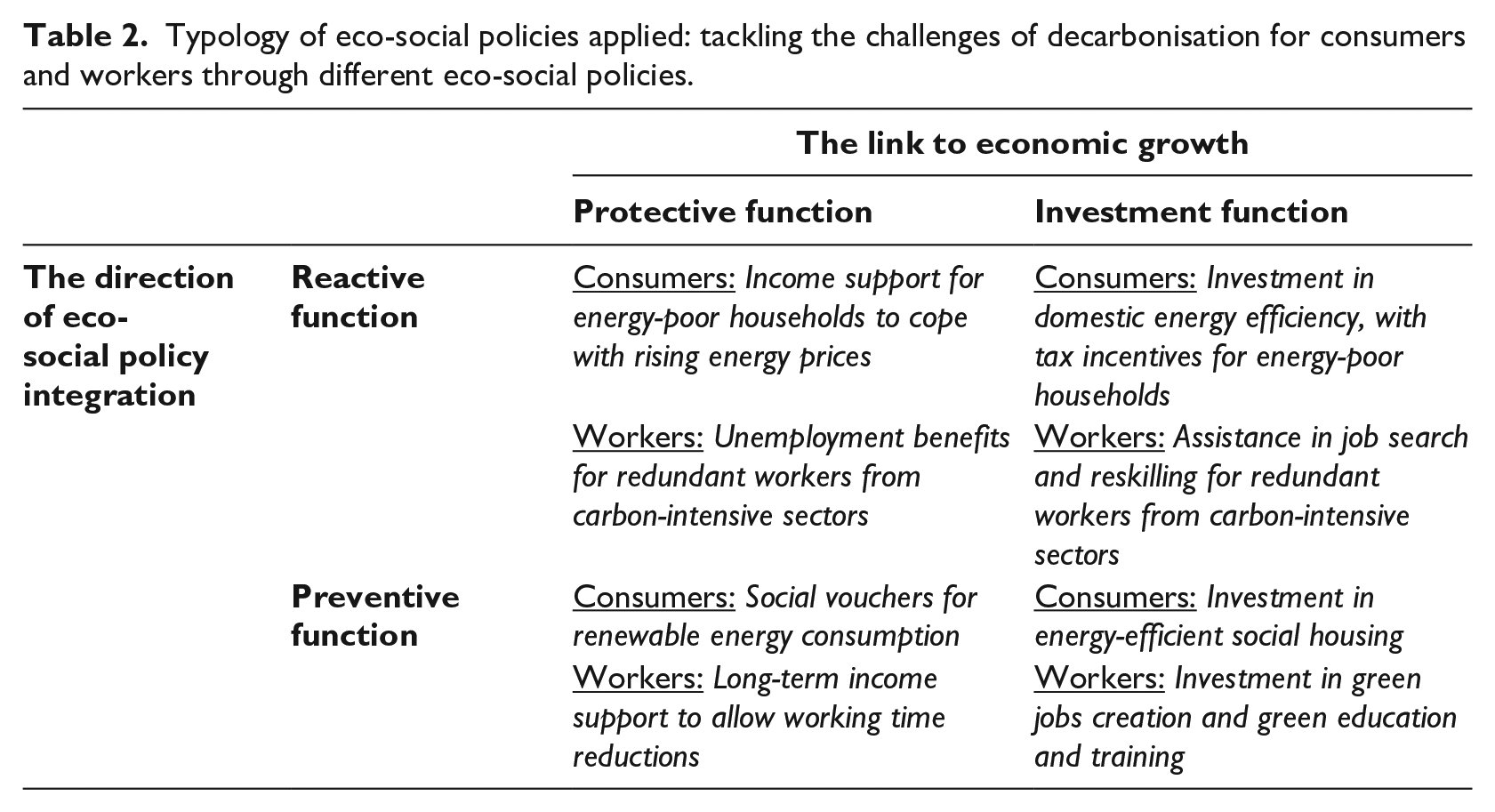
As one can see in Table 2, different eco-social policies can address the same challenge. Compared to preventive measures, the reactive policies in the examples in Table 2 have a narrower scope, addressing urgent challenges and targeting, with social benefits, those most heavily and immediately affected by the transition, such as energy-poor households, or workers made redundant through industrial restructuring. Conversely, preventive eco-social policies go beyond immediate and urgent risks, also incentivising, through a greening of the welfare state, more large-scale and forward-looking changes in societal practices and behaviours in favour of environmental sustainability. Turning to the second analytical dimension, examples of eco-social protection policies in the decarbonisation case include monetary support and vouchers, while eco-social investment measures entail an active role of the state in pursuing social and green investments for a decarbonised economy. Against the main trend in the reference literature, the framework proposed here argues that even growth-oriented policies can be defined as eco-social. This may be deemed as problematic by the advocates of sustainable welfare, given that, at first glance, investment-oriented measures would seem to be incompatible with a post-growth approach. However, this is not necessarily the case. While a decrease in the material and energy throughput is the ultimate objective of a post-growth approach, this could still be compatible with certain growth-enhancing measures. For instance, investments in green social housing or in other green public services could actually represent less environment-damaging alternatives to growth-first approaches to meet people’s needs. More in general, although eco-social policies ultimately seek to purse either a post-growth or a balanced approach, a specific measure should not be ascribed a priori to any of these normative approaches, since, more often than not, to achieve the objectives of an approach – i.e. the reconciliation between economic, social and environmental objectives for balanced approaches; and sustainable welfare beyond growth for post-growth approaches – a mix of different eco-social policies is needed.
Conclusions
The present article contributes to the growing literature on the intertwinement between social and environmental policies. Building on a critical review of this literature, the article proposes an empirical definition of eco-social policies as public policies explicitly pursuing both ecological and social policy goals in an integrated way. It also presents a two-dimensional typology for classifying different eco-social policies, distinguishing between reactive and preventive measures and between protection and investment measures.
Although this research has indulged in a conceptual and analytical dissertation that might seem abstract, it ultimately aspires to inform concrete actions. First, in the academic world, the article should be seen as an attempt to shift the eco-social policy debate away from a predominantly prescriptive towards incorporating also an empirical approach. Further empirical research can indeed apply the definition and typology provided here to identify and assess real-life policies. In particular, the framework could be useful for comparative political economy studies aiming to understand under which conditions different eco-social policies develop and what other conditions constrain their adoption, for instance with reference to entrenched interests.
Second, in the political world, a silo ‘growth-first’ logic remains prevalent in the governance of the social, the environmental and the economic spheres – hereby referred to as the eco-social-growth trilemma. Nevertheless, policy integration is more and more needed in the face of increasingly interconnected challenges, such as those arising from decarbonisation. Governments and socio-political actors everywhere could thus do more in proposing new and creative mixes of eco-social policies in a quest to rethink the welfare and eco states in a synergic manner and to achieve, at the very least, a balance with economic growth, or, more radically, a transition towards post-growth. Therefore, the various eco-social measures discussed here could prove useful for enabling these politically difficult, yet devastatingly necessary and urgent, transitions.
Footnotes
Acknowledgements
Preliminary versions of this article were presented at the following academic conferences: XIV International Conference of the European Society for Ecological Economics (Pisa, 14–17 June 2022); XIV Conferenza ESPAnet Italia (virtual, 8–11 September 2021); 5th International conference on public policy by the International Public Policy Association (Barcelona, 5–9 July 2021); ECPR Joint Sessions of Workshops 2021 (virtual, 17–28 May 2021); Nordic ESPAnet workshop for doctoral students and early career researchers (virtual, 10 December 2020). The author wishes to thank the chairs and participants in these conference panels for their constructive comments. Moreover, the author wishes to personally thank Milena Büchs; Bela Galgóczi; Matteo Jessoula; Adeline Otto; Sebastiano Sabato and Sotiria Theodoropoulou, whose precious advice substantially contributed to developing the article, and Ian Gough for first inspiring this study with his pioneering work.
Funding
This research received no specific grant from any funding agency in the public, commercial, or not-for-profit sectors.