




Abstract
The intensity of internationalization has increased with an escalation in internationalization activities, leading to increasing student, program, and institutional mobility. In Malaysia, the internationalization of higher education in terms of student mobility has changed tremendously in the last two decades as the country has shifted from a sending to a receiving country. Policy-wise, the government has targeted to be a regional hub for higher education. The objectives of this article are to examine government policies, their rationales, and the response of public and private institutions toward these policies. The findings show that while there is also a new emphasis on research and knowledge generation, government policies essentially focus mainly on increasing inbound students to increase export revenues. Institutions’ response vary between public and private as the former have access to research funding from the government while the other is much more fee-dependent and therefore tend to focus on international students as an additional source of revenue but both view internationalization targets set by the government as an end by themselves.
Introduction
The term internationalization is multifaceted and its meaning and interpretations as applied in higher education has evolved over time. This is reflected in the various terminologies and elements associated with internationalization over time. The different terminologies also indicate different phases of internationalization as each terminology is associated with specific dimensions of internationalization (Knight, 2008). They also reflect different rationales for internationalization due to changes in the development of higher education (Kehm, 2003). Prior to the 1980s, international education and cooperation were more commonly used terms instead of internationalization, with activities that were focused on development projects, foreign students, international academic, and cultural agreements (Knight, 2008). Intercultural education was used as an instrument or activity to enhance the quality of education, focusing on cooperation and learning (de Wit, 2011). As globalization intensified, internationalization became increasingly mainstreamed. Cross border movements accelerated, with technology facilitating new forms of internationalization such as virtual education. Economic rationales became increasingly dominant at the institution and policy level accompanied with an increasing focus on market-driven activities rather than development projects. Internationalization also became progressively reduced to a more pragmatic definition of cross border movements of people, programs, and institutions rather than an understanding of internationalization as a “process of integrating an international and intercultural dimension into the teaching, research, and service functions of the institution (Knight, 2004). Instead, activities which are the means for achieving internationalization are sometimes viewed as an end by themselves.
The importance of Malaysia in studies on the internationalization of higher education is due to two reasons: first, the shift in importance of the country from being a sending to receiving country for students and second; its ambitious policy to be a regional hub for higher education. In view of this, the objective of this article is to examine key policies for internationalizing higher education and the response of private and public institutions to these policies. The article is organized as follows: a brief overview of Malaysia’s higher education sector is provided in Section 2. Government policies for internationalization are discussed in Section 3, while the response of universities are analyzed in Section 4. The conclusion summarizes the main findings and key challenges facing the internationalization of higher education.
Overview of Malaysia’s Higher Education Sector
In Malaysia, there are respectively, 20 and 468 public and private higher education institutions. Public universities are categorized into three types: research, comprehensive, and focused universities. The main difference between these three types lies in the fields of study and the ratio between undergraduate and graduate students. Research universities as in comprehensive universities, started out by offering all fields of studies but are encouraged to move toward fields of specialization based on their respective research focus. Focused universities offer specific fields of studies only. The government conferred research university (RU) status for the five oldest public universities (namely Universiti Malaya (UM), Universiti Kebangsaan Malaysia (UKM), Universiti Sains Malaysia (USM), Universiti Putra Malaysia (UPM), and Universiti Teknologi Malaysia (UTM)) in the last 5 years and provided additional research funding for them. They have to shift their respective ratio of undergraduate to graduate students to 50:50, unlike the other two categories that have a ratio of 70:30.
Private higher education institutions (PrHEIs) grew from 354 in 1996 to 704 in 2001 to meet the excess demand for tertiary education while regulatory enforcement was weak before falling to 468 in 2011 with more stringent enforcement of the regulations (Table 1). There are four main categories of private institutions, namely private universities, university colleges, branch campuses, and colleges. Private colleges are not able to confer their own degrees, unlike the other three categories. University colleges are previously private colleges that have shown a good track record in conducting transnational programs completely in Malaysia and are subsequently allowed to confer their own degrees like private universities. While the four older branch campuses (namely Monash University Malaysia, Curtin University of Technology (Sarawak), The University of Nottingham (Malaysia Campus), and Swinburne University of Technology (Sarawak) operate several faculties in Malaysia, the most recent branch campus operate a single faculty, namely the Medical Faculty from the University of Newcastle (Newcastle University of Medicine), at Educity 1 in Iskandar Malaysia.
Number of PrHEIs, 1996 to 2011.
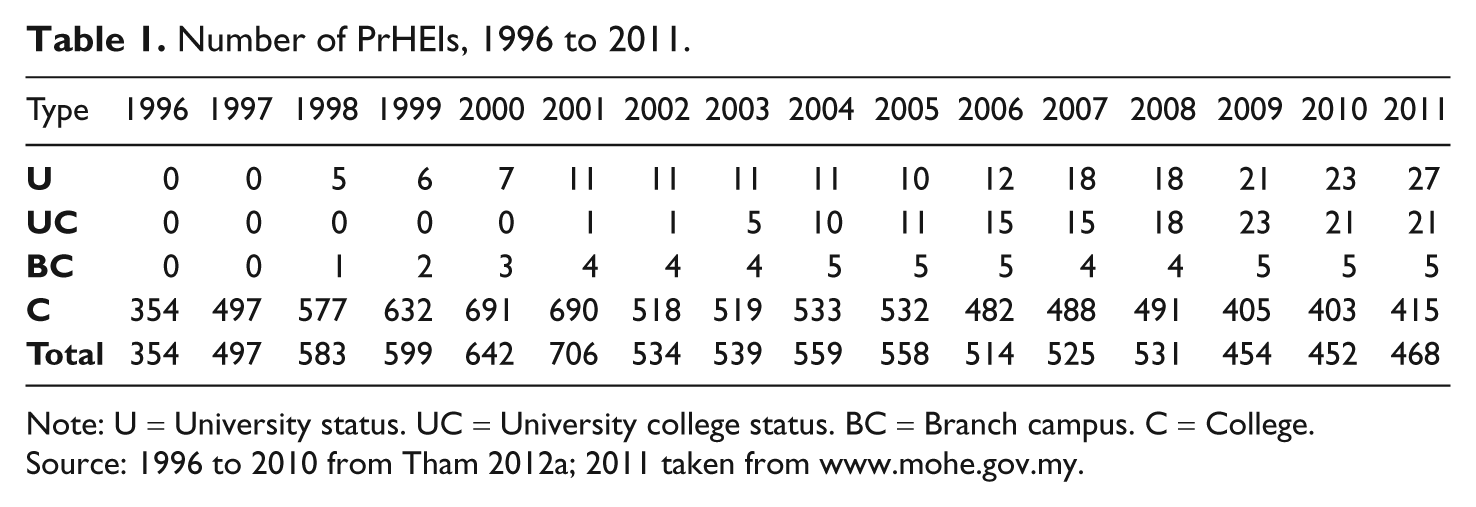
Note: U = University status. UC = University college status. BC = Branch campus. C = College.
Source: 1996 to 2010 from Tham 2012a; 2011 taken from www.mohe.gov.my.
The sizes of PrHEIs in terms of student enrolment are quite uneven. In 2009, it was reported that approximately 36% of the 440 registered active PrHEIs had a student population of less than 300 students (Malaysia, 2010). This implies that the profitability of the different PrHEIs also differs greatly since student fees are the main revenue source. Some PrHEIs are listed in Bursa Malaysia (formerly known as the Kuala Lumpur Stock Exchange), and some are struggling financially to survive (Malaysia, 2010). They also vary in terms of types of business enterprises, ranging from for-profit institutions that are backed by large corporations, to institutions that are backed by government-linked companies (GLCs), political parties, as well as nonprofit institutions. For instance, Multimedia University belongs to Telekoms Malaysia which is a GLC, while Universiti Tunku Abdul Rahman (UTAR) was established by the Malaysian Chinese Association (MCA), a political party. Albukhary International University is an example of a nonprofit university that was established under the Albukhary Foundation.
The increasing number of PrHEIs has changed the share of these institutions in total student enrolment. In 1985, PrHEIs accounted for 15% of total enrolment, but this has increased to 54% by 2010. Competition has intensified as most of these institutions offer similar twinning or foreign affiliated programs in demand-driven fields such as business studies and engineering. Some, however, offer local or home-grown programs such as Multimedia University that are usually cheaper than imported programs.
Government Policies and Institutions’ Response
Government Policies and Rationales
Malaysia as an education hub
Mahathir introduced his Vision 2020 in 1991 which envisaged Malaysia as a developed nation by 2020, thereby requiring an increase in the country’s human capital. The additional human capital requirements was translated into policy directions in the Sixth Malaysia Plan (Malaysia, 1991) by expanding the role of the private sector as a provider through twinning programs between these institutions and the public higher education institutions (PuHEIs) as well as with foreign universities. Later, the mid-term review of the Sixth Malaysia Plan (1993) tabled the idea of promoting the education sector as a significant component of the services industry that can contribute toward export revenues and reduce the perennial services deficit, thereby leading to the vision of Malaysia as an education hub. This vision and its economic rationales continue to be highlighted in subsequent government economic plans up to this day.
The National Higher Education Strategic Plan (NHESP) supports the targeted 100,000 international students by 2010 as stated in the Ninth Malaysia Plan (Malaysia, 2006) by identifying the intensification of internationalization as one of its seven strategic thrusts (MOHE, 2007). 2 This target has subsequently been revised to 200,000 in the Economic Transformation Plan (ETP) and reiterated in the recently launched internationalization policy document from MOHE (Malaysia, 2010; MOHE, 2011a). The latter document gives an interim target of 150,000 by 2015. These targets as well as the expected outcomes from the internationalization policy document 3 indicate that Malaysia’s focus as a regional education hub is very much focused on inbound students as opposed to the other types of education hubs (see Knight & Morshidi, 2011). However, the actual targeted number appears to be an aspirational goal as it was an ambitious target to more than double the enrolment in 5 years, given the intense competition for international students from other existing and potential hubs. When 87,000 international students were enrolled in 2010, the government revised the target of 100,000 to be achieved by 2012 (PEMANDU, 2011).
The implementation of Malaysia’s vision as an education hub required institutional support as the private higher education sector was mostly left to market forces before the enactment of the Private Higher Education Institutions Act, 1996 (PrHEI Act). This landmark Act establishes a regulatory framework for regulating the development of the private higher education sector. It was accompanied with the enactment of other Acts to govern and facilitate a more orderly development of private provision. The National Council of Higher Education Act, 1996 was formulated to enable the establishment of a Council to determine policy and to coordinate the development of tertiary education. Concurrently, the National Accreditation Act 1996 provided for the establishment of a board (or the National Accreditation Board; LAN) to ensure that high academic standards, quality, and control were maintained. Quality assurance for public universities was governed by the Quality Assurance Division (QAD) for these universities in the Ministry of Education. The National Accreditation Board and QAD were subsequently unified to become the Malaysian Qualifications Agency (MQA) in 2007 to strengthen the quality assurance systems and to unify quality assurance of both public and private institutions under one organization. The provision of quality assurance has served to enhance the host environment of Malaysia for students by protecting their interests in terms of ensuring minimum standards are complied.
Another form of institutional support was provided in the establishment of a separate ministry for higher education, namely the Ministry of Higher Education (MOHE) in 2004 to focus on the development of both public and PrHEIs as the government wanted to cultivate world-class tertiary institutions (Badawi, 2004). The newly established ministry was also directed to work closely with the Ministry of Education to ensure consistency in policies. MOHE also established an education marketing division to promote Malaysia as a center of higher education excellence, focusing on marketing and recognition. Four education promotion centers were established in China, Dubai, UAE, Vietnam, and Indonesia. But PrHEIs have been using international marketing to promote their academic programs and to recruit international students long before the establishment of MOHE’s marketing division. Specific incentives were also given for the promotion of exports such as tax exemption on income equivalent to 50% of the value of the increased export of higher education and double deduction for expenses incurred in the promotion of higher education.
Other policy initiatives undertaken to enhance Malaysia’s host environment for international students include improving the governance structure by restricting the recruitment of these students to accredited programs, and a policy for upgrading private colleges to university status and then to full-fledged private universities when they meet the list of conditions stipulated by MOHE such as human capital, physical infrastructure, and facilities. The newly upgraded universities will have to phase out their transnational programs and replace them with home-grown programs within a specified period of time. Two publicly disclosed domestic rating systems have been used since 2007 and 2011 to rate the quality of teaching and learning at the undergraduate level for universities and colleges, respectively.
Moving beyond a student hub?
MOHE was also concerned with the performance of PuHEIs due to increasing calls for accountability since the government has and continues to invest heavily in their development. Performance in terms of ranking in international ranking systems such as the Times Higher Education Supplement (THES) or QS World University Rankings (QSWUR) or Shanghai Jiao Tong’s Academic Ranking of World Universities for some public universities has been carried out since 2004. The quest for international recognition as world-class universities is expressed in the NHESP in the form of targeting the PuHEIs (though this is not stated explicitly) to be ranked among the top in the world. This intensified pressures for PuHEIs to improve certain elements of internationalization that are used to determine world ranking exercises, such as the number of international students and staff and research collaborations that would lead to publications in high impact journals such as International Social Science and Science Citation indexed journals. 4
In 2011, the launch of the action plan for the second phase of the NHESP (MOHE, 2011b) indicates an attempt to capture a broader set of activities under the rubric of internationalization to encompass other academic activities beyond mere numbers of international students and staff. This includes among others, increasing the visibility of Malaysian higher education outside Malaysia through collaborations and networks as well as establishing academic centers of PuHEIs in other countries for teaching, learning, and research. In the same year, MOHE also launched Malaysia’s Global Outreach initiative to intensify global exchanges between Malaysia and other developing countries, including exchanges of knowledge, and people such as alumni, government officials as well as program exchanges that are targeted at specific training programs based on the needs of other developing countries as identified in the document (MOHE, 2011c).
The recently launched Economic Transformation Plan also indicates a bigger role in research for PrHEIs with some designated as key institutions for identified research niches (Malaysia, 2010). For example, Asia-e-University was identified for expanding international distance learning, the International Centre for Education in Islamic Finance (INCEIF) for Islamic finance, UCSI University for hospitality and tourism, and Masterskills and SEGI for health sciences. This is in line with the current private sector-led growth approach of the government and harnessing private investment for growth as research is investment-intensive.
Summary assessment of internationalization policies: Rationales and focus
The quest for internationalization in terms of government policies is motivated primarily by economic considerations such as export revenues and human capital needs. The government estimates that Malaysia will gain RM3 billion in foreign exchange from the targeted 100,000 international students in 2012. Although there is an overwhelming emphasis on student numbers, especially for the PrHEIs, there is an effort made to include other types of internationalization activities such as staff exchanges and research collaboration. There is also a distinct endeavor made to broaden the scope of policy emphasis on internationalization in the second phase of the NHESP, by including more elements of internationalization activities. It remains to be seen if these new initiatives will diversify internationalization efforts as they have just started in 2011. Nevertheless, the policies remain instrumental, ad hoc, and do not seek to embed internationalization into the core functions of the university as defined by Knight (2004). The primary motivation continues to be economic, that is to enhance Malaysia’s reputation and standing as a provider, for the purpose of increasing international student enrolment. Although economic motivations are also found in the internationalization policies of other countries such as New Zealand and the United Kingdom, academic, and cultural rationales are included in the internationalization policies of countries such as the Netherlands, where other internationalization activities are recognized besides the export of higher education (Shannon, 2009). Van der Wende (1997)’s matrix of policy priorities in some of the European countries illustrate a broader range of internationalization activities in these countries, indicating a more comprehensive perspective of internationalization, so that these policies are closer to Knight’s (2004) definition.
Responses of Higher Education Institutions (HEIs)
Private higher education institutions (PrHEIs)
There are two distinct features of PrHEIs in Malaysia, namely their transnational programs and international student enrolment. PrHEIs consider internationalization as part of their institutional make up due to these two features, indicating the extremely narrow view of internationalization held by these institutions. Their use of transnational programs can be traced to the nature of their emergence before the enactment of the PrHEI Act 1996. At the time of independence in 1957, opportunities for higher education in Malaysia were limited as there was only one public university and no private universities in the country. PrHEIs emerged to meet the demand and functioned as tutorial centers for transnational programs that were geared toward selected skills and professional qualifications. After independence, excess demand and its potential negative impact on interethnic relations in multiethnic Malaysia due to affirmative action and ethnic quotas in enrolment in the limited number of public universities led the government to allow private provision to supplement public universities. The demand for transnational programs from private providers coincided with changes in the United Kingdom and Australia’s higher education policies including funding that motivated universities there to innovate different supply models such as twinning and franchise programs for export (Tham, 2010). In turn, these transnational programs attracted domestic and international students as they provide a program that is conducted in English, with a degree that is awarded by the parent institution from the developed world such as the U.K, Australia, or the United States at a cost that is less than that at parent institutions. Branch campuses are also attractive for similar reasons, although they can be more expensive than some of the twinning and franchise programs (Tham, 2012b).
The enactment of PrHEI Act in 1996 marked a shift in the governance of the PrHEIs as they required all PrHEIs to renew their registration and to seek fresh approval for each program (Lee & Ibrahim, 2010). The act also came together with requirements for accreditation for the purpose of quality assurance, even though some of the transnational programs, especially British programs, were already accredited in their home country due to home requirements. While the transition was difficult due to teething and learning problems as both regulators and regulated have to learn how to comply and monitor compliance with the standards of quality that were defined by the newly formed quality assurance department. PrHEIs had “to learn to live with this” (in the words of a dean from a PrHEI), with a dedicated department and personnel in the larger PrHEIs, to handle the accreditation demands (Tham & Kam, 2008). The subsequent establishment of MQA enhanced transparency in the accreditation process as students and parents can check the accreditation status of their programs of interest from the web site. Accreditation is used for marketing the programs of PrHEIs, especially to international students since they can only be enrolled to accredited programs. Accreditation, although not compulsory, is also needed for enabling domestic students to access student loans 5 and the renewal of PrHEIs’ licenses to operate their institutions. The four oldest branch campuses were awarded self-accreditation status in 2010.
PrHEIs are forced to look outwards for student enrolment as the domestic market is exceedingly competitive due to the large number of providers and programs that is catering for a relatively small domestic market. Table 1 shows the number of PrHEIs increasing to a peak in 2001 before decreasing as a result of more stringent enforcement such as issuing fines, regular audits, inspections, and following up on complaints from the public (Gooch, 2011). International marketing strategies such as relationship marketing, rebranding their brand equity, partnering local institutions abroad, targeted marketing at specific companies for staff training, and the use of recruitment agents as well as the establishment of an international office with dedicated staff to handle international students has therefore become the hallmark of PrHEIs. Their marketing differs from the marketing at the ministry level as the latter is more focused on marketing Malaysian education as a brand name, although individual institutions are also invited along. Program innovations such as different variations of transnational programs proliferated as institutions competed against each other to meet the students and market demand. In 2010, there were 3,218 joint, double, or franchise programs in Malaysia that have received provisional or full accreditation (Knight & Morshidi, 2011).
International student enrolment has increased progressively over time, as shown in Table 2, with most of the students recruited from other developing countries, especially Indonesia, China, and increasingly from West Asia such as Iran. A survey on international students’ views of Malaysia found that the main attractiveness of Malaysia as a host country lies mainly in the international recognition of qualifications, competitive program fees, opportunity to make international contact, assistance with student visas, and an opportunity to experience different cultures in multicultural Malaysia (Rohana & Yong, 2010).
Enrolment of International Students in Public and Private HEIs, 2002 to 2010.
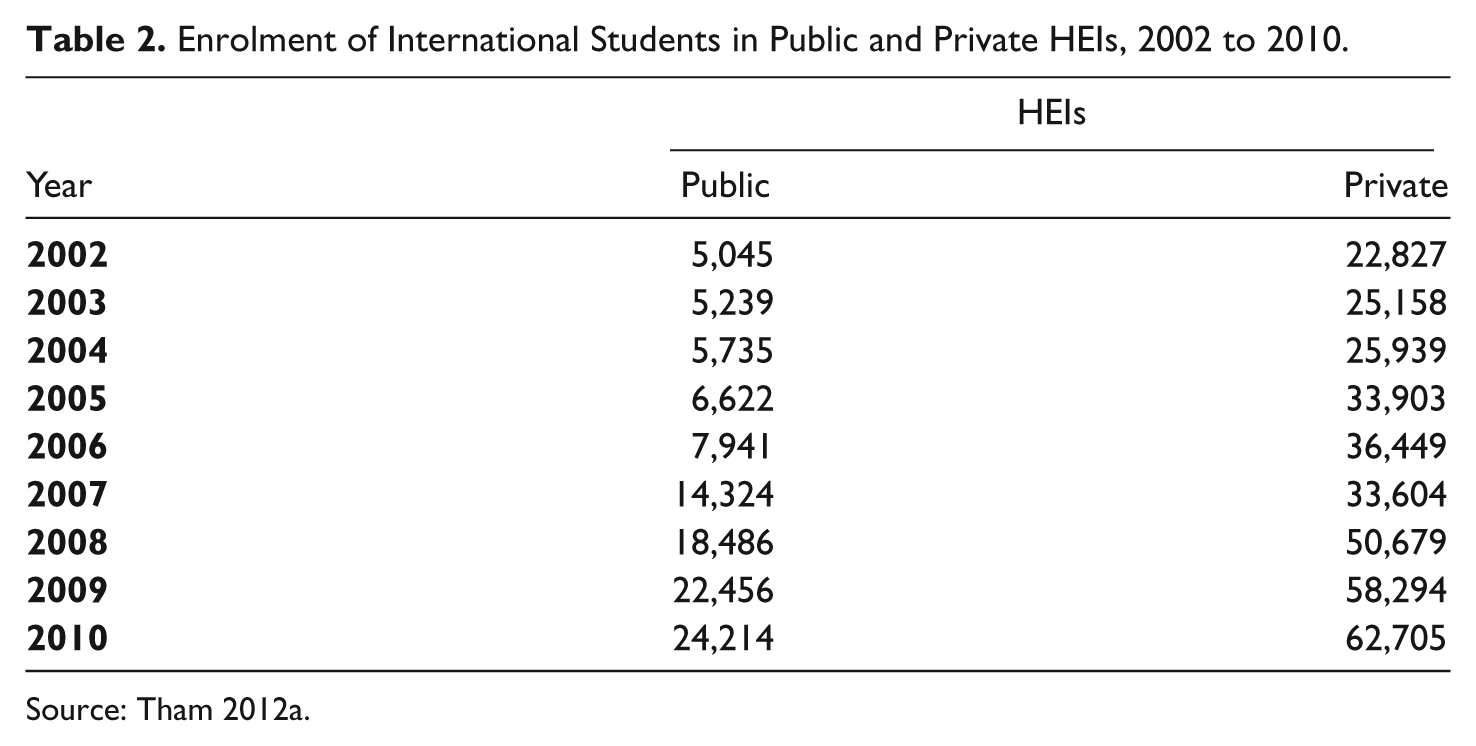
Source: Tham 2012a.
PrHEIs are still by and large mainly focused on teaching as tuition fees are the primary source of revenue for these mainly profit-making institutions. However, the government’s decision and policy to allow private colleges to upgrade to become university-college and later to full-fledged private universities has progressively nudged PrHEIs to focus more on research and publications. Sam (2008), for example, documents some of the research centers of seven selected PrHEIs (Multimedia University, Taylor’s University College, Monash University Malaysia, Universiti Tunku Abdul Rahman, New Era College, Southern College). There is also some anecdotal evidence of research collaboration between PrHEIs and some of the home institutions of their transnational programs such as the research collaboration between INTI International University and Colleges with the University of Wollongong of Australia (The Star, 2012). Branch campuses have also established certain research niches, for example, the Brain Research Institute at Monash University, Malaysian campus. The government has also provided funding of RM113 million for capital and operational costs for 7 years to support, the design, construction, and maintenance of the Crops for the Future Research Centre at Nottingham Malaysia Campus (http://www.nottingham.edu.my/CFFRC/FAQs.aspx). Though PrHEIs are also able to access government research grants, there is no published data on the amount of public funding that have been accessed by these universities. MQA requirements also facilitate research by stipulating a limit on the teaching load. But, research culture takes time to take root and the transition toward research will take time. Nevertheless, signs of change can be seen in the publication record of Multimedia University, one of the pioneering private universities in the country (Table 3).
Number of Publications in Selected PuHEIs, 2001 to 2009.

Notes: UKM = Universiti Kebangsaan Malaysia. UPM = Universiti Pertanian Malaysia. USM = Universiti Sains Malaysia. UM = Universiti Malaya. UTM = Universiti Teknologi Malaysia. MMU = Multimedia University.
Source: UKM 2010.
Staff exchanges in PrHEIs are limited to foreign faculty visiting local from the home institutions of the transnational programs for primarily quality purposes and occasional lecturing stints. Academic staff from private colleges do not have much opportunity to visit foreign institutions as sabbatical leave is limited.
Public higher education institutions (PuHEIs)
This section will focus on the RUs only as they are older, more established, and have more funding and academic resources than the newer PuHEIs. RUs are primarily domestic-market oriented, with a cap of 5% for international students in terms of enrolment at the undergraduate level. This cap was hugely underutilized before 2007 due to excess demand, highly subsidized tuition fees, and language issues as the language of instruction is in the national language as opposed to the permission to use English in PrHEIs. International students were recruited mainly for the postgraduate programs as opposed to undergraduate programs. Nevertheless, the ranking demands have changed the enrolment picture. Table 2 shows a sudden jump in international student enrolment in 2007 in PuHEIs, with the use of English language programs that are dedicated for international students as in the case of UKM or switching to the use of English as the language of instruction in other RUs. These universities have also embarked on marketing and the use of recruitment agents. Like PrHEIs, they have also established international offices to look after the needs of their international students but unlike PrHEIs, these are manned by academic staff that have to juggle this responsibility together with other duties.
RUs are also shifting toward exchange and joint degree programs with foreign collaborators (Norzaini & Yang, 2008; Azizah, 2013). These mobility programs include postgraduate mobility programs that allow students to spend a few months in a foreign laboratory. They also include programs for inbound students that are geared to expose them to the research strengths of a university. For example, UKM organizes short-term programs focusing on sustainability of tropical heritage or indigenous communities (Azizah, 2013). Joint degree programs such as the UKM and the University of Duisburg Essen double degree in electrical and electronics engineering are also forged as part of the internationalization efforts of these universities. Nevertheless, program innovation in RUs are significantly less and slower than the PrHEIs since there is less competition within the public universities and the demand is greater than supply due to heavily subsidized fees.
Prior to the establishment of the QAD in the Ministry of Education, quality assurance in the RUs were regulated by their respective constitution, as well as the use of external examiners, input from local and foreign institutions, as well as the involvement of professional associations. Subsequently, quality assurance has become increasingly more structured under the QAD and later the MQA. As in the case of PrHEIs, RUs now have a dedicated QAD with quality assurance officers in each faculty and research institute, thereby homogenizing the process in both public and private HEIs. In 2010, four out of the five RUs have been awarded self-accreditation status.
RUs have established academic centers of research that focus on research. These include among others, UM Centre of Research for Power Electronics, Drives, Automation and Control, UKM Medical Molecular Biology Institute, Institute for Research in Molecular Medicine in USM, and Institute of Bioscience in UPM. They are increasingly using international research collaborations and research grants as these are among some of the key factors used in their assessment as RUs. While RUs have traditionally hosted foreign lecturers in the form of external assessors, examiners, visiting professors, and lecturers, there is an increasing emphasis on getting world renowned scholars such as Nobel Laureates as visitors. Likewise academic staff from RUs have opportunities to spend their sabbatical overseas every 3 or 5 years to enhance their knowledge and network. It is hoped that these collaborations will also translate into the all-important high impact journal publications that are needed to raise the rankings of these universities in the international league tables for universities. Financial incentives are also provided for publication in high impact journals. Table 3 indicates that the shift in focus had a positive impact in terms of increasing publications from the RUs. Nevertheless, the cumulative total of publications of UM that was the highest among the RUs, is significantly smaller than some of the universities in the region such as the National University of Singapore that had a cumulative total of 36,437 publications in the Web of Science for the same period. Moreover, the target in terms of world ranking by the year 2010 has not been achieved since none of the RUs has made it to the top 200 universities in the THES ranking for 2010. UM, the oldest university was ranked 207 in 2010, 167 in 2011, and 156 in the QS World University Rankings for 2012/13. In 2012, UKM was ranked 261, followed by USM (326), UTM (358), and UPM (360). 6 In the same year, UKM was the only RU ranked 98 in the Times Higher Education ranking of universities under 50 years old. 7
Conclusion
The development of private higher education was politically and economically motivated while government policies on internationalization are driven by the export revenues that can be generated from inflows of international students. Government policies are performance centric, leading to the quantification of internationalization in terms of a measurable list of activities. This led to a broadening of the set of activities that are meant to define internationalization from the first phase to the second phase of the NSHEP. Internationalization targets such as numbers of international students or world-class status for local universities are viewed by both public and private universities as an end by themselves. This piecemeal as well as instrumental view of targets as an end by themselves will not lead to the internalization of internationalization ethos into a university’s mission for it views internationalization as an activity rather than as a core mission of a university as in Knight’s (2004) conceptualization of internationalization. Even quality assurance is used as a marketing tool to attract more international students rather than as a means for enhancing teaching and learning.
Lastly, the desire to raise the banner of Malaysia’s higher education in the world may have led to the policy that the upgrading of private colleges to universities has to be accompanied with a phasing out of transnational programs within a 10-year time frame. Instead, in the near future, these newly minted private universities will have to provide home-grown programs that meet the accreditation requirements of MQA. Since accreditation is not the same as recognition, it remains to be seen if these home-grown programs can substitute transnational programs in terms of attracting both domestic and international students. Private universities will have to invest considerable financial resources to innovate new home-grown programs that meet market needs, as well as international accreditation demands or to improve the international recognition of their programs. It seems unlikely that many small private institutions will be able to survive under this kind of future scenario and only bigger institutions in terms of established track records, enrolment, and deep financial resources will be left at the end of the day, together with branch campuses that are at least semi-elitist institutions in their parent country. The only type of small private institutions that may survive in the future may be very niche boutique colleges that offer specific and specialized programs such as music, art, and sport as these programs are less dependent on economies of scale like big comprehensive universities.
Footnotes
Author’s Note
Revised version of article presented at National University of Singapore (NUS) Conference on “Internationalizing Higher Education in the Asia-Pacific”, 15-16 March 2012, Faculty of Arts & Social Sciences, NUS.
Declaration of Conflicting Interests
The author(s) declared no potential conflicts of interest with respect to the research, authorship, and/or publication of this article.
Funding
The author(s) disclosed receipt of the following financial support for the research, authorship, and/or publication of this article: I would like to change the funding statement to acknowledge partial funding support from the National University of Malaysia, from the Research University Grant (UKM-GUP-TKS-08-10-242).