



Abstract
This article presents our findings of an exploration of students’ perceptions of multicultural group work when specific changes in pedagogy and methods of evaluation were made to include the processes students navigate, instead of merely the end product of their collaboration. Shifting demographics and increasing cultural diversity in higher education classrooms have presented the need for educators to rethink the formation, preparation, and evaluation of group work. This paper argues for learning to include the process of working with others rather than merely the product of group work. The findings from this study support previous literature advocating for more intentional approaches by providing evidence that changes to the preparation of groups, the formation of groups, and the evaluation of group work enhanced intercultural learning and improved the experience of working in a multicultural group for the majority of the participants.
Keywords
Introduction
Canadian universities have been experiencing rapid changes in student demographics. As a result of social and geographic mobility and the targeted recruitment of large numbers of international students, increased cultural diversity has changed many campuses. The Canadian Bureau for International Education (2015) has reported an 83% increase in international student enrollments since 2008. Although this increase has led many institutions to highlight intercultural learning as an academic outcome associated with internationalization, scholarship suggests that successful student interaction is not necessarily a guaranteed outcome of simply sharing a campus or a classroom (Arkoudis et al., 2010). Gurin, Dey, Hurtado, and Gurin (2002) have asserted that structural diversity (representation of diversity on campus) is a “necessary but insufficient condition for maximal educational benefits” (p. 333), affirming that contrary to the rhetoric of internationalization, intercultural learning is not likely to just happen due to increased diversity on campus (Bennett, 2012; Knight, 2011; Leask, 2010; Lee, Poch, Shaw, & Williams, 2012). To the contrary, ample empirical evidence framed by intergroup contact theory has indicated that without guidance and the proper conditions, imposed diversity can lead to entrenched stereotypes and increased divisiveness (Allport, 1954; Pettigrew & Tropp, 2006; Sidanius, Levin, van Larr, & Sears, 2008).
Studies exploring students’ experiences of interactions in internationalized, culturally diverse educational settings in many countries support this view, with the majority reporting concerns about the level of positive intercultural interactions. Canadian students reported that only 11% of their friends were international students, whereas more than 50% of international students reported having difficulty making Canadian friends (Grayson, 2008). Beck (2008) also reported international student dissatisfaction with befriending Canadians. Similarly, an American study that found that 40% of international students surveyed claimed no significant friendships with American students (Gareis, 2012). Other research has directly addressed classroom interactions with parallel outcomes. In Australia, Leask (2010) found that although students saw cultural and international perspectives as important, they were dissatisfied with classroom interactions. In Britain, Osmond and Roed (2010) found that home students were conscious of causing offense in intercultural interactions, which resulted in their avoiding these interactions. In Canada, students reported negotiating tensions in multicultural group work that often was assigned without pedagogical guidance or support (Garson, 2013). These studies illustrate the challenges of intercultural interactions, particularly when students are expected to collaborate. In many of our programs, we expect students from all around the world to form teams and complete discipline-based projects. This expectation often becomes an exercise in frustration for educators and students alike.
The present study was conducted at a small regional university in Western Canada as a means to explore how students’ experiences of working in multicultural groups could be enhanced and potentially lead to intercultural learning. On our campus, international students represent more than 20% of the student population and more than 80 regions from around the world. Given the myriad of worldviews and experiences represented, group projects can be affected by differences in communication, values, and approaches. For a number of years, the course instructor had included a semester-long group project for a third-year Tourism course. She had tried different ways to encourage the mixing of students from different backgrounds, with not only some successes but also many challenges. Drawing on the scholarship that provides frameworks and principles for internationalized learning environments (Arkoudis et al., 2010; Caruana, 2010; Leask, 2012), intercultural development models (Deardorff, 2006, 2009; King & Baxter-Magolda, 2005), and studies on the educational impact of experiences with cultural diversity (Denson & Bowman, 2013; Umbach & Kuh, 2006; Seifert, Goodman, King, & Baxter-Magolda, 2010), we designed a pedagogical intervention to explore whether specific changes to how groups were formed, prepared to interact, and evaluated could enhance group work experiences and promote intercultural learning. Two research questions framed the inquiry:
This study contributes to the current academic discourse on multicultural group experiences and intercultural learning in the classroom by applying the frameworks and principles advocated for by previous scholarship and measuring the results through students’ perceptions of how specific changes to the formation, preparation, and evaluation of group learning influenced their experiences of multicultural group work.
Background
Educational scholarship has illustrated the positive effects of experiences with cultural diversity with respect to student development. For example, Umbach and Kuh (2006) studied the National Survey for Student Engagement (NSSE) and Project Documenting Effective Educational Practices (DEEP) data and concluded that student experiences with diversity are positively associated with effective educational outcomes, such as improved intergroup interaction, critical problem solving, and student satisfaction. Kuh (2008) has identified 10 High Impact Educational Practices of which two directly relate to the potential of multicultural group work: Collaborative Assignments and Diversity Experiences, which he asserts can meet the goals of learning to work with others and refining one’s ability to consider other perspectives by engaging with the different worldviews and cultures of peers. In a longitudinal, mixed-methods study that involved more than 4,500 first-year students at 19 American institutions, Seifert et al. (2010) reported that learning with diverse peers and instructional approaches that deepen awareness of diversity were central to students’ significant learning experiences and development. Drawing on Piaget’s (1985) idea of “cognitive disequilibrium” as a necessary condition to initiate the process of accommodating or assimilating alternative viewpoints as a path to cognitive growth, Denson and Bowman (2013) have demonstrated that high-quality engagement with diverse peers is positively associated with improved intergroup attitudes and civic engagement, whereas poor-quality engagement yields a negative association. Turner, Voci, Hewstone, and Vonofakou (2008) found that learning new information about “the other” can lessen anxiety or uncertainty around interaction. These studies illustrate the need for educators to purposefully design interactions that challenge students to explore cultural differences and similarities as part of explicitly expressed course outcomes. The design and evaluation of multicultural, collaborative assignments have been a topic of a great deal of discussion in the internationalization literature, which has provided various recommendations as the following section illustrates.
Researchers in many countries that host large numbers of international students have explored the student experience in the classroom. For example, in Australia, Leask (2010) collected qualitative data through focus groups and interviews, finding that students’ interactions with culturally diverse peers were not entirely satisfactory. In Britain, Osmond and Roed (2010) found that although students were generally positive about collaborating on academic tasks, British students held negative perceptions that working across cultures created more work. They also were concerned about causing offense, which led to avoidance or disengagement. Similarly, Harrison and Peacock (2010) found that British students avoided engaging with their international peers for a variety of reasons, including differences in work orientation, language and communication issues, fears of causing offense or being seen as interculturally incompetent, and concerns over grades being affected by team work. In a recent British study of postgraduate students, Rienties, Alcott, and Jindal-Snape (2013) sought to understand whether random group selection or self-selected group formation enhanced group learning or to what extent either of these methods contributed to sociocultural inclusivity. Their results confirmed a prevailing disposition for students to select friends from similar cultural backgrounds when the self-selected group method was applied, which aligned with the behaviors we observed when students were left to form groups without guidance.
Consulting the literature convinced us that a revised approach was necessary. In designing our approach, we were influenced by Australian scholars who have contributed much to the literature on the internationalization of teaching and learning (Leask, 2010, 2012) and the intercultural dimensions of teaching and learning (Crichton & Scarino, 2007). One particularly relevant project is Finding Common Ground: Enhancing Interaction Between Domestic and International Students (Arkoudis et al., 2010), which provides a framework for academics facilitating group work. Its “Interaction for Learning Framework” includes six recommendations: planning for interaction, supporting interaction, creating environments for interaction, engaging with subject knowledge, developing reflexive processes, and fostering communities of learners. This framework is useful because of its emphasis on planning for meaningful interactions in which diversity is seen as a learning and teaching resource, and also its emphasis on reflective learning to encourage understanding the process of working with others assessed through self-evaluation and peer evaluation. Building on the Interaction for Learning Framework’s theoretical foundation, we were interested to find out whether a more explicit approach to intercultural skill building had the potential to enhance students’ experiences when working with culturally diverse peers.
To measure the effectiveness of changing our approach to forming, preparing, and evaluating groups, participants were asked to reflect on how specific changes influenced their experience. We also were influenced by Caruana’s (2010) recommendation that learning goals need to be transparent for students to understand the rationale for the learning activities, so efforts were made to explain the purpose of the group project in terms of disciplinary and intercultural learning outcomes. How an existing assignment was revised to include this more intentional approach to learning through multicultural group work is described next.
Approach
Pedagogical and curricular revisions were implemented for three semesters in a third-year bachelor of tourism management course. The course instructor had been engaged in place-based research within a tourism context and was exploring ways for students to make a connection between the theoretical content of the course and the local landscape of Kamloops—a small city of approximately 90,000 in South-Central British Columbia, the western most province of Canada. Within this context, student groups were required to create a 1-hr walking tour as a way to engage tourists and locals with the landscape. The intended outcome of using a group approach was to purposefully engage diversity and make room for multicultural perspectives when building connections to place (Reid, 2014).
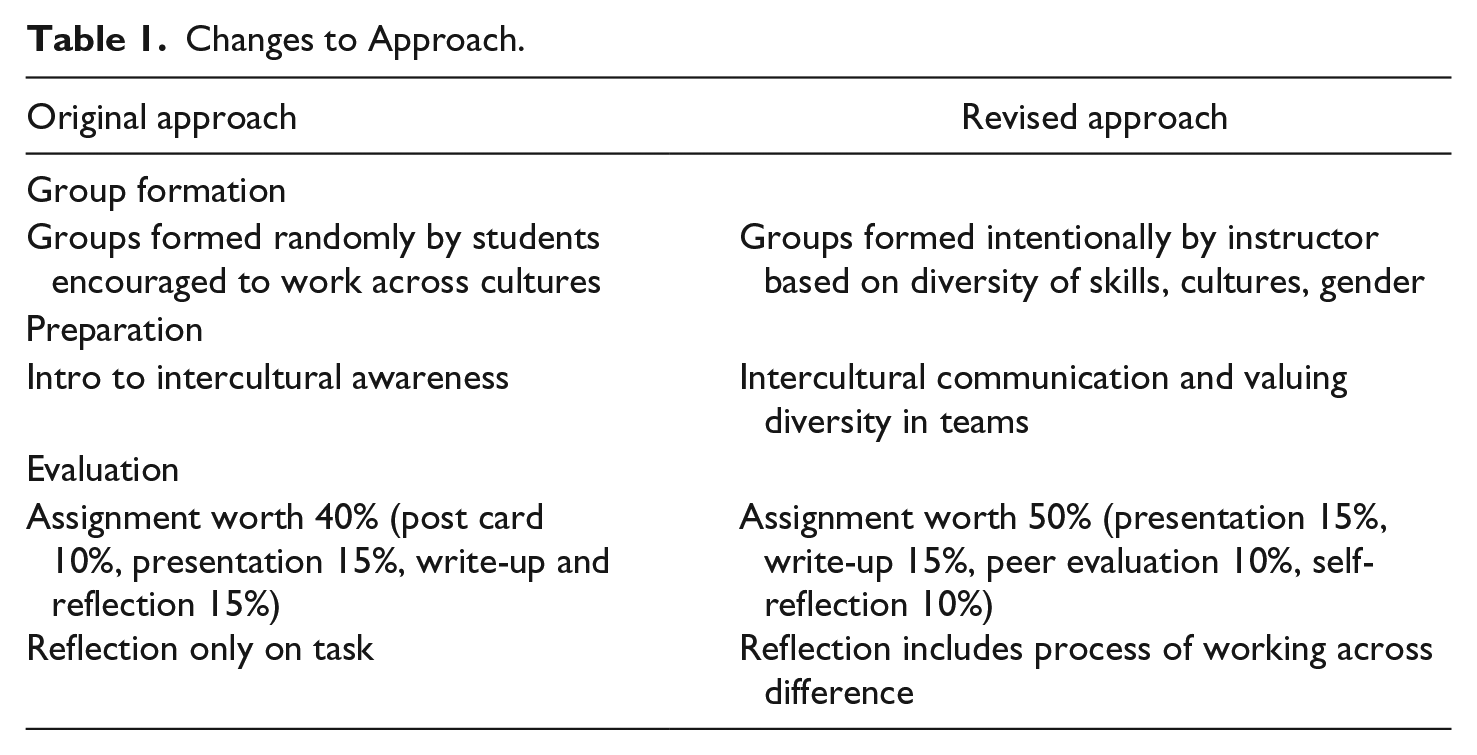
In the fall semester 2013, the course assignment, methods of assessment, and formation of groups were changed to provide students with an opportunity to reflect on their group experiences, with the intention to promote the development of intercultural awareness and skills. The original walking tour assignment was created in fall 2012 and was 30% of the course evaluation. The assignment had three segments: a post card of the tour (10%), an interpretive tour (15%), and a written description of, and reflection on, the tour (15%). Although students were encouraged to form culturally diverse groups, no structure was provided as to how the groups were to be formed; students were asked simply to form groups of three to four and proceed with the assignment. In an effort to raise an awareness of working across cultures, an invited lecturer provided students with basic instruction on intercultural communication, such as high and low context or preferences in terms of direct and indirect styles. Although student evaluations revealed that this part of the course was relevant, evidence about how this lecture influenced the group process was lacking. Although the written reflection could have been used for this purpose, it focused on the creation of the tour and connection to place rather than the group process; therefore, any evidence of intercultural learning or lived experiences working in diverse groups was lost due to the focus of the reflection.
In an effort to purposefully form groups that were not only culturally diverse but that captured the diversity of skills needed for the project, revisions were made to how the groups were formed. Reflecting on previous outcomes of this group assignment and consulting the literature cited in previous sections of this article, we concluded that it was important for students to experience cultural diversity and develop their ability to work with culturally diverse peers, while we were cognizant that culture as the main diversity factor could also result in negative experiences. To highlight what skills diversity can bring to the group work experience, the instructor asked students to identify the skills they brought to the project. This approach drew on the instructor’s 19 years of teaching rather than any established theory or method of practice. The rationale for this approach was to move beyond simply forming groups based on cultural diversity and include diversity of skills necessary to complete the task, so that students would not only share a common goal but collectively have the skills to be successful. At the beginning of the semester, students were given two pieces of colored paper. On one piece, they listed six characteristics of a successful group, for example, respectful of members’ ideas, sharing the workload, showing up on time, and so on. On the second piece of paper, they were asked to write down four strengths that they brought to the group, such as research skills, presentation skills, writing skills, and so on. They were also given an opportunity to write down the name of one person in the class with whom they would like to work. This allowed the students some agency in choosing a group mate while still allowing the instructor the freedom to strategically create the most optimal mix of cultures and skills for the majority of the groups. Interestingly, students often did not identify another person to work with and were content to let the instructor form the groups.
The instructor used this information, as well as the class list with the students’ county of origin and gender, to form groups that aligned complementary skills with cultural and gender diversity. Although the process of putting the puzzle pieces together was time-consuming for the instructor, students indicated an awareness and appreciation of the instructor’s effort in forming the groups.
In the revised approach, the focus of the invited intercultural lecture was expanded to include experiential activities that promoted a valuing of diversity on teams; exploring the role of stereotypes and assumptions in team selection; understanding the dimensions of general cultural frameworks such as individualism, collectivism, and power distance; and intercultural communication models such as high and low context, and direct and indirect styles. Moreover, students practiced using different styles based on the work of Storti (1994). These activities were designed to promote the development of cultural self-awareness, and to present intercultural capacity as a combination of attitudes, knowledge, and skills central to models of intercultural development (Bennett, 1993, 2012; Deardorff, 2006, 2009; King & Baxter-Magolda, 2005).
Finally, the assignment evaluation was altered from 30% in 2012 to 50% in 2013 to allow for self-reflection and peer evaluations focused on the process of working in a group rather than the product of the group’s work. Students were able to reflect not only on their lived experience as a member of a diverse group but also on the process they went through, including how their experience might inform future approaches to group work. Student self-reflections are used widely in practitioner-based disciplines where first-hand experiences are part of real-life learning (Brown & Schmidt, 2016; Isaacs, Rose, & Davids, 2016; C. Wood, 2016). Peer evaluations were used as a means for students to reflect on their contributions to the group process and identify areas of improvement through the criteria by which they would be evaluated (D. Wood & Kurzel, 2008). This type of evaluation is valuable in that students are given the opportunity to reflect and learn from the weaknesses and strengths identified by their peers (Langan & Wheater, 2003).
Table 1 provides a summary of the revised approach.
Changes to Approach.
Although place-based questions were still used in the self-reflection, seven new reflection questions focused specifically on the process of working in groups (see Table 2). Student responses to these questions provided the data set for analysis.
Individual Self-Reflection Questions Related to Group Work.
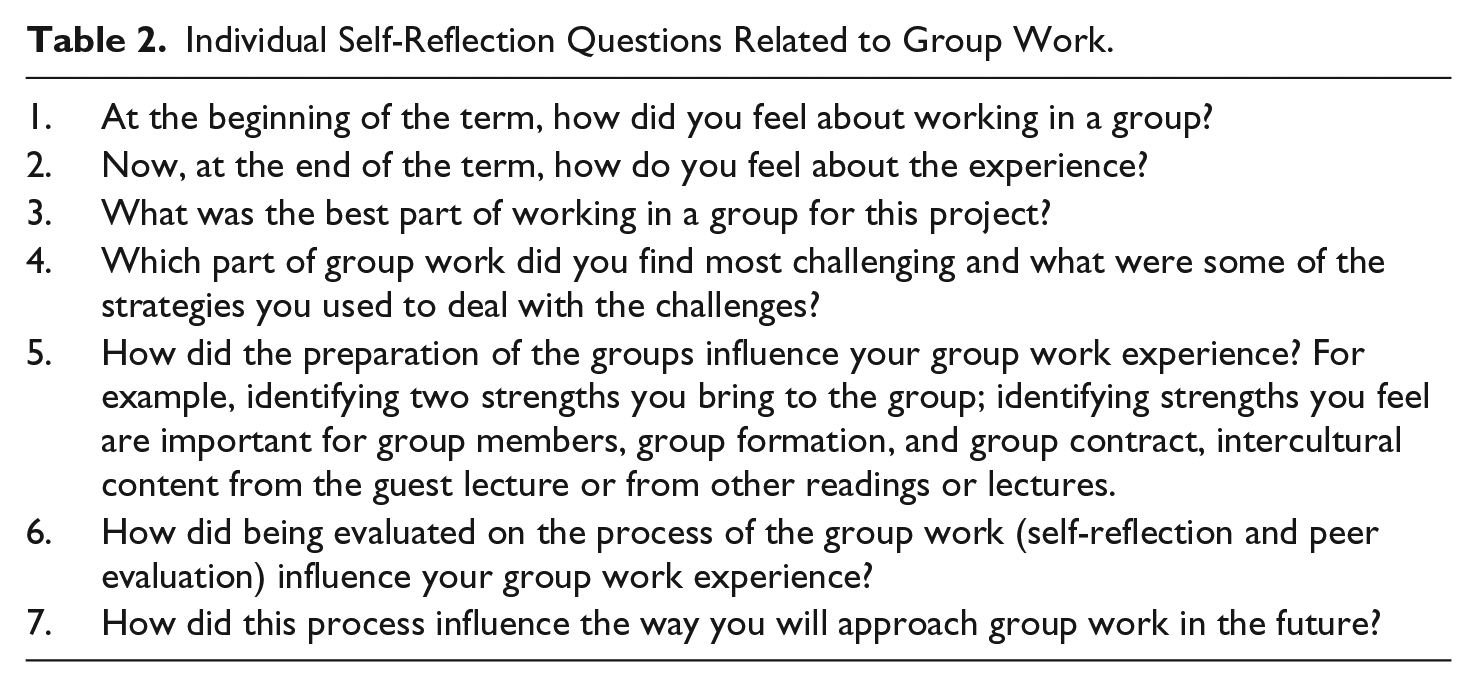
The self-reflection questions provided student perspectives regarding how specific aspects of the revised approach influenced their experience of group work, and how it may influence their approach to future group work. These reflections provided the data for analysis discussed next.
Method and Analysis
Reflections (n = 76) were collected over three semesters. Near the end of each semester, students prepared written responses about their previous experiences with group work and their perceptions of how the intentional formation, preparation, and evaluation of the group process influenced their current experience. Following the submission of these reflections, a third party invited students to participate in the research study. Each semester, between 65% and 70% of students provided consent for their reflections to be included in the study. These written documents were then transcribed and thematically coded and analyzed using Nvivo software to gain insights into whether the changes in formation, preparation, and evaluation of group work had influenced their learning experiences.
Student attitudes toward group work at the beginning of the semester and the end of the semester were quantified to measure shifts in experience that may have resulted from instructional changes. Codes were assigned to shifts in student perceptions toward group work pre and post semester, for example, negative to neutral, negative to positive, and positive to neutral. Next, the reflections were coded to provide insights into students’ experiences of group work generally, and more specifically their perceptions of how the intentional changes influenced their experiences. Comments were analyzed for frequency, and those specific to pedagogical changes were quantified to determine the efficacy of each pedagogical revision.
Findings
In the following section, student reflections reveal their perceptions of how specific changes to group formation, intercultural preparation, and evaluation of group work influenced their experiences of multicultural group work.
Attitudes Toward Group Work
Our analysis of the first two reflection questions explored participant attitudes toward group work at the start of the semester and at the end of the semester. Of the 76 study participants, 56 (74%) began the semester with either a neutral or negative attitude toward group work; 42 of the reflections revealed negative attitudes, and 14 were neutral, revealing neither negative nor positive attitudes. At the end of the semester, 59 (78%) of the participants claimed to have had a positive experience. Table 3 illustrates the participants’ shift in attitude.
Shifts in Attitude From Start to End of Semester.
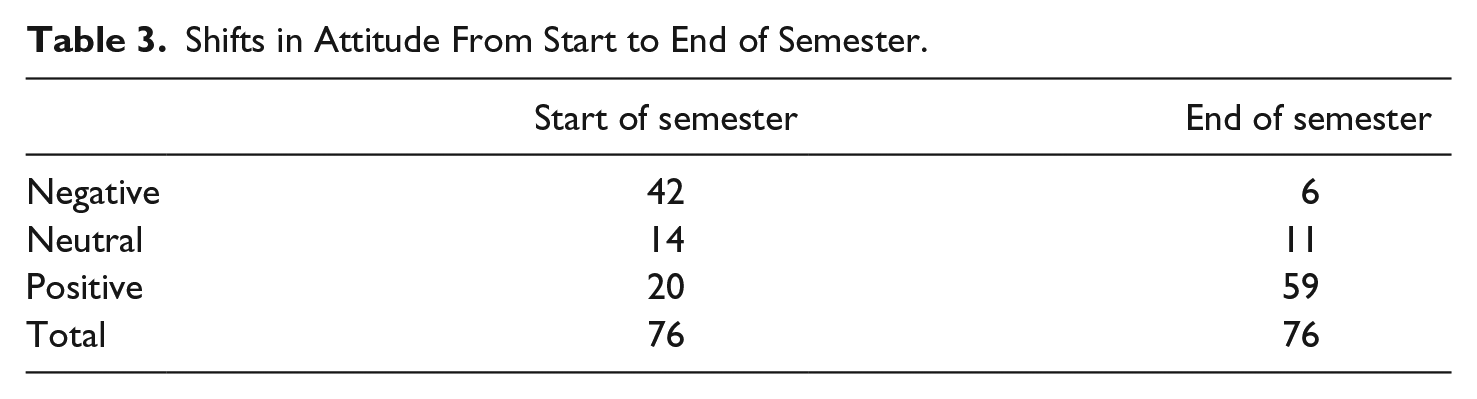
The largest shift was from negative to positive, with 30 participants starting the semester with negative attitudes but finishing the semester having had a positive experience. The following quotes are examples from two participants who shifted from negative to positive.
This international student shared her feelings at the start of the semester: When I heard we were doing group work again I shouted ‘Oh my God, not again’ in my mind. It means I still need to be tortured again and again.
At the end of the semester, her attitude had changed: Such an amazing experience. This time the group experience was impressive and enjoyable.
A Canadian student shared his thoughts on group work at the start of the semester: Throughout university, group work has been a challenge for me. When you said you would be picking group members, I was concerned.
At the end of the semester, this student reflected, This experience opened my eyes though. I believe this exercise will stick with me and keep me from avoiding new partners of different nationalities.
Although the shifts from negative to positive were the most numerous, another 11 participants shifted from neutral to positive. One participant started positive but had a negative experience, and one went from positive to neutral. Three began and remained neutral, seven moved from negative to neutral, and five began and remained negative about group work.
The prevalence of negative attitudes toward group work at the start of the semester prompted further analysis of those reflections. Comments ranged from nervousness or apprehension to fear and even claims of depression. For example, in the responses to the first reflection question, the word worried was used 27 times, nervous was used 14 times, and anxious was used 8 times.
Many students expressed negative attitudes toward group work as a result of previous experiences. Our analysis of these comments revealed that many students’ previous experiences as a member of multicultural groups had been strained or stressful. Four main themes emerged as sources of challenges. The most prevalent were issues around the division of work, for example, perceived differences in standards or levels of dedication, or perceptions of freeloading. Numerous comments suggested that many students’ frustration led to them simply doing the work themselves, which may actually have resulted in further misunderstanding and division.
The second challenge concerned scheduling, in particular, the difficulties of arranging meetings outside class time due to conflicting class, work, or personal schedules. This raises fundamental questions for educators as to why we are asking students to do group work. What purpose is it serving and who is it serving? In other words, how does group work facilitate the learning outcomes of the course?
The third challenge related to grades and perceived risks to individual outcomes as a result of working with others. This concern often was expressed in tandem with the first challenge in that if their group mate’s standards were not high enough, they could be risking their academic standing—hence the urge to just do the work themselves.
The final challenge related to the formation of groups. Many participants expressed anxiety around working with people they did not know and/or having the instructor choose the groups. Although both Canadian and international students expressed concerns about not having control over who they worked with, the international student comments more frequently addressed anxiety around language proficiency, communication differences, and differences in culture. The following section discusses the group formation in more detail by providing evidence that the changes implemented were both recognized and appreciated by students.
Group Formation
The revised group formation was determined primarily by the instructor, with some input from students, and this combined method appears to have yielded benefits. Student reflections revealed their initial anxiety often gave way to relief at not having to work with friends, or experience exclusion when the groups were chosen by their peers. The following comments illustrate these sentiments: I think that how the groups were assembled definitely made a huge difference. I found that this method was more beneficial than working with friends. When working with friends, it’s often harder to deal with differences that arise and conflict due to not wanting hurt anyone’s feelings. (domestic student) The formation of the groups was very beneficial because people weren’t able to work in their cliques, and this definitely allowed us to learn new things from each other as well as make friendships we otherwise wouldn’t have made. (domestic student)
Comments also indicated that students valued the diversity of the individuals on their teams, many commenting on the importance of multiple perspectives: As for the group, the best part for me was how diverse it was and all the different perspectives that were brought to the table and meetings. (domestic student) I think the Canadian students in our group really tried to appreciate that different students have different life experience and backgrounds. Both of us believe diversity can add depth and breadth and produce a completely new understanding of the ideas discussed. (international student)
The intentional formation of the groups based on a variety of diversities also was recognized by the majority of the participants. Reflections revealed that asking students to consider what skills they could offer their group allowed them to self-reflect on what they were good at and what they could improve on. Moreover, once they were in their groups, they gained a heightened awareness that they were put together for a reason and that they could rely on each other’s strengths. The following comments illustrate this awareness and the development of team cohesion: I was surprised by the way we formed our groups. Forming groups is usually either done by the teacher, or we form our own groups; this time was a little bit of both. However, I think this is very effective. We write down what our strengths and weaknesses are so that the members in the group can complement each other. This influences my group work experience in a good way; groups are more balanced. (international student) I liked that everyone had their own skill to contribute to the project. I did not feel limited in what we can accomplish, simply because I know I have a group mate who can do it. (domestic student)
The comments in this section clearly illustrate that the intentional formation of groups based on diversity of cultures and skills was seen as valuable to the learning experience. Student perspectives on working across differences were enhanced as a result of a careful group-selection method, as well as the preparation to work with cultural diversity, which is discussed next.
Intercultural Preparation
As the previous sections and quotes have illustrated, many reflections demonstrated an increased awareness of diversity as valuable to the learning experience. Question 5 of the guided self-reflection invited participants to reflect on how aspects of preparing the groups influenced their group work experience, including the formation of groups, identifying strengths, and the intercultural lecture. Forty-four (58%) participants included aspects of diversity or intercultural awareness in their reflections. Further analysis of responses to Question 5 revealed that five of the six participants who remained negative to group work throughout the semester chose not to reflect on the preparation but rather took the opportunity to reflect on the weaknesses of their group. An additional seven responses misunderstood the question and reflected on their group planning rather than the instructor-initiated preparation. The remainder of the responses were pragmatic more than reflective in that they did not explicitly discuss any of the intentional preparation and instead reflected on things such as schedules, roles, and responsibilities of group members. Although these responses point to the need for more clarity in the guided question, we believe it is significant that as many as 30 participants (40%) directly referenced the intercultural content during class time and used terminology from the intercultural lecture in their reflections indicating an internalization or application of some of the content. Moreover, these comments illustrated self-reflective attitudes about how they worked with and managed cultural diversity in their groups. The majority of comments about the intercultural preparation focused on an increased awareness of communication styles, which is illustrated by the following quotes: The class on intercultural gave me more information about different styles of communication, which I was able to apply while working with team mates. (domestic student) Having that deeper understanding of people’s communication methods and values made it easier for me to understand and be more accommodating with team members different work styles. (international student) I started noticing almost immediately how each person in my team has a different way of communicating as well as how they work. I tried to take this into account in how I communicated and treated my team members. (domestic student)
These selected comments suggest that when students are provided with basic information about cultural differences and communication preferences prior to engaging in group work, as well as time to reflect on their own preferences and behaviors, group work is likely to support more effective interactions and promote intercultural learning. The next section provides student perceptions on how changes in the evaluation of their group work influenced their experience.
Evaluation
The sixth reflection question asked participants to consider how having the process of working in a group included in the project evaluation influenced their group work experience. Although peer evaluations were not included as data for analysis, they did provide students with the opportunity to reflect on multicultural group dynamics as they were guided by questions that prompted reflection on the intercultural skills and strategies used during the group process. For example, they were asked to evaluate peers on their willingness to be collaborative and inclusive of other perspectives, and their ability to work with different communication styles.
Overall, 40 participants (53%) felt that the evaluations positively influenced their group work experience, and another six (8%) acknowledged that the influence of these evaluations was slight. Nineteen participants (25%) maintained that these evaluations had no influence, and 11 participant responses (14%) failed to state clearly whether these evaluations influenced them or not. Of the 19 students who were not influenced by the evaluations, two participants felt that peer evaluations were not useful in anyway, and the rest claimed that evaluations did not generally influence their performance, because they always would do their best work regardless of an evaluation.
Of the 46 (61%) participants who felt that the evaluation influenced their experience, 40 (53%) clearly articulated the benefits of this approach. Two main themes emerged from the analysis: that the evaluation allowed for reflection and review that could lead to improvement or future development, and that the evaluation process helped with accountability, both their own and those of the other group members. The following comments illustrate these themes: I did, however, think about the self-reflection constantly, just making mental notes of the way things were proceeding, and what shortfalls I saw. (domestic student) This self-reflection also allowed me to look back on the semester and compile a list of what I gained from this assignment that I probably wouldn’t have even realized. (domestic student) The evaluation process of the group work made me think ahead of time of how my peers would evaluate my work, and therefore motivated me to work efficiently and demonstrate positive group work skills. (international student) Knowing that we were being evaluated on the process of the group work made my group focus more on the process and not just the result. (domestic student)
Participant comments regarding group formation, preparation, and evaluation illustrate that the changes implemented influenced the students’ experiences of multicultural group work. They demonstrate that the participants had an awareness of themselves and others in the process of working in a group, while still concentrating on the product of their work together. In particular, these reflections illustrate that the careful formation of the groups based on a variety of diversities, including complementary skills, was a positive influence for most participants. The intercultural preparation enhanced their cultural self-awareness when working in groups, which is a critical component of developing intercultural competence (Deardorff, 2006). Finally, the shift in evaluation assisted some participants by providing an accountability framework that enabled them to reflect on their role and their learning.
Discussion
The purpose of this study was to explore student perceptions of multicultural group work, specifically when groups are intentionally formed, when preparation for working across difference is included in the course work, and when the process of working with culturally diverse peers is formally evaluated as part of the course as recommended in the literature (Arkoudis et al., 2010). The results show a positive relationship between the pedagogical interventions and curricular changes introduced and students’ experiences of multicultural group work. The positive experiences of the majority of participants in this study were the result of carefully designing how groups are formed based on a diversity of skills, cultures, and genders; providing students with instruction on the value of diverse perspectives and intercultural communication skills; and evaluating the process of working together rather than only the product of the group work.
As many as 56 students (74%) began the semester with negative attitudes toward group work; however, after specific changes, 59 students (78%) reported having a positive group work experience. Previous scholarship citing difficulties with multicultural class and campus dynamics has alerted educators to the possibility that unintentional approaches may bring unintended results, such as fear or avoidance of interaction (Garson, 2013; Osmond & Roed, 2010), or dissatisfaction with the quality of interaction (Gareis, 2012; Grayson, 2008; Leask, 2010); however, at the same time, ample empirical evidence exists that diversity experiences complement student development (Denson & Bowman, 2013; Umbach & Kuh, 2006; Lee et al., 2012; Seifert et al., 2010). The present study contributes to the literature by providing insights into how specific pedagogical and curricular revisions can influence students’ perceptions of group work, and intercultural awareness and skills development.
Recognizing that research on group-selection methods is limited, the studies suggest that self-selection methods result in higher levels of perceived commitment, trust, and group outcomes (Chapman, Meuter, Toy, & Wright, 2006). Our findings illustrate that although many students voice their preference to choose their own group mates, others may experience stress related to the selection process. Language issues, perceived discrimination, and the idea that domestic students already have established networks also have been explored in the literature (Harrison & Peacock, 2010; Montgomery & McDowell, 2009; Rienties et al., 2013; Russell, Rosenthal, & Thomson, 2010). The findings of this study are consistent with previous research in demonstrating that student aversion to group work is prevalent and complicated by assumptions about working with culturally different peers as the following participant comment illustrates: I always feel that other students are not willing to work with Chinese people in a group. It happens with Chinese students a lot that it’s really hard to find group mates to do a group project. (international student)
Participant perceptions regarding the formation of groups illustrate that although students may complain about not being able to choose their groups, some also genuinely appreciated the careful formation of groups, and for many, not having to choose or be chosen provided a relief from the social tensions of choosing group mates. The experience of being put in a group with others changed the perspectives of many as the following comments indicate: Next time I have to choose a group I will definitely chose a more diverse group instead of just being with my friends. (international student) The experience opened my eyes though. I believe this exercise will stick with me and keep me from avoiding new partners of different nationalities. (domestic student) The experience opened my eyes though, that in other classes and situations, I will generally stick to the near and dear acquaintances I’ve previously worked with. And regrettably, avoid trying to make new partners of different nationalities. I believe this exercise will stick with me though in making these types of decisions in the future. (domestic student)
Although ample evidence exists that students have experienced difficult intercultural interactions in culturally diverse educational settings, the findings of this study illustrate how pedagogical interventions may serve to enhance their learning experiences. The preparation of students to work with culturally diverse peers was an important influence on their group work experience. Participants in this study became more aware of their own and other’s communication styles and culturally influenced preferences. Their reflections illustrate not only an increased awareness but also the development of intercultural skills as foundations for their personal and professional roles. Although the intercultural content was introductory, it had a lasting impact for many participants as the following comments illustrate: I learned that we may be from different cultures and have varying perceptions, but we can make these differences work to our advantage. (international student) This project, like no other before, showed me how attitudes and mindsets differ around the world and taught me how important it is to know how to deal with those differences. This project was a very valuable experience and an actual real-life example of how my group projects in the future might look like. (domestic student)
Participants’ perceptions varied with respect to how the evaluation influenced their experience. However, it is clear to us as educators, and educational researchers, that providing structured reflection resulted in an articulation of learning that may have been otherwise lost. Although knowing they would be evaluated on the process did not change the experience for all participants, many valued the reflective learning for its application beyond the course.
Limitations and Recommendations for Future Study
Although our data included participants over three different semesters, the perspectives collected and presented here are from one course in one discipline, and are therefore limited in scope. If similar studies could replicate the results in other disciplinary contexts, the findings would be more widely applicable. Although our approach to the direct teaching of intercultural frameworks spans the first three of six recommendations in Arkoudis et al.’s (2010) framework—planning for interaction, supporting interaction, creating environments for interaction, engaging with subject knowledge, developing reflexive processes, and fostering a community of learners—future studies might more explicitly explore how an emphasis on specific recommendations might influence students’ experiences. It also would be advisable to further explore the role of group formation in recommendations for facilitating multicultural group work, as our participants clearly identified the intentional group formation as influencing their experience.
Participants in this study were third-year students who had established attitudes toward group work. Further investigation of how similar interventions might mitigate the development of negative attitudes earlier in students’ academic careers may be warranted.
Moreover, participants were asked at the end of the semester to reflect on their prior perceptions and experiences of working in groups. To gauge pre- and post-attitudes more effectively, the methodology should be revisited to allow for pre and post response comparison. A more detailed pre-analysis could also address the complexity and influence of previous experiences.
The intercultural session was limited to one class. Given the clear influence of this preparation on students’ experiences, perhaps more class time could be devoted to intercultural development throughout the course. Further research could more closely examine students’ intercultural development pre and post intervention, and attempt to isolate which aspects of the intercultural content contribute directly to student development.
Conclusion
The design of multicultural, collaborative assignments has been a topic of a great deal of discussion. Studies illustrate the need for educators to purposefully design interactions that challenge students to explore cultural differences and similarities as part of explicitly expressed course outcomes. Clearly, experiences with diversity are considered important to student development, and yet often, these experiences miss opportunities to promote meaningful interaction. This study sought to contribute to the scholarship of teaching and learning by exploring strategies to enhance students’ experiences of multicultural group work and promote intercultural learning. In our design of a revised approach to a specific assignment, we were influenced by the previous scholarship aimed at improving multicultural group work and the knowledge that positive and skill-developing interactions are not likely to happen without intentional planning. The results of our study confirm that planning for and designing meaningful interaction are critical, preparing students by providing them with intercultural frameworks can develop cultural self-awareness, purposeful group formation can improve students’ experience, and including reflection on the process as part of the assignment can help students to develop the attitudes and skills necessary to work across difference.
Footnotes
Declaration of Conflicting Interests
The author(s) declared no potential conflicts of interest with respect to the research, authorship, and/or publication of this article.
Funding
The author(s) received no financial support for the research, authorship, and/or publication of this article.