




Abstract
Cultural competency, in increasingly globalized and cosmopolitan societies, is key to allied health graduate employability. Internationalization at Home initiatives that use virtual technologies have potential to facilitate transformative intercultural learning experiences and build cultural competency. The purpose of this study was to trial a virtual intercultural learning activity with Australian and Hong Kong undergraduate occupational therapy and oral health students to explore cultural competency learning. We utilized a mixed methods study design with quantitative pre- and postsurveys and qualitative group interviews. Study findings illustrate how the activity enabled students to practice and learn intercultural communication skills, gain greater awareness and appreciation for diversity at home and abroad, and engage in global citizenship learning. Educators are encouraged to utilize virtual learning spaces for creating meaningful and transformative cultural learning experiences that enhance graduate intercultural capabilities.
Keywords
Introduction
Employability is increasingly a core responsibility of the higher education sector. Educators need to support students to learn and apply skills such as cultural competency that are globally recognized as desirable by employers (United Nations Educational Scientific and Cultural Organization, 2014), particularly, within an allied health context. The purpose of this study was to determine whether participation in a virtual intercultural learning activity, underpinned by Internationalization at Home (IAH) pedagogy, improved undergraduate occupational therapy and oral health student cultural competency.
In a health context, cultural competence can be defined as “the ability of a care provider to interact with clients who are different to them,” which involves “awareness of one’s own biases or prejudices and is rooted in respect, validation and openness towards differences” (Darby & Knevel, 2014, p. 68). Our aim was to develop a learning activity that would encourage self-reflection and intercultural interaction within a virtual learning space. Students engaged in an online intercultural discussion and written task, which enabled them to recognize and understand cultural similarities and differences (Darby & Knevel, 2014). This activity was informed by Leask’s (2009) IAH pedagogical approach, which argues for the integration of learning tasks that are “structured in such a way that they cannot be successfully completed without a meaningful exchange of cultural information” (p. 211).
The process of developing cultural competence demands critical reflexivity (Beagan, 2015), awareness of one’s own culture, and the ability to identify existing cultural bias (Darby & Knevel, 2014). We conceptualized cultural competency as encompassing intercultural knowledge, attitudes, and skills. Cultural competencies that are linked with global citizenship are key characteristics of what Lilley, Barker, and Harris (2016) attribute to the “ideal global graduate” (p. 1). In an allied health teaching and learning context, global knowledge and social responsibility, awareness, and advocacy are identified as important cultural competencies for our students, and future graduates.
This research involved trialing and evaluating a virtual intercultural learning activity, completed by domestic students located in Australia and Hong Kong, to determine whether cultural competence can be enhanced via virtual intercultural interaction, utilizing inexpensive and accessible information and communication technologies (ICT). We provide (a) an overview of the IAH approach and current issues affecting implementation; (b) a brief description of the study context and participating allied health courses; and (c) the research methods, findings, and discussion.
Background
The development of global citizenship capabilities (Lilley et al., 2016) are often subsumed within a diverse range of objectives and strategies associated with higher education internationalization policy. Knight (2004) offered a view of internationalization as ongoing and developmental, being “the process of integrating an international, intercultural or global dimension into the purpose, functions or delivery of post-secondary education” (p. 11).
A key point in this definition is that of “global” dimension. Internationalization is noted to be related to but distinct from globalization. Knight (2004) refers to globalization as being the context within which internationalization sits and hence a key driver of internationalization in higher education (Altbach & Knight, 2007). In addition, the internationalization agenda is associated with the increased marketization of higher education, whereby international student fees (Robson, 2011), international profile, and global rankings are the focus (Knight, 2015).
Student mobility is identified as an important strategy to enable students to develop intercultural competencies (Daly & Barker, 2010; Killick, 2012; Lilley, Barker, & Harris, 2015). However, there are financial and other barriers associated with the provision of an international mobility experience for all students. Critics of study abroad programs have identified that short-term experiences can be “too isolated, are poorly implemented, do not meet participants’ needs, and unintentionally promote stereotypical views of host cultures” (Wynveen, Kyle, & Tarrant, 2012, p. 335). In addition, institutional factors can influence student participation rates, including organizational leadership and culture (Daly & Barker, 2010).
Given the shortcomings of mobility as the sole means by which students might develop a global perspective, the development of strategies involving all students, at home, is vital. Leask (2009) argues “the development of intercultural competencies in students is a key outcome of an internationalised curriculum,” which requires a learning environment and culture that directly motivates and rewards cross-cultural interactions and relationship building (p. 205). According to Knight (2015), IAH refers to a range of education efforts including the development of intercultural understanding and skills, language training, comparative studies, and integrating an international and intercultural dimension into extracurricular activities (p. 85).
The development of global knowledge and intercultural understanding and skill, a long-standing concern of a number of disciplines (particularly those in allied health), has come to be associated with the goal of education for global citizenship. However, the notion of global citizenship has competing conceptualisations. For example, Harrison (2015) identified an economic orientation concerned with producing global “workers,” running alongside a discourse more sharply focused on citizenship, which emphasizes the importance of global problem solving by a “new generation of global citizens who are equipped with the awareness of the interconnectedness of the modern world and the agency to initiate change” (p. 420). Hanson (2010), incorporating ‘glocal’ (meaning global and local) and social justice learning, described the global citizen as one who is “involved locally, nationally, and internationally; is conscientious, informed, and educated about issues; exhibits environmental and social responsibility; advocated alongside the oppressed” (p. 80). These works informed the development of our intercultural learning activity, and its evaluation.
In many conceptualisations, the importance of cultural awareness and the ability to act skilfully in the presence of diversity are evident. A number of authors have highlighted that the road to cultural understanding lies not so much in understanding the “other” but in understanding self. On this point, Rizvi (2009) argues cosmopolitanism implies that learning about others requires that we learn about ourselves and that we understand others both in their terms and ours (p. 266). For the educator “at home” then, there appears to be a fundamental need to create learning experiences that have the ability to develop “beliefs, attitudes and dispositions that underpin an equal and respectful discourse between cultures, as well as a tolerance to difference and an empathy to understand alternative perspectives” (Harrison, 2015, p. 420). Learning experiences and tasks must promote meaningful and personally challenging intercultural interaction (Leask, 2009). Moreover, such experiences should aim for critical reflexivity (Beagan, 2015) and transformative learning (Mezirow, 2000) achieved through the supportive structuring of disorienting dilemmas (Herbers & Mullins Nelson, 2009) and out-of-comfort-zone learning (Lilley et al., 2015).
In the context of a range of understandings of what internationalizing the curriculum could include, educators lack knowledge on how to do this in ways that are effective, inclusive, and lead to desired cultural learning outcomes (Daly & Barker, 2010; Deardorff, 2006; Hanson, 2010; Simm & Marvell, 2017). The current study utilizes a virtual intercultural exchange as the basis for building cultural competence and evidences possible moments of transformative learning.
Research Aim
The purpose of this study was to trial a virtual intercultural learning activity with undergraduate occupational therapy and oral health students to explore cultural competency learning.
Study Context
The virtual intercultural learning activity was facilitated with students enrolled in three different subjects, across two universities. An outline of the intercultural learning activity is provided in the Supplementary Material. Participants at La Trobe University included occupational therapy and oral health students. Occupational therapy students were located at a metropolitan campus (Melbourne, Victoria) and a regional campus (Bendigo, Victoria). Occupational therapy students were enrolled in the first-year subject Introduction to Occupational Science (OCT1OCS), delivered online to students at both campuses. This is a core subject completed in an intensive 3-week block mode. Oral health students were enrolled in a 3-year subject, Integrated Oral Health Practice (ORH3IOH). The subject is a core (capstone) subject focused on practice preparation. Students need to demonstrate competence in all domains described by the Australian Dental Council, including intercultural capabilities. It is a 2-semester-long subject, including clinical placement (and a 2-week study abroad elective is offered).
At Tung Wah College, Hong Kong, occupational therapy student participants were enrolled in the first-year subject, Culturally Relevant Occupational Therapy (RSS2003). This subject is delivered over a 14-week semester, using face-to-face methods.
Approach/Method
Study Design
The sequential, exploratory mixed methods study design involved a quantitative online pre- and postsurvey, followed by qualitative group interviews (Ivankova, Creswell, & Stick, 2006). The aim of the quantitative survey was to evaluate student cultural competency. The group interviews were used to describe qualitative indicators of cultural competency learning (Ivankova et al., 2006). Both the quantitative and qualitative data were given equal priority for data collection and analysis, and methods were integrated throughout data collection and analysis (Ivankova et al., 2006). Study procedures were approved by human research ethics committees at both institutions. This was a pilot study that we hoped would reveal new findings that could be used as a catalyst for further investigations.
Recruitment and Sampling
Research recruitment advertisements were distributed by email. Students were invited to voluntarily participate in online pre- and postsurveys and a group interview. Two research assistants, one in Australia and the other in Hong Kong, managed student recruitment to protect student anonymity from researchers, who were also their subject coordinators.
Online Survey
Data collection
The online survey was administered pre- and postactivity completion. The presurvey was sent via email to students 2 weeks prior to commencing the activity. A link to the postsurvey was emailed to students at the end of the activity. The cultural competency survey questions are provided in the Supplementary Material. No existing survey was found that measured the desired set of cultural competencies, using an accessible format (suitable for a short, online survey). Our survey incorporated items from existing tools (including the Intercultural Sensitivity Scale (Chen & Starosta, 2000), Ethnocentric Tendency Scale (Chui & Leung, 2014), and the Global Citizenship Scale (Morais & Ogden, 2011).
Data analysis
Independent t tests were carried out using SPSS to compare pretest (T1) and posttest (T2) scores. This was to determine changes in cultural competency to compare the student groups and to measure significance. Five of six survey items had high internal consistency (α ⩾ 0.7; cultural confidence α = 0.877; cultural engagement α = 0.820; cultural respect α = 0.916; attitudes and preferences α = 0.717; social responsibility and awareness: global justice and disparities α = 0.835; and social responsibility and awareness: global knowledge α = 0.545).
Group Interviews
Data collection
The group interviews were conducted within 6 weeks of activity completion. Research assistants facilitated the interviews using a semistructured interview guide. Questions included the following: What did you learn about cross-cultural interaction from participating in the activity? Can you tell me about a particular time during the activity where you felt “out of your comfort zone”? How will you use this experience and knowledge as an allied health student and a future professional?
Duration of group interviews ranged from 45 to 60 min. The Hong Kong group had nine participants, Melbourne had two, and Bendigo had three. The group interviews were audio-recorded and transcribed verbatim. Group interview participants were placed in a draw to win an AUD$50 gift voucher.
Data analysis
The group interview transcripts were analyzed using a qualitative, directed content analysis to identify key themes (Graneheim & Lundman, 2004; Hsieh & Shannon, 2005). Directed content analysis involved using existing theory to determine whether indicators of student learning were present. Theory informed the initial coding scheme and coding decisions (Hsieh & Shannon, 2005).
Four researchers independently conducted preliminary broad-brush coding (Graneheim & Lundman, 2004). Researchers compared key text (meaning units) and possible codes with reference to cultural competency learning (Chen & Starosta, 2000; Chui & Leung, 2014; Morais & Ogden, 2011) and intercultural learning theory (Lilley et al., 2015). Line-by-line coding was completed using a semistructured codebook. Codes were sorted into categories, and all researchers agreed on the final themes.
Findings
Survey Findings
Student cohort
Activity participant location and survey response rate
The participant cohorts were categorized by location (Hong Kong, Melbourne, and Bendigo). Table 1 contains activity participant location and survey responses rates. Only 11 students had previously participated in an international mobility program (N = 11, 8.5% of presurvey respondents) from Bendigo (n= 9) and Hong Kong (n = 2).
Participant Location and Survey Response Rate.
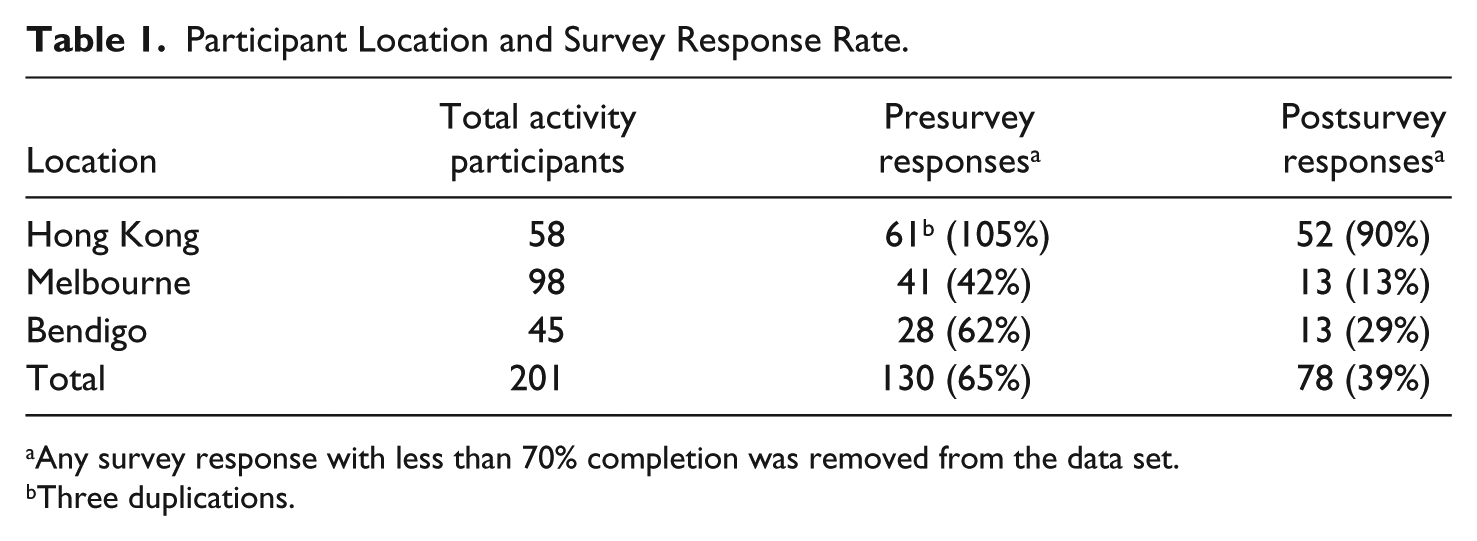
Any survey response with less than 70% completion was removed from the data set.
Three duplications.
Cultural competency
Pre and post means for each location (Australia and Hong Kong) were compared to determine differences in cultural competency between student cohorts (at T1 and T2). Figure 1 illustrates Australian students had higher cultural competency scores for all items. There was a significant difference between the two student cohorts for social responsibility and awareness: global justice and disparities (p = .004). No significant improvements in cultural competency were identified. A significance decrease in cultural competency was identified in both student cohorts for item social responsibility and awareness: global justice and disparities (Australia: p = .038; Hong Kong: p = .043; see Table 2). This change reflects greater uncertainty in student views (more “neither agree or disagree” responses).

Pre- and posttest difference for cultural competency items.
Pairwise Comparisons.

Group Interview Findings
Intercultural communication skill learning
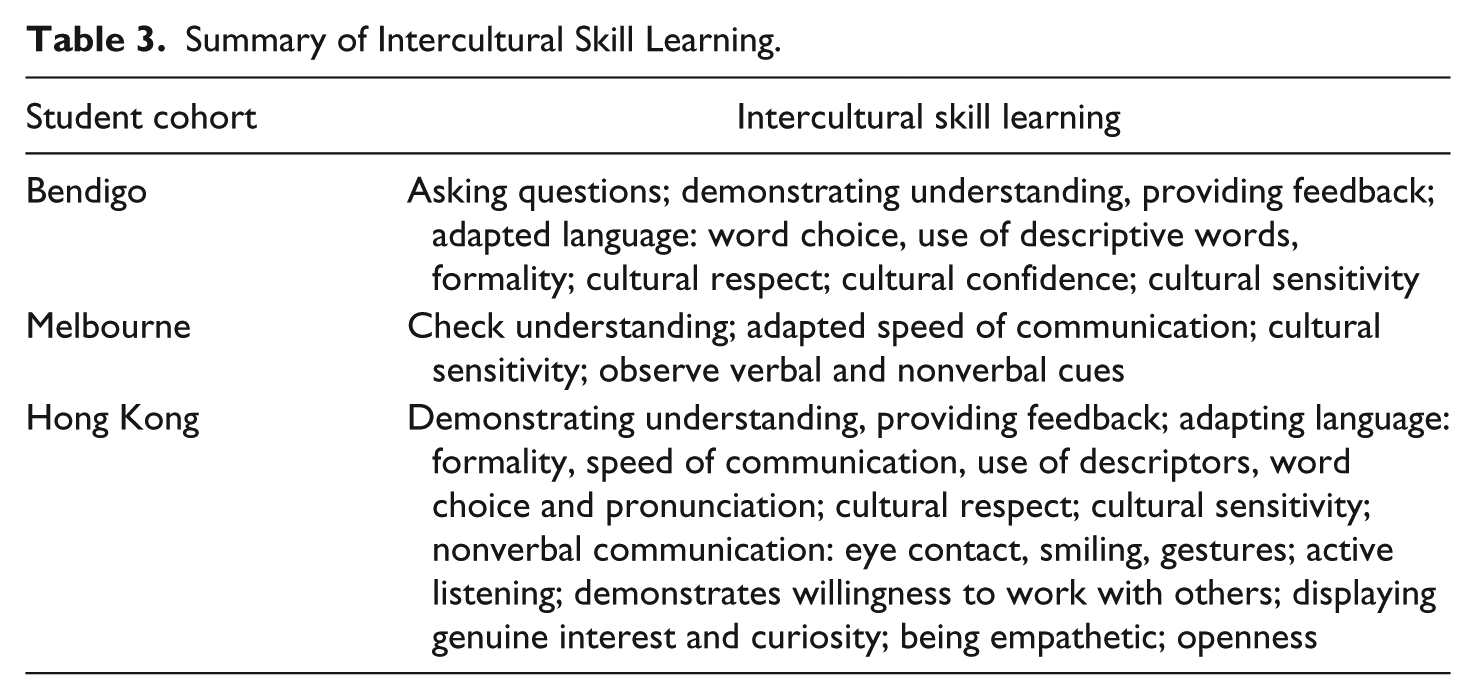
The group interview findings demonstrate that students had the opportunity to practice a myriad of intercultural communication skills. The skills identified by students who participated in the group interviews are listed in Table 3.
Summary of Intercultural Skill Learning.
The student responses demonstrated that active listening and asking questions were important. A Bendigo student explained, “we were always asking questions like, not interrupting, but waiting for a pause to give feedback . . . [We would] ask questions to like reassure [them] that we understand what they were talking about.” Similarly, a Hong Kong student said, “I think during the communication I learnt how to let people know I engage in the communication. For example, after they expressed their ideas or suggestions, I should give them feedback.”
A Hong Kong student described how they learned demonstrating curiosity was important: I think in order to help us to understand more about each other’s cultural background, I think two skills are essential. One is we have to be active listeners. We have to listen to what they say and also need to be curious. I think these two skills are needed in order to break away some stereotypes and in order to understand better the cross-culture.
Adaptation of language was a key intercultural communication skill identified by all three cohorts. Language was adapted by using different words to communicate meaning. A Hong Kong student provided an example of how they learned to adapt language and word choice: I learnt some communication skills from this programme. Such as, when I talked or texted to Australian students, I should avoid using language that only our country/city understand. Also, there are some differences in our mindset. For example, the word “near,” the distance may be different. For example, for Hong Kong students, the word “near” may be “only walk for 2 to 3 minutes.” But the word “near” for them may be 10 to 15 minutes. So sometimes, when I came across these words, I have to ask more about it. (Hong Kong student)
All student cohorts reported that demonstrating cultural sensitivity and respect was important. The Australian students said, “you sort of approached the topic a bit more cautiously and you picked your words a bit more carefully” (Melbourne student), and “[I learned] Just to be mindful of other people’s background whether they’re Australian, or Hong Kong or just whatever, like don’t come in with an expectation” (Bendigo student). Similarly, Hong Kong students said, It’s helped me become more confident in interacting with people that are from a different culture, because I think now a lot of people get offended easily so I’m just always like so anxious to not offend people that I think it’s changed the way I interact with people.
Diversity abroad and at home
The student responses demonstrate that they learned about cultural diversity abroad and at home. This learning occurred through comparing their cultural backgrounds and experiences. Key cultural comparisons described by all three cohorts were university study habits, routines and values, health care systems and health conditions, living situations and physical location (environment), and ethnicity. This enabled them to become aware of similarities and differences between themselves and other students.
Student discussions of study habits, routines, and values provide examples of their participation in intercultural comparison. Australian students, for example, were surprised to hear about the Hong Kong student perspectives of education: one of the girls [Hong Kong female] asked us what our study was like and yeah we just like fit it in whenever we can [laughs] and she was like whoa, she said we’re like looked down upon if we got to bed early. We’re expected to stay up to the early hours of the morning and study and yeah she was like it’s really full on. (Bendigo student)
Similarly, a Hong Kong student said, Australian people may be given more freedom or they may have more time to hang out or play around. But, during the discussion or the meeting, one of the groupmates has mentioned that she was not able to hang out or she should go back home before eleven o’clock. I think that was quite a punishment to me because my parents give more freedom to me and I may get back home at around one to two o’clock. This is quite okay for them. They never scold me.
Generally, student responses reflected that they valued the opportunity to learn about different cultures, a Melbourne student said, Well from what I read about their life and everything, I was more surprised and an eye opener to see, how they live their life and what’s important to them, because we never really spoke about those kind of things with someone from Hong Kong before.
Australian student responses reflected that they learned and became more aware of cultural diversity at home by interacting with domestic students. This was less overt in the Hong Kong student responses. The Australian students stated, I think it opened my eyes that people do have such broad cultural impacts in their lives, even just like the Bendigo and the Melbourne students were all just so different. So it shouldn’t just be assumed that all Australians are the same. Like ideals and priorities, and stuff like that, definitely take it into consideration. (Bendigo student) We had a really diverse group, we had a girl with heritage from Israel, from Greece, I was Dutch, I am Dutch, still Dutch [laughs]. That’s something I found really surprising and really valuable to learn. (Melbourne student) One of the things that surprised the guys and me, a little bit . . . was our Australian students. One was a girl from Melbourne, one from Bendigo all her life with two Australian parents, one was a guy who had been born in Greece and his parents were Australian, and I’m the daughter of an Irish immigrant . . . I think that was a reminder that we’re all Australian but we’re from all over the place. (Melbourne student)
The students reflected on their similar cultural interests, including study, sport, hobbies, self-care, sexuality, and interest in health conditions and health care access. In addition, they discussed various cultural differences, including religion, family values and expectations, city versus rural living environments, body image, gender roles, perceptions of distance, perceptions of safety, openness, and willingness to share emotions and personal information.
Global citizenship learning
Student responses contained indicators of global citizenship learning. Some of the participants identified that participation in the activity increased their social and cultural awareness, and interest in working with people from different cultural backgrounds. A Bendigo student said, For sure, it’s made me want to travel in my grad year and go somewhere and work . . . I kind of thought of it as like an idea, like maybe I’ll do it one time in my life, but like after the cultural activity I was like oh nah, like I really kind of like want to do it, like I’m kind of like set on it now.
Another Bendigo student said that the experience improved her confidence for working in another country: “I haven’t really thought about working overseas or anything yet so yeah, but it would make it easier having participated in that. I think it would make it easier if I did go overseas.”
One Melbourne student reported a contrasting view, identifying that the cultural activity increased her appreciation of the challenges of working in a non-English speaking country: I am happy to work overseas, but I would like it to be in a primarily English speaking country, not because I’m not interested in learning about culture, I just don’t think I could deal with the repercussions if I stuffed up due to a language barrier and something serious went wrong. (Melbourne student)
The Hong Kong student responses reflected global citizenship learning in their descriptions of how they would apply new cultural knowledge in their future professional practice. One student said, For application in future, as an OT, I will try to concern more about the clients’ cultural background because it can help me understand some of their actions or beliefs and it can help our communication. Know more about [what’s in] their mind. (Hong Kong student)
Out-of-comfort-zone experiences are possible indicators of global citizenship learning (Lilley et al., 2015). Students described awkward feelings and difficulties engaging and communicating during the virtual video call. The students had to navigate and manage this uncomfortable intercultural experience to complete the activity and related assessment task.
Hong Kong student responses indicate that the experience of communicating in English was an out-of-comfort-zone experience, for example, To me, I was out-of-comfort-zone during the communication in skype in which I had to communicate with such a number of foreigners and speak in English. There was rare chance for me to communicate with English. I felt nervous and challenged in the skype communication. (Hong Kong student) I also felt very nervous at the video call. And my English is not good, sometimes, I couldn’t understand foreign people or Australian students who spoke fluently and quickly, so I would feel very nervous and, sometimes, very stressed as I can’t explain my thoughts very clearly to them by using English. (Hong Kong Student)
Despite their discomfort, all Hong Kong participants reported that they gained intercultural knowledge and skills from the interaction. One said, “After my sharing, they started to ask some questions. And I felt quite okay afterwards.”
Bendigo students described how their delegated group leadership role caused them some discomfort. One student explained, “I’ve used Skype with my friends and my family and stuff, but I hadn’t used it for a call like that before.” The Bendigo responses describe how they circumnavigated uncomfortable feelings to complete the group activity: Yeah I think we were all group leaders cause they just put all the Bendigo kids as group leaders, I was really uncomfortable because we had to organise a meeting so I was like brutally taking charge . . . I had to make final calls and I had to be respectful of commitments plus, yeah I’ve never been in such a huge [leadership position], cause you had international students and you had Bendigo students and you had Melbourne students, and we all to kind of had to like meet at the same time. So you had to take into consideration time zones, and then once again being group leader so you like open up the chat and they’re all like looking at you and you don’t [know what to do]. (Bendigo student)
Despite initial feelings of awkwardness and discomfort, the Bendigo student responses indicated that completing the activity lead to feelings of relief, satisfaction, and enjoyment. Bendigo students said, “once you had done the video it was like oh now we know what we’re doing,” and “They made it pretty easy once we got going.” A Bendigo student explained how they navigated the discomfort with their peer support: “I think cause we all had like the same goal, we all wanted to find out about each other, we all wanted to get through the assignment together we were all very helpful of each other.”
Hong Kong students described feeling some discomfort when the discussion broached sensitive topics, including religion (“she talked that she stopped going to church. After that, she did not have much to say”), being a mature age student (“my groupmate asked how I felt like to be a senior student and asked me to talk my experience. That was out-of-my-comfort-zone to talk about this”), and parental status and divorce (“I am not willing to talk about my family, except [with] my close friends. As our relationship was not the kind of close friend, not that close, it shocked me when they discussed about these aspects”). Bendigo students described feeling uncomfortable when asked by a Hong Kong student about menstruation (“Yeah we were really all like taken back she’s like what are you guys like when you’re on your periods? And we were like what . . . [laughs], excuse me . . .”], and when a Hong Kong student made a comment about feeling like she was overweight (“cause she wasn’t even like overweight or anything, she was just average, so like I don’t know it’s mentally destroying to have that mind set to think like you’re overweight when you’re not”).
Discussion
The study purpose was to trial a virtual intercultural learning activity with occupational therapy and oral health students to determine whether this improved cultural competency. Research findings provide qualitative evidence of student learning outcomes. The statistically significant decrease for item global justice and disparities demonstrates students felt greater uncertainty about their original views. This could demonstrate critical reflexivity and student reflection on cultural assumptions, bias, and stereotypes, which would represent an important transformative moment for students (Beagan, 2015). In addition, the differences in cultural competency between Australian and Hong Kong student cohorts suggests that internationalized, intercultural learning activities could be strengthened by tailoring activities to students’ different cultural competency learning needs.
A promising outcome was the students’ greater awareness and appreciation of diversity at home. Understanding and valuing student diversity within courses and classrooms is key to IAH pedagogy, and our findings demonstrate how this could be achieved. We recommend that key elements of the virtual intercultural activity that could have contributed to this learning outcome and which are supported by previous research include intercultural leadership demonstrated by educators (Hanson, 2010; Lilley et al., 2016; Simm & Marvell, 2017), facilitated critical self-reflection on cultural identity (Beagan, 2015), and peer-to-peer exchange in an informal and noncompetitive setting (Leask, 2009).
The students’ experiences demonstrate a broadening of perspectives through learning about culture and cultural differences (Lilley et al., 2015). Gudykunst (1993) suggests that exploration of cultural similarities can improve cultural relatedness and reduce anxiety about intercultural communication. The virtual intercultural activity prompted students to reflect on their cultural selves, which is an important precursor for effective engagement in discussions of cultural difference (Darby & Knevel, 2014; Gudykunst, 1993). In our study, students found common ground through discussion of study habits, hobbies and sporting interests, and concerns about health care accessibility. Educators can support student intercultural interaction and connection by designing tasks that allow for discussion of shared interests and issues and using cultural relatedness as a launch pad for further discussions about difference (Gudykunst, 1993; Yashima, 2010).
Students practiced a range of intercultural skills that are desirable for allied health employability. Important skills that were not evident in the study findings were (a) use of questions to invite different perspectives and (b) check assumptions for misunderstandings (Darby & Knevel, 2014). This reflects a missed opportunity for students to probe further and go deeper with their exchange. This was, possibly, a consequence of the brief and/or virtual nature of their interaction. Further strategies should be integrated into the activity to enable students to check and clarify their interpretations, for example, a method of member-checking.
Authors argue that out-of-comfort-zone experiences present opportunities for deeper learning (Lilley et al., 2015; Zembylas, 2015). Out-of-comfort-zone experiences can be any disorientating situation that creates a sense of uncertainty, personal discomfort, or dilemma (Lilley et al., 2015). The students, by encountering and having to navigate through culturally uncomfortable situations, may have had an opportunity to “think, reflect, and grow personally and intellectually” (Lilley et al., 2015, p. 233). Examples of possible out-of-comfort-zone experience in the current study were having to lead the virtual intercultural exchange (Bendigo students), the experience of communicating in English (Hong Kong students), and broaching the discussion of culturally sensitive topics (all students).
Emotional context and experience is important for facilitating meaningful, transformative learning experiences. Emotions can be indicators of student engagement and learning. Discomfort needs to be balanced with effective educator role-modeling, support, and debriefing. Educators are encouraged to be mindful when creating intercultural learning experiences that create discomfort to ensure student anxiety does not exceed a manageable level (Gudykunst, 1993).
The international collaboration between Australia and Hong Kong increased cultural heterogeneity within the student cohort, and increased student exposure to cultures different to their own. The students’ perspectives in our study are similar to experiences of students who participated in study aboard programs. Student participants in Lilley et al.’s (2015) research identified that language and cultural differences, and having to engage with culturally different others, were instigators of discomfort that led to transformative learning (Lilley et al., 2015). Our findings suggest that virtual, IAH approaches have potential to instigate transformative intercultural learning. However, similar to other authors, we recommend further research is needed to build evidence for this alternative approach (Soria & Troisi, 2013).
There is no doubt that the Internet and ICT will increasingly be a central feature of internationalized curriculum (Altbach & Teichler, 2001; Leask, 2004). We support the conclusions of other authors that there is a need to monitor and ensure quality of internationalization initiatives (Altbach & Knight, 2007). Minimal time zone differences and common English language medium in allied health courses creates an ease of partnership between Australia and Asian higher education institutions, which has great potential to be leveraged for IAH initiatives.
Limitations
Independent t test results were limited by poor posttest survey response rates (Australian students), and unavailability of pre- and posttest case matching. Student anonymity is critical for teaching scholarship because of perceptions of coercion. Previous research has similarly identified limitations with pre- and posttesting of student intercultural competence (Deardorff, 2006). Future research could be improved through the development of a virtual and anonymous method of individual case matching, improving sensitivity to subject variability with capacity to more accurately measure significance. In addition, future studies could use longitudinal repeated measures to measure change in students’ cultural competency over the duration of their course, ensuring developmental changes continue to be nurtured.
Qualitative methods were valuable for identifying and describing student learning experiences and outcomes. Qualitative findings might be affected by self-selection bias, and thus findings should be interpreted as indicators of student learning (and not be generalized). A limitation of directed content analysis is that research informed by existing theory has potential for bias. This was addressed by using research assistants to conduct the group interviews, multiples coders for data analysis, and an audit trail (Hsieh & Shannon, 2005). In addition, maturation bias and attrition bias are possible study limitations (Creswell, 2014). Future mixed methods and quantitative studies could build on this exploratory work by introducing a comparison group or other control mechanisms to examine different sources or causes of student discomfort.
Conclusion
Internationalization at Home initiatives have potential to facilitate transformative intercultural learning experiences and build allied health student cultural competency. The use of virtual technologies presents new spaces for internationalization, and facilitating intercultural interaction and learning. A virtual intercultural learning activity, underpinned by IAH pedagogy, was developed and implemented with allied health students in Australia and Hong Kong. Our findings indicate that students engaged in intercultural learning and developed skills that are critical for allied health employability. This learning is facilitated through out-of-comfort-zone experiences, where students learn by navigating the discomfort encountered during intercultural interactions and experiences. A key learning outcome for Australian and Hong Kong students was the greater awareness and appreciation of diversity at home, which is increasingly important for allied health graduates who are working in globalized and cosmopolitan workplaces and communities. We recommend that key features of the activity were intercultural leadership, students’ self-reflection on cultural identity, increased student cohort heterogeneity through international collaboration, and peer-to-peer exchange in an informal and noncompetitive setting. Educators are encouraged to utilize virtual learning spaces for creating meaningful and transformative cultural learning experiences that optimize graduate intercultural capabilities.
Supplemental Material
Supplementary_Material_Cultural_Competency_Survey_Items_and_Questions – Supplemental material for Trialing Virtual Intercultural Learning With Australian and Hong Kong Allied Health Students to Improve Cultural Competency
Supplemental material, Supplementary_Material_Cultural_Competency_Survey_Items_and_Questions for Trialing Virtual Intercultural Learning With Australian and Hong Kong Allied Health Students to Improve Cultural Competency by Nerida Hyett, Ka Man Lee, Ron Knevel, Tracy Fortune, Matthew K. Yau and Shinead Borkovic in Journal of Studies in International Education
Supplemental Material
Supplementary_Material_Virtual_Intercultural_Activity_BLINDED – Supplemental material for Trialing Virtual Intercultural Learning With Australian and Hong Kong Allied Health Students to Improve Cultural Competency
Supplemental material, Supplementary_Material_Virtual_Intercultural_Activity_BLINDED for Trialing Virtual Intercultural Learning With Australian and Hong Kong Allied Health Students to Improve Cultural Competency by Nerida Hyett, Ka Man Lee, Ron Knevel, Tracy Fortune, Matthew K. Yau and Shinead Borkovic in Journal of Studies in International Education
Footnotes
Acknowledgements
The authors would like to acknowledge the research assistants who provided technical assistance, Mr Sam Wong and Dr Graeme Byrne.
Declaration of Conflicting Interests
The author(s) declared no potential conflicts of interest with respect to the research, authorship, and/or publication of this article.
Funding
The author(s) disclosed receipt of the following financial support for the research, authorship, and/or publication of this article: This research was funded by La Trobe University’s Scholarship of Teaching and Learning Fund.
Supplemental Material
Supplemental material is available for this article online.

Author Biographies
References
Supplementary Material
Please find the following supplemental material available below.
For Open Access articles published under a Creative Commons License, all supplemental material carries the same license as the article it is associated with.
For non-Open Access articles published, all supplemental material carries a non-exclusive license, and permission requests for re-use of supplemental material or any part of supplemental material shall be sent directly to the copyright owner as specified in the copyright notice associated with the article.
