



Abstract
Higher education is a labor intensive activity and strong organizational performance depends upon employee commitment. This study analyses antecedents and consequences of employee commitment in universities that are involved in transnational higher education, with a focus on identifying differences between the employees at home and foreign branch campuses. The data for the study were obtained using a questionnaire that was completed by both teaching and non-teaching staff at three institutions in the United Kingdom, three institutions in Malaysia, and two institutions in the United Arab Emirates. A conceptual model was proposed and tested using structural equation modeling. The results indicate that employees at international branch campuses are not as motivated and committed to their organizations as their counterparts at home campuses. The findings suggest that institutions need to employ different and customized human resource strategies at home and foreign campuses, specifically with the aim of improving employee commitment and performance at the foreign campuses.
Keywords
Introduction
Higher education is highly labor intensive, which provides the rationale for analyzing specific aspects of employee attitudes and behaviors that might influence organizational performance. The marketization of higher education globally has put pressure on institutions to simultaneously improve quality and minimize costs. This has been particularly noticeable in transnational higher education, where international branch campuses are expected to cover all of their costs from tuition fees and other commercial income (Wilkins, 2016). In effect, managers have had to get more from their staff for less. In this situation, it is easy for employees to perceive reduced organizational support.
When employees perceive that the organization does not value their contributions or care about their well-being, then the employee’s commitment toward the organization is likely to fall (Eisenberger, Huntington, Hutchison, & Sowa, 1986), and when organizational commitment is low, then the employee may exert less effort in their work and be more inclined to leave the organization for another (Meyer & Herscovitch, 2001). Employee commitment in higher education might have an impact on employee performance and student satisfaction (Xiao & Wilkins, 2015).
This study analyses antecedents and consequences of employee commitment in universities that are involved in transnational higher education. Specifically, the research seeks to identify possible differences in employee commitment, attitudes, and behaviors at the main home country campuses and international branch campuses abroad, to assess the extent to which different human resource strategies might be desirable in different operational contexts.
Employee Commitment
Many different definitions and conceptualizations of organizational commitment can be found in the literature (Swailes, 2002). However, three distinct conceptualizations may be identified. First, organizational commitment may be considered as the strength of an individual’s identification with and involvement in a particular organization (Mowday, Steers, & Porter, 1979). Second, organizational commitment may be considered in terms of loyalty, in addition to identification and involvement (Cook & Wall, 1980). This approach focuses on the individual’s sense of belonging and attachment to the organization, which results in loyalty. The third approach to conceptualizing organizational commitment, proposed by Meyer and Allen (1991), has become the most popular and influential model used in research on employee commitment.
Meyer and Allen (1991) suggest that organizational commitment consists of three components, namely affective, continuance, and normative commitment. Affective commitment refers to an individual’s emotional attachment to, identification with, and involvement in the organization. Employees with a strong affective commitment stay with the organization because they want to. In contrast, with continuance commitment, the employee recognizes that there are costs associated with leaving the organization, such as losing the opportunity to use acquired skills, the loss of attractive benefits, and disruption to personal relationships. Thus, the employee stays with the organization because they feel they need to. Finally, normative commitment exists when an individual feels obliged to continue employment with the organization; hence, they stay in the organization because they feel that they ought to.
Although Meyer and Allen’s three-component model of commitment is the most popular and most used model in employee commitment research, the model has been criticized for not sufficiently differentiating between the psychological state of commitment (identification) and its consequences, such as the willingness to engage in extra-role behaviors and the desire to stay with the organization (Peccei & Guest, 1993). Rather than being a part of the commitment construct, it had been earlier argued that willingness to exert effort and desire to stay are actually outcomes of commitment (O’Reilly & Chatman, 1986). Furthermore, several studies have indicated that the three components do not create a unidimensional construct (e.g., Benkhoff, 1997; McGee & Ford, 1987; O’Reilly & Chatman, 1986; Peccei & Guest, 1993).
A meta-analysis conducted by Meyer, Stanley, Herscovitch, and Topolnytsky (2002) found that affective commitment is the most used measure of commitment. This study used a scale for affective commitment as the measure of employee commitment, as affective commitment goes to the heart of what most researchers and managers think of when conceptualizing or discussing employee commitment (Edwards, 2005).
International Branch Campuses
During the last 15 years, many universities have established international branch campuses as part of their internationalization strategies. At the start of 2016, there were 230 international branch campuses in operation globally and a further 24 were planned or in the process of being built (Cross-Border Education Research Team, 2016). The United States, the United Kingdom, Australia, and Russia are the countries that have the most institutions operating foreign campuses, whereas the United Arab Emirates (UAE), China, Singapore, Qatar, and Malaysia are the countries that host the most international branch campuses (Cross-Border Education Research Team, 2016). An international branch campus may be defined as
an entity that is owned, at least in part, by a foreign education provider; operated in the name of the foreign education provider; engages in at least some face-to-face teaching; and provides access to an entire academic programme that leads to a credential awarded by the foreign education provider. (Cross-Border Education Research Team, 2016)
International branch campuses can be staffed in a number of ways: transferring employees from the home campus on a permanent or long fixed-term basis; flying in faculty from the home campus for short intensive periods of teaching at the branch campus; or recruiting staff locally in the host country (Salt & Wood, 2014). Most institutions use a mix of these methods. This research is concerned only with the branch campus employees who are based at the branch. Faculty who are based at the home campus and merely “fly in” to teach at the branch are not included in the samples as these employees are unlikely to develop strong feelings of identification or commitment toward the foreign campus (K. Smith, 2014). Even though some “fly in” staff may begin to develop a sense of identification with a branch, these faculty members will have an incomplete perspective on the branch and they will not be hired under the same policies as staff permanently employed at the branch.
Potentially, any employee at an international branch campus might feel torn between the natural allegiance to their students and local colleagues and their loyalty to the home university, with its particular culture and procedures (Dobos, 2011; Healey, 2015). Staff at international branch campuses are often employed on inferior terms and conditions compared with staff at the home campus, and branch campus staff typically perceive a lack of support for professional development and limited scope for career advancement (Healey, 2016; Hughes, 2011; Salt & Wood, 2014). When these staff perceive a lack of organizational support, this has the potential to reduce their own motivation, commitment, and loyalty toward the institution.
Branch campus staff are often deprived of participation in strategic decision making, and technology (such as video conferencing) is rarely used to involve these staff in committee meetings held at the home campus (Healey, 2016). Many branch campus employees feel sidelined, overlooked, or marginalized by their departmental colleagues at the home campus (Cai & Hall, 2016). Although universities that own international branch campuses typically decentralize, to a large extent, functions such as human resource management and marketing, strategic decisions about location, financial investment in infrastructure, scale of operations, and curriculum are made at the main home country campus (Shams & Huisman, 2016). When teaching content and materials are determined and produced at the home campus, branch campus lecturers may perceive a lack of job involvement (see Dobos, 2011; L. Smith, 2009). When employees are denied involvement in their jobs, they are less likely to be motivated, committed, and loyal to their employer.
Purpose of Research and Proposed Conceptual Model
Relatively little is known about managing employees at international branch campuses (Healey, 2016). However, Salt and Wood (2014) found that universities engaged in transnational education do not appear to imitate the structures and processes of multinational business corporations and that universities seem to lack the infrastructure to manage the specific challenges of overseas staffing. The staffing of international branch campuses is one of the greatest challenges facing campus managers (see, for example, Fielden & Gillard, 2011; Shams & Huisman, 2016), but the existing literature focuses on the hardships related to recruitment and the seconding of academic staff from home to host campuses. Therefore, other important human resource–related issues such as commitment and involvement are underexplored. Specifically, few studies have examined the antecedents and consequences of organizational commitment in multinational organizations, and to our knowledge, none have been concerned with identifying differences between home and foreign branches.
Although possible reasons why employee commitment might be lower at international branch campuses have already been discussed, it cannot be assumed that employee commitment is actually lower at branch campuses compared with home campuses. The vast majority of international branch campuses are relatively small organizations, typically with fewer than 1,000 students and 200 employees. In these small work units, relationships between colleagues can be close and rewarding, and the comradery that exists between employees at the branch may improve team working and identification with the local branch (cf. Nadolny & Ryan, 2015). These, in turn, might lead to higher job satisfaction and commitment to the organization. Thus, it is not known, and it is not easy to predict, whether differences might be found in the antecedents and consequences of organizational commitment at home and branch campuses.
Such differences may appear a relatively minor matter, but we argue that if differences are found then this would imply that specific and different human resource strategies are needed at home and branch campuses to maximize employee commitment and organizational performance. Thus, a key objective of this study is to discover the extent to which employee commitment has an impact upon employee attitudes and behaviors at the home and foreign branch campuses of universities.
The conceptual model presented in Figure 1 summarizes the hypothesized relationships investigated in this study.
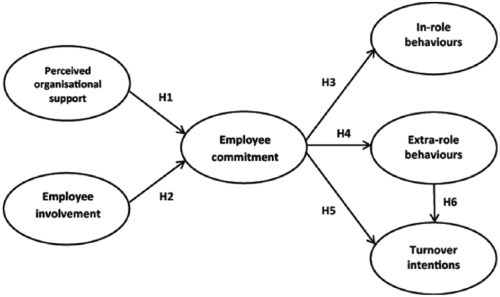
Proposed conceptual model.
Literature and Hypotheses
Organizational Support
Employees tend to personify organizations and perceive that their organization has a favorable or unfavorable orientation toward them (Eisenberger et al., 1986). According to organizational support theory, employees recognize perceived organizational support to meet their emotional needs and to assess the extent to which the organization will recognize, appreciate, and reward increased efforts made to benefit the firm (Shanock & Eisenberger, 2006). This mental process undertaken by employees fits with social exchange theory, which argues that the individual’s actions are performed on the basis of reciprocity, in which employees provide extra effort and loyalty to the organization in return for management recognition and appreciation, which satisfies their esteem needs, financial rewards and other benefits, and career advancement (Eisenberger et al., 1986).
On the basis of reciprocity, perceived organizational support will typically lead an employee to feel obliged to care about the organization’s welfare and to demonstrate greater employee commitment to help the organization achieve its objectives (Rhoades, Eisenberger, & Armeli, 2001). Perceived organizational support also strengthens affective commitment by fulfilling esteem, approval and belonging needs, as well as confirming organizational membership (Armeli, Eisenberger, Fasolo, & Lynch, 1998). Numerous studies have confirmed that perceived organizational support and affective commitment are strongly associated (e.g., Guzzo, Noonan, & Elron, 1994; Settoon, Bennett, & Liden, 1996; Shore & Wayne, 1993). Likewise, perceived support and consideration from managers and supervisors have also been found to be associated with affective commitment (e.g., DeCotiis & Summers, 1987; Glisson & Durick, 1988; Yoon, Baker, & Ko, 1994). Thus, we expect,
Employee Involvement
The term “employee involvement” may refer to a range of practices, but in this research it will be taken to be employees’ influence over how their work is organized and carried out (Fenton-O’Creevy, 2001, p. 28). Employee involvement may take various forms, including participation, consultation, empowerment, and decision making (Morgan & Zeffane, 2003). The distribution of power and involvement in decision making are two key elements of employee involvement.
Senior management are more likely to delegate decision making when they believe that employees possess the “excellence” that is needed to effectively participate in strategic decision making and problem solving (Timming, 2015). Because employees working at the home campus are often reluctant to work abroad for personal or family reasons (Dupuis, Haines, & Saba, 2008) or because they fear it will have a negative effect on their career progression (Wilkins & Huisman, 2012), many of the managers employed at international branch campuses did not previously hold a similar managerial role (Healey, 2016). This could be one reason why strategic decision making is centralized at the home campus. However, employees deprived of decision making and job involvement may feel less committed to the organization if they perceive that the organization is not committed to them.
In transnational higher education, most stakeholders (e.g., students, parents, local employers, quality assurance bodies) expect program content and assessment to be mostly identical at the home and foreign campuses (Shams & Huisman, 2016; K. Smith, 2010). For this reason, many international branch campuses simply deliver “off-the-shelf” programs that are designed at the home campus. This policy deprives branch campus faculty of job involvement, which may also be considered an infringement upon their academic freedom and professional values (Schapper & Mayson, 2004).
A number of authors have concluded that employee involvement has a positive effect on employee commitment (e.g., DeCotiis & Summers, 1987; García-Cabrera & García-Soto, 2012; Ineson, Benke, & Laszlo, 2013; Mowday, Porter, & Steers, 1982). Thus, we propose,
In-Role and Extra-Role Behaviors
In-role behaviors are the job-related behaviors expected of all job holders, for example, attendance at work, punctuality, and completing work tasks with due care and attention (O’Reilly & Chatman, 1986). In contrast, extra-role behaviors are not directly specified by the job description but these behaviors do benefit the organization (O’Reilly & Chatman, 1986). Extra-role behaviors are also known as organizational citizenship behaviors (Organ, 1988). In higher education, there is considerable scope for staff to engage in extra-role behaviors, for example, organizing trips for students, organizing conferences, reviewing papers, and participating in various committees, such as those concerned with teaching and learning, ethics in research, or health and safety.
Extra-role behaviors are very valuable to organizations as they have been found to have a strong effect on overall organizational success and effectiveness (MacKenzie, Podsakoff, & Ahearne, 1998). Previous research has found that positive relationships exist between employee commitment and in-role behaviors (e.g., Brown & Peterson, 1993; Coffman & Gonzalez-Molina, 2002; Darden, Hampton, & Howell, 1989; Hackett, Bycio, & Hausdorf, 1994). Similarly, previous research has also concluded that positive relationships exist between employee commitment and extra-role behaviors (e.g., Gregersen, 1993; MacKenzie et al., 1998; Meyer, Allen, & Smith, 1993). Hence, the following hypotheses are specified:
Employee Turnover Intentions
Employee turnover is often higher at the foreign branches of multinational organizations than at the home branches, so the ability to recruit, develop, and retain employees in the long term are key competencies needed to achieve sustained competitiveness abroad (Reiche, 2009). According to Meyer and Allen (1991), when individuals have a high level of affective commitment to their organization, they identify with and feel attached to the organization, which leads them to want to stay with the organization.
Intentions to stay in or leave an organization have been the most widely studied behavioral correlate of employee commitment. Most studies have found a strong relationship between employee commitment and turnover intentions (e.g., Brunetto, Teo, Shacklock, & Farr-Wharton, 2012; Mathieu & Zajac, 1990; Stumpf & Hartman, 1984; Tett & Meyer, 1993; Wiener & Vardi, 1980). Furthermore, George and Bettenhausen (1990) found that extra-role behaviors enhance work group attractiveness and reduce employee turnover intentions. Thus, we expect
As well as assessing whether our proposed model of antecedents and consequences of employee commitment holds equally at home and foreign branch campuses, a key aim of this research was to discover whether employee commitment is stronger at either home or foreign campuses, and if so, how this impacts upon employee in-role and extra-role behaviors and turnover intentions.
Method
Sample and Data Collection
In addition to testing the proposed hypotheses, a key objective of this study was to discover whether perceived organizational support, employee involvement, employee commitment, in-role behaviors, extra-role behaviors, and turnover intentions differed between employees at the home and foreign branch campuses of universities. University campuses in the United Kingdom were used to represent home branches and university campuses in Malaysia and the UAE were used to represent foreign branches. We used multigroup analysis to assess construct invariance across country samples and to assess possible group differences in the Malaysian and UAE samples.
The data for this study were obtained using a questionnaire that was distributed to both teaching and non-teaching staff. The non-teaching staff consisted mainly of program administrators and employees from support functions such as learning resources and information technology, as well as staff from the marketing and human resource management functions. Using a convenience sampling approach, a total of 795 questionnaires were distributed at three institutions in the United Kingdom, three institutions in Malaysia, and two institutions in the UAE. Although, most international branch campuses are relatively small, our sample included three institutions that were considerably larger than the average branch campus (having over 200 full-time equivalent employees each).
Although various funding and management models exist among international branch campuses, our sample comprised of branches owned and operated by the parent institution. It should be noted that ownership of the branch does not necessarily mean that the home university actually owns the physical infrastructure of the branch, as this is often provided by local private or public sector organizations. All of the sample branches offer programs across a range of disciplines, which include business, computer science, and engineering. To overcome barriers of physical distance between the researchers and respondents, and to satisfy respondent preference, the questionnaire was available online (using the Qualtrics software) or as hard copy.
A total of 515 completed questionnaires were returned. After data cleaning for missing values and extreme cases, a usable sample of 502 respondents was obtained, resulting in a usable response rate of 63.1%. Of the 502 respondents, 47.3% were male and 52.7% were female; 255 (50.8%) were employed in the United Kingdom, 112 (22.3%) in Malaysia, and 135 (26.9%) in the UAE; 32.8% were employed in non-teaching roles, 41.6% were employed in junior faculty roles (instructor/lecturer/assistant professor), and 25.6% were employed in senior faculty roles (senior lecturer/associate professor/professor). The respondents that taught were from a similar range of disciplines at the home and branch campuses, although over two thirds of the total sample of teaching staff were involved with business/management programs.
Measures
The study adopted/adapted previously validated scales. All items were answered using a 7-point Likert scale where 1 = disagree strongly and 7 = agree strongly. The scale for organizational support comprised two subscales adopted from Reade (2001) that measure support from local managers and support from head office, which in this research refers to the university’s home campus management. To measure employee involvement, a five-item scale was adapted from Lodahl and Kejner (1965). Examples of items include “At night, I often think about the next day’s work” and “I am depressed when I fail at work.”
The six-item scale for employee commitment was adopted from Allen and Meyer (1990). Examples of items include “I would be happy to spend the rest of my career with this organization” and “This organization has a great deal of personal meaning for me.” The scales for in-role and extra-role behaviors were adopted from O’Reilly and Chatman (1986). Finally, the four-item scale for turnover intentions was taken from Abrams, Ando, and Hinkle (1998). This scale measures the individual’s intention to leave the organization. All of the Cronbach’s alpha scores were above 0.79 (see Table 1), indicating strong internal consistency for the scales used in this study (Nunnally & Bernstein, 1994).
Construct Reliability, Average Variance Extracted, and Correlations.

Note. All correlations significant at p < .01. CR = construct reliability; AVE = average variance extracted.
A draft version of the questionnaire was subjected to a pre-test at one U.K. University, which involved 20 employees (13 in teaching roles and seven in non-teaching roles). All participants took part in an individual semi-structured face-to-face interview with one researcher. The interviews were used to gain useful contextual background information and to ensure that all items were easily understood and that they appeared to be measuring what they were intended to measure. Examples of questions asked were as follows: Do you think that the level of support you receive from your university affects how you feel as an employee of the university? How would you measure your job involvement? To what extent do you feel a sense of commitment to your university? Were there any questions in the questionnaire that you had difficulty in understanding? The survey instrument appeared to work well in the pre-test, as the pre-test participants had no difficulty in completing the questionnaire and they raised no specific issues, so no changes were made to the questionnaire.
Preliminary Analysis and Measurement Model
IBM SPSS Statistics and SPSS Amos (version 22.0) were used for the data analysis. This section provides details of the preliminary series of statistical analyses conducted to establish the reliability and validity of the scales. To establish the internal consistency of the scales, reliability was tested using the Cronbach’s alpha test. Exploratory factor analysis (EFA) was conducted to establish factor convergence. Then, confirmatory factor analysis (CFA) was conducted to establish that the measurement model demonstrates construct reliability and validity. CFA helps to establish convergent validity by demonstrating that the factor loadings of observed variables are statistically significant on their respective latent constructs (Anderson & Gerbing, 1988). To establish discriminant validity, the approach suggested by Fornell and Larcker (1981) was adopted. Composite reliability and average variance extracted were used as an evidence of construct reliability.
Harman’s one-factor test was applied to investigate a possible common method variance (CMV) problem in the data (Podsakoff, MacKenzie, Lee, & Podsakoff, 2003). EFA on single fixed factor revealed that the factor only explained 43.9% of the variance of the 25 observed variables compared with 69.9% variance explained by a five-factor model, implying that no CMV problem exists in the data (Hair, Black, Babin, Anderson, & Tatham, 2010). Finally, a full structural equation modeling procedure was used to test the hypothesized relationships between the constructs.
CFA was conducted to establish the convergent and discriminant validity of the measurement scales. Items with low loadings (less than .50) and high modification indices were removed in a step-by-step approach. This resulted in the removal of two items from the employee commitment scale. The removal of these items resulted in a very good fit between the data and the model: χ2(256) = 554.63, p < .001; χ2/df = 2.20; CFI = .97; IFI = .97; root mean square error approximation (RMSEA) = .05.
All of the item loadings were statistically significant and were in the range between .60 and .92 (Gefen, Straub, & Boudreau, 2000). All of the scales yielded acceptable values for average variance extracted (AVE > .50) and construct reliability (CR > .70), thereby establishing convergent reliability (Yap & Khong, 2006). Table 1 reports the Cronbach’s alpha scores, the composite reliability scores, the average variance extracted, and the correlation between each pair of constructs.
The Fornell and Larker (1981) criterion was used to establish the discriminant validity of the measurement scales. The bold numbers on the diagonal in Table 1 represent the square root of AVE for each construct. The off diagonal numbers represent the correlations between the constructs. The results suggest that there are no issues of discriminant validity in our data as all constructs have correlations that are lower than the square root of AVE for their respective construct (Yap & Khong, 2006).
Results
Examination of the descriptive statistics reveals that for support, involvement, commitment, in-role and extra-role behaviors, the U.K. respondents gave scores higher than the overall mean scores while respondents in Malaysia and the UAE gave scores lower than the mean scores. There was one exception, as the Malaysian respondents gave a mean score for commitment that was higher than the overall mean score. The U.K. respondents also gave more favorable scores than those in Malaysia and the UAE for turnover intentions, as a lower score indicates intention to stay. Thus, the descriptive statistics suggest that employees at international branch campuses are more likely intending to leave their organization. A summary of the results are presented in Table 2.
Mean Scores and Standard Deviations.
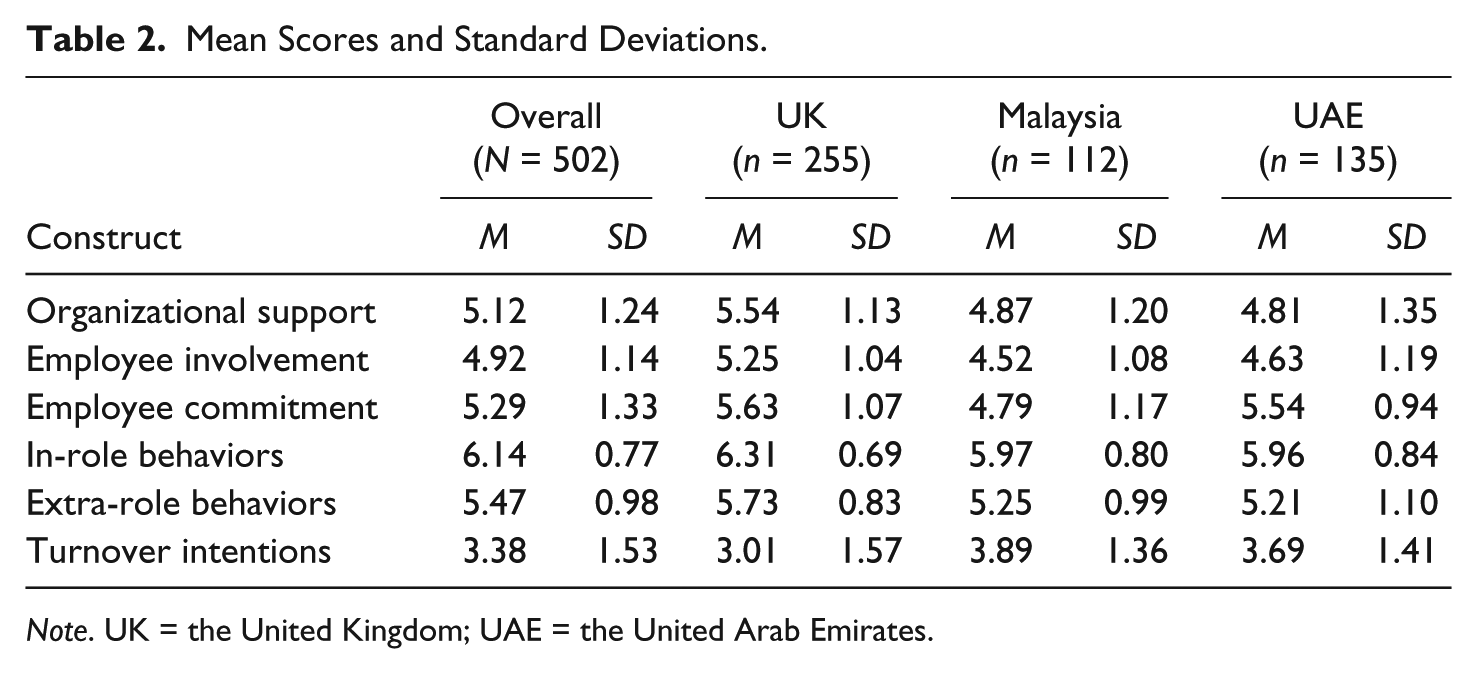
Note. UK = the United Kingdom; UAE = the United Arab Emirates.
Establishing that measurement models are invariant across groups is a pre-condition before conducting multigroup moderation tests when examining cross-cultural data (Byrne, 2004). As the study involved multigroup testing, we decided to first establish the configural and metric invariance of the measurement model before proceeding with the structural model testing.
We used the traditional chi-square difference test to establish metric invariance of the measurement model across the U.K., Malaysian, and UAE samples. There are several types of invariance model that needed to be established. The two most important types of invariance test are the configural and metric invariance. To test the configural invariance model, we conducted a multigroup factor analysis (MGFA). If the results of MGFA meet acceptable criteria, it may be assumed that configural invariance is achieved (Teo, Lee, Chai, & Wong, 2009). Based on the battery of fit indices, it can be argued that the data and model fit well: χ2(768) = 1,310.51, p < .001; χ2/df = 1.70; CFI = .94; IFI = .94; RMSEA = .04.
In the second step, we proceeded to test the metric invariance structure by comparing the baseline multigroup measurement model with a constrained model, in which all the factor loadings were assumed equal. The results suggested that the measurement model was not invariant across the three groups (Δχ2 = 74.40, Δdf = 38, p < .000). This required pairwise comparison of all the three groups in the sample to identify the locus of this variation. Given that two of the groups (Malaysia and UAE) both represented international branch campuses, and are both located in Asia, we expected these groups to be invariant. Thus, we started our pairwise invariance analysis by comparing the Malaysian and UAE samples. The results suggested that there was no significant difference in the measurement model between the Malaysian and UAE samples (Δχ2 = 21.36, Δdf = 19, p = .32). Therefore, it made sense to merge the data for Malaysia and UAE and to then compare this new data set with the U.K. sample, which represented the home campuses (Byrne, 2004).
The results of the multigroup invariance test of the measurement model for home and foreign branch campus respondents revealed a partial invariance measurement structure (Δχ2 = 4.43, Δdf = 2, p = .11). Three items from the employee involvement construct were not invariant. Similarly, three items from the employee commitment construct and two items from turnover intentions were not invariant across home and foreign branch groups. This is quite acceptable, as it is highly unlikely to find a completely invariant structure in cross-cultural research (Byrne, 2004).
In accordance with the two-stage modeling approach, we proceeded with full structural equation modeling using maximum likelihood estimation (MLE) to test the overall fit of the conceptual model, as well as the individual hypotheses. The results indicated that the data have a very good fit with the proposed model: χ2 (264) = 617.24, p < .001; χ2/df = 2.33; CFI = .96; IFI = .96; RMSEA = .05. All the paths in the model were significant. Table 3 presents the structural model results.
Structural Model Results.
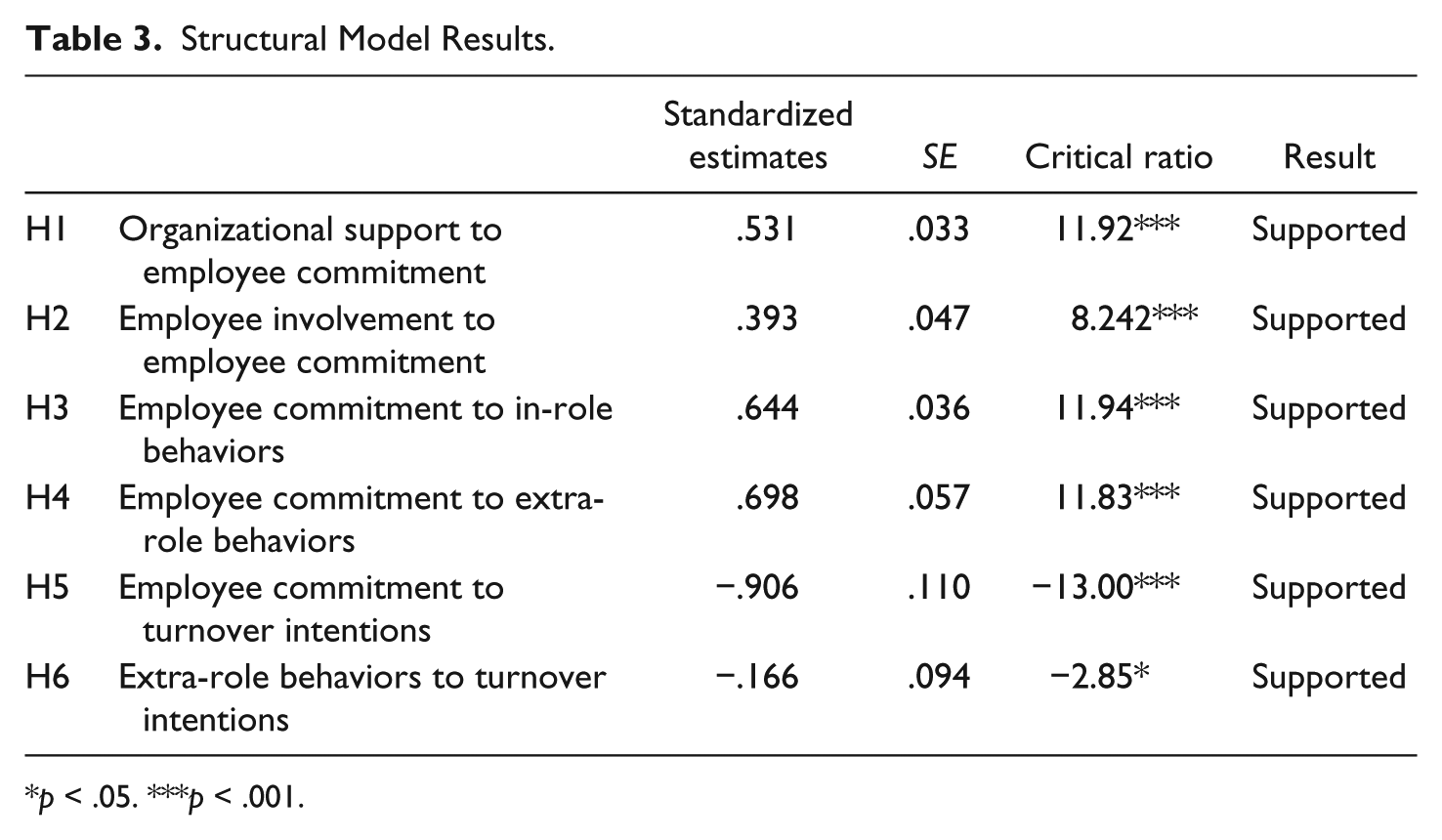
p < .05. ***p < .001.
These results provide support for all of the proposed hypotheses in our conceptual model. Among the two antecedents of employee commitment, support appears to be the strongest. It is also interesting to note that the relationship between commitment and turnover intentions was strongest (although negative, as expected), whereas the relationship between extra-role behaviors and turnover intentions was the weakest and was on the border line of being statistically significant. The results also suggest a strong relationship between employee commitment and in/extra-role behaviors.
Based on the results for the structural model, we tested for the presence of a mediation effect of extra-role behaviors in the relationship between employee commitment and turnover intentions. When using structural equation modeling techniques, the bootstrapping procedure is considered suitable due to its ability to analyze the mediation of complex latent constructs (Kenny, 2012). Table 4 presents the results of the mediation analysis based on the extraction of 2,000 bootstrap samples with 95% bias-corrected confidence intervals. Our tests for mediation indicated that extra-role behaviors mediate the relationship between employee commitment and turnover intentions. However, it is a partial mediation as both the standardized direct and indirect effects remain significant in the model.
Mediation Effects: Two-Tailed Significance Via Bias-Corrected Percentile Test.
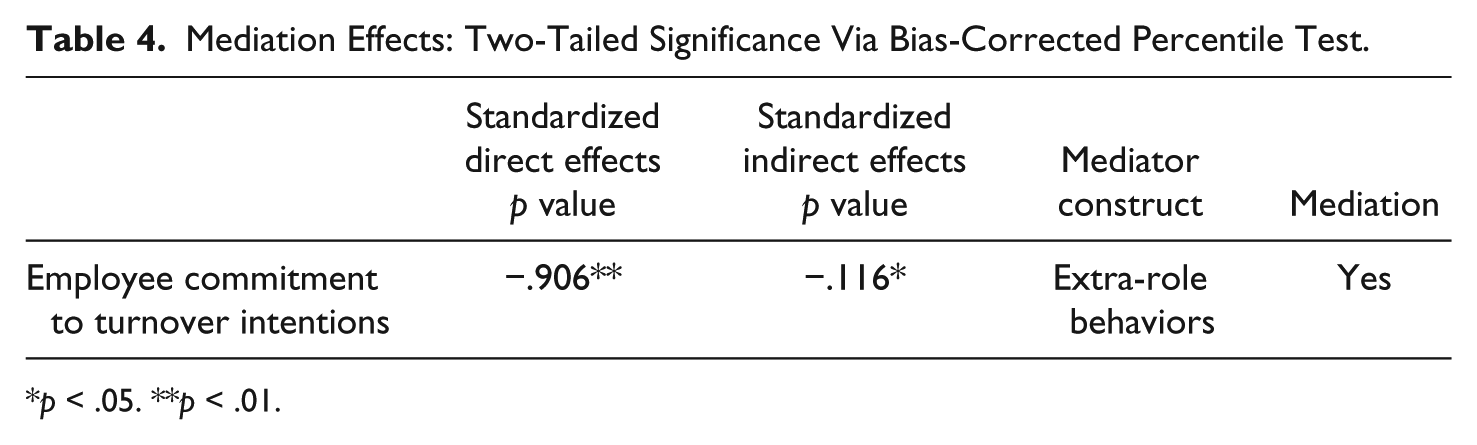
p < .05. **p < .01.
Finally, we tested for the moderation effects of home and foreign branch campuses on the structural relationships in our model. The results (Δχ2 = 31.18, Δdf = 12, p < .001) indicated that the groups are different and therefore we proceed with the pairwise comparison of the groups.
We started our pairwise comparison of the groups with the Malaysian and UAE samples to establish whether these groups are similar or different at path level in the model. We began our analysis to establish configural invariance of the hypothesized model across the two groups. The test of configural invariance revealed that the path from extra-role behaviors to turnover intentions was not significant for the UAE data; therefore, this path was removed from the model and we ran the model again. The results of configural structural model suggest that the data is a decent fit to the model. Once configural invariance was achieved for the structural model, we proceeded with the metric invariance structure for the path model. We constrained all the structural paths in the model and used a chi-square difference test to establish if the two models (constrained and unconstrained) are different. The chi-square test statistic was non-significant (Δχ2 = 5.55, Δdf = 5, p = .35), suggesting that the groups are invariant at path level.
This allowed us to merge the Malaysian and UAE data and compare it with the U.K. data. The results of the multigroup unconstrained model suggest that the model achieved the configural invariance across the two groups. However, the subsequent chi-square test between the constrained and unconstrained models suggests that the groups are different at path levels (Δχ2 = 25.4, Δdf = 5, p < .01). To identify which paths in the model are different across the two groups, we followed the step-by-step process of constraining each path, establishing if it is different or similar across the groups. If the chi-square test results were non-significant, we retain the constrained path in the model and applied an additional constraint to the next path. If the results were significant, we unconstrained the path and applied a constraint to the next path in the model. The results suggested that the two groups were different in all of the paths except for the path between employee commitment and extra-role behaviors.
Discussion and Conclusion
The core purpose of this study was to analyze antecedents and consequences of employee commitment in universities that are involved in running international branch campuses. The secondary objective of the research was to identify possible differences in employee commitment, attitudes, and behaviors at the main home country campuses and international branch campuses abroad.
In terms of the antecedents of employee commitment, organizational support appears to be a far stronger predictor of employee commitment compared with employee involvement. This suggests that in higher education, employee commitment is extrinsically driven. More interestingly, the multigroup analysis further revealed that for international branch campus employees, involvement is a weaker predictor of employee commitment than for the home campus employees. Similarly, the international branch campus employees were more dependent on organizational support for their commitment compared with home campus employees. International branch campus employees may be more inclined to seek additional organizational support in response to the perceived lack of quality infrastructure and policies to support research and other scholarly activities at these campuses.
For the three proposed outcomes of employee commitment, the relationship between employee commitment and turnover intentions was the strongest. This was quite expected based on the existing literature. However, the results also suggest that this negative relationship was stronger for home campus employees than for international branch campus employees. A similar pattern appears for in-role behaviors. The only exception in the model where the two groups were indifferent was the path between employee commitment and extra-role behaviors.
Implications for Practice
This study provides a thoughtful insight for higher education institutions that currently operate an international campus or for those planning to embark upon this particular internationalization strategy. The results suggest that employees at international branch campuses are not as motivated and committed to their organizations as their counterparts at home campuses. This presents a significant challenge for institutions, as the quality of teaching and research of universities is primarily dependent on its employees in general and academic staff in particular. The pattern of our findings is so consistent that it cannot be ignored.
There can be several reasons for this apparent lack of commitment among international branch campus employees. A significant number of employees working for international branch campuses are contractual rather than permanent employees. Furthermore, a sizable proportion of the employees working at branch campuses are expatriates (Healey, 2015). Many of these employees experience difficulties adjusting to alien cultures and norms. Additionally, the policies of many universities that treat expatriate employees transferred from the home campus differently to expatriates or host country nationals hired locally by the branch campus generate a lot of employee grievance and turnover.
The establishment of international campuses as an additional source of revenue rather than as a means to achieve other benefits of internationalization, such as enhanced university image and reputation, is potentially a major stumbling block. This short-term financial focus creates an environment in which resources are increasingly becoming scarce for international branch campuses compared with home campuses. In summary, the operational context of international branch campuses is quite different and unique compared with home campuses, and this demands a set of operational and human resource strategies that are designed specifically for the branch campuses.
Contributions, Limitations, and Further Research
This research proposed and tested a conceptual model of employee commitment across home and foreign branch campuses. This theoretical model helps us understand the important antecedents and consequences of employee commitment in higher education. More importantly, the research further contributes to the literature by investigating the issue from a multicultural perspective. The findings emphasize that institutions need to employ different and customized human resource strategies at home and foreign campuses specifically with the aim of improving employee commitment and performance at the foreign campuses.
Despite its significant contributions to the existing literature, there are some limitations in our research that need to be acknowledged. We used samples obtained in only three countries and thus our results may not be generalizable to all countries globally. Also, we acknowledge that three of the international branch campuses at which we obtained data are somewhat larger in size than the average international branch campus and therefore they might not be typical examples of this type of institution.
The study did not measure the potential differences between the employees at international branch campuses that were transferred from the home campus, recruited in the home country, or recruited locally in the host country of the branch campus. Thus, in future, it will be interesting to see if the locally and internationally recruited employees at a branch campus differ in their perceptions and attitudes toward the university. Future research should specifically investigate the employee perceptions related to internal and external equity at home and branch campuses. It could also investigate the impact of communication between home and branch campuses, particularly with senior management at the home campus, which represents the institution’s headquarters.
Footnotes
Acknowledgements
We thank three anonymous reviewers for their helpful and insightful comments, which enabled us to make valuable and meaningful improvements to this article.
Declaration of Conflicting Interests
The author(s) declared no potential conflicts of interest with respect to the research, authorship, and/or publication of this article.
Funding
The author(s) received no financial support for the research, authorship, and/or publication of this article.