



Abstract
Music cognition is closely related with some types of nonmusical cognition. Music training improves musical cognitive abilities, and also influences nonmusical abilities, especially motor skills. Through simple tapping tasks using visual stimuli, we explored whether music training had an effect on unimanual and bimanual responses and whether there were differences in bimanual synchrony between different types of musicians (pianists and singers) and non-musicians. The results showed that participants reacted more quickly in the unimanual condition than in the bimanual condition, and participants in the pianist group tapped more quickly than those in the non-musician group. Moreover, participants in musician groups had better bimanual synchrony compared with those in the non-musician groups.
Keywords
Humans possess an extraordinary ability to perform tasks that require complex integration of separate movements and remarkable bimanual coordination. These abilities are exemplified in tasks such as playing an instrument.
Individuals in unimanual conditions perform better and have reduced reaction times compared to bimanual conditions (Franz & Fahey, 2007; Hughes & Franz, 2007; Shen & Franz, 2005). In phase coupling experiments, researchers (Yamanishi, Kawato, & Suzuki, 1980) found that variation of the bimanual response was decreased due to inphase bimanual movement. Although there is high temporal coupling when both hands are required to accomplish the same movement, there is still a slight difference between the two hands. There are differences between the right and left hands in the amplitude, moving time and reaction time when participants perform similar-amplitude movements with both hands during moving and drawing tasks (Franz, 1997; Spijkers, Heuer, Kleinsorge, & van der Loo, 1997).
In past years, many studies have investigated the nature of music cognition to better elucidate the mental mechanisms of human socio-cognition (Gaser & Schlaug, 2003; Münte, Altenmüller, & Jäncke, 2002; Sherwin & Sajda, 2013). Music cognition is a complicated cognitive system that includes a variety of components, such as pitch, rhythm and melody. Each component has a complex processing mechanism, and each component is processed by a distinct cognitive module (Satoh, Takeda, Nagata, Hatazawa, & Kuzuhara, 2001; Zatorre, Belin, & Penhune, 2002). Through many years of sensory-motor training, musicians have better music cognitive abilities compared with non-musicians (Kraus & Chandrasekaran, 2010). Morphological differences between musicians and non-musicians have been found in the motor and visuospatial brain regions as well as in the size of the corpus callosum and planum temporale (Schlaug, Jancke, Huang, & Steinmetz, 1995; Schneider et al., 2002), which involve music cognitive processing.
These brain regions not only process musical cognitive components but also other domains (e.g. visual-perceptive skills and motor skills). Thus, music training, by favouring the development and functional efficiency of specific brain regions, improves both musical cognitive skills and other domains. In general, musicians’ performances on many tasks, such as motor tasks, have extremely high levels of spatiotemporal accuracy. Musicians’ anterior corpus callosums are larger (Shahin, Bosnyak, Trainor, & Roberts, 2003), and thicker (Schlaug, Jancke, Huang, & Steinmetz, 1993) than non-musicians. The growth of corpus callosum improves non-music performance, such as tapping a keyboard with two hands. Music training can also have positive effects on motor skills. The tapping rate of both the right and the left index fingers was shown to be faster in musicians than in non-musicians, and the tapping rate of the non-dominant hand was found to increase with training (Jäncke, Schlaug, & Steinmetz, 1997; Repp, 2005).
Playing a musical instrument requires fine motor skills, particularly the coordination of different fingers and hands. We questioned whether different types of music training have similar effects on finger coordination, and compared singers without fine motor training with pianists. We hypothesised that music training, especially instrumental training, could improve the coordination of bimanual movement.
Using auditory stimuli, several studies have found significant performance differences between musicians and non-musicians (McAdams & Drake, 2002). However, the conclusion that musical experts have a significant advantage in other domains still remains controversial, since processing auditory stimuli can be considered a more familiar task for musicians. It is worth noting that Hughes and Franz (2007) found that musicians’ reactions were faster than those of non-musicians in any condition using visual stimuli. We hypothesised that visual processing is a basic cognitive operation for anyone, and we adopted the research paradigm of Hughes and Franz’s study (2007) with a simple tapping task and different types of participants (pianists, singers, and non-musicians). We examined the effects of music training on unimanual and bimanual responses. In light of the literature, our hypotheses are as follows:
The reaction time in the unimanual condition is shorter than in the bimanual condition.
Musicians, especially pianists, react more quickly than non-musicians.
The bimanual synchrony of musicians, especially pianists, is smaller than non-musicians.
Method
Participants
Three groups (pianists, singers, non-musicians) were recruited from different colleges of Shanghai Normal University. The pianist group was composed of 20 students from the Music College ranging in age from 20 to 23 years (M = 20.7, SD = 1.02) who had played the piano for an average of 14.05 years (SD = 2.66); the singer group was composed of 20 students from the Music College ranging in age from 19 to 22 years (M = 20.75, SD = 0.97) who had sung for an average of 6.2 years (SD = 1.13); the non-musician group was composed of 20 participants ranging in age from 20 to 23 years (M = 21.45, SD = 1.04) from other colleges who had no music training except common music lessons at school.
We assessed participants’ handedness according to the Edinburgh Handedness Inventory (Oldfield, 1971). The scores ranged from -1.0 (strongly left-handed) to 1.0 (strongly right-handed). Handedness scores for non-musicians ranged from -1.0 to 1.0 with a mean of 0.662. Scores ranged from 0.05 to 1.0 for pianists (mean score = 0.611), and from -0.7 to 1.0 for singers (mean score = 0.654). The participants received rewards after the experiment.
Procedure
The experiment consisted of three conditions: left hand alone, right hand alone and both hands together. In the left-hand condition, participants were asked to put the left index finger on the “F” key and rest the right hand on their lap. In the right-hand condition, participants were asked to put the right index finger on the “J” key and keep the left hand away from the keyboard. In the bimanual condition, participants used both the left index finger and the right index finger to press the “F” and “J” keys simultaneously. Each of the condition types was run three times in a blocked design. These nine blocks were randomised, and no two consecutive blocks were of the same condition type. Before the experiment, participants conducted 36 trials of each condition to familiarise themselves with the experiment. There were 36 trials in each block, yielding a total of 432 responses in the experiment.
In each trial, a white fixation cross (1 × 1 cm) was presented on a black background in the centre of a monitor. The exposure time of the cross was random and varied from 500 to 1000 ms. Then, the cross disappeared and was replaced by a green dot (1.5 cm diameter) which remained on for 1200 ms or until a response was made, whichever came first. There was a 1000 ms interval between trials. Participants were required to respond as quickly as possible by pressing the corresponding key in unimanual trials and both keys in bimanual trials. Participants were asked not to respond before seeing the green dot.
The experiment lasted approximately 20 minutes. After the experiment, all the participants were asked to fill in a personal information form and the Edinburgh Handedness Inventory. The experimenter also asked about their feelings of the experiment.
Results
Reaction times
The reaction times (RTs, see Table 1) for all the participants were analysed with a 3 × 2 × 2 mixed-designed analysis of variance (ANOVA) with group type (pianist group, singer group, non-musician group) as a between-subjects factor and condition type (unimanual, bimanual) and hand (left, right) as within-subjects factors. The quicker the reaction time, the better the sensorimotor connections.
Mean Reaction Times (ms) and Standard Deviation (ms) for each hand in the unimanual and bimanual conditions (M, SD).

Consistent with previous research (Hughes & Franz, 2007), there was a significant main effect of condition on RT (Figure 1), with longer RTs in the bimanual condition compared with the unimanual condition, F(1,57) = 44.49, p < .001, η2 = 0.438. We also found a marginal significance of the three groups, F(2, 57) = 2.60, p = .083, η2 = 0.084. There was a significant difference between the piano-playing group and the non-musician group (Figure 2), F(1, 38) = 5.455, p = .025, η2 = .126. No interactions between condition and hand were found in the experiment.
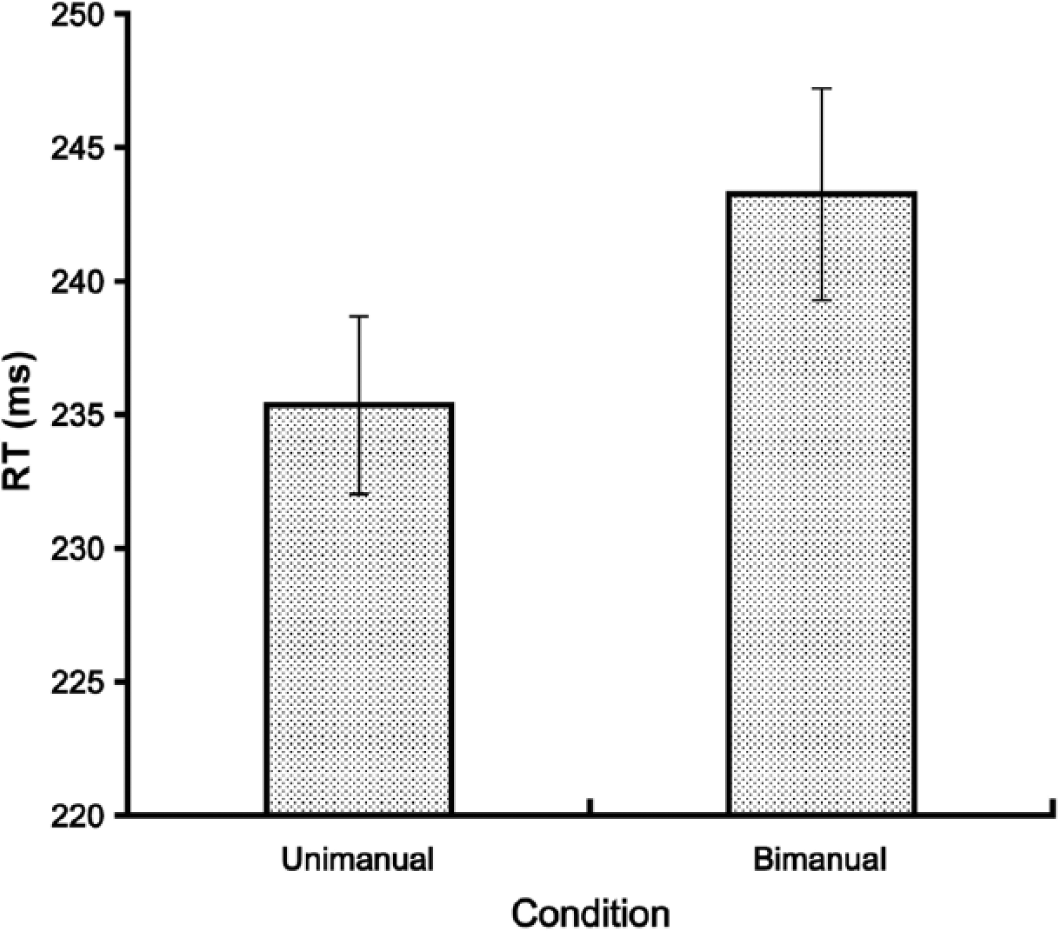
Mean RT in the bimanual condition and the unimanual condition. Error bars show standard errors of the mean.

Mean RT in different groups. Error bars show standard errors of the mean.
Absolute value of the RT differences
The absolute value of the RT difference between hands in the bimanual condition was analysed to assess bimanual synchrony. A large value indicated that bimanual synchrony was weak and a value close to zero indicated high synchrony.
A one-way ANOVA revealed a significant group difference in the bimanual condition (Figure 3), F(2, 57) = 15.41, p < .001, η2 = 0.351. Post hoc testing showed that participants from the pianist group had a smaller absolute value of the bimanual RT difference than those from the non-musician group, t(38) = 4.92 p < .001, d = .320. There was also a significant difference between the singer group and the non-musician group, t(38) = 4.744, p < .001,d = .336. However, we did not find a significant difference between the pianist group and the singer group.
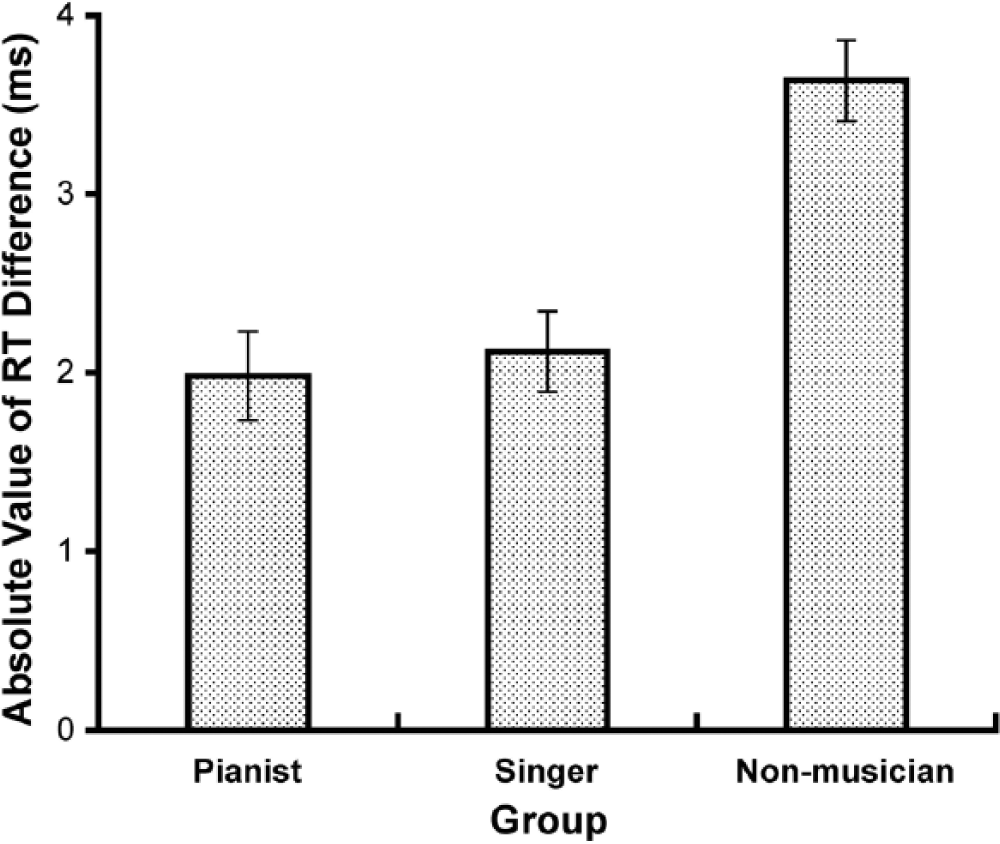
The average absolute value of the RT difference in the bimanual condition (ms). Error bars show standard errors of the mean.
Discussion
Consistent with our hypothesis and with previous studies, reaction times were longer in the bimanual condition than in the unimanual condition (Di Stefano, Morelli, Marzi, & Berlucchi, 1980; Shen & Franz, 2005). This difference may be due to the mutual inhibition of the two cerebral hemispheres mediated by the callosum. In primates, the movements of the arm, hand, and finger are controlled predominantly by motor areas located in the contralateral hemisphere, so bimanual coordination and cooperation are likely to involve a good deal of interhemispheric coupling (Luriëiìa, 1973). Thus, in the bimanual condition, both hands have to respond as quickly as possible to a central stimulus, and the mutual inhibition in the planning process slows down the response time. There was only one response in the unimanual trials that did not involve interhemispheric coordination, so the mutual inhibition only influenced the bimanual and not the unimanual responses. This effect appeared in both the musician and non-musician groups, showing that it is a widespread phenomenon.
Participants from the non-musician group took longer to respond than those from the pianist group. There was no significant difference in RTs between the three groups as a whole. Although the present experiment did not involve music cognitive ability, instrument training had an impact on visual reaction time. Brochard, Dufour, and Despres (2004) found that adult musicians had enhanced connections between visual perception and movement responses compared with non-musicians. Thus, practising an instrument every day for many years improves basic sensory-motor abilities. Rodrigues, Loureiro, and Caramelli (2013) found that musicians are faster than non-musicians at associating a visual stimulus with a specific motor response. All of the above-mentioned studies emphasised that musicians, especially instrumentalists, anticipate (by more than 200 ms) the visual content of a musical score to program the motor actions for a good performance. Maybe such ability leads to faster reaction times when one has to associate a visual stimulus with a motor response.
We also found larger absolute values of RT differences in the non-musician group compared to the musician groups in the bimanual condition, which means that both pianists and singers have greater levels of bimanual synchrony than non-musicians in the bimanual condition. This may be due to the fact that music training involves coordinated movements of both hands. The absolute value of the RT difference may have something to do with executing or even programming the movements, and these processes could be involved in even simple movement tasks. In auditory-motor research, Chen, Penhune, and Zatorre (2008) investigated whether the neural network involving movement synchrony to auditory rhythms differed between musicians and non-musicians. The results showed that musicians were more accurate than non-musicians in synchronising motor responses with auditory cues. Thus, enhanced coordination in musical performance results from extensive practice of motor skills (Meister et al., 2005).
We did not find significant differences between pianists and singers in synchronising bimanual responses. Sparing and his colleagues (2007) found that speech and musical tasks had reciprocal lateralised effects on hand motor cortices of right-handed subjects. Speech facilitates the corticospinal projection of the left hemisphere, which dominates the right hand. However, singing and humming increase the excitability of the right (nondominant) motor cortex. Some neuropsychological studies about preserved singing capabilities of aphasics demonstrate that the right hemisphere dominates the processing of singing (Botez & Wertheim, 1959; Hébert, Racette, Gagnon, & Peretz, 2003; Jacome, 1984). Thus, singers have better balance between the two hemispheres because of long-term vocal training, which indicates that music training, even when it does not involve motor training, can improve bimanual coordination.
Conclusions
We examined the differences in unimanual and bimanual reaction times between musicians and non-musicians. We found that reaction times were longer in the bimanual condition than in the unimanual condition. We also found that pianists reacted faster in both unimanual and bimanual conditions compared with non-musicians. Both singers and pianists had better bimanual coordination than non-musicians in the bimanual condition. Thus, music training improves bimanual synchrony.
The tasks implemented in the present study tested basic motor abilities in both non-musicians and musicians. We suggest that if a task is designed to test specific skills of musicianship, we are testing the “competency” rather than the “efficiency” of the neural system in response to that task, and musicians should activate neural regions specific to the tested skill. Future studies could take advantage of music materials to investigate the planning and control of more complex actions and acquisition of motor skills.
Footnotes
Funding
This research was funded by a grant from Shanghai Jiao Tong University.