




Abstract
Drawing on fieldwork – a set of observations carried out over several years in the presence of conductors and musicians during rehearsals, concerts, and recording sessions, and in-depth interviews with conductors such as Claudio Abbado, Laurence Equilbey, and Claire Gibault – this article seeks to answer, from a sociomusicological perspective, the following question: How is a musical interpretation constructed within a collective body made up of a conductor and musicians? The central hypothesis leading to observation of music-being-made is that it is a collective creative activity. This is what we shall discover in two stages: first, by examining how the authority of the conductor is negotiated in the course of such a collective effort; then, by setting forth various facets by which it is possible to comprehend a process of shared creativity. We shall then approach the role of relays in the orchestra, phenomena of self-regulation, spontaneous interventions of musicians, as well as the process of cooperation. At least, the observation shows how the conductor plays a crucial but not solitary role. This is indeed a collaborative sort of work in multiple dimensions, in which the participation and role of each player is incessantly renegotiated, and in which in fine the meaning given to the musical entity is knit together. Creativity abounds in the heart of initiatives borne by each of the participants and takes form in their synergy.
Spurred by a sociological questioning as much as by a musicological one, the present study is based on a set of observations carried out over several years in the presence of conductors and musicians during rehearsals, concerts, and recording sessions (see Ravet, 2015). The main weight is placed on observation of the musical direction of two orchestral conductors, Claudio Abbado and Claire Gibault, with the same ensemble, the Mozart Orchestra of Bologna; observation of the French premiere of a children’s opera under the musical direction of Claire Gibault in Paris; and observation of the work of Laurence Equilbey with the Accentus Chamber Choir and the Baroque orchestra Concerto Köln in Paris. The study is furthermore grounded in observations carried out on three permanent French orchestras, the National Orchestra of the Paris Opera, the National Orchestra of Lille, and the Orchestra of Brittany (Ravet, 2011). Moreover, in-depth interviews with Laurence Equilbey, Claire Gibault, and Debora Waldman supply additional material for reflection. Lastly, I have worked from annotated scores – by Claire Gibault, for Benjamin Britten’s Lacrymae for solo viola and string orchestra, by myself in a rehearsal situation for the Choralkantaten for choir and orchestra by Felix Mendelssohn – as well as the rushes of a film on Claire Gibault rehearsing the Mozart Orchestra of Bologna with Die sieben letzten Worte unseres Erlösers am Kreuze for orchestra and speaker by Joseph Haydn.
How is a musical interpretation constructed within a collective body made up of a conductor and musicians? Such is the pivotal question of the research. Hence the aim is to pin down the collective doing of orchestra instrumentalists and/or professional singers guided by a conductor, in a very empirical way, going beyond representations conveyed by conventional wisdom according to which “it’s the conductor who decides everything.” The question is therefore not “How does a conductor work out an interpretation?,” which would ultimately have led to another inquiry. The central hypothesis leading to observation of music-being-made is that it is a collective creative activity. This is what we shall discover in two stages: first, by examining how the authority of the conductor is negotiated in the course of such a collective effort; then, by setting forth various facets by which it is possible to comprehend a process of shared creativity.
State of the art
Musicological research on interpretation is not a complete novelty. It has profited in particular from pioneering work in aesthetics (Pistone, 2006), and of course from historic and analytical research into the repertories known as Early Music. It is nonetheless presently experiencing a development of unprecedented scope, preeminently across the Channel and the Atlantic with Performance Studies. Its development is more recent in France. Alongside studies in “historically informed” interpretation, semiological and analytical work as well as musicological approaches to interpretation are multifarious, focusing alternatively upon psychological or cognitive aspects (Chouvel & Donin, 2006a, 2006b; Clarke, 2005; Cook & Everist, 1999; Rink, 1995), and upon the anthropological dimension and/or further upon reflection with an aesthetic thrust (Armengaud & Ehrhardt, 2010; Lacché, 2006). Within the scope of this article it is impossible to give a valid account of the richness of these studies, engrossed as they are in full-scale development (see Donin, 2012). Suffice it to make clear that my inquiry takes account of the crosscurrents in these diverse approaches in a general way. They most often concentrate, however, on the figure and the activity of a single performer when they involve the process of performance. I for one emphasize more specifically the collective dimension, the aim being to provide empirical data. 1
Within the overall corpus of these studies, aside from the approach of François Delalande (2001) on the subject of “sound” or that of musicologists who no longer consider the score to be the defining element of the work (Cook, 2001), theories of situated actuation and distributed cognition stand out as an enlightening conceptual framework. Consider the studies by Maÿlis Dupont (2012) and those by Nicolas Donin carried out with Jacques Theureau (Donin & Theureau, 2006, 2008). Examining the activity of composers and performers, these authors base their work on in-situation observation or reconstitute quasi-experimental situations of observation from the standpoint of a musical score coming into existence. They intimately associate the resources of musical analysis with this data on the creative gesture. By putting to use ethnography and the methodology of the explicative interview the authors move away from genetic analysis as it is ordinarily practiced. The corpus as a whole makes it possible to grasp better the process of step-by-step elaboration of a work. Nevertheless, the social complexity of the situations, the social relationships that emerge thereby and participate in the construction of the situation, and the very artistic form itself remain poorly investigated undercurrents.
A negotiated authority
Max Weber’s classical theory of authority makes it possible to determine the basis of an orchestral conductor’s authority. Hence Macht is to be understood in the sense of a power whose legitimacy is derived from three sources: legal/rational, traditional, and charismatic. Depending on the cases observed, orchestral conductors draw their authority from a variable mix of tradition and charisma. One may add to this the posture of the egalitarian conductor brought to light by Claudio E. Benzecry (2006). In no case does the conductor decide everything, alone. This is what can be shown by the interactionist point of view adopted in research (Becker, 1982; Goffman, 1983), which takes specific situations into account – in particular if the observation of the work involves permanent or non-permanent orchestras – but also of the state of the profession of the orchestral conductor. We shall thus be led to distinguish several “ideal types.” An abstract construction of one or several “type(s)” by working from cases taken from the empirical realm and spotlighting significant traits of a social phenomenon, this model constitutes a tool of comprehension and theorization in Max Weber’s work (1921/1971). Before setting out four forms of grasping the type of relationship built up between conductor and musicians, let us examine in detail the different types of existing interactions.
Interactions
The analytical description of the types of interaction and forms of exchange made following observations in situ may be synthesized in various forms. The following table (Table 1), made up of a choice of verbs that focus upon the action initiated by the actor(s) under consideration, sums up the different types of interaction noted.
Types of verbal and non-verbal interactions.
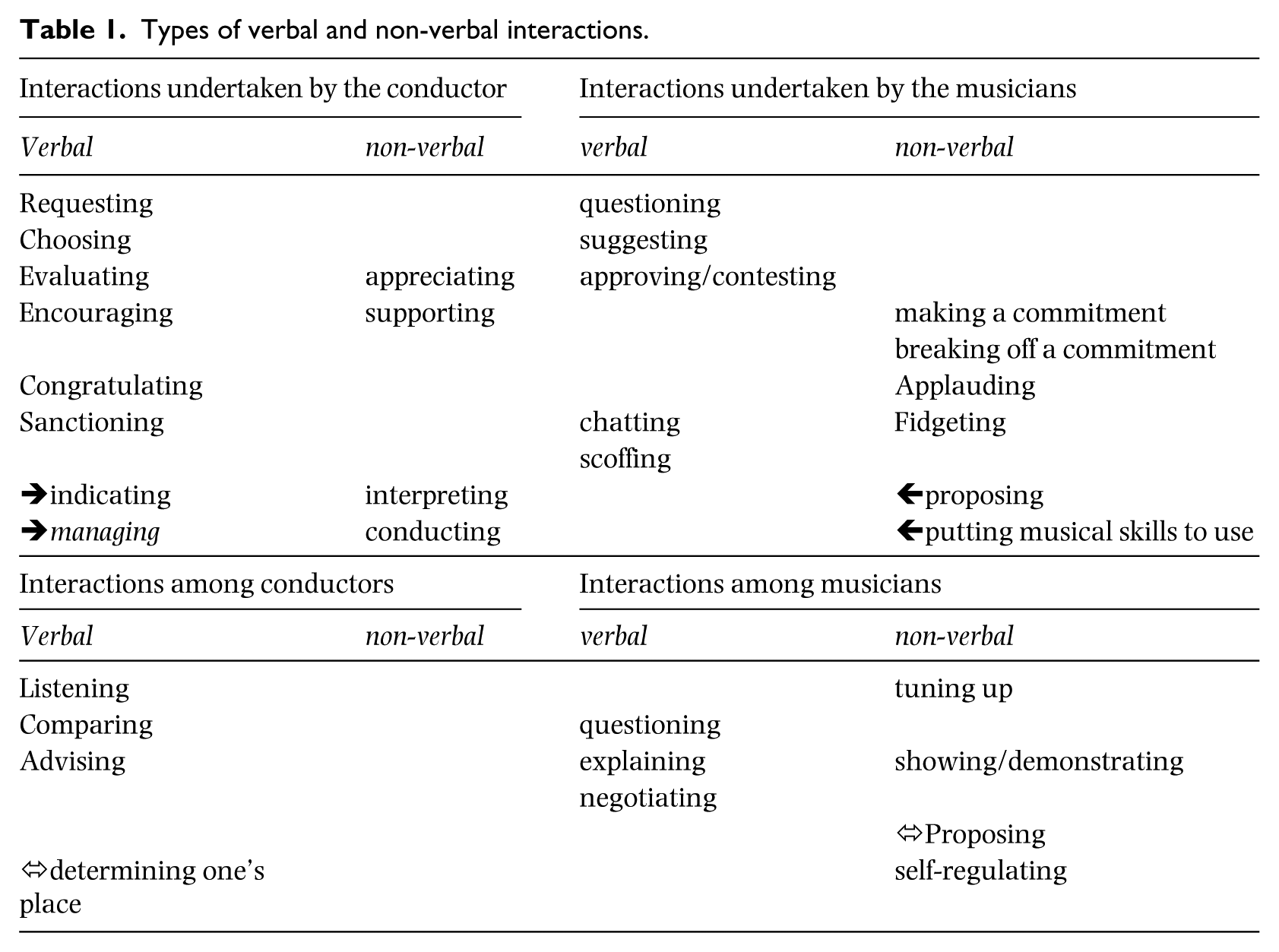
This table makes it possible to clarify the multitude of interactions observed and to retain what is essential. Putting into schematic form the different types of interaction and modes of relationship among the partners in collective activity also enables us to structure the reflection. Each of the two following diagrams illustrates a part of the modalities of collective action. The first diagram (Figure 1) sums up the direction of the interactions between two poles: that of conductors and that of musicians. It symbolizes the impetus provided for exchange among participants.

Direction of the interactions.
Four ideal typical situations
The second diagram (Figure 2), somewhat more complex, synthesizes the type of relationship created between a conductor and the musicians in the course of an interaction. It establishes a cartography of the space of possible occurrences, which can play out in infinite variety starting with different axes. In overall outline, from left to right, the space is distributed between a situation controlled by the conductor and a situation controlled by the musicians; from top to bottom, between a situation conducive overall to the construction of the performance and a generally unfavorable situation. More subtly, the horizontal axis (decreasing from left to right) represents the authority of the conductor such as deployed by the latter and accepted by the musicians. One may also read this axis conversely as the manifestation of a counterpower emanating from the musicians (this time, increasing from left to right). The vertical axis (decreasing from top to bottom) symbolizes the collaboration or voluntary engagement of the different partners in the collective action. Along the two diagonals are also deployed two essential dimensions of the modes of relationships established among the partners. The diagonal descending from left to right gives thematic weight to the evaluation of the situation by the conductor (from most positive to most negative). As a mirror image, that is to say rising from right to left and inverting the polarity, one may read the more or less significant resistance on the part of the musicians. The other diagonal, going from left to right and from the most negative to the most positive, establishes on the one hand the evaluation of the situation by the musicians and, on the other hand and concurrently, the dialogue between the two types of partners (conductors/musicians).

Mapping of the modes of interaction.
Many other dimensions could be symbolized, but the diagram would thereby become too unwieldly. We note, in particular, that the diagram overlooks the differences among musicians (e.g., the first-chair players and the rank-and-file musicians, between the strings and the winds, women and men, etc.) and takes no account of the mode of relationship among the participants (permanent musical director or guest conductor, full-time musicians or not). Nor does it take account of the type of repertory played and the fact of its being – or not being – appreciated by the musicians; or the incidence of it being a routine or novel situation, whether the orchestra is interested or bored, whether the conductor has more or less mastered the work and the production, and so forth.
Be that as it may, the diagram as it stands makes it possible to perceive four ideal types:
above left: a relationship, favoring action, of cooperation and engagement in a willing spirit within the activity (an ideal yet fully real case);
lower right: a more unfavorable, open conflict in which the conductor’s authority is called into question and/or the musicians skirt his authority, a situation which may, in the most critical cases, result in a breaking off of the activity (the rarest situation).
Between these two extremes may be found two intermediary cases that do not prevent pursual of the action, and indeed, in the first case, contribute to it positively:
above right, a situation of negotiation (among the most frequent situations);
lower left, a situation of manifestation of distance taken with respect to the conductor by the musicians (by mocking, irony, commotion), tension, and even simmering conflict (also a common situation).
On the basis of the following diagram (Figure 3) the four perceived ideal types may be highlighted.

Four ideal typical situations of interaction.
Such representation of the situations of interaction is meant to be dynamic since the situations are often located in in-between areas. The diagram of prioritized spaces makes it possible to discern at a glance the power relationships, manifestations of authority and struggles, but also participation and engagement in the collective activity. It furthermore brings to light the evaluative dimension inherent in representation of the situation by the participants (hence aside from its cognitive dimension).
In a more general way, the musical action observed is characterized by a process of negotiated authority throughout the interactions. The Latin etymology of the term “authority” includes different meanings, among them “the power to demand obedience” and “credit due a writer, a text.” In authority, there is author. Showing authority means, in part, establishing oneself as author. This dual meaning is revealing. The cross between the two meanings opens up a collective, collaborative dimension, at a point in time as well as over a longer period: between negotiated authority and shared creativity is woven the activity of performance/interpretation, 2 wherein several co-authors intervene. In day-to-day work, willingly or not, conductor and musicians, but also other partners (who cannot all be taken into account), cooperate in order to give rise to the “work.”
The notion of negotiated authority echoes the thesis of “social order as a product of negotiations” as conceptualized by Anselm Strauss (1978) and developed particularly with regard to the hospital. Here this notion includes a doing of actors who – to one extent or another – make a commitment to a common action wherein authority is never excercised unilaterally but via participation of all the actors; it emphasizes the sharing of this decisional power. In her ethnographic study on the distribution of power in the factory, notably between men and women, Véronique Moulinié shows the complexity of power relationships given hierarchical position: Authority is not, as is claimed, the matter of a few privileged men. It is broken up, distributed among the 450 workers in the factory. Everyone – and above all every female – holds a parcel thereof of which he/she feels free to make use of whenever his/her hierarchical position – however minute and discrete – is imperiled. (1993, p. 141) [L’autorité n’est pas, comme on le prétend, le fait de quelques hommes privilégiés. Elle est morcelée, répartie entre les quatre cent cinquante ouvriers de l’usine. Chacun – et surtout chacune – en détient une parcelle dont il n’hésite pas à user lorsque sa position hiérarchique – si infime et discrète soit-elle – est mise en danger.]
With a musical ensemble directed by a conductor, we once again – as with any social organism – encounter problematics in terms of negotiation of the power relationships including management of margins of uncertainty, regulation of work relationships, and the definition of modes of cooperation. Even if the rules, sectorial agreements [conventions collectives], and labor contracts define the framework of activity, the relations are concretely defined and negotiated on an everyday basis. These negotiations determine the outlines of the collective doing and the shared elaboration of a performance.
A negotiated decision
During a rehearsal of Mendelssohn’s Choralkantaten (observed 22 February, 2006, in Paris), Laurence Equilbey works with the choir and orchestra on comprehension of the musical line. She gives the image of “one mouth that is speaking” to help the musicians understand the type of collective sound she is seeking to create with the two ensembles, simultaneously, like a third timbre. In a musical phrase from the first movement (Chor) of O Haupt, voll Blut und Wunden (measure 21), she requests the number of countertenors to be curtailed, without designating who is to stop singing temporarily (see Figure 4).
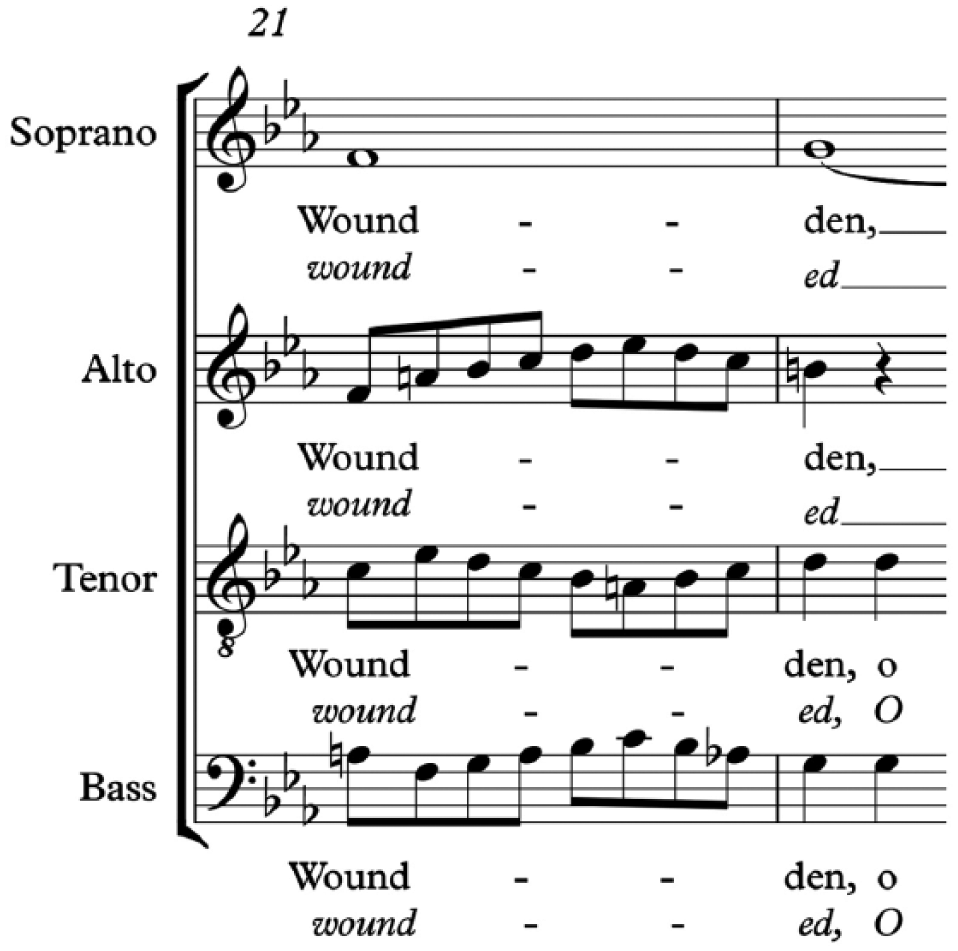
A countertenor surplus (22 February 2006). Felix Mendelssohn, Cantata O Haupt, voll Blut und Wunden, 1st movement “Chor,” mm. 21–22.
An exchange ensues (L. Equilbey and members of the choir, rehearsal, 22 February 2006, transcription by author):
“We need to lighten up. There is too much countertenor.”
“No, but it works fine, Laurence.”
“No, it doesn’t sound good.” [Ce n’est pas beau.]
“Why us all the time?”
“Don’t take it badly. There’s too much countertenor on this phrase, it’s not your fault. Don’t take it for yourself, it’s not personal” (she repeats this last clause twice).
The passage is gone through again.
“Who’s going to sing in the end? Or not sing?”
A mezzosoprano raises her hand.
“No: the mezzo stays.”
A countertenor raises his hand.
“OK, one less countertenor on that phrase.”
This scene exemplifies a direct negotiation between the conductor and the singers. She wishes to obtain a lighter sound on a specific phrase. To achieve this technically she asks that one of the countertenors present within the alto section not sing the phrase. However, the singers try to resist by asserting their disagreement, first from the musical then from the psychological standpoint, manifesting their sensitivity, indeed their touchiness. The conductor explains that this is not a personal attack and lets them take care of the problem among themselves. A mezzosoprano volunteers, but the conductor declines the solution proposed. She settles the matter and validates the proposal when in turn a countertenor singles himself out.
Here we have at once discussion, negotiation within an exchange, and the self-regulation of the musicians beginning with the request of the conductor: that is to say, a functioning by gradual adjustments. The observations reported bring out the multiplicity of the interactions and forms of exchange, as well as their reciprocity within intense processes of negotiation. Via questioning and discussion, the musicians negotiate with the conductor; we have just seen a concrete example thereof. Through their skills, spontaneous interventions, and suggestions, they also propose and contribute actively to giving shape to the musical project, to something that cannot but be a work-in-progress as long as the music is not yet performed on stage or recorded.
Shared creativity
Resolving to study music-in-the-making postulates musical action as work in progress and the work as a process, a performance. This analysis of the creative processes reveals to what extent routine is the root of creativity (Strauss, 1994), especially within such a collective entity. If the practice of conductors rests upon an “acquired spontaneity” (Boulez, 2004a), musicians display instrumental imagination (Ravet, 2015). In what way is this translated? This is what we shall now take into consideration in approaching the role of relays in the orchestra, phenomena of self-regulation, spontaneous interventions of musicians, as well as the process of cooperation.
Relays
In the course of the organisation of rehearsal work, differences become apparent between choir and orchestra, particularly in the definition of relays and their role. If we consider symphonic or vocal ensembles with their conductor, we should recall that the orchestra represents a hierarchical organisation. On the other hand, a choir can claim to be “egalitarian” vis-a-vis the musicians who are members of it, the conductor having a separate status: the ensemble does not avail itself of section heads designated as such. Laurence Equilbey reminds us of this essential difference when she speaks of the role of transmitters upon whom she can rely within the ensemble. However, certain singers informally exercise a preponderant role within the ensemble: You’ll always have singers who have more of a psychology of section leaders (chefs d’attaque) than do others. But there are no first-chair performers. You have singers who are quicker at the attack [plus à l’attaque] and others who are more followers. Obviously I rely somewhat on the bridgeheads, necessarily. At the same time, on the rehearsal level, this is nothing, in the sense that I don’t rely on the person with the thought: “I’m looking at him.” You see, I take everyone into account. (Author’s interview with the conductor, 19 July 2006)
This reliance on unofficial relays comes about discretely. However, in rehearsal I have observed how one of the altos present in the first row of the section often passes on the conductor’s indications. I take note of the first name, since the conductor calls her by name. Nonetheless, these singers who are “quicker at the attack than others” cannot formally organize the work and steer it via explicit remarks. A member of the choir cannot unilaterally force himself/herself on the others. Everything is done by discussion and exchange among musicians, in “proper intelligence.” Hence, aside from very exceptional cases, a conductor addresses the section in its entirety, as Laurence Equilbey explains: “Often I address the entire section, the complete tessituras, basses, tenors, I associate an entire group. But sometimes, even if you hear that it’s a singer who screws up, you say, ‘careful there, tenors’ […].” (Author’s interview with the conductor, 19 July 2006)
When Claire Gibault is preparing a performance project with an orchestra, she notably makes use of relays; in particular, she can be prompted to meet with the concertmaster prior to the rehearsals with the musicians in their entirety: “At the least I have one relay, and that needs to be organized,” she asserts. This idea of organization of the ensemble work, such that each person knows what he/she needs to do and does not remain inactive, is essential. “Order” and “discipline” are necessary to make possible “listening to others” within a large group. Hence the role of the relays in orchestral work is crucial, in particular within the strings among themselves. The winds, all of them soloists, receive an often more personalized treatment on the part of conductors: There is a relay that expresses itself, which is the sectional heads. It is through them that one addresses the orchestra. On the other hand, the winds have a personal treatment because they can be spoken to directly: 1st Flute, 2nd Bassoon, etc. However this is more anonymous for all the strings since things go through the first-chair players, the relays. For this reason one should not neglect to look at those who are at the back, so that they exist, feel themselves to exist, and are motivated as well. And I can also say that […] there is also a surveillance side, so that everyone makes a commitment and does what is demanded of him/her. (Author’s interview with the conductor, 10 November 2005)
In rehearsal, via observation, one can easily see this cascade of decision-making and the “endless mirroring effect” [mise en abyme] of powers within the orchestra (see Figure 5). Let us establish a typical sequence of exchange in a rehearsal: a conductor defines what he/she wishes to hear in the course of the playing by giving technically-oriented indications, explaining a phrasing, sometimes with the aid of images; he/she goes over the matter with the solo violinist and the first-chair players via the spoken word and sung examples. A discussion often ensues or suggestions by the musicians are made through verbal proposals or instrumental playing. Thus, relationships of comprehension set in. Then the explanation or proposal for performance and playing indications decided in common or negotiated are transmitted to the other musicians by delegation to the first-chair and solo players: cooperation with these “relays” is crucial, for they are the transmitters for the other musicians, the strings in particular, and add their contribution by developing an explanation, whence relationships of mediation. Subsequently the musicians discuss among themselves and mark the indications into the scores. The interpretation thus is built up via trials and gradual validations in the course of the playing and concomitant listening, as the conductor’s approval and the reaching of consensus with the section heads are achieved; then the work continues, at the moment itself or during later rehearsals. The interpretation imagined by the conductor only takes on concrete form by execution, which by no means diminishes the preponderance of the impetus supplied by the conductor. This chain of interpretative responsiblility rests not only on the sequential distribution of the interpretation instructions, but on the feedback as well, the responses of the solo musicians, first-chair players for the strings or wind and percussion instruments.
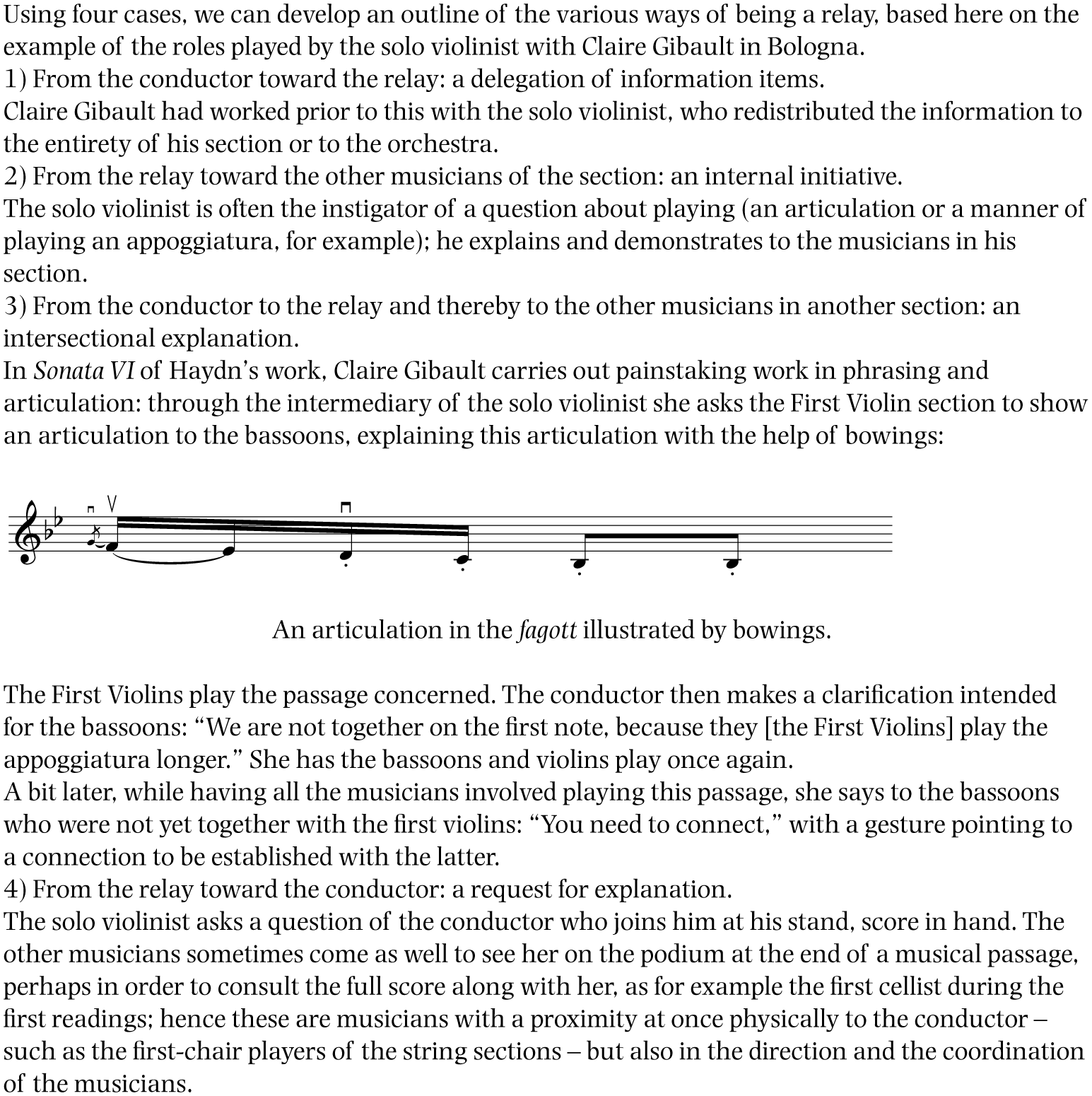
Four roles for the relay.
Finally, let us emphasize that the conductor is generally prone to treat with care his or her relays and the relationship that unites them. Claudio Abbado chose them carefully when he founded his orchestra. Claire Gibault, for her part, makes a point to congratulate them in front of the orchestra, proof of the acknowledgement that she owes their work.
Self-regulation
Without the conductor’s direct intervention or a first-chair player’s relay of the latter’s request, the musicians regulate the playing among themselves; thus they actively participate in the elaboration of the sound, relying on each other and reaching consensus among themselves, in a more or less self-sufficient way.
This self-regulation resides first and foremost in the musicians’ corporal engagement. Necessarily active in their practice, whether vocal or instrumental, their bodies resonate with a well-grounded yet incessantly renewed experience of playing. They can evince an intense commitment within their action. Gestures thus incorporated occur and bear meaning beyond the individual’s own consciousness (Delalande, 1992). They constitute a remarkable input – often passed over on account of being below the radar of an abstract conception of the activity – within the collective working-out of a performance. With the singers in Accentus, for example, I have noted this bodily engagement in a dress rehearsal (2 March 2006, Cité de la musique in Paris): in the forte passages they sing in full voice, attested by the volume of sound in the ensemble, but also the singers’ mouths opening. This type of highly concrete engagement of the musicians is to be found in instrumentalists as well: for instance, in using the full bow of the strings in forte passages.
Aside from bodily engagement, self-regulation of the musicians’ playing is to be read in the direct assuming of responsibility for elements of practice and interpretation. We have already anticipated this type of situation in speaking of the initiative of a relay vis-a-vis the musicians in one’s section. The solo violinist, for example, gives advice for an articulation in relation to the bowings of the first violin section and then rehearses them. Attentively and patiently the conductor waits for this brief moment of practice to conclude. Such a process may be observed as well on the part of another actor, somewhat particular but in a similar situation of authority: the soloist. Hence, in the rehearsal of Lacrymae by Britten with the Mozart Orchestra of Bologna, the solo violist at times interacts directly with the orchestra: for example, she gives advice “past the conductor” to the viola section, without consulting Claire Gibault or waiting for her go-ahead. In a certain sense, the solo violist goes over the conductor’s head, she who is placed spatially between the soloist and the section concerned by the remarks. Yet another case is observed when the musicians agree upon a matter within a section, in particular in the winds, from one section to another. By gestures, in a passage of the work by Haydn (Die sieben letzten Worte unseres Erlösers am Kreuze, “Sonata I”), the flutist for example signals the oboists to reach a consensus, by ear, with the horns.
Inherent to the work of rehearsal within a professional ensemble, the group of musicians is constantly involved in self-regulation, particularly in the matter of intonation. In Bologna, the conductor does not need to ask the instrumentalists explicitly to make adjustments. This competence is an integral part of the profession, of musicians’ experience. In addition, musicians ceaselessly make micro-adjustments among themselves thanks to mutual listening. These adjustments are on the order of rhythmic tidying-up, accord among timbres, convergence of expressive intentions, even if the conductor is beating time and giving impetus to the expressive movement. This is the fruit of years of training and experience of group playing, fashioning an embedded knowhow: the latter is rarely conveyed by verbal explanation. This resembles learning “by body” observed in dance (Faure, 2000). The non-explicit essence of the activity, the non-necessity of reminders about conventions, is grounded in work routines that are set up gradually. With Accentus one observes precisely a quest for intonation, reactivity of the singers – for example in the correction of pronunciation – and tonal blending of the voices within a given section and in the ensemble (no single voice sticks out audibly), the fruit of a long experience of work as a group. The conductor thus counts on the self-regulation skills of the musicians, but also on another phenomenon: the sedimentation that occurs within the process of the work on interpretation.
Spontaneous interventions
Besides the role of relay and the actions of self-regulation among the participants, another phenomenon is observed that shows up the direct contribution of musicians to the construction of the performance: spontaneous interventions and proposals for playing. In connection with the foregoing situations, they stem above all from musicians who exercise an actual responsibility within the ensemble, in particular the orchestra soloists. However, the section players at large, such as the singers in a choir, at times are no less involved either when it comes to these interpellations and suggestions addressed to the conductor. Pierre Boulez makes a point of the importance of the conductors being attuned to musicians’ proposals. However, he has essentially “major soloists” in mind: Certain musicians have a strong personality. They have their own ideas. I occasionally listen to their proposals and adopt them. When a clarinetist or oboist wants to do more, I let him do it. Otherwise I would go against his personality, and that would be bad. It’s better to achieve a situation of dialogue. (Boulez, 2004b)
3
Under the surface, one senses the potentiality cropping up of a situation of disagreement, indeed of a conflict, and by nature detrimental to musical elaboration. The enhancement of reciprocal listening and dialogue seems preferable for Boulez. The discourse concurrently reveals an adjustment of the posture of the conductor as seen by this author: he agrees to set aside a portion of his prerogatives.
Such situations are to be observed in rehearsals with choir or orchestra within the production of the Choralkantaten. In particular, an interaction – significant on account of its length, the number of exchanges, and its goal – involves the physical setup of the singers, their positioning with respect to the instrumentalists, their perception of the sound material, and, in the end, the result produced. The intervention of the musicians is an expression of a viewpoint in order to improve the ensemble playing, in particular the listening of the musicians among themselves, but also the reception of the musical text by the audience. The musicians’ spontaneous proposals also (sometimes) yield actual inflections or colors in the sound material. They make up, partially, that leeway in interpretation available to the participants. When Boulez speaks of an “idea” put forth by an instrumentalist, it is often not put into words but translated by playing. It is then quite difficult for the observer to untangle what is due to the instrumentalist per se, to the conductor, or – more likely – to the alchemy that is created between them. One of the means of perceiving the dynamics of proposal becomes available when the latter is not retained by the conductor (see Figure 6): these are situations that require reaching an agreement in performance, the point of departure potentially being a disagreement.

“He wants to rewrite the score!”.
The freedom of interpretation taken by musicians working from the musical text sometimes coincides with the conductor’s vision of the work. However, this taking of liberty in the interpretation occurs with certain safety valves and an intention of respecting the text as it is written: this exigency makes itself felt with respect to the percussion, whose interventions are essential to the text and provide a varied palette of colors. This leads the conductor to refuse certain adjustments proposed by the musicians.
Let us round out this point with examples of evaluative interaction brought about by the gradual reaching of agreement by a conductor and a soloist in the elaboration of a performance to be recorded. These cases cause adjustments to become visible and audible, beginning with proposals from one side or the other. The two main protagonists – not to neglect the role of the artistic direction of the record company doing the recording – are on an equal footing as to the dynamics of proposal. The conductor, in this case Claudio Abbado, is sometimes led to give up some of his own proposals (see Figure 7). In this context a veritable skein of evaluative, wordless exchanges is woven in the course of the playing, which, on account of the recording, would suffer from brusque interruptions. Soloist participants are to be observed here, among whom may be counted not only the opera singers but also the conductor – vis-à-vis the management of the record company he may be considered as such, since the validation of the interpretation depends on the judgment of the Artistic Director. These participants manifest their satisfaction or lack thereof, in the course of the performance or at the close of the recording takes, by pouting approval and/or smiles. The latter are one of many expressions of thanks addressed by Claudio Abbado, notably to the musicians.
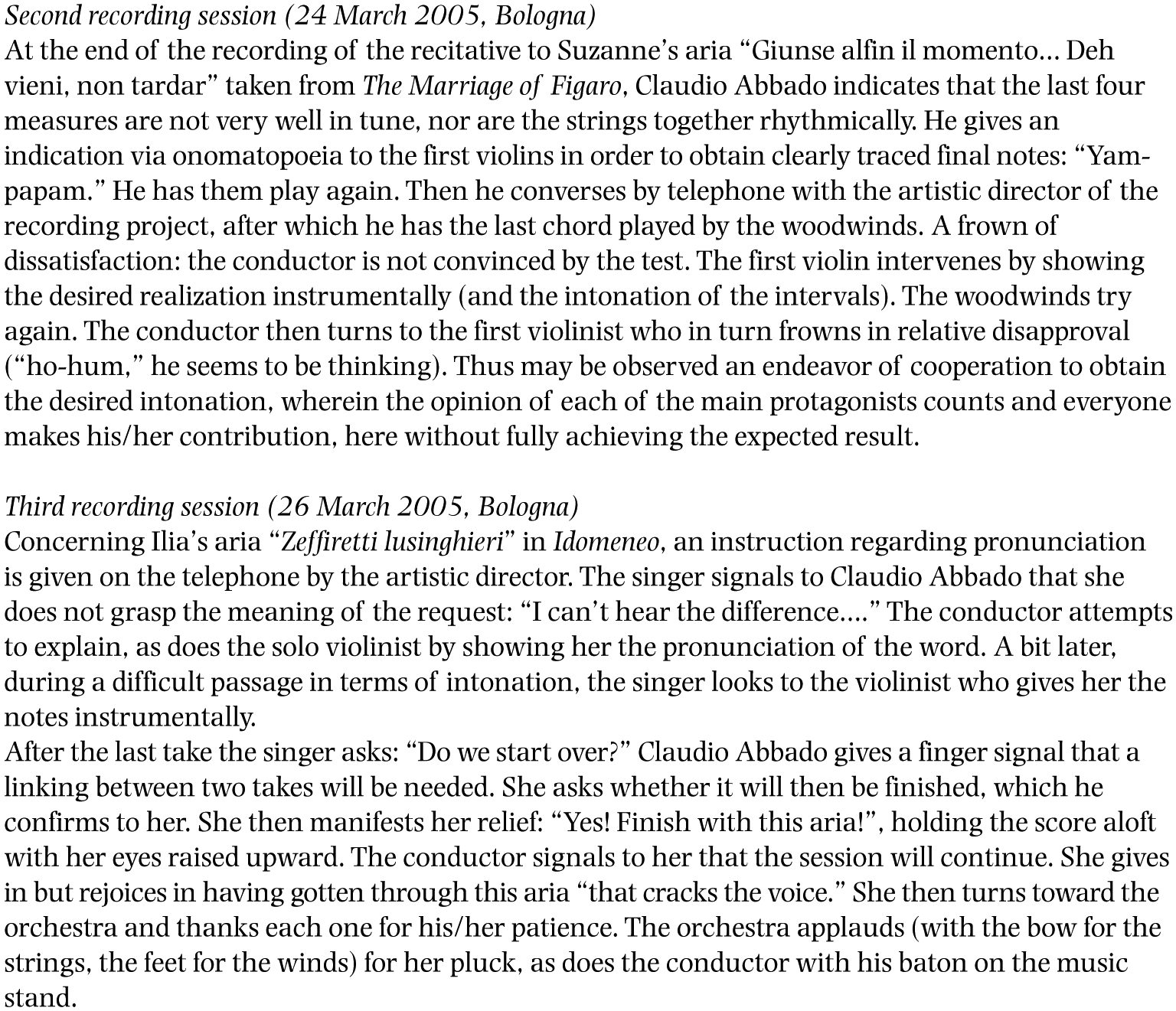
A highly collaborative task.
Cooperating
Conductors are generally quite aware that orchestral or choral activity depends on a mix of negotiation and cooperation working from concrete proposals from the musicians. While prior to an encounter they form a vision of the interpretation of the work that they want to bring forth, the conductors I have interviewed also emphasized the necessity for them to let the interpretation take form within the encounter with the musicians.
Claire Gibault suggests that the interpretation is not completly predetermined from the start. She does have a project in mind and attempts to carry it out, “to get the orchestra to go along with this project” [amener l’orchestre à ce projet] (author’s interview with the conductor, 8 December 2005). At the same time, the musicians should “not feel this project,” or much less sense that it is foisted on them. Nor do they appreciate the conductor arriving without a preestablished vision of what he/she wishes to hear. According to her, musicians, like conductors, should associate discipline with creativity. How then can musicians in fact be “creative”? “They can propose,” Claire Gibault answers (author’s interview with the conductor, 8 December 2005). She then explains how much a conductor relies on what musicians offer musically, and on their sound realization which he/she can then steer by means of indications. This realization begins with a personal initiative and turns into the result of an exchange. The latter is based on a practical theory of interpretation of mimicries and reciprocal corporal attitudes, built up through experience as well as lasting for the span of time appropriate to the exchange.
As a parallel facet of the negotiations, the content of the exchanges is characterized by cooperation (see Figure 7); that is to say, in the strict sense the act of operating jointly with someone or, as current terminology has it, participation in the common activity. Most often cooperation does not preclude negotiation or even a relative distancing for certain musicians or, at certain moments, interaction (see Figure 2 and Figure 3, above). Cases of conflict, furthermore, rarely conclude with a complete break in the interaction; a collaboration – a forced one – most often is the outcome. This is to say that, pressing the vision neither into an ideal nor into a caricature, cooperation remains the most widespread mode of collective action, whether coerced or voluntary.
All in all, the construction of a performance definitely results from the cooperation of the ensemble of the participants and their input, modest as it may be, in the working out of the whole. To sum up the collective production of the Choralkantaten, aside from the contribution of all those not included in the observation (administration, etc.), the decisions about interpretation come from several actors: the two conductors who do not necessarily have the same intentions, the assistant acquiescing to the requests of the ranking conductor, the instrumentalists, and the singers. The latter, in particular, avail themselves of an in-depth experience of performing with their conductor. They collaborate on a daily basis via vocal proposals, explicitly accepted upon listening or without needing approval by the conductor, so much has the long life of the collective shaped the habits of playing together: “creative routines.” They also proceed by correction of what is sung in reaction to a request from the conductor. They further act as a function of their questioning about the way of singing a given passage and the indications given in feedback about the way the passage is to be heard. More generally yet, they intervene by engagement in the playing, by the vocal material, an incarnate musical entity. The conductor herself reacts bodily: with a look, gesture, corporal attitude, or wordless evaluation (by a frown or a smile, etc.).
With regard to Die sieben letzten Worte unseres Erlösers am Kreuze by Haydn, the collective work of coming to agreement on the interpretation consists notably in finding a sound. The latter results from reaching an agreement among the participants, who listen to the conductor and share many common codes long since acquired. But each one also has references “in the ear.” Hence the conductor must also take a position with respect to known modes of performing. Claire Gibault, with a symphony orchestra playing on “modern” instruments, wished to relive an interpretation that would recapture “Baroque” accents. Thus she set herself apart from interpretations inherited from a more “Romantic” vision, conveying a dense musical substance but also a highly rarified material, as if ethereal and idealized. Her work with the orchestra endeavored to highlight contrasts at times violent in the sound material, to play on dynamics and the work’s character: fiery and passionate, painful and tortured, questioning, very human, more “incarnate.” She could say to the orchestra, “You can cuss out God!,” urging a visceral commitment in the sound material, and not respect or distance, vis-à-vis a transcendent divinity. This did not, however, mean yielding to pathos. This project of construction of the interpretation was confronted with the performance of the instrumentalists and the speaker, and their concrete realizations, in the course of the discussions, proposals, and musical trials. With the speaker, for example, the conductor negotiated a less pathetic elocution. Retaining only the greater outline of the process, a co-construction over time may be deduced, at the conductor’s instigation, with the explicit contribution of the relays and the concrete and inventive practical application of all the musicians.
Conclusion
Hence, beginning with the conductor’s viewpoint the reflection proceeded by gradual fanning out from the center to take into account the action of each participant. Analysis of the way each takes responsibility for the interpretation alongside the other protagonists includes examination of the modes of relationship of the conductor with respect to the musicians and the modes of direction. It also brings to light the way the conductor relies on the relays and the spontaneous initiatives of the musicians and their individual proposals. To this is added the importance of the day-to-day self-regulation actions of the musicians among themselves – personal, within, and among sections. Sources of creative routines, these actions refer to all the codes incorporated over years of training, instrumental or vocal exercise and, for some, of collective work (choir or orchestra). Assuming this foundation, a shared creativity emerges that gives rise to the form taken by the work, on that day, at the conclusion of the task that is carried out collectively. Observation shows the path followed in back-and-forth movement of the decision-making, the setting up of a chain of responsibility for the circulation of information, whereby the conductor plays a crucial but not solitary role. This is indeed a collaborative sort of work in multiple dimensions, notably temporal ones, in which the participation and role of each player is incessantly renegotiated, and in which in fine the meaning given to the musical entity is knit together.
This leads us to re-examine what the action of interpreting/performing incorporates. In the case of the interpretation of a work in the process of being premiered, the question may be one of “reducing the gap” with the text, this position being controversial as well (Clarke, 2012). For the situations studied here, the case turns out to be somewhat inverted. Interpreting consists in proposing a collectively personal realization, if we may be allowed this oxymoron: instigated and guided by the conductor, based on or, as the case may be, in reaction to interpretative traditions, this is the result of the action of musicians who make a musical text their own and propose a realization instrumentally. Granting oneself freedom of musical expression without betraying this text – which comes down to the idea of translating the intentions of an author in a personal manner – this is what the conductor and musicians attempt to carry through together. Creativity abounds in the heart of initiatives borne by each of the participants and takes form in their synergy. Out of the collective effort and the sound matter to which it gives rise is invented a new meaning accorded the work.
Footnotes
Acknowledgements
Translated from the French by Kurt Lueders.
Funding
This research received no specific grant from any funding agency in the public, commercial, or not-for-profit sectors.