



Abstract
Technological changes in the last 30 years have influenced the way we consume music, not only granting immediate access to a much larger collection of songs than ever before, but also allowing us to instantly skip songs. This new reality can be explained in terms of attention economy, which posits that attention is the currency of the information age, since it is both scarce and valuable. The purpose of these two studies is to examine whether popular music compositional practices have changed in the last 30 years in a way that is consistent with attention economy principles. In the first study, 303 U.S. top-10 singles from 1986 to 2015 were analyzed according to five parameters: number of words in title, main tempo, time before the voice enters, time before the title is mentioned, and self-focus in lyrical content. The results revealed that popular music has been changing in a way that favors attention grabbing, consistent with attention economy principles. In the second study, 60 popular songs from 2015 were paired with 60 less popular songs from the same artists. The same parameters were evaluated. The data were not consistent with any of the hypotheses regarding the relationship between attention economy principles within a comparison of popular and less popular music.
Introduction
Technological changes in the last 30 years have drastically influenced the way we enjoy recorded music. Portable music devices grew in popularity – from the portable cassette player in the 1980s and the portable CD player in the 1990s to the mp3 player in the 2000s – allowing the music lover easy access to a large collection of music. Furthermore, with the advent in the last 10 years of Internet-based platforms such as YouTube, Apple Music, and Spotify, gone are the days where one needed to own a specific vinyl record, CD, or even mp3 file to enjoy a specific song. Record collections, once the only way to decide what music you wanted to hear, are now obsolete as we can enjoy almost any commercial recording legally and for free in only a few seconds. This ever-increasing availability of new music – Spotify’s catalogue includes over 30 million songs – has had a profound impact on the music industry, with music sales in the U.S. decreasing steadily in the last years (Ingham, 2015).
This radical paradigmatic change is not limited to the way we consume music. In an influential letter published in Wired Magazine in 1997, Goldhaber anticipated the impact of “cyberspace” on economic practices:
We’ve turned a corner toward an economy where an increasing number of workers are no longer involved directly in the production, transportation, and distribution of material goods, but instead earn their living managing or dealing with information in some form. Most call this an “information economy.” Yet, ours is not truly an information economy. By definition, economics is the study of how a society uses its scarce resources. And information is not scarce – especially on the Net, where it is not only abundant, but overflowing. We are drowning in information, yet constantly increasing our generation of it. So a key question arises: Is there something else that flows through cyberspace, something that is scarce and desirable? There is. No one would put anything on the Internet without the hope of obtaining some. It’s called attention. And the economy of attention – not information – is the natural economy of cyberspace. (Goldhaber, 1997, n.p.)
Goldhaber was not the first one to come up with this idea. While the concept of attention economy dates back to the early 1970s (Simon, 1971), the idea that attention is worth money has always been the premise behind modern advertising. Perhaps the best example is the newspaper industry, which for two centuries has been lowering the cost of their product and diversifying their revenues through publicity. But Goldhaber aptly predicted that “[a]s the Net becomes an increasingly strong presence in the overall economy, the flow of attention will not only anticipate the flow of money, but eventually replace it altogether” (1997, n.p.).
The model proposed by online streaming platforms makes little sense in an economic system based on traditional currencies (e.g. USD, EUR, JPY), with artist’s revenues estimated at less than $0.001 USD per listening on a service like Spotify (Dredge, 2015). Indeed, several artists have voiced concerns over the low royalties linked with such services (e.g. Swift, 2014). And yet, the fact that almost all of the artists do offer their music through some online streaming platform confirms Goldhaber’s thoughts: in an economic system treating attention as the preeminent currency, online streaming services offer tremendous possibilities.
While the World Wide Web has become ubiquitous since the new millennium, it would be misleading to attribute this paradigmatic shift to the Internet alone. Free newspapers such as Metro have proven that revenues from advertising alone can be sufficient to make a business model profitable. Perhaps more relevant to our discussion is the tremendous success of MTV in the 1980s. In many ways, the early MTV model – a television channel broadcasting music 24/7 – was based on the idea that “the origin and purpose of music videos is promotional; they are themselves advertisements” (Huron, 1989, p. 570, emphasis in original).
While the meaning of the term may seem intuitive, it might be appropriate to formally define what we mean by attention. In their book on attention economy, Davenport and Beck define attention as follows: “Attention is focused mental engagement on a particular item of information” (2001, p. 20). Key to this definition is the notion of “focused mental engagement,” which distinguishes attention from mere awareness. The transition from awareness to attention occurs when “information reaches a threshold of meaning in our brains and spurs the potential for action” (Davenport & Beck, 2001, p. 22). These actions may be unconscious (e.g. orienting response), or conscious (e.g. buying a specific product after viewing an advertisement).
Formally, we may operationalize attention economy principles as principles that favor focused mental engagement in order to elicit an action that is beneficial for the information generator. Because attention is scarce, it can be convenient to think of attention economy principles as attention-grabbing principles.
A supply and demand economic model predicts that if the demand exceeds supply, the value of the supply increases. In the attention economy model, attention acts as a currency. As such, if the demand for attention is greater than the attention supply (i.e., more things than one can attend to), then the scarcity of attention increases in value. Furthermore, since an increase in demand indicates high economic value, a supply and demand model predicts an increase of supply (Ciampaglia, Flammini, & Menczer, 2015). In other words, since attention is both valuable and scarce, the number of products trying to grab someone’s attention increases, making attention scarcer, and thus even more valuable. This phenomenon is especially relevant in the context of digital content such as web-pages or online streaming.
Research investigating Internet browsing habits showed that “users adopt a ‘screen-and-glean’ browsing behavior where they vet the page prior to more detailed examination” (Liu, White, & Dumais, 2010, p. 386). Moreover, the same study indicated that there appears to be a critical window where the probability of abandoning the page is high, but once this window has passed, the abandonment rate diminishes. The authors describe this window in terms of “screening process:” if a page survives the screening process, the browsing time is high; if it doesn’t, the browsing time is low. These results were consistent with previous studies that showed that web-users visit many pages within seconds (Cockburn & McKenzie, 2001), and that more than half of the visits are shorter than 10 seconds (Weinreich, Obendorf, Herder, & Mayer, 2008).
A similar process can be observed with music listening habits. Lamere (2014) parsed the Spotify data to investigate how millions of music consumers use the skip button. Twenty-one percent of the billions of plays analyzed were skipped in the first 5 seconds. That number reaches 34% after the first 20 seconds. Moreover, only 51% of the songs are listened to in their entirety. As Lamere points out, “most of the song skips happen within the first 20 seconds or so of the song, and after that there’s a relatively small but steady skipping rate” (2014, n.p.). There appears to be a similar critical time period akin to the screening window for web browsing described earlier, although for music, the data suggest that it might be best to understand music listening behavior as a two-window screening process, the first being within the first 5 seconds, and the second within the first 20 seconds.
In the present research, several characteristics of popular songs have been investigated using a database-driven approach. Two related studies are presented that aim to examine compositional practices. The first study analyzes some 300 of the most popular songs between 1986 and 2015 to investigate whether compositional and production practices in popular music have changed in recent decades in accordance with attention economics. The results will show that most of the parameters evaluated support the idea that compositional practices have changed in the last 30 years in a way that is consistent with the proposed theory. The second study investigates whether the most popular songs of a given artist exhibit attention economics principles at a higher level than less popular songs from the same artist. A total of 120 songs from 2015 were analyzed, representing 60 different artists. To anticipate our results, the data were not consistent with any of the hypotheses regarding the relationship between attention economy principles within a comparison of popular and less popular music.
Study 1: Practices between 1986 and 2015
Hypotheses
An essential aspect of conducting research is to aptly operationalize our proposed conjecture. An exploratory pilot study was conducted with an independent sample to identify which musical parameters would be appropriate proxies to evaluate whether or not a song conforms to attention economy principles. Five parameters were identified: number of words in the title, main tempo, time before the voice enters, time before the title is mentioned, and self-focus in lyrical content.
Sample
A sample covering 30 years of music from 1986 to 2015 was assembled using Billboard Magazine’s Year-End Hot 100 charts. For each selected year, the top-10 singles were sampled. Three of those singles were released as “double A-side,” creating a total sample of 303 entries.
Method
The number of words in the title was tabulated using the titles provided by the Billboard charts. If part of the title was enclosed by parentheses, this part was not tabulated (e.g. “Stronger (What Doesn’t Kill You)” was reduced to “Stronger”). Two songs had titles based on acronyms (e.g. “E.T.”), and as such were encoded as missing data. Main tempo was calculated using a “tap along” method, which has been used previously in other musicological studies (e.g. Cook, 1995). One song was encoded as missing data since it oscillated between two different tempi. Timestamps were manually calculated using spectrographic representation of the soundwaves generated by Sonic Visualiser (Cannam, Landone, & Sandler, 2010). Five songs did not feature the title in the lyrics, and as such were encoded as missing data. Lyrical content analyses were performed using the LIWC2015 software, a popular program that tabulates statistics in a body of text based on curated dictionaries (Pennebaker, Boyd, Jordan, & Blackburn, 2015). The same software was used by DeWall et al. (2011) to conduct linguistic analyses of popular songs. Following their methodology, self-focus was evaluated using the first person singular pronoun category in LIWC2015. This category consists of a curated dictionary containing 24 words (e.g. I, me, mine), with a corrected alpha score of .81, using the Spearman-Brown prediction formula (Pennebaker et al, 2015). Lyrics were collected from the web and manually curated to match the audio files. LIWC2015 was used to calculate the presence of first-person pronouns. Specifically, the self-focus score of a text represents the ratio of words in the text also present in the first person singular pronoun dictionary. For sure, the analytical values computed by LIWC2015 – just like those computed by virtually all text analysis programs using a similar methodology – are limited. For example, Mehl, Robbins, and Holleran (2012) have argued that psychological correlates of words are dependent upon the context in which they are used. Nevertheless, automated text analysis offers a practical and objective way to operationalize complex constructs. One song was sung in a language other than English, and as such was encoded as missing data.
Results
The results are summarized in Figure 1. A significant correlation was observed for four of the five studied parameters discussed above: number of words in the title (r = –.27, p < .001), main tempo (r = .18, p = .002), time before the voice enters (r = –.36, p < .001), and time before the title is mentioned (r = -.18, p < .001). These tests remain significant after a Bonferroni adjusted alpha level of .01 per test (.05/5). However, no significant correlation was observed between the year a song was popular and its self-focus score (r = .01, p = .897). In general, the results are consistent with the view that popular music compositional practices have evolved in a way that favors attention grabbing.
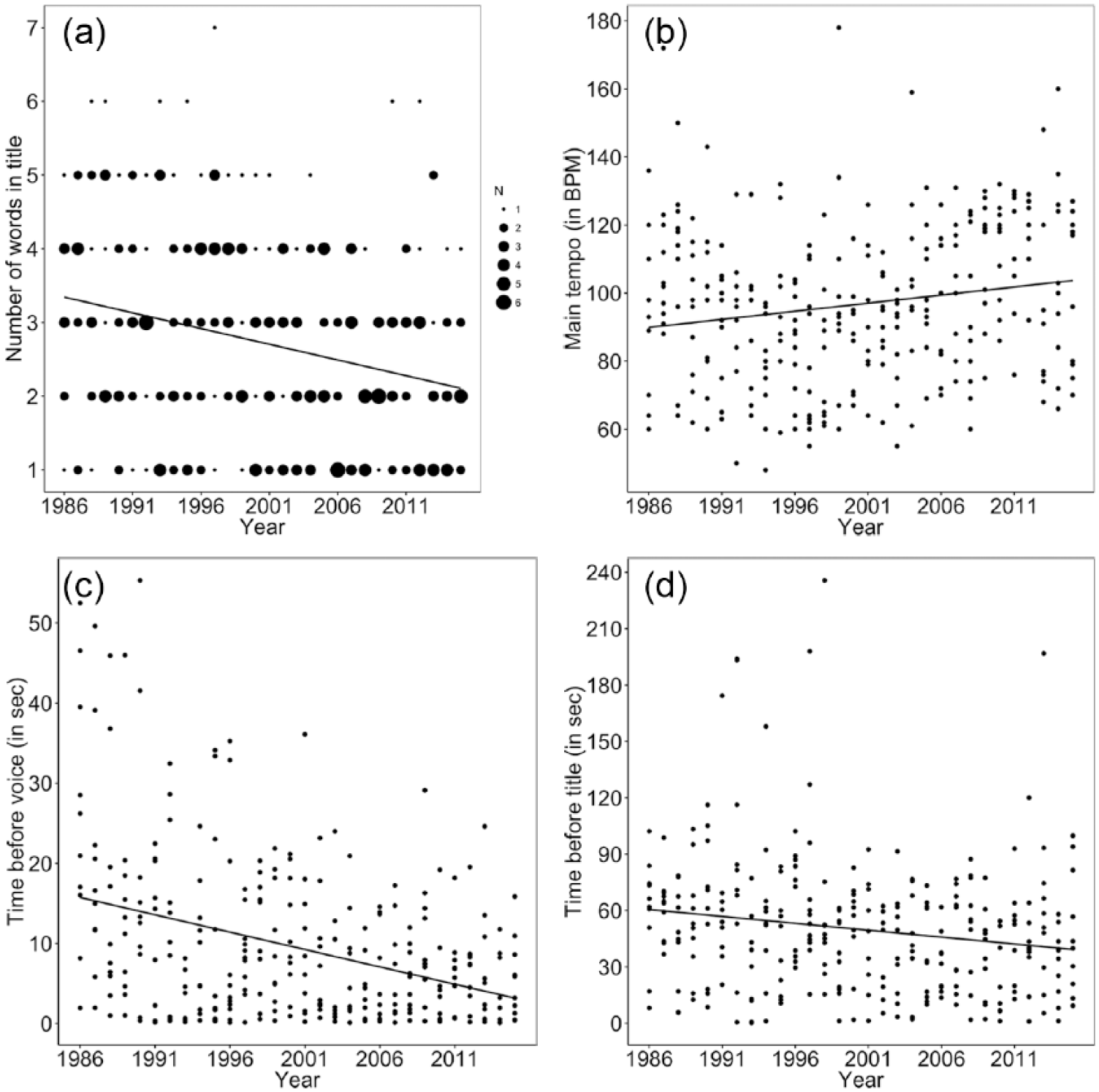
Relationship between the year a song appeared on the Billboard Year-End Hot 100 chart and a) the number of words in its title (r = –.27, p < .001), b) its main tempo, in BPM (r = .18, p = .002), c) the elapsed time before the voice enters, in seconds (r = –.36, p < .001), and d) the elapsed time before the title of the song is mentioned, in seconds (r = –.18, p < .001). For Figure 1a, dots of varying sizes have been used to illustrate overlapping data points, as indicated by the graph’s legend. These tests remain significant after a Bonferroni adjusted alpha level of .01 per test (.05/5). Not shown is the lack of correlation between the year a song was popular and its self-focus score (r = .01, p = .897). The results are consistent with the attention economy principles.
Discussion
Technological changes in recent decades have had an important impact on almost every aspect of our lives, including the way we enjoy music. However, the results presented above suggest that this paradigmatic change is not limited to the way we consume popular music, but has also affected the way musicians create music. A post-hoc linear regression analysis was conducted to evaluate the overall fit of the model. A significant regression model was found, F(5, 288) = 16.15, p < .001, with an adjusted R2 of .21. The effect size is surprising, given the number of factors we might expect to influence the popularity of a song (e.g. the quality of the song, the instrumentation, the popularity of the artist, the image and media presence). As a matter of fact, many songs in the present corpus were successful without conforming to the attentional principles described earlier. For example, Gotye’s 2012 number-one hit “Somebody That I Used to Know” features a title almost three times longer than the other top-10 songs from that year, a 20-second instrumental introduction (roughly four times longer than the average other hits from 2012), and the listener must wait two whole minutes before hearing the singer mention the title of the song (the average for the other 2012 hit songs is 37 seconds). Nevertheless, while not exceptional, these examples are rare.
While four of the five variables behave in the predicted way, the strengths of relationship were modest, with observed r values ranging between ±.18 and ±.36. As visually illustrated in Figure 1, this suggests a lot of variability in the data. A limitation to the present corpus is that it provides no indication regarding musical style. Considering that the Billboard charts are diverse in terms of musical style, and that the time period under study was punctuated by periods of rapid musical changes (Mauch, MacCallum, Levy, & Leroi, 2015), it is possible that most or all of the variability observed is attributable to just one or two substyles, with other styles not being affected by attention economy principles. Nevertheless, even without taking musical style into consideration, we still observe a low but significant relationship for four of the five studied parameters (number of words in the title, main tempo, time before the voice enters, and time before the title is mentioned).
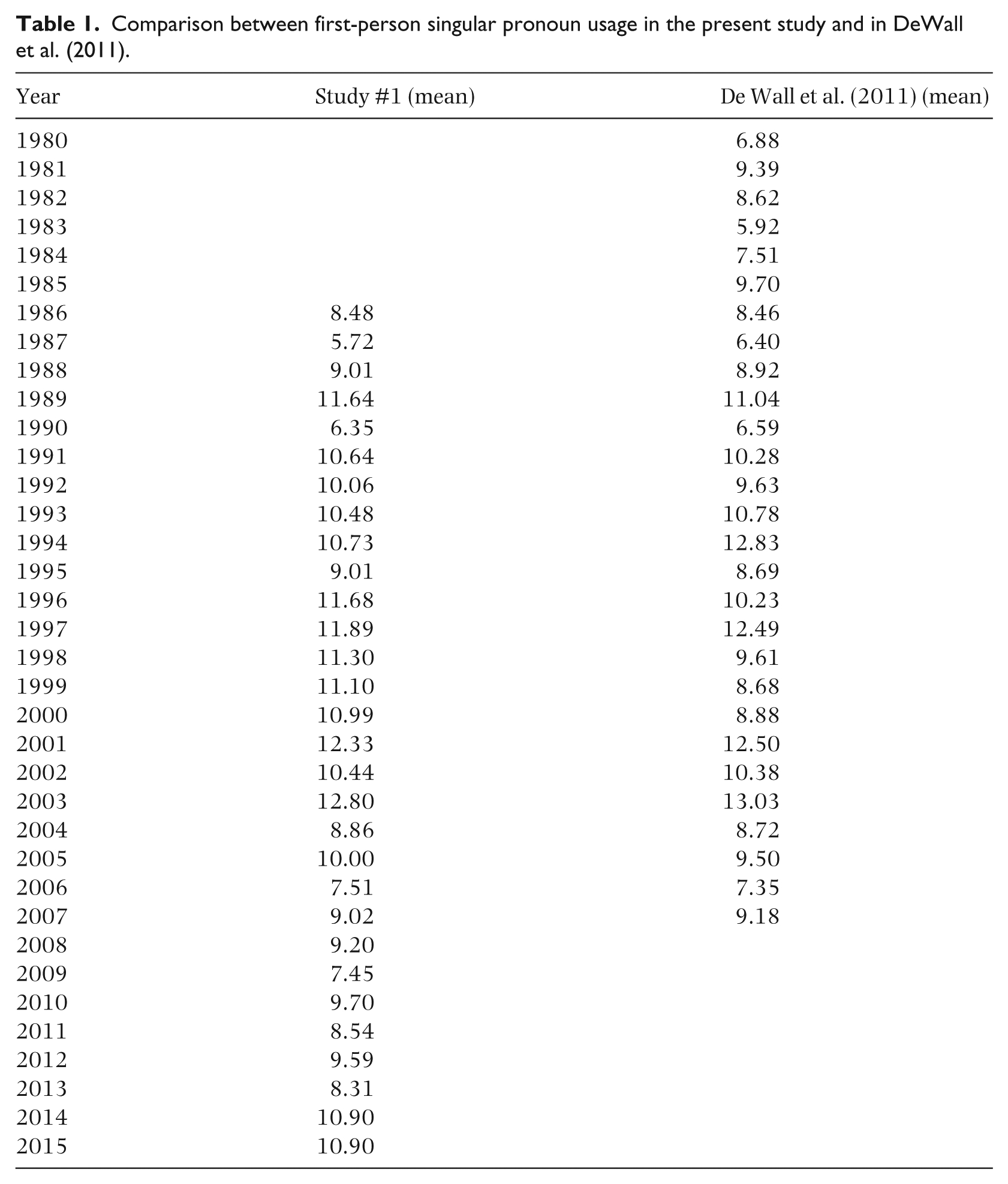
No correlation was found between self-focused lyrics and the year a song charted. This is surprising, considering that DeWall et al. (2011) reported positive association using a very similar sample (the 10 most popular U.S. songs between 1980 and 2007, according to the Billboard Hot 100 Year-End chart) and using a very similar methodology (a more recent version of the LIWC software was used in the present study). Table 1 compares the first-person singular pronoun usage data from the current study with the data reported in DeWall et al. (2011, p. 3, Table 1). The overlapping time period (i.e. 1986–2007) is highly correlated (r = .86), which suggests that our data are similarly reliable. Based on the data reported in DeWall et al., it appears that the moderately low score for a single, high-leverage year (1980) is responsible for the significant results. This is not to say their results are invalid. Without investigating lyrics from the 1970s, it is difficult to assess whether the year 1980 is an outlier or if it is representative of a larger trend. Nevertheless, it seems surprising that a sample ranging from 1986 to 2015 would produce such different results than a sample ranging from 1980 to 2007.
Comparison between first-person singular pronoun usage in the present study and in DeWall et al. (2011).
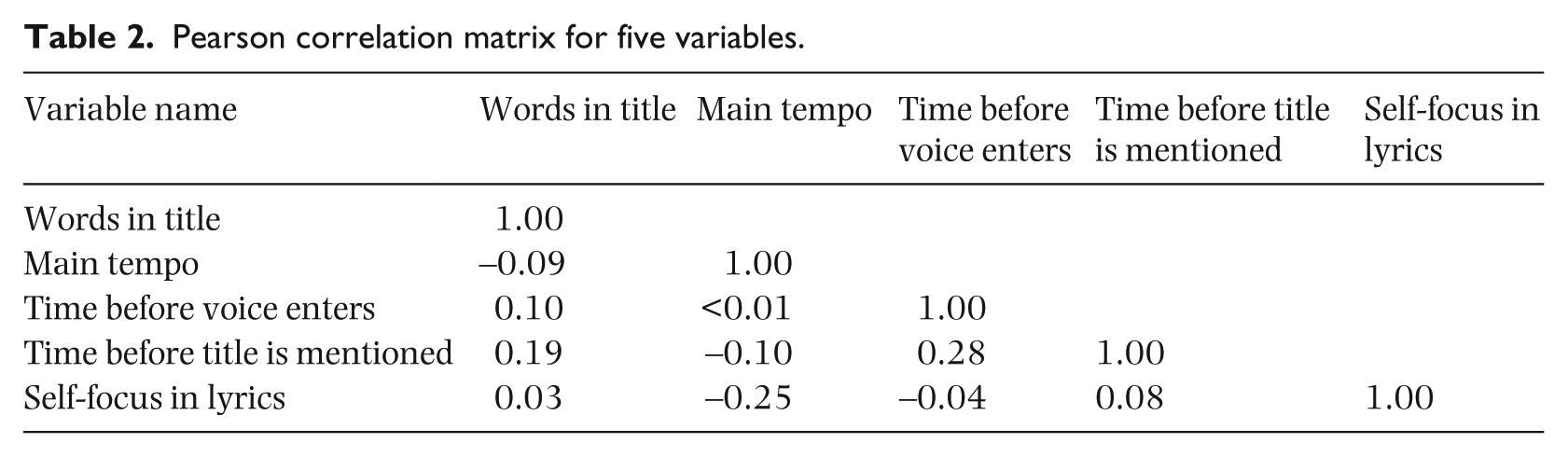
A closer look at the results suggests other trends in compositional practices. Table 2 presents a correlation matrix for the five studied variables. Of particular musical interest is the moderate negative correlation between the tempo of a song and the self-focus quality of its lyrics. This suggests that slower songs such as ballads would tend to be more self-focused or personal, while up-tempo songs such as dance music would be less self-focused. This makes sense from a musical perspective, as we tend to view ballads as more introspective than up-tempo dance music.
Pearson correlation matrix for five variables.
Study 2: Within-artist comparisons of success
The results of the first study suggest that popular music changed in the last 30 years in a way that is consistent with attention economy principles. However, it is unknown whether this phenomenon is limited to the most popular songs (e.g. top-10 songs), or can be generalized to popular music in general. Thus, the aim of our second study is to investigate whether more popular songs exhibit a greater affinity for attention economy principles than less popular songs.
Hypotheses
If we postulate that compositional practices in popular music are influenced by the attention economy theory, it is reasonable to assume that the most popular songs take better advantage of these principles than the less popular songs. Using the variables identified in Study 1 and validated through a post-hoc linear regression model, we hypothesize the following:
Sample
The most-streamed songs on Spotify for 2015 were elected as representative candidates of the most popular songs. We shall refer to this first group as “most popular songs.” In considering what might be the less popular songs, there are several confounds that arise. One might choose songs that are very rarely played on Spotify. However, these songs might be rarely played for numerous reasons. For example, the music might be out of tune, or badly recorded, or badly arranged, or sung in an unpopular style. Ideally, our comparison group should be similar in all musical respects, with the exception of those factors related to attentional economy that are the subject of this study. One way of reducing these unwanted confounds is to select recordings by the same artist that are simply much less popular. Consequently, the most popular and less popular works are more likely to be matched for singer, tuning, recording quality, quality of arrangements, etc. As such, for every “most popular song,” we used the least streamed song by that same artist from the same album as a control, based on Spotify’s streaming statistics. We will refer to this group as the “less popular songs.” This sampling method allows us not only to control for genre, but also to control for the impact of an artist’s notoriety over the popularity of a song.
A potential caveat regarding Spotify’s streaming statistics needs to be acknowledged. As the data from Lamere (2014) shows, Spotify users have a high skipping rate. Jonze (2014) states that tracks need to be listened to for 30 seconds to count towards the total number of plays. Considering that one of our hypotheses relates to lyrics, one might wonder how much analytical weight should be given to the text if listeners are likely to only partially hear it. This is a valid concern. However, considering we have no reason to believe that some songs are systematically more skipped than others, this caveat should not affect our data in any systematic way. In other words, while Spotify’s play count methodology does introduce noise in our data, it likely does so in a randomized way.
Some albums exist in both standard and “deluxe” or “extended” version. When this is the case, the “deluxe” version was used to elect the “less popular” song. Some popular songs are not part of an album, but are rather released as singles. Since these songs can’t be paired with a “less popular” song using the same methodology, they have been omitted from the sample. Similarly, songs only released as part of a compilation of songs from different artists (e.g. a movie soundtrack) have also been omitted. Finally, each artist is only represented once in each group. Subsequent songs by the same artist were omitted.
Using this methodology, 120 songs were included in our sample. The average number of plays for the “most popular” group is 350,761,781 and 6,313,174 for the “less popular” group. 1
Results
Five paired t-tests were conducted to evaluate whether the “most popular” and the “less popular” songs from each album differed significantly from each other. The results are presented in Table 3.
Paired t-test results comparing most popular and less popular songs according to five variables.
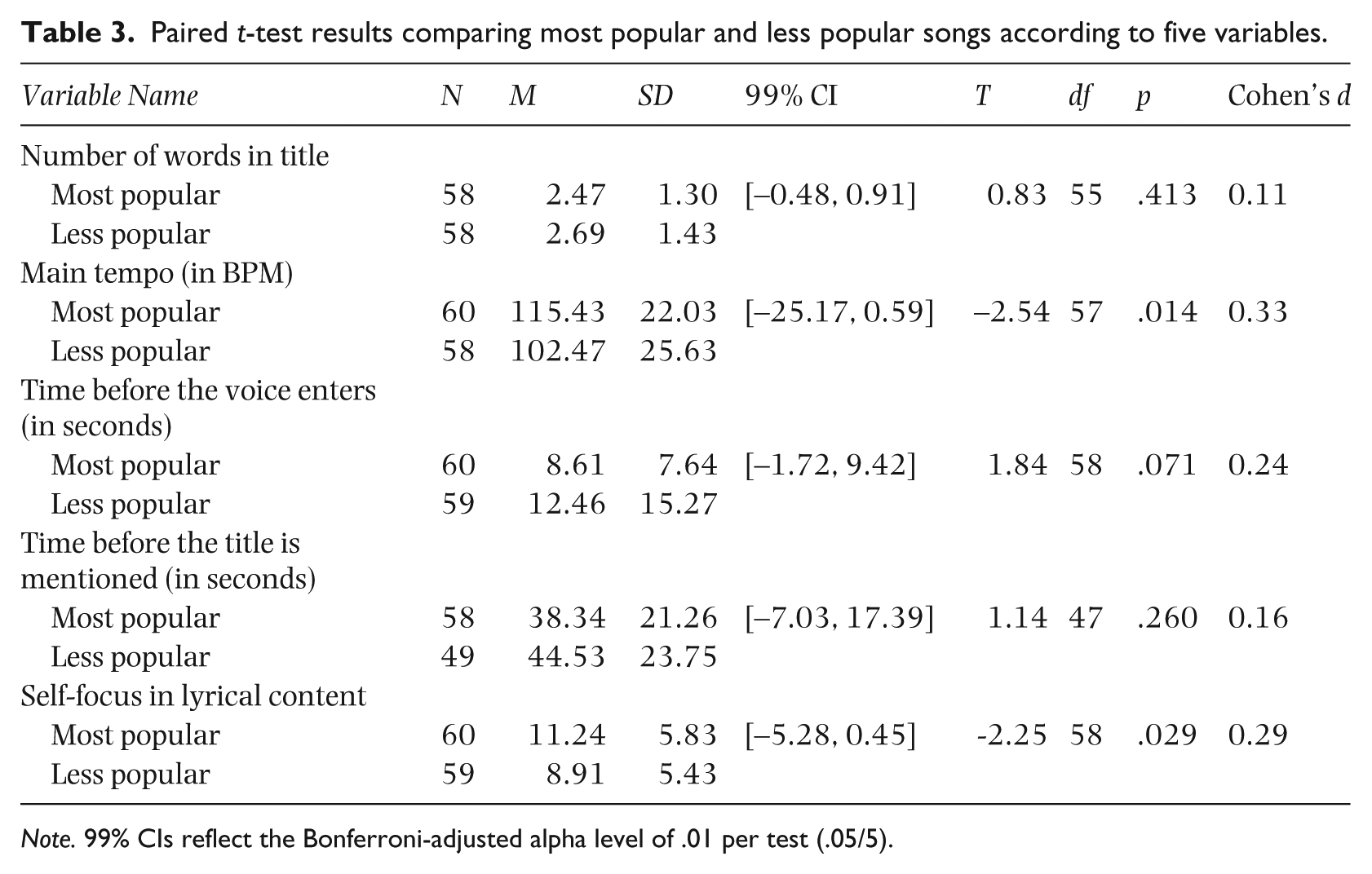
Note. 99% CIs reflect the Bonferroni-adjusted alpha level of .01 per test (.05/5).
Using a 95% confidence level, three variables were identified as significantly different between the two groups: the number of syllables in the title, the main tempo, and the self-focus score of the lyrical content. However, none of the variables remain statistically significant with a Bonferroni-adjusted alpha level of .01 per test (.05/5).
Discussion
Recall that our hypotheses predicted that the most popular songs take better advantage of attention economy principles than the less popular songs. However, the data were not consistent with any of the hypotheses regarding the relationship between these principles and popularity.
General discussion
The results of the first study provide evidence suggesting a change in compositional practice in popular music over the last 30 years. This apparent change is consistent with attention economy principles. The results of the second study, however, failed to support any of the hypotheses regarding the relationship between attention economy principles within a comparison of popular and less popular music.
This capacity for popular music creators to adapt themselves – consciously or not – to a paradigm shift should not come as a surprise. Another much-discussed example is the so-called “loudness war,” a tendency for popular music engineers to increase the perceived loudness of a recording through dynamic compression. This tendency to increase Root-Mean-Square (RMS) levels since 1980, paired with a steady decrease in average dynamic range (Vickers, 2010), is consistent with the attention economy theory described above.
Several other examples in recent history illustrate ways in which music makers – either artists or producers – had to adapt themselves to consumer practices. Perhaps the most obvious example is the so-called “3-minutes rule,” which stated that, in order to be commercially successful, a single had to have a maximum duration of 3 minutes. The 3-minutes rule originates from the “Drake Clock,” a structured time usage formula elaborated by Bill Drake and Ron Jacobs at KHJ where “[d]eejays, songs, even commercials, and news were designed to fit the mold; if they did not, they were not aired” (Denisoff, 1989, p. 84). This system eventually governed the entire radio programming in America (Osborne, 2012).
The rise in popularity of karaoke in Japan gives another example of how cultural practices can influence the music industry. Karaoke emerged in the 1970s and became widely popular during the late 1980s and 1990s, especially through small private rooms called “karaoke boxes.” During the 1990s, the number of multi-million seller singles in Japan increased significantly compared to the preceding decade. Ogawa (1998) suggests that the growing popularity of karaoke boxes is directly responsible for these multi-million sellers:
The songs often sung in karaoke boxes occupy the top 40. Now those who make the top 40 are not just passive listeners but the users of karaoke. This means that one of the important elements for hit songs changed from “good to listen to” to “good to sing.” (Ogawa, 1998, p. 49)
Ogawa gives the example of Tetsuya Komuro, a singer-songwriter and producer who composes songs specifically with karaoke singers in mind. Similarly, Cantopop composer Angel Lam uses “narrower melodic ranges, fewer difficult leaps, and shorter phrases in order to accommodate the amateur singers’ typically modest abilities” (Katz, 2011, p. 468).
All the above examples – the loudness war, the “Drake Clock,” the karaoke boxes, and the attention economy principles in contemporary popular music – highlight the musicians’ and music producers’ impressive capacity to adapt themselves to their rapidly-changing environment. Today’s online streaming platforms create a highly saturated ecosystem that encourages a high level of competition for the listener’s attention. The present research highlighted four main parameters that have changed in the last three decades in a way that is consistent with the proposed theory of attention economy: the number of words in song titles has decreased, the average tempo has increased, the time elapsed before the initial entry of the voice has shortened, and similarly the time before the title of a song is heard has also shortened. However, the data were not consistent with any of the hypotheses regarding the relationship between attention economy principles within a comparison of popular and less popular music. What remains to be demonstrated is whether these compositional changes are an effective way to grab listeners’ attention.
Footnotes
Funding
This research project was supported by the Fonds de recherche du Québec – Société et culture.