



Abstract
Concepts of creativity in music usually focus on explicit theoretical assumptions based on models from psychology research. In recent years, the fields of psychology and education have become increasingly interested in research on laypersons’ attitudes and assumptions about creativity. These implicit theories may complement or even contradict scholarly conceptualisations of creativity and its domain specificity. As a conceptual replication of the work by Runco and Bahleda (1986), this study aims to explore the dimensionality of subjective conceptions of creativity in different domains (arts, science, everyday life, music) by means of an open-ended questionnaire in an online survey (N = 106). A content analysis of the data yielded 27 meta-categories; a correspondence analysis of their distribution across domains revealed differences between domain-specific conceptions. This indicates stereotypical structures regarding creativity in different domains, as expressed in the associations generated by the participants. Unlike science and the arts, music is described as having distinct aesthetic and emotional qualities. The participants’ musical expertise did not appear to significantly influence the generation of associations. With respect to these characterisations cited by the participants, the domain of everyday life seems to be antipodal to other domains and may therefore have served as a point of reference for the participants’ subjective experience of creativity and creative behaviour. These results confirm the findings of Runco and Bahleda (1986), perhaps even furthering them in terms of the analytical methods applied and the findings on the comparison of domains. Nevertheless, the potential of implicit theories (i.e. laypersons’ mindsets concerning the theoretical conceptualisation of musical creativity and its implications for music education) requires further study.
Keywords
Approaching creativity in music
Conceptualisations and dimensionality of creativity
Creativity in music shows in many facets. Whilst composition and improvisation can be seen as paradigmatic generative processes (Lothwesen & Lehmann, 2017, p. 342), reproductive and perceptive activities like performing music (Clarke, 2012; Rink, 2002) and listening to music (Hargreaves, Hargreaves, & North, 2012; Webster, 2002) are also considered to be creative (Hargreaves, MacDonald, & Miell, 2012, p. 3). Musical performance research has shown that a creative process might be shared among the members of an ensemble (Payne, 2016; Sawyer, 2006; Schober & Spiro, 2014). Moreover, elements of the creative process might also be distributed according to the typical characteristics of musical genres. These might include group composing in popular music, which involves a number of different tasks, such as a musician generating musical ideas, a writer writing lyrics, a musical director arranging the musical piece, a producer taking care of technological issues, or even a manager developing a musical image for promotion (Biasutti, 2012; Kleinen, 2003; Seddon, 2005). So, creativity in music is multifaceted; it is situated in social environments and dependent on musical genres. The plurality of musical genres inevitably opens up a multitude of potential influences on creative behaviour and its recognition and appreciation. Since the term “creativity” appears to have been “overused, misused, confused, abused, and generally misunderstood” (Balkin, 1990, p. 29) it has become “a hopelessly over-inclusive-term” (Hargreaves, Miell, & MacDonald, 2012, p. v) and “has a great deal of uncertainty” (Runco, 2014, p. 389), which is why new definitions have been proposed but have not yet found traction in the field (Cook, 2012; Hargreaves, MacDonald, et al., 2012). An overarching working definition of creativity in music might consist of the interaction between learnable abilities (aptitudes), social actions and socio-ecological conditions which facilitate generative musical behaviour in a social field, and which result in tangible products of different relevance (new, original, useful); these products in turn enable their social, cultural, and aesthetic integration (Lothwesen, 2014, pp. 205–206).
The question of whether creativity is domain general or domain specific is complex. Theoretical approaches and research methods are having an impact on how the concept of creativity is structured and they may explain divergent findings. It seems to be broadly accepted that some general features are needed in order to develop specific talents in creative behaviour (Feist, 2004), and recent research has provided some approaches which attempt to merge the contrasting perspectives of domain generality and domain specificity. Sternberg (2005) nonetheless warns that even “within a domain, things are neither wholly domain general nor domain specific” (p. 305). Since a field like music contains different activities that require different skills, the conceptualisation of creativity in music remains unclear in terms of domain generality or specificity. For example, people who frequently listen to music might not be good at making music themselves; or classical composers need not necessarily be equally successful in popular music genres, and the same might hold for performing musicians. And thus, having been explored in subsequent studies as “meta-theoretical heuristics” (Baer, 2012) Sternberg’s approach distinguishes between “analytical, creative, and practical processing” (Sternberg, 2005, p. 302). Taking into account the varying abilities of people who engage in a single creative field, it is not a question of whether they are “creative” or “not creative”, but rather the degree to which and the way in which people act creatively. Adding a phenomenological perspective, Julmi and Scherm (2015) propose a multilayered structure of creativity which differentiates between corporeal (representing perceptions as atmospheres), hermeneutic (contextually defined situations), and analytical creativity (behaving in particular constellations) as major domains that differ regarding the creative processes and abilities required for each. Redefining the dichotomy of everyday (little-c) and excellent (Big-C) creativity, Kaufman and Beghetto (2009) differentiate between types of creativity by taking into account the creative aspects of learning (mini-c) and expertise development (pro-c). This four-c-model provides a categorical differentiation between creative contexts, enabling a more nuanced observation and assessment of creative behaviour (Kaufman & Beghetto, 2013). Focusing on domain content, the Amusement Park Theoretical (APT) Model of Creativity (Baer & Kaufman, 2017) provides a framework for amalgamating the generality–specificity dichotomy. Using the metaphor of an amusement park, Baer and Kaufman (2017) illustrate how domain-general and domain-specific aspects are exhibited in creative behaviour. Starting with domain general factors, the model envisages the gradual specification and specialisation of creative behaviour. In this sense, certain requirements (e.g. intelligence, motivation) function as prerequisites for engaging in particular fields, comparable to the thematic areas of amusement parks (e.g. everyday, scholarly, or artistic creativity), where various domains (e.g. handiwork, maths, theatre) are set so that each exhibits particular genres (e.g. classical music, folk, pop) – or in the case of music, even narrower styles such as the Gregorian chant, French impressionism, the New Viennese School, American experimental music, hard rock, punk, and thrash metal. As for creative behaviour in music, Webster (2002) suggests that it can result in various products including composed music (written in scores or recorded), recorded performances and improvisations, written analyses, and mental representations of any music heard. So, the possible facets of creativity in music are manifold and may vary in their description depending on people’s individual perspectives and subjective experiences, as well as scholarly approaches and empirical methods. Nevertheless, it is still to be clarified what people acknowledge as musically creative and which criteria they use to assess creativity in music – and if these differ from other creative domains. In order to address these issues, the construct of implicit theories provides a helpful frame.
Implicit theories as a paradigm for creativity research
Implicit theories mark a socio-psychological concept describing individual belief systems which represent subjective constructions based on impressions, opinions, experiences and expectations. These belief systems do not need to be verbalised; they reflect tacit knowledge in people’s behaviour and, like stereotypes, implicit theories can support connotations between objects and features because they lead to hypothetical assumptions based on deduction. Implicit theories can be stable or malleable, meaning that they either represent a fixed belief or one that might change (Dweck, 2011; Lüftenegger & Chen, 2017). Implicit theories exhibit similarities to the concept of self-efficacy, as both are subjective belief systems that are constructed gradually via social learning, through “making meaning out of everyday encounters with creative people and creative activities in terms of a social schema” (Hass, Reiter-Palmon, & Katz-Buonincontro, 2017, pp. 219–220). However, while self-efficacy refers to a person’s own abilities, implicit theories tend to make generalisations about elements in a creative setting, such as characteristic features and traits of products, people, and situations (Hass et al., 2017, p. 220). In the same way that expectations about objects or people are formed in relation to their traits, implicit theories may also transfer attributions within traits. For instance, a polite person might also be considered trustworthy. Or, in the case of music, if musical creativity is conceived of as being an unexplainable gift, it would appear consistent to think of all musicians as geniuses per se.
Implicit theories impact on people’s development and behaviour by providing holistic views and explanations, by serving as motivational bases, and by providing a sound basis for judgement (Dweck, Chiu, & Hong, 1995a, 1995b; Hass et al., 2017; Sternberg, 1985). Research on implicit theories emphasises mechanisms of social cognition of intelligence and personality (Dweck, 2011; Sternberg, 1985; Sternberg, Conway, Ketron, & Bernstein, 1981) but also addresses motivational (Dweck & Legett, 1988) as well as educational issues (Runco, 2014, pp. 177–179; Blackwell, Trzesniewski, & Dweck, 2007; Runco & Johnson, 2002), and it examines conceptions of creativity in general (Hass & Burke, 2016; Kaufman & Beghetto, 2013; Runco & Bahleda 1986; Sternberg, 1985; Tang, Baer, & Kaufman, 2015) as well as from the perspectives of different groups, for example (in alphabetical order), artists, children, general population, parents, politicians, scientists, teachers (Runco, 2004, p. 674), and also within a cross-cultural frame (Runco, 2014, pp. 261–262; Lim & Plucker, 2001; Paletz & Peng, 2008; Tang et al., 2015). Research on implicit theories follows different disciplinary approaches and applies several empirical methods (Dweck, 2011, p. 48; Runco, 2011, pp. 644–645; Lüftenegger & Chen, 2017) to focus on either the agreement of people’s judgements or on the differentiation of particular types of belief systems (fixed or malleable), or to examine the content of people’s conceptualisations of intelligence or creativity, for example.
Across all these fields of interest it shows that implicit theories represent knowledge structures that reflect cultural influences in recognising and valuing creativity (Lim & Plucker, 2001; Paletz & Peng, 2008; Runco & Johnson, 2002; Spiel & von Korff, 1998; Tang et al., 2015). As a result of this implicit theories also exhibit prototypical thinking on objects and traits (Hass, 2014; Hass & Burke, 2016; Runco & Bahleda, 1986; Sternberg, 1985; Sternberg et al., 1981). Implicit theories are affected by specialised knowledge and expertise. Experts are assumed to have more detailed and specific beliefs than laypersons, but their mindsets do not necessarily differ significantly from the latter (Runco & Bahleda, 1986). Moreover, experts display specialised perspectives with regard to their professional roles and standards (Sternberg, 1985, pp. 623–624). The variability of implicit theories may differ even greater between professional groups than regarding their cultural background (in this case German and Austrian; Spiel & von Korff, 1998). But still, there are similarities between experts and laypersons; despite following different prototypes, there seems to be a “consensus about certain correlates of creativity” (Runco, 2011, p. 646).
Implicit theories “help to make our definitions more realistic and practical” (Runco & Bahleda, 1986, p. 94). Findings from research on implicit theories may be considered in theoretical conceptualisations and educational contexts alike since they provide insight into individual mindsets and their development (Dweck, 2011, pp. 57–58) and thus may complement the study of explicit theories (Sternberg, 1985, p. 625) and facilitate learning arrangements (Runco, 2011, pp. 644–645). Implicit theories are integrated into people’s everyday life-contexts and thus motivate people’s behaviour (Dweck, 2011, p. 51; Runco, 2011, pp. 644–645), so they can be understood as “social-cognitive structures that help people organize knowledge of complex psychological phenomena” (Hass et al., 2017, p. 221). Since implicit theories can be fostered by subjective experiences when people perform a task or observe others (Hass et al., 2017, p. 220), it should be assumed that they relate to particular contexts and any requirements necessary for carrying out these tasks. In this sense, it would be fair to expect implicit theories to differ depending on the creative domain.
Aims and objectives
The present study aims at revealing and systemising those individual conceptions which form the basis of implicit theories about creativity, in order to be able to describe conceptions of creativity in music in relation to other creative domains. Since there are several studies at hand exploring implicit theories, the present study was conceived as a conceptual replication (Frieler et al., 2013). For this purpose the widely cited and recognised study by Runco and Bahleda (1986) was chosen as a reference. It represents an early and still important empirical attempt to explore implicit theories of creativity in different domains based on the participants’ free associations. This effective method represents people’s actual conceptions, and thus can be applied to recent models and approaches questioning domain contents. So, the present study seeks to explore people’s conceptions of creativity by 1) collecting free associations about different domains, 2) checking their features for domain-specific differences, and 3) making inherent structures visible (i.e. exploring the similarities and differences between domain-specific implicit theories). Accordingly, the aims of the present study are (1) to validate the findings of the reference study, (2) to advance the analytical methods applied in the reference study, and (3) to define a profile for music, a domain that was not explicitly addressed in the reference study.
Synopsis of the reference study: “Implicit theories of artistic, scientific, and everyday creativity” (Runco & Bahleda, 1986)
In a questionnaire study, Runco and Bahleda (1986) investigated implicit theories of creativity in various domains; they implicate that people’s artistic experience would result in different conceptions. According to the participants’ self-evaluation, the sample (N = 88) consisted of groups of professional (n = 16) and amateur artists (n = 20), and a control group without artistic experience (n = 52). Conceived as a free association test, people were asked to list as many characteristics as possible for the domains of arts, science, everyday life, and for non-creativity. A frequency analysis was applied to determine “the most common characteristics generated by each group for each category” (Runco & Bahleda, 1986, p. 95). This yielded a ranking of characteristic features varying in absolute frequencies from 244 words for science up to 281 for the domain of everyday life. The expertise groups did not differ significantly in terms of number and uniqueness of responses per domain (counted words), but they did regarding the participants’ self-evaluation of their creative potential in the given domains: artists were more likely to rate their own creativity as being higher in the arts than the control group. In addition, the expertise groups differed in their use of attributes to describe artistic creativity. For example, the group of artists (professionals and amateurs) described artistic creativity as (in order of their frequency): “expressive”, “imaginative”, “humorous”, “open-minded”, “unique”, “emotional”, and “exciting”, whereas the control group used the following attributes: “imaginative”, “expressive”, “intelligent”, “original”, “perceptive” and “draws well”. This explains why Runco and Bahleda conclude that the groups may have used different prototypes of creativity, typical examples that stand for a particular category or concept (Runco & Bahleda, 1986, p. 97). In this sense, expertise in a particular field must lead to a distinct set of criteria which people draw on to detect and explain creativity, which is reflected in people’s implicit theories.
The results of Runco and Bahleda (1986) clearly mark a domain-specific position; moreover, they emphasise the importance of expertise in detecting and explaining creativity in different domains. However, there are some concerns to be articulated at this point. First, the analysis of the attributes generated by the participants lists features (i.e. adjectives like e.g. “expressive”, “imaginative”, …), skills (e.g. “draws well”), and characterisations of persons (“problem-solver”) (Runco & Bahleda, 1986, p. 95). This demonstrates the nature of implicit theories which may consist of rather unsorted associations, but it does not differentiate particular types of attributes, for example factual features and task-oriented skills or personal traits, that impact on what implicit theories are focused on and how they are structured. Second, some attributes appear as characteristics in multiple domains (for example “intelligent” is a feature of both artistic and scientific creativity). This may suggest a multidimensional structure of implicit theories in which attributes may be shared by various domains. Yet, the analytical procedure does not seem to consider this. Analysing the qualitative data just regarding their frequencies per each domain separately proposes a nominal structure of implicit theories. In this regard the findings of Runco and Bahleda (1986) illustrate the so-called method effect: qualitative approaches may rather confirm a nominal structure whereas psychometric tests may appeal to a factorial structure (Silvia, Kaufman, & Pretz, 2009, p. 140).
Method
In keeping with its main aims, the present study modified the original procedure in a number of ways: (1) the domain of “music” was added as it was not addressed in the reference study; (2) an extra question was inserted regarding the characteristics of creative persons; (3) a self-evaluation of musical expertise was added; (4) people were asked to rate the frequency of their leisure time activities; (5) the question of subjective affectivity was developed further.
Collecting the data
The survey was made available using an online platform (www.surveymonkey.com) to reach a heterogeneous audience with varying degrees of understanding with regard to creativity across domains. The recruitment of the participants relied on snowball sampling, starting from personal acquaintances. In order to prevent multiple participations, a doubling of IP addresses was not allowed: once the questionnaire had been started, it had to be finished, or this particular computer would be excluded from further participation. The online questionnaire asked for:
Subjective conceptions of creativity as gathered in the reference study (Runco & Bahleda, 1986). In a free association test with open-ended questions, participants were asked to list characteristics for each of the given domains (art, science, everyday life, music, non-creativity): “In your opinion, what are characteristics of creativity in art / science / everyday life / music / non-creativity?”
Features and characteristics (e.g. personality traits) of creative persons in a separate open-ended question. Since implicit theories can hold for objects, tasks and people alike an attempt was made to compare object-related (as asked in 1) and person-related conceptions. People were asked to briefly describe their notions in order not to narrow the scope of possible answers: “Now please think of a musically creative person (composer, musician etc.). What are the typical characteristics of this person?”
Socio-demographic data (age, sex, hobbies) to describe the individual in terms of general features. Because the task-specific knowledge required to perform creative activities can be enhanced by the degree of involvement (Hass et al., 2017), participants were asked to rate their leisure activities from a given list of 18 such activities, for example handiwork (knitting), writing stories, etc.
An individual self-evaluation of musical expertise. Developing expertise in relevant fields may also foster conceptions of domain-specific creativity (Baer, 2015; Kaufman & Baer, 2004). In order to compare participants’ responses regarding their musical expertise, the participants were asked to evaluate themselves by choosing one of the following categories (taken from Ollen, 2006): “Concerning your musical activities, would you consider yourself to be a non-musician / a music-loving non-musician / an amateur musician / a semi-professional musician / a professional musician?”
A self-report of trait affectivity. Since dimensions of personality can be influential when people engage in creative behaviour (Eysenck, 1993; Ivcevic & Brackett, 2015; Ivcevic & Mayer, 2006; Kaufman & Beghetto, 2013; Runco, 2014, pp. 273–291), they may therefore have an impact on people’s implicit theories. The PANAS (Positive and Negative Affect Schedule; Watson, Clark, & Tellegen, 1988; Krohne, Egloff, Kohlmann, & Tausch, 1996) defines emotional reactions as traits (stable individual differences) and connects with dimensions of personality such as extraversion (positive affectivity) and neuroticism (negative affectivity).
Sample
In total, 106 people between the ages of 12 and 58 years (Mdn = 24.5, IQR = 10.25) took part in the study. About two-thirds of the sample were female (n = 65). For parts of the analysis, the sample was segmented into five groups based on the participants’ self-reported musical expertise (Table 1). Since these groups were rather small, two larger groups were formed by grouping categories to check for differences regarding musical expertise: MUSIC MAKERS (amateurs, semi-professionals, and professionals, n = 39) and MUSIC LISTENERS (non-musicians, and music-loving non-musicians, n = 31).
Distribution of sex and age regarding musical expertise in the whole sample (absolute frequencies).

Note. . aself-reported; bmissing: n = 2; cmissing: n = 1; dmissing: n = 5.
Of the given 18 items listed as leisure activities, the 10 most preferred hobbies in the whole sample were: “listening to music” (M = 3.42; SD = 0.71), “meeting friends” (3.28; 0.78), “making music” (3.23; 0.92), “reading” (3.14; 0.81), “watching TV” (3.12; 0.82), “internet and computer games” (3.05; 0.89), “doing sports” (2.83; 0.98), “relaxing and meditating” (2.66; 0.73), “going out” (2.65; 0.86), and “going for a walk” (2.49; 0.79). In order to check for participants’ favourite music-related hobbies, the study compared (t-test for independent samples) expertise groups (professional musicians and non-musicians, and music makers and music listeners respectively). For “making music” the scores of professional musicians (M = 3.78, SD = 0.441) and non-musicians (M = 1.75, SD = 0.463) differed significantly, t(15) = -9.246, p < .0001, d = 4.79, as they did for “inventing music” (professional musicians: M = 2.56, SD = 1.014; non-musicians: M = 1.25, SD = 0.463; t(15) = -3.337, p = .005, d = 1.73). Regarding “listening to music”, professional musicians (M = 3.44, SD = 0.726) and non-musicians (M = 3.63, SD = 0.518) did not differ significantly, t(15) = .583, p = .569, d = 0.32. Similar tendencies appeared in the larger expertise groups (MUSIC MAKERS, MUSIC LISTENERS): regarding the frequency of “making music”, t(61) = -4.97, p < .0001, d = 1.29, and “inventing music”, t(61) = -3.25, p = .002, d = 0.84, MUSIC MAKERS had a higher frequency than MUSIC LISTENERS, yet regarding “listening to music”, t(62) = -1.15, p = .255, d = 0.29, these groups did not show any significant differences. Regarding affectivity, there were no significant group differences between professional musicians and non-musicians, PAsum: t(15) = .50, p = .624, d = 0.26; NAsum: t(15) = 1.85, p = .084, d = 0.96, or between MUSIC MAKERS and MUSIC LISTENERS, PAsum: t(62) = -1.16, p = .25, d = 0.3; NAsum: t(61) = 1,22, p = .228, d = 0.31.
Analysing the data
The study analysed the socio-demographic data and self-evaluations using descriptive statistics (see Table 1). It applied qualitative and quantitative procedures for analysing the qualitative data collected from the participants’ answers to the open-ended main question. First, the data was structured by categorising the participants’ answers, and the resulting attributes were quantified through frequency counts. Next, a correspondence analysis was conducted to visualise latent structures in the data.
Content analysis
The initial process of thematically re/structuring the participants’ responses to the open-ended questions involved two coders working in coordination in stages using MAXQDA software (Kuckartz, 2014). They analysed the questions which asked for conceptions of creative domains and features of creative persons (see above) as separate responses. However, due to missing data, it was not possible to pursue the latter question any further here; the following analyses therefore focus on the major question regarding people’s conceptions of creative domains. First, the material was sorted inductively, suggesting particular topics; then, a coding procedure was applied – following the rules of structured content analysis – combining inductive and deductive coding (Mayring, 2010). The coding system and the resulting categories were developed in discussions between the two coding experts. In an iterative process the inductively formed categories were then critically compared with findings from relevant literature to develop a systematic set of categories (from in vivo-coding to meta-categories). This procedure therefore combined inductive (empirical) and deductive (theoretical) approaches for understanding the participants’ associations by not only focusing on the data gathered, but also considering findings from existing empirical and theoretical studies.
The material for the qualitative analysis consisted of words, phrases and sentences, with the latter being regarded as clarifying context. Words and phrases were defined as units of analysis enabling in-vivo coding for each domain, thereby organising the exact words given. Since these units of analysis were of various lengths, the coded words and phrases were all transformed into adjectives to give the attributions a common semantic level. Starting with an in-vivo analysis, the procedure included each category which had been listed at least once. In order to retain the scope of the given answers, filing units with multiple meanings into more than one category was allowed. Following the procedure of a structured content analysis proposed by Mayring (2010), these codings were revised after about 15% of the data had been worked through, thus refining the codings and coding rules. This procedure yielded 686 codings in total, which were then aggregated into 60 categories. Applying qualitative and quantitative procedures, these categories were grouped by semantic meaning and a threshold was set based on statistics: if a category had fewer than eight counts (i.e. 25%, first quartile), it was not considered hard enough to function as an autonomous category; the respective codings were then sorted into semantically neighbouring categories. In order to achieve a general basis for comparing domains regarding their attributions, the categories were pooled into 27 meta-categories which were applicable to all domains due to their super-ordinate meaning.
To give an example: The phrase “attentively absorbing the world around” (unit of analysis) was interpreted as “gaining inspiration from the environment and ambience” (coding) and categorised as “inspiration” (category). This was then integrated into the meta-category “perceptive” (meta-category), meaning being inspired by others, by aesthetic objects and by ambience, being sensitive for moods and atmospheres, and being aware of one’s surroundings both socially and aesthetically (Figure 1).
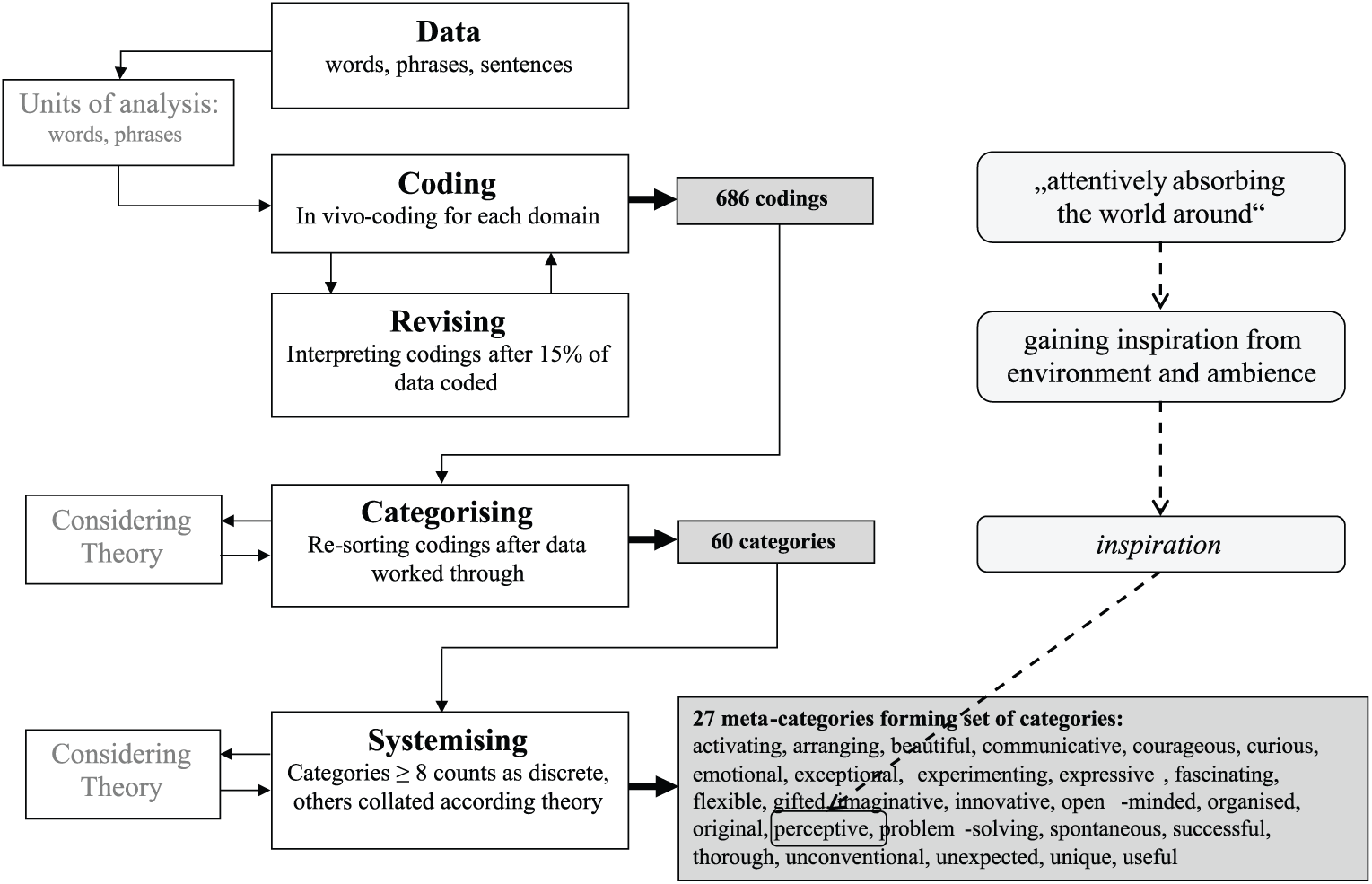
Schematic procedure of content analysis.
Correspondence analysis
After having completed the coding process in the content analysis, a correspondence analysis was conducted to visualise the inherent structures in the categorical data. Correspondence analysis is a statistical procedure which is used to detect latent structures in categorical data in order to explore the relations between the elements, which are then visualised in a multidimensional space. The first step involves standardising the data in a contingency table in which their independence is tested row by row and column by column. The dimensions of the solution space are then extracted and weighted. Various procedures may be applied in a final step to normalise the coordinates regarding their inertia (as a measure to explain variance), which is projected onto the individual values to display the exact distances between the elements (Backhaus, Erichson, Plinke, & Weiber, 2006; Greenacre, 2007). Based on the number of frequencies counted, this method allows the comparison of the distribution of categories by domain by visualising their proximity to one another.
Results
This section first reports the results of the content analysis, and then those of the correspondence analysis. The following analyses focus on participants’ free associations regarding their conceptions of creative domains.
Content analysis
Generation of words
In total, the participants generated about three and a half thousand words in describing their conceptions of creative domains. The domain of music had the largest number of words counted; the domain of science had the fewest. Distribution across the domains was ranked according to frequency, something which was consistent in the total sample as well as in the subgroups of music makers and music listeners alike (Table 2). With respect to the number of words counted, the expertise groups differed significantly: music makers generated more words for each domain except SCIENCE than did the music listeners, χ2 [4; N = 3447] = 45.989, p < .001; professional musicians generated almost twice as many words for MUSIC than did non-musicians, with the latter generating more words for EVERYDAY than the former, χ2 [4; N = 947] = 57.768, p < .001.
Word counts per domain regarding musical expertise groups.

Note. aSince the expertise groups “professional musicians” and “non-musicians” are subgroups of “music makers” and “music listeners” respectively, the total sum displays just the word counts for the larger groups.
Codings and meta-categories
As the meta-categories aggregate the categories that have been found inductively in the content analysis, they consequently compound all codings (Table 3). The whole set of meta-categories therefore covers the widest possible range without losing any specifics belonging to the data. Across all domains, the meta-categories counted most in the whole sample were: innovative (74), imaginative (69), arranging (54), unconventional (54), and flexible (46); most codings were counted for MUSIC (203) and the fewest for SCIENCE (128).
Distribution of meta-categories per domain (absolute frequencies).

Note. The absolute frequencies displayed refer to the whole sample.
Group differences
The expertise groups differ significantly regarding the number of words used to characterise the domains in question (see above). Regarding the distribution of meta-categories across domains (Table 3), codings were counted more frequently for the groups of non-musicians (138) than for professional musicians (118), yet the distribution strongly correlates (ρ = .70; p = 0.188) and does not differ significantly, χ2 [4; N = 256] = 4.562; p = .335. Focusing on the domain of music, the groups of professional musicians (33) and non-musicians (34) almost achieved the same number of codings. This was also the case for the larger expertise groups: the group of music makers achieved more codings for MUSIC in total (98) than did the group of music listeners (69), but the groups did not differ significantly regarding the distribution of the codings regarding the meta-categories, χ2 [23; N = 167] = 32.551; p = .089.
Correspondence analysis
Since no expertise differences were found regarding the number of categories, the whole sample was defined as a database for the correspondence analysis. By using row principal normalisation, it was possible to compare domains with respect to their distribution of categories, for example the profiles of MUSIC and ARTS regarding their characteristic attributions. Since the aim of the correspondence analysis was to visualise relations between creative domains the category NON-CREATIVITY was excluded from the analysis. As four domains were now given, the correspondence analysis calculated a maximum of three dimensions (see Table S1 in the Supplemental Material Online section). Since the first two dimensions already accounted for 78.6% of inertia (DIM 1 = 45%, DIM 2 = 33.6%) a two-dimensional solution was considered sufficient enough to explain the variance in the data. The two dimensions correlate slightly, r = .119, χ2 [78, N = 686] = 416.035, p < .001, and are clearly distinguished content-wise, as indicated by the elements in the two-dimensional response space (Figure 2).
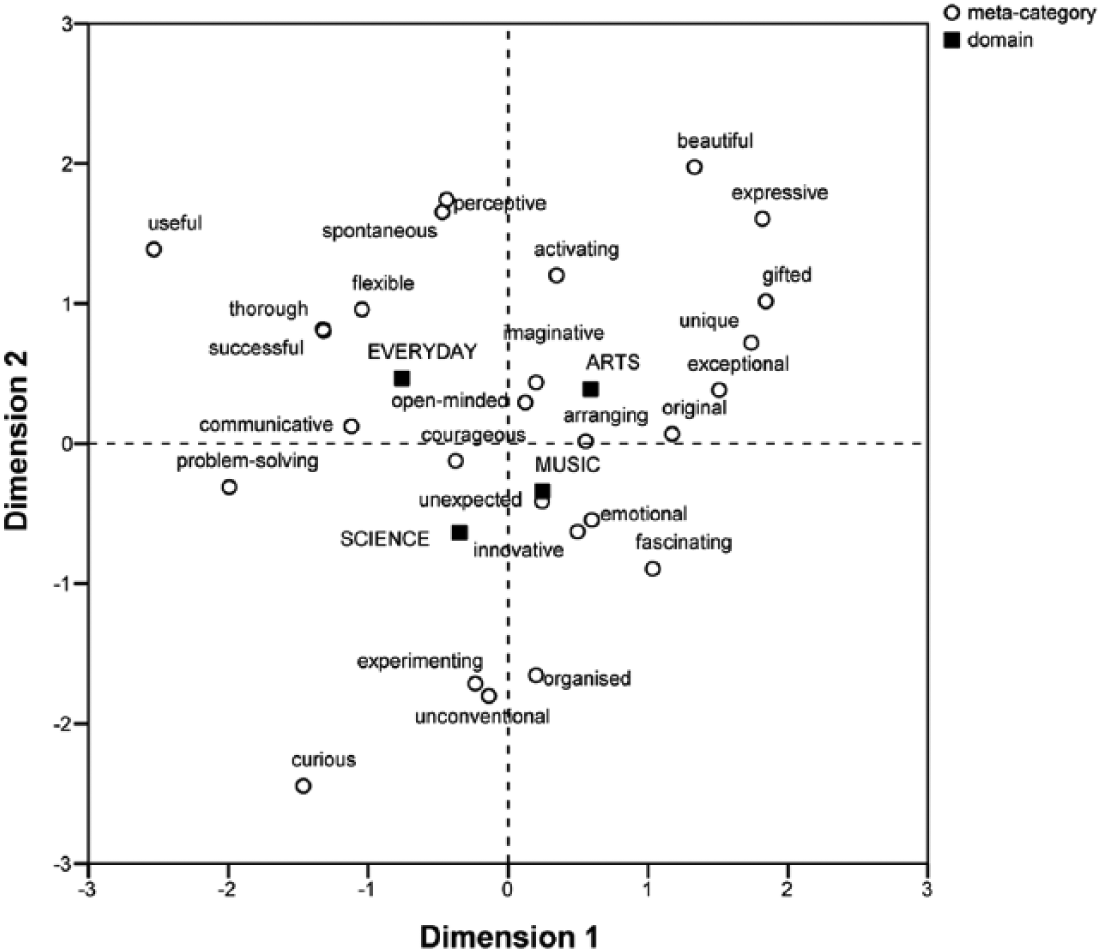
Correspondence of meta-categories regarding domains (CA, row principal normalisation).
The response space is determined by the positions occupied by the elements on the two dimensions; each element contributes to the inertia of these dimensions (see Table S2 in the Supplemental Material Online section). Characteristic for dimension 1 (DIM 1) is the diametric opposition of EVERYDAY (score on dimension: -.759; contribution to inertia: 48.9%) and ARTS (.588, 36.2%), while MUSIC (.246, 6.6%) and SCIENCE (-.348; 8.3%) are located between these vertices. The extreme points of dimension 2 (DIM 2) are marked by SCIENCE (-.637, 37.1%) and EVERYDAY (.467; 24.8%), with MUSIC (-.340; 16.8%) and ARTS (.390; 21.3%) positioned in between. Regarding the way the elements contribute to the inertiae of the dimensions, EVERYDAY clearly dominates DIM 1 (48.9%) and also appears important for DIM 2 (24.8%), whereas MUSIC is least relevant for determining either dimension (6.6% on DIM 1, and 16.8% on DIM 2). Concerning the location in the response space, MUSIC appears next to ARTS on DIM 1 and closer to SCIENCE on DIM 2 than to other domains. Unlike these, MUSIC does not relate that closely to EVERYDAY on either dimension. Crossing the response space diagonally, EVERYDAY appears in opposition to the others at approximately similar distances. Regarding the participants’ associations, DIM 1 is defined by the meta-categories useful (-2.531; 11.2%) and gifted (1.843; 2.0%) as vertices, and the extreme points of DIM 2 are marked by curious (-2.447; 7.0%) and beautiful (1.975; 3.4%). However, in determining the dimensions, other meta-categories appear to be more important: problem-solving (-1.992; 22.6%) and expressive (1.818; 10.6%) contribute most to the inertia of DIM 1, as do unconventional (-1,804; 25.6%) and expressive (1.604; 8.3%) on DIM 2. Both dimensions are characterised by clear opposing elements. EVERYDAY appears relevant for both dimensions as a counterpart to ARTS (DIM 1) and SCIENCE (DIM 2) respectively. DIM 1 is therefore characterised by the opposition between EVERYDAY vs. ARTS, and the contrasting useful vs. gifted, whereas problem-solving and expressive appear as major determinants; regarding its contrastive content it might be called the Artistic Dimension. DIM 2 is characterised by the opposition between SCIENCE and EVERYDAY, and the contrasting curious vs. beautiful, with unconventional and expressive being major determinants; correspondingly it might be called the Scientific Dimension.
The dimensional space has distinct partitions (Figure 2). First, indicating strong attributions for creativity across domains, the origin of the plot is surrounded by the meta-categories open-minded (DIM 1: .123, 0.1%, DIM 2: .294, 0.5%), imaginative (DIM 1: .200, 0.4%, DIM 2: .437, 1.9%), unexpected (DIM 1: .244, 0.2%, DIM 2: -.413, 0.5%), courageous (DIM 1: -.374, 0.3%, DIM 2: -.124, 0%), innovative (DIM 1: .496, 2.7%, DIM 2: -.629, 4.3%), arranging (DIM 1: .555, 2.4%, DIM 2: .016, 0%) and emotional (DIM 1: .598, 1.5%, DIM 2: .-546, 1.3%). These meta-categories may therefore represent the overarching core characteristics of creativity across domains. Second, a diagonal separates EVERYDAY from the other domains and places MUSIC between ARTS and SCIENCE. This again indicates the relevance of everyday life contexts in this analysis. Third, the response space shows a clear segmentation into quadrants. These four fields coincide with the positions of the four domains, elucidating their specific profiles with clusters of particular meta-categories, whereby the distance between the elements indicates their relations. Following the positions the meta-categories occupy in the response space (see Table S3 in the Supplemental Material Online section), creativity for EVERYDAY (DIM 1: -.759, DIM 2: .467) is associated with categories like flexible (DIM 1: -1.045) and communicative (DIM 1: -1.12) but not expressive (DIM 1: 1.818) or gifted (DIM 1: 1.843). Creativity for ARTS (DIM 1: .588, DIM 2: .390) is associated with emotional (DIM1: .598), arranging (DIM 1: .555), fascinating (DIM 1: 1.034), innovative (DIM 1: .496), exceptional (DIM 2: .383), imaginative (DIM 2: .437) and open-minded (DIM 2: .294), but without the need to be useful (DIM 1: -2.531). And regarding creativity for SCIENCE (DIM 1: -.348, DIM 2: -.637) there are attributions like courageous (DIM1: -.374), perceptive (DIM 1: -.439), experimenting (-.234), and innovative (DIM 2:-.629). Focusing on MUSIC (DIM 1: .246, DIM 2: -.340) the following attributions appear on the Artistic Dimension (DIM 1): unexpected (.244), organised (.201), imaginative (.200), innovative (.496), and on the Scientific Dimension (DIM 2): problem-solving (-.311), unexpected (-.413), emotional (-.546), courageous (-.124) and innovative (-.629). According to the most distant elements on the Artistic Dimension (DIM 1), creativity for MUSIC does not have to be useful (-2.531) nor gifted (1.843), and on the Scientific Dimension (DIM 2) it need not be curious (-2.447) or beautiful (1.975).
Discussion
In order to explore people’s conceptions of creativity, the overall aims of this study were (1) to collect people’s associations, (2) to check these associations for domain-specific features, and (3) to make inherent structures visible. The data collected in an online questionnaire was analysed using content analysis and yielded a system of 27 meta-categories. Their distribution displayed distinct profiles for each of the four creative domains (arts, science, everyday life, music). Since this study was conceived as a conceptual replication of Runco and Bahleda (1986), a number of specific objectives were set: (1) validating the findings of the reference study, (2) advancing the analytical methods for data analysis, and (3) specifying a profile for the domain of music.
The results in comparison to the reference study
The reference study did not find significant group differences (professional, amateurs, control) with respect to quantitative factors. Although the “specific characteristics generated were quite different among the groups” (Runco & Bahleda, pp. 95–97), no significant group differences were found regarding the number of characteristics per domain, nor regarding unique responses or a “unique-to-number-ratio” (Runco & Bahleda, 1986, p. 95). In the present study, the expertise groups (professional musicians vs. non-musicians, music makers vs. music listeners) differed significantly regarding the number of words generated, but not regarding the distribution of meta-categories per domain. This basically confirms the earlier findings: the expertise groups do not differ significantly regarding the meaning of the characteristics generated, with the exception of the number of words used to describe the subjective associations. So, expertise may show in the use of different characteristics to describe creativity in various domains (Runco & Bahleda, 1986, p. 96), and it may also show in the number of words generated and in the number of features for a relevant domain (e.g. the codings for music, as in the present study). Yet, a higher level of expertise does not seem to guarantee a significantly different qualitative assessment of creativity.
Both studies found characteristic attributions for the various domains of creativity (Runco & Bahleda, 1986, p. 96). Each domain can thus be described with a set of characteristics displaying people’s conceptions, that in some ways converge across the studies. The most obvious accordances show regarding the domain of arts. In both studies creativity in this domain is characterised likewise as “imaginative”, “expressive”, “open-minded”, “unique”, “original”, and “emotional” (listed in order of frequency); in addition the reference study adds “humorous”, “intelligent”, “perceptive”, “draws well” and “exciting”, attributions which may refer to particular experiences or encounters with artists or artwork. But the deviance appears more interesting. Creativity in the domains of science and everyday life appear more divergent; here, both studies share just few commonalities. Accordingly creativity in science is characterised as “thorough” and “problem-solving” respectively “problem-solver”, and for everyday contexts “open-minded” and “imaginative” are used as common descriptors. Besides these, several other characteristics are listed that differ between the studies. Regarding the reference study, these might partly suggest relations between the domains, for example when the domains of arts and everyday life share the following characteristics: “imaginative”, “humorous”, “open-minded”, and “exciting”. These and other overlaps of characteristics confound the basically nominal structure of the profiles found in the reference study; yet due to their analytical protocol Runco and Bahleda (1986) could neither pursue nor explain these. So, since the studies differ in their respective procedures in analysing the qualitative data the resulting domain-specific profiles are structured differently.
The reference study applied a frequency analysis to reveal the specific characteristics of domains, resulting in a nominal structure for creativity. In contrast, the present study assumed creativity to have a factorial structure, and consistently explored a multidimensional judgement space and examined relations between the particular domains with reference to shared attributes; the distribution of these meta-categories then indicates domain-specific characteristics of creativity.
Domain specificity and facets of musical creativity
The results of the present study support a domain-specific view on creativity which is based on generalised attributes (meta-categories). In a joint response space covering the domains in question, people’s associations emphasise particular characteristics for identifying the specific profiles of creativity and creative behaviour. Connecting with the APT-model of creativity (Baer & Kaufman, 2017) this multidimensional structure introduced here allows us to distinguish between artistic domains (arts, music) and others (science, everyday life), and also to differentiate within the field of artistic creativity by displaying a genuine profile for music.
The domain of everyday life dominates in the correspondence analysis. It serves as an essential reference in unfolding a space between everyday life contexts and artistic engagement (DIM 1) and scientific and everyday contexts (DIM 2). Creativity in everyday life differs conceptually from other domains, especially the arts and science (Glăveanu, 2014; Ivcevic, 2007; Kaufman, 2012; Runco & Bahleda, 1986). As a realm of subjective experience, everyday contexts are open to different facets of creative behaviour beyond professional achievement or historical greatness. In contrast to these eminent features of Big-C creativity, the concept of little-c creativity suggests that creative activities also appear in mundane situations. Highly specialised skills such as improvising a minor blues on saxophone in a bebop style may not be absolutely necessary in everyday life. However, following the concept of mini-c creativity, creative behaviour might be fostered in everyday situations in a “dynamic, interpretive process of constructing personal knowledge and understanding within a particular sociocultural context” (Kaufman & Beghetto, 2009, p. 3). Along a scale from eminent to everyday creativity, the scope for social contextualisation is broadened or narrowed respectively, thus affecting the social acceptance of creative ideas (Plucker & Beghetto, 2004, p. 158). So, creativity in everyday contexts may be seen as a complement to creativity in scholarly and artistic contexts, as it is based on subjective experiences which are rooted in everyday encounters with creative products, persons, tasks, and situations (Hass et al., 2017). This triadic constellation appears to exist independently of the methods applied. It has been confirmed empirically (Hass & Burke, 2016; Ivcevic, 2007; Ivcevic & Mayer, 2009; Kaufman & Beghetto, 2013; Runco & Bahleda, 1986) and it also relates to theoretical approaches distinguishing between particular processes or phenomena (Baer, 2012; Julmi & Scherm, 2015; Sternberg, 2005).
Regarding implicit theories, creativity tends to be associated paradigmatically with the arts (Glăveanu, 2014). However, the participants’ conceptions of creativity in music appear to be quite differentiated. In the correspondence analysis music exhibits a distinct profile comprising perceptual, emotive, and cognitive aspects that seems partly related to the other domains. The relation of music to science and the arts in the response space may represent different notions of creative engagement with music. The dimensions of the response space make it possible to distinguish between two major representations. Emphasising the Scientific Dimension, music might be seen as a thoroughly generative process which is related to scientific thinking on account of its clear structure and focus on solving problems by experimentation; focusing on the Artistic Dimension, music appears to be more intuitive, something which is rooted in its emotional quality regarding making music and listening to music alike. These paradigmatic notions may arise as a consequence of using certain prototypes, and thus be aligned to particular techniques (composition vs. improvisation) or styles (baroque music vs. Free Jazz); however, recent findings underline the necessity of intuition and intentional decision making alike for generative processes in music (Lothwesen & Lehmann, 2017, pp. 350–351).
Music is deeply embedded in everyday life contexts, although it shows to have different attributions. Its everyday uses are manifold and can be emotionally intense, especially regarding the regulation of emotional states (Juslin, 2013, 2016; Krause & North, 2016; Lamont, Greasley, & Sloboda, 2016; North, Hargreaves, & Hargreaves, 2004). In this respect, it is interesting to examine the participants’ associations with regard to general notions of music. Among the attributions indicating emotional aspects, there are responses describing creativity in music as “emotional eloquence” (participant identity, PID 023), “the capability to express emotions” (PID 061), “being able to express one’s feelings in music” (PID 106), “to be willing to put all one’s feelings in music so that people can be touched” (PID 009) or simply “a connection between emotion and music” (PID 031). One participant emphasises the energising effect of music by describing creativity in music as a capability to “express feelings and moods in compositions, music gives you energy” (PID 094) and underlines this by contrasting it with non-creativity, with the latter being characterised as “phlegmatism, passivity, negative thinking” (PID 094). In the participants’ understanding, music shows emotive qualities in different perspectives, such as expressing feelings through making music, feeling different by listening to music, and choosing music that matches one’s current emotional states. Music is therefore basically associated with emotions, and music is used for self-expression and emotive communication. Emotional responses to music in everyday contexts reflect the “personal emotional meaning of the non-musical context” (Sloboda, 2010, p. 501) as there are always interactions between objects, subjects and situations (Juslin, 2013, p. 248; North & Hargreaves, 2008, p. 138). The creative use of music in such interactions may affect a person’s perception of self, other social agents, and environmental configurations; it may therefore enable aesthetic experiences in everyday life contexts, such as those enabled paradigmatically by the iPod (Bull, 2000).
Limitations
Regarding the aims of the study, the sample appears sufficient, but it is not representative. With a total of 106 participants the sample size is relatively small and shows an uncontrolled structure as an effect of the convenience sampling. Although the sample supposedly consisted entirely of German participants (the questionnaire was written in German and all responses collected were given in German), the data did not give any hint of any possible cultural bias. The snowball sampling method reached people from different musical backgrounds, yet the size of the expertise groups (professional musicians vs. non-musicians) could not serve as a reliable base for group comparison, which is why bigger expertise groups were formed (music makers vs. music listeners). In the reference study, the expertise groups differed significantly regarding their self-rated creative potential in different domains; for example professional artists tended to rate themselves as being more creative than amateur artists and the control group (Runco & Bahleda, 1986, p. 95). In the present study, leisure activities were seen as equivalent to these self-ratings, corresponding with the participants’ self-reported musical expertise: musicians (professional musicians and the group of music makers) are more engaged in making or inventing music as well as listening to music than are non-musicians (and the group of music listeners); these significant group differences were accepted as evidence for convergent construct validity concerning the participants’ musical expertise. In respect thereof, both studies have identified well-defined expertise groups.
Yet, further studies with larger samples might apply more stringent measures than self-reports to assess musical expertise. The Gold-MSI (Müllensiefen, Gingras, Musil, & Stewart, 2014) appears appropriate, since it differentiates between musical engagement and abilities (like training, singing, perception) and also considers the influence of socio-economic conditions. Relations between personal traits (affectivity) and musical expertise (self-report, leisure activities) were to be expected (Benedek, Borovnjak, Neubauer, & Kruse-Weber, 2014; Hass, 2014; Kemp, 1996), but did not show in this sample. The analyses conducted here yielded significant group differences regarding music-related hobbies, but not regarding affectivity. Future studies might examine the relations between these factors more closely with respect to implicit theories.
Since implicit theories not only consist of beliefs about concepts (like creativity) but also relate to the abilities and traits of self and others, they also represent a form of latent social comparison by drawing on exemplars (creative persons) of a particular domain (Dweck, 2011; Hass, 2014; Hass & Burke, 2016; Hass et al., 2017; Runco & Bahleda, 1986). By adding a question concerning the characteristics of creative people the present study has sought to examine these kinds of exemplars for the domain of music. Unfortunately these person-related associations could not be analysed due to considerable missing data. Still, asking participants to briefly describe their notions seemed more appropriate than possibly narrowing their individual beliefs by a given checklist of attributes (Gough, 1979); likewise the Kaufman Domains of Creativity Scales (Kaufman, 2012) did not fit here since they aim at self-evaluation. However, examining what features creative persons are attributed with would potentially add to the discourse on musical talent and music sophistication, especially regarding the question of musical development and creativity. Recognising the fixedness or malleability of implicit theories might be of value in educational settings, especially when firm beliefs concerning musical talent or creativity are conceived as fixed traits (“Either you got it, or not”).
The participants responded to the open-ended questions by generating subjective associations that represent a high ecological validity. Yet, gathering data in free association tasks has to deal with a certain uncertainty regarding the potential divergences of their subjective meanings. This is why Runco (2011, p. 645) recommended avoiding open-ended questions in this stage of research. However, the present study answered this challenge by following a comprehensible and replicable content analytical protocol that systematically sorted the collected associations. This procedure retained the participants’ associations in the so-called meta-categories which allowed comparison of attributions regarding the different domains. However, these characteristics (meta-categories) formed in the content analysis should be evaluated according to the paradigm of social validation (Runco, 2011, p. 644). Futures studies might test these meta-categories in a rating task or questionnaire on the way to expanding the empirical base for further theorising in this field.
Outcomes
As personal belief systems implicit theories cover various topics that are relevant for everyday life contexts. And as they are intuitive, inductive, casual, and content-oriented, they also impact on constructing meaning in social contexts (Lüftenegger & Chen, 2017, p. 100; Glăveanu, 2014, pp. 12–13). Researching implicit theories thus can offer valuable insights in real word conceptualisations and applications of concepts like creativity, for example. This of course is also of interest for education. Whereas educational psychology has already assembled a large base of findings concerning conceptions of teachers, pupils, and parents (Runco, 2014, pp. 177–179; Runco, 2011, pp. 644–645; Runco & Johnson, 2002), music education has so far focused on the music teacher’s beliefs to reveal approaches to teaching and their implications (Niessen, 2008; Odena & Welch, 2009). But it might well expand its activities in examining implicit theories about the specifics of musical learning and teaching. As a conglomeration of subjective experiences, individual notions, and common stereotypes, implicit theories provide the basis for making judgements on musical achievement and appreciation, or for supporting false beliefs or simplified and shortened findings from scholarly research, such as the so-called Mozart effect (see Düvel, Wolf, & Kopiez, 2017, on neuro-myths among music teachers). Even forms of resentment might arise, as one of this study’s participants revealed when asked to characterise a musically creative person: “Thinking of Bach, Beethoven or Brahms, nothing comes to my mind except that it is presumptuous to put their art into words. Music defies any description” (PID 037). This comment, seen from the perspectives of music education and social psychology, is an interesting one. It marks a subjective mind-set and thus represents a tempting object of research in light of implicit theories: Why is it that music cannot be described? What might happen if one did? And, might there be music beyond the three Bs? Music psychology and music education might use implicit theories to review the social structures behind aesthetic judgements and propose educational approaches to understanding and fostering creative musical behaviour, since implicit theories affect both engagement and learning as well (Hass et al., 2017).
Finally, implicit theories might be considered as a reference for finding new hypotheses for research (Sternberg, 1985, p. 608). Some of the key topics of creativity research also show in the laypersons’ associations analysed in the present study. For example, topics like “domain competences”, “originality”, and “spontaneity and subconscious processing” (Jordanous & Keller, 2016, p. 18) may well present a frame for the implicit theories. Yet, examining lay conceptions involves collecting data rich enough to yield reliable results, which primarily requires reflecting upon the appropriate research methods. Recent studies discussing the method effect demonstrate the benefits of triangulating methods and structural equation modeling (Plucker, 2004) or suggest latent class models (Silvia et al., 2009) to address questions of domain generality or specificity concerning issues of creativity (creative achievements, self-descriptions). As for the present study, combining qualitative (content analysis) and quantitative (correspondence analysis) methods in a multi-staged process, the nominal structure of the qualitative data was transformed into a multidimensional space, thus trying to overcome the method effect that affected the reference study. Moreover, whereas the reference study was not able to examine interrelations of creative domains due to its methodological procedure, the findings presented here shed light on such correspondences allowing discussion of domain specificity concerning particular attributes. The results presented here may promote a nuanced view of creativity in music contributing to further development of theories of musical creativity. Moreover, providing distinct profiles for each creative domain and its relations may well support a “theory of domains” (Sternberg, 2005, p. 305).
Supplemental Material
Supplemental_Material – Supplemental material for The profile of music as a creative domain in people’s conceptions: Expanding Runco & Bahleda’s 1986 study on implicit theories of creativity in a conceptual replication
Supplemental material, Supplemental_Material for The profile of music as a creative domain in people’s conceptions: Expanding Runco & Bahleda’s 1986 study on implicit theories of creativity in a conceptual replication by Kai Stefan Lothwesen in Musicae Scientiae
Footnotes
Acknowledgements
I would like to thank Katharina Buchert for assisting in the data collection and first analyses, as well as Judith Hechler and Klaus Frieler for discussing conceptual issues, and the two anonymous reviewers who provided helpful comments on this manuscript.
Funding
This research received no specific grant from any funding agency in the public, commercial, or not-for-profit sectors.

References
Supplementary Material
Please find the following supplemental material available below.
For Open Access articles published under a Creative Commons License, all supplemental material carries the same license as the article it is associated with.
For non-Open Access articles published, all supplemental material carries a non-exclusive license, and permission requests for re-use of supplemental material or any part of supplemental material shall be sent directly to the copyright owner as specified in the copyright notice associated with the article.
