



Abstract
Musicians face demands such as long-term practice, skill assessment, mental preparation difficulties, anxiety, depression, and study addiction. These challenges extend to their professional life with occupational demands influencing well-being, which underlines the necessity for psychological interventions and preventive programs. Acceptance and Commitment Therapy/training, based on the psychological flexibility model (acceptance, defusion, self as context, committed action, values, and contacting the present moment), has recently been implemented in work with musicians and appears to be effective in lowering performance anxiety and enhancing performance. This study aimed to conceptualize the psychological functioning of musicians using the psychological flexibility model and to qualitatively analyze possible differences between musicians with high and low experiential avoidance measured with the Measurement of Experiential Avoidance Questionnaire (MEAQ-30PL). The survey was administered twice, with slight modifications the second time, to two samples of 57 and 63 musicians, respectively. In both experiential avoidance groups, we observed flexibility processes such as values and engaged actions, and inflexibility processes such as fusion with thoughts and avoidance of unease. We also found differences between the ways in which committed actions, fusion, and inflexible attention were expressed by participants with high and low experiential avoidance. We discuss these results in light of preventive programs in music education, with an indication of improvements that could be made on the basis of the psychological flexibility model.
The psychological functioning of musicians
Maria Manturzewska was a pioneer in building a counseling network in music education in Poland, the first broad program of its kind dedicated to the promotion of musicians’ psychological well-being. She understood musicians’ need for psychological support and the development of skills necessary to ensure growth and stability of psychological functioning (i.e., ways of responding to emotions, thinking patterns, beliefs, and coping skills) in a highly demanding environment (Kantor-Martynuska, 2021). This article therefore focuses on these aspects of the development of musicians.
A recent study shows that music students are more likely than the student population in general to seek psychotherapy (Vaag et al., 2021). This may indicate a need for counseling and psychological support while they are training for their careers. After all, music education is associated with many challenges for young musicians, who may struggle with experiences of having their skills assessed and compared with those of other students (Pecen et al., 2018), peer-criticism and self-criticism (Dobson, 2011), and difficulties in carrying out mental preparation (Osborne et al., 2014; Van Kemenade et al., 1995). A focus on errors and negative feedback may result in the development of music performance anxiety (MPA) and dysfunctional perfectionism in students (Patston & Osborne, 2016).
MPA, typically the outcome of pressure and either excessive or inadequate practice, often compromises self-confidence and performance quality. Emotion regulation and motivation in the case of high levels of MPA may take the form of avoidance and substance abuse (e.g., Kenny et al., 2014), and are therefore often maladaptive and counterproductive. Similarly, substance abuse, social avoidance, poor motivation for musical achievement, and fear of negative evaluation are the strongest predictors of MPA (Lupiáñez et al., 2021). In addition, musicians are more likely than other artists or the general population (Kapsetaki & Easmon, 2019; Vaag et al.,2016, 2021) to experience psychological difficulties such as depression and anxiety (Kenny et al., 2014; Vaag et al., 2016). Recent research has shown that musicians may also suffer from study addiction (Lawendowski et al., 2020). These challenges extend to their professional life with occupational demands influencing well-being (Willis et al., 2019). Psychological research shows that the way in which individuals respond to stress and difficult experiences can be related, for example, to their temperament (Kaleńska-Rodzaj, 2014), personality (Sadler & Miller, 2010), previous experiences (Boucher & Ryan, 2011), and learned coping (Biasutti & Concina, 2014). However, the multitude of difficulties faced by musicians makes it important to understand the specificity of their global psychological functioning and the situational factors associated with being a musician that may be conducive to their experiencing such problems. The psychological flexibility model can be used to achieve both goals (Hayes et al., 1999).
The psychological flexibility model
The theoretical basis of the psychological flexibility model is relational frame theory (RFT; Hayes et al., 2001), which concerns language and cognition. On one hand, RFT is based on a pragmatic philosophy of science (i.e., functional contextualism; Hayes et al., 1988); on the other hand, it draws on B. F. Skinner’s radical behaviorism (Hughes & Barnes-Holmes, 2016). Combining these two approaches, RFT researchers apply behavioral principles such as differentiation, generalization, and conditioning, and the analysis of the context of behavior, which determines its nature and function, to predict and influence people’s actions. The psychological flexibility model was developed on the basis of the results of their studies of adaptive and maladaptive human cognitive (Moore, 2000), emotional (Feldner et al., 2003), and behavioral functioning (Hayes et al., 1986).
Psychological flexibility has been defined as “contacting the present moment as a conscious human being, fully and without needless defence—as it is and not as what it says it is—and persisting with or changing a behavior in the service of chosen values” (Hayes et al., 2012, pp. 97–98). People with a high level of psychological flexibility are able to notice and let go of ineffective principles governing their behaviors, to accept what cannot be changed in the internal and external world, to live in the present moment and pay attention to what is important to them here and now, to treat the self as a certain point of view, to choose the values that are important to them, and take action in accordance with these values in their life (Harris, 2009; Hayes et al., 2012). The six core processes underlying psychological flexibility are cognitive defusion (ability to notice, distance oneself from, and let go of thoughts), acceptance (willingness to stay in contact with difficult experiences such as emotions or bodily sensations), contacting the present moment (ability to observe all the experiences happening in the present moment), self as context (ability to take an observer’s perspective toward content related to oneself), values (ability to identify and freely choose directions of the undertaken actions such as self-development, improving one’s health, being in a committed relationship), and committed actions (ability to take actions related to values) (Luoma et al., 2007).
By contrast, psychological inflexibility manifests itself through a limited and rigid behavioral repertoire focused on attempts to control and avoid difficult experiences, tendency to ruminate on the past or worry about the future, defend a fixed view of oneself, and follow others or react passively in everyday situations (Harris, 2009; Hayes et al., 2012). The six core processes underlying psychological inflexibility are cognitive fusion (tendency to be overly attached to the literal meaning of thoughts), experiential avoidance (tendency to control, avoid, or try to get rid of difficult experiences such as emotions or bodily sensations), inflexible attention (difficulties in focusing on experiences in the present moment), self as content (tendency to be overly attached to a fixed history of one’s life and view of oneself), lack of values clarity (difficulties in identifying and following important directions in one’s life), and inaction (tendency to inaction, impulsivity, or persistent avoidance) (Luoma et al., 2007).
An important aspect of the model is that the core processes underlying psychological flexibility and inflexibility should not be seen as a series of continuums (e.g., from high cognitive fusion to high cognitive defusion) but as opposing processes related to particular aspects of human functioning. They can be used together to describe the mechanisms of human psychological functioning, identify the reasons why people experience psychological difficulties, plan interventions to help people live their lives fully, and differentiate between the way people function and the kinds of psychological difficulty they experience, according to their level of psychological flexibility (Tyndall et al., 2020). Recent research shows that psychological (in)flexibility processes predict and explain well-being (Howell & Demuynck, 2021), quality of life (Baker & Berghoff, 2022), obsessive–compulsive symptoms (Thompson et al., 2022), anxiety (Mallett et al., 2021), negative conflict behavior (Daks & Rogge, 2020), and the discontinuation of substance abuse (Ii et al., 2019).
Psychological flexibility and the psychological functioning of musicians
Two inflexibility processes have been described as crucial in the development of maladaptive behavior (Hayes et al., 2012), fusion and experiential avoidance, from which the latter is highly relevant to musicians’ psychological difficulties. It involves avoiding contact with difficult, negatively evaluated, or uncomfortable experiences such as thoughts, emotions, bodily sensations, situations, and interactions. It can provide short-term relief from psychological distress but, in the long run, it can also lead to the development of predominantly aversive behavioral control, a reduction of the behavioral repertoire to avoidance, and the failure to learn from past experiences (Hayes et al., 1996; Hayes & Wilson, 1994). Experiential avoidance can be manifested by the tendency to control internal events and by engaging in observed avoidant behaviors. Typical internal manifestations include excessive worry, dissociation, attempts to think differently, and thought suppression, while typical external manifestations include self-isolation, drinking, substance abuse, self-harm, sensation-seeking, gambling, overeating, and avoiding stimuli that remind the individual of their problem or situation (Luoma et al., 2007). Experiential avoidance has been shown to predict anxiety (Kelso et al., 2020), loneliness (Maitland, 2020), negative emotions (Fitzpatrick et al., 2019), and health symptoms related to diagnosed anxiety disorders (Berghoff et al., 2017).
Previous research has shown that tendencies and coping styles based on avoidance are used by musicians experiencing psychological difficulties. For example, Kenny et al. (2014) found that over 50% of professional orchestra musicians attributed their MPA to self-pressure, excessive physical arousal before or during the performance, inadequate preparation for the performance, negative thoughts/worries about performing, and lack of confidence as a musician. Experiential avoidance can be identified in predictors of MPA such as social avoidance, substance abuse (Lupiáñez et al., 2021), and negative rumination after the performance (Nielsen et al., 2018). Examples of experiential avoidance can also be found in case studies of musicians. They include attempts to silence negative thoughts concerning performance (Kenny, 2016), staying silent during orchestra meetings to avoid anxiety (Kenny et al., 2016), avoiding challenging repertoire (Juncos et al., 2017), fighting with anxiety (Shaw et al., 2020), and avoiding solo opportunities and optional performances (Juncos & Markman, 2016).
To date, a range of interventions have been implemented with musicians to address their difficult experiences (Kenny et al., 2014). On the basis of empirical evidence, cognitive behavioral therapy (CBT) would appear to be the most effective (Fernholz et al., 2019). One type of CBT is Acceptance and Commitment Therapy (ACT), based on developing psychological flexibility processes and reducing psychological inflexibility processes. ACT has been shown to be effective in treating psychopathology and enhancing performance (Juncos & de Paiva e Pona, 2022). ACT interventions for reducing MPA and other clinical symptoms have helped musicians to accept and let go of anxious thoughts and feelings related to performance (Juncos et al., 2014; Juncos & Markman, 2016); experience less shame associated with MPA (Juncos et al., 2017); report fewer physiological, cognitive, behavioral, and emotional symptoms of MPA (Clarke et al., 2020); and engage in new value-based performance-related behaviors (Shaw et al., 2020). Overall, ACT has led to higher psychological flexibility and lower psychological inflexibility, lower levels of MPA, and enhanced performance quality (Juncos & de Paiva e Pona, 2018).
Given the effectiveness of ACT for improving musicians’ psychological functioning, the psychological flexibility model might be useful for understanding how musicians function and why they experience particular psychological difficulties. By linking the core processes of psychological flexibility and inflexibility to the unique characteristics of the music performance environment (Ford & Arvinen-Barrow, 2019), it could be possible to understand in more detail the context of the difficulties experienced by musicians. By linking the core processes to musicians’ thoughts, emotions, beliefs, rules, and behavioral tendencies, it could be possible to develop interventions tailored to their needs.
Aims and research questions
In this study we wanted to describe participants’ psychological functioning by reference to the core processes of psychological flexibility and inflexibility with examples related to their professional activity. Our aim was to provide knowledge that is needed to promote musicians’ mental health, help them develop skills, and inform therapy. Our first research question asked if it is possible to conceptualize musicians’ experiences and behaviors using the psychological flexibility model.
Our second research question asked if there would be differences between the psychological functioning of musicians scoring high and low on measures of experiential avoidance. On the basis of the empirical evidence outlined above, we predicted that these two groups would report different adaptive and maladaptive behavioral tendencies and strategies.
To answer these questions, we carried out two studies with two samples. We used the same questionnaires in both studies but modified them in Study 2 on the basis of feedback from the participants in Study 1 to reduce the number of questions within each item and explore participants’ reported behaviors in more detail.
Method
Measures
We conceptualized participants’ psychological functioning according to the psychological flexibility model using the questions set out by Harris (2018), specifically adapted for musicians (e.g., Q1 [Study 1]: “What matters to you in the ‘big picture . . .’?” was adapted to read “What matters to you in the ‘big picture’ of being a musician…?”). Table 1 presents the questions asked in the two studies, side-by-side. Additionally, in Study 2, we included questions about the workability of participants’ behaviors (i.e., leading to adaptive results and moving toward what is important in their lives, cf. Harris, 2018) using 10-point scales.
Questions relating to psychological flexibility.

These questions were followed in both studies by the Polish version (MEAQ-30PL; Baran et al., 2019) of the Multidimensional Experiential Avoidance Questionnaire (MEAQ-30; Sahdra et al., 2016). MEAQ-30PL has 30 items to be rated using a 6-point Likert-type scale from 1 (strongly disagree) to 6 (strongly agree). The items were summed to create indices for six dimensions with five items each: behavioral avoidance (e.g., “I won’t do something if I think it will make me uncomfortable”; ωs1 = .67, ωs2 = .50), distress aversion (e.g., “I would give up a lot not to feel bad”; ωs1 = .61, ωs2 = .76), procrastination (e.g., “I won’t do something until I absolutely have to”; ωs1 = .71, ωs2 = .87), distraction and suppression (e.g., “I work hard to keep out upsetting feelings”; ωs1 = .74, ωs2 = .81), repression and denial (e.g., “I feel disconnected from my emotions”; ωs1 = .66, ωs2 = .69) and distress endurance (e.g., “When I am hurting, I still do what needs to be done”; ωs1 = .73, ωs2 = .67). Higher scores on the first five subscales indicate higher experiential avoidance, and higher scores on distress endurance indicate lower experiential avoidance. The questionnaire items and scale scoring are provided by the authors of the long MEAQ version (Gámez et al., 2011), while the items that were included in the shortened version of the scale used in this study are available in the paper by Sahdra et al. (2016).
Study 1: Participants and procedure
Participants were recruited via convenience sampling from June to September 2020. The first author distributed the link to the study through posts and messages on social media (Facebook and Instagram). It was delivered via LimeSurvey, an online research platform on the university server. First, participants read the aim of the study and provided informed consent. Next, they answered the demographic questions (age, sex, and main professional activity in the field of music) and Questions 1 to 5, as shown in the left-hand column of Table 1. Of the 63 individuals who started to complete the survey, only 13 responded to all the items. On the basis of feedback from participants who indicated that they had experienced difficulty responding to items, including multiple open-ended questions, we reduced the questionnaire to three of the items, randomly selected. A further 44 participants responded to these items, resulting in a final total of 57 participants who went on to complete the MEAQ-30PL and provide contact details if they wanted to find out more about the study. The final sample consisted of self-defined musicians (people who study, teach, perform, and/or compose music): eight males, 46 females and three who identified themselves as gender non-binary (age range 18–66 years; M = 31.5; SD = 10.6). Their main professional activities in the field of music included studying music, playing solo or in a band, and teaching music.
Study 2: Participants and procedure
Participants were recruited via convenience sampling from January to February 2022. The link to the study was distributed through posts and messages in social media (Facebook and Instagram) by the first author and graduate students of psychology who recruited participants for additional course points. As in Study 1, the survey was delivered via LimeSurvey. Participants began by reading the aim of the study, providing informed consent, and answering the demographic questions. Then they responded to Questions 1–10 as presented in the right-hand column of Table 2. These were designed to be clearer than the originals, and included three additional questions (3, 5, and 10) relating to the workability of actions, entanglement with thoughts/struggle with feelings, and the avoidance of challenging situations. Of the 248 individuals who started to complete the survey, the final sample who responded to all the items including the MEAQ-30PL and provided contact details if they wanted to find out more about the study consisted of 63 self-defined musicians: 30 males, 32 females, and one who defined themself as gender non-binary (age range 18–56; M= 29.98; SD = 10.34). Their main professional activities in the field of music included studying music, playing solo or in a band, teaching music, and composing.
Quartiles and cut-off scores for all participants on MEAQ-30PL.
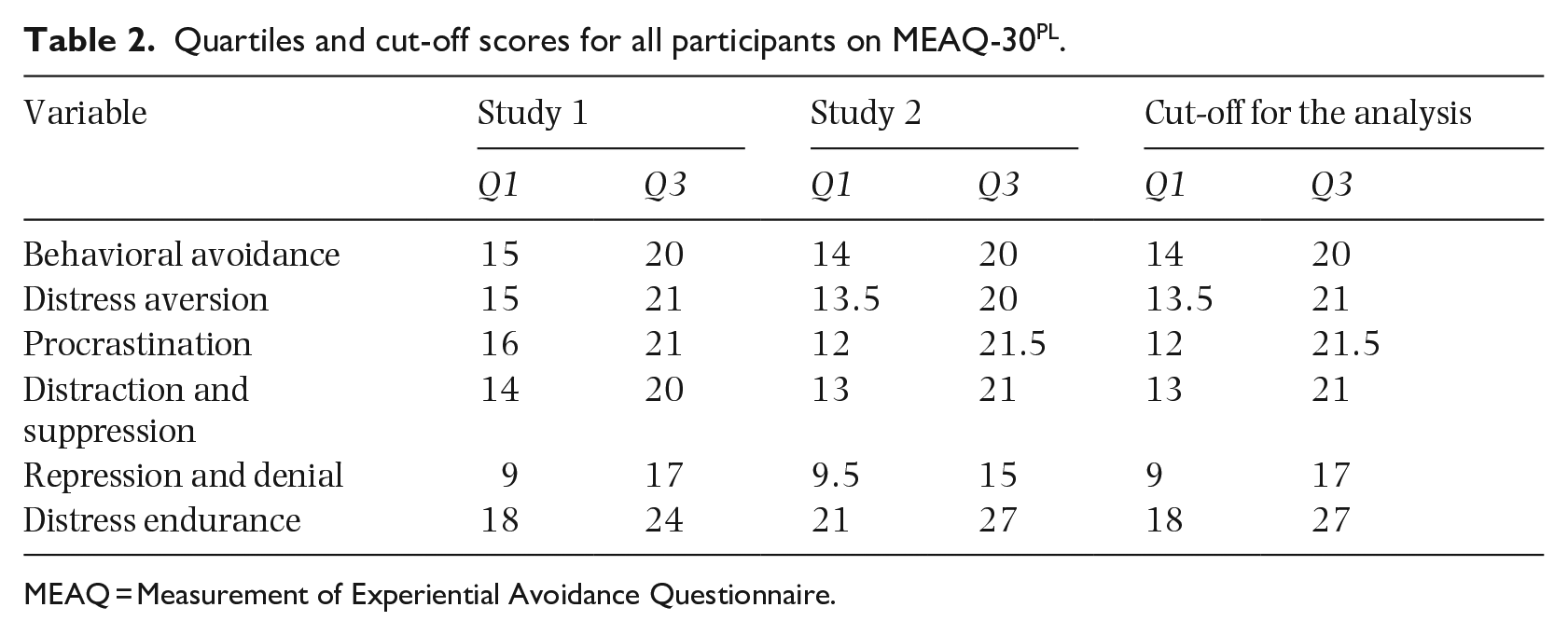
MEAQ = Measurement of Experiential Avoidance Questionnaire.
Coding and data analysis
Psychological flexibility specialists (ACT therapists and academics) conceptualized the experiences of musicians using the psychological flexibility model by coding the data (i.e., the responses to the open-ended questions). The codes were the 12 terms representing psychological flexibility and inflexibility processes. Data in Study 1 were coded by 13 specialists but, to avoid potential coding bias, only specialists who had not coded Study 1 data were invited to code data from Study 2. Because there are very few such specialists in Poland, three coded the Study 2 data. One code was assigned to each response unless it was complex, in which case more than one code might be assigned (e.g., values and engaged action, or fusion and self-as-content). In both studies two independent sets of codes were assigned to the data obtained from each participant. The two sets of codes were reduced to a single agreed set of codes by the authors. Disagreements were resolved following discussion. Rather than assessing psychological flexibility and inflexibility in the two samples by simply counting codes, we conceptualized musicians’ psychological functioning according to the psychological flexibility model via a qualitative analysis of participants’ responses to the questions asked in Studies 1 and 2. We present examples of these responses under the headings of the codes assigned to them.
To answer the second question, we identified participants with high and low experiential avoidance by calculating lower and upper quartiles in the MEAQ-PL results. Participants who scored low or lower than the 1st quartile in the MEAQ-PL subscales were assigned to the low experiential-avoidance group, while participants who scored high or above the 3rd quartile in the MEAQ-PL subscales were assigned to the high experiential-avoidance group. The results of the statistical tests are presented in the following section.
Results and discussion
Research question 1
Psychological flexibility
Responses are labeled by study, participant ID, sex, and age. For example, response S1, 18F26 represents data obtained from a female participant assigned the code number 18 who was aged 26 and took part in Study 1. We identified flexible and inflexible aspects of participants’ functioning according to the psychological flexibility model.
Values
Flexibility processes often identified in the data were clarity of values and the ability to engage in committed actions. Participants indicated that important and valued aspects of their lives were the development of skills, the appreciation of music and its beauty, teaching, and the sharing of love for music with listeners or students. They reported, for example, “taking I want to pass on the beauty to others, to move the deeper and more sensitive places of the soul. My mission as a musician is to evoke emotions in people and let them touch the Absolute . . . By teaching others to play, I want them to find joy in themselves. (S1, 01F26)
These findings show that values could act as a foundation for developing psychological support programs focusing, first, on identifying the important values that direct their behaviors in the context of being a musician.
Committed actions
Participants’ engagement in committed actions included self-development as a way of achieving goals in their music-related activities. They developed themselves by practising regularly, improving their technique independently, participating in courses and masterclasses to enhance their skills, and seeking inspiration in music and elsewhere, “ I try to take my instruments wherever I go to people so I can learn something from my friends and other musicians. When I see open, announced music workshops, especially the part that interests me, I try to attend them to broaden my perspective. (S2, 40M29)
Committed actions such as sharing the beauty of music, expressing emotions, teaching others, caring for one’s health, action planning, and achieving goals were subordinate to music-related values insofar as participants prioritized the latter when engaging in self-development for the purposes of making music. As one said, “
Acceptance
Participants expressed acceptance in terms of the willingness to let go of unwanted feelings, for example by “enduring failures,
Defusion
It is crucial for coping with performance-related difficulties to be aware of thoughts that constantly occur during practice or performance and understand that they do not need to lead to actions. Participants reported being able to observe these unhelpful thoughts related to their work: “
Self-as-context
It might be helpful to broaden one’s perspective so as to find different approaches to one’s feelings and experiences. Participants in our study used this skill in the service of others, most often in the context of teaching: “I want to work on the ability to properly approach a student
Contacting the present moment
Being in the present moment is an essential element of practice and performance, as it allows for more conscious management of difficulties. Awareness of the present moment brought benefits such as the experience of flow during performance, and of the performance as a whole: “ these emotions are, on the one hand, eternal unfulfillment, low self-esteem, and on the other hand, the awareness that music gives me some kind of release from these negative emotions and it also brings joy and fulfilment and allows for purification. (S2, 48F29)
Through focusing on (largely music making in) the present moment, participants reported being able to learn and develop their skills: “Above all, co-musicking is one of the best ways to improve musical relationships. No notes, I have recently been trying to analyse in which type of work as a musician I would find myself the most, which elements of my work give me wings and which destroy me. In this way, I would like to make decisions in the near future that will allow me to live in harmony with myself, my dreams and beliefs in the years to come. (S2, 2F30)
Psychological inflexibility
Fusion with thoughts
Acting in line with thoughts is an important element of many psychological difficulties faced by musicians (e.g., anxiety and depression). Participants reported fusion with thoughts that reduced effectiveness and sometimes led to helplessness and inaction. Many of these examples included critical thoughts related to participants’ abilities as a musician: “
Experiential avoidance
Participants often reported avoiding situations in which they were expected to play or perform because they found them difficult and were frightened of being laughed at or criticized. Avoidance behaviors included procrastinating, and postponing both practice and public performances: “I often I avoid unpleasant professors (so I look for excuses not to come to class). I cannot stand people who are unfulfilled and arrogant at the same time, I do not accept an environment in which one “teaches” by humiliating another person. (S1, 48F26)
Avoidance behaviors were also related to the participant’s history of learning to play or sing, and their perception of music education more widely. Participants reported avoiding music making, performing solo in public, and meeting other musicians. Some avoidance behaviors resulted from traumatic experiences of violence and abuse in the past: A piano teacher in the first-level music school made me very stressed and cry because she shouted, challenged, kicked under the chair, threw notes, and lowered the piano lid on my hands. I was 7-9 years old at the time. After this trauma, I returned to playing after 16 years as an adult woman. (S2, 22F35)
The avoidance of difficult situations was also related to the perception of the environment as being judgmental: “I
Self-as-content
According to participants’ responses, this process was strongly related to the fusion-with-thoughts process, whereby the individual sees themself as inadequate or not up to the job, for example: “
Inaction
Linked to the processes of experiential avoidance and fusion with thoughts, participants often mentioned inaction related to withdrawal from activities such as auditions, competitions, and solo performances. Participants also avoided other challenging activities could have helped them achieve their life goals: “Unfortunately, I
Inflexible attention
Not being in the present moment can lead to difficulties with concentration during practice or performance. Participants reported remembering and ruminating on “
Lack of contact with values
Whereas one of the flexibility processes mentioned most often was categorized as clarity of values, we also noted participants’ references to what might be described as a pseudo-value motivating them to take action: “I
Research question 2
Psychological functioning of participants scoring high and low on measures of experiential avoidance
Psychological functioning was defined in terms of the codes representing psychological flexibility and inflexibility that were assigned to the data. High and low experiential avoidance was defined in terms of the lower (Q1) and upper quartiles (Q3) shown in Table 2.
Ten participants with high experiential avoidance (six in Study 1 and four in Study 2) had scores of or above the Q3 cut-off score in three of the five categories (behavioral avoidance, distress aversion, procrastination, distraction and suppression, repression, and denial) but no lower than average in the other two, and of or below the Q1 cut-off score in the sixth category, distress endurance. Nine participants with low experiential avoidance (five in Study 1 and four in Study 2) had scores of or lower than the Q1 cut-off score in three of the five categories (behavioral avoidance, distress aversion, procrastination, distraction and suppression, repression, and denial) but no more than the average on other scales. We compared the content of the responses from the 10 participants in the high experiential-avoidance group and the nine participants in the low experiential-avoidance group and the way they were coded.
In terms of psychological flexibility, both groups reported being aware of values reflecting the need to develop skills for pursuing excellence and helping others. The latter was related to teaching experience. Important values for both groups also included engagement in music-related activities, and deriving joy and pleasure from music making, which was also important from the perspective of sharing these experiences with students, and building their musical sensitivity. Both groups took engaged actions such as developing their skills and continuing to learn through self-development or attending workshops. However, we observed a difference between the engaged actions reported by the two groups. In the low experiential-avoidance group, committed actions tended to relate to specific activities such as regular practice, or music making. Participants in the high experiential-avoidance group, by contrast, referred to their wanting to take engaged actions. According to RFT, language shapes our actions (Hayes, 2004). The difference between the responses provided by the two groups may indicate different attitudes to the difficulties they both experienced. We found no other differences between the groups’ core flexibility processes.
In terms of psychological inflexibility, both groups reported fusion with thoughts including self-judgments, comparisons with others, and the need for successful musicians to exhibit specific characteristics such as confidence. The high experiential-avoidance group provided a wider variety and more detailed examples of fusion. Both groups reported avoiding difficult feelings such as unease, stress, and tension. In the high experiential-avoidance group, participants were more likely to report difficulties contacting the present moment, having problems finding time to rest, and or focusing on past experiences.
Although items added to the questionnaire that was used in Study 2 asked participants to quantify the workability of their behaviors, we could not compare the responses of the high and low experiential-avoidance groups because the samples were so small.
Our results relating to the functioning of people with different levels of experiential avoidance are in line with the psychological flexibility model and can be used by ACT therapists working with musicians. First, participants with low experiential avoidance reported engaging in more committed actions. This is consistent with the evidence that the processes underlying psychological flexibility are intertwined, and that improving acceptance and defusion is related to more valued-based engagement in life (Hayes et al., 2012). Second, participants with high experiential avoidance were more likely to report the desire to change their behavior than carrying out committed actions. This confirms that the shift from avoidance to acceptance must include developing the willingness to let go of previous unworkable strategies and experience unwanted thoughts and/or emotions (Luoma et al., 2007). Without such willingness, people go on trying to control or get rid of their discomfort, which in turn leads them to form ideas as to what they could do, or would want to do, if only their discomfort would disappear (Batten, 2011). Third, experiential avoidance might be reinforced by other processes evident in the responses of participants who scored high on this measure: fusion with thoughts of one’s failure to act differently, or inability to deal with unwanted emotions. The implementation of ACT with musicians should begin by decreasing their experiential avoidance and fusion with thoughts. It should go on to develop their willingness, for example, by establishing creative hopelessness (Luoma et al., 2007), and focusing on a repertoire of new behaviors that can be enacted. Given the specific occupational context of the music profession, in which high levels of experiential avoidance were observed, it would also be advisable to introduce clients to the values that reinforce engagement in new activities, often described clearly by participants.
Limitations
The first limitation of the present study is that it was not always possible to take contextual information into account when coding the data. This made it difficult for us to be sure we had correctly assigned all the behaviors reported by participants to the categories of psychological flexibility and inflexibility. In some cases, the same behaviors could be coded as either unworkable actions that do not help long-term psychological functioning (e.g., avoiding certain people) or as workable actions in particular circumstances (e.g., ending professional relationships blocking the participant’s opportunity to engage in committed actions). To address this limitation, future studies should include the collection of data at multiple time points, including information on the context of the reported experiences, and/or involve the analysis of data from in-depth interviews.
Second, the low internal consistency of the behavioral avoidance subscale of the MEAQ30PL weakens the quantitative findings of our study and might explain why we were only partly successful in differentiating between participants with high and low experiential avoidance. It may be that participants responded inconsistently to the items in the behavioral avoidance subscale (e.g., agreeing that they avoid situations in which they could be hurt but not those in which they would feel uncomfortable such as performing) because they conceptualize dedication to practice in different ways. Both the original and Polish translations of the behavioral avoidance subscale have adequate internal consistency (α = .78 and .70 respectively). No concerns with reliability have been raised by the authors of other Polish studies using the MEAQ-30PL scale (Hajok, 2022; Stefanek, 2022; Wojdyła, 2022). It might be possible, therefore, that the reason for the low internal consistency lies not in the construction of the scale but in our sample. In our opinion, it would be important to find out if behavioral avoidance needs to be operationalised and validated contextually to ensure that it is applicable to musicians. In addition, in future studies, larger samples should be recruited and experiential avoidance in musicians and non-musicians (defined appropriately—see Zhang & Schubert, 2019) compared to identify possible differences in operationalisation of this process.
Third, we were able to compare only very small samples of participants with high (10) and low experiential avoidance (9), insufficient to explore differences in depth.
Fourth, our sample consisted of individuals who defined themselves as musicians; we did not control for years of music education. Professional musicians who have completed their formal music training may be more psychologically flexible and less influenced by MPA than current music students. There is some evidence that MPA is both related to musical experience (e.g., Biasutti & Concina, 2014) and rarer in older and professional musicians than younger musicians (Kenny et al., 2014). Given the mean age of our participants and the (assumed) predominance of professional musicians in our sample, it is possible that the majority is more psychologically flexible and it is thus difficult to find strong evidence of differences in their psychological functioning. It would be interesting to analyze the differences between self-taught and formally educated musicians, especially in the light of the music-education difficulties described by our participants.
Finally, we conducted the study during the COVID-19 pandemic—the first sample was recruited after the first wave and the second sample when the pandemic was on the decline—but we did not control for potential pandemic-related factors in participants’ responses. It may be that the second sample’s scores on the distress endurance scale were significantly higher than those of the first sample because of the stressful experiences of the second sample during the initial lockdown.
Conclusion
Developing psychological flexibility processes is related very closely to psychoeducation since it is based on learning new ways in which people can get in touch with their experiences and react to them. Therefore, increasing psychological flexibility could be introduced as an element of psychological counseling in music schools, giving young musicians the abilities they need for their careers. The use of interventions based on the development of key processes of the psychological flexibility model could lead to musicians experiencing higher self-efficacy and engaging in committed actions, which could help them organize their work better, give higher quality performances, and experience more satisfaction with work. Such a broadly targeted intervention could be helpful on several levels, improving subjective well-being and performance quality, reducing the symptoms of anxiety, depression, and stress in musicians already experiencing increased symptoms, and in preventing such symptoms emerging in musicians at risk.
