



Abstract
This article investigates the nature of interrelationships among high political discourse, operational political discourse and accounting intended as a technology of government in the development of modern states. Specifically, the study demonstrates evidence of the capacity of accounting and other technologies in the field of financial management (i.e. distribution of powers and tasks, and control system) of nurturing and disseminating a governmental discourse in Italy during and immediately after its unification process. Records of parliamentary debates and the text of some laws (1853–1869), beside secondary sources, were analysed to get a twofold finding. While the investigation reveals the contribution of technologies in disseminating a sense of unity, it also sheds light on the existence of circular relationships among the elements of the usual governmentality scheme of analysis. In other words, technologies are typically driven by previous political rationalities/discourses, but they can be also used to further strengthen the same rationalities/discourses, especially when they are at an early stage of development.
Introduction
The role played by accounting in the origins and evolutions of nation states is a topic of some weight for scholars of accounting history (Colquhoun and Parker, 2012). However, according to Miller (1990), the understanding of the concept of such a role deserves more attention, especially in the light of the new conceptualisations that emerged to analyse accounting change and its relationship with power and government. Based on this judgement, certain scholars 1 have used the concept of governmentality, as elaborated by Michel Foucault, to interpret the relationships between means of governing and accounting. In this view, accounting is not just a technique for recording transactions, but a ‘process of attributing financial values and rationalities to a wide range of social practices, thereby according them a specific visibility, calculability and operational utility’ (Miller, 1990: 316–317).
In Foucault’s (2007) analysis, the concept of governmentality is a ‘guideline’ for a ‘genealogy of the modern state’ (p. 354). In fact, a kind of transformation of statehood occurred in the eighteenth century, and the idea of governmentality would provide an innovative conceptual perspective to explore how a state comes ‘to act as a coherent political force’ and how the ‘imaginary unity of the state’ is produced in ‘practical terms’ (Lemke, 2007: 46). As stated by Rose and Miller (1992), the modern vision of the state can be seen as a specific way in which the problem of government is discursively codified, . . . a way in which certain technologies of government are given a temporary institutional durability and brought into particular kinds of relations with one another. (pp. 176–177)
Previous studies (Armstrong, 2015; Maran et al., 2016; Miller and Rose, 1990; Radcliffe, 1998; Sánchez-Matamoros et al., 2005, 2016) have analysed accounting practice as a technology related to the discursive nature of government. In these works, a close and linear connection between knowledge – especially, political knowledge – and technologies of government is postulated. More precisely, political rationalities provide new understanding of problems, design new conceptual keys to interpret those problems and open new spaces of government (Lemke, 2007). At the same time, they need elaboration and nurturing of discourses to develop programmes and justify actions (Lemke, 2007). In this sense, a hierarchical and linear connection is postulated among political rationalities (and discourses), programmes and technologies, such as accounting (Castel, 1994; Miller and Rose, 1990). However, this linearity has been sometimes questioned due to a possible resistance of actors (Sánchez Matamoros et al., 2005, 2016; Spence, 2010) or factors not in line with a supposed rationality of the governmentality scheme (Lemke, 2002, 2007). In fact, the existence of this linear and hierarchical connection among rationalities, programmes and technologies should not be taken for granted (Armstrong, 1994). At the same time, there is little evidence of a possible bidirectional and even circular relationship among them (Maran et al., 2016).
This article aims to contribute to fill this knowledge gap, investigating the nature of interrelationships among high political discourse (i.e. rationalities), operational political discourse (i.e. programmes) and accounting intended as a technology of government in the development of modern states. Specifically, the study demonstrates evidence of the capacity of accounting and other technologies (i.e. distribution of powers and tasks, and control system) in the field of financial management of nurturing and disseminating. We believe that in this way major knowledge can be acquired about ‘the relationship of discourse to practice’ (Armstrong, 1994: 50).
The unification of Italy provides a convenient case to explore this aspect. The unification process was completed only in the second half of the nineteenth century, as the culmination of the long period known as the Risorgimento, which extended from the beginning of the nineteenth century until 1871 (Pécout and Balzani, 1999). This Risorgimento amounted to the aggregation of pre-existing Italian states, fostered by the Kingdom of Sardinia, and ruled by the Royal House of Savoy. Some scholars (Meriggi, 1996; Sarlin, 2014), due to the dynamics of that process, claimed that Italian unification was rather an expansion of the Kingdom of Sardinia which, at the beginning of the Risorgimento, ruled the northwestern part of the Italian peninsula and the island of Sardinia. Certainly, long after its political unification, the Italian state was characterised by significant social, cultural and economic differences among its regions. Remarkable differences were recognisable also with regard to the accounting and administrative traditions (Antonelli et al., 2019; Coronella et al., 2013; Mussari et al., 2010; Nobolo et al., 2013), so that the heavy intervention of the Savoyan ruling class was expected to adapt the whole administrative apparatus to the unification. This setting suggests potential and significant relationships among political discourse and technologies in the light of Foucault-inspired studies.
In this work, the creation of a compact, centralised and standardised administrative apparatus is considered as a tool to exercise power (Dean, 1999) and ‘mediate the relationship between the state and citizens’ (Maran et al., 2016). In this sense, the article draws attention to the building process of an administrative machine, with a focus on financial management, to make a new state and its citizens governable.
The article consists of eight sections. In the following section, we illustrate the foundational pillars of the theoretical background of our work. Then, the sources and methods of the research are presented in a further section. Subsequently, in section ‘Historical setting’, we sketch the political context that existed before the Italian unification and briefly present its final stage. This leads to a section devoted to the analysis of high and operational political discourses. Further on, the following technologies in the field of financial management are examined: distribution of powers and tasks; accounting and control. Each one of these technologies is investigated in a specific sub-section. The results of our study are dicussed and some concluding remarks presented.
Literature review and interpretative framework
This work is inspired by Foucault’s (1991) concept of governmentality. This theoretical framework has been used by accounting scholars in the last three decades as a part of a strong cultural movement that examines accounting as a social practice (see, for example, Carnegie, 2014; Mennicken and Miller, 2012; Stewart, 1992). As Collier (2009: 96) affirmed, governmentality means the ability to ‘make some form of that activity [government] thinkable and practicable’. The idea of governmentality reflects the particular perspective, called genealogy, applied by Foucault to interpret history along the line traced by Nietzsche. This vision has attracted scholars of accounting history for its functionality to argue a positivistic view of accounting and, especially for its ability to highlight its disciplinary and constitutive activity (Stewart, 1992).
The usual conceptual scheme of governmentality makes use of three fields of analysis: rationalities, programmes and technologies. Miller and Rose (2008) argue that political rationalities and programmes to be inseparable, distinguishing them from technologies. In fact, they concern the level of the conception and representation of phenomena and actions that transform phenomena. Conversely, technologies deal with the ways such mental representations are made operative. This is not only a matter of tools or formalised practices but also of the form of promotion of a governmental rationality that makes a government possible without direct intervention.
In this view, accounting is brought within the array of instruments referable to the Foucauldian idea of technology. As stated by Mennicken and Miller (2012: 9), ‘accounting has the capacity to act as a “mediating instrument.” It operates as both means of representation and means of intervention, linking discrete domains and activities’.
Moreover, the disciplinary and constitutive role of accounting can acquire a particular relevance when a new state is at its beginning and whenever the implementation of political rationalities may struggle with pre-existing values and practices diffused in a social, political and administrative context.
In this regard, Miller (1990: 334) refers to a ‘programmatic aspect of accounting’, also claiming that this is ‘a relatively unexplored issue for research, and the concepts to be used in analysing it remain undeveloped’. Although some time has passed since Miller’s judgement, greater understanding is still needed on the issue.
Indeed, few studies (Baker and Rennie, 2017; Gomes et al., 2014; Lai et al., 2012; Neu and Graham, 2006; Platonova, 2009; Sargiacomo et al., 2016; Silva et al., 2019; Yayla, 2011) on the foundational role of accounting in the process of building a nation state have been carried out. In these works, a close and linear connection between knowledge and technologies of government is postulated. Political rationalities provide new understanding to interpret problems and design programmes and actions. They are inseparable from discourses and narratives that give representation and justification of those choices (Lemke, 2007). In this sense, a kind of hierarchical and linear order is established among rationalities, programmes and technologies (Miller and Rose, 1990).
Some scholars have questioned this consistent and tidy regime of relationships. For example, Spence (2010) showed the limits of technologies as a tool of promotion and implementation of political rationalities. The author reported a case study in which the congenital failing of national accounting as a technology of government is documented. In this study, the dissonance between the domain of political knowledge and that of implementing activities is essentially due to the arbitrary use of technologies by actors. A partially different conclusion was reached by Sánchez-Matamoros et al. (2005), who stated that accounting can master the population independently from the discourse of institutions. Although their research proves the capacity of accounting to govern people, a disassociation between rationalities and technologies is postulated. This result would confirm what Armstrong (1994) believes about the fact that accounting practices can exist without a political discourse that calls for and gives sense to them.
In a more recent article, Sánchez-Matamoros et al. (2016) provide another point of view, investigating a Spanish case of contestation of a new system of administrative control entailing new accounting techniques. Their research concludes that resistance not only can block the implementation of a new accounting system but can also require a change in the governmental discourse. In other words, resistance to accounting innovations can represent resistance to a new political programme and this fact can lead to reformulating the political discourse.
Interrelationships between political discourse and technologies were explored also by Maran et al. (2016). In their study of an Italian municipality during the Napoleonic occupation, they presented a case of a linear connection between rationalities, programmes and technologies (namely, distribution of tasks and power, and accounting), although a non-perfect alignment between these three domains was recognised. More precisely, while the analysis showed the existence of a learning loop between the operational political discourse (i.e. programmes) and the technologies, any bidirectional relationship was recognised between high political discourse (i.e. rationalities) and technologies.
The nature of relationships between the different domains of the governmentality framework is a specific focus of this article (Figure 1). We are interested in shedding light on the capacity of accounting to contribute in moulding a governmental discourse, verifying a possible circular relationship between the political and the technological level. Especially, we aim to investigate the role of accounting and other technologies in the field of financial management in disseminating a sense of unity in the new Italian state immediately following its unification. For our analysis, an adaption of the interpretative scheme provided by Maran et al. (2016: 63) is applied.

Interpretative map.
The innovations in governmental technologies that are explicitly examined in this article are those related to the legal reforms of distribution of tasks and powers (administrative reorganisation), governmental accounting and financial control system, issued from 1853 to 1869. Indeed, the enactment of legislation is a powerful resource for the translation of governmental programmes into ‘mechanisms that establish, constrain, or empower certain agents or entities and set some key terms of their deliberations’ (Miller and Rose, 1992: 189–190). Moreover, this study endeavours to go beyond the analysis of laws, targeting transcription of speeches and other official documents suitable for understanding the logics of governmentality underneath formal regulations. Finally, we believe that the innovations that were formally promoted earlier in the Kingdom of Sardinia and those legally introduced in the unified state were a complex network of interconnected actions rather than a set of disparate events, undertaken with the aim of rendering the new Kingdom of Italy governable.
Sources and method
The development of this study required the analysis of a diversity of primary and secondary sources. Primary sources were examined at the State Archives in Rome and using Italian government portals that provide digitalised versions of historical legislative documents. 2 These consist of legal proposals, relations of texts and memoranda of the commissions of the Kingdom of Sardinia and the Kingdom of Italy, transcriptions of parliamentary speeches, reports and ministerial regulations for the implementation of laws.
More precisely, the following primary sources were used to identify high and operational political discourses:
Parliamentary speeches by the Italian prime minister during the debate on a law proposed on 2 October 1860 (law n. 4497, approved on 3 December) for the annexations of provinces;
The first speech of the King to the first Italian parliament on 18 February 1861;
Two parliamentary sittings (26 February and 14 March 1861) to discuss law n. 4671 of 17 March 1861, that appointed the King of Italy;
A speech by the Italian ministry of finance to present the annual budget for the fiscal year 1863 to the Parliament (1 December 1862).
To explore technologies, the following primary sources were utilised:
A bill of law presented to the Senate on 5 March 1852 and approved on 3 January 1853 (law n. 1483) regarding the reform of ministers and governmental accounting in the Kingdom of Sardinia, related commentary and transcriptions of the parliamentary debate to approve that law (eight parliamentary sittings from 23 December 1852 to 4 March 1853);
Law n. 3702 of 1859 regarding the administrative reform at a local level in the Kingdom of Sardinia;
Act n. 3708 of 1859 and the subsequent series of decrees issued until 1861 to extend the Piedmontese accounting model to all the parts of the new Italian Kingdom;
Law n. 800 of 1862 that set up the Court of Accounts and related commentary to present the law to the Parliament;
An inaugural speech to the Court of Accounts given by the Italian Minister of Finance on 1 October 1862;
Law n. 2248 of 1865 regarding the reorganisation of local governments in the new Kingdom of Italy, related commentary to present the law to the Parliament and transcriptions of the parliamentary debate to approve that law (eight parliamentary sittings from 30 January 1865 to 7 February 1865);
A bill of law presented to the House of Deputies on 4 February 1868 and approved on 22 April 1869 (law n. 5026) regarding the reform of governmental accounting in the Kingdom of Italy, related commentary to present the law to the Parliament and transcriptions of the parliamentary debate to approve that law (11 parliamentary sittings from 20 July 1868 to 22 April 1869).
To select primary sources, each author separately analysed documents identifying relevant parts of the research aim. During weekly meetings, the content and significance of those parts were discussed by the authors in order to minimise personal bias. Documents and quotes have been finally categorised according to the identified discourses and technologies, for use in the present article.
To extend, deepen and corroborate the analysis, relevant secondary sources were also drawn upon. These include documents from international literature and Italian publications dating from the end of the nineteenth century to the present day. They provide further information on the period considered in this study and, especially, allow us to verify the validity of the evidence obtained from primary sources.
Historical setting
The political unification of Italy was a result of a complex and articulated process that occurred in the nineteenth century. With the Congress of Vienna held in 1815, through which the ancien régime was recreated to ‘recover’ Europe from the Napoleonic upheavals, Italy, was divided into 10 states under the influence of other European powers (Figure 2).

Italy after the Vienna Treaty (1815).
The peninsula showed deep divisions from demographic, social and economic points of view, accentuated by these conditions of political fragmentation and subjection to foreign influence. Such a situation of strong differentiation among several areas also concerned the administrative systems of the states (Antonelli et al., 2019; Coronella et al., 2013; Mussari et al., 2010; Nobolo et al., 2013).
In this context, the Piedmontese state of the Kingdom of Sardinia, governed by the Royal House of Savoy, became the main actor of Italian unification. The Savoys and the politicians of their Kingdom of Sardinia knew how to interpret the nationalist feeling that was spreading throughout Italy and the desire to reconstruct political unity that spread with it (Mascilli Migliorini, 1998). The Kingdom of Italy was officially created in 1861, although its full territorial extent would not be reached until later, after the annexation of the Venetian region in 1866, and the conquest of Rome in 1870 (Figure 3). 3

The Italian process of unification.
Historians term this period the Risorgimento, which means resurgence or revival. However, serious challenges emerged immediately following unification. First of all, only part of the population, made up largely of the bourgeoisie, desired unification. In many cases, the aristocracy, fearing a loss of its privileges, and a large share of the lower classes did not recognise themselves in the new state. Therefore, the Kingdom of Italy, in particular, the Savoy Royal House, soon encountered a loss of legitimacy. In this context, the rulers struggled with the need to create mechanisms able to enhance the unity of the new state and assure the governability of the territory and population of the new Italy.
Political discourse on the sense of unity
The complex process of unification led by the Kingdom of Sardinia required the elaboration of a political discourse to disseminate a sense of unity. This sense of unity was something to be created and stimulated in a territory with populations diverging in culture, language and economic condition. The awareness of this necessity was clearly expressed by the Italian Ministry of Finance in presenting the annual budget for the fiscal year 1863: The Kingdom of Italy was created in a very short time, when provinces, separated for many centuries by huge barriers, united. The economic conditions of a number of them, miserable because they were badly ruled or enslaved by foreigners, and because of very few means of communication, almost no schools and their trade stuck in a rut . . . (Quintino Sella, speech to the Parliament, 1 December 1862)
Moreover, political unification was the result of the expansionist policy of the Kingdom of Sardinia, posing many problems in terms of acceptance by the other regions (Mascilli Migliorini, 1998). An operation of legitimation of the new state and the Savoy Royal House was promoted. The Kingdom of Sardinia needed to propose itself as the actor able to make possible the long-lasting desire of political unity in continuity with the work of the most well-known national heroes. 4 The protagonists of Italian cultural history and those of the Risorgimento period were constantly quoted in official celebrations of the Kingdom.
Here follows an example given by Deputy Brofferio on the occasion of the parliamentary debate on law n. 4671 of 1861 appointing the King of Italy: It took Galileo Galilei, Dante Alighieri, Francesco Petrarca, Nicolò Machiavelli, Michel Angelo Buonarroti, Cesare Beccaria, Mario Pagano, and Filangieri, and Parini, and Carlo Botta, and Filicaia, and Leopardi, and Ugo Foscolo, and Alfieri. It took Cola di Rienzo, Arnaldo da Brescia, Giovanni da Procida, Francesco Ferruccio, and Savonarola, and Olgiati, and Caracciolo, and Santa Rosa, and Silvio Pellico, and Ciro Menotti, and Tito Speri, and the Bandiera brothers, and Vochieri, and Pisacane, and Rosolino Pilo and the luckiest and greatest of all, Giuseppe [Garibaldi] . . . (Angelo Brofferio, sitting of the House of Deputies, 14 March 1861)
The subject that embodied the continuity between Italian history and the Kingdom of Sardinia was the Royal House of Savoy. The following excerpt from the speech of Senator Scoplis, on the occasion of the parliamentary discussion about the same law, is iconic: Your Royal House, Your Majesty, decided a long time ago to take the responsibility for watching over the affairs of Italy and secure its freedom. Your magnanimous father revived and broadened this illustrious concept giving his people constitutional rights, and initiating the rising for the national liberation. (Federico Sclopis, sitting of the Senate, 26 February 1861)
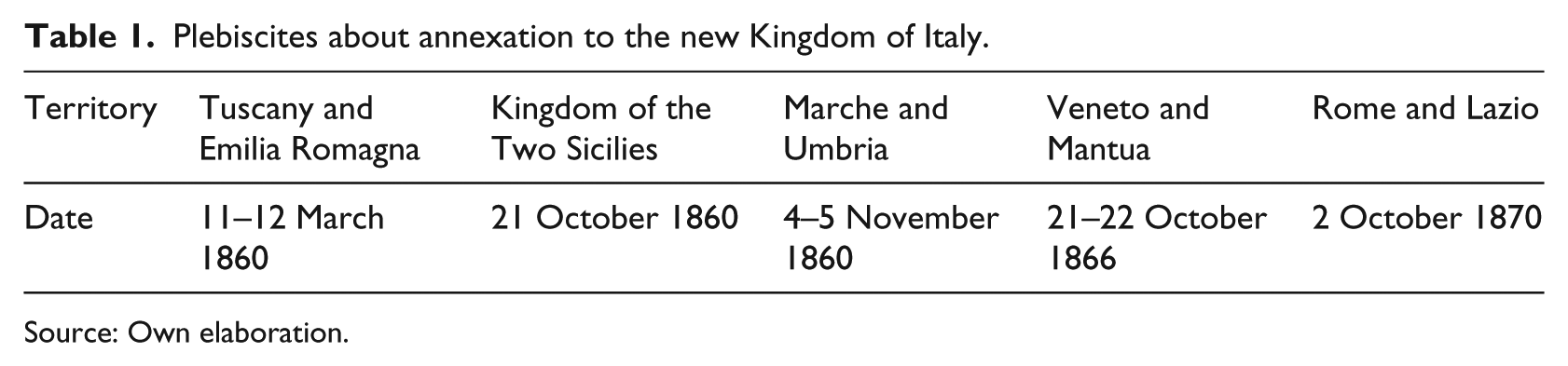
The exaltation of monarchy represented the fundamental value of the unity in opposition to the revolutionary and democratic idea of unification that some protagonists of the Risorgimento (i.e. Giuseppe Mazzini and Giuseppe Garibaldi) had originally tried to promote. The new Italian state was lacking a symbolic and largely shared foundational event (Martucci, 1999) and the new rulers looked for a legitimation through an event presented as an expression of democratic acceptance. This is the reason for the referendums organised in all the regions on their annexation to the rising Kingdom of Italy (Table 1).
Plebiscites about annexation to the new Kingdom of Italy.
Source: Own elaboration.
As stated by Prime Minister Cavour, in presenting the referendum for the annexation of the Southern provinces, the unification should have been realised only with a clear and free popular consent: As Italians, we frequently desire that the people of provinces not yet unified acted as those in Central Italy and with the same enthusiasm and with equal humanity declared to accept the unifying principle of the entire peninsula under the constitutional powers of [King] Vittorio Emanuele. (Camillo B. Cavour, speech to the Parliament, 2 October 1860)
Those plebiscites aimed to enhance the enthusiasm on unity and effectively did, even if some impositions (e.g. voting was public, not secret) question the substantial value of the initiative (Martucci, 1999).
After the annexations, the government continued to work to remove the perception of conquest of the provinces by the Piedmontese, especially through solemn ceremonies to celebrate the new state (Mascilli Migliorini, 1998). Also, monarchic clubs (such as shooting clubs, cafés and cultural associations) were set in place throughout the whole country, even if they were targeting the aristocratic part of the society (Pécout and Balzani, 1999). Finally, the emblem of the Savoy dynasty was put in the centre of the Italian flag.
The problem was to make the new state visible, spreading the perception that it constituted the fulfilment of the secular unitary aspirations that had animated most of the peninsula. Since unification had been obtained, rendering it evident and ‘touchable’ was believed necessary: At this point now that we have the capacity to form a nation of 22,000,000 Italians, a strong and harmonious state, that could have numerous different means, both moral and material, Italy must begin immediately its legal and internal organization. (Camillo B. Cavour, speech to the Parliament, 2 October 1860)
To this aim, a particular value was given to the construction of a centralised administrative machine governed by the principles of hierarchy and uniformity (Ruffilli, 1976). As remarked by Sepe et al. (2007), the Italian Kingdom needed a new ‘spine of administration’ that had to translate into practice a vision of a governable country. The centralised system was based on the following loyalty chain: King, Ministry of Interior, prefects and mayors. The figure of the King had to communicate the idea of a strong state, while local communities had to be governable by the representatives of the king in the country.
This approach, inspired by the French model, was particularly debated. Other pre-existing Italian states had previously applied different administrative models, following the English or Prussian example. Some politicians deemed that in the new state, it was necessary ‘to contain the powers of the administrative monarchy’ (Ragionieri, 1967: 77) and some kind of federal model was claimed to be more suitable to this end.
Therefore, the creation of a compact and centralised public administration was a precise and conscious choice. The new and fragile country needed the ‘pedagogism’ of an authoritarian state (Pavone, 1976: 54), as witnessed in the words of De Sancits, an important scholar and politician who actively participated in the Risorgimento and also became Minister of Education: Imagine a people that called itself free but was not able to rule itself: the government then, for the benefit of freedom itself, will be allowed to rule a bit more than freedom should permit. (Francesco Sanctis, 28 January 1864, quote in Pavone, 1976: 54)
Many historians (e.g. Salvemini, 1961: 432) agree on considering this programme of centralisation as a ‘setting, disciplining and dominating’ one.
The process was executed through a progressive extension of the Sardinian model in the whole country, replacing by law the administrative traditions of the pre-unitarian states (Martucci, 1999). Even in this case, it was a kind of conscious and deliberate choice based on the assumption that the government could have benefitted from a fast administrative unification. Moreover, this approach also enhanced the possibility to spread the pre-existing bureaucracy through the whole country, putting Piedmontese officers in high positions of local offices and assuring high standardisation and effective control (Calandra, 1978). As a very heterogeneous society, the key idea was that only the use of pre-existing and rigid organisational structures could ensure a suitable institutional framework to stabilise and grow the new state (Melis, 1996). In this way, a manageable and controllable public machine could be built and the state become more visible and closer to all citizens (Pavone, 1976).
Technologies in financial management
The objective to increase the perception among the Italians of a unitary state able to control the territory and to justify rules and customs often diverging from the pre-existing ones required some interventions in the legislation domain. In this study, a special attention has been paid to the legal acts issued in order to organise three different, but intimately interrelated domains of government in the field of financial management: (1) distribution of powers and tasks, (2) governmental accounting and (3) the system of control. We have considered these legal interventions as a consistent set of instruments defined to promote and operationalise the political discourses identified in the previous section. At the same time, these acts represent a tool to recognise contents and characteristics of those political discourses. Due to the substantial adoption of the pre-existing model of the Kingdom of Sardinia, some of these acts can be considered a revision of those previously designed and issued in the Kingdom of Sardinia (Martucci, 1999; Melis, 1996). For this reason, the innovations earlier introduced in the pre-existing Savoy state and those issued by the new unified state have been jointly considered as a unitary and consistent network of actions undertaken with the aim of rendering the Kingdom of Italy governable.
Distribution of powers and tasks
With respect to the model of governing and administering the new national territory, the choice was to confirm the reform promoted by Cavour immediately after his appointment as a Minister of Finance and Prime Minister of the Kingdom of Sardinia. The reorganisation he desired culminated in the bill of law presented to the Senate on 5 March 1852 and approved on 3 January 1853, following a multi-sided debate.
During the parliamentary sitting, Cavour stated that the main aim of the reform was to allow . . . coordination among the different parts of the central services to compose a single administrative ensemble and unify financial management, with positive effects on the rapidity of governing. Thus, the goal was clearly to ‘lead to the unification of the activities of the central and peripheral officers’ and to pursue ‘universal welfare’. (Camillo B. Cavour, Commentary to the bill of law presented to the House of Deputies, 5 March 1852)
The new law enacted a concentration of financial power into the hands of ministers, with a special role carved out for the Minister of Finance. Beginning in 1730, key units in the governing model were represented by special entities, the so-called aziende, something similar to the modern idea of an agency. Each azienda was linked to a specific ministry but enjoyed a significant level of autonomy, even in managing its own budget.
5
Preserving the previous organisational structure would have implied that [each] minister could influence only policy making and have responsibility for guidance but not execution. (Camillo B. Cavour, Commentary to the bill of law presented to the House of Deputies, 5 March 1852)
In Cavour’s view, ministries were required to steer political action while also leading executive activities to implement political decisions. Significantly, during parliamentary debate, Deputy Pescatore commented, It is undeniable that the abolition of aziende will increase enormously the will of the ministry [of finance], concentrating in its hands the direction and execution of administration. (Matteo Pescatore, sitting of the House of Deputies, 24 December 1852)
On the other hand, this new ministerial model of administration (Calandra, 1978) corresponded with the adoption, within each ministry, of an organisational approach inspired by rigidity of roles, standardisation of activities and hierarchical relationships.
At the local level, the administrative system was drawn up with law n. 2248 of 1865 but also, in this case, the choice was to follow the pre-existing model defined by the Piedmontese just before the unification with law n. 3702 of 1859. Therefore, the local administration of the country consisted of four different levels: province, circondari, mandamenti and comuni. The latter, that are municipalities, constituted the most important level under the strong control of central state and provincial prefects. They were also formally provided financial and fiscal autonomy. In reality, with the reform of 1865, municipalities were charged 20 different types of compulsory expenses and their autonomy was severely jeopardised. As a matter of fact, municipalities were conceived as the ‘peripheral terminals of central policies of which they could in no way determine the management and orientation’ (Melis, 1996: 78). Some data taken from accounts of the first decade of government of the new state confirm the will of a strong investment in the creation of a new centralised public apparatus.
Table 2 shows the weight of effective allocation for the general administration in the annual state budget. We have considered data first available (1862) up to those of fiscal year 1871, when a full implementation of the last reform we have analysed in this work occurred and the Risorgimento can be considered ended. A growing trend in the share of expenditure devoted to the functioning and development of the public machine is visible, passing from the 32.36 per cent of 1862 to 55.79 per cent of 1871. This tendency is rather constant with a significant increase after the reform of local government in 1865. The decrease in 1866 was mainly due to the engagement of the Kingdom in a war to conquer some other northeastern regions (i.e. the so-called Third War for Italian Independence) and a consequent difference in allocating financial resources.
Percentage of state expenditure allocated for the general administration.

Source: Own elaboration based on data of the Italian General Accounting Office (RGS, 2011).
Another aspect highlighted by the accounting is the character of strong centralisation of Italian public finance. Table 3 reports the share of state expenditure directly transferred to local government, enterprises and families. It represents a category of public expenditure that follows a classification applied by modern macro-economists. At the time this analysis covers, these types of expenses were rather exclusively composed of transfers to local governments.
Percentage of state expenditure transfers.

Source: Own elaboration based on data of the Italian General Accounting Office (RGS, 2011).
Although there are some annual changes, the table shows a centralised financial management approach. The growing trend of transfers to municipalities revealed that the local level was intended as the executor of central policies, although a process of soft financial devolution started after the reform of 1865.
Governmental accounting
With reference to the accounting system, three main stages are distinguishable: (1) the above-mentioned law n. 1483 of 1853, through which a new accounting system was designed for the Kingdom of Sardinia, (2) the set of decrees and laws promulgated from 1859 to 1861 to automatically extend that system to the states that had been annexed to the Kingdom of Sardinia and now constituted the Kingdom of Italy and (3) law n. 5026, promulgated in 1869, intended to reinforce the same model of administration and introducing relevant innovations to accounting control.
With the law of 1853, the financial management system of the Piedmontese state was redesigned and therefore the accounting system was also revised. The close connection among the administrative offices, financial management and the accounting system was a deep belief of Cavour. He was known to state, ‘Give me a well-shaped budget and I will tell you how the country is governed!’ (Camillo B. Cavour, quoted in De Brun, 1911: 332).
For the first time, special attention was given to defining and disciplining the general principles – a kind of qualitative characteristics – that should be followed in the preparation of state budgets.
The first and fundamental characteristic of the budget was its legal function: revenues could be collected and expenditures could be made only if previously included in the general budget after its approval in the regular process. At stake here was the mechanism of appropriation of public money and, in the end, the problem of balancing power between the ministries and parliament. Ministries could only spend money on the basis of parliamentary authorisation received with budget approval. On the other hand, the parliament could only manage the funds that were specifically granted to it by the government.
Another regulatory device introduced by the new law was the principle of specification, or the classification of items and identification of voting entities within a budget. The new model budget was essentially classified by the nature of items, and revenues and expenditure were distinguished by titles and categories (Table 4).
Classification of revenue and expenditure according to law n. 1483 of 1853.

Source: Own elaboration.
Categories were the basic entities in terms of parliamentary control. Among expenditures, each category could be divided into chapters (and sometimes into articles) by the ministers in consideration of their necessity. They could also vary and compensate different articles to assure a certain grade of flexibility in budget management. This reinforced the power and centrality of the ministries. Furthermore, parliamentary control was essentially limited to variable expenditures, as fixed expenses (such as the pay of public employees) could be automatically repeated by the executive body.
The unity of the budget is another pillar of this architecture. Previously, each ministry and azienda managed its own budget, but the new law set a complete general budget, prepared by the Minister of Finance, which covered all the expenses. Moreover, general budget approval required two separate acts of parliament: one for revenue (bilancio attivo) and one for expenditures (bilancio passivo). The intention was to avoid any correlation between specific taxes and specific expenditure items. The revenue budget must be considered a single mass of resources that was to cover the single mass of expenditures of the expense budget. This idea can be summarised by the expression ‘one single budget for one single government’, although different ministers managed different parts of the same budget.
This idea of the unity of the budget was strengthened by two other general principles: universality and integrity (or prohibition of clearing items). The former concept meant that all expenses were required to be cited in advance in the budget, and any extra-budgetary expense was forbidden. The latter meant that no spontaneous expense could be compensated for by correlative revenue.
A kind of modified accrual accounting was adopted for the accounting basis. In this way, the accrued expenditures could be executed even after the end of the financial year, giving – or better, maintaining – a supplementary flexibility to the action of governing. As shown, between 1859 and 1861, most of the pre-existing Italian states were annexed to the Kingdom of Sardinia, and the new Kingdom of Italy was proclaimed in 1861. This accounting model was immediately extended to all parts of the Kingdom, including the new acquisitions. Act 3708 of 1859 and a subsequent series of decrees, issued without parliamentary approval, detailed the new regime.
Another crucial step was the new accounting law (n. 5026) issued in 1869, after the unification. The first objective of these regulations was to cope with the problems of implementing the Piedmontese model in a heterogeneous country and making the system more efficient. In fact, even as late as 1868, no annual financial report of the Italian state had been submitted for parliamentary approval. Deputy Sormani-Moretti’s words in the chamber on the bill of law were emblematic: Currently, it is impossible for those who are in the centre and at the head of the financial administration to be precisely and promptly aware of the state of its cash, assets and liabilities . . . Italy has a supreme need to create a simpler and more efficient public administration. And this intent cannot be achieved without making our accounting system provide better working conditions. (Luigi Sormani-Moretti, sitting of the House of Deputies, 20 July 1868)
Again, the new law was to have constituted the cornerstone of a building able to give to ministers of finance, the parliament and the public a clear and unequivocal view of the management of public money and to embrace at a single glance all of the assets and liabilities of the country. (Luigi Sormani-Moretti, sitting of the House of Deputies, 20 July 1868)
To this aim, governmental accounting was believed to be pivotal. Existing problems in the functioning of the system were believed to be due to a partial and incorrect application of the rules put into place by the previous law of 1853. The design of that act was confirmed, and few accounting adaptions were introduced in the reform of 1869. Instead, a reinforcement of the same principles and technical solutions was made available, clarifying the rules to allow for a modified accounting basis and urging the substantial use of double entry bookkeeping (DEB). 6
Above all, the introduction of a new body, the General Accounting Office (GAO), was a crucial part of the law and subsequent implementing decrees, made to tune the accounting machinery and strengthen financial audits. This office was placed at the top of a network of ministerial accounting offices and a separation between administrative and accounting offices was realised. In this way, accounting became an autonomous practice with the main function of control. At the same time, the Minister of Finance strengthened his power since the GAO was a part of his ministry. The General Accounting Officer himself was appointed as advisor of the minister. The key role played by the Ministry of Finance is confirmed by the share of state financial resources managed by itself (Table 5).
Percentage of expenditure managed by the Ministry of Finance on the overall state current and capital expenditure.

Source: Own elaboration based on data of the Italian General Accounting Office (RGS, 2011).
In 1871, when the reform process can be considered as concluded, the appropriations of that ministry amounted to about 72 per cent of current expenses and almost 39 per cent of capital expenses. This fact means a financialisation of the entire government and the ability to exert a strong control of public expenditure (Cassese, 1984).
Financial management control
On this issue, apart from the mentioned law of 1869, we have to be aware of the creation of the Court of Accounts with the law n. 800 of 1862.
This law abolished the entire range of audit bodies existing in all other pre-unitarian states and established that the new court must be located in the capital city of the Kingdom. This fact is particularly significant: the creation of one single headquarters for the Court without any territorial sections in the old pre-unitarian states was a decision intended to ‘maintain uniform principles to drive the work of the institution’ (Commentary to the law n. 800 of 1862). Quintino Sella, the Minister of Finance of that time, on his inaugural speech, commented, The Court unifies, not solely a special part of the public administration, but its creation especially begins the unification of civil rights to equalise the condition of every citizen, wherever she lives. (Quintino Sella, inaugural speech to the Court of Accounts, 1 October 1862)
The Court was intended to combine a wide range of controls on state budgeting and reporting. These tasks were especially focused on the central level of public administration to monitor the overall state of public finances and the use of funds by the ministries.
The system was completed by a significant reorganisation of the structure of the ministry of finance according to the law of 1869. Within the ministry, two new bodies were established, with opposite functions: on the one hand, the GAO, already presented in the previous subparagraph, on the other hand, the Tesoreria Generale (National Treasury). The GAO through its system of ministerial offices had the task of authorising, recording and consolidating all expenses managed at the central and local levels. At the same time, the National Treasury, with its ministerial and local offices, was tasked with collecting taxes and executing all payments. Close attention was paid to expenditures. According to the 1869 law, two different typologies of control were identified: an administrative one and a constitutional one. The first was exerted by the ministerial accounting offices, with the goal of verifying justification of expenses, correct estimation of total amounts and accounting records.
Constitutional control was especially concerned with funding, checking that each authorised expense had corresponding budgetary availability and was associated with a correct budget item (specifically, a budget chapter). This control was executed by the Court of Accounts and positioned at the end of the preventive control procedure with the aim of guaranteeing the general budget.
Beyond these preventive activities, other ex-post controls were disciplined. The ministerial accounting offices retained records of all expenses and prepared annual ministerial reports. The GAO was responsible for consolidating accounts and preparing the general state financial report. The Court of Accounts played a crucial role in auditing that report.
Thus, after the law of 1869, the design of a new complex system of control was complete, as shown in Figure 4.
In brief, the financial control system was based on two principles:
Separation of the offices that authorise and record accounts from those focused on the management of public finances;
Proximity of accounting control bodies to the ministries intended as centres of executive power.

Control system of public expenditures.
The main effect was to further centralise and compact the public administration system. While the reform of 1853 had emphasised the hierarchical role of ministers, the reform of 1869 promoted a horizontal consolidation of the central administration through a cross-checking process among ministers (Giosi, 2012; Melis, 1996). To this aim, an important role was assigned to accounting and financial control (Giosi, 2012).
Discussion
Italian unity was achieved by a quick, progressive process of annexation of pre-existing states. Immediately following the final political unification in 1861, deep differences persisted among different areas of the new kingdom, in multiple domains, including within their administrative and public accounting systems (Antonelli et al., 2019; Coronella et al., 2013; Mussari et al., 2010; Nobolo et al., 2013). The ruling political class was required to communicate the ideal of a unified country, making palpable the presence of the new state and diffusing means of promoting that perception.
On this regard, the literature on the Foucauldian concept of governmentality (Armstrong, 2015; Maran et al., 2016; Miller and Rose, 1990; Radcliffe, 1998; Sánchez-Matamoros et al., 2005, 2016) has highlighted the importance of political discourses in order to elaborate projects of government and design and promote specific political programmes. At the same time, scholars (Miller, 1990; Neu and Graham, 2006) have underlined the crucial role of technologies in fulfilling the vocational nature of political rationality to be implemented as programmes. Generally, political discourses are considered as preceding accounting technologies since they are believed indispensable to make accounting thinkable and accounting changes feasible (Armstrong, 1994). It has also been noted (Castel, 1994) that relationships between political discourses and technologies are typically presumed as linear, going even beyond the original intent of Foucault himself. However, this linearity has been sometimes questioned by scholars (Lemke, 2007; Maran et al., 2016; Sánchez-Matamoros et al., 2005, 2016; Spence, 2010) and possible disconnections between political discourses and technical devices can be recognised.
To further explore the nature of relationships among these aspects, by analogy with prior works (Maran et al., 2016; Miller and Rose, 1990), we have identified high and operational discourses and technologies in the field of financial management and their interconnections (Figure 5).

Governmentality of Italian unification.
The figure shows a situation characterised by coherence among high and operational political discourses and specific technologies. The rhetoric of national unity was used to legitimate the leading role of the Kingdom of Sardinia and the Royal House of Savoy, with thanks also to plebiscites promoted to create the foundational event of the new state (Martucci, 1999; Mascilli Migliorini, 1998). Although these discourses and actions aimed to spread a sentiment of democratic acceptance, the establishment (even better, the extension) of an authoritarian administration with a pedagogic role (Ruffilli, 1976) was considered the main pillar to symbolise and make tangible the unity coveted for a long time.
In pursuit of this aim, the creation of a compact and strongly centralised public administration was emphasised by the government, using the pre-existing model of the Kingdom of Sardinia as a cornerstone. This evidence confirms the idea that technologies of government usually entail the ‘development of the bureaucratic and the administrative apparatus of the state’ (Dean, 1999: 19) and, moreover, that such apparatuses can be designed as mediator between the state and citizens (Maran et al., 2016). In our case, a hierarchical and standardised public machine was the way to make unity more visible and touchable. The adoption of the administrative model pre-existing in the Kingdom of Sardinia was believed to be the fastest way to build this system of public administration.
Centralisation constituted the way to guarantee a strict control over local administrations from a political and financial point of view.
A precise distribution of powers and tasks favoured the definition of an efficient command chain with ministers at the top. The settlement of new accounting principles and the progressive application of DEB played a double role: on the one hand, they mirrored the idea of a unified state; on the other hand, they put financial management at the centre of government action. The creation of powerful mechanisms of control further stimulated centralisation and uniformity.
These remarks give evidence of the capacity of the governmentality framework to interpret how the exercise of power can be thought, represented and discursively justified, and how it can be operationalised in the rise of a modern state. We have a confirmation of the fact that the production and spread of a discourse have a constitutive role in the emergence and durability of a modern state (Lemke, 2007). Using Foucault’s (1982: 93) words, the state needs ‘production, accumulation, circulation and functioning of a discourse’ to build and justify its structure of power.
Concluding remarks
This study explored part of the process leading to the birth of unity in a new state. More specifically, this article sheds light on the capacity of technologies to nurture and support political discourses. The Italian case we have examined shows that discourses and technologies can be effectively put in place also in a non-linear order. At the beginning of the period considered in this study, the political discourse had designed and justified reforms in the financial management field (especially, through the accounting reform of 1853). Subsequently, political discourse immediately after the political unification was able to benefit from the technological innovations previously introduced in the Kingdom of Sardinia. This confirms the existence of a circular (at least, bidirectional) relationship among the elements of the governmentality scheme of analysis. In other words, technologies are often driven by previous political rationalities/discourses, but they can be also used to further strengthen the same rationalities/discourses, especially when they are at an early stage of development.
This result offers an answer to the call by Armstrong (1994) for ‘much more work on the relationship of discourse to practice’ (p. 50). However, our conclusion requires further study so as to be confirmed, even in the light of a possible redefinition of the hierarchical order typically used to investigate relationships among political rationalities, programmes and technologies in the Foucault-inspired studies of accounting history.
Furthermore, our investigation contributes to the understanding of the Italian unification process and of the origin of some problems that are still affecting the Italian state. Our evidence, corroborated by secondary sources (see, for example, Cassese, 1984; Mascilli Migliorini, 1998), confirms that the government project of the new rulers succeeded. We can affirm that the technologies examined in the article effectively contributed to the dissemination of a sense of unity, especially in a rhetorical and formal dimension. Some choices and systems set in place at that time (e.g. organisation of the ministry of finance and the definition of some accounting principles) are still in effect in the current Italian administration, at the time of writing.
At the same time, this setting caused problems. In particular, it led to the diffusion of a culture of control with an excessively slow and complex mechanism, posing a problem of duplication of accounting controls by the Court of Accounts and the GAO. Some researchers (see, for example, Calandra, 1978) assert it to be at the basis of the persistent and notorious bureaucratic matrix of Italian public administration. Beyond their rhetorical value, technologies pursued the aim of creating a ‘monarchic administration’ that was critiqued by some scholars and politicians (Ruffilli, 1976; Sepe et al., 2007). In this perspective, Salvemini (1961) significantly recognised that model of state as ‘setting, disciplining and dominating’ (p. 432).
Finally, it must be considered that our investigation itself has limits. We have been mainly focused on the logic of the design and the parliamentary debate of certain laws, neglecting the possible contribution of other sources (such as academics and professionals), influence exerted by actors entrusted to operate the reforms, and effects, whether intended or not, produced by those laws at a local level. In this sense, following the Foucauldian approach, the role of some experts can be deepened.
Footnotes
Acknowledgements
The authors gratefully acknowledge the comments received during the presentation of the earlier version of this paper at the ninth Accounting History International Conference held in Verona, Italy, in September 2017. They also thank Garry Carnegie for his precious suggestions and encouragement and the two anonymous reviewers for their constructive comments. Any remaining errors are the authors’ responsibility.
Funding
The author(s) received no financial support for the research, authorship and/or publication of this article.
