



Abstract
The authors propose a critical reinterpretation of a case study embedded in the historical period of post-WWII in Southern Italy. This period is characterised by relevant socio-political and economic consequences at a global scale, and it has been scarcely investigated from a business perspective. The authors consider the connections between war damages accounting, adverse collateral events, and agricultural accounting as tools to claim for social changes. The analysis specifically concerns the damages caused to the warehouses of hemp growers in the province of Caserta (Campania region, Italy). This area was known as Terra di Lavoro (‘land of work’ (authors’ translation)) since the Middle Ages to outline the poor conditions of hemp growers. The features of the accounting analysed herein, in the light of neo-institutional theory, show how it was used as a technology for problem-solving and a potential trigger for the agrarian reform of 1950.
Keywords
Introduction
Whoever wishes to foresee the future must consult the past; for human events ever resemble those of preceding times. This arises from the fact that they are produced by men who ever have been, and ever shall be, animated by the same passions, and thus they necessarily have the same results. (Niccolò Machiavelli, 2017: 222)
Currently, more and more catastrophic events, both man-made and natural-based (Kohn, 2007; Van Zyl, 2012), are demonstrating the relevance of accounting processes in the lives of human beings (Rainero and Modarelli, 2022) and organisations. Accounting is interpreted as a technology (Gomes et al., 2014; Horvat and Korošec, 2015) that reflects various organisational procedures (Carnegie et al., 2020; Riccaboni et al., 2006) and the related repercussions in the social sphere (Yu, 2021).
War damages, for example, because of bombings and conflicts of various kinds (e.g., air, land, sea, occupation) can be understood and studied from two points of view: (a) fatalities and (b) damages to infrastructure, such as buildings, bridges and roads (Ezzamel and Bourn, 1990; Faust, 2006; Garazhian and Yazdi, 2008; Nielsen et al., 2014; Shimizu and Fujimura, 2011; Zovko-Cihlar, 1993). In both cases, it would be possible to recognise several aspects (Yu, 2021). One aspect is linked to socio-organisational repercussions (a) regarding the management of an ad hoc accounting for death and remembrance, which can be often traced to war periods (Capelo and Araújo, 2019; Fein, 1993; Kakel, 2013; Manetti et al., 2017). Another aspect concerns the identification of (b) a clear connection between the damage to buildings and other constructions and the wartime conflicts involving such physical infrastructure (Zovko-Cihlar, 1993). This kind of damage includes the disruption of pre-existing social and organisational balances around the damaged/destroyed physical infrastructure (Ezzamel and Bourn, 1990; Faust, 2006; Garazhian and Yazdi, 2008; Nielsen et al., 2014).
During catastrophic events, either man-made like wars (Kohn, 2007; Van Zyl, 2012) or natural disasters (hurricanes, tsunamis, earthquakes, epidemics and pandemics, see Rainero and Modarelli, 2022), there is an increase in the production of ad-hoc accounts, for victims, injured people, recovered and dead people, and material damages (De Renzi, 1968; Rutterford and Walton, 2014). Unfortunately, the emergence of these accounts does not always reflect the depth of the perceived loss and remembrance. In some cases, the loss and remembrance are dismissed, replaced or deinstitutionalised through the emergence of other organisational aspects tied to the reconstruction (De Renzi, 1968). Demographic studies have taken into account the costs of damages and their economic repercussions, such as expected financiallosses, also in cases of war relief (Coburn et al., 2009; Cunha, 2004; Hays, 2005; Hoppensteadtand, 1975; Lacina, 2006; Monto et al., 2006; Rappuoli and Dormitzer, 2012; Reed et al., 2013; Sargiacomo, 2015; Sargiacomo et al., 2012).
However, fewcontributions have examined accounting and reporting processes, which reflect these intertwined aspects during man-made or natural crises (Arnold, 2014, 2017; Broadberry and Harrison, 2005; Capelo and Araújo, 2019; Carroll, 2008; Manetti et al., 2017; Rutterford and Walton, 2014; Yu, 2021). These crises cause medium to long-term effects on the affected population which are rarely accounted for. Food and water supplies, livelihoods and resilience to catastrophic events, and production of and access to basic necessities imply a total dependence of humanity on the conditions of the land, the relationship between people and nature, and the ability of human beings to preserve such nature. With regard to war damages, Levant and Zimnovitch (2017) point out that the above-mentioned spheres of interest are poorly investigated. For instance, accounting, the natural world and agriculture are the most neglected segments of research that deserve further investigation. It should be considered that wealth inequalities between local and national or global development are also based on the conditions of the land and the availability of agricultural technologies. The land is therefore a factor of greatest importance, especially in economies that are agriculturally dependent (Percoco, 2018), such as this case study.
The accounting materials kept in public or private historical archives are invaluable for the reconstruction of past events and for the critical re-reading of recent or cyclical events such as wars, epidemics and natural disasters of various kinds, since accounting practice is reflective of and can change social practice (Di Maggio, 1988; Di Maggio and Powell, 1983; Hopwood, 1983, 1990, 1994; Potter, 2005; Powell and Di Maggio, 1991; Riccaboni et al., 2006; Townley, 1993). Accounting and business historians may overlook the analysis of primary sources (Hernàndez-Esteve, 2010; O’Brien et al., 2003; Santayana, 1905), which is why the authors decided to draw on original documents (primary sources) for this study. 1 Their in-depth documentary analysis considers accounting for war damages (damages produced by bombings and military occupation during WWII, 1939–1945) at the hemp mill of the province of Caserta and its warehouses (Campania region, Southern Italy). Their reconstruction of the cost accounting aspects of war damages is linked to the work and life conditions of the hemp growers at the time, which depended on the availability of storage and sale physical infrastructure (warehouses) for the hemp. The choice of the historical period of reference (post-WWII) is not a popular one in business studies (Miley and Read, 2012).
The authors draw a connection between war damages accounting, the natural (agricultural) world and social-organisational repercussions when presenting their insights on social reporting. The authors propose the use of neo-institutional theory to represent the ensuing organisational change. Under the lens of institutional sociology (Carruthers, 1995; Covaleski et al., 1996; Lounsbury, 2008; Modell, 2009, 2022; Powell and Bromley, 2015; Ribeiro and Scapens, 2006; Scott, 1987, 2013; Tolbert and Zucker, 1983; Zucker, 1987), the accounting tool is considered as an institutional practice, which can influence complex social and organisational changes. In this sense, social and organisational changes are larger than the consideration of individual cause-and-effect manifestations (e.g., war causes damages, war causes deaths, war causes social repercussions, and war causes economic repercussions). The authors evaluate the possibility that accounting technology played a double role: (a) it was used to claim war damages to the agricultural fabric of the province of Caserta, and (b) it enhanced reform instances of social change, which was conducted during the agrarian reform of 1950. While that reform was mainly motivated by riots and raliies of the local population's, it resurfaced the historical issue of wealth equality, based on the conditions of the land and access to agricultural technologies. The 1950 agrarian reform resulted in the achievement of greater welfare in Southern Italy and a renewed sustainable relationship between people and nature (Dietz et al., 2003; Elkington, 2006; Ones and Dilchert, 2012; Thoradeniya et al., 2022).
In the analysis, the use of agricultural cost accounting allows for depicting the living conditions of the field workers, especially hemp growers. It also serves to highlight the relevance of the hemp storage warehouses for the local economy. These were requisitioned or destroyed during WWII, as shown through war damage accounting. In so doing, accounting would reflect conditions of life and work at the limit of the poverty threshold. Thus, it would support the request for necessary social and organisational change in the agriculture sector post-WWII.
The authors use the case study approach to investigate the above-mentioned aspects by selecting and analysing accounting documents and chronicles of the time. The originality of this research sits on re-interpreting the role of accounting as a bridge between war damages claims, the relationship between nature and hemp growers (Somma, 1923) in a poor agricultural province and the demand for social and organisational change. While it is not possible to fully represent every effect and impact of WWII in Southern Italy, the authors recognise that the post-WWII period is a source of generative, constructive change in the agricultural sector and that the accounting can be considered as a starting point of renewal in times of crisis to account for the past and current institutional relationships and that shape the future.
The first section of this article introduces the research; the second section refers to the methodological aspects; the third section considers the background of the research and the literary attribution; the fourth section refers to the interpretative paradigm, concerning the neo-institutional theory; the fifth section introduces the contextualisation and the main findings, specifically orienting the reader to World War II damages in Caserta Province and the post-war agrarian reform; the sixth section widely refers to the existing linkages between the accounting practice and socio-organisational change; and the seventh section concludes, summarising the method, findings and added value to the literature.
Methodological aspects of the literature review
Santayana (1905: 2) warns about the consequences of forgetting the past as follows concerning its ‘ideal function of envisaging the absent, memory and reflection will add (since they exist and constitute a new complication in being) the practical function of modifying the future’. In this sense, applying that to research into historical accounting-organisational research, it would be possible to say that historical documents in this attribution sphere may provide potential solutions to current problems, by enhancing the wisdom of their management and, sometimes, by preventing the foolishness of our predecessors.
The study of accounting history reached an international reputation in 1970 with the First World Congress of Accounting History in Brussels (Jones and Oldroyd, 2015). Since then, it has received interest from the academic community around the world; the boundaries of the discipline (McWatters, 2014; Napier, 2006) have also embraced influences from other disciplines (Carnegie and Napier, 1996, 2002, 2012; McWatters, 2017; Napier, 2006; Walker, 2005, 2006, 2008).
Historians of accountancy consider a wide variety of topics and frameworks ranging from economics, finance, political economy and labour market studies, to critical approaches such as gender studies, equality issues related to disasters, war and specific productive sectors like agriculture (Jones and Oldroyd, 2015). Studies in accounting and agriculture still remain a largely unexplored research area (Levant and Zimnovitch, 2017).
This work identifies several socio-economic aspects (Gaffikin, 2011; Previts et al., 1990; Walker, 2005) that are represented through the accounting tool, in a precise historical setting (Coronella et al., 2017), that is post-WWII. The period analysed falls under the category of ‘contemporary history’, as suggested by Senatore (2013). This research examines the complexity of war damages accounting, agricultural accounting, and social and organisational claims using original accounting documentation. The use of original accounting documentation helps with the contextualisation of facts in the era in which they occurred, and the re-interpretation of them in light of the institutional theoretical paradigm. Specifically, the authors use in support of their thesis a great list of primary and secondary sources such as photos (involving bombing destruction of hemp mills and warehouses in Caserta Province); accounting reports written by experts for assessing damages); requests for estimated compensation for war damages; confidential (restricted) military documents related to damages caused by occupation; appraisals and statements of damages caused and certificated by estimation under the activity of the Civil Engineering Office of Caserta Municipality; and cost accounting documents detailing the efforts in hemp production for the year 1945 (all of which were retrieved from Archive ‘Amministrazione Provinciale Terra di Lavoro’ – Provincial Administration of Land of Work (authors’ translation)). The authors also used coeval newspaper articles concerning the life and working conditions of hemp growers in the province of Caserta (retrieved from State Archive of Caserta – Capobianco Giuseppe Archive No. 1745–1755 – Bunch D-1746; D-1746; n. 1218).
The historiographical method (Carnegie and Napier, 2016; O’Brien et al., 2003) used by the authors comprises a detailed document analysis (Bowen, 2009; Salminen et al., 1997; Wong et al., 1982) based on a case study (Fidel, 1984; Hamel, 1993; Gomm et al., 2000).
This study addresses a specific gap in the literature, which is depicted using secondary sources, as advised by Miley and Read (2012) and Levant and Zimnovitch (2017). In addition, the authors have queried the main databases and search engines of the academic literature in the business field (Scopus, Business Source Complete or BSC and EconLit) to support the above-mentioned literature gap identification. The filters and criteria applied through the queries are shown in Figure 1. First, they refer to the presence of the keywords ‘accounting’ AND ‘war’ AND ‘damage’. This query identified only one publication from Scopus, 17 contributions from BSC and two publications from EconLit. A further search has been drawn for the keywords ‘accounting’ AND ‘war’ AND ‘agriculture’. This other query has returned two results from Scopus, three contributions for BSC and 15 publications from EconLit. This literature enquiry has confirmed the scarcity of works addressing at the same time multiple and interconnected aspects of accounting, post-war periods, and the agricultural sector (Levant and Zimnovitch, 2017; Miley and Read, 2012). These results have strengthened the authors’ decision to investigate aspects related to war, agriculture and accounting as a starting point for potential social claims.

Evaluation of the literature gap using the keywords of accounting, war, damage, and agriculture. Source: Authors’ elaboration from Scopus, Econ-lit and BSC databases and search engines.
Background: framing literary production on war and agriculture
Introductive frame
Human existence has always been inextricably linked to nature for the satisfaction of primary and secondary needs. Agriculture, including livestock breeding and mining, are classified as ‘primary’ sectors due to their chronological emergence in history, their relevance for human existence and their direct connections with nature. Unfortunately, these activities have currently exceeded the limits of sustainability and permanently altered the ecosystem. Due to the high exploitation of land, livestock farming and intensive agriculture, which are designed to satisfy an ever-increasing demand, climate and environmental changes are set to increase rapidly in the upcoming decades (Timma et al., 2020). The current agendas of governments around the world are taking these effects into account by setting policies in favour of sustainability and general well-being (UN, Agenda 2030). The labour aspect is equally important because of the regimes of labour exploitation around the world, starting with forms of slavery, latifundium and strict labour control in industrial production. According to some studies, these are features of capitalism and poor ethical choices. The race to exploit natural and human resources still reflects the intrinsic connection between man and nature. While progress has been made through international agreements, the proclamation of human and workers’ rights and the issuing of protocols for the protection of the ecosystem, wars and power games based on the acquisition and usage of scarce resources persist, especially in relation to energy and primary natural resources. Given the cyclical nature of these events, it seems appropriate to analyse the relationship between the damages caused by war, especially in the agriculture sector and the emergence of claims about social and organisational change.
War damages, accounting and social aspects
Jobe (2010), in his study on war and accounting, analyses American society and outlines the upheavals that war caused, especially in the period between WWI and WWII. He defines this period as ‘dynamic upheaval’ (Jobe, 2010: 3) He argues that, in this context of analysis, the accountants steered the society towards a recovery from the war, by showing how to cope with the increasing demands and complexities arising from the war effort. Therefore, the war paved the way for new opportunities in accounting: specialised consultancy, taxation, auditing, damage assessment and penalty enforcement. Different types of accounting tools are said to be related to man-made disasters such as wars. Accounting practice has substantially modified social practices related to death and remembrance (Chwastiak, 2008; Ezzamel and Bourn, 1990; Faust, 2006; Fein, 1993; Garazhian and Yazdi, 2008; Kakel, 2013; Nielsen et al., 2014; Shimizu and Fujimura, 2011; Yu, 2021; Zovko-Cihlar, 1993).
Chwastiak (2008) considers the practices related to disaster accounting, and more specifically to war, as ‘social accounting’ (Chwastiak, 2008: 575). She identifies in those forms of reporting a justification instrument, which goes beyond purely economic aspects to become an institutionalised practice. Among the possible accounting methods to be used for war costs, the following are proposed: accounting for accidental costs, the value of life, psychological hidden costs, opportunity costs, costs of war on victims and relatives, costs of death itself, costs related to destruction and disease, and more generally social costs. Jewell et al. (2018) focus on the ability of accounting to assess the position of the troops, identify the economic aspects related to the damages endured, identify and quantify whom and how much to compensate, and quantify the value of sick or dead people through the post-conflict compensation to surviving family members and the pensions for amputees or survivors. Jewell et al. (2018) clarify that there is a greater difficulty to account for the damages produced by the enemy with respect to one's own army. Therefore, accounting data may be provided with distortions and errors, often overestimating or underestimating the information. In any case, although there are different types of accounting related to war, the predominant one would be related to military losses and lists of names of soldiers killed in battle (a basic method for which the minimum of accounting technology is required – writing down what happened and reporting names and dates). Barry (2020) considers some natural disasters, such as epidemics, as strictly connected to wars, that is a kind of epidemic war, which often occur during actual wars and result in indirect losses. In addition to what has been expressed above, war accounting would inherently reflect social, historical, and institutional behaviours and attitudes, which characterise every war context (Chwastiak, 1998). Cost accounting (Fagerberg Jr., 1990; Quinn and Jackson, 2014) and economic and financial quantifications (Harrison, 2002; Lindgren, 2005) generally show an increase in costs and negative economic and financial consequences.
In analysing the changes in the Soviet accounting system during WWII, Djatej and Sarikas (2009) claim that the war triggered a change in accounting methods that better reflected the changes in the social environment.
Agriculture, accounting and social aspects
The current growing needs of the world's population tend to increase the demand for resources such as food, water, energy and raw materials. More specifically, the agricultural sector is said to be more connected to the environment and the natural world than other sectors. It has a profound impact on the economy, social aspects and climate change (Timma et al., 2020). Thus, agriculture is not only satisfying food needs but would also be integrated into the energy market through the production of ethanol (Calzadilla et al., 2011). Agriculture is currently involved in rapid climate change (Schlenker et al., 2005). Therefore, the connection between the natural world and social aspects through the agriculture sector would generate heated debates on the issue of climate change. For the purposes of this study, the authors tend to look at the literature gap regarding agriculture and the contribution of accounting in this sector. Accounting, as a technology (Gomes et al., 2014; Horvat and Korošec, 2015), has been scarcely investigated within the agricultural world, although accounting information, whether financial or otherwise, would play a key role in decision-making and reporting in agriculture. Features of accounting in agriculture should take into account: the total uncontrollability of agricultural production; characteristics of the land such as the distance from its ownership and its size and quality; the difficulty in assessing assets and sunk costs; seasonality; and marginal remuneration (Poppe, 1991). It is therefore evident that, for farmers, the use of the accounting tool is almost marginal, although the establishment of agriculture in the neolithic period was accompanied by the rise of the first archaic accounting methods. These made use of stones to note the main information related to production (Giraudeau, 2017).
As identified in the literature, the prevailing adoption of accounting systems related to agriculture appears to be tied to cost accounting, as it would be more useful for farmers to specifically designate the costs of production of each product unit separately, and then the cost of the final product (Sharma, 2012).
In more recent times, prevailing literature has focused on the analysis and study of Farm Management Survey systems, restricting the research activity to England and Wales. This process began in 1936 and has continued, under the name Farm Business Survey, to the present day. The prevailing aim of such approaches is to produce an assessment of income levels in the agricultural sector (Brassley et al., 2013). Some authors have focused on building models for water consumption in agriculture (Calzadilla et al., 2011). Other studies focus on proposing growth models based on accounting for agricultural production (Fuglie, 2015). Currently, strategic management accounting in agriculture focuses on the study of the environment, both internal and external, through the collection of data, their subsequent processing, and the identification of managerial strategies based on prior planning, execution and monitoring/evaluation (Migliavacca et al., 2018). The importance of these methodological aspects can be seen in the development of accounting in agriculture (Alborov et al., 2017). Authors such as Adelman and Robinson (1986) concentrate their efforts in the United States (1982), on the construction of a social accounting matrix capable of verifying the impact of different exogenous shocks on agriculture. As far as the social aspects are concerned, accounting for the natural (agricultural) world would be of fundamental importance in identifying and quantifying the impacts of agriculture on the environment. In fact, as it emerges from a survey carried out by Hrubovcak et al. (2000), it would be essential to focus on the agricultural sector because it would reflect, in a significant way, the impacts on natural resources and the environment. Currently, 50 per cent of these impacts would be related to the exploitation of the soil, 80 per cent to the use of water resources, 25 per cent to the deterioration of rivers and 19 per cent to lakes, with 18 per cent of the length of rivers affected by pollution from toxic substances used for production. According to Jack (2005), WWII led to the development and adoption of simplified management accounting practices in U.K. agriculture. This is also due to the lack of accounting education and the resulting reduced accounting knowledge in the agricultural sector.
Interpretative paradigm: neo-institutional theory
Accounting as a social practice and its role in social and organisational change
Several studies focus attention on organisational change and its accounting links, referred to as neo-institutionalism. Carruthers (1995) declares that the new institutional view has developed in the ambit of organisation theory with great consideration of the accounting perspective. In this sense, it carries ambiguities. Covaleski et al. (1996) recognise the crucial role of sociological variables as controlling activities and coordination perspectives in socially organised aggregations. Through this paradigm it would be possible to investigate aspects of functioning by accounting procedures, stressing the sociological dimension of the practice. In addition, Di Maggio (1988), Di Maggio and Powell (1983) Hopwood (1983; 1990; 1994) and Powell and Di Maggio (1991) consider institutional patterns in the organisational dimension. Especially Hopwood (1976; 1978; 1983; 1990; 1994; 1990) investigates and poses attention to the existing relations among accounting, human behaviour, organisational change and its operational contexts. Powell and Bromley (2015) and Powell and Di Maggio (1991) analyse organisational complexity and the possibility to shape the inherent relations under the institutional interpretative paradigm. Lounsbury (2008) highlights the new ways of institutionalism. More specific contributions in this direction are given by Modell (2009, 2022) who considers aspects of institutional research in the public sector and accounting sphere of attribution. Oliver (1991) reserves attention to the more human aspects of the institutionalist paradigm, referring to the strategic responses against external pressures. Potter (2005) reflects the core of the interpretation given by the authors to accounting as an institutional practice; Ribeiro and Scapens (2006) investigate the institutional theories related to evolution and change in accounting and, in addition, Riccaboni et al. (2006). Previously Tolbert and Zucker (1983), Townley (1993) and Zucker (1987) reflected on the interconnection existing between accounting and organisation theory, involving declinations as power relations. Other interesting and crucial contributions to the research proposed are given by Scott (1987, 2013) recognising evolutionary steps of institutionalism by using a metaphor of movement from childhood to adolescence. However, the instance of change still seems to be far from a comprehensive resolution. This accounting literature attempts to enhance the connections between accounting and organisational practice (Quinn and Jackson, 2014). Change processes in the neo-institutional framework occur over longer periods of time and are conducive to change in the sphere of individual action (Burns and Scapens, 2000).
In this respect, it is important to consider the perspective of Pettigrew (1979, 1985, 1990, 1997) on the dimensions of organisational change: (a) content; (b1) internal and (b2) external processes. In this case study, the content would be related to the claims of the segment of the population (hemp growers) that is requiring change through agricultural reform. In terms of processes, they refer to all those actions, reactions and interactions of the party/ies involved in the attempt to shift from a past or present condition to a prospective better one. In this case study, the population of hemp growers of the province of Caserta (Campania region, Italy) is impacted by two processes: (b1) the external ones, which include the devastation caused by the bombing and military occupation of the hemp warehouses; (b2) the internal ones, which include riots and rallies aimed at demanding agrarian reforms to guarantee a better standard of living for the families of the hemp-growers. In both processes, the accounting tool is present, on the one hand (b1) for the reporting of war damages and subsequent compensation claims, on the other hand (b2) in the reporting of costs for hemp production. The two processes (b1–b2) impacting the population's claims (content-a) are considered determinants of the social and organisational change introduced by the agrarian reforms in 1950. In turn, this is interpreted as the institutionalisation of the role of accounting as a factor of change. In that sense, accounting is a social practice inextricably linked to the case under analysis (Carnegie et al., 2020; Riccaboni et al., 2006). The following Figure 2 shows graphically these concepts.

Accounting as a determinant of social and organisational change of hemp growers in the Caserta province, post-WWII. Source: Authors’ elaboration from Pettigrew (1979, 1985, 1990, 1997).
Over the years, accounting has acquired an increasingly broader cultural significance, not only due to its growing importance for representing the economic and financial situation but also because of the meanings attributed to accounting representations. In fact, the range of interpretations of accounting has widened the contexts in which it is used (Hopwood, 1990).
Accounting is not only a mere technical tool for economic and financial control (Chandler and Daems, 1979; Hopwood, 1976), but an instrument that produces a series of consequences, including social and institutional ones, and therefore leads to a change or to a creation of a new organisational order in its context of reference (Dent, 1991). Accounting cannot be regarded as a neutral subject that simply and objectively reports economic events in books and records (Hopwood, 1990; Kloot, 1997). On the contrary, it is able to influence the cultural dimension (Catturi, 1992) of an organisation as Hopwood (1983: 300) suggests: ‘accounting … has the power to shape and influence organisational life on its own accord’. Accounting has been defined as a social practice (Burchell et al., 1980; Miller and Napier, 1993) with a social role (Walker, 2016), such as promoting economic and social change. Accounting can generate change by facilitating an understanding of the meaning of contextual events.
According to Pierotti et al. (2020), accounting scholars increasingly see accounting as a social practice rather than merely a technical tool (Burchell et al., 1980; Potter, 2005).
In the present study, the authors follow this interpretation of accounting. By using the model of Acikgoz et al. (2022), the authors consider the role of accounting in preempting reforms, such as the 1950 agrarian reform. This study shows how accounting (understood as a system of measurement) combines reporting requirements (although not compulsory) with political objectives of social welfare, generating awareness and knowledge about the conditions of hemp growers, and thus leading to the reform of the agricultural system. The authors believe that accounting helped to rationalise the agricultural socio-economic issues that led to riots and rallies for reform in the period considered. As suggested by Radcliffe et al. (2017: 45), ‘accounting technologies become essential to governmental intervention’, which concerns the activities and life of hemp growers in this case study. Accounting information provides knowledge to the political apparatuses and therefore enables them to perform their functions and to better govern (Rose, 1996). As a consequence, the authors assume that accounting information about the hemp growers in the Caserta province post-WWII contributed to state intervention.
According to Miller (1994: 28) accounting can be interpreted in three ways:
as technology, accounting is a tool able to to transform raw data into useful information for governmental decision-making processes; as rationaliser, accounting is useful in rationalising circumstances and social occurrences, making it possible to rationally explain and attribute meanings; as reconstructor, accounting is a creator of knowledge.
The analysis carried out in this article consists in studying the accounting records, considering them as ‘the historical voice of wider social events’ (Pierotti et al., 2020: 620) that contributed to a better awareness of the state of the social context and finally led to agrarian reform post-WWII.
Context and main documental findings
WWII and damages in the province of Caserta
Even though the bombing of Italian cities began as early as 11 June 1940, about 24 hours after the Italian declaration of war on France and the United Kingdom, the destruction continued throughout the war. In the five years between the start of the war (1940) and its end (1945), almost every Italian city was bombed. The industrial centres of the north, such as Genoa, Milan and Turin suffered more than 50 attacks; the port cities of the south, such as Messina and Naples, more than 100 attacks. Milan recorded more than 2,000 civilian victims; Naples, in 1943, lost almost 6,000 inhabitants to the bombs (Baldoli, 2010; Battaglia, 1966). Anglo-American troops landed in Sicily in July 1943 and in Salerno, south of Naples in September 1943, and between 1943 and 1944, they were stationed near Naples. In 1943, Italian opposition to fascism was growing, and socio-economic difficulties and living conditions resulting from occupation and bombing led the King of Italy to dismiss Mussolini in July and for the new Italian government to open negotiations with the Allies.
The investigation of this study allows us to draw a link between the effects of WWII in the Campania region (Southern Italy) and the shape of institutions, economy and society at the time (Chianese, 1994). This link would provide the possibility to evaluate the relationship between the claims of hemp growers (farmers’ population) about war damages, the contemporary riots and rallies to better their working and life conditions and an effective change of the social and organisational system. Bombings, occupation and destruction in the period of WWII affected the way territory and space were perceived (Schwarz, 2003). Bedin (2015) suggests that photos, war reports and accounts, and relics buried in the abandoned trenches, would become pieces of a puzzle to reconstruct that past as truthfully as possible.
Figure 3 represents the damage caused to the Capua warehouse (in the province of Caserta): the warehouse was completely destroyed, thus in the photo, there are only dust and ruins in front of another building. Figure 4 contains the details of the 1949 expert's report on the damage to the Capua warehouse: ‘The warehouse was completely destroyed by aerial bombardment in August 1943. The cost estimate of the damage drawn up from this report is 18,600,000.00 lire’. 2

Capua warehouse destroyed by the bombing. Source: Photograph from State Archive of Caserta, Amministrazione Provinciale Terra di Lavoro.

Expert's report about damage assessment of Capua warehouse, destroyed by the bombing. Source: Photograph from State Archive of Caserta, Amministrazione Provinciale Terra di Lavoro.
Figure 5 depicts the Marcianise (in the province of Caserta) hemp mill and warehouse looted during the military occupation on 4 October 1943.

Marcianise hemp mill and warehouse looted on 4th October 1943. Source: Photograph from State Archive of Caserta, Amministrazione Provinciale Terra di Lavoro.
The following Figure 6 shows the claim for war damages to the Marcianise hemp mill and warehouse looted on 4th October 1943. The second part of the document in Figure 6 translates as follows (authors’ translation): Ownership of this real estate: Textile Fibres Agency

Request for compensation for war damages to the Marcianise hemp warehouse looted on 4th October 1943. Source: Photograph from State Archive of Caserta, Amministrazione Provinciale Terra di Lavoro.
Summary description of individual properties [looted]:
– one building composed of several barns with an office building and accommodation, used as hemp storage with joint courtyards and driveways, as well as lands;
– one building was partly ransacked because fixtures, glass windows, iron gates and marble parts were removed.
Market value in the month prior to the declaration of war Lire 3,000,000 = compensation claimed Lire 250,000.
Date of looting: 4th October 1943.
Figure 7 shows the detailed statement of the damages caused to the warehouse in Marcianise looted on 4th October 1943, following public investigation and witnesses’ interviews. The document was signed on 5th May 1961: When questioned separately, they (witnesses) shared the following declaration: we saw and can certify that the building in Marcianise (location), used as a hemp warehouse, was requisitioned by the Allied troops from 5th December 1943 to 14th February 1946 and used as a depot and military quarter. During this period of occupation, damages were made for an amount of around Lire 3,000,000 …. (Authors’ translation)

Statement of damages caused to the warehouse in Marcianise. Source: Photograph from State Archive of Caserta, Amministrazione Provinciale Terra di Lavoro.
Figure 8 illustrates a confidential military document about the occupation of the Marcianise warehouse from 5th December 1943 to 14th February 1946, in which the same damages reported in Figure 7 are accurately described.

Confidential militaru document about the occupation of the Marcianise warehouse 5th December 1943 - 14th February 1946 and the damages occurred.
The documents (a), (b), and (c) shown in Figure 9 are experts’ 1949 reports on the damage caused to the hemp warehouse in Caserta by aerial bombardment in August–September 1943.

Documents (a), (b) and (c) of appraisal (1st May 1949) of the damages caused to the Caserta hemp warehouse by aerial bombardment occurred in August–September 1943. Source: Photograph from State Archive of Caserta, Amministrazione Provinciale Terra di Lavoro.
Document (a) states the following: The Caserta warehouse, owned by the ‘Ente’ (formerly the General Warehouse of the province of Terra di Lavoro), was occupied (by) a partial requisition as a depot for German naval material and was almost completely destroyed by aerial bombardment on the 21st, 27th August and 1st September 1943. (Authors’ translation)
The appraisal description (document (a)) and the total sum of the works to be carried out (document (c)) are calculated following the method illustrated in document (b) for the demolition and reconstruction. The final value of Lire 35,000,000 (document (c)) is calculated as follows: ‘28,500,000 Lire plus 10 per cent for contingencies/unexpected events (2,850,000 Lire) plus engineering fees to be paid by the ‘Ente’ (650,000 Lire) equal to 35,000,000 Lire’. (Authors’ translation)
Figure 10 shows the official document of the Civil Engineers of Caserta certifying the total destruction of the annexe to the hemp warehouse in Caserta following aerial bombardment: ‘The undersigned chief engineer certifies that the complex of buildings (annexe) forming part of the hemp warehouse in Caserta, Viale Ellittico, was completely destroyed by the bombing on 23rd August 1943’. (Authors’ translation)

18th October 1949 certification of the civil engineers of Caserta about the total destruction of the annexe to the Caserta hemp warehouse, following aerial bombardment on 23rd August 1943. Source: Photograph from State Archive of Caserta, Amministrazione Provinciale Terra di Lavoro.
Figure 11 shows the remains of the hemp warehouse of Caserta, following the aerial bombardment on 23rd August 1943.
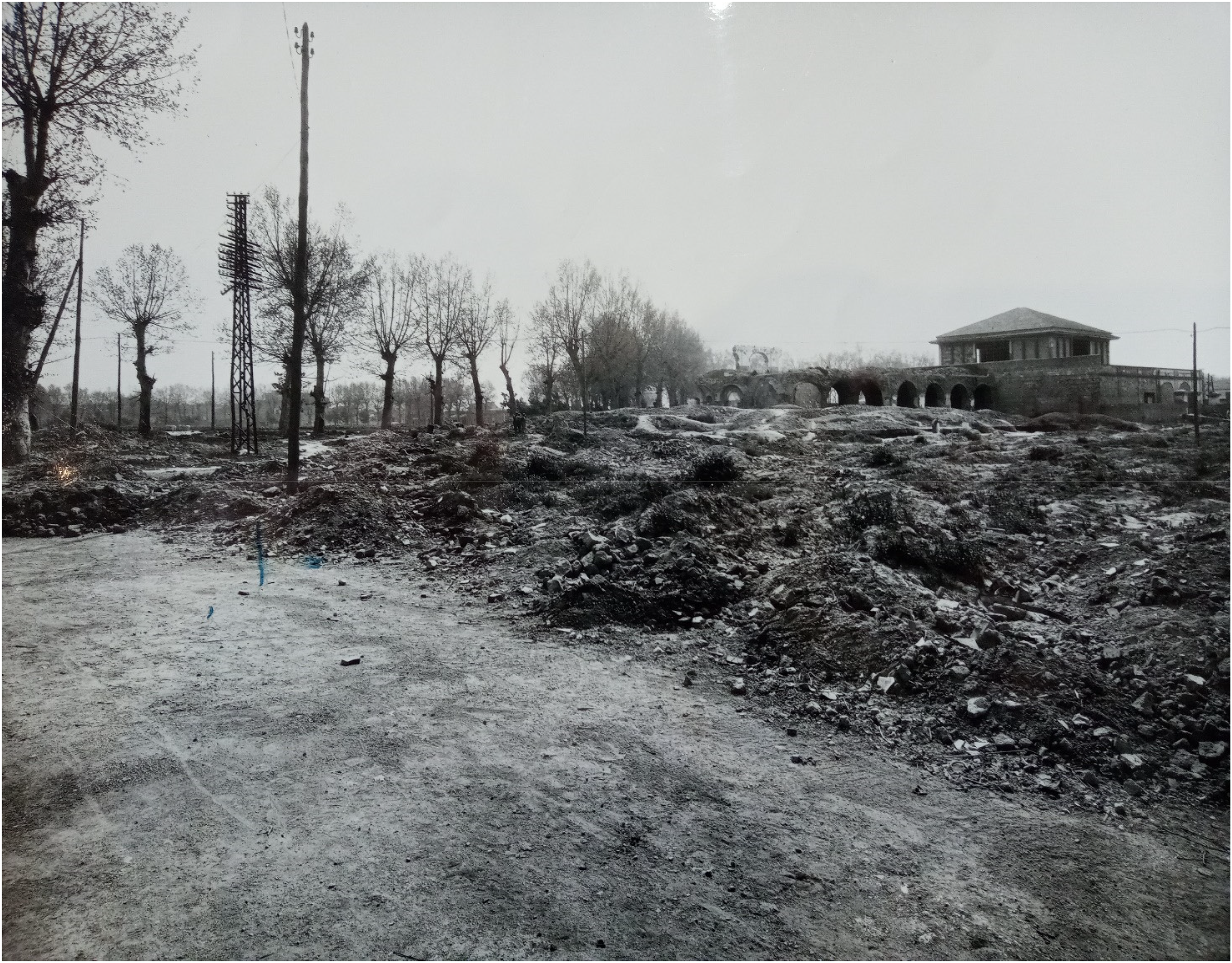
Remains of the hemp warehouse of Caserta, following the aerial bombardment on 23rd August 1943. Source: Photograph from State Archive of Caserta, Amministrazione Provinciale Terra di Lavoro.
Specific accounting documentation related to the war damages to hemp warehouses in the Caserta province is shown in Figure 12. This accounting documentation identifies the damage by geographic area (specific location in the province of Caserta) (columns a and b); the nature of the damaged or destroyed properties (columns c); the tax office where the claim for compensation was filed (column d); the date of filing (column e); the code of the claim (column f); the value of the damage reported (column g); and value of the damage per clusters of location (h).
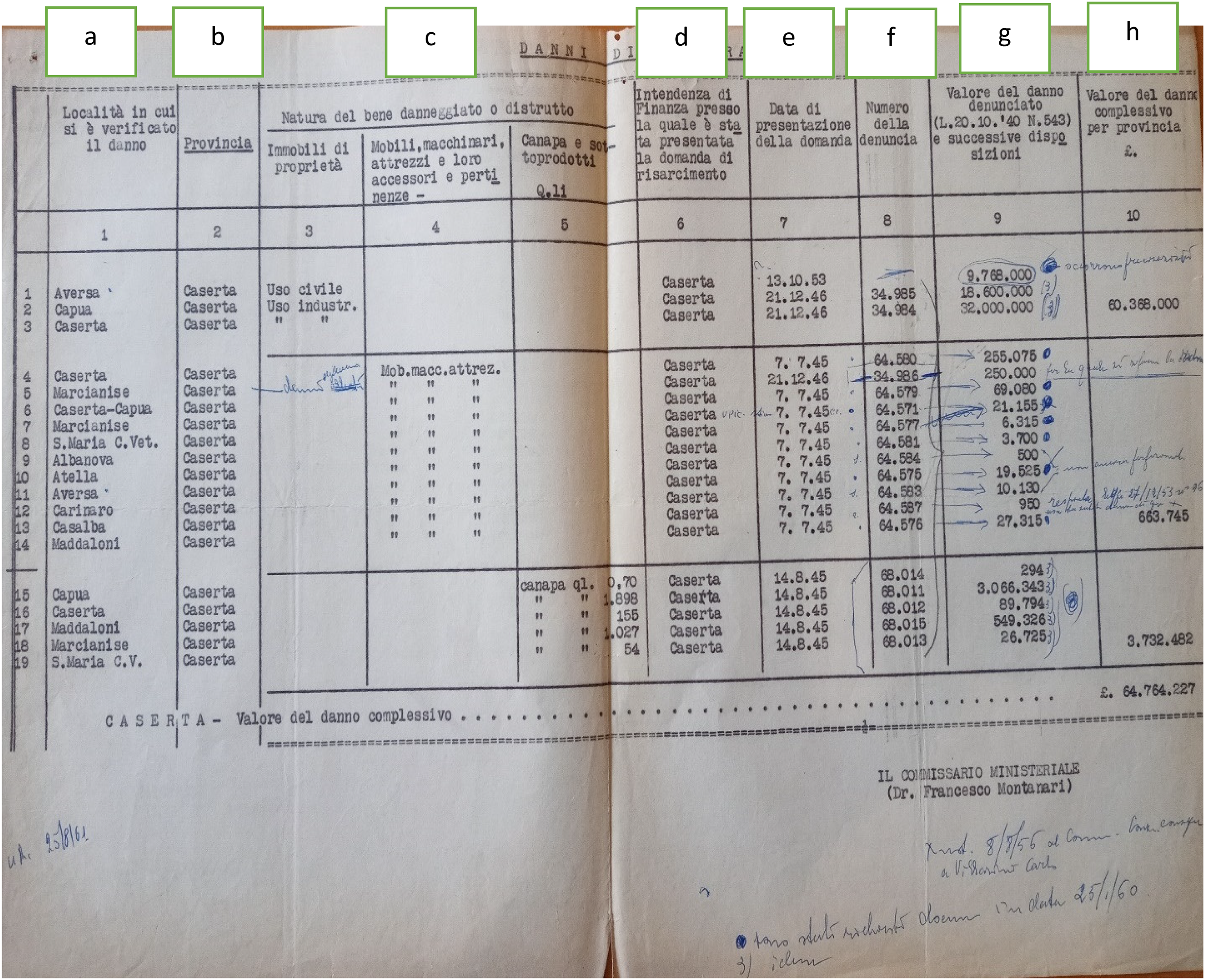
Statement of accounts showing war damages to hemp warehouses in the province of Caserta, by location. Source: Photograph from State Archive of Caserta, Amministrazione Provinciale Terra di Lavoro.
Hemp, agricultural cost accounting and social condition of hemp growers in the Caserta province
Hemp was a popular plantation in the province of Caserta in the period analysed. Capasso (2001) points out that it is not possible to identify the precise country of origin of hemp, but this plant had been known for a long time. A useful indication of where hemp was first introduced can be traced back to the area spread between the lower Danube and northern China. In this vast area, hemp grew almost spontaneously. In Italy, however, in the lower Po Valley and later in Piedmont, hemp was introduced by the Romans.
According to the data published by the General Directorate of Agriculture (Annali di Statistica, 1889), the ploughed surface of the province of Caserta in 1889 was 435,321 hectares, 3 meaning 80.44 per cent of the available land. Wheat was the largest crop, followed by maize and cereals. Grapes and olives orchards were also fairly well developed as were citrus fruits cultivations, especially in the Caserta and Gaeta locations. The cultivation of hemp (together with lime and tow) was particularly important, with an average annual production of 108,212 quintals 4 (10,821 ton 5 ). In the agricultural sector, hemp became popular to replace the cultivation of madder, which had become unprofitable.
In the Campania region, hemp cultivation was one of the agricultural activities that occupied most of the cultivated land and rural population for centuries (Macry, 1990), until its regression in the last decades of the twentieth century. This type of crop was completely abandoned after 1975 (Casoria and Scognamiglio, 2006).
In the close Neapolitan province of the Campania region, more precisely in the Atellana area, hemp cultivation and yarn-making were considered typical local activities until the 1950s (Capasso, 2001).
Hemp cultivation was already widespread in the Caserta and Neapolitan provinces during the Roman Empire. From the seventeenth century onwards, it came to occupy ever larger portions of land, such as the southern part of the provinces of Caserta and Naples, including the slopes of the Vesuvius volcano (Canino, 1981). Bevilacqua (1992) observes that contrary to what occurred in Europe, in Italy and in the Mediterranean area the functional coordination of residential settlements with respect to the type of fields is weak. This discrepancy, in evaluating the life condition of hemp growers in the agricultural sector, is crucial in view of the research proposition, representing the living difficulties of these kinds of workers.
At the beginning of the twentieth century, hemp farming was covering more than 50,000 hectares, meaning 60 per cent of the available land in the province of Caserta, until the 1960s (Di Vilio, 2012).
After the war ‘agricultural production … was absolutely insufficient to meet the minimum needs of the population’ (State Archive of Caserta – Capobianco Giuseppe Archive Folder n. 1218: Barbieri, 1947, authors’ translation).
The summary of historical statistics from 1861 to 2010 (ISTAT, 2011) shows a radical decline in terms of thousands of quintals of hemp produced from 1939 (1200 quintals or 120 tons) to 1945 (401 quintals or 40.1 tons). It is impossible to describe the misery in which the peasants of the province of Caserta live. Their life is less than a human life, it can be considered as an existence in a primitive and barbaric status … Fascism left these populations at the mercy of the landowners, greedy exploiters … (State Archive of Caserta– Capobianco Giuseppe Archive Folder n.1218: Vergani, 1946, authors’ translation)
The daily wage for women hemp growers was 200 Lire and for men 300 Lire, considering the working day of 9-10 h. (State Archive of Caserta – Capobianco Giuseppe Archive Folder n. 1218: Vergani, 1946, authors’ translation)
The attention of the authorities in charge was often drawn to the widespread unease that reigned among the peasant masses. (State Archive of Caserta – Capobianco Giuseppe Archive Folder n. 1218: Graziadei, 1947, authors’ translation)
The economic and social structure of the province of Caserta [is characterised by] small industrial oases – some of them painstakingly rebuilt after the war … unable to change the poor rural environment …the problems is … providing an effective and immediate solution to the low standard of living of the vast majority of our population … hell is in the countryside, where the social and economic environment not only prevents from having a bearable standard of living but also consolidates the conservative cultural background that prevents progress and democracy. (State Archive of Caserta – Capobianco Giuseppe Archive Folder n. 1218: Graziadei, 1949, authors’ translation)
In this context, the landowners’ claim for the payment of rent or ‘estaglio’ is the result of their interpretation of the Ministerial Decree of 26th July 1944 to their own advantage. They required that the tenant farmers who were not able to deliver the agreed quantity of wheat (calculated on the basis of the hectarage of the leased land), should pay the landowners an amount that is double the price market of the wheat (not 450 Lire per quintal, but 900 Lire per quintal. [Even when] the farmers did not store the product [or when the] war and fighting troops prevented the cultivation or destroyed the product before harvest [farmers had to pay] … Farmers … often carried out [the cultivation] heroically under the iron rain of the bombardments. However, even in these cases, the landowners required the payment of double the rent. (State Archive of Caserta – Capobianco Giuseppe Archive Folder n. 1218: Graziadei 1949, authors’ translation)
Figure 13 is the original document containing the production costs (cultivation) of hemp for the year 1945.
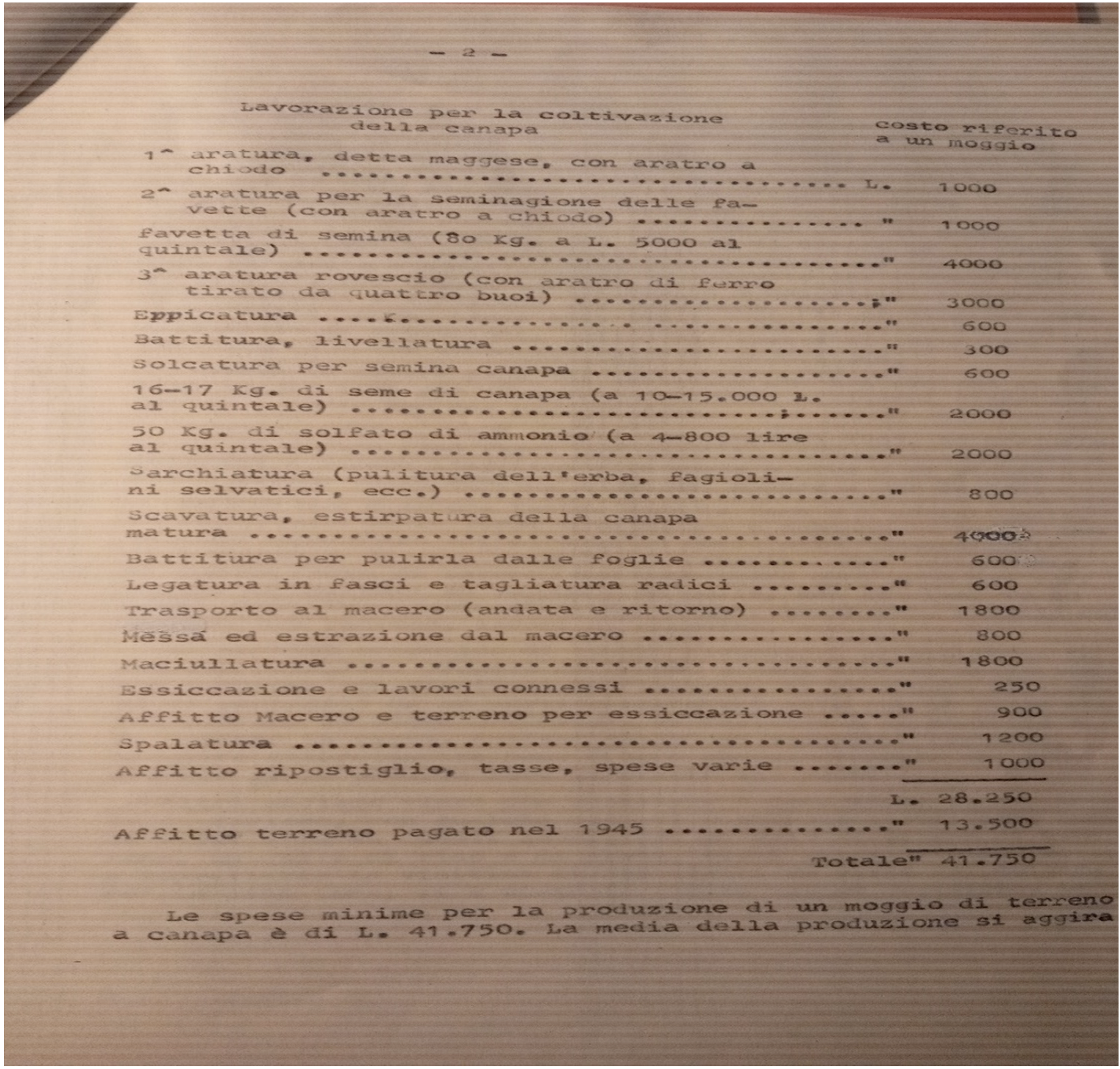
Cost-accounting document detailing the costs of hemp production in 1945. Source: Photograph from State Archive of Caserta, Archivio Capobianco Giuseppe No. 1745–1755, Folder n. 1218 (Vergani, 1946).
From Figure 13, the minimum cost for the production of one bushel (moggio
6
) of hemp is Lire 41,750. It should be considered that: the average production is around 6 bundles (fasci
7
) of hemp (6 × 71kg = 426 kg), which can be sold at the favourable price of 8000 Lire per quintal, this yields the little revenue amount of 34,080 lire. … even in the case of good average production, the revenues are 34,080 Lire, while the costs, calculated on the basis of the lowest farmers’ wages, are 41,750 Lire. … Therefore, the farmer's pay, which was set at 300 Lire for 10 h, must be reduced even further, and it becomes a starvation wage. (Folder n. 1218: Vergani, 1946, authors’ translation)
Post-WWII agrarian reform (1950)
The authors believe that war, hemp cultivation and the history of the Caserta province are intrinsically linked by the leitmotif of accounting. Farms are defined as the organisation of resources, such as land, non-land capital (equipment) and human capital for agricultural production (Silverman, 1968). The documentary evidence used by the authors outlines the dire social conditions of the period analysed, in particular in the rural territory, and indicates the strong repercussions of WWII on the socioeconomic and organisational fabric of the Southern Italy rural population. A typical example of the disastrous situation of the farmers in this province [Caserta] is that of the hemp growers. The majority of these farmers are small and medium-sized tenants who pay their rent in kind, namely two and a half bundles of hemp per bushel of land. The payment of the estaglio (rent) has to be made to landowners independently from production trends. During the 1945 harvest, some farmers were not able to collect enough revenue to pay the rent as a result of the drought and the war. (State Archive of Caserta, Archivio Capobianco Giuseppe No. 1745–1755, Folder n. 1218: Vergani, 1946, authors’ translation)
In addition, landowners enjoyed further ‘benefits’. As described by Vergani (1946: 3, authors’ translation): After hunger and destitution, the land-worker has to suffer the mockery. He must hand over to the landowner the so-called ‘benefits’ of barbaric and feudal memory. The tenant farmer of this ‘Terra di Lavoro’ has to deliver every year and for each bushel of land the following: one capon; one chicken; one hen; 10–20 eggs and other services: wood, transport, cleaning of the master's house, gardening work, …
Our hemp growers, after several years of drought, are unable to pay a rent that was disproportionate to the actual harvest. After asking and begging in vain for a reasonable reduction driven by necessity, they began an agitation that ended up with the full recognition of their just claims. (State Archive of Caserta, Archivio Capobianco Giuseppe No. 1745–1755, Folder n. 1218: Graziadei, 1947, authors’ translation)
The peasants of the Caserta countryside, exasperated by the high rentals that bound them to the landlords, asked the prefect on 12th December 1946 to revise their contracts. In the morning, about 10,000 peasants were at the gates of the prefect of Caserta, although all access routes had been blocked by the police. … The peasants themselves felt the need to make their grievances known to those in charge. (Bunch D-1746: ‘contadini a Caserta’ 12-12-1946–Corrado Graziadei, authors' translation)
In the months of July and August, there were several agitations by hemp farmers in the province of Caserta due to the decrease in hemp harvests. These rallies ended in an agreement between the Provincial Land Federation [governmental entity] and the association of the farmers of the province before the prefect and the chief of the police. The agreement reduced the hemp hectarage [on the basis of which the estaglio (rent) was calculated] by 25 per cent. This agreement was not respected. (State Archive of Caserta, Archivio Capobianco Giuseppe Bunch D-1746: ‘agitazioni contadini’ [farmers’ rallies], 13th December 1946, Nino De Andreis Secretary of Fedration – express correspondence addressed to PCI Secretariat, authors' translation)
There is a strong link between agricultural organisations, on the one hand, and social structure and values, on the other hand (Silverman, 1968). Unfortunately, the transcription and translation of the original historical documents demonstrate that the social claims of the hemp growers of the Caserta province through various agitations were not accepted in the first instance by the landowners. It would take a few years (1950) for the agrarian reforms to occur and improve the conditions of the regions of southern Italy (Vanzetti and Meissner, 1953).
As identified by McEntire (1970), the more far-reaching agrarian reform (1950) was the result of balancing peasant demands, land redistribution and agricultural technological progress. The main target of the reform was the population of land workers and farmers who were the poorest social classes.
Towards the end of the 1950s, the dire situation of the ‘Mezzogiorno’ (southern Italy), including its prevailing rural aspect, began to be considered and analysed in a more holistic way, also from the perspective of cultural and social anthropology (Mariuzzo, 2013).
The problems related to agriculture in Italy were at the basis of the peasant revolts at the end of WWII until the mid-1950s. Only post-WWII was a series of agricultural reforms to modernise the country in this productive sector implemented.
Linkages between accounting and socio-organisational change
Pietro Vergani's work (1946) allows us to understand the conditions of the hemp growers of the province of Caserta in the period immediately after WWII. This reveals the intrinsic connection between agricultural costs (Figure 13) and war damages accounting (Figure 12), which raises this technology from a mere informative tool to become the starting point of social and organisational change. Vergani (1946: 4) states that: Too little has been done by the government and the Federterra [associations for the land] to remove these populations [farmers] from the dire situation in which they are. The economic uplift of these workers is a necessary condition for the development of democracy and freedom. These concepts must not remain mere abstract expressions but should be translated into feasible leases that allow the peasants to get out of the brutal situation in which they live …. The Constituent Assembly must establish a democratic agrarian reform …. Immediate intervention is needed in order to support … the payment of the estaglio on hemp cultivations … the abolition of the odious and offensive ‘benefits’ of feudal memory should be ratified. Only in this way, we will defend the peace and create prosperity for everyone in a new democratic state.
These words from the original documents at the time are repeated in the current critical discussions and debates (Dietz et al., 2003) about global well-being and welfare (UN, 2015), sustainability and equal working conditions (Elkington, 2006; Ones and Dilchert, 2012).
War, agriculture and the close connection of man with property and land make the accounting tool an increasingly important technology not only for solving practical problems of everyday life, such as keeping accounts of damages or deaths during war periods. Rather, under the interpretative lens of neo-institutional theory, accounting is a social institution to reflect and create knowledge to manage disparate situations. The close connection between accounting and organisations (Carnegie et al., 2020; Riccaboni et al., 2006) implies that some spheres of managerial literature emphasise the role of accounting towards social and organisational change.
The authors consider aspects that are under-researched in the business environment (war and agriculture) and argue that these aspects are interacting. The originality of this work sits in the connecting role of the accounting tool to the above-mentioned aspects. This has emerged from the documentary evidence, and accounting becomes the main trigger of the far-reaching social-organisational change (the agrarian reform 1950).
The accounting of agricultural costs is a fundamental element to represent the poor living conditions of the population. The accounting for war damages (especially the damages caused to the hemp warehouses) highlights further social, economic and working difficulties of the farmers who could not manage properly the production, storage, yarn making and sale of hemp.
Therefore, the accounting tool reflects a threefold aspect: (1) it is a measurement technology (to measure quantities: damages, harvests and costs); (2) it is a rationaliser technology of social and institutional change; and (3) it is an influencing technology on institutional and contextual processes.
According to the analysis, another aspect was highlighted, that of sustainability. Accounting is the engine of the informative system, where it plays territorialising and mediating roles (as argued by Miller and Power, 2013). Territorialising implies the capability of shaping a context based on the precise data available. The mediating role refers to the capability to interact with the environment and create information. In addition, accounting is argued to push and promote the upgrading of the status quo, in view of sustainability improvement.
Conclusion
This research aims to address the post-WWII period by linking the following topics: (a) war, (b) agriculture and (c) influence on social claims for agrarian reforms. The authors focus on the role of the accounting tool to represent the contingencies of such a timeframe (Pettigrew, 1979, 1985, 1990, 1997) for the population of hemp growers in the Caserta province, Campania region, Italy. War damages exacerbated the life of the poor and the working conditions of the farmers, pushing for a request for reforms. The authors conclude that accounting information played an important role to push for change, because of its nature of institutional practice. The cost accounting system analysed in the article concerns both war accounting and agricultural accounting and it can be interpreted as an engine of socio-organisational change. This study considers Miller's (1994) framework on the roles of the accounting tool, and Acikgoz et al.'s (2022) notion of social accounting and applies them to the agricultural sector and the war damages to hemp warehouses. Based on Acikgoz et al.'s (2022) and Miller's (1994) considerations, the accounting tool would assume the features of:
Technology: The war accounts allow us to quantify the damage caused by the WWII bombings to the hemp warehouses and to the fields used for cultivation. Agricultural accounting leads to the calculation of the costs associated with the cultivation of hemp. Thus, the accounting system represents a cost measurement technology (Edwards and Boyns, 2012). Rationaliser: Accounting practices make it possible to interpret the changes in a certain sector context. Accounting rationalises social and institutional circumstances that would otherwise remain hidden or poorly considered. In the current case, accounting allows us to clarify the reasons for behaviours, attitudes, riots and rallies that influenced reform initiatives (Acikgoz et al., 2022; Baker and Quéré, 2014; Carnegie et al., 2020; Doron, 2016; Fowler and Keeper, 2016; Radcliffe et al., 2017). Reconstituent: The knowledge that accounting systems create may influence government actions and the resulting changes in context (Chandler, 2004; McDonough et al., 2020). The result of the 1950 agrarian reform was an increase in social welfare not only at the local level but also at the national level.
Considering the main theme of the research, accounting (in the dual role of war damages accounting and agricultural cost accounting) is a great trigger influencing and directing lines of action in political decision-making and governance (agrarian reform is the output of this process facilitated by accounting), not only strategically oriented in terms of business view (resulting in improved farm management conditions), but socially driven (driven by the dramatic conditions of hemp farmers) and for this reason institutionalised and quite endemic in human lives. In this sense, accounting has an important role in facilitating reforms, as noted by Collier and Miranti (2019). In this specific case of the study, the link between accounting and sustainability emerges clearly. The achievement of greater sustainability of the farmers’ living conditions via the 1950 agrarian reform was facilitated by the accounting tool. Accounting has an obvious social purpose, enabling social and organisational change towards a generalised welfare improvement.
Funding
The authors received no financial support for the research, authorship, and/or publication of this article.
