




Abstract
Employability development is a strategic priority for universities across advanced western economies. Despite this, there is no systematic study of employability development approaches internationally. In this study, we considered how universities portray employability on the public pages of their websites. We undertook website content analysis of 107 research-intensive universities in Australia, Canada, the United Kingdom and the United States. Following Farenga and Quinlan, we classified these strategies as Portfolio, Hands-off, Award and Non-embedded. Portfolio or Award strategies were the most common across all four locations; Hands-off and Non-embedded strategies were more common to US universities; and Award was more common in the United Kingdom. Universities focused on either possessional or positional approaches to employability. We advocate for a pedagogical shift towards processual approaches in which responsibility for employability development is shared.
Introduction
Universities are under enormous pressure to develop graduates who can negotiate a crowded, volatile and globally competitive labour market (Boden & Nedeva, 2010; Office for National Statistics, 2012; Siefert, 2011). In this context, employability has shifted from a focus on “job-getting” towards the metacognitive capacity to adapt, lead and learn. Universities have responded with numerous initiatives to enhance student employability. These include multiple forms of work-integrated learning (Freudenberg, Brimble, & Cameron, 2011); optional or compulsory, stand-alone employability units; and employability activities embedded throughout degree programmes (Pegg, Waldock, Hendy-Isaac, & Lawton, 2012).
Research into the efficacy of employability initiatives has typically focused on activities across a single or small group of institutions or departments (see, e.g. Faulkner, Mahfuzul, Waye, & Smith, 2013; Mason, Williams, & Cranmer, 2009; Owens & Tibby, 2014; Gamble, Patrick, & Peach, 2010; Watson, 2011). Very rarely does research report on the strategy adopted at an institution-wide level. In one such study, Farenga and Quinlan (2016) reviewed careers services websites from 24 research-intensive universities in the United Kingdom (UK). The authors proposed three strategic models of employability development: Hands-off, Portfolio and Award (defined below). We extended Farenga and Quinlan’s (2016) study with a sample of 107 research-intensive universities across (the UK, Australia, Canada and the United States (US). Our focus was universities’ portrayal of employability on the public pages of their websites: namely, their communication of employability to the outside world. We considered two questions:
What employability related content appears on the public pages of university websites? What does this content communicate about employability strategies?
Employability is a contested concept that lacks precision and clarity (Hillage & Pollard, 1998), defined by Yorke (2006) as a complex and non-linear idea, far broader than a ‘graduate’s achievements and his/her potential to obtain a “graduate job”’ (Yorke, 2006, p. 2). Our research focused on the publicly available employability information found on university websites. This is the information viewed by external visitors and it presents a unique picture, an external view, of how universities portray employability. In this study, we employed Holmes’s (2013) framework for analysing university employability perspectives and approaches, which he defined as possessional (possession of employability attributes), positional (capital) and processual (focus on the process of employability development). In line with this, we adopted Holmes’s (2013) definition of employability development: namely, the process of creating a worker identity where one develops the capacity for self-management, lifelong learning and adaptability.
To shed light on the conceptual frameworks on which these strategies were based, we drew on Farenga and Quinlan’s (2016) descriptions of three employability models used by the UK Russell Group universities: Hands-off, Portfolio and Award. The authors characterise the Hands-off model as one where skills such as problem solving, communication and leadership are seen as being naturally developed through the academic programmes; specific gaps identified by students might be filled through activities offered by a careers service. This model is typified by a clear distinction between the role of academic programmes and that of careers service in developing student employability, often with little interaction between the two.
In contrast, the Portfolio model is characterised as one where students are offered a portfolio of opportunities to develop their employability skills. Some of these are embedded within academic programmes, while others are offered as extracurricular opportunities through a careers centre or similar service; these include credit and non-credit bearing activities. Portfolio models incorporate communication between academic departments and central services such that both faculty (academic staff) and careers advisers contribute to employability delivery. In the Award model, the main strategy is to offer a formal credential rather than a ‘pick and choose’ menu of offerings. These often come from both faculty and careers advisers, where completing students receive an additional transcript, certificate or similar award.
According to Holmes (2013), the possessional approach is one of the most common approaches to graduate employability and focuses on graduates possessing skills, abilities or characteristics needed for employment. Conceptually, the possessional approach is aligned with demands for ‘employable’ graduates and, as such, it includes the development of generic skills that employers believe to be missing (Van de Heijde & Van de Hejden, 2006). Recognising the difficulties of developing and evaluating these items, a number of countries have established graduate attribute frameworks. For example Canada has developed an Employability Skills Profile (ESP) that delineates three major themes of academic, personal management and teamwork (Leroux & Lafleur, 1995). In Australia, graduate attributes are detailed in a Blueprint for Career Development (Commonwealth of Australia, 2010) that emphasises personal management; learning and work exploration; and career building competencies.
Positionality, Holmes’s second approach, concerns the idea that one’s social and cultural relationship to the labour market can influence the probability of employability. Employability from this perspective is a ‘complex construct encompassing the wider personal, social, economic and labour market circumstances’ (Sin & Neave, 2014, p. 3). It is also a reciprocal relationship as one’s social, economic and cultural capital influences changes with local, state and national labour markets (Brown, Hesketh, & Williams, 2003; Yorke, 2006). Positionality highlights that students’ attainment of skills, attributes or particular characteristics through higher education study does not necessarily heighten their social or cultural capital (Bourdieu, 1986), but that individuals from advantaged social backgrounds will better position themselves for limited, highly skilled roles.
Holmes’s third approach is termed processual and moves beyond skills to highlight the relationship between the integrative and continually interactive process of employability development and what Holmes (2013) has termed ‘gatekeepers’. The emphasis here is to develop ‘work-related dispositions and identities’ (Tomlinson, 2012, p. 11) which ‘lead others [gatekeepers] to ascribe to them the identity of being a person worthy of being employed’ (Holmes, 2013, p. 30). These identities form as students ‘(re)conceptualise their strengths, interests and goals and experience a corresponding increase in curiosity, motivation, creativity and problem-solving’ (Bennett, 2012, p. 27) through repeated engagement with learning opportunities and the workforce.
Method
Context and sample
Websites are one of the public faces of universities, accessible by multiple stakeholders, including current and potential students, alumni, parents, educationalists, philanthropists, journalists and employers. Institutional websites help shape the public image of an institution and represent an important component of an institution’s integrated marketing strategy. As such, websites should arguably reflect the most important messages a university wishes to portray in the shaping of its image.
Of course, websites are only one communication vehicle. Here, our methodological approach is informed by the work of Saichaie and Morphew (2014), who employed website content analysis to consider the strategic position of universities in connection with knowledge economy debates. Saichaie and Morphew (2014, p. 500) remarked on the need for research on institutional websites: while the messages communicated by institutional websites ‘should tell us much about how IHEs [Institutions of Higher Education] represent their purposes to prospective students’, in fact little is known about what these messages portray.
Demographics for the sample universities.

Two Canadian universities belonged to both the US and Canadian groupings. These were excluded from the US list to avoid duplication.
Framework
We operationalised Farenga and Quinlan’s qualitative descriptions of Hands-off, Portfolio and Award models to determine how universities portray employability on the public pages of their websites. Defining characteristics for each model are presented below:
Hands-off
Three criteria, all of which must be met:
Employability development is not embedded within degree programmes; There is no employability award; and Only non-credit bearing activities and events are available to students.
Portfolio
Three criteria, all of which must be met:
Students can access multiple employability development opportunities; Some employability development is embedded within degree programmes (beyond that required for accreditation); and Employability development opportunities are variously credit and non-credit bearing, or entirely non-credit bearing.
Award
An institution-wide employability award that is formally recognised in some way: for example the award appears on a transcript, co-curricular record or separate certificate.
Team members entered their observations into an online survey hosted at SurveyMonkey, Inc. A trial with two university website cases led to refinements of the questions and explanatory text to ensure consistency of approach. The final instrument included 22 items, comprising both closed and open questions and repeated themes for the purpose of triangulation. For each university, demographic information (student numbers, ratio of undergraduate to postgraduate students and numbers of academic staff) was collected. Employability content was gathered on the following five themes:
Reputation of the university and link to job prospects: the website indicates that attending the institution will, because of its high reputation, enhance job prospects; graduate destination data included; Careers service and its role: the institution has a careers service, which provides opportunities for employability development; Presence of an employability award: a university-wide award that includes opportunities to develop multiple employability skills and is formally recognised through an official transcript or similar; Multiple opportunities for students to engage with employability: multiple opportunities, credit or non-credit bearing, and evidence of opportunities embedded within academic programmes; and A list of graduate attributes that are university-wide and refer to employability or graduate job or career-preparedness.
Procedure
The procedure for analysis was informed by Groneman Hite and Railsback’s (2010) study of 100 university websites, through which a number of common website inclusions, reflecting the needs of both internal and external stakeholders, was identified. Groneman Hite and Railsback (2010) confirmed the need for website users to be able to complete their searches in as little as two clicks, without the use of a scroll bar, in order to access messages the authors deemed to be the most important for shaping an institution’s holistic public image. However, 60% of the university websites analysed by Groneman Hite and Railsback included a scroll bar on their homepage. Accordingly, we adapted their protocol when conducting our analysis:
Searches were restricted to three (rather than two) clicks from the identified page with the use of a scroll bar permissible; and Searches were undertaken from the following pages: Home page; ‘About’ page on which the university was described; Pages for future students: for example, admissions, new/potential students, courses; Pages describing careers services/career development/student employment/workshops relating to employability; Pages describing the university mission and its vision statement; and Pages for current students: for example student life, activities and/or organisations.
To reduce error and bias in coding (Mays & Pope, 2000) two primary coders initially analysed 10 universities, selected alphabetically from the 107 institutions, ensuring proportional representation from each group. These results were discussed, and once consensus results for each question was reached, one primary coder and a second coder analysed each remaining website. Inter-coder reliability was calculated for each instrument question. Where inter-coder reliability was less than 0.8, a third coder analysed the website (Miles & Huberman, 1994). Agreement of two of the three coders was recorded as the final result. The final dataset had an inter-coder reliability of 0.86 to 0.95 for each question.
Results
Employability content presented on university websites
Employability-related content presented on university websites (count (%)).

To understand the different modes of employability provision, we sought evidence of employability development through degree programmes. We found evidence of activities embedded within degree programmes at 75% of UK universities (highest) and 37.5% of Australian universities (lowest). We considered embedded opportunities within degree programmes to be those beyond work-related learning required as part of professional training programmes, such as in Nursing, Engineering and Medicine. Examples included professional development courses designed explicitly to develop employability skills, and experiential learning opportunities, including work placements.
Less common opportunities for employability development.
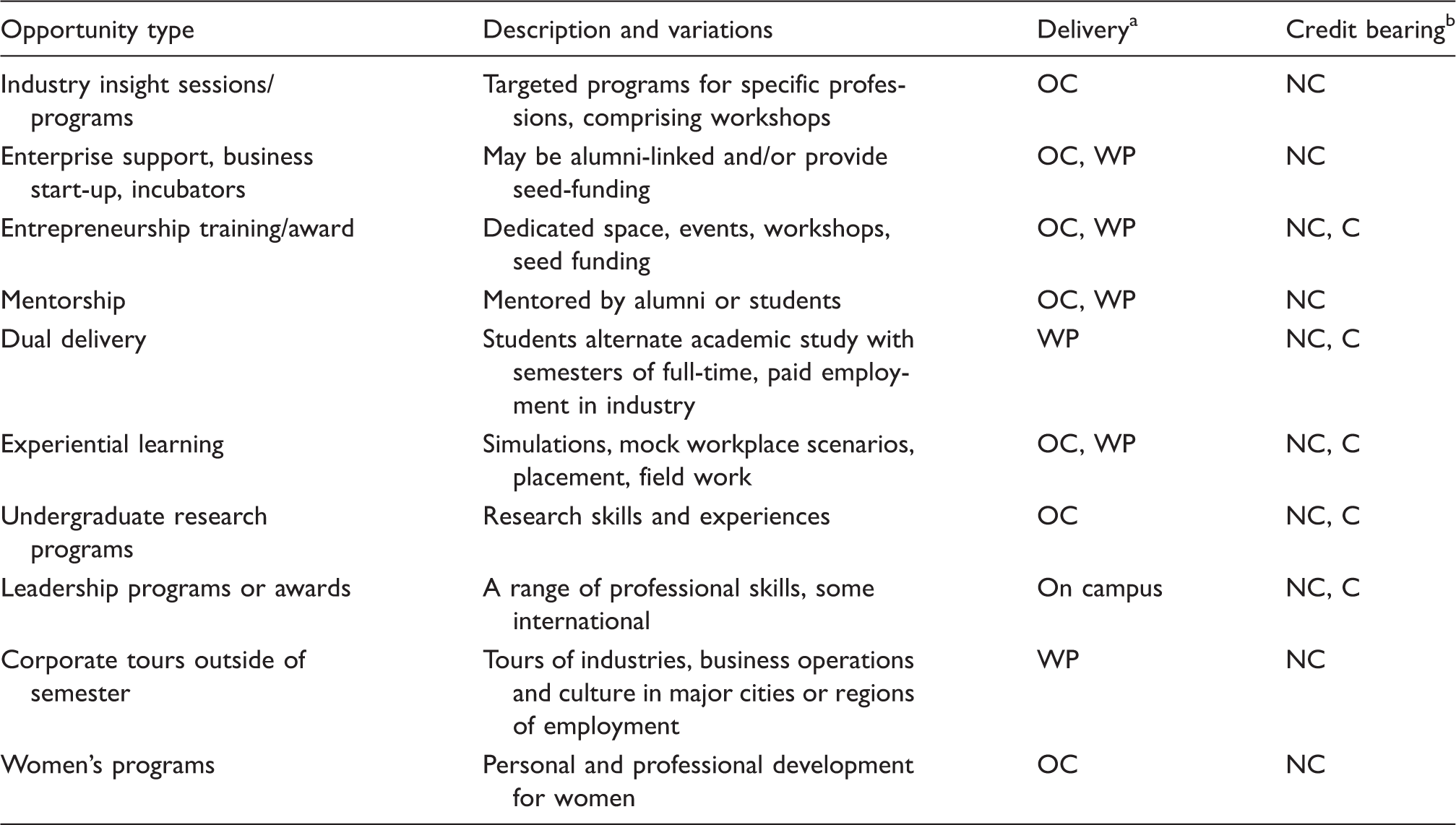
OC: on campus; WP: workplace.
NC: non-credit; C: credit.
Classification of employability strategies
Following the work of Farenga and Quinlan (2016), employability strategies utilised by the universities were classified as Hands-off, Portfolio or Award, using the criteria presented earlier. Analysed as a single cohort, the Portfolio strategy emerged as the most prevalent employability strategy (adopted by 39.3%), followed by a similar occurrence of Hands-off and Award model (22.4% and 18.7%, respectively). However, 19.6% of the cases did not fall within these categories. This group labelled Non-embedded was characterised by the absence of a formal employability award and had no evidence of embedded employability development. However, students at these institutions had opportunities to engage in centrally delivered credit and non-credit bearing employability activities.
As shown in Figure 1, there were marked differences in employability development strategies when viewed by institutional location. While the Portfolio model was the most prevalent in all locations, the Awards model dominated in the UK (58.3% of the UK universities). In contrast, the Awards model was used much less in Australia and Canada (25% and 20%, respectively) and was virtually absent from universities in the US (1.7%). This trend was reversed for the Hands-off model, which was employed more frequently in US universities (30%) than those in Australia (25%) and Canada (20%). Indeed, the Hands-off model was observed in only 4.2% of UK universities. Adoption of the Non-embedded model was most prominent in the US population, with approximately one-quarter of US universities (26.7%) categorised in this way. We also assessed whether reputational claims were more common in universities operating the Hands-off model. Our analysis showed that this was not the case, with reputational claims being highest amongst universities classified as Award (75%) and lowest with the Hands-off (45.8%) and Non-embedded (42.9%).
Prevalence of employability models by location. Differences are statistically significant (χ2 = 39.34; p < 0.001) with the UK having more universities in the Award category than other countries.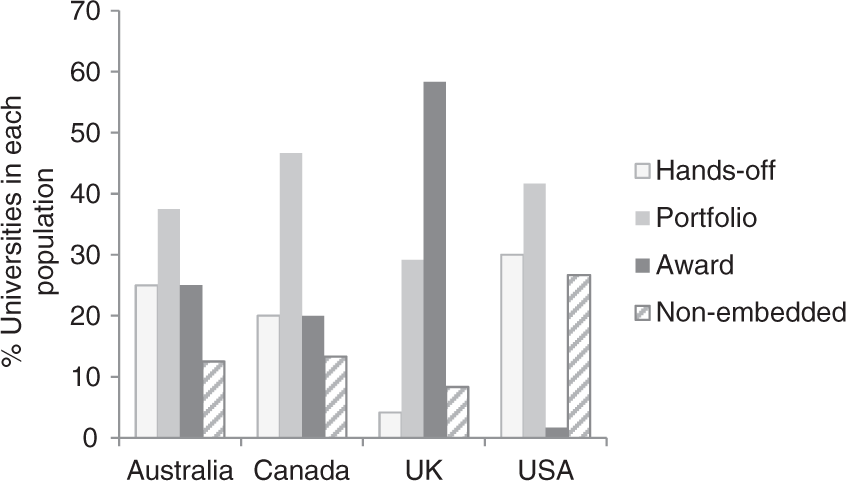
Discussion
This study utilised Farenga and Quinlan’s three employability models to classify the employability strategies viewed on the websites of 107 research-intensive universities. We observed that Farenga and Quinlan’s three models were manifest within all four of our location-specific university groupings. However, we also identified a fourth transitional model, for which we coined the term Non-embedded. This model sits between Hands-off and Portfolio and is characterised by the availability of multiple, centrally delivered employability development opportunities, all offered outside the formal curriculum. Our work shows that employability models can be positioned along a continuum of institutional involvement and responsibility, with Hands-off at one end, followed by Non-embedded, then Portfolio and ending with Award at the opposite end of the continuum. We found that location influences where institutions may cluster on this spectrum, with US institutions positioned towards the Hands-off end, while UK institutions appear at the opposite, Award end.
We found no evidence of Farenga and Quinlan’s assertion that (high) reputational claims are more common amongst institutions that utilise a Hands-off model. Rather, we found that such claims were higher on institutional websites using the Awards model. Thus, the way in which institutions may choose to enact employability is more likely to be linked with geographical location and the employability discourse associated with that location. For example, the strong employability agenda in the UK (see Ekaterina, 2013) explains to some extent the more formalised, Awards approach to employability in the UK. It also explains the frequency of reputational statements associated with enhancing job prospects, found on the sites of universities operating the Awards model.
We next ask what the different models might mean in higher education learning and teaching. With an emphasis on the operationalisation of employability development, the discussion is organised according to Holmes’s (2013) possessional, positional and processual approaches.
The possessional approach to employability development
Holmes’s (2013) possessional approach focuses on graduates possessing a collection of skills, abilities or characteristics needed for employment. Initiatives used to develop skills and qualities within a possessional approach might include a combination of opportunities that are credit or non-credit bearing, embedded in the curriculum and co-curricular or extracurricular. Thus, the possessional approach aligns with Farenga and Quinlan’s Portfolio model (2016). Where a Portfolio model leads to a formal credential such as a certificate, employability award, separate or modified transcript, the possessional approach encompasses both Portfolio and Award strategies.
Our findings, which show that the Portfolio and Award strategies are the most dominant across all four study locations, are consistent with Holmes’s (2013) contention that in policy and practice discourse the most common approach to employability development is possessional. Associated with the possessional approach has been the establishment of graduate attribute lists or frameworks (Holmes, 2013). We note here that Holmes is critical of the ‘skills and attributes’ movement, and that his categorisations do not seek to favour such an approach. In our study, we identified institutional-level graduate attributes in approximately half of our UK and Australian sampled universities while this figure was much lower in the US and Canadian universities. We acknowledge that language and context may have been factors here, in that Australia and the UK have engaged in rigorous national debates about graduate attributes (Oliver, 2011), whilst in other countries discussion, and therefore terminology, has been much less explicit. This language may also be a reflection of a broader philosophical difference between countries, where the emphasis of undergraduate education in the US and Canada is for a broad undergraduate education (liberal arts) with more career focus at the postgraduate level. In contrast, undergraduate degrees at Australian and UK universities tend to be more specialised.
Opportunities to accrue both skills and additional or amended academic transcripts often entail shared responsibility as institutions make opportunities available and students select those in which they will be involved. The employability awards seen in the current study tended to be the result of an institution-wide response. As such, they were most often centrally organised and monitored, bringing together and recognising a range of both centralised and faculty-based activities. An institution-wide response to employability might indicate institutional commitment at the level of policy and strategy and might, in turn, suggest meaningful engagement in the development of employability. Surprisingly, few awards were featured within the home and recruitment pages of institutional websites as might be expected if they were primarily recruitment tools.
The positional approach to employability development
As noted by Farenga and Quinlan (2016), students engaged in the three models have multiple opportunities to build their employability and gain valuable previews of career; this was also the case in our fourth model. Thus, building up personal capital through higher education study should enable graduates to better position themselves in the employment market. However, students and graduates with social and cultural capital are advantaged in the employment market, using their resources to access higher earnings (Norton & Carroll, 2015). Employers reinforce this selective advantage by recruiting from prestigious universities (Holmes, 2013; Tomlinson, 2012). As such, the Hands-off model may align with Holmes’s positional approach in that it ‘may work well for students whose backgrounds are already privileged enough to have tacit labor-market awareness, networks, and cultural capital’ (Farenga & Quinlan, 2016, p. 10).
We found the Hands-off model to be the second most prevalent across our population, but less than we had anticipated, given our focus on research-intensive, typically prestigious universities. Indeed, we found that just over half the institutional websites explicitly linked enhanced employment prospects to high institutional reputation. These universities marketed their ability to heighten positionality through opportunities for networking with successful business owners or prosperous alumni, positioning access to professional networks as an employability advantage (Hillage & Pollard, 1998; Tomlinson, 2007). In the US group of universities, in particular, university websites evidenced strong alumni networks. Other learning and teaching activities to enhance social or cultural capital included opportunities for students to shadow, volunteer or intern in their intended professions. In a Hands-off model, it is the responsibility of students to identify the need for development and seek out opportunities for development (Farenga & Quinlan, 2016).
The processual approach to employability development
One of the disadvantages of the possessional approach is that it can ignore the process (Holmes’s (2013) third approach) through which skills and knowledge are identified, conceptualised and realised, in line with emerging identity. It is through this process that students come to imagine, convey and refine their graduate identities (Bennett, 2012; Holmes, 2013). It is, similarly, the process of self-authorship (Baxter Magolda, 2001) through which individuals develop along interrelated epistemological, intrapersonal and interpersonal dimensions towards making independent judgments about knowledge, self, values and relationships with others.
Tangible examples of processual employability development come in the form of students’ creation of professional portfolios. Students’ reflections on why or how they have learned what they have learned is key to the processual nature of portfolios. Rather than a stagnant indicator of skills and abilities, students’ identification and re-identification of self continues in their pursuit of emerging professional identity (Peet, 2015), such that they learn ‘how to portray themselves as focused and capable individuals with definable skills sets, and also as adaptable, lifelong learners who can reshape themselves to different contexts and develop new skillsets as required’ Bennett, Rowley, Dunbar-Hall, Hitchcock, & Blom, 2016, p. 120). The processual view of graduate employability is further supported through the work of Okay-Somerville and Scholarios (2015), who have shown that career-self management behaviours, in particular career exploration, networking and guidance seeking, can significantly enhance graduate employability.
Concluding comments
We begin by expressing the limitations of this study as well as some of the opportunities for further research. We acknowledge that whilst institutional websites are an important mode of communication, they represent only one such mode. Further examples of employability development are undoubtedly hidden beyond the three-click limit of our website search or behind password-protected institutional sites. We also acknowledge that terms such as employability and graduate attributes vary between countries. This was mitigated by the inclusion of multiple terms as part of the search strategy, informed by authors from each of the countries studied. Further, our study focused on research-intensive universities and our findings cannot be generalised to institutions that are not research-intensive. Further research might expand the population to other university groupings to determine whether different employability development approaches apply, whether new models emerge and/or whether further insight into processual approaches can be gained. Following Farenga and Quinlan (2016), we placed each university within a single category. As such, our analysis provides an overview of employability strategies at the institutional level and does not reflect the fine detail of all programmes available within the institutions. Similarly, we acknowledge that the way in which employability is outwardly portrayed may differ from the way in which it is internally perceived and operationalised. We encourage other scholars to compare the similarities and differences of these perspectives.
The study has implications for both policy and practice. First, it provides a framework with which institutions might gauge how employability is being portrayed, enacted or operationalised. This might lead to consideration of the philosophies underpinning each strategy and the responsibility associated with each of these. It may also stimulate careful consideration of the employability messages institutions communicate to external stakeholders and how these are positioned on their websites. Conceptual thinking about employability at the institutional level might lead to employability strategies that prompt a pedagogical shift towards processual approaches and shared responsibility between institutions and students. This will most likely involve career services staff in the co-delivery of programmes alongside discipline educators as they seek to embed both the functional and cognitive aspects of employability development.
Our findings illustrate that the three models proposed by Farenga and Quinlan are manifest in an international population of research-intensive universities, as reported here. In addition, we identified a fourth model that represented a transition between Hands-off and Portfolio; this was termed Non-embedded. We noted geographical differences in the dominant model used. These differences appear to reflect international differences in higher education and broader economic policy and structure; future research might seek to clarify these distinctions. By aligning the models of employability development with the three approaches devised by Holmes (2013), we were able to show that the strategies used by universities to develop employability are mostly possessional or positional; we saw limited evidence of the processual approach.
Considered in the context of Holmes’s approaches, and Farenga and Quinlan’s models, our findings indicate that the public (website) face of employability development strategies for the universities reviewed is mostly positional or possessional. As outlined above, the selected strategy also indicates whether the responsibility for employability development should be that of the student or the institution, or indeed whether it should be shared between the two. We assert that process is central to employability development; therefore the most effective strategies for employability development combine the development of skills, attributes and student/graduate identity. This is supported by the work of multiple authors (see Bennett, 2012; Holmes, 2013; Peet, 2015; Porter & Phelps, 2014).
For some students, graduate identity is understood in a single instance, ‘like waking up one day and realising that I could do all these things I didn’t know I could do’ (Peet, 2015, p. 18). For most students, however, the process is gradual and it is a central concern for learning and teaching. In this sense, employability becomes a set of person-centred constructs that involve individual proactivity and reflexivity relating to career identity, personal adaptability, and social and human capital (Fugate, Kinicki, & Ashforth, 2004). We argue that a pedagogical shift towards process and relevance, through reflection, engagement and experiential learning, offers multiple opportunities to engage with industry, community, peers, alumni and career services. This shift has the potential to move each model towards a processual approach in which responsibility between student, institution and employer is shared.
The issue of shared responsibility brings to the fore the cognitive aspect of employability through which ‘learners develop along cognitive dimensions with respect to their dispositions and capacities to engage as professionals’ (Bennett, 2016, p. 392). It is this, rather than the functional dimension of employability, that aligns with the purpose of higher education.
Footnotes
Declaration of Conflicting Interests
The author(s) declared no potential conflicts of interest with respect to the research, authorship, and/or publication of this article.
Funding
The author(s) received no financial support for the research, authorship, and/or publication of this article.