




Abstract
Based on career construction theory, this research aimed to investigate the mediating role of orientation to happiness in the relationship between career adaptability and in-role and extra-role performance of employees in the hospitality industry. Using data collected from 360 respondents working in 6 five-star hotels in Pakistan, the authors found that career adaptability was positively associated with orientation to happiness, in-role performance, and extra-role performance. Moreover, orientation to happiness mediated the relationship between career adaptability and both in-role and extra-role performance. The study has important theoretical and practical implications.
Keywords
Introduction
In the era of boundaryless careers, demand for individuals to adapt to new job requirements, different groups of people, and unfamiliar situations have increased (Biemann, Zacher, & Feldman, 2012; Briscoe, Hall, & Frautschy DeMuth, 2006; Sullivana & Arthur, 2006). Individuals consistently face new challenges, contrasting environments, and different employee groups (Savickas et al., 2009). These fundamental changes in the world of work are affecting the career of individuals in organizations, as most individuals have to perform various job tasks throughout their professional life (Biemann et al., 2012). Considering these issues, career construction theory describes how individuals manage their job-related tasks, for example, finding a job, achieving pertinent skills, and fulfilling the career objectives (Savickas et al., 2009). This theory assumes that ongoing transformation in the job domain is critical to attaining success in a career (Karaevli, Hall, & Douglas, 2006). To achieve their career objectives, individuals need to develop adaptability skills that can enable them to adjust and manage these work-related transitions through planning, exploring, and making suitable decisions (Klehe, Zikic, Van, Annelies, & De Pater, 2011; Rossier, Zecca, Stauffer, Maggiori, & Dauwalder, 2012). Career adaptability is defined as “the readiness to cope with the predictable tasks of preparing for and participating in the work role and with the unpredictable adjustments prompted by changes in work and working conditions” (Savickas, 1997, p. 254), and is considered to be related to better performance, managing work stress (Hannes, 2014), fostering happiness and satisfaction, and handling organizational emergencies (Guan et al., 2013). Of the many possible outcomes of career adaptability, happiness is one of the more important ones. Career adaptability is related to an individual’s capacity to achieve a successful and desired life (Johnston, Luciano, Maggiori, Ruch, & Rossier, 2013). Career construction theory proposes that adaptable individuals respond to psychosocial challenges in their workplace through self-regulation strategies that enhance their work success and make their job more pleasant (Rossier et al., 2012). Happiness enables individuals to adjust and cope better with work-related challenges, for instance, workload and stress (Hirschi, 2011). Researchers, e.g. Peterson, Park, and Seligman (2005) describe happiness as reflecting a positive attitude, high moral standard, proficiency at work, and creating a life worth living. Both career adaptability and orientation to happiness are resources that also contribute to improving job performance, both in-role and extra-role (Savickas, 2013).
The present study aimed to investigate the association between career adaptability and job performance (both in-role and extra-role performance) and test the role of orientation to happiness as a mediator. We used data collected from hotel employees (managers and frontline workers) working in 6 five-star hotels situated in Pakistan. This study has contributed to the literature in three different ways. First, career adaptability is a relatively new concept and has not received sufficient research focus from scholars of organizational behavior. Examination of the literature reveals that career adaptability in the hospitality industry has been largely ignored (Karatepe & Olugbade, 2017). It is therefore important to study the consequences of career adaptability of employees in the hospitality sector. The job nature of frontline hotel employees is unique as they have frequent face-to-face interactions with customers and play a critical role in service delivery and complaint handling processes; provide feedback to management; and generate ideas and solutions for sudden, unique, and novel customer issues (Karatepe & Olugbade, 2017). Hence career adaptability is a concept of much significance for hospitality sector employees. Second, the relationship between career adaptability and orientation to happiness has not been widely studied, especially in the context of the hospitality industry (Zacher, 2015). Third, there is a need for more empirical research about the outcomes of career adaptability (Hannes, 2014; Rossier et al., 2012). We examine two organizationally valuable outcomes (i.e. in-role and extra-role performance), which are significant for hospitality industry organizations and employees as well as for employees in other organizations, and test their relationships with adaptability and orientation to happiness.
Career adaptability
The term career adaptability was initially defined by Super and Knasel (1981) as the key factor of career development, and has since been broadly considered as an essential ability in career success (O’Connell, McNeely, & Hall, 2008). According to career construction theory, adaptation is expressed when individuals are in transition, for example, from school to work, employment to employment, and profession to profession, and is related to the person’s skills and preparedness to change. Employees, for example, need five attributes of adaptability: these are the ability to (a) engage, (b) explore, (c) experiment, (d) develop and maintain a positive attitude, (e) and hold self-belief. Engagement means having the capacity to interact with others and the environment to influence the future; exploration refers to being able and interested in finding out what is happening and to determining if it is relevant; experimenting is described as being ready for new challenges; positive attitude reflects being positive about the future; and self-belief refers to confidence in oneself and one’s ability (Lindsay, 2014).
Happiness
Different people pursue happiness through different paths i.e., pleasure, engagement and meaning and these different pursuits might reflect differing orientation to happiness. Seligman, Parks, and Tracy (2004) presented the concept of hedonic and eudaimonic well-being which outlined pleasure, meaning, and engagement as the three main components of happiness (p. 1380). Kruger (2014) considered that employee happiness arises when they experience positive life or work-related affects. Emotions of comfort, pleasure, and excitement represent positive affect that indicates happiness, while emotions of anxiety, displeasure, and stress are representative of negative affect and indicate the low state of happiness (Warr & Clapperton, 2010). Similarly, Bakker (2011) proposed that happiness encourages individuals to perform better at their workplace as it enhances their satisfaction and commitment. According to other researchers (Quick & Quick, 2004; Rego & Cunha, 2008), happy employees are more productive representatives of organizations.
Job performance
Frontline employees’ job performance is described as the level of productivity of an individual employee, relative to several job-related behaviors and outcomes (Babin & Boles, 1998). Job performance is described as the level of productivity of an individual employee, relative to several job-related behaviors and outcomes (Busch & Bush, 1978). Front line employees' performance is affected more negatively by increased role conflict or role ambiguity (Babin & Boles, 1998, p. 87). Performance can be represented as the behavior of employees related to their regular work, duties, and responsibilities that are included in the job description (Williams & Anderson, 1991). However, it is difficult to measure both in-role and extra-role performance (eg. Organizational citizenship behaviors, or OCB) in some workplaces as the employment situation does not remain stable (Bishop, 1989). This is particularly the case with hospitality employees, who have been characterized as requiring ongoing exertion and creativeness, and needing to provide prompt solutions to problems (Ma, Qu, Wilson, & Eastman, 2013; Turnipseed & Rassuli, 2005). This is why organizations in the hospitality industry consider frontline employees as the most important source of retaining loyal and satisfied customers as they have a direct connection with customers (Chang & Chang, 2008). Hospitality industry organizations want to retain frontline employees who have shown quality performance as they play a critical role in for customer satisfaction and organizational profitability (Tang & Tang, 2012).
Hypothesis development
According to career construction theory (Savickas, 2011), adaptable individuals adjust their self in different circumstances to better face and meet the demands of psychological and social challenges. In this way, individual self-development can progress and the person can focus more on the future and available opportunities, and deal better with intrapersonal and environmental conflicts that affect them achieving their career objectives (Baumeister & Vohs, 2007). In this context, career construction theory, supported by empirical studies, e.g. Johnston et al. (2013); Proyer, Annen, Eggimann, Schneider, and Ruch (2012), propose that employees with higher career adaptability better manage workplace transitions because of self-regulatory strengths that increase their work satisfaction and make their job experience more pleasant. Researchers, e.g., (Hartung & Taber, 2008; Johnston et al., 2013; Rossier et al., 2012) have proposed that career adaptability has an association on orientation to happiness. Therefore, it is hypothesized that:
H1: Career adaptability is significantly related to orientation to the happiness of employees.
According to Savickas (2013), career adaptability positively affects self-regulation strategies. Career adaptability is an essential competence for individuals to deal effectively with the job-related challenges that arise with environmental changes (Tolentino et al., 2014). In accordance with career construction theory and consistent with the prior empirical studies (e.g. Hannes, 2014), career adaptability has a positive effect on the task performance of employees; that is, adaptable individuals perform better (Zacher, 2015). Thus, it is hypothesized that:
H2: Career adaptability is significantly related to in-role performance of employees.
Career construction theory assumes that adaptable employees are more likely to perform work in organizations that goes beyond the basic requirements of the job and ultimately enhances organizational outcomes, i.e. engage in OCB behaviors; (Biemann et al., 2012). Based on this, we expected that career adaptability to be related positively to OCBs. We hypothesized:
H3: Career adaptability is positively related to extra-role performance/OCB in employees.
Happy employees are able to manage their job-related responsibilities more effectively, and work theories, e.g., work adjustment theory (Dawis, Lofquist, & Weiss, 1968) and empirical studies (Begley & Czajka, 1993; Grawitch, Trares, & Kohler, 2007; Meyer & Allen, 1997; Wright & Cropanzano, 2004) indicate that happiness has a positive relationship with the task performance of employees. For example, happiness motivates employees to better perform their assigned tasks as their job commitment is higher (Quick & Quick, 2004; Rego & Cunha, 2008). Our hypothesis here is that:
H4: Orientation to happiness is significantly related to in-role performance of employees.
Happy employees tend to be more cooperative with others; for example, they are more compassionate and courteous and perform extra work for the organization (Avey, Wernsing, & Luthans, 2008; Donald, Boreman, Spector, & Fox, 2002). According to work adjustment theory (Dawis et al., 1968) and the results of some prior empirical studies (e.g. Bergami & Bagozzi, 2000; Spector & Fox, 2002), happiness has a positive effect on OCB, as happiness can encourage employees to work not only for remuneration or career development but also for personal satisfaction (Wright & Cropanzano, 2004). Thus, we hypothesized that:
H5: Orientation to happiness is positively related to the extra-role performance of employees.
Method
Participants were 360 Pakistani hospitality industry workers from 6 five-star hotels situated in three different cities in Pakistan (i.e. Lahore, Karachi, and Islamabad). A total of 610 surveys were distributed, indicating a response rate of 59%. These 360 participants had a mean age of 33 years (SD ± 16). There were (71%) men and (29%) women. The average length of employment was 8.4 years (SD ± 4.2) with supervisors (24%), and frontline workers (76%).
Measures
The questionnaire consisted of 61 items, with demographic questions (e.g. gender, age, marital status, designation, and experience) and scales measuring career adaptability, orientation to happiness, and in-role and extra-role performance of employees.
Career adaptability
Intercorrelations and descriptive statistics.
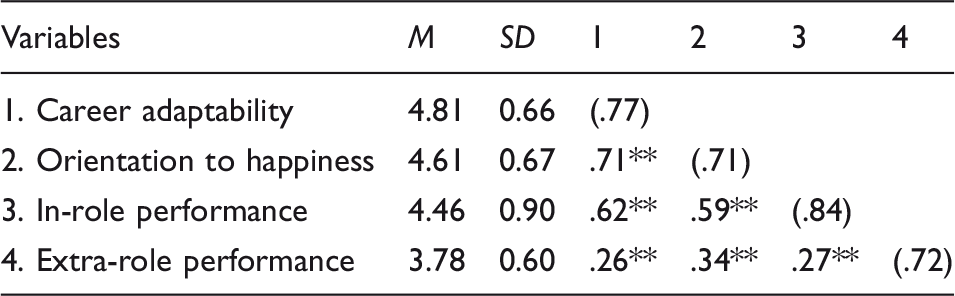
Notes: Significant at *p < .05 (two-tailed) and **p < .01 (two-tailed); figures in parentheses are alpha internal consistency reliabilities.
Orientation to happiness
We used the 18-item Orientation to Happiness Scale (Peterson et al., 2005), which assess the three dimensions of orientation to happiness, i.e. engagement (e.g. “I am always very absorbed in what I do”), pleasure (e.g. “Life is too short to postpone the pleasures it can provide”), and meaning (e.g. “I have a responsibility to make the world a better place”). Responses are provided using a 7-point format, where 1 = Not a priority and 7 = Essential priority. Past reliability has been reported as .70 (Peterson et al., 2005). The internal reliability of the scale in the current study was .71.
In-role performance
We used the 5-item In-role Performance Scale (Williams & Anderson, 1991). Scale items included “I fulfill responsibilities specified in job description” and “I meet formal performance requirements of the job.” Responses are provided using a 7-point format, where 1 = Not a priority and 7 = Essential priority. Past reliability has been reported as .91 (e.g. Williams & Anderson, 1991). The internal reliability of the scale in the current study was .72.
Extra-role performance
We used the 14-item Extra-role Performance Scale (Allen & Lee, 2002). Sample scale items are “I adhere to informal rules devised to maintain order” and “I assist my supervisor with his/her work (when not asked).” Responses are provided using a 7-point format where 1 = Not a priority and 7 = Essential priority. Past reliability has been reported as .94 (Piccolo & Colquitt, 2006). The internal reliability of the scale in the current study was .84.
Procedure
The survey was conducted in 6 five-star hotels in Pakistan, situated in three different cities. We personally visited all of these organizations with prior approval from the management. Upon our visit, we distributed surveys to the supervisors and requested them to hand them to their subordinates and to ask volunteers to complete them before leaving the office on that day. A cover letter attached to each questionnaire explained the survey purpose and assured confidentiality.
Data analysis
The SPSS PROCESS macro (Hayes, 2013) was used to test our hypotheses. Following the recommendations of Aiken, West, and Reno (1991), all the continuous measures were mean centered.
Results
Descriptive statistics
Table 1 reports descriptive statistics and intercorrelations among variables. Career adaptability was positively related to orientation to happiness and in-role and extra-role performance, as expected, and orientation to happiness was positively related to in-role and extra-role performance, again as expected. These results provide support for the hypotheses related to variable relationships. The demographic variables were not related to the study variables and thus were not included in any analyses.
Mediation analysis
Results of mediation analysis.
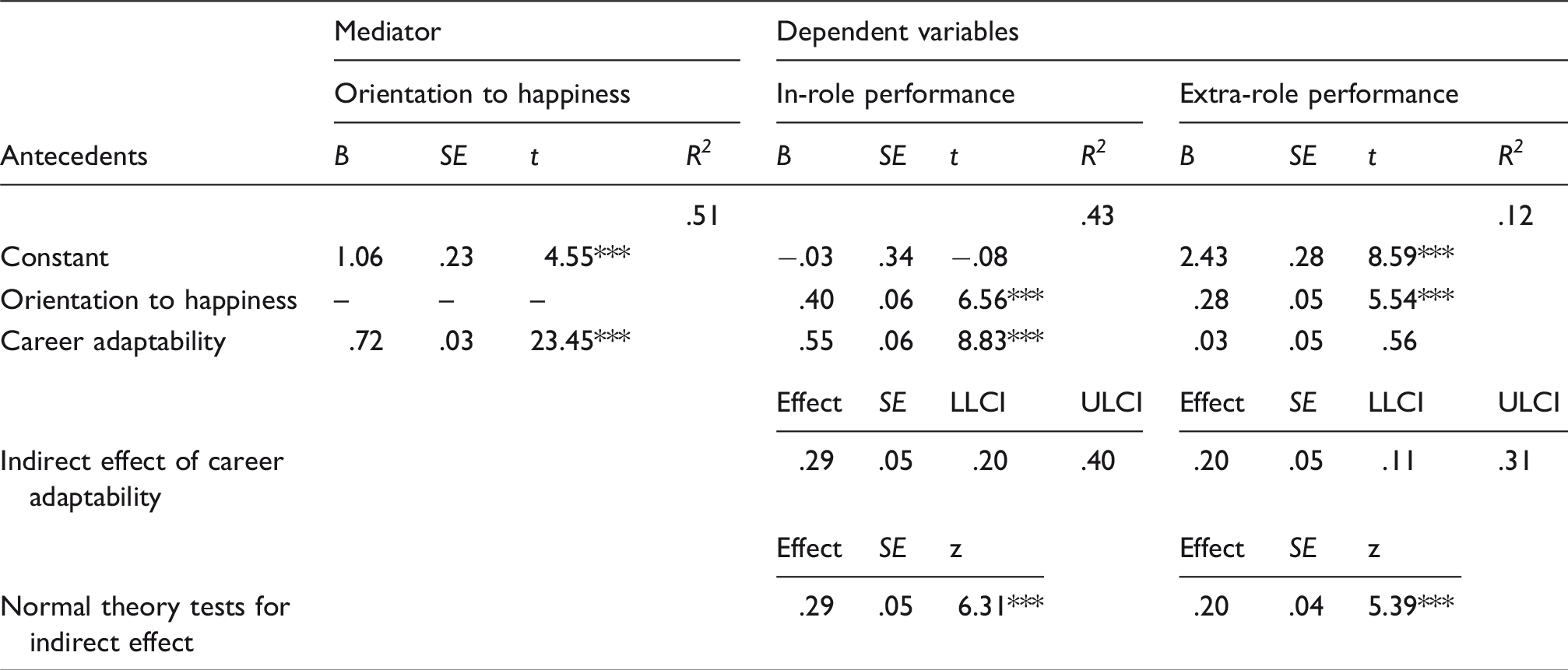
LLCI: bias corrected lower limit confidence interval; ULCI: bias corrected upper limit confidence interval.
Notes: Unstandardized regression coefficients are shown; bootstrap sample size = 5000; significant at: *p < 0.05; **p < 0.01; and ***p < .001.
Discussion
The present study examined the relationship between career adaptability, orientation to happiness, and job performance, including both in-role and extra-role performance in the hospitality industry, to investigate if adaptable individuals perform better in hospitality sector organizations. Specifically, we hypothesized that a positive orientation to happiness mediates the relationship between career adaptability and in-role and extra-role performance of employees. The results of the mediation analysis, consistent with our preliminary analysis, revealed that career adaptability was directly related to in-role performance, but not the extra-role performance of employees. However, career adaptability was found to have a significant indirect relationship with in-role and extra-role performance, supporting our hypothesized model. The absence of support for the direct relationship between career adaptability and extra-role performance validates our prediction of the existence of the underlying mechanism, i.e. orientation to happiness in the relationship between career adaptability and job performance. With regards to the relationship of career adaptability and orientation to happiness, our results are similar to those of previous studies, which have shown the influence of career adaptability on the happiness of employees (Hartung & Taber, 2008; Johnston et al., 2013). This means that employees with higher career adaptability skills show more orientation to happiness in their organizations. Similarly, our results supported the mediation hypotheses among hospitality sector employees, showing that career adaptability was related to in-role and extra-role performance of employees through orientation to happiness.
The results of the mediation analysis help us answer the question of why adaptable individuals perform better in organizations. Here we found that adaptable individuals have more orientation to happiness and, hence, having more happiness they can cope better with various work-related challenges; for example job stress and high job demands. Happy employees have a positive attitude toward their jobs (e.g. vis-à-vis standards and proficiency), and thus these resources help them perform better in organizations. Although there will be some other factors contributing to the high performance of adaptable individuals in hospitality sector organizations, we tested one plausible path (i.e. career adaptability → orientation to happiness → in- and extra-role performance), and found our predictions supported by the empirical results of this field study. The study was conducted in the hospitality industry, therefore we can expect that, in the hospitality industry, employees having higher career adaptability skills will perform better when they have a higher orientation to happiness.
Answering the call for more empirical research about the outcomes of career adaptability (Hannes, 2014; Rossier et al., 2012), we examined two organizationally valuable outcomes (i.e. in-role and extra-role performance) and tested their relationship with adaptability and orientation to happiness in the hospitality sector. The main purpose of this research was to evaluate the effect of career adaptability on in-role and extra-role performance of employees, and to test the role of orientation to happiness as an underlying mechanism in this relationship. The results suggest that career adaptability skills are related to higher levels of organizational happiness, and, in turn, related to better performance. This empirical study increases our understanding of career adaptability, orientation to happiness, and job performance of employees in hospitality industry. The study of career adaptability in hospitality organizations has been ignored in the literature (Karatepe & Olugbade, 2017), and we have contributed to filling this gap.
Practical implications
The study is important for hospitality industry organizations that need skilled and trained workers. It can be inferred that there is a significant indirect relationship between career adaptability and job performance, through orientation to happiness. The findings of this study have practical implications for managers and human resource practitioners who are responsible for providing career development and job performance interventions. The findings contribute to the existing knowledge regarding the relationship between career adaptability and job performance, which has not been sufficiently explored in the hospitality sector. Practically, this research highlighted the significance of career adaptability concept in the hospitality industry organizations. Facilitating career adaptability skills in hospitality sector employees can help to equip them to deal better with the changing world of work. Understanding the importance of career adaptability to the job performance of employees should encourage the management of hospitality sector organizations to invest more resources in the development of career adaptability skills in their employees. The study suggests that adaptable individuals are better performers in the hospitality industry, so, additionally, recruiters and human resource professionals of this industry might focus on hiring individuals who have high career adaptability skills.
Limitations and future directions
This research study has several limitations. The sample was drawn from one country only, which reduces the generalization of this study. It is hoped that future research will recruit participants from other regions and countries, with the aim of studying and testing the model in hospitality sector organizations located in different areas. Our study was cross-sectional, even though we tested a process model; thus, future researchers need to test our results with longitudinal data. As our mediator did not explain all of the mediated variance, some alternative paths can also be identified. It is possible, for example, that more engagement in work increases job performance, rather than our hypothesized direction. Similarly, future researchers can test moderators to the relationships, as it will be important to determine what conditions (e.g., gender) and situations (e.g., culture) affect these relationships.
Conclusion
This paper addressed the research question, why adaptable individuals perform better in organizations. A sample of 360 survey responses was used to study the role of orientation to happiness as a mediator in the relationship between career adaptability and in-role and extra-role performance of employees in the hospitality sector. The authors studied career adaptability, which is a critical but little addressed concept in the context of the hospitality sector. The results suggested that career adaptability is related to higher levels of happiness, and this helps them perform better at their jobs.
Footnotes
Acknowledgments
The authors acknowledge the role of the editor, Professor Peter Creed and pay gratitude for his helpful suggestions and comments on earlier versions of this article.
Declaration of Conflicting Interests
The author(s) declared no potential conflicts of interest with respect to the research, authorship, and/or publication of this article.
Funding
The author(s) disclosed receipt of the following financial support for the research, authorship, and/or publication of this article: This work was supported by natural science foundation of China (Project no.71373251; no.71422014).