



Abstract
Building new space for institutional theory, we propose how the severity of formal and informal institutional voids shapes the productivity of entrepreneurial activities within society. Our theory makes the key assumptions that voids can exist in both formal and informal institutions and that they are capable of hindering entrepreneurial behavior that is favorable to development progress. We extend new theoretical domains by conceptualizing informal institutional voids and proposing how both formal and informal institutional voids and their interaction influence two qualitative outcomes within localities: (1) the unique forms of entrepreneurial activity, and (2) the objectives underlying this entrepreneurial activity.
Keywords
The instrumental functioning of institutional environments varies considerably across the broad spectrum of societies at various stages of development. Acknowledging this wide variation, the concept of institutional voids—defined as a lack or a failure of existing institutions to support efficient and effective market transactions (Khanna & Palepu, 1997; Mair, Martí, & Ventresca, 2012)—helps to identify the relative levels of institutional support that foster development progress within a society. In particular, scholars have more specifically examined the influence of formal institutional voids (Pinkham & Peng, 2017; Puffer, McCarthy, & Boisot, 2010; Webb, Kistruck, Ireland, & Ketchen, Jr., 2010), such as when a government’s political, economic, and legal/regulatory institutions fail to provide the basic systems of governance, property rights protection, infrastructures, and/or rule of law (Khanna & Palepu, 1997). When formal institutions are limited in their ability to provide these basic systems, transactional and operational costs are amplified, thereby inhibiting the creation and effective functioning of markets (North, 1990). While the concept of formal institutional voids has served as the basis for a significant stream of research concerning entrepreneurship, scholars have placed less effort in understanding how informal institutions support or constrain enterprise pursuits (exceptions include Khoury & Prasad, 2016; Light & Dana, 2013; Mair et al., 2012; Slade Shantz, Kistruck, & Zietsma, 2018) and the roles that informal institutions can play alongside formal institutions.
Addressing this key gap at the societal level (Davidsson, 2016), we explore how both formal and informal institutional voids affect the productivity of entrepreneurship. Entrepreneurship provides the means through which novel and innovative solutions are delivered and diffused throughout society in solving socioeconomic needs (Schumpeter, 1942). Therefore, we define productivity of entrepreneurship as the degree to which entrepreneurial efforts, via the delivery and diffusion of innovations, are capable of increasing the efficiency and effectiveness with which a society’s scarce resources are allocated (Baumol, 1990).
Complementing formal institutions, a society’s norms, values, and belief systems define the codes for socially acceptable behaviors that are embedded in its informal institutions (North, 1990). Such codes can either bolster or compromise the economic potential of entrepreneurial actors and the societies in which they operate. Herein, we define informal institutional voids to be the inability of norms, values, and beliefs and their localized representations to facilitate stable, efficient, and effective transactions. This definition of informal institutional voids does not suggest an absence of norms, values, and beliefs in a society, but rather an absence or suppression of the informal institutions that support stable, efficient, and effective market activities. 1 Informal institutional voids can manifest when the use of relational mechanisms, access to factor and product markets, and means to secure investments are unjustly manipulated or unavailable to individuals, resulting in a failure to facilitate stable, efficient, and effective transactions. Research provides support for the presence of informal institutional voids, such as when societal norms allow for the exclusion of specific groups from market participation (Khoury & Prasad, 2016), or when limited trust diminishes transacting through relational contracts (De Soto, 2006).
In presenting the dual distinction of voids that occur in both formal and informal institutions, we seek to extend research explaining the presence and developmental impact of institutional voids. How formal and informal institutional voids affect the economic development is important to understand since: (1) development—specifically that occurs through the entrepreneurial activities within a society—is influenced by the institutional environment (Acemoglu & Robinson, 2012); and (2) such activity may not necessarily translate into the needed improvements in living standards necessary to realize development progress (Acs, 2006).
These realities prompt the need to go beyond an understanding of how institutions shape the level of entrepreneurial activity within a society to examine how they shape the productivity of this activity (Baumol, 1990). To do so, we draw upon two different categorizations for understanding productivity of entrepreneurship. First, productive forms of entrepreneurship can occur as formal enterprise endeavors, less productive and unproductive activities occur more predominantly in the informal economy, and destructive activities occur in the criminal economy (Webb, Tihanyi, Ireland, & Sirmon, 2009). 2 Second, we distinguish productive activity by individuals’ objectives, with activities driven by growth-, lifestyle-, or subsistence-based objectives. By distinguishing these two categorizations, we present an examination of form that focuses on the positive versus negative externalities of entrepreneurial activity as well as an understanding of objectives that provides a complementary perspective of the extent to which the positive or negative externalities are spread throughout society. 3 Our proposed framework for how formal and informal institutional voids affect the productivity of entrepreneurship is depicted in Figure 1.
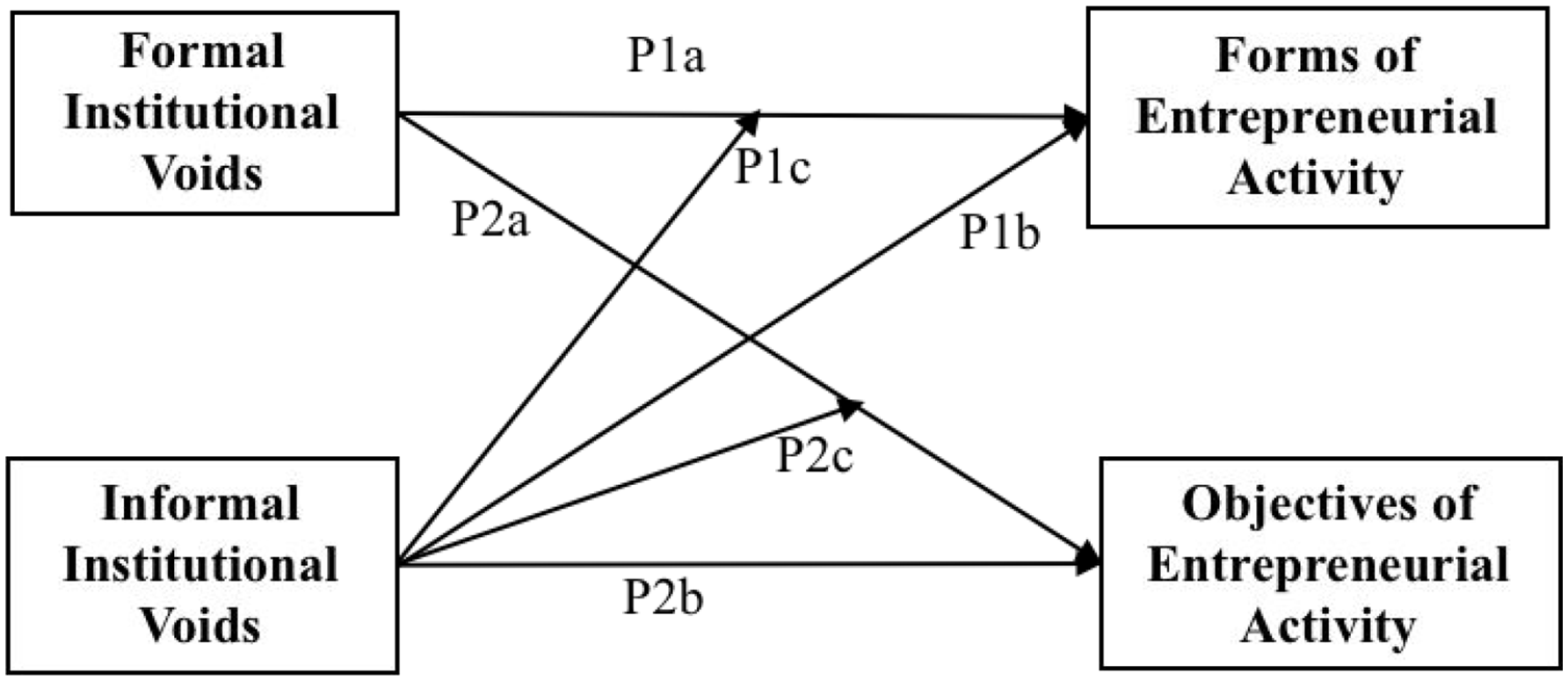
Proposed theoretical model and relationships.
Herein, we seek to make several contributions to theory. First, we conceptualize the notion of informal institutional voids, thereby expanding the explanatory value of institutional theory in the study of entrepreneurship. Through illustrating how informal institutional voids manifest within society, we provide a new organizing framework to explore how norms, values, and beliefs and their localized representations can guide facets of enterprise. While formal institutional voids have received more attention (Khanna & Palepu, 1997; Puffer et al., 2010), scholars have taken a more simplified view of informal institutions as serving as compensatory mechanisms for formal institutional voids (Peng & Khoury, 2008; Webb, Ireland, & Ketchen, 2014; Xin & Pearce, 1996). Building beyond this conceptualization, we aim to disentangle approaches to analyzing the interactive relationship between formal and informal institutions and how voids independently and jointly shape the form and objective of entrepreneurship in society. Lastly, our theory enriches the understanding of societal development challenges by informing the means by which the institutional context influences the productivity of entrepreneurship.
Theoretical Framework
The Formal and Informal Institutional Foundations of Societies
An economy is comprised of the system of institutions, organizations, and entrepreneurial activities that facilitate the dispersion of scarce resources, thereby providing for societal needs (Baumol & Blinder, 2008). Within the economy, institutions not only provide for a society’s most basic needs but also serve as the “humanly devised constraints [and incentives] that structure human interactions” (North, 1990, p. 33). Governed and facilitated by institutions, the private and nonprofit sectors provide products and services that attempt to address broader societal needs and desires not fulfilled by institutions alone. Similarly guided by institutions, entrepreneurs play a critical role in developing innovations that serve as more efficient and effective ways of allocating a society’s scarce resources (Schumpeter, 1942), thereby supporting economic development.
The influence of institutions on entrepreneurship has served as a catalyst for significant research. To more fully specify the influence of institutions, scholars distinguish between formal and informal institutions (North, 1990). Formal institutions—the formalized laws, rules, systems, and regulations that prescribe what is socially acceptable (North, 1990)—provide constraints and incentives to promote lawful behaviors, while also offering structure via a variety of supporting apparatuses, such as regulatory agencies, capital and labor markets, and key elements of infrastructure (e.g., communication, utilities, or transportation). When an important formal institution is limited or completely absent, this deficit undermines efficient transactions and operations, leaving formal institutional voids (Khanna & Palepu, 1997). When there is greater stability in and efficacy of formal institutions (Clemens & Cook, 1999), these institutions are better equipped to support entrepreneurial activity.
In less developed localities, formal institutional voids can take different forms. For instance, a lack of well-defined property rights can hinder entrepreneurs’ ability to appropriate value from their activities (Khoury, Cuervo-Cazurra, & Dau, 2014) and reduce their willingness to invest in productive assets; harsh bankruptcy laws may deter new entries (Lee, Peng, & Barney, 2007); and, minimal capital market options and investment sources can limit access to critical start-up and growth funds (Khoury, Junkunc, & Mingo, 2015). Formal institutional voids can also occur through the absence of developed infrastructure domains, such as those related to communication, transportation, and utility access (Khoury & Prasad, 2016). 4 Whether lacking or ill-enforced, such voids can hamper development by prohibitively increasing operational costs (Webb et al., 2010), and leading to the favoring of one population over another.
Although it has been convention among scholars to examine formal institutions at the national level, their robustness can differ within a country because of limited means to implement rules and significant variations in infrastructure across localities (Dhanani & Islam, 2002). Moreover, while typically studied in developing contexts, formal institutional voids also can exist in developed settings. For example, isolated rural areas in developed settings often do not have the same support infrastructure as do suburban and urban areas. And, technological advancements can outpace changes in regulatory frameworks (Roland, 2008), creating ambiguity regarding the types of behaviors and rules that are regarding as legitimate.
In contrast, informal institutions refer to a society’s norms, values, and beliefs and prescribe what is socially acceptable, or legitimate. Relative to formal institutions, they represent more tacit constraints on societies, through “codes of conduct, norms of behavior, and conventions” (North, 1990, p. 36). As manifested through a society’s behavioral codes, informal institutions ultimately guide expectations and ensure greater predictability in social exchanges, thereby shaping individuals’ and organizations’ choices and actions (North, 1990).
Scholars have generally suggested that informal institutions compensate for formal institutional voids (Peng & Khoury, 2008; Puffer et al., 2010; Webb et al., 2010). These scholars emphasize “inhabited institutions” (Hallett & Ventresca, 2006) in which traditions, norms, and the relational closeness between societal members establish general expectations among individuals about how to interact and transact in socially acceptable ways (Mair et al., 2012). In economic exchange, informal institutions serve to govern transactions among individuals within society, where informal institutions can manifest in supporting apparatuses (i.e., monitoring and enforcement groups, informal lending and insurance providers, resource-sharing arrangements) that both incentivize and constrain specific behaviors (Portes & Sensenbrenner, 1993).
In the following section, we conceptualize informal institutional voids to describe when informal institutions might not effectively compensate for formal institutional voids. Like formal institutions, informal institutions can likewise differ significantly across localities due to the limited transportation and communication infrastructures in some contexts (Webb et al., 2010). As localities have historically been isolated due to the lack of formal institutions, the norms, values, and beliefs within those localities have become differentiated in significantly meaningful ways, and despite formal institutional advancements in some cases, the durability of informal conventions persist over time (Roland, 2008). Given the often significant variance of formal and informal institutions within countries, we emphasize a subnational view going forward focused on the locality (i.e., a city, village, neighborhood, prefecture, or otherwise local geographic area).
Conceptualizing Informal Institutional Voids
In addition to formal institutional voids, a society’s institutional environment can also be characterized by informal institutional voids. In parallel with Khanna and Palepu’s (1997) notion of formal institutional voids, we define informal institutional voids as the inability of norms, values, and beliefs and their localized representations to facilitate stable, efficient, and effective transactions and enterprise processes that contribute to the development of productive markets. This conceptualization of informal institutional voids does not suggest an inherent lack of norms, values, and beliefs in the broader society. Rather, the concept refers to settings in which there is a lack, suppression, or limited manifestation of the specific informal institutions that can support efficient and effective market transactions at a level that fosters development progress.
Informal institutional voids can exist for a number of reasons. First, some societies uphold caste-, apartheid-, or patriarchal-based systems that exclude certain groups of individuals from participating in economic transactions or place them at severe market disadvantages (Bird & Shepherd, 2003). Referred to as social exclusion or marginalization, this informal institutional void stems from norms and beliefs in society that certain individuals, based on their gender, ethnicity, age, or other demographic attributes, lack the status to partake in market activities, own property, and/or participate in certain types of relational exchange (Khoury & Prasad, 2016). For example, women in a number of countries lack access to property ownership or rights and often are excluded from basic access to credit markets (Cleaver, 2005). Such voids create barriers for women to build personal financial security and negatively influences their ability and/or willingness to make investments to support a business (De Soto, 1989). Similarly, gender biases in many settings have pushed younger females into child labor to support family subsistence and further limit their progress by disallowing them access to education that provides the knowledge and capabilities to succeed in entrepreneurial activities (Abu-Ghaida & Klasen, 2004). Gender- and caste-based biases can also exclude or limit individuals from participating in more resource-rich networks (Silvey & Elmhirst, 2003). Even when marginalized groups are provided certain basic rights (i.e., some form of property ownership), they are often spatially isolated to resource-poor regions with undeveloped infrastructure (Aliber, 2003), obligated to prioritize other identity- or gender-defined roles before pursuing entrepreneurial interests (Kantor, 2009), or incur more significant costs when exercising their rights (i.e., female entrepreneurs facing higher interest rates on loans in the United States (Eddleston, Ladge, Mitteness, & Balachandra, 2016). Thus, the ability to access limited rights is constrained, and the social demands and obligations underpinned by societal norms act as an inhibitor to specific pursuits (Woolcock, 1998).
Informal institutional voids also can exist when a society’s beliefs allow elites (e.g., chiefs, neighborhood bosses, clan leaders) to leverage their recognized power and misallocate resources that satisfy their own personal utilities rather than supporting efforts that further local development (Platteau & Gaspart, 2003). Elites can “behave like ‘interface experts’ (Hilhorst, 2003) or ‘development brokers’ (Bierschenk, Chauveau, De Sadan, & Kossi, 2002), who are able to manipulate and exploit outside intervention (e.g., nongovernmental organizations, NGOs) as well as local expectations on their own behalf” (Bastiaensen, De Herdt, & D’Exelle, 2005). Similarly, because of their socially recognized status, elites may also be allowed to ignore other norms and expectations to the detriment of other individuals in the locality. For example, Schnegg and Linke (2015) describe sharing and sanctioning norms within a locality that prescribe a small maintenance fee when pumping water from a community well. They suggest that elites’ refusal to pay the fees is begrudged and yet accepted because attempting to collect payment would be inappropriate, according to societal status beliefs. Thus, voids can occur when actors are disadvantaged in their access to resources and markets compared to influential elites.
Informal institutions are shaped by prescriptive behaviors influenced by various domains, including religion, family, tradition, and markets, among other domains (Thornton, Ribeiro-Soriano, & Urbano, 2011), where a third form of informal institutional void manifests when norms, values, and beliefs enforce resistant and constraining rules as to how accessible resources can or should be leveraged within society. Because belief systems can be deeply rooted within social conventions, myths, and symbolic meanings that are inconsistent with established facts and scientific knowledge (Calero, Bedi, & Sparrow, 2009), new or foreign approaches on how resources can be utilized can face strong resistance within both developed and developing communities based on the dominance of other guiding logics, such as those drawn from religion and family influence. Accordingly, technological advancements in various areas of society (i.e., climate science, transportation, and medicine) that are expected to yield significant development gains can be met with varied levels of institutionally derived skepticism (Banerjee, Banerjee, & Duflo, 2011). Thus, informal institutional voids can occur when norms, values, or beliefs guide actors to undertake practices that deliberately favor ineffective uses of resources that, over time, can erode the enterprise options available for development progress.
A fourth form of informal institutional void is the relationship barrier that occurs due to a lack of trust in society (De Soto, 2006; Fukuyama, 1995). Voids caused by the lack of trust can occur for different reasons. For instance, cases of corruption in various facets of society can breed mistrust in transacting or dealing with specific actors (DiRienzo, Das, Cort, & Burbridge, 2007). Similarly, significant barriers can occur due to a lack of trust in working with outsiders (i.e., out-group members of a clan) or the inability to vet out-group members on whether it is safe to engage, given levels of violence or opportunism within and across localities (De Soto, 2006; Sutter, Webb, Kistruck, & Bailey, 2013). Ultimately, these informal institutional voids arising from trust barriers deter economic activity by undermining the value and potential for cooperation and social cohesion. Lack of trust not only prompts the need to construct costlier safeguards and contracts and more rigorous monitoring (Collewaert, Filatotchev, & Khoury, 2018) but also limits investment size and willingness to invest in operations, undermining development progress (Khoury et al., 2015).
A final form of informal institutional void occurs when informal institutions manifest in coordinative mechanisms that fail to support efficient market transactions. Generally localized, these mechanisms include informal lending and insurance, monitoring and enforcement apparatuses, and other resource-sharing arrangements. While having the capacity to support market transactions and operations under specific conditions, these informal mechanisms can be characterized by voids in at least two ways. First, social obligations can arise in which individuals who benefit from the local coordinative mechanism are then committed to the local community, precluding the individuals from taking advantage of opportunities outside of the locality (Portes & Sensenbrenner, 1993; Woolcock, 1998). Second, as informal mechanisms are dependent on in-person access to other transacting parties, market failures can occur when local infrastructure is ill-equipped to handle harsh events, such as war, health epidemics, or natural disasters. Carter and Maluccio (2003) describe how informal insurance can assist development by mitigating isolated individual hardships (e.g., child illness, death in a family, or a prior failed business); however, when tragic events with broader societal repercussions occur, such arrangements are overwhelmed and collapse, leaving localities in a vulnerable state. Overall, informal institutional mechanisms impede the ability for local entrepreneurs to re-establish themselves and fail to provide the foundation needed to support development progress.
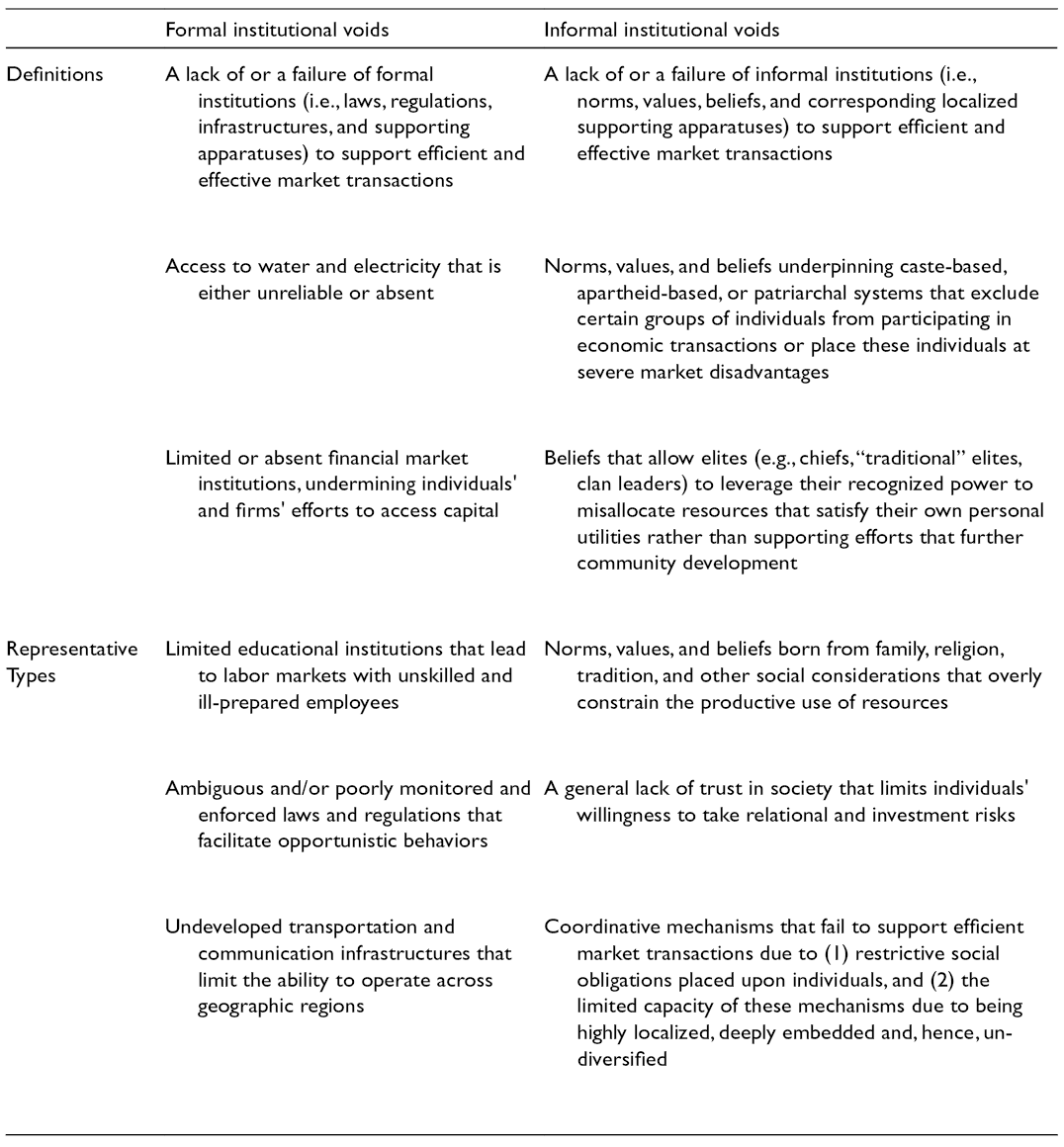
To summarize these various elements, Table 1 delineates the definitions and representative types of formal and informal institutional voids. Our discussion of the different types of informal institutional voids seeks to provide a set of tangible illustrations for operationalization, although other variations and combinations exist. In the following sections, we examine how the direct effects and interplay between institutions—specifically, the severity of formal and informal institutional voids—affect the relative forms and objectives of productive entrepreneurial activity in society.
Definitions and Representative Types of Formal and Informal Institutional Voids.
Hypotheses
Institutional Voids and Relative Forms of Productive Entrepreneurial Activity
Scholars have studied how the quantity of entrepreneurial activities within a society is tied to its economic development (Stenholm, Acs, & Wuebker, 2013). In recognizing that many developing economies are shown to have higher levels of entrepreneurial activity and yet continue to lag in development progress (Bosma & Levie, 2010), there is great relevance in Baumol’s (1996) view that the quantity of entrepreneurial activities within a society may remain stable over time, but the more important development-related concern is the extent to which a society’s institutional context shapes the productive character of such entrepreneurial activities.
One way in which the productivity of entrepreneurial activities can be differentiated is the extent to which they are legal and legitimate (i.e., socially acceptable in terms of the society’s formal and informal institutions, respectively (Webb et al., 2009). As the primary focus of most entrepreneurship research, formal entrepreneurship is represented by pursuits that abide by prescriptions of legality and legitimacy. While the societal impact of formal entrepreneurship varies depending on the relative productivity achieved by such activity, formal entrepreneurship creates value for society through job creation and quality of life improvements. Moreover, formal entrepreneurs, in concept, are considered compliant with various regulations (i.e., tax, environmental, labor practices), and conceivably, create relatively less negative externalities, while generating revenues to contribute to society’s broader economic development.
In contrast, the informal form of entrepreneurship refers to entrepreneurial activities that are illegal yet remain legitimate to large groups in a society (Godfrey, 2011; Portes & Haller, 2005; Webb et al., 2009). Such informal entrepreneurial activities can involve illegal processes to manufacture legal (and legitimate) products, such as providing socially acceptable products or services, while skirting tax obligations (Alford & Feige, 1989), registration and licenses requirements (De Soto, 1989) and/or labor laws (Portes, 1994), environmental pollution (Blackman, 2000), or other regulations (Liedholm, 1994). Importantly then, informality can be viewed along a continuum accounting for a variety of societal outcomes (Williams & Nadin, 2010).
To shed light on the continuum, we adopt the assumption that individuals face occupation pursuits that vary according to real and perceived gains and losses and with financial and social tradeoffs. Beyond the notion of occupational preferences where some individuals seek autonomy and flexibility (i.e., per entrepreneurial pursuits) and others seek the stability and compensation afforded by formal employment options, many contexts lack adequate formal employment options or the ability to pursue formal entrepreneurial routes. Thus, individuals can be pushed towards less productive forms of entrepreneurship, especially in localities with more pervasive levels and forms of informal pursuits. Operating in the informal economy increases in prevalence when the perception of reasonable and acceptable gains can be attained from pursuits in these market domains and when the legal risks and their corresponding penalties can be safely skirted.
Informal entrepreneurship includes activities that are arguably less productive and even unproductive in some cases, given their countervailing effects on society. Proponents of the informal economy highlight its potential impact on individuals who are excluded from jobs within the formal economy through its access to economic benefits (De Soto, 1989). Informal entrepreneurship also can provide products to markets underserved by the formal economy. And, subcontracting relationships between informal and formal actors allows the formal actors to gain efficiencies (Coletto, 2010). In contrast, counter-productive attributes of informal activities include the loss of tax revenues (Alford & Feige, 1989), environmental, health-related, and other social risks due to noncompliance with regulations (Blackman, 2000), and unfair competition with formal firms (Kettles, 2007). Pursuits in the informal economy can be viewed somewhat positively in that, despite their inferior capacity to be productive to society, they create a buffer that engages individuals who are otherwise disenfranchised from the formal economy.
Finally, some individuals can pursue opportunities that are both illegal and illegitimate, including more organized informal pursuits (i.e., gambling structures and offshore financial centers) and further into the selling of illegal products (i.e., narcotics and weapons trade) or fraudulent investment schemes (Calavita & Pontell, 1993; Webb et al., 2009). These activities primarily, or only, provide benefits to those leading and can be highly destructive to society (Baumol, 1990). Representing the extreme of informality, this entrepreneurial form has deleterious effects on development, especially in localities where illegitimate power structures have taken root and increased its degree of pervasiveness (Sutter et al., 2013). 5 Baumol’s (1996) view provides a clarifying perspective with the proposal that governments are not inherently powerless but have policy levers that can be leveraged to assert their formal institutions towards reducing these activities.
Formal institutions create systems of incentives and constraints that shape the proportion of formal, versus informal, activities within a society (Baumol, 1990; Portes & Haller, 2005). Beyond avoiding the various penalties from being identified as operating an informal or criminal enterprise (North, 1990), compliance with formal institutions enables formal entrepreneurs to access resources, such as operating more openly, securing a broader choice of contracts, using property rights enforcement when disputes arise, and accessing formal capital and labor markets.
Despite the significant benefits that are available in the formal economy, entrepreneurs may opt towards informality for a number of reasons. First, formality often necessitates additional operating costs, such as taxes, licenses and fees, the time and effort needed to satisfy various governmental agencies’ requirements, and compliance with regulations (e.g., minimum wage laws and environmental policies (Webb, Bruton, Tihanyi, & Ireland, 2013). Opportunistic entrepreneurs might perceive the potential to avoid these costs to enable competitive advantage over formal entrepreneurs. In other cases, entrepreneurs might view compliance as overly burdensome. For example, taxes support formal institutions in allocating resources within society, and yet entrepreneurs might rationalize the resource distributions as not equitably addressing their own personal needs. Formal institutional laws mandate licenses and certifications to ensure quality standards within industries. In doing so, however, they may, inadvertently or intentionally, protect inefficient business models since overly burdensome licensing requirements and/or quotas can impose entry barriers upon more efficient and effective ventures (De Soto, 1989). Finally, infrastructure investments in one institutional domain (e.g., financial institutions) might occur, yet there is still a need to improve other basic parts of the infrastructure (e.g., utilities or transportation), thus producing limited benefits (Estrin & Mickiewicz, 2012).
Formal institutional voids such as weak monitoring and enforcement infrastructures might also exist. For instance, in many developing settings, feasible capabilities for monitoring and enforcement lack sufficient investment (Khoury et al., 2014), police are underpaid or corrupt (Fadahunsi & Rosa, 2002), and agencies to support tax collection are understaffed (Aron, 2003). These conditions undermine the ability to control informal and criminal enterprise activities (Safavian, Graham, & Gonzalez-Vega, 2001). In addition, enforcement agents may disagree with the formal institutional guidelines they are tasked to uphold (Webb et al., 2009) or empathize with the plight of disadvantaged entrepreneurs (Cross, 1998), undermining their motivation to enforce formal institutions’ prescriptions. Such voids then enable the acceptability of pursuing entrepreneurship outside the formal economy (Fadahunsi & Rosa, 2002).
In sum, formal institutions can establish incentives for entrepreneurs to operate in the formal economy and place constraints on activities outside the formal economy (Pearce, Dibble, & Klein, 2009). In societies characterized by more severe formal institutional voids, entrepreneurs can incur relatively high costs in gaining formal status but receive minimal benefits in return; and given minimal constraints imposed on pursuing more informal activities, entrepreneurs can create value for themselves with relatively less risk. Thus, we hypothesize: 6
Contrasted with formal institutions, informal institutions are less codified, are more localized, and more resilient to change (Roland, 2008). Despite their tacit nature, the localization of informal institutions often enables closer monitoring, more responsive enforcement against rule violations, and appropriate incentives for socially desirable behaviors (North, 1990). By establishing expectations for socially acceptable economic transactions and constructing mechanisms to incentivize and ensure compliance, ideally, informal institutions provide a framework upon which entrepreneurs can reasonably depend. With more robust informal institutions, acts of opportunism are more commonly deterred, and resources—particularly, social networks—can be leveraged with greater ease (Batjargal & Liu, 2004).
In contrast, contexts characterized by informal institutional voids provide less local support and operational transparency for entrepreneurs, such that they are likely to search for alternative frameworks to govern contracts and facilitate their transactions. Formal institutions can provide an alternative framework, leading entrepreneurs to favor complying with legal mandates. For example, in multicultural localities, the local diversity may undermine a consistent informal institution that can support economic activities (Pessar, 1995). While diversity in norms, values, and beliefs can support entrepreneurship, empirical findings find that diversity within society can actually undermine entrepreneurship if the informal institutions do not also support cooperation and communication across the diverse groups (Lee, Florida, & Acs, 2004; Light & Dana, 2013). Instead of pluralism, such diverse contexts become characterized by fractionalization that undermines entrepreneurial activity (Mickiewicz, Hart, Nyakudya, & Theodorakopoulos, 2017). Broader formal institutions can provide a guiding framework that satisfactorily accommodates the diversity of needs and provides a standard to resolve conflicts that can arise across the diverse groups within a locality (Pettigrew, 1998). Alternatively, the lack of robust informal institutions and the fractionalization that can occur might enable alternative, illegitimate power structures to manifest that can circumvent (and in some localities even overpower) formal institutions, allowing more destructive forms of entrepreneurship to proliferate. In sum, we propose:
Robust, formal institutions provide broad, overarching frameworks underpinned by independent authorities that enable efficiency and effectiveness and treat diverse individuals fairly within and across localities. In contrast, robust informal institutions provide more localized benefits that may not engender equal treatment for the set of diverse actors, but offer additional sources of efficiency and effectiveness to specific individuals who can leverage the informal institutions. No society is characterized by perfectly robust formal and informal institutions; even well-developed economies are characterized by some level of institutional voids. Moreover, entrepreneurs are strategic in how they leverage their institutional contexts (Khoury & Prasad, 2016). As such, entrepreneurs engage their institutional contexts in ways that allow them to maximize their perceived advantages while minimizing potential disadvantages. In some cases, individuals might favor the breadth of and authority embodied in formal institutions (e.g., in first-time transactions with other actors; when expanding across greater distances). In other cases, informal institutions might afford the localized benefits that lead individuals to favor this framework, such as when trying to differentiate the venture’s products or when attempting to gain access to specific resources. When adequate frameworks exist, entrepreneurs can feasibly leverage them towards desired outcomes; however, when adequate frameworks do not exist, entrepreneurs will search for ways to construct alternative means (Webb & Ireland, 2015).
We expect the degree to which formal and informal institutions are characterized by voids to have an interactive effect on the proportion of various forms of entrepreneurship within a society. With minimal voids, formal institutions provide a “default setting,” enabling entrepreneurs to form and engage in new relationships, undertake investments, and otherwise assume risks. Individuals incur substantial costs (i.e., taxes, license fees, and compliance costs) associated with formal institutions engendering an expectation among individuals that the authority vested in formal institutions will support and protect their activities. As such, contexts characterized by minimal formal institutional voids will have higher proportions of formal entrepreneurship when compared to contexts characterized by more formal institutional voids since entrepreneurs seek to gain the benefits available through more robust formal institutions.
While robust formal institutions provide entrepreneurs with equitable treatment, greater efficiencies, and effectiveness within and across localities, robust informal institutions provide supporting benefits, allowing a greater variety of entrepreneurial actors to approach resources necessary for their pursuits. Because informal institutions are more locally embedded, entrepreneurs can gain additional benefits that are not always available via formal (i.e., state-level) institutions. Certainly, formal and informal institutions can be congruent in their guidance of activities; however, formal and informal institutions can also establish different sets of social expectations (Webb et al., 2009). Therefore, robust informal institutions can reemphasize the value of formal entrepreneurship but also leave market spaces for a small proportion of entrepreneurs to engage in informal entrepreneurship. Accordingly, market spaces for informal entrepreneurship open up from more minimal proportions when informal institutional voids are more severe.
In contexts of formal institutional voids, formal institutions are less of a default for entrepreneurs as the costs associated with formalization do not provide commensurate benefits. Robust informal institutions can operate as a compensatory mechanism when there are formal institutional voids (Peng & Khoury, 2008). While lacking the fiat of formal governance mechanisms to safeguard transactions, relying on informal institutions might be the only viable alternative in contexts with formal institutional voids. Robust informal institutions can still provide access to critical resources, establish expectations for transactions, and ensure monitoring and enforcement of local activities (Portes & Sensenbrenner, 1993) to where deviants are ostracized and/or face community sanctions (Nee & Opper, 2012). Therefore, when informal institutional arrangements serve as viable substitutes for formal institutions when voids exist, individuals may have incentives to pursue informal versus formal entrepreneurship.
Finally, we consider contexts characterized by both formal and informal institutional voids. Informal institutional voids undermine the extent to which informal institutions can complement or substitute for formal institutions. When formal and informal institutional voids exist concurrently, societies lack the social cohesion and normative guides necessary to structure stable entrepreneurial activity (Khoury & Prasad, 2016). Instead, entrepreneurs are left with limited options to gain access to available market spaces, lack guidance on legitimate operational structures and other venture decisions, and face increased exposure to exploitation and misappropriation. In short, entrepreneurs are likely to perceive less gains and greater potential losses via formal or informal forms of entrepreneurial enterprise. When the severity of voids in both formal and informal institutions is high, a greater proportion of destructive forms of entrepreneurship is likely to exist, given individuals’ needs to subsist within an overarching system that does not deter or dissuade individuals’ pursuit of such opportunistic activities. In summarizing these arguments, we hypothesize:
Institutional Voids and Entrepreneurship Objectives
Entrepreneurial activities can also be differentiated based on the objectives of prospective entrepreneurs. We draw from prior work on entrepreneurs’ objectives and present three realistic representations of objectives on a continuum to qualitatively illustrate our theory of voids. For example, some entrepreneurs are oriented towards growth objectives as they seek to develop more scalable ventures (Wiklund & Shepherd, 2003). Growth-oriented entrepreneurship can lead to productive benefits across broader geographic and product markets, thereby creating significant value in yielding higher employment and delivering innovative solutions to more customers. Given their ventures’ potential for economic impact within and across localities, the objectives of growth-oriented entrepreneurs can be considered highly productive to development (Schumpeter, 1942).
Lifestyle-oriented entrepreneurs seek to secure lifestyle benefits, such as pursuing hobbies or having personal autonomy (Henricks, 2002; Marcketti, Niehm, & Fuloria, 2006). Lifestyle entrepreneurs can manage productive ventures by providing skilled and/or somewhat innovative solutions, although productivity outcomes towards development progress are often lower on average as these entrepreneurs favor a scope of acceptable achievement that offers more personal benefits, such as a comfortable living wage, over higher-aspiration market growth. To the extent that the importance of lifestyle benefits to entrepreneurs outweigh the provision of market benefits, this entrepreneurship objective can become less productive towards development progress since it typically contributes societal benefits that are generally smaller and/or more concentrated in their geographical market scope. Accordingly, lifestyle entrepreneurship can be viewed as being less productive to development when compared to growth-oriented objectives.
At a more basic level of objective, subsistence-oriented entrepreneurship refers to those entrepreneurial activities that are undertaken given individuals’ objectives to meet their daily survival needs (Sharif, 1986). In many impoverished localities, a lack of formal employment options or value for their skill sets lead individuals to pursue subsistence objectives (Sharif, 1986). As such, subsistence-oriented entrepreneurship does not necessarily stem from the inherent desire to pursue such activity but is based on individuals’ requirements to satisfy basic needs for themselves and their families. Entrepreneurs pursuing subsistence objectives might engage in more routine tasks (i.e., cleaning, making repairs) or re-selling common items. Such pursuits often require less skill and are easily imitated, but can also be unstable given the challenges to grow ventures beyond their initial size (Mead & Liedholm, 1998) and their overall susceptibility to environmental shocks (Hulme & Shepherd, 2003). By only satisfying individuals’ basic needs, subsistence entrepreneurship is generally considered less productive or even unproductive (Mandelman & Montes-Rojas, 2009).
Formal institutions can influence the relative proportions of growth- versus lifestyle- versus subsistence-oriented entrepreneurial activities within a society. In contexts of robust formal institutions, monitoring and enforcement apparatuses, capital markets, and property rights increase the operational and transactional efficiency for ventures and also produce clear expectations throughout the broader society. More specifically, as is the case in these contexts, the expectations derived (and concomitant efficiencies afforded) from formal institutions within one locality of a country are more commonly consistent with expectations within other localities. Establishing consistent expectations across localities, formal institutions engender entrepreneurs’ confidence that opportunities are accessible and a trajectory towards productive economic development via growth-based ventures is viable (Estrin, Korosteleva, & Mickiewicz, 2013).
In comparison, contexts with formal institutional voids are characterized by significant operational and transactional inefficiencies (Webb et al., 2010), increasing uncertainty for entrepreneurs (Khoury et al., 2015). In essence, the responsibility for creating the necessary operational and transactional infrastructure to facilitate and govern venture activities shifts from the government to individual entrepreneurs in contexts of formal institutional voids. Given the substantial costs associated with privately building infrastructure, especially beyond the immediate locality, growth-oriented entrepreneurs would incur substantial costs and bear the associated potential for losses needed to support their objectives. Given individuals’ heightened concerns related to potential losses (Kistruck, Webb, Sutter, & Ireland, 2011), entrepreneurs’ willingness to undertake major efforts to grow their ventures are greatly reduced amid contexts with formal institutional voids.
Instead, entrepreneurs are more apt to pursue lifestyle-oriented activities that require lower resource investments, are more labor intensive, and are more localized to ensure transactional security. When formal institutional voids are more severe, entrepreneurs face even greater transactional and operational costs in their ventures. Such voids create an environment that can shift both the tolerance for and pervasiveness of objectives towards subsistence-oriented entrepreneurship. Overall then, the high levels of uncertainty and risk inherent in contexts with more severe formal institutional voids create environments that lack incentives for entrepreneurs to pursue growth objectives and instead engender lifestyle and subsistence objectives. In summary, we propose:
We also expect the severity of informal institutional voids to influence entrepreneurs’ objectives. In particular, given the localization of informal institutions, lifestyle objectives of entrepreneurship increase with more robust informal institutions, yet subsistence-based activities become increasingly prevalent in contexts characterized by informal institutional voids. To elaborate, supporting apparatuses, such as informal lending and insurance mechanisms and inter-household transfers of resources, are often embedded within specific localities. Similarly, entrepreneurs can sometimes draw upon informal institution-construed communal property rights (Ostrom, 2015), which allows them access to water in rivers and to local forests to gather wood resources (Lastarria-Cornhiel, 1997). Such informal institutions can facilitate access to resources needed to support the more localized ventures of entrepreneurs who have lifestyle objectives. Conceivably, entrepreneurs with growth objectives can leverage the informal mechanisms within each new locality entered to regularly access new resource stocks and maintain continuous growth. However, these mechanisms are generally premised on their degree of embeddedness within a locality, such as through occupying residence and/or beholding trust within the locality so that the entrepreneurs’ activities can be easily monitored (Hermes, Lensink, & Mehrteab, 2005). Thus, while not providing the breadth across markets or level of resources to support growth objectives, robust informal institutions enable entrepreneurs to access lower, yet adequate levels of resources to support lifestyle entrepreneurship.
With more severe informal institutional voids, the objectives of prospective entrepreneurs can more easily drift from an orientation that is lifestyle-based to one that is more subsistence based. Severe informal institutional voids, such as limited trust based on widespread violence or extreme power differentials (De Soto, 2006), undermine the predictability of transactions and instead promote smaller, more frequent, less efficient, face-to-face modes of transacting. Entrepreneurs have to work longer hours and constantly struggle to amass any meaningful savings (Liedholm, 1994). Likewise, such contexts can lead entrepreneurs to take on operational structures based on more excessive, and perhaps unnecessary, labor intensity, while also reducing their willingness or feasibility to invest in more productive assets (Webb, Pryor, & Kellermanns, 2015). The fear of potential losses that could force entrepreneurs into chronic poverty (Hulme & Shepherd, 2003) leads those within environments having severe informal institutional voids to favor more immediate, albeit minimal, returns via more basic pursuits (i.e., towards subsistence) versus higher-risk contracts that could potentially offer greater returns (Kistruck et al., 2011). Finally, when informal institutional voids are presented through harsh discriminatory features in society, they undermine individuals’ ability to access resources and markets and compromise their ability to engage in efficient transactions and operations, such that even the pursuit of lifestyle objectives can face insurmountable challenges (Khoury & Prasad, 2016). For example, gender bias marginalizes the position of women, leaving them with little access to resource networks or valuable physical property; in turn, this constrains their objectives towards more subsistence-based entrepreneurship (Agarwal, 1994). Thus, we hypothesize:
We expect an interactive effect of formal and informal institutional voids on entrepreneurs’ objectives. When both formal and informal institutions are robust, entrepreneurs have complementary frameworks to guide and inform their activities, from which to gain resources, and to help resolve conflicts. In doing so, formal and informal institutions resolve various problems that lead to uncertainty for entrepreneurs and spread the risks related to their venture activities. Robust formal institutions generally establish social expectations across localities and, hence, can offer a more significant and reliable resource base to support entrepreneurs’ activities. Robust informal institutions enable entrepreneurs to derive sources of differentiation and gain access to specific, idiosyncratic resources. Together then, robust formal and informal institutions offer enhanced support to entrepreneurs with growth objectives.
In contrast, contexts characterized by robust formal institutions with informal institutional voids are likely better able to nurture lifestyle-based entrepreneurship. Informal institutional voids can undermine entrepreneurs’ opportunity recognition given that overly insular localities exclude external ideas, which can undermine innovativeness (Karnani, 2007; Light & Dana, 2013). Likewise, to the extent that informal institutions are too insular, the source of differentiation derived by entrepreneurs might not carry the same value across localities, and the growth-related efforts by entrepreneurs might then be undermined as they lack the knowledge to span across different norms, values, and beliefs systems (Webb et al., 2010). Therefore, while robust formal institutions might still support growth-oriented entrepreneurship to a degree, an increased proportion of lifestyle objectives will likely surface when informal institutional voids are concurrently present.
In contexts with formal institutional voids, informal institutions serve in an important compensatory role. In such cases, informal institutions can have a stronger influence on lifestyle-oriented entrepreneurs, who draw upon fewer resources and generally remain embedded within their locality, versus growth-oriented entrepreneurs who undertake more resource-intensive operations to grow beyond local markets and transcend beyond localized institutional constraints. To the extent that transportation and media-access infrastructures are undeveloped through the presence of formal institutional voids, localities become more isolated from outside influences and instead are defined by more provincial and steadfast norms, values, and beliefs (Karnani, 2007). This relative isolation caused by formal institutional voids reinforces attitudes of wariness towards entities and influences from outside the immediate locality (Kistruck et al., 2011), and places emphasis on maintaining provincial norms that limit entrepreneurs’ potential scope. In essence, informal institutions struggle to operate as a functionally equivalent substitute for formal institutions. Thus, the compensatory role of informal institutions is likely to provide enough environmental stability and individual mobility to pursue lifestyle objectives but fall short of providing the support needed to pursue growth objectives.
In contexts characterized by formal and informal institutional voids, entrepreneurs are often forced to engage in subsistence activities in order to satisfy basic needs. Formal institutional voids present significant transactional and operational inefficiencies, given the lack of a powerful authority to establish expectations and govern fairly. Informal institutional voids exacerbate the challenges introduced by formal institutional voids. For example, when informal institutional voids related to gender-, caste-, or apartheid-based biases preclude individuals from accessing necessary resources and markets (Khoury & Prasad, 2016), the basic means necessary to initiate a venture, let alone further develop it, are simply not available. When accounting for the formal (legal) institutions, marginalized individuals might have the right to access land according to property rights law but, in reality, are restricted to infertile land or areas far-removed from vital marketplaces and infrastructure (Lastarria-Cornhiel, 1997). Given difficulties in accessing potential markets and resources, entrepreneurs within marginalized groups often must seek low-skill, service-oriented work to meet their daily subsistence needs (Blackman, 2000; Glenn, 1992; Ward & Kamsteeg, 2006). In summarizing our logic, we propose the following:
Discussion
When adopting a focus on the locality, various development challenges exist across both developed and developing societies. Herein, we attempt to provide a theoretical framework that offers an understanding how the productivity of entrepreneurship is influenced by the robustness of formal and informal institutions. In particular, we provide a detailed conceptualization of informal institutional voids and then theoretically examine the direct and interactive relationships of formal and informal institutions on the productive capability of entrepreneurial activities. Going beyond the more economic conventions that stress sheer levels of entrepreneurial activity, we instead position our work to address productivity in terms of entrepreneurial form and objectives. With this distinction, we provide a framework that informs the expectations and feasibility for economic and social progress to occur within localities through presenting a macro-theoretical account of institutional voids and their role in shaping entrepreneurship-based contributions to development. We thus contribute to the study of entrepreneurship through an institutional lens in at least three key ways.
In terms of the capacity of institutions to facilitate stable, efficient and effective market transactions and enterprise, extant research has largely emphasized the effect of formal institutional voids (Khanna & Palepu, 1997; Webb et al., 2010). Scholars typically discuss informal institutions conceptually as “safety nets” in their ability to substitute for formal institutional voids (Peng & Khoury, 2008; Puffer et al., 2010; Xin & Pearce, 1996). However, the concept of informal institutional voids helps us better understand contexts in which informal institutions might not effectively substitute for formal institutional voids. Whether due to societal barriers based on exclusion, low levels of trust, social hierarchy, beliefs in elitism, restrictive social obligations placed upon individuals, or the limited capacity of localized relational mechanisms, embedded informal institutional voids produce challenges to entrepreneurship that, in turn, hinder development progress. Through conceptualizing how and where informal institutional voids can manifest in society, we delineate the various means to account for and operationalize dimensions of the informal institution environment.
Our proposed framework informs a more holistic understanding of institutional effects by elaborating on the interactive influence that both formal and informal institutions have on the nature of entrepreneurial activities. Thus, a more in-depth examination of the interplay between formal and informal institutions represents an important contribution. Depending on the severity of both formal and informal institutional voids, the resultant prospects for economic development is determined by institutional scenarios that yield mutualistic (e.g., low severity in both formal and informal voids), substituting (e.g., when either formal or informal voids are severe but not the other), or exacerbating (e.g., when both formal and informal voids are severe) interactions between both institutional domains. The recognition of informal institutions’ influence on entrepreneurship begets a deeper understanding of the multifaceted outcomes of both formal and informal institutions, as well as how informal institutions conditionally influence the effects of formal institutions (Lee & Hung, 2014).
Finally, in building on previous calls for richer analysis of entrepreneurship at the societal level (Davidsson, 2016), we go beyond the premise that activity matters to provide a more fine-grained examination of the qualitative character of entrepreneurship. While the institutional environments in many societies often produce higher levels of entrepreneurial activity (Bosma & Levie, 2010), this activity does not necessarily translate into economic development because of the productivity of entrepreneurship occurring in many of these contexts. Herein, we qualify productivity based on the form and objectives of such entrepreneurial pursuits.
Extending Baumol’s (1990) recognition that entrepreneurship can carry a substantial weight in shaping societal development, we bring light to the qualitative character of entrepreneurship and account for the development paths influenced by institutional voids along a continuum that spans from productive to destructive influence. Although we respect the reasoning for previous scholars’ recommendations regarding theories of entrepreneurship to advance the understanding of productive entrepreneurship (e.g., Davidsson, 2016), we advocate that future scholarship aspire for a deeper understanding of the modern, and often less ideal, realities posed by various interacting formal and informal institutions. As scholars of entrepreneurship, we have to tackle the less recognized idea that entrepreneurial pursuits can vary greatly in their productive contributions to development.
Beyond the fact that representations of entrepreneurship in the informal form can occur in meaningful proportions throughout the developed and developing world (Williams & Nadin, 2010), their presence sheds light on the manifestation of what might also be considered characteristic attributes for eminent or future entrepreneurial potential. Thus, we contend that it is important to understand how institutions influence a spectrum of entrepreneurial implementations. Taking these ideas further, future research may consider reconciling the structural, versus more agentic, prompts of unproductive forms of entrepreneurship to account for pursuits motivated by individual hubris or greed (Haynes, Hitt, & Campbell, 2015). Taking the structural perspective, our research points to a significant peril for policymaking that prioritizes the improvement of formal institutions without an understanding of how informal institutional voids can continue to limit the realization of benefits that can be gained from formal institutional reforms. Thus, scholars might consider alternative typologies of productivity (e.g., innovation versus imitation versus piracy) to inform how entrepreneurship influences economic development.
Although our focus is on entrepreneurial actors, future work can account for the repercussions of institutions when multinationals are heavily tied into localities. For instance, do voids, such as government corruption, that limit productive entrepreneurship simultaneously enable unproductive multinational activity (i.e., large-scale natural resource extraction or worker rights exploitation)? Thus, we hope our proposals can extend beyond entrepreneurship-related inquiry to address calls for more work at the business-society interface (Davidsson, 2016).
Research Implications
Scholars interested in empirically investigating informal institutional voids may benefit from the propositions developed herein. Indeed, our theory accounts for the macro institutional environment, yet the individual levers that comprise the environment can be studied at more fine-grained levels of analysis because the nature and scope of how these voids manifest are context-specific and depend on various historical social, economic, and political conditions. For example, the codification of laws and regulations in some contexts are intentionally ambiguous, raising questions as to why and how entrepreneurs navigate ambiguous, versus more clearly defined and transparent, contexts (Lee & Hung, 2014).
Because both formal and informal institutions can be accounted for at localized levels, the isolated and interactive effects of both formal and informal institutional voids affect the characteristics of entrepreneurial activity. Thus, we contend that the predictive value of our theory can be applied at broader levels of analysis (e.g., the country-level) as long as there is consistency in the characteristics of how institutions operate across all localities. However, we caution that if the institutional environments of some local settings are evaluated at the country level, some flawed assumptions might occur in how representative information is aggregated across localities.
Although we encourage the application of anthropological methodologies to study informal institutions, such as ethnographic approaches (Van Maanen, 1988), these methods often pose access challenges for researchers. Alternatively, social network analysis could shed much needed light on the early stages of entrepreneurial pursuit (Batjargal & Liu, 2004), and in particular on how entrepreneur networks form within societies characterized by institutional voids. Further, for creative inspiration in research design, we also encourage scholars to draw upon a broader scope of disciplines and methodologies to examine institutions.
Conclusion
Motivated by the intent to understand development challenges, we expand institutional theory to examine how formal and informal institutions directly and, through interaction with one another, indirectly influence the kinds of entrepreneurial activity within society. Our framework moves beyond the predominant notion that activity is deterred by formal institutions to present a theory of formal and informal institutional voids that qualitatively accounts for the yield of different entrepreneurial pursuits. Based on this foundation, we present how the institutional voids, both formal and informal, of a society affect the form and objectives of entrepreneurial activities. With this work, we seek to provide a fresh perspective on how the development potential of societies can be understood and to bring a realistic light to the feasible prospects for more productive entrepreneurship to occur in areas facing ongoing social and economic hardships.
Footnotes
Acknowledgments
We thank the following scholars for their comments and feedback at an earlier stage of developing this manuscript: Paul Godfrey, Isabelle Le Breton-Miller, Valentina Marano, Ajnesh Prasad, Neil Ramiller, Yuliya Shymko, Sully Taylor, Pam Tierney, and participants present during its presentation at the Southern Management Association meeting in November 2013 and presentations given at Vlerick Business School and the University of Minho in February 2018.
Declaration of Conflicting Interests
The author(s) declared no potential conflicts of interest with respect to the research, authorship, and/or publication of this article.
Funding
The author(s) received no financial support for the research, authorship, and/or publication of this article.
Notes

Author Biographies