



Abstract
Despite mounting interest in growth mindset interventions, this approach has yet to be applied to the domain of entrepreneurship. In the present research, we developed and tested if a growth mindset intervention could be leveraged to promote students’ entrepreneurial self-efficacy and if this, in turn, predicted career development (i.e., academic interest, career interest, task persistence, and academic performance). We report on our findings, from an Open Science Framework (OSF) preregistered study, that is a randomized controlled trial implementing a growth mindset intervention. We randomly assigned undergraduate students (N = 238) in an introduction to entrepreneurship class to either the growth mindset intervention or to a knowledge-based attention-matched control. Students in the growth mindset intervention, relative to the control, reported greater entrepreneurial self-efficacy and task persistence on their main class project. The intervention also indirectly improved academic and career interest via entrepreneurial self-efficacy. However, the intervention failed to directly or indirectly impact performance on a classroom assignment. Additionally, and somewhat surprisingly, gender and past experience in the field failed to moderate any effects of the intervention on outcomes. Theoretical implications, limitations, and future directions are discussed.
Introduction
We need empirically-based and theoretically-driven solutions in entrepreneurship education to enhance students’ career development, which encompasses interest in the field as well as persistence and performance (Béchard & Grégoire, 2005; Fayolle, 2013; Lent, Brown, & Hackett, 1994; Mcmullan & Long, 1987). In the current work, we seek to advance existing research in two key ways. First, continuing in the tradition of numerous theoretical perspectives (e.g., achievement motivation theory; Wigfield & Eccles, 2000; entrepreneurial education and intentions; Wilson, Kickul, & Marlino, 2007; theory of planned behavior; Ajzen, 1991), we illustrate the importance of self-efficacy for career development. Second, we offer growth mindsets, beliefs about the potential to develop entrepreneurship abilities, as one theoretical approach that can be easily incorporated into entrepreneurship education that will enhance entrepreneurial self-efficacy with downstream implications for career development. To examine our hypotheses, we empirically tested, with a rigorous randomized design and preregistered open science approach, a scalable online growth mindset intervention integrated into the classroom curriculum.
An Implicit Theory Approach
Mindset interventions are grounded in the venerable literature on implicit theories, which are knowledge structures about the malleability of an attribute that organize the way people ascribe meaning to events (Dweck & Leggett, 1988). Research on implicit theories distinguishes between two main beliefs, what has now been termed mindsets: an incremental theory or growth mindset, and an entity theory or fixed mindset (Dweck & Leggett, 1988). Individuals with a growth mindset believe that human attributes (e.g., athletic ability, intelligence) are malleable and therefore can be developed through hard work and effective strategies. In contrast, individuals with a fixed mindset believe that human attributes are fixed and therefore cannot be honed or changed. A few things to keep in mind about implicit theories, or mindsets, is that they are domain specific, distinct from personality constructs such as the big five and cognitive ability, and can be shifted with one-shot laboratory experiments (e.g., Burnette, 2010) or longer-term interventions (Aronson, Fried, & Good, 2002; Blackwell, Trzesniewski, & Dweck, 2007). Additionally, these implicit beliefs are distinct from the more general lay use of the term mindset—an associated set of attitudes or way of approaching a task (e.g., McGrath & MacMillan, 2000). Finally, implicit theory-related mindsets predict self-regulatory strategies, especially when challenges arise. For example, students with growth mindsets set goals focused on learning, adopt mastery-oriented approaches like seeking help from others, persist, and remain efficacious when faced with obstacles. In contrast, students with fixed mindsets focus on outperforming their peers, proving their ability, and avoiding mistakes (for a meta-analytic review, see Burnette, O'Boyle, VanEpps, Pollack, & Finkel, 2013).
In the current work, in examining how to increase students’ career development, we focus on how growth mindsets are an important antecedent of entrepreneurial self-efficacy beliefs, which in turn have implications for academic and career interest as well as persistence when challenges arise. Social cognitive theory provides some general guidance about possible sources of sense of efficacy more generally. Namely, Bandura (1986) proposed four sources: mastery experiences, vicarious experiences, verbal persuasion, and physiological arousal, with mastery experiences postulated as a key facilitator. However, when mastery experiences are limited (e.g., novices), persuasion is a more critical process.
Growth mindset messaging implies that everyone has the capacity to succeed even when challenges arise or experience is lacking, and represents a potent and implicit message that development is possible. A growth mindset message is a persuasive tool, especially for students in introductory classes who may not have had a number of opportunities for mastery experiences. For example, when presented with failure feedback after working on a challenging academic task, a student with a growth mindset reported that he or she had the skills to reach their goal (strong self-efficacy), whereas a student with a fixed mindset noted that they “wouldn’t feel smart enough to make it” on future tasks (Dweck, 2000, p. 46). Drawing on the theoretical as well as empirical evidence, our primary hypothesis is as follows.
Additionally, we suggest that confidence in one’s ability is a powerful motivator of interest and persistence—key components of career development (Lent et al., 1994). When people affirmatively answer the question, “can I do this task?” (self-efficacy), they are much more interested and motivated to pursue the task and are more likely to persist in the face of setbacks—with implications for performance. For example, achievement motivation theory posits that in addition to evaluating the value of an activity, one’s expectations about the potential for success are critical for understanding an individual’s choice, persistence, and performance (Wigfield & Eccles, 2000). Related, the theory of planned behavior incorporates the concept of perceived behavioral control, which originates from self-efficacy theory, and is also a critical predictor of intentions and behavior (Armitage & Conner, 2001). Overall, generally, self-efficacy can positively relate to interest—and, this is especially true when considering career interest (Bierer, Prayson, & Dannefer, 2015).
The entrepreneurial intentions literature also notes the importance of entrepreneurial self-efficacy for choosing to start or run a business (Zhao, Seibert, & Hills, 2005). Similarly, and of relevance to the current work, many theories of career development highlight the importance of self-efficacy. For example, Vroom's (1964) model suggests that decisions about careers are driven, in large part, by the subjective probability that certain acts produce particular outcomes. And, scholars in social cognitive career theory (e.g., Lent et al., 1994) note that, “people form enduring interest in an activity when they view themselves competent at it …” (Lent & Brown, 1996, p. 313). In sum, numerous theoretical perspectives highlight the importance of self-efficacy for the outcomes of focus in the current work. More specifically, we posit the following hypotheses.
In addition, we explore the total effects of our mindset intervention for career development outcomes. First, we expect that growth mindset interventions can also be leveraged to foster not only entrepreneurial self-efficacy but also academic interest and career interest in the domain of entrepreneurship (Lent et al., 1994; Sadler, Sonnert, Hazari, & Tai, 2012). A fundamental predictor of interest is one’s evaluation of the potential to learn the subject (Eccles, 2005). Although numerous aspects go into the evaluation of whether one is interested in learning and/or starting a business (e.g., previous knowledge; Miralles, Giones, & Riverola, 2016), we suggest that growth mindsets also predict students’ interest in the field of entrepreneurship. For example, middle-school students’ growth mindsets about science ability correlated positively with whether they thought they could become a scientist (Hill, Corbett, & St. Rose, 2010). We draw on this empirical finding to suggest that students’ growth mindsets about entrepreneurship will influence academic and career interest.
Additionally, we also examined how students perform on their main class assignment as a function of the intervention as well as via their entrepreneurial self-efficacy and task persistence. Recent work suggests that there are small effects of growth mindsets on academic achievement (Sisk, Burgoyne, Sun, Butler, & Macnamara, 2018) and that these relations do not hold for all students (Chao, Visaria, Mukhopadhyay, & Dehejia, 2017). However, research generally supports the idea that mindsets matter for psychological processes (i.e., efficacy) and behavioral outcomes (i.e., persistence) and there is robust support for the importance of self-efficacy for goal persistence and motivation to continue when challenges arise (e.g., Pajares, 1996). For example, students with growth, relative to fixed mindsets, report more mastery-oriented regulatory strategies and are less likely to disengage when challenges arise (Burnette et al., 2013). And, we know that being tenacious is a critical component of becoming a successful entrepreneur (Shane, Locke, & Collins, 2003; Timmons & Spinelli, 2009). In sum, although the link between growth mindsets and academic performance has been called into question (see Sisk et al., 2018), evidence supports the idea that growth mindsets foster efficacy and persistence. And, this steadfast goal pursuit predicts better performance. Accordingly, we offer our next hypothesis.
Finally, mindsets do not function alone in shaping outcomes. Rather, these variables are affected by and operate in concert with other aspects of the self, such as gender and past experiences. Women are generally less likely than their male counterparts to engage in entrepreneurship, and those who do participate run smaller businesses, get less funding, are less profitable, have slower growth, and are more likely to partake due to necessity (Brush, Kelley, & Duffy, 2012; Jennings & Brush, 2013; Kauffman Foundation, 2016). One theoretical explanation for their underrepresentation is that women often find themselves threatened by the possibility of confirming negative stereotypes associated with their gender. This phenomenon, termed “identity threat,” can undermine motivation and performance (Steele, Spencer, & Aronson, 2002). Identity threat can lead women to experience self-efficacy concerns. For example, in the domain of computer science, when stereotypical cues are salient in the environment, women are less likely to expect to succeed (Cheryan, Plaut, Davies, & Steele, 2009; Cheryan, Ziegler, Montoya, & Jiang, 2017). This effect has also been shown in entrepreneurship (Gupta, Turban, & Bhawe, 2008; Gupta, Goktan, & Gunay, 2014; Pollack, Burnette, & Hoyt, 2012).
However, much of the identity threat work relates to women in the current work force where the conditions may be quite different than in an introductory entrepreneurship classroom setting where it is implied that everyone has an opportunity to succeed. Nonetheless, gender differences still emerge, albeit for potentially different theoretical reasons. For example, social cognitive theory and gender development (Bussey & Bandura, 1999) highlight how modeling can impact motivations (Bandura, 1986). In the current work, that may translate into females seeing fewer females succeeding and being rewarded at higher levels of entrepreneurship education and thus reporting less interest in the field, relative to males who have more same-sex role models. Although there are many interrelated reasons why women are underrepresented in entrepreneurship, lack of early exposure is another often cited one (e.g., Cheryan et al., 2017).
Additionally, lack of experience may serve as a deterrent in general, not just for women, as it undermines self-efficacy and subsequent interest. With relevance to the present work, growth mindsets may help promote entrepreneurial self-efficacy by helping reframe what potential challenges, like lack of role models and inexperience, mean. A growth mindset message implies that everyone, regardless of identity or previous experiences, has the capacity to learn and improve. Indeed, across a range of contexts, growth mindsets are especially relevant in times of ego threats (Burnette et al., 2013; Pollack et al., 2012) and are especially powerful for students at risk academically (e.g., Sisk et al., 2018).
Overview of Current Work
In summary, we extend the implicit theory framework to the field of entrepreneurship and merge it with social cognitive self-efficacy theory and the career development literature. This amalgamation and novel theoretical approach led us to postulate that growth mindset messaging is a persuasive technique for fostering entrepreneurial self-efficacy with downstream implications for career development-related outcomes. To examine our hypotheses, we developed a theoretically-driven, and scalable, growth mindset intervention and administered it in a large introductory entrepreneurship class using a randomized design. We focused our efforts on an introductory class in college for two main reasons. First, unlike math and many other STEM disciplines, entrepreneurship is not part of the core curriculum in high school education (Carmichael, Martino, Porter-Magee, & Wilson, 2010). Thus, students are often first introduced to it in college, making it an ideal time to improve career development (Chambliss & Takacs, 2014). Second, the rate of entrepreneurship activity for younger entrepreneurs has declined roughly 10% since 1996 (Fairlie, Morelix, & Tareque, 2017). Accordingly, the student population is an important demographic that warrants attention.
Methods
We used the Open Science Framework (OSF), which is a tool that promotes open science by enabling researchers to publicly post different aspects and products of the research lifecycle (Anderson, Wennberg, & McMullen, 2019; Foster & Deardorff, 2017). It is widely acknowledged that OSF preregistration is consistent with best practices in the literature to increase transparency in research and decrease questionable research practices (QRPs; Anderson et al., 2019; Banks et al., 2016; Yamada, 2018). In the current work, we preregistered our primary hypotheses, exploratory questions, methods, and data analytic approach before undertaking data collection (https://osf.io/tmna5). This research was conducted in accordance with the standards of a University Institutional Review Board pertaining to research with human subjects, and the authors are not aware of any conflicts of interest.
Participants, Consent, and Confidentiality
We recruited undergraduate college students at a large public university to participate in our study. The class was an introduction to entrepreneurship class taught during a fall semester. The class was composed of first year students (2%), sophomores (28%), juniors (49%), and seniors (21%). Roughly 90% of the students enrolled were in-state residents. There were no prerequisites needed for the class. However, the class was required for all Bachelor of Science in Business Administration majors in the College of Management. Of the students in the class, 75% reported majoring in an area within the College of Management, whereas 25% reported majoring in an area outside the College of Management. Accordingly, while there likely was some self-selection of students enrolling in this class as an elective, the majority of students were directed to take the class from degree requirements.
We integrated the study-related materials into the curriculum and both the intervention and control conditions contained material typically covered in this professor’s class. Federal regulations, with regard to research with human subjects, exempt research conducted in established or commonly accepted educational settings, involving normal educational practices, such as the comparison among instructional techniques or curricula. Because we qualified for this, the Institutional Review Board requested that we ask for “consent of data inclusion,” rather than “consent to participate”—we asked for this consent at the start of the study and the start of each subsequent module (see Figure 1 for a summary of our timeline).

Timeline.
Throughout the intervention, students completed all modules online. A research team, independent of the instructor introduced the modules, administered the surveys, and controlled the data. We asked participants to not discuss the content and the professor was not aware of student condition and did not see student responses or data. In the consent form, it was clear that all responses would be confidential and not shared with the professor of the class. At the conclusion of the study, with feedback from the research team, the professor debriefed the students and made materials from both conditions available to all students.
Three students did not consent for inclusion of their data at all time periods and we deleted them entirely. Additionally, some students refused at the module-level and we deleted just that particular time period (pretest, n = 3; Module 1, n = 10; Module 2, n = 15; Module 3, n = 22). Participants with complete data did not differ from participants missing one or more modules on any assessments at pretest, and there is no differential attrition by condition, chi-square = .059, p = .808 (n = 15 were missing some data in growth mindset intervention condition; n = 16 were missing some data in the attention-matched control).
RCTs, like what we conducted in the current work, often result in some missing data, including participants missing treatment, or intervention sessions. A solution to this problem is a statistical concept called intention-to-treat (ITT) analysis which is an approach that includes every participant who is randomized to a condition. Thus, ITT ignores deviations or withdrawals and anything else that happens after randomization. The advantage of this type of analysis is that it maintains the balance generated from the original random assignment procedure and the estimate of treatment effects are more conservative (Gupta, 2011). Thus, we took an ITT approach, including all students who were randomized to a condition, regardless of whether they completed all “treatment” sessions. 2 The final sample included 238 students 3 (65% male, n = 155). 4 The mean age was 20.52 (SD = 2.192). The majority reported their race/ethnicity as White (76.9%), but the sample also included individuals who reported their ethnicity as Asian (8.4%), Multiracial (8.8%), Black (3.4%), Latino or Hispanic (2.5%).
Procedures
In designing our procedures, we relied on well-established methods for implementing mindset interventions (e.g., Blackwell et al., 2007; Paunesku et al., 2015; Yeager, Lee, & Jamieson, 2016). We randomly assigned students to the growth mindset of entrepreneurship condition (n = 120) or the attention-matched control condition that focused on knowledge regarding the myths of entrepreneurship (n = 118). Both conditions were matched in terms of time, type of content, and flow (see Appendices 1 and 2). For students in the growth mindset condition, we created a short scalable intervention consisting of three modules lasting approximately 45 minutes in total, with all information delivered online—making this easy to integrate into classrooms and entrepreneurship curricula. The three modules had a consistent structure and included standard implementation procedures from past growth mindset interventions in classroom settings (e.g., Blackwell et al., 2007; Yeager et al., 2016). Each module had a direct message about the changeable nature of entrepreneurial ability either through an informative video or scientific article. And, each module included a video teaching about research on growth mindsets (e.g., explaining the associated benefits) and providing real-world examples. Also, each module consisted of a tip aimed at fostering a growth mindset. And, as the final component of each module, students completed a short multiple-choice quiz and an interactive writing activity (i.e., pen pal activity) based on the content of the module. For the pen pal activity, the participants wrote to “Riley,” a struggling student interested in entrepreneurship, and explained what they had learned about the growth mindset of entrepreneurship. This writing exercise required participants to explain mindsets and entrepreneurship in their own words. 5
Students in the attention-matched control condition received information that debunked common myths in the field of entrepreneurship and followed a similar structure. The first module focused on the myth of entrepreneurs as risk-takers, the second module explained how myths can negatively affect entrepreneurial success, and the third module explored the inefficiencies of the workplace. And, finally, students also wrote to “Riley” about what they had learned regarding the myths of entrepreneurship.
Before participating in these modules, the research team asked students to complete pretest questions via an online survey. Following the pretest assessment, the research team emailed participants every 2 weeks to complete the module for that week. Each participant had approximately 7 days to complete the module. Two weeks after completing the final module, participants completed the posttest measures (see Figure 1 for timeline of assessments).
Measures
We assessed our manipulation check (i.e., growth mindsets) at all time periods. We assessed our mediator (i.e., entrepreneurial self-efficacy) at pretest and after each module. We assessed students’ task persistence on their class assignment at Module 3 as that was when students were working on that task. We tested our primary outcomes of academic and career interest at pretest and posttest. We used this structure to avoid temporal overlap between the assessments of our mediator and our primary outcomes. 6
Pretest assessments
We assessed the following at pretest to confirm random assignment and for use as covariates in tests of endogeneity (Antonakis, Bendahan, Jacquart, & Lalive, 2010).
Implicit theory of entrepreneurship
We used the implicit theory, or mindset measure, from Pollack et al. (2012) who created an adapted scale based on (Dweck, 2000) for the domain of entrepreneurship by replacing the word “intelligence” with “entrepreneurial ability.” An example item included: “To be honest, you can’t really change your entrepreneurial ability.” For this measure, captured on a 7-point scale ranging from 1 (Strongly Disagree) to 7 (Strongly Agree), we recoded so that higher scores on this scale represent a stronger growth mindset of entrepreneurship (α = .893).
Entrepreneurial self-efficacy
Participants responded to a standard five-item measure (Zhao et al., 2005), captured on a 7-point scale ranging from 1 (Strongly Disagree) to 7 (Strongly Agree), that assessed their beliefs about their capacity to succeed as an entrepreneur (e.g., “I am confident in my ability to successfully commercialize an idea or new development”). Higher scores on this scale represent greater entrepreneurial self-efficacy (α = .845).
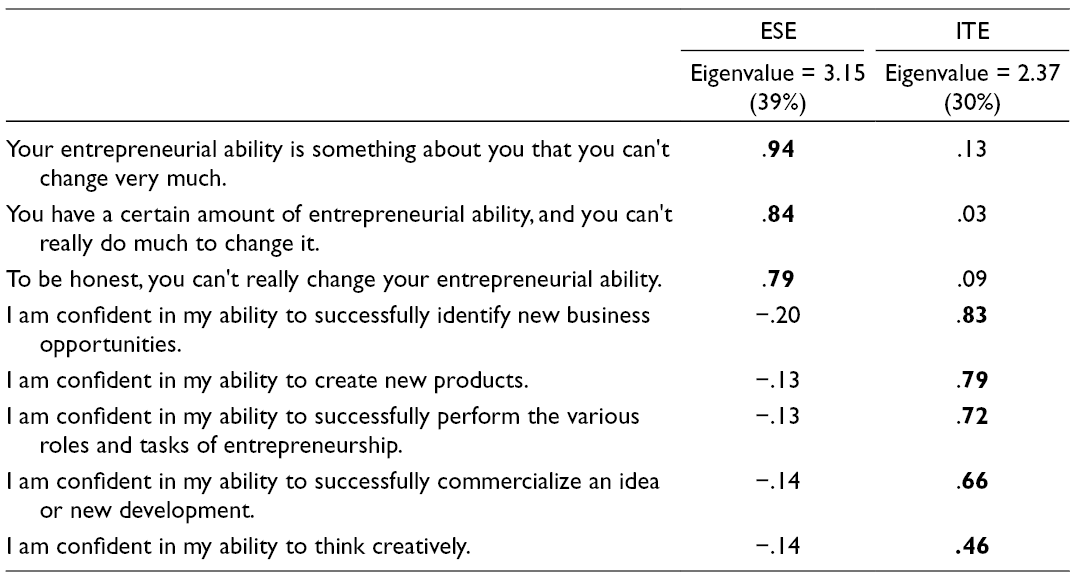
Regarding these first two measures, implicit theories of entrepreneurship and entrepreneurial self-efficacy, we did confirm that they loaded on two separate factors (see Table 1 for loadings). 7
Factor Loadings for Entrepreneurial Self-Efficacy (ESE) and Implicit Theories of Entrepreneurship (ITE).
Academic interest
Participants completed a 12-item scale measuring academic interest in the subject of entrepreneurship (e.g., “I’m excited about the subject of entrepreneurship,” “I think what we are learning in this course is important”) adapted from past achievement motivation theory work (Wigfield & Eccles, 2000). Higher scores on this, captured on a 7-point scale ranging from 1 (Strongly Disagree) to 7 (Strongly Agree), represent greater academic interest (α = .930).
Career interest
Participants completed an adapted eight-item scale drawing on the work of Zhao et al. (2005) as well as Krueger, Reilly, and Carsrud (2000). This scale measured interest in entrepreneurship-related activities (e.g., “I am interested in acquiring a small business in the next 5 to 10 years,” “It is likely that I will personally own a small business in the relatively near future”). Higher scores on this, captured on a 7-point scale ranging from 1 (Strongly Disagree) to 7 (Strongly Agree), represent greater career interest (α = .954).
Entrepreneurship personal experience
We adapted the face-valid single item (from Pollack et al., 2012), captured on a 7-point scale ranging from 1 (Strongly Disagree) to 7 (Strongly Agree), to assess entrepreneurial experience (e.g., “I have a lot of experience being an entrepreneur”).
Covariates
For use in endogeneity analyses, in addition to assessing demographics, we also examined family experience and self-reported assessments of one’s own entrepreneurial ability. For sake of time, we used single face-valid assessments. First, for family entrepreneurial experience, we asked the following: “People in my immediate family have a lot of experience being entrepreneurs”) rated on a 1 (Strongly Disagree) to 7 (Strongly Agree) scale. Second, to examine self-confidence in classroom success, we asked: “How successful do you think you will be in your entrepreneurship class?” rated on a scale ranging from 1 (Not at all Successful) to 7 (Very Successful). 8 Third, students reported on the following question that assessed relative ability: “Compared to most of your other school subjects, how good do you think you will be at entrepreneurship?” rated on a scale from 1 (A Lot Worse) to 7 (A Lot Better). We used these three single items, in addition to gender and personal experience as covariates, in our exploratory analyses to examine if our results of intervention effects hold above and beyond these additional potential predictors of interest in the field.
Postmodule assessments
After each module, we assessed growth mindsets of entrepreneurship to confirm the manipulation worked and we also assessed entrepreneurial self-efficacy to examine this as a process variable, taking an average of the items across the modules to get a sense of the students’ mid-semester growth mindsets of entrepreneurship (α = .966) and entrepreneurial self-efficacy (α = .949). We also report growth curve analyses looking at change over time for each of the postmodule assessments. In addition, at the conclusion of Module 3, when students were working on their main class assignment, we assessed task persistence.
Task persistence
We assessed students’ persistence on their primary project for the semester—an activity that involved identifying and exploring an idea for value creation (i.e., an ideation traction project). 9 We measured the student’s self-reported willingness to persist on the academic project despite challenges by adapting a measure used in past mindset work (e.g., Burnette, 2010). More specifically, these six items, captured on a 7-point scale ranging from 1 (Strongly Disagree) to 7 (Strongly Agree), started with the following prompt: “If you encounter challenges in preparation for your ideation traction activity, how likely are you to…”. Three of the items included mastery-oriented responses (e.g., exert more effort) and three of the items included helpless-oriented responses (e.g., give up). We recoded such that higher numbers represent greater task persistence (α = .798).
Follow-up assessments
Implicit theory of entrepreneurship
We used the same scale here as above (α = .951).
Academic interest
We used the same scale here as above (α = .939).
Career interest
We used the same scale here as above (α = .963).
Task grade (academic performance)
To assess academic performance, we requested grades on the ideation traction project. We focused on this performance outcome rather than final grades, because our assessment of persistence related to this specific task. The professor calculated grades for this project based on the number of website unique page views, visitors’ time spent on the page, as well as “likes” and “follows” across platforms including Facebook and Twitter.
Additional mindsets (intelligence, person)
We also assessed mindsets of intelligence (Dweck, Chiu, & Hong, 1995; α = .963) and mindsets about the nature of people (Chiu, Hong, & Dweck, 1997; α = .919) at follow-up to explore if we uniquely manipulated theories of entrepreneurship. These were captured on a 7-point scale ranging from 1 (Strongly Disagree) to 7 (Strongly Agree), and we recoded items such that higher scores represent stronger growth mindsets.
Results
Table 2 shows the descriptive statistics and correlations for assessments included in analyses and assessments across modules. Confirming random assignment, there are no statistically significant differences based on condition on relevant outcomes assessed at pretest. Our analytic approach described below follows our OSF preregistered plan. 10 We also included exploratory analyses—some of which are preregistered and some of which were not. We clearly denote this in the results. We first present the manipulation check and then report results for each hypothesis, concluding with exploratory analyses.
Means, Standard Deviations, and Correlations Across Modules.
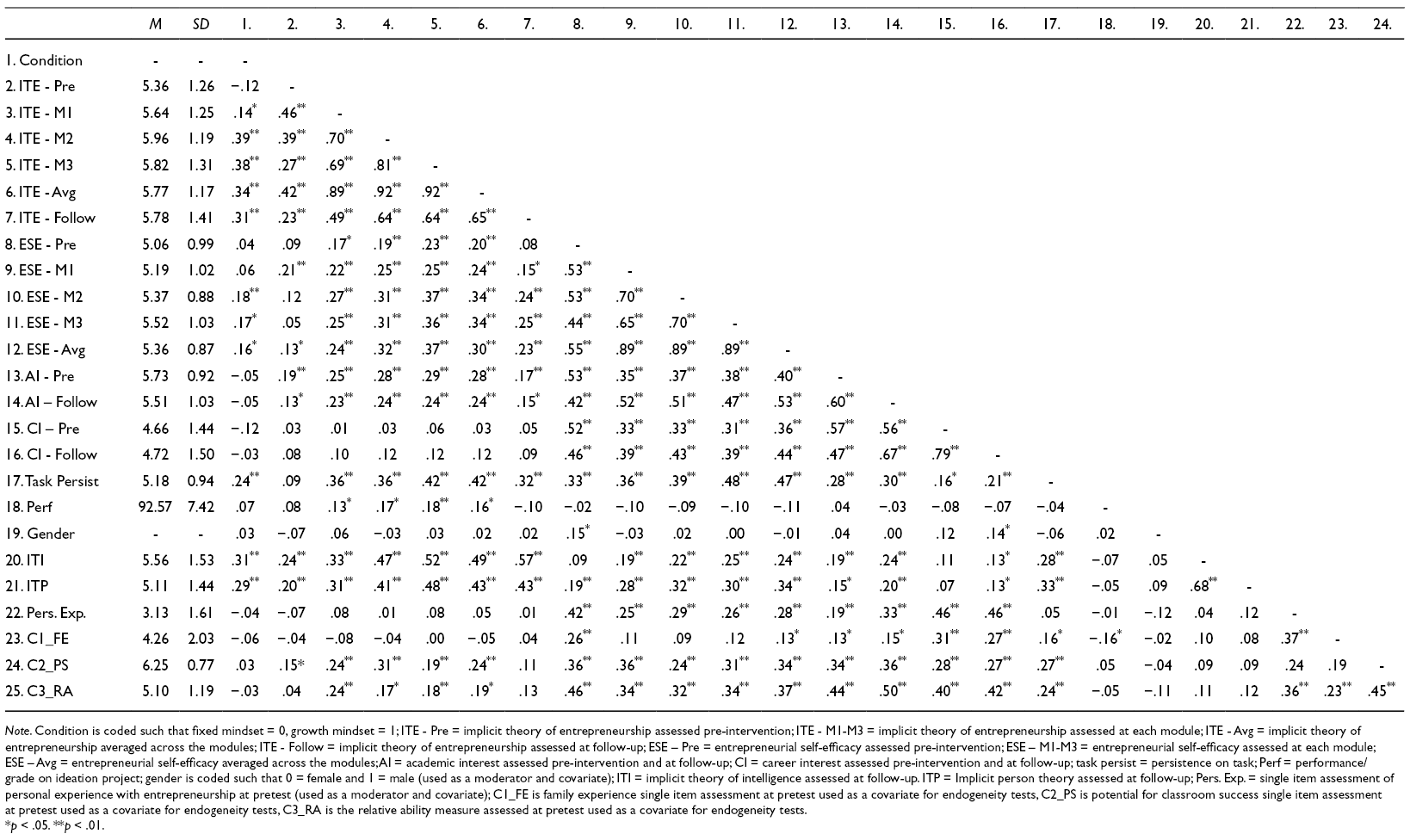
Note. Condition is coded such that fixed mindset = 0, growth mindset = 1; ITE - Pre = implicit theory of entrepreneurship assessed pre-intervention; ITE - M1-M3 = implicit theory of entrepreneurship assessed at each module; ITE - Avg = implicit theory of entrepreneurship averaged across the modules; ITE - Follow = implicit theory of entrepreneurship assessed at follow-up; ESE – Pre = entrepreneurial self-efficacy assessed pre-intervention; ESE – M1-M3 = entrepreneurial self-efficacy assessed at each module; ESE – Avg = entrepreneurial self-efficacy averaged across the modules; AI = academic interest assessed pre-intervention and at follow-up; CI = career interest assessed pre-intervention and at follow-up; task persist = persistence on task; Perf = performance/grade on ideation project; gender is coded such that 0 = female and 1 = male (used as a moderator and covariate); ITI = implicit theory of intelligence assessed at follow-up. ITP = Implicit person theory assessed at follow-up; Pers. Exp. = single item assessment of personal experience with entrepreneurship at pretest (used as a moderator and covariate); C1_FE is family experience single item assessment at pretest used as a covariate for endogeneity tests, C2_PS is potential for classroom success single item assessment at pretest used as a covariate for endogeneity tests, C3_RA is the relative ability measure assessed at pretest used as a covariate for endogeneity tests.
*p < .05. **p < .01.
Manipulation Check
An independent samples t-test revealed a significant effect of intervention condition on mindsets immediately postmodule, t(232) = −5.46, p < .001, with participants in the growth mindset condition (n = 117; M = 6.16, SD = .91) reporting significantly stronger growth mindsets of entrepreneurship than those in control condition (n = 117; M = 5.37, SD = 1.27). Additionally, the effect on growth mindsets held at follow-up, t(234) = −4.945, p < .001, with participants in the growth mindset condition (n = 119; M = 6.21, SD = 1.26) reporting significantly stronger growth mindsets of entrepreneurship than those in control condition (n = 117; M = 5.34, SD = 1.43). We report growth curve analyses below, which articulate effects on mindsets after each individual module.
Mindsets, Entrepreneurial Self-Efficacy, and Interest (Hypotheses 1–4)
We used PROCESS macro model 4 (Hayes, 2017) to test two models in which the growth mindset intervention, relative to the control predicts entrepreneurial self-efficacy, which in turn predicts interest—one predicting academic interest, the other career interest (Figure 2). We used follow-up assessments of interest and the mean score of entrepreneurial self-efficacy across the modules—providing a long-lag examination of this process model.
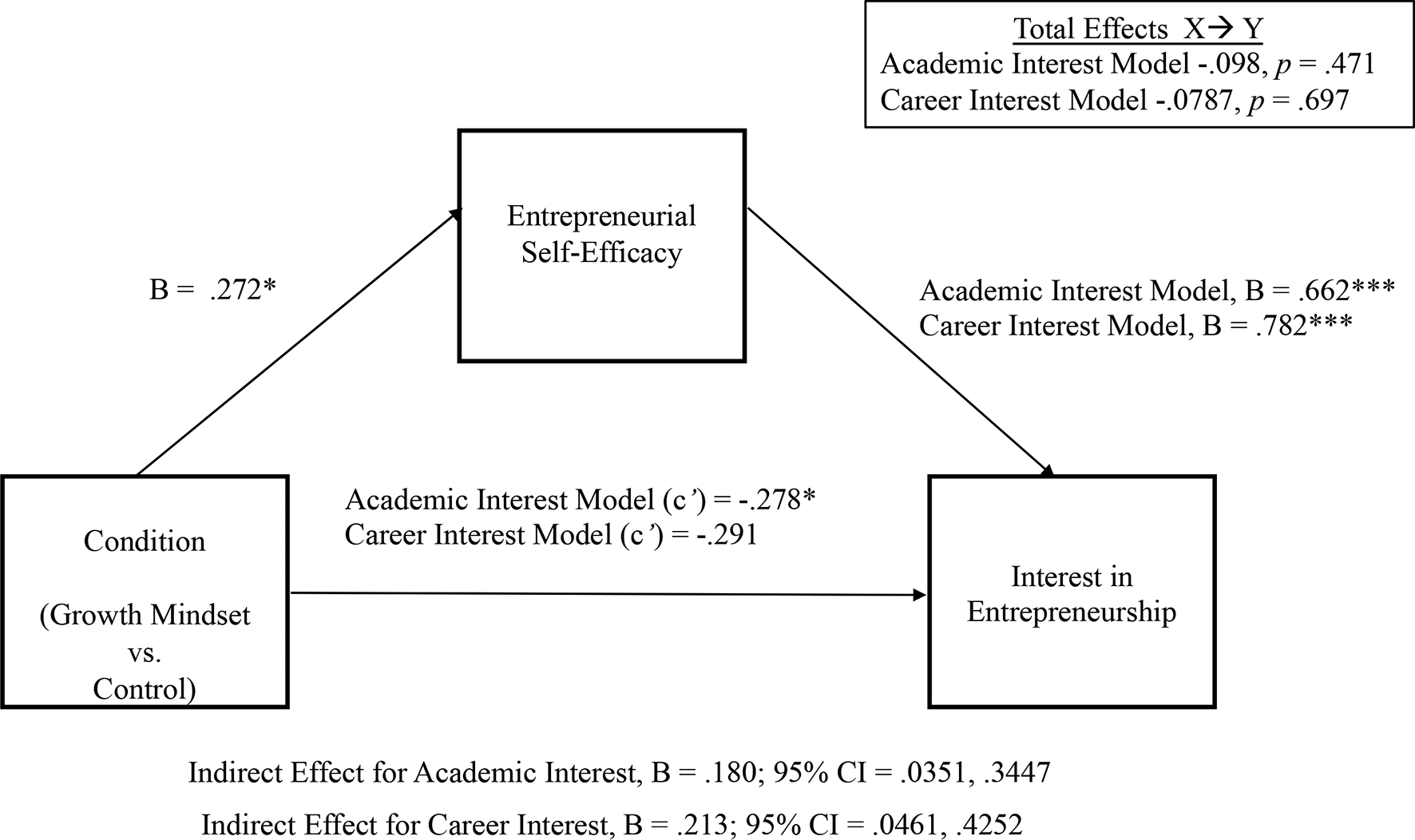
The mediating effect of entrepreneurial self-efficacy on the relation between condition and interest in entrepreneurship (academic and career).
For academic interest, in support of Hypothesis 1, students in the mindset condition, relative to the attention-matched control, reported stronger entrepreneurial self-efficacy, B = .272, t(230) = 2.404, p = .017; 95% CI [.0490, .4943]. And, as predicated in Hypothesis 2, entrepreneurial self-efficacy significantly predicted academic interest, controlling for condition, B = .662, t(229) = 9.946, p < .001; 95% CI [.5309, .7931]. With regard to Hypothesis 3, the growth mindset intervention significantly indirectly predicted academic interest via entrepreneurial self-efficacy, B = .180; 95% CI [.0351, .3447]. But, in contrast to Hypothesis 4, analyses indicated that the total effect of condition on academic interest was not significant, B = −.098, t(230) = −.723, p = .471; 95% CI [−.3668, .1699]. Surprisingly, the direct effect is significant and negative, B = −.278, t(229) = −2.41, p = .0168; 95% CI [−.5058, −.0507].
For career interest, results are similar (Figure 2). As reported above, the growth mindset intervention, relative to the control condition, strengthened entrepreneurial self-efficacy, B = .272, t(230) = 2.404, p = .017; 95% CI [.0490, .4943]. Entrepreneurial self-efficacy significantly predicted career interest, controlling for condition, B = .782, t(229) = 7.543, p < .001; 95% CI [.5708, .9867], and growth mindsets significantly indirectly predicted career interest via entrepreneurial self-efficacy, B = .213; 95% CI [.0461, .4252]. These three analyses support Hypotheses 1–3. However, with regard to Hypothesis 4, the total effect of condition on career interest also was not significant, B = −.0787, t(230) = −.397, p = .692; 95% CI [−.4691, .3118]. Additionally, although the direct effect is again negative, it is not statistically significant, B = −.291, t(229) = −1.62, p = .1070; 95% CI [−.6457, −.0634].
Task Persistence and Task Performance (Hypothesis 5)
Next, we examined our hypothesis involving serial mediation and also report on the total effect of the intervention on task persistence and task performance. As outlined by Miller, Dannals, and Zlatev (2017) in their call for more long-lagged interventions examining the process of both psychological and behavioral change in improving academic performance, we expected the shift in entrepreneurial self-efficacy due to the intervention to predict task persistence, which in turn, would predict better task performance (i.e., grade on the class assignment). First, as noted above, condition predicted entrepreneurial self-efficacy, B = .25, t(213) = 2.15, p = .032; 95% CI [.0215, .4844], entrepreneurial self-efficacy significantly predicted task persistence, B = .48, t(213) = 7.45, p < .001; 95% CI [.3560, .6123]. However, task persistence did not predict task performance, B = −.07, t(213) = −.104, p = .917; 95% CI [−1.3375, 1.2037], and thus condition also failed to significantly indirectly predict task performance via the proposed serial process. Condition also did not indirectly predict task performance via entrepreneurial self-efficacy. And, analyses indicated that the total effect of condition on task performance was not significant, B = 1.14, t(213) = 1.09, p = .279; 95% CI [−.9288, 3.206]. However, the intervention did have a total effect on task persistence, B = .34, t(213) = 3.00, p = .003; 95% CI [.1156, .5596] with students in the growth mindset condition, relative to the attention-matched control, reporting persisting longer on their classroom assignment when facing challenges. In summary, we find limited support for Hypothesis 5—we do not find support for a serial process model predicting classroom performance, but the intervention does have a total effect on task persistence.
Moderation (Hypothesis 6)
We explored two moderators noted in Hypothesis 6. First, to examine if any effects of the intervention on outcomes are moderated by gender, 11 we ran a MANOVA 12 with entrepreneurial self-efficacy, mindsets, academic interest, career interest, task persistence, and task performance as the outcomes. The overall Wilks’ Lambda test of the interaction was not significant for any outcomes, F(6, 201) = 1.179, p = .319. The only main effect of sex was for career interest, with males reporting stronger interest (M = 4.845; SD = 1.39) than females (M = 4.299, SD = 1.68).
Second, to examine if any effects of the intervention on outcomes are moderated by experience, we ran PROCESS model 1 (Hayes, 2017) with the single entrepreneurial experience item and condition as the predictors with each outcome (i.e., growth mindset of entrepreneurship, entrepreneurial self-efficacy, academic interest, career interest, persistence, and task performance). Experience does predict 13 greater entrepreneurial self-efficacy, B = .152, t(231) = 4.42, p < .001; CI [.0840, .2196], academic interest, B = .200, t(233) = 4.93, p < .001; CI [.1202, .2800], and career interest, B = .415, t(233) = 7.53, p < .001; CI [.3067, .5239]. However, there were no significant interactions of experience with intervention condition for any of the outcomes.
Preregistered Exploratory Research Question
We also explored if the intervention impacted other mindsets at follow-up. Based on past research, mindsets are domain specific (i.e., differentiated rather than connected). Here, we assessed the two most commonly manipulated theories: mindsets of intelligence, and mindsets of people (Molden & Dweck, 2006). We ran a MANOVA with these two additional mindsets as outcomes and intervention condition as the predictor. This analysis revealed a significant overall effect, Wilks’ Lambda = .892, F(2, 233) = 14.13, p < .001, partial eta-squared = .11 and significant univariate tests—namely students in the growth mindset condition reported stronger growth mindsets of intelligence, F(1, 234) = 24.75, p < .001, partial eta-squared = .096, as well as people, F(1, 234) = 21.860, p < .001, partial eta-squared = .085. This is in addition to the effect of the intervention on mindsets of entrepreneurship as reported above.
Non-Preregistered Exploratory Analyses
Growth curve analyses
We specified separate models for the growth mindset of entrepreneurship and entrepreneurial self-efficacy measures using only participants with complete data across these measures at all time points. The process was parallel for both outcomes and thus only the differences are noted. A null model was initially specified to use as a baseline comparison. The −2 log likelihood statistics indicated that adding a random intercept and error for time significantly improved the fit over the null model. Likewise, adding the linear effect of time improved models for both mindsets and entrepreneurial self-efficacy. A subsequent test of quadratic and cubic terms found that only the quadratic model improved the model fit for the mindset outcome over the linear effect and neither improved the model fit for the entrepreneurial self-efficacy outcome over the linear effect. Thus, for testing the hypothesized main effects and interactions, only a linear trend for entrepreneurial self-efficacy was retained in the model whereas both linear and quadratic trends were retained for the mindset outcome.
The main effect for intervention condition along with the interaction between intervention condition and time was then added to the retained models. As expected, in both cases a significant interaction was found. A test of simple effects at each time point reveals that the intervention resulted in a significant effect following Module 2 for both mindsets and entrepreneurial self-efficacy. As expected, the effect of time within the attention-matched control condition was not significant for mindsets whereas both the linear and quadratic trends were significant within the intervention condition. For entrepreneurial self-efficacy, individuals in both conditions reported greater entrepreneurial self-efficacy throughout the intervention but, as expected, the individuals in the intervention saw greater improvements in entrepreneurial self-efficacy than those in the attention-matched control condition (see Figures 3 and 4, Table 3 for more information).
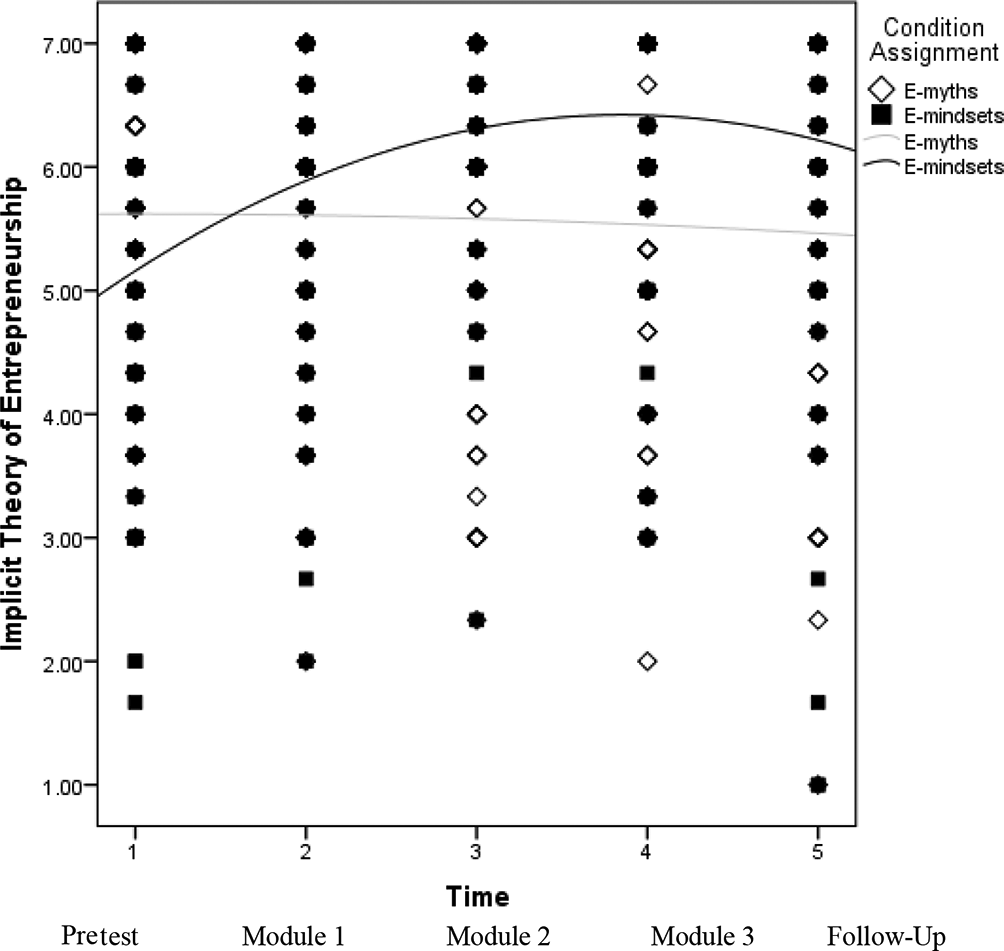
Growth curve analyses for mindset outcome.
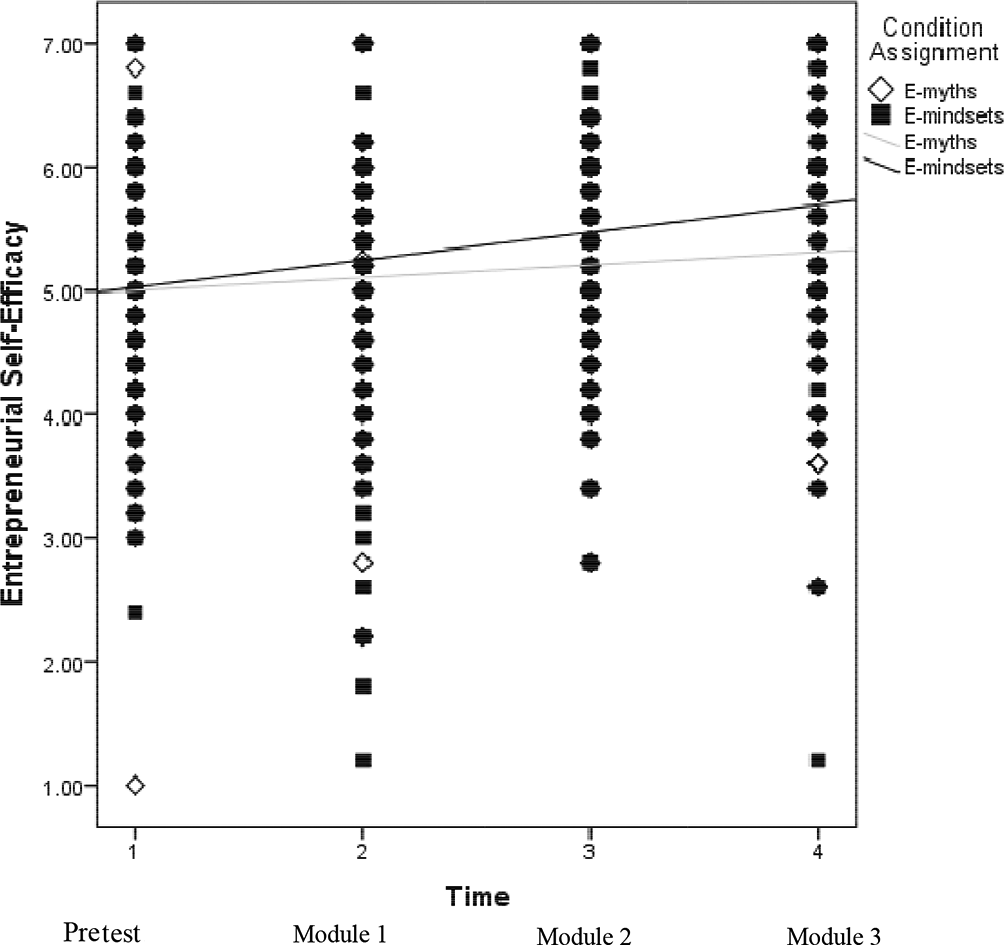
Growth curve analyses for entrepreneurial self-efficacy outcome.
Growth Curve Models and Effects for Mindset and Entrepreneurial Self-Efficacy.

Note. The quadratic trend did not significantly improve the model for entrepreneurial self-efficacy and therefore is not included in subsequent analyses.
Endogeneity analyses
We took two approaches to test for endogeneity. First, we evaluated the possibility of a reversed causal relationship between entrepreneurial self-efficacy and both academic interest and career interest using the same process model with the mediator and outcome switched. The results of both models indicated that neither academic interest nor career interest is predicted by the intervention: academic interest, B = −.10, t(230) = −0.72, p = .47; 95% CI [−0.37, 0.17]; career interest, B = −.08, t(230) = −0.40, p = .69; 95% CI [−0.47, 0.31]. Additionally, although both predict entrepreneurial self-efficacy when controlling for the effect of the intervention: academic interest, B = .46, t(230) = 9.95, p < .001; 95% CI [0.37, 0.55]; career interest, B = .25, t(230) = 7.54, p < .001; 95% CI [0.19, 0.32], the indirect effect revealed that neither academic interest, B = −.04; 95% CI [−0.16, 0.08], or career interest, B = −.02; 95% CI [−0.12, 0.07], mediated the effect of the intervention on entrepreneurial self-efficacy.
Second, we evaluated if the overall model holds when controlling for variables assessed at pretest that are related to career development outcomes (i.e., gender, personal and family experience in entrepreneurship, entrepreneurship ability and knowledge). We again replicated the original and statistically significant PROCESS mediation models but included these additional variables as covariates in the analyses (Table 4). The indirect effect of the intervention on interest through entrepreneurial self-efficacy was smaller but remained significant for both academic interest, B = .12; 95% CI [0.03, 0.23], and career interest, B = .13; 95% CI [0.02, 0.27]. In addition, entrepreneurial self-efficacy was still a significant predictor of both academic interest, B = .45, t(230) = 6.41, p < .001; 95% CI [0.31, 0.59], and career interest, B = .48, t(230) = 4.49, p < .001; 95% CI [0.27, 0.69]. This indicates that even when including other variables that may be relevant for predicting interest in the field, the effect of the intervention is still based on an increase in entrepreneurial self-efficacy. These two endogeneity tests increase confidence in our results.
Endogeneity Tests of Covariates.

Discussion
Overview
In summary, we demonstrated that (a) growth mindsets of entrepreneurship are malleable, (b) the growth mindset intervention, relative to an attention-matched control condition, is effective at fostering entrepreneurial self-efficacy, and (c) entrepreneurial self-efficacy has downstream implications for career development outcomes. In addition to the psychological benefits (i.e., stronger growth mindsets and entrepreneurial self-efficacy) of the intervention, we also see enhanced persistence on an academic task in the face of potential challenges—an outcome with great relevance for continuing long-term in the field. However, we failed to move the needle (even indirectly) on task performance—at least as assessed on students’ class-based ideation traction project. Although this lack of effect is in line with more recent work calling into question the potential for growth mindset interventions to impact academic performance-related outcomes (e.g., grades; Sisk et al., 2018), in the current work we had a ceiling effect for grades and lack of variability (i.e., M = 92.57; SD = 7.42). Finally, we found that the intervention is equally effective for females and males and for those with more or less experience. This null finding may be due to the specific setting of the intervention in which the professor and students hopefully provide more support for equal opportunities for careers regardless of gender or previous experiences.
Additional findings worth noting are three somewhat unexpected results. First, we failed to get a total effect of the intervention on academic or career interest. This may be due, in part, to our rigorous attention-matched control that provided information regarding myths in the field. Indeed, within the entrepreneurial intention literature, human capital theory explains why education improves the desire to start or own a business (Becker, 1964). That is, information can improve attitudes about the field and promote intentions to engage in such activities. Thus, our attention-matched control, in combination with the fact that we targeted students in a class, may have attenuated any effect of a growth mindset intervention on academic and career interest.
Second, when entrepreneurial self-efficacy was in the equation predicting academic interest, it unsuppressed a negative association between the intervention and the outcome. Thus, the part of the mindset intervention that is independent of entrepreneurial self-efficacy, is negatively predicting academic interest and is trending negative for career interest (p = .107). Although this also helps explain the lack of hypothesized total effect for interest, future research should look into what part of the intervention might be inhibiting interest. One fruitful theory to draw on in this exploration is theory of planned behavior. For example, in the awareness education literature, controllability beliefs can have an impact on the intention to choose (or not choose) entrepreneurship as a career path (Fretschner & Weber, 2013). Another potential explanation is methodological and related to our sample—the intervention took place in a required course where many of the students may not be inherently interested in pursuing entrepreneurship. Thus, the negative direct relation could be a spillover effect related to students generally not being interested in the subject that the mindset intervention exacerbated. 14
The third somewhat unexpected result is that our intervention moved not only mindsets of entrepreneurship but also mindsets of intelligence and people. Typically, these mindsets are domain specific. Put differently, these mindsets are differentiated (rather than connected). However, in retrospect, when teaching about what mindsets are in the current work, we included general research on the importance of growth mindsets which is typically anchored in academic settings, with a focus on mindsets of intelligence. Additionally, entrepreneurship is a domain in which intelligence and personality are thought to be key components of success (Sternberg, 2004; Zhao & Seibert, 2006). Discussing the malleable nature of entrepreneurial ability may implicitly imply that intelligence and personality are also malleable. Thus, it may be that mindsets of entrepreneurship are not as domain specific as other types of mindsets—and, it also could be that the message we manipulated about mindsets of entrepreneurship provided a connection to other mindsets in way that extant work has not yet done. Future work should explore if a combined intervention—one that explicitly targets entrepreneurial, intelligence, and person mindsets—is effective at promoting not only interest in the field but also academic achievement.
Further interesting results include the growth curve analyses which highlight the importance of multiple interactions with students in promoting a growth mindset and entrepreneurial self-efficacy. That is, a single interaction with the intervention did not result in significant differences, but differences did emerge over time. Efforts to promote growth mindsets and self-efficacy in other areas should consider adopting this approach as single session interventions may fail to have the intended effect. We also note that entrepreneurial self-efficacy remained on a positive trajectory throughout the intervention, suggesting that additional modules may have continued to increase entrepreneurial self-efficacy. Future work could seek to identify the optimal number of interactions needed to successfully implement a mindset intervention. Finally, tests of endogeneity provide some confidence in the proposed causal paths and offer a robustness test showing that effects on the intervention hold when controlling for other relevant predictors of career development.
Overall, the intervention successfully changed beliefs—namely, it fostered stronger growth mindsets and greater entrepreneurial self-efficacy. In addition, students in the intervention condition, relative to the control, reported persisting longer on their academic task. All of these outcomes have important implications for career development.
Theory-Based Implications
Our research complements theoretical perspectives on entrepreneurial self-efficacy and awareness education in entrepreneurship. First, the findings provide compelling evidence that a growth mindset intervention positively impacted students’ entrepreneurial self-efficacy that, in turn, positively predicted academic interest as well as career interest in entrepreneurship.
Overall, our work extends models of self-efficacy in which the antecedents to self-efficacy include gender (Wilson et al., 2007), or learning and experience (Zhao et al., 2005) by offering a psychological process that can be shifted by brief, scalable, online interventions that can be easily incorporated into classrooms and curricula. It also speaks to the potential of growth mindset messaging as one of the four antecedents of efficacy—namely growth mindsets offer a form of verbal persuasion.
Our work also extends existing knowledge regarding predictors of interest in entrepreneurship. One of the main insights that extant research consistently illustrates is how human capital and entrepreneurial self-efficacy can contribute to entrepreneurial interest and intentions. In the current work, our approach supports both of these ideas. For example, our growth curve models highlight a general increase in entrepreneurial self-efficacy across the semester, suggesting that education can affect one of the critical psychological processes for intentions to engage in starting or owning a business. And, importantly, we show this linear increase to be even stronger in the growth mindset intervention condition. Here, total effects of the intervention on entrepreneurial self-efficacy and indirect effects on academic and career interest hold when controlling for other key predictors of career development including sociocultural (e.g., gender; Wilson et al., 2007), personal and family experience (Carr & Sequeira, 2007), and ability or knowledge (Thébaud, 2010). Overall, the current work highlights how growth mindset messaging may be a promising avenue, especially when combined with educational activities, in fostering greater entrepreneurial self-efficacy with important implications for career development-related outcomes that go beyond just intentions to start or own a business, including academic interest and task persistence, for example.
Additionally, the current research makes important theoretical contributions to the implicit theory, or mindset, literature. Our findings demonstrate the importance of these belief systems in the domain of entrepreneurship. And, moreover, we illuminate one of the psychological processes involved in the link between mindsets and academic and career interest in entrepreneurship, namely entrepreneurial self-efficacy. A greater theoretical understanding of the mechanisms of change can go far in helping improve the implementation of interventions. Related, our work contributes to the growing body of work questioning whether growth mindset interventions are able to move the needle on academic performance outcomes (Sisk et al., 2018). Growth mindset interventions may be better served when the goal is to increase efficacy, interest in the field, and persistence when challenges arise, rather than academic performance—outcomes that may be every bit as important to educators fostering a passion for learning.
Practical Implications
As academics and researchers in the domain of entrepreneurship, we know that entrepreneurship can be taught—and, now we have empirical evidence that we can change students’ beliefs about the malleability of their own entrepreneurial ability. Although it is often assumed that students in our classes must feel the same way—that is, with time, effort, and energy, entrepreneurship is a skill that can be improved, our work shows that there are easy, inexpensive, and scalable ways to strengthen these beliefs and that these beliefs matter. A vast array of research shows that growth mindsets enable individuals to persist despite difficult situations and respond more adaptively to challenges (Dweck, 2000; 2006). And, we bolster that finding in the current work—students in the growth mindset intervention, relative to the attention-matched control, reported greater persistence in the face of setbacks. Therefore, one practical implication of the present work is that we now know that the venerable line of research on mindsets is adaptable to the context of entrepreneurship. Accordingly, it seems plausible that academics in the classroom as well as practitioners engaged in training aspiring entrepreneurs can now draw on this literature in developing educational materials.
For example, our research shows that one promising approach to increasing the entrepreneurship pipeline is through disputing the notion that innate talent is the primary driver of success—instead, we should promote growth mindsets about the nature of entrepreneurial ability. In summary, academics, practitioners, and policy makers alike—anyone who has interest in increasing the degree to which students show career inclinations toward entrepreneurship—can cultivate growth mindsets among students with an inexpensive, scalable, and efficient intervention.
Limitations and Future Directions for Research
With regard to the participants and setting of the current work, we note the following limitations as well as future directions for research. Although we deliberately implemented the intervention with students because of our focus on career development for this population, we recommend that future work build on our findings to examine how growth mindsets of entrepreneurship function in populations that are more diverse in terms of age, geography, race and ethnicity, and socioeconomic status. Related, a limitation of the current work is the educational status of our participants and the fact that we did not track multiple years of educational (i.e., class) choices. In the future, starting earlier in the academic pipeline could be fruitful and could shed light on which students opt into entrepreneurial classes. And, tracking participants’ curricular as well as extracurricular activities with regard to entrepreneurship through graduation and into their first job role would help us move beyond intentions to behavior and address the intention to behavior gap limitation of the current work (Bae, Qian, Miao, & Fiet, 2014). This longitudinal approach can also help to address the issue of how long effects from mindset interventions last. Although the current work only examines outcomes across a semester, the results of these interventions can last well beyond the conclusion of the program (e.g., Schleider & Weisz, 2018). This is in large part because mindset interventions are recognized as wise interventions that change reinforcing processes and thus effects tend to be sustained well into the future (Walton, 2014; Walton & Wilson, 2018).
With regard to the design and measures in the current work, we note the following limitations as well as future directions for research. Employing a thorough and multifaceted intervention, like the one in the current work, makes it unclear which element(s) are necessary and which are sufficient for promoting growth mindsets. Future research should investigate which components of mindset interventions are required to reliably promote growth mindsets. For example, does teaching about mindsets and offering a tip enhance the strength of the manipulation? Or is the standard approach with a malleable message and “saying is believing” message adequate? Additionally, with regard to the design of these types of interventions, they are susceptible to “contamination” because it can be difficult to confine the growth mindset message only to those in the intervention condition. For example, there is potential that some students, who are working together in a course over an entire semester, discussed with each other the information they received in their modules. Contamination is difficult to detect and can reduce effect size estimates, introduce bias, and decrease power (Keogh-Brown et al., 2007). Last, with relevance for measures, we note that although interventionists often use single item measures to reduce the burden on participants over time (West et al., 2014), other researchers have raised questions about the validity of such an approach (see Bergkvist & Rossiter, 2007)—in our work, such a critique is only relevant for the test of moderation using experience and for analyses with the covariates. Our primary analyses relied on validated multi-item assessments. In the future, subsequent work should replicate our work as well as extend our efforts by incorporating the full assessments of all constructs.
With regard to the delivery structure of the intervention in the current work, we note the following limitations as well as future directions for research. In integrating the intervention into the classroom—although such an approach enhanced recruitment, participation, and retention—we relied heavily on the professor to deliver the knowledge-related materials in the attention-matched control. The professor and many of the experts debunking the myths were White males and we needed to match the two conditions. Thus, future research could fruitfully explore if growth mindset interventions are more impactful, for example for females, to the degree that they match in terms of identity of participants (Van Auken, Fry, & Stephens, 2006). Based on gender development theory for example, role models who are similar should make the message more persuasive (Van Auken et al., 2006). 15
Additionally, we suggest that future work should focus more directly on interventions designed to enhance entrepreneurial self-efficacy. The growth mindset intervention in this research was crafted to capitalize on the verbal persuasion route to increasing self-efficacy. This route might be even more powerful with the inclusion of story-telling, as this process also strengthens growth mindsets (Yeager et al., 2016a; 2016b). A specific illustration of how this might work is the story of Daymond John, a star on the television show Shark Tank and founder of the $6B brand FUBU. As Draymond John tells the story, he worked at Red Lobster while he labored to gain the skills and tools needed to launch his venture (Elkins, 2017). We encourage making this story, and others like it, a part of future interventions to potentially strengthen growth mindsets and their subsequent impact.
Furthermore, future interventions might leverage other sources of self-efficacy to promote entrepreneurial self-efficacy and in turn bolster entrepreneurial career development. For example, researchers might investigate the utility of incorporating vicarious experiences to augment the primarily verbal persuasion-based mindset interventions (Bandura, 1986; 2001). 16 And, future inquiry of such interventions should seek to be vigilant for potential unintended effects akin to the inhibition of interest that we found in this work once we accounted for entrepreneurial self-efficacy. Related, from an achievement motivation theory perspective, perceptions of ability, expectations of success, and value for an activity all factor into a person’s decision regarding a course of action (Wigfield & Eccles, 2000). As we focused on only a part of this equation, future work is encouraged to build on our findings. Overall, before implementing growth mindset interventions on a large scale, we hope our initial work encourages entrepreneurship researchers to explore ways to strengthen effects and bolster and extend the evidence provided in the current research.
Conclusion
It is intuitively appealing to think that simple exposure to content in the domain of entrepreneurship through the increased number of classes offered at universities is enough to drive students’ academic and career interest in entrepreneurship. And, we do have some evidence that supports the idea that mere exposure to knowledge and participation in programmatic offerings related to entrepreneurship can drive intentions and entrepreneurial self-efficacy (Peterman & Kennedy, 2003). In the current work, we offered a low-cost approach integrated into the classroom that can enhance the impact of providing learning opportunities. We presented evidence that cultivating a growth mindset of entrepreneurship—a belief that with time, effort, and the right strategies an individual can improve entrepreneurship ability—has promise for increasing students’ career development in entrepreneurship above and beyond simply learning about entrepreneurship. And, we empirically illustrated this using a short, scalable intervention that it is feasible to integrate in the classroom. We hope our work provides the foundation for additional empirical inquiry that helps bolster our findings that (a) growth mindsets of entrepreneurship are malleable, and (b) encouraging a growth-oriented mindset facilitates students’ entrepreneurial self-efficacy and persistence on classroom tasks when challenges arise.
Footnotes
Appendix 1. Growth mindset intervention modules.

| Module | Content | Delivery method | Minutes | Example quotes |
|---|---|---|---|---|
| Module 1: The basics of mindsets |
Step 1. Everyone has the ability to be an entrepreneur | White Male Professor (Video) | 1 | “Well the fact is, we all have the ability to innovate. You see, it resides in all of us, in something I call the entrepreneurial mindset.” |
| Step 2. What are mindsets? | Powtoons Animation (Video) | 2 | “People in a fixed mindset believe that abilities are fixed. Everyone has a certain amount and that’s that. People in a growth mindset believe that abilities can be developed.” | |
| Step 3. What do people with growth mindsets do? | White Female Professor (Video) | 2 | “The first is to remember to focus on the process. The second is when you face challenges, remember to look at them as learning opportunities. The third is what we call saying is believing.” | |
| Step 4. Comprehension check | N/A | N/A | N/A | |
| Step 5. Survey | N/A | N/A | N/A | |
| Module 2: Entrepreneurial mindsets |
Step 1. Entrepreneurial ability is changeable | Short Article | N/A |
“Entrepreneurial ability seems to be malleable and can be developed over time.”
“An individual’s entrepreneurial skills can be improved.” |
| Step 2. Why are growth mindsets useful in overcoming obstacles? | Powtoons Animation (Video) | 2 | “The more you challenge your mind to learn, the more brain cells you grow, leading to a stronger, smarter brain. As a result, things that once seemed hard actually become easier.” | |
| Step 3. How to overcome obstacles | White Male Professor (Video) | 1 | “If you ever feel stuck on a concept, don’t be afraid to try a new learning strategy or ask someone for help.” | |
| Step 4. Comprehension check | N/A | N/A | N/A | |
| Step 5. Survey | N/A | N/A | N/A | |
| Module 3: Overcoming obstacles |
Step 1. Mindsets for entrepreneurs | White Male Professor (Video) | 11 |
“Hard work + correct strategy lead to success in the domain of entrepreneurship”
“Not yet and not that.” |
| Step 2. Activity | N/A | N/A | N/A | |
| Step 3. Survey | N/A | N/A | N/A |
Appendix 2. Control condition modules.
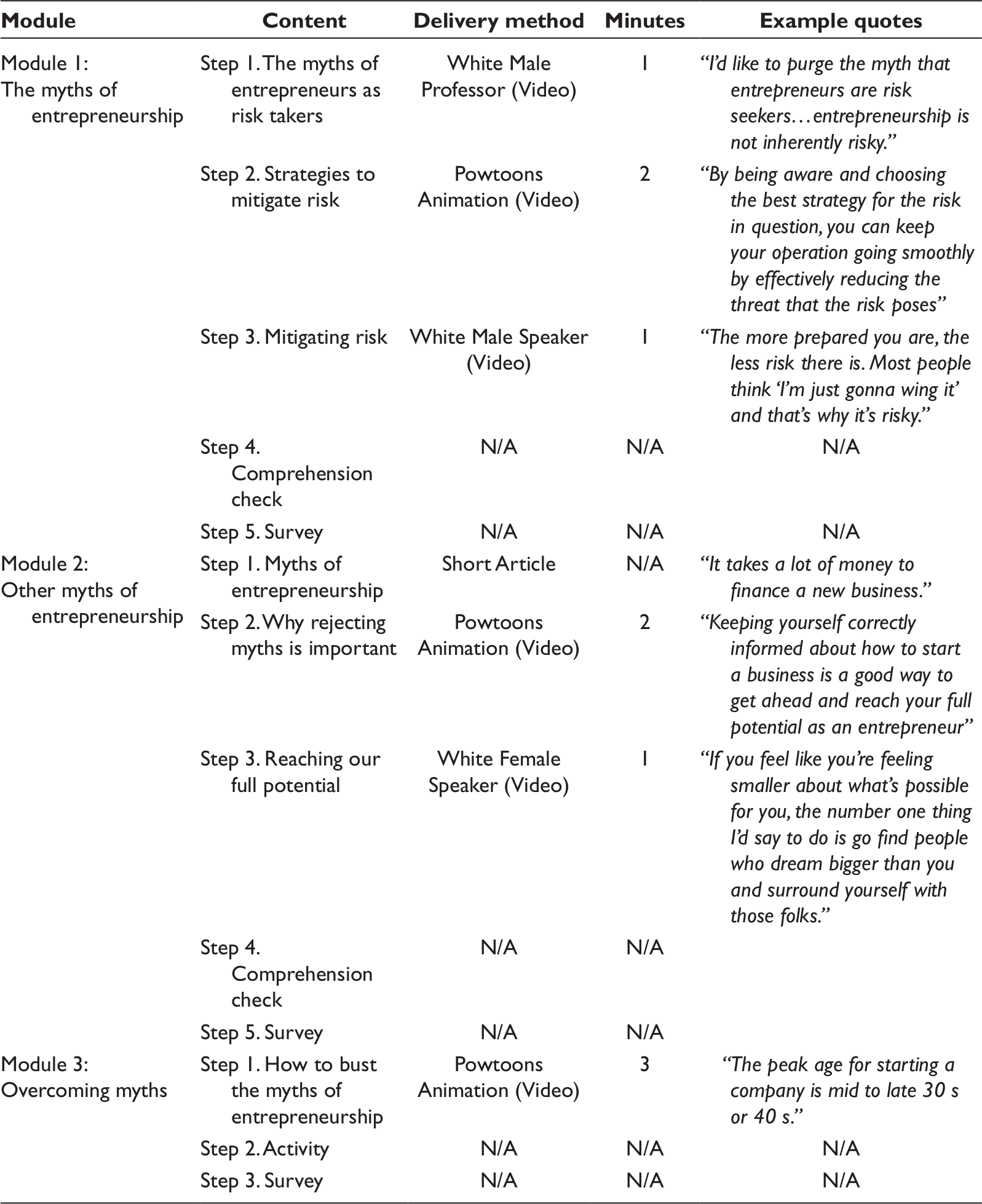
| Module | Content | Delivery method | Minutes | Example quotes |
|---|---|---|---|---|
| Module 1: The myths of entrepreneurship |
Step 1. The myths of entrepreneurs as risk takers | White Male Professor (Video) | 1 | “I’d like to purge the myth that entrepreneurs are risk seekers…entrepreneurship is not inherently risky.” |
| Step 2. Strategies to mitigate risk | Powtoons Animation (Video) | 2 | “By being aware and choosing the best strategy for the risk in question, you can keep your operation going smoothly by effectively reducing the threat that the risk poses” | |
| Step 3. Mitigating risk | White Male Speaker (Video) | 1 | “The more prepared you are, the less risk there is. Most people think ‘I’m just gonna wing it’ and that’s why it’s risky.” | |
| Step 4. Comprehension check | N/A | N/A | N/A | |
| Step 5. Survey | N/A | N/A | N/A | |
| Module 2: Other myths of entrepreneurship |
Step 1. Myths of entrepreneurship | Short Article | N/A | “It takes a lot of money to finance a new business.” |
| Step 2. Why rejecting myths is important | Powtoons Animation (Video) | 2 | “Keeping yourself correctly informed about how to start a business is a good way to get ahead and reach your full potential as an entrepreneur” | |
| Step 3. Reaching our full potential | White Female Speaker (Video) | 1 | “If you feel like you’re feeling smaller about what’s possible for you, the number one thing I’d say to do is go find people who dream bigger than you and surround yourself with those folks.” | |
| Step 4. Comprehension check | N/A | N/A | ||
| Step 5. Survey | N/A | N/A | ||
| Module 3: Overcoming myths |
Step 1. How to bust the myths of entrepreneurship | Powtoons Animation (Video) | 3 | “The peak age for starting a company is mid to late 30 s or 40 s.” |
| Step 2. Activity | N/A | N/A | N/A | |
| Step 3. Survey | N/A | N/A | N/A |
Appendix 3. Intervention details and measures.
Growth Mindset of Entrepreneurship Condition Website: Available from corresponding author.
Myths of Entrepreneurship Control Condition Website: Available from corresponding author.
Acknowledgments
We gratefully acknowledge the editorial guidance of Candida Brush as well as the three anonymous reviewers.
Declaration of Conflicting Interests
The author(s) declared no potential conflicts of interest with respect to the research, authorship, and/or publication of this article.
Funding
The author(s) disclosed receipt of the following financial support for the research, authorship, and/or publication of this article: Our work was funded by a grant from the Ewing Marion Kauffman Foundation (grant #: G-201703-1934). The contents of this publication are solely the responsibility of the authors.

Notes
Author Biographies