



Abstract
We examine the relationships between oxidative stress (i.e., manifestations of physiological stress), antioxidants, potentially negative health outcomes (i.e., triglyceride levels), and self-employment through two studies. Our results indicate that oxidative stress is associated with higher triglyceride levels and, as hypothesized, this relationship is mitigated in the presence of higher levels of antioxidants. Perhaps most interestingly, in both studies, we find that oxidative stress has a stronger positive relationship with triglyceride levels for individuals who are self-employed and have lower antioxidant levels relative to employed individuals. We discuss the implications of these findings on research regarding self-employment, stress, and well-being.
There has been increasing scholarly interest in the relationship between work and stress (Colligan & Higgins, 2006), with recent attention being given to the association between self-employment, entrepreneurial careers, and individual well-being (for a review, refer to Stephan [2018]). In a recent review of literature on the relationships between work, physical health, and mental well-being, Follmer and Jones (2018) introduce an interesting model that demonstrates how both individual and organizational factors can influence the relationship between well-being and the physical symptoms that are experienced within organizational contexts. Although substantial attention has been given to the individual and organizational factors than can influence physical symptoms as well as mental well-being within organizational settings (Follmer & Jones, 2018), relatively less attention has been given to the link between physical health and self-employment.
Self-employment has been inherently linked with stress (Rauch et al., 2018); however, the direction of this association is ambiguous. Although self-employment can be beneficial in regard to increased levels of autonomy and control (Hessels et al., 2017), the increased pressures associated with self-employment can prove detrimental to key aspects of individual health (Prottas & Thompson, 2006). Particularly, compared to individuals employed in organizational settings, self-employed individuals are known to experience higher levels of job stress, lower levels of non-work satisfaction, and higher risks for psychosomatic health problems (Jamal, 1997). Extending these lines of research, we employ biological markers for stress and the counterbalancing relationship between oxidative stress and antioxidants to examine whether this relationship is different for those who are self-employed than for those employed in other occupations.
Oxidative stress results from the generation of reactive oxygen species (ROSs) (“free radicals”) and the subsequent cellular damage that these compounds produce (Zhu et al., 2007). While these compounds are formed in large quantities as byproducts of a host of essential biochemical processes, they become problematic when present in excess. Fortunately, the body is equipped with several antioxidant mechanisms, which are enzymatic and non-enzymatic compounds that serve to counterbalance the presence of free radicals (Birben et al., 2012). However, when excess free radicals are present for a consistent and prolonged period, they can result in a host of adverse health conditions, ranging from diabetes and cancer to cardiovascular disease and neurological disorders (Reuter et al., 2010). While numerous factors can contribute to oxidative stress, such as smoking (Cano et al., 2010) and diet (Noeman et al., 2011), aspects of work can also contribute the oxidative stress process (Irie, Asami, Nagata, Miyata, et al., 2001; Sharifian et al., 2005). Furthermore, psychosocial factors, such as tension, anxiety, and fatigue, all of which are associated with self-employment, can increase oxidative stress (Irie, Asami, Nagata, Ikeda, et al., 2001; Rossner et al., 2008). To that end, in this study we attempt to examine the following research question: Are there important differences in the relationships between oxidative stress, antioxidants, and cardiovascular-related biomarkers between individuals who are self-employed and those who are employed?
In completing our study, we make the following contributions. First, we expand the growing conversation on the relationship between self-employment and individual well-being, particularly stress, and move a step forward by assessing differences in stress-related biological outcomes between employed and self-employed individuals. Our study extends upon previous findings regarding the physiological effects that individuals can experience as a result of work (Ganster & Rosen, 2013; Ganster et al., 2001; Zhang & Zyphur, 2015). Specifically, given that evidence suggests that self-employed individuals can experience higher levels of prolonged stress and that this stress can manifest in several physical health symptoms (Patel et al., 2019), we present further confirmation of the link between self-employment, manifestations of physiological stress, and potentially negative health outcomes (i.e., triglyceride levels).
Second, our results provide important insight and nuance into how antioxidants might play an important role in moderating the association between oxidative stress and negative health outcomes for those who are self-employed. Whereas the relationship between oxidative stress and triglyceride levels remained relatively consistent for employed individuals in the presence of both low and high levels of antioxidants, we report a stark increase in the positive relationship between oxidative stress and triglyceride levels for those who are self-employed when antioxidant levels are low. Because an individual’s diet is one of the primary sources of antioxidant acquisition (Giugliano, 2000; Miller & Ruiz-Larrea, 2002), our findings emphasize the importance of ensuring a healthy diet, and more importantly the potential risks associated with unhealthy diets for those who are self-employed.
Finally, we respond to recent calls to incorporate biological and physiological perspectives within management research (Wiklund et al., 2019). While some studies have employed other objective physiological stress markers, such as cortisol levels (Diebig et al., 2016) and catecholamines (Almadi et al., 2013), these individual biomarkers relate to relatively limited and narrow health outcomes. Because oxidative stress is a contributing factor for a wide range of adverse health conditions, we believe that our findings provide a wider perspective on key mechanisms that contribute to overall individual health.
Health and Oxidative Stress
Oxidation reactions are at the center of numerous degradation events, ranging from the rusting of metal to the spoiling of food, and although mammals have evolved to leverage oxygen as the basis for continued life, the processing of oxygen within our bodies can still produce potentially hazardous results (Mittler, 2002). The primary toxic byproduct of oxygen metabolism comes in the form of ROSs, also known as “free radicals.” Free radicals are chemical compounds that contain unpaired electrons, which substantially increase their ability to react with other atoms or molecules (Betteridge, 2000). Oxidative stress refers to “a disturbance in the balance between the production of ROSs (i.e., ‘free radicals’) and antioxidant defenses” (Betteridge, 2000). The sources of free radical production can vary and include damaged mitochondrial functioning (Castellani et al., 2002; Lin & Beal, 2006), over-accumulation of certain metals (e.g., copper and iron; Smith et al., 1997), and proteolysis dysfunction (Zhu et al., 2007). If left unchecked within the human body, these free radicals, which are commonly produced as a result of several biochemical processes, can interact with and severely damage healthy cells.
Fortunately, organisms have evolved several systems, both enzymatic and non-enzymatic, to combat these free radicals, the most notable of which are antioxidant defense systems (Mittler, 2002). However, at times, the pace of free radical formation can outstrip the level of antioxidants present within the body, and while temporary occurrences of such disturbances are generally not harmful, prolonged states of oxidative stress can have serious ramifications on individual health and well-being. Evidence has shown that continued oxidative stress is one of the primary antecedents of chronic inflammation, which may in turn mediate several chronic diseases. Although several factors can contribute to oxidative stress, such as smoking (Cano et al., 2010) and dietary habits (Noeman et al., 2011), certain key work factors that are closely linked to self-employment and entrepreneurial occupations have also been linked to oxidative stress.
Oxidative Stress, Antioxidants, and Self-Employment
The relationships between oxidative stress, antioxidants, and cardiovascular disease have been substantiated in previous research (Madamanchi et al., 2005; Siti et al., 2015) and research has examined the effects that work can have on oxidative stress (Irie, Asami, Nagata, et al., 2001; Sharifian et al., 2005). Furthermore, there is a considerable body of literature that has examined how work-related stress in organizational contexts can be associated with detrimental health outcomes such as high blood pressure (Ganster & Rosen, 2013, Ilies et al., 2010; Lundberg, 2005; Lundberg & Frankenhaeuser, 1999; Melin et al., 1999) and cardiovascular disease (Ganster & Rosen, 2013; Ganster et al., 2001; Matteson & Ivancevich, 1979; Schaubroeck & Merritt, 1997; Schaubroeck et al., 1994; Steffy & Jones, 1988). 1 However, although previous studies have substantiated the link between physiology and self-employment (Greene et al., 2014; Nicolaou et al., 2018; White et al., 2006, 2007) less is known about how self-employment, as a unique work context, could be related to detrimental health outcomes.
Self-employment has been inherently associated with stress (Rauch et al., 2018), and this association could increase self-employed individuals’ likelihood of experiencing detrimental health outcomes (i.e., cardiovascular disease). Furthermore, certain antioxidants (e.g., vitamin D) are associated with specific personality traits (e.g., extraversion and openness to new experiences) that are potentially linked to self-employment (Ubbenhorst et al., 2011). Therefore, while antioxidants likely help mitigate the potential health risks of oxidative stress (Mittler, 2002; Siti et al., 2015), it is possible that antioxidants’ influence on the relationship between oxidative stress and cardiovascular disease could vary between self-employed individuals and those employed in occupational settings.
Psychophysiological biomarkers are associated with workplace stressors (Chandola et al., 2010). Perceived workload has been associated with oxidative stress (Irie, Asami, Nagata, Miyata, et al., 2001), and since self-employed individuals are often viewed as having high workloads (Kolvereid, 1996a, 1996b), their oxidative stress will likely be higher as a result. Indeed, recent evidence suggests that the processes of self-employment and stress are innately linked primarily via the inherent uncertainty associated with both processes (Rauch et al., 2018). Additionally, a high workload (Shirom et al., 2009) and elevated job strain (Rau et al., 2001), are commonly linked with self-employment, can increase stress at the expense of individual health. Furthermore, psychosocial factors, such as tension, anxiety, and fatigue, can also increase oxidative stress (Irie, Asami, Nagata, Ikeda, et al., 2001) and are also associated with self-employment (Blonk et al., 2006). Self-employment and entrepreneurial careers are often associated with long work hours (Douglas & Shepherd, 2002), often resulting in a lack of sleep (Barnes et al., 2012), which can in turn increase oxidative stress (Faraut et al., 2013). All of these factors can contribute to a lower overall quality of working conditions and increased work stressors, thereby resulting in potentially negative health consequences (Melamed et al., 2001).
Although several factors could contribute to self-employed individuals being more at risk of experiencing the negative consequences of oxidative stress, one of the most potentially damaging factors to consider relates to dietary choices. It has been noted that “the characteristics of self-employment require higher investments of physical and psychological resources, which in turn results in an increased proneness to and adoption of at-risk behaviors” (Lewin-Epstein & Yuchtman-Yaar, 1991). Specifically, self-employed individuals are more likely to have poor dietary habits leading to an increased risk of obesity, diabetes, and high cholesterol (Cardon & Patel, 2015; Lewin-Epstein & Yuchtman-Yaar, 1991; Rietveld et al., 2015). This is important to note because excessive caloric intake and obesity can lead to mitochondrial dysfunction (Bournat & Brown, 2010), and oxidative stress has been shown to increase in damaged mitochondria (Genova et al., 2004; Keating, 2008; Mancuso et al., 2006). Moreover, mitochondrial dysfunction has also been shown to lead to the accumulation of triglycerides in fat cells (Vankoningsloo et al., 2005, 2006). This is important to note because triglycerides are the major form of fat stored by the body, and triglyceride levels are important to monitor because elevated levels are one of the most common precursors to certain forms of heart disease such as atherosclerosis. However, evidence suggests that antioxidants can work to alleviate a host of conditions related to mitochondrial dysfunction such as asthma (Jaffer et al., 2015), Alzheimer’s disease (Manczak et al., 2010), as well as other serious conditions (Smith & Murphy, 2011). Therefore, it is possible that the presence of high levels of antioxidants could be particularly beneficial in mitigating the risks of elevated triglyceride levels associated with oxidative stress for those who are self-employed. Specifically, if indeed self-employed individuals are more susceptible to mitochondrial dysfunction as a result of poor dietary choices, which can in turn cause elevated levels of triglycerides, then the presence of higher levels of antioxidants to help combat this condition becomes even more imperative. Based on this reasoning, we predict the following:
Study 1
Sample
For Study 1, we use the two cross-sections of the National Health and Nutrition Examination Survey (NHANES): NHANES 1999–2000 and 2001–2002. NHANES is a cross-sectional stratified probability sample of the non-institutionalized civilian population in the United States. Data are collected both through interviews and laboratory examinations. The interview component of the study focuses on collecting demographic and behavioral data, whereas the laboratory component of the study focuses on collecting serum, urine, and saliva samples. The data are released every 2 years, and the participation rate in the laboratory component is about 75%. Providing a detailed description of the sampling and data-collection procedures is beyond the scope of this work. We refer interested readers to the Centers for Disease Control’s Continuous NHANES website: https://wwwn.cdc.gov/nchs/nhanes/ContinuousNhanes/. NHANES medical surveys recruited participants who were 20 or older, so our sample includes participants between the ages of 20 and 65. Based on case-wise deletion, our sample includes 4,015 participants who were employed (N = 3,629) or self-employed (N = 386).
Measures
We use triglycerides (millimoles per liter [mmol/L]) 2 as our outcome variable. As a biomarker for oxidative stress, we use gamma glutamyl transferase (units per liter [u/L]; Lee et al., 2004; Liu et al., 2012), and for our antioxidant biomarker, we use total bilirubin (micromole per liter [μmol/L]) 3 (Stocker et al., 1987; Ziberna et al., 2016). A detailed description of the lab procedures used in the collection of these three biomarkers is provided in the biomarker data-collection procedures reported here: https://wwwn.cdc.gov/nchs/nhanes/search/datapage.aspx?Component=Laboratory. To lower the effect of outliers and to ensure the comparability of biomarkers measured on different measurement scales, we first winsorized (at 1% of each tail) and then standardized the three biomarkers.
To limit the effects of alternative explanations, we include a variety of controls. To control for the length of exposure to self-employment or employment, we include the log of the number of months the participant worked in his or her main job. We control for age because with increasing age, “free radical reactions are expected to produce progressive adverse changes that accumulate with age throughout the body,” and “such normal changes with age are relatively common to all” (Lobo et al., 2010, p. 119). 4 Physiological functioning also changes systematically with age (Taddei et al., 2001). Further, sex (1 = male, 2 = female) is associated with higher triglycerides; specifically, men are more likely to have higher triglycerides levels (Silva de Paula et al., 2005). Social support through the presence of a partner also influences triglycerides (Hemingway & Marmot, 1999), therefore, we control for marital status. Because stress experiences and biological basis of stress may vary across race we control for race.
Socioeconomic factors, specifically income and its strong predictor, education, are also associated with triglycerides (Brunner et al., 1999; Howe et al., 2010). We control for education and the poverty level of the respondent’s household. The poverty level measure is the ratio of family income to income associated with the federal poverty level guidelines for the year of the survey. To control for the potential effects of the NHANES data-collection period, we include the dummies for the year of the data collection. Table 1 lists the sample descriptives and correlations.
Study 1—Descriptives
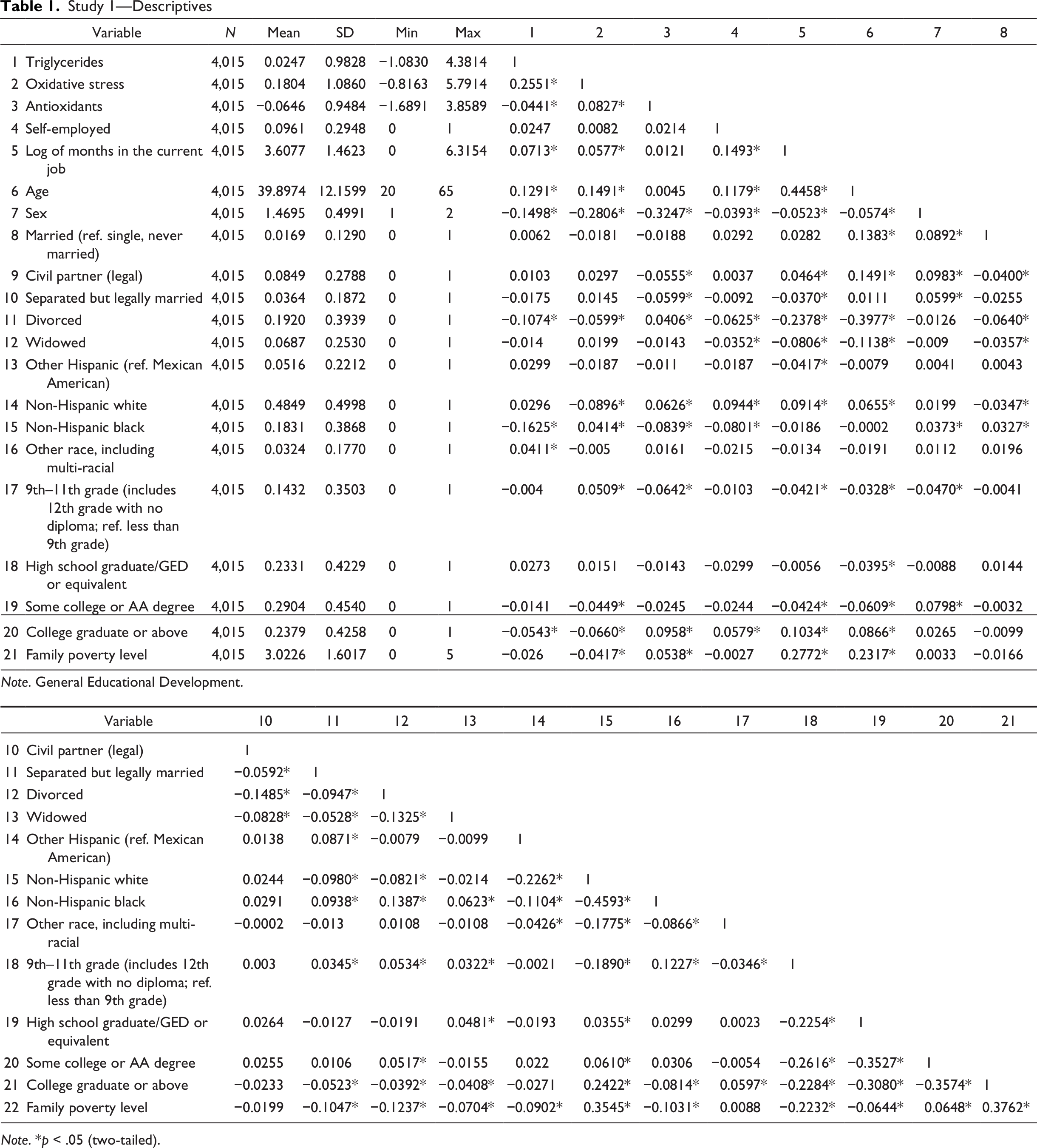
Note. General Educational Development.
Note. *p < .05 (two-tailed).
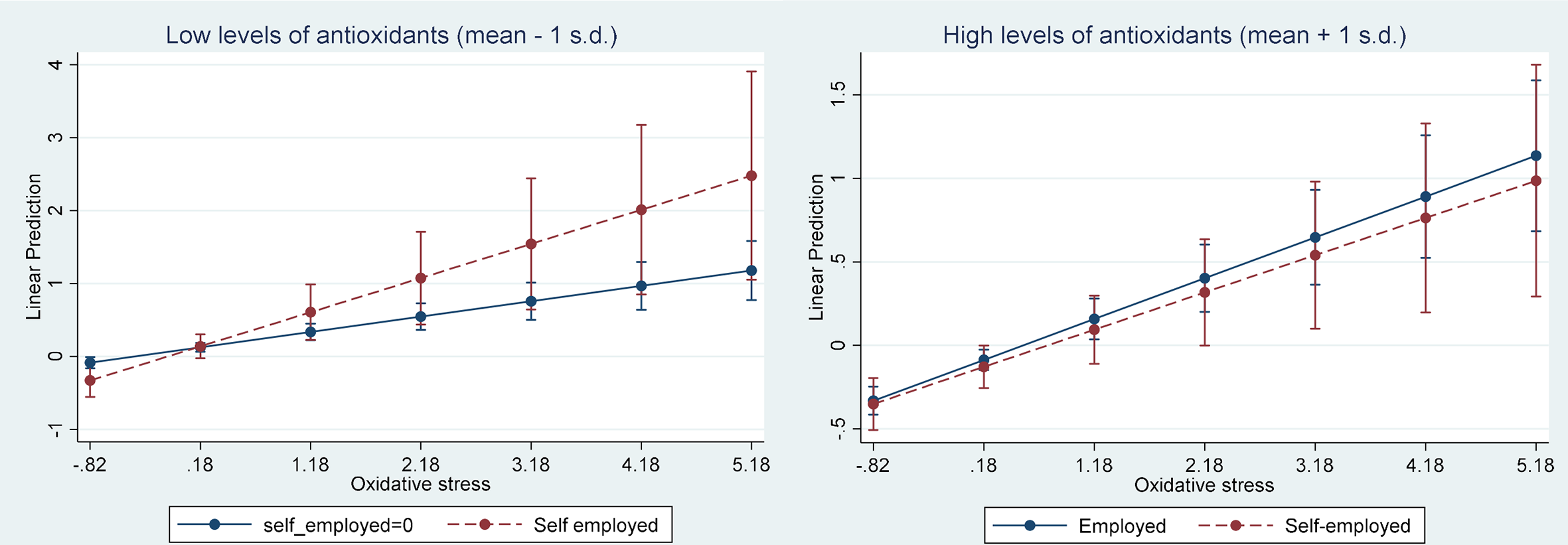
Moderation effects of oxidative stress and antioxidants under self-employment on triglycerides.
Study 1—OLS Estimates

Notes. +p < .1, *p < .05, **p < .01, ***p < .001.
Robust standard errors in parentheses.
Results
In Table 2, we present the ordinary least squares (OLS) regression estimates. Based on the NHANES guidelines, we use the sample weighting variable for participants participating in the medical exam (wtmec4yr). We start by testing the proposed hypotheses in models with and without controls. In both studies, the outcome, predictor, and moderator variables are standardized. As such, the effect sizes are interpreted as a one standard deviation increase in predictor (and, moderator) will result in the beta estimate increase of a standard deviation in the outcome.
Before testing the main hypothesis we test for the main effects. The oxidative stress (proxied as gamma glutamyl transferase [u/L]) is positively associated with triglyceride levels (in all the models the association is positive and significant). With increasing oxidative stress, at higher antioxidant levels (proxied by total bilirubin [umol/L]), triglyceride levels will be lower. However, in Models 3 and 7, the association is not significant. Hypothesis 1 proposed that the relationship between oxidative stress and triglyceride levels is stronger for individuals who are self-employed and have low antioxidant levels. The hypothesis is supported in Models 4 and 8 (Table 2). As shown in Figure 1, low antioxidant levels have a stronger influence on the relationship between oxidative stress and triglyceride levels for those who are self-employed than for employed individuals. In other words, although all occupational groups have increased triglycerides levels (positively sloping lines) with increased oxidative stress, the association is strongest for self-employed individuals with lower antioxidants levels. Interestingly, we do not see a meaningful statistical distinction between employed and self-employed individuals with higher antioxidant levels. Overall, the hypothesis is supported.
Due to considerable heterogeneity in entrepreneurial activity and the variations in ability to cope with stress, additional analysis based on education and income (proxied by poverty ratio) as additional drivers of variations in outcome variable is provided in Table A1 (Appendix). We neither find significant difference in stress with increasing education between employed and self-employed for the three-way interaction nor any differences in the outcome between employed and self-employed by varying family poverty levels.
Study 2
Systematic Replication
For the second study, we draw on the Understanding Society: Waves 2 and 3 Nurse Health Assessment, 2010–2012 (University of Essex, 2014. Registered nurses trained by the National Centre for Social Research developed the data-collection and study protocols and collected the biomarker data in Wave 2 on the The UK HouseholdLongitudinal Study (UKHLS) sample and in Wave 3 on the British Household Panel Survey (BHPS) sample. When visiting participants, nurses collected blood samples and completed direct health assessments. Because we draw on data from two cross-sections, we have a cross-sectional design. Based on case-wise deletion, our final sample includes 4,391 employed and self-employed participants.
Measures
We use triglycerides (mmol/L, unfasted) as the outcome variable. For oxidative stress, we use gamma-glutamyl transferase (u/L). As a proxy for antioxidant biomarkers, we use alkaline phosphatase (u/L; Torino et al., 2016, Valentine et al., 1954). Rich details on the assays used for these biomarkers are provided in Benzeval et al. (2014). Triglycerides levels were derived from serum samples using an enzymatic method on a Roche P module analyzer. Gamma-glutamyl transferase was measured using an enzymatic method on a Roche P module analyzer. Alkaline phosphatase was measured using the International Federation on Clinical Chemistry colorimetric Purine Nucleotide Phosphorylase method on a Roche P module analyzer.
To facilitate interpretation across different measurement scales and to lower the effects of outliers, we winsorized each biomarker at 1% on each tail and then standardized the resulting winsorized measure. Self-employed is a dummy variable, coded 1 if a participant was self-employed and 0 if a participants was employed. All other occupational statuses are dropped from the analysis.
We control for a variety of confounds that are directly associated with triglycerides. Based on Study 2, we include year of birth, sex (1 = male; 2 = female), partnered status (1 = married or civil partner [legal], 0 = single, separated but legally married, divorced, or widowed), and number of children below 15. To control for the distinct motivations of those continuing past retirement, we include a dummy for whether the participant is over 65. A portion of the sample reported an employment status despite passing retirement age. To accommodate these individuals, the dummy variable controls for the unobserved differences below and above retirement age among those active in the workforce. We include a categorical measure of education and the log of participants’ total monthly personal gross income. Further, studies have found that body mass index (BMI) is directly associated with triglycerides (Dotevall et al., 2004; Vallianou et al., 2013), therefore, we include the categories of BMI. Finally, we include two digit industry dummies, 5 occupational classification, 6 and industry × Paula, R. occupation dummies.

Moderation plots. a: Moderation effect of antioxidants on triglycerides. b: Moderation effects of oxidative stress and antioxidants under self-employment on triglycerides.
Study 2—Descriptives

Note. PGCE,.
Note. *p < .05 (two-tailed).
Study 2—OLS Regression Estimates

Notes. Robust standard errors in parentheses.
***p < .001, **p < .01, *p < .05, +p < .1.
Results
Table 3 presents the sample descriptives based on case-wise deletion. In Table 4, we present the OLS regression estimates. Based on the study guidelines, we use the sample weighting variable for participants participating in the blood sample collection (indbdub_xw).
Oxidative stress is positively associated with triglycerides (Models 1 and 5), and with increasing oxidative stress, higher antioxidant levels are associated with lower triglyceride levels (Models 3 and 7; Table 2). As shown in Figure 2a, higher antioxidant levels are associated with lower triglyceride levels. The hypothesis is partially supported in Models 4 (marginally significant) and 8 (significant; Table 4). As shown in Figure 2b, with increased oxidative stress, low antioxidant levels have a stronger association with triglyceride levels for self-employed individuals than for employed individuals. Overall, the hypothesis is confirmed in both samples.
Similar to Table A1, we replicate the analysis using education and income in Study 2. In Table A2, we find no differences in outcomes for employed and self-employed based on education and log of gross monthly income.
Discussion
The results from our studies show that at low antioxidant levels the relationship between oxidative stress and triglyceride levels is stronger for self-employed individuals. This finding could provide at least one potential mechanism explaining why previous research has suggested that self-employment might prove detrimental to individual health (Rietveld et al., 2015), particularly with regard to cardiovascular and heart-related conditions (Lewin-Epstein & Yuchtman-Yaar, 1991). Among self-employed individuals, high levels of oxidative stress are associated with elevated triglyceride levels, which are a key factor related to cardiovascular disease (Miller et al., 2011), heart attacks (Stampfer et al., 1996), and strokes (Freiberg et al., 2008). These results emphasize the need for further research into the physiological outcomes that could potentially be associated with self-employment and entrepreneurship, especially for self-employed individuals with lower antioxidant levels.
Our findings indicate that there are potentially important differences between self-employed individuals and those who are employed concerning the relationships between oxidative stress, antioxidants, and triglyceride levels. Furthermore, our findings extend research regarding the influence that physiological factors might have on the association between work and well-being (Heaphy & Dutton, 2008; Zhang & Zyphur, 2015) as well as provide an important example of how both work context and individual factors might affect the relationship between physical symptoms and individual well-being (Follmer & Jones, 2018). While we present one plausible mechanism via which the relationship between self-employment and well-being, as measured by triglyceride levels, might function (i.e., via increased risk of poor dietary and lifestyle choices), it is important to note that this relationship is embedded in a complex nomological network of physiological relationships. For instance, as noted antioxidant levels have also been shown to be associated with certain personality traits (Ubbenhorst et al., 2011), which is another important alternative to consider. Given the fact that elevated levels of triglycerides have been linked with factors related to impulsivity (Sutin et al., 2010), and that specific personality traits such as extraversion and openness to experience can potentially increase impulsivity (Shahjehan et al., 2012), there may be underlying factors associated with these relationships that must be considered in light of our results. Furthermore, recent research has also indicated that certain personality traits such as extraversion could also be linked with obesity (Michaud et al., 2017), which further substantiates the need for future research focusing on teasing out the nuances of these relationships. Finally, very recent research has suggested that there could well be a unifying, heritable, genetic factor that is at least in part responsible for both personality traits as well as poor dietary habits (Vainik et al., 2019), further emphasizing the need for future research into the underlying factors involved in these relationships, as well as the causal mechanisms that drive them.
Interestingly, although our results do not reveal a significant difference between self-employed and employed individuals at higher antioxidant levels, our findings do suggest that low antioxidant levels could be especially dangerous for those who are self-employed. While our findings support previous research regarding the effectiveness of antioxidants in mitigating the effects of oxidative stress (Davies, 2000), they add important insight into the possible risks that could occur with lower antioxidant levels, particularly for self-employed individuals. (Bouayed & Bohn, 2010). These findings extend growing research streams on the link between self-employment and individual health and well-being (Stephan, 2018; Stephan & Roesler, 2010) and emphasize the importance of maintaining a healthy lifestyle for individuals who pursue self-employment opportunities. Specifically, maintaining high levels of antioxidants via key behaviors (e.g., diet, exercise, and not smoking) could prove beneficial to ensure that the effects of oxidative stress related to self-employment are mitigated and do not develop into potentially life-threatening health conditions. Because self-employment as an occupation can be inherently fraught with higher levels of stress than could be expected from other occupations (Patel et al., 2019), it is imperative that those who pursue self-employment work to minimize other ancillary factors that could contribute to poor health and well-being. To that end, maintaining a healthy diet and lifestyle could prove uniquely beneficial to the health and well-being of those who are self-employed, in other words, poor dietary and lifestyle choices could have amplified consequences for the self-employed, as they essentially could serve to magnify the negative effects that are already possible as a result of the inherent stress associated with pursuing self-employment as an occupation.
These results further emphasize the potential importance of dietary antioxidants (Giugliano, 2000; Kaliora et al., 2006), particularly those found from natural sources, such as plants and spices (Lobo et al., 2010), and suggest that this relationship could be particularly salient for individuals who pursue self-employment. However, some caution should be employed about the use of external antioxidants as overuse can interfere with normal cellular functioning (Seifried et al., 2007) and, at extremely high levels, can prove potentially detrimental to individual health and well-being.
In conclusion, by examining the physiological and health factors among self-employed individuals, we have attempted to answer the increasing calls for incorporating more biological perspectives into management research (Heaphy & Dutton, 2008). Although there has been growing interest in the potential relationships between self-employment and specific health outcomes (Stephan, 2018; Stephan & Roesler, 2010), our study represents one of the first to examine the association between oxidative stress—a factor that has been linked to a vast array of serious health conditions (Reuter et al., 2010)—and important health outcomes. By demonstrating that oxidative stress, particularly when considering associated antioxidant levels, is significantly related to key health factors, we hope to further the ongoing conversation regarding the consequences that self-employment can have on individual health and well-being.
Limitations and Future Research
Our studies are not without limitations. First, although the data in both studies provide biomarkers that are less prone to measurement error, we rely on cross-sectional data. To our knowledge, due to the prohibitive costs of longitudinally collecting biomarkers from the same participants over time, very few, if any, studies have done so (Sobus et al., 2015). Instead, related studies have only collected basic biomarker data, such as blood pressure and glucose levels, among others, but not the broad array of biomarkers collected in our data. Moreover, these studies have generally drawn on samples from elderly individuals. For example, while a small number of biomarkers were collected for the Health and Retirement Study in the United States, the data collection started in 2003, when individuals were around the age of 65. We acknowledge that the cross-sectional data used here has limitations. We lack the longitudinal data to assess the lagged effects, and the contemporaneous effects may be less meaningful in highly endogenous biological systems. However, we hope that the findings prime further interest in relying on biomarker-based measures of stress.
Second, readers must not infer causality as only association is implied. Although we control for the major confounds and our findings are consistent in models with and without controls, complex social, demographic, and physiological processes could coalesce to influence the proposed associations. Additionally, while we present one well-established theoretical mechanism via which our proposed relationship could occur (i.e., dietary factors), we do not empirically test this specific mechanism. Future research will be needed to explicitly examine the mechanisms underlying our proposed conceptual model. Third, we draw on the measures of oxidative stress and antioxidants based on available biomarkers in the data. We call on future studies to assess the generalizability of our results for other biomarkers representing oxidative stress and antioxidants. Fourth, although the use of self-employment as a proxy for entrepreneurship has gained in popularity (Patzelt & Shepherd, 2011), this still represents an important limitation to note for our study. Future research specifically employing alternative measures of entrepreneurship will be needed to ensure the validity of our results. Furthermore, it is important to note that although we examine the self-employed as a single category, this category is indeed relatively heterogeneous concerning key factors that could substantially influence our reported results. Whether distinguishing between self-employed with and without employees, younger versus older self-employed individuals, or those in distinctly different categories with regards to access to financial, human, and social capital it will be imperative for additional future research to examine the specific variance that can occur in our proposed relationships within different self-employment subcategories.
One must note that antioxidant levels could be driven by a variety of factors, including nutritional literacy of the participant, dietary intakes, and lifestyle changes, among others. The medical exams for the datasets in both studies were not designed to select or exclude individuals around these unobservables and perhaps the bias from such unobservables as random. Nevertheless, variations in antioxidants driven by short-term dietary changes could upward bias estimates for a portion of the samples.
Finally, although we examine a key health marker—triglycerides—that is associated with potentially serious health conditions, we by no means provide an exhaustive examination of additional health consequences that could be associated with either oxidative stress or self-employment in general. Further research will be necessary to determine whether the relationships that have been discovered between oxidative stress and other health outcomes (e.g., cancer, neurological conditions, and pulmonary disease) hold within the context of self-employment. Moreover, our results present preliminary findings suggesting that the relationship between self-employment and health is highly complex, and future research will need to examine other key health indicators to tease out the potential nuances of this relationship.
Footnotes
Appendix
Study 2—Interactions with Education and Income
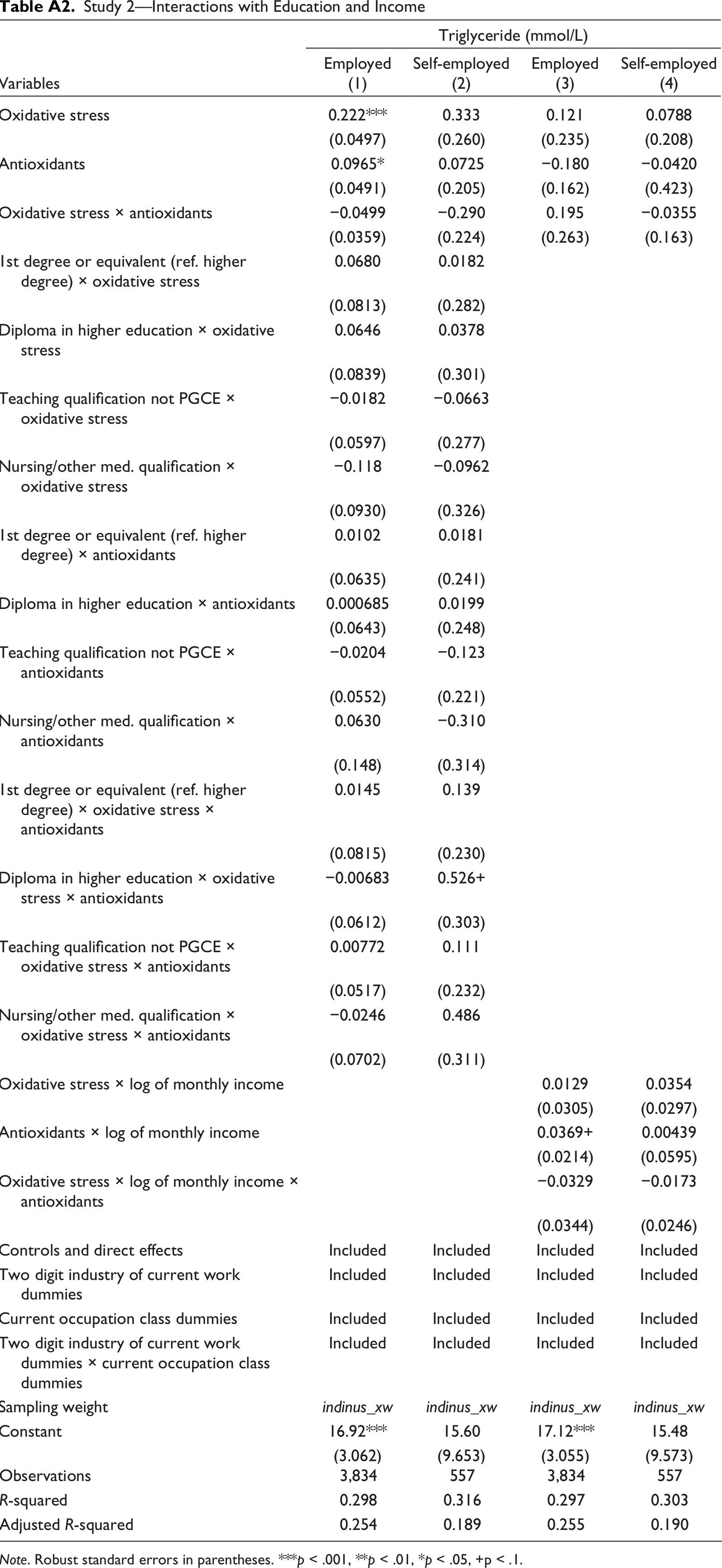
| Variables | Triglycerides (standardized and winsorized at 1% of each tail) | |||
|---|---|---|---|---|
| Employed |
Self-employed |
Employed |
Self-employed |
|
| Oxidative stress | 0.222*** | 0.333 | 0.121 | 0.0788 |
| (0.0497) | (0.260) | (0.235) | (0.208) | |
| Antioxidants | 0.0965* | 0.0725 | −0.180 | −0.0420 |
| (0.0491) | (0.205) | (0.162) | (0.423) | |
| Oxidative stress × antioxidants | −0.0499 | −0.290 | 0.195 | −0.0355 |
| (0.0359) | (0.224) | (0.263) | (0.163) | |
| 1st degree or equivalent (ref. higher degree) × oxidative stress | 0.0680 | 0.0182 | ||
| (0.0813) | (0.282) | |||
| Diploma in higher education × oxidative stress | 0.0646 | 0.0378 | ||
| (0.0839) | (0.301) | |||
| Teaching qualification not PGCE × oxidative stress | −0.0182 | −0.0663 | ||
| (0.0597) | (0.277) | |||
| Nursing/other med. qualification × oxidative stress | −0.118 | −0.0962 | ||
| (0.0930) | (0.326) | |||
| 1st degree or equivalent (ref. higher degree) × antioxidants | 0.0102 | 0.0181 | ||
| (0.0635) | (0.241) | |||
| Diploma in higher education × antioxidants | 0.000685 | 0.0199 | ||
| (0.0643) | (0.248) | |||
| Teaching qualification not PGCE × antioxidants | −0.0204 | −0.123 | ||
| (0.0552) | (0.221) | |||
| Nursing/other med. qualification × antioxidants | 0.0630 | −0.310 | ||
| (0.148) | (0.314) | |||
| 1st degree or equivalent (ref. higher degree) × oxidative stress × antioxidants | 0.0145 | 0.139 | ||
| (0.0815) | (0.230) | |||
| Diploma in higher education × oxidative stress × antioxidants | −0.00683 | 0.526+ | ||
| (0.0612) | (0.303) | |||
| Teaching qualification not PGCE × oxidative stress × antioxidants | 0.00772 | 0.111 | ||
| (0.0517) | (0.232) | |||
| Nursing/other med. qualification × oxidative stress × antioxidants | −0.0246 | 0.486 | ||
| (0.0702) | (0.311) | |||
| Oxidative stress × log of monthly income | 0.0129 | 0.0354 | ||
| (0.0305) | (0.0297) | |||
| Antioxidants × log of monthly income | 0.0369+ | 0.00439 | ||
| (0.0214) | (0.0595) | |||
| Oxidative stress × log of monthly income × antioxidants | −0.0329 | −0.0173 | ||
| (0.0344) | (0.0246) | |||
| Controls and direct effects | Included | Included | Included | Included |
| Two digit industry of current work dummies | Included | Included | Included | Included |
| Current occupation class dummies | Included | Included | Included | Included |
| Two digit industry of current work dummies × current occupation class dummies | Included | Included | Included | Included |
| Sampling weight | indinus_xw | indinus_xw | indinus_xw | indinus_xw |
| Constant | 16.92*** | 15.60 | 17.12*** | 15.48 |
| (3.062) | (9.653) | (3.055) | (9.573) | |
| Observations | 3,834 | 557 | 3,834 | 557 |
| R-squared | 0.298 | 0.316 | 0.297 | 0.303 |
| Adjusted R-squared | 0.254 | 0.189 | 0.255 | 0.190 |
Note. Robust standard errors in parentheses. ***p < .001, **p < .01, *p < .05, +p < .1.
Declaration of Conflicting Interests
The author(s) declared no potential conflicts of interest with respect to the research, authorship, and/or publication of this article.
Funding
The author(s) received no financial support for the research, authorship, and/or publication of this article.
