



Abstract
Seven cases of hematological malignancy reported in recipients of Skysona™ (elivaldogene autotemcel) have reignited long-standing concerns about insertional mutagenesis in lentiviral vector (LV)-based gene therapy. Here, we dissect the molecular and clinical evidence underlying these events, place them in the broader context of over 300 patients treated with LV-modified hematopoietic stem and progenitor cells (HSPCs), and review the real-world safety record of LV-engineered chimeric antigen receptor T cells. We show that cancers associated with Skysona are mechanistically linked to the use of a potent viral MNDU3 promoter probably combined with intensive conditioning and growth-factor support, whereas LV products employing weak or physiological promoters continue to display an excellent safety profile. With event rates <0.6/100 patient-years, lower than those after autologous HSCT, the therapeutic index of approved LV-HSPC advanced therapy medicinal products remains favorable. Ongoing optimization of vector design, conditioning, and long-term surveillance, together with emerging genome-editing platforms, is expected to further mitigate residual risk.
INTRODUCTION
The announcement in March 2024 of 7 hematological cancers among 67 patients with cerebral adrenoleukodystrophy (cALD) treated with lentiviral vector (LV)-modified hematopoietic stem and progenitor cells (HSPCs) 1,2 has once again raised concerns about the safety of gene therapy (GT). Since 2004, more than 30 GT-based drugs have obtained regulatory approval for the treatment of 12 genetic diseases, 9 of which were previously considered incurable. 3,4 Although the therapeutic benefits, particularly the balance between efficacy and safety, are well established, new data occasionally emerge that, when misinterpreted, can lead to decisions that prevent the application of these technologies in patients, detracting them from an improved quality of life. The recent report of hematological cancers in 7 of 67 patients treated with Skysona™ has prompted reassessments aimed at enhancing these therapeutic approaches. Unfortunately, recent developments have attracted significant media coverage that emphasizes the oncogenic risks associated with LVs and occasionally presenting these findings in ways that may contribute to public concern or encourage overgeneralization of these risks across all LV-based therapies. 5,6 In this review, we aim to examine in detail the underlying causes of the adverse events reported with Skysona. We assess whether these events genuinely challenge the overall safety of LV-based GTs. Drawing on published data from patients treated with other LV-modified HSPC products, we highlight this platform’s distinct therapeutic advantages over conventional care while emphasizing that findings from one GT product should not be indiscriminately extrapolated to another. Finally, we argue that, even for Skysona itself, the cumulative efficacy data show it remains the best available option for patients with cALD, particularly in its most severe forms.
LVS ARE SAFE BUT NOT RISK FREE: A MATTER OF DESIGN AND STRATEGY
Ex vivo GT often requires integrative vectors to stably transfer the therapeutic gene into the long-term repopulating HSPCs collected from the patient. To date, there are two main strategies for ex vivo modified HSPCs depending on the disease: first, to correct HSPCs to reestablish normal gene expression of the mutated gene in the different hematopoietic lineages, immune cells or red blood cells (RBCs) in the case of bone marrow failures, primary immunodeficiencies or haemoglobinopathies, respectively (Fig. 1, right); or second, to cross-correct affected tissues in metabolic disorders, by providing HSPCs-differentiated myeloid cells that express supraphysiological levels of the defective enzyme (Fig. 1, left). 7,8
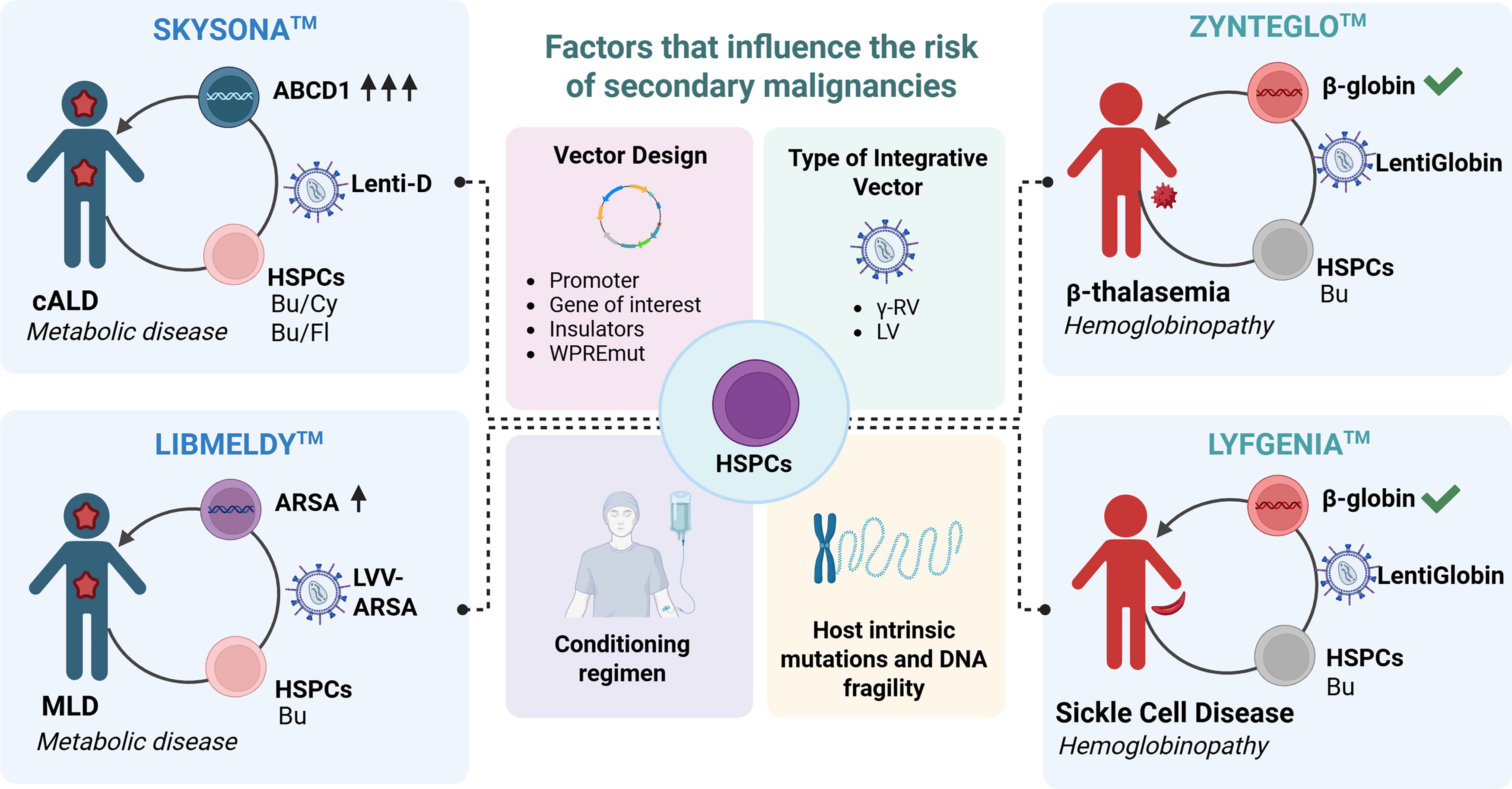
Overview of current HSPC-based lentiviral advanced medicinal therapeutic products (ATMPs) and risk factors for secondary malignancies. This figure summarizes current ATMPs based on hematopoietic stem and progenitor cells (HSPCs) genetically modified with lentiviral vectors (LVs), highlighting key factors that influence the risk of secondary malignancies. Therapies are grouped by disease type: on the left, those targeting metabolic diseases, characterized by neurological and systemic symptoms: Skysona™ (for cerebral adrenoleukodystrophy, cALD) and Libmeldy™ (for metachromatic leukodystrophy, MLD), which aim to achieve supraphysiological expression levels of the therapeutic enzyme. On the right are therapies for hemoglobinopathies, which aim to reestablish normal gene expression of the mutated gene: Zynteglo™ (for β-thalassemia) and Lyfgenia™ (for sickle cell disease). For each therapy the figure includes information on the vector used, the encoded gene, the gene expression level (high ↑↑↑↑, low ↑ or physiological ✓), and the conditioning regimen. γ-RV, gamma-retroviral vector; Bu, busulfan; Cy, cyclophosphamide; Fl, fludarabine; WPREmut, mutant woodchuck hepatitis virus post-transcriptional regulatory element. Created in BioRender. Tristán, M. (2025) https://BioRender.com/2s78m4a.
Until recently, only GT approaches employing gamma-retroviral vectors (γ-RVs) to modify HSPCs had been associated with the development of leukemias in treated patients. In the 1990s, the first clinical applications of this strategy were carried out in patients with adenosine deaminase—deficient severe combined immunodeficiency (ADA-SCID), marking an initial therapeutic success. This breakthrough catalyzed a wave of clinical trials targeting other previously incurable primary immunodeficiencies, such as Wiskott–Aldrich syndrome (WAS), X-linked SCID (X-SCID) and X-linked chronic granulomatous disease (X-CGD), all severe and life-limiting conditions affecting children. GT in these settings led to significant clinical improvements, with at least partial and sometimes sustained correction of immune function. However, in 1999, a turning point occurred when the first cases of hematological malignancies were reported in patients treated with γ-RV-based GT. These cancers were linked to vector insertions near proto-oncogenes (such as LMO2, MECOM, MDS1, or PRDM16, among others 9 ) and their enhancer-mediated activation, highlighting the genotoxic risks associated with the integration profile of γ-RV. 10 –13 All the genotoxic events occurred in patients from seven trials (Table 1): specifically, 9 WAS, 6 X-SCID, 5 X-CGD patients and 1 patient of ADA later in 2020, after the approval of Strimvelis, the first γ-RV-GT approved in Europe and with more than 40 patients treated along 10 years of follow-up. These first genotoxic cases emphasized the urgent need for safer vector systems.
Comparative Summary of Reported Genotoxic Events and in HSPC Gene Therapy Using γ-Retroviral and Lentiviral Vectors
Post-treatment with G-CSF: in parenthesis the number of patients who have been treated with G-CSF post GT.
ADA-SCID, adenosine deaminase–deficient severe combined immunodeficiency; cALD, cerebral adrenoleukodystrophy; M, myeloablative; MLD, metachromatic leukodystrophy; N, no; PYO, person-years of observation; S, submyeloblative; SCD, sickle cell disease; WAS, Wiskott–Aldrich syndrome; X-CGD, X-linked chronic granulomatous disease; X-SCID, X-linked severe combined immunodeficiency.
In response to the genotoxicity observed with earlier vectors, the field adopted third-generation self-inactivating (SIN) LVs, which exhibited a significantly safer integration profile. These vectors markedly reduce the risk of insertional activation of oncogenes while preserving, and in some cases enhancing, the therapeutic efficacy previously achieved with γ-RV. Nevertheless, in the past 2 years, up to seven cases of cancer have been reported in patients treated with LV-modified HSPCs. These cases have contributed to a growing misconception that all LV-based GTs carry an equivalent genotoxic risk. However, not all LVs are the same. While LVs integrate semi-randomly into the genome, meaning their exact insertion sites cannot be controlled, they show a consistent bias toward transcriptionally active regions and gene bodies, but unlike γ-RV, they do not preferentially target transcription start sites. 19,20 This distinct integration pattern contributes to a more favorable safety profile and supports more reliable therapeutic outcomes when compared with γ-RV.
To enhance their safety, all clinically used LVs include a mutation in the 3′ long-terminal repeat (LTR), rendering the lentiviral promoter/enhancer function inactive. This SIN configuration enables the expression of the therapeutic gene through an internal promoter, thereby avoiding the use of the native LTR promoter. 21 This modification enhances vector safety, as the original LTR promoter is very strong and, upon integration, could drive the unintended expression of adjacent host genes, a phenomenon known as transactivation. If proto-oncogenes are located near the integration site, their overexpression could increase the risk of cellular transformation and hematological cancer. Furthermore, SIN configuration also reduces the risk of generating replication-competent lentiviral particles and prevents potential interference between the lentiviral enhancer sequences and other regulatory elements incorporated within the vector itself. 22
To prevent transactivation, researchers have developed novel LVs incorporating weak-moderate or physiological promoters. Systematic head-to-head studies show that ubiquitin-C (UBC) is the weakest promoter tested across multiple cell types, with phosphoglycerate kinase (PGK) also consistently weak, whereas full-length elongation factor 1-α (EF1α), CAGG (a chimeric synthetic promoter), cytomegalovirus, spleen focus forming virus (SFFV) and the viral MNDU3 element (a modified murine retroviral promoter) are uniformly strong; the truncated EF1α variant (EFS) occupies an intermediate range. 23 –25 In LV-HSPC GT products, promoters such as PGK, UBC, EFS, β-globin, and WAS are favored because they provide adequate transgene output without measurable trans-activation of neighboring genes. 26,27 By confining expression to physiological levels and/or lineage-appropriate patterns, these promoters markedly lower insertional mutagenesis risk and underpin the excellent safety profile documented for LV-HSPC therapies. 7,28,29
Therefore, contemporary LVs for HSPC-directed GT now favor weak or lineage-restricted internal promoters rather than viral U3 derivatives strong promoters. This design choice improves safety for two primary reasons: (1) it minimizes transactivation, thereby reducing the risk of activating nearby oncogenes; and (2) it restricts gene expression in HSPCs, which helps lower the potential for genotoxic effects at the stem cell level. 30 By contrast, in the context of metabolic genetic diseases such as cALD or metachromatic leukodystrophy (MLD), there is a demand for supra-physiological levels of enzyme production by brain-homing myeloid cells. In such cases, genetically modified HSPCs act as “Trojan horses” to deliver therapeutic proteins to the target tissues. Early trials therefore employed strong promoters like MNDU3 to attain therapeutic levels, with the unintended consequence of a higher insertional-oncogenesis signal in Skysona recipients. 14,31
Another strategy to mitigate genotoxicity is the incorporation of chromatin insulators 32 –34 into the LV backbone. These elements serve dual purposes: they act as barriers against repressive chromatin domains and help prevent enhancer-mediated trans-activation of adjacent host genes. In addition, inclusion of the Woodchuck Hepatitis Virus Post-Transcriptional Regulatory Element (WPRE) can enhance transgene stability and expression while reducing the formation of aberrant or nonfunctional transcripts. 9
Despite these safety-enhancing features, including SIN configuration, weak promoters, insulators and regulatory elements, residual genotoxicity may happen. LV integration may result in loss of function when integrated into tumor suppressor genes 28 or may lead to the generation of aberrant splicing events, chimeric transcripts, or premature termination products that could alter normal cellular physiology. 35 –37 Until recently, no cancers caused by LV-mediated insertional mutagenesis had been reported, despite over 300 patients being treated with LVs-modified HSPCs with consistently favorable safety and efficacy outcomes. This was thoroughly reviewed in a 2022 meta-analysis encompassing more than 400 patients treated ex vivo with RV- or LV-modified HSPCs, summarizing two decades of GT clinical data. This analysis highlighted the superior engraftment efficiency and safer genotoxicity profile of LV-HSPC therapies compared with earlier γ-RV approaches. 7
Notably, the incidence of secondary malignancies due to LV-mediated insertional mutagenesis in GT patients using LV-modified HSPCs remains ∼2.6%, which translates to approximately 0.6 cases per 100 patient-years of follow-up across the four approved LV-HSPC-based advanced therapy medicinal products (ATMPs). This estimate is based on seven reported cases following treatment with Skysona across approximately 1,095 patient-years (data presented at the American Society of Hematology [ASH] Annual Meeting, December 2024). These events have only been observed with Skysona, which differs from the other LV-HSPC-based ATMPs primarily in the promoter used and the conditioning regimen, as will be discussed below. Importantly, this rate is significantly lower than the 4–7% incidence of secondary malignancies reported 7 years post-autologous HSPC transplantation (HSPCT), a common alternative treatment for hematological disorders. Risk may be higher in patients with preexisting immunodeficiencies or hematopoietic stress, such as those with sickle cell disease (SCD). 7,38 To date, ≈127 patients have received γ-RV HSPC GT, with 21 insertional malignancies reported (median latency ∼31 months), whereas ≈233 patients have been treated with modern SIN LV vectors, yielding 7 malignancies to date (median latency ∼48 months), all associated with the MNDU3-driven Skysona product. 7,14
Moreover, the genetic status of the starting HSPC product may also influence post-treatment clonal dynamics. Clonal expansion after GT is frequently driven by the positive selection of preexisting mutant clones rather than the emergence of de novo mutations, as observed in both HSPC and chimeric antigen receptor (CAR) T-cell settings. 31,39 Although pre-treatment screening to identify such mutations could be considered good practice, current evidence indicates that many of these preexisting clones exist at variant allele frequencies (VAFs) below the detection threshold of standard clinical sequencing approaches (typically VAF >3%), thereby limiting the practical utility of conventional screening methods. 39,40 Furthermore, there is currently no conclusive evidence that low-VAF mutations—detectable only through ultra-sensitive sequencing platforms—are associated with an increased risk of malignancy.
These findings highlight that, beyond vector design and integration derived effects, other factors also contribute to the emergence of secondary malignancies. Data from HSPCT cohorts suggest that the patient’s underlying condition, genetic susceptibility, and the conditioning regimen, particularly the dose and type of chemotherapy (e.g., busulfan), play critical roles in oncogenesis 38,41,42 (Fig. 1).
THE SKYSONA CASE
cALD is a devastating metabolic disease in which high expression of the therapeutic gene in HSPCs is required for effective disease correction. To achieve this, the first clinical GT trial for cALD used a strong viral promoter (MNDU3), similar in strength to those used in early γ-RV. In this initial proof-of-concept, single-center study, two patients demonstrated marked clinical benefit with no safety concerns, encouraging results in the context of a fatal condition. 43 Building on this success, the same vector was used in the development of Skysona (elivaldogene autotemcel). In 2017, results from the ALD-102 trial involving 17 patients showed promising clinical outcomes with no serious adverse events over 21 and 42 months of follow-up. 31
However, by 2024, after treatment of a total of 67 patients across two clinical trials (ALD-102 and ALD-104), seven cases of hematological malignancies have been reported. These tens of cases are currently being monitored in the integrated long-term follow-up study (LTF-304) (ClinicalTrials.gov numbers are NCT01896102, NCT03852498, and NCT02698579, respectively) with reported oligoclonal integrations in MECOM locus among others (PRDM16, SMG6, SLCA16, INO80 and more) in all the patients that developed leukemia and the presence of somatic mutations (KRAS, NRAS, WT1, CDKN2A/B, or RUNX1) in six out of seven patients with leukemia, while one patient had chromosome 7 monosomy. Of interest, 66 of 67 treated patients exhibited LV integration into the MECOM locus, whose integration pattern did not differ between patients with sustained polyclonality versus those with persistent oligoclonality and/or cancer. 14 However, the fraction of insertions into MECOM and its close homologue PRDM16 was significantly higher in the patients involved in the ALD-102 and ALD-104 studies than in the patients involved in the clinical studies of Zynteglo™ and Lyfgenia™ (Table 1, Fig. 2), also sponsored by Bluebird Bio, which highlights the importance of LV design. 14
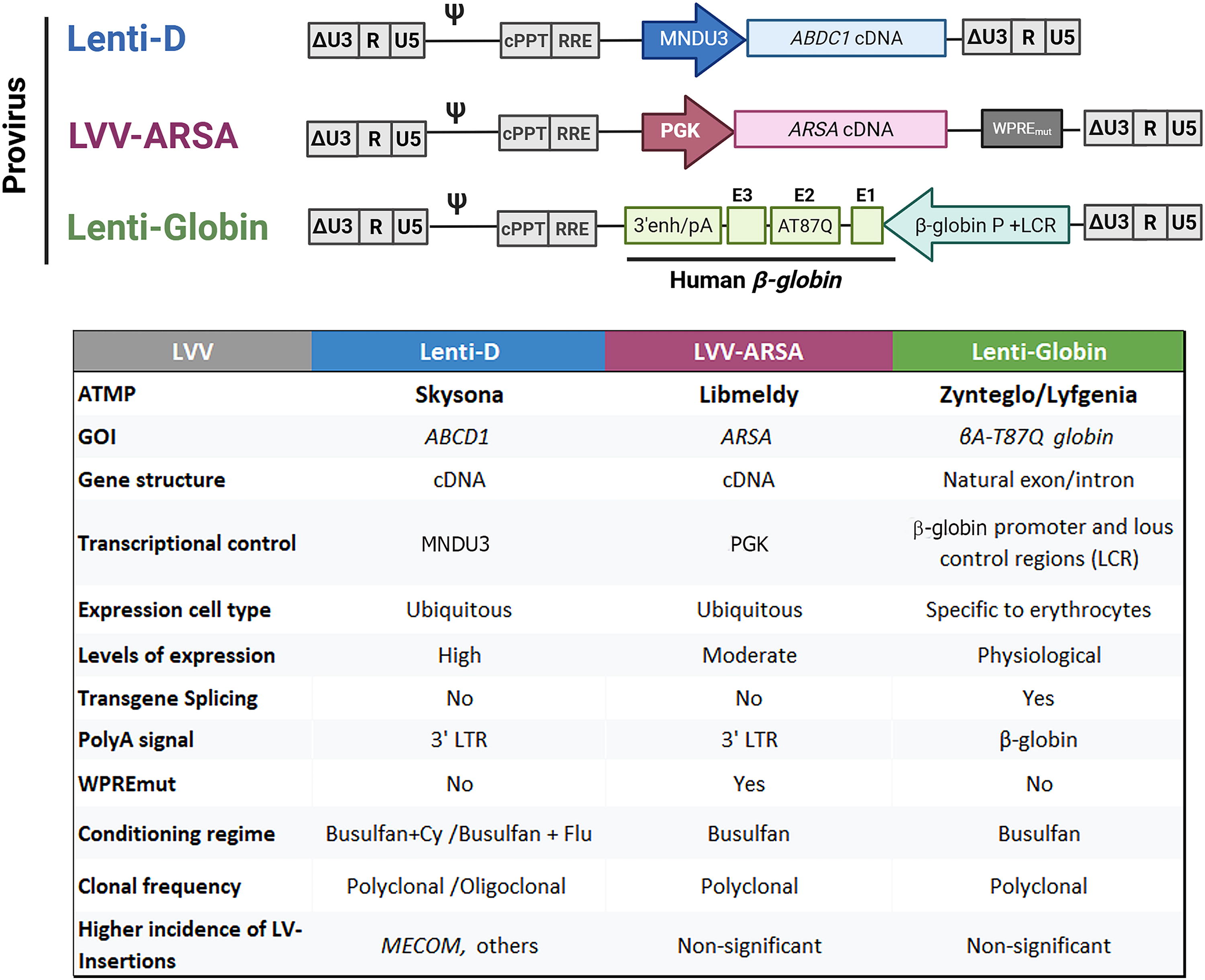
Graphical representation and characterization of LV proviral structure used in HSPC-based lentiviral ATMPs. Top panel: schematic diagrams of the three LVs used for the generation of the Skysona (Lenti-D), Libmedly (LV-arylsulfatase A [ARSA]), Zynteglo, and Lyfgenia (LentiGlobin). Bottom panel: table summarizing key structural elements and features of each LVs, including regulatory elements, gene cassettes and safety modifications. Source information derived from the European Medicines Agency (EMA) public assessment reports for Skysona and Libmeldy and from relevant scientific literature: Skysona EMA Report, Libmeldy EMA Report, Blood Advances Article; FDA Document: Introduction — June 9, 2022, Afternoon Lentiviral Vector Safety. cPPT, central polypurine tract; E, exon; GOI, gene of interest; LCR, locus control region; pA, polyadenylation signal (polyA); RRE, rev response element. Part of the figure was created in BioRender. Tristán, M. (2025) https://BioRender.com/mpn4zu4.
In addition, six of the seven cancers occurred in patients from the ALD-104 trial and one in ALD-102, with time to onset ranging from 14 to 92 months post-treatment. 14,44 Although patients in the ALD-102 trial have been followed for a longer period, the incidence of cancer in this cohort has remained lower, despite using the same therapeutic vector. This observation shifts the focus on the preparative chemotherapy used in the ALD-104 trial (busulfan plus fludarabine), which was designed to facilitate the engraftment of LV-HSPCs and may exert a synergistic oncogenic effect when combined with the use of a strong promoter. In addition, granulocyte-colony-stimulating factor (G-CSF) is commonly administered to patients to enhance neutrophil recovery following HSPCT or chemotherapy. In the ALD-104 clinical protocol, G-CSF administration is initiated after day 5 post GT. Emerging evidence suggests that the use of G-CSF after ex vivo GT-HSPCs can amplify proliferative stress. 45 Therefore, further studies should be performed to determine its potential toxicity in the context of GT clinical trials.
Despite these recent safety concerns, it is important to emphasize that clinical outcomes in patients with cALD remain highly favorable. In the ALD-102 trial, at a median follow-up of 6 years post ex vivo GT with LV-modified HSPCs, 81% of early-stage cALD patients treated with Skysona exhibited no meaningful functional impairments. Additionally, with follow-up extending to 8.9 years, the overall survival rate reached 94%. 44 In contrast, untreated patients with cALD typically follow a devastating course, marked by rapid cognitive and neurological decline, often leading to premature death within a decade of diagnosis. 46 While allogeneic HSPCT remains the standard of care, its application is limited by donor availability and risks such as graft failure, graft-versus-host disease, and complications arising from chemotherapy and immunosuppression—all contributing to considerable treatment-related morbidity and mortality. 42
The durable therapeutic effects of HSPCT in cALD are believed to result from the engraftment of donor-derived myeloid cells—potentially including microglia—within the central nervous system (CNS). 47,48 The election of a strong promoter for Skysona may be key to its efficacy, as high expression of the therapeutic gene ABCD1 is required in these myeloid-derived cells 49 to produce sufficient ALD protein and reduce toxic accumulation of very-long-chain fatty acids in cerebral white matter. However, neither allogeneic HSPCT nor GT seems to halt the progression of white-matter lesions within the first 12–18 months following treatment, 50,51 highlighting the necessity for robust transgene expression during this critical window.
In summary, the Skysona case highlights both the transformative potential and the safety inherent complexities of ex vivo LV GT for cALD. While the use of a strong promoter has proven crucial for robust expression of ABCD1 gene and achieving therapeutic benefit, emerging evidence of hematological malignancies underscores the importance of continued monitoring, refinement of vector design, optimization of conditioning regimens, and careful post-treatment management to ensure long-term safety.
APPROVED ATMPs FOR EX VIVO GT WITH LV-MODIFIED HSPCs
In contrast to Skysona, GTs based on LV-modified HSPCs using weak or physiological promoters have demonstrated a markedly improved safety profile. To date, around 300 patients have been treated in clinical trials with this vector design, across a range of genetic diseases. The cumulative data consistently show no genotoxic event in any of the patients and sustained clinical benefit, reinforcing the validity of weak promoter strategies in reducing genotoxic risk while maintaining therapeutic efficacy.
This strong clinical foundation has led to the regulatory approval of four ATMPs that combine the use of HSPCs and LVs for different diseases and strategies: Skysona, Libmeldy™, Zynteglo, and Lyfgenia. We provide a comparative overview of these four ATMPs, summarizing the disease indications and treatment strategies, stating all the factors (Fig. 1) that may be involved in the occurrence of hematological cancers (type of vector and conditioning regimen; Fig. 2), the side effects observed and the therapeutic benefits for patients:
Skysona for the treatment of cALD
Skysona (elivaldogene autotemcel, eli-cel) was approved in 2021 by the European Medicines Agency (EMA) for the treatment of early cALD in patients under 18 years of age with a genetic mutation in ABCD1 and for whom a matched sibling donor of HSPCs is not available. This ATMP is no longer authorized in Europe because bluebird bio, the marketing authorization holder, voluntarily withdrew it. The withdrawal, which took effect on November 18, 2021, was not due to safety or efficacy concerns but rather commercial reasons—specifically, the company decided not to market the product in Europe. 52
Disease description
cALD affects nearly 35% of boys with adrenoleukodystrophy before they reach adulthood. This X-linked metabolic disorder results from pathogenic variants in the ABCD1 gene, which impair the function of the peroxisomal transporter adenosine triphosphate (ATP)-binding cassette subfamily D member 1 (ABCD1 or ALD protein), leading to the accumulation of saturated very-long-chain fatty acids. 53 The buildup of these fatty acids triggers progressive inflammation and demyelination in the white matter, ultimately causing cognitive and neurological decline. Symptoms related to learning and behavior in cALD typically appear between the ages of 3 and 15 years, with a median onset at 7 years. Without allogeneic HSPCT, most patients succumb to the disease within 10 years of diagnosis. 46
Conditioning
Busulfan + cyclophosphamide (ALD-102 clinical trial) or busulfan + fludarabine (ALD-104 clinical trial): this regimen of 16 doses during 4 days (0.8–1.1 mg/kg), with an estimated area under the concentration-time curve (AUC) ≈70–86 mg·h/L, is considered myeloablative standard. 54
Lentiviral vector
Lenti-D (SIN LV vector) is encoding the ABCD1 cDNA under the control of a strong viral promoter and enhancer from the MLV virus (MNDU3) to produce ALDP (Fig. 2).
Posology
The minimum recommended dose of Skysona is 5 × 10⁶ CD34+ cells/kg. In clinical studies doses up to 38.2 × 10⁶ CD34+ cells/kg have been administered.
Post-administration treatment with G-CSF
After Skysona administration, 24 of 32 patients received G-CSF according to investigator discretion and institutional guidelines in ALD-102, and in ALD-104, patients were required to start G-CSF from day 5 post-treatment.
Therapeutic benefits
Long-term follow-up of patients treated in the ALD-102 trial shows that out of a total of 29 patients monitored, none of them had significant functional impairment 24 months post-treatment and overall survival was 94%. In the most current assessment, at a median follow-up of 6 years, 26 of 32 patients (81%) remained free of major functional impairment, with a follow-up duration of nearly 9 years in two patients. In the subsequent phase III trial, ALD-104, all 35 patients included have completed the 2-year follow-up and are now included in the long-term follow-up LTF-304 study. 44 These results improve on the 5-year overall survival for untreated patients from the time of diagnosis (55%) and with those obtained by HSPCT (78%), that is, the standard of care. 55 Furthermore, HSPCT is restricted by the scarcity of sufficient human leukocyte antigen (HLA)-matched donors:HLA-matched sibling donors are linked to improved survival outcomes compared to unrelated donors, which are available for fewer than 20% of patients. 56 Additionally, approximately 18% of patients experience engraftment failure after their initial HSPCT, alongside the persistent risk of graft-versus-host disease. 55
Side effects
The observed adverse events aligned with those expected from HSPCs collection procedures and conditioning regimen. In addition, seven patients have developed hematological cancers: six myelodysplastic syndrome (MDS) and one acute myeloid leukemia (AML). Five patients with MDS underwent allogeneic HSPCT, of which four remain MDS-free and one patient died of presumed post-transplant graft-versus-host disease. The patient with AML is alive and had complete donor chimerism after allogeneic HSPCT. The most recent case of MDS is alive and awaiting transplantation. 14
Balance
Taken together, these data support that Skysona is still the best alternative for patients with severe cALD, demonstrating an 81% probability of 4-year event-free survival, defined as absence of severe functional deficits, hematological cancer, and need for allogeneic HSPCT. On the contrary, they also indicate the imperative need to develop safer LVs and/or other alternatives such as genomic editing 57 that could reduce the risk of cell transformation in addition to the detailed study of the role of the conditioning used.
Libmeldy for the treatment of MLD
Libmeldy (atidarsagene autotemcel, arsa-cel), marketed as Lenmeldy in the United States, received approval from both the Food and Drug Administration (FDA) in 2020 and the EMA in 2024 for treating MLD, in children and juvenile with presymptomatic or early-onset appearance of the disease who previously had no treatment options beyond supportive and end-of-life care. Libmeldy is the only approved treatment for MLD. The mechanism of action is similar to the previous case of Skysona, where repaired HSPCs differentiate into multiple cell types, including microglia, to provide functional enzymes to the damaged tissues (including the CNS) to prevent or slow disease progression.
Disease description
MLD is a fatal lysosomal storage disorder. It is caused by a deficiency of the enzyme arylsulfatase A (ARSA) due to biallelic disease-causing variants in the ARSA gene. This enzymatic deficiency leads to the buildup of sulfatides in both the central and peripheral nervous systems, triggering progressive demyelination, neuroinflammation, and neurodegeneration. Sulfatides also accumulate in internal organs such as the gallbladder, which may elevate the risk of developing malignant tumors. 58 MLD presents a wide and variable clinical spectrum, typically classified by age at symptom onset: late-infantile (≤30 months), early juvenile (30 months–6 years), late juvenile (7–16 years), and adult (≥17 years). Early onset (<7 years), particularly with motor symptoms, is linked to faster and more severe disease progression. 59 There is a significant need for effective treatments, particularly for this subset of patients, for whom HSPCT is poorly efficient in stopping the peripheral demyelination progression and care is mostly palliative. 60
Conditioning
Busulfan: two different regimes were assayed in the clinical trial: sub-myeloablative (67 mg *h/L, 45% of the patients) and a high dose (85 mg *h/L, 55% of the patients), with no noticeable differences in engraftment efficacy, transduction, or safety.
Lentiviral vector
SIN-LV encoding ARSA cDNA under the control of the moderate human promoter PGK (Fig. 2).
Posology
The minimum recommended dose of Libmeldy is 3 × 10⁶ cells CD34+/kg of corporal weight. In clinical studies doses of up to 30 × 106 cells CD34+/kg have been administered.
Post-administration treatment with G-CSF
Five of 29 patients received G-CSF between 28 and 118 days after Libmeldy GT because of neutropenia. Additionally, neutrophil engraftment following busulfan conditioning appears to occur more slowly in MLD patients treated with Libmeldy than what is reported in the Summary of Product Characteristics for busulfan and Zynteglo.
Therapeutic benefits
In a combined analysis of 39 children with MLD treated with Libmeldy and 49 untreated controls from clinical trials NCT01560182 and NCT03392987, Libmeldy showed significant therapeutic benefits. With a median follow-up of 6.76 years (range: 0.64–12.19), the risk of severe motor impairment or death was substantially lower in treated patients. At 6 years of age, 100% of children with presymptomatic late-infantile MLD treated with arsa-cel survived without severe motor impairment, compared with 0% in the untreated group. For early-juvenile MLD, 87.5% of presymptomatic and 80% of early-symptomatic treated patients remained free from severe motor impairment at 10 years, versus 11.2% in the untreated group. Recently, data from another phase III trial (NCT04283227) (ASGCT, 2025) reported six children treated: four presymptomatic and two early-symptomatic, all were alive after a median follow-up of 27.8 months (range: 12.6–34.3 months). Five patients remained neurologically stable, while one early-symptomatic patient experienced disease progression shortly after GT, followed by stabilization up to 30 months post-treatment. 15
Side effects
In addition to those expected from HSPC collection procedures and the conditioning regimen, the most common adverse reaction attributed to Libmeldy treatment was the appearance of anti-ARSA antibodies. Transient anti-ARSA antibodies appeared in 15% of treated patients. No cases of insertional oncogenesis or vector-related malignancy were observed, and the three reported deaths were deemed unrelated to treatment. 15
Balance
Taken together, these data show Libmeldy as the single greatest therapeutic option for patients with MLD.
Zynteglo for the treatment of β-thalassemia
Zynteglo (betibeglogene autotemcel, beti-cel) was approved in 2022 by the FDA to treat the patients with transfusion-dependent β-thalassemia (TDT) who require regular RBC transfusion. In Europe, Zynteglo was granted conditional marketing authorization in 2019, but this authorization is no longer continuing for commercial reasons. Zynteglo works by adding functional copies of a modified form of the β-globin gene (βA-T87Q-globin gene) into the patient’s own HSPCs to enable the production of a modified functional adult hemoglobin (HbAT87Q). Once a patient has the βA-T87Q-globin gene, they have the potential to increase Zynteglo-derived adult hemoglobin (HbAT87Q) and total hemoglobin to normal or near normal levels that can eliminate the need for regular RBC transfusions.
Disease description
β-thalassemia is a diverse group of inherited autosomal recessive anemias marked by a partial or complete deficiency in β-globin chain production due to mutations in the HBB gene 61 that leads to an excess of uncoupled α-globin chains. The severity of the disease is primarily determined by the extent of excess α-globin chains, which accumulate in RBC precursors and lead to mechanical and oxidative damage, resulting in ineffective erythropoiesis. Patients lacking β-globin production experience a more severe disease course, often presenting between 6 and 24 months of age with severe anemia, growth delays, and organ damage. 61 These individuals, diagnosed with TDT, require lifelong transfusions every 2–5 weeks and have reduced life expectancy. Chronic transfusions lead to iron overload, causing complications like liver dysfunction, pulmonary hypertension, and cardiac issues, which are managed with iron chelation therapy. 62 HSPCT remains the only curative option but is limited to patients under 14 with an HLA-matched sibling donor—available to fewer than 25% of TDT patients. 63
Conditioning
Busulfan, with a cumulative AUC ≈60–75 mg·h/L, which is considered a standard fully myeloablative regimen: the planned dose of busulfan was 0.8 or 3.2 mg·kg/day for patients younger or 18 years and older, respectively, for a total of 16 doses.
Lentiviral vector
LentiGlobin: SIN-LV encoding the modified β-globin gene containing the T87Q mutation (βA-T87Q), including exons (exon 1–3) and introns under the control of the β-globin promoter and local regulatory zones in antisense position. This configuration enables an erythroid-specific expression, enhancing safety by preventing transcription in HSPCs. It also incorporates the β-globin polyadenylation signal to ensure proper termination of the transcript (Fig. 2).
Posology
The minimum recommended dose is 5 × 10⁶ cells CD34+/kg. In clinical studies doses of up to 20 × 106 cells CD34+/kg have been administered. The minimum recommended dose is the same for adults and adolescents 12 years-old and older.
Post-administration treatment with G-CSF
G-CSF was administered to 14 of 45 patients within 21 days following Zynteglo infusion in clinical trials. In phase III studies, G-CSF use was not recommended for 21 days after GT infusion to avoid interference with engraftment.
Therapeutic benefit
Data presented at the 66th ASH Annual Meeting (December 2024) in San Diego (USA) showed that a total of 63 patients had received Zynteglo across all clinical trials (cutoff February 2024) with a follow-up of 5 years (51 patients) and 10 years (2 patients) (Table 1). The phase III trial indicates that 90.2% (37/41) of treated patients achieved transfusion independence and importantly, the 75.7% of these improved patients are no longer undergoing iron chelation therapy. In the same line, 15/22 (68.2%) infused in the phase I/II studies achieved transfusion independence. 16
Side effects
The main serious adverse reactions (in 37% of patients) were not due to the LV but due to the conditioning necessary to make room for transplantation of the modified HSPCs. At the time of monitoring, no malignancies or insertional oncogenesis were reported.
Balance
Taken together, these data show Zynteglo as a very good therapeutic option for patients with TDT.
Lyfgenia for the treatment of SCD
Lyfgenia (lovotibeglogene autotemcel, lovo-cel) was approved by the FDA on December 8, 2023, for the treatment of patients aged 12 years and older with SCD and a history of vaso-occlusive events (VOEs). In Europe, Lyfgenia has not been reviewed by the EMA, as bluebird bio has prioritized its commercialization efforts in the U.S. market. Lyfgenia is a GT that introduces functional copies of the βA-T87Q-globin gene into the patient’s own HSPCs using a LV, the same vector as Zynteglo. This leads to the production of HbAT87Q, an anti-sickling form of hemoglobin that reduces the polymerization of sickle hemoglobin, thereby decreasing hemolysis and other symptoms associated with SCD. 64
Disease description
SCD is a hereditary group of disorders caused by mutations in the HBB gene, which encodes the β-globin subunit, and follows an autosomal recessive pattern of inheritance. This mutant hemoglobin can polymerize, causing RBCs to sickle and undergo hemolysis. 65 Children with SCD are usually diagnosed around the age of 6 months, when fetal hemoglobin stops to be produced. 66 Typical symptoms of the disease are progressive vasculopathy and chronic hemolytic anemia, which are linked to health complications and a higher likelihood of premature death. Acute complications include pain crises, acute chest syndrome, and stroke, and chronic issues can affect multiple organs. 67 While treatments like hydroxyurea and transfusions help manage symptoms, the only current cure is HSPCT, which is limited by compatible donors’ availability and has several associated risks. 68
Conditioning
Busulfan: the recommended initial dose of busulfan is 3.2 mg·kg/day for 4 consecutive days as a 3-h infusion for a total of 4 doses with a cumulative AUC ≈72.2–88.7 mg·h/L, which is considered as the myeloablative standard.
Lentiviral vector
LentiGlobin (same as Zynteglo) (Fig. 2).
Posology
The minimum recommended dose is 3 × 10⁶ cells CD34+/kg. In clinical studies doses of up to 14 × 106 cells CD34+/kg have been administered.
Post-administration treatment with G-CSF
Four of 45 patients from HGB-206 clinical trial (NCT02140554) received G-CSF following treatment with Lyfgenia and prior to neutrophil engraftment and recovery. G-CSF is not recommended for 21 days after Lyfgenia infusion.
Therapeutic benefit
According to the data presented in the 66th ASH Annual Meeting (2024) and company press release, 17,18 so far, there are data on 58 people with SCD treated with a median follow-up duration of 47.7 months (4.0 years) (Table 1); 86.8% of treated patients had no VOE (33/38) and 94.7% no severe VOEs.
Side effects
The safety of the Lyfgenia treatment regimen for SCD largely reflected the known side effects of the HSPCs collection procedures, the busulfan conditioning regimen, and the underlying disease. Although two cases of hematological malignancies have been reported in this context, available evidence does not implicate LVs as the underlying cause. In fact, in one case, the involvement of the LV was ruled out due to the absence of LV integration. In the second case, although LV integration was detected, further analysis excluded its role in the malignant transformation, 38 based on the integration site’s genomic location and the lack of effect on neighboring gene expression. The findings instead pointed to busulfan conditioning and preexisting mutations as more likely contributors to this second leukemia.
Balance
Taken together, these data show Lyfgenia as a very good therapeutic option for patients with SCD.
LESSONS FROM LV-BASED ADVANCED THERAPIES: THE CAR T EXPERIENCE
While clinical data from patients treated with LV-modified HSPC therapies continue to accumulate, LV-engineered, particularly CAR T cells, represent the most extensive body of evidence in LV-based GT to date. Since the emergence of CAR T-cell therapy as a disruptive cancer treatment, nearly 2,000 clinical trials have been registered globally (https://clinicaltrials.gov/) and 7 ATMPs have gained approval, 5 of which were developed using LVs.
Although T cells and HSPCs differ significantly in their biology and associated oncogenic risks, the broad clinical experience with LV-engineered T cells offers valuable insights into the long-term safety of this GT platform. 69 In December 31, 2023, the United States had been notified of 22 cases of T-cell malignancies following CAR T therapy. Among these, only three cases involved detection of the CAR transgene in the malignant clone, raising concerns about a potential contribution of the genetic modification to cancer development. 70 Additional isolated cases have been reported, with some T-cell lymphomas testing positive for the CAR transgene with both γ-RV or LV-CAR products. However, in-depth investigations have frequently revealed preexisting mutations in tumor suppressor genes or alternative oncogenic mechanisms unrelated to vector insertion as likely drivers of these malignances. Indeed, the majority of those novel T-leukemia reported cases—the pathogenesis was probably caused by multiple genetic aberrations—already present in a preexisting T cell clone of the infusion product. 9
Extensive data support that to date, secondary T-cell malignancies directly attributed to insertional mutagenesis from LV-modified T-cell therapies remain exceedingly rare. This is supported by large clinical programs: the University of Pennsylvania (n = 783) and Stanford University (n = 724), both reporting no confirmed cases of malignancy linked to LV integration. 9,70,71 Similarly, independent evaluations by the Paul Ehrlich Institute in Germany (n = 2,500) 72 and the DESCAR-T registry in France (n = 3,066) 73 each identified only one case in which the CAR construct was detected in a malignant clone, raising the possibility, though not confirming, a role for vector-mediated insertional mutagenesis. Lastly, a meta-analysis that searched reports of non-relapse mortality after CAR T cell therapy, which analyzed 7,604 patients across 46 studies, found zero deaths secondary to T-cell lymphoma. 74
Importantly, the incidence of secondary malignancies among CAR T–treated patients appear comparable with that observed in patients receiving conventional standard-of-care therapies, many of which these individuals had previously undergone. This observation reinforces the notion that the overall risk profile of CAR T therapy is not significantly higher than that of existing oncologic treatments. It also suggests that pre-treatment factors, such as prior therapeutic exposures, baseline immune dysfunction, and underlying genetic susceptibility, may contribute more substantially to the development of post-treatment malignancies than the LV-based CAR construct itself. 75 Considering the higher risk of post-treatment malignancies due to prior exposure to cytotoxic chemotherapy, using CAR T as a first-line treatment may help to reduce the incidence of secondary malignancies. In this context, the emerging experience with CAR T-cell therapy for autoimmune diseases is particularly informative, as no prior oncologic treatment or underlying malignancy is present before CAR T infusion. This group of cancer-naïve patients offers a valuable opportunity to better understand long-term GT-associated genotoxicity in the absence of confounding oncologic factors. However, other challenges may arise, such as increased risk of infections or potential cancer malignancy due to immune system impairment or B cell depletion. 76 The risk of insertional mutagenesis differs significantly between HSPC and CAR T cells. For HSPCs, the reported incidence of insertional mutagenesis-related complications is approximately 2.6%, whereas for secondary T-cell lymphomas following CAR T therapy, not even proven to be caused by insertional mutagenesis, the incidence is much lower, around 0.06%. 77 Therefore, while some risk factors are similar between LV-HSPCs and CAR T cells (such as conditioning regimens, genetic predisposition, and the type of viral vector used), the impact of vector design differs considerably. HSPCs exhibit greater plasticity compared with lineage-committed T cells, often require higher multiplicity of infection (MOI), and need long-term persistence to achieve therapeutic benefit. 9 These biological differences make vector design and promoter selection especially critical in controlling risk for LV-modified HSPCs, as they can originate lineage-committed expression, which reduces plasticity and impact on the required MOI.
DISCUSSION
Recent concerns regarding the safety profile of LV-mediated GT have been raised by the Skysona case. In that instance, the therapeutic LV included a potent viral enhancer-promoter, designed to achieve high transgene expression. However, the inclusion of this strong regulatory element also increases the risk of insertional activation of nearby cellular genes, a well-known mechanism underlying insertional mutagenesis, providing a 10.4% (7/67 patients) of malignancy incidence near to 17.8% (21/118) of reported γ-RV clinical trials, which, apart from their preferential integration profile, γ-RVs provide high levels of the transgene 7 (Table 1).
This stands in sharp contrast to the strong safety and efficacy profile observed in LV-based GT using weak or physiological promoters. Robust clinical and real-world data support their high therapeutic potential and favorable risk–benefit ratio of these strategies. In fact, based on outcomes from numerous trials, LV-modified HSPC GT is currently among the most effective and safest treatments for conditions such as β-thalassemia, SCD, cALD, and MLD. In addition, several phase II and phase III trials confirm the suitability of LVs incorporating weak or physiological promoters for broader indications. In addition, the use of lineage-restricted promoters such as CD11b (NCT04201405) 78 could lower the secondary malignancy rate of HSPCs, since the gene of interest will be only expressed in myeloid-derived cells, which are less plastic than HSPCs and admit a higher expression with lower MOIs. Safety improves further when the expression cassette is flanked by chromatin insulators (e.g., cHS4 or IS2), which prevent clonal dominance without diminishing transgene output. 34 A complementary approach is to pair weak ubiquitous promoters (PGK, UBC) with codon-optimized ABCD1 sequences or tandem vector copies, achieving therapeutic protein levels while keeping the enhancer profile low. 78 In combination, myeloid-specific promoters, insulated cassettes, and optimized weak-promoter vectors provide viable, safer alternatives to strong viral promoters for treating cALD and related disorders.
To date, LV-based GT has been applied to over 16 monogenic disorders, including hemoglobinopathies, immunodeficiencies, bone marrow failure syndromes, and lysosomal storage disorders such as WAS, X-SCID, X-CGD, Fanconi anemia, ADA-SCID, and mucopolysaccharidosis type I, among others. Importantly, across hundreds of patients treated over the past 15 years, no cases of genotoxicity have been reported that are attributable to vector integration. 79 Moreover, long-term molecular follow-up in cohorts of patients with MLD, WAS, and β-thalassemia has revealed stable polyclonal hematopoiesis without clonal dominance for up to 8 years post-treatment. 80 Overall experience shows that LV-HSPC GT offers a strong risk-to-benefit profile and is the treatment of choice whenever no curative option exists or an HLA-matched donor cannot be found. 81 However, long-term series in X-CGD and ADA-SCID still favor matched-sibling HSCT for survival and late effects 82 –84 positioning LV vectors as first-line only when transplantation is infeasible and as a valuable second-line alternative otherwise, especially when administered early in childhood, where clinical benefit and safety are maximized.
The Skysona case nonetheless serves as a valuable reference for refining safety assessment in ongoing clinical trials. This ATMP, even though the reported malignancy issues, is the unique up-to-date option for patients with severe cALD to delay the disease progression with more than 80% of probability. However, we encourage that standardized clinical protocols should include comprehensive monitoring of vector integration patterns, enclosing novel and more sensitive techniques in patients exhibiting atypical hematopoietic behavior, together with other factors that can potentially increase or contribute to the oncogenic risk, such as the conditioning regimes or the study of a patient’s intrinsic previous mutations. Based on HSPCs GT and on CAR T experience, it is increasingly evident that conditioning regimens, often involving reduced-intensity and well-tolerated chemotherapeutic agents, administered prior to hematopoietic cell transplantation or CAR T infusion can contribute to the emergence of oncogenic mutations in the starting material (HSPCs or T cells). These agents, such as busulfan, cyclophosphamide, and fludarabine, are DNA-alkylating agents or nucleoside analogs that disrupt DNA integrity, thereby increasing the risk of mutagenesis. 85 In this context, the development and implementation of less genotoxic conditioning strategies, 86 combined with minimizing prior treatments before reaching the GT stage, hold significant promise for improving the safety and long-term outcomes of these therapies.
Additionally, we encourage that the generation of a unified database for long-term follow-up data would be instrumental in identifying rare complications across trials and centers, providing critical info for safer and efficacious future GT developments.
Looking ahead, gene editing (GE) platforms are increasing the GT toolbox to achieve safer and more effective genetic modifications of HSPCs. 58,70 –73 While most of these new technologies remain under clinical evaluation, several have reached late-stage development, and one GE-based ATMP-Casgevy™ (exagamglogene autotemcel, exa-cel) has already received regulatory approval, 74 which may pave the way for highly targeted advanced therapies.
Footnotes
AUTHOR DISCLOSURE
P.R. has received honorariums as consultant and holds stock options and royalties for licenses to Rocket Pharmaceuticals Inc. The institution has received funding for research on GT from Rocket Pharmaceuticals Inc. The rest of the authors declare that they have no competing interests.
AUTHORS' CONTRIBUTIONS
P.P.S., A.H.B., and M.T.M.: Writing–original draft. P.R., R.T.R., S.R.P., and F.M.M.: Writing–review & editing. All authors approved the final version of the manuscript.
FUNDING INFORMATION
This study was supported by the Instituto de Salud Carlos III (ISCIII) Health Research Fund and the European Regional Development Fund (FEDER) through grants PI24/00888 (F.M.), Red TerAv RD21/0017/0004 (F.M.), TerAv+ RD24/0014/0005 (F.M.), Red TerAv RD21/0017/0027 and TerAv+ RD24/0014/0023. Additional support from ISCIII–FEDER included PI23/01932 (S.R.-P.) and PI21/01641 (R.T.-R.). Funding was also provided by the Spanish Ministry of Science and Innovation (MICIN) and the European Union–NextGenerationEU, within the Plan de Recuperación, Transformación y Resiliencia, through the Centro para el Desarrollo Tecnológico Industrial (CDTI): projects 00123009/SNEO-20191072 (F.M.), PMPTA22/00060 (F.M.), and IDI-20230065 (CDTI). MICIN further supported this work through the strategic lines grant PLEC2021-008094 (F.M.) and project PID2021-125077OB-C21 (P.R.). From the Consejería de Salud y Familias (CSyF), Junta de Andalucía, with co-funding by FEDER/European Cohesion Fund (FSE), this work received support through grants CARTPI-0001-201, PECART-0031-2020, and PI-0236-2024 (F.M.). Additional support was obtained from the Consejo de Educación, Ciencia y Universidades de la Comunidad de Madrid (grant TEC-2024/BIO-450 to S.R.-P.) and the Asociación Española Contra el Cáncer (AECC) through grant AECC_Lab 2020 (S.R.-P. and R.T.-R.). Individual fellowships included a predoctoral contract from MICIN (FPU19/05043 to P.P.-S.) and a postdoctoral contract from the Consejería de Salud y Consumo, Junta de Andalucía (RHJ-0106-2024 to M.T.-M.).