




Abstract
This paper tests the theory of Relative Risk Aversion (RRA), which argues that educational decisions are intended to minimize the risk of downward social class mobility. We propose a structural model which distinguishes the instantaneous utility of educational decisions from the future utility of these decisions with respect to reproducing one’s parents’ social class position. We analyse British data and find that RRA accounts for some of the observed social class differences in educational decisions. We also find that while more than 90% of individuals derive utility from reproducing their parents’ social class position (RRA ‘conformists’), a small group of individuals experience disutility from reaching their parents’ social class position (RRA ‘rebels’). Individuals who experience disutility from reproducing their parents’ social class position are characterized by low cognitive ability and a high incidence of behavioural problems in childhood.
Keywords
Introduction
In recent years several rational choice theories have been proposed to explain the persisting social class inequalities in educational attainment which can be observed in many countries. One of the most influential of these theories is the theory of Relative Risk Aversion (RRA) (Breen and Goldthorpe, 1997). According to the RRA theory, individuals are utility-maximizing agents whose educational decisions reflect their desire to avoid downward social class mobility. The key theoretical propositions in the RRA theory are that, first, individuals are forward looking agents whose educational decisions serve future as well as immediate goals (i.e. people care about the future consequences of present educational choices) and, second, the utility of educational decisions depends on agents’ social class origin (i.e. individuals with different social class origins need different levels of education to minimize the risk of entering a lower social class than that of their parents).
A range of studies have tested and found empirical support for the RRA theory (Becker, 2003; Breen and Yaish, 2006; Davies et al., 2002; Gabay-Egozi et al., 2010; Hillmert and Jakob, 2003; Holm and Jæger, 2008; Lucas, 2009; Need and De Jong, 2001; Stocké, 2007; Tieben, 2011; Tolsma et al., 2010; Van De Werfhorst and Andersen, 2005; Van De Werfhorst and Hofstede, 2007). Some studies find that preferences for intergenerational status maintenance, which are correlated with social class position, are linked to educational decisions (e.g. Becker, 2003; Stocké, 2007; Van De Werfhorst and Hofstede, 2007). Other studies find that subjective beliefs about the risks and benefits associated with different educational alternatives partially account for social class differences in educational attainment (e.g. Becker and Hecken, 2009; Need and De Jong, 2001; Tolsma et al., 2010). Finally, studies find that educational choices made by children from different social class backgrounds but with similar levels of academic ability are consistent with predictions from the RRA theory (e.g. Breen and Yaish, 2006; Davies et al., 2002; Holm and Jæger, 2008; Tieben, 2011).
This paper provides a new empirical test of the RRA theory. We extend previous research, most of which focuses on different sub-dimensions of the RRA theory such as the role of subjective beliefs, by proposing a structural model which accounts for the links among social class origin, educational career and social class destination. In our structural model, which uses the British educational system as the institutional context, agents derive utility from avoiding downward social class mobility, i.e. agents get a utility ‘bonus’ from reproducing their parents’ social class position. This is the core idea in the RRA theory. A key feature of our model is that it distinguishes the instantaneous utility of educational decisions (i.e. the utility when making the decision) from the future utility of eventually reproducing one’s parents’ social class position (i.e. the RRA utility bonus). Our empirical test of the RRA theory consists of analysing whether the weight agents assign to future RRA utility contributes in a statistically significant way to explaining actual educational decisions. We find that RRA helps to explain observed social class differences in educational attainment.
Our structural model also incorporates two extensions of previous research. Our first extension is that we allow for agents to use information about their academic performance at early educational transitions to infer the utility of future educational transitions. According to the RRA theory, an agent’s decision to proceed to a higher level of education (also) depends on her subjectively expected probability of successfully completing this educational level. However, an agent may possess inaccurate information about her own academic ability, or she may learn new information as she progresses through the educational system. For example, based on exam performance at the end of primary school, an agent may learn that she is not as academically gifted as she initially believed. As a consequence, she infers that her academic performance in secondary education would most likely also be lower than anticipated and, consequently, the overall costs of obtaining a level of education which would allow her to reproduce her parents’ social class position will be higher than expected. In our empirical analysis, we find that exam performance at the end of primary school affects the utility of continuing in secondary education and, furthermore, that exam performance at the end of secondary education affects the utility of continuing in higher education. Consequently, our analysis suggests that agents are forward looking in the sense that they respond to new information which may affect their likelihood of reproducing their parents’ social class position.
Our second extension of existing research is that we allow for heterogeneity in the utility bonus associated with reproducing one’s parents’ social class position. In the RRA theory everyone is assumed to obtain the same utility from avoiding downward social class mobility. However, it is more realistic to assume that there will be heterogeneity in a population with regard to how much agents care about avoiding downward social class mobility. In our structural model, we accommodate heterogeneity in the utility of avoiding downward social class mobility by distinguishing two latent groups which differ with regard to how much members care about reproducing their parents’ social class position. In our empirical analysis, we find that one latent group (comprising around 93% of respondents) captures agents who obtain utility from avoiding downward social class mobility (‘RRA conformists’), while a second group (comprising around 7% of respondents) captures agents who obtain negative utility from avoiding downward social class mobility (‘RRA rebels’). We furthermore attempt to distinguish empirically between these two latent groups on the basis of individual characteristics measured in childhood, such as cognitive ability, time discounting preferences and social maladjustment. We find that, compared to ‘RRA conformists’, individuals classified as ‘RRA rebels’ are characterized by low cognitive ability and a high incidence of behavioural problems in childhood. These findings add flesh to the RRA theory by suggesting that not all agents care equally about reproducing their parents’ social class position.
Theoretical background
The theoretical section is divided into three parts. First, we describe the core ideas in the RRA theory. Second, we use a simple example to illustrate the RRA theory in the context of a structural model. Third, we extend the structural model to our institutional context, which is the British educational system in the 1960s and 1970s. The main benefit of our structural approach is that it provides a comprehensive framework for analysing RRA. In this framework, we can analyse the link between social class origin, educational career and destination social class, and we can derive the utility of different educational decisions with respect to reproducing one’s parents’ social class position. The structural model also takes into account that agents may use new information on academic ability to infer the utility of staying on in school and, furthermore, that agents may differ with regard to how much utility they derive from avoiding downward social class mobility. The text is organized in a way which is intended to maximize readability and, consequently, we provide a supplementary Appendix 1 which discusses technical aspects of the structural model (including details concerning identification and estimation). We refer to this Appendix 1 whenever relevant.
The theory of relative risk aversion
The theory of Relative Risk Aversion (RRA) is conceptually rooted Boudon (1974) and Kahneman and Tversky (1979), but was formalized by Breen and Goldthorpe (1997). Boudon (1974) distinguished two effects of social class background on educational attainment: primary effects which comprise the effect of class background on children’s academic ability and secondary effects which comprise the effect of social class background on educational choices over and above academic ability. Primary effects pertain to class-related factors (economic, cultural, social, etc.) that generate differences in academic ability. Secondary effects pertain to class-related factors that affect educational decisions for children with the same level of academic ability.
The RRA theory provides an explanation of secondary effects: i.e., why children with the same level of academic ability but with different social class backgrounds choose systematically different levels of education (Breen and Goldthorpe, 1997; see also Breen, 1999; Goldthorpe, 1996, 1998). The core proposition in the RRA theory is that agents use education as a means of minimizing the risk of downward social class mobility. Consequently, the primary objective of education is to make sure that the agent reaches at least the same social class position as that of her parents. Furthermore, it follows that because more education generally leads to a higher probability of reaching a higher social class position, agents with different social class backgrounds need different levels of education to ensure that they will reach at least their parents’ social class position.
The RRA theory is a rational choice theory because agents are assumed to make educational decisions in light of the expected benefits and costs associated with these decisions. The most important aspect which affects educational decision making is the RRA utility ‘bonus’ associated with eventually reaching at least one’s parents’ social class. The costs of education include both economic costs (tuition fees, earnings foregone, etc.) and ‘psychic’ costs (more education requires higher academic ability and effort and entails a higher risk of failure). Children with service class backgrounds obtain more education than children with working class backgrounds because, first, they need more education to reach their parents’ social class position (and thus obtain the RRA utility bonus) and, second, they also face lower psychic costs of pursuing higher education because, on average, they have higher academic ability (primary effects) and better family support.
A simple model of relative risk aversion
We use a simple example to illustrate our structural approach to testing the RRA theory. We present the RRA theory in the context of the British educational system in the next section.
Assume for the sake of argument, and without loss of generality, that agents are identical except for social class origin. That is, agents have the same intrinsic preferences and abilities and differ only with respect to social class origin. Social class origin (o) consists of two classes, the working class (labelled 0) and the service class (labelled 1; i.e., o = 0,1). Destination social class (d) consists of the same two social classes (d = 0,1).
The agent uses education, which we label e and which takes the values 0 (not in education, but in work) or 1 (in education) as a strategy for maximizing lifetime utility. In our example ‘lifetime’ consists of only two time periods, which we label 0 and 1. In period 0 the agent may choose to work (e = 0) and she obtains utility

This agent will always get the RRA utility bonus because she cannot fail to reach at least her origin social class (the working class). The corresponding expression for an agent with a service class background is:

This agent will only get the RRA utility bonus if she reaches the service class in period 1. In general, agents want to find the value of e that maximizes total lifetime utility. We write this problem

Based on this expression, we can derive the conditions for whenever education (e = 1) is the optimal strategy given class origin:
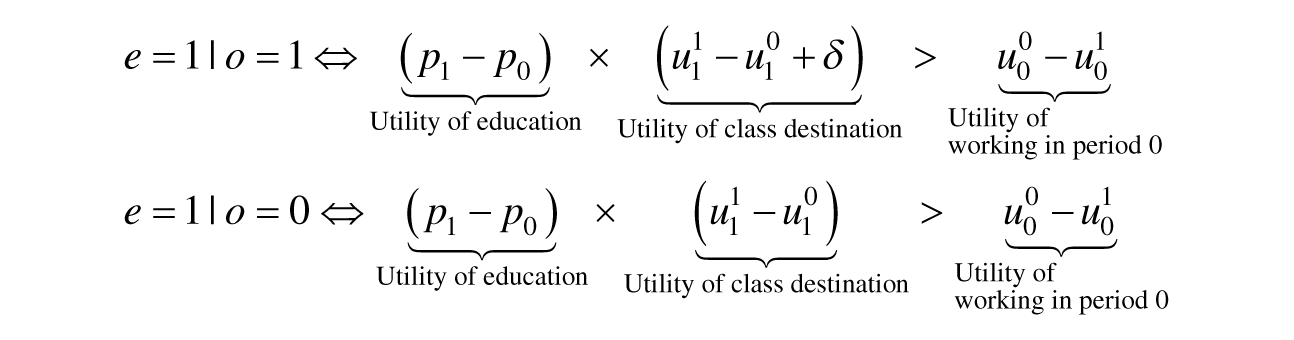
where p 1 is the probability of reaching the service class conditional on having chosen education in time period 0 (e = 1), and p 0 is the probability of reaching the service class conditional on having instead chosen to work in time period 0 (e = 0). This expression shows that, even though agents are identical in terms of preferences and abilities, agents with service class backgrounds have a higher utility of choosing education compared to agents with working class backgrounds due to the utility bonus implied by the RRA theory.
This simple setup illustrates two points which are relevant for our analysis. First, assume that the population consists of agents with different social class backgrounds and who differ with regard to the probability of completing education (for example, due to differences in academic ability caused by primary effect). In this scenario a randomly drawn agent with a service class background will have a higher probability of completing education than an agent with a working class background due to mean differences in academic ability. Second, assume that agents are myopic and ascribe no value to the future, i.e., their outcomes in time period 1. In this scenario, the optimal strategy is to choose education in period 0 (e = 1) if
A structural model of RRA
Building on the previous example, this section presents our structural approach to testing the RRA theory. We present the main features of the model in this section, including details of the British educational system, but omit technical details regarding identification and estimation. This information is presented in Appendix 1.
Utility of class destinations
The setup is now more complex than in the simple example given, but the idea is the same. We wish to understand whether the utility of reproducing one

Summary of educational transitions.
Students who complete secondary education face a second transition at around age 18 (t 2 ). After completing their Advanced Level (A-level) examinations at the end of voluntary secondary education, these students have three options: (a) leave the educational system, (b) take up postsecondary, non-university education, or (c) enter university. In our analysis, we are not interested in which type of postsecondary education respondents pursue and, consequently, we merge postsecondary, non-university education and university into one category labelled ‘higher education’. Figure 1 shows transition probabilities in our British sample. The figure shows that only around one-quarter of the sample completes the first transition into secondary education and, furthermore, that among those who complete secondary education around half also complete higher education.
Our structural model starts begins with a model for the utility of ending up in c different social classes, given class origin and other characteristics. Following previous research (Breen and Yaish, 2006; Holm and Jæger, 2008), our model distinguishes three (origin and destination) social classes: (I) the service class, (II) the middle class and (III) the working class (c = I, II, III). We write the utility u of ending in destination class c as

Equation (1) includes three utility-generating components:
Equation (1) describes the outcomes of a process which involves two educational decisions: the decision about whether or not to continue in secondary education after completing GCE exams and, given completion of secondary education after A-levels, the decision about whether or not to continue in higher education. In the following sections we present a model for educational decision making which accommodates RRA, updated information on academic ability and potential heterogeneity in the RRA utility bonus associated with reproducing one’s parents’ social class position. We provide additional details in Appendix 1.
Utility of educational choices
Upon completion of GCE exams at the end of primary school, the agent has to decide whether she wants to leave school or continue in secondary education. This decision depends on the agent
Crucially, our structural model distinguishes between instantaneous and future utility of educational decisions. Instantaneous utility is the utility when making the decision. For example, an agent from an academically oriented family may derive utility from choosing academically oriented secondary education because this type of education meets her parents’ expectations. The agent may also derive utility from being around academically oriented peers. Future utility is the long-term utility of an educational decision, including the option value of continuing in higher education and the utility of this education as a means of reproducing one’s parents’ social class position. Both types of utility may affect educational decisions.
Utility of GCE
The first educational decision which the agent faces is whether or not to attend secondary education. We write the utility of leaving school with GCE as the highest level of education:

Equation (2) presents our argument in four steps. The first line of Equation (2) summarizes the overall idea. The second line of Equation (2) formalizes this idea by stating that the instantaneous utility of leaving school after GCE depends on a set of individual characteristics which are observable to the agent when making the decision, x (for example gender and age when leaving school), and a set of characteristics which are unobservable to the agent, e (for example IQ). We write this argument βGCE x+ e GCE. Furthermore, the second line states that the utility of leaving after GCE depends on the future utility of entering a class destination with GCE as the highest level of education. We write this argument
The third line in Equation (2) extends the second line by separating the future utility of leaving school after GCE into three components: (a) the utility of characteristics which are observable to the agent (x), (b) the utility of reaching at least one’s parents’ social class position (the RRA utility bonus δ) and (c) the utility of characteristics which are not observable to the agent when making the decision (e). 1 In this paper we are mainly interested in one aspect of future utility: the RRA utility bonus associated with reproducing one’s parents’ social class position.
The fourth line in Equation (2) summarizes the model components which we can empirically identify. We can identify the effect of reaching at least one’s parents’ social class position on the utility of leaving after GCE. This is the RRA effect. We cannot distinguish between the effects of characteristics which are observable to the agent (x) on, respectively, instantaneous and future utility (i.e. in line 3 we cannot distinguish βGCEx+eGCE from
Utility of A-levels
Instead of leaving school after GCE, the agent may also choose to enter secondary education and complete A-level exams. In our structural model, the expression for the utility of choosing A-levels after GCE looks very similar to the expression for the utility of leaving after GCE (Equation (2)). The difference between the two expressions is that we now allow for the utility of choosing A-levels to also depend on how the agent performed in her GCE exams:
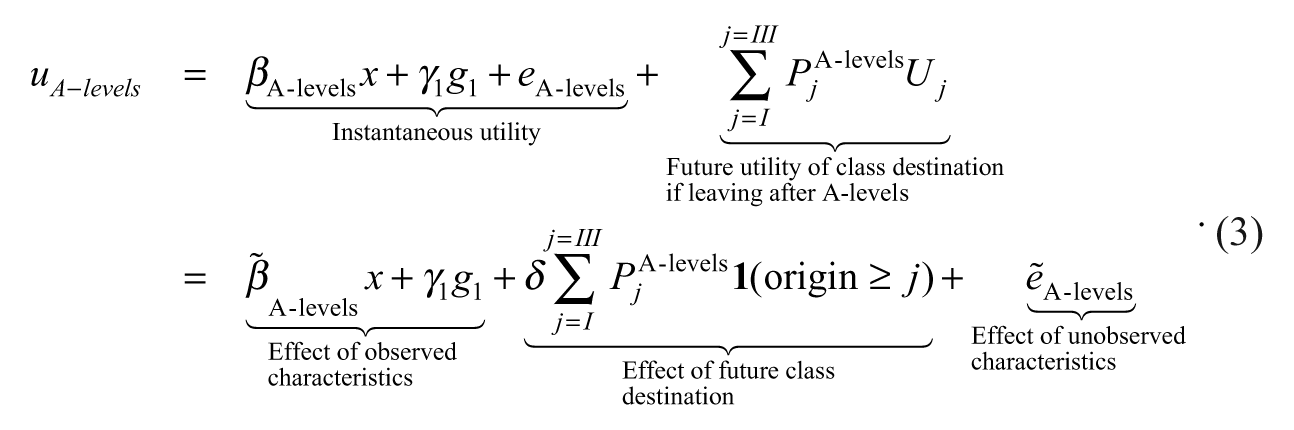
Equation (3) shows that the utility of choosing A-levels depends on both instantaneous and future utility. Future utility is the RRA utility bonus associated with reproducing one’s parents’ social class position. However, unlike in Equation (2), the utility of A-levels now also depends on how the agent performed in her GCE exams. We allow for this possibility by including the term γ1g1, which captures the effect of GCE exam performance on the utility of A-levels. This term accommodates the (very realistic) possibility that an agent uses her GCE performance to infer her future performance in A-levels and the psychic costs of pursuing A-levels.
Utility of higher education
After completing A-levels the agent may choose to enter higher education (HE). The expression for the utility of completing higher education, which is shown in Equation (4), is almost identical to the expression for the utility of completing A-levels (Equation (3)). The difference is that we now include the term γ1g2 to capture the effect of A-level exam performance on the utility of higher education (the idea being that agents use A-level performance to infer their likely performance in, and thus the utility of, higher education):

In Appendix 1 we explain how we derive agents’ educational choices as outcomes of utility maximizing decisions.
The total choice set
Equations (2)–(4) describe our structural model for the instantaneous and future utility associated with leaving school after, respectively, GCE, A-levels or higher education. In Appendix 1 we describe our approach to conceptualizing how, given the available information at each educational transition, the agent must choose between either leaving or staying in school. The substantive argument, however, is straightforward. After GCE exams the agent knows more about her academic performance. Based on this information, she can infer her utility of completing A-levels (agents with higher GCE performance have lower psychic costs of pursuing A-levels and thus they are expected to have higher utility from choosing A-levels). Note that the agent does not know what her actual A-level performance will be. Consequently, given the available information after GCE, she can make a qualified guess about her utility of leaving after GCE and after A-levels (cf. Equations (2) and (3)). However, part of the utility of completing A-levels is the option value of continuing in higher education, and this utility depends on A-level performance (cf. Equation (4)). Consequently, based on GCE performance the agent can also infer about the expected utility of completing A-levels, including the option value of higher education.
Identification, estimation and heterogeneous RRA effects
Appendix 1 describes in detail first, how we apply model constraints to identify the key parameters in the structural model, and second, how we estimate the model. In this section we describe the empirical approach in non-technical terms.
Although our structural model is more complex than a standard regression model, identification and estimation is similar to that used in standard regression models. The structural model, which consists of a series of educational transitions, is parameterized as a multinomial probit model. However, our model departs from the standard probit model by incorporating a parameter (δ) which captures the future utility of present educational choices. Standard regression models do not distinguish present from future utility. We cannot identify all theoretically relevant parameters in Equations (2)–(4). The parameters which we can identify are shown in the last line of Equations (2)–(4) (with a tilde superscript). As in standard multinomial regression, we treat one educational outcome as the reference category and normalize regression coefficients for this outcome to zero. We use the choice of leaving after GCE as the reference category, which means that we identify parameters capturing the utility of choosing respectively A-levels or higher education relative to this alternative. In practice, we estimate the parameters
As it stands, our structural model assumes that the RRA utility of reproducing one’s parents’ social class position is the same for everyone. This assumption is reflected in the fact that we estimate only one RRA parameter, δ. However, we wish to address the possibility that not all agents obtain the same utility from reproducing their parents’ social class position; i.e. the RRA effect might be heterogeneous. We allow for a heterogeneous RRA effect by assuming that the population consists of two latent subgroups that differ with respect to the utility agents derive from reproducing their parents’ social class position. For one proportion of the population, say π, the RRA effect enters the utility function with weight δ1, while for another proportion, 1-π, the RRA effect enters the utility function with weight δ2. Consequently, we split the population into two distinct subgroups that differ with regard to how much they care about reproducing their parents’ social class position (captured by δ1 and δ2). 2
In addition to identifying the two latent subgroups, we also wish to characterize agents with different utility of reproducing their parents’ social class position. Previous research has mainly analysed whether RRA accounts for social class differences in educational attainment. We extend previous research by asking why some agents are more concerned with avoiding downward social class mobility than others. Several studies analyse correlates of the subjective importance agents assign to reproducing their family’s social status (e.g. Gabay-Egozi et al., 2010; Stocké, 2007; Van De Werfhorst and Hofstede, 2007). These studies provide some evidence that the preference for reproducing one’s parents’ social status varies in a population. Generally, research in economics and psychology shows that several individual-level factors are correlated with risk aversion and with time discounting preferences, both of which are key components in the RRA theory. First, studies show that cognitive ability is positively correlated with a low time discounting rate (i.e. a preference for a bigger reward in the future compared to a smaller reward in the present) and negatively correlated with risk aversion (e.g. Dohmen et al., 2010). Second, studies show that behavioural problems and lack of impulse control are correlated with a high time discounting rate and low risk aversion (e.g. Frederick et al., 2002). Finally, research shows that women are more risk averse than men and, furthermore, that some family background characteristics such as birth order are correlated with risk aversion (e.g. Hartog et al., 2002; Rohde et al., 2003). Based on previous research, we study if a range of observable individual characteristics which are available in our British data, for example cognitive ability, time discounting preferences, gender and birth order, help to distinguish our two latent groups with different RRA effects. Specifically, we extend the structural model with a model component in which the likelihood of belonging to the first latent group relative to the second group is a logistic regression model of the form

where z is a vector of individual characteristics. Below we present the variables in the z vector.
This section concludes the presentation of our structural model. The next section presents the data and variables used in the empirical analysis.
Data and variables
Data
We analyse data from the National Child Development Study (NCDS). The NCDS is a longitudinal study of all children (approximately 17,500) born in the United Kingdom during the first week of March 1958. Follow-ups were carried out in 1965 (age seven), 1969 (age 11), 1974 (age 16), 1981 (age 23), 1991 (age 33), 1999/2000 (age 42), 2004 (age 46) and 2008/2009 (age 50–51) (see Plewis et al., 2004 for details). We restrict our sample to respondents with valid observations on all key variables (origin social class, destination social class, educational career and academic performance). This restriction leaves an effective sample size of 3499. This sample size is very similar to that in Breen and Yaish (2006), who also used the NCDS data to test the RRA theory.
Variables
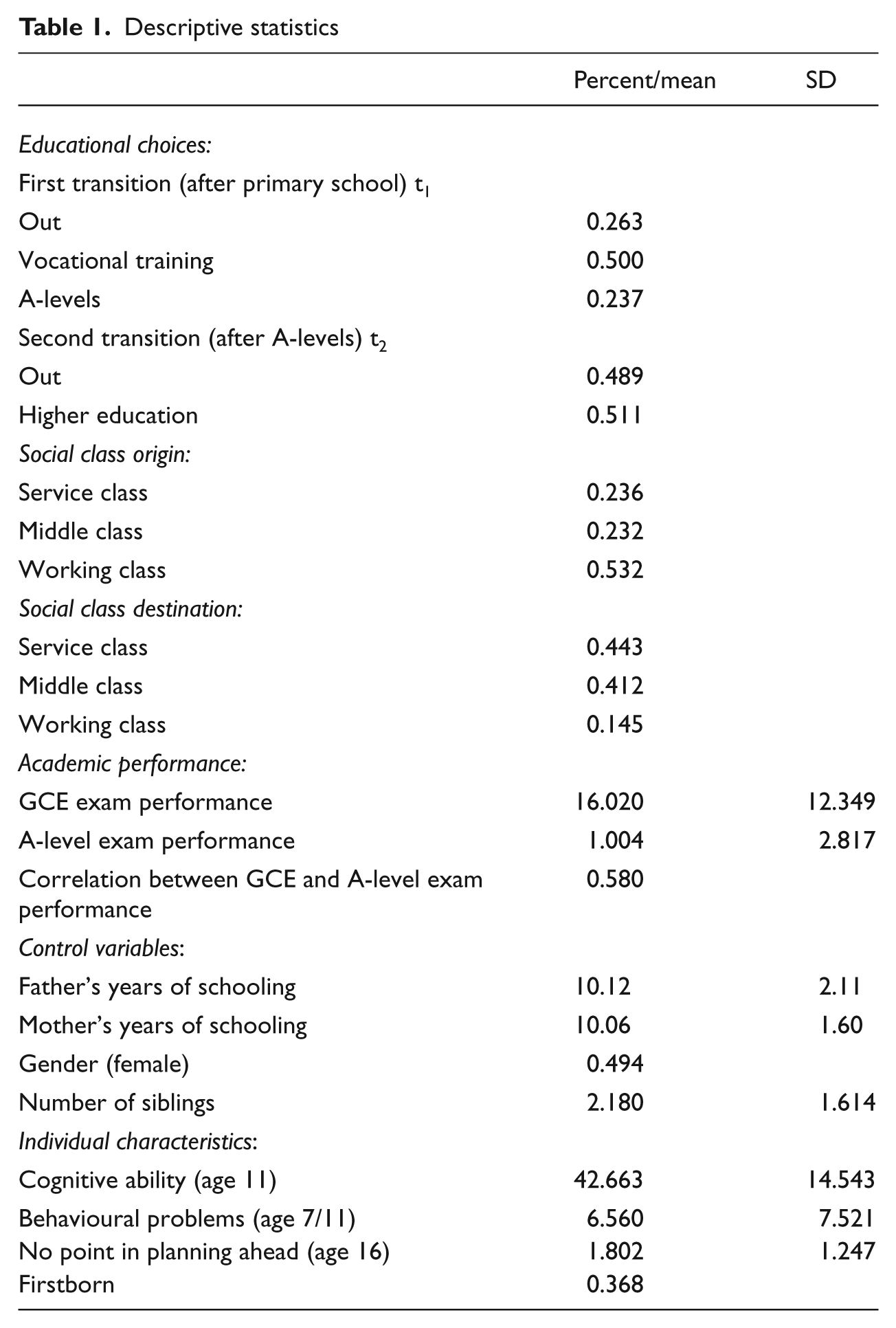
To the extent it was possible, and in order to maximize comparability of results, we have replicated the coding of all the main variables from Breen and Yaish (2006) and Holm and Jæger (2008). Table 1 shows descriptive statistics.
Descriptive statistics
Educational choices
The choice set and the transition probabilities into different educational levels were described above.
Academic performance and ability
We include two measures of academic performance (which are observable to the agent) and one measure of cognitive ability (which is only partially observable to the agent). Our measures are coded similarly to Breen and Yaish (2006).
Our first measure of academic performance is the respondent’s performance in the GCE examinations in 1974 (at around age 16). The NCDS data includes equivalent scales of 21 O-level/CSE exams (with the codes: 1 = O-level, grade A or B; 2 = O-level, grade C and CSE grade 1; 3 = O-level, grade D or E and CSE grade 2 or 3; 4 = CSE grade 4 or 5; 5 = other result; 6 = no entry). Similarly to Breen and Yaish (2006), we inverted these codes (so that higher values signify a better grade) and summarized respondents’ total score across the 21 exams.
Our second measure of academic performance is the respondent’s performance in the A-level examinations taken at around age 18. This measure is only available for respondents who enrol in secondary education at t 1 . The NCDS data includes a variable which measures A-level grades in the form of a 15-point scale formed by summing the three best A-level grades. Table 1 shows that the correlation between GCE and A-level exam performance (for the respondents who also completed A-levels) is 0.58.
Our measure of cognitive ability is the respondent’s score on the General Ability Test (GAT) at age 11. This test is considered to be the best proxy for IQ in the NCDS (Breen and Yaish, 2006: 241). The NCDS respondents were also subjected to mathematics and reading ability tests at ages seven, 11 and 16. We used respondents’ test scores on these tests and Stata’s impute procedure to impute missing values on the GAT at age 11. After imputation, we have valid GAT scores for all but two respondents in our sample.
Social class
As our measure of social class we use a reduced version of the Erikson–Goldthorpe–Portocarero social class scheme (see Erikson and Goldthorpe, 1992). We distinguish between the service class (I), the middle class (II) and the working class (III). We use the social class position of the NCDS respondent at age 42 as the destination social class and the social class position of the respondent’s father (which is normally used as the primary indicator of social class background) as the origin social class.
Control variables
Since the structural model is already complex, and in order to gain statistical efficiency, we restrict to number of control variables to the respondent’s gender (with a dummy variable for women), father and mother’s education (years of completed schooling) and number of siblings. These variables comprise the x vector in Equations (1)–(4), and we include these variables to control for individual and family background characteristics which affect the utility of different educational decisions.
Correlates of heterogeneous RRA
We include a range of variables which might help us to distinguish agents who obtain different utility from reproducing their parents’ social class position. These variables comprise the z vector in Equation (5). Our selection of variables is motivated by previous research on correlates of risk aversion and includes cognitive ability, behavioural problems, time discounting preferences and socio-demographic characteristics. First, as our measure of cognitive ability we include the respondent’s score on GAT variable described above. Second, as our measure of behavioural problems we include the respondent’s score on the British Social Adjustment Scale (BSAG). The BSAG is a summary measure of behavioural problems (for example, hostility towards adults, anxiety and restlessness) completed by the respondent’s main school teacher at age seven or 11, with higher values indicating more problems. Third, as our indicators of time discounting preferences we include a variable in which respondents responded to the following question at age 16 (in 1974): I think there is no point in planning for the future. You should take things as they come. The response scale for this item was: (1) ‘Not true at all’, (2) ‘partly or usually true’, (3) ‘cannot say, no feelings either way’, (4) ‘partly or usually true’, (5) ‘very true’. Finally, our socio-demographic variables include a dummy variable for being firstborn and for gender. We include birth order to analyse if firstborns are particularly preoccupied with reproducing their parents’ social class position.
Results
This section presents results from our empirical test of the RRA theory. We estimate three specifications of the structural model. In the first model we assume that the RRA utility ‘bonus’ from reproducing one’s parents’ social class position is zero (i.e., δ = 0). This is a benchmark model with no RRA. In the second model we estimate δ which captures the RRA utility bonus from reproducing one’s parents’ social class position. We then compare these two models to analyse the substantive effect of RRA. In the third model we introduce heterogeneity in the utility of reproducing one’s parents’ social class position by allowing for two latent subgroups with different values of δ. We also use a range of individual characteristics to characterize the two latent groups.
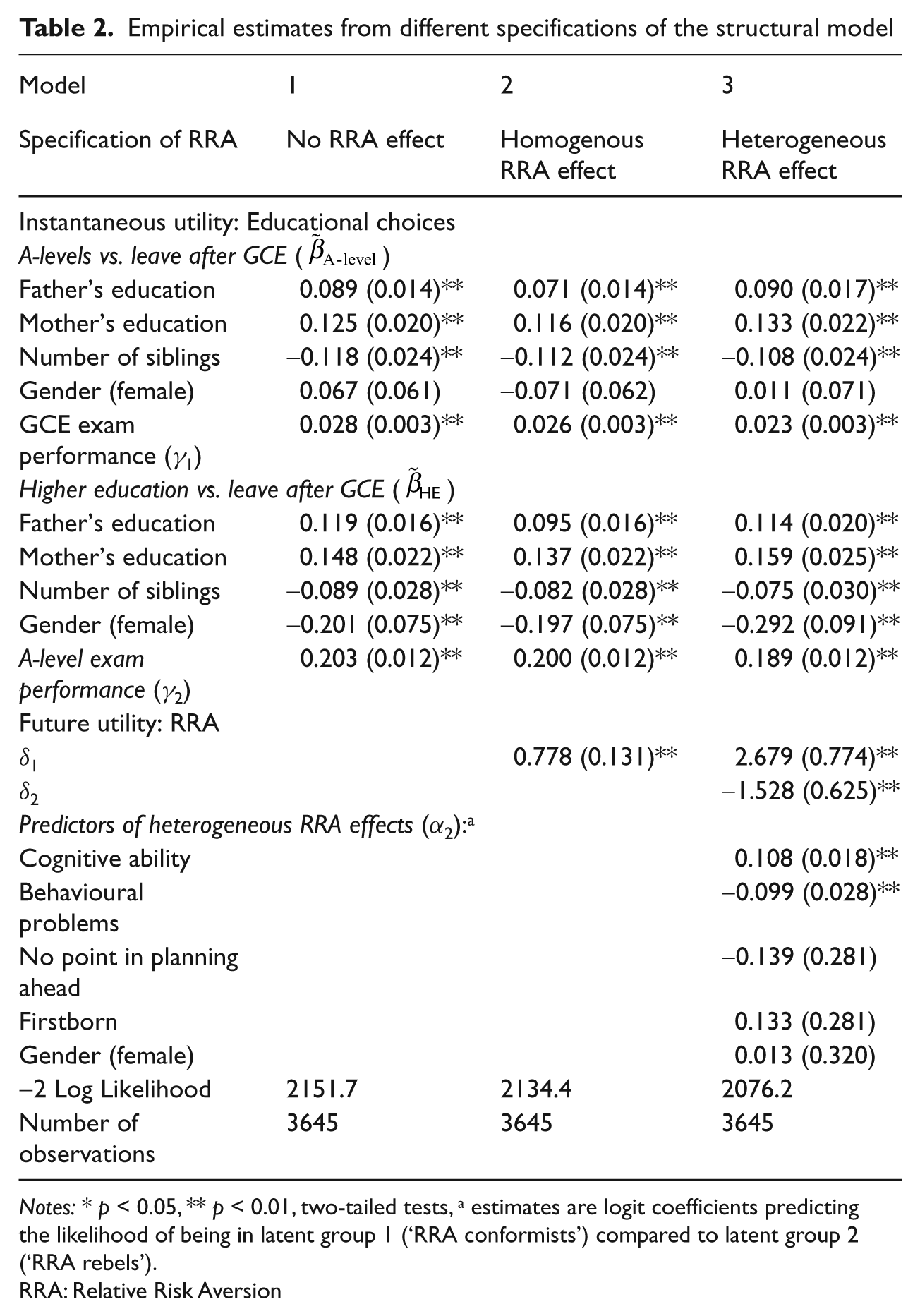
Table 2 shows estimates from three specifications of the structural model. The top panel – labelled instantaneous utility – shows the effect of the control variables on educational decisions. We use the choice of leaving school after GCE as the reference category and, consequently, the estimated effects of the control variables on educational decisions are relative to this reference category. The regression coefficients are probit coefficients, and in our structural model we interpret these parameters as reflecting factors which affect the instantaneous utility of making different educational choices. The control variables are not of principal interest, but we discuss their effects at the end of the results section. The bottom panel – labelled future utility – shows the model parameters pertaining to the future utility of present educational choices. The coefficient δ captures the effect on utility of ending up in a destination social class which is equal to, or higher than, the origin class. Consequently, the coefficient δ captures the RRA utility ‘bonus’ from reproducing one’s parents’ social class position. In the model in which we assume a homogenous RRA effect (Model 2) we estimate only one δ, while in the model which assumes a heterogeneous RRA effect (Model 3) we estimate one δ for each of two latent subgroups which are hypothesized to have different utility of reproducing their parents’ social class position. Finally, the bottom of the panel labelled predictors of heterogeneous RRA effects summarizes the effect of individual characteristics on the likelihood of belonging to each of the latent subgroups. The regression coefficients in this part of the structural model are logit coefficients.
Empirical estimates from different specifications of the structural model
Notes: * p < 0.05, ** p < 0.01, two-tailed tests, a estimates are logit coefficients predicting the likelihood of being in latent group 1 (‘RRA conformists’) compared to latent group 2 (‘RRA rebels’).
RRA: Relative Risk Aversion
Our analytical strategy is to compare the empirical fit of structural models which impose different assumptions on RRA. First, we wish to analyse whether RRA has an effect on educational decision making. Our benchmark model, Model 1, assumes no RRA effect (δ = 0) and, consequently, in this model agents are assumed to be completely myopic with respect to the future utility of reproducing their parents’ social class position (technically, this model is a standard multinomial probit model because it does not include any parameters which capture the future utility of present educational choices). We use a likelihood-ratio test (LRT) to compare the fit of this model to the model which incorporates an RRA effect (Model 2). The LRT test shows that model fit increases in a statistically significant way by taking RRA into account (LRT: χ2 = 17.3, df = 2, p = 0.0007). In other words, we find strong empirical evidence that RRA affects educational decisions. The coefficient δ in Model 2 is a probit coefficient, and it captures the effect on future utility of reaching a social class destination which is equal to, or higher than, the origin class. The estimate of δ is 0.778; i.e. positive. Consequently, and in accordance with the RRA theory and previous empirical research, we find that there is a utility bonus associated with reproducing one’s parents’ social class position. The parameter δ has no intuitive scale, which makes it difficult to gauge the substantive size of the RRA effect with respect to explaining social class differences in educational attainment. However, in order to quantify the substantive effect of RRA, we use the estimates from our models to calculate predicted probabilities of different educational outcomes given social class origin.
Table 3 shows sample frequencies and predicted probabilities of completing A-levels and higher education from different model specifications and for respondents with different social class backgrounds. The table also shows predicted probabilities from the structural model which assumes a heterogeneous RRA effect (Model 3), which we discuss below. The most striking result when comparing predicted probabilities from the model which assumes no RRA effect (Model 1) and the model which assumes a homogenous RRA effect (Model 2) is the difference in the predicted probabilities of completing A-levels for respondents with a service class background. The model which assumes no RRA effect predicts that 35.3% of respondents with a service class background complete A-levels. By contrast, the model which takes RRA into account predicts that 41.9% of these respondents complete A-levels. The actual percentage of respondents with a service class background that completes A-levels is 41.2%. Consequently, the model which takes RRA into account is significantly more accurate in predicting educational decisions for respondents with a service class background compared to the model which ignores RRA. Differences in predicted probabilities from Model 1 and 2 are much smaller for respondents with other social class backgrounds (and negligible with respect to the probability of completing higher education). Consequently, our results suggest that RRA has a larger effect on educational decisions (and, specifically, the decision about whether or not to pursue A-levels) among respondents with a service class background than among respondents with middle and working class backgrounds. This finding makes sense because respondents with service class backgrounds need more education than everyone else to ensure that they can reproduce their parents’ social class position and, furthermore, A-levels were the most selective educational transition in the British educational system at the time the NCDS respondents went through this system (Figure 1 shows that only about one-quarter of the NCDS respondents completed A-levels).
Sample frequencies and predicted probabilities of educational outcomes by social class origin
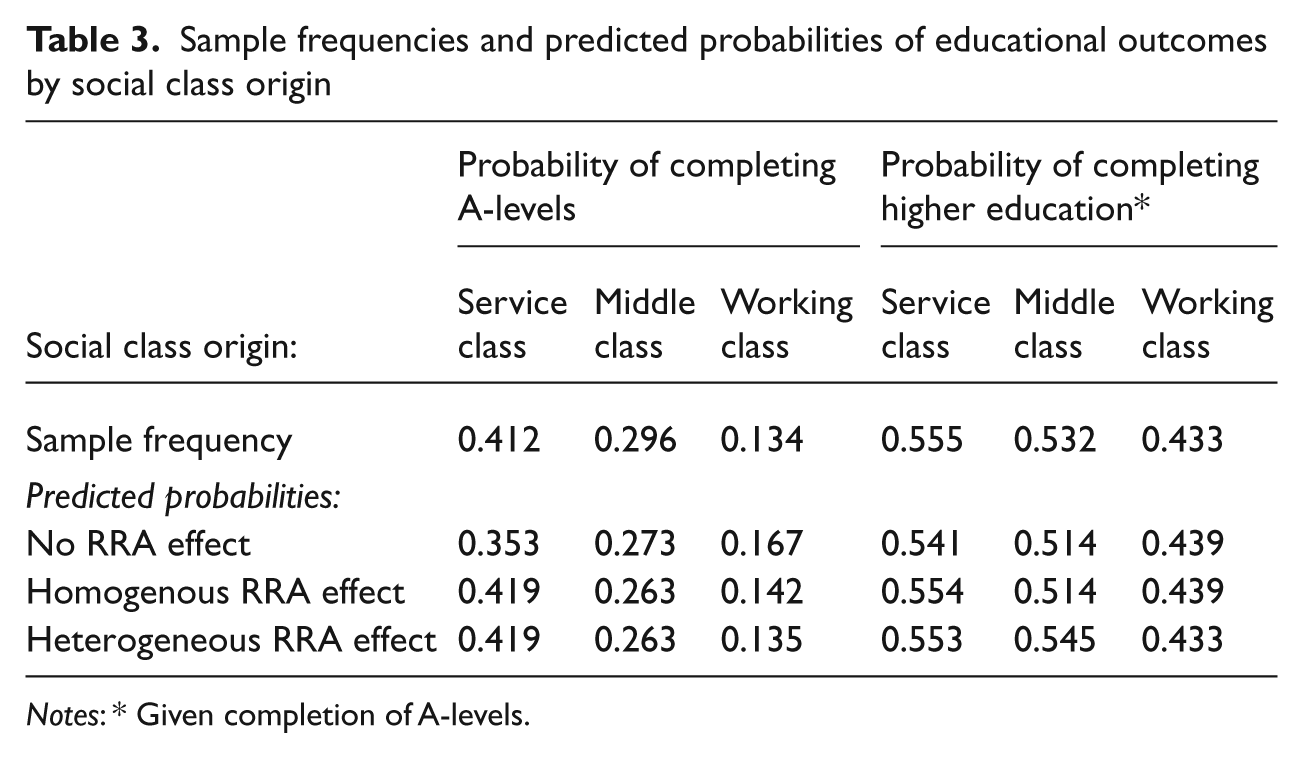
Notes: * Given completion of A-levels.
Model 2 assumes that everyone obtains the same utility bonus from reproducing their parents’ social class position. In our structural model, and based on previous research, we also hypothesize that there may be heterogeneity in a population with regard to how much agents care about reproducing their parents’ social class position. In Model 3 we test the assumption of heterogeneous RRA effects by allowing for two latent groups which differ with regard to how much they care about reproducing their parents’ social class position. Empirically, we model heterogeneity in RRA by allowing for each latent subgroup to have a different value of δ . We run a LRT and compare the empirical fit of the model which assumes a heterogeneous RRA effect (Model 3) to the fit of the model which assumes a homogenous RRA effect (Model 2). The LRT provides strong empirical evidence of a heterogeneous RRA effect (LRT: χ2 = 58.2, df = 7, p < 0.000).
Table 2 shows results from the structural model with two latent subgroups with different RRA effects (Model 3). The first latent subgroup is characterized by a statistically significant and positive estimate of δ1 (2.679). Consequently, respondents in this subgroup obtain high positive utility from reproducing their parents’ social class position. We refer to this group as ‘RRA conformists’ because respondents in this group act in accordance with the RRA theory. Furthermore, we use the estimates from Model 3 to calculate the proportion of the NCDS sample that belongs to the latent group of RRA conformists. We find that the vast majority of respondents, 92.8%, are classified as belonging to this group. The second latent subgroup is characterized by a statistically significant negative estimate of δ2 (–1.528). Consequently, respondents in this subgroup experience disutility from reproducing their parents’ social class position. We refer to this group as ‘RRA rebels’ because respondents in this group act in the opposite way of what is implied by the RRA theory. We use the model estimates and calculate that only a minority of the NCDS sample, 7.2%, belong to this latent group. 3 The existence of a small group of RRA rebels is puzzling, but we think of this group as capturing agents who oppose their social class background and who gain disutility from reproducing this background. Below, we provide more evidence on RRA rebels.
In order to distinguish the two latent subgroups in the data, we include a set of individual-level variables to predict the likelihood of belonging to the RRA conformist rather than the RRA rebel group. As explained above, we include variables measured in childhood which capture respondents’ cognitive ability, social maladjustment, time discounting preferences, birth order and gender. The bottom panel of Table 2 (Model 3) shows logit estimates of the effect of these variables on the likelihood of belonging to the group of RRA conformists compared to the group of RRA rebels (the reference group).
First, we find that, compared to the latent group of RRA rebels, respondents’ cognitive ability at age 11 is significantly and positively correlated with the likelihood of belonging to the latent group of RRA conformists. Consequently, respondents with high cognitive ability are particularly likely to belong to the latent group that obtains utility from reproducing their parents’ social class position. An interpretation of this finding might be that, compared to less bright people, very bright people are better able to link current educational decisions to future socioeconomic outcomes and, consequently, are better able to anticipate long-term returns on educational decisions.
Second, we find that the index which summarizes behavioural problems in childhood, for example social maladjustment and hostile behaviour in school, is significantly and negatively correlated with the likelihood of belonging to the group of RRA conformists. Consequently, respondents who exhibited disruptive behaviour in childhood are particularly likely to be RRA rebels and to derive negative utility from reproducing their parents’ social class position. An interpretation of this result might be that disruptive behaviour is a proxy for rebellious behaviour and a preference for distancing oneself from one’s family background. Consequently, a small group of rebellious respondents who end up reproducing their parents’ social class position (perhaps inadvertently) do not experience positive but rather negative utility from this outcome.
Third, we find no correlation between the extent to which at age 16 respondents agreed with the statement there is no point in planning for the future and the utility they derive from reproducing their parents’ social class position. Consequently, our results do not support the idea that those who do not care about the future are more likely to be RRA rebels than to be RRA conformists. Finally, our results show no relationship between birth order and gender and the likelihood of belonging to each of the two latent groups characterized by different RRA effects.
Finally, we briefly discuss the effects of the academic performance and control variables on the instantaneous utility of different educational decisions. In our structural model agents use information on academic ability to infer the utility of staying on in school. The top panel in Table 2 shows that in all model specifications GCE exam performance has a positive effect on the utility of choosing A-levels over no education (for example, in Model 3 we find that γ1 = 0.023, p < 0.01). Furthermore, we find that A-level performance has a positive effect on the utility of choosing higher education over no education (in Model 3 we find that γ1 = 0.189, p < 0.01). Together, these findings suggest that new information on academic performance which the agent receives during her educational career affects her expected utility of staying on in education. We also find that father’s and mother’s education has a positive effect on the utility of choosing A-levels and higher education over no education beyond GCE. Consequently, respondents with highly educated parents have a higher instantaneous utility of staying on in school compared to respondents whose parents have only little education. The reason for these effects might be that respondents with highly educated parents adhere to family norms and traditions by choosing academically oriented types of education. We also find that having many siblings reduces the utility of staying on in school and, regarding the decision of whether or not to continue in higher education, women also experience negative utility from making this decision.
Discussion
In this paper we test the theory of Relative Risk Aversion (RRA) within a structural model. Furthermore, the paper offers two extensions of previous research. First, we allow for agents to use information on academic performance at lower educational levels to infer about the utility of higher educational levels. Second, we allow for heterogeneity in the utility agents obtain from reproducing their social class background.
Our main conclusion is that RRA affects educational decision making. We find that reaching at least one’s parents’ social class position yields a statistically significant RRA utility ‘bonus’. We also find that RRA explains parts of the observed social class differences in educational decisions. In particular, we find that, first, RRA helps to explain who chooses A-levels over no education and, second, RRA appears to be particularly important for agents with a service class background. We speculate that the selective nature of A-levels and the fact that agents with a service class background need A-levels in order to attend higher education and reproduce their parents’ social class might explain this finding. Finally, we find that not everyone cares equally about reproducing their parents’ social class position. We identify two latent subgroups of agents that differ with respect to how much utility they derive from reproducing their parents’ social class position. The majority of agents behave according to the RRA theory; this group is labelled ‘conformists’. A small group of agents experience negative utility from reproducing their parents’ social class position and are labelled RRA ‘rebels’. We furthermore find that those most likely to be RRA rebels were characterized by low cognitive ability and a high incidence of behavioural problems in childhood.
Several limitations in the present analysis and perspectives for future research should be mentioned. First, while our analysis allows us to separate instantaneous utility from future utility, this flexibility comes at a cost. Notably, our model is very complex and requires several behavioural and statistical assumptions to be identified from the available data. This is never a desired feature in an analytical model. Second, some parts of the analysis are very crude. For example, we assume that there is no dropout. Consequently, from the perspective of the agent there is no uncertainty as to whether a chosen educational level will be completed. Future research should incorporate the risk of failing to complete education.
Our results feed into the existing literature on RRA and educational decision making. As in most previous studies, we find evidence that RRA explains part of the social class gradient in educational outcomes. Consequently, there is growing evidence that RRA matters. We extend the existing literature by demonstrating that there is substantial heterogeneity in RRA effects in a population of agents. Not everybody cares equally about reproducing their parents’ social class position, and our results suggest that a small group of agents experience disutility from reproducing their origin social class. This is an expected result in a ‘real-world’ application, but it challenges the assumption in the RRA theory that the RRA effect is homogenous. Future research should explore why and how RRA differs across individuals, social groups and possibly societies.
Footnotes
Appendix 1
In this appendix we present the structural model which we use to test the theory of Relative Risk Aversion. Our model is a Dynamic Decision Process model (e.g. Houser et al., 2004; Taber, 2000), and describes the instantaneous and future utility streams associated with different educational decisions and social class destinations. The model is described by Equations (1)–(4). This appendix is organized into three sections which elaborate on (a) the utility of educational choices, (b) the statistical model and (c) identification of the statistical model.
The research presented in this article was supported by the Danish Council for Strategic Research (grant 2139-08-0020).