



Abstract
The assessment and collection of monetary sanctions (fines, fees, and restitution) have become a common element of the U.S. criminal justice system, especially in community corrections. Although the application of monetary sanctions is often dictated by state-level legislation, court rules, and agency policy, little research has sought to organize and systematically examine a set of these policies to compare them across several community corrections contexts more broadly. As such, this study fills a gap in the literature by using thematic content analysis to examine legislative policies governing the use of monetary sanctions in six states from across the United States. Laws and policies regarding the assessment, waiver, and collection of monetary sanctions utilized by agencies of varying size and jurisdictional scope were considered to identify common themes. We conclude with a discussion of whether the policies and laws examined align with rehabilitative and punitive goals of community supervision and highlight emerging opportunities for research and policy reform.
Introduction
As a result of their conviction, many individuals are ordered by their sentencing judge to pay monetary sanctions. These monetary sanctions may include fines, restitution, and several types of fees. In addition to what is ordered by the judge, fees may be assessed by probation and parole agencies. Failure to pay these debts could result in further legal consequences. Limited research has systematically explored the statutes and policies that govern the assessment, collection, and enforcement of monetary sanctions in the context of community corrections (e.g., probation, parole/supervised release). Thus, we know little about how existing monetary sanction policies (a) guide assessment practices, (b) influence supervisee ability to pay determinations, (c) determine individual nonpayment consequences, and (d) may vary between jurisdictions.
The current study examines policies related to the imposition and collection of monetary sanctions in community corrections across six states. Due to space constraints, we concentrate on policies within three specific subtopics: (a) supervision fees, (b) ability to pay considerations, and (c) nonpayment consequences. These topics were selected for discussion due to their potential for comparison across jurisdictions. Although the number and types of monetary sanctions vary widely between states in this study, policies in nearly every state permitted some form of a supervision fee, set ability to pay criteria, and detailed consequences for nonpayment. Such policies can have important consequences for the liberty of justice-involved individuals. In this study, we also assess the alignment of these policies with key correctional philosophies (rehabilitation, retribution, restoration, and deterrence). Results can be used to inform future research and policy initiatives surrounding the use of financial sanctions.
Monetary Sanctions and Community Corrections
The imposition of monetary sanctions has become increasingly routine, and their payment is now a common condition of community supervision (Harris, 2016; Travis & Stacey, 2010). Several types of monetary sanctions exist today. Fines are imposed upon conviction of a criminal offense, mainly for punitive reasons. In comparison, restitution is imposed to compensate the victim(s) for losses stemming from the offense (Beckett & Harris, 2011). Meanwhile, revenue from fees can offset the costs associated with courts and corrections (Harris, 2016). Examples of fees include those for electronic monitoring and substance abuse counseling. Fees could also be assessed to pay for specialty programs and interventions (Friedman & Pattillo, 2019).
Community supervision was originally developed as an alternative to incarceration, with a rehabilitative focus accomplished by allowing defendants to live their “normal” lives (i.e., going to work, maintaining relationships) while receiving rehabilitative/treatment services and supervision (Grinnell, 1941). However, the ideological focus of community corrections has shifted over time. In the late 1980s through the 1990s, correctional populations skyrocketed, including the number of individuals on probation and parole (Maruschak & Parks, 2012). Around the same time, Martinson’s (1974) influential work, which suggested “nothing works” in offender rehabilitation, had detrimental effects on rehabilitative programming. Consequently, community supervision became increasingly focused on enforcing and strictly monitoring compliance with supervision conditions (Cullen & Gendreau, 2001) rather than connecting those on supervision with rehabilitative services.
Today about 5 million people in the United States are under community supervision, more than double the number of individuals incarcerated (Kaeble et al., 2016). Although correctional populations have grown, many departmental budgets have remained stagnant (Oldfield & Grimshaw, 2008). It is possible that the use of fees and fines has increased as a way to generate revenue for correctional operations. The increased use of fines and fees can be understood as largely, but not purely, for financial reasons (Martin et al., 2018). Growth in the use of fines was also based on a belief in deterrence—that individuals would be less likely to engage in criminal activity knowing there were financial ramifications for their actions (O’Malley, 2011).
As sentencing should have clear correctional goals and purposes (Cullen, 2007), so too should conditions of community supervision (Taxman & Belenko, 2012). As such, the payment of monetary sanctions should have some connection to a correctional goal. Limited research has considered the correctional goals of monetary sanctions. The payment of fines can be said to achieve largely retributive and deterrent goals. Within a retributive framework, fees/fines are meant to punish and are assessed proportional to the severity of the offense. Within a deterrence framework, substantial monetary sanction amounts could influence an individual’s decision to commit a crime. Restitution is restorative in that it is often paid to compensate for damages. Furthermore, fees may serve a rehabilitative function (Reitz, 2015) when their purpose is to offset participation in treatment. However, it must be recognized in such cases that it is not the fee that serves a rehabilitative purpose but the underlying reason it is assessed (i.e., the treatment program). Scholars have previously argued that theoretical justification for monetary sanctions is lacking (Beckett & Harris, 2011). In this study, we extend such research by examining policies which discuss the existence of monetary policies and their consequences within the context of probation and parole. We also expand upon the work of Friedman and Pattillo (2019) by comparing the types of monetary sanctions, their assessment, and consequences for nonpayment among multiple states.
Current Study
Knowledge regarding existing policies and laws that guide correctional departments and affect supervised individuals is limited. There has been scant research that has sought to identify the various types of monetary sanctions for individuals on community supervision, examine how existing monetary sanctions are intended to be assessed/applied, and link these monetary sanctions back to prevailing correctional goals. As such, the goal of this study is to extend the literature by examining the content of different statutes and policies concerning monetary sanctions, within states and community corrections departments. Specifically, we analyze legislative policies governing the use of monetary sanctions across six states.
Method
Sample
The use and implementation of community corrections fees are heterogenous across states. To capture this variation, we examine the operation of monetary sanctions across six states: Arizona, Indiana, Massachusetts, Michigan, Pennsylvania, and Texas. Examining multiple states allows for in-depth investigation and comparison of how fees and fines operate. These states were selected because they are located in different regions of the country. These interstate comparisons allow the examination of areas with drastically different correctional populations (Bonczar & Mulako-Wangota, 2018a, 2018b) and budgets (Hyland, 2019). For our analysis, we extracted materials from two primary sources: state statutes and state policy guides.
Data
State statutes
A list of state statutes was compiled from two primary sources. First, we utilized Harvard Law School’s Criminal Justice Policy Program’s (CJPP) Criminal Justice Debt Reform Builder. 1 This resource was created by CJPP to increase accessibility to state laws governing monetary sanctions (CJPP at Harvard Law School, 2016). We utilized CJPP’s Law Explorer to create an initial list of existing statutes concerning monetary sanctions (including general laws, criminal codes, and codes of criminal procedure) in our six states.
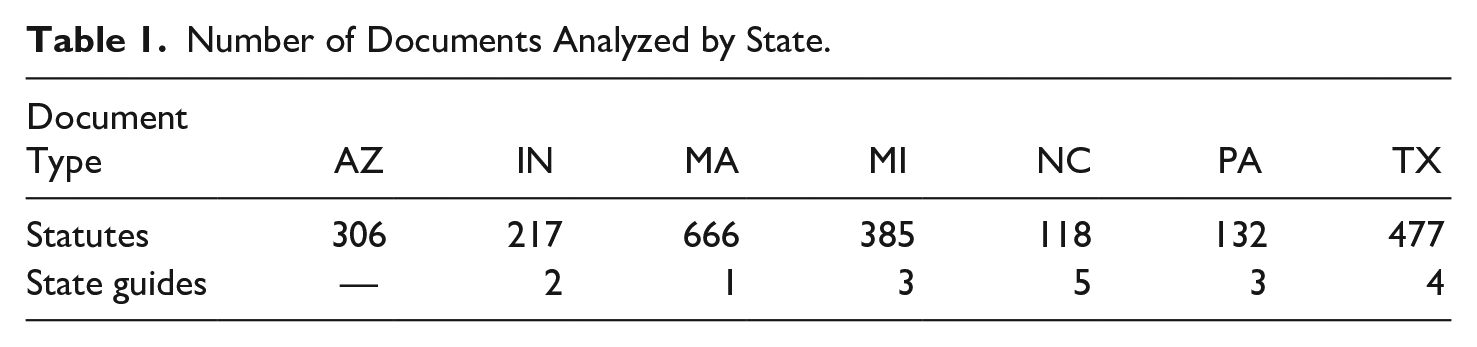
Second, we used Thompson Reuters’ Westlaw database for 2018 2 statutes concerning monetary sanctions that could be relevant to this study’s primary research questions. Searches were conducted for state statutes that addressed the following categories: (a) filing fees or court costs for criminal cases, (b) costs and/or fees associated with probation, and (c) costs and/or fees associated with parole. 3 Once the two databases of potentially relevant state statutes were compiled, the list of laws in each database was combined. The statutes were compared, all duplicates were removed, and the result was a final list of statutes concerning monetary sanctions and their associated processes. During our review, if statutes were found to be associated with civil, traffic, parking, or juvenile offenses, they were removed from the analysis. The first row in Table 1 outlines the total number of statutes examined by state.
Number of Documents Analyzed by State.
State policy and guides
Beyond examining state statutes, we searched government websites and databases for the six included states. The purpose of this search was to identify any documentation meant to guide criminal monetary sanction administration, collection, payment, and/or waiver. Such information often supplemented or explained existing statutory language to instruct agency practices. These documents were included in this analysis because they gave us a glimpse of what parts of the law state governing bodies deemed the most important to emphasize to practitioners. This could be due to their level of complexity or for some other reason. Our search revealed two primary types of documentation: (a) bench cards and (b) charts, lists, or manuals of standard state court costs, fines, and fees. Judges can refer to bench cards during sentencing for an illustration of the different monetary sanctions available to them and the associated options for their imposition or waiver. The information contained in the guiding documentation varies by state. However, in most of the states, their overall purpose was to provide a snapshot of existing standard amounts outlined in state statutes and information about them. The total number of guiding documents analyzed by state is depicted in the second row of Table 1.
Analytic Procedure
Once a complete database was created, a thematic content analysis was conducted. Thematic analysis is “a method for systematically identifying, organizing, and offering insight into patterns of meaning (themes) across a dataset” (Braun & Clarke, 2012, p. 1). Similarly, content analysis is a useful analytic technique for detecting trends and patterns in documents (Stemler, 2000). Overall, both thematic and content analysis are techniques used to assist researchers in identifying and organizing patterns present within qualitative data. For this project, coding was conducted using MAXQDA, a computer-assisted qualitative analysis software program.
Codes were identified based on our research questions and informed by prior research (see Harris et al., 2017). In this article, we present information from three of these primary categories: monetary sanction types, assessment, and payment. Specifically, we describe patterns identified under three subcodes of these headings: supervision fees (organized under parent code “monetary sanction types”), ability to pay (under parent code “assessment”), and nonpayment consequences (under parent code “payment”). The subject matter present within the content of each document was reviewed and then grouped beneath the larger categories identified above. As such, we used a deductive approach (Braun & Clarke, 2012).
Results
Types of Monetary Sanctions
In each state, individuals on community supervision could be assessed three different types of monetary sanctions: fines, restitution, and/or fees. Our analysis found that the language and substance of statues surrounding monetary sanctions fluctuate by conviction circumstances and jurisdiction. Specifically, fine amounts vary depending on the type and seriousness (i.e., felony/misdemeanor) of conviction. Language concerning restitution similarly varies based on estimates of financial damage. Generally, crimes of greater seriousness, or involving a greater degree of financial damage, are associated with assessments of higher amounts of fines and restitution.
Beyond fines and restitution, each state has an array of fees that can be ordered as a result of an individual’s conviction and sentence to community supervision. Many state statutes reveal multiple fees of variable amounts can be assessed to individuals when they are sentenced to community supervision. Fees could be grouped under several categories. These include reimbursement fees, surcharges and interest, specialty fund fees, and supervision fees. Reimbursement fees are assessed to reimburse the court or supervision office for the costs they incur (i.e., program costs) during an individual’s case. Fees classified in the surcharge/interest category include those related to how payments are collected or paid. For example, individuals can be charged a surcharge or service fee to offset the cost of processing credit card payments (Ind. Code § 35-38-2-1(l)). Individuals may also be required to pay fees for processing payments in installments rather than a lump sum (Ariz. Rev. Stat. § 12-116), or after a specified period of time has passed after conclusion of their case (Tex. Code Crim. Proc. § 102.030(a)(2)). In comparison, specialty fund fees are earmarked for specific categories or organizations that may (or may not) be related to an individual’s instant conviction. Specialty funds can also be associated with fines and surcharges depending on the state, if a portion of the revenue collected from such payments is distributed to a specialty fund. For example, in Massachusetts, individuals convicted of a hate crime are assessed a US$100 surcharge, which then contributes to a Diversity Awareness Education Trust Fund (Mass. Gen. Laws ch. 265 § 39(b)).
Previous research has outlined policies on fines, general fees, and restitution (Beckett & Harris, 2011; Friedman & Pattillo, 2019; Ruback & Bergstrom, 2006). Due to the extensive number of existing fees, there is insufficient space to outline each fee identified in great detail. Thus, the remainder of this section will focus specifically on supervision fees, including the amount that states can assess, and the purpose of these funds once collected. Such fee types are most relevant to community supervision and have not been expansively studied in previous research.
Supervision fees
Supervision fees for states in this study are recurring and often make up a large portion of the amount supervised individuals are required to pay while on supervision. Specific amount requirements are highlighted in Table 2. These fees can vary depending on the intensity or type of supervision and jurisdiction where supervision is assigned, with lesser fee amounts assigned to those on lower intensity supervision. For example, supervision fees differed for individuals on standard versus intensive probation in Arizona, probation versus parole in Massachusetts, and supervision with or without electronic monitoring in Michigan. States also varied in how they chose to define supervision fee amounts. Although Arizona and Pennsylvania set minimum supervision fee requirements, Indiana and Texas specified both minimum and maximum amounts. 4
Monthly Supervision Fee Amounts by State.
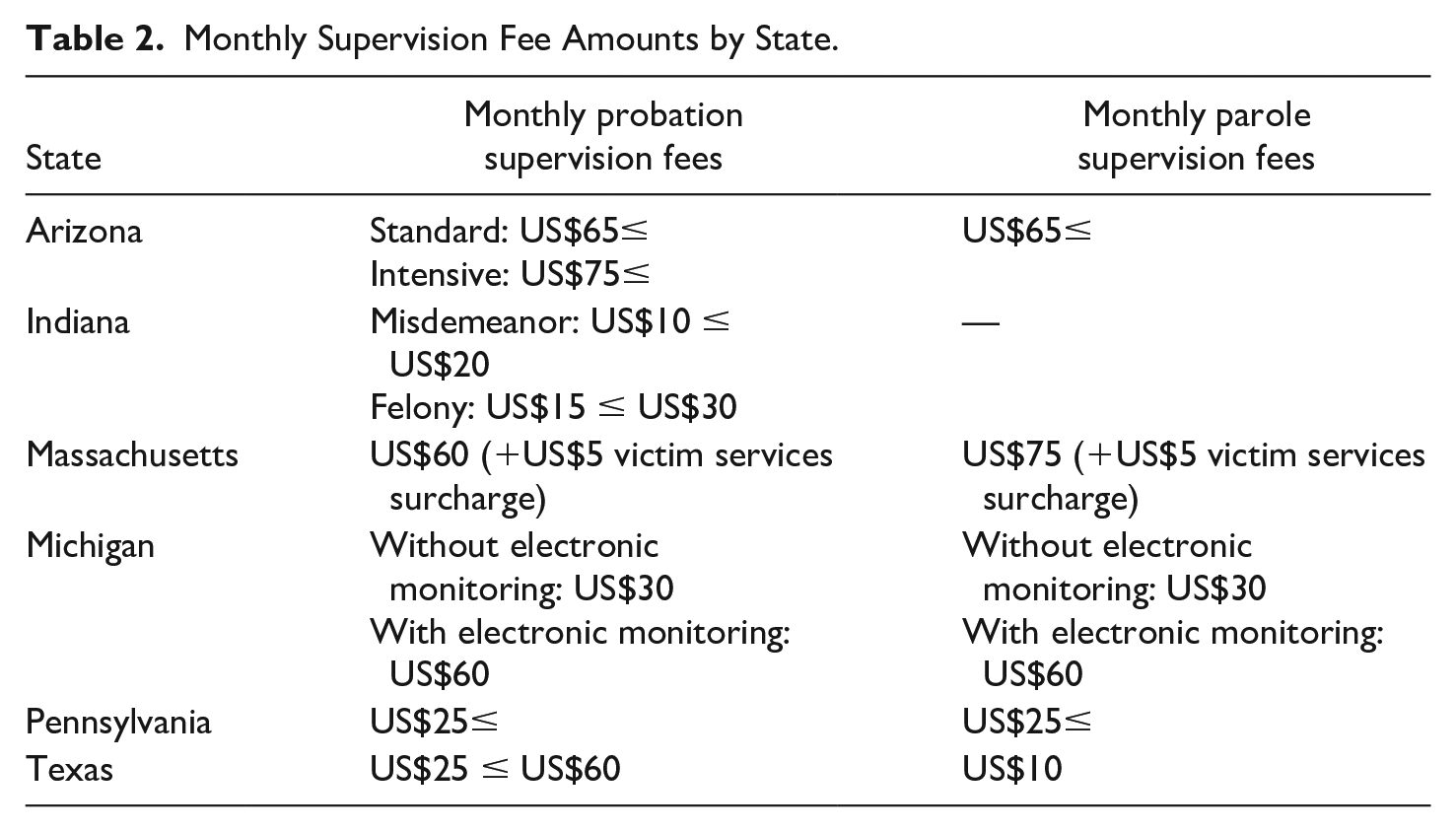
Supervision fees could also vary depending on offense characteristics. In Indiana, individuals on probation are assessed three types of fees with amounts determined by their offense level. These include two onetime fees—an initial user fee (US$50 for misdemeanors, US$25–US$100 for felonies) and an administrative fee (US$50 for misdemeanors, US$100 for felonies), in addition to a monthly user fee (Indiana Office of Court Services, 2019). These fees are required for felony cases but left to the discretion of the sentencing court for misdemeanors (Indiana Office of Court Services, 2019). In Texas, individuals on supervision convicted of sex offenses are charged an additional US$5 per month in supervision fees (Tex. Code Crim. Proc. § 42A.653(a)). This additional fee is unique to sex offenders and contributes to Texas’ Sexual Assault Program Fund, which funds efforts to prevent sexual assault, domestic violence, and human trafficking and to improve services for survivors of sexual assault (Tex. Gov’t Code. § 420.008(b)(1)(a)).
How supervision fees are disbursed and are intended to be used varies among states. In Arizona, funds generated are ultimately sent to the county treasury and then distributed to adult probation services (Ariz. Rev. Stat. § 13-901(a)). Similarly, in Indiana, some administrative and user fees are provided to local adult probation agencies. In Arizona and Indiana, part of the revenue obtained from supervision fees 5 can be used to “supplement” officers’ salaries (Ariz. Rev. Stat. § 13-901(a); Ind. Code § 35-38-2-1(f)(2)). Arizona is also authorized to use supervision fee funds for “program support,” a term which was not defined further. Likewise, Texas uses a portion of probation fee revenue to pay for officer salaries and supportive costs, such as office rental space. About 40% of Texas probation department budgets’ come from supervision fees (Texas Department of Criminal Justice, 2016).
In Michigan, 20% of the funds collected from probation fees are reverted to the department and used for administrative costs and “enhancement of services,” a category which could include purchasing supervision equipment (Mich. Comp. Laws § 791.225a(6)). In Pennsylvania, 50% of supervision fees collected at the county level contribute to the County Offender Supervision Fund (37 Pa. Code § 68.51(c)). The other 50% is deposited with the clerk of courts, who then sends the money to The Board of Probation and Parole (The Board). The County Supervision Fund is used to pay salaries and employee benefits as well as other operational expenses (37 Pa. Code § 68.72). Similarly, the legislature authorizes The Board to disperse funds to counties “solely for improved adult probation services” that are both approved by The Board and disbursed according to the discretion of the president judge (37 Pa. Code § 68.73). Finally, in Massachusetts, all revenue from supervision fees contribute to the state general fund and are reported to the state ways and means committee (Mass. Gen. Laws ch. 276 § 87A). Massachusetts also adds a US$5 surcharge to each monthly supervision payment to fund victim services.
In sum, our analysis revealed variations among states regarding the amount and assessment of supervision fees. Revenue collected from supervision fees also frequently contribute directly or indirectly toward agency expenses or enhancements. Although it is important to consider the types of fees assessed, an understanding of the operation of monetary sanctions in community corrections cannot be complete without exploring how ability to pay is determined for individuals on supervision. Next, we turn our attention to considerations of ability to pay.
Ability to Pay
Although all states require that an individual’s ability to pay be considered, each state approaches this topic differently. Findings for this section are summarized in Table 3. In Massachusetts restitution cases, judges are required to determine the individual’s ability to pay before setting their amount owed (Commonwealth v. Henry, 2016), but this is not required for other monetary sanctions. As of 2017, Texas courts are required to inquire at sentencing (or immediately after) whether an individual has adequate resources or income to pay all or part of their fines and costs (Tex. Code Crim. Proc. § 42.15(a-1)). If not, Texas courts can issue a deferral or waiver through the completion of community service (Texas Office of Court Administration, 2017a, 2017b). As described further below, approximately half of the state statutes identified more concrete criteria that could be used to make an ability to pay assessment, whereas other states policies include less prescribed language. However, every state included statutory language that allows for waivers or modifications when the court and/or supervision department determines that an individual is indigent.
State Ability to Pay Specifications.
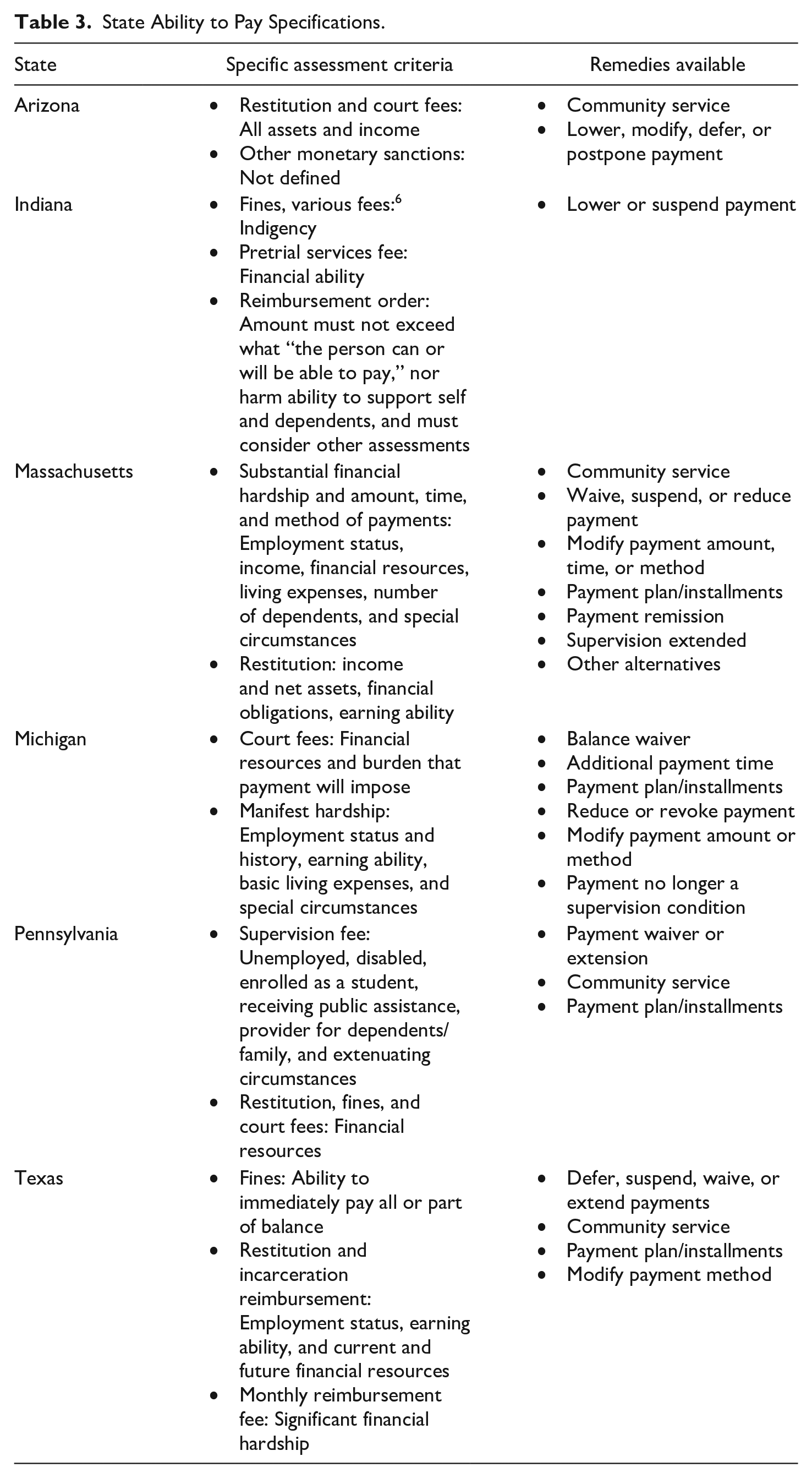
Some states identify specific factors that can be used to determine ability to pay. In short, state specifications of ability to pay often consider an individual’s current or prospective 7 wealth, balanced against recurring expenses or financial requirements. Examples include Arizona, Indiana, Massachusetts, and Pennsylvania. Arizona instructs the use of all assets and income when determining restitution. Massachusetts allows the use of assets and income as well as an extensive list of other factors, including employment background, living expenses, and dependents. Similarly, Pennsylvania provides an exhaustive list of factors that can be used to consider waivers or modifications of fees. These factors include being unemployed, disabled, enrolled as a student, receiving public assistance, having a financial role in the family, and other “extenuating circumstances.” Similar to Pennsylvania, other states also used markers of poverty or financial hardship when considering ability to pay. For example, Indiana uses indigency as an indicator of inability to pay when assessing fines. Likewise, in Arizona, considerations of U.S. poverty guidelines and receiving public assistance were required for making payment deferral or postponement decisions.
Other states provide broader guidance, as in Michigan, which instructs courts to consider “the individual on probation’s financial resources and the nature of the burden that payments of costs will impose” (Mich. Comp. Laws § 771.3(6)(a)) when assessing costs, fines, fees, or other payment requirements. Michigan documentation also specifies that presentence reports should estimate an individual’s financial situation and ability to pay (Michigan Supreme Court, State Court Administrative Office, 2016). This information can then be used during the assessment phase. Michigan also provides guidance on when monetary sanctions can be waived for individuals on supervision. At the end of community supervision, if an individual has a balance remaining, departments in Michigan are instructed to waive any amount in excess of the aggregate sum of US$30 per month for each month the individual was supervised without an electronic monitoring device or US$60 for each month supervised with a device (Mich. Comp. Laws § 791.225a(7)). Unpaid amounts not waived are required to be reported to the department of the treasury, which will then attempt to collect the balance owed. Texas also provides broad guidance on ability to pay criteria. For example, specifying that determinations should generally consider “sufficient resources or income” (Texas Office of Court Administration, 2017a).
We now shift our focus to policies that govern consequences for nonpayment of monetary sanctions, some of which consider ability to pay and some that do not. The ability to pay theme is primarily concerned with the assessments of fines and fees. Once payment was assessed and determined, there were consequences identified when payments were late or not received.
Consequences for Nonpayment
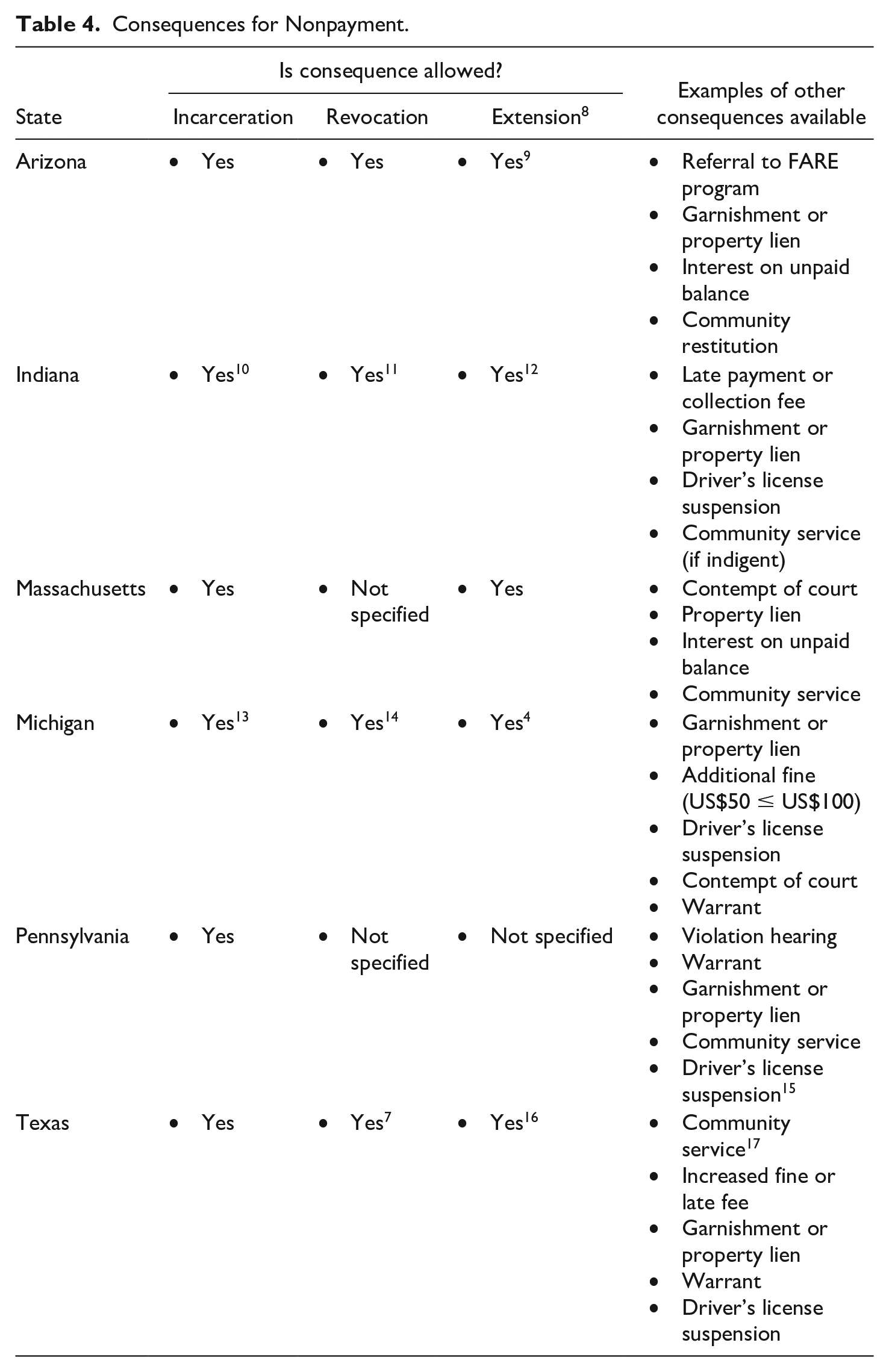
In every state in this study, when individuals are sentenced to community supervision and assessed monetary sanctions, making payments toward these financial obligations can become part of their formal probation conditions. In such circumstances, failing to pay represents a violation of supervision and can therefore trigger serious consequences, including revocation. A key theme identified throughout policies in this section was distinguishing between willful and nonwillful compliance with payment requirements. Consequences for nonpayment are summarized in Table 4.
Consequences for Nonpayment.
Revocation, incarceration, and supervision extensions
For willful nonpayment, revocation of the supervision term is allowed in Arizona, Indiana, Michigan, and Texas. State policies dictate that warrants can be issued for nonpayment in most states, a practice which in some states can also incur an additional warrant fee. 18 Revocation cannot occur without a court hearing to determine whether the individual is willfully not paying or simply lacking available funds to pay. In Indiana, Michigan, and Texas, for example, statutes indicate that ability to pay must be established when considering revocation for nonpayment (Mich. Comp. Laws § 771.3(8); Tex. Code Crim. Proc. Art. 42.037 19 ). Yet requirements for making ability to pay determinations in such circumstances vary considerably.
Every state in this study has statute language which indicates that individuals cannot be incarcerated for nonpayment due to financial hardship (consistent with Bearden v. Georgia, 1983). Even when policies indicate that incarceration is available as a legal remedy due to willful noncompliance, there are still restrictions of its use. As an example, in Indiana, willful nonpayment cannot be the only reason for incarceration (Ind. Code § 35-38-2-3(m)). Furthermore, every state except Pennsylvania has statutory policies that allow for the extension of supervision terms, often within limits defined by statute (Brett, Khoshkoo, & Nagrecha, 2020). The amount of time allowed for extensions vary across states, from 1 year in Indiana when related to nonpayment (Ind. Code § 35-38-2-3) to up to 10 years for felony cases in Texas (Tex. Code Crim. Proc. § 42A.753(a)).
Specialty caseloads
Statutes in at least three states identified that individuals who are not paying or have had difficulty paying can be diverted to a specialized program or caseload whose sole focus is on debt collection. For example, Arizona has a program called the Fines/Fees and Restitution Enforcement (or FARE). FARE is essentially a collections’ agency that works with clients to develop an installment plan and monitor their payments. Once payment plans are developed in this unit, they cannot be waived or modified in the future. A county in Pennsylvania uses a similar model (see Link et al., 2021), as do jurisdictions in Indiana.
Other consequences
In addition to the consequences for nonpayment discussed above, a variety of other sanctions exist. For example, driver’s license suspension is another broadly accepted nonpayment sanction in several states. 20 In all states in this analysis, courts can also order community service in response to nonpayment or generally as a substitution for ordering monetary sanctions. 21 Community service can therefore be assessed as an extra condition meant to serve as punishment for nonpayment, or as respite from monetary sanctions that an individual cannot afford. States also allow additional fees to be assessed as a result of nonpayment. Collection fees or interest can be assessed in nearly every state if the individual on supervision stops paying, and the court must utilize collections’ services to secure payment. 22 Furthermore, every state except Massachusetts allows the use of account or wage garnishment. 23 Property liens can also be assessed against individuals who do not pay in every state examined. 24 Finally, in addition to the consequences outlined in statutes and state policies, courts and community supervision departments were often left with discretion to use other sanctions not identified in statues.
Discussion
This study provided a review on the landscape of statutes and policies governing supervision fees, ability to pay, and consequences for nonpayment within the context of community corrections. Expanding on previous research that found several fees in the courts (Harris et al., 2011), we also identified many post-adjudication fees that could be assessed as a result of their conviction and supervision. In addition, we encountered several examples of fees consistent with previous policy studies (Friedman & Pattillo, 2019). Uniquely, we explored the supervision fee in-depth. Supervision fees were present in all six states. The amounts of these fees and how the money used from these fees varied among the states. Many of the states’ statutes dictated that supervision fees (and other monetary sanctions) were a part of the conditions for individuals on community supervision.
Funds from supervision fees among the states we studied were used to pay for or reimburse the department for the services that individuals on supervision were utilizing. Although the fiscal purpose of supervision fees is clear, more difficult to disentangle is the correctional purpose of the supervision fees. Others have argued that fees imposed in the larger criminal justice system have no correctional rationale (Beckett & Harris, 2011). In our policy review, the data did not show supervision fees to have any identifiable rehabilitative purpose. Even if they could be applied to treatment programming, the program is the underlining rehabilitative purpose—not the fee. One could potentially find restorative goals, yet this too is not a direct connection. Typically, correctional restorative goals link directly to the harms that the individual caused either to the victim or to the community (Johnstone, 2002). Through this direct financial connection, the individual repairs the harm that was caused leading hopefully to the prevention of future harms or crimes by individual (Bonta et al., 2008). Our analysis found that the supervision fees go directly to the departments or toward a general fund (in Massachusetts) and thus not connected to a victim. Thus, for supervision fees, restorative goals are nonexistent. However, as it relates to other fees, in particular, specialty fees that go directly to a victim fund, restorative goals may be more apparent.
The ordering of fees and assigning consequences for nonpayment may be an attempt to achieve retribution. Retribution is concerned with punishing the individual for the crimes committed and is not primarily concerned with the victim or community (Cunneen & Hoyle, 2010). So, monetary sanctions could be considered a just part of the punishment. Important to the retributive philosophy is that the punishment is deserved (Cotton, 2000). Some may view imposing supervision fees on individuals on probation and parole as appropriate because they are the ones utilizing the services that supervision officers provide. In addition, if they are not paying then sanctions are part of this punishment. Proportionality is also a key goal of retribution (Frase, 2005). In these states, supervision fees are applied generally across supervision sentences, and the amounts do not vary by individual circumstances, and thus, there is little proportionality being applied to this punishment. Yet for states that required higher amounts for intensive probation supervision and lower amounts for administrative probation may be signaling attempts at proportionality. Fines and other specific types of fees that are assessed based on the type of conviction may also be more aligned with retributive goals.
The supervision fee which accumulates by the number of months sentenced to supervision may also serve as a deterrent. The combination of legal obligations can be costly for individuals and could produce general and specific deterrence. The principle of deterrence is one does not commit a criminal act for fear of the consequence (Paternoster, 2010). General deterrence is related to the overall prevention of crime through the threat of punishment, whereas specific deterrence is the effect of punishment on individuals to prevent reoffending (Nagin, 2013). However, if people are unaware of the consequences, then arguments for deterrence are weakened (Apel, 2012). The public is probably unaware of all the monetary sanctions one may have to pay because of supervision, so it is unclear how much general deterrence factors into the goals of monetary sanctions. Future research could explore the public’s understanding of fees as it relates to sentencing. Regarding specific deterrence, individuals who are ordered to pay several monetary sanctions, and who have difficulty paying them, may be deterred from becoming involved with the system in the future. Some community supervision officers view monetary sanctions as a deterrent to prevent future involvement in probation or parole. Findings from one study reported that some probation officers believed individuals would be less likely to commit crimes due to the amount of debt they were ordered to pay while on probation (Ruhland, 2020). Yet research is needed, employing the perspective of the individuals on supervision, to determine whether being assigned fees influences recidivism or deters individuals from becoming further involved in crime. Deterrence may also have different effects based on the characteristics of the individual (i.e., racial background, social class, age; Nagin, 2013). Thus, deterrent effects of fees may affect individuals with limited financial resources differently compared with those who have more resources.
The use of sanctions for nonpayment may also attempt to deter individuals from not making payment. Given that individuals could face probation sentence extensions, driver’s license revocation, and other such consequences, individuals may be more motivated to pay not to receive these consequences. However, if individuals do not have the income, it matters little if deterrence is a goal. Deterrence goals with issuing sanctions for nonpayment may be more relevant for individuals who have the means to pay but are not. The overall assignment of fees and their connection to correctional goals warrants further attention. Rather than inundating individuals with financial obligations, courts may want to limit fees to those that have identifiable and direct correctional purposes (rather than solely or largely focused on revenue generation).
In addition to exploring the type of fees, mainly the supervision fee, this policy review also explored how these fees were assessed. A theme in the qualitative analysis revealed ability to pay language. Results from the thematic analysis indicated that states had language in statute that considered a person’s ability to pay. Most states included language identifying individual circumstances and/or specified factors that should be considered when assessing ability to pay. However, many of the existing statutes were unclear on exactly how individual factors identified should be considered or what effect they should have. Like Friedman and Pattillo (2019), we found a lack of clear guidance for how to adequately assess ability to pay. For instance, Massachusetts recommended mental and physical health be considered in determining indigency but provided no further language on how to consider them. At the state level, there were no standardized assessments required in statute to formally assess ability to pay. However, local jurisdictions may have developed their own assessments that were not captured in the policy review. The language in the statutes examined left a significant amount of discretion for judges and other court officials to make assessments on one’s ability to pay.
To provide courts with better guidance on how to accurately assess ability to pay, states may want to revise the language in the statutes. This is not to suggest that judicial discretion should be eliminated, as in some cases it may be necessary. However, greater clarity in language could allow for more consistency across courtrooms within the states examined. Lack of consistency could lead to racial, class, gender, or other types of disparate outcomes (Beckett & Harris, 2011). Future research may want to explore these outcomes and compare them across jurisdictions within the same state.
This study also explored the consequences for nonpayment of monetary obligations. Consistent with Friedman and Pattillo (2019), our policy review found states differentiated between willful and nonwillful nonpayment. All states could use incarceration in instances of willful noncompliance. Yet, before this could happen, hearings were often required to determine whether the individual had the means to pay or not. In cases of nonwillful compliance, and even in instances of willful noncompliance in payment, jurisdictions had sanctions available beyond incarceration. These sanctions could be restorative in nature with substituting community service for payment if an individual were unable to pay. Yet sanctions could also be punitive as most every study state could extend supervision sentences for individuals who still owed. As much of the language gave judges the discretion to implement other consequences, there may be other sanctions available or in use that could not be unearthed from this policy review.
This study is not without limitations. First, this study was a policy review, and thus, we do not know how these policies are implemented in practice. We did not interview or survey court officials or community supervision officers to ascertain how the laws and policies influenced their everyday practices. Prior research highlights there is sometimes a disconnect between what is written in policy and how it is implemented in practice (Pesta et al., 2018). Future research may seek to explore how these policies are administered within the states included in this study. Second, much of the data on the policies examined were collected in 2018–2019. Policies are fluid and can change. We tried to capture any changes since the full data collection, but it is possible some changes exist that were not captured. This study was an examination of state statutes. Thus, local and departmental policies are not reflected in this review. It is possible that departmental policies have more refined policies and practices that are not captured in this study. Relatedly, this was a policy review to identify overarching policies on monetary sanctions that directly affect community corrections. Much of the language reviewed could vary in their application and detail depending on several circumstances. For instance, we examined broad instances where individuals could have fees modified. However, in certain circumstances (e.g., with certain convictions or upon repeat conviction of the same offense), statutes may have denoted that modifications were not allowed. These nuances were not captured in this broad overview. Future research can build upon this review to examine such nuances. As statutory language is limited, we also could not ascertain the original intent or goals behind the policy. Finally, this was a review of policies governing state agencies. These policies may or may not be different within private probation departments. An area of future research may examine how these policies, specifically around ability to pay and consequences for nonpayment, differ between government and private supervision agencies.
Through this policy review, we have a better understanding of the various statutes and policies that exist concerning monetary sanctions and that may affect individuals on community corrections. This review can, therefore, be used as a foundation for future research to understand how these policies directly affect practices within community supervision departments and outcomes for the individuals they supervise.
Footnotes
Acknowledgements
We would like to thank Kelly Mitchell, Jake Gray, and Robin Tu, and the Robina Institute of Criminal Law and Criminal Justice at the University of Minnesota Law School, for their help with data collection. We also acknowledge Kathleen Powell’s contributions to this manuscript. This manuscript would not be possible without their efforts. Finally, we would like to thank Arnold Ventures for their support.
Declaration of Conflicting Interests
The author(s) declared no potential conflicts of interest with respect to the research, authorship, and/or publication of this article.
Funding
The authors disclosed receipt of the following financial support for the research, authorship, and/or publication of this article: The authors belong to the Community Corrections Fines and Fees (CCFF) research team. Funding for CCFF’s research is generously provided by Arnold Ventures.