



Abstract
This paper analyses the labor-market transitions among older people with disabilities in Europe as compared to their non-disabled counterparts. Particular attention is paid to the workers’ transitions to and from self-employment. Using data from the two first waves (2004 and 2007) of a panel data from the Survey of Health, Ageing and Retirement in Europe (SHARE), we estimate employment transition matrices for disabled and non-disabled individuals aged 50 years or over, taking into account the possible transitions in disability status that individuals may experience throughout our panel data. The results show that older people with disabilities (especially females) who are self-employed in 2004 are less likely to remain in the same labor status three years later. In contrast, transitions from self-employment to “out of labor force” were relatively higher for disabled individuals as compared to non-disabled ones. In addition, the results vary when we take into consideration the disability trajectories. Areas of future research and policy recommendations are given.
Keywords
The shift in age structure associated with population aging has a profound impact on future labor, financial, and commodity markets (Bloom, Canning, & Fink, 2008; Börsch-Supan, 2009; United Nations, 2001). All countries will face population aging, although at varying levels of intensity and in different time frames. Increasing the labor-market participation and employment rates for older people is of key importance to European Union (EU) policy, which must be addressed through a comprehensive and sustainable approach known as “active ageing” (European Commission, 2007). The relationship between disability and aging is evident and straightforward because the incidence of disability increases with age. For example, in Europe, almost one in three people aged 55 to 64 years suffers from a disability and more than two thirds of those aged 55 to 64 years with some form of disability are out of the labor force (Eurostat, 2002). In addition, employment levels among older people with disabilities are slightly above the 50% rate of their counterparts without a disability (Organisation for Economic Co-operation and Development [OECD], 2003).
Within this context, self-employment has been an important element in raising employment levels of older people in the last decades, providing flexibility which allows them to better combine personal and health needs with working life. Many policy makers and governments have adopted a wide range of policies to support self-employment that has become a source of economic growth (European Commission, 2008). Although the share of self-employment has remained quite stable in the EU, in terms of overall employment levels, the number of self-employed has been increasing and varying significantly among European countries (Eurostat, 2010).
From a theoretical perspective, employment transitions can be addressed within the comparative advantage framework (Evans & Jovanovic, 1989; Evans & Leighton, 1989), wherein individuals who have found a business opportunity must decide whether to follow it or not. What they choose to do depends on a comparison of the usefulness they expect to receive in the alternative labor statuses. For individuals with disabilities, this usefulness will depend not only on the nature of the disability (and personal characteristics) but also on the tasks and characteristics of the job. For all individuals, these characteristics will affect their relative returns from self-employment versus wage work, unemployment or being out of the labor force, as well as the rates of entry into and exit out of self-employment.
Although there is a wide array of international studies on self-employment (e.g., Blanchflower, 2000; Brown, Farrel, & Sessions, 2006; Evans & Jovanovic, 1989; Hyytinen & Rouvinen, 2008), self-employment transition itself among older workers with disabilities has not been a major focus of study. Only the works of Quinn (1980), Fuchs (1982), and Zissimopoulos and Karoly (2007) have analyzed the transitions to self-employment at older ages for the American case. Nevertheless, it is worth mentioning some relevant studies that have analyzed, in particular, the relationship between self-employment and disability (e.g., Arnold & Ipsen, 2005; Boylan & Burchardt, 2002; Clark & Kays, 1995). For example, Clark and Kays (1995) mentioned that people with disabilities may see self-employment as a good option because it allows greater flexibility in staying home or working nontraditional hours to address an illness or disability. In addition, self-employment can accommodate the accessibility, communication, or transportation issues of people with disabilities. In the same vein, Boylan and Burchardt (2002) pointed out that self-employment is an important source of paid work for people with disabilities, especially part-time self-employment. For those with professional qualifications, self-employment could be a matter of free choice (even though they reported limitations in employment opportunities), but for those with low or no educational qualifications, while recognizing that it had positive aspects, self-employment was more often a last resort. Finally, Arnold and Ipsen (2005) evaluated the policies and procedures of 45 state vocational rehabilitation agencies regarding self-employment for people with disabilities and concluded that these policies are much more positive toward self-employment than previous ones. They point out a set of policy recommendations for vocational rehabilitation agencies such as the provision of self-employment-related training and information, monitoring the business’s progress or assistance with the development of viable business plans, among others.
Our main interest is to investigate the labor force transitions of older people with disabilities as compared with their counterparts in Europe. Specifically, we will test two different hypotheses: (a) the individuals with disabilities who are self-employed in 2004 are more likely to remain in the same labor status 3 years later and (b) the employment transitions to “out of labor force” from self-employment are higher for individuals with disabilities as compared with their counterparts without disabilities. To test these two hypotheses, we analyzed the transitions to and from self-employment among individuals with disabilities at older ages, and we used probit regression models to estimate (a) the factors influencing the probability of remaining self-employed in 2004 and 2007 and (b) the determinants of the transitions from self-employment in 2004 to “out of the labor force” in 2007. In this study, we used a measure of disability based on the social model of disability, which is not a traditional diagrammatic model like many psychological and sociological models but rather a progressive political concept that opposes the medical model commonly used in the health professions. In this sense, disability refers to the social effects of physical or mental impairment, requiring a change in society’s values and practices in order to remove the barriers to participation that result in discrimination against people with disabilities. In addition, the database used in this study provides information on the labor force status of the respondents, and in terms of employment outcomes, workers are asked whether they are currently self-employed in their main job. Within this analysis, throughout our panel data, we have taken into account the possible transitions in disability status that individuals may experience.
Overall, none of the previous studies have analyzed the possible employment transitions that older people with disabilities can follow throughout time. In this sense, this study fills this important gap in the existing literature and contributes to increasing our knowledge regarding the special situation of people with disabilities in the labor markets. Furthermore, we used an updated, novel, and specific data set (the Survey of Health, Ageing and Retirement in Europe [SHARE]) that contains harmonized information for older workers in 11 European countries. This data set has not yet been substantially exploited, and thus, this study contributes toward the analyses of these data. Finally, this analysis may be very important for policy makers, health services, social analysts, and employers in providing some insights into key equity considerations that would complement the efficiency arguments advocated by those who promote a greater flexibility in the labor markets (Bardasi & Francesconi, 2004).
Method
The analysis relies on the use of the SHARE, which includes information in detail for European individuals aged 50 years or above on a wide range of topics such as health and psychological measures, socioeconomic variables, family and social relationships, among others. We used data from the first two waves (2004 and 2007) for 11 European countries (Austria, Germany, Sweden, the Netherlands, Spain, Italy, France, Denmark, Greece, Switzerland, and Belgium). One of the advantages of this multidisciplinary and cross-national database is that it offers harmonized data from all these countries, thanks to the use of the same questionnaire and methodology in all participating countries. The country average of the household response rate is 61.8% for the total sample, ranging from 38.8% (Switzerland) to 81% (France). The individual response rate varies from 79.7% in Italy to 93.3% in France, whereas for the whole sample, this rate is 85.3% (see Börsch-Supan & Jürges, 2005, for a full description of this database and its methodology).
With the release of Wave 2 (in December 2008), the SHARE allows us to enter a longitudinal dimension and to explore variations of the same people over time. Following Burkhauser and Daly (1998), Burchardt (2000, 2003), and Jenkins and Riggs (2004), using data from a single year or pooled data has the drawback of including, for example, people with temporary disabilities (e.g., an injury suffered during that year), as well as people disabled from childhood or with a long-term disability. The possibility of differentiating between the different disability trajectories a person might follow and their main socioeconomic characteristics is an essential requirement for the design, implementation, and subsequent evaluation of the effectiveness of public policies aimed at people with disabilities. The SHARE also provides us the opportunity to identify each individual’s work history and job transitions between the two available waves. As the job transitions are analyzed at two points in time (2004 and 2007), we cannot tell anything about the individual’s employment status during the two waves. However, this method has the advantage of not relying on the individual’s memory as in the retrospective questions, and the linked waves reflect more reliably the true status of the individual at each point in time (Dex & McCulloch, 1998).
We constructed a measure of disability from two questions that have been used in previous studies on disability and are included in the health section of the SHARE questionnaire (Gannon, 2005; Gannon & Munley, 2009; Jones, Latreille, & Sloane, 2003; Pagán, 2011): “Do you have any long-term health problems, illness, disability or infirmity? (yes/no).” Those who answer “yes” can be defined as people with disabilities. In addition, the follow-up question, “For the past six months at least, to what extent have you been limited because of a health problem in activities people usually do? (severely limited/limited, but not severely/not limited),” allows us to determine the degree of severity of the disability. 1 This definition of disability is a standard measure used in many OECD countries because it conforms to the newer social model of disability whereby disability is seen as a consequence of social, attitudinal, and environmental barriers that prevent people from participating in society (Gannon & Munley, 2009). However, we have to bear in mind that this measure of disability is a self-evaluation, and it does not refer to an “objective” definition of disability. For example, Chirikos and Nestel (1984) and Kreider (1999) have argued that self-classification may lead to overestimation (when the individuals try to justify situations of inactivity or limited work activity) or underestimation (when the disability is regarded as a stigma) of the prevalence of disability rates. However, Burchardt (2000) pointed out, first, that there is some evidence that self-assessed disability is closely related to “harder” measures of disability (e.g., Ferraro, Farmer, & Wybraniec, 1997; Verbrugge, Reoma, & Gruber-Baldini, 1994), and second, self-assessment may be a better way of picking up the complex barriers to participation faced by people with disabilities than is assessment by a third party based on fixed criteria. Nevertheless, the questions of the SHARE contain the main objective of the World Health Organization (WHO) definition that relates disability to limitations on daily activities.
To identify the employment status of the individual in his or her main job, we used the answers to the question: “In general, how would you describe your current job situation? (retired, employed or self-employed, unemployed and looking for job, permanently sick or disabled, homemaker, and other [rentier, living off own property, student, doing voluntary work]).” If the person responds “employed or self-employed,” the follow-up question allows us to distinguish between both employment statuses: “In your main job are you an employee or self-employed?” In addition, respondents are also asked about self-employment in second jobs. For the purpose of our analysis, we focused only on the employment status in the main job.
Our sample consists of individuals aged 50 years or above who are included in both waves. Initially, we have a balance panel comprising a longitudinal sample of 18,461 individuals, that is, 36,922 person–wave observations. Therefore, our balance panel data include only the 11 original countries participating in the first wave. The final sample used in the descriptive analysis after dropping those with missing information consists of 17,091 individuals (7,691 men and 9,400 women), of which 5,847 individuals were disabled in both waves (2,443 men and 3,404 women).
To test our two hypotheses, we used two procedures. First, we analyzed the pattern of employment transitions by disability status between the Years 2004 and 2007. For example, for workers in a given state at time t (e.g., self-employed), we determined the fraction remaining in the same state versus those that transition to another state (e.g., wage and salary worker, unemployed, or not in the labor force). These employment transition matrixes allow us to examine the inflows and outflows from one labor status to another between the Years 2004 and 2007. All these transition matrixes have been calculated separately for men and women. Although men and women with disabilities are subject to discrimination because of their disabilities, women with disabilities are at a further disadvantage because of the combined discrimination based on disability: They face gender issues as well as a mental or physical disability. This double discrimination experienced by women with disabilities has profound effects on all major areas of their lives such as, for example, employment status. These facts justify the disaggregated analysis of labor force transitions by gender. Second, we have used two probit regression models to estimate the following: (a) the likelihood to remain self-employed in 2004 and 2007 and (b) the likelihood to move from self-employment in 2004 to inactivity in 2007. These two probit models are estimated only for those individuals who are self-employed in 2004. Our main focus is on the disability status (and its possible trajectories) and its impact on the permanence in self-employment positions as well as on the transition from self-employment to inactivity.
The dependent variable in the first probit model equals 1 if the individual is self-employed in 2004 and 2007, and 0 otherwise. In contrast, the dependent variable in the second probit model is equal to 1 if the individual was self-employed in 2004 and was “out of the labor force” in 2007 and 0 otherwise. For both probit models, we used individual characteristics (disability status, gender, citizenship, age, years of education, presence of children aged 0-5 years, presence of children aged 6-12 years, number of children in the household, partner’s labor status, total household gross income, and country of residence) and job characteristics (tenure, pension claims, other jobs, occupation, and industry) as explanatory variables. With regard to these explanatory variables, the variable “total household gross income” is based on the income earned by individuals from their jobs before taxes and adjusted by the purchasing power parity. The dummy variable “pension claims” equals 1 if the respondent is entitled to at least one pension (public and/or private) in the future and 0 otherwise. The remaining explanatory variables are defined in the traditional way.
Results
To start with, Table 1 shows the levels of self-employment (as a percentage of the total employment) for older workers (men and women) in 2004 and 2007 to obtain an initial vision or idea regarding the use and incidence of self-employment by disability status and European country. In general, the incidence of self-employment among older workers (disabled or not) differs significantly across the European countries analyzed, and the self-employment rates are higher for men as compared with those observed for women. If we compare the self-employment rates between individuals without and with disabilities, we find that the highest differentials (and which are statistically significant according to a test of equality of percentages) in favor of men without disabilities are found in the Netherlands and Austria (9.2 and 7.5 in 2004, and 4.9 and 8.6 in 2007, respectively). In contrast, for the female sample, these differentials are found in France and Italy in 2004 (8.8 and 7, respectively), and in Italy and Germany in 2007 (11 and 5, respectively). On the contrary, the significant differentials in favor of men with disabilities are found in Spain and Greece in 2004 (11.2 and 4.4, respectively) and in Sweden and France in 2007 (13.7 and 12.5, respectively). For the female sample, these differentials are found in Greece in 2004 (7.4) and in Spain and Denmark in 2007 (13.9 and 8.9, respectively). Finally, the last two columns of Table 1 show the variation rate of self-employment between 2004 and 2007 by disability status. For men with disabilities, the increase in the self-employment rates is statistically significant in 4 of 11 countries analyzed between 2004 and 2007, whereas for women with disabilities, this significant increase is found in 6 of 11 countries. In contrast, the increase in the self-employment rates for the men without disabilities is only significant in 2 of 11 countries.
Self-Employment Rates (Proportion of Employed Individuals in Self-Employment) for Nondisabled (ND) and Disabled (D) in 2004 and 2007
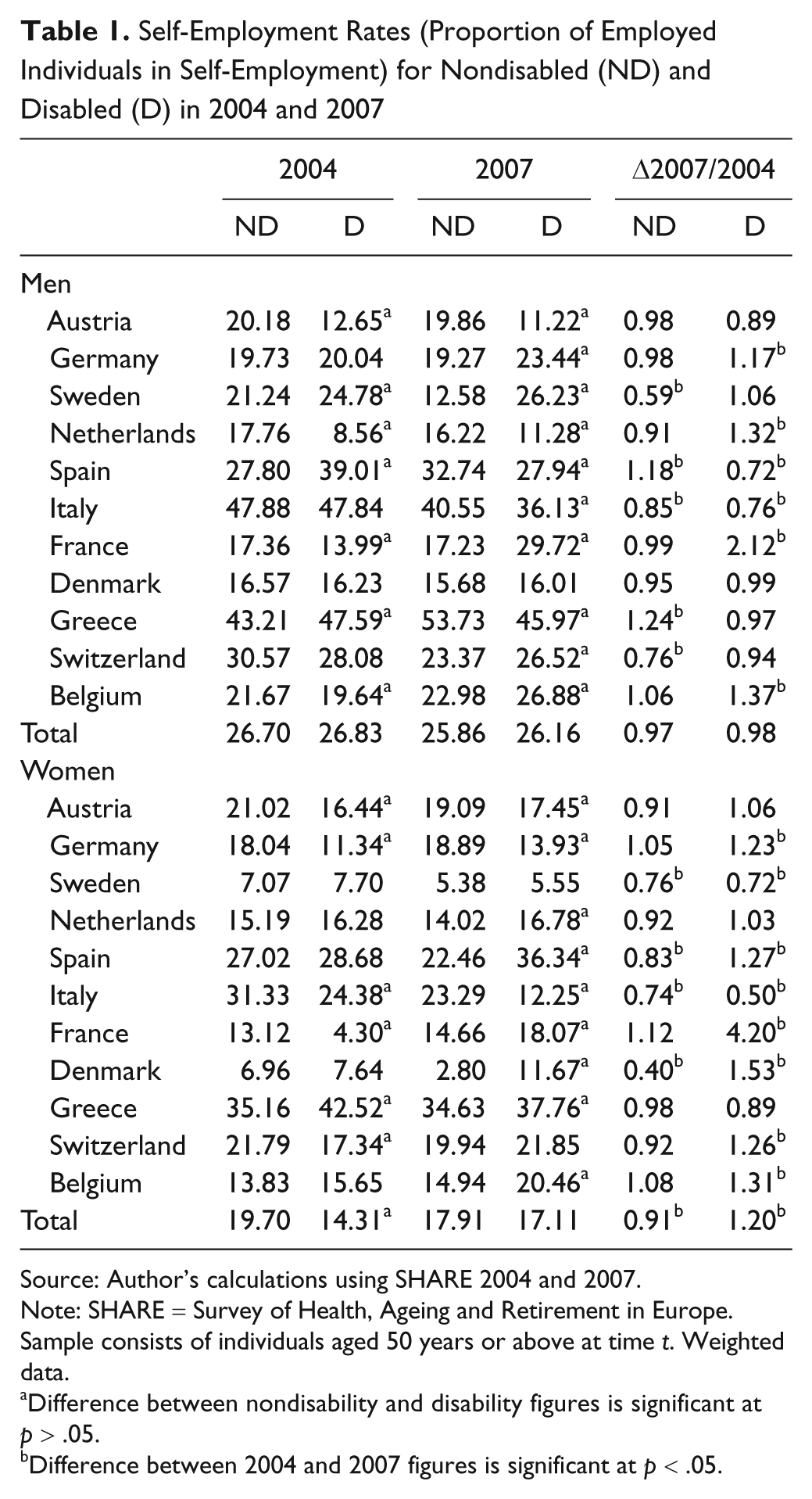
Source: Author’s calculations using SHARE 2004 and 2007.
Note: SHARE = Survey of Health, Ageing and Retirement in Europe. Sample consists of individuals aged 50 years or above at time t. Weighted data.
Difference between nondisability and disability figures is significant at p > .05.
Difference between 2004 and 2007 figures is significant at p < .05.
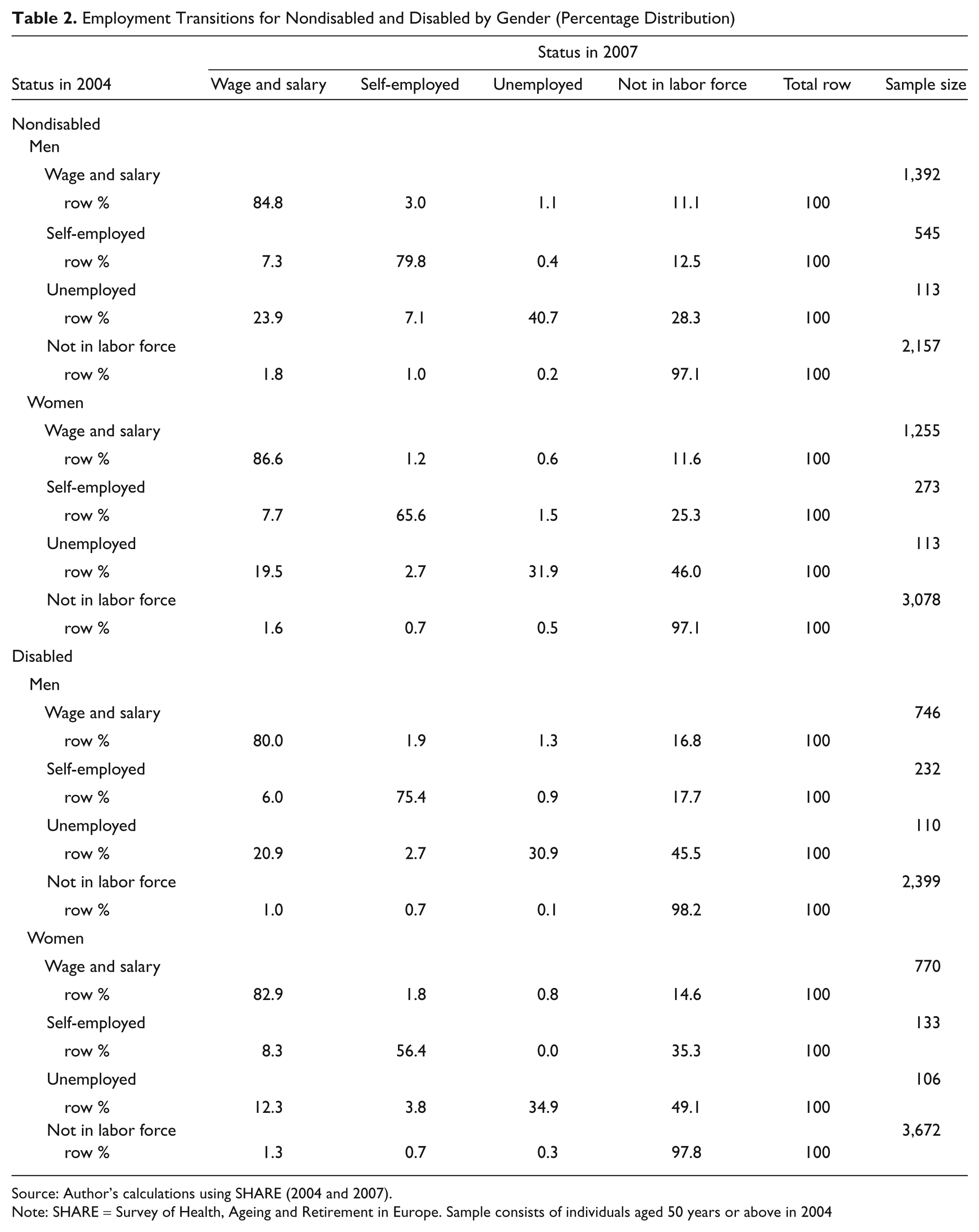
Table 2 shows the employment transitions for all European respondents on the basis of their initial labor status in 2004 (i.e., wage and salary employment, self-employment, unemployment, and not in the labor force) into one of the four possible statuses in 2007 (the same as before). Table 2 has been calculated from the aggregation of the data for all European individuals because it is not possible for this analysis to be carried out separately for each country (due to sample size issues). Tables 3 and 4 shown later have been obtained by using the same data aggregation. In Table 1, the row totals for each collective add up to 100 and show the percentage of individuals for a given status in 2004 located in a given status in 2007. As noted earlier, as we observed only the employment status of individuals in two specific years (2004 and 2007), we cannot capture those employment transitions occurring between these two years. The same thing happens when we explore the transitions in the disability status of individuals throughout the panel data.
Employment Transitions for Nondisabled and Disabled by Gender (Percentage Distribution)
Source: Author’s calculations using SHARE (2004 and 2007).
Note: SHARE = Survey of Health, Ageing and Retirement in Europe. Sample consists of individuals aged 50 years or above in 2004
Workers with disabilities who are self-employed are somewhat less likely than ones without disabilities to remain in the same labor status 3 years later. For example, the percentage of older men who were self-employed in 2004 and continued working in the same employment class in 2007 is relatively higher among workers without disabilities than ones with disabilities. For women, this gap in favor of individuals without disabilities is even higher (9.2 percentage points). Initially, this result seems to reject our first hypothesis, that is, the individuals with disabilities who are self-employed in 2004 are more likely to remain in the same labor status 3 years later.
Of the men (women) with disabilities who were self-employed in 2004, 17.7% (35.3%) were “out of labor force” in 2007. In contrast, transitions from self-employment to “out of labor force” were relatively lower for counterparts without disabilities. For women, the exit rate from self-employment to “out of labor force” is significantly higher than the exit rate from wage and salary employment to “out of labor force.” This exit rate is especially higher if the individual is disabled. In this case, the gap is 20.7 percentage points, whereas for individuals without disabilities, it is 13.7 percentage points. This finding supports our second hypothesis (i.e., the employment transitions to out of labor force from self-employment are higher for individuals with disabilities as compared with counterparts without disabilities). Regarding the exit rate toward labor inactivity, some authors have suggested that self-employment can be an attractive option for moving gradually to inactivity for many older workers with disabilities because it offers them independence, flexible work hours, and better control over how to spend their time (e.g., Cahill, Giandrea, & Quinn, 2007; Giandrea, Cahill, & Quinn, 2008). According to Oi (1991), one of the main characteristics of disability is that it “steals” time from individuals (e.g., hours of work), especially if it is more severe or intense. In this sense, self-employment can be used by individuals with disabilities as a bridge job that meets many of their personal and health needs.
Although we have described the main transition patterns and observed differences by disability status, we have to take into account that we are not controlling for other variables that can affect the likelihood to remain self-employed in 2004 and 2007 (Hypothesis 1) or move to inactivity from self-employment (Hypothesis 2).
In addition and as noted earlier, all figures shown in Table 2 do not take into account the possible transitions in disability that an individual may experience between 2004 and 2007. It is necessary to introduce into our analysis the different disability trajectories that an individual may follow between both years (Table 3). Apart from the row totals, we also included in Table 3 the column totals that again add up to 100 and indicate the percentage of individuals for a given disability status in 2007 located in a given disability status in 2004. According to Table 3, the mobility between disability states (nondisabled vs. disabled) is limited. A total of 78.2% of men (74.7% of women) are nondisabled in both years, whereas 70.1% of men (72.7% of women) remain disabled in both years. Higher percentages are found for those individuals with disabilities in 2004 who exit from disability in 2007.
Disability Transitions by Gender (Percentage Distribution)

Source: Author’s calculations using SHARE (2004 and 2007).
Note: SHARE = Sample consists of individuals aged 50 years or above in 2004.
Table 4 repeats the labor-market transitions shown in Table 2 but now taking into account these transitions in disability. A total of 76.3% (58.1%) of those self-employed men (women) in 2004 who are disabled in both years remain in the same labor status in 2007, whereas 79.8% (66.5%) of those self-employed men (women) who have never experienced disability are observed in self-employment in 2007 as well. The percentage of self-employed men (women) who are disabled in both years and move out of the labor force in 2007 is 18.4% (37.2%). This percentage is greater than those observed for the rest of disability trajectories. In addition, for women, the flows from self-employment to “out of labor force” in all trajectories analyzed are higher than those transitions observed from wage employment to “out of labor force.” For example, the percentage of women in wage employment who were disabled in 2004 and 2007 and move to inactivity in 2007 was 16.1%, that is, 21.1 percentage points lower than the percentage observed for self-employed women. For men, the differentials in the flows to inactivity between wage employment and self-employment are lower as compared with those for women. These results show that the validity of our two hypotheses depends on the type of disability trajectory that the individual has followed throughout the panel.
Transition Matrix by Disability Status and Employment Status (Percentage Distribution)
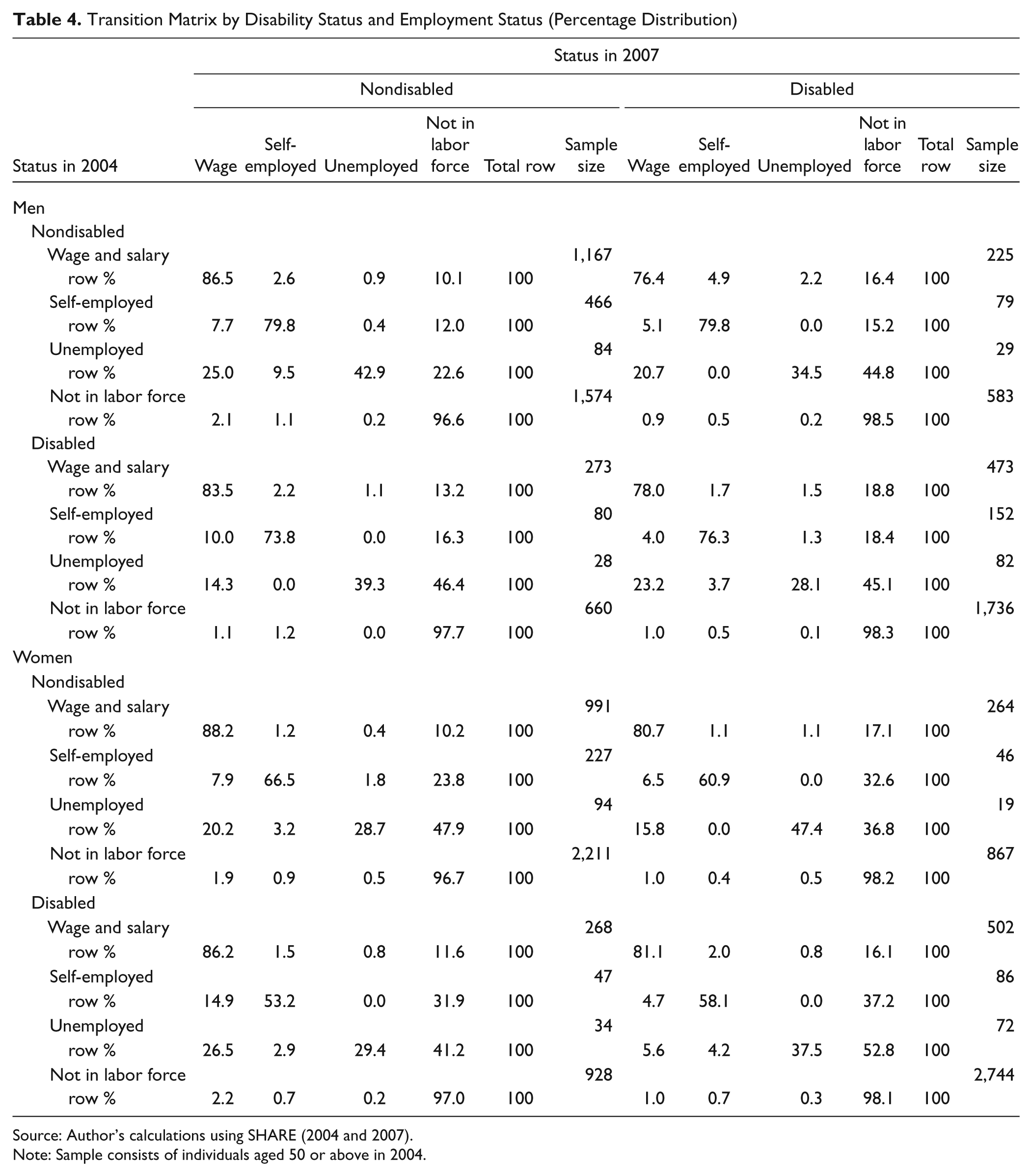
Source: Author’s calculations using SHARE (2004 and 2007).
Note: Sample consists of individuals aged 50 or above in 2004.
Turning to the econometric results, Table 5 shows the results obtained from the estimation of our first probit model (i.e., likelihood to remain self-employed in 2004 and 2007). We present the coefficients and marginal effects for two different specifications, wherein the only difference between them is in the use of different disability measures (i.e., disabled status and disability trajectories). In Specification 1, the coefficient of the disability variable (= 1 if the individual reports a disability in 2004) is not significant at a 5% level and means that individuals without and with disabilities have the same probability of remaining self-employed in 2004 and 2007. However, looking at the results obtained in Specification 2 (now with disability trajectories), we observed that those individuals who are either disabled in 2004 and nondisabled in 2007 or disabled in both years are more likely to remain self-employed in both years as compared with the category of reference (never disabled). For example, being disabled in 2004 and 2007 increases the probability of remaining self-employed by about 2 percentage points relative to the baseline probability (73.5%). Therefore, these results corroborate in part our first hypothesis, that is, only those individuals who follow the disability trajectories “disabled → nondisabled” and “disabled → disabled” are more likely to remain self-employed in 2004 and 2007. In addition, this finding shows again the importance of differentiating in our analysis among the different disability trajectories that individuals can follow through the panel.
Estimation Results From a Probit Regression on the Permanence in Self-Employment in 2004 and 2007 (Mean Values, Coefficients, and Marginal Effects [ME])
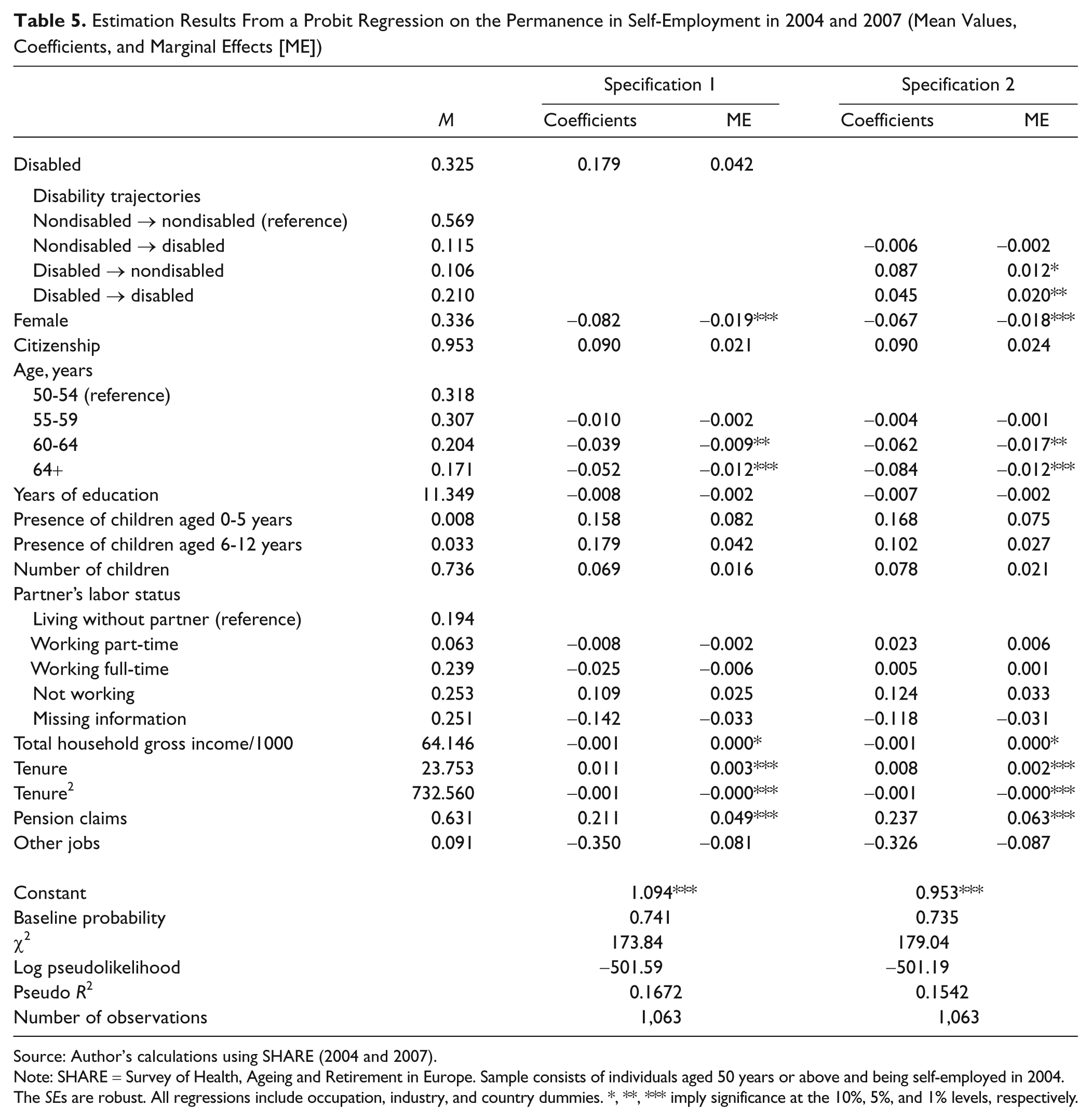
Source: Author’s calculations using SHARE (2004 and 2007).
Note: SHARE = Survey of Health, Ageing and Retirement in Europe. Sample consists of individuals aged 50 years or above and being self-employed in 2004. The SEs are robust. All regressions include occupation, industry, and country dummies. *, **, *** imply significance at the 10%, 5%, and 1% levels, respectively.
Finally, Table 6 presents the results of our second probit model (i.e., the likelihood to move from self-employment in 2004 to inactivity in 2007). In Specification 1, the coefficient of the disability variable is significant at a 5% level and indicates that the individuals with disabilities who were self-employed in 2004 are significantly more likely than their counterparts without disabilities to be out of the labor force 3 years later (3.8 percentage points relative to the baseline probability). According to Specification 2, those individuals who are disabled in both years are more likely to move from self-employment to inactivity in 2007 as compared with the category of reference (never disabled), that is, being disabled in 2004 and 2007 increases the probability of exiting from self-employment to inactivity by about 4.3 percentage points relative to the baseline probability (5.7%). The coefficient of the disability trajectory “nondisabled → disabled” is also significant, increasing the probability of moving to inactivity by 3.5 percentage points relative to the baseline probability. According to these results, our second hypothesis is only valid if the person has been disabled in both years or has followed the trajectory “nondisabled → disabled.” Finally, variables measuring individual, job, and household characteristics also affect the probability of remaining self-employed in both years or of moving from self-employment to inactivity, and the results are similar to those found in the existing literature on self-employment. For example, in Table 6, women and the older workers are more likely to move from self-employment to inactivity between 2004 and 2007. In contrast, the variables “total household gross income” and “tenure” have a significant negative impact on the likelihood to move from self-employment to inactivity.
Estimation Results From a Probit Regression on the Exit From Self-Employment to “Out of Labor Force” (Mean Values, Coefficients, and Marginal Effects [ME])

Source: Author’s calculations using SHARE (2004 and 2007).
Note: SHARE = Survey of Health, Ageing and Retirement in Europe. Sample consists of individuals aged 50 years or above and being self-employed in 2004. The SEs are robust. All regressions include occupation, industry, and country dummies.*, **, *** imply significance at the 10%, 5%, and 1% levels, respectively.
Discussion
Using data from the two waves of the SHARE (2004 and 2007), we have analyzed the employment transitions of older European individuals (disabled and nondisabled), with particular attention to the inflows and outflows from self-employment. We have proposed two different hypotheses: first, the disabled individuals who are self-employed in 2004 are more likely to remain in the same labor status in 2007, and second, the employment transitions to out of labor force from self-employment are higher for individuals with disabilities as compared with their counterparts without disabilities. The employment transition analysis has shown that workers with disabilities (especially women) who are self-employed in 2004 are somewhat less likely to remain in the same labor status 3 years later. In contrast, transitions to out of labor force from self-employment were relatively higher for individuals with disabilities as compared with ones without disabilities. In addition, we have found differences in the flows to inactivity from self-employment depending on the type of disability trajectory. For example, those individuals who are disabled in 2004 and 2005 are more likely to move from self-employment to inactivity. The econometric results have shown that only those individuals with the disability trajectories “disabled → nondisabled” and “disabled → disabled” are more likely to remain self-employed in 2004 and 2007 than their counterparts without disabilities. With regard to the exit from self-employment to “out of the labor force,” the results support our second hypothesis by depending on the type of the disability trajectory. This second hypothesis is only valid if the person has been disabled in both years or has followed the trajectory “nondisabled → disabled.”
Although the econometric results support the first and second hypotheses (partially), we have to take into account some limitations and propose future research on this issue. It is important to mention that a limitation of the SHARE is that it does not contain any information regarding the type of disability and impairment that the person suffers. The availability of this information in the SHARE would have permitted a detailed analysis. Nonetheless, the results of our study may offer an important step toward understanding the labor-market transitions of older people with disabilities in Europe and particularly the use of self-employment as a way to enter or leave the labor markets. As other authors have mentioned (e.g., Arnold & Ipsen, 2005; Boylan & Burchardt, 2002), more research in this area is needed such as the study of the effects of some active labor public policies on the levels of employment of people with disabilities in general and the rates of self-employment in particular, the role of vocational rehabilitation agencies across Europe in the promotion and implementation of their policies and procedures, the main barriers to self-employment for workers with disabilities, and the level of satisfaction reported by individuals with disabilities who are self-employed as compared with wage and salary earners, among others. In addition, the differences in industrial background, the labor market of each country, types of business, and the sizes of self-employment may be variables to investigate in future research.
Following the findings obtained in this study, policy makers must encounter ways and mechanisms to reduce the number of early withdrawals of older workers (disabled or not) from the labor force in general and to offer older workers with disabilities smooth and gradual work transitions to inactivity in particular, especially for those individuals suffering long-term disability trajectories (who have the highest probability to move from self-employment to inactivity). In some cases, this transition from self-employment to inactivity for individuals with disabilities can be especially painful and can lead to an important reduction in financial resources. Following Scott (2004), a gradual withdrawal from the labor force can have two forms: either phased retirement (reducing work hours in the same job) or partial retirement (changing to a less demanding job usually with fewer hours and lower earnings). Each retirement path comes with its own income trajectories before, during, and after the transition process, with, for example, a combination of wages and a partial state pension and/or occupational pension during the period of gradual retirement. In this sense, a better combination of benefits and self-employment could make it possible and more attractive for people with disabilities to be entrepreneurs and still feel economically safe. Flexibility and security (i.e., flexicurity) are two important issues for this collective. According to Boylan and Burchardt (2002), the flexibility offered by self-employment—given sufficient and appropriate support—is particularly important for people with disabilities, as the impact of their impairments on their ability to work may be a variable. Moreover, these authors mention that self-employment can provide an alternative to a competitive and discriminatory labor market. At a general level, the encouragement and promotion of self-employment among older workers (disabled or not) may help to maintain the financial sustainability of social security and pension systems across Europe, as well as decrease the employment gap between the population with and without disabilities.
Footnotes
Declaration of Conflicting Interests
The author(s) declared no potential conflicts of interest with respect to the research, authorship, and/or publication of this article.
Funding
The author(s) received no financial support for the research, authorship, and/or publication of this article.