




Abstract
As charter schools continue to gain influence as a presence in public education reform initiatives, it is increasingly important to examine issues related to the education of students with disabilities in these settings. This study examined two dimensions of the education of students with disabilities in charter schools when compared with the public school districts in their host communities: (a) the population characteristics of students with disabilities and (b) the extent to which the schools are following federal and state special education compliance requirements. The author found that there were notable differences between the population characteristics of students with disabilities enrolled in charter schools and public school districts. Although charter schools were no less likely than comparison school districts to implement special education compliance requirements, there were fundamental areas of special education procedures that need to be improved in these settings. The article concludes with recommendations for policy actions and technical assistance.
Almost 20 years after the first charter school began operation in Minnesota, charter schools continue to gain influence as a presence in public education reform initiatives (Estes, 2003; Nathan, 1996). Policy changes related to the number and size of charter schools in the author’s home state of Massachusetts highlight this growing presence. On January 18, 2010, Massachusetts Governor Deval Patrick signed into legislation an education reform bill that increased the number of students attending charter schools in Massachusetts, through both expansion in the overall number of operating charter schools and through increases in the number of students enrolled in previously existing charter schools (Official Website of the Governor of Massachusetts, 2010).
The move to expand the number of charter schools and number of students attending charter schools raises questions regarding the education of students with disabilities in these settings. To what extent are students with disabilities enrolled in Massachusetts’ charter schools? Are charter schools able to fulfill the requirements of state and federal laws regarding the education of students with disabilities? Are there particular challenges related to special education services faced by charter schools that could be targeted for support? The new legislation did not specifically address any issues or concerns related to students with disabilities, and an examination of the existing Massachusetts law on charter schools revealed that there are only limited references to special education services (Massachusetts General Laws [MGL] Ch. 71, Sec. 89). The references provided are focused on issues related to general enrollment policies, and programmatic and financial responsibility for students in private day and residential placements. The law states that charter schools “shall be open to all students” and not discriminate “on the basis of race, color, national origin, creed, sex, ethnicity, sexual orientation, mental or physical disability, age, ancestry, athletic performance, special need [emphasis added], or proficiency in the English language or a foreign language or academic achievement” (MGL Ch. 71, Sec. 89, (m)). Regarding fiscal and programmatic responsibility, the statute requires the school district of residence (as opposed to the charter school) to maintain responsibility for students in private day and residential placements (MGL Ch. 71, Sec. 89 (s)).
This study was designed to contribute to the existing research literature on the representation and education of students with disabilities in charter schools. Specifically, the study sought to develop a deeper understanding of the special education population characteristics and compliance levels of Massachusetts’ charter schools. Although previous studies have focused on the population characteristics of students with disabilities in charter schools, this study attempted to make an important contribution by examining the level of special education services as indicated by the extent to which charter schools implement special education compliance requirements as outlined in state and federal law. In light of the growing emphasis on charter schools as viable public education providers at the state and national levels, it is important to closely examine special education enrollment practices and services in these organizations. It is hoped that the findings from this study inform researchers, policy makers, and practitioners at the state and national levels as to current challenges in providing special education services faced by charter schools and potential areas for targeted support.
Literature Review
The literature review focused on the legal foundations for charter schools and studies of student population characteristics, enrollment practices, and special education services in charter schools. The sources for the literature review were identified by the following methods: (a) searches of three electronic databases prominent in the field of education research: Education Full Text, Academic One, andthe Educational Resources Information Center (ERIC);(b) Internet searches using Google Scholar; and (c) review of the bibliographies found in studies identified through the previous two methods. The terms used for electronic searches were charter schools, school choice, special education, disabilities, exceptional children/education, and compliance.
Responsibilities for Educating Children and Youth With Disabilities
The federal laws that govern the educational opportunities and services provided for children and youth with disabilities define public school districts as being local education agencies (LEAs; Heubert, 1997). As LEAs, public school districts are responsible for providing the access to schooling and range of supports that are outlined in the federal laws that directly impact the education of students with disabilities.
The Individuals With Disabilities Education Improvement Act of 2004 provides the legal foundations for special education services, including the fundamental provision that all students receiving special education services must be provided a free, appropriate public education in the least restrictive environment (2004).
Section 504 of the Rehabilitation Act of 1973 and the Americans With Disabilities Act (1990, amended in 2008) ensure that agencies receiving federal funds may not discriminate against individuals on the basis of disability. For students with disabilities attending public schools, Section 504 provides the authority for reasonable accommodations to be implemented in order that students may have equal access to all aspects of schooling (Rehabilitation Act of 1973).
The No Child Left Behind Act of 2001 governs aspects of the education of students with disabilities by providing specific measures related tothe participation of students with disabilities in high-stakes assessments and state accountability systems.
The extent to which charter schools are responsible for fulfilling the mandates of these laws is dependent on whether they are regarded as being LEAs. Multiple authors have examined the legal implication of the federal statutes, and contend that charter schools that operate independently from school districts are considered LEAs and are therefore subject to the provisions of federal laws and regulations (Heubert, 1997; O’Neill, Wenning & Giovannetti, 2002; Rhim, Ahearn, & Lange, 2007). In addition, guidance from the U.S. Department of Education (2004) indicated that although charter schools operate with a larger degree of autonomy than public school districts, these organizations are still subject to federal laws and regulations governing public education. Based on this information, charter schools are responsible for educating students with disabilities to the same extent as public school districts.
However, there are charter schools that do not operate independently of public school districts (O’Neill et al., 2002). These schools work in collaboration with public school districts, which can blur the line of responsibility for services provided to children and youth with disabilities. The nature of these relationships varies from state to state and is typically defined in individual states’ charter school laws (O’Neill et al., 2002). Examinations of state charter school legislation have found that nature of the relationship between charter schools and the school districts in their host communities impacted (a) which entity had responsibility for providing special education services and (b) how funding for special education services was allocated across the organizations (Ahearn, Lange, Rhim, & McLaughlin, 2001; Ahearn, Rhim, Lange, & McLaughlin, 2005).
Research on the Education of Children and Youth With Disabilities in Charter Schools
Research studies conducted on charter schools and students with disabilities have focused on two aspects of the legal requirements outlined in the Individuals With Disabilities Education Improvement Act of 2004, Section 504 of the Rehabilitation Act of 1973, and the Americans With Disabilities Act: (a) the extent to which students with disabilities have access to education in charter schools, as examined through the population characteristics of students with disabilities and the enrollment practices implemented by charter schools, and (b) the types of special education services provided in charter schools, as examined through the practices of administrators and teachers working in these settings. The research findings indicated that although charter schools enroll students with disabilities and are providing a special education services, they may not be completely fulfilling their obligations under federal law.
Regarding the student population characteristics of students with disabilities, studies in various states have found that the percentage of students receiving special education services in charter schools is lower than in public school districts. The studies included Arizona (McKinney, 1996), California, (Rhim, Faukner, & McLaughlin, 2006), Texas (Estes, 2003), Washington, D.C. (Lacireno-Paquet, Holyoke, Moser, & Henig, 2002), and a multistate sample (Miron, Urschel, Mathis, & Tornquist, 2010). There are also differences in the severity of disabilities of students enrolled in charter schools when compared with public school districts, and in the settings in which special education services are provided. Studies across states have demonstrated that students with disabilities enrolled in charter schools typically had mild disabilities, that enrollment of students with more significant disabilities was less common in charter schools than in public school districts, and that students with disabilities attending charter schools were typically educated in general education classroom settings at higher rates than in public school districts (Estes, 2004; Fiore, Harwell, Blackorby, & Finnigan, 2000; Miron et al., 2010; Rhim et al., 2006; Rhim & McLaughlin, 2001; Wilkens, 2011).
One potential reason for discrepancies in the population characteristics of students with disabilities in charter schools when compared with public school districts is the practice of counseling students with disabilities away from enrolling in charter schools. The theory contends that certain policy incentives—finances, accountability, and homogenization (the practice of enrolling students who are likely to have skills that align with the theme or focus of the school)—may lead charter schools to discourage students with disabilities from enrolling (Welner & Howe, 2005). The counseling away practices may be either overt or covert, and studies have found that contributing factors include having inadequate levels of staffing to serve students with disabilities, communicating to parents that the students’ abilities may not be at the level needed to meet the standards of the school, making enrollment conditional on student performance, and steering students with disabilities toward schools with a vocational focus, when compared with more academically focused schools (Fiore et al., 2000; Howe & Welner, 2002; Rhim & McLaughlin, 2001). Despite the presence of practices that counsel away students with disabilities, parent influence plays an important role in charter school enrollment (Arsen & Ray, 2004). Parents enroll their children in charter schools for a variety of reasons, including for the special education services offered, the needs of their children, and dissatisfaction with their children’s former public school districts (Fiore et al., 2000; Lange & Lehr, 2000).
Financial incentives and market standing are also factors that impact the enrollment of students with disabilities in charter schools (Arsen & Ray, 2004; Lacireno-Paquet et al., 2002). A general analysis of national data and more detailed analysis of data from Michigan led Arsen and Ray (2004) to conclude that enrollment practices in charter schools are driven primarily by the amount of reimbursement provided by the state for the costs associated with educating students with disabilities. Lacireno-Paquet et al. (2002) placed an emphasis on the market-driven foundation of many charter schools. They posited that certain charter schools—such as those operated by for-profit companies—were more likely to engage in enrollment practices that improve their market standing. The practices could include enrolling academically successful students most likely to succeed in these schools and “cropping” off the enrollment numbers of students with disabilities. These types of practices would potentially improve the performance of for-profit charter schools while keeping operating costs to a minimum.
A limited amount of research has been conducted on the provision of special education services in charter schools. Studies demonstrated that there may be a general lack of knowledge regarding the requirements of federal and state special education laws and that the highly regulated nature of these laws conflicts with the autonomous philosophical underpinnings of charter schools (Ahearn et al., 2001; Estes, 2003, 2006; McKinney, 1996; Rhim & McLaughlin, 2001). Tensions regarding autonomy reach into classroom instructional practices. The individualized instruction, accommodations, and curricular modifications typically required for students with disabilities may present challenges for charter schools reluctant to deviate from their selected approach (Rhim & McLaughlin, 2007). These findings indicate that charter schools may be struggling to fulfill the mandates of IDEIA (2004) to provide a free appropriate public education in the least restrictive environment.
Method and Procedures
As previously stated, this study was designed to contribute to the existing research literature on the representation and education of students with disabilities in charter schools. Specifically, the study sought to develop a deeper understanding of the special education population characteristics and compliance levels of Massachusetts’ charter schools. Although previous studies have focused on the population characteristics of students with disabilities in charter schools, this study attempted to make an important contribution by examining the level of special education services as indicated by the extent to which charter schools implement special education compliance requirements as outlined in state and federal law. The research questions addressed were the following:
Research Question 1: What are the population characteristics of students with disabilities in Massachusetts’ charter schools?
Research Question 2: What are the compliance levels of Massachusetts’ charter schools as determined through state special education compliance monitoring reviews?
Research Question 3: How do Massachusetts’ charter schools compare to the public school districts in their host communities on special education student population and compliance indicators?
Sample
The target population for this study was all Massachusetts charter schools and the school districts located in their host communities up to and including the 2009–2010 academic year. Charter schools and school districts were identified from the enrollment files available from the Massachusetts Department of Elementary and Secondary Education (MADESE) website (http://www.doe.mass.edu/infoservices/reports/enroll/). Host communities for each charter school were identified by reviewing the location of each charter school and including the corresponding district from that city or town. For charter schools located in towns that are members of regional school districts, the regional school district was used as the host community. In total, 62 charter schools and 37 school districts were included in the sample.
For the analysis of special education compliance monitoring reports, the sample was refined to include only those charter schools and host school districts that have been monitored by the MADESE through the Coordinated Program Review (CPR) process since the beginning of the 2005–2006 academic year. That year was selected as it was the first complete school year following the reauthorization of IDEIA in 2004. Through the CPR process, charter schools and school districts are monitored in 59 areas of special education compliance. The monitoring is conducted by staff from the MADESE and consists of a combination of document review, on-site inspections, and in-person interviews with school personnel (MADESE, 2009). Charter schools and school districts undergo a CPR every 6 years, with a mid-cycle review conducted at the 3-year mark between CPRs (MADESE, 2009). As the CPR is a full review that typically covers all 59 criteria—as opposed to the mid-cycle review, which only reviews selected criteria based on previous monitoring results—only charter schools and school districts that participated in a CPR and had a final report issued by the MADESE were included in the study. As a result of these criteria, 43 charter schools and 31 districts were included in the analysis of special education compliance monitoring reports.
Data Collection: Sources and Procedures
Publicly available data from the MADESE website were used for this study. Data on student population characteristics and the lists of charter schools and school districts were taken from district-level Excel files found at http://www.doe.mass.edu/infoservices/reports/enroll/. Data on special education compliance monitoring were collected from individual district and charter school CPR reports available at http://www.doe.mass.edu/pqa/review/cpr/reports/. All data were downloaded from the MADESE website between June 15, 2010, and June 22, 2010.
The analysis of population characteristics of students receiving special education services used data from 5 years: the 2005–2006 academic year through the 2009–2010 academic year. Of the 62 charter schools included in the study, 54 were in operation for the entire 5-year period. Two schools began operating in 2006–2007, 3 schools in 2007–2008, 1 school in 2008–2009, and 1 schools in 2009–2010. For the student population characteristics of interest (special education status, disability category, and educational environment), files were downloaded, merged, and imported into SPSS statistical software for analysis.
After careful consideration and a review of relevant literature, a decision was made to not examine the race/ethnicity of students with disabilities in charter schools and the comparison school districts. This decision was not intended to detract from the significance of issues pertaining to racial/ethnic representativeness in special education. In fact, the decision reflects the complexity of issues pertaining to race, ethnicity, and determination of eligibility for special education services. The research on disproportionate representation in special education has shown that a myriad of issues contribute to the overrepresentation of students from historically disadvantaged minority groups (Donovan & Cross, 2002; Klingner et al., 2005; Losen & Orfield, 2002). To effectively engage this topic, issues such as inequitable access to health services, the cultural values of school personnel, policies and practices that demonstrate overt and/or covert bias and discrimination, and diagnostic practices would need to be closely examined (Swanson, 2008). These issues are important but reside beyond the intended scope of this particular study.
To collect and analyze special education compliance monitoring results, CPR reports for all charter schools and districts in the sample were downloaded, read, and the scores for each criterion were recorded in a database created for this study. The MADESE assigns a score of commendable, implemented, partially implemented, not implemented, or not applicable to every criterion reviewed during a CPR. Over the course of the academic years covered in this study (2005–2006 through 2009–2010), seven special education monitoring criteria ceased to be monitored on CPRs. Data for these criteria were recorded in the study’s database but were not included in the analyses. The analyses conducted for this study were focused on currently monitored criteria (as of 2009–2010), with the belief that these areas are most relevant for analysis, discussion, and future policy and programmatic considerations.
Data Analysis: Methodologies and Procedures
SPSS statistical software was used throughout the data analysis process. For the analysis of student population characteristics, one notable methodological decision was made. For the educational environment analysis, students in out-of-district placements were not included. As charter schools are not typically responsible for serving students in out-of-district special education settings, it was deemed appropriate to focus on those students being served within the charter schools and comparison school districts.
Determining the appropriate measurement scale for the variables representing special education compliance monitoring results was an important aspect of the data analysis process. The MADESE defined the compliance ratings as follows:
Commendable—Any requirement or aspect of a requirement implemented in an exemplary manner significantly beyond the requirements of law or regulation;
Implemented—The requirement is substantially met in all important aspects;
Partially Implemented—The requirement, in one or several important aspects, is not entirely met;
Not Implemented—The requirement is totally or substantially not met; and
Not Applicable—The requirement does not apply to the school district or charter school. (MADESE, 2009)
There was concern over what the value of each compliance rating actually represents. It appeared to the author that operational terms such as “substantially met,” “not entirely met,” and “substantially not met” lacked specificity and that there could be resulting overlap between compliance ratings such as commendable and implemented. For example, there was no standard provided for receiving a commendable rating on ensuring that timelines for determining special education eligibility are met. Would a commendable rating be given for an average of 30 days to determine eligibility, or 35 days? As another example, the definition of implemented includes the phrase “all important aspects,” but there was no information provided in the state’s compliance monitoring document to distinguish which aspects are considered “important” (MADESE, 2009). Due to the potential overlap in the compliance ratings, it was decided to treat the variables representing special education compliance monitoring results as nominal (or categorical) variables. Although this decision placed limitations on the types of statistical analyses conducted, it was viewed to be a more appropriate manner for treating these data. Frequency counts, comparison of percentages, and chi-square tests were used as the primary methods of analysis.
It should also be noted that not every charter school or school district was monitored for every special education criterion. There were instances in which criteria were deemed not applicable in the CPR report, and other instances in which a specific criterion was not reviewed during a CPR. In these instances, these data were treated as “missing” and were not included in the analyses.
Analysis of Population Characteristics of Students Receiving Special Education Services
As presented in Table 1, the proportion of students receiving special education services in Massachusetts charter schools ranged from 11.5% to 12.1% over the 5-year period. The school districts included in the sample had consistently higher rates of students receiving special education services during this period. The school district rates ranged from 18.0% to 19.3%. Both groups experienced increases in the overall number of students receiving special education services.
Special Education Enrollment Counts and Rates by Academic Year: Massachusetts Charter Schools and School Districts Included in Study.

The next phase of data analysis focused on the disability categories of students receiving special education services. The disability categories and definitions are those used by Massachusetts charter schools and school districts, as described in state statute and regulation. Table 2 presents the disability rates for students in both charter schools and comparison school districts.
Special Education Disability Category Rates by Academic Year: Massachusetts Charter Schools and School Districts Included in Study.
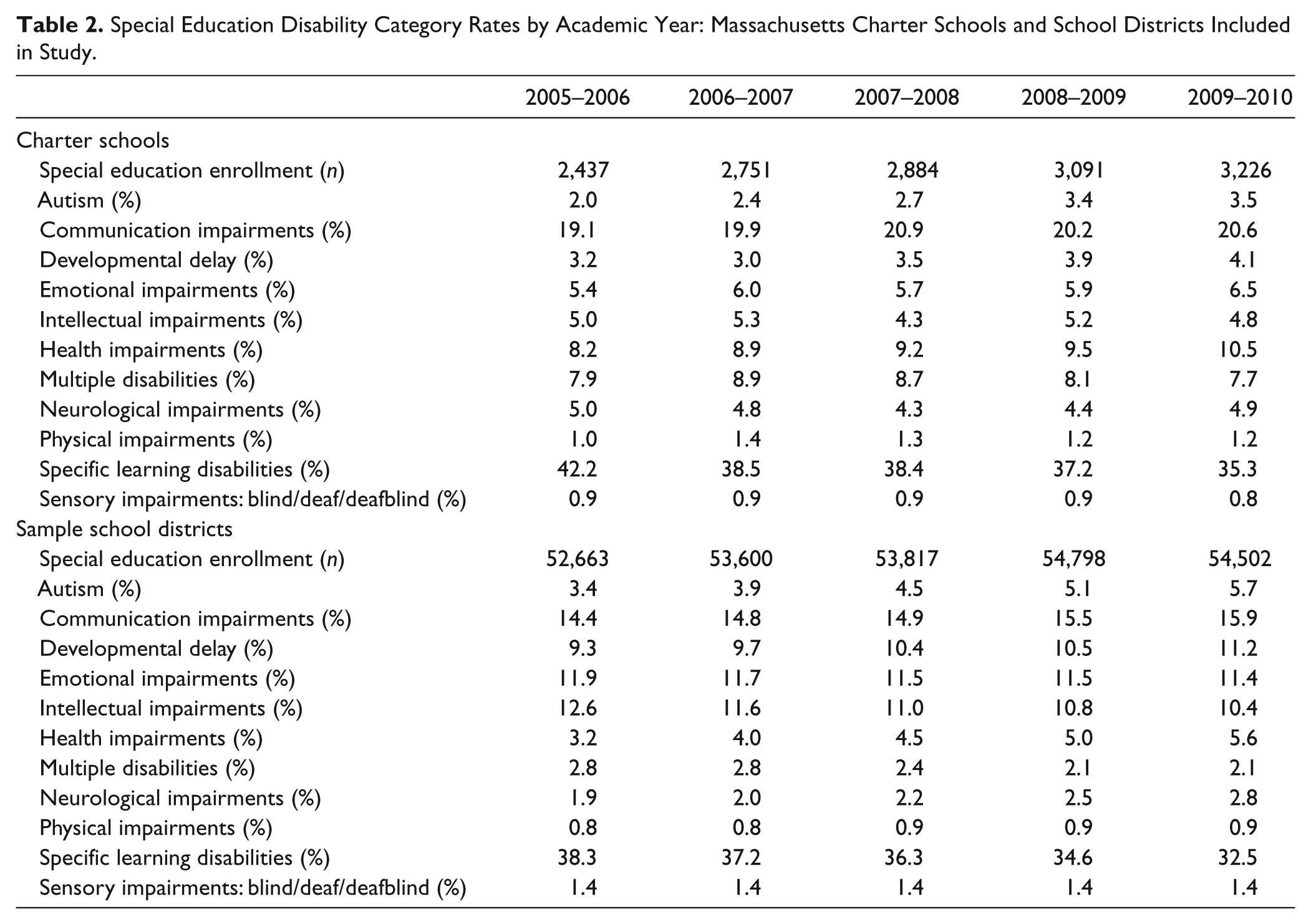
Disability categories that had notable differences were autism, emotional impairments, intellectual impairments, health impairments, multiple disabilities, and neurological impairments. School districts served consistently higher rates of students with autism, emotional impairments, and intellectual impairments. For autism, school district rates ranged from 3.4% in 2005–2006 to 5.7% in 2009–2010, when compared with charter school rates ranging from 2.0% in 2005–2006 to 3.5% in 2009–2010. School district rates for emotional impairments ranged from 11.9% in 2005–2006 to 11.4% in 2009–2010, whereas charter school rates ranged from 5.4% to 6.5% over this same period. Rates for students with intellectual impairments in school districts ranged from 12.6 in 2005–2006 to 10.4% in 2009–2010 and in charter schools ranged from a high of 5.3% in 2006–2007 to a low of 4.3% in 2007–2008.
The disability categories for which charter schools had notably higher rates than comparison school districts were health impairments, multiple disabilities, and neurological impairments. For health impairments, charter school rates ranged from 8.2% to 10.5%, when compared with a school district range of 3.2% to 5.6%. The rate of students with multiple disabilities in charter schools ranged from a high of 8.9% in 2006–2007 to a low of 7.7% in 2009–2010, when compared with a school district high of 2.8% in 2005–2006 and 2006–2007, to a low of 2.1% in 2008–2009 and 2009–2010. Rates of students with neurological impairments in charter schools ranged from 4.3% to 5.0%, and for school districts ranged from 1.9% to 2.8%.
A final student population characteristic analyzed was the educational environment in which students receiving special education services were educated. Table 3 presents the educational environment rates for students educated within the charter schools and school districts by academic year. As noted in the “Method and Procedures” section, students in out-of-district placements were excluded from this portion of the analysis.
Special Education Educational Environment Rates for Students Educated Within Charter Schools and School Districts by Academic Year: Massachusetts Charter Schools and School Districts Included in Study.
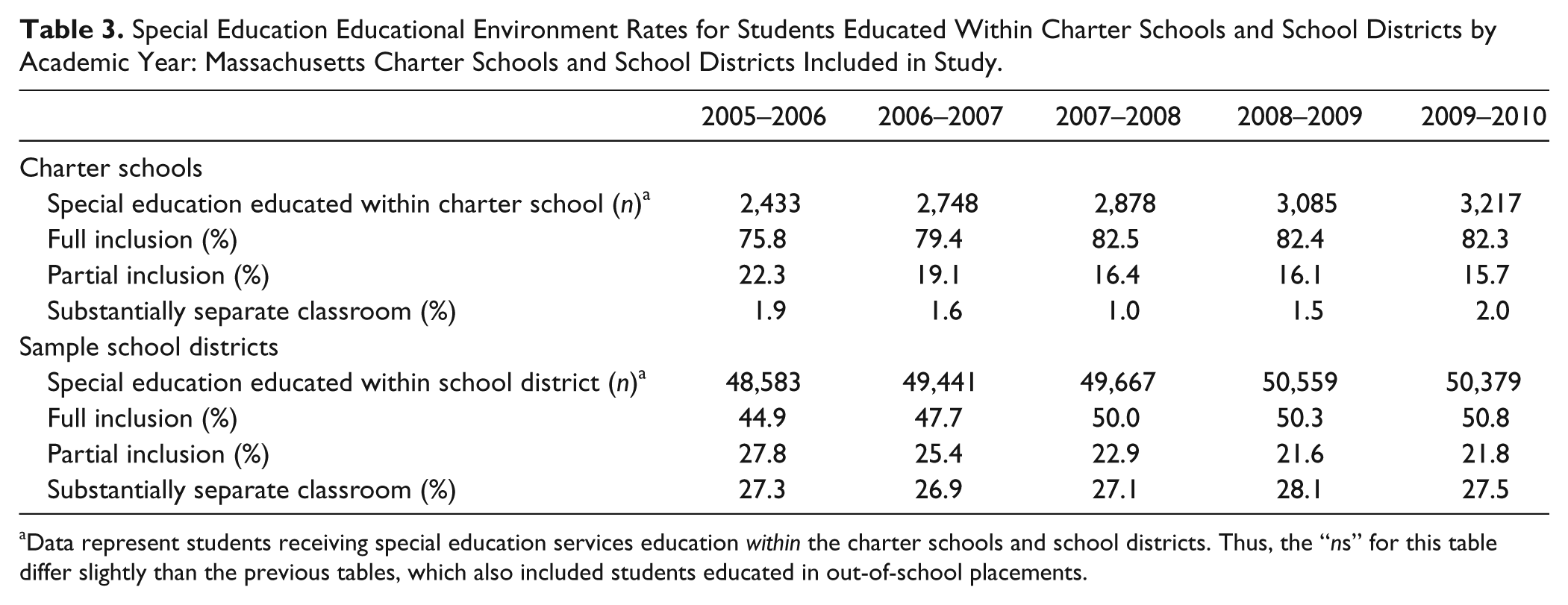
Data represent students receiving special education services education within the charter schools and school districts. Thus, the “ns” for this table differ slightly than the previous tables, which also included students educated in out-of-school placements.
These data indicate that students receiving special education services in charter schools are educated in full inclusion settings at notably higher rates than students in the comparison school districts. Data for charter schools ranged from 75.8% to 82.5%, and for school district ranged from 44.9% to 50.8%. Students in charter schools were educated in substantially separate classrooms at lower rates than students in the comparison school districts. Charter school rates ranged from 1.0% in 2007–2008 to 2.0% in 2009–2010, and school district rates ranged from 26.9% in 2006–2007 to 28.1% in 2008–2009.
Analysis of Special EducationCompliance Monitoring Levels
Charter School Compliance Levels
The next area for examination focused on the extent to which charter schools and school districts implemented special education compliance requirements. The first step in the data analysis was calculating and examining compliance rates for each special education criterion. Compliance rates for charter schools ranged from a low of 41.9% receiving a rating of either commendable or implemented for the requirement that LEAs develop and sustain special education parent advisory councils, to a high of 100% commendable/implemented for requirements regarding dispute resolution procedures and the registration of educational interpreter for students who are deaf. In total, 10 criteria were between 90% and 100% commendable/implemented, 14 criteria were between 80% and 89%, 12 criteria were between 70% and 79%, 8 criteria were between 60% and 69%, 5 criteria were between 50% and 59%, and 4 criteria were below 50% commendable/implemented. Table 4 presents the compliance rates by ranges to provide a clearer picture of the criteria with the highest and lowest compliance rates.
Analysis of Massachusetts CPR: Compliance Levels of Charter Schools Presented by Ranges.

Note: CPR = Coordinated Program Review; FAPE = Free Appropriate Public Education; IEP = Individualized Education Program; SE = Special education monitoring criterion.
Comparison Between Charter Schools and School Districts
The second phase of data analysis focused on comparing results between charter schools and school districts included in the sample. The compliance rates for each group were calculated and compared, and all criteria with a greater than 10% point difference between the percentage commendable/implemented for charter schools and school districts were flagged. Chi-square tests of independence were then run for each of the flagged criteria.
Charter schools were flagged for compliance rates higher than 10% points (when compared with school districts) for 14 criteria. Of these criteria, significant interaction effects were found for four—instructional grouping requirements, age span requirements, appropriate certifications/licenses, and special education facilities and classrooms. Table 5 provides additional detail.
Special Education Monitoring Criteria for Which Charter Schools Have a Greater Than 10% Point Difference Over Comparison School Districts in the Implementation Rate of Designated Criterion.
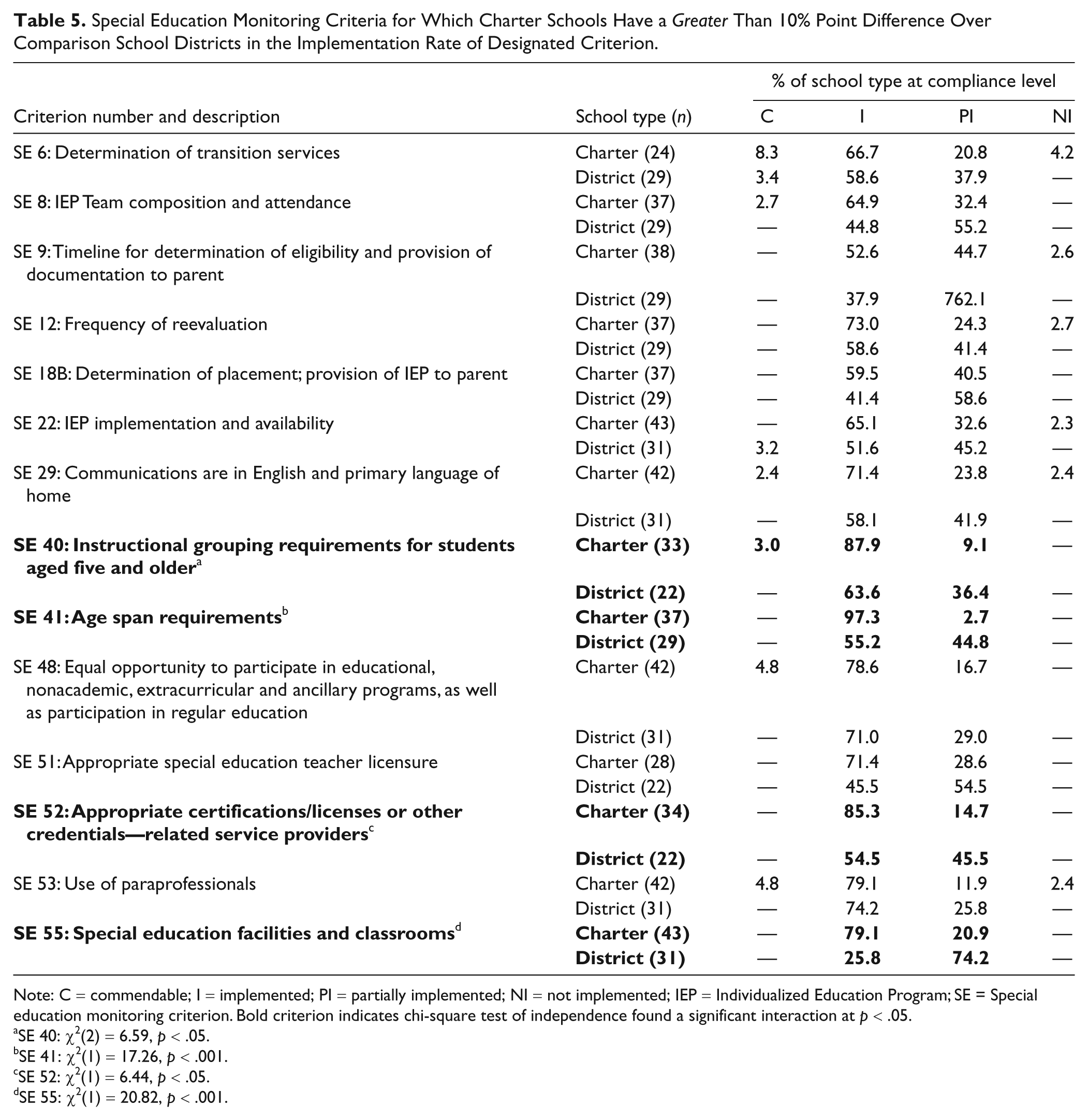
Note: C = commendable; I = implemented; PI = partially implemented; NI = not implemented; IEP = Individualized Education Program; SE = Special education monitoring criterion. Bold criterion indicates chi-square test of independence found a significant interaction at p < .05.
SE 40: χ2(2) = 6.59, p < .05.
SE 41: χ2(1) = 17.26, p < .001.
SE 52: χ2(1) = 6.44, p < .05.
SE 55: χ2(1) = 20.82, p < .001.
School districts were flagged for compliance rates higher than 10% points (when compared with charter schools) for six criteria. Of these criteria, a significant interaction effect was found for one—school district response to parental request for independent educational evaluation. Table 6 provides additional detail.
Special Education Monitoring Criteria for Which Comparison School Districts Have a Greater Than 10% Point Difference Over Charter Schools in the Implementation Rate of Designated Criterion.
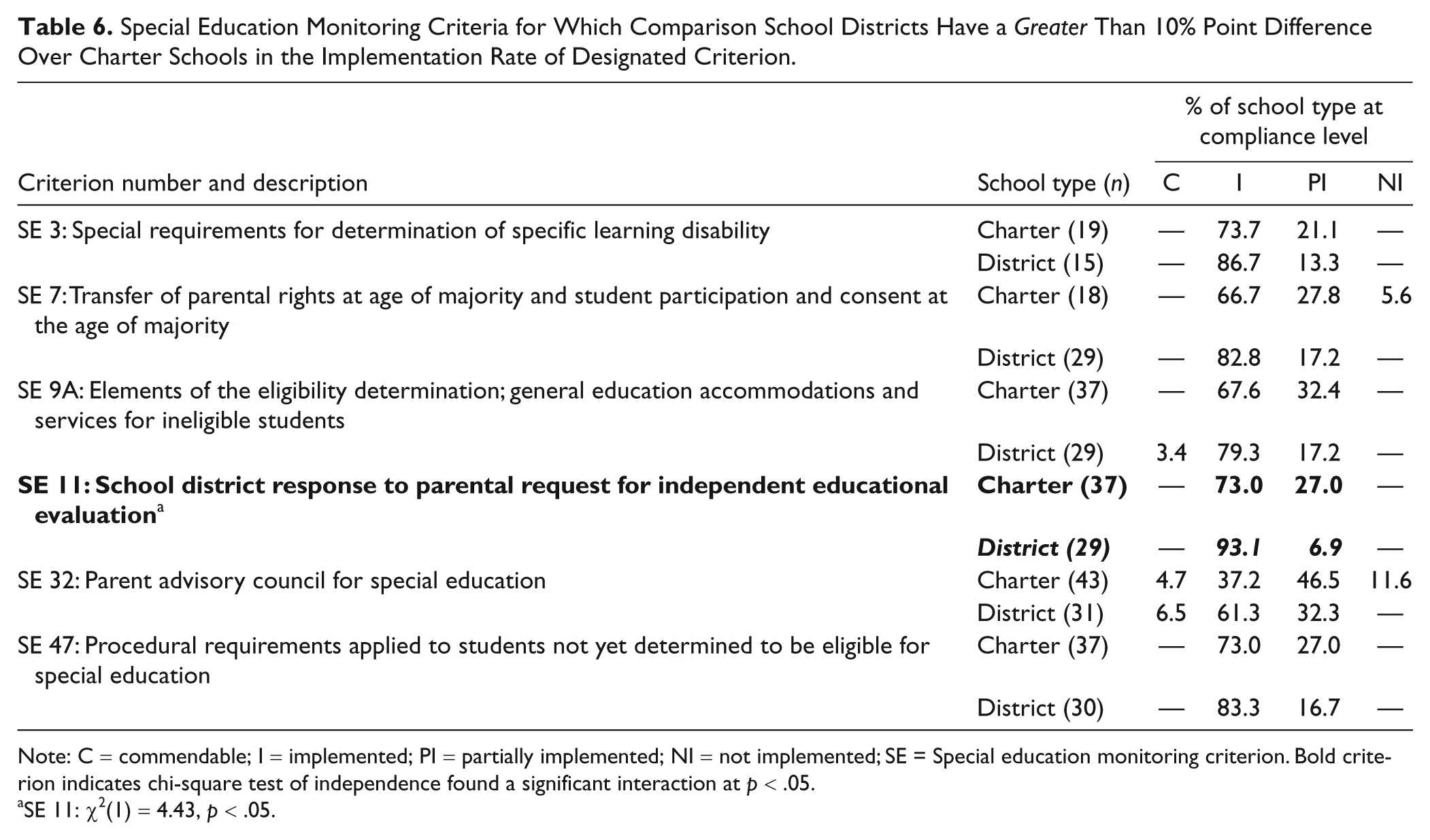
Note: C = commendable; I = implemented; PI = partially implemented; NI = not implemented; SE = Special education monitoring criterion. Bold criterion indicates chi-square test of independence found a significant interaction at p < .05.
SE 11: χ2(1) = 4.43, p < .05.
Findings and Discussion
Analyses of student population data found that Massachusetts’ charter schools enroll a notably lower percentage of students receiving special education services than the public school districts in their host communities. This finding was consistent with results from studies conducted in other states by Rhim et al. (2006) and Miron et al. (2010). The analyses also found that there were discrepancies between charter schools and school districts in the types of disabilities present in their respective student populations. The disabilities more prevalent in public school districts (e.g., autism, emotional impairments, and intellectual impairments) are typically considered to be more severe disabilities. The findings correspond to findings from previous studies conducted in Massachusetts (Wilkens, 2011) and other states (Fiore et al., 2000; Lacireno-Paquet et al., 2002; Miron et al., 2010; Rhim & McLaughlin, 2007).
These findings that Massachusetts’ charter schools enroll a lower percentage of students with disabilities, including students with severe disabilities, raise significant concerns in an education policy environment that supports the continued expansion of charter schools. One premise for the discrepancies in student representation could be that charter schools are engaging in enrollment practices that are either overtly or covertly discouraging students with disabilities from attending these schools. Studies by Fiore et al. (2000) and Welner and Howe (2005) have found that these types of practices do exist. Before making this assertion regarding charter schools in Massachusetts, further research and investigation would be needed. It would be necessary to study enrollment practices in charter schools and to examine the perspectives of students and families during the school choice process.
Another premise could be that charter schools are open to serving a broad range of diverse learners but are not prioritizing the enrollment of students with disabilities during the development and design phases of their charters. If this is the case, then the questions for policy makers become, “What types of policy levers can be used to ensure that charter schools enroll and educate a representative range of learners?” and “How can the innovative qualities of charter schools be designed to serve all students?” The levers identified need to move beyond financial incentives, which are not a pragmatic solution in the current economic climate. One possibility is for state education officials to require potential charter schools to demonstrate the capacity to serve the full spectrum of students with disabilities. As part of the charter application process, schools would have to show more than a willingness to serve students with disabilities. From the mission of the school through the instructional and curricular design, the capacity to educate all students would need to be clearly evident.
Regarding the extent to which students with severe disabilities are enrolled in charter schools, there are multiple factors to consider. As stated above, research is needed to more closely examine the enrollment practices in charter schools, including an exploration of the perspectives of families during the school choice process. In addition to the research, state agencies could provide targeted professional development to charter schools to increase the capacity of their teachers and special education program administrators to serve students with significant disabilities in these settings. If there are fiscal limitations regarding the costs associated with educating students with more severe disabilities, states could help charter schools and their local school districts develop cost-sharing mechanisms to address this barrier.
Although the percentage of students with autism, emotional impairments, and intellectual impairments were notably lower in charter schools, there were a relatively high proportion of students in charter schools identified as having multiple disabilities, and neurological impairments is another area for additional research. These disabilities are commonly considered to be more severe disabilities. The higher rates in charter schools are inconsistent with the comparatively lower rates of students with other severe disabilities. One possibility for the high rates of students with multiple disabilities and neurological impairments is that charter schools included in the sample are using these categories more broadly than the comparison school districts. Additional investigation is needed into the identification practices in both charter schools and school districts.
Regarding the educational environments in which students are served, the analyses demonstrated that Massachusetts’ charter schools educate students receiving special education services in the general education classroom at higher rates than public school districts in their host communities. This finding is consistent with results from previous studies conducted by Fiore et al. (2000), Estes (2004), Rhim et al. (2006), and Wilkens (2011). Although it could be reasoned that this higher percentage is due in part to the fact that charter schools serve fewer students with severe disabilities, the difference in the full inclusion rates (82.3% for charter schools in 2009–2010, when compared with 50.8% for school districts) is too large for this to adequately account for the discrepancy. The higher percentage of students served in general education classroom settings appears to be a double-edged sword. On one hand, charter schools should be recognized for serving students with disabilities in inclusive environments. On the other hand, the significantly higher percentage of students served in general education settings raises concerns over the degree to which special education services are individualized to meet students’ needs. To determine the appropriateness of the placement decisions, further research is needed on the service delivery models used in charter schools. If there is reason to believe that charter schools could use additional supports in meeting the needs of students with disabilities, new charter schools (and existing charter schools if policy structures allow) could be required to develop partnerships with universities or other capacity-building organizations (e.g., technical assistance centers), with the intention that these types of organizations could provide expertise in the development and implementation of a range of special education service delivery models.
A final area for discussion concerns the findings from the analyses of special education compliance monitoring data. Although no previous studies have been conducted examining compliance data from state monitoring reviews, there have been previous studies in other states that addressed similar issues (Ahearn et al., 2001; Estes, 2003; McKinney, 1996; Rhim & McLaughlin, 2007). These studies all raised concerns about the knowledge level of charter schools regarding the requirements of federal and state special education laws. When considering the compliance findings for this study, it is important to recognize that there are variations in the procedures and methods that states use for monitoring special education compliance (Comstock-Galagan & O’Connell, 2002). In addition to differences in how monitoring is conducted and the types of data collected during these processes, there are also differences in state legal requirements for special education across states. Due to these factors, the results and discussion of the compliance findings are appropriate to Massachusetts, but should not be generalized to other states.
The analyses conducted for this study indicated that—when taken on the whole—charter schools in Massachusetts are no less likely than public school districts to meet compliance requirements. In some instances (e.g., instructional grouping and age span requirements, special education facilities and classrooms), charter schools demonstrated that they were in compliance at higher rates than school districts. When the results for charter schools are examined in isolation (without comparison to public school districts), the finding that there were nine compliance criteria for which Massachusetts’ charter schools had compliance rates less than 60% is concerning (see Table 4). Of these areas, seven criteria are tied to federal requirements (parent advisory council for special education and special education programs and services are evaluated are both specifically related to Massachusetts state requirements). Although the findings on compliance rates are specific to Massachusetts, these are areas that could potentially be problematic for charter schools in other states as well. The following provides additional detail on the seven criteria connected to federal requirements that had less than 60% compliance rates (MADESE, 2009).
Individualized Education Program (IEP) development and content (40.5%): The IEP is developed after a finding of eligibility for special education services, and all required elements are included in the IEP.
Required and optional assessments (48.6%): For initial eligibility determinations and reevaluations, required and optional assessments are completed by qualified personnel.
Progress reports (51.3%): Progress reports addressing IEP goals are provided for students with disabilities at least as often as progress is reported for students without disabilities, and a summary of performance is provided for students whose eligibility for special education services has ended.
Timeline for determination of eligibility (52.6%): Student eligibility for special education services is determined within required timelines.
Notice to parent (53.5%): Parents are provided notice for actions involving identification, evaluation, and/or educational placement.
Review and revision of IEPs (56.8%): The IEP for each student eligible for special education services is reviewed and revised at least annually.
Determination of placement (59.5%): The decision-making processes for determining the educational placement are based on the federal requirements of least restrictive environment, including consideration of the types of services and location of services to be provided.
These are all important parts of the special education process that are required to ensure students with disabilities are evaluated through nondiscriminatory procedures and receive individualized educational services in the least restrictive environment as required through the Individuals With Disabilities Education Improvement Act (2004). There is a clear need for technical assistance to be provided to both current and new charter schools in these areas. One potential action step could be for the state education agency to require all charter school leaders to attend semiannual or annual workshops on special education processes related to these areas. The extent of compliance challenges warrants such a requirement. Another solution could be to require applicants to demonstrate concrete knowledge of special education procedures before approval of new charter schools or renewal of existing charter schools.
Conclusion
A detailed analysis of special education population characteristics indicated that there are issues related to the representation of students with disabilities in Massachusetts’ charter schools. Examination of special education compliance monitoring data showed that although charter schools are no less likely than comparison school districts to meet compliance requirements, there are fundamental areas of special education procedures that need to be improved. Although the variations in the procedures and methods that states use for monitoring special education compliance make it difficult to generalize results from one state to another, the compliance findings from Massachusetts still have relevance for charter school practices in other states. Based on these findings, it is important to closely examine compliance findings for charter schools in other states to determine areas for improved practice and support. As Massachusetts moves ahead with the expansion of charter schools—and the national education policy agenda continues to support charter schools as viable public education providers—researchers, policy makers, and practitioners need to be aware of these challenges regarding the education of students with disabilities in charter schools. Policy levers and technical assistance supports should be used to ensure that charter schools are able to provide all students with disabilities the services and supports required under state and federal laws.
Footnotes
Declaration of Conflicting Interests
The author(s) declared no potential conflicts of interest with respect to the research, authorship, and/or publication of this article.
Funding
The author(s) received no financial support for the research, authorship, and/or publication of this article.