



Abstract
The accumulation of human capital during childhood and adolescence greatly influences the value employers place on youth as they transition into the adult labor market. Disabilities acquired prior to adulthood have the potential to disrupt this critical human capital accumulation. This study examines how disability onset among youth affects their education and employment outcomes as young adults. We find that youth with limiting disabilities—especially mental limiting impairments—have poorer labor market and human capital outcomes than their peers without limitations. We also discover some evidence that youth with persistent or later onset disabilities have poorer outcomes than those whose disabilities dissipate as they become adults. These findings suggest that surveys targeting youth and young adults should consider including better measures of disability onset and mental impairment status to understand the disability characteristics of this population.
Disability characteristics of youth may influence their later human capital—the stock of skills and abilities that have economic value—and labor market outcomes as adults. Disabilities acquired at birth or during youth may impede the development of human capital. Late onset of a disability could affect a youth’s already accumulated human capital; conversely, the human capital a youth possesses before the onset of a disability may minimize the effects of a condition (e.g., individuals who obtain a college degree before the onset of disability may have a wider range of employment opportunities than individuals who do not).
This study is the first to examine how disability onset affects the human capital development of transition-age youth. We use longitudinal data from the National Longitudinal Study of Youth 1997 (NLSY97) to address three topics regarding disability for youth as they enter adulthood. First, we track the onset of disability for youth from the first to the sixth annual interview rounds, which cover about 5 calendar years. We identify disability onset status (defined as nonlimiting, temporary, acquired, and persistent disabilities) and the type of impairment (sensory, physical, or mental). Second, we examine the demographic and household characteristics, such as gender, race/ethnicity, and family status, of youth by their disability status to determine whether there are any systematic differences in these characteristics associated with the timing and duration of a disability. Finally, we observe labor market (such as employment status) and human capital (such as years of employment and educational attainment) outcomes at age 24 across youth with varying disability statuses. This study adds to the current literature through its longitudinal observation of disability and later outcomes (as opposed to retrospective analyses) and by exploring differential effects by type and onset of disability.
We find that youth with limiting disabilities have poorer labor market and human capital outcomes than youth without such impairments, with some evidence that youth with more long-lasting or recent limiting conditions have poorer outcomes than youth with conditions that may have dissipated. However, these results may be driven predominantly by mental limiting impairments, as a large portion of individuals identified as having such disabilities in Round 1 did not report having a condition in Round 6. In addition, youth with a condition that did not limit their functioning had outcomes that were similar to youth without an impairment.
This article is structured as follows. The “Background” section provides the background for our research on how disability and disability onset are defined, findings related to youth human capital accumulation, and our research questions and hypotheses for this study. The “Method” section presents our method for answering those research questions. The “Results” section presents our findings, structured around the research questions. The “Discussion” section concludes with implications of our findings and discussion of the limitations of the research.
Background
The poor human capital accumulation and labor market experiences of youth with disabilities relative to youth without disabilities are well documented. The human capital accumulation of youth with disabilities is affected by the nature and the extent of their disability, their family environment, and the public institutions that can assist such youth (Davies, Rupp, & Wittenburg, 2009). Youth with disabilities are less likely to complete high school and to pursue postsecondary college programs than those without disabilities; those who do pursue postsecondary education participate more in 2-year colleges than in 4-year colleges (Horvath-Rose, Stapleton, & O’Day, 2004; Wagner, Newman, Cameto, Garza, & Levine, 2005; Wells, Sandefur, & Hogan, 2002). Similarly, these same studies show that youth with disabilities are less likely to be employed than those without disabilities, and, when employed, they tend to work fewer hours and at lower wages. Further complicating their human capital development, youth with disabilities often come from households with fewer socioeconomic resources (such as lower family income and lower parental educational achievement; Halfon, Houtrow, Larson, & Newacheck, 2012). This literature has tended to use cross-sectional data or, when longitudinal data are used (as with studies using the National Longitudinal Transition Study-2 [NLTS2]), has failed to consider the effect of disability onset on these outcomes.
Youth with mental disorders may have poorer outcomes than those with other types of conditions. For example, having an emotional or behavioral disorder may be significantly associated with dropping out of high school, or may be related to other factors, as such suspension or poor academic performance, that lead to dropping out (Zablocki & Krezmien, 2012). According to a report on the NLTS2, fewer than half of youth with emotional disturbances were employed up to 8 years after leaving high school (Newman et al., 2011). Having a mental health condition as a child is more likely than having a physical condition to negatively affect later outcomes in employment (such as number of weeks worked in a year) and education (such as the number of years of schooling; Delaney & Smith, 2012).
Information about the effects of disability onset timing for youth is limited to studies that retrospectively collect youth data. For adults, onset of a condition can affect an individual’s health and capacity to engage in work and reduce household resources through decreased earnings (see, for example, Smith, 2005). Adults who report early disability onset (before age 22) were more likely to be employed than adults with later onset (after age 22), after controlling for disability benefit income (Loprest & Maag, 2007). The same study also found that young adults with a disability onset before age 22 were less likely to obtain a high school degree, though those who had onset before age 5 were more likely to have completed high school than those who had onset after that age. Adults of ages 50 and older who had a disability onset at age 21 or before reported better health than adults of the same ages who had a disability onset after age 21, suggesting that the experiences and perceptions of individuals for whom disability onset occurs during their youth may differ from those of individuals for whom onset occurs in adulthood (Jamoom, Horner-Johnson, Suzuki, Andresen, & Campbell, 2008).
We can also draw on evidence that examines the relationship between the onset of a health condition during youth and later adult outcomes as a proxy for the effect of disability onset on the same outcomes. There is a growing body of evidence that poor health as a child affects adult outcomes (Case, Fertig, & Paxson, 2005; Case, Lubotsky, Paxson, 2002; Currie, 2009; Smith, 2005). For example, using administrative records for a cohort of Canadian children, Currie (2009) found that children with major health conditions, particularly those with multiple health conditions or with mental health conditions, had poorer educational outcomes than children without such conditions. This pattern was consistent across different types of conditions. Moreover, youth who developed conditions as adolescents (ages 14–18) tended to have poorer outcomes than those who had their conditions earlier, while youth who had a condition at early ages and then recovered had better outcomes than those who had a condition but did not recover.
Youth with an early onset of a disabling condition may have school and social experiences that differ in significant ways from those for whom onset occurs during late adolescence. While youth with early onset impairments may encounter barriers to school completion, they may also have access to in-school and other supports to assist them with their educational attainment (Loprest & Maag, 2007). Youth with late onset conditions may have completed their schooling before the condition occurs, and their educational achievement may help mediate their labor market experiences. Youth with early onset conditions may also have differences in the expectations that their parents have for their educational achievement (Shandra & Hogan, 2009). Despite these findings of differences related to age of onset, we have little concrete information about disability onset for youth.
Further complicating analysis of disability onset for youth is that some conditions, such as learning disabilities, are measured while a youth is in school but are not measured after school exit, although those conditions are still potentially present and disabling. Consequently, as these youth transition into adulthood, they may feel that they no longer have a disability or may stop disclosing their disability because doing so has negative effects. Furthermore, surveys may ask questions about conditions identified in school for children and adolescents but not ask these questions about adults (Honeycutt & Wittenburg, 2012). However, youth with such conditions, particularly attention deficit hyperactivity disorder, may still be affected by their conditions into adulthood and therefore may have poorer outcomes than youth with other conditions (Currie, 2009).
Given this background, we sought to address the following:
Describe how the disability status of youth changes by creating and comparing disability onset categories.
Explore how labor market and human capital outcomes differ among youth with varying disability onset statuses.
The NLSY97 provides a unique data set to address our research questions and identify the changing disability statuses of youth. The NLSY97 follows a cohort of youth through annual surveys, thereby providing a longitudinal view of the disability status of these youth. In this study, we observe disability at the initial point of data collection and 5 years later (Survey Rounds 1 and 6). These data allow us to define youth with sensory, physical, and mental impairments in the following disability onset status categories: persistent (observed in both survey rounds), acquired (observed in the sixth but not the first round), and temporary (observed in the first but not the sixth round). We also can identify youth with a condition that is not limiting (i.e., does not result in a functional limitation). We contrast the experiences of these youth with those of youth without any impairment.
We expect to find the following, based on prior research discussed above and theoretical expectations using a human capital framework. First, youth with conditions that do not limit their functioning will have outcomes similar to those of youth without impairments, as their conditions would not impede their ability to accumulate human capital. Second, youth with more long-lasting conditions (persistent status) will have poorer outcomes than youth with more recent onset (acquired status) or those whose conditions may have dissipated over time (temporary status) because their health and functional ability may be more severely affected (and therefore may impede human capital development) than individuals in the other two categories. Third, even after accounting for severity and onset, youth with mental impairments will have poorer outcomes than youth with sensory or physical impairments. This expectation follows existing research that documents the poorer outcomes for such youth (such as Newman et al., 2011 and Delaney & Smith, 2012).
Method
Data
The data for the analysis are from the 1997 cohort of the NLSY97. The NLSY97 includes 8,984 youth who were first interviewed in 1997 or early 1998 and contains a wealth of information on educational attainment, employment and earnings, and health and disability status. NLSY97 respondents were of age 12 to 17 at the time of the first survey round interview. Thirteen annual survey rounds have been conducted since the NLSY97’s inception. In addition to its national cross-section sample of 6,748 respondents, the NLSY97 includes an oversample of 2,236 Hispanic and Black respondents.
Several considerations limit the size of our analysis sample. Because our analysis evaluates human capital and employment outcomes, we focus on respondents for whom we can measure these outcomes after they have had a reasonable amount of time to develop. Consequently, we drop 1,538 respondents who have no longer appeared in the NLSY97 by age 24. Furthermore, disability data were only collected during the NLSY97’s 1st, 6th, 11th, 12th, and 13th survey rounds. Our analysis requires that we know each respondent’s disability status at Rounds 1 and 6. We therefore exclude an additional 1,144 NLSY97 respondents from our sample whose disability status is unknown at either or both survey rounds. We eliminate 91 more respondents from the analysis sample due to missing information on educational attainment, family status, or functional limitations.
The analysis sample thus includes 6,211 youth who are observed through age 24. The youth are tracked by academic year, which we define as July 1 through June 30. Each youth’s contribution to the tabulations and analysis has been weighted to make the analysis sample nationally representative. We used SAS code from the Bureau of Labor Statistics, which administers the NLSY97, to construct customized weights that scale the analysis sample to be nationally representative and account for sample attrition. The “Methods” subsection describes the sample in terms of disability, demographic, and human capital characteristics.
Measures
Disability characteristics
The NLSY97 includes questions on four broad disability impairment categories: physical, chronic, sensory, and mental. When asking respondents about disability status, the interviewer first asks four questions, one about each type of impairment: (a) “Have you ever had a part of your body that was deformed or missing (e.g., tonsils)?” (physical impairment); (b) “Have you ever been diagnosed with any other chronic health condition or life threatening disease such as asthma, cardiovascular or heart condition, anemia, diabetes, cancer, epilepsy, HIV/AIDS, sexually transmitted disease other than HIV/AIDS, other?” (chronic impairment); (c) “Have you ever had trouble seeing, hearing, or speaking?” (sensory impairment); and (d) “Have you ever had an eating disorder, a learning or emotional problem, or a mental condition that has limited your ability to attend school regularly, do regular school work, or work at a job for pay?” (mental impairment). If the respondent indicates having one of these types of impairment, the interviewer follows up by asking whether the respondent has any of a list of conditions associated with that impairment and, if so, whether that condition limits the respondent’s functional ability a lot, a little, or not at all. For example, for sensory impairments, conditions asked about include vision difficulty, blindness, hearing difficulty, deafness, speech impairments, and other sensory conditions. One important concern for our study is that the identity of the respondent differs in Rounds 1 and 6: In Round 1, parents report the youth’s disability status; in Round 6 interviews, youth report their own disability status.
To capture the progression of disability status among the NLSY97 respondents, we create five disability onset groups across three impairment categories. First, we combine the NLSY97’s chronic and physical impairment categories together, leaving us with the three categories of sensory, physical, and mental impairment. Next, we use the Rounds 1 and 6 functional limitation data to create the following onset groups:
No impairment: youth without an impairment during either survey round
Impairment without limitation: youth with an impairment at either or both survey rounds but no reported functional limitations
Temporary limiting impairment: youth who had a functionally limiting impairment at Round 1 but did not have one by Round 6
Acquired limiting impairment: youth who did not have a functionally limiting impairment at Round 1 but had one by Round 6
Persistent limiting impairment: youth with a functionally limiting impairment at both survey rounds.
Slightly more than half the sample—56%—did not have an impairment at Round 1 or 6, whereas 44% did. In Table 1, we show the number of individuals in each of the five onset groups. For most youth with an impairment, the condition is usually not associated with a functional limitation. Slightly more youth (11%) had a temporary limiting condition than an acquired limiting condition (7%). Relatively few youth—2%—reported having a persistent limiting condition. For individuals with a limitation, we created a measure indicating whether the youth had a mental limiting condition; 571 youth, or 9% of the sample, had such a condition. Notice that the limiting impairment categories overlap somewhat. This is because we coded the mental and nonmental impairments of each survey respondent in our sample.
Frequency of Youth by Disability Onset Status.
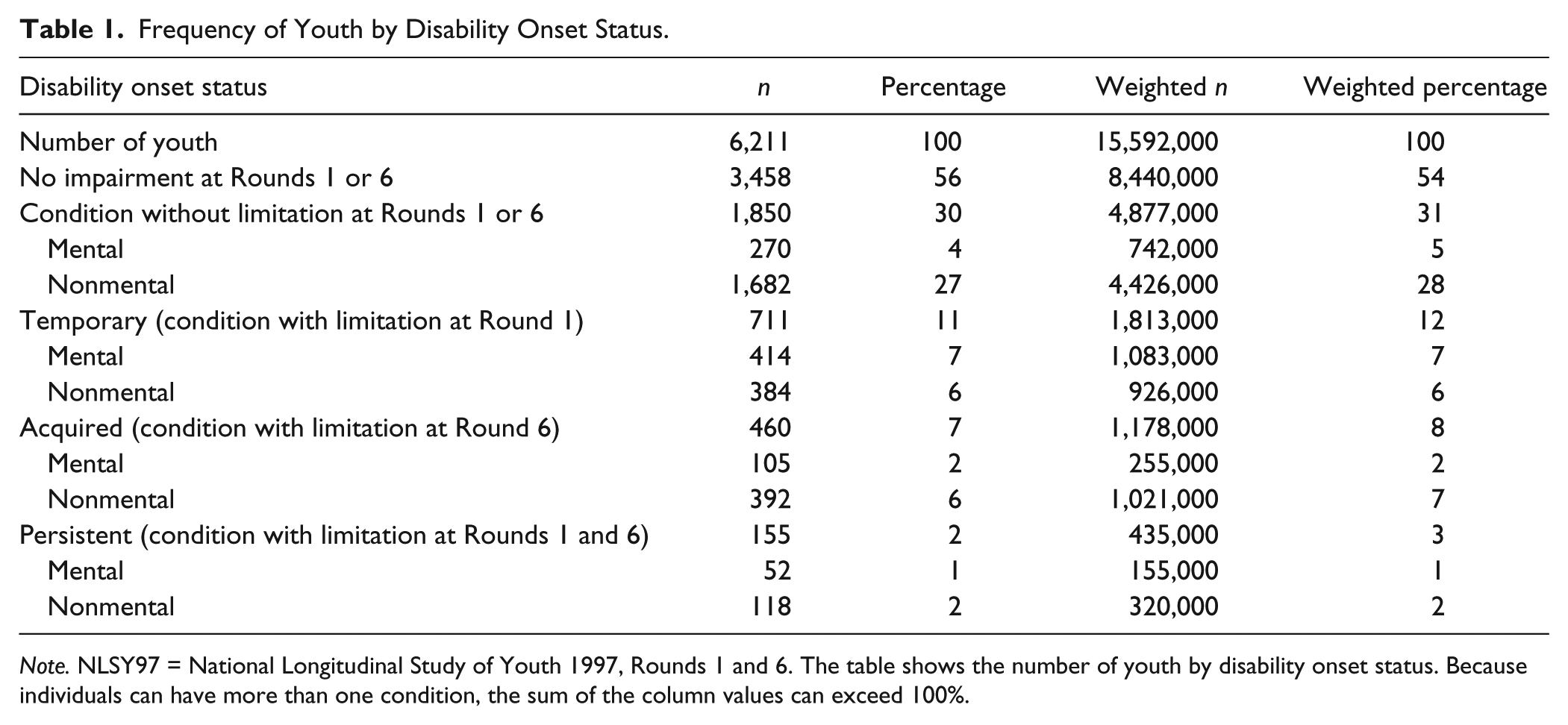
Note. NLSY97 = National Longitudinal Study of Youth 1997, Rounds 1 and 6. The table shows the number of youth by disability onset status. Because individuals can have more than one condition, the sum of the column values can exceed 100%.
For a significant number of youth, limitation status changes before adulthood: One in five youth either lose or acquire a functional limitation as they complete adolescence and transition into adulthood. If we consider only those conditions that cause a functional limitation, the onset percentages become even more dramatic. About 87% of limiting conditions experienced during youth are either lost or acquired during adolescence or early adulthood. This pattern of onset is proportionally most prevalent among youth with mental impairments. More than half of all youth with a mental impairment are reported as having an impairment that limits function at Round 1 but no longer limits function by Round 6. Several possible reasons could explain the prevalence of this onset group among those with mental impairments. It might be that the reporting is accurate and that youth with mental impairments often develop in such a way that they no longer have a functional limitation. It could be, however, that parents are somehow inaccurately reporting whether their children have limiting mental impairments during the first interview round or that the youth could be misreporting that their impairment is no longer limiting during Round 6. Youth might have some incentives to misreport their mental impairment status as adults. As youth transition into adulthood and either graduate or drop out of high school, being identified as having a mental impairment no longer automatically qualifies them for specialized services and supports and could attract unwanted stigma in the job market and in society.
Demographic characteristics
We include several demographic variables as part of our analysis. These variables include gender, age at first interview, race/ethnicity (non-Black/non-Hispanic, Black, Hispanic, and Mixed), household income (relative to the federal poverty level [FPL]), family structure (intact [with both biological parents residing in the household] or nonintact [all other parent combinations]), self-reported health status at Round 6, region of residence during Round 1, and residence in a metropolitan statistical area (MSA) in Round 1. We show the summary statistics for the analysis sample’s demographic characteristics for all disability onset status groups as well as for youth without impairments in Table 2. Because the membership of the functional limitation categories overlaps slightly, we are unable to produce statistics for the descriptive tables that test whether differences between the groups are statistically significant.
Demographic Characteristics by Disability Onset Status.
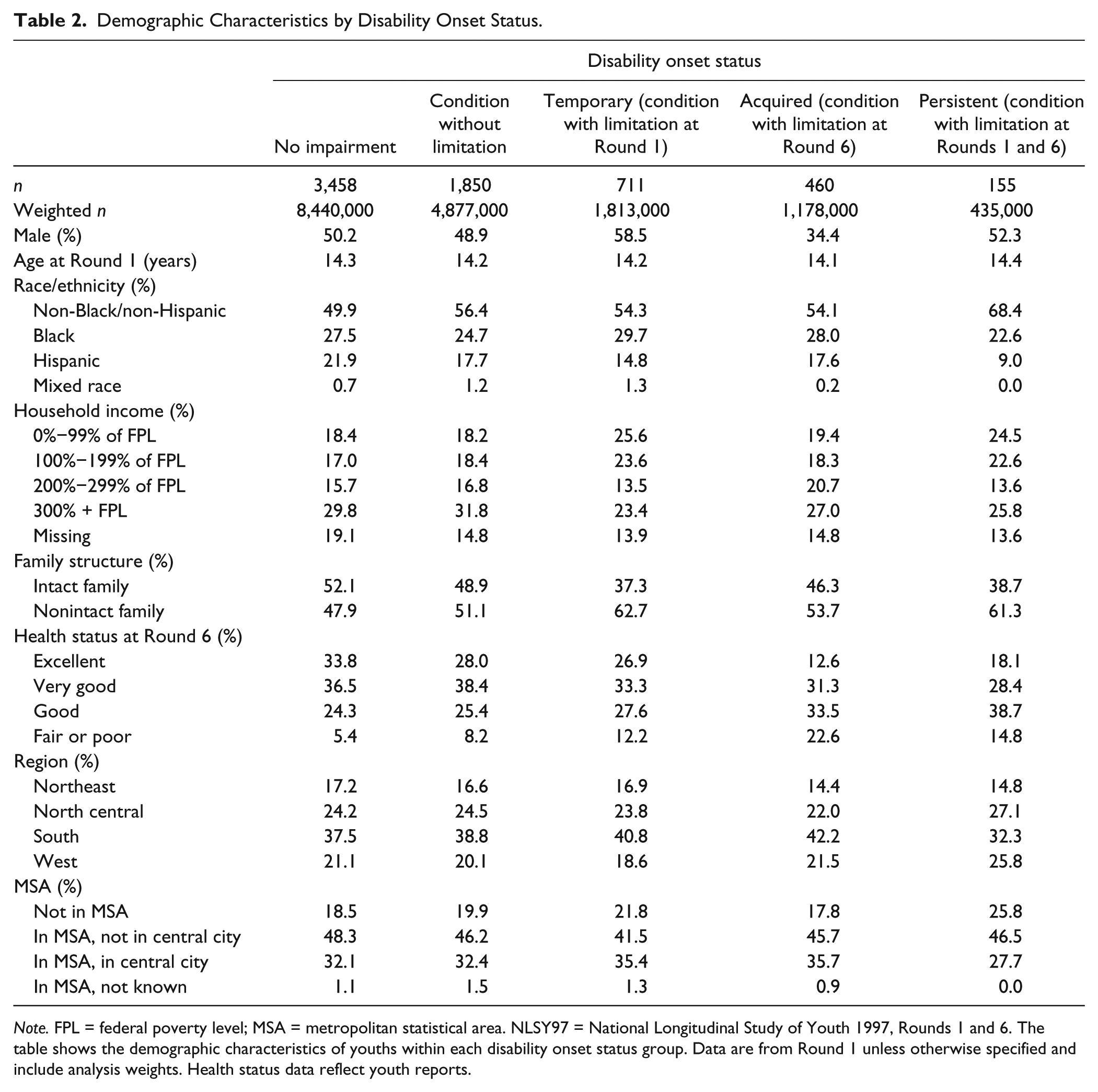
Note. FPL = federal poverty level; MSA = metropolitan statistical area. NLSY97 = National Longitudinal Study of Youth 1997, Rounds 1 and 6. The table shows the demographic characteristics of youths within each disability onset status group. Data are from Round 1 unless otherwise specified and include analysis weights. Health status data reflect youth reports.
While youth with impairments are similar to those without impairments on many characteristics, they differ on others. With some exceptions, youth are similar in age at first interview, race/ethnicity, region, and MSA variables. For gender, youth with temporary conditions are more often male, whereas those with acquired conditions are more often female. Youth with impairments—particularly those with limitations—have a higher prevalence of nonintact family structure, lower household income, and poorer health status. For instance, youth with temporary, acquired, and persistent conditions have higher rates of living below the FPL and living in a nonintact family than youth without a condition or with a nonlimiting condition.
Education and employment
We focus on six variables to capture education and employment outcomes of youth by age 24. Grade level and highest degree completed summarize each youth’s educational attainment. Grade level is reported as years of completed schooling after kindergarten. Highest degree completed is categorized as not completing high school (with or without a high school equivalency degree), having a high school diploma, earning an associate’s degree, or attaining a bachelor’s, professional, or graduate degree. To be categorized as having earned a degree during an academic year, a youth must have reported receiving that degree during that year. That is, we do not associate passing a certain grade level as having necessarily earned a certain degree; thus, youth who claimed to have passed the 12th grade but did not report earning a high school diploma are not considered high school graduates. We create two employment measures to capture varying intensities of employment. A youth is considered to have been employed during an academic year under the less intense measure if he or she worked at all during that year. To be categorized as having worked under the more intense measure, youth had to have worked during at least two thirds of the weeks in that year. Years of employment experience acquired from age 18 to 24 are also tracked for both employment measures and are computed by summing the appropriate employment status variable across all relevant academic years.
Analytical Approach
The primary objective of our analysis is to understand how disability onset status affects education and employment outcomes. We also wish to understand whether the effects of disability are more pronounced for youth with mental impairments after controlling for onset status. To achieve both objectives with our limited sample size, we estimate three sets of models. We estimate multinomial logit models to determine how disability onset status affects the highest degree a youth obtains by age 24. We then model the probability of employment at age 24 as a function of onset status. Finally, we predict the years of employment experience obtained between ages 18 and 24 as a linear function of disability onset status. The models in each set include two different disability specifications. The first specification includes indicators for each onset type; the second includes an additional indicator for mental impairments that cause functional limitations, which allows us to test whether having a mental limiting condition differs from having sensory or physical limiting conditions after controlling for onset. Each model is estimated for the entire sample and includes potentially influencing characteristics (gender, age at first interview, race/ethnicity, household income, and family structure). The employment models are estimated separately for the two employment measures. More details of each model follow.
Degree completion
To better understand the relationship between degree completion, onset group status, and other covariates, we specify and estimate a multinomial logit model. The model depicts degree completion as a function of individual covariates and disability onset group status. For each model, we have four outcome categories: did not complete (a) high school, (b) high school diploma, (c) associate’s degree, and (d) bachelor’s, professional, or graduate degree. The multinomial logit model takes the following form:


or:

where Equation (1) includes only the disability onset groups and Equation (2) also incorporates mental limitations into the disability definition. Y is a random variable of degree completion status, i is the individual youth subscript, j is the degree completion outcome, X is a vector of demographic control variables, “group1” through “group4” are indicators for onset group status (representing, respectively, youth with nonlimiting impairments, temporary limiting impairments, acquired limiting impairments, and persistent limiting impairments), and “mental” is an indicator for having a functionally limiting mental impairment. High school diploma was chosen as the reference educational outcome in all models. Consequently, the coefficients for that outcome in the multinomial logit models have been normalized to 0. The variables of interest are the coefficients for the disability onset status groups; a positive and significant coefficient indicates that the outcome is more likely for youth within the relevant group compared with youth with no impairment; a negative and significant coefficient indicates that the outcome for the relevant group is less likely than for youth with no impairment. We hypothesize that the temporary, acquired, and persistent disability onset status groups, as well as having a mental limiting impairment, are negatively related to attainment of an associate’s and bachelor’s degree and positively related to not completing a high school degree.
Employment
Disability status may affect an individual’s ability to work but is also likely to be correlated with other factors that influence employment. Therefore, to better understand how disability onset group status affects various employment outcomes while controlling for these other factors, we specify and estimate a logistic regression model and a linear regression model.
The logistic regression model examines employment status at age 24 as a function of the variables included in Equation 1, along with additional covariates for the highest degree completed:


or:

In these equations, EMP is a Bernoulli random variable of employment status (with a value of 1 indicating employment) at age 24, and the X vector contains demographic control variables as well as degree completion controls. Again, the variables of interest are the coefficients for the disability onset status groups, with a positive and significant coefficient indicating that employment status at age 24 is more likely for youth in a specific group compared with youth with no impairment and a negative and significant coefficient indicating that the employment status is less likely for the group with the disability than those without the impairment. We hypothesize that the onset status groups that are limiting (temporary, acquired, or persistent) and the mental limiting impairment are negatively associated with employment status at age 24.
The linear regression model predicts years of employment experience from age 18 to 24 as a function of demographic and disability onset group status variables:

or:

The variables are the same as those defined in Equations (3) and (4). As with other models, we hypothesize that the years of employment will be fewer for individuals with temporary, acquired, or persistent statuses or for those who have limitations associated with a mental condition.
Results
Outcome Summaries
Based on descriptive statistics, youth with functional limitations have poorer educational outcomes than those without limitations. The highest grade level obtained among youth with temporary or persistent limitations is almost an entire grade level less than that obtained by youth with conditions without limitations or no conditions, and more youth in the former categories fail to complete high school or only have a high school diploma than youth in the latter categories (Table 3). Youth with acquired impairments have educational outcomes between the two extremes.
Human Capital Characteristics at Age 24 by Disability Onset Status (n = 6,211).
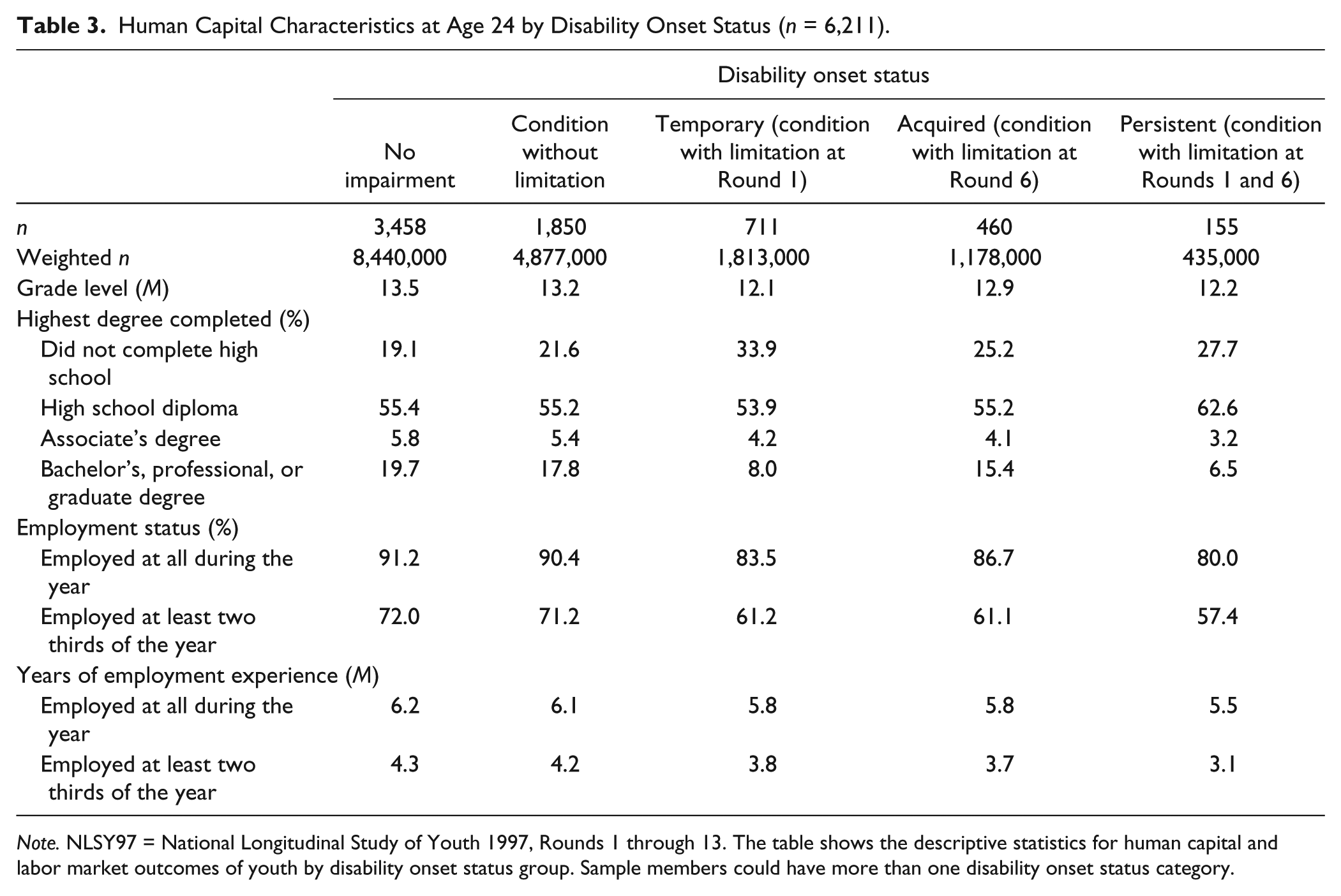
Note. NLSY97 = National Longitudinal Study of Youth 1997, Rounds 1 through 13. The table shows the descriptive statistics for human capital and labor market outcomes of youth by disability onset status group. Sample members could have more than one disability onset status category.
We find a similar story with employment outcomes: Youth with limitations have lower employment outcomes than youth without limitations. Youth with nonlimiting impairments have similar employment rates and years of employment as youth without any impairment, which are higher than those for youth with limitations. For example, youth without a condition or with nonlimiting conditions average at least a half year more of more intensive employment experience than youth in the other onset status groups. Employment outcomes tend to be lower for youth with persistent conditions than for youth with temporary or acquired conditions. Youth with persistent conditions have at least a half-year less of experience than youth in the other two limitation onset status categories.
Although the summary outcome measures provide an overview of educational attainment and employment trends across onset groups, the summary measures fail to account for other covariates that have the potential to influence these outcomes. In the “Regression Analyses” section, we control for these influencing factors by using regression models.
Regression Analyses
Degree completion
Onset of a limiting condition, no matter the timing, has a negative effect on educational attainment. We show the onset group coefficients from the multinomial regression models in Table 4. In Model 1, which includes only the disability onset variables as measures of disability status, educational attainment is no different for youth with a nonlimiting condition than for those with no impairment. Relative to youth without impairments, youth with temporary conditions are more likely to not complete high school and less likely to obtain at least a bachelor’s degree. Youth with acquired conditions are more likely to not complete high school, and youth with persistent conditions are less likely to obtain a 4-year postsecondary degree. No results are significant between onset status and associate’s degree completion, perhaps because of the relatively few youth with this outcome.
Influence of Disability Onset Status on Educational Attainment by Age 24 (Regression-Adjusted Models; N = 6,211).
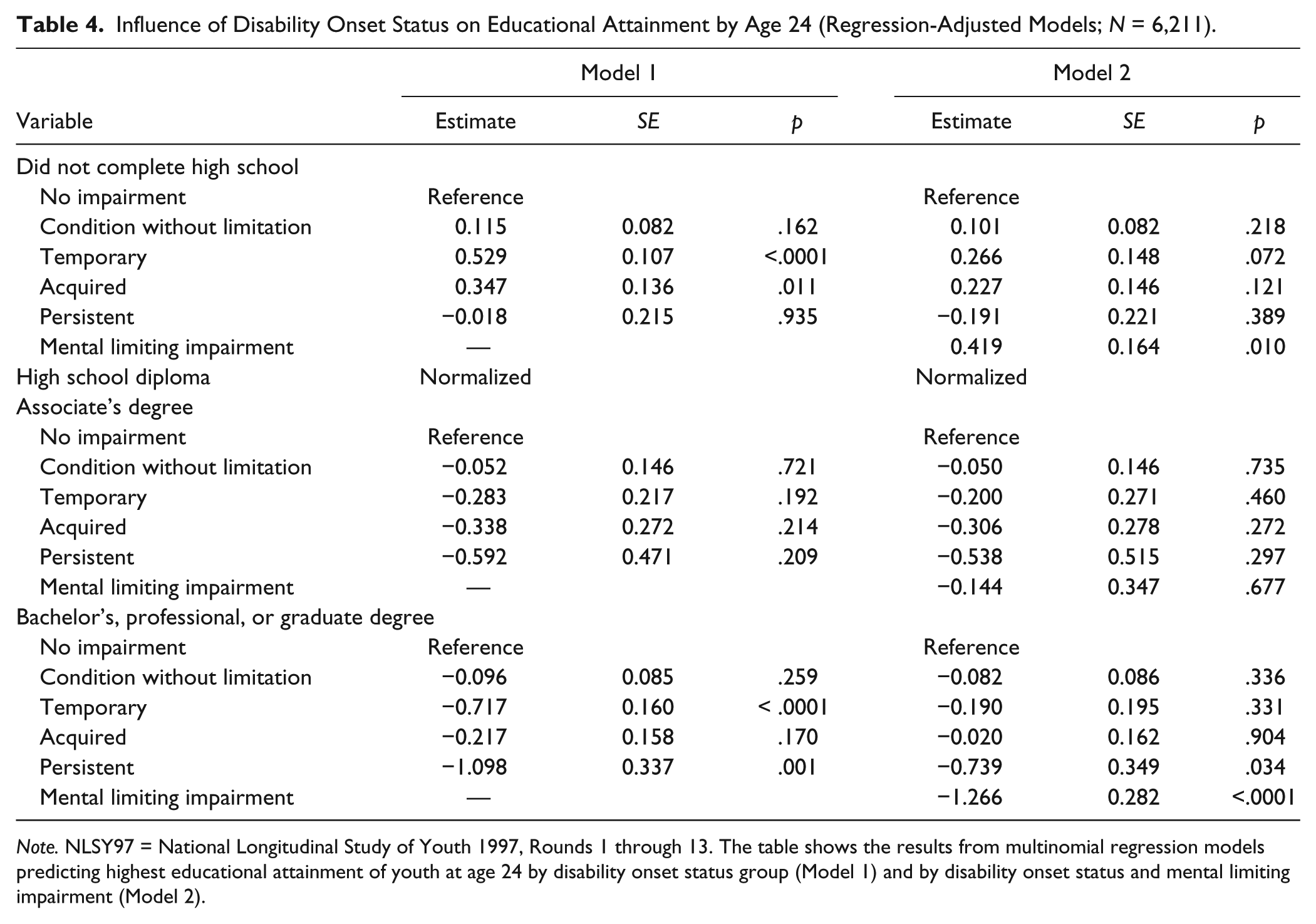
Note. NLSY97 = National Longitudinal Study of Youth 1997, Rounds 1 through 13. The table shows the results from multinomial regression models predicting highest educational attainment of youth at age 24 by disability onset status group (Model 1) and by disability onset status and mental limiting impairment (Model 2).
Having a mental impairment makes not completing high school more likely, makes having a 4-year postsecondary degree less likely, and attenuates the results for onset status. We add an indicator for having a mental limiting condition in Model 2 (Table 4). The parameter estimates labeled “mental limiting impairment” capture the additional effect having a mental impairment has on the outcome measures, relative to nonmental impairments. Youth with mental limiting conditions are more likely to not complete high school and are less likely to obtain a 4-year postsecondary degree, even after controlling for disability onset status. The inclusion of this variable in the model also eliminates the significance of the association between the onset status groups and educational attainment. Only the association between persistent conditions and 4-year postsecondary degree achievement continues to be significant at p < .05; the other coefficients that were significant in Model 1 are reduced in magnitude and no longer significant at conventional levels, though the direction of the coefficient remains the same.
In Table 4 (as well as the tables that follow), it is noteworthy that the estimates for the disability onset categories change with the introduction of the mental impairment coefficient. Specifically, the mental impairment coefficient better explains some of the variation associated with poorer outcomes, such as, in the case of education, dropping out of high school or not completing at least a bachelor’s degree. Consequently, the point estimates for the disability onset categories in Model 2—which only reflect those with nonmental impairments—tend to moderate relative to Model 1, though the difference between the coefficients is not statistically significant.
Employment
Disability onset status is a good predictor of whether someone is employed at age 24, though with different patterns across employment measures, and is not as good a predictor when mental conditions are included. Table 5 reports the disability onset group coefficients for the logistic regression models of employment at age 24. In Model 3, most estimates are significant at conventional levels. Youth with temporary, acquired, or persistent conditions are less likely to be employed according to either measure than youth with no impairment, while the model suggests no difference in employment for youth with a nonlimiting condition compared with youth with no impairments. The pattern of onset of limitations suggests that effects on less intensive employment are strongest (i.e., there is a larger regression coefficient) for persistent conditions though we do not see similar results for more intensive employment. Having a mental impairment (Model 4) also is negatively associated with either employment measure, albeit at p < .10. Inclusion of this variable in the model reduces the magnitude of the disability onset estimates, and few of the relationships between onset and employment continue to be significant.
Influence of Disability Onset Status on Employment and Employment Experience at Age 24 (Regression-Adjusted Models; N = 6,211).

Note. NLSY97 = National Longitudinal Study of Youth 1997, Rounds 1 through 13. The table shows the results from logistic regression models predicting employment of youth at age 24 by disability onset status group (Model 3) and by disability onset status and mental limiting impairment (Model 4). The table also show the results from ordinary least squares (OLS) regression models predicting the number of years of employment of youth at age 24 by disability onset status group (Model 5) and by disability onset status and mental limiting impairment (Model 6).
Disability onset status has a strong negative relationship with years of employment from ages 18 to 24. We report the ordinary least squares (OLS) regression results on the effect of disability onset group status and having a mental limiting impairment on the number of years of either employment measure in Table 5 and find similar patterns as those shown for employment. Youth with limiting disabilities have fewer years of employment than youth with no impairment, whereas the results for youth with conditions that are nonlimiting are close to zero and nonsignificant (Model 5). Among youth with limitations, the effects on years of employment tend to be largest for those with persistent disabilities, as indicated by coefficients that are up to 2 to 3 times larger than the coefficients for other onset status groups; the effect on years of employment is lowest for youth with temporary conditions. For example, youth with persistent impairments have, on average, almost 7 months less of less intensive employment experience and almost 1 year less of more intensive employment experience than youth with no disabilities, whereas youth with temporary conditions have about one quarter of a year less of either type of employment. Although not statistically significant, the onset effects for more intensive employment experience appear larger than the onset effects for the less intensive employment experience.
The effect of having a mental impairment on years of employment experience is pervasive but does not eliminate the effects for onset. Youth with limiting mental impairments have significantly fewer years of employment than youth with no disabilities, over and above the decrease observed for youth with limiting sensory or physical impairments and controlling for other covariates (Table 5, Model 6). Moreover, unlike the results for education and employment status at age 24, the coefficients for acquired and persistent conditions continue to be large and significant with the inclusion of mental impairment in the model.
Using a linear regression model for count data is potentially problematic because it can predict negative outcome values. Consequently, we estimated a Poisson regression model to test the robustness of our linear regression estimates for our employment experience measures. The Poisson model does not predict negative values of the outcome variable, making it specially qualified for modeling count data. Results across the two model types are consistent in relative magnitude of the coefficients, though there were two differences in significance level. In the Poisson models, the acquired condition variable was no longer significant in the model predicting employment years for our less intense employment measure, and the mental limiting impairment was significant at p < .10 for the same outcome. Because the Poisson model estimates are meant simply as a robustness check and largely confirm our linear regression estimates, we do not present the Poisson model estimates in the article.
Discussion
The timing of disability onset matters for youth in terms of the educational attainment and employment outcomes as young adults. By adapting a dynamic definition of disability that captures onset information, we find confirmation of prior research showing the relatively poorer outcomes for youth with long-lasting disabilities that occur early in or are already present by adolescence. In addition, youth who acquire a disability during the study period also have poorer outcomes, despite the additional time they have to develop their human capital. We also find, however, that youth whose physical or sensory conditions (though not mental conditions) dissipate over time have outcomes that are no different from youth without a limitation; that is, having a limitation that is either corrected or that, into adulthood, the youth no longer perceive as limiting does not negatively affect early adult transition outcomes.
Youth with limiting conditions have poorer outcomes on educational attainment, employment status at age 24, and years of employment by age 24 than youth without impairments. The results tend to show that outcomes are poorer among youth with persistent conditions (who have a disability throughout the 5-year observation period) or with acquired conditions (who report a disability only at the end of the period). About one in three youth with temporary conditions and one in four youth with acquired or persistent conditions fail to complete high school, compared with one in five youth with no impairment or with a nonlimiting condition. The effect of disability onset on years of employment between ages 18 and 24 is concerning: Youth with acquired conditions lag behind those with no disability by about a third of a year and youth with persistent conditions have almost a full year less of employment experience after controlling for having a mental impairment.
Many of the results regarding onset status are lessened or eliminated when we account for having a mental limiting impairment. That mental limitations attenuate the findings may be a function of a lack of statistical power to detect a significant difference when one actually exists; by creating models to account for youth with mental conditions, we simply may not have had a sufficient sample of youth with sensory or physical impairments within the specific onset statuses. The fact that the coefficients tended to be large and negative for youth with acquired or persistent conditions when mental limiting conditions were included suggests a potential negative effect for these onset statuses on outcomes.
Youth with conditions that are nonlimiting appear no different on later outcomes than youth without any conditions during the years of this study. These individuals have conditions that may have a relatively low effect on day-to-day functioning or may be receiving sufficient supports, such as regular access to health care, to avoid the condition becoming disabling.
The grade completion statistics suggest that youth with limitations—especially those with mental impairments—are at risk for poorer educational outcomes than their peers without limitations. Youth with persistent conditions and youth with mental limiting conditions are less likely to obtain bachelor’s or higher degrees, at least by age 24. Youth with mental limiting conditions are also, on average, less likely to complete high school than youth without impairments. Although the evidence suggests that youth with temporary and acquired conditions are more likely not to complete high school, these effects were diminished after controlling for having a mental limitation. One concern for this population is that such youth are more prone to school suspensions, leading to reduced attachment to school, which in turn discourages high school completion (Losen & Gillespie, 2012).
Although youth and their families receive supports and guidance for transitions in secondary school, no such comprehensive supports exist after youth leave high school, leaving youth on their own to navigate post high school supports (Aron & Loprest, 2012; United States Government Accountability Office [US GAO], 2012). Despite access to secondary school supports, many youth with disabilities find themselves unprepared to achieve their vocational goals. A further gap exists for youth who drop out of school—a sizeable portion of youth with disabilities—and for youth who acquire a disability after leaving high school, as there are few agencies for them to turn to for support. Improving transition outcomes more broadly may, therefore, depend on extending the availability of transition services beyond high school. Options that other countries have applied include having dedicated vocational supports for young adults (as in Denmark and the Netherlands) and having a dedicated agency and staff to support transition-age youth (as in Australia). These polices may be worth reviewing to determine whether and how they could be applied in the United States. For instance, the federal government could expand funding to state vocational rehabilitation agencies to develop youth-specific programs dedicated to serving all transition-age youth with disabilities (rather than currently serving them through their adult rehabilitation service programs). Alternatively, Department of Labor One Stop Centers could add staff devoted to serving transition-age youth with disabilities exclusively. In both of these options, one central organization would be tasked to assist youth and families in identifying supports beyond high school that could help connect youth to employment and educational resources. Such policies may be particularly important for youth with mental impairments who would otherwise not qualify for other types of services for people with disabilities (i.e., they no longer have a qualifying disability once they leave high school).
Including measures of disability onset and better measures of mental impairments might be important for surveys that focus on youth and young adults. The high proportion of individuals with mental impairments at Round 1 but not Round 6 suggests some combination of (a) wording of the disability measures that was not sufficient to elicit a response from at least some members of the sample who likely continued to have an impairment if we assume, from their eventual outcomes, that they still had an impairment; and (b) confounding reports of conditions by parents (Round 1) and youth (Round 6) using the same questions. In addition, our approach to measuring disability status onset is limited in existing surveys, as few include such measures. At best, questions that ask about onset of current conditions may capture part of our approach, yet retrospective data may be contaminated by recall bias and may not capture those who had temporary impairments. Improved survey questions may be able to identify these youth, whose outcomes may be just as poor as those with impairments at the time that survey data are collected.
Our results should be viewed in light of our study’s limitations. First, the impairment and limitation reports in the NLSY97 may be inconsistent across survey rounds because different people provide them—a parent in Round 1 and the youth in Round 6. If the parent and youth provide inconsistent reports about a youth’s disability status, the data’s disability measure might over- or underreport the number of youth with limitations. Second, as with any parent report or self-report, the impairment and limitation data may contain biases that would be missing from an objective disability measurement. This issue may be most apparent for mental impairments, as suggested in the previous paragraph. Third, the NLSY97’s disability measure may be too coarse. A 5-year gap exists between Round 1 and Round 6. Therefore, if someone’s disability status changed between rounds, we cannot identify at what age the change occurred, which may be important to control for. Finally, the relatively small sample size limits the precision of our estimates and so impedes our ability to detect significant effects when they exist (such as might occur for youth with temporary limiting impairments, after accounting for mental limiting impairments). Overall, just 3% (155 youth) of the sample had a persistent limitation and 8% (460 youth) had an acquired condition. Despite the small sample size for some disability groups, our results indicate persistent negative effects that are consistent with other research.
The disability onset status groups that we defined for this study provide a promising approach to viewing and measuring disability among youth and their eventual outcomes. Our analysis shows that the onset of limiting disabilities is surprisingly prevalent among youth, that onset group status influences education and employment outcomes, and that having a limiting mental impairment affects human capital outcomes after controlling for onset group status. Future research could follow the outcomes of the same youth as they age, comparing their outcomes with those of others who acquire disabilities later in life. Other promising research approaches could include understanding how access to secondary school and community services differs for youth with varying onset types (and subsequent effects on outcomes), exploring the relationship between environmental or community characteristics and onset status, and tracking how disability onset affects access to federal disability benefits and other programs into adulthood.
Footnotes
Acknowledgements
The authors appreciate the assistance of Mason DeCamillis for programming support, David Wittenburg for helpful comments on the analysis, and Dale Anderson, John Kennedy, and Linda Heath for editorial and production support.
Declaration of Conflicting Interests
The author(s) declared no potential conflicts of interest with respect to the research, authorship, and/or publication of this article.
Funding
The author(s) disclosed receipt of the following financial support for the research, authorship, and/or publication of this article: This study was supported by the National Institute on Disability and Rehabilitation Research, U.S. Department of Education, through its Rehabilitation Research and Training Center on Disability Statistics and Demographics grant to Hunter College, CUNY (Grant No. H133B080012-09A).