



Abstract
I conducted a descriptive analysis of how disability shapes labor market activity differentially by educational attainment and disability type using the American Community Survey, 2015 (N = 1,504,947) and linear probability models. Having a disability is associated with a decrease in the probability of labor force participation (proportion of those employed or seeking employment;
Employment is considered a key predictor of happiness and independence for those with disabilities and is increasingly linked to well-being. Employment has far-reaching benefits, including psychosocial benefits (such as self-esteem increases and reductions in hospital admissions), and important implications for identity development for those with cognitive or emotional disabilities (Bal et al., 2017; Saavedra, Lopez, Gonzáles, & Cubero, 2015; Saavedra, Lopez, Gonzáles, Sánchez, & Cubero, 2015). Compared with their nonworking counterparts, those with disabilities who are employed are less likely to receive governmental assistance and more likely to report high community attachment (Mattila-Holappa, Joensuu, Ahola, Vahtera, & Virtanen, 2015). Employment is also considered an important determinant of health for those with disabilities (Benach, Vives, Varoelen, & Muntaner, 2014).
Despite the important benefits of employment, individuals with disabilities often struggle to find or keep employment (Kelly, 2013; Langley et al., 2010; Lastuka & Cottingham, 2016; Stern, 1989). The Americans with Disabilities Act (ADA) of 1990 protects the fundamental civil rights of those with disabilities—specifically prohibiting employment discrimination (United States Department of Justice Civil Rights Division). However, in the more than 20 years since the implementation of the ADA, there has been little change in the low employment rate among those with disabilities (Bjelland, Burkhauser, Schrader, & Houtenville, 2011). The employment rate for those with disabilities is 33.5%, compared with 76.3% for those without disabilities (Erickson, Lee, & Schrader, 2012). For those with physical disabilities, capability, supervisor attitudes, self-efficacy, and assertiveness influence their capacity to work (Bal et al., 2017). Individuals with visual impairments are also less likely than the general population to participate in the labor force, and those who do are far more likely to be unemployed (Kelly, 2013). For individuals with disabilities, both education and duration of disability are positive predictors of employment (Lastuka & Cottingham, 2016).
For both those who have a disability during their education process and those who become disabled after entering the workforce, education may play a key role in their ability to work. Therefore, developing education-based interventions for those who become disabled after entering the workforce to increase their education and thereby the depth and variety of their employment possibilities may hold promise. Furthermore, a descriptive understanding of how education and labor force participation are associated may provide evidence to support increased funding to break down barriers to education that those with disabilities face and have policy implications for the public school system in the United States. The literature strongly suggests that people with disabilities achieve lower levels of education than those without (Blackorby & Wagner, 1996). If providing additional support and resources to students with disabilities could lead to higher levels of labor force participation (and therefore less government assistance), education may be an important intervention point.
The literature on the positive benefits of employment for individuals with disabilities is comprehensive, as is the understanding of the overall relationship between education and employment opportunities for the general population. Despite the apparent importance of both education and ability to work for those with disabilities, few existing studies look descriptively at how the relationship between disability and ability to work differs by educational attainment. With changes to the American health care system on the horizon, as well as looming budgetary changes for many sectors of the government, there is a pressing need to address this gap in the literature. Furthermore, demographic changes in the population in addition to increased return of veterans who may suffer from nonapparent disabilities indicate that the share of the U.S. workforce with disabilities will increase seriously in the coming years (Schrader, Malzer, & Bruyére, 2014). Gaining a deeper understanding of how the association between disability and labor force participation differs by educational attainment level could be crucial in informing policies regarding the barriers to education that people with disabilities face throughout the education process and the potential effectiveness of developing education-based interventions for those who become disabled after completing their education. This study seeks to explore how the relationship between disability and labor force participation varies for those with different levels of educational attainment.
Research Objectives
How does disability shape labor force participation differentially by education?
How does disability shape labor force participation differently across disability types (difficulties with hearing, vision, cognition, ambulatory, self-care, and independence)?
How does disability shape employment for those in the labor force differentially by education?
How does disability shape employment among those in the labor force differently across disability types?
How are the relationships between disability and labor force participation, and between disability and employment, moderated by age?
Background
The literature has found that those with disabilities are less likely to participate in the workforce, and that for those who do participate in the workforce, they are more likely than their able-bodied counterparts to be unemployed. Those with disabilities face discrimination during hiring, as well as numerous barriers to keeping employment (such as transportation for those with sensory or physical disabilities or inconsistent attendance for those with emotional or mental disabilities). I hypothesize that the relationship between disability and labor force participation will vary based on educational attainment. Literature has found that in the general population the relationship between education and ability to work is positive, whereby higher levels of educational attainment are associated with higher levels of income and increased probability of labor force participation. Some previous studies have found this to be true for those with disabilities as well. One study found that educational attainment, as well as length of time with disability, is a strong predictor of labor force status among those with disabilities (Lastuka & Cottingham, 2016). Research examining education, disability, and employment has focused on alternative education, such as special education services or participation in vocational rehabilitation. While research has found that specialized educational programming, such as vocational rehabilitation, has been effective in increasing employment (Dutta, Gervey, Chan, Chou, & Ditchman, 2008), less research has focused on traditional academic education and how it mediates the relationship between disability and employment.
There are several hypothesized mechanisms through which increased educational attainment is believed to influence the relationship between disability and ability to work—including increased access to resources and greater job variety and feasibility of career change. One study found that higher levels of education are associated with greater levels of resource access for those with disabilities—including health care, legal recourse, and adaptive services (Zimmerman, Woolf, & Haley, 2015). These resources allow people with disabilities to be higher functioning in society (e.g., through assistive technology), defend their right to work, and increase ease of transportation and other key processes necessary for employment.
In the general population, people with higher levels of education have greater variety in possible employment paths and higher wages (Carnevale, 2009). For people with disabilities, I hypothesize that the increased variety of employment options associated with higher education can be particularly important as it allows people to find work not requiring high physical demands. Furthermore, the increased access to resources and variety of possible employment increases the feasibility of career change for those who become disabled after joining the workforce. This is particularly true in the current information economy, where lower wage jobs that require less education tend to involve more physical labor and higher wage jobs that require more education tend to involve less physical labor.
Research Methods and Process
To explore how the relationship between disability and labor force participation is differentiated by educational attainment, I used data from the 2015 reporting of the American Community Survey (ACS; publicly available at https://usa.ipums.org/usa/). The ACS is measured at the household level, with the primary householder completing information on all persons residing in the household (N = 2,305,707). The sample has a 95.8% response rate, partly due to legal mandates to complete the survey. The ACS is collected by the U.S. Census Bureau annually. This analysis focused on a subset of working-aged participants (aged 25–65; n = 1,504,947). This age selection was chosen because most people have completed their education by age 25 and the average retirement age in the United States is 65 (although the retirement age for full benefits is gradually being increased). This age range targets those who are of “working age” because I am interested in how disability shapes work ability. The ACS has a large sample size, includes a dynamic definition of disability that includes disability type, and reports on my focal variables.
My focal variables are labor market activity, disability, and education. Labor market activity is operationalized through variables on labor force status and employment. Employment status refers to those who are in the labor force, whereas those who are absent from the labor force are not employed and are not seeking employment. The primary predictor variable is disability. Instead of a dichotomous yes/no disability question, the ACS uses a series of questions focusing on disability type. If a respondent responded in the affirmative to any of the six disability types, they are considered to have a disability. Disability types are hearing, vision, cognition, ambulation, self-care, and independent living. Educational attainment is measured by the highest grade attained. Individual grade-level attainments were collapsed into groups and coded as dummy variables (middle, some high school, high school, some college, bachelors, and graduate/professional degree). Statistical controls include race, gender, age, and family income. Race categories are non-Hispanic Whites, non-Hispanic Blacks, non-Hispanic Asians, and Hispanics. Gender was coded as male or female. Age is measured in years. Last, family income is measured in thousands of dollars.
Analytic Strategy
To describe how disability shapes work ability differentially by educational attainment, I ran linear probability regression models. The analysis was also conducted using a logit model, and the outcomes were substantively the same; therefore, the linear probability model results will be presented here for ease of interpretation (Aldrich & Nelson, 1984). The linear probability estimates did not approach 0 or 1 (Aldrich & Nelson, 1984). My analysis uses the following equation;
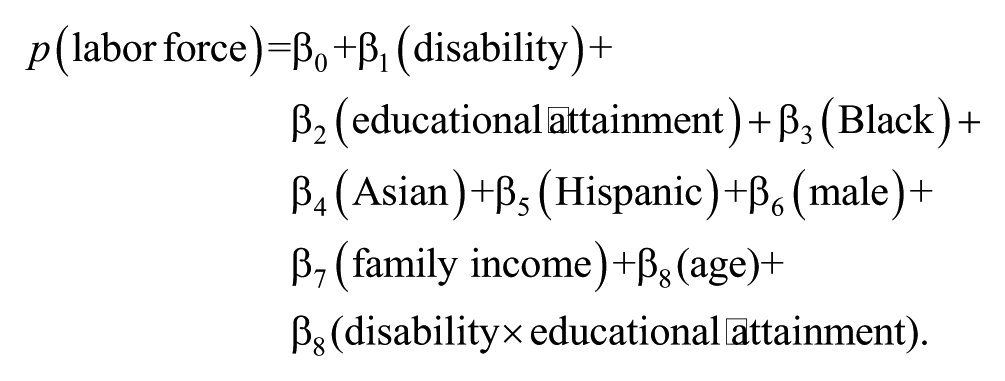
This analysis was run with several subpopulation groups—this allows me to describe how the estimate of the disability effect on labor force participation changes across educational groups. The analysis was then run with employment as the outcome variable instead of labor force participation.
The first portion of Tables 2 to 4 examines the association between having a disability and labor force participation. In Table 2, the initial model explores the bivariate relationship between disability and labor force participation status. I subsequently introduced both educational attainment (as a series of dummy variables with high school degree as the reference category) and demographic characteristics as control variables to see how the relationship between disability and labor force status persisted. Table 3 reestimates the coefficient for disability based on the educational attainment of participants maintaining the demographic controls. Next, I used linear probability models to explore how the relationship between disability and labor force participation varies by disability type in Table 4, comparing the coefficient for disability by disability type. For example, Model 1 will compare those with disabilities with those without, whereas Model 2 will compare those with cognitive disabilities with those without disabilities and Model 3 will compare those with self-care disabilities with those without disabilities. Then, I replicate the above models using employment as the outcome variable instead of labor force participation. These results are found in the bottom portion of Tables 2 to 4. Participants with multiple disabilities are included in multiple models when differentiating by disability type (e.g., someone with a cognitive and vision disability is included in the cognitive model and the vision model). I have run the analysis both ways (where those with multiple disabilities are in multiple models or where they are excluded from the sample), and the results are not sensitive to inclusion choice.
Results
I begin my analysis with a discussion of the demographic characteristics of the sample, as seen in Table 1. Ten percent of the sample has a disability; of those who have a disability, 39% have a cognitive disability, 18% have self-care-related disabilities, 35% have a mobility disability, 53% have a physical disability, 18% have a vision disability, and 21% have a hearing disability. For the entire sample (those with and without disabilities), 78% of participants participate in the labor force, compared with 39% of those with disabilities. Furthermore, for those who are in the labor force, 74% of the sample are employed compared with 34% of those with disabilities. Deep inequality in both labor force participation and employment for those in the labor force exists for those with disabilities. This inequality varies by race, as seen in Figure 1. Although Blacks and Whites without disabilities have the same proportion participating in the labor force, for those with disabilities there is a 6-percentage point gap in labor force participation. On the contrary, Asians have the lowest labor force participation among those without disabilities (79%) and the highest labor force participation among those with disabilities (45%). One possible explanation for the difference in the pattern for Asians is different cultural norms and the subjective nature of disability (Okazaki & Kallivayalil, 2002), leading to differences in perceptions of what is a disability. It is possible that differences in these subjective understandings spur variations in the patterns. The gap in labor market participation exists for all races between able-bodied and disabled individuals; however, for Blacks the gap is particularly large.
Demographic Characteristics of the Sample and the Subsample With Disabilities.

Note. HS = high school.
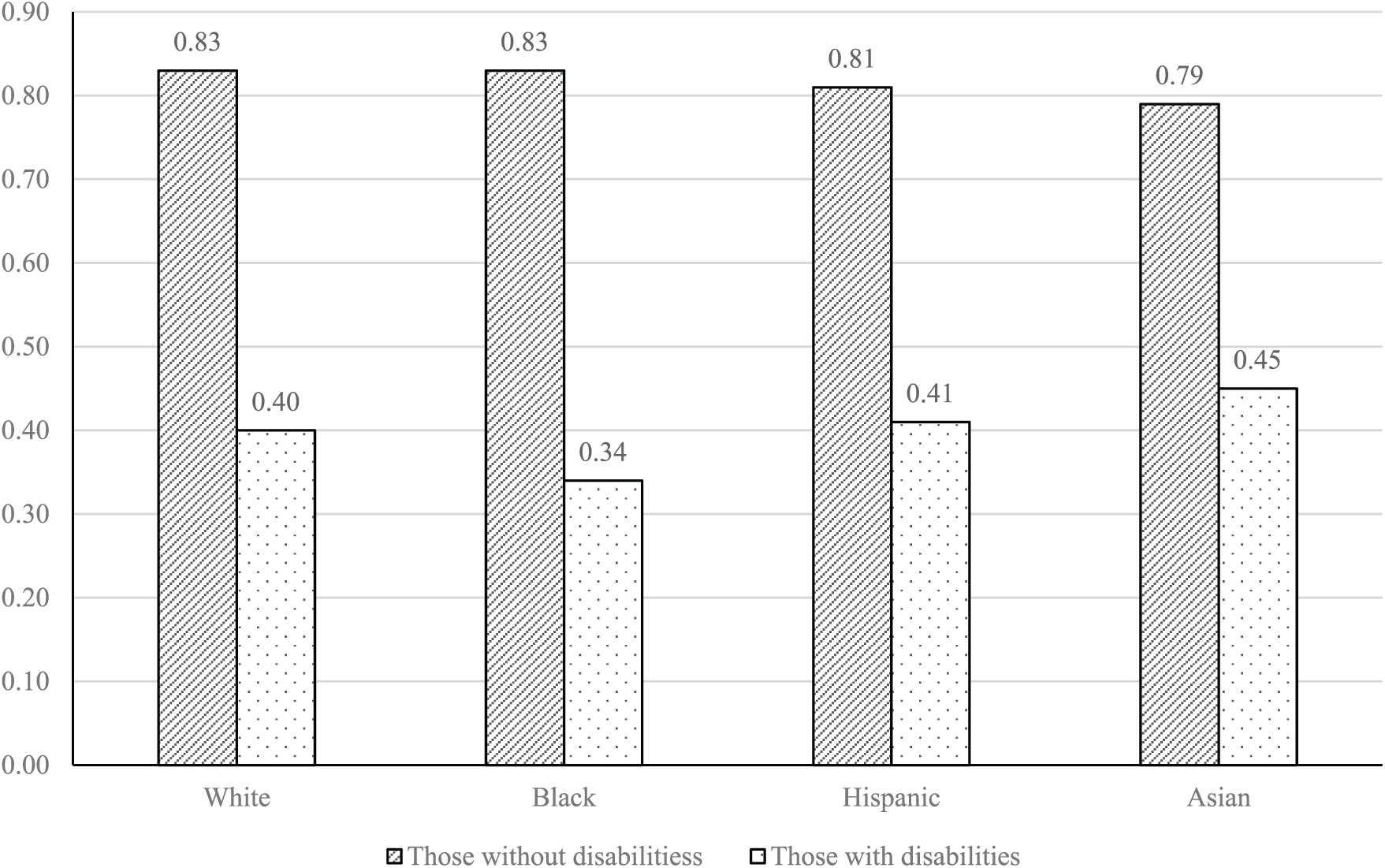
Proportion of those with and without disabilities who participate in the labor force.
Educational attainment varies between the sample and those with disabilities, with the sample having higher educational attainment than those with disabilities. A greater share of those with disabilities have lower levels of education, whereas a greater share of those who are able-bodied have higher levels of education. Both the sample and those with disabilities are 49% male; however, the racial/ethnic breakdown varies between the sample and those with disabilities, as seen in Table 1. Those with disabilities are, on average, slightly older than the sample (50.12 compared with 44.96) and come from families with lower household incomes.
Labor Force Participation
Having a disability is associated with, on average, a .43 decrease in the probability of labor force participation, as seen in Model 1 of Table 2. Even after controlling for demographic characteristics, this decrease in probability persists, as seen in Model 2 of Table 2. Having a disability is associated with, on average, a .34 decrease in the probability of labor force participation, net of race, gender, family income, and age. Model 3 of Table 2 shows that the decrease in the probability of labor force participation among those with disabilities is .48 when including an interaction effect between disability and educational attainment. The interaction term
Linear Probability Regression of Disability on Labor Force Participation and Employment Including Controls and an Education Attainment and Disability Interaction Effect and an Age and Disability Interaction Effect.

Note. N = 1,504,947. Standard errors in parentheses. Control variables include educational attainment (less than high school degree, high school degree, some college, bachelor’s degree, graduate/professional degree), gender, race (Black, Asian, Hispanic, White), log family income, and age.
p < .05. **p < .01. ***p < .001.
The coefficient for disability varied by educational attainment, as seen in Table 3. For those whose highest grade-level attainment is less than a high school degree and for those whose highest grade-level attainment is having a high school degree, having a disability is associated with (on average) a decrease of .38 in the probability of labor force participation, net of demographic characteristics. For those with some college, having a disability is associated with a decrease of .33 in the probability of labor force participation (on average, net of gender, race, income, and age). For those with higher levels of education, the reduction in the probability of labor force participation is smaller. Having a bachelor’s degree is associated with a decrease in the probability of labor force participation of .23, and having a graduate or professional degree is associated with a decrease of .19. For those with lower levels of education, the decrease in the probability of labor force participation is higher than that in those with higher levels of education, as seen in Figure 2.
Linear Probability Regression of Disability on Labor Force Participation and Employment Including Controls and Differentiated by Educational Attainment.
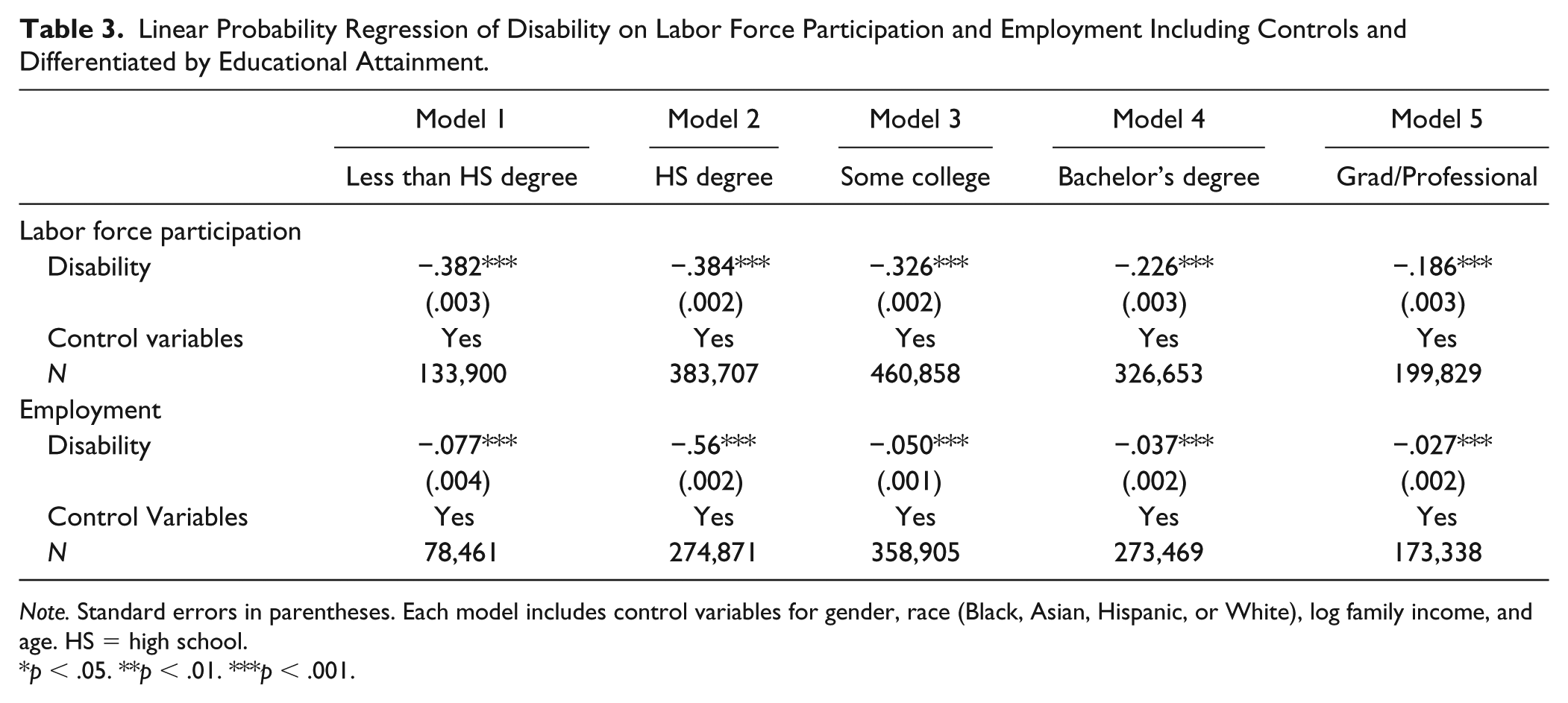
Note. Standard errors in parentheses. Each model includes control variables for gender, race (Black, Asian, Hispanic, or White), log family income, and age. HS = high school.
p < .05. **p < .01. ***p < .001.
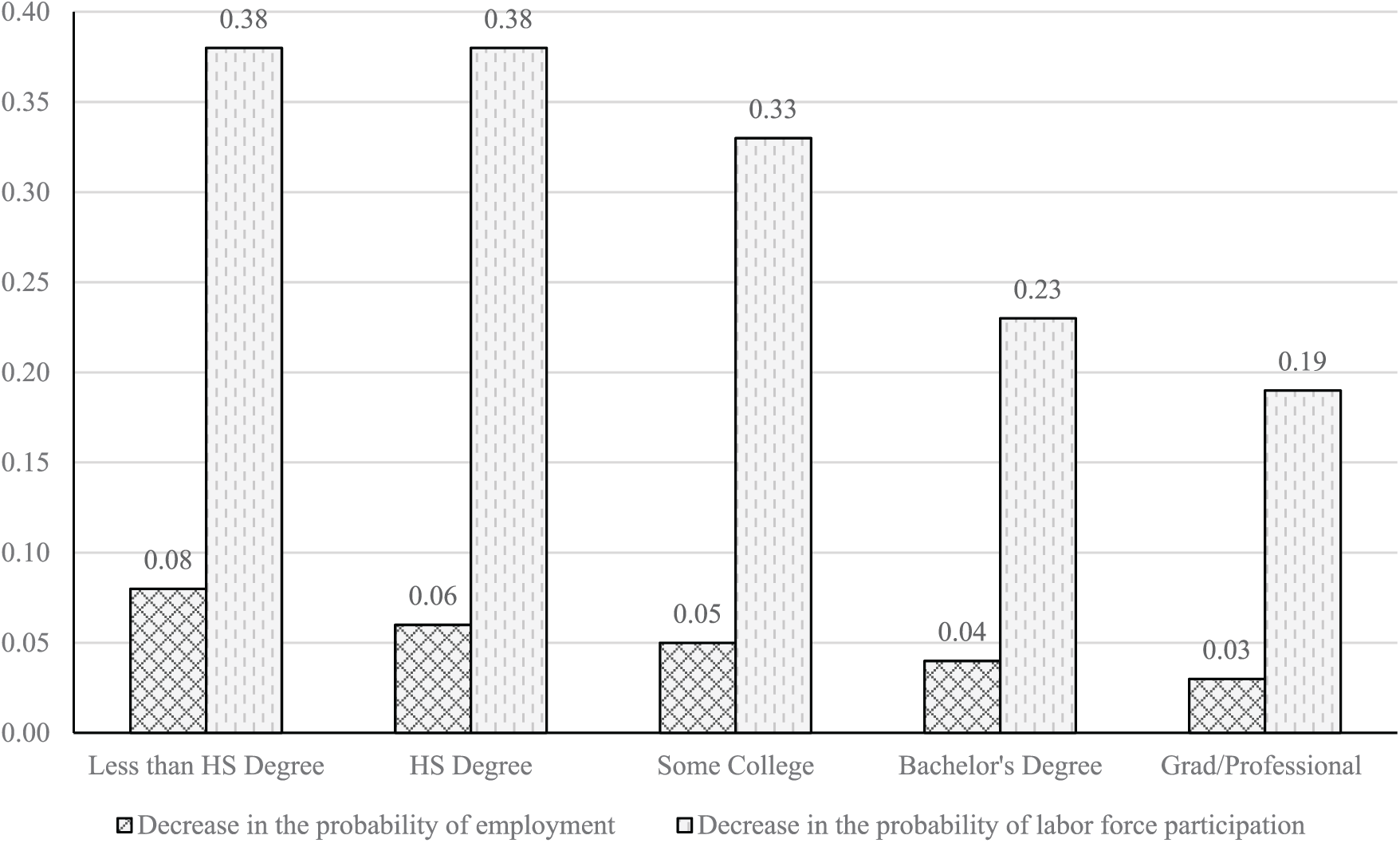
Decrease in the probability of labor force participation for those with disabilities controlling for race, gender, age, and family income differentiated by educational attainment.
The probability of labor force participation varied by disability type as well, as seen in Table 4. Having a mobility-
Linear Probability Regression of Disability on Labor Force Participation and Employment Including Controls and a Disability and Education Interaction Effect for Different Disability Groups.

Note. Standard errors in parentheses. Each model includes control variables for gender, race (Black, Asian, Hispanic, or White), log family income, and age.
p < .05. **p < .01. ***p < .001.
Employment Status
Among those who do participate in the labor force, having a disability is associated with a decrease of .08 in the probability of reporting employment, as seen in the bottom portion of Table 2. After introducing controls for educational attainment, gender, race/ethnicity, family income, and age, the effect persists, with having a disability being associated with a decrease of .05 in the probability of reporting employment. After including an interaction effect examining the interaction between disability and education, the decrease in the probability of reporting employment increases to .09, as seen in Model 3 of Table 2. The effect of having a disability on the probability of reporting employment is different for different levels of education, similar to the effect of having a disability on the probability of reporting labor force participation. Including an interaction effect for age and disability, the coefficient for disability is –.16, and the interaction term is .002, meaning that for each additional year of age the decrease in the probability of reporting employment decreases by .002. It is important to note that the relationship between employment and age is not linear, and employment drops dramatically at older ages, which is why I limited my sample to those under 65.
The bottom portion of Table 3 explores how the relationship between disability and reporting employment varies by educational attainment. Having lower levels of education is associated with larger decreases in the probability of reporting employment for those with disabilities
Discussion
Having a disability was associated with a decrease in the probability of labor force participation
This study provides three key contributions to the literature. First, I found that having a bachelor’s degree is associated with a 30.68% increase in the probability of reporting labor force participation compared with having some college. This indicates that a pivotal area for future research and possible intervention to improve the probability of labor force participation for those with disabilities is during college. For those with lower levels of education, there is no large change in the coefficient for disability between educational attainment groups. Furthermore, among those in the labor force, those who have a college degree are 26.84% more likely to report employment than those with some college. This descriptive analysis suggests promise for policy reforms aimed at increasing resources to support those with disabilities in achieving higher levels of education, such as improved support networks on university campuses and college counseling specifically for those with disabilities at the high school level.
Second, this study illustrates how different disabilities are associated with labor force participation differently. This strongly indicates that future research on the relationship between disability and labor force participation should differentiate by disability type. For all types of disability, having a disability is associated with a significant decrease in the probability of labor force participation and employment among those in the labor force. Education moderates the relationship between disability and labor force participation for all disability types, where increases in educational attainment are associated with a higher probability of labor force participation among those with disabilities. Surprisingly, for those with self-care-, vision-, and hearing-related disabilities, an increase in educational attainment was not associated with the probability of employment for those who have disabilities in the workforce. The differences in the decrease in the probability of labor force participation associated with different disabilities and the differing role of education in moderating that relationship indicate that different mechanisms may be at play, which indicate different interventions and policy changes may be needed to help support the integration of those with disabilities into the workforce.
Third, having a disability is associated with a far larger decrease in the probability of reporting labor force participation than in the probability of reporting employment among those in the labor force. The difference in this “disability penalty” between labor force participation and employment supports the theory of involuntary labor market exit—where vulnerable populations are more likely to exit the labor market after long periods of employment due to lack of opportunity or options (Flippen & Tienda, 2000). Perhaps, those with disabilities who cannot find employment may drop out of the labor force, suppressing the effect of having a disability on reporting employment. If researchers or policy makers are looking merely at employment, not at labor force participation and employment, they may underestimate the effect of having a disability on ability to work and underestimate social and economic inequality.
Limitations
Despite these important implications, this study has several limitations. First, there is an issue of selection, where perhaps those who attain higher levels of education may be different attitudinally or in work ethic from those who attain lower levels of education. Those who attain higher levels of education may have more resources, more support, more educational access, or less severe symptoms for their disability. This study captures both the direct and indirect effects of educational attainment on labor force participation for those with disabilities. Although this study’s findings cannot imply causation, they still paint a more in-depth descriptive portrayal of these different subpopulations (by educational attainment and disability type) that are often ignored and collapsed into one group. While gaining a deeper understanding of how labor force participation is associated with disability for different disability types and those with different educational attainment levels can inform interventions and policies, and probe for areas of continued research, future causal studies are needed to determine how disability causes decreased labor force participation. This can be accomplished using a study design that minimizes the selection threat—such as randomizing participation into an educational intervention. Second, the ACS relies on self-reporting data, which are vulnerable to threats to internal validity. If participants underreported absence from the labor force or misreported disability, these estimates may be conservative. Third, this study does not account for disability severity or length of disability due to data limitations, which have been proven to influence labor force participation status.
Although limitations on these findings exist, this study suggests the promise of educational interventions for those with disabilities—particularly for those with high school degrees and some college. Future research should further explore who is most likely to benefit from educational interventions—specifically looking at disability severity and length of disability. Furthermore, causal studies should be conducted to evaluate educational interventions for those with disabilities and evaluate policy reforms aimed at increasing resources and support for the pursuit of higher levels of educational attainment. Increasing labor force participation for those with disabilities remains a difficult and complex task, but one with great promise. Developing education-based interventions for those who become disabled after entering the workforce to increase their education and thereby the depth and variety of their employment possibilities is a key next step. Furthermore, a deeper understanding of how education and labor force participation are associated may provide evidence to support increased funding to break down barriers to education that those with disabilities face and have policy implications for the public school system in the United States. People with disabilities achieve lower levels of education than those without. If providing additional support and resources to students with disabilities could lead to higher levels of labor force participation (and therefore less government assistance), education may be a pivotal intervention point. Educational interventions for those with disabilities have the potential to reduce the financial burden of the Social Security Administration’s Supplemental Security Income (SSI) and Social Security Disability Income (SSDI) benefit programs by increasing the probability of labor force participation and increase independence and self-sufficiency for those with disabilities.
Footnotes
Acknowledgements
The author acknowledges Policy Research Inc. and the Social Security Administration for supporting graduate student research in the area of disability and employment, and Dr. Matthew Hall for his feedback in the process of preparing this manuscript.
Declaration of Conflicting Interests
The author(s) declared no potential conflicts of interest with respect to the research, authorship, and/or publication of this article.
Funding
The author(s) disclosed receipt of the following financial support for the research, authorship, and/or publication of this article: The research reported herein was performed pursuant to a grant from Policy Research, Inc. as part of the U.S. Social Security Administration’s (SSA) Analyzing Relationships between Disability, Rehabilitation, and Work (ARDRAW) Small Grant Program. The opinions and conclusions expressed are solely those of the author(s) and do not represent the opinions or policy of Policy Research, Inc., SSA, or any other agency of the Federal Government.
