



Abstract
The debate around recent implementation of the Common Core State Standards (CCSS) has perplexed many policy makers, practitioners, and researchers; yet, there remains broad agreement for the need to improve reading outcomes and college and career readiness for all students, including students with disabilities. One of the most vulnerable populations with disabilities in terms of college and career readiness is students with emotional disorders (ED). A considerable percentage of students with ED encounter unfavorable academic and long-term outcomes, often due to reading difficulties and behavioral variables that impede learning. To date, the impact of rising expectations in reading on the education of students with ED has been absent from this conversation about CCSS. In this article, we consider the implications of new reading expectations in the critical period of Grades 6 through 12 for students with ED. First, we summarize grade-level expectations of the standards. We next describe the characteristics and underachievement of students with ED. We then evaluate challenges in meeting the expectations based on extant research and provide recommendations for practice based on the intervention literature. We conclude by prioritizing a research and policy agenda that advocates for increasing the likelihood of success in reading for students with ED in middle school and high school.
The United States is currently one of the few remaining nations without national standards (Haager & Vaughn, 2013). The National Governor’s Association Center for Best Practices (2010) developed the Common Core State Standards (CCSS) to address concerns about the quality and rigor of education in the United States. The rationale for the CCSS was to provide educators with a precise description of K–12 academic standards and college and career expectations, promote consistency across states, and improve global competitiveness. The CCSS have the potential to guide better preparation for students to master the increasingly complex texts required for college and career readiness (International Center for Leadership in Education, 2012; Williamson, 2004). At the time this article was written, 43 states and the District of Columbia have developed and adopted standards aligned with the CCSS (National Governor’s Association Center for Best Practices, 2010), which has implications for parents, educators, students, and researchers. The CCSS were written for students in K–12 and include mathematics, English language arts (ELA; includes informational or content-area reading implications for social studies), and science. States that have not adopted the CCSS also have developed sophisticated standards for increasing post-secondary readiness (e.g., Texas College and Career Readiness Standards).
In this article, we discuss the implications of more sophisticated reading standards and expectations (i.e., CCSS expectations) in the critical period of Grades 6 through 12 for a high-needs group of students with disabilities: students with emotional disorders (ED). First, we summarize grade-level expectations of the standards. We next describe the characteristics and underachievement of students with ED. We evaluate challenges in meeting the expectations based on extant research, and provide recommendations for practice based on intervention literature. We conclude by prioritizing a research and policy agenda that advocates for increasing the likelihood of success in reading for students with ED in middle school and high school.
CCSS: Heightened Reading Complexity and Associated Challenges
There are increased literacy demands across not only the ELA CCSS but also in the social studies and science standards that affect all learners. Overarching principles include raising the volume of content-specific text, practicing deep reading to locate evidence for application, and increasing text complexity at higher lexile levels (Alberti, 2013). The standards include two components: the Anchor Standards for College and Career Readiness, which articulate longitudinal purpose, and grade-level reading standards for literary and narrative text (see Table 1). The Anchor Standards ensure that secondary teachers and students understand which reading-related skills and literature are essential, whereas the reading standards delineate skills needed for reading comprehension achievement.
College and Career Readiness Grades 6 to 12 Reading Anchor Standards.

The Anchor Standards and the reading standards for narrative and literary text (see Table 1) are divided into four categories: (a) key ideas and details, (b) craft and structure, (c) integration of knowledge and ideas, and (d) range of reading and level of text complexity. The reading standards first emphasize that when identifying key ideas and details, students must read critically and make inferences. This requires students to derive meaning, recall information, and connect it to new ideas. Students must understand how to identify key details that support the purpose of the text and understand how details coalesce. For example, imagine a humorous narrative text describing a 17-year-old student taking a drivers’ test. A disastrous chain of events occur, with the student taking a wrong direction, forgetting to use a turn signal, running a curb during parallel parking, and nearly running a stoplight. In this case, the inference would be that the student fails the test because of the cumulative errors.
The standards also address how students interpret craft and structure. While reading, students are asked to use text to assist with interpretation. Students must use context as a reference to obtain meaning. It is crucial to understand how text structure works and how different parts of the text fit together as a whole. So in the case of the driver’s test story, the students might list errors in sequence and reorder them in terms of severity. With an understanding of text organization, it is easier for readers to identify details and understand how details support the overall text. This conceptual understanding will not only contribute to reading growth but may also transfer to writing (Graham & Harris, 2013).
The CCSS also state that students should be cognizant of the integration of knowledge and ideas. Students will process and interpret information that is presented not only in text format but also visually and quantitatively. For example, students might confirm the severity of the errors the driver made via researching a drivers’ manual. Students should understand that everything within the text fits together as one concept and how those features support each other. The ability to assess arguments and claims by examining evidence, using prior knowledge and connecting themes across texts is vital. Students might be asked to write a persuasive essay to the driver about how to properly prepare for the next driver’s test.
However, there is also controversy around the CCSS. Some states have declined to participate (e.g., Texas) or have opted out after initial adoption the standards (e.g., Oklahoma). Although different states and interest groups have different and evolving beliefs about the impact and effectiveness of the CCSS, some key issues include a lack of buy-in from stakeholders and questions pertaining to the role that research had in informing the standards development (McDonnell & Weatherford, 2013). In addition, there are ongoing discussions about rising costs associated with testing and the quality and content of the assessments (Chingos, 2013). Despite these controversies, more than 40 states continue to implement the CCSS. To be responsive to the needs of students and educators during this change in policy and educational rigor, ongoing research and support is necessary (Pearson & Hiebert, 2013; Saunders, Bethune, Spooner, & Browder, 2013).
Special education researchers and practitioners are concerned on behalf of students with disabilities about the increased complexity of expectations associated with the CCSS and about whether it is reasonable for all students to meet them. Several papers have been published for teachers of students with learning disabilities (LD; Graham & Harris, 2013; Haager & Vaughn, 2013; Scruggs, Brigham, & Mastropieri, 2013), intellectual disabilities (Hudson, Browder, & Wakeman, 2013), and autism (Constable, Grossi, Moniz, & Ryan, 2013).
To date, there have been no published articles directly considering the instructional implications and research needed to foster success on the CCSS for students with emotional disturbances (ED). This is unfortunate because students with ED make up the fourth largest category of students receiving special education services as defined in the Individuals With Disabilities Education Improvement Act (IDEA; 2004), and represent up to 7% of the school-aged population (Pastor, Reuben, & Duran, 2012). In addition, up to 20% of all students will experience mild-to-severe internalizing or externalizing behaviors at any given time, even though they do not have an ED label; these behaviors may also make mastering the CCSS challenging (Forness, Kim, & Walker, 2012). Thus, while we focus on students in this ED category, we encourage policy makers and practitioners to keep in mind this broader population of students.
Grim Reality: Characteristics and Underachievement of Students With ED
When compared with students with other disabilities, students diagnosed with ED have historically experienced less favorable outcomes (Wagner, Kutash, Duchnowski, Epstein, & Sumi, 2005). These outcomes have been documented using data from the Special Education Elementary Longitudinal Study (SEELS: SRI International, 2002) and the National Longitudinal Transition Study-2 (NLTS2). The findings from the SEELS and NLTS2 data, along with the research of special education scholars, underscore the significance of the problem and the need for ongoing research, policy, and advocacy to improve outcomes for students with ED.
On one hand, it is encouraging that long-term outcomes indicate that more students with ED are graduating from high school compared with 1990 (Wagner & Newman, 2012). Eleven percent of students with ED were enrolled in a 4-year college in 2009, 33% in vocational or technical schools, and 38% in 2-year colleges, according to the NLTS2. On the other hand, of the students with ED in post-secondary programs, less than 50% had graduated or completed their program (Wagner & Newman, 2012). Although many attain employment after high school, they do not consistently retain jobs (Newman, Wagner, Cameto, Knokey, & Shaver, 2010). Involvement in the criminal justice system represents another outcome in need of improvement. Between 1990 and 2009, the number of youth with ED arrested increased from 36% to 60%, which is a statistically significant difference compared with students with other disabilities (Newman et al., 2010).
Academically, this population reported negative perceptions regarding school, and they encountered difficulties in reading, math, and writing (Lane, Barton-Asrwood, Nelson, & Wehby, 2008). Research suggests that underdeveloped social skills significantly influence the educational achievement of students with ED (Milsom & Glanville, 2010). Sutherland, Lewis-Palmer, Stichter, and Morgan (2008) described a dual discrepancy, where students have significant behavioral issues and pervasive academic deficits.
Persistent Reading Difficulties
Based on the aforementioned academic and social challenges facing students with ED, many of these students will likely experience difficulty in meeting the CCSS reading expectations. First, many students have reading deficits and perform 1 to 2 years behind grade level at a minimum (Epstein, Nelson, Trout, & Mooney, 2005; Trout, Nordness, Pierce, & Epstein, 2003). In a study of the SEELS data, Wei, Blackorby, and Schiller (2011) examined word reading and comprehension growth for more than 3,400 students with disabilities aged 7 to 17. On average, 17-year-olds with ED exiting high school achieved W scores of 500 and 510 on comprehension and word reading, which represents the reading level of the average fifth grader (Wei et al., 2011). In addition, students with ED demonstrate underachievement in vocabulary and written language in addition to word reading, and comprehension (Taft & Mason, 2011). A recent large-scale study that included more than 185,000 typically developing students and 2,146 students with ED (Wanzek, Al Otaiba, & Petscher, 2014) demonstrated that underachievement begins early. This study revealed that students with ED read slower than typically developing peers, and that oral fluency growth from first through third grade was significantly slower than peers. By the end of third grade, 53% of students with ED read below the 20th percentile in fluency, resulting in a clear disadvantage. Thus across studies, it is clear that delayed reading and language skills will make it challenging for students with ED to reach grade-level reading proficiency.
Persistent Behavioral Issues
Behavioral trajectories are established early. Teacher reports of behavioral issues as early as kindergarten reliably predict behavior problems in middle school (Montague, Enders, & Castro, 2005). In addition, primary grade teacher reports of academic competence predicted middle school reading performance (Montague et al., 2005). Researchers have found that behavioral variables predict reading and writing scores among elementary and secondary students with ED (Lane et al., 2008). Furthermore, inattentiveness and externalizing behaviors are associated with treatment resistance to literacy intervention (Al Otaiba & Fuchs, 2002; Nelson, Benner, & Gonzalez, 2003).
The relationship between poor reading and behavior is likely bi-directional, the proverbial chicken and egg issue (Miles & Stipek, 2006). On one hand, problem behavior may cause academic failure. On the other hand, as students with ED are aware of their academic underperformance, it may cause an increase in problem behaviors. In particular, reading failure is often associated with poor motivation, frustration, failure to comply with directions, or aggressive behavior to avoid assignments (Milsom & Glanville, 2010). Unfortunately, young students at risk of ED may not immediately qualify for special education under the ED category until they demonstrate low academic achievement, according to the IDEA (2004) criteria. The result of delayed services is that students in middle school may not have received targeted early intervention. Furthermore, many children have co-morbid LD. Essentially, these characteristics may influence students’ ability to meet CCSS related to all four reading categories.
Issues Related to Setting and Instruction
Another area that influences achievement is educational setting and instructional quality. The degree of generalizability for research conducted in restrictive placements must be considered (Griffith, Trout, Hagaman, & Harper, 2008). Griffith and colleagues (2008) conducted a systematic review of literacy interventions for adolescents with ED. The findings suggested that the settings for which the studies have been conducted are not aligned with current data on service delivery and placement, and that participant descriptions were not adequately described. Only one study included participants from a general education setting, whereas the majority of studies were conducted in self-contained classrooms and interventions were one to one or in small groups (Griffith et al., 2008).
Despite the paucity of research conducted in general education settings, students receiving special education services for ED are often educated, at least partially, in general education. Approximately, 25% of students with ED spend a majority of their daily instruction in general education classes (Bradley, Doolittle, & Bartolotta, 2008). Another issue is active engagement in learning. Although researchers have concluded that when students are given numerous opportunities to respond (OTR), off-task behavior decreases and academic engagement increases; research suggests that teachers have often not provided sufficient OTR (Sutherland & Wehby, 2001).
In the next section, we discuss each of the four strands of the CCSS reading standards (key ideas and details, craft and structure, integration of knowledge and ideas, and range of reading and text complexity within the context of the extant intervention research for students with ED). We have analyzed each strand and connected them to the research for this population. We discuss potential pitfalls as well as research with encouraging outcomes. This article concludes with critical research and policy priorities.
Strand-Specific Challenges: Research-Based Recommendations
Researchers have conducted systematic reviews of the research on combining reading instruction with behavior supports (see Table 2; for example, Garwood, Brunsting, & Fox, 2014; Griffith et al., 2008; Mooney, Epstein, Reid, & Nelson, 2003; Reid, Gonzalez, Nordness, Trout, & Epstein, 2004; Rivera, Al Otaiba & Koorland, 2006; Ryan, Reid, & Epstein, 2004). In the following section, this research is utilized to inform the recommended supports and strategies to answer the challenges facing students with ED within each strand.
Systematic Reviews of Literature for Students With ED in Secondary School.
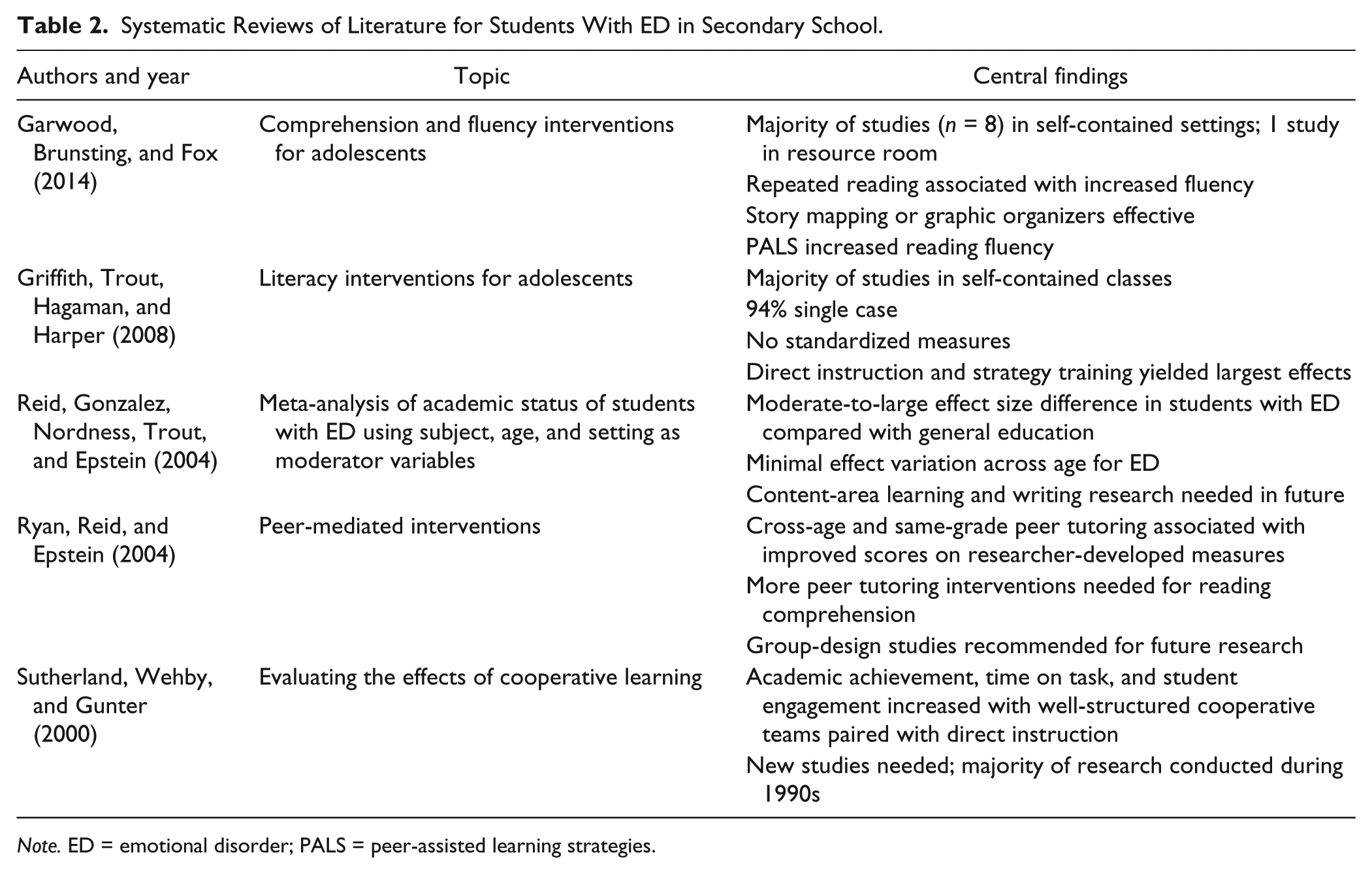
Note. ED = emotional disorder; PALS = peer-assisted learning strategies.
However, this literature base has several limitations. First, only a small number of single-case design studies have been conducted. Although several strategies show promise and will be highlighted in the following sections, further replication studies are needed to establish that these strategies meet criteria for evidence-based practices (Cook & Odom, 2013; Horner & Kratochwill, 2012; Makel & Plucker, 2014). For example Garwood et al. (2014) reported that only nine studies (with n = 38 students) have been published since 2004 that have provided any type of fluency and comprehension interventions for adolescents with ED. Second, the majority of studies in the syntheses were conducted in restricted settings rather than in general education classrooms. Third, less is known about writing intervention for this population (see Mason, Kubina, Valasa, & Mong Cramer, 2010, on Self-Regulated Strategy Development [SRSD]); yet writing to read is an important instructional strategy for content literacy in secondary school (Graham & Hebert, 2011). Despite the aforementioned limitations, the following suggestions rely on the available research to guide instruction, research, and policy considerations.
Challenges Related to Key Ideas and Details
This strand requires students to cite evidence to support conclusions, identify themes, and analyze. It is likely that students with ED, who have limited vocabulary, comprehension, and self-regulation (Fulk, Brigham, & Lohman, 1998), will require support to critically read complex text and to make inferences. Delayed reading fluency could contribute to fatigue when attempting to compile key ideas from text details, and determine how details develop over the course of a passage (Wanzek et al., 2014). Appropriate instructional practices can improve student’s likelihood of success on this CCSS strand.
Recommended supports and strategies
Two instructional practices to enhance students’ potential to succeed on the key ideas and details strand are supported by research for this population. First, graphic organizers and concept maps (paper or technology-based) have been associated with increased comprehension of informational text in students with disabilities (Dexter & Hughes, 2011), including students with ED (Stone, Boon, Fore, Bender, & Spencer, 2008). For example, Inspiration© computer-based concept maps enhanced social studies content learning in three high school students with ED compared with typical practice (Blankenship, Ayres, & Langone, 2005). The modified multiple-baseline study, which replicated the intervention across students, found that when students studied social studies material without teacher support during an intervention that included computer-based concept maps, increased content knowledge was demonstrated (Blankenship et al., 2005). Research also suggests that text maps can improve understanding of narrative text. In a single-case study (Stone et al., 2008) involving four students with ED, teaching students to use text maps resulted in improved comprehension (Stone et al., 2008). More research is warranted using graphic organizers for adolescents with ED because of the small sample sizes in the existing studies, but this initial evidence is promising (Garwood et al., 2014).
Summarization strategy training with peer tutors (Spencer, Scruggs, & Mastropieri, 2003; Sutherland & Snyder, 2007) is a second effective strategy that aligns with this CCSS strand. Middle school students with ED participated in a crossover design where peer tutoring with summarization training and a traditional instruction condition to understand content-area text was implemented. Peers read text, provided feedback, and used a summarization strategy. Reading outcomes were statistically significantly higher in the treatment than in the traditional condition, with moderate-to-large effect sizes ranging from .40 to .89 (Spencer et al., 2003).
Researchers also implemented a peer-mediated learning intervention with middle school students with ED consisting of peer-assisted learning strategies (PALS; Fuchs, Fuchs, Simmons, & Mathes, 2008). Students improved their reading fluency, and effectively utilized a summarization/main idea strategy in pairs where students identified the important topic of each paragraph, integral details about the topic, and summarized the main idea in approximately 10 words (Fuchs et al., 2008; Sutherland & Snyder, 2007). In addition to using graphic organizers and peer-mediated summarization strategy training to locate key details for this strand, research suggests that educators should initially use lower lexile texts to enable students to apply the strategies independently (Biancarosa & Snow, 2006).
Challenges Related to Craft and Structure
Limited vocabulary proficiency can exacerbate challenges related to interpreting words and phrases and understanding figurative meanings. Similarly, dysfluent reading and comprehension difficulties could hinder the ability of students to analyze text structure. Without an understanding of text organization, it is difficult to identify details and understand how they support the text. Furthermore, because anti-social behavior is a characteristic of ED (Shores & Wehby, 1999), it is challenging for many students to take another’s point of view. Thus, it will likely be difficult to understand author’s purpose or to gain the perspective of a character.
Recommended instructional supports and strategies
Research indicates that pre-reading support and vocabulary instruction are integral instructional components. Because vocabulary is essential to comprehension, educators must go beyond the typical practice of introducing terms, and having students read definitions (Hawkins, Hale, Sheeley, & Ling, 2011). Instead, fostering a connection to the content prior to reading can be empowering as students prepare to interact with complex text (Guthrie, Klauda, & Morrison, 2012). An example of complex text might be Dr. Martin Luther King’s 1963 letter from the Birmingham jail. Advanced organizers and graphic organizers that make vocabulary comprehensible can be utilized to unpack this complexity and make relationships more concrete. These tools provide multiple exposures and uses with new vocabulary such as chemical weathering in science, or legislative agenda when reading about the Civil Rights Movement in social studies, and provide background before reading (Bos & Vaughn, 2006).
The element of the multi-component intervention Collaborative Strategic Reading (CSR) referred to as fix-up strategies (Vaughn, Klingner, & Bryant, 2001) may also support mastery of requirements for this strand. In CSR, students work collaboratively to apply fix-up strategies to decipher unfamiliar words or phrases (Vaughn et al., 2001). Students are provided cue cards that explicitly describe the strategies, which include re-reading the sentence with the term/phrase, re-reading the sentence before and after, analyzing word parts, and using cognates for students who speak Spanish. In summary, explicit pre-teaching, motivation, vocabulary practice, and text analysis strategies, as previously described, can be applied.
Challenges Related to Integration of Knowledge and Ideas
Below-grade-level fluency and word reading ability (Wanzek et al., 2014; Wei et al., 2011) and difficulties with comprehension tasks such as inferences will pose challenges within this strand. Students are expected to process and interpret information that is presented not only in text format, but integrate information presented visually and quantitatively. In addition, students must evaluate arguments and claims by examining evidence, using prior knowledge, and connecting themes across multiple texts, which is common in ELA and social studies.
Recommended supports and strategies
The integration of lower lexile texts has benefited students with disabilities while reading content-area text (Gersten, Baker, Smith-Johnson, Dimino, & Peterson, 2006). Alternate texts can foster independent proficiency and target comprehension goals by reading independent-level passages that contain grade-level content. This includes passages from websites, newspapers, or lower lexile books (e.g., Biancarosa & Snow, 2006; Faggella-Luby & Deshler, 2008). We suggest gradually increasing text difficulty to help students attain grade-level proficiency. For example, to evaluate evidence for causes of the Great Depression, students would read a newspaper editorial from a banker written in 1929 and the transcripts of a Senator’s speech, before debating which person’s argument corresponded best with a video they watched about the Depression. These primary sources would hypothetically represent a Grade 6 to 8 lexile level, but provide 11th-grade content.
Employing purposeful writing is also related to this standard as research has shown that writing interventions can improve reading as well (Graham & Hebert, 2011). Evidence-based interventions including SRSD (Lane, Harris, Graham, Weisenbach, Brindle, & Morphy, 2008; Graham & Harris, 2009) can be incorporated that teach students to write persuasive essays related to topics related to their reading. Students with ED demonstrated improved written expression for persuasive essays using SRSD on proximal and maintenance evaluations (Mason et al., 2010). The use of SRSD is notable for two reasons. First, persuasive or argumentative writing directly corresponds with the Integration of Knowledge and Ideas strand and is a tested writing genre in secondary schools in most states. In secondary classrooms, following reading, students are often asked to write about the extent to which the arguments they have read are valid (Mason et al., 2010). Second, self-regulation is a mechanism for monitoring and evaluating understanding, and can potentially generalize to other settings. Reading strategies to locate main ideas and SRSD writing to plan and compose persuasive essays have been demonstrated as effective for adolescents with academic difficulties and ED (Mason et al., 2010). In summary, teaching students to effectively write can enhance reading outcomes (Graham & Hebert, 2011), which can support achievement on the CCSS for reading and writing standards (Graham & Harris, 2013).
Challenges Related to Range of Reading and Text Complexity
Students are expected to transfer the skills emphasized in all the previously described categories to independent grade-level text reading. This will be difficult for students with ED given their extensive reading difficulties (Wanzek et al., 2014; Wei et al., 2011), which in turn will make grade-level expectations difficult to achieve. Attaining independent reading proficiency will require the collaborative support of educators and researchers.
Recommended supports and strategies
Although there has been minimal experimental research to date examining the effects of assistive technology, including reading software and e-books for students with ED, there is guidance for scaffolding comprehension and writing with grade-level text using such devices (e.g., Edyburn, 2006). At least one study has demonstrated that post-secondary students with attention problems read faster, attend to reading, and complete assignments quicker when listening to text and following along (Hecker, Burns, Elkind, Elkind, & Katz, 2002). Clearly additional research is warranted but it is possible that technology could increase motivation and engagement, which in turn could improve reading skills. The use of these technologies then would be not only a teaching tool but also a positive reinforcement. There is evidence that this technology is not yet used extensively. Less than 8% of students with disabilities reported using assistive technology in high school (Bouck, Maeda, & Flanagan, 2012). Future research should investigate the potential of e-texts and applications for students with ED. Building support for reading via videos and teaching students to navigate textbooks through direct instruction and questioning before, during, and after reading can also increase understanding. Overall, the goal is to increase the time students are engaged with print.
Two more important evidence-based strategies include cooperative learning and peer-mediated learning (see Table 2). Sutherland, Wehby, and Gunter (2000) reviewed the literature on cooperative learning. More positive effects were associated with well-structured groups that were selected based on social skills and academic achievement, and when students received precise guidelines. Without these instructional supports, cooperative learning groups were largely unsuccessful. Ryan et al. (2004) found that although more research is needed with different populations and settings, peer-mediated interventions were associated with improved academic outcomes. Peer-mediated interventions for struggling learners in secondary school were also synthesized recently, and moderate to high effect sizes were found in addition to favorable social validity ratings from students and educators (Wexler, Reed, Pyle, Mitchell, & Barton, 2013).
Direction for Future Research and Policy
In this article, we analyzed the implications of rigorous reading standards related to secondary school literacy for students with ED. After describing the new expectations across the strands, we discussed how characteristics of learning and behavior in students with ED could pose difficulties for students and their educators. Although reading intervention research for students with ED is limited, we highlighted encouraging interventions to foster improved reading skills for each CCSS strand. Further research can potentially reduce the unfavorable outcomes for this population (Wagner & Newman, 2012). To this end, we encourage the following research priorities that are responsive to the specific needs of students with ED and correlated with the CCSS.
Research Priorities
Reading intervention
We suggest three needs pertaining to literacy instruction for students with ED in Grades 6 through 12 connected to CCSS standards that build on extant intervention research. First, replications of treatments for reading comprehension and reading fluency are essential because contrary to research for students with LD, there is a need for evidence-based instructional practices in literacy for students with ED (Garwood et al., 2014). To accomplish this, replications of promising treatments discussed in this article and as reported in systematic reviews of literature (i.e., graphic organizers, summarization training, PALS and highly structured peer-mediated and cooperative learning frameworks; Garwood et al., 2014; Griffith et al., 2008) are warranted, as are more rigorous studies examining use of assistive technology. Given the increased emphasis on learning in the content areas within the CCSS, pairing interventions with content-specific reading and vocabulary would contribute to the field’s understanding of effective practices.
Second, research for students with ED in different settings is necessary. To date, more than 90% of intervention studies for students in secondary school with ED were implemented in self-contained settings (several studies conducted in clinical or residential settings). Intervention studies within inclusive settings can be responsive to the many students with ED who receive instruction in settings other than self-contained classrooms (Griffith et al., 2008). Because many schools have policies that support increased levels of inclusion for students with ED (e.g., Goodman, Hazelkorn, Bucholz, Duffy, & Kitta, 2011), interventions for students with ED in inclusive settings in reading and writing in secondary schools can inform practice and professional development. New intervention studies would also provide the opportunity to investigate the contribution of student-specific moderator variables and teacher-specific instructional components (e.g., evidence of direct instruction, time allocated to text reading or strategy) to better understand relationships and variables that contribute to the literacy performance of students with ED.
The final recommendation involves paying careful attention to methodology and ensuring that interventions are intensive and when appropriate, include multiple components of literacy (e.g., phonics, vocabulary, comprehension, and/or writing; for example, Vaughn & Wanzek, 2014). Given the pervasive academic needs and long-term outcomes of students with ED (e.g., Wagner & Newman, 2012; Wei et al., 2011), longer intervention trials can evaluate the efficacy of sustained interventions. Methodology considerations are also warranted. The extant research for students with ED has almost exclusively utilized single-case research designs (e.g., Garwood et al., 2014; Ryan et al., 2004). For single-case research, methodological rigor is needed to help establish that a practice is evidence-based by choosing appropriate designs, meeting standards for the number of baseline and treatment data points, and replication by different researchers. Finally, including more students with ED within the participant samples of group-design experimental studies is encouraged given the paucity of group-design research for this population (e.g., Garwood et al., 2014).
Policy implications
Two considerations for policy based on the review of research and CCSS competencies presented in this article have emerged. First, because evaluating teacher performance is often connected to test performance (Darling-Hammond, Amrein-Beardsley, Haertel, & Rothstein, 2012), these decisions should be discussed carefully. Researchers suggest that attendance, behavior, teacher training, and other student and contextual variables contribute to performance (Darling-Hammond et al., 2012). However, additional factors may moderate outcomes for students with ED including the lack of current research and the extent of professional development for educators of students with ED. In sum, as comprehensive programs that consider social/behavioral needs, family involvement, and sustained academic support continue to develop (e.g., Simpson, Peterson, & Smith, 2011), we encourage ongoing discussion between policy makers, teachers, and researchers to consider the unique needs of students with ED and their educators when selecting appropriate accountability platforms.
Second, transition services for students in high school with ED relating to college and career readiness should be tailored to individual needs. Statistics including the low reading profiles at age 17 (Wei et al., 2011), the failure of many people with ED to attain a college degree and gain stable employment (Newman et al., 2010) suggest that students with ED require the interventions and adaptations previously described to succeed on the CCSS along with post-secondary and transition activities (Lane & Carter, 2006). To this end, policy debates regarding balancing the CCSS along with other initiatives should include a discussion of what specific academic, social, and behavioral supports will be necessary to help improve the outcomes of persons with ED following high school.
Conclusion
The United States has witnessed various educational reform movements; recently, we witnessed the 30th anniversary of the national publication of the reform document, A Nation at Risk (National Commission on Excellence in Education, 1983). This controversial report brought attention to achievement inequalities in education and the need for improving U.S. competitiveness. Initially, the CCSS aimed to develop common benchmarks that lead to better preparation for college and career readiness, to clearer comparisons on assessments for accountability across states, and to increased reading and writing performance that will lead to increased global competitiveness. Despite widespread adoption, some controversy remains about implementation because creating higher standards does not guarantee that students with disabilities will attain them (Haager & Vaughn, 2013). Students with ED have historically encountered unfavorable academic and social outcomes and warrant advocacy. We described learning characteristics for these students, the extensive challenges in meeting the increased expectations, promising approaches, research, and policy priorities. These challenges will likely live beyond the current CCSS debate and warrant attention from policy makers and key stakeholders.
Footnotes
Declaration of Conflicting Interests
The author(s) declared no potential conflicts of interest with respect to the research, authorship, and/or publication of this article.
Funding
The author(s) disclosed receipt of the following financial support for the research, authorship, and/or publication of this article: This work was supported by the U.S. Department of Health and Human Services National Institutes of Health-National Institute of Child Health and Human Development (P50HD052120). The content is solely the responsibility of the authors and does not necessarily represent the official views of the National Institute of Child Health and Human Development or the National Institutes of Health.