



Abstract
Effectively integrating provisions of the Workforce Innovation and Opportunity Act (WIOA) into public Vocational Rehabilitation (VR) systems will require extensive effort at both the organizational and system levels. This article presents information on WIOA provisions, enacted in July of 2014, that affect public VR systems plus rationale, strategies, and tools for implementing these provisions in a manner that promotes quality and sustainability. Both “ideal” implementation methods and “pragmatic” methods are presented based on the experience of one state’s efforts to incorporate customized employment strategies into its VR system to benefit customers who have not been successful at achieving a competitive, integrated employment outcome through traditional VR strategies.
Section §361.5(c)(15) of the newly enacted Workforce Innovation and Opportunity Act (WIOA) specifically identifies customized employment (CE) as an employment outcome under the public Vocational Rehabilitation (VR) program. CE is defined by WIOA as
competitive integrated employment, for an individual with a significant disability, that is based on an individualized determination of the strengths, needs, and interests of the individual with a significant disability, designed to meet the specific abilities of the individual with a significant disability and the business needs of the employer, and carried out through flexible strategies. (Civic Impulse, 2015, p. 573)
Previously, the definition of competitive employment was vague and offered great latitude in regulations. WIOA includes a more specific definition that states, “competitive integrated employment is full- or part-time work at minimum wage or higher, with wages and benefits similar to those without disabilities performing the same work, and fully integrated with co-workers without disabilities” (Civic Impulse, 2015, p. 571). Also, the definition for supported employment (SE) has been modified to clarify that SE is integrated, competitive employment, and it now includes CE in the definition. CE differs from the long-standing SE service option in that SE is typically driven by the labor market and is characterized by competitive employment within the community with training and support provided by a skilled job coach, whereas CE is characterized by competitive employment in integrated settings with focus on the relationship between the individual with a disability and the specific employer and meeting the needs of both (Parent, 2004).
Integration of CE strategies into public VR systems necessitates both organizational and system change. Change theory tells us that this type of change is complex and requires a comprehensive and integrated approach (Amagoh, 2008; Peirson, Boydell, Ferguson, & Ferris, 2011). Foster-Fishman and Behrens (2007) define systems change as “efforts that strive to shift the underlying infrastructure within a community or targeted context to support a desired outcome, including shifting existing policies and practices, resource allocations, relational structures, community norms and values, and skills and attitudes” (p. 192). Changing an agency’s service delivery practices requires substantial effort beyond training of staff or sheer will of leadership. Effective integration of any new practice into an existing system requires extensive upfront planning, stringent project management, a solid plan for implementation and expansion, and ongoing evaluation.
The purpose of this article is to provide state VR systems with tools and guidance in implementing the provisions of WIOA regarding the inclusion of CE strategies to promote competitive, integrated employment outcomes for their customers. Information on major provisions of WIOA that affect the public VR systems is provided along with best practice methods for creating systems change through the incorporation of CE strategies in VR’s menu of services. Both “ideal” implementation methods and “pragmatic” methods are presented based on the experience of one state’s efforts to incorporate CE strategies into its VR system to benefit customers who have not achieved competitive, integrated employment outcomes through traditional VR strategies.
Workforce Innovation and Opportunities Act
The WIOA was signed into law on July 22, 2014. WIOA reauthorizes the Workforce Investment Act (WIA) of 1998 and contains a number of important changes to the Rehabilitation Act—the first major piece of civil rights legislation for persons with disabilities. WIOA increases access to high quality workforce services to prepare individuals with disabilities for competitive, integrated employment. It requires better employer engagement and promotes physical and programmatic accessibility to employment and training services. WIOA also creates an Advisory Committee with a purpose of developing strategies to increase competitive, integrated employment for individuals with disabilities. Most provisions of WIOA take effect on July 1, 2015. The State Unified Plans and Common Performance Accountability provisions take effect in July, 2016. WIOA is authorized for 6 years through 2020 (U.S. Department of Labor [USDOL], 2014b).
WIOA enacts several changes that affect the public VR system. Major changes include (a) an increased role in transition of youth with disabilities from school to adult life, (b) a requirement for formal cooperative agreements between VR and State Medicaid and Intellectual/Developmental Disabilities (IDD) Agencies, (c) expansion of the VR system to work with employers, (d) a federal definition of competitive integrated employment as an optimal outcome, and (e) an updated definition of SE that includes CE (Hoff, 2014; Schroeder, 2014; USDOL, 2014b).
In addition to requiring that 15% of VR funds be used for transition services for youth with disabilities, WIOA requires VR local offices to provide preemployment transition coordination activities such as partnering with schools and local workforce development programs to support specific transition activities. These include work-based learning experiences, counseling related to postsecondary opportunities, workplace readiness training, self-advocacy training, and other related services. While this provision improves upon earlier legislation, it still allows for services to be provided in segregated settings and in low-skill, low-wage job experiences (Schroeder, 2014).
WIOA requires state VR agencies to have a formal cooperative agreement with the state agencies responsible for administering the State Medicaid Plan and with State intellectual and developmental disabilities agencies with respect to VR services including extended services (Schroeder, 2014). VR defines extended services as “the ongoing support services and other appropriate services provided by appropriate State agencies, private organizations, employers or any other source, to assist the individual in maintaining supported employment once intensive supported employment services are completed” (Vocational Rehabilitation Manual, n.d.). This WIOA provision will benefit individuals with intellectual and developmental disabilities who often require long-term care. Another population that often requires extensive care is individuals with mental illness. Unfortunately, state mental health agencies were not included in this provision.
Through WIOA, Section 109 of the Rehabilitation Act has been expanded to support VR’s work with businesses at the local, state, regional, and national levels to provide support and technical assistance in hiring, promoting, and retaining employees with disabilities (Schroeder, 2014). Section 109 allows for the provision of training in disability awareness, the Americans With Disabilities Act and other employment related laws. It also allows VR to provide technical assistance for employers to develop work-based learning experiences (i.e., internships, apprenticeships), opportunities for preemployment services, recruitment strategies, training for employees with disabilities, and awareness of disability-related obstacles to continued employment. Consultation and support is also provided on accommodations, assistive technology, and access (USDOL, 2014b).
CE Process
The CE process is grounded in social-ecological theory in that it acknowledges the complex interplay between a person and his or her environment. It emphasizes the importance of person–environment fit, as well as the diverse systems that influence human functioning (Schalock et al., 2010; Shogren, 2013). It takes into consideration the unique aspects of each person such as the person’s age, type of disability, functional capacities, disposition, and interaction style while also recognizing contextual factors such as living arrangements, geographical location, support systems, connections, and resources to help facilitate an employment outcome that aligns with the individuals’ interests and talents while considering conditions that may affect successful, long-term employment.
The CE process consists of the following key elements: (a) the Discovery process, (b) the Vocational Profile, (c) the CE Planning meeting, (d) the Visual Resume, (e) Customized Job Development and Negotiation, and (f) Accommodations and Post-Employment Support. Each element is described briefly. However, it should be noted that learning to apply the CE process with fidelity requires time and practice combined with training and technical assistance from a person with expertise in the process. States should take this into consideration when incorporating CE strategies into their service options. Figure 1 illustrates the CE process.
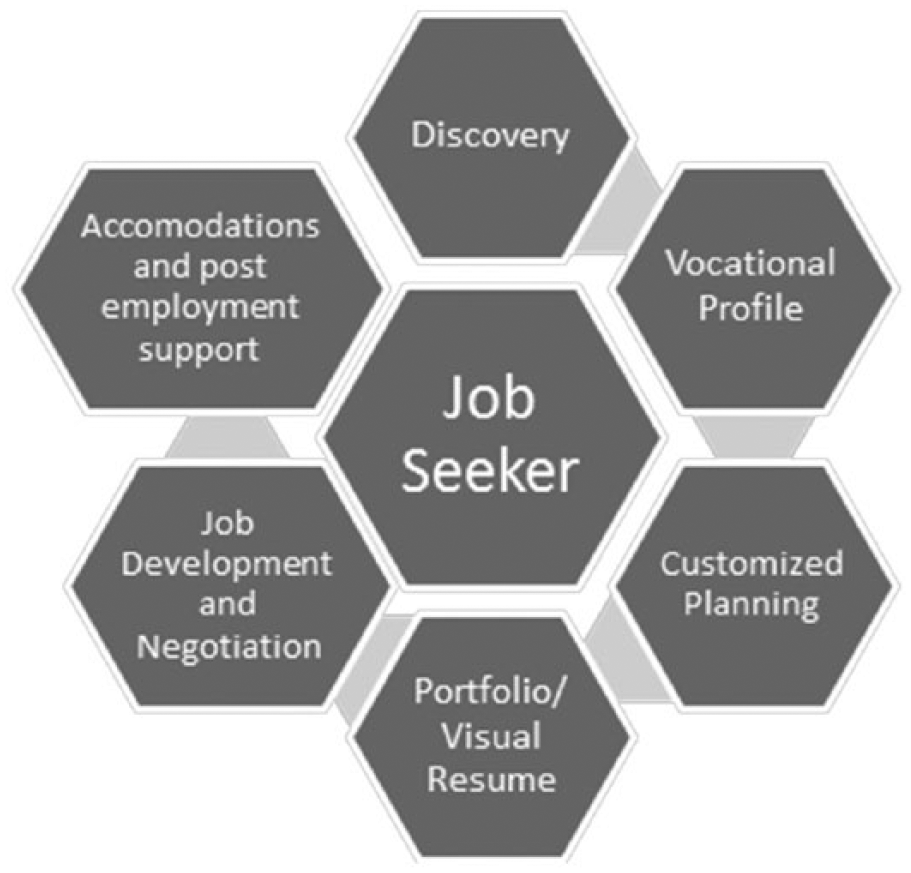
Customized employment process.
Discovery
The emphasis on serving individuals with more significant disabilities has placed new demands on consumer assessment (Hagner, 2010). According to Hagner (2010), “Naturalistic assessments add an important dimension to the assessment toolkit available to rehabilitation counselors and vocational evaluators” (p. 33). He defines naturalistic assessment as “the assessment of performance on real-world tasks and observation of responses in natural contexts” (Hagner, 2010, p. 28). Hagner suggests that naturalistic assessments provide vocationally meaningful information about consumers with the most significant disabilities, including those who are unable to participate in traditional testing. A combination of naturalistic and traditional assessment approaches can complement each other and reveal a more complete picture of the individual than either approach used alone.
Discovery is a type of naturalistic assessment that uses qualitative methods to gather information useful in building a narrative snapshot of a job seeker to facilitate the identification of ideal working conditions (Callahan & Condon, 2007). Discovery is a vital part of the CE process because it promotes improved employment matching. The Discovery process takes place in natural environments such as the home, neighborhood, and community. It includes interviews, conversations, observations, and records reviews to get to know the job seeker and his or her interests, talents, and conditions for employment (e.g., environmental tolerances, social interaction skills, etc.).
Vocational Profile
The Discovery process culminates in the development of a vocational profile that provides a descriptive picture of the job seeker. It is a robust, narrative report that provides a foundation for effectively negotiating personalized potential job opportunities with employers (Condon & Callahan, 2008). The profile is a living document that can be amended as new information is uncovered, making it a particularly useful tool for students transitioning from school to the community and workforce. Profiles provide “an alternative format to traditional evaluation reports that test and compare persons with complexities to general standards and others” (Callahan, Shumpert, & Condon, 2011, p. 5).
CE Planning
The customized planning meeting includes the job seeker, family, friends, advocates, service providers, VR counselors (VRCs), and other stakeholders chosen by the job seeker. Ideally, it occurs within 2 weeks of the completion of the Vocational Profile. The purpose of the meeting is to develop a CE blueprint that bridges the gap between Discovery and job placement. The information contained in the Vocational Profile is utilized to develop a specific plan of action for achieving a competitive, integrated employment outcome in a job that matches the individual’s interests, talents, and conditions for employment.
Visual Resume
The visual resume is a sales tool to introduce the job seeker to potential employers. It is different from a typical resume in that it utilizes photos or video clips to demonstrate the job seeker completing tasks/skills essential to the position. This tool is very useful for individuals who may not be able to express their talents and abilities in verbal format as is traditionally done through the interviewing process. The visual resume may also be utilized to explain the concept of CE to an employer.
Customized Job Development and Negotiation
CE includes negotiating employment opportunities with employers through the identification of unmet business needs that may be fulfilled by the talents of a job seeker. Typically, this process does not begin with a response to an advertisement for employees, but rather through meeting with employers and touring businesses to identify mutually beneficial matches. Customized job development strategies include (a) job carving—the process of breaking jobs down into their key components and reassigning those pieces in more efficient or understandable way; (b) job sharing, where two or more people share a position based on the strengths of each; and/or (c) job creation, where a new job description is developed based on unmet needs of the employer (USDOL, 2014a).
Example: Allen has autism with limited speech. Through the Discovery process, Allen is identified as having an interest in video games and a talent for organization and data entry. A local video store that sells new and used games has multiple employees who, when interviewed, state that they all prefer answering questions and selling games to stocking and organizing. While they are helping customers, games that have been ordered or bought for resale are typically set aside until there is time to enter the inventory into the computer and put it on the shelves. The sales floor quickly becomes disorganized due to movement of product by browsers. When a customer requests a particular game, the system does not show that it is in stock because it has not yet been entered into the computer or, the system does show it is in stock, but the game cannot be located on the shelf because it is out of place. The employer indicates that, typically, employees are hired to perform all aspects of the job (selling, stocking, etc.). A customized approach allows the individual with autism to be hired to enter games into the computer, stock, and organize product. This leaves more time for other employees to sell and makes it much easier to access games that are in stock. In addition to an increase in sales, morale is increased because employees spend more time doing work that they enjoy. A win-win!
Accommodation and Post-Employment Support
Post-employment supports have been proven to be beneficial for people with disabilities who may encounter issues that they are not prepared to handle without assistance (Targett, Wehman, McKinley, & Young, 2004). Prior to VR case closure, assistance should be provided in the development of natural supports and resources for targeting solutions to challenges prior to the loss of employment. In addition, employees and employers should be aware of the services available through the Job Accommodation Network (http://askjan.org) to aid in the identification and implementation of accommodations as required by the Americans With Disabilities Act.
Integrating CE Practices Into Public VR Systems
According to a report by the U.S. Census Bureau (2012), one in five people in the United States have a disability. The National Organization on Disability (2010) estimates that the percentage of jobless among individuals with disabilities is a staggering 79%. In January 2015, the national unemployment rate of people with disabilities was 11.9% compared with 5.9% of people with no reported disability, and labor force participation for people with disabilities was 19.6% compared with 68.2% for people without disabilities (USDOL, Bureau of Labor Statistics, 2015).
Feasibility
Integration strategies are being presented in two formats: ideal and pragmatic. The rationale for this approach is, simply put, because public VR systems typically do not have the capacity to serve every person who has a disability that affects the ability to work. Several factors influence the feasibility of successful integration of CE strategies into public VR systems. These include (a) underfunding, (b) turnover, (c) large caseloads, and (d) counselor burnout.
A major issue that affects the feasibility of timely integration of CE strategies into public VR systems is that the programs are underfunded. Continuing budget cuts limit the funding available to serve people with disabilities who wish to return to work. Many states have resorted to an Order of Selection that classifies eligible VR customers by severity of disability. People with the most complex disabilities are served first and the funding trickles down until it is exhausted—often prior to serving all individuals who are eligible for services.
VR systems commonly experience high turnover, which results in understaffing. From 2013 to 2014, Florida VR’s counselor turnover rate was 24.8% for reasons including termination, promotion, lateral position transfers, or retirement. This exceeds the national average turnover rate of 16% as reported by Chan and Ruedel (2005) in a national Rehabilitation Services Administration report. High turnover creates expense for recruiting, hiring, and training; less experienced counselors; heavy caseload burden; and counselor burnout.
Most VRCs have very large caseloads. Hayward and Schmidt-Davis (2005) conducted a longitudinal survey of the public VR system and found that “97 percent of local VR offices had counselors who managed general caseloads” (p. 42). The average size of general caseloads was 112 (median 109) per counselor, with the size of caseloads ranging from 54 to 244 consumers. Nearly four fifths (79%) of counselors reported that the size of their caseload prevented them from spending sufficient time with individual consumers throughout their VR services. With heavy workloads, VRCs and staff do not always welcome the introduction of new requirements and process. Now that WIOA is requiring the inclusion of customized practices for customers, VR systems must adapt their policies and process, train staff, identify additional resources, and moderate resistance that may add to the issues of turnover and burnout.
Ideal Versus Pragmatic Approaches
As illustrated in Figure 2, the ideal implementation of CE practices within the VR process would replace traditional vocational evaluation with Discovery for persons with complex disabilities who may not perform well in prescribed settings in which they are required to answer questions, complete assessments, and perform tasks that result in a scoring system that compares individuals with a normative sample. Many vocational evaluation reports describe activities that the person cannot do (i.e., cannot stand for more than 15 min) rather than focusing on the strengths and talents of the individual. Vocational evaluations of individuals with complex disabilities will often indicate that the person is “too significantly disabled to achieve an employment outcome.” Discovery, on the contrary, will always identify interests, skills, and abilities of the person that translate to employment options. The very nature of the Discovery process creates an influx of eligible candidates for VR services.
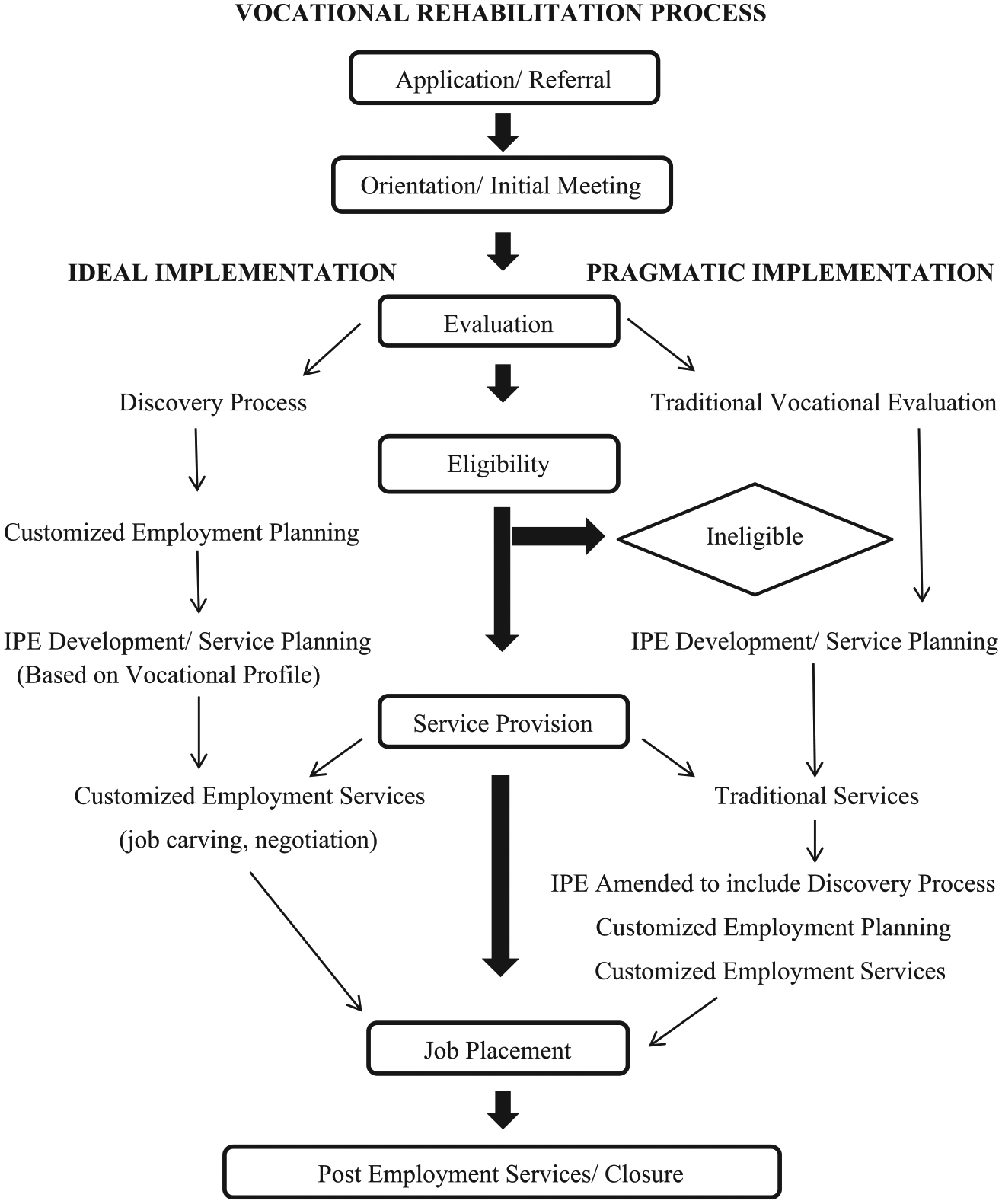
Customized employment integration process.
To allow for the integration of Discovery, as a best practice, Florida VR developed a more pragmatic approach to provide the customized service for those customers who need it without increasing the already large caseload sizes of VRCs. To accomplish this, the Discovery process is added to the Individualized Plan for Employment (IPE) as an amendment when traditional strategies have not resulted in a competitive, integrated employment outcome. The reason this compromise is not ideal is twofold. First, many applicants will have been determined ineligible for VR services based on the traditional vocational evaluation. These individuals will not have the opportunity to benefit from Discovery as an alternative strategy to identify their strengths and employment options. Second, for those individuals who are determined eligible, the time frame from employment planning to an employment outcome may be significantly delayed as CE strategies are only employed after traditional strategies have failed. Ultimately, this approach has the potential to be much costlier as customized approaches are utilized as an alternate option rather than as the first option for service provision.
Stakeholder Training
To effectively implement CE strategies, all stakeholders need to be trained on both the CE process and the philosophy behind it. Without embracing the philosophy that everyone has talent that can be channeled into employment opportunities, stakeholders may lack the buy-in needed for successful implementation. It is also important to tailor information and training to the specific audience based on their role in the process.
Job seekers, families, and support providers
Job seekers, their family members, and support systems need to have clear information pertaining to roles, timeframes, and expectations. It is important to note that CE strategies take time to implement correctly. Job seekers who enter into the CE process without this knowledge may become inpatient and frustrated. Sharing success stories is an effective way to illustrate the benefits of CE strategies. Also, job seekers should be actively involved in their VR, and it is essential that they participate in all meetings and decisions. This promotes self-determination and develops self-advocacy skills that will benefit the person in all aspects of life.
Community-based rehabilitation providers
Many public VR systems outsource job development and placement services to community-based provider agencies. Therefore, methods should be put into place to train these providers to implement CE strategies with fidelity. Florida began the process of adding CE strategies to their menu of services several years ago and currently has more than 90 community-based providers who are certified to provide Discovery as a billable service for Florida VR customers. The training is being expanded to the full CE process in early 2016. Training includes online, on-demand content modules that are applied with a real VR job seeker with a high level of technical assistance from a national expert. The training model is highly sustainable, because providers pay an upfront fee for the course with an opportunity for an immediate return on investment when they submit the approved Vocational Profile for the job seeker to the VR counselor. Smith, Dillahunt-Aspillaga, and Kenney (2015) detail the planning, development, and piloting of the training initiative.
Vocational rehabilitation counselors
To be able to best utilize the Vocational Profiles that are developed to facilitate the employment of job seekers, VRCs need to be trained to interpret them. They also require training on proper referrals for CE services and processes and procedures for implementing CE strategies with fidelity. Training must be offered in a format that is flexible and readily available to VRCs as they enter the field. Current VRCs should be provided with foundational training paired with opportunities for continuing education. Supervisors must also be knowledgeable of the CE process and provide supportive leadership for their employees as they embrace this new method of service provision.
Fidelity and Other Quality Assurance Measures
Florida enlisted the assistance of national experts and the developers of the Discovery process, Marc Gold & Associates (MGA), in the planning and implementation of integrating CE processes into the Florida VR system. MGA has developed training manuals, a fidelity checklist, and other tools that provide a foundation for training and quality assurance. Also, MGA has trained Discovery Stewards to provide technical assistance to states when incorporating CE strategies. In addition to these tools and technical assistance, states should include recertification and continuing education in their planning efforts to ensure ongoing quality in the provision of CE services. At a minimum, Vocational Profiles should be reviewed for quality assurance periodically to ensure that they continue to meet quality standards. Booster training should also be offered to both providers and VRCs to reinforce learning and promote fidelity.
Implications for Policy and Practice
Successful implementation of CE strategies involves educating all stakeholders, training service providers, and monitoring and evaluation of activities to promote ongoing quality in service provision. It is recommended that public VR systems (a) utilize a phased approach for introducing new practices, (b) develop success measures that are clearly connected to the project activities and provide a basis for decisions to expand or sustain the new practice, (c) develop a work plan with timelines covering all phases (pilot, expansion, full integration), (d) use strong project management to ensure that the work plan is completed as scheduled, and (e) conduct a comprehensive evaluation of all phases of implementation. It is also important to build and leverage partnerships among agency staff, leadership, community-based providers (VR vendors), employers, VR customers, and other appropriate stakeholders to achieve consensus on resource allocation, key outputs, and outcomes.
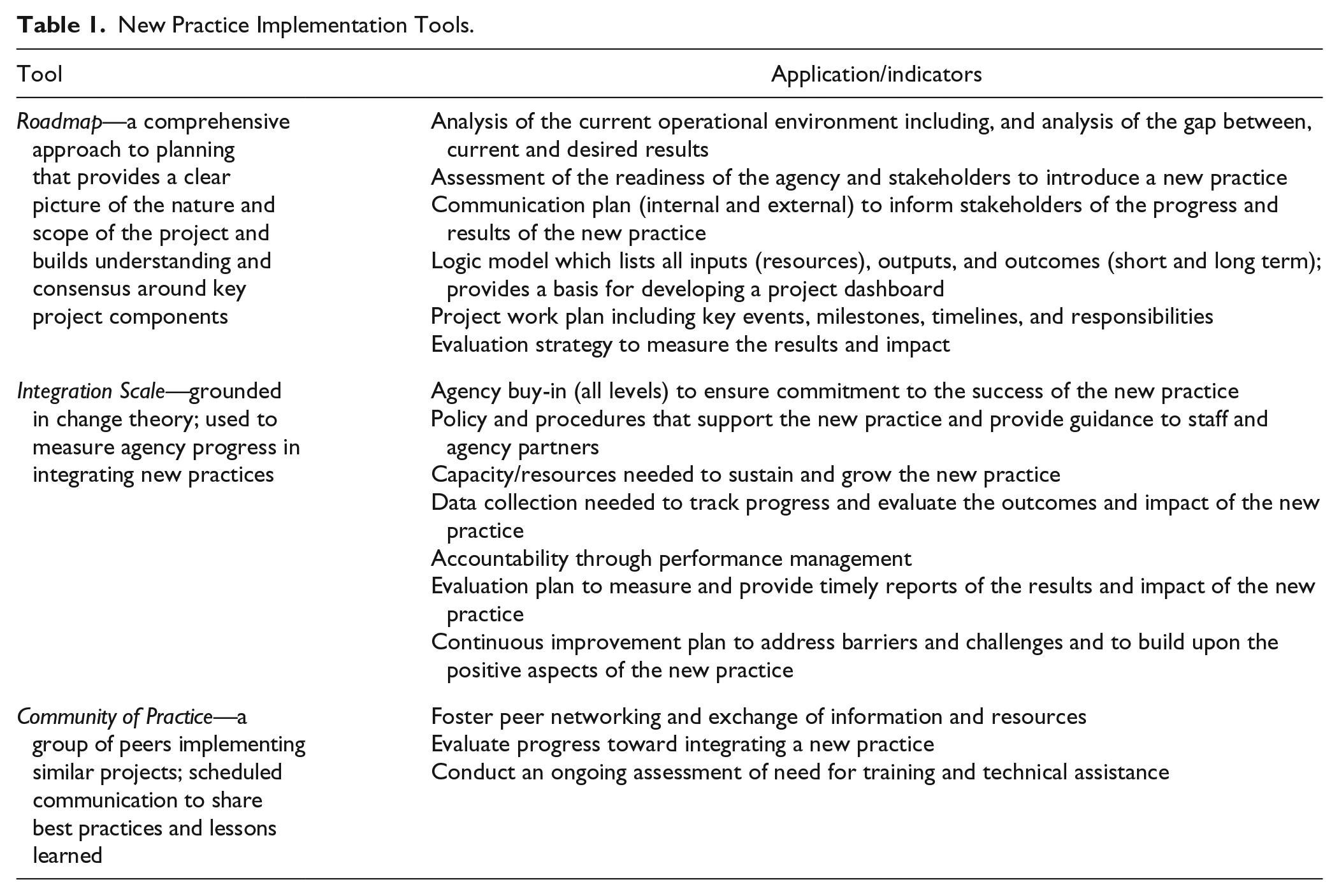
In addition to this approach, there are three tools that can be utilized to facilitate planning, project management, and evaluation. Southeast TACE (Technical Assistance and Continuing Education) developed these tools as part of their mission to meet the strategic goals and program performance needs of state VR agencies and their community partners. The tools include a (a) Roadmap, (b) Integration Scale, and (c) Community of Practice. The tools are described in detail in Table 1.
New Practice Implementation Tools.
A proactive strategy to promote the integration of CE strategies into the field of VR is to include information and experiential learning related to CE practices into the curriculum for future rehabilitation counselors. This approach helps to relieve the expense and burden of training VR employees to understand and utilize CE approaches when working with customers with complex disabilities. They enter the field knowledgeable and prepared to offer best practice approaches that focus on the strengths, interests, and talents of persons with disabilities. This aligns with the philosophy and requirements of public VR systems.
Conclusion
Effectively integrating any new practice requires extensive effort beyond training. A blueprint for the implementation of WIOA provisions for CE integration into public VR systems will help to prepare agencies for systems change and ensure that they are poised to expand and sustain this change. Utilization of the tools and strategies outlined in this article will facilitate timely and effective implementation of WIOA provisions to best serve individuals with complex disabilities who seek the services of the public VR system to achieve their competitive, integrated employment goals and to become fully included, productive members of society.
Footnotes
Declaration of Conflicting Interests
The author(s) declared no potential conflicts of interest with respect to the research, authorship, and/or publication of this article.
Funding
The author(s) received no financial support for the research, authorship, and/or publication of this article.