



Abstract
Background. Adult Student Priorities Survey (ASPS) from Ruffalo Noel Levitz was utilized to examine the level of importance and the level of satisfaction of continuing education students in allied health care and English as a second language (ESL) programs at Kingborough Community College, Brooklyn, NY. Method. Mean scores for both “importance” and “satisfaction” items were calculated by summing participants’ ratings (1-7 Likert-type scale) and dividing them by the number respondents. Mean scores for each scale were also calculated by summing all respondents’ scale scores and dividing them by the number of respondents. Gaps between importance and satisfaction were calculated by subtracting the score for satisfaction from the score for importance. The mean scores of allied health care students were compared with mean scores of ESL students. Results. The highest gap score was observed for academic services (0.91) followed by service excellence (0.85) as reported by the allied health care group, showing that students reported high importance but low satisfaction. There were no statistically significant differences between the average score of the two groups, indicating that the ratings were similar for the groups. Conclusion. Based on our findings, simple fixes such as extending registration times, having additional college and career advisors on staff, and training existing staff on customer service skills have the potential to increase enrollment and revenue, thereby giving us the resources to offer additional classes and programs in response to student needs.
“This study focused on the needs and satisfaction of adult noncredit continuing education students at KCC who were registered in the allied health career or ESL programs.”
Background
As reported in the Fast Facts-2019 of the American Association of Community Colleges (AACC), over 5 million noncredit students were enrolled in 1,051 community colleges in the United States as the fall of 2017, making up 42% of the total community college student body (AACC, 2019). Noncredit continuing education student enrollment has increased in the past two decades (Xu & Ran, 2015), and these students are outnumbered at many 2-year colleges (Van Noy, Jacobs, Korey, Bailey, & Hughes, 2008). According to the 2016 Adult Education and Training Survey from the U.S. Department of Education, 80% of adults who have a nondegree certificate reported that noncredit certificates were very helpful with getting a job, and staying marketable in the current job market (Cronen, McQuiggan, & Isenberg, 2018).
The National Center for Education Statistics (NCES; 2016) defined noncredit continuing education as “a course or activity having no credit applicable toward a degree, diploma, certificate, or other formal award.” These courses and activities often focus on specific skills and respond to the needs of the students, local businesses, and employers. Many who attend noncredit programs are adult learners, immigrant students, and individuals identified as low-income and underserved (Ma & Baum, 2016). As many noncredit programs focus on immediate employment, they are often seen as the “last best hope” for many of these students (Becker, 2011).
In addition, some studies argue that noncredit programs are not only beneficial to students and employers but also to colleges. Van Noy et al. (2008) noted that noncredit programs help colleges develop and pilot new programs and courses, and assist with marketing and engaging institutional donors. Additional studies report that many noncredit programs act as conduits to higher education when students transfer to credit-bearing programs (Grubb, Badway, & Bell, 2003; Price & Sedlak, 2018; Xu & Ran, 2015). Even though enrollment in noncredit programs has significantly increased the many benefits of the noncredit programs, information about the needs and satisfaction of noncredit students has not been exclusively studied.
While many studies have, in a general sense, looked at adult education, far fewer studies have been conducted about the needs and satisfaction of adult students. In fact, we did not find a single study that specifically examined the needs and satisfaction of students who enrolled in noncredit continuing education programs.
By neglecting these students’ needs and satisfaction, colleges are doing a disservice to a large population of learners. Therefore, it is necessary to include attention to noncredit students to increase our knowledge about their needs and satisfaction and, in doing so, improve the services delivered to and the experiences of noncredit students.
Furthermore, higher education is being seen more and more as a service industry (Mark, 2013). According to marketing studies on higher education, students are satisfied with a company or organization when the quality of services matches or exceeds their expectations for a particular service, just as they would with any other industry (Elliott, 2002; Munteanu, Ceobanu, Bobâlcă, & Anton, 2010; Swan, Bowers, & Grover, 2002). As higher education becomes more competitive, students become more critical about choosing what schools to attend. Factors such as the college’s overall image, the quality of instructors and learning outcomes, student satisfaction, and word-of-mouth reviews affect a students’ selection of college (Hall & Zuhair, 2006; Ledden, Kalafatis, & Samouel, 2007). Studies also report that when institutions respond to student needs, overall student satisfaction increases, and their loyalty to the institution as a whole and the institution’s position in the larger educational market strengthen (Boksberger & Melsen, 2011; Gallarza, Gil-Saura, & Holbrook, 2011; Hall & Zuhair, 2006). By focusing on higher education as a service industry, higher educational institutions are increasingly focusing on students’ (customers’) needs and level of satisfaction.
Satisfaction is defined as the fulfillment of students’ academic goals and objectives (Kumar & Dileep, 2006) and can also be seen as the difference between students’ perceptions and expectations (Napitupulu et al., 2018). Wu, Tennyson, and Hsia (2010) suggested that student satisfaction was the most accepted measure of the institution’s quality and effectiveness of services. Similarly, Munteanu et al. (2010) noted that student satisfaction is an important measure of the quality of teaching, which can be seen as an indicator of the overall quality of educational services for higher educational institutions.
This article aims to understand the satisfaction and needs of noncredit continuing education students at the Kingsborough Community College (KCC) in Brooklyn, NY. The goals of the study are to learn about student’s educational experiences, and the overall satisfaction and needs of the continuing education student body, specifically within the allied health care and English as a second language (ESL) programs. This is the first attempt to learn about the needs and satisfaction of adult noncredit students to improve program outcomes, to meet their unique needs, and to increase their satisfaction not only at KCC but also at other community colleges. Davaasambuu, Cinelli, D’Alessandro, Hamid, and Audant (2018) found that a majority of community colleges in the United States were only collecting headcounts for their noncredit programs, and there were no systematic data collection standards and mechanisms in place for assessing overall noncredit program success, in addition to more insightful data such as the needs and satisfaction of noncredit adult students. Therefore, this study is innovative in terms of its in-depth assessment of the needs and satisfaction of adult noncredit student learners.
As the only community college in Brooklyn, NY, KCC provides accessible, affordable, and comprehensive educational and training opportunities. KCC serves nearly 30,000 students annually through both credit and noncredit programs. For some, they are the first in their family to go to college, which represents a significant step toward achieving the American Dream. Others come to KCC seeking professional certifications they need to secure and retain gainful employment in competitive job markets. At KCC, students come from over 140 countries and speak over 70 languages; they are primarily over 20, contribute to family incomes, come from families whose incomes are under US$30,000, and are from racial minority groups (32% African American, 18% Hispanic, 14% Asian, and 54% foreign-born students).
Allied Health Care Programs
Allied health care is defined by the Association of Schools of Allied Health Professions as a part of the health care sector that “delivers services involving the identification, evaluation and prevention of diseases and disorders; dietary and nutrition services; and rehabilitation and health systems management.” Several allied health programs are in high demand at KCC and include Certified Nurse Aide (CNA), which is an intensive program that prepares students for an entry-level position at a nursing or hospital facility; Patient Care Technician (PCT) which teaches the technical skills for rehabilitation services, bedside care, the collection of lab specimens, phlebotomy, and the operation of electrocardiogram (EKG) machines within an inpatient setting; and Certified Clinical Medical Assistant (CCMA) which teaches the skills to perform administrative and clinical responsibilities at physician and other medical officers. Allied health is currently the borough’s leading career pathway and a growth sector throughout the city.
ESL Learners
The Kingsborough English Language Institute provides four different program structures to the needs of different students: full-time intensive, part-time, advanced English courses, and a vocational ESL program. Only students from the full-time intensive program participated in this study.
When surveying KCC’s continuing education population, it was found that the allied health care and the ESL programs had the largest overall enrollment and the most culturally diverse students, and would therefore be best to study for this current research.
Method
Participants and Sampling Method
A total of 93 (45 students from allied health care and 48 students from ESL programs) students who were enrolled in allied health care and ESL programs during the 2018 fall–winter semesters participated in the study. This study used convenient sampling methods and all students participated in the study after their school programs. The study used the convenience sampling method because of the noncredit students’ class schedules (evening and weekend classes). Other methods such as random selection were not feasible because of the unique priorities of the adult students (busy schedule, family duty, jobs, and weekend and evening classes).
Research Instrument
Adult Student Priorities Survey (ASPS) from Ruffalo Noel Levitz was utilized to examine the level of importance and satisfaction of adult continuing education students enrolled in allied health care and ESL programs at KCC. The ASPS is a self-reported instrument with 50 standardized items that investigate the importance and satisfaction of adult students, and assists colleges with identifying the priorities of adult student learners and their needs. The instrument is widely used for adult students in colleges, for example, 30,294 adult undergraduate students from 158 institutions and 36,988 adult graduate students from 158 institutions, including community colleges participated in the ASPS in 2018 (Ruffalo Noel Levitz, 2018). In addition, the survey was especially designed for adult students, aged 25 years and older, who studied in evening, weekend, continuing education, credit and noncredit, graduate, and undergraduate programs (Noel-Levitz, Inc., 2005). Therefore, this instrument was chosen as the most fitting to gather information of the importance and satisfaction of adult noncredit students at KCC.
The instrument has high reliability (Cronbach’s coefficient alpha was .93 for importance items and .90 for the satisfaction items) and validity (Pearson’s correlation was .74 for importance and .67 for satisfaction items; Ruffalo Noel Levitz, 2017), and used in similar research studies (Boylston, Peters, & Lacey, 2004; McCann & Graves, 2012).
The instrument is focused on following target areas (scales):
Academic Advising Effectiveness (12 items) assessed the inclusiveness of academic advising services. Academic advisors and counselors are evaluated for their knowledge, competence, the quality of assistance they provide to students, as well as on their approachability. Items included “My academic advisor is available at times that are convenient for me” were evaluated by the students.
Academic Services (total of five items) reviewed the services of the campus library, computer labs, tutoring, and study areas. Items included “Library resources and services adequately meet the needs of adult students.”
Admissions and Financial Aid Effectiveness (five items) assessed competence and knowledge of admissions counselors, as well as the effectiveness and availability of financial aid programs, for example, “Admissions representatives respond to adult students’ unique needs.”
Campus Climate (10 items) questions focused on the students’ feelings of belonging. These scales also examined the effectiveness of communication provided by the college, for example, “Adult students are made welcome at this institution.”
Instructional Effectiveness examined students’ academic experience, the quality of curriculum, and effectiveness of faculty in and out of the classroom.
Registration Effectiveness (eight items) assessed students’ satisfaction with the registration process and billing services. For example, “Classes are scheduled at times that are convenient for me.”
Safety and Security (four items) examined the college’s responsiveness to safety and security on campus, and the effectiveness of both security personnel and campus facilities: “Classroom locations are safe and secure for all students.”
Service Excellence (12 items) assessed the perceived attitude and quality of services provided by the service staff. An example question was, “There is a commitment to academic excellence at this institution.”
In addition, the survey had nine items that examined pre-enrollment factors (Ruffalo Noel Levitz, 2017). These items asked about the importance of pre-enrollment factors that were vital in making the decision when choosing the college. The survey also included several items about student demographics.
Data Analysis
Mean scores for both “importance” and “satisfaction” items were calculated by summing participants’ ratings (1-7 Likert-type scale) and dividing them by the number of respondents. Mean scores for each scale were also calculated by summing all respondents’ scale scores and dividing them by the number of respondents. Gaps between importance and satisfaction were calculated by subtracting the score for satisfaction from the score for importance (Ruffalo Noel Levitz, 2017). The mean scores of allied health care students were compared with mean scores of ESL students. In addition, institutional strengths and challenges were calculated based on the survey items. For example, institutional strength was calculated from items that scored above the midpoint and in the upper 25% of the satisfaction score (Ruffalo Noel Levitz, 2017). Challenges also calculated similar ways and items in the challenges were above midpoint in importance and in the lower 25% of satisfaction score (Ruffalo Noel Levitz, 2017).
Results
Demographic information of the students included sex, age, ethnicity/race, marital status, current employment status, current residency, residence classification, current class loads, and educational goals (Table 1). Most of the participants were female (66%) and more than 72% were 25 years old or older. There was a large diversity of race and ethnic backgrounds. In addition, about 25% of the respondents were international students. Almost 46% of the participants reported their marital status as “single.” Roughly 94% indicated that in addition to taking classes at KCC, they worked during the day, evening, or on weekends. Exactly half of participants were full-time KCC students. Almost 43% of the students indicated that their educational goal was to obtain at least a bachelor’s degree followed by 12% master’s degree.
Demographics

Note. ESL = English as a second language.
Students were asked about their college experience: “So far, how has your college experience met your expectations?”; about 46% of the students reported that their college experience was “what they expected” and 22% indicated that it was “better” than they expected. In terms of the question regarding satisfaction, “Rate your overall satisfaction with your experience here thus far?”; 36% noted that they were “satisfied,” 18% “somewhat satisfied,” and 24% were “neutral.” Thirty-two percent of students reported that they would enroll in the college again when they were asked, “All in all, if you had to do it over, would you enroll here again?”
More than 68% reported that KCC was their first college choice. When students were asked about factors that influenced their decision to enroll at KCC, 87% reported the main factor was the cost of the programs, followed by 79% who said the availability of evening/weekend courses, and 75% the academic reputation of the school. Moreover, 75% of the students reported they chose the college because of recommendations from family/friends/employers, 74% the campuses location, 72% future employment opportunities, and 65% personalized attention prior to enrollment.
In addition, students identified specific strengths and weaknesses of KCC as an institution of higher education.
Strengths:
Classroom locations are safe and secure for all students
Classes are scheduled at times that are convenient for me
The staff at this institution are caring and helpful
The registration processes are reasonable and convenient for adults
My classes provide opportunities to improve my technology skills
The quality of instruction I receive in my program is excellent
The content of the courses within my major is valuable
I am able to complete most of my enrollment tasks in one location
Challenges:
I am able to register for classes I need with few conflicts
Faculty provide timely feedback about my progress
My academic advisor is knowledgeable about requirements in my major
Faculty are usually available for adult students outside the classroom by phone, email, or in-person
Financial aid counselors are helpful to adult students
Table 2 shows the mean scores for each scale as reported by both allied health care and ESL students, as well as the differences in mean scores between the two groups. Overall, allied health care students reported higher levels of item importance and higher levels of satisfaction than the ESL students. However, gap scores between importance and satisfaction were much narrower for the ESL group than the allied health care group, indicating that ESL students had lower levels of importance and higher levels of satisfaction. The highest gap score was observed for academic services (0.91) followed by service excellence (0.85) as reported by the allied health care group, showing that students reported high importance but low satisfaction. There were no statistically significant differences between the average score of the two groups, indicating that the ratings were similar for the groups.
Scale Summary of Allied Health Care and ESL Programs

Note. ESL = English as a second language.
Figure 1 shows a higher order of importance for specific items by both groups of students. For example, the most important item for the allied health care students was, “The content of the courses within my major is valuable” with the mean score of 6.71 out of 7. Satisfaction mean score for the item was 5.97 (SD = 1.45), indicating that there was a larger gap score of 0.74. Second in importance for the allied health care students was, “Classroom locations are safe and secure for all students” with the mean of 6.70. Satisfaction mean scores for the item was 6.17 (SD = 1.21) with the performance gap of 0.53. “Classes are scheduled at times that are convenient for me” ranked third in importance with the mean score of 6.68. The satisfaction level for this item was 6.10 (SD = 1.29) with the performance gap of 0.58.

Gaps between most important items and satisfaction for allied health care students.
“The quality of instruction I received in my program is excellent” ranked fourth in importance by the allied health care participants. The group rated the importance 6.55 with a satisfaction of 5.52 (SD = 1.73), showing a larger gap of 1.03 between the importance and satisfaction. “Business office hours are convenient for adult students” ranked fifth with participants in this group rating it as 6.52 with a 5.32 (SD = 1.66) satisfaction rating. The performance gap was 1.20 for this item. Three items tied for sixth importance with a mean score of 6.51. One item was “I am able to register for classes I need with few conflicts” with satisfaction of 5.55 (SD = 1.50) and performance gap of 0.96. “Registration processes are reasonable and convenient for adults” was also an important item with a satisfaction mean score of 5.65 (SD = 1.64) and a gap score of 0.86. The last item ranked as high importance was “I am able to complete most of my enrollment tasks in one location” with a satisfaction of 5.76 (SD = 1.30) and the gap score of 0.75.
Figure 2 illustrates higher order of the importance for ESL students. The item of importance given by the highest rating by ESL students (importance, 6.19; satisfaction, 5.91 [SD = 1.23]; and gap score, 0.28) was “Classroom locations are safe and secure for all students.” Second in importance for the group was “The staff at this institution are caring and helpful” with 6.11 mean score. Satisfaction score for the item was 5.34 (SD = 1.50) and the gap score of 0.77. ESL students ranked “Classes are scheduled at times that are convenient for me” as third with mean importance score of 6.06, satisfaction of 5.93 (SD = 1.23), and gap score of 0.13. “Computer labs are adequate and accessible for adult student” was ranked fourth with 5.98, satisfaction of 5.77 (SD = 1.13), and performance gap of 0.21.
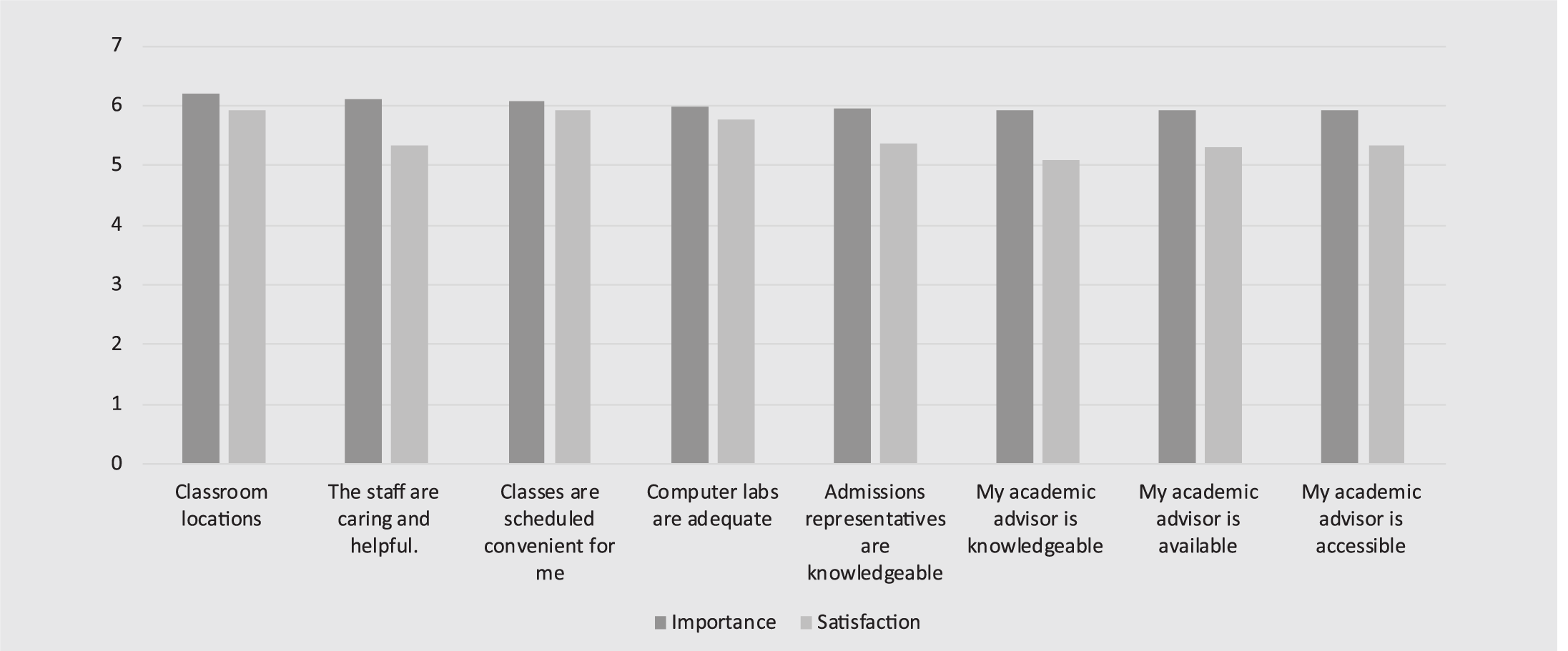
Gaps between most important items and satisfaction for ESL students.
“Admissions representatives are knowledgeable” ranked fifth with 5.94 and satisfaction of 5.36 (SD = 1.34). The gap score between importance and satisfaction was 0.58. Sixth in importance order by ESL students was “My academic advisor is knowledgeable about requirements in my major” with 5.93 for importance, 5.10 (SD = 1.26) for satisfaction, and 0.83 for gap. “My academic advisor is available at times that are convenient for me” ranked seventh in importance with the importance of 5.92 and a satisfaction of 5.30 (SD = 1.41) and a gap score of 0.62. Eighth in importance was “My academic advisor is accessible by telephone and email.” The ESL participants rated the item 5.91 in importance, 5.34 (SD = 1.47) in satisfaction, and 0.57 in performance gap.
Discussion
This exploratory study focused on the needs and satisfaction of adult noncredit continuing education students at KCC who were registered in the allied health career or ESL programs in the fall/winter of 2018. This is the first attempt for the college to learn about the noncredit students, their experiences and goals, and their needs and satisfaction.
Higher educational institutions often use national student survey data to make informed decisions about credit-bearing course structure, schedules, and other priorities that might lend to degrees of student satisfaction. However, many higher education institutions that serve adult noncredit continuing education students often overlook the needs and satisfaction of those in noncredit continuing education programs. In fact, most continuing education programs at community colleges only use enrollment figures to inform decisions on course offerings, at what semester, during which season, and at what price.
Without any knowledge of noncredit students’ needs and satisfaction of courses, it is difficult to talk about the effectiveness of, demand for, and evaluation of these programs, as well as developing enhanced practices or policies for future noncredit programs. Student satisfaction has always been considered a core element for colleges and universities that serve traditional students in for-credit programs. Based on this current research, it is apparent that colleges and universities need to expand assessments to adult learners in noncredit programs, as well. Our review found neither a systematic national record of noncredit students, nor a national standard on data collection for noncredit students. As mentioned earlier, noncredit students outnumber for-credit students at many community colleges.
Considering that comparable information on adult noncredit students was not available, we reviewed what was available: data on adult learners who are 25 years of age and older, who were in evening, weekend, continuing education, credit and noncredit, and graduate and undergraduate courses. These data were collected by the ASPS, by the Ruffalo Noel Levitz Center. However, these data included not only noncredit students but all individuals in credit-bearing programs, including graduate-level students. Not surprisingly, despite the population differences, the ASPS item results of program availability, time, and location compared equally with our adult learner enrollment. In addition, the cost of classes and distance to campus are also rated by community college students as highly important. The results also highlighted the importance of the course registration processes and payment structures, two items that have consistently been rated highly in other studies. Other studies reported that class scheduling is a key determinant of student satisfaction (Elliott, 2002), as well as registration processes and wait time (Zineldin, Akdag, & Vasicheva, 2011).
In addition, previous studies have found that faculty competency is a significant contributor for student satisfaction (Elliott, 2002; Howell & Buck, 2012), as well as being highly correlated to the perceived quality of education. In the national sample by Ruffalo Noel Levitz, in terms of their levels of satisfaction, adult learners placed a high level of importance on receiving timely feedback and other communication from instructors. One study found that consistent and meaningful engagement between faculty and students was a strong predictor for students’ satisfaction (Bjorklund, Parente, & Sathianathan, 2004; Lundberg & Schreiner, 2004). Similarly, students in our sample indicated that not only was feedback from faculty important but also communication and feedback from the Office of Continuing Education administrative staff are important. Similar to the national sample, KCC continuing education students also rated the college’s ranking, academic advising, registration effectiveness, and excellence in service areas as important factors for choosing where to study.
Identifying, assessing, and enhancing these services will help KCC’s Office of Continuing Education to improve its overall student satisfaction, program outcomes, and the college as a whole. Based on our findings, simple fixes such as extending registration times, having additional college and career advisors on staff, and training existing staff on customer service skills have the potential to increase enrollment and revenue, thereby giving us the resources to offer additional classes and programs in response to student needs. Currently, Kingsborough is enhancing its online learning initiative by offering more classes. By expanding online offerings to include continuing education classes, nontraditional students will be able to take classes that fit within their busy schedules.
Limitations
This current study includes students from only two continuing education programs at one community college. Therefore, generalizability of the results is limited. In addition, there were no comparable findings at the national level.
Due to funding availability, we were only able to survey/interview students once without any follow-up. More robust data would include follow-up surveys that touch students at the beginning and end of their classes or programs.
Recommendations for Future Research
Our research has found that noncredit, continuing education students make up 41% of the total community college enrollment across the nation, and very few colleges assess student needs and satisfaction (AACC, 2019). Future research should focus on three specific areas: academic advising, registration effectiveness, and service excellence, areas which have been identified by surveyed students as the most important. Future research should also expand into other programs and course offerings.
Traditionally, community college student demographics reflect the college’s surrounding communities; Kingsborough is no different. The college is 14 miles and over an hour by train/bus ride to midtown Manhattan; KCC serves a racially and ethnically unique student body—recent immigrant or second-generation students from Eastern European countries; Asia including China, and the Philippines; Pakistan, India, Israel, and Caribbean nations—that does not necessarily reflect larger college demographics. Further research should also focus on the needs of the college’s unique student body to get a more comprehensive understanding of their needs and satisfaction.
Footnotes
Conflict of Interest
The author(s) declared no potential conflicts of interest with respect to the authorship and/or publication of this article.
Funding
The author(s) disclosed receipt of the following financial support for the research, authorship, and/or publication of this article: This work was supported by the Capital One Foundation.

Author Biographies
Sarantsetseg Davaasambuu, PhD, is a Research Associate at the Research Foundation of CUNY. She is currently carrying out a research project that is focused on tracking workforce development students, learning about their needs and satisfactions, and increasing abilities to compete at job markets.
Jessica Cineli, BA, is a Workforce Development Manager at the Kingsborough Community College. She has over six-years of experience researching trends and best practices in Workforce Development which has led to the development of job training and college entry programs for adult learners.
Christine Zagari, MA, is the Director of Workforce Development and Strategic Community Partnership at the Kingsborough Community College. Ms. Zagari oversees all operational aspects of the workforce development division.