



Abstract
The main purpose of this study is to investigate how students’ perceptions of need satisfaction and need frustration at school are indirectly associated with academic achievement through academic engagement. A modified version of the Basic Psychological Need Satisfaction and Frustration Scale was used to assess these needs in a school-based context. The study sample consisted of 551 students, comprising 299 males (54.3%) and 252 females (45.7%), with an average age of 16.19 years (SD = 1.49). The results suggested autonomy satisfaction and relatedness satisfaction are positively correlated with academic engagement, autonomy frustration is negatively correlated with academic engagement, and, moreover, academic engagement is associated with increased academic achievement. The results of this study highlight the importance of developing specific training programs to promote a school environment that pays attention to students’ psychological needs.
Keywords
Academic achievement is the result of the interaction between several factors (e.g., individual skills and competences, emotional and motivational variables, and relationships with classmates and teachers – Liu et al., 2016; Filippello et al., 2020). In addition, understanding the factors that facilitate students’ academic achievement has attracted considerable attention from psychologists (Filippello et al., 2018; Molinari & Mameli, 2018).
The role of academic engagement on academic achievement
One of the factors that promote academic achievement is academic engagement (Perkmann et al., 2021). This is a multifactorial construct that is composed of closely interconnected cognitive, emotional, and behavioral components. At the cognitive level, engagement refers to the ability to self-regulate one’s learning processes; on the emotional level, it signifies the degree to which students experience close and affectionate relationships with adults and peers and how they judge their time spent in the classroom; finally, on the behavioral level, it can be defined as the commitment of students to everyday academic activities (Wang & Fredricks, 2014). In the literature, engagement has been conceptualized as a protective factor of academic and social adaptation in young people (Wang & Fredricks, 2014).
Engagement also refers to the study-related state of mind characterized by high levels of energy, enthusiasm, concentration, pride, and happiness (Schaufeli et al., 2002). Students with a good level of engagement are positive, motivated, energetic, and satisfied (Deci & Ryan, 2000; Wang & Fredricks, 2014). Thus, for all young people, academic engagement is a strong predictive factor of academic success (Filce & LaVergne, 2015). Furthermore, it seems that the role played by engagement in academic achievement is similar among different ethnicities. In fact, the mediating role of engagement in the relationship between intrinsic motivation and achievement in sub-samples of African American and Latin students has been demonstrated (Froiland & Worrell, 2016).
Basic psychological needs and academic engagement
Self-Determination Theory (SDT; Deci & Ryan, 2000) is one of the main frameworks used to study self-determined academic engagement (Deci et al., 2017; Vansteenkiste et al., 2018). According to this theory, academic engagement is facilitated by the satisfaction of three basic psychological needs—namely, autonomy, competence, and relatedness (Ryan & Deci, 2009).
The need for autonomy refers to the intrinsic desire of individuals to act freely and choose when to perform an activity. The need for competence refers to the possibility of exercising and expressing one’s abilities and experiencing one’s behavior as effective. The need for relatedness refers to feelings of connection, love, and belonging with other people and in certain social environments (Ryan & Deci, 2017).
Need satisfaction develops in social contexts that support the three needs; low need satisfaction occurs in passive social contexts that exclude the student from the possibility of satisfying needs; and need frustration develops in intrusive social contexts that thwart the satisfaction of the three needs (Vansteenkiste & Ryan, 2013). For this reason, SDT suggests a dual-process model that distinguishes between the experience of need satisfaction/dissatisfaction and need frustration because they have different effects on motivational criteria and students’ learning processes (Vansteenkiste & Ryan, 2013) and adolescents’ functioning (Rodríguez-Meirinhos et al., 2020). The dual-process model identifies bright-side aspects (which explain the conditions under which students tend toward a trajectory of greater support, motivational satisfaction, and engagement) and dark-side aspects (which explain the conditions under which students tend toward a trajectory of greater control, motivational frustration, and disengagement - Jang et al., 2016). Jang et al. (2016) showed a relationship between perceived autonomy support, students’ engagement, and need satisfaction. They also demonstrated a relationship between perceived teacher control, students’ disengagement, and need frustration, highlighting reciprocal effects. The perceived motivating style affected students’ motivation (need satisfaction/frustration) and engagement/disengagement. This in turn affected perceptions of their teachers’ motivating style toward them. Therefore, students who felt supported by their teachers showed greater need satisfaction, which, in turn, increased engagement (bright side). Conversely, students who perceived their teachers as controlling showed greater frustration of basic needs, which, in turn, fueled greater disengagement (dark side) (see Jang et al., 2016).
Students with need frustration at school are often unmotivated, tend not to engage in studying, and avoid school activities (Ryan & Deci, 2017). Need frustration and a low satisfaction rate of psychological needs at school was also related to poor academic performance (Earl et al., 2019). Conversely, the satisfaction of these three needs is positively related to school satisfaction, academic achievement, classroom adjustment, vitality, intrinsic motivation, and academic engagement (Buzzai et al., 2021; Deci & Ryan, 2000; Jang et al., 2009; Molinari & Mameli, 2018). Some studies (Liu & Flick; 2019; Molinari & Mameli, 2018; Olivier et al., 2020) showed that academic engagement was predicted by the need for competence and relatedness, thus indicating that students need to be considered competent to cope with complex tasks and their associated challenges and experience a sense of belonging. Instead, Jang et al. (2009) found that satisfaction of the need for autonomy and competence is associated with more satisfying learning experiences, engagement, and academic achievement, while Connell and Wellborn (1991) indicated that the relationship between satisfaction of the need for autonomy and relatedness at school and achievement was mediated by engagement. Furthermore, Froiland et al. (2019) found that positive teacher-student relationships satisfy psychological needs among adolescents, and Tian et al. (2016) showed that teacher-student relationships promote psychological need satisfaction, and, in turn, the school-related subjective well-being.
The present study
Overall, studies showed that satisfaction of the three basic psychological needs not only influences academic engagement but also affects academic achievement (Connell & Wellborn, 1991; Jang et al., 2009; Liu & Flick; 2019; Molinari & Mameli, 2018; Olivier et al., 2020). This seems to be true even if the contribution of each need is unclear, and most of the studies tend to examine general satisfaction or frustration without differentiating the role of each need. The above studies have shown correlations between need satisfaction, academic engagement, and academic achievement. However, these studies only investigated the satisfaction/dissatisfaction of basic psychological needs. As mentioned above, SDT (Vansteenkiste & Ryan, 2013) suggests that it is important to distinguish between the experience of need satisfaction/dissatisfaction and need frustration because they are rooted in distinct social experiences and they have different effects on motivational criteria, with different implications for students’ learning processes. Although SDT-based studies have shown that the satisfaction of needs in different contexts has profound repercussions on positive outcomes (Ryan & Deci, 2017), studies on academic achievement and academic engagement have not taken into account the role of satisfaction and frustration of each specific need (autonomy, competence, and relatedness). This absence could be partly explained by the lack of a well-validated instrument in the school context to measure the satisfaction and frustration of basic psychological needs. Although the SDT has shown that all three needs have a fundamental and independent role in predicting various development outcomes, there is a general tendency for parsimony to aggregate individual needs into total scores, losing their uniqueness. However, considering that each need has a distinctive role and that the frustration of just one of these needs is sufficient to create a negative personal experience, it becomes essential to take the satisfaction and frustration of all three needs into account (Ryan & Deci, 2017).
For these reasons, the main purpose of this work is to investigate the association of academic engagement with the relationship between students’ perceptions of psychological basic needs and academic achievement. Consistent with previous studies (Jang et al., 2009; Molinari & Mameli, 2018), we hypothesize that autonomy satisfaction, competence satisfaction, and relatedness satisfaction positively correlate with academic engagement and, in turn, academic achievement, while autonomy frustration, competence frustration, and relatedness frustration negatively correlate with academic engagement and, in turn, academic achievement.
To achieve this goal, the Italian version of the Basic Psychological Need Satisfaction and Frustration Scale (BPNSFS; Costa et al., 2018) was used. Its items have been modified for use in the school context. Thus, a complementary objective of this research was to validate the modified version of the BPNSFS (Costa et al., 2018) used in an Italian school setting. This version, the “School-Basic Psychological Need Satisfaction and Frustration Scale” (S-BPNSFS) was evaluated in terms of its psychometric properties and dimensionality through a series of competitive factorial models. The Italian version of the BPNSFS, through a measurement invariance approach between adolescent and young adults, has shown good psychometric characteristics in a sample of fourteen-year-old subjects (Liga et al., 2018) that represent the starting age of high school in Italy. For this reason, this study aimed to replicate the factor structure of the original instrument in a sample of high school students within the same age range as the study of Liga et al. (2018). According to the study of Costa et al. (2018), we hypothesized that satisfaction of the three needs (i.e., autonomy satisfaction, competence satisfaction, and relatedness satisfaction) negatively correlates with the three areas of need frustration (i.e., autonomy frustration, competence frustration, and relatedness frustration).
Method
Participants
The study sample consisted of 551 students, comprising 299 males (54.3%) and 252 females (45.7%), with an average age of 16.19 years (SD = 1.49). Participants were selected from four high schools located in the city of Messina, Sicily (Italy). Regarding students’ socioeconomic status (SES) (see Sirin, 2005), 25.2% of the students belonged to a low SES (one or both parents held a lower secondary education diploma), 46.6% belonged to a medium SES (one or both parents held a high school diploma), and 28.1% belonged to a high SES (one or both parents held a university degree). Furthermore, 96.7% of the students had Italian nationality, and all participants spoke Italian.
Measures
A demographic questionnaire collected the participants’ basic demographic information, including their age, gender, nationality, educational level/academic class, and socioeconomic status (SES).
Basic Psychological Need Satisfaction and Frustration Scale
The Italian version of the Basic Psychological Need Satisfaction and Frustration Scale (BPNSFS; Chen et al., 2015) by Costa et al. (2018), was used for this study, and its items were modified to adapt it to school context. The new Italian version, termed the School Basic Psychological Need Satisfaction and Frustration Scale (S-BPNSFS), contains 24 items that assess the satisfaction and frustration of students’ three basic psychological needs in a school setting. The satisfaction and frustration of these three needs were each assessed using four items. Examples of these items include the following: autonomy satisfaction (e.g., “I feel a sense of choice and freedom in the things I undertake at school”), autonomy frustration (e.g., “At school, I feel forced to do many things I wouldn’t choose to do”), relatedness satisfaction (e.g., “At school, I feel that the people I care about also care about me”), relatedness frustration (e.g., “At school, I feel that the people who are important to me are cold and distant toward me”), competence satisfaction (e.g., “I feel confident that I can do things well at school”), and competence frustration (e.g., “At school, I have serious doubts about whether I can do things well”). The participants responded to these items on a 5-point Likert scale (1 = completely disagree, 5 = completely agree). In this study, Cronbach’s alpha was .76 for autonomy satisfaction, .80 for autonomy frustration, .79 for relatedness satisfaction, .81 for relatedness frustration, .83 for competence satisfaction, and .82 for competence frustration.
Engagement
The Utrecht Work Engagement Scale—Student Forms (UWES-SF; Schaufeli & Bakker, 2004; Schaufeli et al., 2002) were used to assess school engagement in the academic setting. This instrument was chosen because some studies have used UWES-SF as a measure to evaluate the level of school engagement, which they used as an indicator of need satisfaction (i.e. Ariani, 2019; Molinari & Mameli, 2018). The UWES-SF includes nine items (e.g., I am enthusiastic about my studies), and the version used in this study was adapted to the Italian context by Balducci et al. (2010). The scale includes three subscales: vigour, dedication, and absorption. In this study, the composite score was used. Participants responded on a 8-point Likert-type scale (0 = never, 7 = always). The scale includes three subscales: vigor, dedication, and absorption. In this study, the composite score was used. Participants responded on an 8-point Likert-type scale (0 = never, 7 = always). The reliability and validity of the UWES-SF are supported through previous research (Schaufeli & Bakker, 2004; Schaufeli et al., 2002). In this study, Cronbach’s Alpha was .92.
Academic achievement
The data on academic achievement were provided by the students, based on their grade point average on written tests and oral examinations, which they obtained from the electronic school register. The first page of the protocols contained the list of all subjects, with two columns in which the student calculated and indicated the grade point average from the written and oral tests of the last school term. All pages of each questionnaire were marked with a number that corresponded to the order in which the students were listed in the register log. At the end of the administration of the instruments, the teachers received the first page of the protocol to verify the correctness of the grade point averages provided by the students. The teachers were asked to correct incorrect statements to guarantee accurate contributions. The Italian marking system ranges between 1 (extremely insufficient) and 10 (excellent), with 6 being the cut‐off for sufficiency. In this study, the mean score for the students’ academic achievement was 7.00 (SD = 1.19).
Procedure
This study was conducted following the recommendations of the Ethical Code of the Italian Association of Psychology (AIP) and all subjects were given written informed consent, following the Declaration of Helsinki (2013). The protocol was approved by the Ethics Committee of the Centre for Research and Psychological Intervention (CERIP) of the University of Messina (protocol number: 30465).
The school provided authorization to the students to participate in a research project and obtained informed consent from the parents. Only students who had informed consent signed by their parents were allowed to participate in this study. Subsequently, the participants completed the questionnaires in a single session before giving their personal informed consent. The privacy and anonymity of their answers were guaranteed. Participation required between 20 and 30 minutes.
Data analysis
IBM SPSS 19.0 (2010) was used to calculate descriptive statistics, Cronbach’s alpha, and correlations and RStudio (RStudio Team, 2015) with the lavaan package (Rosseel, 2012) was used to carry out the structural equation modelling (SEM), and a series of confirmatory factor analyses (CFA) to assess the S-BPNSFS factorial structure. Specifically, we compared a series of competitive factor models: a one-factor model, two-factor model, three-factor model, six-factor model, hierarchical one-factor model, and hierarchical two-factor model (six2-factor). Missing was handled using the Full Information Maximum Likelihood (FIML) estimation. Furthermore, several goodness-of-fit indices were used to assess the fit of the model: the RMSEA index (Root Means Square Error Approximation), with 90% confidence intervals, in which values less than or equal to .05, .08, or .10 indicate an optimal, acceptable, or mediocre fit (Marsh et al., 2004); the SRMR index (Standardized Root Mean Square Residual) in which values less than .05 indicate a good fit, whereas values smaller than .10 indicate an acceptable fit (Hu & Bentler, 1995); and the incremental index CFI (Comparative Fit Index) in which values equal to or greater than .90 are considered acceptable (Bentler, 1990). To conduct the comparison between the models, the χ2 difference test was used, and a value of ΔCFI (differences in CFI) > .01 between two models was considered as the cut-off for a meaningful difference in model fit (Cheung & Rensvold, 2002).
Results
Confirmatory factor analysis
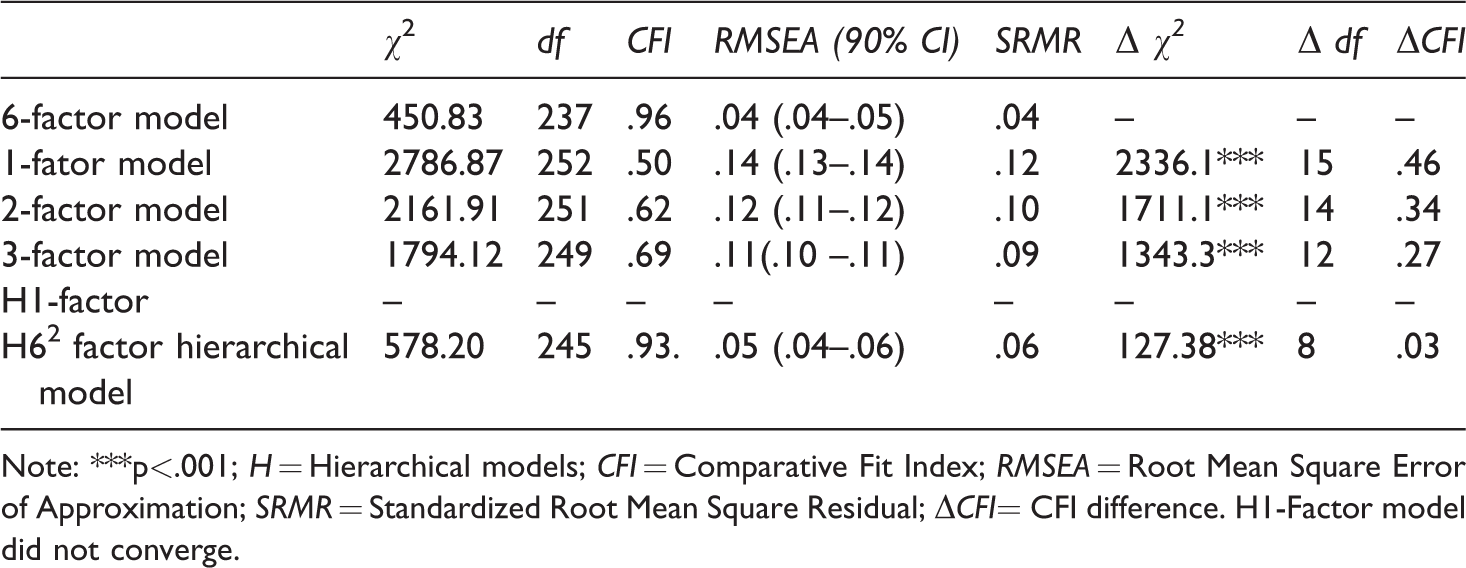
The goodness-of-fit indices are presented in Table 1. The one-factor, two-factor, and three-factor model did not have a good data fit, the hierarchical one-factor model did not converge, while the six-factor and hierarchical two-factor models fit the data well (Table 1).
Summary of goodness-of-fit indexes for confirmatory factor analysis models (N =551).
Note: ***p<.001; H = Hierarchical models; CFI = Comparative Fit Index; RMSEA = Root Mean Square Error of Approximation; SRMR = Standardized Root Mean Square Residual; ΔCFI= CFI difference. H1-Factor model did not converge.
The fit indices indicated that the best-fitting model was the six-factor model. Furthermore, the models’ comparison (Table 1) against the six-factor model showed that the differences in CFI were meaningful (ΔCFI range between .03 and .46), thus confirming that the six-factor model produced a better fit. Furthermore, all the standardized factor loadings were significant and ranged from .60 to .76 for autonomy satisfaction, from .64 to .77 for autonomy frustration, from .58 to .83 for relatedness satisfaction, from .63 to .84 for relatedness frustration, from .68 to .80 for competence satisfaction, and from .64 to .78 for competence frustration (Table 2).
Descriptive statistics and factor loading of the 24 items of the S-BPNSFS.

Note: the items are presented in both English and Italian language.
Descriptive statistics, reliability and correlation
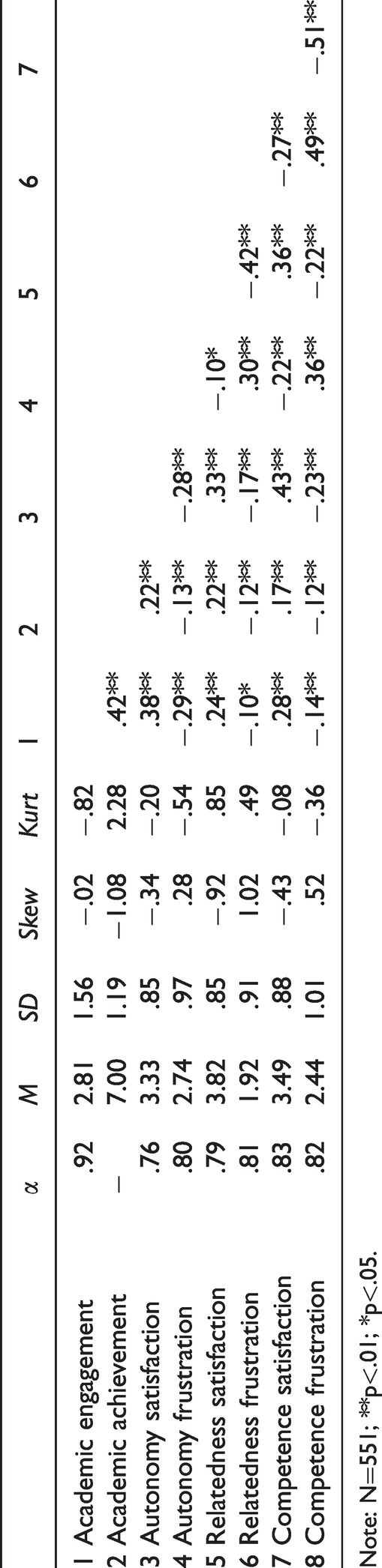
Table 3 presents the means, standard deviations, skewness, kurtosis, Cronbach’s alpha values, and correlations for all measures considered in this study. The descriptive analysis showed that all scales have good symmetry and kurtosis scores. The S-BPNSFS internal reliability scores were .76 for autonomy satisfaction, .80 for autonomy frustration, .79 for relatedness satisfaction, .81 for relatedness frustration, .83 for competence satisfaction, and .82 for competence frustration. Furthermore, for academic engagement, internal reliability was .92.
Descriptive statistics and correlation among variables.
Note: N=551; **p<.01; *p<.05.
The intercorrelation between the S-BPNSFS subscale indicated that satisfaction of the three needs was negatively correlated with frustration of the three needs. Moreover, the correlation between the S-BPNSFS subscale and the other measures showed that autonomy satisfaction, relatedness satisfaction, and competence satisfaction were positively correlated with school engagement and academic achievement, while autonomy frustration, relatedness frustration, and competence frustration were negatively correlated with school engagement and academic achievement.
Mediation
Structural equation modelling (SEM) with latent variables was used to examine the model of the association between the six basic needs and academic achievement that was explained by the role of academic engagement. The four items of each subscale were used as indicators to represent the latent variables of the basic psychological needs. An aggregation of items to compose three parcels was used as an indicator of academic engagement (Little et al., 2002). The average score of academic achievement was used as the observed variable in the model. Furthermore, we used confidence intervals of the direct and indirect associations with 5,000 bootstrap replication samples, and a 95% bias of corrected confidence intervals was applied, following the recommendations of Wu and Jia (2013), Preacher and Hayes (2008), Shrout and Bolger (2002). Several indices of fit were examined: the Chi-square (χ2) value, the Comparative Fit Index (CFI), the Root Mean Square Error of Approximation (RMSEA) with a 90% confidence interval (CI) and the Standardized Root Mean Square Residual (SRMR) (for a description of these indices, see Hair et al., 1998; Hu & Bentler, 1995).
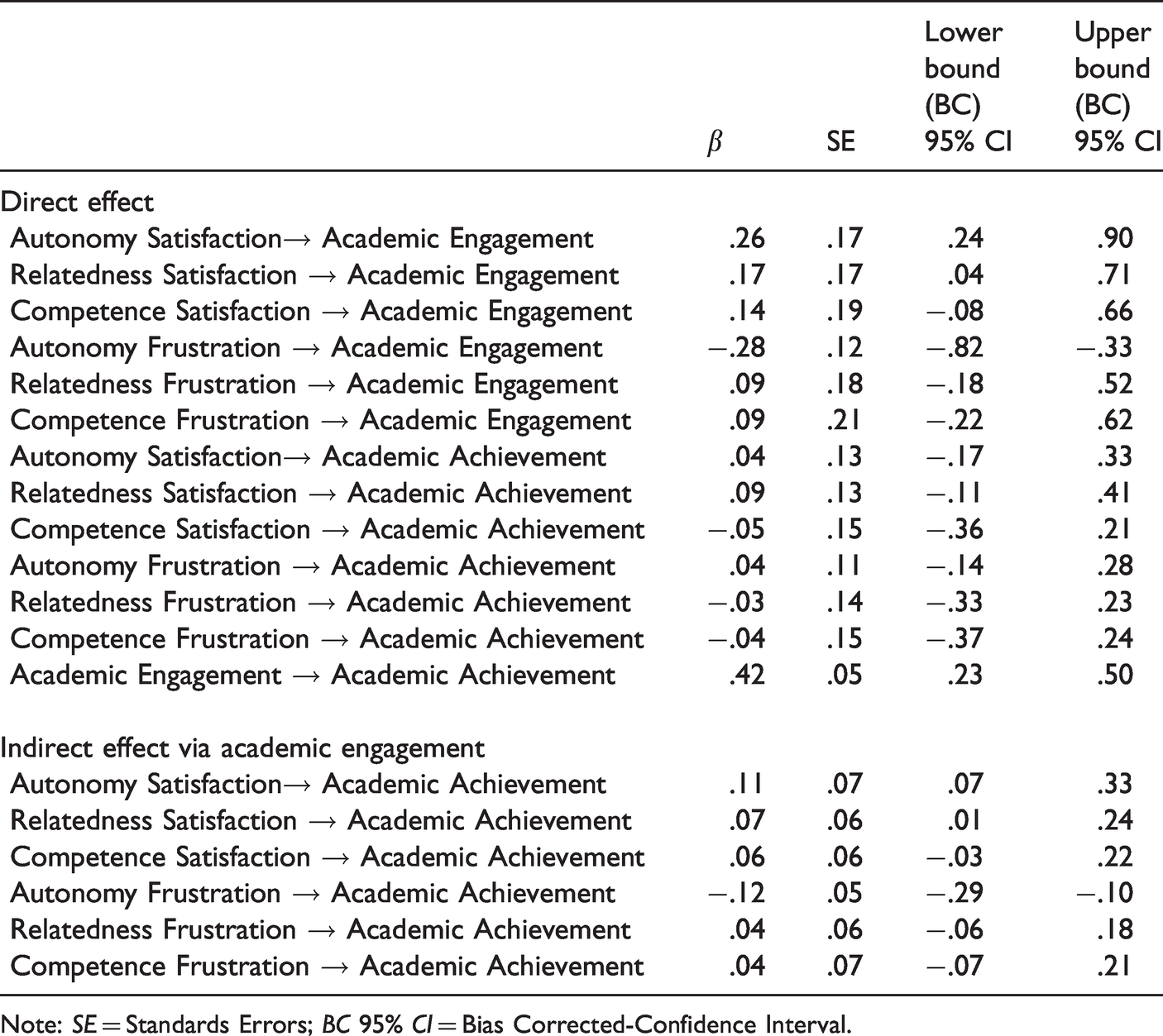
The estimation of the model indicated that the data fit the model well (Figure 1), χ2(323) = 627.527, p < .001, CFI = .95, RMSEA = .04 (90% CI = .04 –.05), SRMR = .04, and showed significant direct associations from autonomy satisfaction (β = .26, p = .001) and relatedness satisfaction (β = .17, p < .05) to academic engagement, from autonomy frustration (β = -.28, p < .001) to academic engagement, and from academic engagement to academic achievement (β = .42, p < .001). An examination was conducted of the total and indirect relations from the satisfaction of the three needs and frustration of the three needs at school to academic achievement, while controlling for academic engagement (Table 4). Examination of total effect showed significant associations of autonomy satisfaction to academic achievement (β = .15, p = .05) and from relatedness satisfaction to academic achievement (β = .16, p = .05). In this model, the indirect relations between achievement and autonomy satisfaction (β = .11, p < .01) and relatedness satisfaction (β = .07, p <. 05) mediated by academic engagement were statistically significant, and the indirect relations between autonomy frustration (β = -.12, p <. 001) and academic achievement, mediated by academic engagement, were statistically significant.

Path diagram depicting the relationships between study variables. Note: ***p ≤ .001, **p ≤ .01; *p ≤.05. Coefficients shown are standardized direct path coefficients. Dotted lines represent non-significant parameters. Coefficients’ Correlation: Autonomy Satisfaction <–> Relatedness Satisfaction: .39; Autonomy Satisfaction <–> Competence Satisfaction: .53; Relatedness Satisfaction <–> Competence Satisfaction: .43; Autonomy Frustration <–> Relatedness Frustration: .33; Autonomy Frustration <–> Competence Frustration: .44; Relatedness Frustration <–> Competence Frustration: .61; Autonomy Satisfaction <–> Autonomy Frustration: −.34; Autonomy Satisfaction <–> Relatedness Frustration: −.20; Autonomy Satisfaction <–> Competence Frustration: −.29; Relatedness Satisfaction <–> Autonomy Frustration: −.12; Relatedness Satisfaction <–> Relatedness Frustration: −.52; Relatedness Satisfaction <–> Competence Frustration: −.25; Comepetence Satisfaction <–> Autonomy Frustration: −.25; Competence Satisfaction <–> Relatedness Frustration: −.32; Competence Satisfaction <–> Competence Frustration: −.61.
Path estimates, SEs and 95% CIs.
Note: SE = Standards Errors; BC 95% CI = Bias Corrected-Confidence Interval.
Discussion
SDT has emphasized that the satisfaction and frustration of basic psychological needs play an important role in the context of school as they affect the academic engagement and academic achievement of students (Deci et al., 2017; Ryan & Deci, 2009; Vansteenkiste et al., 2018). The main purpose of this study was to investigate how students’ perceptions of need satisfaction and need frustration at school are indirectly associated with academic achievement through academic engagement.
The results indicate that academic engagement explains the relationship between academic achievement and psychological needs at school. In particular, our results suggest that autonomy satisfaction and relatedness satisfaction have significant positive relations with academic engagement, and therefore they are associated with increased academic achievement. These results are consistent with previous studies (Molinari & Mameli, 2018; Ryan & Deci, 2009, 2017), where it has been suggested that students who feel free to act and choose activities that are coherent with their values and students who feel close and connected with teachers and classmates show greater academic engagement, are more involved in their studies, and are more attentive, thus achieving good academic results. In contrast, when the basic psychological need of autonomy is frustrated at school, students do not feel free to choose activities and experience a sense of external or self-imposed control, meaning that they do not engage in school activities and show poor academic performance (Chen et al., 2015; Costa et al., 2018). Instead, unlike what has been assumed, the results of the model do not indicate that competence satisfaction is correlated with academic engagement and, in turn, with academic achievement. Although in the simple correlation matrix, academic engagement and achievement were positively correlated with competence satisfaction and negatively correlated with competence frustration, in the full model they drop the significance. Although it seems clear from these results that all three needs are essential for a positive school experience, the lower association of the need for competence is interesting and could support previous studies that showed a decrease in the salience of the competence domain during the transition to high school (Ratelle & Duchesne, 2014; Wigfield et al., 2006). Adolescents generally tend to give strong weight to social relations in the expression of their individual choices, which clearly could have repercussions in the school context, where aspects related to skills could be underestimated and given implicitly (Connell & Wellborn, 1991; Eccles et al., 1993; Ratelle & Duchesne, 2014). Furthermore, the absence of a relationship between competence satisfaction/frustration and academic engagement and achievement could be because the measure used for the evaluation of engagement underestimates some aspects of this multidimensional construct (Reeve, 2012). Future studies could try to replicate these findings with a more comprehensive questionnaire on engagement like the Agentic Engagement Scale by Reeve (2013), which has been shown to have wide coverage of the construct domain. Furthermore, another explanation for the lack of a relationship between competence satisfaction/frustration and academic achievement could be found in the validity of the measure of academic achievement used in this study. In fact, the grade point average obtained by students in the written and oral tests may excessively emphasize the discrepancies between students’ perception of competence and teachers’ evaluations, but it may also not adequately reflect the different weight that students give to some disciplines over others. Future research could use standardized tests for the evaluation of academic achievement.
Another interesting aspect is related to the absence of an association in the model between relatedness frustration and academic outcomes. This result seems to provide yet another proof of the dual process proposed by the SDT, where the satisfaction of needs tends to be more associated with positive outcomes (e.g., engagement), while frustration tends to create a dysfunctional path that in future studies could be measured through an opposite construct, such as school dropout or school burnout. Overall, our results are consistent with SDT (Ryan & Deci, 2017), which suggests that satisfaction and frustration of basic psychological needs at school have a relationship with academic engagement and academic achievement. In particular, academic engagement was mostly related to psychological need satisfaction for autonomy and relatedness and to psychological need frustration for autonomy, which in turn are correlated with academic achievement.
Finally, a complementary objective of this research was to validate the modified version of the BPNSFS (Chen et al., 2015; Costa et al., 2018) in an Italian school setting (S-BPNSFS) and examine the main psychometric characteristics (dimensionality, reliability, and criterion validity). Overall, the results of our study have shown the multidimensionality of the Italian S-BPNSFS and the adequate reliability and validity of the scale, consistent with previous studies (Costa et al., 2018; Liga et al., 2020). Coherent with our hypothesis, the original factorial structures were replicated in a sample of high school students, confirming the six-factor model of autonomy satisfaction, autonomy frustration, relatedness satisfaction, relatedness frustration, competence satisfaction, and competence frustration. Furthermore, these results underscore the relevance of meeting basic needs in association with school outcomes and the usefulness of this questionnaire in the Italian context (Filippello et al., 2019).
Educational implications
According with results from other studies (Cheon et al., 2020; Diseth et al., 2018), findings from this study points towards some important implications. One central implication could be that teacher training should provide more knowledge about how to support student autonomy. Therefore, the teachers could stimulate students’ self-control and self-regulation skills, encourage the use of strategies that have previously been proven effective, plan activities, structure learning activities in a way that takes into account students’ perspectives, and welcome their contributions, etc. (Reeve, 2012). This could favor the perception of satisfaction of autonomy needs, thus, in turn, promoting students’ academic engagement and, consequently, academic achievement. Moreover, it it would be necessary that teachers build positive relationships with their students. In fact, it has been shown that (de)motivating teaching styles could have a relevant role in shaping student need satisfaction/frustration. Considering that previous studies showed that teachers’ needs and motivations (Moè & Katz, 2020; Vermote et al., 2020) could be relevant antecedents of teaching styles, preventive programs could try to foster teachers to increase adoption of motivating styles.
Furthermore, it is suggested to take into consideration that the learning environment is a complex system that includes the interaction of teachers, fellow students, peers, parents, organizational culture, and other educational processes that could thwart or support basic psychological needs at school (Froiland, 2021; Froiland et al., 2019; Tian et al., 2016). In fact, adolescents benefit both from teacher autonomy support both from autonomy and relatedness supportive parenting, positive expectations, and trust between the parents and teachers (Froiland, 2021). Furthermore, a perfectionistic drive toward success at all costs has been widely shown to be a risk factor for the occurrence of need frustration, and for this reason, the implications of this study could be important not only at the school level but also in general for the entire school system and policymakers (Vandenkerckhove et al., 2019). In general, could be useful to consider the relevance of a more generally supportive school environment that could satisfy psychological needs for all the agents that work in the school system. In future studies, it would be interesting, indeed, to develop specific scales that quantitatively assess how these agents contribute to need satisfaction/frustration in school.
Despite the interesting results obtained and their practical implications for schools, this study has some limitations that should be investigated in future studies. Future research should include a balanced sample of different schooling levels to investigate the evolutionary trend of the relationships between the analyzed variables. Furthermore, the participants of this study were a convenient sample recruited from high schools in just one city in Italy, which could reduce the generalizability of the results. In addition, the inclusion of only participants from schools that provided the authorization to participate could represent a selection bias that needs to be considered. It could be more effective to use randomized samples for future studies. Also, future studies should include other variables, such as personal (i.e., self-esteem, well-being, motivation) and contextual (i.e., supportive or obstructive interpersonal behavior). Furthermore, it would be useful to further investigate how intrinsic motivation promotes engagement and, consequently, achievement (Froiland & Worrell, 2016; Ryan & Deci, 2017).
Another limitation to take into account is the use of a questionnaire (the S-BPNSFS), which evaluates the satisfaction and frustration of students’ three basic psychological needs in a general school setting. Future studies could include other methods of data collection in addition to the questionnaire, such as direct observation within the classroom. This might identify specific situations that can satisfy or frustrate basic psychological needs. Moreover, the cross-sectional nature of the design does not allow causal associations. If the theoretical suggestion of this study is that the causal direction could be from basic needs to academic performance, it could also be that high achievers may feel that they are more able to control the situation in school and therefore perceive more satisfaction of the need for autonomy. Moreover, high achievers could be more likely to get positive attention from teachers and may also be more popular among peers and therefore more likely to experience the satisfaction of the need for relatedness. Future experimental and longitudinal studies could try to explore the causal direction of these associations. Despite this, the present study contributes to the literature by expanding and enriching existing knowledge within SDT.
Conclusion
The results of this study highlight the importance of students’ autonomy and relatedness in promoting academic achievement. SDT suggests that a supportive academic context can facilitate the satisfaction of these three basic psychological needs. In practice, a supportive academic environment promotes autonomy and facilitates engagement and success among students by encouraging initiative, opinion, and conversation. This favors the formation of an internal locus of motivation and higher-quality learning outcomes (Decharms & Carpenter, 1968). Conversely, need frustration can occur in an adverse academic environment, characterized by controlling educational practices, such as teachers’ intrusive behaviors aimed at inducing guilt, showing disapproval, or ignoring students who do not meet the standards imposed (Filippello et al., 2018). These teacher behaviors can actually thwart need satisfaction in social contexts and cause frustration of autonomy, competence, and relatedness (Ryan & Deci, 2017; Vansteenkiste & Ryan, 2013). Therefore, these educational styles do not promote critical or independent thinking in students but focus on duty and coercion.
Footnotes
Ethical approval
All procedures performed in studies involving human participants were in accordance with the the recommendations of the Ethical Code of the Italian Association of Psychology (AIP) and all subjects were given written informed consent in accordance with the Declaration of Helsinki (2013). The protocol was approved by the Ethics Committee of the Centre for Research and Psychological Intervention (CERIP) of the University of Messina (protocol number: 30465). This article does not contain any studies with animals performed by any of the authors.
Informed consent
Informed consent was obtained from parents of all participants included in the study.
Declaration of conflicting interests
The author(s) declared no potential conflicts of interest with respect to the research, authorship, and/or publication of this article.
Funding
The author(s) received no financial support for the research, authorship, and/or publication of this article.
