



Abstract
This study follows the idea that the key to understanding team meeting effectiveness lies in uncovering the microlevel interaction processes throughout the meeting. Ninety-two regular team meetings were videotaped. Interaction data were coded and evaluated with the act4teams coding scheme and INTERACT software. Team and organizational success variables were gathered via questionnaires and telephone interviews. The results support the central function of interaction processes as posited in the traditional input-process-output model. Teams that showed more functional interaction, such as problem-solving interaction and action planning, were significantly more satisfied with their meetings. Better meetings were associated with higher team productivity. Moreover, constructive meeting interaction processes were related to organizational success 2.5 years after the meeting. Dysfunctional communication, such as criticizing others or complaining, showed significant negative relationships with these outcomes. These negative effects were even more pronounced than the positive effects of functional team meeting interaction. The results suggest that team meeting processes shape both team and organizational outcomes. The critical meeting behaviors identified here provide hints for group researchers and practitioners alike who aim to improve meeting success.
Team meetings constitute a vital situation: Team members’ expertise is combined for discussing ideas, making decisions, and initiating change processes (cf. Kauffeld, 2006a). To tap this potential, many contemporary organizations have implemented regular team meetings. For example, team meetings and group discussions are part of the Continuous Improvement Process (CIP; e.g., Liker, 2006). Ravn (2007) argues that meetings became popular as a result of the 1960s movement: “Sitting in a circle, waiting for your turn to speak, and listening respectfully . . . were norms that traveled from the kindergarten to the boardroom” (p. 4). Arguably, this development reduced (perceived) restraints to speak up at meetings, which in turn led to more time-consuming meetings (cf. Ravn, 2007). Employees and managers attend approximately 3.2 meetings per week. However, the quality of these meetings is evaluated as poor in 41.9% of the cases (Schell, 2010). Considering the amount of time that employees spend in meetings, this result is disturbing. Moreover, dissatisfaction with the meeting procedure and results affects employees’ attitudes and leads to a negative and pessimistic perspective on meetings (cf. Hackman, 2002). High meeting time demands have been linked to decreased well-being (Rogelberg, Leach, Warr, & Burnfield, 2006) and increased fatigue and subjective work load (Luong & Rogelberg, 2005). However, abolishing meetings altogether is not a likely option. Teams often face difficult tasks, often without routine answers. This calls for combining several team members’ expertise, which in turn requires interaction (e.g., via team meetings). Group interaction means coordinating team members, tasks, and tools (Ericksen & Dyer, 2004). Thus, meetings are a necessity for building successful teamwork. In light of the above mentioned findings, the following questions arise: What makes a team meeting successful? How can the potential inherent in teams (e.g., Strozniak, 2000) be triggered and used in team meetings?
One approach to this question lies in the analysis of the processes that determine more or less functional interaction during team meetings. This approach follows the traditional input-process-output model of team performance (Hackman & Morris, 1975; see also Mathieu, Maynard, Rapp, & Gilson, 2008). Processes in this model are those activities that mediate the relationship between input factors (e.g., team members’ personalities, group size, or financial incentives) and team outputs or outcomes (e.g., productivity, team member satisfaction, or meeting effectiveness). Process factors include planning and monitoring behaviors, as well as interpersonal team processes such as managing conflict management or increasing team members’ commitment (Marks, Mathieu, & Zaccaro, 2001). Thus, the group interaction process is viewed as a central component for predicting team outcomes. To understand what makes a team meeting successful, it is necessary to examine the interaction process during the meeting: Which communication behaviors promote successful meetings? Which are detrimental?
To date, research on real team meeting interaction in the workplace is sparse, with a few exceptions (e.g., Kauffeld, 2006a, 2006b). This study builds on previous research concerning meeting success by examining the team interaction processes that separate successful from less successful meetings. Functional and dysfunctional meeting behaviors are identified via interaction analysis of 92 real team meetings in the field. Moreover, these observational data are linked to satisfaction measures as well as objective team productivity data and organizational success. Our results offer important theoretical implications for studying team meetings and provide useful hints for practitioners who want to help teams make the most of their meeting time; for example, practitioners may use interaction analysis as a reflexivity tool for pointing out a team’s strengths and weaknesses.
Observing Team Meeting Interaction
Despite a growing body of research on team meetings (e.g., Leach, Rogelberg, Warr, & Burnfield, 2009; Luong & Rogelberg, 2005), the process components that can increase or decrease meeting effectiveness remain somewhat vague. To gain insight on the actual behaviors that can promote or inhibit meeting success, participants’ actual behavior during team meetings needs to be examined.
On the basis of the functional perspective of problem-solving groups (e.g., Wittenbaum et al., 2004), previous research with real work groups has identified both functional and dysfunctional interaction behaviors. Kauffeld (2006b) compared self-directed and traditional work groups and found that the former were better able to structure their discussions and create conditions for implementing their ideas in practice. Kauffeld and Meyers (2009) identified complaining cycles, that is, negative complaining loops that keep teams from making the most of their meeting time. These findings have been replicated and extended to complaining and action cycles in team meetings (Lehmann-Willenbrock, Meyers, Kauffeld, Neininger, & Henschel, 2011).
The research reported here is based on a recently developed and validated instrument for group interaction analysis, act4teams (see Kauffeld, 2006a, 2006b). The act4teams coding scheme derives from an extensive review of past research on interaction, expertise, teams, and problem-solving processes. Existing classification systems for intragroup interaction such as the interaction process analysis (IPA, Bales, 1950), the system of multiple-level observation of groups (SYMLOG; Bales, 1980), and time-by-event-by-member pattern observation (TEMPO; Futoran, Kelly, & McGrath, 1989) were considered as well as time-based process dimensions (Marks et al., 2001). For a detailed explanation of the theoretical underpinnings of the act4teams coding scheme, see Kauffeld (2006a). act4teams distinguishes four types of team interaction: problem-focused, procedural, socioemotional, and action-oriented communication. Table 1 shows these four types of interaction.
Advanced Interaction Analysis (act4teams) Coding Scheme.

Note: The four facets of interaction are found in the four columns. Interaction aspects within the facets are highlighted in gray; coding category names are printed in italics.
In accordance with input-process-output models of team interaction processes and performance outcomes (e.g., Hackman & Morris, 1975), we expect functional team meeting communication to promote team meeting success and dysfunctional communication to diminish team meeting success. The act4teams coding scheme serves as a basis for distinguishing between functional and dysfunctional team meeting communication (cf. Kauffeld, 2006a; Lehmann-Willenbrock & Kauffeld, 2010; see Table 1). Problem-focused communication is presumed to be inherently functional. However, procedural, socioemotional, and action-oriented communication can be either functional (positive) or dysfunctional (negative). We now explain these team meeting interaction aspects and their presumed link to meeting success in more detail.
Problem-Focused Communication
Meetings are usually meant to serve several purposes such as exchanging information, solving problems, and finding consensus or making decisions (cf. Leach et al., 2009). Problem-focused communication is directly related to understanding the issue, finding appropriate solutions, and evaluating those solutions. A successful problem-solving process is characterized by a thorough definition and analysis of the problem (e.g., Wittenbaum et al., 2004). If teams do not accomplish these steps, they are more likely to fail (Mitroff & Featheringham, 1974). Moreover, problem-focused communication involves idea generation and finding solutions. A complex problem (cf. Funke, 2010) can lead to several possible solutions (Dörner, 1997). Finally, problem-focused communication can relate to knowledge sharing, when team members develop a common representation of a problem and possible solutions to it (cf. Mesmer-Magnus & DeChurch, 2009). As all of these communicative activities have been linked to positive team outcomes, we hypothesize,
Hypothesis 1: Problem-focused communication will be positively linked to team meeting success.
Procedural Communication
Positive procedural communication concerns statements that are aimed at structuring and organizing the discussion. Previous research suggests that task-contingent structuring of the group process increases team performance (e.g., Mesmer-Magnus & DeChurch, 2009). Furthermore, results from sequential analysis show that positive procedural statements help promote more functional discussion processes by inhibiting dysfunctional behaviors such as complaining (Kauffeld & Meyers, 2009). However, negative procedural communication leads to a loss of thought, for example, as a result of lengthy monologues and redundant explanations by individual participants. Okhuysen and Eisenhardt (2002) found that team members felt constrained by lengthy contributions by others. Whereas all problem-focused statements should be helpful, we presume a distinct positive influence of positive procedural statements, but a negative influence of negative procedural statements. We hypothesize,
Hypothesis 2a: Positive procedural statements will be positively linked to team success.
Hypothesis 2b: Negative procedural statements will be negatively linked to team success.
Socioemotional Communication
Socioemotional statements capture the relational interaction that occurs in teams. This type of communication carries considerable social influence both inside and outside the workplace (Huang, 2009). Positive socioemotional communication has also been examined in previous taxonomies of team interaction. IPA describes positive socioemotional communication in terms of showing solidarity, releasing tension, or agreeing (Bales, 1950, 1980). Positive socioemotional communication has been identified as a team requirement (Beck & Keyton, 2009). Moreover, positive socioemotional communication has been found to aid cognitive flexibility and creative problem solving (Ashby & Isen, 1999). However, factors such as relationship conflict (e.g., De Dreu & Weingart, 2003) have been associated with lower team performance. In team meeting interaction, these factors become apparent in negative socioemotional communication. For example, offending statements are linked to personal conflicts that negatively affect team performance (cf. De Dreu & Weingart, 2003). Moreover, side conversations can be understood in terms of negative socioemotional communication, because they demonstrate disinterest in the team interaction (cf. Swaab, Phillips, Diermeier, & Medvec, 2008). Similar to procedural communication, we thus presume a distinct influence of positive versus negative socioemotional communication on team success.
Hypothesis 3a: Positive socioemotional statements will be positively linked to team success.
Hypothesis 3b: Negative socioemotional statements will be negatively linked to team success.
Action-Oriented Communication
Action-oriented statements describe a teams’ willingness to take action to improve their work. Positive action-oriented communication can be described as proactive behavior (e.g., Frese, Garst, & Fay, 2007). Communicating interest in change, taking responsibility for changes ahead, or planning concrete actions are understood as proactive statements. Action planning is beneficial for individual as well as group-level success, particularly when solving complex tasks (e.g., Gollwitzer & Sheeran, 2006). Moreover, proactive cycles, in which team members engage in sequential patterns of proactive communication, are expressions of a positive group mood (Lehmann-Willenbrock et al., 2011). However, counteractive communication has been observed as well. Cooke and Szumal (1994) showed that teams who lacked initiative or interest developed poor solutions. Communicative behaviors such as complaining, seeking others to blame, or denying responsibility can waste precious meeting time. Moreover, research has identified complaining cycles, in which one complaining statement is chasing the next (Kauffeld & Meyers, 2009). These counteractive patterns have been linked to a negative group mood (Lehmann-Willenbrock et al., 2011). In sum, we presume that proactive communication promotes, and counteractive communication inhibits team success.
Hypothesis 4a: Proactive statements will be positively linked to team success.
Hypothesis 4b: Counteractive statements will be negatively linked to team success.
Functional interaction processes have been examined in previous research following the functional perspective (e.g., Wittenbaum et al., 2004). However, we aim to analyze functional and dysfunctional interaction processes in real team meetings in the field. To do so, we aim to link the four facets of team meeting interaction observable with act4teams (i.e., problem-focused, procedural, socioemotional, and action-oriented communication) to three outcomes: meeting satisfaction, team productivity, and organizational success.
Team Meeting Outcomes
Team meeting outcomes can be operationalized in terms of three types of outcomes. First, team meeting outcomes can concern participants’ meeting satisfaction. Rogelberg and colleagues found that meeting satisfaction was a distinct facet of job satisfaction (Rogelberg, Allen, Shanock, Scott, & Shuffler, 2010). These findings suggest that meeting satisfaction is an important component of meeting success. Second, team outcomes can refer to team performance. A recent meta-analysis shows that the overall team process, comprising transition processes, action processes, and interpersonal processes, is positively linked to team performance and team member satisfaction (LePine, Piccolo, Jackson, Mathieu, & Saul, 2008). These results suggest that team performance can be considered as another facet of meeting success. Third, team meeting outcomes can also concern organizational success. Only recently have team researchers started to include outcomes at the organizational level (cf. Mathieu et al., 2008). One particular difficulty in linking teams to organizational performance concerns lower-level teams (e.g., production teams). Mathieu et al. (2008) argue that, although the link between team performance and organizational success is relatively easy to imagine in top management teams or sales teams, the connection might be less clear in lower-level teams. However, when looking at organizations as open systems (e.g., Cummings & Worley, 2009), this connection appears quite plausible. From an open systems perspective, an organization comprises various subsystems. For example, a team-based organization contains teams as subsystems, which are in turn made up of individual employees. Thus, organizational success in a team-based organization will largely depend on the employees who work in teams to accomplish organizational goals. Official team meetings in organizations are aimed at trouble-shooting, team decision making, and idea generation, among others. If team meetings live up to their potential, they can help reach organizational goals as well (cf. Rogelberg et al., 2006).
Method
Sample
A total of 92 teams from 20 medium-sized organizations from the automotive supply, metal, electrical, chemical and packaging industries were examined. There were usually four to six teams from each organization. There were more participating teams in 2 of the 20 organizations, where we were able to recruit additional 11 and 16 groups who provided productivity key figures. The majority of the participants were 31 to 40 years old (43.5%). 21.5% were aged 21 to 30, 22.9% were aged 41 to 50, and 12.1% were 51years of age and older. The sample was 90.6% male, which is representative of the industries examined. There were no hierarchies within the teams. Prior to the study, all participating teams had stated that team meetings were carried out regularly. As not all of the outcome variables were available for all teams, the sample was reduced for some outcome variables, as indicated.
Meeting Interaction: Data Collection
Interaction data were collected during regular team meetings. These teams meet regularly (every 2 to 4 weeks) for approximately 1 hr. All teams discussed a current topic relevant to their specific work activities (e.g., “How can we improve the quality of our work?”), which was chosen by the teams themselves. To ensure realistic team meeting data, the supervisor as well as the team had to agree prior to the meeting that it was important to work on that particular topic. The team meetings were videotaped. Participants were advised to ignore the camera and to talk as they would under normal circumstances. When asked afterwards, all teams characterized the discussion as typical for their meetings.
Meeting Interaction: Coding With act4teams
Meeting interaction was coded with the act4teams coding scheme (e.g., Kauffeld & Meyers, 2009; Lehmann-Willenbrock et al., 2011). Accordingly, the act4teams coding scheme was designed for analyzing real team meetings in organizations. It was developed in an iterative fashion, based on previous group interaction research as well as empirical observations during team consultations and feedback by practitioners. With act4teams, four types of team interaction are coded: problem-focused statements, procedural statements, socioemotional statements, and action-oriented statements, see Table 1. Each of these facets is subdivided into several divisions which are highlighted in gray. In turn, each division is subdivided into a set of categories (in italics) culminating in a total of 44 observation categories. The four-factor structure as well as the internal consistency of the subdivisions has been demonstrated earlier (Kauffeld, 2006a). For examples of verbal statements coded with act4teams, see Lehmann-Willenbrock et al. (2011). We now describe the coding scheme and its comprising categories in more detail.
Problem-focused statements
Problem-focused statements address problem- or solution-oriented aspects in a meeting. In the act4teams coding scheme, they are divided into six aspects: (a) Differentiating a problem (uttering a problem or describing a problem), (b) cross-linking a problem (connections with a problem), (c) differentiating a solution (defining the objective), (d) contributing a solution, or describing a solution, (e) cross-linking a solution (stating a problem with a solution or connections with a solution), and (f) statements about the organization or about knowledge management (explaining organizational knowledge, knowing who, or asking a question). The distinction between differentiating and cross-linking aspects is based on the “cognitive mapping” method (Axelrod, 1976). Research shows that complex task processing benefits from relating different aspects of the task to each other and explicitly establishing links (e.g., Sonnentag, 1995). Moreover, the distinction between problem orientation and solution orientation in teams’ problem solving processes is grounded in previous research (e.g., Pelz, 1985). Domain-specific knowledge (coded as organizational knowledge) has repeatedly proven to be a requirement for creativity (cf. Amabile, 1996). Finally, references to specialists (knowing who) or specific questions are viewed as problem-focused communication because they reveal metaknowledge (cf. Brauner & Becker, 2006).
Procedural statements
Procedural statements are subdivided into positive procedural statements and negative procedural statements. Positive procedural statements comprise ten categories: goal orientation, clarifying, procedural suggestions, procedural questions, prioritizing, time management, task distribution, visualizing, weighing costs/benefits, and summarizing. These statements show that a team is able to structure its task. However, negative procedural statements can occur as well. These are coded as “losing the train of thought in details and examples,” for example, when a team member is taking a long time explaining things already discussed or chatting about unnecessary details (cf. Cooke & Szumal, 1994).
Socioemotional statements
Positive socioemotional statements comprise nine categories: encouraging participation, providing support, active listening, reasoned disagreement (in contrast to offending someone; cf. Gambrill, 1977), giving feedback, lightening the atmosphere, separating opinions from facts, expressing feelings (both positive and negative feelings; cf. Gambrill, 1977), and offering praise. However, socioemotional communication can be negative as well. Negative socioemotional statements can be coded as criticizing/running someone down (points made aggressively; cf. Cooke & Szumal, 1994), interrupting, side conversations, which demonstrate disinterest in the interaction partners (cf. Swaab et al., 2008), or self-promotion, which aims at glorifying oneself.
Action-oriented statements
Action-oriented statements are divided into positive, proactive and negative, counteractive statements. Proactive statements are coded as one of the following three categories: interest in change (e.g., signaling that an idea seems worthwhile and should be pursued further), personal responsibility (e.g., acknowledging that the team rather than someone else in the organization is responsible for taking the next step), and action planning (e.g., mapping out who will do what next). These statements ensure that ideas and solutions developed in the team meeting will be carried out beyond the meeting room. However, negative, counteractive statements signify a lack of initiative and interest (cf. Cooke & Szumal, 1994). On the basis of these previous studies and, to a large extent, on observations from pilot studies for developing act4teams (see Kauffeld, 2006a), the following five categories are used for coding counteractive statements: (a) no interest in change (e.g., trivializing a problem or denying that there is room for change), (b) complaining, (c) empty talk (which only wastes time and does not lead to progress in the meeting), (d) seeking someone to blame (instead of tackling the underlying causes of a problem), and (e) terminating the discussion (not using the time available by ending or trying to end the meeting early).
Interaction analysis using act4teams requires videotapes of team meetings. To obtain videotaped data, individual participants’ anonymity must be warranted and the teams’ trust must be gained. Importantly, the videos should be coded and analyzed in a research institution rather than in the organizational context where they were taped. In terms of practical applications, act 4teams has successfully been used as a basis for team reflexivity workshops aimed at promoting more functional team meeting interaction (Lehmann, Meyers, Kauffeld, & Lehmann-Willenbrock, 2009) and as a basis for team coaching processes (see Lehmann-Willenbrock & Kauffeld, 2010). Research questions previously addressed with act4teams include the examination of communicative cycles in team meetings (e.g., Kauffeld & Meyers, 2009), the emergence of group mood via team meeting interaction (Lehmann-Willenbrock et al., 2011), and the success of self-directed work teams (Kauffeld, 2006).
Meeting Interaction: Analysis
The number of sense units (cf. Bales, 1950) was counted for each observation category. Any particular statement will only fit exactly one act4teams category. For example, the sentence “Well in my opinion that sounds really promising” would be used as two separate sense units: “Well in my opinion” (separating opinions from facts) and “that sounds really promising” (interest in change). To assess interrater reliability, six randomly selected videos were coded twice by two independent raters. Unitizing was done using INTERACT software (Mangold, 2010). 1 The first rater subdivided the verbal statements into sense units and encoded each unit with one of the 44 act4teams observation categories (see Table 1). The second rater then coded the units again based on the subdivision (without coding) provided by the first rater. Rater 1 did the first rating for three of these videos; Rater 2 for the other three videos. 1 Interrater reliability reached a value of Cohen’s κ = .90. All interaction analyses refer to the group level. As discussion length differed somewhat across the groups, we related all coded interaction data to a 1-hr period (dividing the frequencies of the act4teams codes by the discussion length and multiplying by 60). For a simplified data analysis, we looked at the act4teams aspects by adding up the comprising categories (see Table 1). Problem-focused statements were added according to the problem-solving process. For example, the interaction aspect differentiating a problem was calculated by adding the frequencies of problem and describing a problem in each group (per hour). Procedural, socioemotional, and action-oriented statements were added according to their functional/dysfunctional qualities.
Team Meeting Outcomes
We measured meeting satisfaction as an indicator of immediate team meeting success as well as two indicators of team success, namely team performance and organizational success.
Meeting satisfaction
Meeting satisfaction was assessed via questionnaires postmeeting in 59 of the 92 teams. In the remaining teams, we did not have the opportunity to hand out these questionnaires due to time constraints or, in some cases, because the management did not support this. Satisfaction with the meeting was measured with four items (e.g., “I am completely satisfied with the results of the discussion,” M = 2.77, SD = .88, α = .93; see Table 2), using a 6-point response format (1 = strongly disagree to 6 = strongly agree). To ensure that this scale could be aggregated to the team level, ICC values were calculated. ICC(1) for meeting satisfaction was .61, thus 61% of the individual-level responses were explained by team membership. ICC(2) for meeting satisfaction was .90, which was statistically significant and reached the cut-off value of .60 as recommended by Glick (1985). Thus, it was suitable to aggregate the meeting satisfaction measure to the team level of analysis (cf. Bliese, 2000).
Means, Standard Deviations, and Pearson’s Correlations Between Interaction Aspects and Meeting Outcomes
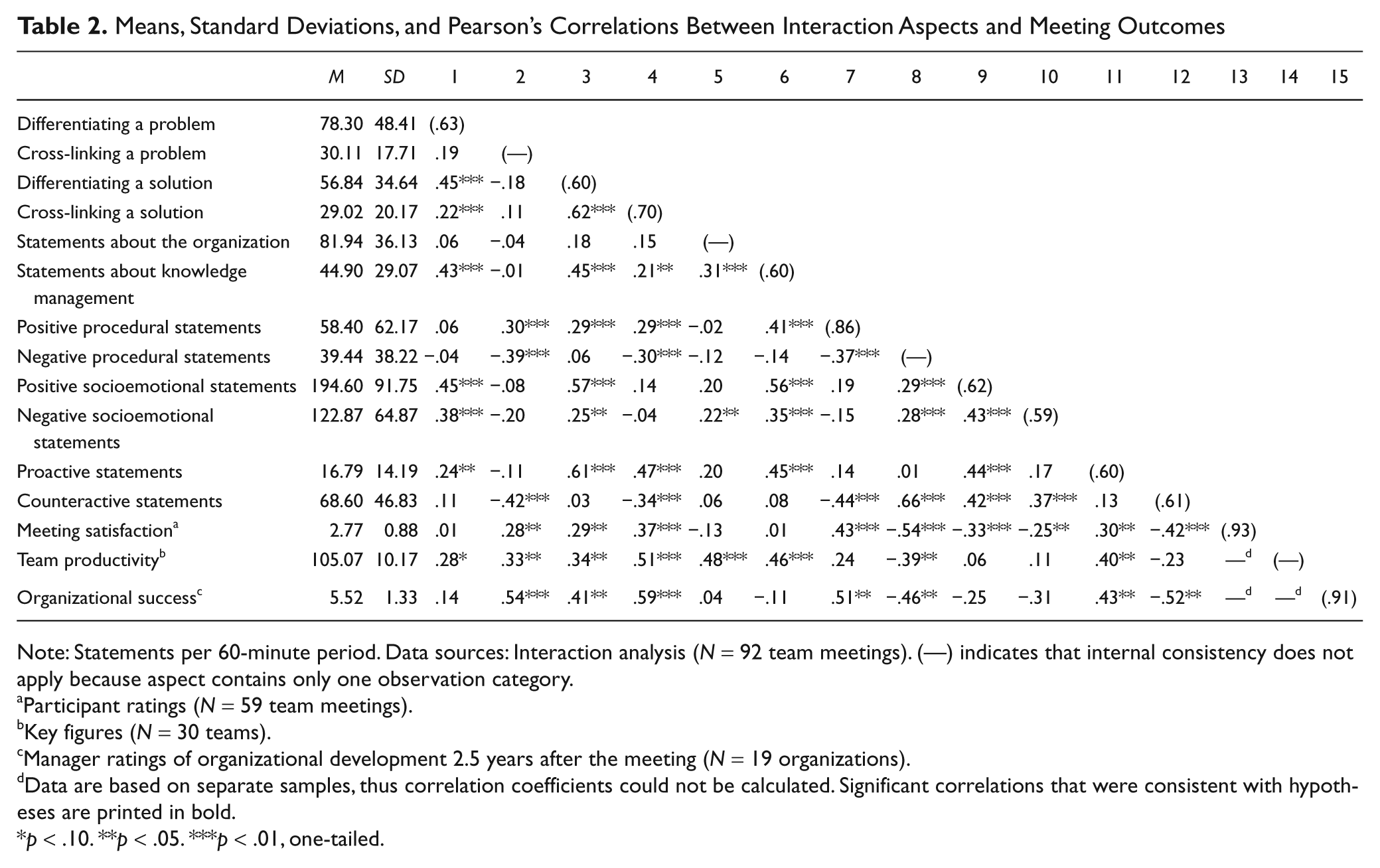
Note: Statements per 60-minute period. Data sources: Interaction analysis (N = 92 team meetings). (—) indicates that internal consistency does not apply because aspect contains only one observation category.
Participant ratings (N = 59 team meetings).
Key figures (N = 30 teams).
Manager ratings of organizational development 2.5 years after the meeting (N = 19 organizations).
Data are based on separate samples, thus correlation coefficients could not be calculated. Significant correlations that were consistent with hypotheses are printed in bold.
p < .10. **p < .05. ***p < .01, one-tailed.
Team performance
Objective productivity data were available in a comparable manner in only 2 of the 20 organizations, yielding a sample size of n = 30 teams. Team productivity (M = 105.07, SD = 10.17) was defined as the planned productivity (previous year and increase specified by management) minus the actual productivity in the year after the team meeting. For example, in a manufacturing team, productivity would be calculated from the number of expected and actual parts produced within a given time period. To avoid negative values, parameters were related to 100%. Team productivity data were provided by the management.
Organizational success
Two and a half years after the meetings, the CEOs of 19 of the 20 organizations were asked to rate to what extent their organization had developed during that interval compared with relevant competitors, with a 9-point response format (9 = greatly increased [+30%] to 1 = greatly decreased [–30%]). These organizational success interview items pertained to turnover, the number of employees, the market share (e.g., “Please rate the changes in the number of employees compared to relevant competitors over the past 3 years”), the share of new products in the organizations’ overall turnover, and the absolute number of product and process innovation (M = 5.52, SD = 1.33, α = .91; see Table 2). To ensure that the act4teams aspects could be aggregated to the team level, ICC values were calculated. With ICC(1) = .27 and ICC(2) = .62, analyses at the company level were permissible (cf. Bliese, 2000).
Results
Table 2 shows all intercorrelations between the interaction aspects and the three outcomes examined (meeting satisfaction, team productivity, and organizational success). Internal consistency values are depicted diagonally. For correlations between specific act4teams observation categories and the outcomes, see appendix.
Hypothesis 1 stated that problem-focused communication would be positively linked to team outcomes. The results largely support this assumption. The interaction aspects of cross-linking a problem (r = .28, p < .05), differentiating a solution (r = .29, p < .05), and cross-linking a solution (r = .37, p < .01) were significantly linked to increased meeting satisfaction. Concerning team productivity, five out of the six problem-focused interaction aspects showed significant positive correlations: cross-linking a problem (r = .33, p < .05), differentiating a solution (r = .34, p < .05), cross-linking a solution (r = .51, p < .01), statements about the organization (r = .48, p < .01), and statements about knowledge management (r = .49, p < .01) were all associated with higher team productivity. Finally, three of the problem-focused interaction aspects were significantly linked to organizational success, namely cross-linking a problem (r = .54, p < .01), differentiating a solution (r = .41, p < .05), and cross-linking a solution (r = .59, p < .01).
Second, we hypothesized that positive procedural communication should be linked to increased team meeting satisfaction, whereas negative procedural communication should be linked to decreased team meeting satisfaction. Indeed, we found a positive connection between positive procedural statements and meeting satisfaction (r = .43, p < .01) and a negative connection between negative procedural statements and meeting satisfaction (r = −.54, p < .01). Whereas positive procedural statements did not correlate with team productivity, negative procedural statements showed a significant negative relationship (r = –.39, p < .05). Positive procedural statements were positively linked to organizational success (r = .51, p < .05) and negative procedural statements showed a negative relationship with organizational success (r = −.46, p < .05). Taken together, these findings largely support Hypothesis 2a and Hypothesis 2b.
Third, we expected positive socioemotional interaction to be positively connected to team success, whereas negative socioemotional interaction should be negatively linked to team success. Lending support to Hypothesis 3b, negative socioemotional interaction was indeed associated with decreased meeting satisfaction (r = −.25, p < .05) and lower organizational success (r = −.31, p < .05). Strikingly, positive socioemotional statements showed a significant negative association with meeting satisfaction as well (r = −.33, p < .05) and no significant link to team productivity or organizational success. A closer look at the comprising categories suggests that the negative relationship between positive socioemotional statements and meeting satisfaction can be attributed particularly to negative correlations of reasoned disagreement (r = −.25, p < .05) and expressing feelings (r = −.25, p < .05; see appendix). Possibly, expressing negative rather than positive feelings help the individual but drag the group down. Thus, Hypothesis 3a was rejected.
Fourth, we expected a positive link between proactive communication and team success and a negative link between counteractive communication and team success. For proactive communication, this assumption was supported for all three outcomes examined. Lending support to Hypothesis 4a, teams with more proactive statements were more satisfied with their meetings (r = .30, p < .05) and showed higher productivity (r = .40, p < .05). Moreover, the amount of proactive communication in the team meetings was positively associated with organizational success (r = .43, p < .05). However, the amount of counteractive statements in a team meeting was negatively linked to meeting satisfaction (r = −.42, p < .01) and organizational success (r = −.52, p < .01). These findings largely support Hypothesis 4b.
Discussion
The current study provides empirical evidence for a linkage between team meeting interaction processes and team success. Most of the problem-focused statements, positive procedural statements, and proactive statements were associated with increased meeting satisfaction, team productivity, and organizational success. However, dysfunctional communicative behaviors such as criticizing or complaining showed numerous negative relationships with these outcomes, although not all interaction aspects were linked to all outcomes.
Problem-focused communication
The link between problem-focused statements and meeting success primarily concerns cross-linkage and solution-based aspects. Describing and cross-linking solutions refines and improves the ideas and solutions developed in a meeting, thus making team success more likely. Moreover, problem analysis—trying to find the reasons for a problem— is important for team and organizational success. Complex tasks require linking the different aspects of a problem together (e.g., Sonnentag, 1995), whereas insufficient problem analysis diminishes team success (e.g., Wittenbaum et al., 2004).
Interestingly, statements about the organization were significantly related to productivity. Productivity results not only from team meetings, but rather on managing daily work. Knowledge about particular machines, organizational procedures, or who to talk to in specific situations, is essential and keeps production going. Thus, knowledge-based interaction aspects can pay off in actual daily work. Taken together, these results suggest that problem-focused communication is an important basis for team problem solving.
Procedural communication
Although the use of methods such as clarifying or visualizing in team meetings was positively linked to meeting satisfaction and organizational success, the present results suggest that negative procedural statements (i.e., losing the train of thought in details and examples) have a higher impact on all three success measures. However, recent results from sequential analysis show that positive procedural statements can help avoid dysfunctional communication (e.g., losing the train of thought in details and examples, criticizing, or complaining; cf. Kauffeld & Meyers, 2009).
Socioemotional communication
Though teams spent a considerable amount of time exchanging socioemotional statements, the results show that this type of communication does not contribute to team success. However, recent research with real teams indicates that positive socioemotional statements are not beneficial per se. Positive socioemotional statements are often supporting statements. These can encourage the implementation of solutions, however they can also sustain complaining cycles and straying from the subject, thus supporting communicative behaviors that diminish team meeting success (see results from sequential analysis by Kauffeld, 2006a, Kauffeld & Meyers, 2009). Importantly, dysfunctional cycles tend to be more frequent than functional cycles (cf. Lehmann-Willenbrock et al., 2011), which could help explain why socioemotional statements that have a supportive function (active listening, providing support) show a negative relationship with team meeting success in the present study. Moreover, this study examined real teams who had been working together for sometime. As such, positive socioemotional communication might be less necessary than in ad hoc or new teams who still need to get to know each other and establish mutual trust. Although negative socioemotional statements did not particularly affect team meeting outcomes overall, criticizing statements did show strong negative relationships with both meeting satisfaction and organizational development. This suggests that criticizing statements can be rather harmful in the short as well as in the long run. Criticizing statements could be interpreted as team members stating antipathy toward others or as representations of relationship conflict. The negative impact of criticizing statements can thus be understood in terms of the negative effect of relationship conflict, which has been demonstrated repeatedly (see De Dreu & Weingart, 2003).
Action-oriented communication
Our findings demonstrate the impact of both proactive and counteractive statements in team meetings, and thus correspond to individual-level findings from goal setting and action regulation research (e.g., Vohs & Baumeister, 2004). Moreover, the positive relationship between proactive communication and teams, as well as organizational success, relates to research on personal initiative (e.g., Frese et al., 2007). Strikingly, counteractive statements such as complaining clearly outnumbered proactive statements. This finding is in line with qualitative observations of demotivating actions in teams (Marks et al., 2001). Debilitating team processes can spiral teams into a vicious cycle that decreases both team confidence and performance over time (Lindsley, Brass, & Thomas, 1995). Moreover, processes such as social loafing (Latané, Williams, & Harkins, 1979) typically occur when low participation levels reduce the amount of effort expended by teams on tasks. Many teams are not aware that active involvement in designing their work and their workplace is possible and beneficial. Meetings should be used as a means for active job crafting. Kauffeld (2006b) showed that job characteristics such as the participation granted to teams are important predictors for enhancing team meetings.
Implications
This study adds to previous work on meeting effectiveness (e.g., Leach et al., 2009; Luong, & Rogelberg, 2005) by shedding light on what actually happens during team meetings: Which communicative behaviors are helpful and which are harmful for team meeting success? Our results support the central function of interaction processes as posited in the traditional input-process-output model (Hackman & Morris, 1975). Teams that showed more functional interaction in their meetings, in terms of problem-focused, positive, procedural, and proactive communication, were significantly more satisfied with their meetings. The relationships between the interaction aspects and the different measures of meeting success point in the same direction, regardless of the data source (e.g., participant ratings, objective business ratios) and their chronological positioning (immediately after the optimization discussion, at the end of the workshops, 1 or 2.5 years later).
Interestingly, dysfunctional communication appeared to affect team meeting success more than functional communication. For example, the negative relationship between counteractive statements and team meeting success was stronger than the positive relationship between proactive statements and team meeting success. The conclusion that “bad is stronger than good” relates to many psychological phenomena. For example, bad impressions are formed more quickly than good impressions; bad feedback and bad emotions have a stronger impact than those that are good; and bad interpersonal interactions affect us more than good interactions (cf. Baumeister, Bratlavsky, Finkenauer, & Vohs, 2001). Our process-analytical findings support this notion at the microlevel of communicative behavior within team meetings.
Our results highlight the importance of proactive communication for team meeting effectiveness and organizational success. Although this kind of communication has rarely been recognized in process analytical studies to date, it could be linked to recent research on personal initiative (e.g., Frese et al., 2007).
The relevance of socioemotional interaction is put into perspective. Previous research suggests that positive socioemotional communication carries an important team function (cf. Beck & Keyton, 2009). However, both negative socioemotional statements and positive socioemotional statements were negatively associated with team meeting success in our study. The contextual relevance of socioemotional statements should be noted. Positive socioemotional statements can support new ideas and solutions but can also maintain complaining cycles (cf. Kauffeld & Meyers, 2009; Lehmann-Willenbrock et al., 2011) or support statements that are beside the point (losing the train of thought) and thereby cost valuable team meeting time. Negative socioemotional statements, however, should be avoided in any case, as the results show that criticizing statements are rather dysfunctional.
Our results further show that team meetings present an opportunity to discuss negative aspects of one’s job in much detail, without taking any steps to change the situation. The amount of meeting time spent on analyzing and describing problems, losing the train of thought in details and examples, and the amount of statements categorized as no interest in change shows that the teams tended to focus on the past and/or the negative present situation. Only 2 of 822 sense units per hour were coded as actual action planning statements. This suggests that an active problem-solving approach that incorporates specific action planning communication in a meeting seems to be quite difficult to pursue for many teams. To implement new ideas in their work lives, team members need to be interested in action planning, getting their peers involved, and talking to their supervisors, so that their ideas can become reality.
For practitioners, an evaluation with act4teams can function as a direct means for team development by enhancing teams’ general ability to reflect on meeting processes (e.g., Konradt & Wiedow, 2011). The results obtained from an analysis with act4teams can help teams grow aware of functional and dysfunctional interaction in their meetings. Importantly, it should be established that every team member is responsible for the meeting process and outcome. For example, even if team member A is not the one who complains, he will be responsible for tolerating someone else’s complaining and thereby consuming valuable team meeting time. Process analytical results can be used for pointing out such dysfunctional patterns, but they can also serve as an illustration of a team’s resources that become apparent as functional interaction throughout a meeting (see Lehmann-Willenbrock & Kauffeld, 2010, for more detail on using act4teams as a team intervention tool). Via team reflexivity, teams can learn more about their role in the organization, their opportunities for getting involved, and their resources for doing so.
These results obtained from real meetings in organizations point out the potential of interaction research for understanding the processes that determine functional and dysfunctional communication in teams and thus the success of team meetings. The microlevel of analysis adopted in this study provides a number of important hints as to how meeting participants’ behavior shapes the discussion process and affects short- and long-term team and organizational success far beyond a specific meeting.
Limitations
There are several limitations to this study. First, when using recording instruments, the question arises whether the social situation may be biased. The reality that behavior is observed and recorded can influence participants’ mental processes in the discussion (e.g., Wicklund, 1975). However, a demanding activity that is of importance to the participants such as a real team meeting should let them forget the recording instruments. After the team meeting, participants described the session as being typical throughout for a meeting in this constellation in their organization. Low reactivity to the recording was quite evident as some participants were openly criticizing their (absent) supervisors, cell phones were answered, beverages consumed, and conversations on the side carried on freely and sometimes quite noisily.
Third, our sample consisted of production teams, primarily from manufacturing companies. Thus, the results do not generalize to other kinds of teams such as project teams or teams from the service sector. Although some studies in progress provide hints that functional and dysfunctional interaction behavior can be observed rather independently of the working context and status of the team members, future research is warranted. Our results are likely limited to a German-speaking cultural background and may not be generalizable to samples with a more even gender distribution. Moreover, we investigated teams without their supervisors and, thus, without any status differences. It remains to be seen how the presence of a supervisor affects team interaction behavior and meeting success.
Fourth, the identification of beneficial and detrimental interaction behaviors in the team meetings that we examined is not independent of the analysis approach and the coding instrument we used. Different coding schemes might yield different results concerning functional and dysfunctional team interaction during meetings. Moreover, we only analyzed verbal behaviors. Given the multifunctional nature of messages, especially socioemotional communication might be shown in other ways not observed in this study (i.e., nonverbal behaviors). However, we decided to focus on verbal behaviors because these leave less room for interpretation and because mimic expressions in our sample were rather remote. Moreover, we examined sense units in the interaction behavior flow and coded with 44 categories, yielding a rather high resolution picture of the team interaction process.
Fifth, from a balance theory point of view (e.g., Cartwright & Harary, 1956), the question arises whether a maximum amount of functional communication (e.g., proactive statements) or a minimum amount of dysfunctional communication (e.g., negative statements inhibiting action) is ideal. In a linear model, a team meeting would be more successful when team members develop more solutions during the meeting, plan more measures, do not lose the train of thought in details and examples, and refrain from complaining. However, one might also assume a curvilinear relationship between functional/dysfunctional communication and team effectiveness. The potential of a meeting could drop when a certain quantity of structured action or objections is exceeded. Likewise, complaining might be uncritical up to a certain point. Okhuysen and Eisenhardt (2002) showed for student teams that a regulatory structure can be positive but should not be too rigid to prevent the team from feeling restricted. A team which discusses nothing but meeting procedures will be ineffective. However, these are extreme cases that are scarcely found in reality. In their meta-analysis of the relationship between individual abilities and performance, Coward and Sackett (1990) showed that linear models prove to be robust and that nonlinear models do not explain more variance. Although the results of this study do not provide any evidence for curvilinear relationships, this should be considered in future research.
Sixth, variance across time was collapsed into a static indicator of teamwork processes as if it occurred at a single point in time. However, aggregating process data over time into a summary index that portrays direct process outcome connections reduces complexity and is in line with other researchers (e.g., Barry & Stewart, 1997). As processes occur over and over again during team activities, it is crucial to choose a reasonable unit of team activities for analysis.
Future Research
In a sample of real teams in organizations, this study shows which communicative behaviors are helpful and which are harmful for team and organizational success. The results point out the importance of team meeting processes. Our findings call for future research on how team meetings can actively be improved, for example, by team development. Finally, multilevel designs and interaction analytic tools such as pattern analysis can help distinguish between sense unit, individual, and group influences on the team meeting process.
Footnotes
Appendix
Means, Standard Deviations, and Pearson’s Correlations Between act4teams Categories and Meeting Outcomes
| M a | SD a | Meeting satisfaction b | Team productivity c | Organizational success d | |
|---|---|---|---|---|---|
| Problem | 29.45 | 13.68 | .12 | .22 | .32 |
| Describing a problem | 48.70 | 39.04 | −.05 | .28* | −.05 |
| Connections with a problem | 30.52 | 17.47 | .28** | .33** | .51** |
| Defining the objective | 6.38 | 4.73 | .08 | −.06 | .43* |
| Solution | 21.80 | 12.76 | .33*** | .27* | .49** |
| Describing a solution | 27.90 | 23.31 | .22** | .33** | .25 |
| Problem with a solution | 11.45 | 7.96 | .21* | .49*** | .34* |
| Connections with a solution | 17.38 | 14.14 | .42*** | .40** | .59*** |
| Organizational knowledge | 82.68 | 35.74 | −.13 | .48*** | .03 |
| Knowing who | 1.29 | 2.04 | −.07 | .42*** | .11 |
| Question | 51.24 | 29.12 | −.13 | .44*** | −.27 |
| Goal orientation | 4.57 | 5.39 | .18* | .01 | .40* |
| Clarifying | 10.23 | 11.56 | .37*** | .26 | .41* |
| Procedural suggestion | 9.98 | 15.22 | .33*** | .10 | .46** |
| Procedural question | 4.59 | 7.33 | .37*** | .09 | .33 |
| Prioritizing | 3.06 | 2.97 | .31*** | .06 | .21 |
| Time management | 1.37 | 2.43 | .29** | −.11 | .50** |
| Task distribution | 3.61 | 8.34 | .22* | .24 | .41* |
| Visualizing | 10.57 | 16.68 | .48*** | .45*** | .45* |
| Weighing costs/benefits | 3.20 | 3.85 | .17* | −.10 | −.01 |
| Summarizing | 4.60 | 5.36 | .26** | .07 | .48** |
| Losing the train of thought | 39.19 | 38.19 | −.54*** | −.39*** | −.46** |
| Encouraging participation | 5.09 | 5.55 | −.02 | .10 | .13 |
| Providing support | 84.44 | 51.40 | −.16 | −.12 | −.31 |
| Active listening | 24.59 | 34.61 | −.18* | .19 | −.42* |
| Reasoned disagreement | 20.97 | 14.24 | −.25** | .20 | −.28 |
| Giving feedback | 11.69 | 8.02 | .02 | .26 | .15 |
| Lightening the atmosphere | 16.71 | 14.40 | −.17 | −.09 | .21 |
| Separating opinions from facts | 17.28 | 12.08 | −.17* | .05 | .03 |
| Expressing feelings | 1.11 | 1.33 | −.25** | .07 | −.26 |
| Offering praise | 8.63 | 7.24 | −.16 | .00 | −.14 |
| Criticizing/running someone down | 30.66 | 20.87 | −.46*** | .04 | −.62*** |
| Interrupting | 36.90 | 28.42 | −.07 | −.01 | −.32 |
| Side conversations | 49.87 | 36.93 | .03 | .16 | −.15 |
| Self-promotion | 8.07 | 7.50 | −.30** | .11 | −.39* |
| Interest in change | 9.17 | 8.82 | .21* | .28 | .32 |
| Personal responsibility | 5.18 | 5.13 | .15 | .21 | .35 |
| Action planning | 2.42 | 4.34 | .32*** | .50*** | .28 |
| No interest in change | 8.64 | 8.88 | −.54*** | −.13 | −.63*** |
| Complaining | 31.51 | 26.81 | −.36*** | −.20 | −.47** |
| Empty talk | 13.29 | 13.04 | −.27** | −.19 | −.31 |
| Seeking someone to blame | 3.77 | 4.55 | −.20* | .06 | −.33 |
| Denying responsibility | 8.59 | 7.97 | −.21* | −.25 | −.46** |
| Terminating the discussion | 1.98 | 2.26 | −.11 | −.01 | .10 |

Note: Statements per 60-minute period.
Interaction analysis (n = 92 team meetings).
Participant ratings (n = 59 team meetings).
Key figures (n = 30 teams).
Manager ratings of organizational development 2.5 years after the meeting (n = 19 organizations).
p < .10. **p < .05. ***p < .01, one-tailed.
Acknowledgements
The authors thank Linda Shanock and their three anonymous reviewers for their constructive feedback and helpful comments.
Subsets of these data have been examined before (Kauffeld, 2006a, 2006b; Kauffeld & Meyers, 2009). However, the hypotheses and set of variables examined here have not been published previously.
The author(s) declared no potential conflicts of interest with respect to the research, authorship, and/or publication of this article.
The author(s) disclosed receipt of the following financial support for the research, authorship, and/or publication of this article: This research was funded by the German Federal Ministry of Education and Research and the European Social Fund (ESF).