



Abstract
In the present experiment, members of three-person groups read information about two hypothetical cholesterol-reducing drugs and collectively chose the better drug under high or low time pressure. Information was distributed to members as a hidden profile such that the information that supported the better drug was unshared before discussion. Correct solution of the hidden profile required members to pool their unshared knowledge. Some groups discussed the drug information from memory (memory condition). Others kept the drug information during discussion, accessing sheets that either indicated which pieces of information were shared and unshared (informed access condition) or did not (access condition). Low time pressure groups chose the better drug more often than high time pressure groups, particularly when groups had access to information. Groups in the informed access condition chose the correct drug more often than groups in the memory and access conditions. Memory groups showed the typical discussion bias favoring shared over unshared information, whereas groups with access to information during discussion reversed this bias. This effect was stronger under low than high time pressure.
Groups are formed in organizational and educational settings with the hope that they will make better decisions than a single individual. If group members with varied expertise contribute their unique knowledge to discussion, the group may make a more informed decision than any individual. However, research has shown that members of decision-making groups ineffectively pool their unique knowledge. Specifically, groups tend to discuss more shared information that is known by all group members rather than unshared information that is known to a single member (for overviews, see Wittenbaum, Hollingshead, & Botero, 2004; Wittenbaum & Stasser, 1996). Failure to disseminate unshared information may harm the quality of the group’s choice if unshared information is critical for uncovering the best decision alternative (Stasser & Titus, 1985, 1987).
Discussing unshared information improves group decisions when information is distributed in the group as a hidden profile (Winquist &Larson, 1998; Wittenbaum, 2010). In a hidden profile, information that supports the optimal decision alternative is largely unshared, whereas information that supports the less desirable option is mostly shared. Thus a hidden profile task requires that group members pool unshared information to discover the best option. Over two decades of research have identified factors that increase group members’ likelihood of discussing unshared information thereby improving group decision quality (see Wittenbaum et al., 2004). We are interested in how time pressure, in particular, affects information sharing and subsequent group decisions in a hidden profile.
In one study, Kelly and Karau (1999) found that the effect of members’ initial preferences on their ability to solve a hidden profile depended on the amount of time pressure imposed on the group. When members mildly preferred the suboptimal decision alternative before discussion, high time pressure exacerbated these poor choices after discussion relative to low time pressure—an effect not found when members strongly preferred the less desirable option before discussion. Two studies found no effect of time pressure on hidden profile solution in face-to-face groups (Campbell & Stasser, 2006; Houlette, 2004), yet others showed that low time pressure facilitated information sharing in face-to-face (Fraidin, 2002; Parks & Cowlin, 1995) and computer-mediated groups (Campbell & Stasser, 2006). The purpose of the present study is to understand the effect of time pressure on process and performance in hidden profile groups and how it is moderated by group members’ access to information during discussion.
The Attentional Focus Model
The Attentional Focus Model (AFM; Karau & Kelly, 1992) can explain the effects of time pressure on group decision making. Karau and Kelly (1992) argued that time pressure serves to focus group members’ attention and discussion to the most salient features of the task environment. As group members perceive certain aspects of a task to be more central to completing that task, those features increase in relative salience. Meanwhile, time pressure decreases the relative salience of those features that are less central to the completion of that task. If salient features are detrimental for good performance, then time pressure decreases performance. If salient features are necessary for optimal performance, then time pressure should improve group performance.
The AFM predicts the effects of time pressure on group members’ ability to solve a hidden profile. In a hidden profile task, prediscussion decision preferences are salient. Members focus their attention on the preferred (suboptimal) decision alternative and the information that supports it. Shared information, therefore, is salient because it is confounded with being preference- consistent in a hidden profile task. AFM predicts that time pressure will accentuate this tendency, thereby impairing hidden profile performance. Groups with ample time, however, are more likely to solve the hidden profile and pool unshared information, which emerges later in a group’s discussion (Larson, Christensen, Abbot, & Franz, 1996, 1998; Larson, Foster-Fishman, & Franz, 1998; Larson, Foster-Fishman, & Keys, 1994). Kelly and Karau (1999) found support for this prediction in a hidden profile task but only when group members mildly (not strongly) preferred a suboptimal decision alternative prior to discussion.
In Kelly and Karau’s (1999) experiment, members of three-person groups read information about two cholesterol-reducing drugs and collectively determined which one should be marketed by their pharmaceutical company. Group members were told to reach a decision as quickly as possible (high time pressure) or were instructed to take as much time as needed (low time pressure). The total pool of information supported Drug 2; however, members’ preference for Drug 1 was manipulated prior to discussion by varying the information distribution. When group members mildly preferred Drug 1 before discussion (weak incorrect preference), high time pressure worsened members’ ability after discussion to discover that Drug 2 was optimal. Contrary to AFM predictions, time pressure did not also affect group decisions when group members strongly leaned toward Drug 1 before discussion (strong incorrect preference).
To provide a better test of AFM, we replicated Kelly and Karau’s (1999) strong incorrect preference condition with an improved time pressure induction. In Kelly and Karau’s (1999) study, group members in the high time pressure condition were told to imagine that they were on a stressful decision-making team where it was essential to come to a decision as quickly as possible. In addition, group members were asked to time themselves and record the discussion length. In the low time pressure condition, members were informed to take as much time as needed. The time pressure in this manipulation was perceived rather than actual time differences. The manipulation check showed that all groups, regardless of condition, perceived little time pressure. It is possible that a stronger time pressure manipulation might have produced a more powerful effect on group decision quality.
In addition, members in Kelly and Karau’s (1999) study relied exclusively on memory to recall information during discussion and determine the correct drug. Thus the weak time pressure effects may have been due to members’ incomplete memories. The time pressure effect on hidden profile solution may be stronger when members have access to information during discussion. Group members mention more information (both shared and unshared) when they keep their information sheets during discussion rather than discuss from memory (Hollingshead, 1996; Parks & Cowlin, 1996). Therefore, having access to information during discussion functionally increases the pool of items that members can discuss without changing the relative saliency of shared and unshared items. Assuming that time pressure accentuates group members’ attention to information that supports their preferred (suboptimal) solution (which in a hidden profile is mostly shared information), being able to access this information during discussion should make those under high time pressure better able to focus on it. Group members with ample time and access to information should be more likely to pool both shared and unshared information and reach the best decision. Thus we would expect a larger effect of time pressure for hidden profile groups that have access to information during discussion.
Information access not only acts as a potential moderator of time pressure effects but also has theoretical importance. Information access varies the saliency of information—a key mechanism through which time pressure effects operate, according to AFM. AFM predicts that group members focus attention on salient task information, which in a hidden profile task is (largely shared) information that supports the preferred (suboptimal) solution. One strategy for increasing the salience of unshared information is to underline it and identify it as unshared to group members. Members are more likely to discuss unshared information when it is written in boldface rather than normal font (Schittekatte & van Hiel, 1996). If group members learn before discussion which pieces of information are unshared, then they are better equipped to use the information to solve the hidden profile, particularly if they can keep these information sheets during discussion. Access to information during discussion that distinguishes shared and unshared information should improve hidden profile solution for all groups, regardless of time pressure. But, because groups under high time pressure do not have enough time to discuss all of the unshared information on their sheets, they will not reap the benefits of increased unshared information saliency as much as groups with low time pressure.
Overview and Predictions
In the present experiment, members of three-person groups read information about two hypothetical cholesterol-reducing drugs and collectively chose the better drug under high or low time pressure. A strong incorrect preference was induced before discussion, and access to the drug information during discussion was manipulated. In the memory condition, members read the drug profiles and then discussed them from memory. In the access condition, members had access to the drug profiles during discussion. In the informed access condition, members read drug profiles that had items of unshared information identified and had access to these profiles during discussion.
We make the following predictions:
Hypothesis 1: Groups with informed access will solve the hidden profile better than groups with access or reliance on memory.
Hypothesis 2: Groups with low time pressure will solve the hidden profile better than groups with high time pressure.
Hypothesis 3: The effect of time pressure on group decisions will be stronger for groups with access to information than those that rely on memory.
Hypothesis 4: Groups with low time pressure and access to information during discussion will pool the most unshared information.
Method
Participants and Design
The participants in the study were 354 introductory communication students at Michigan State University who participated in exchange for class credit. The study employed a 2 × 3 between-groups design, defined by time pressure (high vs. low) and information access (memory vs. access vs. informed access). At least 14 three-person groups were run in each of the six cells of the factorial design. There were 15 groups in the low time pressure/memory cell, 16 groups in the high time pressure/memory cell, 29 groups in the low time pressure/access cell, 30 groups in the high time pressure/access cell, 14 groups in the low time pressure/informed access cell, and 14 groups in the high time pressure/informed access cell. 1
Drug Profiles
Participants read drug profiles containing information about two hypothetical cholesterol-reducing drugs: Drug A and Drug B. The total pool of information favored Drug B. Overall, Drug A contained 9 positive, 7 neutral, and 12 negative pieces of information, whereas Drug B contained 12 positive, 7 neutral, and 9 negative pieces of information (see Table 1). Example items are as follows: neutral (“Drug B would most likely be produced in the form of gel caplets.”), positive (“Government contacts have indicated that Medicaid may cover Drug B.”), and negative (“Patients below the age of 55 should not use Drug B because some of its ingredients could lead to serious liver problems.”). A sample of student volunteers who read the total pool of information preferred Drug B (82%) to Drug A (18%), χ2(df = 1, N = 49) = 19.61, p < .001. Information was distributed in a hidden profile such that nearly all positive information about Drug B and negative information about Drug A were unshared. In order for groups to discover that Drug B was better, they needed to disseminate their unshared knowledge. The manifest profile, which contained both shared and unshared information, was the version of the drug profiles that each member read. As shown in Table 1, the manifest profiles should have strongly biased members to prefer Drug A before discussion (i.e., a strong incorrect preference). Indeed, group members who read the manifest profiles before discussion selected Drug A (87%) more often than Drug B (13%), χ2(df = 1, N = 354) = 190.96, p < .001. Positive and negative information was clearly identified on members’ drug profile sheets as benefits and potential problems, respectively.
Distribution of Drug Facts for the Overall Distribution and Manifest Profiles

Information Access Manipulation
Three levels of information access varied members’ access to information during discussion and the saliency of that information. In the memory condition, members read the drug profiles, returned the information to the experimenter, and then discussed the drug information from memory. In the access condition, members read the drug profiles and kept them during discussion. In the informed access condition, members read the same drug profiles as in the other conditions, but immediately prior to discussion, the drug profile sheets were replaced with ones where unshared information was underlined to both identify and increase the salience of that information. The informed access condition was the only one in which members were told which items were shared and unshared. Members in this condition were told the following about their drug profiles:
The underlined sentences on this sheet are pieces of information that only you know. Other group members do not have access to this information about the two drugs unless you choose to tell them.
Like members in the access condition, members with informed access kept their drug profiles during group discussion. In both access conditions, members were able to share any piece of information from the drug profiles provided that they did not show their information sheets to each other.
Time Pressure Manipulation
Groups in the high time pressure condition were told the following:
We would like you to discuss your information and opinions about the two drugs and choose the one drug that is most desirable to market. Group performance will be evaluated based on both accuracy of the decision and the speed with which the decision is made. Groups will be rewarded for quickly coming to a decision that is correct. The fastest groups that correctly choose the best drug will be placed into a lottery. A US$60 cash prize, consisting of US$20 per member, will be awarded to two different groups that are randomly selected from among the fastest correct groups. So, six US$20 prizes will be awarded to individuals at the end of the study based on both speed and accuracy. For this reason, it is very important for your group to come to the correct decision as quickly as possible. We will use this stopwatch to help keep track of how much time has elapsed.
Groups in the low time pressure condition were told the following:
We would like you to discuss your information and opinions about the two drugs and choose the one drug that is most desirable to market. Group performance will be evaluated based on the accuracy of the group decision. Groups will be rewarded for coming to a decision that is correct. Groups that correctly choose the best drug will be placed into a lottery. A US$60 cash prize, consisting of US$20 per member, will be awarded to two different groups that are randomly selected from among the correct groups. So, six US$20 prizes will be awarded to individuals at the end of the study based on accuracy. For this reason, it is very important for your group to come to the correct decision. But, feel free to take your time on this task. There is no need to rush.
The use of a lottery prize for both high and low time pressure conditions served to equalize across conditions task importance and member motivation. The emphasis on accuracy for both conditions also helped to ensure that high and low time pressure group members had equivalent perceptions of task demonstrability.
Procedure
Prediscussion phase
Participants volunteered for a drug marketing study in which they played the role of a manager deciding between two drugs to market. On arriving at the study, participants were assigned to three-person groups in a small room. Members were told to place all personal items on a table at the end of the room, including all personal electronic devices (e.g., watches, cell phones, pagers), so that they not serve to distract group members. Each group member sat on one of three sides of a table with a video camera at the opposite end of the room to record the group discussion. After indicating their consent to participate, members received a version of the manifest drug profiles and general information about cholesterol-reducing drugs. They were told to read individually the information about the two drugs and subsequently indicate which drug each personally felt was more desirable to market. At this point, members in the memory condition returned their drug profiles. All others were allowed to access the drug profiles during discussion.
Discussion phase
The time pressure manipulation was implemented at this point. Members discussed information about the two hypothetical cholesterol-reducing drugs and chose the better one to market. Group members were then instructed to inform the experimenter when they completed the task.
Postdiscussion phase
After discussion, group members individually again indicated their preferred drug to market. A final questionnaire assessed the adequacy of the time pressure and information access manipulations. Ratings for all questions were made on a 9-point scale from 1 (strongly disagree) to 9 (strongly agree). Finally, participants were debriefed and invited to receive a copy of the results on completion of the study.
Manipulation Checks
Time pressure
Ten questionnaire items tested the success of the time pressure manipulation. An exploratory factor analysis using principle components and varimax rotation yielded three different aspects of time pressure: quick pace, take time, and stress. Questionnaire items and factor loadings for all factors are displayed in Table 2. The items that loaded on each factor were averaged together to form a reliable composite measure for quick pace (α = .86), take time (α = .76), and stress (α = .83). Scores on each measure were averaged across members of the group to yield a group-level score and analyzed in a time pressure (high vs. low) × information access (memory vs. access vs. informed access) between-groups factorial ANOVA. 2
Time Pressure Manipulation Check Items and Factor Loadings From a Varimax-Rotated Principle Components Factor Analysis
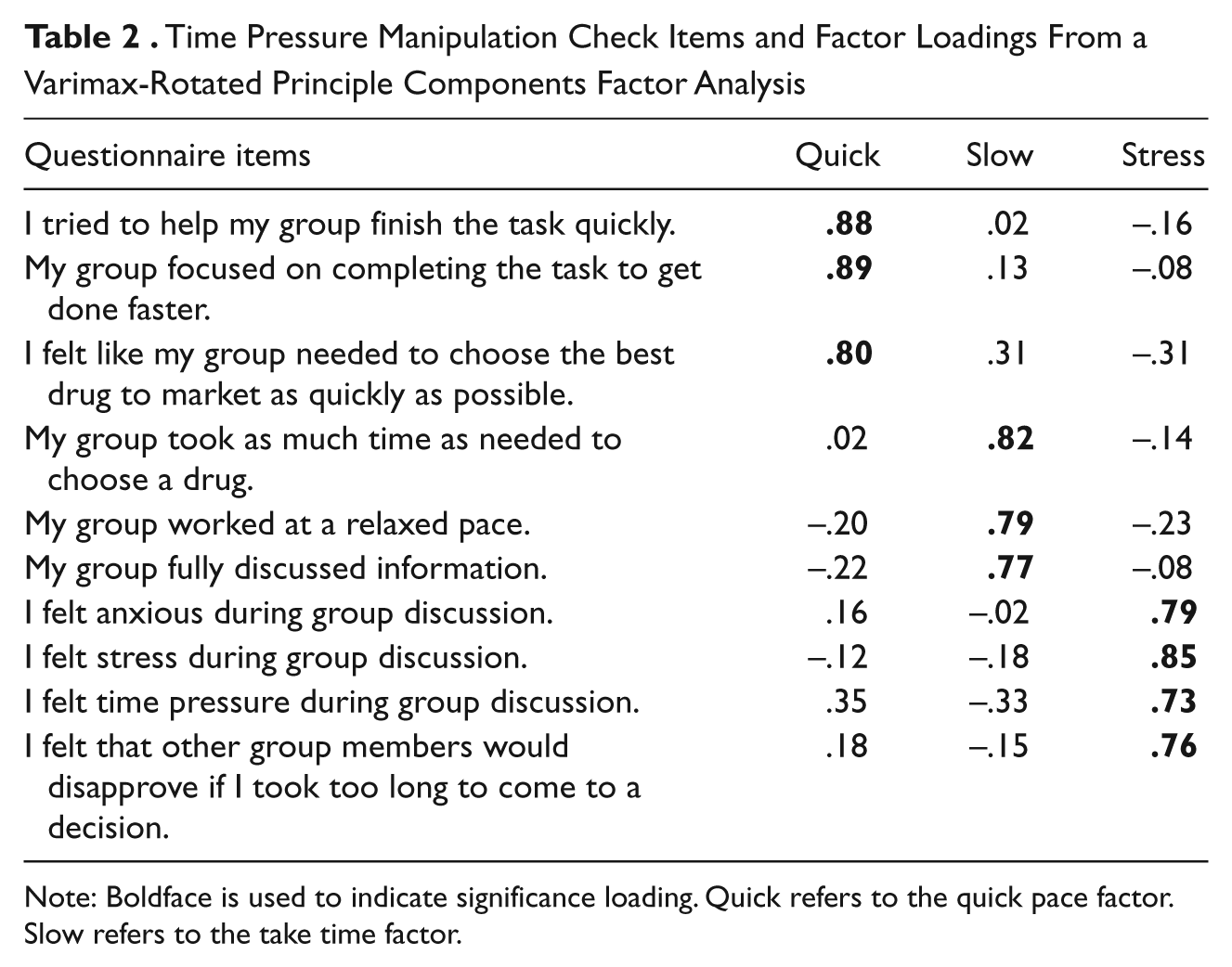
Note: Boldface is used to indicate significance loading. Quick refers to the quick pace factor. Slow refers to the take time factor.
As expected, a main effect of time pressure emerged for all three measures. High time pressure groups (M = 7.40, SD = 1.60) reported working at a quick pace more than low time pressure groups (M = 4.93, SD = 1.82), F(1, 99) = 166.08, p < .001, η2 = .32. Low time pressure groups (M = 7.46, SD = 1.61) reported taking their time more than high time pressure groups (M = 6.57, SD = 1.83), F(1, 112) = 13.41, p < .001, η2 = .04. And, high time pressure groups (M = 3.10, SD = 1.86) reported feeling more stress during their group discussion than low time pressure groups (M = 2.33, SD = 1.43), F(1, 105) = 14.05, p < .001, η2 = .04. 3 These time pressure effects were not moderated by the information access factor for any of the three measures.
Information access
Three measures from the postdiscussion questionnaire were used to assess the success of the information access manipulation: memory reliance, information access, and unshared identification. The memory reliance measure (α = .75) comprised the average of two items used to test the success of the memory condition: (a) “I had to rely on my memory to discuss information about the drugs,” and (b) “I had to work hard to try to remember the information during discussion.” The information access measure comprised a single item used to test the success of both the access and informed access conditions: “I was allowed to use the drug profile sheet during discussion.” The unshared identification measure (α = .70) comprised the average of two items used to test the success of the informed access condition: (a) “Some pieces of information were underlined on the drug profile sheet,” and (b) “I knew exactly which pieces of drug information I knew that others did not.” Group scores for all three measures were computed as the average of member scores.
For the memory reliance measure, the memory condition was contrasted against the average of the access and informed access conditions. Memory groups (M = 6.41, SD = 1.25) were significantly more likely to report discussing information from memory than were access groups and informed access groups (M = 3.54, SD = 1.16), F(1, 114) = 143.93, p < .001, η2 = .54. For the information access measure, the average of the access and informed access conditions were contrasted against the memory condition. Access groups and informed access groups (M = 8.48, SD = 0.90) were significantly more likely to report using the information sheet during discussion than memory groups (M = 1.31, SD = 0.56), F(1, 114) = 1693.80, p < .0001, η2 = .94. For the unshared identification measure, the informed access condition was contrasted against the average of the memory and access conditions. Informed access groups (M = 7.84, SD = 0.85) were significantly more able to identify unshared information than were memory and access groups (M = 3.56, SD = 1.05), F(1, 114) = 390.73, p < .0001, η2 = .77. Therefore, each aspect of the information access manipulation was successful.
Results
Member Preferences and Group Choices
Prediscussion preferences
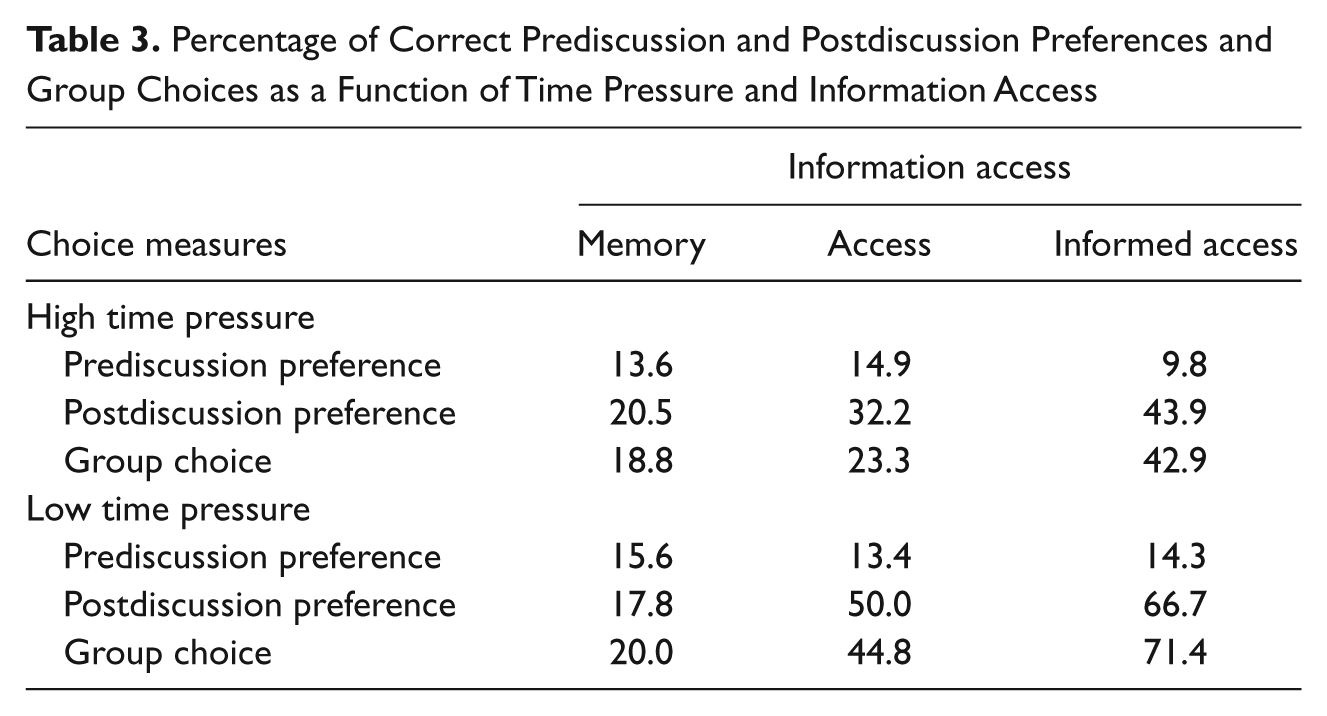
Directly after reading the drug information but before any manipulation was induced, members indicated privately which drug they most preferred. The percentage of members who chose the correct drug (Drug B) was submitted to a time pressure (high vs. low) × information access (memory vs. access vs. informed access) logistic regression. Prediscussion preferences could be confidently analyzed at the individual level because choices within groups were not interdependent (intraclass r = .12). No significant effects were found (see Table 3).
Percentage of Correct Prediscussion and Postdiscussion Preferences and Group Choices as a Function of Time Pressure and Information Access
Postdiscussion preferences
From examining the postdiscussion preferences (see Table 3), it is apparent that many members switched their preference after discussion to Drug B, the correct drug. Because postdiscussion preferences strongly were interdependent within groups (intraclass r = .94) and consistent with group choices, we focused our analyses on group choices.
Group choices
The percentage of groups that chose the correct drug was analyzed in a logistic regression as a function of time pressure (high vs. low) and information access (memory vs. access vs. informed access). Of the three omnibus effects, only the two main effects proved significant. Consistent with Hypothesis 1, there was a main effect of information access, χ2(df = 2, N = 118) = 9.065, p < .003, d = .58. Informed access groups were more likely to choose the correct drug than memory groups, χ2(df = 1, N = 59) = 8.93, p < .01, d = .84, and access groups, χ2(df = 1, N = 87) = 4.22, p < .05, d = .45. Groups in the memory and access conditions were equally likely to choose the correct drug, χ2(df = 1, N = 59) = 2.11, ns, d = .38. Consistent with Hypothesis 2, a main effect of time pressure revealed that groups in the low time pressure condition were more likely to choose the correct drug than were high time pressure groups, χ2(df = 1, N = 118) = 4.277, p < .05, d = .39 (see Table 3).
Hypothesis 3 predicted that the main effect of time pressure would be stronger in the access than memory condition. To test the effect of time pressure at each level of access we performed three simple effects tests. Each of the tests, however, was not statistically significant for groups in the access condition, χ2(df = 1, N = 59) = 3.06, ns, d = .47, informed access condition, χ2(df = 1, N = 28) = 2.33, ns, d = .60, and memory condition, χ2(df = 1, N = 31) = .0078, ns, d = .03. Although the significance tests are not consistent with Hypothesis 3, it is important to note that these simple effects tests had a reduced sample size, and thus statistical power, relative to the time pressure main effect. The simple effects of time pressure in both access conditions have comparable values of Cohen’s d as that for the main effect of time pressure.
Group Discussion
Discussion length
To measure discussion length, the author and a coder blind to hypotheses independently timed (in seconds) each discussion from the videotaped interactions. Discussion length was analyzed in a time pressure (high vs. low) × information access (memory vs. access vs. informed access) between-groups factorial ANOVA. Not surprisingly, low time pressure groups (M = 714.67, SD = 451.97) took significantly longer to reach a decision than did high time pressure groups (M = 218.32, SD = 204.11), F(1, 112) = 65.32, p < .001, η2 = .34. The main effect of information access also was significant, F(2, 112) = 5.97, p < .005, η2 = .06. Groups in the memory condition took significantly fewer seconds (M = 303.8, SD = 328.2) to discuss the drug information as compared to groups in the access condition (M = 476.7, SD = 377.46), F(1, 86) = 6.80, p < .01, η2 = .05, and informed access condition (M = 607.5, SD = 560.81), F(1, 55) = 10.47, p < .005, η2 = .10. There was no significant difference between the informed access and access conditions, F(1, 83) = 1.65, p = .20. In addition, group decision accuracy (0 = incorrect, 1 = correct) was positively correlated with discussion length, r(116) = .37, p < .01. These results suggest that groups that spent more time discussing the drug information were more likely to select the correct drug.
Discussion content
Group discussion of shared and unshared information was coded independently by a set of research assistants blind to hypotheses. Each item of drug information mentioned during discussion was matched to the list of shared and unshared information. An item was marked as mentioned if it was raised in discussion at least once (repetitions were not counted). We divided the number of shared and unshared items mentioned at least once by the total number available in the pool (i.e., 26 and 30, respectively) to obtain the proportion of shared and unshared items mentioned. We correlated each of these measures across the two codings and adjusted the correlations using the Spearman Brown formula to estimate the reliability of the average for shared (.97) and unshared (.98) items mentioned. The proportion of items mentioned were averaged across the two codings and analyzed in a time pressure (high vs. low) × information access (memory vs. access/informed access) × information type (shared vs. unshared) mixed factorial ANOVA, with the information type factor occurring within groups. For this analysis, we averaged the access and informed access conditions to provide the necessary contrast to test Hypothesis 4. Hypothesis 4 predicted that low time pressure and access to information would improve information exchange. As expected, low time pressure groups (M = .45, SD = .27) mentioned more information than high time pressure groups (M = .20, SD = .22), F(1, 111) = 37.29, p < .0001, η2 = .15. Also consistent with Hypothesis 4, groups in the access conditions (M = .39, SD = .29) mentioned more information than groups in the memory condition (M = .18, SD = .16), F(1, 111) = 28.37, p < .0001, η2 = .11.
Further understanding of groups’ information processing comes from examining the effects of information type. Groups discussed more unshared (M = .38, SD = .31) than shared information (M = .28, SD = .22), F(1, 111) = 4.10, p < .05, η2 = .01—a reversal of the discussion bias typically found in hidden profile research. This effect was moderated by the information access factor, F(1, 111) = 21.21, p < .0001, η2 = .03. Specifically, memory groups tended to show discussion bias favoring shared (M = .20, SD = .17) over unshared information (M = .15, SD = .14), F(1, 111) = 3.13, p < .08, η2 = .003. In contrast, groups in the access conditions mentioned more unshared (M = .46, SD = .32) than shared information (M = .31, SD = .24), F(1, 111) = 54.06, p < .0001, η2 = .01. Having access to information during discussion reversed the discussion bias favoring shared information and focused members’ attention to unshared information, consistent with Hypothesis 4.
Finally, a three-way interaction emerged, F(1, 111) = 5.34, p < .01, η2 = .01. To ease the presentation of this interaction, we computed an index of discussion bias by subtracting the proportion of unshared information mentioned from the proportion of shared information mentioned. A positive value indicates a bias toward discussing shared information, whereas a negative value indicates a bias toward discussing unshared information. The means, as a function of time pressure and information access, are shown in Figure 1. When time pressure was low, information access affected the discussion bias, F(1, 111) = 23.38, p < .0001, η2 = .17, with the access groups (M = −.20, SD = .29) leaning toward an unshared information discussion bias and memory groups (M = .12, SD = .12) leaning toward a shared information discussion bias. The effect of information access was significantly eliminated under high time pressure, F(1, 111) = 2.70, p = .10, η2 = .02, albeit still a tendency for access groups (M = −.11, SD = .20) and memory groups (M = .0009, SD = .09) to differ. Group decision accuracy (0 = incorrect, 1 = correct) was negatively correlated with discussion bias, r(115) = −.39, p < .0001. That is, group decisions were more likely to be accurate when groups biased discussion toward unshared information. In sum, these results show that discussing unshared information benefits group decision quality, and groups with access to information during discussion were more likely to do so, particularly under low time pressure.
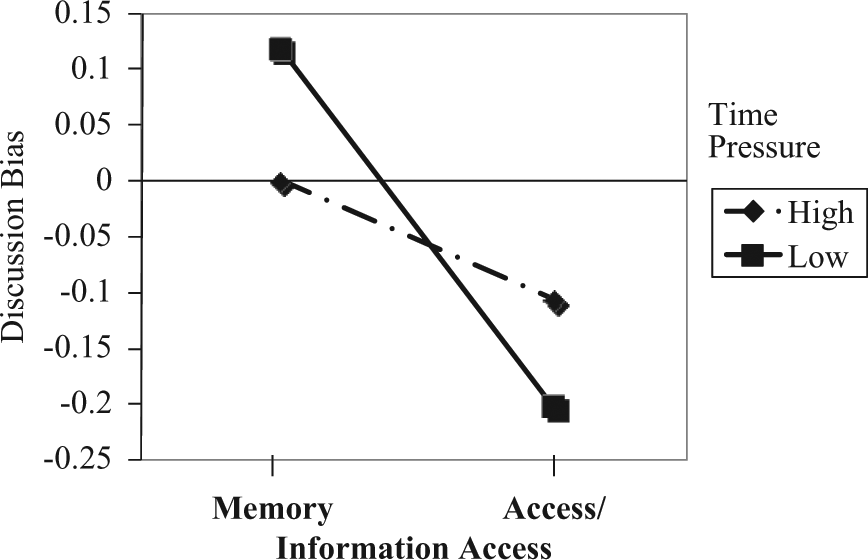
Mean discussion bias as a function of time pressure and information access
Discussion
The present study showed that time pressure impaired hidden profile solution. Groups that experienced high time pressure engaged in shorter discussions about the decision alternatives and exchanged less information than groups with low time pressure. These factors likely were mechanisms producing the poorer performance in high time pressure groups. These results support Karau and Kelly’s (1992) AFM and mirror a body of research suggesting that time pressure hurts hidden profile performance (Fraidin, 2002; Parks & Cowlin, 1995) and effective group decision-making processes more generally (e.g., Lehner, Seyed-Solorforough, O’Connor, Sak, & Mullin, 1997; Neck & Morehead, 1995). The time pressure manipulation in the present experiment was a more potent induction than that used by Kelly and Karau (1999). Our stronger time pressure manipulation, paired with allowing group members access to information, promoted the emergence of the time pressure effect predicted by the AFM.
The effect of time pressure on performance did not vary in statistical significance across conditions of information access. The level of information access, however, affected groups’ ability to solve the hidden profile task. The performance of both high and low time pressure groups benefited from members having unshared items identified on sheets that they kept during discussion (i.e., informed access condition). Underlining unshared items increased their salience and emergence during group discussion. High and low time pressure groups did not differ significantly in their solution of the hidden profile in the informed access condition. Groups in this condition were more likely than not to correctly solve the hidden profile (57% correct), unlike groups in the access (34% correct) and memory conditions (19% correct). This finding makes us wonder whether hidden profile solution fares better in natural decision-making groups than often suspected. Members of established groups in organizations may be aware of domains of knowledge held by others and also may access information (e.g., resumes, applications, reports) during discussion. As a result, findings from the informed access condition may generalize to natural work groups more than those from the memory and access conditions. This idea, of course, is speculative and warrants scientific investigation.
Since the classic collective information sharing experiments were conducted (e.g., Stasser & Stewart, 1992; Stasser, Taylor, & Hannah, 1989; Stasser & Titus, 1985, 1987), it has become more commonplace to give members access to information during discussion (e.g., Cruz, Henningsen, & Smith, 1999; Graetz, Boyle, Kimble, Thompson, & Garloch, 1998; Gruenfeld, Mannix, Williams, & Neale, 1996; Lavery, Franz, Winquist, & Larson, 1999; Postmes, Spears, & Cihangir, 2001; Savadori, Van Swol, & Sniezek, 2001). This methodological change often is made without any comment about how it may alter information sharing and hidden profile solution in groups. With ample time for discussion, our results suggest that the effects are dramatic with groups relying on memory showing the typical discussion bias favoring shared information and access groups reversing this bias. It was this bias toward discussing unshared information that aided hidden profile solution among access groups. Our results suggest that increasing the saliency of and access to unshared information during discussion can benefit information pooling and group decision quality. We are not sure why other studies that gave members access to information during discussion showed the typical discussion bias favoring shared information, whereas ours did not. We suspect that factors such as an imposed time limit and the proportion of shared to unshared information in the total pool play a role.
One of the difficulties in comparing the effects of time pressure in groups across different experiments is the variation in time pressure inductions. Time pressure has been induced by encouraging group members to simulate having to rush or take time completing the group task (e.g., Kelly & Karau, 1999). Other studies have created a real time limit by varying the amount of time group members have to complete the task (e.g., Campbell & Stasser, 2006; Karau & Kelly, 1992; Parks & Cowlin, 1995). Fraidin (2002) induced time pressure by varying the amount of time that group members had to study information before discussion. In a meta-analysis, Reimer, Reimer, and Czienskowski (2010) compared the discussion bias favoring shared over unshared information between decision-making groups that had less time (under 30 min) versus more time (above 30 min) for discussion. In this case, less time (albeit not time pressure, per se) produced a smaller discussion bias much like the groups in our memory condition. We advise caution, however, in comparing the results of experiments using different measures of time pressure. Variation in the effects of time pressure on information sharing and group decision making may be due, in part, to the disparate methods of inducing time pressure. It may be helpful to identify the key elements of time pressure (e.g., pace, stress) and ensure appropriate measurement of this construct. Understanding which types of time pressure inductions produce particular effects will assist in unifying the literature on time pressure in decision- making groups.
Footnotes
Research Presented at the 2011 Conference of the Interdisciplinary Network for Group Research
The author(s) declared no potential conflicts of interest with respect to the research, authorship, and/or publication of this article.
The author(s) received no financial support for the research, authorship, and/or publication of this article.